City, University of London Institutional Repository
Citation
:
Benetos, E., Kotti, M. and Kotropoulos, C. (2006). Applying supervised
classifiers based on non-negative matrix factorization to musical instrument classification.
Paper presented at the IEEE International Conference on Multimedia and Expo (ICME
2006), 9 - 12 July 2006, Toronto, Canada.
This is the unspecified version of the paper.
This version of the publication may differ from the final published
version.
Permanent repository link:
http://openaccess.city.ac.uk/2104/
Link to published version
:
http://dx.doi.org/10.1109/ICME.2006.262650
Copyright and reuse:
City Research Online aims to make research
outputs of City, University of London available to a wider audience.
Copyright and Moral Rights remain with the author(s) and/or copyright
holders. URLs from City Research Online may be freely distributed and
linked to.
City Research Online:
http://openaccess.city.ac.uk/
[email protected]
APPLYING SUPERVISED CLASSIFIERS BASED ON NON-NEGATIVE MATRIX
FACTORIZATION TO MUSICAL INSTRUMENT CLASSIFICATION
Emmanouil Benetos, Margarita Kotti, Constantine Kotropoulos
∗Department of Informatics, Aristotle Univ. of Thessaloniki
Box 451, Thessaloniki 541 24, Greece
E-mail:
{
empeneto, mkotti, costas
}
@aiia.csd.auth.gr
ABSTRACT
In this paper, a new approach for automatic audio classification us-ing non-negative matrix factorization (NMF) is presented. Trainus-ing is performed onto each audio class individually, whilst during the test phase each test recording is projected onto the several training matrices. Experiments demonstrating the efficiency of the proposed approach were performed for musical instrument classification. Sev-eral perceptual features as well as MPEG-7 descriptors were mea-sured for 300 sound recordings consisting of 6 different musical instrument classes. Subsets of the feature set were selected using branch-and-bound search, in order to obtain the most discriminating features for classification. Several NMF techniques were utilized, namely the standard NMF method, the local NMF, and the sparse NMF. The experiments demonstrate an almost perfect classification (classification error 1.0%), outperforming the state-of-the-art tech-niques tested for the aforementioned experiment.
1. INTRODUCTION
The need for musical content analysis arises in different contexts and has many practical applications, mainly for automatic music transcription, effective data organization, annotation in multimedia databases, and internet search. Automatic musical instrument clas-sification is the first step in developing such applications. It is a re-search area which can also be applied to general sound recognition tasks. However, despite the massive research which has been carried out in the automatic speech recognition, limited work has been done on musical content identification.
The problems addressed so far in musical content identification can be broadly classified into two categories: classification of iso-lated instrument tones and classification of sound segments. Clas-sifiers using isolated tones have a limited use in practical applica-tions, while sound segment classifiers could be effectively used in music information retrieval (MIR) systems. Using sound segments, identifications of 79-84% for 4 classes of instruments were reported in [8] using Bayes decision rules for classification. Cepstral coeffi-cients, constant-Q coefficients and autocorrelation coefficients were used as features to recordings extracted from the MIS Database from UIOWA [1], which is used in this paper as well. More recently, MPEG-7 temporal descriptors and spectral features were used in conjunction with thek-NN algorithm and decision rules based on rough set theory [9]. A recognition rate of 68.4% at best was re-ported for classifying sounds coming from 18 instrument classes.
∗This work has been supported by the project PYTHAGORAS-II,
“Ef-ficient techniques for information organization, browsing, and retrieval in multimedia”, funded by the Greek Ministry of Education and the European Union.
Non-negative matrix factorization (NMF) is a subspace method for basis decomposition [4]. Its various modifications have been used in several classification experiments, where the training pro-cedure is performed by applying an NMF algorithm to a data matrix containing the training vectors of all the available classes. This tech-nique results to an unsupervised training approach. NMF classifica-tion experiments report encouraging results compared to other unsu-pervised classifiers, but also indicate that a suunsu-pervised NMF classi-fication approach is needed to obtain comparable results with other supervised classifiers.
In this work, the problem of automatically classifying musical instrument segments is addressed. Recordings from the UIOWA database were used that form 6 instrument classes. A total num-ber of 9 features were extracted, covering perceptual descriptors as well as spectral descriptors defined by the MPEG-7 audio standard [2]. The first and second moments of the features were considered, creating a feature set of 41 dimensions as explained in Section 5.2. Branch-and-bound selection was applied to the feature set in order to select the subset that maximizes the classification accuracy [12]. The audio files were split into a training set and a test set using 70% of the available data for training and the remaining 30% for testing. For classification, NMF is used by training individually a classifier for each class and projecting the test data onto each trained class ma-trix. The class label of each test recording is determined by using the cosine similarity measure (CSM). Several variants of the NMF algo-rithm were employed, such as the standard NMF method, the local, and the sparse NMF enabling a comparative study of the algorithms’ efficiency. The results indicate that using the subset comprising of 6 best features and the standard NMF algorithm yields a correct classi-fication rate of 99.0%, outperforming the traditional NMF classifica-tion methods and other statistical model-based classifiers employed for the aforementioned experiment [10].
The remainder of the paper is organized as follows. The audio features extracted are discussed in Section 2. Section 3 is devoted to the NMF method and its extensions. Section 4 presents the standard unsupervised NMF classification approach and the proposed super-vised classifier. Section 5 describes the data set used, the feature selection strategy, and the experiments performed to assess the per-formance of the proposed classifier. Finally, conclusions are drawn in Section 6.
2. FEATURE EXTRACTION
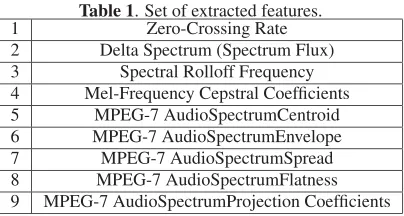
Table 1. Set of extracted features. 1 Zero-Crossing Rate 2 Delta Spectrum (Spectrum Flux) 3 Spectral Rolloff Frequency 4 Mel-Frequency Cepstral Coefficients 5 MPEG-7 AudioSpectrumCentroid 6 MPEG-7 AudioSpectrumEnvelope 7 MPEG-7 AudioSpectrumSpread 8 MPEG-7 AudioSpectrumFlatness 9 MPEG-7 AudioSpectrumProjection Coefficients
audio framework is used. The complete list of extracted features is presented in Table 1. The scalar features 1-3 are proposed in sys-tems concerning general audio data (GAD) classification and speech recognition. They can be treated as a short-term description of the textural shape of the audio segments. The mel-frequency cepstral coefficients (MFCCs) form a feature vector. They are widely used in audio processing applications providing a description of the spectral shape of the audio signal. For each audio frame of 10 msec dura-tion, 13 MFCCs were used. The features 5-8 are proposed by the MPEG-7 audio standard [2]. They belong to the basic spectral de-scriptors category. As 9th feature we used the projection coefficient to a single basis. AudioSpectrumProjection coefficients are part of the MPEG-7 spectral basis descriptors.
3. NON-NEGATIVE MATRIX FACTORIZATION
Non-negative matrix factorization (NMF) has been proposed as a novel subspace method in order to obtain a parts-based representa-tion of objects by imposing non-negative constraints [4]. The prob-lem addressed by NMF is as follows. Given a non-negativen×m data matrixV(consisting ofmvectors of dimensionsn×1), it is possible to find non-negative matrix factorsW andH in order to approximate the original matrix:
V≈WH (1)
where then×rmatrixWcontains the basis vectors and ther×m matrixHcontains in its columns the weights needed to properly ap-proximate the corresponding column of matrixVas a linear com-bination of the columns ofW. Usually, the component numberr is chosen so that(n+m)r < nm, thus resulting in a compressed version of the original data matrix.
To find an approximate factorization in (1), a suitable objective function has to be defined. The generalized Kullback-Leibler (KL) divergence betweenVandWHis the most frequently used objective function. Various algorithms that incorporate additional constraints in deriving (1) have been proposed and are briefly reviewed subse-quently.
3.1. Standard NMF
The standard NMF enforces the non-negativity constraints on ma-tricesWandH. Thus, a data vector can be formed by an additive combination of basis vectors. The proposed cost function is the gen-eralized KL divergence:
D(V||WH) =
n
i=1
m
j=1
[vijlogvyij
ij −vij+yij] (2)
whereWH = Y = [yij]. D(V||WH)reduces to KL divergence whenni=1mj=1vij =ni=1mj=1yij= 1. NMF factorization is defined then as the solution of the optimization problem:
min
W,H D(V||WH) subject to W,H≥0, n
i=1
wij= 1∀j (3)
whereW,H ≥0means that all elements of matricesWandHare non-negative. The above optimization problem can be solved by using the iterative multiplicative rules [4].
3.2. Local NMF (LNMF)
Aiming to impose constraints concerning spatial locality and con-sequently revealing local features in the data matrixV, LNMF in-corporates 3 additional constraints into the standard NMF problem: 1) Minimize the number of basis components representingV. 2) The different bases should be as orthogonal as possible. 3) Retain the components giving most important information. The above con-straints are expressed in the following LNMF cost function:
D(V||WH) =
n
i=1
m
j=1
[vijlogvyij
ij −vij+yij]
+ α
r
i=1
r
j=1
uij−β r
i=1
r
j=1
qii (4)
whereα, βare constants,WTW =U= [uij], andHHT =Q =
[qij]. The minimization is similar to the one used in NMF (3) and a local solution can be found by using 3 update rules [5].
3.3. Sparse NMF (SNMF)
Inspired by NMF and sparse coding, the aim of SNMF is to impose constraints that can reveal local sparse features on data matrixV. The following cost function is optimized for SNMF:
D(V||WH) =
n
i=1
m
j=1
[vijlogvyij
ij−vij+yij] +λ
m
j=1
||hj||l (5)
whereλis a positive constant and||hj||lthel-norm of thej-th col-umn ofH. An SNMF factorization is defined as in (3), including also that∀i||wi||l= 1. In SNMF, the sparseness is measured by a linear activation penalty: the minimuml-norm of the column ofH. A local solution of the minimization problem (5) can be obtained by the update rules proposed in [6].
4. CLASSIFICATION BASED ON NMF
4.1. Unsupervised NMF classification
The standard approach to audio classification in the NMF subspace is performed as follows [10]. Using data from the training set, the data matrixVis created (each columnvjcontains a feature vector computed from an audio file). The training procedure is performed by applying an NMF algorithm to the data matrix yielding the basis matrixWand the encoding matrixH.
In the test phase, for each test audio recording, represented by a feature vectorvtest, a new test encoding vector is obtained by:
whereW†is defined as the Moore-Penrose generalized inverse ma-trix ofW. Having formed during trainingN classes of encoding vectorshl,l = 1,2, . . . , N(by applying an NMF algorithm onV, yields matricesWandHas in (1)), a nearest neighbor classifier is employed to classify the new test sample by using the cosine simi-larity measure (CSM). The class labellof the test sound is:
l= arg max
l=1,2,...,N
hTtesthl
htesthl
(7)
thus maximizing the cosine of the angle betweenhtestandhl. An alternative measure is also used, where the class label of each test file is determined by examining each row ofhtest:
l= arg max
i hi,test (8)
wherehi,testis thei-th element ofhtest. 4.2. The proposed approach
The major drawback of the NMF classifier presented in Section 4.1 is the unsupervised manner of learning parts-based patterns from the data, since no information about the class discrimination is incorpo-rated into the NMF training procedure. In addition, the initial ran-dom values of matricesWandHcan affect greatly the convergence of the algorithm, as the value of NMF objective function defined in (2) may result in a local minimum, thus not yielding in an appropri-ate factorization.
The creation of a supervised classifier where the NMF training procedure is performed for each data class individually is proposed. This results in a pair of matricesWandHfor each class:
Vi=WiHi, i= 1,2,· · ·, N (9)
whereNis the number of different classes,Vithe data matrix of classi. The number of components used for training each class is given by:
ri=
nimi
ni+mi
(10)
whereniandmiare the dimensions of matrixVi. In a sense, this ap-proach is an application of one-class classification, where the ing of each class is performed individually, by using a set of train-ing data representtrain-ing the respective class in the absence of counter-examples [11].
vt
. . .
h(2)t
h(tN)
.
. .
.
. .
W1
W2
WN
h(1)t H1
H2
HN
arg max
h(ti)=W†i·vt
CSMN
CSM1
CSM2
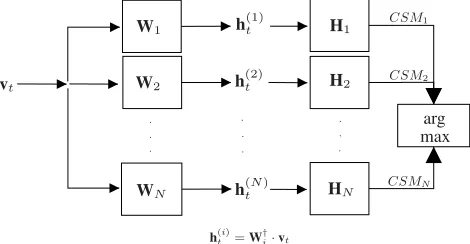
Fig. 1. Testing using the proposed NMF classifier (htandvtstand forhtestandvtestrespectively).
During test procedure, each test sound is represented by the fea-ture vectorvtest, as in the approach described in Section 4.1. After-wards,vtestis projected onto each class basis matrixWi, yielding:
h(testi) =W†i·vtest (11)
For each class, the vectorh(testi) is compared to each column vector of matrixHiusing the CSM. The vector that maximizes the CSM for the matrixHiis calculated as a measure of similarity for this class:
CSMi= max
j=1,2,...,ri
h(i)T
testh(ji)
h(testi) h(ji)
(12)
whereh(ji)represents thej-th column of matrixHi. Finally, the class label of the recording is determined by the the maximumCSMi, i.e.:
l= arg max
i=1,2,...,N{CSMi} (13)
A block diagram of the testing procedure using the proposed NMF classification method is plotted in Figure 1.
5. EXPERIMENTAL RESULTS
5.1. Dataset
Audio files extracted from the Musical Instrument Samples database collected by the university of Iowa [1] were used. Overall 300 au-dio files were extracted that belong to 6 different instrument classes: piano, violin, cello, flute, bassoon, and soprano saxophone. In de-tail, 58 piano recordings, 101 violin recordings, 52 cello recordings, 31 saxophone recordings, 29 flute recordings, and 29 bassoon ones were used. The 300 sounds are partitioned into a training set of 210 audio files and a test set of 90 audio files, preserving a 70%/30% analogy between the two sets, which is typical for classification ex-periments. All recordings have a duration of about 20 sec and are sampled at 44.1 kHz sampling rate.
5.2. Feature selection
For each feature described in Section 2, its mean and its variance were computed, resulting in 41 features in total. In order to reduce the feature vector dimension, a suitable feature subset for classifica-tion has to be selected. The optimal feature subset should maximize the ratio of the inter-class dispersion over the intra-class dispersion:
J= tr(S−w1Sb) (14)
wheretr(·)stands for the trace of a matrix,Swis the within-class scatter matrix, andSbis the between-class scatter matrix. Because the number of distinct subsets is (41−41!D)!D!, where D is the de-sired subset size, the branch-and-bound search strategy is consid-ered for complexity reduction. In this strategy, a tree structure of
[image:4.612.61.296.518.640.2](41−D+ 1)levels is created, where every node corresponds to a subset. The highest level corresponds to the full set, while each node corresponds to aD-dimensional subset at the lowest level. The branch-and-bound algorithm traverses the structure using a depth-first search with backtracking [12].
Two separate experiments using the various NMF algorithms have been performed by employing different feature subsets in or-der to find the feature dimension that maximizes the classification performance. In the first experiment, 6 features were used, while in the second experiment a set of 20 features was utilized. The subset of 6 best features is summarized in Table 2.
5.3. Performance Evaluation
Experiments were carried out using 7-fold cross validation and the mean value of the classification accuracy and its standard deviation for the three NMF algorithms and for all the two feature subsets is shown in Figure 2. The SNMF algorithm was tested using two different values for the parameterλ(0.001 and 0.1). The highest mean accuracy of 99.0% is achieved by the standard NMF algorithm when the subset of 6 features is used. The achieved results outper-forms the classification accuracy for the aforementioned experiment in [10] which used the standard NMF classifier, as well as supervised GMM and continuous HMM classifiers. In addition, the accuracy of NMF exceeds 97% when the 20-feature subset is employed. The LNMF is clearly outperformed by all algorithms, which may be ex-plained due to the locality constraints LNMF imposes when applied to holistic descriptors. The SNMF overall displays better results than the LNMF, but its efficiency depends on the selection of parameter
λ(performance is slightly better whenλ= 0.001).
NMF Algorithm
Mean
classification
accurac
y
%
6 Features
20 Features
NMF LNMF SNMFλ= 0.001 SNMFλ= 0.1
70 75 80 85 90 95 100
Fig. 2. Mean classification accuracy for NMF algorithms.
Additional information about the performance of the standard NMF algorithm using the 6-dimensional set is depicted in Table 3 where a confusion matrix for one run of the experiment is depicted. The columns of the confusion matrix correspond to the predicted musical instrument and the rows to the actual one. Only one mis-classification occurs for the flute, that it is wrongly classified as pi-ano. It is worth mentioning that the flute samples displayed similar dynamical and spectral shape with some piano samples.
6. CONCLUSIONS
[image:5.612.315.557.81.167.2]In this paper, we have proposed a new method of classifying audio signals using non-negative matrix factorization which is trained in-dividually for each class. Experiments applied to musical instrument
Table 3. Confusion matrix for standard NMF, 6 Features. Instr. Piano Bassoon Cello Flute Sax Violin
Piano 18 0 0 0 0 0
Bassoon 0 9 0 0 0 0
Cello 0 0 16 0 0 0
Flute 1 0 0 8 0 0
Sax 0 0 0 0 9 0
Violin 0 0 0 0 0 29
classification indicate that the standard NMF algorithm can classify the musical instrument recordings with a high accuracy compared to its variants. It has also been shown that a feature subset selec-tion can increase the classificaselec-tion accuracy. In the future, NMF techniques will be applied to discriminate the whole spectrum of orchestral instruments. Finally, for musical instrument classification experiments, advanced timbral features could also be extracted, such as the timbral descriptors proposed by the MPEG-7 standard.
7. REFERENCES
[1] Univ. of Iowa Musical Instrument Sample Database, http://theremin.music.uiowa.edu/index.html.
[2] MPEG-7 overview (version 9), ISO/IEC JTC1/SC29/WG11 N5525, March 2003.
[3] H. G. Kim, N. Moreau, and T. Sikora, “Audio classification based on MPEG-7 spectral basis representations,”IEEE Trans. Circuits and Systems for Video Technology, vol. 14, no. 5, pp. 716-725, May 2004.
[4] D. D. Lee and H. S. Seung, “Algoritnms for non-negative ma-trix factorization,”Advances in Neural Information Processing Systems, vol. 13, pp. 556-562, 2001.
[5] S. Z. Li, X. Hou, H. Zhang, and Q. Cheng, “Learning spatially localized, parts-based representation,” in Proc. IEEE Conf. Computer Vision and Pattern Recognition, pp. 1-6, 2001. [6] C. Hu, B. Zhang, S. Yan, Q. Yang, J. Yan, Z. Chen, and W. Ma,
“Mining ratio rules via principal sparse non-negative matrix factorization,” in Proc.IEEE Int. Conf. Data Mining, 2004.
[7] G. Tzanetakis and P. Cook, “Musical genre classification of audio signals,”IEEE Trans. Speech and Audio Processing, vol. 10, no. 5, pp. 293-302, July 2002.
[8] J. C. Brown, O. Houix, and S. McAdams, “Feature dependence in the automatic identification of musical woodwind instru-ments,”J. Acoustical Society of America, vol. 109, no. 3, pp. 1064-1072, March 2001.
[9] A. Wieczorkowska, J. Wroblewski, P. Synak, and D. Slezak, “Application of temporal descriptors to musical instrument sound recognition,”J. Intelligent Information Systems, vol. 21, no. 1, pp. 71-93, July 2003.
[10] E. Benetos, M. Kotti, C. Kotropoulos, J. J. Burred, G. Eisen-berg, M. Haller, and T. Sikora, “Comparison of subspace analysis-based and statistical model-based algorithms for mu-sical instrument classification,”2nd Workshop On Immersive Communication And Broadcast Systems, October 2005. [11] D. M. J. Tax,One-Class Classification, PhD thesis, Delft
Uni-versity of Technology, The Netherlands, 2001.
[image:5.612.57.297.341.533.2]