Zhang, Yonghao and Gu, X.J. and Barber, Robert W. and Emerson, David
(2008) A thermal lattice Boltzmann model for micro/nano-flows. In:
Proceedings of Micro/Nanoscale Heat Transfer International Conference
(MNHT2008). ASME, pp. 1275-1281. ISBN 0791842924 ,
This version is available at
https://strathprints.strath.ac.uk/6667/
Strathprints is designed to allow users to access the research output of the University of Strathclyde. Unless otherwise explicitly stated on the manuscript, Copyright © and Moral Rights for the papers on this site are retained by the individual authors and/or other copyright owners. Please check the manuscript for details of any other licences that may have been applied. You may not engage in further distribution of the material for any profitmaking activities or any commercial gain. You may freely distribute both the url (https://strathprints.strath.ac.uk/) and the content of this paper for research or private study, educational, or not-for-profit purposes without prior permission or charge.
Any correspondence concerning this service should be sent to the Strathprints administrator:
The Strathprints institutional repository (https://strathprints.strath.ac.uk) is a digital archive of University of Strathclyde research outputs. It has been developed to disseminate open access research outputs, expose data about those outputs, and enable the
Proceedings of ASME MNHT2008 Micro/Nanoscale Heat Transfer International Conference January 6-9, 2008, Tainan, Taiwan
8--
Y- 1 X- 2 2 2
1. Department of Mechanical Engineering, University of Strathclyde, Glasgow, G1 1XJ, UK. Email: [email protected]
2. Department of Computational Science and Engineering, SFTC Daresbury Laboratory, Warrington, Cheshire, WA4 4AD, UK.
Emails: [email protected]; [email protected]; [email protected]
With the development of micro/nano-devices, low speed rarefied gas flows have attracted significant research interest where successful numerical methods for traditional high speed flows, including the direct simulation Monte Carlo method, become computationally too expensive. As the Knudsen number can be up to the order of unity in a micro/nano flow, one approach is to use continuum-based methods including the Navier-Stokes-Fourier (NSF) equations, Burnett/super Burnett equations, and moment models. Limited success has been achieved because of theoretical difficulties and/or numerical problems.
The recently developed lattice Boltzmann equation (LBE) offers a fundamentally different approach which is close to kinetic methods but with a significantly smaller computational cost. However, success of LBE methods for rarefied gas motion has been mainly on isothermal flows. In this paper, thermal rarefied gas flows are investigated. Due to the unique features of micro/nano flows, a simplified thermal lattice Boltzmann model with two distribution functions can be used. In addition, kinetic theory boundary conditions for the number density distribution function can be extended to construct a thermal boundary condition. The model has been validated in the slip-flow regime against solutions of the NSF equations for shear and pressure driven flows between two planar plates. It is shown that the present thermal LBE model can capture some unique flow characteristics that the NSF equations fail to predict. The present work indicates that the thermal lattice Boltzmann model is a computationally economic method that is particularly suitable to simulate low speed thermal rarefied gas flows.
Keywords: lattice Boltzmann method, microfluidics, nanofluidics, non-equilibrium flow
NOMENCLATURE
Symbol Description Unit
cs lattice speed of sound m/s
D flow dimension
e lattice velocity m/s
F external force N
f number density distribution function
g energy density distribution function
H distance between two parallel plates m
k Thermal conductivity W/(m.K)
Kn Knudsen number
l mean free path m
Ma Mach number
NH lattice number across the characteristic
length of the flow domain
p pressure N/m2
R specific gas constant J/K/kg
T temperature K
t time s
Umean averaged velocity m/s
Uplate velocity of the upper plate m/s
u macroscopic velocity m/s
Greek symbols
ε energy J/kg
λ relaxation time for number density
distribution function s
λt relaxation time for energy density
distribution function s
µ dynamic viscosity N.s/m2
ν viscosity m2/s
ρ density kg/m2
τ nondimensional relaxation time -
ω constant -
Subscripts
k lattice direction
ref reference properties
Superscript
eq equilibrium state
In micro/nano-devices, gas flows are characterized rarefied and low speed, i.e. the Knudsen number can be up to the order of unity while the Mach number is negligibly small. Traditionally, research interest for rarefied gas flows has been for high speed or vacuum applications, where directly solving the Boltzmann equation or using the direct simulation Monte Carlo (DSMC) method offers accurate numerical solutions. However, for low speed gas flows, these methods become computationally too expensive with DSMC suffering from large statistical scatter and the direct solution of the Boltzmann equation is very complex [1, 2]. Meanwhile, continuum-based methods such as the Navier-Stokes-Fourier (NSF) equations and the Burnett equations have failed to produce satisfactory results for low-speed gas flows in the transition regime. Despite significant progress being made in coupling the NSF equations with the BGK model [3], developing the Information Preservation (IP) method for DSMC [4], and reducing the statistical scatter associated with Monte Carlo methods [5], no comprehensive and numerically-economical model exists for gas micro/nano-flows with Knudsen numbers up to unity. There is an urgent demand for an efficient and accurate numerical method for the low speed rarefied gas flows often encountered in micro/nano-systems.
Recently, the lattice Boltzmann method has attracted significant interest for simulating micro/nano-flows where the microscopic and macroscopic behaviors are coupled [6-17]. It retains a computational efficiency comparable to NSF solvers, and is potentially a more accurate model for gas flows over a broad range of Knudsen numbers. While Guo, Zhao and Shi [18] argued that current lattice Boltzmann models cannot be valid in the transition flow regime (0.1<Kn<10), Sbragaglia et al. [19] have shown that lattice Boltzmann equation (LBE) can be valid for rarefied gas flows with Knudsen number up to the order of unity. Shan, Yuan and Chen [20] have developed a theoretical framework for higher-order LBE models based on an expansion of the Boltzmann distribution function. However, most work has focused on developing new slip velocity boundary conditions for isothermal flows. Here, we investigate whether a LBE model can produce sufficiently accurate solutions for thermal rarefied gas flows.
M
Unlike the success of isothermal (athermal) LBE models, thermal LBE models have not been satisfactory in dealing with realistic thermal flows. Due to the broad application of thermal flows, continuous effort has been made to construct thermal LBE models and improve numerical stability. However, thermodynamically consistent thermal LBE models are still expected, while numerical instability of the current thermal LBE models also defers the model application. Current thermal LBE models may be divided into three categories: multispeed models [21-23], two distribution function models [24-26] and hybrid schemes [27, 28]. The multi-speed models use a large set of discrete velocities with higher-order velocity terms in the
equilibrium distribution function. Therefore, the macroscopic energy conservation equation can be obtained correctly. These models, however, have suffered from numerical instability and the single relaxation time leads to an unphysical fixed Prandtl number. The hybrid schemes employ other methods including a finite difference scheme to solve the temperature equation while the velocity field is determined by the LBE model. This approach does not take advantage of the mesoscopic feature of the LBE methods. The two relaxation time schemes use two sets of distribution functions, for particle number and energy densities, to trace velocity and temperature evolution so that the problems associated with multi-speed models become amenable.
He, Chen and Doolen [26, 29] have established a two-distribution function model which relates the energy density distribution function to the number density distribution function. In addition, viscous heating and compression work are considered in their model. Recently, Shi, Zhao and Guo [30] have proposed an improved model which simplifies the numerical algorithm of He, Chen and Doolen. Whether thermal LBE models are applicable, with reasonable accuracy, to simulate thermal rarefied gas flows and micro/nano flows in particular remains unknown. Here, a modified two-distribution function model based on refs [26, 30] will be examined to test whether it is suitable to simulate low speed rarefied gas flows. In addition, a kinetic boundary condition for the energy density distribution function will be proposed.
The evolution of both number and energy density distribution functions are given by [26]:
and
(1)
where qk is given by
(2)
The relation between the two distribution functions is
(3)
The density distribution function at equilibrium is given by
(4)
The equilibrium distribution function for the energy density is
(5)
The macroscopic properties can then be recovered by
(
)
, 2 eq k s i i ki eq k k i k ki k f c F u e f f x f e t fρ
λ
− + − − = ∂ ∂ + ∂ ∂ , k k t eq k k i k kik g g f q
x g e t
g =− − +
∂ ∂ + ∂ ∂
λ
(
)
. ∂ ∂ + ∂ ∂ ⋅ − = j i kj i i ki k x u e t u u e q(
)
f u e g i i2 2
− =
(
)
D e u RTeq i i
e RT
f =ρ 2π − /2 −( − )2/2
(
)
. 2 2 eq i i eq f u e g = −,
∫
= fde
(6) where ε =DRT/2.
For gas flows in the micro/nano devices considered here, the flow speed is typically very low, i.e. Ma<<1. Therefore, both compression work and viscous heating are negligibly small. Consequently, the above scheme can be simplified, which has been attempted by Peng, Shu and Chew [31]. However, the equilibrium energy density distribution functions are negative at rest. Recently, Shi, Zhao and Guo [30] proposed another similar thermal LBE model but with a simplified equilibrium distribution function for the energy density. Although the inconsistency of the viscosity in the momentum and energy equations may still remain if viscous heating is not negligible, as for high speed gas flows, this simplified approach can be applied to low speed rarefied gas flows. Another advantage of adopting this approach is that the kinetic boundary condition for the energy density distribution at the solid wall can be readily implemented. Following the simplification approach of Shi, Zhao and Guo [30], we obtain a thermal LBE model for rarefied gas flows in micro/nano-devices, which is given below:
(
)
( )
( )
( )
[
]
(
)
( )
, , , , 1 , ,2 f x t
c F u e t t x f t x f t x f t t t e x f i eq k s i i ki i eq k i k i k ki i k ρ δ τ δ δ − + − − = − + + (7) and
(
x e t,t t)
g( )
x,t 1[
g( )
x,t g( )
x,t]
.gk i+ ki + − k i = k i − eqk i
τ δ
δ (8)
In rarefied gas flow, we determine the relaxation time from the Knudsen number. For the D2Q9 lattice BGK model, the relation between the Knudsen number and the relaxation
time is
H
N
Kn 0.5
3
8 −
= τ
π [6]. For a given Prandtl number, we
can get the thermal relaxation time. According to kinetic theory, the mean free path can be related to the viscosity and the mean molecular velocity by
l c a
=
ν , (9)
where a=0.499 [32], and
c
=
8
RT
/
π
. The temperaturedependent viscosity can be described by:
, ω
ρν ∝T (10)
where the value of ω depends on the molecular interaction model, which is between 0.5 for hard sphere interaction and 1 for Maxwellian interaction [32]. Combining Eqs. (8) and (9), the influence of temperature variation on the mean free path can be given by
. 5 . 0 − = ω ρ ρ ref ref ref T T l l (11)
Therefore, the local temperature dependent Knudsen number can be determined which couples the lattice Boltzmann equations for the number and energy density distribution functions.
[image:4.612.329.571.154.354.2]The present thermal LBE model for gas micro/nano flows is simple in terms of numerical implementation and boundary conditions. In this section, the model will be examined for both shear and pressure driven flows between two infinitely long parallel plates. The kinetic boundary conditions as described in ref. [17] will be used for the gas molecule interactions with the solid wall, while periodic boundary conditions will be used at the inlet and outlet so that only three grid points are needed in the streamwise direction.
Fig. 1: Nondimensional velocity profiles for planar Couette flow at Knudsen numbers of 0.01, 0.05 and 0.1. Comparison of the LBE solution with the NSF slip flow solution.
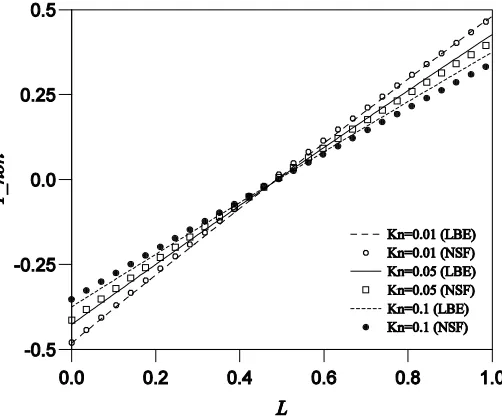
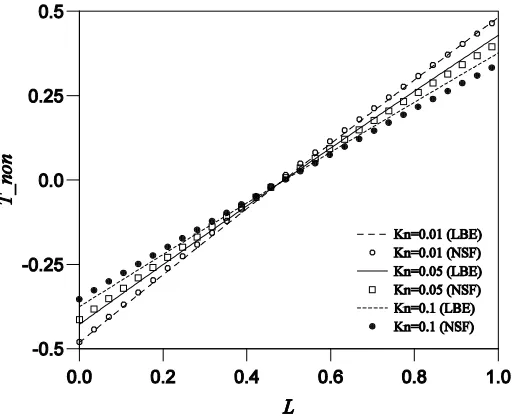
Fig. 2: Nondimensional temperature profiles for planar Couette flow at Knudsen numbers of 0.01, 0.05 and 0.1. Comparison of the LBE solution with the NSF slip flow solution.
Since experimental data are rare for rarefied gas flows in micro/nano devices, numerical results obtained from DSMC or directly solving the linearized Boltzmann equation are usually used for model validation. However, for flows with both small
,
∫
= e u fd ρ ,∫
= gde
[image:4.612.324.575.413.621.2]Knudsen number and low speed, these methods become not only expensive but also inaccurate. When the Knudsen number is less than 0.1, the NSF equations with slip boundary conditions can provide results with reasonable accuracy. Therefore, we mainly compare the present thermal LBE solution with the solutions of the NSF equations in order to test whether the present thermal LBE is valid in the slip flow regime (0.001<Kn<0.1). Note, the velocity slip and temperature jump coefficients are only weakly correlated with the molecular model [33]. The effect of the molecular model is implemented through the viscosity-temperature power law as given by Eq. (9). Through the Prandtl number, the influence of the temperature on the thermal diffusivity can also be determined. For consistent comparisons, the Maxwellian molecule model will be used for both thermal LBE and NSF simulations.
In the following simulations, the temperature difference at the two plates is ∆T and the mean temperature is Tref. The
temperatures at the upper and lower plates are Tref+0.5∆T and
Tref-0.5∆T, respectively. For planar Couette flow, U is a
velocity nondimesionalized by Uplate and the lower plate
remains stationary. The velocity of the upper plate is negligibly small in comparison with the sound speed, so that viscous heating and compression work can be ignored. In the following figures, if not explicitly noted, the temperatures of the lower and upper plates are 0.9 Tref and 1.1 Tref , respectively.
As shown in Fig. 1, the velocity profiles of the present thermal LBE model and the NSF equations are in excellent agreement. The present thermal LBE can predict not only the slip velocities but also the increasing slip motion with the Knudsen number. In Fig. 2, the profile of the nondimensional temperature, T-non, which is (T-Tref)/ Tref, is shown. When the
[image:5.612.322.580.37.249.2]Knudsen number is small, at 0.01, both the thermal LBE model and the NSF equations give almost identical solutions. However, the discrepancy increases with Knudsen number, especially in the near wall region.
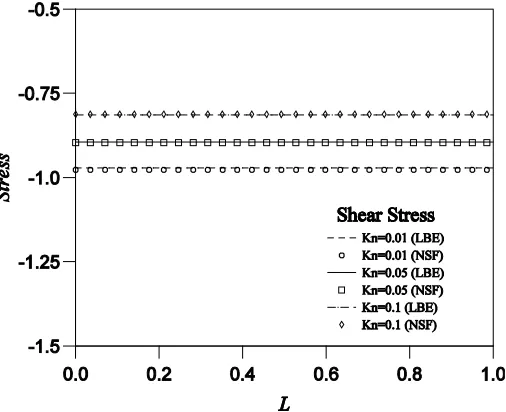
Fig. 3: Nondimensional shear stress profiles for planar Couette flow at Knudsen numbers of 0.01, 0.05 and 0.1. Comparison of the LBE solution with the NSF slip flow solution.
Fig. 4: Nondimensional normal heat flux profiles for planar Couette flow at Knudsen numbers of 0.01, 0.05 and 0.1. Comparison of the LBE solution with the NSF slip flow solution.
Shear stress profiles are presented in Fig. 3, where the stresses are nondimensionized by µrefUplate/H. Both the thermal
[image:5.612.42.295.444.650.2]LBE model and the NSF equations predict a zero normal stress, which is also true for flows with other Knudsen numbers. If there is no slip motion at the wall, the nondimensional shear stress will be unity. Due to velocity-slip, the magnitude of the shear stress is now less than 1.0 despite it still being constant across the two plates. As shown in Fig. 3, the magnitude of the shear stress decreases with increasing Knudsen number which is due to increasing slip velocity. Again, excellent agreement has been observed for the stress profiles predicted by the thermal LBE and the NSF equations.
[image:5.612.328.579.447.656.2]Fig. 6: The effect of temperature variation on the nondimensional temperature profile for planar Couette flow at a Knudsen number of 0.01. Comparison of the LBE solution with the NSF slip flow solution.
In Fig. 4, the heat flux is nondimensionized by kref∆T/H.
The tangential heat flux, which is the heat flux in the flow direction, is zero because the viscous heating and compression work are negligible. Therefore, only heat flux in the normal direction is compared in Fig. 4. When Kn is 0.01, the solution of the thermal LBE model agrees well with the prediction of the NSF equations. However, the discrepancy grows with increasing Knudsen number. Again, because of the temperature jump at the wall, the heat flux magnitude in the normal direction is smaller than unity. In addition, both the thermal LBE model and the NSF equations can predict a decreasing magnitude of the normal heat flux with increasing Knudsen number, i.e. increasing temperature jumps.
As both viscosity and thermal conductivity depend strongly on the temperature, we have examined the effect of the temperature on the velocity and temperature profiles in Fig. 5 and Fig. 6. The temperatures at the upper and lower plates are 0.9Tref and 1.1 Tref in Case 1, and 0.7 Tref and 1.3 Tref in Case 2.
It is clearly demonstrated that the large temperature drop between the two plates causes the maximum velocity to be shifted towards the cold plate and a larger deviation of the temperature profile from the linear one. This test case shows that the present thermal LBE model is capable of simulating thermal flows with large temperature variation.
Overall, the present thermal LBE performs well in the slip flow regime for planar Couette flows. Since the NSF equations become inappropriate when the Knudsen number is beyond 0.1, the deviation from the solutions of the NSF equations at large Knudsen number needs further investigation.
Since gas usually moves slowly in a pressure driven micro/nano channel, the applied pressure gradient can be assumed as constant in the fully-developed and steady flow status. Therefore, we can treat the uniform pressure gradient in the stream direction as a body force in the simulation. Meanwhile, we need to ensure that the gas speed caused by the
applied pressure gradient is small. The nondimensional force applied in the flow direction, β, is given by
2
xe F
δ
β = , (12)
where F= ρ
p
∇ , and β is a small constant, which is taken at the
[image:6.612.325.573.141.346.2]order of 10-7 in the simulations.
Fig. 7: Nondimensional velocity profiles for planar Poiseuille flow at Knudsen numbers of 0.01, 0.05 and 0.1. Comparison of the LBE solution with the NSF slip flow solution.
[image:6.612.320.576.404.612.2]In Fig. 7, the velocity is nondimensionized by the averaged velocity, Umean. Slip motion at the wall is clearly observed and
[image:7.612.52.292.152.355.2]it increases as the Knudsen number becomes larger. In Fig.8, the nondimensional temperature is defined as in the Couette flows. There is also a temperature jump at the wall that becomes larger when the Knudsen number increases. Overall, the thermal LBE model and the NSF equations give close predictions, which may indicate the present thermal LBE model is valid in the slip flow regime.
Fig. 9: Nondimensional deviatoric stress profiles for planar Poiseuille flow at a Knudsen number of 0.01. Comparison of the LBE solution with the NSF slip flow solution.
Fig. 10: Nondimensional heat flux profiles for planar Poiseuille flow at Knudsen numbers of 0.01, 0.05 and 0.1. Comparison of the LBE solution with the NSF slip flow solution.
The analysis of the deviatoric stresses can be found in Fig. 9 where the stress has been nondimensionalized by µrefUmean/H.
Again, compression work is negligible due to low speed so that the normal stresses can be ignored for all Knudsen numbers. Therefore, we only show the effect of the Knudsen number on
shear stress in Fig. 9. The magnitude of the shear stress is found to decrease with increasing Knudsen number, which can be attributed to increasing slip motion. Agreement between solutions for the present thermal LBE equation and the NSF equations is good.
A constant normal heat flux is predicted by both thermal LBE and the NSF equations, and agreements are reasonable. Fig.10 shows that normal heat flux is constant, as expected, but the magnitude decreases with increasing Knudsen number because of the increasing temperature jump. Interestingly, the normal heat fluxes for various Knudsen numbers are almost the same as the Couette flow, which further confirms that the normal heat flux is dominated by the temperature difference at the two plates and that viscous heating and compression work can be ignored. However, we found that the tangential heat flux is not zero in our LBE simulation despite a zero temperature gradient in the tangential direction. This interesting high-order rarefaction phenomenon was observed in directly solving the Boltzmann equation and NSF solver fails to capture this non-equilibrium effect.
The effect of various temperature differences on the velocity and temperature profiles can be seen in Fig. 7 and Fig. 8. With a larger ∆T, the maximum velocity shifts to the lower plate and the temperature profile becomes more nonlinear. The reason is that physical properties like viscosity and thermal conductivity are strongly related to the temperature.
The present thermal LBE model has the advantages of a simple algorithm and numerical efficiency for low speed rarefied gas flows. The model results are in excellent agreement with the solution of the NSF equations in the slip flow regime. Moreover, the present model can capture high-order rarefaction effects in the heat flux where the NSF equations fail. It therefore offers an ideal numerical simulation tool for low speed rarefied gas system simulation as encountered in micro/nano devices. In the next step, we will investigate whether a thermal LBE model based on the present work can be applied to simulate low speed rarefied gas flow in the transition regime with Knudsen numbers up to the order of unity.
This work is financially supported by UK Engineering and Physical Sciences Research Council (EPSRC) under grant reference no. EP/D07455X/01. Additional support under the auspices of CCP12 is gratefully acknowledged.
[1] N. Hadjiconstantinou, M. Bazant, G. He, "Statistical Error In Particle Simulations Of Hydrodynamic Phenomena.,"
Journal of Computational Physics, Vol. 187, 274-297, 2003.
[2] F. Sharipov, L. M. G. Cumin, D. Kalempa, "Plane Couette Flow Of Binary Gaseous Mixture In The Whole Range Of The Knudsen Number," European Journal of Mechanics B-Fluids, Vol. 23, 899-906, 2004.
[image:7.612.40.296.398.602.2][4] J. Fan, C. Shen, "Statistical Simulation Of Low-Speed Rarefied Gas Flows," Journal of Computational Physics,
Vol. 167, 393-412, 2001.
[5] L. L. Baker, N. G. Hadjiconstantinou, "Variance Reduction For Monte Carlo Solutions Of The Boltzmann Equation," Physics Of Fluids, Vol. 17, 051703, 2005. [6] Y. H. Zhang, R. S. Qin, D. R. Emerson, "Lattice
Boltzmann Simulation Of Rarefied Gas Flows In Microchannels," Physical Review E, Vol. 71, 047702, 2005.
[7] Y. H. Zhang, R. S. Qin, Y. H. Sun, R. W. Barber, D. R. Emerson, "Gas Flow In Microchannels - A Lattice Boltzmann Method Approach," Journal of Statistical Physics, Vol. 121, 257-267, 2005.
[8] M. Sbragaglia, S. Succi, "Analytical Calculation Of Slip Flow In Lattice Boltzmann Models With Kinetic Boundary Conditions," Physics of Fluids, Vol. 17, 093602, 2005.
[9] X. B. Nie, G. D. Doolen, S. Y. Chen, "Lattice-Boltzmann Simulations Of Fluid Flows In Mems," Journal of Statistical Physics, Vol. 107, 279-289, 2002.
[10] C. Y. Lim, C. Shu, X. D. Niu, Y. T. Chew, "Application Of Lattice Boltzmann Method To Simulate Microchannel Flows," Physics of Fluids, Vol. 14, 2299-2308, 2002. [11] X. D. Niu, C. Shu, Y. T. Chew, "A Lattice Boltzmann
BGK Model For Simulation Of Micro Flows,"
Europhysics Letters, Vol. 67, 600-606, 2004.
[12] T. Lee, C. L. Lin, "Rarefaction And Compressibility Effects Of The Lattice-Boltzmann-Equation Method In A Gas Microchannel," Physical Review E, Vol. 71, 046706, 2005.
[13] Y. H. Zhang, X. J. Gu, R. W. Barber, D. R. Emerson, "Capturing Knudsen Layer Phenomena Using A Lattice Boltzmann Model," Physical Review E, Vol. 74, 46704, 2006.
[14] G. H. Tang, W. Q. Tao, Y. L. He, "Gas Slippage Effect On Microscale Porous Flow Using The Lattice Boltzmann Method," Physical Review E, Vol. 72, 056301, 2005. [15] G. H. Tang, W. Q. Tao, Y. L. He, "Lattice Boltzmann
Method For Gaseous Microflows Using Kinetic Theory Boundary Conditions," Physics of Fluids, Vol. 17, 058101, 2005.
[16] V. Sofonea, R. F. Sekerka, "Diffuse-Reflection Boundary Conditions For A Thermal Lattice Boltzmann Model In Two Dimensions: Evidence Of Temperature Jump And Slip Velocity In Microchannels," Physical Review E, Vol. 71, 066709, 2005.
[17] Y. H. Zhang, X. J. Gu, R. W. Barber, D. R. Emerson, "Modelling Thermal Flow In The Transition Regime Using A Lattice Boltzmann Approach," EPL, Vol. 77, 30003, 2007.
[18] Z. L. Guo, T. S. Zhao, Y. Shi, "Physical Symmetry, Spatial Accuracy, And Relaxation Time Of The Lattice Boltzmann Equation For Microgas Flows," Journal of Applied Physics, Vol. 99, 074903, 2006.
[19] M. Sbragaglia, S. Succi, "A Note On The Lattice Boltzmann Method Beyond The Chapman-Enskog Limits," Europhysics Letters, Vol. 73, 370-376, 2006. [20] X. W. Shan, X. F. Yuan, H. D. Chen, "Kinetic Theory
Representation Of Hydrodynamics: A Way Beyond The
Navier-Stokes Equation," Journal of Fluid Mechanics,
Vol. 550, 413-441, 2006.
[21] P. Pavlo, G. Vahala, L. Vahala, "Higher Order Isotropic Velocity Grids In Lattice Methods," Physical Review Letters, Vol. 80, 3960-3963,1998.
[22] F. J. Alexander, S. Chen, J. D. Sterling, "Lattice Boltzmann Thermohydrodynamics," Physical Review E,
Vol. 47, R2249-R2252, 1993.
[23] Y. Chen, H. Ohashi, M. Akiyama, "Thermal Lattice Bhatnagar-Gross-Krook Model Without Nonlinear Deviations In Macrodynamic Equations," Physical Review E, Vol. 50, 2776-2783, 1994.
[24] J. G. M. Eggels, J. A. Somers, "Numerical-Simulation Of Free Convective Flow Using The Lattice-Boltzmann Scheme," International Journal of Heat and Fluid Flow,
Vol. 16, 357-364,1995.
[25] X. W. Shan, "Simulation Of Rayleigh-Benard Convection Using A Lattice Boltzmann Method," Physical Review E,
Vol. 55, 2780-2788, 1997.
[26] X. He, S. Chen, G. D. Doolen, "A Novel Thermal Model For The Lattice Boltzmann Method In Incompressible Limit," Journal of Computational Physics, Vol. 146, 282-300, 1998.
[27] O. Filippova, D. Hanel, "A Novel Lattice BGK Approach
For Low Mach Number Combustion," Journal of
Computational Physics, Vol. 158, 139-160, 2000.
[28] P. Lallemand, L. S. Luo, "Hybrid Finite-Difference Thermal Lattice Boltzmann Equation," International Journal of Modern Physics B, Vol. 17, 41-47, 2003. [29] P. Lallemand, L. S. Luo, "Theory Of The Lattice
Boltzmann Method: Dispersion, Dissipation, Isotropy, Galilean Invariance, And Stability," Physical Review E,
Vol. 61, 6546-6562, 2000.
[30] Y. Shi, T. S. Zhao, Z. L. Guo, "Thermal Lattice Bhatnagar-Gross-Krook Model For Flows With Viscous Heat Dissipation In The Incompressible Limit," Physical Review E, Vol. 70, 066310, 2004.
[31] Y. Peng, C. Shu, Y. T. Chew, "Simplified Thermal Lattice Boltzmann Model For Incompressible Thermal Flows,"
Physical Review E, Vol. 68, 026701, 2003.
[32] S. Chapman, T. G. Cowling, The Mathematical Theory Of Non-Uniform Gases. Cambridge: Cambridge University Press, 1971.
[33] C. Cercignani, The Boltzmann Equation And Its