Electrical and Computer Engineering Publications
Electrical and Computer Engineering
2012
Effect of deviation from stoichiometric
composition on structural and magnetic properties
of cobalt ferrite, CoxFe3−xO4 (x = 0.2 to 1.0)
Cajetan Ikenna Nlebedim
Iowa State University, [email protected]
J. E. Snyder
Cardiff University
A. J. Moses
Cardiff University
David C. Jiles
Iowa State University, [email protected]
Follow this and additional works at:
http://lib.dr.iastate.edu/ece_pubs
Part of the
Electromagnetics and Photonics Commons
The complete bibliographic information for this item can be found at
http://lib.dr.iastate.edu/
ece_pubs/27
. For information on how to cite this item, please visit
http://lib.dr.iastate.edu/
howtocite.html
.
Effect of deviation from stoichiometric composition on structural and
magnetic properties of cobalt ferrite, CoxFe3−xO4 (x = 0.2 to 1.0)
Abstract
The effects of deviation from stoichiometric composition on the structural and magnetic properties of cobaltferrite, CoxFe3−xO4(x = 0.2 to 1.0), are presented. Both CoFe2O4and Fe3O4have a spinel crystal
structure, and it might be expected that intermediate compositions would have the same structure. However, results show that synthesis via the ceramic method leads to the development of a secondary α-Fe2O3phase.
Both structural and magnetic properties are altered depending on the concentration of the α-Fe2O3phase.
Saturation magnetization is at a maximum for the stoichiometric composition (i.e., x = 1.0) and thereafter decreases with x. In attempts to achieve the properties required for application, the ceramic method offers the ability to selectively adjust the concentrations of both CoFe2O4and α-Fe2O3phases.
Keywords
Ames Laboratory, Ozone, Crystal stoichiometry, Ceramics, Crystal Structure, Thermodynamic properties
Disciplines
Electromagnetics and Photonics
Comments
The following article appeared inJournal of Applied Physics111 (2012): 07D704 and may be found at
http://dx.doi.org/10.1063/1.3670982.
Rights
Copyright 2012 American Institute of Physics. This article may be downloaded for personal use only. Any other use requires prior permission of the author and the American Institute of Physics.
Effect of deviation from stoichiometric composition on structural and magnetic
properties of cobalt ferrite, CoxFe3xO4 (x=0.2 to 1.0)
I. C. Nlebedim, J. E. Snyder, A. J. Moses, and D. C. Jiles
Citation: Journal of Applied Physics 111, 07D704 (2012); doi: 10.1063/1.3670982
View online: http://dx.doi.org/10.1063/1.3670982
View Table of Contents: http://scitation.aip.org/content/aip/journal/jap/111/7?ver=pdfcov
Published by the AIP Publishing
Articles you may be interested in
The crystal structure and magnetic properties of Ba2xSrxCo2Fe12O22
J. Appl. Phys. 115, 17A523 (2014); 10.1063/1.4866892
Erratum: “Extraordinarily large perpendicular magnetic anisotropy in epitaxially strained cobalt-ferrite CoxFe3xO4(001) (x=0.75, 1.0) thin films” [Appl. Phys. Lett. 103, 162407 (2013)]
Appl. Phys. Lett. 104, 059902 (2014); 10.1063/1.4864102
Extraordinarily large perpendicular magnetic anisotropy in epitaxially strained cobalt-ferrite CoxFe3xO4(001) (x= 0.75, 1.0) thin films
Appl. Phys. Lett. 103, 162407 (2013); 10.1063/1.4824761
Influence of manganese substitution on the microstructure and magnetostrictive properties of Co1xMnxFe2O4 (x =0.0–0.4) ferrite
J. Appl. Phys. 113, 153902 (2013); 10.1063/1.4802435
Structural, magnetic, and transport properties of a novel class of ferromagnetic semiconductors: Sr M 2 ± x Ru 4 ± x O 11 ( M = Fe , Co )
J. Appl. Phys. 103, 07D112 (2008); 10.1063/1.2832308
Effect of deviation from stoichiometric composition on structural and
magnetic properties of cobalt ferrite, Co
xFe
32xO
4(x
5
0.2 to 1.0)
I. C. Nlebedim,1,a)J. E. Snyder,2A. J. Moses,2and D. C. Jiles3 1
Ames Laboratory, U.S. Department of Energy, Iowa State University, Ames, Iowa 50011, USA 2
Wolfson Centre for Magnetics, School of Engineering, Cardiff University, Cardiff CF24 3AA, United Kingdom
3
Electrical and Computer Engineering Department, Iowa State University, Ames, Iowa 50011, USA
(Presented 31 October 2011; received 19 September 2011; accepted 14 October 2011; published online 10 February 2012)
The effects of deviation from stoichiometric composition on the structural and magnetic properties of cobalt ferrite, CoxFe3xO4 (x¼0.2 to 1.0), are presented. Both CoFe2O4 and Fe3O4 have a
spinel crystal structure, and it might be expected that intermediate compositions would have the same structure. However, results show that synthesis via the ceramic method leads to the development of a secondarya-Fe2O3 phase. Both structural and magnetic properties are altered
depending on the concentration of thea-Fe2O3phase. Saturation magnetization is at a maximum
for the stoichiometric composition (i.e., x¼1.0) and thereafter decreases with x. In attempts to achieve the properties required for application, the ceramic method offers the ability to selectively adjust the concentrations of both CoFe2O4 and a-Fe2O3 phases. VC 2012 American Institute of
Physics. [doi:10.1063/1.3670982]
I. INTRODUCTION
Cobalt ferrite (Co-ferrite) and its derivatives have been studied for magnetoelastic stress sensors and actuators,1 as a component of multiferroic nanocomposites,2 and for drug/gene delivery purposes.3 The samples studied here were CoxFe3xO4 (x¼0.2, 0.7, 0.8, and 1.0). Because
Co-ferrite prepared via the traditional ceramic approach can deviate from the stoichiometric composition (CoFe2O4), it is
important to understand the range over which the structure is still single phase and how deviation from stoichiometry affects structural and magnetic properties. This research describes the effect of the Co/Fe ratio on the formation of single phase Co-ferrite and the responses of structural and magnetic properties to changes in this ratio.
II. EXPERIMENTAL DETAILS
Fe3O4and Co3O4powders were mixed in their
appropri-ate ratios, calcined twice at 1000C, and sintered at 1350C in air for 24 h. The crystal structures were determined using x-ray diffractometry (XRD). The microstructures and com-positions were studied via scanning electron microscopy (SEM) and energy dispersive x-ray spectroscopy (EDX), respectively. The magnetic properties were measured in a SQUID magnetometer with a magnetic field of up to H¼50 kOe.
III. RESULTS AND DISCUSSION
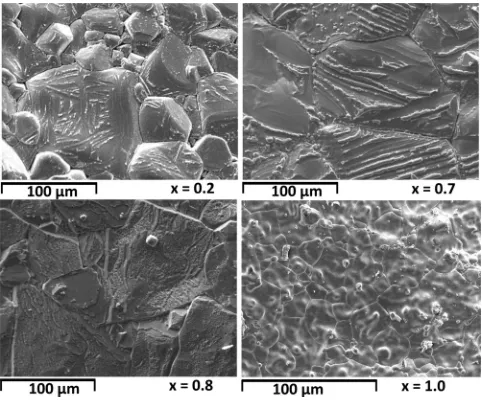
In Fig. 1, the SEM micrographs for the samples with x¼0.2 and 0.7 show two phases. Although the sample with x¼0.8 appears to have a uniform microstructure, it has a low concentration of the secondary phase (see Fig. 2(a)and subsequent discussion). The sample with x¼1.0 shows a uniform microstructure, indicative of a single phase. In Table
[image:4.612.318.559.525.725.2]I, only the compositions of Co and Fe are shown, because the EDX technique is not sufficiently sensitive to oxygen. The samples with x¼0.8 and 1.0 were slightly richer in Co than targeted. In the two phase samples, specific
FIG. 1. SEM micrographs of the CoxFe3xO4samples. a)Author to whom correspondence should be addressed. Electronic mail:
0021-8979/2012/111(7)/07D704/3/$30.00 111, 07D704-1 VC2012 American Institute of Physics
compositions were not obtained for each phase because the spatial extents of the phases were too fine to be independ-ently resolved via EDX.
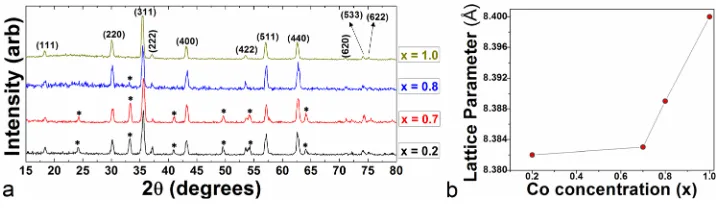
The XRD pattern in Fig. 2(a) shows that the sample with x¼1.0 has only spinel phase peaks. Additional peaks (labeled with *), corresponding to peaks in the a-Fe2O3
pattern,4 were observed at x¼0.2, 0.7, and 0.8. However, only a very small amount of a-Fe2O3 seems to be present
in the x¼0.8 sample. The similarities in the structure of Fe3O4 and Co3O4, and in the properties of Fe and Co,
would lead one to expect that CoxFe3xO4 would be
single spinel phase for all 0x1, but this study shows results to the contrary. A previous study on CoxFe3xO4
(x¼0.0 to 1.0) (Ref. 5) reported only spinel peaks. However, the samples for that study were produced via the co-precipitation method, whereas those for this study were made using the traditional ceramic approach.
Because the reactivity of Fe3O4 depends on surface
area,6and because the reacting volume of Co3O4is smaller
than that of Fe3O4, it seems likely that both reactants, in their
appropriate proportions, formed CoFe2O4and that the excess
Fe3O4was oxidized toa-Fe2O3. For x¼0.2, Eq. (1) shows
the reactions forming CoFe2O4 and a-Fe2O3. If calcined
in oxygen, Fe3O4 initially forms c-Fe2O3 at about 180C,
and that changes to a-Fe2O3 at about 350C.7 As Fe3O4
and Co3O4 were calcined twice at 1000C and sintered at
1350C, it seems likely that the excess Fe3O4was oxidized
toa-Fe2O3. A similar explanation should apply to the
sam-ples with x¼0.7 and 0.8 (Eqs. (2) and (3), respectively). Equations (1)–(3) show that the concentration of a-Fe2O3
should decrease with the Co content; thus only the strongest peak ina-Fe2O3(2h¼33.1) was seen at x¼0.8. Although
the equations show the primary phase as CoFe2O4, the
meas-urements in this research cannot completely exclude the presence of other spinel phases. As a result, the primary phase will hereinafter be referred to as the spinel phase. The lattice parameter of the spinel phase shown in Fig. 2(b)
increased with Co content. The changes in the lattice param-eter of the spinel phase might be due to the crystal lattice of thea-Fe2O3phase that is present in the two-phase samples.
2:8Fe3O4þ0:2Co3O4þ0:6O2¼0:6CoFe2O4þ3:6a
Fe2O3 (1)
2:3Fe3O4þ0:7Co3O4þ0:225O2¼2:1CoFe2O4þ1:35a
Fe2O3 (2)
2:15Fe3O4þ0:85Co3O4þ0:1125O2¼2:55CoFe2O4
þ0:675aFe2O3
(3)
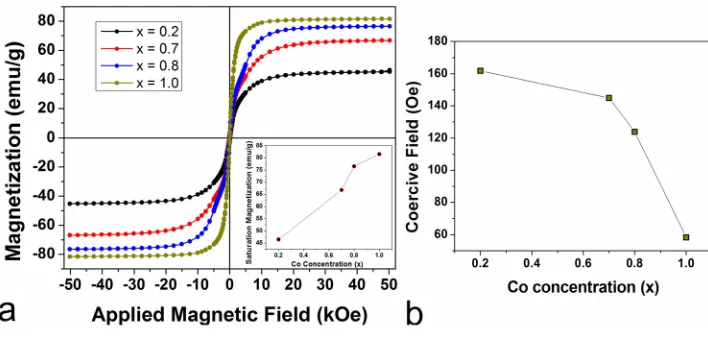
Fig. 3(a) shows the M-H curves, and the inset shows that the saturation magnetization (Ms) increased with x.
Althougha-Fe2O3is a weakly ferromagnetic material above
its Morin temperature of 260 K, its net moment is very small compared to that of the ferrimagnetic spinel phase. Depending on the processing, the magnetization of a-Fe2O3
at H¼12.5 kOe is less than 1 emu/g.8At a similar magnetic field, spinel CoFe2O4 (x¼1), for example, has
magnetiza-tion of 80 emu/g. In a ferrimagnetic spinel/a-Fe2O3
com-posite system, a higher a-Fe2O3content would be expected
to lower the net magnetization, whereas a higher spinel con-tent would increase it. This agrees with the observations here. In Fig. 3(b), the higher coercive field in the samples with a higher concentration of a-Fe2O3 could be due to
exchange coupling between the two phases or domain wall pinning during magnetization as a result of the two-phase structure.
From these results, it is seen that when Co-ferrite pre-pared via the ceramic method deviates from stoichiometry, EDX might still show the overall targeted cation ratio expected from a single phase material, even though the secondary a-Fe2O3phase might be present in a fine
micro-structure. The presence of the secondary phase will alter the magnetic properties of the material relative to those of the single phase material, even though the composition as determined by EDX is the same. When a ferrimagnetic spi-nel/a-Fe2O3composite is desired, the ceramic method offers
the ability to adjust the relative amounts of each phase by adjusting the overall Co content. For example, exchange coupling in bilayers ofa-Fe2O3and CoFe2O4has been
stud-ied for spin-valve sensor development.9
[image:5.612.50.408.62.166.2]FIG. 2. (Color online) (a) X-ray diffrac-tion pattern of the CoxFe3xO4 samples. Peaks marked with * correspond to an a-Fe2O3 pattern. (b) Dependence of lat-tice parameter of the spinel phase on the Co concentration.
TABLE I. Targeted and EDX compositions of the CoxFe3xO4samples.
EDX composition
Target composition (x¼Co) Fe Co
x¼0.20 2.80 0.20
x¼0.70 2.30 0.70
x¼0.80 2.15 0.85
x¼1.0 1.98 1.02
07D704-2 Nlebedimet al. J. Appl. Phys.111, 07D704 (2012)
[image:5.612.51.297.675.765.2]IV. CONCLUSIONS
In CoxFe3xO4 samples prepared via the ceramic
method, at x¼0.2, 0.7, and 0.8, deviation from stoichiome-try (CoFe2O4) results in a secondarya-Fe2O3phase with a
different crystal structure. The a-Fe2O3 phase, which was
not observed at the stoichiometric composition (x¼1.0), changes the microstructure and thereby alters the magnetic properties of the samples.
ACKNOWLEDGMENTS
Research at the Ames Laboratory was supported by the Department of Energy-Basic Energy Sciences under Con-tract No. DE-AC02-07CH11358, and research at Cardiff University was supported by the UK EPSRC under Grant No. EP/D057094.
1I. C. Nlebedim, N. Ranvah, Y. Melikhov, P. I. Williams, J. E. Snyder, A. J.
Moses, and D. C. Jiles,IEEE Trans. Magn.45, 4120 (2009). 2
H. Zheng, J. Wang, S. E. Lofland, Z. Ma, L. Mohaddes-Ardabili, T. Zhao, L. Salamanca-Riba, S. R. Shinde, S. B. Ogale, F. Bai, D. Viehland, Y. Jia, D. G. Schlom, M. Wuttig, A. Roytburd, and R. Ramesh,Science303, 661 (2004).
3
E. J. Juan and M. Visbal-Onufrak, AIP Conf. Proc. 1311, 273 (2010).
4Patterns were compared with others from the International Centre for
Dif-fraction Data (ICDD 00-001-1053). 5
M. Sorescu, A. Grabias, D. Tarabasanu-Mihaila, and L. Diamandescu,J. Mater. Synth. Process.9, 119 (2001).
6J. P. Saanders and P. K. Galagher, J. Therm. Anal. Calorim. 72, 777
(2003). 7
G. Buxbaum,Industrial Inorganic Pigment, 2nd ed. (Wiley VCH, Berlin, 1998), p. 91.
8S. Mitra, S. Das, K. Mandal, and S. Chaudhuri, Nanotechnology 18,
275608 (2007). 9
T. Fuiji, T. Yano, M. Nakanishi, and J. Takada,Mater. Res. Soc. Symp. Proc.674, T1.10.1 (2001).
FIG. 3. (Color online) (a) Variation of the magnetization with applied field for the CoxFe3xO4samples. Inset shows the variation of the saturation magnetization with the Co concentration. (b) Variation of the coercive field with x.
[image:6.612.53.407.62.232.2]