Gregor von Laszewski, Geoffrey C. Fox
Abstract In this chapter we will be introducing FutureGrid, which provides a testbed to conduct research for Cloud, Grid, and High Performance Computing. Although FutureGrid has only a modest number of compute cores (about 4500 reg-ular cores and 14000 GPU cores) it provides an ideal playground to test out various frameworks that may be useful for users to consider as part of their big data analysis pipelines. We will be focusing here on the use of FutureGrid for big data related testbed research. The chapter is structured as follows. First, we will provide the reader with an introduction to FutureGrid hardware (Section 2). Next, we will focus on a selected number of services and tools that have been proven to be useful to conduct big data research on FutureGrid (Section 3). We will contrast frameworks such as Message Passing Interface, virtual large memory systems, Infrastructure as a Service and map/reduce frameworks. Next we will present reasoning by analyz-ing requests to use certain technologies and identify trends within the user com-munity to direct effort in FutureGrid (Section 4). The next section, we will report on our experience with the integration of our software and systems teams via De-vOps (Section 5). Next, we summarize Cloudmesh, which is a logical continuation of the FutureGrid architecture. It provides abilities to federate cloud services and to conduct cloud shifting; that is to assign servers on-demand to High Performance Computing and Cloud services (Section 6). We conclude the chapter with a brief summary (Section 7).
1 Introduction
FutureGrid [27, 11] is a project led by Indiana University (IU) and funded by the National Science Foundation (NSF) to develop a high performance grid test bed that will allow scientists to collaboratively develop and test innovative approaches to parallel, grid, and cloud computing. FutureGrid will provide the infrastructure
Indiana University, [email protected]
to researchers that allows them to perform their own computational experiments using distributed systems. The goal is to make it easier for scientists to conduct such experiments in a transparent manner. FutureGrid users will be able to deploy their own hardware and software configurations on a public/private cloud, and run their experiments. They will be able to save their configurations and execute their experiments using the provided tools. The FutureGrid test bed is composed of a high speed network connecting distributed clusters of high performance computers. FutureGrid employs virtualization technology that will allow the test bed to support a wide range of operating systems.
2 Overview of FutureGrid
2.1 Hardware Overview
FutureGrid contains a number of clusters of different types and size that are inter-connected with up to a 10GB Ethernet among its sites. The sites include Indiana University, University of Chicago, San Diego Supercomputing Center, Texas Ad-vanced Computing Center, and University of Florida.
2.1.1 Overview of the Clusters
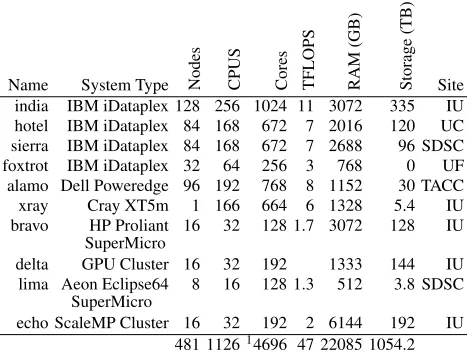
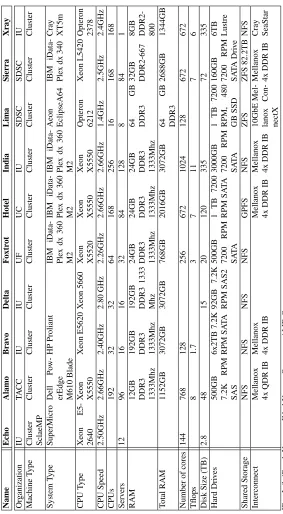
Table 1 provides a high level overview of the clusters currently available in Fu-tureGrid. The biggest cluster is located at IU. It is called India and contains 128 servers with 1024 cores. In total, we currently have 481 compute servers with 1126 CPUs and 4496 Cores. In addition, we have 448 GPU cores. The total RAM is about 21.5TB. Secondary storage is about 1PB. A more detailed table is provided in Table 2. We found that India is one of the most popular resources on FutureGrid.
2.1.2 Overview of Networking
Table 1 FutureGrid Compute Resources
Name System Type Nodes CPUS Cores TFLOPS RAM
(GB)
Storage
(TB)
Site
india IBM iDataplex 128 256 1024 11 3072 335 IU
hotel IBM iDataplex 84 168 672 7 2016 120 UC
sierra IBM iDataplex 84 168 672 7 2688 96 SDSC
foxtrot IBM iDataplex 32 64 256 3 768 0 UF
alamo Dell Poweredge 96 192 768 8 1152 30 TACC
xray Cray XT5m 1 166 664 6 1328 5.4 IU
bravo HP Proliant 16 32 128 1.7 3072 128 IU
delta
SuperMicro
GPU Cluster 16 32 192 1333 144 IU
lima Aeon Eclipse64 8 16 128 1.3 512 3.8 SDSC
echo
SuperMicro
ScaleMP Cluster 16 32 192 2 6144 192 IU
481 112614696 47 22085 1054.2
and UF are now all connected via the XSEDE network and integrated via the FG core router in Chicago. Within the IU network additional clusters are integrated and are described in more detail in Section 2.1.1.
A Spirent H10 XGEM Network Impairment emulator [14] can be collocated with resources at Indiana University, to enable experiments to include network latency, jitter, loss, and errors to network traffic.
In addition we have added several components that are related to a special soft-ware service called Cloudmesh, which we explain in more detail in Section 6.
2.1.3 Overview of Storage
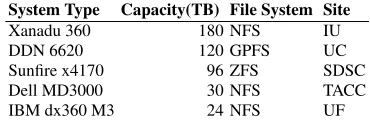
FutureGrid does not provide capacity for long-term storage or long-term experi-ments. FutureGrid has a limited amount of storage space and users are requested to remove their storage after use. However, users with special needs may be accom-modated by special storage setups. The list of storage services is shown in Table 3.
3 Services and Tools for Big Data
T able 2 FutureGrid cluster details. Name Echo Alamo Bra v o Delta F oxtr ot Hotel India Lima Sierra Xray Or g anization IU T A CC IU IU UF UC IU SDSC SDSC IU Machine T ype Cluster SclaeMP Cluster Cluster Cluster Cluster Cluster Cluster Cluster Cluster Cluster System T ype SuperMicro Dell Po w-erEdge M610 Blade HP Proliant IBM iData-Ple x dx 360 M2 IBM iData-Ple x dx 360 M2 IBM iData-Ple x dx 360 M2 Aeon EclipseA64 IBM iData-Ple x dx 340 Cray XT5m CPU T ype Xeon E5-2640 Xeon X5550 Xeon E5620 Xeon 5660 Xeon X5520 Xeon X5550 Xeon X5550 Opteron 6212 Xeon L5420 Opteron 2378 CPU Speed 2.50GHz 2.66GHz 2.40GHz 2.80 GHz 2.26GHz 2.66GHz 2.66GHz 1.4GHz 2.5GHz 2.4GHz CPUs 192 32 32 64 168 256 16 168 168 Serv ers 12 96 16 16 32 84 128 8 84 1 RAM
12GB DDR3 1333Mhz 192GB DDR3 1333Mhz 192GB DDR3
1333
Mhz
24GB DDR3 1333Mhz 24GB DDR3 1333Mhz 24GB DDR3 1333Mhz
64
GB
DDR3
32GB DDR2-667 8GB DDR2- 800
[image:4.612.165.448.127.641.2]Cloudmesh Peers
Sites
FutureGrid Core Router
Impairment Simulator UF
XSEDE Internet 2
SDSC UC
TACC
CM User Managed Service
Azure HP Cloud KIT
User
Managed Others
Alamo Sierra Lima Foxtrot Hotel Bravo Delta Echo India
CM
CM FG Hosted Service
Indiana GigaPOP IU
[image:5.612.139.462.88.333.2]Fig. 1 High level network diagram and conceptual integration of Cloudmesh resources.
Table 3 Storage Resources of FutureGrid.
System Type Capacity(TB) File System Site
Xanadu 360 180 NFS IU
DDN 6620 120 GPFS UC
Sunfire x4170 96 ZFS SDSC
Dell MD3000 30 NFS TACC
IBM dx360 M3 24 NFS UF
our general FutureGrid high-level architecture depicted in 3. More details about the architecture can be found in [27, 11]. Within this paper we will focus on describing services that have been explicitly used for big data research in FutureGrid.
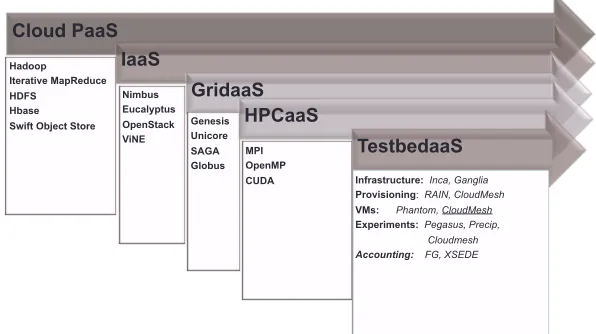
3.1 Testbed as a Service (TestbedaaS)
[image:5.612.207.392.383.444.2]Cloud PaaS
Hadoop Iterative MapReduce HDFS
Hbase Swift Object Store
IaaS Nimbus Eucalyptus OpenStack ViNE GridaaS Genesis Unicore SAGA Globus HPCaaS MPI OpenMP CUDA TestbedaaS
Infrastructure: Inca, Ganglia
Provisioning: RAIN, CloudMesh
VMs: Phantom, CloudMesh
Experiments: Pegasus, Precip, Cloudmesh
Accounting: FG, XSEDE
Fig. 2 FutureGrid high-level user services.
Base Software and Services
OS, Queuing Systems, XCAT, MPI, ...
Access Services
Management Services FutureGrid Operations
Services Development Services Wiki, Task Management, Document Repository User and Support Services Portal, Tickets, Backup, Storage, PaaS Hadoop, Dryad, Twister, Virtual Clusters, ... Additional Tools & Services Unicore, Genesis II, gLite, ... Image Management FG Image Repository, FG Image Creation Experiment Management Registry, Repository Harness, Pegasus Exper. Workflows, ... Dynamic Provisioning
RAIN: Provisioning of IaaS, PaaS, HPC, ...
Monitoring and Information Service Inca, Grid Benchmark Challange, Netlogger, PerfSONAR Nagios, ... FutureGrid Fabric
Compute, Storage & Network Resources
Development & Support Resources
Portal Server, ...
IaaS Nimbus, Eucalyptus, OpenStack, OpenNebula, ViNe, ... Security & Accounting Services Authentication Authorization Accounting HPC User Tools & Services Queuing System, MPI, Vampir, PAPI, ...
[image:6.612.149.447.101.268.2] [image:6.612.150.450.293.594.2]allows us to create usage reports from our entire Infrastructure as a Service (IaaS) frameworks. Repeatable experiments can be created with a number of tools includ-ing Pegasus, Precip and Cloudmesh. VMs can be managed on high level either via Cloudmesh (see Section 6). Provisioning of services and images can be conducted by RAIN [9, 10]. Infrastructure monitoring is enabled via Nagios [7], Ganglia [17], and Inca [22] and our own cloud metric system [29].
3.2 Traditional High Performance Computing as a Service
(HPCaaS)
Within the traditional High Performance Computing (HPC) services FG offers a traditional MPI/batch queuing system and a virtual large memory system that are beneficial for big data calculations.
3.2.1 MPI and Batch Queues
The traditional HPC environment provided by queuing systems and Message Pass-ing Interface (MPI) programs creates a suitable infrastructure not only for simu-lations, but also for the analysis of large data. However, considerable amount of work has to be conducted to optimize the available infrastructure to deal with dis-tributed domain decompositions. Optimized use via traditional HPC has been suc-cessfully demonstrated for many biological applications. Additionally, the existence of a queuing system can provide some advantages when the available resources are over utilized while sharing the resources with other users. This has been especially useful in FutureGrid to support educational activities for classes with many users that, for example, want to test map reduce activities controlled by a queuing system as described in Section 3.5.1.
3.2.2 Virtual Large-Memory System
3.3 Grid as a Service (GridaaS)
Not surprisingly the demand for computational Grids on FutureGrid has been rel-atively small. While we saw few requests for Globus we decided to focus on the installation of more popular systems. The low use can be explained by the avail-ability of large Grid production infrastructure elsewhere such as in XSEDE and based on the move of the community away from complex Grid solutions to either cloud computing or even back to more traditional batch processing solutions. Fur-thermore, toolkits such as the CoG Kit also known as jglobus [24, 26, 28] have provided enough abstractions for users that experimenting with such technologies has become less prominent and can be made on the client side while interfacing to production Grid services instead of testbeds.
3.4 Infrastructure as a Service (IaaS)
One of the main features of FutureGrid is to offer its users a variety of infrastructure as a service frameworks [25, 31]. These frameworks provide virtualized resources to the users on top of existing cyberinfrastructure fabric. This includes but is not limited to virtualized servers, storage, network, disk, and other IaaS related ser-vices. In FutureGrid the most common hypervisor that runs the virtual machines as guest on the underlying operating system is KVM. Some resources also run XEN, however most recently the demand for KVM has increased and some services will be switched from XEN to KVM. Through the ability to provide large numbers of virtual machines to the users, the access mode to utilize resources, in contrast to tra-ditional HPC, has been changed from a reservation-based service to an on-demand service. This comes with the benefit that if enough resources are available they will be immediately allocated to the user. However, if not enough resources can be of-fered, the system will define the request and return with an error. Based on our experience with FutureGrid over the last couple of years, it is advantageous to offer a mixed operation model. This includes a standard production cloud that operates on-demand, but also a set of cloud instances that can be reserved for a particu-lar project. We have conducted this for several projects in FutureGrid, including those that required dedicated access to resources as part of big data research such as classes [19, 18] or research projects with extremely large virtual machines [20].
The IaaS services that are offered in FutureGrid contain the following:
sup-port of companies. Within FutureGrid OpenStack clouds are currently deployed on India, Sierra, Hotel, and Alamo, while currently India provides the most up to date services.
Nimbus is an open source service package allowing users to run virtual machines on FutureGrid hardware. Just as in OpenStack users can upload their own virtual machine images or customize existing ones. Nimbus, next to Eucalyptus is one of the earlier frameworks that make managing virtual machines possible. Nim-bus provides a basic set of cloud services including services to orchestrate the deployment of virtual machines. However, Eucalyptus and OpenStack now also provide such services.
Nimbus provides a selected subset of AWS protocols such as EC2. Accounting of Nimbus VMs does not currently provide features for project management. Such group-based and role based user management is essential for proper administra-tive resource and project management and is provided by other IaaS frameworks. In Nimbus it is only conducted on a user-by-user basis. This has significant impli-cations on user management as in large-scale deployments project management features are highly desired but are not offered in Nimbus. Although, single users may not be interested in this feature, it is essential to provide proper project man-agement of groups of users.
Eucalyptus is an open source software IaaS framework for cloud computing. Eu-calyptus provides an Amazon Web Services (AWS) compliant EC2-based web service interface to its users enabling the easy integration between a local cloud managed with Eucalyptus and AWS. However, as other IaaS frameworks such as OpenStack also provide EC2 interfaces for many application users OpenStack has become a viable alternative.
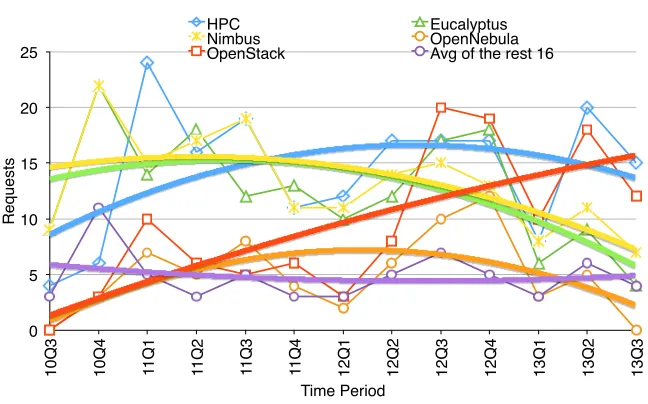
Which of the IaaS frameworks to choose is a question that is not that easy to answer. Many of our projects evaluate several of them in order to choose the one best suited for their use case. At other times users chose a framework that they had previously successfully used. Over time the quality of the IaaS framework has significantly changed. Within the last year OpenStack has become the most popular platform on FutureGrid.
3.5 Cloud Platform as a Service (PaaS)
3.5.1 Map Reduce
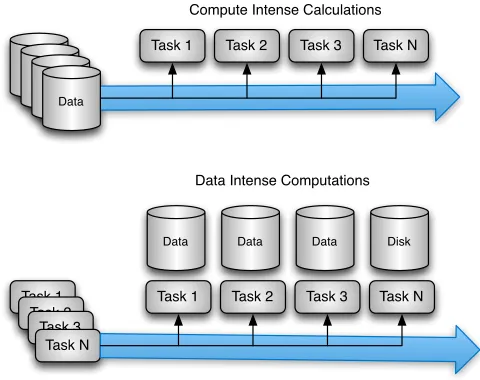
Map reduce models have been familiar to the programming and distributed com-puting community for a long time and have been historically associated with the functional programming’s map and reduce. However the map and reduce frame-work introduced recently [8] distinguishes itself from such efforts while applying it repeatedly, with fault tolerance on a very large distributed data set [4].
when we assume that a large number of data is distributed over many servers and repeated search queries are cast to find results across them (as in the case of Google motivating map/reduce).
In general, we can define amapstep that takes the input problem and divides it into smaller sub-problems distributing it among worker nodes. The map function is then executed on the data distributed on the various servers. Thereducestep collects the answers of the subproblem and combines them in some fashion.
Task 1 Task 2 Task 3 Task N
Disk Data
Data Data
Compute Intense Calculations
Disk Data
Data Data
Data Intense Computations
Task 1 Task 2
Task 3 Task N
Task 1 Task 2 Task 3 Task N
Fig. 4 Bring the data to the computation vs. bring the computation to tha data.
Hadoop.
[image:10.612.178.418.199.389.2]myHadoop.
MyHadoop [15][16], which is installed on many of the compute clusters in Fu-tureGrid, enables users to launch Hadoop clusters via traditional high-performance compute clusters. For this, it utilizes the underlying batch scheduling system.
The reasons for managing Hadoop jobs via a batch system are manifold. First, the available infrastructure is resource constrained, and utilization of disks and compute resources must be specially accounted for to allow shared usage by many users. This naturally happens in the educational research community quite frequently. Second, to efficiently utilize the compute and data infrastructure researchers may not run Hadoop or MPI jobs continuously. At times they may need a Hadoop environment. At other times they may prefer a traditional message passing environment while at the same time being under resource constraints.
The idea of myHadoop is to submit a job to the queuing system that sets up a Hadoop cluster for the length of the reservation and the researcher can then use it to conduct experiments either via predefined jobs or in interactive mode. This is achieved by first identifying a number of resources via the scheduler, followed by the deployment of the Hadoop software across the identified servers. The user will then be presented with information on how to access this newly provisioned Hadoop cluster. MyHadoop, in its new version [16] is supported for Oracle Grid Engine (formerly known as Sun Grid Engine), PBS, and SLURM.
Once Hadoop has been initialized, it can be accessed through regular job scripts as shown in Figure 5. This example script uses eight nodes. It is important to set the processor per node to 1 to assure the various Hadoop daemons are scheduled on different servers. The rest of the script is not depicted as it contains the actual details on setting up Hadoop via the script and is beyond the scope of this chapter. The user should replace the text in< ... >to customize the job. As Hadoop is a user level program, it is also possible to run a usermodified version of Hadoop which helps in adding new features or trying out newer versions of Hadoop than the default version that is installed for my Hadoop. The FutureGrid manual provides more details on how to practically use myHadoop on FutureGrid [13].
#!/bin/bash
#PBS -q <queue_name> #PBS -N <job_name> #PBS -l nodes=8:ppn=1 #PBS -o <output file> #PBS -e <error_file> #PBS -A <allocation> #PBS -V
#PBS -M <user email> #PBS -m abe
... details omitted
Twister.
Twister [6] is an extension to MapReduce to allow more easily the introduction of iterative map reduce processes. In addition twister has introduced a number of concepts including distinction between static and variable data, long running tasks, publish/subscriber based communication, and various other enhancements. Twister is developed at Indiana University, and is used as part of classes on distributed sys-tems and other educational activities; hence, it reaches popularity within FutureGrid.
Virtual Clusters.
In addition to the map/reduce platforms offered on FutureGrid, it is also possible to deploy virtual clusters. One of the earliest such frameworks has been showcased by von Laszewski [30] while deploying a SLURM cluster. Such a cluster can then be used as a teaching tool or provides additional mechanisms to custom create queues and reservations. However, the most advanced feature of FutureGrid will be via Cloudmesh, which will allow the deployment of clusters not only in virtual ma-chines, but on baremetal.
4 FutureGrid Usage
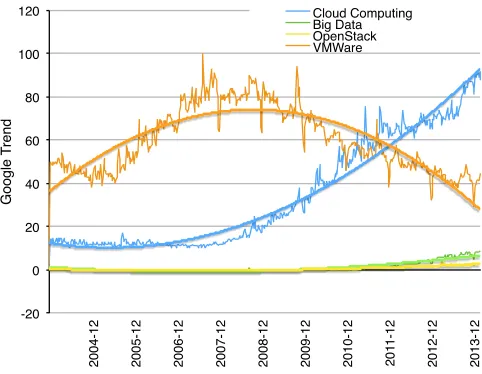
When offering services such as FutureGrid to the community, we have to analyze and predict which services may be useful for the users. We have therefore estab-lished a number of activities that monitor external and internal data. Externally, we look, for example, at information provided by Gartners technology hype curve [2] or Google trend information as shown in Figure 6. From Google Trend data we ob-serve that the popularity of Grid computing has been very low in the recent years and much attention has shifted to cloud computing. Therefore we removed this in-formation from the figure and focus exemplary on cloud related terms such asCloud Computing,Big Data,OpenStack VMWare. From this information we see that all but VMWare are rising, with Cloud Computing dominating the Google trends in comparison to the others. This trend is important as it shows a shift in the cloud computing community buzz away from a traditional commercial market leader in virtualization technology. We believe that is correlated with a large number of ven-dors offering alternative products and services while at the same time the novelty from VMWare is reduced.
comput--20! 0! 20! 40! 60! 80! 100! 120! 2 0 0 4 -1 2 ! 2 0 0 5 -1 2 ! 2 0 0 6 -1 2 ! 2 0 0 7 -1 2 ! 2 0 0 8 -1 2 ! 2 0 0 9 -1 2 ! 2 0 1 0 -1 2 ! 2 0 11 -1 2 ! 2 0 1 2 -1 2 ! 2 0 1 3 -1 2 ! G o o g le T re n d !
Cloud Computing! Big Data! OpenStack! VMWare!
Fig. 6 Google Trends.
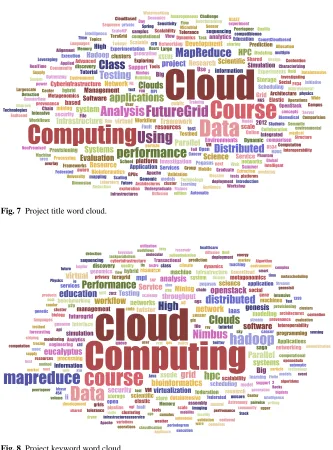
ing and terms such as mapreduce, OpenStack, Nimbus, and Eucalyptus appear quite frequently. It is, therefore, worthwhile to analyze this data in a more quantitative form.
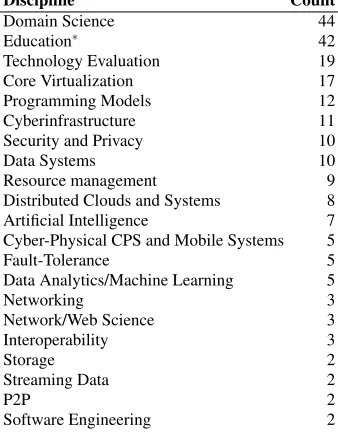
FutureGrid supports a rich set of projects, of which many are principally related directly or indirectly to big data systems. In Table 4 we list the areas of research and the number of projects conducted in these areas over a time period identified between November 2011 and December 2013. One of the focal obeservations is that the majority of projects are related to computer science research which can be found in the table in more detail. Domain Science and Education related projects take on a large portion.
[image:13.612.179.420.96.283.2]Big
Day
Fall
High
run
Cloud
Computing
Using
Data
Course
FutureGrid
Analysis
Class
Testing Clouds HPC Systems virtual Grid 2012 Use test Open Fault Web Group Site GPUs next File 2 Nimbus Model text Cancer MOOC VM P434 FG NGS CFD MPI system Parallel View scale Apache areaDistributed
based B534 tests Taskperformance
MapReduce
XSEDE Spring applications Infrastructure Evaluation security Running Social aware power Hadoop Resource resources public Tools Phantom Scaling Memory sharing Design Center Flames edition Time project Science Network Scientific Development Framework Research SoftwareManagement Storage platform Cyberinfrastructure Service Simulation analytics Support Investigation Environments information clusters Application Testbed mining Services Scheduling Dynamic Provisioning Tutorial Elastic networks Experiments Prediction Workflow Bioinformatics Scalable Shared Architecture Online Metagenomics Advanced Exploring Networking Integrated OpenStack comparison Large generation sequencing hybrid Education Experimentation Pegasus discovery computational Modeling Mobile Environment Dynamics Improvement Frameworks Validation Processing Twister Tolerance Scalability provenance Community samples Graduate Summer School Optimizing Chain Genomic mapping Execution models Intensive Workflows Collaborative Technology TeraGridScaleMP Students Microbial Machine Extraction Biomedical Laboratory Topics Computation Investigating Sensor medical Architectures Languages Massive Characterizing deployment cluster Undergraduate Applied concepts Training Learning Global Sensitivity NonPremixed Counterflow multiple Federated private Users compatibleone Appliance Introduction CometCloudbased Detection Intelligence overlay Peertopeer Semantic platforms Improve Operations Server Largescale fluid Flow Intelligent Future Secure particle physics Supply BLAST User Reduction Benchmarking environmental University Structure Sequence Alignment Workshop experiment Diffusion analyzing Genomics Technologies Campus Contention Leveraging Automatic heterogeneous Initiative Challenge Dimension Comparision Allocation DataIntensive Watermarking CloudBased Interoperability exploration Endtoend Infrastructures Wide Quality RealTimeFig. 7 Project title word cloud.
Big
High
cloud
Computing
course
Data
futuregrid analysis class TestingClouds
hpc systems virtual grid 2012 open fault web next file 2Nimbus
model Text cancer mooc VM ngs cfd mpi system Parallel scale Apachedistributed
Performancemapreduce
xsede Applications infrastructure evaluation security socialhadoop
resource resources toolsMemory design Center time science network scientific development research software management storage cyberinfrastructure Service simulation Analytics support Information clusters application testbed Mining services scheduling provisioning tutorial elastic networks prediction workflow bioinformatics shared metagenomics networking openstack generation sequencing hybrid education pegasus discovery computational modeling environment dynamics validation processing twister tolerance scalability provenance community chain execution models intensive workflows technology teragrid scalemp machine computation sensor architectures languages deployment cluster learning federated appliance detection intelligence peertopeer operations fluid flow future particle Physics supply user benchmarking diffusion genomics contention automatic dataintensive Interoperability endtoend quality eucalyptus throughput genesis virtualization iaas ii saga federation store interface programming machines xd CometCloud grids privacy gene pipeline assembly Transactional engineering genome unicore twitter teaching stream sky p2p osg gpu gis cuda climate natural monitoring clustering biology Astronomy api queue forecasting kepler imaging Java genetic vine tool taskparallelism selfoptimization rest raytracing qos policy
perfromance opennebula ogf products molecular mobility lustre keyvalue infrastructureasaservice io hbase Finite volume method
dryad cumulus locality
condor autonomic administration genesisii weather variations SNP smart Rocks utilization reservoir sensing healthcare periodogram Streams pairwise classification occi radio metascheduling markov market compilers energy algorithms Algorithm striping event complex bigdata best Stack 454 1399 xsp tis sge xray writing upper ware
Fig. 8 Project keyword word cloud.
[image:14.612.134.467.87.537.2] [image:14.612.138.463.93.300.2]Table 4 FutureGrid supports a rich set of projects, of which many are importantly related directly or indirectly to big data systems.
Discipline Count
Domain Science 44
Education∗ 42
Technology Evaluation 19
Core Virtualization 17
Programming Models 12
Cyberinfrastructure 11
Security and Privacy 10
Data Systems 10
Resource management 9
Distributed Clouds and Systems 8
Artificial Intelligence 7
Cyber-Physical CPS and Mobile Systems 5
Fault-Tolerance 5
Data Analytics/Machine Learning 5
Networking 3
Network/Web Science 3
Interoperability 3
Storage 2
Streaming Data 2
P2P 2
Software Engineering 2
∗90% of which on computer science
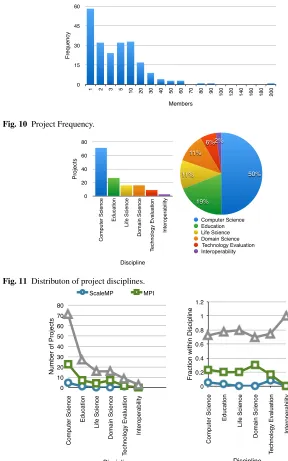
that the dominant unique number of members within all projects is either one, two or three members. Then we have another class between 4 and 10 members, and the rest with more than ten members. One of the projects had 186 registered members overall for an education class as part of a summer school. Looking at the distribution of the members and associating them with research and education projects, we find all projects with larger numbers of projects to be education projects.
When we look in more detail into the map/reduce related technology requests over the entire period FutureGrid has been active, we identified the distributions as depicted in Figure 13. We can see that the requests for IaaS together with map/reduce technology requests dominate. HPC requests are much fewer. The rea-son why the other category in Figure 13 is that high is because we have a significant number of other choices, each with a very low total count. Also, we would like to re-mind the reader that users can chose multiple categories for their projects. Within the category of map/reduce, users had the choice of Hadoop, Map/Reduce, or Twister as a technoology. The breakdown of these choices is shown in the right part of Fig-ure 13 dominated by the choice for Map/Reduce and Hadoop representing 85% of all choices.
0!
5!
10!
15!
20!
25!
10Q3
!
10Q4
!
11
Q
1
!
11
Q
2
!
11
Q
3
!
11
Q
4
!
12Q1
!
12Q2
!
12Q3
!
12Q4
!
13Q1
!
13Q2
!
13Q3
!
R
e
q
u
e
st
s
!
Time Period!
HPC! Eucalyptus!
Nimbus! OpenNebula!
OpenStack! Avg of the rest 16!
Fig. 9 Requested technologies by project
which provides a production HPC system to the scientific community, the usage of FutureGrid for map reduce frameworks is dominated with 50% by computer science related projects followed by education with 19%.
Looking further into this data, we present in Figure 12 the number of projects in a particular category as well as the Fraction of technologies within a discipline. As we are focusing in this paper on the impact on big data, we have looked in partic-ular at requests for mapreduce, Hadoop, and twister, while also looking at requests for MPI and ScaleMP. It is interesting to note that the percentual distribution of the technologies among these projects is about constant, if we exclude technology eval-uations and interoperability. As MPI is more popular with domain sciences, we find a slight increase in projects requesting MPI. However, with the life sciences we see the opposite as map/reduce and associated technologies are more popular here. MPI and ScaleMP are not much requested as part of technology evaluations and interop-erability experimentation as they either project a very stable framework and do not require evaluation, or the question of interoperability is not of concern for most of the projects.
5 System Management
[image:16.612.143.467.90.292.2]F re q u e n cy 0 15 30 45 60 Members
1 2 3 5 10 20 30 40 50 60 70 80 90
[image:17.612.132.420.110.571.2]100 120 140 160 180 200
Fig. 10 Project Frequency.
1 Pro je ct s 0 20 40 60 80 Discipline C o mp u te r Sci e n ce Ed u ca tio n L ife Sci e n ce D o ma in Sci e n ce T e ch n o lo g y Eva lu a tio n In te ro p e ra b ili ty 2% 6% 11% 11% 19% 50% Computer Science Education Life Science Domain Science Technology Evaluation
Interoperability
Fig. 11 Distributon of project disciplines.
0! 10! 20! 30! 40! 50! 60! 70! 80! C o mp u te r Sci e n ce ! Ed u ca ti o n ! L if e Sci e n ce ! D o ma in Sci e n ce ! T e ch n o lo g y Eva lu a ti o n ! In te ro p e ra b ili ty ! N u mb e r o f Pro je ct s ! Discipline!
ScaleMP! MPI!
0! 0.2! 0.4! 0.6! 0.8! 1! 1.2! C o mp u te r Sci e n ce ! Ed u ca ti o n ! L if e Sci e n ce ! D o ma in Sci e n ce ! T e ch n o lo g y Eva lu a ti o n ! In te ro p e ra b ili ty ! F ra ct io n w ith in D isci p lin e ! Discipline!
390
332
203
489
0 100 200 300 400 500 600
IaaS Map/Reduce HPC Other
N
um
be
r o
f Re
qu
es
ts
Requested Technologies
146 136
50
0 20 40 60 80 100 120 140 160
Hadoop Map/Reduce Twister
N
um
be
r o
f Re
qu
es
ts
[image:18.612.140.461.76.190.2]
Requested Technologies
Fig. 13 Map reduce related technology requests.
in order to efficiently manage the system and provide services that have never been offered to users as they exist on FutureGrid.
5.1 Integration of Systems and Development Team
FutureGrid started initially with a model where the systems team and the software team were separated. An unnecessary wall between teams was erected that resulted in multiple challenges:
1. The system setup and management were completely separated from the soft-ware development team focusing mostly on the deployment of existing tech-nologies. However the technologies deployed were themselves under heavy de-velopment and required intercorrelations between developers and system teams. 2. The deployed system was complex, but its deployment was documented to a limited extent, which resulted in developers having insufficient information to utilize the system properly or to know what had been deployed.
3. Lack of trust by the systems team did not allow the software team to have a valid development environment as proper privileges were not issued to the de-velopers. As the development team needed to use privileged system services, the development could not be carried out.
4. The software developed needed a testbed within the testbed that was not neces-sarily reflecting the actual system setup.
Together, these issues made it extremely difficult, if not impossible, to further any development in regards to the design of a testbed infrastructure as proposed by our original ambitious goals.
5.2 DevOps
DevOps is not just a buzzword from industry and research communities. It provides value added processes to the deployment and development cycles that are part of modern data centers. It can today be understood as a software development method that stresses collaboration and integration between software developers and infor-mation technology professionals such as system administrators.
While using an infrastructure such as clouds we recognized early on that the life-time of a particular IaaS framework is about 3-6 months before a new version is installed. This is a significant difference to a traditional High Performance Com-puting Center that is comprised of many software tools experiencing much longer life spans. This is not only based on security patches but significant changes, for example, in the evolving security infrastructure and user services, as well as, the deployment of new services that become available in rapid procession.
This rapid change of the complex infrastructure requires rethinking how systems in general are managed and how they can be made available to the development teams. While previously it may have been enough to install updates on the ma-chines, DevOps frameworks provide the developer and system administrators a way to create and share environments that are used in production and development while at the same time increasing quality assurance by leveraging each others experiences (see Figure 14).
Development!
Quality Assurance!
Operations!
DevOps!
Fig. 14 DevOps Intersection.
Release Deploy
Operate
Monitor Plan
Code Build
Test
[image:19.612.148.449.373.502.2]Dev! Ops!
Fig. 15 DevOps Cycle.
DevOps Cycle.
it is possible to roll out new developments into production much faster. This leads to a much more rapidly integrated cycle than would not be possible without the correlation between development and operation.
DevOps Supporting Tools.
A number of tools are available that make the introduction of DevOps strategies more efficient. The first is the need for an simplified communication pathway to manage tasks not only between developers but also between users. Thus the ideal system would provide a complete integration of a project management system that allows managing tasks for both developers and operators, but also to easily inte-grate tickets and transform them into tasks. In XSEDE and other supercomputing centers a system called RT [5] is typically used for user ticket management. Other systems such as jira, mantis, and basecamp are often used to manage the software and systems related tasks. Unfortunately, personal or organizational constraints of-ten prevent the integration of the two systems and additional overhead is needed to move user tickets into tasks and the development cycle. Within FutureGrid, as part of our opensource development, we experimented extensively with jira as systems and ticketing system [3] revealing that newest development in such areas motivated by DevOps teams led to tools that support the overall cycle including user ticket management in a single system (see Figure 16). However, the integration of Future-Grid within the overall much larger XSEDE effort made it not possible to switch from RT to jira for user ticket management. To stress this user integration we term this frameworkUseDevOps. Tools to integrate Development and Operation deploy-ment include puppet, chef, ansible, cfengine and bcfg2. While FutureGrid started out with bcfg2 we have since switched to other tools due to their prevalence within the community. Chef, puppet, and ansible have significant amount of traction. Due to expertise within our group we currently explore chef and ansible.
Development!
Quality Assurance!
Operations!
User!
[image:20.612.245.356.465.574.2]Support! UseDevOps!
5.3 Support for Education
To support the many educational and research projects on FutureGrid, we have pro-vided, through a portal, a significant amount of material on how to use the discussed services. In addition, we realized that not every educational project has users with advanced computer experience, therefore we provide for such projects a streamlined user interface rather than having the users fight with complex command line syntax and parameters. For example, we provided for a recent MOOC on big data taught with resources on FutureGrid the basic functionality not only to start VMs as part of the IaaS framework, but also to deploy sophisticated images that contain prein-stalled software and allow services to be hosted by the users such as iPython, R and much more. This was implemented on top of OpenStack while utilizing the newest OpenStack services such as Heat. The management of the VMs and starting of the iPython server was controlled by a python application that provides the user with a menu system. Thus, the management of them became literally as easy as pressing 1, 2, 3, ... in the menu. For other classes, we have also provided completely sep-arate OpenStack deployments as the teachers were afraid that students would not have enough resources due to the shared environment. However, we learned from this that the teachers overestimated the actual utilization of the project and many resources were not used. Based on this analysis we now have a model to justify the creation of more relaxed access policies and can justify that even classes should be utilizing the public region that are provided by FutureGrid. If resource contention would become an issue, we could set aside a special region for a limited amount of time. Reconfiguration needs have also arisen where one day a class may want to explore traditional MPI, while the next they want to experiment with Hadoop. Furthermore, we identified that several users wanted to combine various cloud IaaS platforms in order to avoid resource over-provisioning or were interested in com-bining all resources.
6 Cloudmesh
At [12] we find an extensive set of information about Cloudmesh that is cited within this section.
From the experience with FutureGrid we identified the need for a more tightly integrated software infrastructure addressing the need to deliver a software-defined system encompassing virtualized and baremetal infrastructure, networks, appli-cation, systems and platform software with a unifying goal of providing Cloud Testbeds as a Service (CTaaS). This system is termed Cloudmesh to symbolize (a) the creation of a tightly integrated mesh of services targeting multiple IaaS
(b) the ability to federate a number of resources from academia and industry. This includes existing FutureGrid infrastructure, Amazon Web Services, Azure, HP Cloud, Karlsruhe, using not only one IaaS framework, but many.
(c) the creation of an environment in which it becomes more easy to experiment with platforms and software services while assisting to deploy them effortlessly. In addition to virtual resources, FutureGrid exposes baremetal provisioning to users, but also a subset of HPC monitoring infrastructure tools. Services will be available through command line, API, and Web interfaces.
6.1 Functionality
Due to its integrated services Cloudmesh provides the ability to be an onramp for other clouds. It also provides information services to various system level sensors to give access to sensor and utilization data. They internally can be used to optimize the system usage. The provisioning experience from FutureGrid has taught us that we need to provide the creation of new clouds, the repartitioning of resources between services (cloud shifting), and the integration of external cloud resources in case of over provisioning (cloud bursting). As we deal with many IaaS we need an ab-straction layer on top of the IaaS framework. Experiment management is conducted with workflows controlled in shells [23], Python/iPython, as well as systems such as OpenStacks Heat, Accounting is supported through additional services such as user management and charge rate management. Not all features are yet implemented. Figure shows the main functionality that we target at this time to implement.
6.2 Architecture
The three layers of the Cloudmesh architecture include a Cloudmesh Management Framework for monitoring and operations, user and project management, experi-ment planning and deployexperi-ment of services needed by an experiexperi-ment, provisioning and execution environments to be deployed on resources to (or interfaced with) en-able experiment management, and resources.
System Monitoring and Operations.
Fig. 17 CM Functionality.
The Cloudmesh management framework offers services that simplify integration of resources in the FutureGrid nucleus or through federation. This includes, for user management, access to predefined setup templates for services in enabling resource and service provisioning as well as experiment execution. To integrate IaaS frame-works Cloudmesh offers two distinct services:
(a) a federated IaaS frameworks hosted on FutureGrid, (b) the availability of a service that is hosted on FutureGrid, allowing the integration of IaaS frameworks through user credentials either registered by the users or automatically obtained from our distributed user directory.
For (b) several toolkits exist to create user-based federations, including our own abstraction level which supports interoperability via libcloud, but more importantly it supports directly the native OpenStack protocol and overcomes limitations of the EC2 protocol and the libcloud compatibility layer. Plugins that we currently de-velop will enable access to clouds via firewall penetration, abstraction layers for clouds with few public IP addresses and integration with new services such as Open-Stack Heat. We successfully federated resources from Azure, AWS, the HP cloud, Karlsruhe Institute of Technology Cloud, and four FutureGrid clouds using vari-ous versions of OpenStack and Eucalyptus. The same will be done for OpenCirrus resources at GT and CMU through firewalls or proxy servers.
Management Framework
Pr
o
vi
si
o
n
in
g
a
n
d
Ex
ec
u
ti
o
n
Platform as a ServiceProvisioning & Federation
Compute Provisioning Ex p er im en t Mo n ito ri n g & Ex ec u ti o n Se cu ri ty Au th en tica tio n, Au th ori za tio n,
SSO HadoopCluster, HPC Cluster,, Customization virtual
System,VM, Hypervisors, Bare-Metal, GPU,MIC
Resources
Federated InternetInternet2 Nucleus
... AWS ... Azure Rack-space Google TACC
Portal, REST, API, command line
Federation Management, Systems Monitoring, Operations
User & Project Services
Experiment Planning and Deployment Services
HP Cloud
Infrastructure as a Service
OpenStack, Eucalyptus, Nimbus,
OpenNebula, CloudStack, Customization
Network Provisioning Storage Provisioning Partitions, Disks, Filespace, Object Store OpenFlow, Neutron, ViNe, others F ed er ati o n Se rv ic es EGI XSEDE Grid 5000
[image:24.612.135.461.87.431.2]IU UF UC
Fig. 18 CM Architecture.
used to allow for reserved creation of such environments, along with improvements of automation of cloud shifting.
User and Project Services.
Accounting and App Store.
To lower the barrier of entry, Cloudmesh will be providing a shopping cart which will allow checking out of predefined repeatable experiment templates. A cost is associated with an experiment making it possible to engage in careful planning and to save time by reusing previous experiments. Additionally, the Cloudmesh App Store may function as a clearing-house of images, image templates, services offered and provisioning templates. Users may package complex deployment descriptions in an easy parameter/form-based interface and other users may be able to replicate the specified setup.
Due to our advanced Cloudmesh Metrics framework, we are in the position to further develop an integrated accounting framework allowing a usage cost model for users and management to identify the real impact of an experiment on resources. This will be useful to avoid over-provisioning and inefficient resource usage. The cost model will be based not only on number of core hours used, but also the capa-bilities of the resource, the time, and special support it takes to set up the experiment. We will expand upon the metrics framework of FutureGrid that allows measuring of VM and HPC usage and associate this with cost models. Benchmarks will be used to normalize the charge models.
Networking.
We have a broad vision of resource integration in FutureGrid offering different levels of control from baremetal to virtual machine and platform management. We also offer the ability to utilize resources in a distributed environment. Likewise, we must utilize networks offering various levels of control, from standard IP connectivity to completely configurable SDNs, as novel cloud architectures will almost certainly leverage NaaS and SDN alongside system software and middleware. FutureGrid resources will make use of SDN using OpenFlow whenever possible, however, the same level of networking control will not be available in every location.
Monitoring.
6.3 Cloud Shifting
We have already demonstrated via the RAIN tool in Cloudmesh that it is possible to easily shift resources between services. We are currently expanding upon this idea and developing more easy to use user interfaces that assist administrators and users through role and project based authentication to move resources from one service to another (see Figure 19).
FG Move
FutureGrid Fabric
FG Provisioning Component
(Teefaa) FG
CLI Component
FG Metrics Component
OpenStack
FG Move Controller
HPC
FG Move Controller
Eucalyptus
FG Move Controller FG
Scheduler Component
1 2
CM CM CM CM
CM CM CM
[image:26.612.202.401.205.349.2]Plugin
Fig. 19 Shifting resources makes it possible to offer flexibility in the service distribution in case of over or underprovisioning.
6.4 Graphical User Interface
Despite the fact that Cloudmesh was originally a quite sophisticated command shell and command line tool, we have recently spent more time in exposing this function-ality through a convenient Web interface. Some more popular views in this interface are depicted in Figure 21 hinting at how easy it is with a single button to create multiple VMs across a variety of IaaS. This not only includes resources at IU but also at external locations, making it more practical for users.
Fig. 20 Monitoring the Service distribution of FutureGrid with Cloudmesh.
6.5 Command Shell and Command Line Interface
Fig. 21 Screenshot demonstrating how easy ot is to manage multible VMs accross various clouds.
Fig. 22 One click deployment of platforms and sophisticated services that could even spawn mul-tiple resources.
[image:28.612.152.452.293.530.2]is managed through a hosted web server. Through this combination Cloudmesh can be seemlessly used as command shell or as GUI.
____ _ _ _
/ ___| | ___ _ _ __| |_ __ ___ ___ ___| |__
| | | |/ _ \| | | |/ _‘ | ’_ ‘ _ \ / _ \/ __| ’_ \ | |___| | (_) | |_| | (_| | | | | | | __/\__ \ | | |
\____|_|\___/ \__,_|\__,_|_| |_| |_|\___||___/_| |_| ======================================================
Cloudmesh Shell cm> help
Documented commands (type help <topic>): ========================================
EOF defaults graphviz keys metric py script var
banner dot2 help label open q storm verbose
clear edit info list pause quit timer version
cloud exec init login plugins rain use vm
count exp inventory man project register user
Cloud Commands ==============
cloud exp inventory list rain storm vm project
[image:29.612.144.400.141.272.2]defaults init label metric register user keys
Fig. 23 The cloudmesh shell
cm> cloud list
+---+
| Clouds |
+---+
| alamo |
| aws |
| azure |
| devstack_icehouse |
| hp |
| hp_east |
| india_eucalyptus |
| india_openstack_havana | | sierra_openstack_grizzly | +---+
Fig. 24 Listing the clouds
7 Summary
can be achieved and future activities in regards to efficiency and usability can be de-ducted. The lessons learned from FutureGrid are motivating a toolkit, Cloudmesh, that currently allows managing virtual machines on a variety of infrastructure as service frameworks. The easy deployment of sophisticated setups with one-click has been validated as part of an infrastructure designed for a MOOC. Furthermore the novel concept of shifting resources [29] between services to support services that need more resources is a significant contribution by Cloudmesh. Image management and creation under security restrictions [10] is furthermore an important aspect. We will continue to develop the Cloudmesh environment and make it available to our users.
Acknowledgement
Some of the text published in this chapter is available form the FutureGrid portal. The FutureGrid project is funded by the National Science Foundation (NSF) and is led by Indiana University with University of Chicago, University of Florida, San Diego Supercomputing Center, Texas Advanced Computing Center, University of Virginia, University of Tennessee, University of Southern California, Dresden, Pur-due University, and Grid 5000 as partner sites. This material is based upon work sup-ported in part by the National Science Foundation under Grant No. 0910812 [11]. If you use FutureGrid and produce a paper or presentation, we ask you to include the references [27, 11] as well as this chapter. We like to thank Fugang Wang for the development of the framework that allowed us to produce the statistical data and Hyungro Lee for assiting in the creation of the data tables that lead to the creation of Figures 11 and 12. Furthermore we like to thank Barbara O’Leary for proofreading this paper.
References
1. “Apache Hadoop Project.” [Online]. Available: http://hadoop.apache.org
2. “Gartner’s 2013 hype cycle for emerging technologies maps out evolving relationship between humans and machines,” Press Release. [Online]. Available: http://www.gartner.com/ newsroom/id/2575515
3. “Jira ticket system,” Web Page. [Online]. Available: https://confluence.atlassian.com/display/ JIRAKB/Using+JIRA+for+Helpdesk+or+Support
4. “Map reduce,” Wikepedia. [Online]. Available: http://en.wikipedia.org/wiki/MapReduce 5. “Rt: Request tracker,” Web Page. [Online]. Available: http://www.bestpractical.com/rt/ 6. “Twister: Iterative mapreduce,” Web Page. [Online]. Available: http://www.
iterativemapreduce.org
8. J. Dean and S. Ghemawat, “Mapreduce: Simplified data processing on large clusters,” Commun. ACM, vol. 51, no. 1, pp. 107–113, Jan. 2008. [Online]. Available: http: //doi.acm.org/10.1145/1327452.1327492
9. J. Diaz, G. von Laszewski, F. Wang, and G. C. Fox, “Abstract Image Management and Universal Image Registration for Cloud and HPC Infrastructures,” in IEEE Cloud 2012, Honolulu, Jun. 2012. [Online]. Available: http://cyberaide.googlecode.com/svn/trunk/papers/ 12-cloud12-imagemanagement/vonLaszewski-12-IEEECloud2012.pdf
10. J. Diaz, G. von Laszewski, F. Wang, A. J. Younge, and G. C. Fox, “Future-Grid Image Repository: A Generic Catalog and Storage System for Heterogeneous Virtual Machine Images,” in Third IEEE International Conference on Coud Com-puting Technology and Science (CloudCom2011), Athens, Greece, 12/2011 2011, paper, pp. 560–564. [Online]. Available: http://cyberaide.googlecode.com/svn/trunk/papers/ 11-cloudcom11-imagerepo/vonLaszewski-draft-11-imagerepo.pdf
11. G. C. Fox, G. von Laszewski, J. Diaz, K. Keahey, J. Fortes, R. Figueiredo, S. Smallen, W. Smith, and A. Grimshaw,Contemporary HPC Architectures, draft ed., 2012, ch. Future-Grid - a reconfigurable testbed for Cloud, HPC and Future-Grid Computing. [Online]. Available: http://cyberaide.googlecode.com/svn/trunk/papers/pdf/vonLaszewski-12-fg-bookchapter.pdf 12. Gregor, “Cloudmesh on Github,” Web Page. [Online]. Available: http://cloudmesh.github.io/
cloudmesh/
13. S. K. Gregor von Laszewski, “Using hadoop on futuregrid,” Web Page, Manual, 2013. [Online]. Available: http://manual.futuregrid.org/hadoop.html
14. “The Network Impairments device is Spirent XGEM,” 2012. [Online]. Available: http://www.spirent.com/Solutions-Directory/ImpairmentsGEM.aspx?oldtab=0&oldpg0=2 15. S. Krishnan, M. Tatineni, and C. Baru, “myHadoop - Hadoop-on-Demand on Traditional HPC
Resources,” Tech. Rep., 2011. [Online]. Available: http://www.sdsc.edu/∼allans/MyHadoop.
16. G. K. Lockwood, “myhadoop 2.” [Online]. Available: https://github.com/glennklockwood/ myhadoop
17. M. L. Massie, B. N. Chun, and D. E. Culler, “The Ganglia Distributed Monitoring System: Design, Implementation, and Experience,” inJournal of Parallel Computing, April 2004. 18. J. Qiu, “Course: Fall 2013 P434 Distributed Systems Undergraduate Course.” [Online].
Available: https://portal.futuregrid.org/projects/368
19. ——, “Spring 2014 CSCI-B649 Cloud Computing MOOC for residential and online students.” [Online]. Available: https://portal.futuregrid.org/projects/405
20. L. Ramakrishnan, “FRIEDA: Flexible Robust Intelligent Elastic Data Management.” [Online]. Available: https://portal.futuregrid.org/projects/298
21. “ScaleMP,” 2012. [Online]. Available: http://www.scalemp.com/
22. S. Smallen, K. Ericson, J. Hayes, and C. Olschanowsky, “User-level grid monitoring with inca 2,” in Proceedings of the 2007 workshop on Grid monitoring, ser.
GMW ’07. New York, NY, USA: ACM, 2007, pp. 29–38. [Online]. Available:
http://doi.acm.org/10.1145/1272680.1272687
23. G. von Laszewski, “Cmd3,” Github Documentation and Code. [Online]. Available: http://cloudmesh.futuregrid.org/cmd3/
24. ——, “Workflow Concepts of the Java CoG Kit,”Journal of Grid Computing, vol. 3, pp. 239–258, Jan. 2005. [Online]. Available: http://cyberaide.googlecode.com/svn/trunk/papers/ anl/vonLaszewski-workflow-taylor-anl.pdf
25. G. von Laszewski, J. Diaz, F. Wang, and G. C. Fox,
“Compari-son of Multiple Cloud Frameworks,” in IEEE Cloud 2012, Honolulu,
HI, Jun. 2012. [Online]. Available: http://cyberaide.googlecode.com/svn/trunk/papers/ 12-cloud12-cloudcompare/laszewski-IEEECloud2012 id-4803.pdf
27. G. von Laszewski, G. C. Fox, F. Wang, A. J. Younge, Kulshrestha, G. G. Pike, W. Smith, J. Voeckler, R. J. Figueiredo, J. Fortes, K. Keahey, and E. Deelman, “Design of the FutureGrid Experiment Management Framework,” in Proceedings of Gateway Computing Environments 2010 (GCE2010) at SC10. New Orleans, LA: IEEE, Nov. 2010. [Online]. Available: http://cyberaide.googlecode.com/svn/trunk/papers/10-FG-exp-GCE10/ vonLaszewski-10-FG-exp-GCE10.pdf
28. G. von Laszewski, M. Hategan, and D. Kodeboyina, Workflows for E-science: Scientific Workflows for Grids. Secaucus, NJ, USA: Springer-Verlag New York, Inc., 2007, ch. Grid Workflow with the Java CoG Kit. [Online]. Available: http://cyberaide.googlecode.com/svn/ trunk/papers/anl/vonLaszewski-workflow-book.pdf
29. G. von Laszewski, H. Lee, J. Diaz, F. Wang, K. Tanaka, S. Karavinkoppa, G. C. Fox, and T. Furlani, “Design of an Accounting and Metric-based Cloud-shifting and Cloud-seeding Framework for Federated Clouds and Bare-metal Environments,” inProceedings of the 2012 Workshop on Cloud Services, Federation, and the 8th Open Cirrus Summit, ser. Federated-Clouds ’12. New York, NY, USA: ACM, 2012, pp. 25–32.
30. G. von Laszewski and X. Yang, “Virtual cluster with slurm,” Github repository. [Online]. Available: https://github.com/futuregrid/virtual-cluster
Cloud Shifting, 26 Cloudmesh, 21
GUI, 26 Shell, 27
DevOps, 19
Eucalyptus, 9
FutureGrid, 1 Hardware, 2 Networking, 2 Services, 3 Storage, 3 Usage, 12
Grid, 8
Hadoop, 10
IaaS, 8
Map Reduce, 9 MPI, 7 myHadoop, 11
Nimbus, 9
OpenStack, 8
Testbed as a Service, 5 Twister, 12
Virtual Cluster, 12 Virtual Large-Memory, 7