International Journal of Innovative Technology and Exploring Engineering (IJITEE) ISSN: 2278-3075,Volume-8, Issue-5, 2019
Abstract: Different real-time applications have different requirements in Wireless Sensor Network (WSN). Some may be time critical (hard), some may have soft deadline, some need huge amount of data to be transmitted but subjected to bandwidth constraint and others may be low data rate and battery constrained. Design of hardware and software is crucial to address these requirements. Numerous routing protocols proposed in literature restricts to only simulation and only few are implemented and tested in sensor-mote based hardware platform(s). This work focuses on scalable hierarchical tree based real time cross layered routing protocol for Internet of Things (IoT) based static multi-hop wireless sensor network. The objective function for parent selection and association for next hop forwarding is based on link quality metric (LQI) estimated by the IEEE 802.15.4 radio transceiver based on Received Signal Strength Indicator (RSSI). The tree formation process avoids implosion problem by incorporating sleep schedule to achieve energy savings and optimal transmission power level selection. The implementation is experimented in test-bed in a linear chain deployment using SENSEnuts stack sensor mote hardware platform. Also, simulation results in Ns2 is modelled with a realistic log-normal shadowing and performance metrics are analyzed for linear chain of nodes.
Index Terms: Routing, IEEE 802.15.4, Tree, Scalable, Parent, sensor mote, Ns2, LQI, RSSI.
I. INTRODUCTION
WSN has been the key component for smart remote monitoring and control applications and driver for IoT driven battery powered smart sensor motes. Though applications could either be star topology centric where gateway controls all the devices, several other applications such as Habitat monitoring, Environmental monitoring, Industrial monitoring, precision agriculture requires the deployment of low power low data rate battery driven sensor motes with protocol stack enabled. The necessity of energy efficient communications and multi-hop routing of acquisitioned data to reach the gateway or sink is the goal of routing protocol design. The several resource constraints with respect to the tiny battery driven sensor motes are energy, bandwidth and computation speed [1].
The graph connectivity modeling and the several multi-hop network challenges such as in Mobile Ad hoc networks (MANETs), Vehicular Ad hoc networks (VANETs), Delay Tolerant Networks (DTNs), sensor networks are comprehensively surveyed in this work [2]. The dynamic
Revised Manuscript Received on April 07, 2019.
Jayavignesh Thyagarajan, School of Electronics Engineering, Vellore
Institute of Technology, Chennai Campus, India.
Suganthi K, School of Electronics Engineering, Vellore Institute of Technology, Chennai Campus, India.
topology changes in IoT based static wireless sensor network could be due to intermittent link connectivity and sensor node failures. However, node mobility and topology change due mobility is not the focus of this work.
Traditional TCP/IP layered stack does not suit well for wireless multi-hop sensor networks as the conventional shortest path routing algorithms does not take dynamic topology change due intermittent link connectivity and node failures. Hence the necessity of cross layered framework [3] and protocol design has been the focus of several works to improve the Quality of Service (QoS) metrics of network protocols and algorithms.
Zigbee/ 6LowPAN based low data rate, low power has been the de-facto standard for WSN due to the energy efficiency achieved by Physical and Medium Access layer design. [4]
Numerous works on routing protocol design focus only on modeling and simulation for large scale WSN applications. This work focuses on real time protocol design and test bed experimentation in SENSEnuts sensor mote hardware platform. The organization of the work is presented in below sections. Section II presents the literature survey, Section III presents the computational complexity of routing protocols and routing metrics design, Section IV presents the proposed algorithm in real time test-bed implementation. Section V showcase the hardware implementation details. Section VI presents the performance analysis and results in terms of QoS metrics both in simulation and real time test bed experimentation.
II. RELATEDWORK
Numerous works in past two decades has focused on routing protocol algorithms for wireless multi-hop networks [5]. General design category of routing protocols falls in any one of the approaches namely the Proactive driven routing, Reactive driven on-demand routing and hybrid routing protocols. Proactive routing such as Destination sequenced distance vector (DSDV) are not suitable for energy constrained wireless sensor network environments as there is enormous exchange of routing tables. Though the advantage of these approach is to minimize the end to end delay in delivery of data it tremendously fails when the network scales up as the space complexity, message complexity and the energy utilization becomes extremely high leading to choking of resources. On the other hand, reactive driven routing approaches minimizes the table exchange unlike proactive designs and then could be suited for large scale applications.
Scalable Real Time Routing Protocol Design for
IoT based Static Wireless Sensor Network
However, energy utilization due to the beaconing procedure such as periodic hello message to track neighbors consumes the resources of constrained sensor mote. Ad hoc On demand Distance Vector Routing (AODV) and Dynamic Source Routing (DSR) [11-12] has been the well-known reactive routing strategies. The overhead involved in periodic beaconing consumes and the packet header carrying all the list of forwarding node addresses adds to the limiting factor for network scalability and energy consumption. Geographical routing protocols [13-14] are found to be scalable but however needs the location of neighbors to be computed via GPS or other localization schemes which increases the overhead. Adel Ali Ahmed [6] focus on location of nodes information and make a complex computation for restricting the choice of parent forwarding neighbors. These forwarding neighbor nodes replies in unicast which leads to heavy channel utilization to their sender for making choice.
Routing metrics such as Received Signal Strength Indicator (RSSI), Link Quality Indicator (LQI) which is an 8-bit quantized value estimated based on RSSI are found to better cross layered routing metrics [7-8] compared to traditional routing metrics.
III. COMPUTATIONAL COMPLEXITY OF ROUTING
METRICS
Square root, multiplication and division operations are costly computations and should be simplified in real time routing protocol design in sensor mote hardware platform. Most of the greedy variant algorithms focus on distance computations, where square root computations can be avoided. Normalization needs division and necessity for accurate floating-point approximation algorithm arises as in the case of dense network. Significant importance needs to be given to space, time complexity and communication cost owing to the strict constraints of sensor node‟s bandwidth, memory and battery. Proactive routing protocols needs a space complexity of O(n) as the need to track all nodes (No of nodes say n) in the network in form of routing table. A suitable routing metric to choose a best hop neighbor influences time-complexity and can make it at-least quadratic O(n2). This approach is not suitable for scalable network. The communication cost in pro-active routing approach is again worse due to periodic-beaconing scheme to maintain the one-hop neighbors. This badly influences the lifetime of the nodes and poor power management due to active operation of transceiver. Hence, design and analysis of simplified routing metrics and on-demand beaconless routing algorithms will be suitable for large scale wireless sensor network-based applications.
IV. METHODOLOGY
A. Level Based Routing (LBR) – Existing Implementation
SENSEnuts Protocol Task developed by Eigen Technologies [9-10] incorporates the LBR layer 3 routing design. The PAN Coordinator serves the gateway or sink for network setup and data collection. The existing design does a periodic network setup process where the personal area network (PAN) Coordinator sends a setup packet to establish the depth of the tree throughout the network in terms of broadcast storms. The destination of the data gathering is PAN coordinator where
the data collected are uploaded onto cloud for monitoring and control purposes. The protocol will commence once the medium access control of IEEE 802.15.4 compliant does the association to the PAN after channel selection and energy scan procedure. Once the medium access control layer enables all the node in the network to associate to the channel w.r.to PAN coordinator and other full function devices (FFD), the routing task for network setup commences. PAN coordinator initiates the task to create a tree setup packet and schedule the task to broadcast the setup packet.
1)Once the timer expires for the scheduled task, PAN Coordinator broadcasts the setup packet in the network with the depth field in packet set to „0‟.
2)The neighbors of PAN coordinator which are within the transmission range of the gateway node are the potential receivers of the setup packet. They populate their neighbor tables and sink gateway becomes their potential parent and direct neighbor. The received nodes modify the depth of tree field to „1‟ in the setup packet and contend for the channel to rebroadcast the setup packet. 3)Each sensor mote stores neighbor parent‟s information of maximum of four nodes (at max) and modify depth field to 2 and re-broadcasts.
4)This process is repeated by all nodes in the network till all sensor mote calculates the depth and parents in the previous depth
5)Now to send data packet, sensor node choses parent in Round Robin principle in the previous depth to load balance and not overload the same parent node. The round robin selection principle is load balancing principle to save battery and increase lifetime of network.
B. Proposed Scalable Tree based Routing
LBR leads to broadcast storm flooding process for establishing the routing tree where every node rebroadcast and associate to their corresponding depth and receives redundant transmission.
1) This leads to implosion problem
2) Sensor motes at depth „i‟ would receive duplicate copies of data-packets from multiple neighbors at depth “i-1”
3) Sensor motes at Level „i‟ would also receive duplicate copies of data packets from the higher depth “i+1” unnecessarily
4) SENSEnuts radio module technical specifications clearly shows the reception current rating subjects to 17mA and Transmission current rating subject to 15mA.
5) As sensor motes are always ON state, unnecessary redundant receptions will lead to energy wastage. The sensor mote are explicitly switched to sleep state in the proposed approach
International Journal of Innovative Technology and Exploring Engineering (IJITEE) ISSN: 2278-3075,Volume-8, Issue-5, 2019
V. HARDWARE IMPLEMENTATION
A. SENSEnuts Radio Module Specifications
Fig1 shows the SENSEnuts modular stack platform where the sensors, radio module, gateway modules could be plugged and configured. Fig 2 shows the Radio Module hardware platform which primarily is JN516x, an IEEE802.15.4 compliant wireless microcontroller with the protocol stack operating in the 2.4 - 2.5GHz frequency ISM band. It is 32-bit microcontroller with dynamic operating clock speeds in terms of 1, 2, 4, 8,16 till 32 MHz clock speed. An inbuilt 128 bit AES security processor and capability of 256KB Flash, 32KB RAM and several DIO pins and ADCs, UARTs availability. Fig 3 shows the gateway module to program and flash the PAN coordinator code on the SENSEnuts radio platform.
Fig 1 : SENSEnuts Sensor Mote Platform
Fig 2 : SENSEnuts Radio (RD) Module
Fig 3 : SENSEnuts Gateway Sink
VI. PERFORMANCE ANALYSIS ON QOS
A. Simulation Results using Ns2 – Linear Chain of Nodes The sensor nodes can either be deployed in regular or random manner. The nature of environment is configured using the radio propagation models log-normal shadowing and two-ray ground in NS2 simulator with IEEE 802.15.4 MAC/PHY layers support [15].
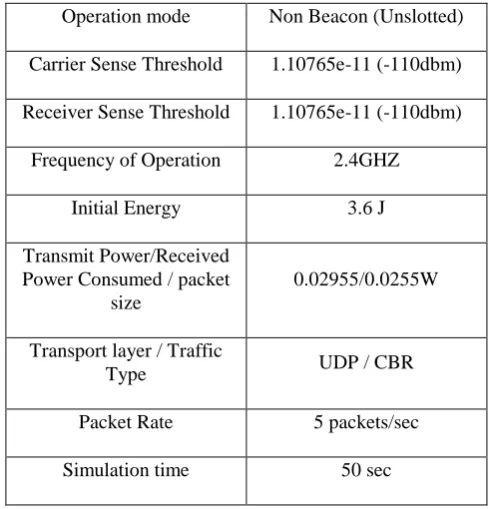
Table I shows the simulation parameters configured to all sensor nodes in NS2 operating in 2.4Ghz unlicensed band. Table II displays the path loss exponent and shadowing deviation values for indoor/outdoor environment based on log-normal shadowing model.
Table 1: Simulation Configuration Parameters in Ns2
Operation mode Non Beacon (Unslotted)
Carrier Sense Threshold 1.10765e-11 (-110dbm)
Receiver Sense Threshold 1.10765e-11 (-110dbm)
Frequency of Operation 2.4GHZ
Initial Energy 3.6 J
Transmit Power/Received Power Consumed / packet
size
0.02955/0.0255W
Transport layer / Traffic
Type UDP / CBR
Packet Rate 5 packets/sec
[image:3.595.309.554.49.304.2]Simulation time 50 sec
Table 2: Log normal Shadowing Model - Path loss
Nature of Environment
Outdoor
Free space 2
Shadowed urban area 2.7 to 5
Indoor (building)
Line-of-sight 1.6 to 1.8
[image:3.595.116.220.243.317.2]Obstructed 4 to 6
Table 3: Log normal Shadowing deviation
Nature of Environment
dB(dB)
Outdoor 4 to 12
Indoor, hard partition 7
Indoor, soft partition 9.6
Factory, line-of-sight 3 to 6
Factory, obstructed 6.8
Transmission Power Level value has a direct impact on the communication range of the node. There are three regions within the transmission range of a radio sensor node. The connected, transition and the disconnected regions. Log normal shadowing model helps to realistically model the probabilistic reception of packets within the transition region/ The connected region is till distance D1 which records good receptions and transition till distance D2 (D2>D1) where there is probabilistic reception. Beyond D2, there is no reception. D1 and D2 values are calculated based on path loss exponent and transmission power level chosen.
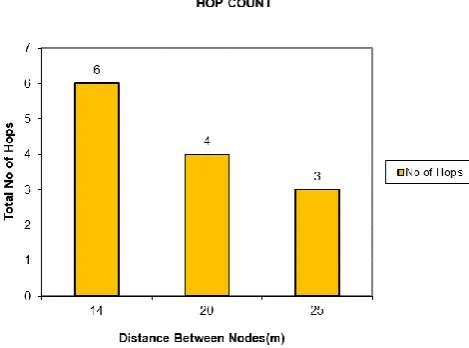
[image:3.595.131.205.346.465.2]from 15 to 28m using Pt 0dbm.Hence 3 different distance values are used in the placement of intermediate nodes between Source and Destination such as 14,20,25m.As the distance between the nodes increases the number of hops to reach the destination decreases. When intermediate nodes are placed 20m, it would take 4 hops to reach the destination as shown in Fig 4.
Fig 4. Total Number of Hops versus Intermediate Distance between Nodes
[image:4.595.67.302.143.317.2]The PDR factor is high when the nodes are placed at 14m as shown in Fig 5 as the node is placed in the connected region and hence is higher compared to those placed in the transition region. In the case of node placement at 25m which can be claimed to be at edge of communication range delivers at a poor rate due to weak link quality. Hence an optimal forwarding node should be in connected and transition region to provide a better and reliable progress neighbor towards the destination.
Fig 5. Packet Delivery Ratio versus Intermediate Distance between Nodes
Fig 6 shows the Average End to End Delay variation with the distance between the nodes. It is found to take more hops to reach the destination for minimum distance selection (14m) and hence more the delay. At the same time nodes placed at max distance(25m) takes less hops to reach destination and hence less delay. But practically, this will incur more delay due to retransmission at Mac Level for no acknowledgement of data. Hence to obtain an optimum
value of end-end delay is a challenge as it involves to forwarding neighbour node in transition region.
Fig 6. Avg End to End delay versus Intermediate Distance between Nodes
[image:4.595.324.555.454.615.2]The Normalized energy consumption calculation is shown below in Fig 7. Intermediate node placed closely at 14m takes more hops to reach the destination and hence more nodes [No of Hops + 1] participate in transmission and reception of data and route packets. Hence the normalized energy consumption per packet is higher. Though node placed at far away at the edge of communication range takes less nodes to participate in forwarding process, the energy incurred is higher than that placed at 20m, due to mac level retransmission of data due to no acknowledgement of data. Hence an optimum selection of node in the transition region is to be chosen.
Fig 7. Normalized Energy Consumption versus Intermediate distance between Nodes
B. SENSEnuts Hardware Platform – Testbed Experimentation Results
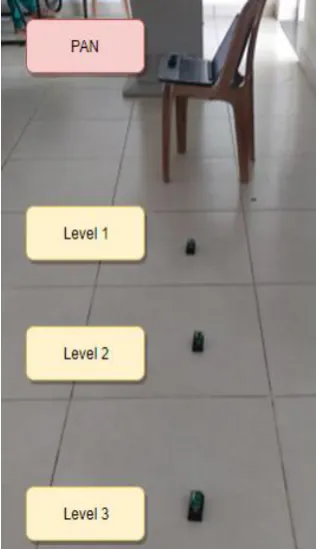
The experiment was performed in indoor environment as shown in sample Fig 8. A linear chain of SENSEnuts sensor motes was deployed in this experiment. The tasking node which periodically send the data was the node at the last level and the remaining nodes at previous level were only forwarder nodes. The
[image:4.595.55.300.487.658.2]International Journal of Innovative Technology and Exploring Engineering (IJITEE) ISSN: 2278-3075,Volume-8, Issue-5, 2019
[image:5.595.89.249.109.384.2]performing packet reception range testing experiment. The inter-separation distance between nodes is bounded to 10meters after this range testing. The tasking node was made to send data every 1 second and the experiment was recorded for 60 sensed data packet transmissions.
Fig 8 : Sample Test-bed Deployment – Linear Chain
Fig 9. Packet Delivery Ratio (%) vs Number of hops (Test-bed) – Linear chain.
The PAN coordinator (Gateway Sink) initiates the network with the tree formation procedure. During the tree formation phase, the depth or level is setup initiated by the PAN Coordinator. Instead of traditional flooding process which leads to implosion where redundant packets from higher level nodes are received which leads to energy wastage the forwarding nodes are put to sleep state after they complete their rebroadcast attempt. Once the tree is setup, the data tasking of nodes is performed. The experiment was repeated for each network size by increasing the number of linear chain of nodes. The routing protocol was inferred to scale well through unicast to previous level nodes by recording the PDR (%) for each network size as shown in Fig 9.
VII. CONCLUSION AND FURTHER WORK
This work focuses on a test bed real time implementation of multi-hop tree-based routing protocol design for large scale IoT based static WSN applications such as periodic monitoring or event driven IoT applications. The results shown in this work are for linear chain of nodes deployed and the PDR (%) is recorded as the network is scaled up more. It is imperative that due to short range and low power mode of operation, multi-hop routing becomes a necessity. Due to channel lossy characteristics, more the network scales up there is drop in the packet delivery ratio. A realistic log normal shadowing model is used for simulation to compare with the real time test bed results. The further work is to extend the experiment in a grid deployment to increase the choice of parent selection and record the packet delivery ratio when forwarding parent selection is based on LQI metric for large scale environment.
REFERENCES
1. C. Li, H. Zhang, B. Hao, and J. Li, “A Survey on routing protocols for large-scale wireless sensor networks,” Sensors, vol. 11, no. 4, pp. 3498–3526, 2011.
2. G. Khanna and S. K. Chaturvedi, “A Comprehensive Survey on Multi-hop Wireless Networks: Milestones, Changing Trends and Concomitant Challenges”, Wireless Personal Communications, Vol. 101, No. 2, pp. 677–722, 2018
3. B. Fu, Y. Xiao, H. J. Deng, and H. Zeng, “A survey of cross-layer designs in wireless networks,” IEEE Commun. Surv. Tutorials, vol. 16, no. 1, pp. 110–126, 2014.
4. P. Baronti, P. Pillai, V. W. C. Chook, S. Chessa, A. Gotta, and Y. F. Hu, “Wireless sensor networks: A survey on the state of the art and the 802.15.4 and ZigBee standards,” Comput. Commun., vol. 30, no. 7, pp. 1655–1695, 2007.
5. N. Sabor, S. Sasaki, M. Abo-Zahhad, and S. M. Ahmed, “A comprehensive survey on hierarchical-based routing protocols for mobile wireless sensor networks: Review, taxonomy, and future directions,” Wirel. Commun. Mob. Comput., vol. 2017, 2017. 6. A. A. Ahmed, “An enhanced real-time routing protocol with load
distribution for mobile wireless sensor networks”, Computer Networks, Vol. 57, No. 6, pp. 1459–1473, 2013.
7. K. Wolosz, U. Bodin, and L. Riliskis, “A measurement study for predicting throughput from LQI and RSSI,” Lect. Notes Comput. Sci. (including Subser. Lect. Notes Artif. Intell. Lect. Notes Bioinformatics), vol. 7642 LNCS, pp. 89–92, 2012.
8. N. Baccour, A. Koubâa, H. Youssef, and M. Alves, “Reliable link quality estimation in low-power wireless networks and its impact on tree-routing,” Ad Hoc Networks, vol. 27, no. November, pp. 1–25, 2015. 9. SENSEnuts Radio Platform – User Manual Datasheet
http://www.eigen.in/pdf/sensenutsuniversity.pdf
10. Agarwal, Smriti, Ashish Payal, and B. V. Reddy. "Design and Implementation of Medium Access Control Based Routing on Real Wireless Sensor Networks Testbed." International Journal of Computer, Electrical, Automation, Control and Information Engineering, Vol 11, No. 6 , 2017, pp.671-679.
11. D.B. Johnson and D.A. Maltz, “Dynamic source routing in ad hoc wireless networks”, Mobile Computing, Kluwer Academic Publishers, pp. 153–181,1996.
12. Perkins, Charles E., and Elizabeth M. Royer. "Ad-hoc On-demand Distance Vector Routing." In proceedings of the 2nd IEEE Workshop on Mobile Computing Systems and Applications, pp. 90-100, 1999 . 13. Young-Bae Ko and Nitin H. Vaidya, “Location-aided routing (LAR) in
[image:5.595.53.285.421.571.2]14. B. Karp and H.T. Kung, “GPSR: Greedy perimeter stateless routing for wireless networks”, In Proceedings of the 6th annual international conference on Mobile computing and networking, ACM MOBICOM, 2000, pp. 243–254.
15. Ns2 simulatorwww.isi.edu/nsnam/ns
AUTHORSPROFILE
Jayavignesh Thyagarajan is a faculty in Vellore
Institute of Technology (VIT), Chennai, India. His research interests include Routing Protocols Design, Analysis of Medium Access Protocols and Congestion Control mechanism in the area of Wireless Adhoc, Sensor, Mesh, Vehicular and Opportunistic networks. He acquired his Masters in Engineering from Madras Institute of Technology, Anna University and secured First Rank with a Gold medal in Communication and Networking program. He obtained his Bachelors in Engineering degree in Electronics and Communication from College of Engineering, Guindy, Chennai
Dr. K. Suganthi received the B.E. degree in
Computer Science and Engineering from Madras University in 2001, M.Tech degree in Systems Engineering and Operations Research and Ph.D in Wireless Sensor Network from the Anna University in 2006 and 2016 respectively. She is currently working as Assistant Professor (Senior) in the School of Electronics Engineering (SENSE) at VIT University Chennai campus, India since 2016. She is the author of about 10 scientific publications on journals and International conferences. Her research interests include Wireless Sensor Network, Internet of Things, Data Analytics and Network Security.