Page 3, the last line. In the sentence stating “Similarly, other domestic factors..
the words “and increases in unskilled labour productivity” are deleted.
Page 16, the last line. In the sentence stating “This means that the FPE Theorem....”,
the following words are appended at the end of the sentence: “when countries
move from autarky to free trade”.
Page 30, fourth paragraph. The second sentence (stating “Moreover, Wood’s ...”) is
amended to read: “This, coupled with Wood’s observations that wage gaps in
the East Asian ‘tiger’ economies appear to have fallen after they liberalised
their economies, seems to be consistent with the Stolper-Samuelson
Theorem”. The third sentence (stating “This suggests ...”) is deleted.
Page 32, second paragraph. The first sentence is amended to read “Freeman (1995)
doubts the relevance of the factor price equalisation theorem in explaining
widening wage inequality between skilled and unskilled labour in developed
countries. He also questions the assertion that trade acts to link labour
markets, even when the traded share of GDP is small.”
Page 33, first paragraph. In the last sentence (stating “Therefore, they conclude ...”),
the words “that this employment ratio shift suggests” are deleted.
Page 40, third paragraph. The seventh sentence (stating “This policy was finally
abandoned ...”) is deleted.
Page 47, fourth paragraph. The end of the second sentence is corrected as “... and an
increasingly unequal distribution of income (Adelman, 1984).”
Page 70, third paragraph. The end of the first sentence is amended to “... and it
retains the assumption of homogeneous products.”
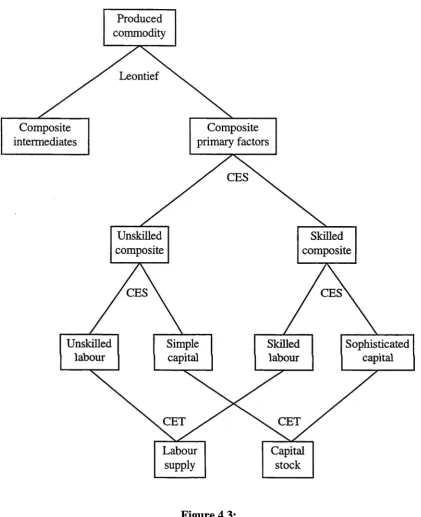
Page 78, second paragraph. The existing paragraph is deleted and replaced by:
“To take into account the possibility of the existence of a dual labour market in the
developing region, as discussed in Chapter 3, a dual labour market closure is
used in each model simulation in addition to the standard integrated labour
market closure. This dual labour market closure is implemented by first
disabling the CET system whereby households transform labour between
skilled and unskilled. The supply of skilled labour is then made exogenous
and held constant while the wage of skilled labour remains endogenous. The
supply of unskilled labour is made endogenous and its wage is made
exogenous. This extreme specification implies that the traditional sector
comprises subsistence households able to relinquish labour at a reservation
wage without impact on their output.10”
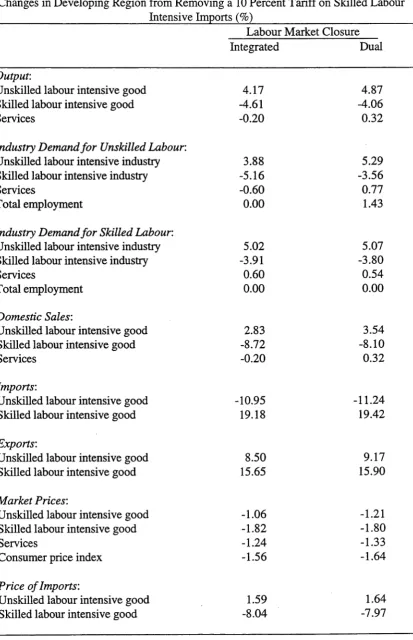
Page 80, Table 4.3. The title of this table is changed to read “Changes in Real Unit
Factor Rewards in the Developing Region from Removing a 10 per cent Tariff
on Skilled Labour Intensive Imports (%)”.
Page 155, third paragraph. In the third sentence (stating “In addition, with critical
values . . the words “ accept the null hypothesis” are replaced by “fail to
reject the null hypothesis”.
Page 185, second paragraph. The fourth sentence is replaced by “The first is to
replicate the effects of globalisation on Indonesian labour markets. It is
implemented by simulating observed shocks, and then using the results to
apportion significance to each component globalisation shock.”
Page 203, first paragraph. The following sentences are added at the end of the
paragraph: “Meanwhile, land is a specific factor in the primary sector. Since
the output of this sector declines, the real return to land also declines.”
Asep Suryahadi
July 1999
The Case of Indonesia
Asep Yadi Suryahadi
A thesis submitted for the degree of Doctor of Philosopy
of The Australian National University
National University, it is affirmed that, unless otherwise stated, the work that follows is
my own.
ACKNOWLEDGMENTS
During the process of writing this thesis, I accumulated debts to many people.
The largest one, however, is to Rod Tyers, my thesis supervisor. His mastery on the
subject has been instrumental in keeping me focused on the question being analysed. His
expertise on International Trade and Applied General Equilibrium has been very helpful
in identifying the errors I made in my research. Another large contribution to the process
of writing this thesis has been given by Paul Chen, one of my thesis adviser. His
outstanding knowledge on Labour Economics as well as on Econometrics has guided me
through the cumbersome data analysis. I am also indebted to Chris Manning, my another
thesis adviser. His exclusive knowledge on the Indonesian labour market has helped me
understand the facts better.
Outside my thesis supervisory committee, a person to whom I owe much is Kelly
Bird, a fellow PhD scholar at the Australian National University (ANU). With his help, I
was able to obtain access to a substantial part of the data I use in this thesis. In relation
to this, I would like to thank the Social Science Data Archive at the Research School of
Social Sciences, ANU, for allowing me to use the Indonesian Manufacturing Survey data
base. In addition, I also would like to thank the International Economic Data Bank at the
Research School of Pacific and Asian Studies, ANU, for providing me an access to their
data bases.
This thesis has benefited much from the comments and suggestions raised during
discussions and seminars at the ANU, the University of Western Australia, and the
Athukorala, Ross McLeod, Kym Anderson, Allan Woodland, as well as many other
people who are too numerous to mention.
Administrative support from Zann Miranda and computer support from Christina
Jankovic, both of the Department of Economics, Faculty of Economics and Commerce,
ANU, are thankfully acknowledged.
I am very grateful to my wife, Nancy Haulussy, who has accompanied me
patiently and supported me without reservation during my writing of this thesis. Last but
not least, my sincere appreciation for my parents who always include me and my well
In the past two decades, economic ties between developed and developing
countries have increased. In the developed countries, meanwhile, the labour market
performance of unskilled workers has deteriorated. In some, their rate of unemployment
has risen, while in others their real wage has declined either absolutely or relative to that
of skilled workers. Openness and technological change are most commonly seen as the
causes of this poor labour market performance. Both openness and technological change
have also been important in developing countries over this period, though their labour
market impacts have been less widely studied.
This thesis addresses the issue in three parts. First, the contributions of modem
trade theory are reviewed. The standard Heckscher-Ohlin-Samuelson (HOS) framework
is extended to multiple goods and factors and intra-industry trade is accommodated via
differentiation of home from imported products. These extensions alone have been found
to dilute the strong labour market effects of trade shocks in the HOS framework. Their
examination, however, requires the use of numerical analysis in a stylised computable
general equilibrium model. This approach is then extended to examine characteristics
common amongst developing countries, including the relative abundance of unskilled
labour.
A key result of this exercise concerns the HOS prediction that openness should
benefit unskilled workers in developing countries. If unskilled workers are very abundant
and their elasticity of supply very large, then this prediction no longer holds. Trade and
technology shocks of the type observed in recent decades then all result in increasing
that uses skilled workers more intensively than the economy as a whole, raises the skilled
relative to the unskilled wage. This is so even if both types of labour are inelastic in
supply to the economy as a whole and even if there is no associated technology change.
Second, a case study of the Indonesian manufacturing sector is carried out. Of
particular significance in Indonesia is the transition from inward looking to outward
looking trade and regulatory regimes that occurred during the mid 1980s. The case study
uses a highly detailed data set covering manufacturing industries. It facilitates an
examination of the association between the relative demand for skilled and unskilled
workers and such determinants of change as overall economic openness, the trade
orientation of domestic firms, foreign ownership, and the rate of capital accumulation at
the firm level. The results show that openness and foreign ownership, by themselves,
have acted to raise the relative demand for unskilled workers, while the newness of
capital is associated with increased relative demand for skilled workers. Overall, the
relative demand for unskilled workers has slightly increased, but the relative wage of
unskilled workers has declined. This is seen as due to the greater elasticity of supply of
unskilled workers previously engaged in other sectors.
Third, a more indicative multi-region computable general equilibrium model is
developed to examine Indonesia's trade regime and its labour markets further. Results
from the empirical analysis enable the estimation of the labour market impacts of shocks
to trade policy, the capital stock, and technology to be examined individually and
collectively. Clearly dominant in affecting wage inequality in Indonesia is total factor
productivity growth. This strong role of total factor productivity gains is distinctive,
considering the prevailing view that East Asia's strong growth was driven primarily by
Finally, the same model is used to examine possible policy measures to reduce
growth-induced wage inequality, including a return to some trade protection and the use
of domestic taxes and subsidies. All are found to be costly to the economy as a whole
and most to unskilled workers. The last piece of analysis addresses the Asian financial
crisis and its effects on Indonesian labour markets. The effects of contractionary shocks
prove the opposite of the growth-related shocks of the previous decade. All workers are
made worse off, the unskilled less so. Raising the elasticity of skilled labour supply
through education, training, and migration is seen as the best approach to addressing the
LIST O F C O N TEN T
Page
LIST OF TABLE xiv
LIST OF FIGURE xx
Chapter 1: INTRODUCTION 1
Background 1
Thesis Objectives and Main Results 5
Thesis Outline 7
Chapter 2: TRADE SHOCKS AND LABOUR MARKET ADJUSTMENTS:
THE THEORY AND STYLISED FACTS IN DEVELOPED
COUNTRIES 10
The Heckscher-Ohlin-Samuelson Model 10
Pattern of Trade: The Heckscher-Ohlin Theorem 11
The Factor Price Equalisation Theorem 13
Product and Factor Prices: The Stolper-Samuelson
Theorem 18
Factor Endowment Change: The Rybczynski Theorem 22
Generalisation of the HOS Model 26
The Stylised Facts and Debate in Developed Countries 27
The Trade Explanation 30
The Technology Explanation 33
Page
Chapter 3: THE SPECIAL CASE OF DEVELOPING COUNTRIES:
LABOUR MARKET OUTCOMES OF OPENNESS 39
Labour Market Outcomes of Openness 39
The Newly Industrialising Countries 40
South-East Asia 42
Latin America 43
The Sources of the Differences 45
Development Strategy 46
Labour Supply Characteristics 48
Theoretical Frameworks Alternative to HOS 51
The Dual Labour Market Theory 51
The Efficiency W age Theories 57
Technology-Neutral Capital Inflow 58
Embodied Skill-Intensity in Imported Capital 59
Technology Transfer Through Trade 62
Skill-Biased Technological Change 62
Supply-Side Factors 63
Chapter 4: QUANTITATIVE EXTENSIONS TO THE THEORY:
A STYLISED GENERAL EQUILIBRIUM APPROACH 67
Previous Quantitative General Equilibrium Studies of Labour
Market Effects 69
A Stylised Global Database 71
Page
Openness and Technological Change Shocks 78
Trade Liberalisation 79
Neutral Technological Change 82
Biased Technological Change 85
Increase in Capital Endowment 88
An Alternative Model 91
Hypotheses on Wage Inequality in Developing Countries 96
Chapter Appendix 97
Key Equations of the Model 97
Data Base and Parameter Values 100
Simulation Results 102
Chapter 5: THE CASE OF INDONESIA’S MANUFACTURING SECTOR:
TRADE AND INVESTMENT LIBERALISATION AND THE
EVOLUTION OF THE LABOUR MARKET 110
Background: The Evolution of the Economy 111
Growth Phases 111
Structure of the Economy 113
Labour Market Development 116
Review of Data 117
Trends in the Indonesian Labour Market 118
Wages and Employment of Non-Production and
Production Workers 119
Page
Trends in Relative Supply and Demand 125
Trend in Relative Supply 125
Trend in Relative Demand 127
Openness 127
Technological Change 132
Concluding Remarks 137
Chapter 6: ESTIMATING THE EFFECTS OF OPENNESS AND
TECHNOLOGICAL CHANGE ON SKILLED AND
UNSKILLED LABOUR RELATIVE DEMAND: AN
INTERRELATED FACTOR DEMAND ANALYSIS 139
Trade or Technology: Review of Empirical Studies 140
Import Competition 140
Export Expansion 143
Technological Change 144
Outsourcing and Foreign Investment 147
Review Summary 148
An Interrelated Factor Demand Model 148
Data and Estimations 153
Direction of the Relative Labour Demand Effect 157
Export Expansion 15 8
Import Competition 161
New Capital 162
Page
Magnitude of the Relative Labour Demand Effect 164
Concluding Remarks 167
Chapter Appendix 170
Chapter 7: GLOBALISATION AND WAGE INEQUALITY IN
INDONESIA: A GLOBAL CGE APPROACH 185
The Model and Database 186
Replicating the Effects of Globalisation on Wage Inequality 194
Trade Liberalisation 195
Capital Accumulation 198
Technological Change 199
The Cumulative Effects 203
Possible Policy Responses to Globalisation 208
New Protectionism 209
Tax or Subsidy on Capital 211
Labour Supply Response 212
Special Case: The Asian Economic Crisis 215
Concluding Remarks 219
Chapter Appendix 220
The Data Base 220
Parameter Values Used in The Model 222
Simulation Results 224
Page
THESIS APPENDIX
249
Tablo Input File of the Basic Model
249
Tablo Modification for the Alternative Model
290
ABBREVIATIONS AND ACRONYMS
294
LIST OF TABLE
Page
Table 4.1:
Distribution of Value Added in Each Region in the Identical
Two-Region Data Base (%)
72
Table 4.2:
Distribution of Value Added in the Stylised Global Data Base
(%)
73
Table 4.3:
Changes in Real Factor Returns in Developing Region from
Removing a 10 Percent Tariff on Skilled Labour Intensive
Imports
( % )80
Table 4.4:
Changes in Real Factor Returns in Developing Region from a 10
Percent Neutral Technological Progress in Unskilled Labour
Intensive Industry (%)
83
Table 4.5:
Changes in Real Factor Returns in Developing Region from a 10
Percent Less Demand for Unskilled Labour in the Unskilled
Labour Intensive Industry (%)
86
Table 4.6:
Changes in Real Factor Returns in Developing Region from a 10
Percent Increase in Capital Stock (%)
89
Table 4.7:
Changes in Real Factor Returns in Developing Region from
Various Shocks Using the Alternative Model
95
Table A4.1:
Parameter Values in the Basic Model
100
Table A4.2:
Distribution of Value Added in the Data Base for the Alternative
Model (%)
101
Page
Table A4.4:
Changes in Developing Region from Removing a 10 Percent
Tariff on Skilled Labour Intensive Imports (%)
102
Table A4.5:
Changes in Developing Region from a 10 Percent Neutral
Technological Progress in Unskilled Labour Intensive Industry
(%)
104
Table A4.6:
Changes in Developing Region from a 10 Percent Less Demand
for Unskilled Labour in the Unskilled Labour Intensive Industry
(%)
106
Table A4.7:
Changes in Developing Region from a 10 Percent Increase in
Capital Stock (%)
108
Table 5.1:
Shares of Agriculture, Industry, and Services Sectors in
Indonesian GDP, 1971-95 (%)
114
Table 5.2:
Shares of Agriculture, Industry, and Services Sectors in
Employment in Indonesia, 1971-95 (%)
115
Table 5.3:
Proportion of Exports and Imports to GDP in Indonesia,
1971-95 (%)
116
Table 5.4:
Nominal and Effective Rates of Protection in Indonesian
Manufacturing, 1987 and 1995 (%)
129
Table 6.1:
Openness and Technological Change Indicators’ Coefficient
Differences on Skilled and Unskilled Labour Cost Share
Equations
159
Table 6.2:
Magnitude of Openness and Technological Change Indicators’
Page
Table A6.1:
List of Industries Included in The Estimation
170
Table A6.2:
Estimation Results for All Industries, 1975-93
174
Table A6.3:
Estimation Results for All Industries, 1975-86
175
Table A6.4:
Estimation Results for All Industries, 1986-93
176
Table A6.5:
Technology Grouping of Industries
177
Table A6.6:
Estimation Results for Higher Technology Industries, 1975-86
178
Table A6.7:
Estimation Results for Lower Technology Industries, 1975-86
179
Table A6.8:
Estimation Results for Higher Technology Industries, 1986-93
180
Table A6.9:
Estimation Results for Lower Technology Industries, 1986-93
181
Table A6.10: Means and Standard Deviation of Variables in Estimation
182
Table 7.1:
Regions, Industries, and Primary Factors in the Model Structure
190
Table 7.2:
Proportion of Skilled Labour Payments from the Total Labour
Payments or Proportion of Sophisticated Capital Payments from
the Total Capital Payments
191
Table 7.3:
Distribution of Value Added in Data Base for the Indonesian
Region (%)
192
Table 7.4:
Indonesia’s Direction of Trade, 1992 (%)
193
Table 7.5:
Indonesia’s Tariff Structure (%)
196
Table 7.6:
Changes in Real Factor Returns in Indonesian from Trade
Liberalisation (%)
196
Table 7.7:
Changes in Real Factor Returns in Indonesia from a 15 Percent
Increase in Simple Capital Stock and a 14 Percent Increase in
Page
Table 7.8: Changes in Real Factor Returns in Indonesia from Technological
Change in Manufacturing Industries (%) 202
Table 7.9: Changes in Real Factor Returns in Indonesia from Combination
of S h o ck s(%) 204
Table 7.10: The Effects of Trade Liberalisation, Capital Accumulation,
Technological Change, and Their Combination on Changes in
Real Factor Returns and Wage Inequality (%) 206
Table 7.11: Contributions of Trade Liberalisation, Capital Accumulation,
and Technological Change on the Cumulative Changes in R.eal
Factor Returns (%) 207
Table 7.12: Changes in Real Factor Returns in Indonesia from a 10 Percent
Increase in the Power of Tariff in Primary, Unskilled
Manufacturing, and Both Industries (%) 210
Table 7.13: Changes in Real Factor Returns in Indonesia from a 10 Percent
Increase Tax on the Use of Sophisticated Capital and a 10
Percent Subsidy on the Use of Simple Capital in Primary and
Unskilled Manufacturing Industries (%) 212
Table 7.14: Changes in Real Factor Returns in Indonesia from Labour
Supply Responses to Increased W age Inequality (%) 214
Table 7.15: Changes in Real Factor Returns in Indonesia from the Asian
Crisis (%) 218
Page
Table A7.2: Substitution Parameter in The CDE Minimum Expenditure
Function 222
Table A7.3: Expansion Parameter in The CDE Minimum Expenditure
Function 222
Table A7.4: Substitution Elasticities in Final and Intermediate Demand 222
Table A7.5: Regional Specific Parameter 223
Table A7.6: Substitution Elasticites in Production 223
Table A7.7: Changes in the Indonesian Region from Trade Liberalisation (%) 224
Table A7.8: Changes in the Indonesian Region from a 15 Percent Increase in
Simple Capital Stock and a 14 Percent Increase in Sophisticated
Capital Stock(%) 226
Table A7.9: Changes in the Indonesian Region from Technological Change in
Manufacturing Industries (%) 228
Table A 7.10: Changes in the Indonesian Region from Combination of Shocks
(%) 230
Table A 7 .11: Changes in the Indonesian Region from a 10 Percent Increase in
the Power of Tariff in Primary, Unskilled Manufacturing, and
Skilled Manufacturing Industries (%) 232
Table A 7.12: Changes in the Indonesian Region from a 10 Percent Increase in
the Power of Tax on the Use of Sophisticated Capital and a 10
Percent Increase in the Power of Subsidy on the Use of Simple
Table A7.13:
Table A7.14:
Page
Changes in the Indonesian Region from Labour Supply
Responses to Increased Wage Inequality (%) 236
LIST OF FIGURE
Page
Figure 2.1: The Pattern of Trade
12
Figure 2.2: Factor Price Equalisation
17
Figure 2.3: The Stolper-Samuelson Theorem
21
Figure 2.4: The Rybczynski Theorem
24
Figure 3.1: Wage Determination for Unskilled Labour in a Dual Labour
Market
53
Figure 4.1: Demand Structure
75
Figure 4.2: Supply Structure
77
Figure 4.3: Supply Structure in the Alternative Model
92
Figure 5.1: Average Real Wage of Production and Non-Production Workers
in Indonesian Manufacturing, 1975-93 (Rp. 1,000 per year, 1990
prices)
121
Figure 5.2: Employment of Production and Non-Production Workers in
Indonesian Manufacturing Sector, 1975-93 (1,000 workers)
121
Figure 5.3: Wage Ratio (left axis) and Employment Ratio (right axis) of
Non-Production to Non-Production Workers in Indonesian Manufacturing,
1975-93
122
Figure 5.4: Coefficient of Variations of All, Production, and Non-Production
Page
Figure 5.5: Ratio of High School and Above to Below High School Graduates
(left axis) and Ratio of University to Below University Graduates
(right axis) in the Indonesian Labour Force, 1975-93 126
Figure 5.6: Export Intensity and Import Penetration Ratios (left axis) and
Index of Real Output (right axis) in Indonesian Manufacturing,
1975-93 130
Figure 5.7: Proportions of Investment and New Capital in the Total Capital
Stock in Indonesian Manufacturing Sector, 1975-93 134
Figure 5.8: Proportions of the Number of Firms (left axis) and Output (right
axis) of Multinational Corporations in Indonesian Manufacturing
Sector, 1975-93 135
Figure 6.1: Demand Increases and Changes in Employment and W ages of
Skilled and Unskilled Labour 168
Figure 7.1: Demand Structure 187
Chapter 1:
INTRODUCTION
Background
Increasing openness and globalisation have broadened economic links between
developed and developing countries in the last three decades. Flows of goods and
services between the two country groups have intensified. According to World Bank
(1995a), the movement of goods and services across borders grew from 23 percent of
world Gross Domestic Product (GDP) in 1970 to 40 percent in 1990. Not only have the
magnitudes of the flows risen, but also their patterns have changed. During the 1950s
and 1960s, developing countries were mainly exporting primary products to developed
countries, while developed countries were exporting manufactures and services to
developing countries. Meanwhile, the flow of financial capital during that period was
predominantly in the form of development aid from developed to developing countries.
After three decades of change, the pattern of flows has become more
complicated. Developed countries’ exports to developing countries still mostly consist of
manufactures, especially capital goods, and services. Developing countries, however, no
longer rely on primary product exports. Their exports are now mostly manufactures too,
albeit the simpler ones. Meanwhile, their role on services trade has also increased.
Furthermore, the flow of financial capital is now much more diversified. Foreign direct
investment, portfolio investment, as well as commercial loans have joined development
aid as the common forms of financial flow from developed to developing countries. In
the course of five years from 1989 to 1994, net private capital flow to developing
developing countries have been able to reverse the direction of the capital flow, mainly
for investment purposes. Hence there is now a two-way flow of financial capital between
the two country groups.
The main causes of these changes in international flows of goods and services
appear to be twofold. The first is technological progress, where advances in
transportation and communication technologies have facilitated the increasing flows of
goods and services across country boundaries. The second is more open commercial
policy, the trend toward which has continued amongst developed countries since World
W ar II and more recently amongst developing countries.
The effects of this globalisation on labour markets in developed countries have
gained considerable attention recently. This is because two related phenomena have
occurred in developed economies simultaneously with the intensifying international
economic ties. In countries with regulated labour markets, unemployment has increased
among unskilled workers. In others, there has been a widening of wage inequality
between skilled and unskilled workers (Davis, 1996). Increasing unemployment among
unskilled labour has been typical in continental Europe, while a combination of increased
unemployment and wage inequality has been observed in Australia, Canada, the United
Kingdom and, most prominently, the United States (World Bank, 1995a).
There is an ongoing debate as to the size of the contribution of openness and
globalisation in explaining this poor performance of unskilled workers in developed
countries. One side of the debate puts the contribution of increasing trade with
developing countries as very substantial (Learner, 1994; Sachs and Shatz, 1994; W ood,
1994 and 1995). Their argument emphasises standard international trade theory.
developing countries, while developing countries export goods which are intensive in
unskilled labour to developed countries. In developed countries, as this trade expands,
industries that are intensive in unskilled labour shrink, while industries which are
intensive in relatively abundant skilled labour and capital expand. As a result, demand for
unskilled labour decreases relative to skilled labour, pushing the skilled to unskilled wage
ratio up. This explains the widening wage inequality between skilled and unskilled
workers and, where unskilled labour wages are regulated above market clearing levels,
the rise in unemployment.
In addition, Rodrik (1997, pp. 4, 12) argues that globalisation has not only
reduced the demand for unskilled labour, but also makes the demand more elastic. The
reason is because globalisation makes the services of labour in one country more easily
substituted for the services of labour in other countries, either through trade
(outsourcing) or through foreign direct investment (FDI).
The other side of the debate argues that spontaneous technological change is the
main cause of the demise of unskilled labour, while the role of increasing openness and
globalisation is minimal (Baldwin, 1994; Berman et al, 1994; Johnson, 1997; Krugman
and Lawrence, 1994; Lawrence and Slaughter, 1993). The proponents of this view
believe that the reasons for the labour market problems in the developed countries he
mostly in their domestic economies. In their view, manufacturing employment is falling
because companies are replacing workers with machines and making more efficient use
of those they retain. Meanwhile, wages have stagnated because the rate of productivity
growth in the economy as a whole has slowed, and unskilled labour in particular is
suffering because a high-technology economy has less and less demand for its services.
increases in unskilled labour productivity, have been much more important in influencing
the changes in total domestic employment than substitution of imports for home
products.
If globalisation and technology change have important implications for developed
countries, then they clearly have important implications for developing countries too.
However, their effects on labour markets in the developing countries have not yet been
well researched. In contrast to the substantial volume of analysis in the industrial country
context, relatively little careful work has been done on these issues in developing
countries (Diwan and Walton, 1997).
The standard international trade theorems, derived from the Heckscher-Ohlin-
Samuelson (HOS) model, predict that openness should be beneficial for unskilled labour
in developing countries. The decline of barriers to trade has allowed them to realise their
comparative advantage in unskilled labour intensive goods. The domestic terms of trade
shifts in favour of unskilled labour intensive sectors and so, by the Stolper-Samuelson
theorem, the wage of unskilled labour rises relative to product prices and the wage of
skilled labour.
Much of the empirical work on this subject (Diwan and Walton, 1997; Gonzalez
and McKinley, 1997; Pissarides, 1997; Robbins, 1996a and 1996b; Tan and Batra, 1997;
W ood, 1997a) show mixed results on the labour market outcomes of openness in
developing countries, however. Wood (1997a), for example, finds that although trade
liberalisation in the East Asian countries during the 1960s and 1970s caused reduced
wage equality between skilled and unskilled labour, the experience of the Latin American
countries in the 1980s and early 1990s offers contradictory evidence. He argues that the
into world markets for manufacture starting in the late 1970s, which in effect
substantially increased the world’s supply of unskilled labour.
Thesis Objectives and Main Results
The preliminary work on openness and labour markets in developing countries
leaves numerous questions unresolved. New research is required that incorporates more
developing countries at various stages of development. The general objective of this
thesis is, therefore, to contribute to the understanding of how openness and globalisation
affect labour markets in developing countries, both theoretically as well as empirically.
The theoretical part of this general objective is pursued by incorporating developing
country labour market characteristics into the standard HOS model using a stylised
global data base in a computable general equilibrium (CGE) framework. The specific
objective is to identify departures from HOS predictions associated with incorporating
the developing country labour market complications.
Generalisations to include multiple products and factors and some product
differentiation are found not to alter the standard trade theorems’ qualitative predictions.
The stylised parameters used do, however, yield in the model a muting of the factor
market effects of trade shocks relative to HOS predictions. These results are consistent
with Falvey et al (1995). More substantial divergences from HOS predictions do occur,
however, when a dual labour market is imposed by rendering perfectly elastic the supply
of unskilled labour. With this type of labour market, most trade and technology shocks
lead to increasing wage inequality between skilled and unskilled labour.
The empirical part of the general objective, meanwhile, is achieved by using
been the forefront of increasing openness in the Indonesian economy. If openness has any
effect on the labour market, it will be most apparent in this sector. The specific objective
of this empirical analysis is to establish the trends in skilled to unskilled labour relative
employment and wages in this sector and to account for the effects of openness and
technological changes on these trends.
The results show that since Indonesia shifted its development strategy from
import substitution to export orientation in the mid 1980s, there is a tendency for the
employment of unskilled labour relative to the skilled to increase, but the unskilled wage
relative to the skilled wage decreases. Further analysis indicates that greater openness in
a developing country increases the relative demand for unskilled labour. Increasing
foreign participation also leads to higher relative demand for unskilled labour, because
multinational corporations come to developing countries precisely to exploit the
abundance of unskilled labour by investing in unskilled labour intensive industries. The
only opposing force to this trend is the newness of capital stock. It tends to increase the
relative demand for skilled labour.
The increase in the relative employment for unskilled labour is thus driven both
by greater openness and increasing foreign participation. Because Indonesia is still in the
labour surplus phase, however, skilled labour is relatively inelastic in supply and so the
wages of skilled labour still increase faster than those of the unskilled, resulting in the
observed widening wage inequality.
In addition, a decomposition of the factors affecting wage inequality is carried
out using a CGE framework which is applied to a global data base, in which Indonesia is
identified. The results indicate that productivity growth has been dominant in explaining
responses to globalisation and technological change is carried out using the same
framework. The results show that the only constructive policy objective to mitigate
widening wage inequality is to enhance the labour supply response. A reversal of trade
liberalisation or tax and subsidy policies directed at raising demand for unskilled labour
are either ineffective or bear negative welfare consequences for the economy.
Thesis Outline
The first part of Chapter 2 reviews the trade theorems derived from the HOS
model, which provide a link between trade shocks and changes in factor markets. The
second part of the chapter reviews the relatively recent theoretical and empirical work on
the subject. Since these studies are mostly conducted with application to developed
countries, it is not surprising that their conclusions are not directly applicable to
developing countries.
Chapter 3 considers the special case of developing countries. The first part of this
chapter addresses the available findings on the effects of trade shocks on developing
country labour markets. Quite a variety of different patterns are observed and the
discussion concentrates on the development strategies adopted as well as different labour
supply behaviour in each country as possible explanations. The second part of this
chapter reviews developing country labour market theories.
In Chapter 4, the alternative theories of labour market adjustment to trade and
technology shocks in developing countries are explored in a stylised global computable
general equilibrium (CGE) framework. The model used has two regions with one
representing developing countries as a block and the other for developed countries.
technological change shocks are applied, hypotheses about the effects of these shocks are
established.
The thesis turns to the case study of Indonesia in Chapter 5. Indonesia is clearly
an interesting case to be studied, mainly because of its apparent development strategy
shift from inward-looking import-substitution to outward-looking export-orientation in
the mid 1980s. It therefore presents an opportunity to observe the effects of this shift on
wages and the employment of various types of labour. Using data from the
manufacturing sector, trends in skilled-unskilled labour relative employment and wages
are established. So are the trends in various openness and technological change
indicators.
In Chapter 6, using an econometric analysis, the effects of openness and
technological change indicators are accounted for explaining the observed trends in
skilled-unskilled labour relative employment and wage as established in Chapter 5. This
is done through an interrelated factor demand analysis using input cost shares model,
which is derived from a translog cost function. Hence, the analysis does not directly
assess the relative employment and wages of skilled and unskilled labour, instead it
focuses on their relative demand.
In the first part of Chapter 7, the contribution of trade liberalisation, capital
accumulation, and technological change on wage inequality is decomposed. This is
carried out in a global CGE framework, where Indonesia is identified as a distinct region
in the model. In the second section, the model is used to analyse possible policy
responses to globalisation and technological change. In addition, a special section
analysing the labour market effects of the Asian economic crisis is supplemented in this
Chapter 2:
TRADE SHOCKS AND LABOUR MARKET ADJUSTMENTS:
THE THEORY AND STYLISED FACTS IN DEVELOPED COUNTRIES
The first section of this chapter reviews the Heckscher-Ohlin-Samuelson (HOS)
model and the theorems derived from it. This model is important in understanding the
relationships between trade in goods and developments in the labour market because it is
the simplest relevant model that links changes in open product markets with changes in
factor markets in a general equilibrium framework. In the second section, the stylised
facts of current labour market changes in developed countries and the subsequent
debates on the explanations of these changes are discussed. Understandably, many of the
arguments in these debates are derived from the interpretation of the HOS model and its
theorems.
The Heckscher-Ohlin-Samuelson Model
As the review by Burtless (1995) asserts, the most commonly invoked
international trade theory to explain the link between trade and the labour market is the
two-region two-sector two-factor HOS model of the world economy. This model is a
general equilibrium framework which assumes that the two factors of production have
fixed supplies and both are perfectly mobile domestically but completely immobile
internationally. All agents are price takers in both product and factor markets. The two
regions have identical technologies and consumers in both regions have identical
homothetic preferences. Four theorems stem from the HOS model: the Heckscher-Ohlin
Stolper-Samuelson theorem on the relationship between product prices and factor prices, and the
Rybczynski theorem on changes in factor supply or endowment. These theorems
together can be used to predict the effects of international trade on labour markets both
in developed and developing countries.
Pattern o f Trade: The Heckscher-Ohlin Theorem
The Heckscher-Ohlin (HO) theorem states that with free trade, a region exports
the good making relatively intensive use of the comparatively abundant factor in that
region. Wood (1997a) refers to this theorem as often disputed but widely applied. He
uses it nonetheless (Wood, 1994), but chooses a less conventional factor dichotomy,
namely that of skilled and unskilled labour. If developing countries are relatively
abundant in unskilled labour, while developed countries are relatively abundant in skilled
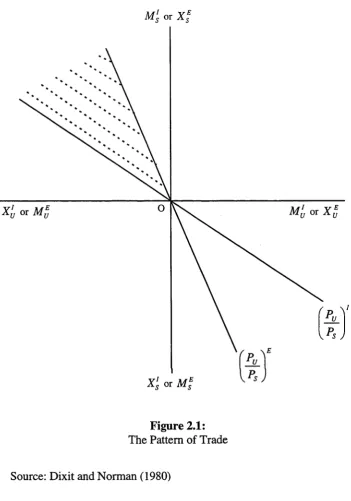
labour, the HO theorem is as illustrated in Figure 2.1.
In this figure, which is adapted from Dixit and Norman (1980, pp. 5-8), the
horizontal axis represents trade in the unskilled labour intensive good (denoted by
subscripts U), while the vertical axis represents trade in the skilled labour intensive good
(denoted by subscripts S). The variable X represents exports, M imports, and P prices.
Meanwhile, the superscripts I and E index developing and developed countries
respectively. This means that, for example, X' is export from developing countries on
unskilled labour intensive good. In this case, this is the same as M j , import by
M ’s or X /
Figure 2.1: The Pattern of Trade
The relative price line (Pu/Ps) is the price ratio (terms of trade) between unskilled
and skilled labour intensive goods. This line always passes the origin because autarky is
always feasible given the production technology and the condition that there be no trade
deficit. At the autarky price ratio in developing countries (Pu/Ps)1, all allocations on and
to the left of this line are feasible, yet the no-trade case is chosen. This means that
autarky must be preferred to all other allocations on and to the left of (Pu/Ps)1- The
autarky price ratio in developed countries is (Pu/Ps)E This line is steeper than (Pu/Ps)'
due to the assumption that developing countries are relatively abundant in unskilled
labour and developed countries are relatively abundant in skilled labour. By the same
token, autarky is preferred to all allocations on and to the right of
(Pu/Ps)E-This implies that if the developed and developing countries trade with each other,
then the equilibrium price ratio will lie between the two autarky price ratios, which
means that trade will take place at a point in the area marked with broken lines in Figure
2.1. This implies that, in this framework, the HO theorem predicts that developing
countries will export the unskilled labour intensive good ( ) and import the skilled
labour intensive good (M's ), while the developed countries will export the skilled labour
intensive good (X f ) and import the unskilled labour intensive good ( ) .
The Factor Price Equalisation Theorem
The factor price equalisation (FPE) theorem predicts that free trade will equalise
factor returns internationally (Samuelson, 1948 and 1949). Rassekh and Thompson
(1993) provide a survey of the theoretical evolution and empirical investigation of this
theorem. To establish the FPE theorem formally, let U and S represent the unskilled and
developing and developed countries as before. In addition, let L represent the total
quantity of unskilled labour available. Similarly, let H be the total quantity of skilled
labour available. Let also wL and wH be the wage rates of unskilled and skilled labour
respectively.1 Meanwhile, the input-output coefficients atj are, respectively, the number
of units of factor i (i = L and H) used to produce one unit of output j (j = U and S). If
labour markets always clear, then:
L!v +L!s = lJ (2.1a)
H[ + H[ = H 1 (2.1b)
LEV +LE = L E (2.1c)
H E + H E = H E (2. Id)
which, using the input-output coefficients, can be restated as:
aLuUI + a ILSS I = L! (2.2a)
alHUU' + ^ sS 7 = H 1 (2.2b)
a ELUUE +a[sS E = L E (2.2c)
a EvU E + a EsS E = He (2.2d)
From the cost minimisation problem, the input-output coefficients al} are solved
as a function of relative factor prices: a.. = atj \ WH J
. The constant returns to scale
assumption implies that these input-output coefficients are independent of the quantity of
output produced. This assumption, together with the competitive zero profit condition,
implies that:
/ , / w, + a
/ / \ '1/47
//£/ v ^ w y
/ . / w, + a u
f w,I \
\ W H J
< = P v
< = P s
\ W H J
( E\
v 4 , W L a HU
( E \
Wr
L
nL
= P U
E r * n E
.
E ( E\w.
U LS E • wL + a HS E
[w hJ
< = P f
(2.3a)
(2.3b)
(2.3c)
(2.3d)
Because technologies are identical across regions, a~(-) = a~ (•) = a,y(-).
Furthermore, due to trade liberalisation, Pj = P f - P .. Because of these identical
technologies and product prices, equations (2.3a) - (2.3d) can be transformed into:
\ m H J
wL + a HU
K ^ H J w
'h = P U
( 1 \ ( i ^
a LS
W h )
• w L + a HS w l
Iw h J
f E \
•Wf
+ a HU( E \
E E
Vw h ) Vw h J
a LS ( E \
E ■ w L + aHS ( E\
E
Vw h ) Kw h )
■ K = P S
■W H = P U
‘ WH — Ps
(2.4a)
(2.4b)
(2.4c)
(2.4d)
However, if there is a unique solution to (2.4a) - (2.4d) given Pu and Ps, then it
must be true that xv[ = w f = wL and w'H = w EH = w H , which means that factor prices are
equal in both regions. This implies that the equation (2.4a) is identical with (2.4c) and
(2.4b) is identical with (2.4d). This solution establishes the FPE theorem. Under the
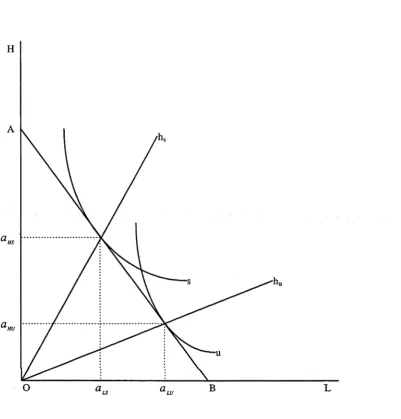
Figure 2.2 illustrates how factor price equalisation works. The vertical axis
represents skilled labour (H), while the horizontal axis represents unskilled labour (L).
The isoquants s and u are the unit value isoquants for the skilled labour intensive good
(S) and the unskilled labour intensive good (U) respectively. A unit value isoquant
combines output levels that correspond in value to one unit of the numeraire. Cost
minimisation by producers implies that the input combinations actually employed will be
such that the marginal rate of technical substitution between inputs (the slope of the
isoquant) will be equal to the relative factor prices (the slope of the isocost line). This
means that in equilibrium, if the zero profit conditions are satisfied and hence both goods
are being produced, then factor prices must be such that both unit value isoquants are
tangent to the unit value isocost line, which is shown by line AB in the figure.
Assuming the initial distortions reduce trade, then this theorem implies that
liberalisation of trade between developed and developing countries will result in opposite
effects in the labour markets in each region. To see this, imagine that the two regions are
making the transition from autarky to free trade. The pattem of trade predicted by the
Heckscher-Ohlin theorem has goods intensive in unskilled labour flowing from
developing countries to developed countries and goods intensive in skilled labour
flowing from developed to developing countries. In the developed countries, this pattem
of trade increases demand for skilled labour while it reduces the demand for unskilled
labour. Real wages of skilled labour rise relative to those of unskilled labour. In
developing countries, on the other hand, demand for unskilled labour increases while
demand for skilled labour decreases. Consequently, the real wages of unskilled labour
Figure 2.2:
Factor Price Equalisation
wage inequality between skilled and unskilled workers increases in developed countries
and decreases in developing countries.
Product and Factor Prices: The Stolper-Samuelson Theorem
The Stolper-Samuelson (SS) theorem, which originated in Stolper and Samuelson
(1941), predicts that an increase (decrease) in the relative price of a traded good will
increase (decrease) return to the factor which is used intensively in the production of that
good and decrease (increase) return to the other factor. To establish this theorem
formally, start by totally differentiating the equations (2.4a) and (2.4b) without the
superscript I to get:
wl ' daLU + a LU • dw L + w H • daHU + a HU ■ dw H — dPy (2.5a)
w L ■ daw -I- aLS ■ dw L + w H ■ daHS + a HS ■ dw H = dPs (2.5b)
At the optimum level of output, the first and the third terms in both equations
(2.5a) and (2.5b) cancel each other.2 Then, converting both equations into proportional
changes, the results are:
A A A
WL + ® H U ' W H — P f J (2.6a)
A A A
W L ' W H = P s (2.6b)
where 0 ;) denotes the share of factor i in the unit cost of product j, while the A sign
denotes a proportional change in the variable.
Using Cramer’s rule (Chiang, 1984, p. 107), the solution to the equations (2.6a)
and (2.6b) is:
C _ ® HS ' ® HU ‘
W r -
---L
|0|
(2.7a)® L U ' F*S ®L5 ' P y
l0l
(2.7b)where |0 | = S LU ■ Q HS - S LS • & HU .
Since the cost shares of a product always sum up to one, |
0
| =0
i t / -0L
5
or|0 | = Qhs - ® hu • Given the relative factor intensity of the products, <dLU > Ols and
Qhs > 0 w , so that |©| is positive. Now suppose there is an exogenous increase in the
A
price of the unskilled labour intensive good (Pv > 0 ) while the price of the skilled labour
A
intensive good does not change (Ps = 0), then the wages of unskilled labour will go up
A A
(w L > 0 ) and the wages of skilled labour will go down { w H < 0). This establishes the
Stolper-Samuelson theorem.
This theorem implies that an increase in tariff protection for a good which is
relatively intensive in unskilled labour in developed countries increases the real wage
received by unskilled labour in this region. A reduction in the protection of this good,
therefore, lowers their real wage. Burtless (1995) concludes that for unskilled workers in
developed countries, a reduction in protection of goods which use their services
intensively will tend to reduce the real wage received by them. For developing countries,
on the other hand, a reduction in protection of the unskilled labour intensive good in
developed countries increases the price of their export. This raises the real wage of
unskilled labour in developing countries and, therefore, reduces wage inequality. In
addition, a reduction in developing countries’ protection of skilled labour intensive
Bhongmakapat (1990) suggests, however, that in reality the impact of export
expansion on income distribution in developing countries is overestimated by the
assumption of perfect intersectoral factor mobility. To see this, Figure 2.3 illustrates the
mechanism of the Stolper-Samuelson theorem. The horizontal axis L represents the
unskilled labour and the vertical axis H represents the skilled labour, U is the unit value
isoquant of the skilled labour intensive good, S is the unit value isoquant of the skilled
labour intensive good, p is the wage ratio between unskilled and skilled labour, hu is the
skilled to unskilled labour ratio in the production of the unskilled labour intensive good,
and hs is the skilled to unskilled labour ratio in the production of the skilled labour
intensive good.
Now suppose that, due to trade liberalisation in developed countries, the price of
the unskilled labour intensive good increases in developing countries. This is represented
by an inward shift of the unit value isoquant U to Ui. This means that for developing
countries it is now profitable to produce more of the unskilled labour intensive good and
less of the skilled labour intensive good. However, at the original wage ratio p, the
proportion of skilled labour released per unit of skilled labour intensive good production
foregone is higher than that being absorbed per unit of unskilled labour intensive good
production added. To maintain full employment, the relative wage of skilled labour has
to decline, which is represented by the steeper new wage ratio pi. Thus, both industries
will substitute unskilled labour for skilled labour, with the result that both will then
employ a higher proportion of skilled labour per unit of output. This is represented by
steeper skilled to unskilled labour ratios, hui and hsi, in both industries. As
Figure 2.3:
The Stolper-Samuelson Theorem
Source: Lawrence and Slaughter (1993)
this mechanism will not take place. Instead, changes in output prices will be associated
with inter-industry wage differentials.
Factor Endowment Change: The Rybczynski Theorem
Finally, the Rybczynski theorem states that, at constant relative prices, an
increase (decrease) in the endowment of a certain factor of production will increase
(decrease) the production of the good intensive in that factor and decrease (increase)
production of the other good (Rybczynski, 1955). To confirm this in the case of
domestically mobile factors, let L denote capital which is suitable for the production of
simple manufactures of the type produced in developing countries. H then denotes the
capital suitable for the production of sophisticated manufactures.3 Consequently, wL and
w H now denote the rental rates of both types of capital respectively.
The derivation of this theorem starts by totally differentiating the equations (2.2a)
and (2.2b). Dropping the superscript I, the results are:
U ■ daLU + a LU • dU + S ■ daLS + a LS ■ d S - dL (2.8a)
U ■ daHU + aHU ■ dU + S ■ daHS + a HS • dS = dH (2.8b)
Since at constant factor prices there will be no changes on the input-output
coefficients, the first and the third terms in both equations can be dropped. Converting to
proportional changes results in:
X LU - U + X LS S - L (2.9a)
X HU - U + X HS - S = H (2.9b)
where X t] denotes the share of the total endowment of factor i employed in industry j.
Again solve using the Cramer’s rule to get:
A A
(2.10a)
A A
(2.10b)
w
where |A,| =
X LU
•X HS
- •X HU
. Since the endowment shares always sum up to one foreach factor, |A.| =
X LU
-X HU
or \k\ = X HS - . Given relative factor intensities of theproducts,
XLU
>XHU
andXHS
>XLS,
so that |A.| is positive. Now suppose in developingcountries there is an increase in the endowment of capital which is suitable for simple
manufactures ( L > 0) while the endowment of the other type of capital does not change
A A
( H = 0 ) , then the production of simple manufactures will increase ( U > 0) and the
production of sophisticated manufactures will decrease ( S < 0). This establishes the
Rybczynski theorem.
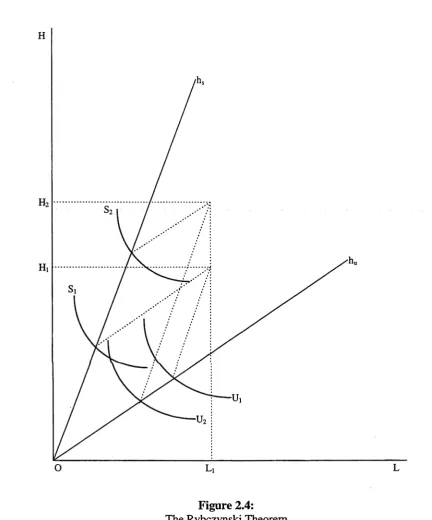
The mechanism of Rybczynski theorem is illustrated in Figure 2.4. The vertical
axis represents the endowment of H, namely capital suitable for the production of
sophisticated manufactures. The horizontal axis represents the endowment of L, namely
capital suitable for the production of simple manufactures. The levels of production of
sophisticated and simple manufactures, meanwhile, are represented by isoquants S and U
respectively. The ratio of the two types of capital used in the production of sophisticated
manufactures is represented by the line hs, while for simple manufactures is hu. These
ratios are fixed since standard HOS assumptions prevail and so the FPE theorem holds.
A
A
Figure 2.4:
The Rybczynski Theorem
Suppose the original endowments of H and L are Hi and Li respectively. All
these endowments are distributed to the production of S and U in accordance to hs and
hu, so that the quantity of S produced is represented by the isoquant Si and that of U by
the isoquant Uj. Now suppose the endowment of H increases from Hi to H2. The
quantities of S and U produced are now S2 and U2 respectively. Since S2 is greater than
Si and U2 is less than Ui, this clearly shows that an increase in the endowment of a factor
leads to an increase in the production of the good which is intensive in that factor and a
reduction in the production of the other good. The production of U decreases because, in
order to employ the additional H, some L has to be released from the production of U.
One application of this theorem is to analyse the effects of capital mobility. With
openness and globalisation, capital can move freely among countries. Since developed
countries have relatively more abundant capital than developing countries, then the
marginal productivity of capital, and therefore the rate of profit, in developed countries is
lower than in developing countries. Consequently, capital moves from the developed to
developing countries. Wood (1994, pp. 32, 37) rejects the notion that rate of profit is
higher in developing countries, however. He argues that technologies are readily
available in the market equally for both developed and developing countries. The only
question is whether a country can afford to buy them or not. He implies, therefore, that
the rate of profit is the same in developed and developing countries and that this
therefore cannot be the driving force of capital movement. Instead, he suggests that the
movement of capital in the form of labour intensive manufacturing from the developed to
developing countries might have been precipitated by the relative abundance of unskilled
labour in the newly open developing countries or by increased scarcity of unskilled
Returning to the Rybczynski theorem, if as before it is assumed that there are two
forms of capital, one which is suitable for simple manufactures and the other for
sophisticated manufactures, the inflow of the former to developing countries clearly
increases the output of that sector. In developed countries, on the other hand, the
outflow of this form of capital reduces output of simple manufactures while increasing
the output of sophisticated manufactures. This further strengthens the pattern of trade
predicted by the Heckscher-Ohlin theorem and its effects on the labour market as
predicted by the FPE theorem.4
Generalisation o f the HOS Model
The HOS model has obvious restrictive assumptions, the most prominent being
its low and even dimensionality. Efforts to generalise the model into a many goods, many
factors, and many countries framework have been attempted (eg. Ethier, 1974 and
1984). The conclusion from these generalisations is that the basic messages of the
theorems still hold to the large extent. The theorems derived from the strictest HOS
model turn out to have pointed the way with a good deal of accuracy (Ethier, 1984).
In Chapter 4, the HOS model is generalised in the context of a computable
general equilibrium (CGE) framework. The generalisation incorporates product
differentiation by country of origin, a non-tradeable services sector, and it adds capital as
a factor of production in addition to skilled and unskilled labour. Before generalising the
model, however, the remainder of this chapter reviews the debate about labour market
effects of openness in the developed country context, while the next chapter elaborates
on the circumstances of developing countries.
The Stylised Facts and Debate in Developed Countries
During the last three decades, manufacturing exports from developing to
developed countries have increased significantly and, at the same time, the demand for
unskilled labour in developed countries has fallen substantially, while on the other hand
the demand for skilled labour has increased (Wood, 1994). Furthermore, these
developments have coincided with increasing unemployment among unskilled workers in
some countries, or widening wage inequality between skilled and unskilled labour in
some other countries (Wood, 1995).
The phenomenon of widening wage inequality between skilled and unskilled
labour became more widespread in developed countries after the 1980s. The degree of
this widening, however, varies from country to country. The largest increases in
inequality are observed in the United States (US) and the United Kingdom (UK).5
Substantial increases are also observed in Canada, Australia, and New Zealand, while
smaller increases are observed in the Nordic countries, the Netherlands, France, Italy,
and Japan. The only developed country which seems to have avoided an increase in wage
inequality in recent years is Germany (Gottschalk, 1997; Katz et al, 1995).
Evidence that wage inequality increased in so many developed countries, each
having its own unique institutional structure, suggests that similar forces have been at
work around the globe. The role of internal institutions in each country determines the