C
2013. The American Astronomical Society. All rights reserved. Printed in the U.S.A.
A DOUBLE PLANETARY SYSTEM AROUND THE EVOLVED INTERMEDIATE-MASS STAR HD 4732
Bun’ei Sato1, Masashi Omiya1, Robert A. Wittenmyer2, Hiroki Harakawa1, Makiko Nagasawa1,
Hideyuki Izumiura3,4, Eiji Kambe3, Yoichi Takeda4,5, Michitoshi Yoshida6, Yoichi Itoh7,
Hiroyasu Ando5, Eiichiro Kokubo4,5, and Shigeru Ida1
1Department of Earth and Planetary Sciences, Tokyo Institute of Technology, 2-12-1 Ookayama, Meguro-ku, Tokyo 152-8551, Japan;[email protected] 2Department of Astrophysics, School of Physics, University of NSW 2052, Australia
3Okayama Astrophysical Observatory, National Astronomical Observatory of Japan, Kamogata, Okayama 719-0232, Japan 4The Graduate University for Advanced Studies, Shonan Village, Hayama, Kanagawa 240-0193, Japan
5National Astronomical Observatory of Japan, 2-21-1 Osawa, Mitaka, Tokyo 181-8588, Japan 6Hiroshima Astrophysical Science Center, Hiroshima University, Higashi-Hiroshima, Hiroshima 739-8526, Japan
7Nishi-Harima Astronomical Observatory, Center for Astronomy, University of Hyogo, 407-2, Nishigaichi, Sayo, Hyogo 679-5313, Japan
Received 2012 October 1; accepted 2012 October 24; published 2012 December 7
ABSTRACT
We report the detection of a double planetary system orbiting around the evolved intermediate-mass star HD 4732 from precise Doppler measurements at Okayama Astrophysical Observatory and Australian Astronomical Observatory. The star is a K0 subgiant with a mass of 1.7Mand solar metallicity. The planetary system is composed of two giant planets with minimum mass of msini = 2.4MJ, orbital period of 360.2 days and 2732 days, and eccentricity of 0.13 and 0.23, respectively. Based on dynamical stability analysis for the system, we set the upper limit on the mass of the planets to be about 28MJ(i >5◦) in the case of coplanar prograde configuration. Key words: planetary systems – stars: individual (HD 4732) – techniques: radial velocities
Online-only material:color figures
1. INTRODUCTION
Precise radial velocity measurements of stars have revealed more than 500 extrasolar planets in the last 20 years. Due to the increase in velocity precision and the duration of the planet search programs, not only single planets but also many multiple-planet systems have been discovered. Around solar-type stars, including those systems with long-term radial velocity trends, ∼30%–50% of stars with giant planets are multiple-planet systems (Fischer et al. 2001; Wright et al. 2007, 2009), and systems comprising less massive planets such as super-Earths and Neptune-mass planets are more abundant (Mayor et al. 2011; Howard et al.2012; Wittenmyer et al.2011b).
The multiple-planet systems give us deep insight into the formation and evolution of planetary systems (e.g., Ford2006). For example, evidence of planet–planet scattering events could be preserved in the current orbital configurations of planets (e.g., Ford et al. 2005), and the prevalence of orbital mean-motion resonances constitutes strong support for differential convergent orbital migration having occurred (e.g., Lee and Peale2002; Kley et al.2004). Their statistical properties may also provide us with hints about the mechanisms of these processes; the rather uniform semimajor axis distribution without the pileup of hot Jupiters and the jump at 1 AU that are seen in single planets, and systematically lower eccentricities compared to single planets (Wright et al.2009).
Studying the long-term orbital stability of multiple-planet systems is also important. Since the best-fit orbital parameters derived from radial velocity data do not necessarily guarantee that the resulting orbits are stable over long periods of time, dynamical stability analysis can check and further constrain the system parameters, such that the solutions consistent with the data are stable (e.g., Lovis et al.2006; Pepe et al.2007; Niedzielski et al. 2009a; Wright et al. 2009; Johnson et al. 2011; Robertson et al.2012b; Wittenmyer et al.2012c).
Here we report the detection of a double giant-planet sys-tem around the evolved intermediate-mass star HD 4732 (K0
IV, M = 1.7M), one of the 300 targets of the Okayama Planet Search Program (e.g., Sato et al. 2012). This discov-ery was facilitated by joint precise radial velocity observations made from the Australian Astronomical Observatory (AAO). Discoveries of planets and multiple-planet systems around such intermediate-mass stars have been rapidly growing in number during the past several years. Although the number of known multiple-planet systems around intermediate-mass stars is still small, it is interesting that many of them appear to be in mean-motion resonances, such as 24 Sex (2:1; Johnson et al.2011), HD 102272 (4:1; Niedzielski et al.2009a),ν Oph (6:1; Quir-renbach et al.2011; Sato et al. 2012), and BD20+2457 (3:2; Niedzielski et al.2009b). Although detailed dynamical studies are required to determine whether these systems are truly in res-onance (e.g., Robertson et al.2012a; Wittenmyer et al.2012b), the existence of such systems suggests that the planetary orbital migration process for intermediate-mass stars is similar to that for solar-type ones.
This paper is organized as follows. The stellar properties are presented in Section2and the observations are described in Section3. Orbital solutions are presented in Section4and results of line shape analysis are described in Section5. Dynamical stability analysis is presented in Section 6 and Section 7 is devoted to summary.
2. STELLAR PROPERTIES
HD 4732 (HR 228, HIP 3834) is listed in the Hipparcos catalog (Perryman & ESA1997) as a K0 giant with the apparent V-band magnitudeV =5.90 and the parallaxπ=17.70±0.99 mas, giving the distance of 56.5±3.2 pc and the absolute visual magnitudeMV = +2.04 taking into account the correction of interstellar extinctionAV =0.10 based on Arenou et al.’s (1992) table (Takeda et al.2008).
Atmospheric parameters (effective temperatureTeff, surface
Figure 1.H-R diagram for HD 4732. Pairs of evolutionary tracks from Lejeune & Schaerer (2001) for stars withZ=0.02 (solar metallicity; solid lines) and Z=0.008 (dashed lines) of masses between 1 and 3Mare also shown.
approach using the equivalent widths of well-behaved Fei
and Feii lines of iodine-free stellar spectra. Details of the procedure and resultant parameters are presented in Takeda et al. (2002,2008). For HD 4732, they obtainedTeff=4959 K,
logg(cgs)=3.16,vt =1.12 km s−1, and [Fe/H]= + 0.01 as well as projected rotational velocity ofvsinirot=1.45 km s−1.
With the use of these atmospheric parameters together with MV, a bolometric correction based on the Kurucz’s (1993) theoretical calculation, and theoretical evolutionary tracks of Lejeune & Schaerer (2001), Takeda et al. (2008) also determined luminosity L and mass M for HD 4732 to be L = 15.5L and M = 1.74M. The stellar radius R was estimated to beR = 5.4R using the Stefan–Boltzmann relationship and the measured L and Teff. Although the star is listed in the Hipparcoscatalog as a giant star, the star is better regarded as a subgiant rather than giant based on the surface gravity and its position on the H-R diagram (Figure1). The stellar properties are summarized in Table1.
Hipparcosobservations revealed photometric stability for the star down toσHIP=0.006 mag. Furthermore, the star shows no
significant emission in the core of Caii HK lines as shown in Figure2, which suggests that the star is chromospherically inactive. For subgiants like HD 4732, Johnson et al. (2010) reported a typical radial velocity jitter, which arises from a number of phenomena intrinsic to the star such as granulation, oscillation, and activity, of about 5 m s−1. The value is
comparable to that of 6 m s−1 estimated for HD 4732 in
Section4.
3. OBSERVATION
3.1. OAO Observations
Observations of HD 4732 at Okayama Astrophysical Obser-vatory (OAO) were made with the 1.88 m telescope and the HIgh Dispersion Echelle Spectrograph (Izumiura 1999) from 2004 August to 2012 January. A slit width of the spectrograph was set to 200μm (0.76) corresponding to a spectral resolution (R=λ/Δλ) of 67,000 by about 3.3 pixels sampling. For precise radial velocity measurements, we used an iodine absorption cell (I2 cell; Kambe et al.2002), which provides a fiducial
wave-length reference in a wavewave-length range of 5000–5800 Å. We have obtained 48 data points of HD 4732 with signal-to-noise ratio S/N=60–250 pixel−1by an exposure time of 900–1800 s
depending on the weather condition. The reduction of echelle
[image:2.612.339.546.57.356.2]Figure 2.Spectra in the region of Ca H lines. Stars with similar spectral type to HD 4732 in our sample are also shown. A vertical offset of about 0.3 is added to each spectrum.
Table 1
Stellar Parameters for HD 4732
Parameter Value
Spectral type K0 IVa
π(mas) 17.70±0.99
V 5.90
B−V 0.944
AV 0.10
MV 2.04
B.C. −0.27
Teff(K) 4959±25b
logg(cgs) 3.16±0.08b
vt(km s−1) 1.12±0.07b
[Fe/H] (dex) 0.01±0.04b
L(L) 15.5
R(R) 5.4 (5.0–5.8)c
M(M) 1.74 (1.60–1.94)c
vsinirot(km s−1) 1.45
σHIP(mag) 0.006
aThe star is listed in theHipparcoscatalog as a K0 giant.
But, judging from the position of the star on the H-R diagram (Figure1), the star should be better classified as a less evolved subgiant.
bThe uncertainties of these values are internal statistical
errors (for a given data set of Feiand Feiiline equivalent widths) evaluated by the procedure described in Section 5.2 of Takeda et al. (2002).
cThe values in the parenthesis correspond to the range of
the values assuming the realistic uncertainties inΔlogL corresponding to parallax errors in theHipparcoscatalog, ΔlogTeffof±0.01 dex (∼ ±100 K), andΔ[Fe/H] of
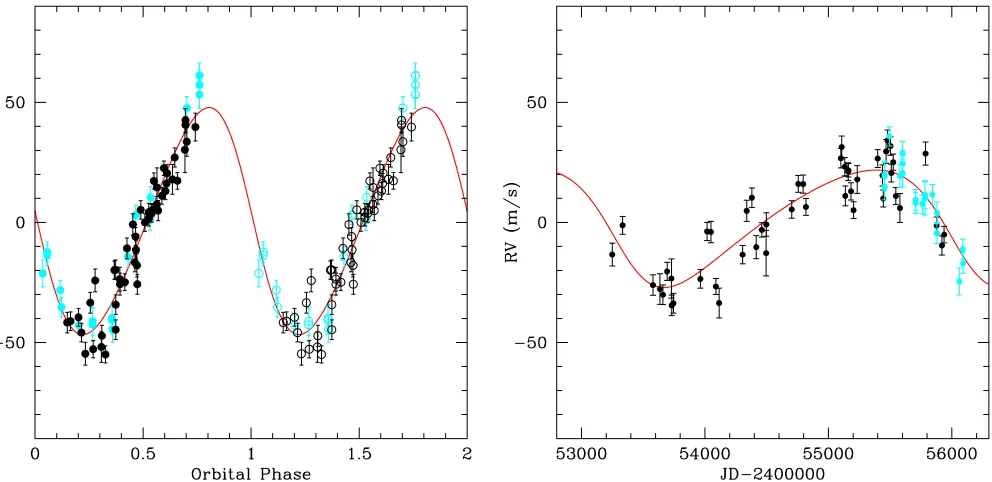
[image:2.612.353.533.428.617.2]Figure 3.Two-planet fit for HD 4732 radial velocities. The planets have periods of 360 and 2732 days, and the rms about this fit is 7.09 m s−1. OAO data are shown as filled black circles, and AAT data are filled cyan circles.
(A color version of this figure is available in the online journal.)
data (i.e., bias subtraction, flat-fielding, scattered-light subtrac-tion, and spectrum extraction) was performed using the IRAF8 software package in the standard way.
For radial velocity analysis, we modeled I2-superposed stellar
spectra (star+I2) by the method detailed in Sato et al. (2002, 2012), which is based on the method by Butler et al. (1996) and Valenti et al. (1995). In the method, we model a star+I2spectrum
8 IRAF is distributed by the National Optical Astronomy Observatory, which
is operated by the Association of Universities for Research in Astronomy, Inc., under cooperative agreement with the National Science Foundation, USA.
as a product of a high-resolution I2 and a stellar template
spectrum convolved with a modeled point-spread function (PSF) of the spectrograph. We obtain the stellar spectrum by deconvolving a pure stellar spectrum with the spectrograph PSF estimated from an I2-superposed B-star spectrum. We have
achieved a long-term Doppler precision of about 4–5 m s−1over
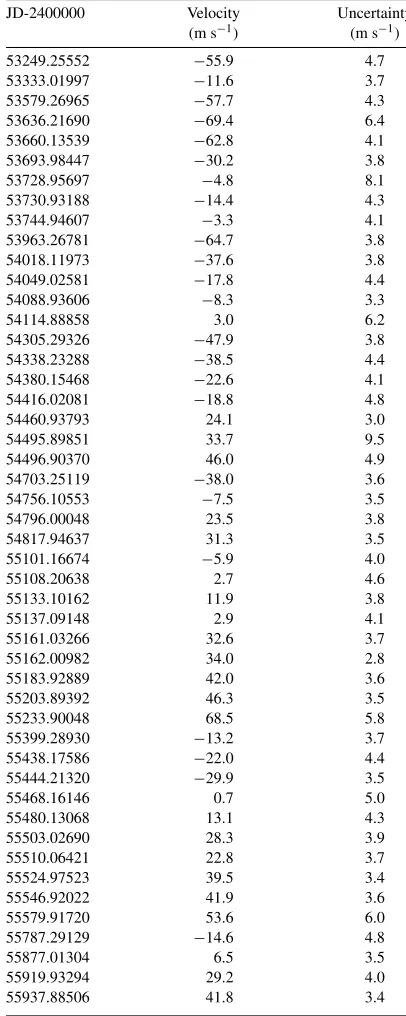
a time span of nine years. Measurement error was derived from an ensemble of velocities from each of∼300 spectral chunks (each∼3 Å long) in every exposure. We listed the derived radial velocities for OAO data in Table2together with the estimated uncertainties.
3.2. AAT Observations
As HD 4732 is near the southern limit for OAO (δ ∼ −25◦), it is desirable to make observations from a more southerly site. To improve the phase coverage for HD 4732, in 2010 September we began observing it with the UCLES echelle spectrograph (Diego et al. 1991) at the 3.9 m Anglo-Australian Telescope (AAT). UCLES achieves a resolution of 45,000 with a 1slit. An iodine absorption cell provides wavelength calibration from 5000 to 6200 Å. The spectrograph PSF and wavelength calibration are derived from the iodine absorption lines embedded on every pixel of the spectrum by the cell (Valenti et al. 1995; Butler et al.1996). The result is a precision Doppler velocity estimate for each epoch, along with an internal uncertainty estimate, which includes the effects of photon-counting uncertainties, residual errors in the spectrograph PSF model, and variation in the underlying spectrum between the iodine-free template, and epoch spectra observed through the iodine cell. The photon-weighted mid-time of each exposure is determined by an exposure meter. This technique has been successfully used at the AAT by the Anglo-Australian Planet Search (e.g., Tinney et al.2001,2011a; O’Toole et al.2009; Jones et al.2010) and the Pan-Pacific Planet Search (Wittenmyer et al. 2011a). All velocities are measured relative to the zero point defined by the template observation. AAT/UCLES precision velocities are obtained using theAustralcode (Endl et al.2000).
Figure 4.Left: phase plot for HD 4732b (P =360 days), after removing the signal of the outer planet. Two cycles are shown for clarity. Right: radial velocity observations for HD 4732c (P=2732 days), after removing the signal of the inner planet. The symbols have the same meaning as in Figure3.
[image:3.612.63.559.476.717.2]Table 2
OAO Radial Velocities for HD 4732
JD-2400000 Velocity Uncertainty
(m s−1) (m s−1)
53249.25552 −55.9 4.7
53333.01997 −11.6 3.7
53579.26965 −57.7 4.3
53636.21690 −69.4 6.4
53660.13539 −62.8 4.1
53693.98447 −30.2 3.8
53728.95697 −4.8 8.1
53730.93188 −14.4 4.3
53744.94607 −3.3 4.1
53963.26781 −64.7 3.8
54018.11973 −37.6 3.8
54049.02581 −17.8 4.4
54088.93606 −8.3 3.3
54114.88858 3.0 6.2
54305.29326 −47.9 3.8
54338.23288 −38.5 4.4
54380.15468 −22.6 4.1
54416.02081 −18.8 4.8
54460.93793 24.1 3.0
54495.89851 33.7 9.5
54496.90370 46.0 4.9
54703.25119 −38.0 3.6
54756.10553 −7.5 3.5
54796.00048 23.5 3.8
54817.94637 31.3 3.5
55101.16674 −5.9 4.0
55108.20638 2.7 4.6
55133.10162 11.9 3.8
55137.09148 2.9 4.1
55161.03266 32.6 3.7
55162.00982 34.0 2.8
55183.92889 42.0 3.6
55203.89392 46.3 3.5
55233.90048 68.5 5.8
55399.28930 −13.2 3.7
55438.17586 −22.0 4.4
55444.21320 −29.9 3.5
55468.16146 0.7 5.0
55480.13068 13.1 4.3
55503.02690 28.3 3.9
55510.06421 22.8 3.7
55524.97523 39.5 3.4
55546.92022 41.9 3.6
55579.91720 53.6 6.0
55787.29129 −14.6 4.8
55877.01304 6.5 3.5
55919.93294 29.2 4.0
55937.88506 41.8 3.4
We have obtained 19 AAT observations of HD 4732, and an iodine-free template observation was obtained on 2010 October 25. Exposure times ranged from 400 to 1200 s, with a resulting S/N of ∼100–200 pixel−1 each epoch. The AAT data span a total of 636 days and have a mean internal velocity uncertainty of 5.0 m s−1. The data are given in Table3.
4. ORBIT FITTING AND PLANETARY PARAMETERS
[image:4.612.64.267.77.585.2]For candidate multiple-planet systems, and for planet candi-dates with orbital periods near one year, it is critical to obtain the most complete possible phase coverage, and it is ideal to independently confirm the signal(s) from independent observa-tories. A recent example is HD 38283b, a 0.34MJupplanet with a
Table 3
AAT Radial Velocities for HD 4732
JD-2400000 Velocity Uncertainty
(m s−1) (m s−1)
55455.16094 −19.7 5.6
55455.20587 −20.5 5.9
55456.06022 −24.3 5.5
55494.91653 21.9 4.0
55579.92330 63.1 4.8
55600.90903 67.7 5.9
55600.91897 75.7 5.1
55600.93330 71.8 5.3
55707.30755 −3.1 4.3
55707.31526 −4.4 4.4
55760.15572 −36.3 4.0
55783.13308 −37.3 6.9
55783.14079 −35.9 5.8
55841.99044 −12.3 4.3
55878.95827 1.0 4.4
55880.01556 10.3 4.5
56060.29762 −31.2 5.6
56089.30186 −39.6 4.2
56091.27740 −46.8 4.2
periodP =363.2±1.6 days (Tinney et al.2011b). That planet required 12 years of observations to confirm, and a robust detec-tion was further aided by the fact that HD 38283 is circumpolar and so could be observed year round (although at high airmasses below the pole). Another example is HD 159868c, which has a periodP =352.3 ±1.3 days (Wittenmyer et al.2012c), also worryingly close to one year. Again, more than nine years of AAT data were needed for a secure detection, and the 352 day period was confirmed independently with Keck data over a four-year span (Wittenmyer et al.2012c).
Five years of radial velocity observations of HD 4732 at OAO revealed evidence of a signal with a period near one year (∼338 days). Since this star is near the southern limit for OAO, it is only observable for five months of the year, resulting in persistent phase gaps that make the confirmation of such a period extremely difficult. AAT observations in 2010–2011 filled in the critical phase gaps and confirmed the orbital period suggested by the OAO data. Continued observations from both telescopes in 2011–2012 have also revealed a second velocity signal, first manifesting as a residual trend, and subsequently as a second, long periodicity.
To fit the two Keplerian signals evident in the HD 4732 data, we first employed a genetic algorithm. This approach has proven useful in previous work where it was necessary to fit highly uncertain orbits with long periods near the total duration of observations (Wittenmyer et al. 2012a, 2012c; Horner et al. 2012). We ran the genetic algorithm for 10,000 iterations, each consisting of 1000 individual trial fits. The best-fit set of parameters is thus the result of ∼107 trial fits.
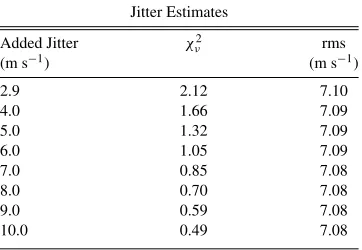
Table 4 Jitter Estimates
Added Jitter χν2 rms
(m s−1) (m s−1)
2.9 2.12 7.10
4.0 1.66 7.09
5.0 1.32 7.09
6.0 1.05 7.09
7.0 0.85 7.08
8.0 0.70 7.08
9.0 0.59 7.08
10.0 0.49 7.08
For the final orbit fitting, we added radial velocity jitter in quadrature to the velocity uncertainty of each observation. This jitter arises from a number of phenomena intrinsic to the star, such as granulation, oscillations, and activity (Saar et al. 1998; Wright2005). As HD 4732 is an evolved star, scaling relations (Kjeldsen & Bedding1995,2011) are not applicable. We thus determine the appropriate level of jitter empirically by performing two-Keplerian fits with varying levels of jitter. On some dates, the AAT recorded multiple consecutive exposures of HD 4732 (Table3). This provides one way to estimate the jitter: by noting the velocity spread of the multiple exposures. On the four dates that had multiple exposures, the mean velocity spread is 2.9 m s−1. This is, however, a lower limit as the timescales
of many jitter sources are on the order of hours (granulation) or months (rotation). We also try a range of jitters from 4 to 10 m s−1, and note the results of the fits in Table4. The estimation of radial velocity jitter is quite uncertain, and this is reflected in Table4, where we see that the amount of added jitter has little effect on the quality of the resulting fit. We adopt a jitter estimate of 6 m s−1, as this value brings the reducedχ2of the
fit close to unity. The resulting two-Keplerian planetary model is shown in Figures3 and4, and the parameters are given in Table5. The uncertainties on the fitted parameters are derived in the usual way, from the covariance matrix of the least-squares fit. The phase gap for planet b has the greatest impact on the uncertainty inT0for that planet. As a result, the uncertaintyσT
=18.4 days remains large even though many orbital cycles of planet b have been observed. The two-planet fit has a reduced χ2of 1.05, and the rms scatter about the fit is 7.09 m s−1. Using
a stellar mass of 1.74+0−0..1420M(Takeda et al.2008), the planets
have minimum massesmsiniof 2.4±0.3 (inner planet) and 2.4±0.4MJup(outer planet).
5. LINE SHAPE ANALYSIS
In order to investigate other possible causes of observed radial velocity variations such as pulsation and rotational modulation rather than orbital motion, spectral line shape analysis was performed with the use of high-resolution stellar template spectra. Details of the analysis method are described in Sato et al. (2007,2002).
At first, two stellar templates were extracted from five star+I2
spectra at phases with different radial velocity level,∼40 m s−1
Figure 5.Bisector quantities of cross-correlation profiles between the templates of HD 4732 at phases with ∼40 m s−1 and with ∼−20 m s−1 of the
observed radial velocities: bisector velocity span (BVS, circles), bisector velocity curvature (BVC, triangles), and bisector velocity displacement (BVD, squares). Offsets of 300 m s−1and−300 m s−1are added to BVS and BVD, respectively.
and∼−20 m s−1, of the observed radial velocities based on
the method by Sato et al. (2002). Cross-correlation profiles of the two templates were calculated for about 90 spectral chunks (4–5 Å width each) in which severely blended lines or broad lines were not included, and then three bisector quantities were derived for the cross-correlation profile for each chunk: the velocity span (BVS), which is the velocity difference between two flux levels of the bisector; the velocity curvature (BVC), which is the difference of the velocity span of the upper half and lower half of the bisector; and the velocity displacement (BVD), which is the average of the bisector at three different flux levels. Here we used flux levels of 25%, 50%, and 75% of the cross-correlation profile to calculate the above three bisector quantities, and obtained BVS = 3.9 ± 4.7 m s−1,
BVC =2.4± 3.3 m s−1, and BVD = −57±11 m s−1 for HD 4732 (Figure5). Both of the BVS and the BVC are identical to zero and the average BVD agrees with the velocity difference between the two templates. Then the cross-correlation profiles can be considered to be symmetric and thus the observed radial velocity variations are best explained by parallel shifts of the spectral lines rather than distortion of them, which is consistent with the orbital-motion hypothesis.
6. DYNAMICAL STABILITY ANALYSIS
[image:5.612.79.260.62.187.2] [image:5.612.78.260.67.187.2]We here present dynamical studies of the HD 4732 system. Since the eccentricities of the planets are relatively small and it is thus considered that they probably have not experienced close encounters, we here assume that both the planets share the same orbital plane and are prograde. For the numerical integrations, we use a fourth-order Hermite scheme. Figure 6 shows the one-million-year evolution of the best-fit two-Keplerian model derived in Section4, fori =90◦ orbits (i.e., planet masses at
Table 5 Keplerian Orbital Solutions
Planet Period T0 e ω K msini a
(days) (JD—2400000) (deg) (m s−1) (MJup) (AU)
HD 4732b 360.2±1.4 54967±18 0.13±0.06 85±16 47.3±3.5 2.37±0.34 1.19±0.05
[image:5.612.63.551.698.749.2]0 1 2 3 4 5 6 7
0 2 4 6 8 10
a
,
a
(1−
e
)
,
a
(1
+e
)
(AU)
time (105 year)
[image:6.612.323.567.55.285.2]inner planet outer planet
Figure 6.Evolution of semimajor axisa, pericentera(1−e), and apocenter a(1 +e) distances for the two planets of HD 4732 system for the best-fit two-Keplerian model to the radial velocity data. Red lines are for semimajor axis and blue ones are for pericenter (lower line for each planet) and apocenter (upper line for each planet) distance. We here assumei=90◦and prograde coplanar orbits.
(A color version of this figure is available in the online journal.)
minimum). The system has two secular eigenfrequencies related with eccentricity, 11 yr−1 and 28 yr−1. Accordingly, the
planetary pericenter,a(1−e), and apocenter,a(1 +e), distances oscillate with the secular timescale of 76,000 years.
For lower inclinations, since the mass increases proportional to 1/sini, mutual perturbations become stronger. The stability map in the (a, e) plane of the outer planet for different values of i is shown in Figure 7. Here we plot the stability index D= |n2 − n1|(in◦yr−1) following Couetdic et al. (2010),
which studied stability of HD202206 system using Laskar’s frequency map analysis (Laskar 1990; Laskar et al. 2001). Following the analysis, we calculate an average of mean motion of the outer planet in 1000 Kepler periods (n1) and subtract it from an average of mean motion of the same planet obtained in the next consecutive 1000 Kepler periods (n2). Through comparison with the five times longer simulations, we find that the system is regular when log10D−3 (blue to navy), while the system is chaotic when log10D > −1 (yellow to red). As inclination decreases, the system loses stability. There is no stable area around 1σ of the best-fitted coplanar orbits for i 5◦. Thus, in the coplanar prograde configuration, we can roughly set the upper limit on the mass of both of the two planets to be about 28MJup(i >5◦), which falls in the substellar mass
regime.
In the top left panel of Figure 7, one can find the effects of mean-motion resonances as green vertical incisions. In the case of this system, based on the best-fit values of argument of pericenter, orbits closer to the mean-motion resonances are more unstable. The best-fit solution derived by the radial velocity data (white cross) sits between the 7:1 and 8:1 mean-motion resonances. From the orbital integration shown in Figure6, we have also confirmed that their resonant angles are not librating. We thus conclude that the outer planet is not in the mean-motion resonances of the inner planet.
7. SUMMARY
We report the detection of a double planet system around the evolved intermediate-mass star HD 4732 (K0 IV,M=1.7M)
i=90o
0 0.2 0.4 0.6
i=12o
i=8.5o
1 2 3 4 5
semimajor axis (AU) 0
0.2 0.4 0.6
eccentricity
-6 -5 -4 -3 -2 -1 0 1 2
log10D i=5o
1 2 3 4 5 6
Figure 7.Stability map of the outer planet (HD 4732c) for a coplanar prograde configuration with different values of inclinationi. Orbital elements other than semimajor axis and eccentricity of the outer planet are taken from the best-fit values. The color scale shows the level of mean-motion diffusion, log10D. Blue
to navy orbits are stable, while yellow to red orbits are chaotic. The step size of eccentricity isΔe=0.005. The step sizes of semimajor axis areΔa=0.005 AU (top-left panel),Δa=0.01 AU (top-right panel), andΔa=0.05 AU (bottom panels). White crosses represent the best-fittedaandewith their 1σ errors. Black dotted line is the orbit crossing line.
(A color version of this figure is available in the online journal.)
by precise radial velocity measurements at OAO and AAO. The system is composed of two giant planets with minimum masses ofm2sini=2.4MJ, an orbital period of 360.2 days and 2732 days, and an eccentricity of 0.13 and 0.23, respectively. The joint observations of OAO and AAO allowed us to increase the phase coverage of the nearly one-year periodicity of the inner planet and detect long-period signal of the second outer planet.
The configuration of the system is similar to those of other multiple-planet systems currently known: two giant planets in a combination of intermediate- and long-period orbits with relatively low eccentricities. HD 4732 c is the outermost planetary candidate (mpsini <13MJ) ever discovered around
intermediate-mass stars except for those discovered by direct imaging.9 The period ratio of the two planets is close to 7:1 or 8:1, but dynamical analysis showed that the system is not in the mean-motion resonance and orbits close to mean-motion resonances are unstable in this case.
The one-million-year orbital evolution of the best-fit two-Keplerian model in a coplanar prograde configuration showed no significant changes in eccentricities, but showed their slight oscillations with secular timescale of 76,000 years. Based on the dynamical stability analysis, we found that the system is dynamically unstable in the case of i 5◦ for a coplanar prograde configuration. Thus, we can set the upper limit on the mass of both of the two planets to be about 28MJ(i >5◦)
in this case, which falls well into the substellar mass regime.
9 νOph c (msini=27M
J, a=6.1 AU; Sato et al.2012) is the outer most
[image:6.612.68.273.57.234.2]This research is based on data collected at OAO, which is operated by National Astronomical Observatory of Japan, and at the Australian Astronomical Observatory. We are grateful to all the staff members of OAO for their support during the observations. We thank the students of the Tokyo Institute of Technology and Kobe University for their kind help for the observations. B.S. was partly supported by MEXT’s program ”Promotion of Environmental Improvement for Independence of Young Researchers” under the Special Coordination Funds for Promoting Science and Technology, and by Grant-in-Aid for Young Scientists (B) 20740101 from the Japan Society for the Promotion of Science (JSPS). R.W. is supported by a UNSW Vice-Chancellor’s Fellowship. M.N. is supported by Grant-in-Aid for Young Scientists (B) 21740324 and H.I. is supported by Grant-In-Aid for Scientific Research (A) 23244038 from JSPS. This research has made use of the SIMBAD database, operated at CDS, Strasbourg, France.
REFERENCES
Arenou, F., Grenon, M., & Gomez, A. 1992, A&A,258, 104 Butler, R. P., Marcy, G. W., Williams, E., et al. 1996,PASP,108, 500 Couetdic, J., Laskar, J., Correia, A. C. M., Mayor, M., & Udry, S. 2010,A&A,
519, A10
Diego, F., Charalambous, A., Fish, A. C., & Walker, D. D. 1990, in Society of Photo-Optical Instrumentation Engineers (SPIE) Conf. Ser. Vol. 1235, ed. D. L. Crawford, 562–576
Endl, M., K¨urster, M., & Els, S. 2000, A&A,362, 585
Fischer, D. A., Marcy, G. W., Butler, R. P., et al. 2001,ApJ,551, 1107 Ford, E. B. 2006, in ASP Conf. Ser. 352, New Horizons in Astronomy: Frank
N. Bash Symposium, ed. S. J. Kannappan, S. Redfield, J. E. Kessler-Silacci, M. Landriau, & N. Dory (San Francisco, CA: ASP),15
Ford, E. B., Lystad, V., & Rasio, F. A. 2005,Natur,434, 873
Horner, J., Wittenmyer, R. A., Hinse, T. C., & Tinney, C. G. 2012,MNRAS, 425, 749
Howard, A. W., Marcy, G. W., Bryson, S. T., et al. 2012,ApJS,201, 15 Izumiura, H. 1999, in Observational Astrophysics in Asia and its Future, ed. P.
S. Chen (Kunming: Yunnan Observatory), 77
Jefferys, W. H., Fitzpatrick, M. J., & McArthur, B. E. 1987, CeMec,41, 39 Johnson, J. A., Aller, K. M., Howard, A. W., & Crepp, J. R. 2010,PASP,
122, 905
Johnson, J. A., Payne, M., Howard, A. W., et al. 2011,AJ,141, 16 Jones, H. R. A., Butler, R. P., Tinney, C. G., et al. 2010,MNRAS,403, 1703 Kambe, E., Sato, B., Takeda, Y., et al. 2002, PASJ,54, 865
Kjeldsen, H., & Bedding, T. R. 1995, A&A,293, 87
Kjeldsen, H., & Bedding, T. R. 2011,A&A,529, L8 Kley, W., Peitz, J., & Bryden, G. 2004,A&A,414, 735
Kurucz, R. L. 1993, Kurucz CD-ROM, No. 13 (Harvard-Smithsonian Center for Astrophysics; Cambridge, MA: Smithsonian Astrophysical Observatory) Laskar, J. 1990,Icar,88, 266
Laskar, J., & Robutel, P. 2001,CeMDA,80, 39 Lee, M. H., & Peale, S. J. 2002,ApJ,567, 596 Lejeune, T., & Schaerer, D. 2001,A&A,366, 538 Lovis, C., Mayor, M., Pepe, F., et al. 2006,Natur,441, 305
Mayor, M., Marmier, M., Lovis, C., et al. 2011, A&A, submitted (arXiv:1109.2497v1)
Niedzielski, A., Gozdziewski, K., Wolszczan, A., et al. 2009a,ApJ,693, 276 Niedzielski, A., Nowak, G., Adamow, M., & Wolszczan, A. 2009b, ApJ,
707, 768
O’Toole, S. J., Jones, H. R. A., Tinney, C. G., et al. 2009,ApJ,701, 1732 Pepe, F., Correia, A. C. M., Mayor, M., et al. 2007,A&A,462, 769
Perryman, M. A. C., & ESA, 1997, The Hipparcos and Tycho Catalogues, As-trometric and Photometric Star Catalogues Derived from the ESA Hipparcos Space Astrometry Mission (ESA Special Publication), Vol. 1200 (Noord-wijk: ESA)
Quirrenbach, A., Reffert, S., & Bergmann, C. 2011, in AIP Conf. Proc. 1331, Planetary Systems beyond the Main Sequence, ed. S. Schuh, H. Drechsel, & U. Heber (Melville, NY: AIP),102
Robertson, P., Endl, M., Cochran, W. D., et al. 2012a,ApJ,749, 39 Robertson, P., Horner, J., Wittenmyer, R. A., et al. 2012b,ApJ,754, 50 Saar, S. H., Butler, R. P., & Marcy, G. W. 1998,ApJ,498, L153 Sato, B., Izumiura, H., Toyota, E., et al. 2007,ApJ,661, 527
Sato, B., Kambe, E., Takeda, Y., Izumiura, H., & Ando, H. 2002, PASJ, 54, 873
Sato, B., Omiya, M., Harakawa, H., et al. 2012, PASJ, in press (arXiv:1207.3141v1)
Takeda, Y., Ohkubo, M., & Sadakane, K. 2002, PASJ,54, 451 Takeda, Y., Sato, B., & Murata, D. 2008, PASJ,60, 781
Tinney, C. G., Butler, R. P., Jones, H. R. A., et al. 2011a,ApJ,727, 103 Tinney, C. G., Butler, R. P., Marcy, G. W., et al. 2001,ApJ,551, 507 Tinney, C. G., Wittenmyer, R. A., Butler, R. P., et al. 2011b,ApJ,732, 31 Valenti, J. A., Butler, R. P., & Marcy, G. W. 1995,PASP,107, 966
Wittenmyer, R. A., Endl, M., Cochran, W. D., Levison, H. F., & Henry, G. W. 2009,ApJS,182, 97
Wittenmyer, R. A., Endl, M., Wang, L., et al. 2011a,ApJ,743, 184
Wittenmyer, R. A., Horner, J., Marshall, J. P., Butters, O. W., & Tinney, C. G. 2012a,MNRAS,419, 3258
Wittenmyer, R. A., Horner, J., & Tinney, C. G. 2012b, ApJ, in press (arXiv:1211.1078v1)
Wittenmyer, R. A., Horner, J., Tuomi, M., et al. 2012c,ApJ,753, 169 Wittenmyer, R. A., Tinney, C. G., Butler, R. P., et al. 2011b,ApJ,738, 81 Wright, J. T. 2005,PASP,117, 657