“ I hereby declare that I have read through this report entitle “Design of Slot-less Linear Actuator for Food Processing Application” and found that it has comply the partial fulfillment for awarding the degree of Bachelor of Electrical Engineering (Power Electronics and Drives)”
Signature : ………..
Supervisor’s Name : ………..
KAMALIA BINTI KAMARULZAMAN
A report submitted in partial fulfillment of the requirement for the degree
of Bachelor of Electrical Engineering (Power Electronic and Drives)
Faculty of Electrical Engineering
UNIVERSITI TEKNIKAL MALAYSIA MELAKA
I declare that this report entitle “Design of Slot-less Linear Actuator for Food Processing Application” is the result of my own research except as cited in the references. The report has not been accepted for any degree and is not concurrently submitted in candidature of any other degree.
Signature : ………..
Name : ………..
ACKNOWLEDEMENT
First of all, I am so grateful to Allah, The Almighty for establishing me to complete this thesis. I hope that this thesis would be helpful in the future.
I wish to express my sincere thanks to University Teknikal Malaysia Melaka (UTeM) especially to Faculty of Electrical Engineering, department of Power Electronic and Drives, for providing me all the necessary facilities upon completing this final year project. I place on my record, to express my sincere gratitude to my Supervisor, Dr. Raja Nor Firdaus Kashfi bin Raja Othman. I am extremely grateful and indebted to him for his expert, sincere and valuable guidance and encouragement extended to me. A special mention goes to, Mrs. Farina Binti Sulaiman, for her kindness and help. My thanks and congratulations also go to my entire fellow colleague on their support and effort to complete this final year project.
ABSTRACT
ABSTRAK
TABLE OF CONTENT
Page
ACKNOWLEDGEMENT i
ABSTRACT ii
LIST OF TABLES vi
LIST OF FIGURES vii
LIST OF SYMBOLS ix
LIST OF APPENDICES x
CHAPTER
1 INTRODUCTION
1.1 Research Background 1
1.2 Problem Statement 3
1.3 Objective 3
1.4 Scopes 4
1.5 Report Outline 4
2 LITERATURE REVIEW
2.1 Overview about Traditional or Conventional Moulding Device Available
6
2.3 Comparison between Slot-type and Slot-less Actuator 9 2.4 Overview on Related Research of Linear Actuator 10
3 METHODOLOGY
3.1 Research Methodology 15
3.2 Preliminary Experimentation 16
3.2.1 Experimentation Setup 17
3.2.2 Result of Preliminary Experimentation 20 3.3.3 Summary of Preliminary Experimentation 21
3.3.4 Specification of Linear Actuator 22
3.3.5 Expected Thrust Characteristic 24
3.4 Modeling of Linear Actuator 25
3.5 Analysis of Coil Sizing 28
3.6 Model for Fabrication 31
4 RESULT AND DISCUSSION
4.1 Analysis Result of Coil Sizing 32
4.1.1 Simulation Result for One (1) Coil 33
4.1.2 Simulation Result for Two (2) Coils 34
4.1.4 Simulation Result of the Performance Current Characteristic
36
4.2 The Final Design of Linear Actuator 37
5 CONCLUSION AND RECOMMENDATION
5.1 Conclusion 39
5.2 Recommendations 40
REFERENCES 41
LIST OF TABLES
Table Page
2.1 Comparison between traditional and proposed moulding device. 6 3.1 The time taken for load of 2.5 kg, 3.75 kg, 5.0 kg and 7.5 kg. 20 3.2 The time taken for a piece of cookies and estimated 100 cookies. 21
3.3 Target specifications of linear actuator. 22
3.4 Fixed parameters. 30
LIST OF FIGURES
Figures Page
1.1 Concept of traditional moulding device for food processing
application. 2
1.2 Concept of electrical moulding device with slot-less linear actuator. 2
2.1 Traditional or conventional moulding device. 6
2.2 Basic structure of linear actuator. 8
2.3 Basic operation of linear actuator. 8
2.4 Basic structure of slot-less and slot-type stator 9
2.5 The PMLSM force characteristic [4]. 10
2.6 The structure of tubular linear motor [5]. 11
2.7 The structure of TLM [6]. 12
2.8 Fundamental constitution of the proposed linear oscillatory actuator
[7]. 13
2.9 The types of LOA [8]. 14
3.1 Flowchart for overall research. 16
3.2 Flowchart of preliminary experimentation. 17
3.3 Structure dimension of traditional moulding device. 18 3.4 Experimental setup of traditional moulding device. 18 3.5 Performance characteristic for load of 2.5 kg, 3.7 kg, 5.0 kg and
7.5 kg.
20
3.6 Design specification using one (1) coil. 23
3.7 Design specification using two (2) coils. 23
3.8 The expected thrust characteristic. 24
3.9 Flowchart of modeling of the linear actuator. 26
3.10 The example of flux lines distribution and flux density of two (2)
coils. 27
3.12 The parameters in structure modeling of the linear actuator using one (1) coil.
30
3.13 The parameters in structure modeling of the linear actuator using two (2) coils.
30
4.1 Result of linear actuator model using one (1) coil. 33 4.2 Result of linear actuator model using two (2) coils. 34 4.3 Result analysis for varied gap of two (2) coils. 35
4.4 Result of performance current characteristic. 36
4.5 Full specifications of chosen model of linear actuator. 37
4.6 Cross-sectional view of the linear actuator. 38
LIST OF SYMBOLS
dc Diameter of coil wire [mm]
ρ Density [kg/m3]
F Force [N]
g Gravitational constant [9.81 kgm-1]
gc Gap between two (2) coil [mm]
hc Height of coil [mm]
hs Height of stator [mm]
I Current [A] l Length [m]
m Mass of the dough [kg] N Number of turns
P Power [W] r Radius [mm]
R Total resistance [Ω] rmg Radius of magnet [mm]
rmy Radius of moving yoke [mm]
T Thrust [N]
v Volume of the water change [l] v Voltage [V]
wc Width of coil [mm]
wmg Width of magnet [mm]
wmy Width of moving yoke [mm]
ws Width of stator yoke [mm]
x Displacement [mm]
LIST OF APPENDICES
APPENDIX Page
A Technical Drawing of Slot-less Linear Actuator 43
CHAPTER 1
INTRODUCTION
1.1 Research Background
This research is about designing a slot-less linear actuator for food processing application. Linear actuator is a device that produces linear motion directly without using any mechanical transmission to convert rotary motion to linear motion in contrast with rotational motor that produce rotary motion [1]. The advantages of the linear actuator compared to the conventional actuators are it has a simple structure, better dynamical performance and have higher reliability. Linear actuator is widely used in power generation sector, factory automation sector and also used in household appliances. Slot-less type stator is the stator that has stator yoke without stator tooth. The coil in the slot-less type stator is wound around cylindrical shape. This slot-less type stator offers advantages such as can produce high speed and high efficiency.
Plunger
Compression direction
External force Absolute dough
Resultant dough
Chamber
Figure 1.1: Concept of traditional moulding device for food processing application.
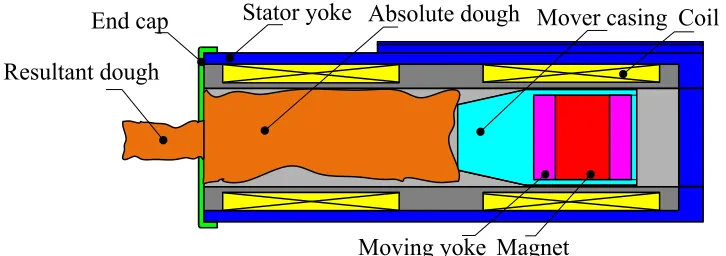
The concept of the electrical moulding device with slot-less linear actuator for food processing application is as shown Figure 1.2. As power is applied to the slot-less linear actuator, the mover will compress the dough inside the chamber to produce desired shape of dough. The mover is made up from permanent magnet which will be sealed by mover casing that made up from non-ferromagnetic material such as plastics to avoid contact and dough isolation. This research is more practical since it use less human energy and less hand contact with dough. So, cleanliness issues will not rise. The productivity also will increase as this device can handle a larger quantity of dough. The density of the dough whether the dough is hard or soft is also will be considered in this project.
Resultant dough
Stator yoke Mover casing Coil
Moving yoke Magnet
[image:17.612.162.482.86.195.2]End cap Absolute dough
[image:17.612.111.474.463.591.2]1.2 Problem Statement
For over so many years, peoples are still using traditional or conventional compression method by pressing hand in the moulding device for food processing application. Foods such as samperit and tart cookies are the examples of foods that require this method in processing it. But, this method is no longer practical as it requires human energy and this method is not productive when handling larger amount of dough. Thus, this will caused a problem to the entrepreneur when customers order large quantities of cookies. Furthermore, in cleanliness aspect, this method is in the poor level as there is frequent hand contact with the dough itself. Improper handling of the device is also a problem when using this conventional compression method. Therefore, a power moulding device for food processing application should be introduced to solve these problems. A power moulding device that use less amount of human energy and less hand contact to the dough should be developed. As a result, a proper moulding device that can increase the productivity, save to handle and have high cleanliness level should be introduced.
1.3 Objectives
The objectives of this project are:
i. To design a slot-less linear actuator for food processing application.
1.4 Scope
This project covers the scope of designing the slot-less linear actuator as the device that converts rotary motion to linear motion for food processing application. The slot-less linear actuator is then been examine and analyze. This project can be divided into several stages. The first stage of this project is to carry out the preliminary experimentation using traditional moulding device to get the real specifications and dimension of the device. The specifications and dimension needed such as the height of the device, the volume of the dough that can be filled in the chamber of the moulding device and the force needed to push the dough. The next stage is to model the actuator. The modeling of the actuator by using SolidWorks software and the design is transferred to Ansys Maxwell Software to get the desired specifications of designed linear actuator. Then, the model of the actuator will be analyzed in order to get the best model of the actuator. Lastly, the best designed model of the actuator will be model by using rapid prototyping. However, this project do not covers designing motor driver and field testing.
1.5 Report Outline
This report consists of five (5) chapters. The first chapter of this report covers the research background, problem statements and objective of this project. The scope and report outline are also included in this chapter.
The next chapter is the methodology which explains in detail about the whole workflows and method used to accomplish this project. Design and simulation software which are used to complete this project are also explained in this chapter.
CHAPTER 2
LITERATURE REVIEW
This chapter discusses the slot-less linear actuator in general. This includes the overview about traditional device available, the basic operation of slot-less linear actuator, the comparison between slot-type and slot-less linear actuator. Besides, the overview on related research of slot-less linear actuator is also shown.
2.1 Overview about Traditional or Conventional Moulding Device Available
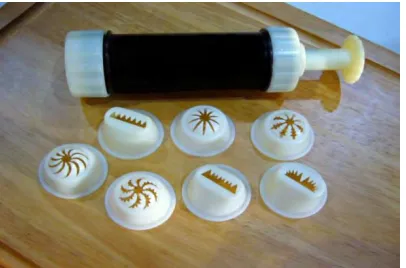
[image:21.612.215.418.546.680.2]Figure 2.1 shows the traditional or conventional moulding device for food processing applications that available in the market. The presser device is basically consists of two parts; compressor and chamber. Amount of dough is put in the chamber and the compressor will compress until the dough come out from the bottom with desired shape. The shape of the dough that will come out can change as there is multiple design of mould. If the dough is hard, the force used to compress the dough is larger.
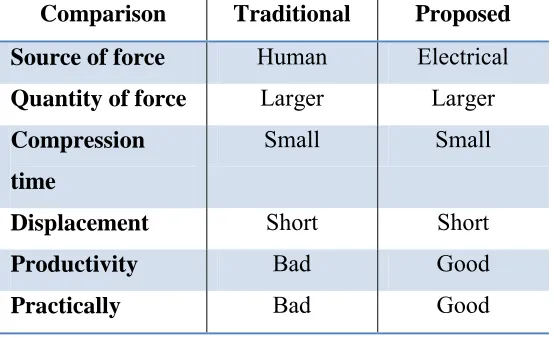
Table 2.1 shows the comparison between the traditional and proposed moulding device. It can be seen that the traditional moulding device requires larger external force for compression. However, the compression time is small and the chamber displacement is short. Meanwhile, the proposed moulding device is powered by electrical and does not require human energy. Besides, more cookies can be made since it has smaller compression time and short chamber displacement.
Table 2.1: Comparison between traditional and proposed moulding device. Comparison Traditional Proposed
Source of force Human Electrical Quantity of force Larger Larger Compression
time
Small Small
Displacement Short Short
Productivity Bad Good
Practically Bad Good
2.2 Slot-less Linear Actuator
N S
Stator yoke Coil
Permanent Magnet Moving yoke
[image:23.612.165.463.74.205.2]Shaft
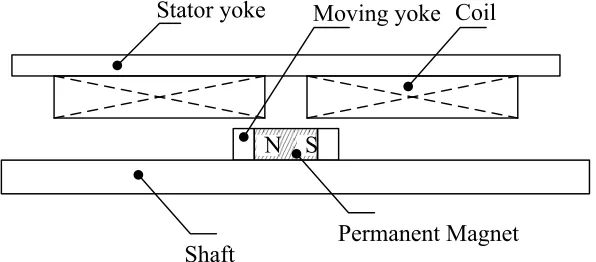
Figure 2.2: Basic structure of linear actuator.
Figure 2.3 shows the basic operation of linear actuator. Based on the Fleming’s left-hand rule, the force will be produced when the current carrying conductor is placed inside the magnetic field [2]. The coil must be applied with different direction as it will produce flux. The coil current will flows perpendicularly to the flux of permanent magnet. The current will flow from the North pole to the South pole. So, as the current flows through the coils, the mover will move to the left direction.
N S
[image:23.612.172.447.444.535.2]Moving Direction
2.3 Comparison between Slot-type and Slot-less Linear Actuator
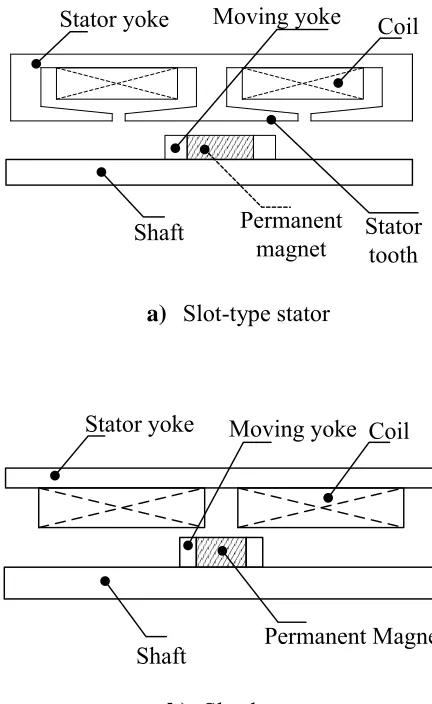
Figure 2.4 (a) and (b) shows the basic structures of slot-less and slot-type linear actuator. Based on the structures, the main difference between the two structures of the linear actuator is the structure of the stator yoke. Slot-less type of stator yoke do not have tooth and slots. Meanwhile, the slot-type stator has the stator tooth and slot. The coil in the slot-less type stator is wound cylindrically around the shape of the stator and the coil in slot-type stator is wound around the stator tooth in between the slots.
Permanent magnet Shaft
Coil
Stator yoke Moving yoke
Stator tooth
Stator yoke Coil
Permanent Magnet Moving yoke
Shaft
a) Slot-type stator stator
[image:24.612.198.414.257.609.2]b) Slot-less stator