Efficient and Secure ECDSA Algorithm and its
Applications: A Survey
Mishall Al-Zubaidie
1,2, Zhongwei Zhang
2and Ji Zhang
21
Thi-Qar University, Nasiriya 64001, Iraq 2
Faculty of Health, Engineering and Sciences,
University of Southern Queensland, Toowoomba, QLD 4350, Australia
Abstract: Public-key cryptography algorithms, especially elliptic curve cryptography (ECC) and elliptic curve digital signature algorithm (ECDSA) have been attracting attention from many researchers in different institutions because these algorithms provide security and high performance when being used in many areas such as electronic-healthcare, electronic-banking, electronic-commerce, electronic-vehicular, and electronic-governance. These algorithms heighten security against various attacks and the same time im-prove performance to obtain efficiencies (time, memory, reduced computation complexity, and energy saving) in an environment of constrained source and large systems. This paper presents detailed and a comprehensive survey of an update of the ECDSA algorithm in terms of performance, security, and applications.
Keywords:ECDSA, coordinate system, fault attack, scalar multi-plication, security.
1. Introduction
Public key encryption algorithms such as elliptic curve cryp-tography (ECC) and elliptic curve digital signature algorithm (ECDSA) have been used extensively in many applications [1] especially in constrained-resource environments due to the ef-fectiveness of their use it in these environments. These al-gorithms have appropriate efficiency and security for these environments. Constrained resource environments such as wireless sensor network (WSN), radio frequency identifier (RFID), and smart card require high-speed, low consump-tion ability, and less bandwidth. ECC has been considered to be appropriate for these constrained-source environments [2]. These algorithms provide important security properties. For example, ECDSA provides integrity, authentication, and non-repudiation. ECDSA has been proven to be efficient in its performance because it uses small keys; thus the cost of computation is small compared with other public key cryptog-raphy algorithms, such as Rivest Shamir Adleman (RSA), tra-ditional digital signature algorithm (DSA) and ElGamal. For example, ECDSA with a 256-bit key offers the same level of security for the RSA algorithm with a 3072-bit key [3, 4]. Ta-ble 1 [5, 6, 7] shows a comparison of key sizes for public key signature algorithms.
The preservation of efficiency and security in the ECDSA is important. On one hand, several approaches have been de-veloped to improve the efficiency of the ECDSA algorithm to reduce the cost of computation, energy, memory, and sumption of processor capabilities. The operation that con-sumes more time in ECC/ECDSA is the point multiplication (PM) or scalar multiplication (SM). ECC is used PM for en-cryption and deen-cryption, while ECDSA is used this operation to generate and verify the signature [8]. One can improve the PM efficiency by improving finite field arithmetic (such as inversion, multiplication, and squaring), elliptic curve model (such as Hessian and Weierstrass), point representation (such
as Projective and Jacobian), and the methods of PM (such as Comb and Window method) [9]. Many researchers have made improvements to the PM to increase the performance of the ECC/ECDSA as we will see in Section 4.
On the other hand, the security improvement in ECDSA is no less important than its efficiency because this algorithm is designed primarily for the application of security properties. ECDSA, like previous algorithms, may possibly suffer from some of the security vulnerabilities such as random weak, bad random source [1] or leaking bits of the private key. Also, many researchers have made improvements to close security gaps in the ECC/ECDSA algorithm by providing sures against various attacks. But when selecting countermea-sure there should be a balance between security and efficiency [10]. To maintain the security of these algorithms it is impor-tant to use finite fields (either prime or binary) recommended by credible institutions such as the Federal Information Pro-cessing Standard (FIPS) or National Institute of Standards and Technology (NIST). The choice of appropriate curves and fi-nite fields according to the authoritative organizations’ stan-dards leads to secure ECDSA’s implementations [11]. There-fore, we note from the above that any encryption algorithm or signature should possess a high performance and security level.
1.1 Our Contributions
Our contribution in this survey is to provide an updated study of three important parts in ECC/ECDSA. These items can be summarized as follows:
• Presenting a study on the efficiency of ECC/ECDSA in terms of speed, time, memory, and energy.
• Investigating the security problems of the ECC/ECDSA and countermeasures.
• Giving a description of the most important applications that use ECC/ECDSA algorithms.
1.2 Structure of the paper
The remainder of this paper is structured as follows: Section 2 provides basic concepts and general information about ECC and ECDSA algorithms. Section 3 describes existing surveys about ECC/ECDSA. Efficiency improvement on ECDSA al-gorithm is presented in Section 4. In Section 5, we will show the security improvement on ECDSA algorithm through us-ing countermeasures against attacks. The ECDSA applica-tions are described in Section 6. Finally, we will present the conclusion and future work on this survey in Section 7.
2. Preliminaries of ECDSA
Table 1.Keys sizes and some information for public key algorithms
Algorithm Keys sizes Ratio Author(s) Year Mathmatical
problem
Other algorithms
RSA
Rivest, Shamirand, and Adleman
1978 Integer
factorization Rabin
Elgamal Taher Elgamal 1985
DSA
1024 2048 3072 7680 15360
David W.
Kravitz 1991
Multiplicative group
Schnorr, Nyberg-Rueppel
ECDSA 160-223 224-255 256-383 384-511 512-more
1:6-30
Scott Vanstone 1992
Elliptic curve discrete log. (ECDLP)
ECIES
2.1 ECC
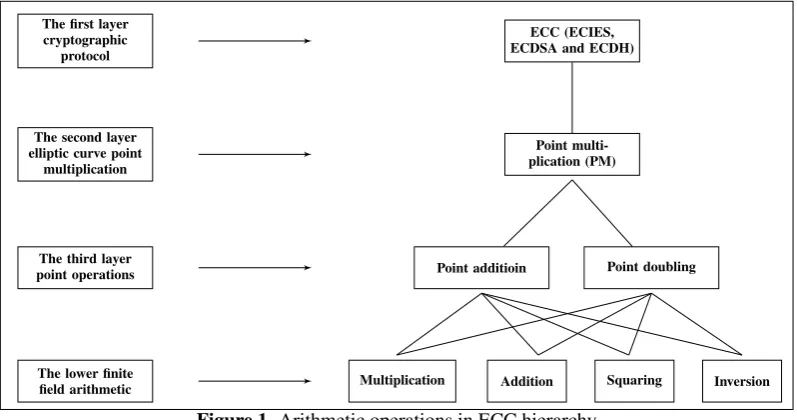
ECC has been used to encrypt data to provide confidentiality in the communications network with limited capacity in terms of power and processing. This algorithm was independently proposed by Neal Koblitz and Victor Miller in 1985 [12]. It depends on the discrete logarithm problem (DLP) which is impervious to different attacks when selecting parameters ac-curately [13], i.e difficulty obtainingkfromPandQ( wherek is integer and,PandQare two points on the curve). Small pa-rameters used in ECC help to perform computations quickly. These computations are important in constrained-source envi-ronments that require processing power, memory, bandwidth or power consumption [7]. ECC provides encryption, signa-ture and keys exchange approaches [12]. Many operations are performed in ECC algorithms (shown in four layers) as shown in Figure 1 [14].
ECC uses two finite fields (prime field and binary field). The binary field uses two types to represent basis ( normal and polynomial basis) [7], and is well suited to implementation in hardware [14]. LetFq indicates field type, ifq=p(wherep > 3) then ECC uses prime field (Fp). In the second case, ifq=2
then ECC uses binary field (F2m) where m is the prime integer
[15]. ECC consists of a set of points (xi, yi), where xi, yi
are integers and the point at infinity (O) provides an identity for Abelian group rule that satisfies long form for Weierstrass equation (with Affine coordinate).
y2+a1xy+a3y=x3+a2x2+a4x+a6 (1)
When prime field is used over ECC, the simplified equation is as follows:highlighted
y2=x3+ax+b (2)
Wherea, b∈Fp,4a3+ 27b26= 0(modp). The law of
chord-and-tangent is used in ECC to add two points on the curve. Let us suppose thatPandQare two points on the curve; these two points have coordinates(x1, y1),(x2, y2)respectively and
the sum of these two points is equal to a new pointR(x3, y3)
(i.eP(x1, y1)+Q(x2, y2)=R(x3, y3)) [7]. ECC uses two
op-erations for addition that are point addition(P+Q) and point doubling (P+P) (Figure 1), as in the following equations: In the case of the point addition (P +Q) whereP and Q
∈E(Fp):
with using the slopeλ= y2−y1 x2−x1
x3=λ2−x1−x2, y3=λ2(x1−x3)−y1 (3)
In the case of the point doubling(P+P)whereP ∈E(Fp):
with using slopeλ= 3x21+a
2y1
x3=λ2−2x1, y3=λ2(x1−x3)−y1 (4)
When the binary field is used over ECC, the simplified equa-tion is as follows:
y2+xy=x3+ax2+b (5)
Algorithm 1ECC encryption and decryption algorithm:
1: Alice and Bob use same parameters domain D =
{a, b, q, G, n, h}, wherea, bare coefficient,qis field type,
Gis base point,nis order point andhis cofactor. 2: Alice selects random integerdAas private key.
3: Alice generates public keyQ=dAGand sendsQandG
to Bob.
4: Bob receives messagemfrom Alice, selects random inte-ger as private keydBwheredB≤n.
5: Bob encrypts messagemwith pointP in elliptic curve
E(Fq).
6: Bob computesC1=P+dBQ,C2=dBGand sendsC1
andC2to Alice.
7: Alice receives Bob’s message and decrypts the message by computingC1−dAC2to obtain plaintext.
Wherea, b∈F2m, b6= 0[7], as addition operations are in the
following form:
In the case point addition(P+Q)wherePandQ∈E(F2m):
with using the slopeλ= y1+y2 x1+x2
x3=λ2+λ+x1+x2+a, y3=λ(x1+x3) +x3+y1 (6)
In the case point doubling(P+P)whereP∈E(F2m):
x3=x21+
b x2
1
, y3=x21+ (x1+
y1
x1
)x3+x3 (7)
ECC operations for encryption and decryption are explained through the algorithm 1 [16].
2.2 ECDSA
The first layer cryptographic
protocol
The second layer elliptic curve point
multiplication
The third layer point operations
The lower finite field arithmetic
ECC (ECIES, ECDSA and ECDH)
Point multi-plication (PM)
Point additioin Point doubling
[image:3.595.104.503.53.263.2]Multiplication Addition Squaring Inversion
Figure 1.Arithmetic operations in ECC hierarchy
• Key generation:
1 Select a random or pseudorandom integerdin the interval[1, n−1].
2 ComputeQ=dG
3 Public key isQ, private key isd. • Signature generation:
1 Select a random or pseudorandom integerk, 1 ≤ k≤1.
2 ComputekG= (x1, y1)and convertx1to an
inte-gerx¯1.
3 Computer=x1modn. Ifr= 0then go to step 1.
4 Computek−1modn.
5 Compute SHA-1(m) and convert this bit string to an integere.
6 Computes=k−1(e+dr)modn. Ifs= 0then go
to step 1.
7 Signature for the message m is(r, s). • Signature verification:
1 Verify thatrandsare integers in the interval [1,n -1].
2 Compute SHA-1(m) and convert this bit string to an integere.
3 Computew=s−1modn.
4 Computeu1=ewmodnandu2=rwmodn.
5 ComputeX =u1G+u2Q.
6 IfX =θthen reject the signature. Otherwise, con-vert thex-coordinatex1ofX to an integerx¯1, and
computev= ¯x1modn.
7 Accept the signature if and only ifv=r.
ECDSA algorithm becomes unsuitable for signing messages (integration) if used poorly and incorrectly. Validation of do-main parameters is important to ensure strong security against different attacks. This algorithm becomes strong if the param-eters are well validated [20, 21]. The authors’ recommenda-tions are to update the validation scheme.
2.3 ECDSA Implementations on Constrained Envi-ronments
The performance and security presented by ECDSA algo-rithm, make it suitable for use in several implementations on WSN, RFID, and smart card. Digital signatures in ECDSA have better efficiency in devices with constrained-resource than DSA and RSA. Many authors have pointed to the
possibility of using ECDSA with environments constrained-resource (memory, energy, and CPU capability). In the fol-lowing Subsections, we will explain using ECDSA with these implementations.
2.3.1 Wireless Sensor Network (WSN)
A WSN consists of a group of nodes that communicate wire-lessly with each other to gather information about a particular environment in various applications [22]. This network often has restricted sources such as energy and memory. Therefore, a WSN needs efficient algorithms to reduce the complexity of the computation in order to increase the length of the network lifetime. In addition, it requires a high level of security to pre-vent attacks. Several researchers have investigated the use of ECDSA algorithm in WSN and explained that ECDSA is con-venient for WSN.
WSN (TelosB and MICAz) through the Kerberos key distribu-tion protocol (symmetric encrypdistribu-tion) and ECDH-ECDSA key agreement protocol (asymmetric encryption). They noted that TelosB sensor node consumes less power than MICAz and Kerberos performs better than ECDH-ECDSA. Moreover, Fan and Gong [27] implemented ECDSA on Micaz motes with the binary field (163-bit). They improved signature verification via cooperation idea of the adjacent nodes. Also, ECDSA’s implementation was presented in sensor node (IRIS) [28], but because this node supports 8-bit of the microcontroller the author modified the SHA-1 code from 32 bits original to 8 bits. Through implementation, the original algorithm is bet-ter in size and time than a modified algorithm. The author explained the possibility of using ECDSA algorithm with the sensor node (IRIS) held 8-bit microcontroller.
Recently, researchers in [29, 30] have applied the ECDSA al-gorithm as a light-weight authentication scheme in the WSN. This demonstrates the effectiveness and efficiency of using ECDSA in WSN in terms of security and performance.
2.3.2 Radio Frequency Identifier (RFID)
Another implementation of ECDSA is Radio Frequency Iden-tifier (RFID). RFID is one of the technologies used in wireless communication. This technology has been used significantly in various fields, but it suffers from constrained-resources such as area and power. Therefore, many researchers con-sidered ECDSA algorithm to be the best choice in RFID tags because ECDSA is not required to store private/public keys as in symmetric cryptography algorithms.
The hardware’s implementation of ECDSA algorithm has been widely used on RFID technology [31]. Authors have used ECDSA algorithm to authenticate the entity. They have applied this algorithm to the prime field (Fp160) according
to SECG standards. They accelerated multiplication algo-rithm by combining integer multiplication and fast reduction. Through implementation, they get good results in reducing chip area and power consumption (860µwin 1MHz). They concluded that ECDSA computation requires 511864 clock cycles. Also, Hutter et al. [32] proposed ECDSA processor with RFID tag. This processor has security services (authenti-cation, integrity, and non-repudiation). Authors used this pro-cessor to authenticate between tag reader and RFID tag. They used several countermeasures to prevent side channel attacks such as Montgomery ladder algorithm, randomized Projective coordinate andk randomness through SHA-1. Through re-sults, the computation cost of the signature in this processor is 859188 clock cycles (127ms at 6.78 MHz) and the area is 19115 GE. Implementation of ECDSA algorithm is presented with prime field (Fp160) on RFID [33]. Authors exchanged
SHA-1 hash algorithm with KECCAK hash to reduce run-ning time in ECDSA on RFID. Also, they used a fixed-base comb with w=4 to accelerate and reduce hardware require-ments. Results show that their scheme gets an area of 12448 GEs, power consumption 42.42µw in 1MHz and signature generation is less than 140 kcycles. With these results, their scheme competes with other schemes for the binary and prime fields.
Recently, the ECDSA with password-based encryption in [34] has been adopted to improve security and privacy in RFID. Authors pointed out that lightweight processes performed by ECDSA in data signing are significantly effective in RFID.
Also, Ibrahim and Dalkılıc¸ [35] used ECDSA with the Shamir scheme to secure RFID technology. They applied the Shamir scheme to reduce the cost of two scalar multiplications to one. Finally, ECDSA has been implemented to secure RFID in IoT applications in [36] have implemented. Authors proposed a shopping system, during the analysis and evaluation, arguing that ECDSA is suitable to sign users requests in the shopping system.
2.3.3 Smart Cards
A smart card is a novel way for authentication as it contains important information for users. This technology is used by several algorithms to implement authentication mechanisms, such as RSA, DSA and ECDSA. ECDSA algorithm is used in this area largely because of the advantages found in ECDSA. The design and implementation of ECC/ECDSA algorithms have been investigated and they are used in constrained-source devices like smart cards [12]. The authors used a java card that supports the java language and the environment used is next generation integrated circuit card (NGICC). Results showed that the ECC/ECDSA is better than RSA. The results also pointed to the possibility of using these algorithms in the other wireless devices constrained-source. Moreover, the EC al-gorithms (ECDSA and ECDH) with pairing were used on a Java card [37]. ECC requires little data to move between the card reader and the card, compared with the RSA. Further-more,Savari and Montazerolzohour [38] concluded that the ECC/ECDSA algorithm is more efficient in terms of power, storage and speed than RSA on the smart card. On the other hand, Bos et al. [1] discussed using ECDSA with Austrian e-ID (smart card). They noted that ECDSA uses the same keys many times; therefore, they pointed to improved randomness in ECDSA. In 2017, Dubeuf et al. [39] discussed the secu-rity risks of the ECDSA algorithm when applied to a smart card. They proposed the development of a scalar operation algorithm when applying the Montgomery ladder method in ECDSA. They described that ECDSA offers a security solu-tion for their smart card implementasolu-tions.
3. Existing Surveys
In this section, we will present the existing surveys in ECC/ECDSA. In this survey, we will focus on a study to many of the aspects of ECC/ECDSA algorithm. To start with begin-ning, we will present these articles and then explain the differ-ence between our research and existing studies. Table 2 lists existing surveys for the ECC/ECDSA algorithm.
• Performance and efficiency
Table 2.Different between existing surveys and our research
Paper Contribution of existing surveys Aspect Year
[40] Efficiency and flexibility in hardware implementations Efficiency 2007
[17] Compared many different signature schemes 2008
[41] Attacks and countermeasures Security 2010
[42] Hard problems in public cryptography algorithms 2011 [43, 10] SCA and fault attacks, and countermeasures 2012,2013
[44] Security techniques in WSN Applications 2015
[45] Attack strategies in Bitcoin and Ethereum 2016
[6] ECC/ECDSA with some applications 2017
This work Classification of efficiency, security methods and applications with updated con-tributions
Efficiency Security Applications
(ECDSA, XTR-DSA, and NTRUSing) in terms of en-ergy consumption, memory, keys length and signature, and performance. Through implementation, the authors found that NTRUSing algorithm is the best in term per-formance and memory. However, NTRUSing algorithm suffer from security weakness against attacks.
• Security and countermeasures
A detailed study in [41] on attacks and countermeasures in ECC algorithm is presented. The authors divided at-tacks to passive and active atat-tacks. They explained that the countermeasure for a specific attack may be vulner-able to other attacks, whereas countermeasures should have been selected carefully. Therefore, the authors have made some recommendations in selecting countermea-sures. Some surveys have studied public cryptography algorithms in terms of computation of hard problems (integer factorization problem(IFP), discrete logarithm problem (DLP), lattices and error correcting codes) in quantum and classical computers [42]. The authors de-scribed RSA, Rabin, ECC, ECDH, ECDSA, ElGamal, lattices (NTRU) and error-correcting code (McEliece cryptography), as they pointed out that ECC provides a higher security level than other cryptosystems; in ad-dition, it presents advantages such as high speed, less storage, and smaller keys sizes. But they did not dis-cuss the use of ECC/ECDSA in applications and imple-mentations of different technologies. Meanwhile, the au-thors in [43, 10] explained physical attacks on ECC al-gorithms, where they focused on two known physical attacks: side channel analysis (SCA), and fault attacks. They also described many attacks including these two types, as they presented countermeasures against these attacks such as simple power analysis (SPA), differential power analysis (DPA) and fault attack (FA) countermea-sures. Also, some recommendations were presented for countermeasures that add randomness, countermeasures selection, and implementation issues. However, none of these papers investigated non-physical attacks on public key signature algorithms such as ECDSA.
• Implementation and applications
A study on security techniques has investigated wireless sensor networks (WSNs) [44]. It focused on three fea-tures in WSN security: key management, authentication, and secure routing. This study pointed out that ECC algorithm was convenient for constrained-resource de-vices. In addition, a survey on attack strategies was given in relation to ECC and ECDSA algorithms in Bitcoin and Ethereum [45]. The author pointed out that different standards for curves (such as ANSI X9.63, IEEE P1363, and safecurves), where this survey focused on safecurves with SECP256k1 through using ECDSA, as this paper
referred to safecurves as one of the strongest curves stan-dards. The author suggested many basic points to pre-vent attacks on ECDSA or ECC. Finally, Harkanson and Kim [6] compared RSA and ECC/ECDSA, and pointed out that ECC/ECDSA exhibited the highest performance with the same level of security from RSA. They noted that 69% of websites use ECC/ECDSA, 3% used RSA and the rest used other algorithms. They also described ECC with some applications (such as vehicular commu-nication, e-health and iris pattern recognition). However, they had a duplication between implementation and ap-plication. For example, RFID is a technology that can be used to implement a particular application.
In our survey, we study the ECDSA algorithm differently to previous studies. First, we integrate three aspects (efficiency, security, and applications) into one search. Second, systemat-ically, we provide different details (ECDSA aspects) of previ-ous studies. Finally, we provide an updated explanation of all these aspects in ECDSA.
4. Efficiency Improvement on ECDSA
In this section, we will discuss the improvement of ECDSA’s efficiency in many ways such as scalar multiplication, coor-dinate system, and arithmetic operations. In each subsection, successive improvements to several authors will be explained.
4.1 Efficiency Improvement of Scalar Multiplication
This section includes many strategies to improve scalar multi-plication; these are efficient in terms of scalar representation, curve operations, and ECDSA arithmetic operations.
4.1.1 Representation Improvement of the Scalar
In this section, we explain the scalar representation methods on scalar multiplication. Implementation of scalar multipli-cation take a large amount of time [46, 19] in ECDSA and ECC algorithms. Scalar multiplication takes more than 80% for running time in operation of key computation in sensor de-vices [13, 47]. Scalar multiplication (SM) or point multiplica-tion (PM) is a set of point addimultiplica-tion(P+Q)and point doubling
(P+P)that generateskP (wherekis a large integer andPis a point on the curve) throughP+P...(k-times)[48, 49]. Rep-resentation of 25 points in traditional double-and-add (D&A) method presents as the following [50].
AA25P= 2(2(2(P+2P)))+P
Or
AA25P= 2(2(2(2P)+P))+(2(2P)+P)
The efficient and fast implementation of ECC algorithm and its derivatives are needed to accelerate SM implementation [51]. As we can see from step 5, signature verification in ECDSA algorithm requires 2 scalar multiplications(u1G+
SM uses three operations: inversion, squaring and multiplica-tion (where it takes the notamultiplica-tion i, s and m respectively) that is considered expensive for an ECC algorithm [48]. These operations are used to evaluate SM efficiently through imple-mentations. When using the Affine coordinate system with SM, both point doubling and point addition consume 2 mul-tiplications, 1 squaring and 1 division operation in field [48]. Improving on SM leads to reduce computation cost, and run-ning time and thus improve the efficiency of performance in ECC algorithm and its derivatives. The traditional method (double-and-add algorithm) in scalar multiplication uses base 2 in point doubling such as 2(...(2(2P))) in addition to point addition [48]. In this method, point doubling is implemented in each bit ink(wherekis integer scalar and represented in bi-nary form) while point addition is implemented when bit equal ”1” ink [52]. Improving SM makes these algorithms con-venient for constrained-source devices such as WSN, RFID, and smart card [14] through reducing of running time and en-ergy consumption. Many researchers have presented methods to represent scalar in order to reduce computation complex-ity inkP. Many representations have used for SM such as traditional method (double-and-add), double base chain (2,3), multibase representation ((2,3,5) and (2,3,7)) and point halv-ing (1/2P). All these representations lead to shorter repre-sentation length of terms and hamming weight. For instance, multibase representation (2,3,5) is shorter terms length and more redundant than a double base chain (2,3). Representing 160-bit in multibase representation (MBNR) needs 15 terms while double base chain (DBNR) needs 23 terms [50]. Some-times, improving on methods of SM representation may bring storage problems, for example, using point halving instead of point doubling with polynomial base requires greater storage in memory [53]. In the following subsections, we will discuss methods to improve the representation of scalar in SM.
4.1.1.1 Double-Base Chain (2,3)
One of the methods used to develop doubling(2P)is tripling
(3P). This method was proposed to use bases 2 and 3 to re-duce the execution time of the PM. Ciet et al. [54] proposed a point tripling operation(3P)and mixed it with point dou-bling(2P)depending on various methods to evaluate2P+Q
when 1 inversion is more than 6 multiplications that lead to improving tripling. They presented a comprehensive evalu-ation through i, s and m for operevalu-ations types: P +Q, 2P,
2P +Q,3P,3P+Q,4P,4P+Q. The authors noted that
2P+Qis faster thanP+(P+Q)but2P+Qhas slightly more cost. They used the idea of Eisentr¨ager et al. [15] in removing
y3from equations when computing2P+Q; the authors used this idea with3P+Qand removedy4when 1i is more than 6m to reduce computation cost. Their results proved that this scheme improved SM efficiency in ECC, ECDSA and ECDH. Double-base chain equation is
k=X i
si2bi3ci (8)
Where si is ±1, and (2bi3ci) are integer numbers and bi
and ci decreased monotonically (b1 > b2...bm > 0 and
c1 > c2...cm > 0). Furthermore, characteristic 3 was
investigated with both Weierstrass and Hessian forms [11]. The authors pointed out that characteristic 3 is efficient in Weierstrass form, where tripling operation performs more ficiently than double and add, while characteristic 3 is not
ef-ficient with Hessian form (Triple-and-add (T&A) used with Weierstrass and double-and-add(D&A) used with Hessian). In addition, the scalar in the double base number system al-gorithm (DBNS) is analysed on superlinear EC in character-istic 3 [55]. Double-base chain is DBNS but with restriction doubling and tripling and increasing the number of point ad-dition through a Horner-like manner. The authors proposed sublinear SM algorithm for PM (i.e. sublinear in scalar’s length) with running time O(log log nlog n ), and it is faster than D&A and T & A. They pointed out that their algorithm is ap-propriate to use with large parameters in EC, where selecting large parameters leads to improving performance and secu-rity. Also, Dimitrov et al. [56] proposed double-base chains method through prime and binary fields, using point tripling with a Jacobian coordinate in prime fields, and quadrupling combined with quadruple-and-add with an Affine coordinate in binary fields. They used a modified greedy algorithm to convert kto DBNS form. Also, they applied the same idea that was used in Eisentr¨ager et al. [15] to evaluate only x -coordinate in computation2P+Qbut with4P+Qto increase SM efficiency. Through results, the authors have become effi-cient in speeding SM better than classical D&A (21%), NAF (13.5%) and ternary/binary (5.4%) in binary fields. In prime fields, their scheme also gets better results than D&A (25.8%), NAF (15.8%), 4NAF (6%). But results in [54] are better than this scheme in term inversions (with binary fields) in the com-putation case 4P and 4P+Q, where their scheme obtains for 4P(2[i] + 3[s] + 3[m]) and for 4P+Q(3[i] + 3[s] + 5[m]). Re-sults in [54] are 4P(1[i] + 5[s] + 8[m]) and 4P+Q(2[i] + 6[s] + 10[m]) where squaring is free and ignored in binary fields, while their scheme is better than [54] when using prime fields.
4.1.1.2 Multibase Representation (2,3,5)
Multibase representation is a method to improve SM through using a point quintupling (5P). It uses 3 bases (2,3,5) called step multibase representation(SMBR). Multibase representa-tion algorithms are shorter terms, more redundant, and have more sparseness than DBNS algorithms. For instance, repre-sentation 160-bit costs 23 terms in bases reprerepre-sentation (2,3) whereas 15 terms in representation bases (2,3,5). SMBR equation is presented as follows:
k=X i
si2bi3ci5di (9)
Wheresiis±1, and (2bi3ci5di) are integer numbers andbi,ci
and di decreased monotonically (b1 > b2...bm > 0, c1 >
c2...cm > 0 and d1 > d2...dm > 0). Mishra and
Dim-itrov [57] used SMBR with Affine in binary fields and Ja-cobian in prime fields similar to the scheme in [56]; there-fore, their scheme is a generalization for [56] but with 3 bases. They improved on a greedy algorithm (mgreedy) in order to fit SMBR and to gain shorter representation and faster run-ning. Moreover, they recommended using small values for exponents because it does not affect cost. Computation of
5P was efficient with the prime field through 2(2P) +P
and 2P + 3P. They found that 2(2P) +P costs 9s+17m (with Affine ) and 14s+20m (with Jacobian) while2P+ 3P
ternary/binary and DB chains whether with precomputation or without precomputation points. Finally, Longa and Miri [58] concluded that the cost of5P+Qis 26m + 13s.
4.1.1.3 Multibase Representation (2,3,7)
Multibase representation is a scalar representation method, which depends on base triple bases to accelerate point multi-plication. It uses 3 bases (2,3,7) and is called multibase num-ber representation(MBNR). This representation is the devel-opment of previous representation methods (DBNR (2,3) and SMBR (2,3,5)). Purohit and Rawat [50] proposed triple base method (binary, ternary and septenary) with addition and sub-traction. The greedy algorithm was used to convert an integer to the triple base (2,3,7), through finding the closest integer to a scalar. Their evaluation referred to this method as having better results than previous methods of scalar representation. They pointed out that septupling (7P) costs is less than two formulas (2(2P) + 3pand2(3P) +P), where7P=3i + 18m,
2(3P) +P=4i + 18m and2(2P) + 3P= 5i + 20m. Also, squaring cost was neglected, regarded as inexpensive in the fields with characteristic 2. MBNR representation was applied through the following equation:
k=X i
si2bi3ci7di (10)
Wheresiis±1, and (2bi3ci7di) are integer numbers andbi,ci
anddi decreased monotonically (b1 > b2...bm > 0, c1 >
c2...cm > 0andd1 > d2...dm > 0). MBNR (2,3,7) is
bet-ter than MBNR (2,3,5) in bet-terms of shorbet-ter bet-terms length, more redundant and spare. The next example gives a comparison between using quintaupling and septupling when points num-ber= 895712 as mentioned in [50].
(usingquintaupling)
243752+ 243551+ 243450+ 213450+ 203250+ 203150
(usingseptupling)
293571+ 273371+ 253171+ 253170
This method presents efficiency in scalar multiplication better than previous representation methods, where we note from the previous example that septupling is more redundant and has fewer terms than quintupling. Also, Chabrier and Tisserand [59] proposed MBNR (2,3,5,7) to represent scalar without precomputation. They investigated the costs in their method when a = -3, the cost is 18m + 11s (prime field). The results of their proposal indicate high performance in FPGA implemen-tations with SM at high speed with storage level and execution time.
4.1.1.4 Point Halving with DBNR and MBNR Repre-sentations
This section will discuss point halving (PH) first, then bases (1/2,3), (1/2,3,5), and (1/2,3,7) respectively. Point halving method is one of the methods used to reduce the cost of point doubling. It means extractPfrom2P[48]. Knudsen [53] and Schroeppel [60] separately proposed point halving in order to accelerate point multiplication. They wanted to reduce the cost of computation complexity in point doubling. Point halv-ing was suggested to use instead of all point doublhalv-ing, where point halving is faster than point doubling in the case of us-ing Affine coordinate on the curve (minimal two-torsion) [53]. This method was implemented on the binary field (polynomial and normal). Both polynomial and normal basis perform fast
computations, but polynomial basis suffers from storage prob-lem. This scheme neglected squaring operation and evaluation as it depends on inversion and multiplication. To implement point halving on binary field in curve, the following equations were used to getQ= 2P, whereP = (x, y)andQ= (u, v):
λ=x+y
λ (11)
u= (λ)2+λ+a (12)
v=x2+u(λ+ 1) (13)
Through previous equations, we get point halving; the sec-ond equation gives us λvalue, the third equation gives us x and subsequently uses values of x,λto get y value from the first equation. Fong et al. [61] presented analysis and com-parison between SM methods (point doubling and point halv-ing) and used binary fields (F2163 andF2233) through
reduc-tion polynomials of trinomial and pentanomial (using polyno-mial basis instead of normal) on standards of NIST’s FIPS 186-2. Through analysis, they found that point halving is faster (29%) than point doubling when P is known in ad-vance. Also, they noted τ-adic (Frobenius Endomorphism) used in [62] faster than PH. They presented a comparison be-tween double-and-add and halve-and-add (H&A) over F2163
through Affine and Projective coordinate systems. Also, they pointed out that point doubling can use with mixed nate while point halving must be used in the Affine coordi-nate. They explained that signature verification in ECDSA has 2 SM and this operation is expensive whenP is known. But performing ECDSA verification with halving is more ef-ficient than doubling in addition to halving being better for constrained-resources in the case assumption that storage is available. Ismail et al. [48] mentioned that point halving is faster than point doubling by 5-24%.
Point halving(1/2P)is combined with DBNR (2,3) in [52] to reduce computation complexity and to increase operations ef-ficiency of scalar multiplication in ECC/ECDSA. The authors implemented their scheme on Pentium D 3.00 GHz using C++ with MIRACL library V 5.0 that deals with a large integer. Equations of scalar representation in this scheme are:
k0 = 2qmodp (14)
Where2q a large integer and value it close to field size.
k=k0/2q = Pm
i=1si2
bi3ci
2q =
m X
i=1
si(1/2)q−bi3ci (15)
Where si is ±1, and (2bi3ci) are integer numbers and bi
and ci decreased monotonically (b1 > b2...bm > 0 and
c1 > c2...cm > 0). The authors showed a comparison
be-tween their scheme results and DBNR with using the binary field (163-bit, 233-bit, and 283-bit) and prime field (192-bit) according to NIST’s standards. Their scheme achieved bet-ter results than an original double-base chain, their results re-duced 1/2 inversion, 1/3 squaring and few number of multipli-cation and that led to improving DBNR in scalar multiplica-tion.
double-and-add. It applied the following equation:
k=k0/2q= Pm
i=1si2bi3ci5di
2q =
m X
i=1
si(1/2)q−bi3ci5di
(16) Where si is ±1, and (2bi3ci5di) are integer numbers and
bi,ci and di decreased monotonically (b1 > b2...bm >
0, c1 > c2...cm > 0 and d1 > d2...dm > 0). The
greedy algorithm is used to convert an integer to modified MBNR. The authors referred to MBNR (2,3,5) and modified MBNR(1/2,3,5) as having the same terms but costs in modi-fied MBNR (i=7,s=17,m=77) were less than original MBNR (i=15,s=36,m=80) with k = 314159. Sometimes, the origi-nal algorithm has fewer terms than the modified MBNR, but modified algorithm remains less costly in operations(i,s,m). The modified and original algorithm are applied on different curves sizes (163, 233, 283), where each curve is tested with 100 random numbers. Results refer to modified scheme of less computation cost (30%) rather than the original scheme (2,3,5).
The authors in [51] proposed combining point halving with MBNR (2,3,7). They used bases (1/2,3,7) instead of (2,3,7). This scheme is less costly than schemes that have bases (2,3,5) and (2,3,7). Also, this scheme is used with the binary field. The authors referred to MBNR as being convenient for ECC because of its shorter representation length and less hamming weight. MBNR (1/2,3,7) representation uses the following equation:
k=k0/2q= Pm
i=1si2bi3ci7di
2q =
m X
i=1
si(1/2)q−bi3ci7di
(17) Wheresiis±1, and (2bi3ci7di) are integer numbers andbi,ci
anddi decreased monotonically (b1 > b2...bm > 0, c1 >
c2...cm > 0 and d1 > d2...dm > 0). This scheme
[image:8.595.307.553.69.332.2]presents improvement in the performance of scalar multiplica-tion through reducing computamultiplica-tion complexity. Through these results, the authors pointed out that their scheme reduced in-version to 1/2, and squaring to 1/3 and there were fewer num-bers of multiplication when compared with previous schemes. Table 3 shows the costs of arithmetic operations to represent scalar.
4.1.2 Methods of Improving Curve Operations
In this section, we describe the methods which are used to improve the PM by reducing the addition formula operations (point addition and point doubling). In the second part, we ex-plain that some research efforts have used the different meth-ods for first part methmeth-ods.
4.1.2.1 Improvement Via Various PM Methods
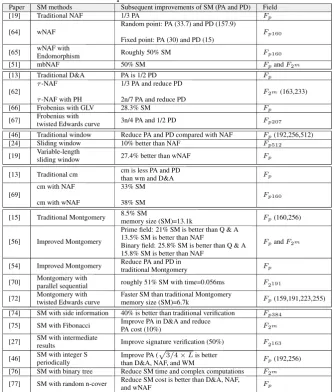
Many approaches can be used to improve PM methods be-cause the PM operation consumes a large amount of time from ECC and ECDSA algorithms. Many researchers have pre-sented different methods to improve the performance of basic PM algorithm (D&A) such as NAF, Window, Comb, Mont-gomery, Frobenius. In this section, these algorithms will be elaborated. Table 4 shows improvements on SM methods.
• Double-and-Add (D&A) Method
D&A is a basic algorithm in PM. It has been repeat-edly used for two operations: point addition(P+Q)and point doubling(P+P). This algorithm is similar to the
Algorithm 2The D&A algorithm
Input: pointP onE(Fp); l-bits scalark= (kl−1...k0)2
Output:Q=k.P Q=P
fori = l - 2 downto 0do
Q= 2.Q
ifk(i)= 1thenQ=Q+P
returnQ
Algorithm 3NAF algorithm: Input: A positive integerk
Output: NAF(k)
i=0
whilek≤1do ifkis oddthen
ki=2−(kmod 4)
k=k−ki else
ki= 0
k=k/2,i=i+1.
return (ki−1, k−i−2, ..., k1, k0).
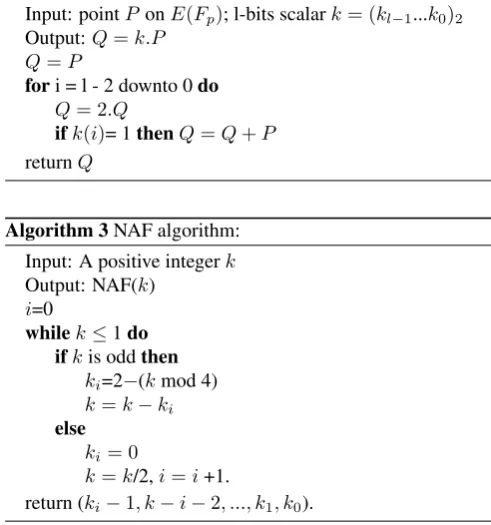
square-and-multiply algorithm [13], and depends on bits in scalarkafter it was represent it in binary form, where if bit inkhas zero value, the D&A algorithm will exe-cute point doubling, while if bit inkhas one value, this algorithm will execute the point doubling and point ad-dition in each loop. In this method, the number of point addition is a half of the point doubling. D&A method is explained in algorithm 2.
• Non Adjacent Form (NAF) Method
NAF is the representation of signed-digit and was intro-duced to reduce execution time in PM; it outperforms D&A algorithm. It does not allow for any two nonzero bits in scalarkto be adjacent [13, 52] and this leads to reducing hamming weight as PM computation depends on the number of zeros and bits length in a scalar. As a result, this algorithm reduces the number of point ad-dition. The NAF method is faster than the square-and-multiply method [19]. This method can reduce the num-ber of point addition to one-third. It is represented using the following equation:
N AF(k) = l−1
X
i=0
ki2i (18)
Where k ∈ {0,±1}, NAF method is explained in al-gorithm 3 [63]. When NAF is combined with a win-dow through a random point in PM with the Jacobian coordinate system, NAF can achieve an improvement of 33.7 addition and 157.9 doubling (withksize is 160-bit) [64]. Also, Gallant et al. [65] combined simultaneous multiple point multiplication with left-to-right window-NAF, where they convert form (kP) for PM to form
k1p+k2φ(p)(φwhich is Endomorphism operation). This
method improved point doubling (79 points) and point addition (38 points) that lead to improving PM to 50% better than traditional methods with Fp160. Similarly,
addi-Table 3.Costs of inversion (i), squaring (s), and multiplication (m) for scalar representation
Binary field Prime Field
Scalar representation
i s m i s m
1/2P - - 1 - -
-1/2 P + Q 1 - 5 - -
-P +Q 1 1 2 1 1 2
2P 1 1 2 1 1 2
2P + Q 1 2 9 1 2 9
3P 1 4 7 1 4 7
3P + Q 2 3 9 2 3 9
4P 1 5 8 1 9 9
4P + Q 2 6 10 2 4 11
5P 1 5 13 - 10 15
5P + Q - - - 1 13 26
7P 3 7 18 - 11 18
7P + Q - - - 1 22 28
1/2 & DBNR DBNR/2 DBNR/3 Slightly lower
than DBNR DBNR/2 DBNR/3
Slightly lower than DBNR
1/2 & SMBR SMBR/2 SMBR/3 Slightly lower
than SMBR SMBR/2 SMBR/3
Slightly lower than SMBR
1/2 & MBNR MBNR/2 MBNR/3 Slightly lower
than MBNR MBNR/2 MBNR/3
Slightly lower than MBNR
Algorithm 4Frobenius with D&A algorithm: Input: PointP,τ-adic expansion ofk(kl−1,...k0).
Output:k.P
P1=PandP2= 2P
fori in 0 to ( l-1) loopdo ifk(i)=1then
Q=Q+P
else ifk(i)= -1then
Q=Q−P P= Frobenius(P) End loop
tion to many NAF versions such as 3 and NAF-4). Furthermore, NAF algorithm (right-to-left binary method) without precomputations (to use in constrained devices) was used with the mixed coordinate system to improve PM [9]. The author compared his algorithm with NAF (left-to-right binary method). Results showed that this scheme presented better performance than NAF (left-to-right binary method). Also, Purohit et al. [51] pointed out that multibase non-adjacent form (mbNAF) provided a speeding up of the execution time in PM with improving scalar performance through multibase. • Frobenius Map Method
Some researchers have used Frobenius map algorithm in-stead of point doubling(2P)because Frobenius map per-forms squaring operationsτ(x, y) =τ(x2, y2)whereτ
is Frobenius [62] (that is replacing point doubling with 2 squaring), and is represented by the following equations:
2.P =−τ2P+µτ P (19)
Whereµ=±1, and
k= t−1τ
X
i=0
siτi (20)
Wheresiis 0 or±1andτis Frobenius endomorphism.
Scalarkvalue is obtained through the division repeated for s by τ [14] as in the foregoing equation. Algo-rithm 4 shows combining Frobenius map instead of point doubling with D&A; this algorithm uses addition, sub-traction, and Frobenius. Frobenius endomorphism (τ -adic) was combined with point halving [62]. The authors used point halving because it is three times faster than point doubling; therefore, they usedτ-and-add instead of
double-and-add with Koblitz curves; these curves have useful features in acceleration kP. They used these curves with fields sizes (k-163 bit andk-233 bit) to stan-dards of NIST’s FIPS in binary fields. τ-NAF was used to reduce point addition fromn/3to2n/7. Results have proved thatτ-and-add basedτ-NAF provides speeding 14.28% better than Frobenius method, and in addition, it does not require of additional memory in the case us-ing of normal basis. Frobenius expansion method for the special hyperelliptic curve (introduced by Koblitz) with GLV(Gallant-Lambert-Vanstone) endomorphism (using fields of large characteristic) is presented to improve the efficiency of scalar multiplication [66]. Through the re-sults, the authors largely improved point doubling while point addition did not improve. This scheme improved scalar point multiplication from 15.6 to 28.3% when it was implemented on Fpn. Reducing the time and
in-creasing performance in ECDSA algorithm is performed through exchange doubling point with Frobenius scheme in the PM [14]. The authors presented ECDSA algorithm with curves of subfields Koblitz for binary fields (key length a 163-bit). They explained that binary fields are convenient for hardware implementation. This scheme achieved good results in performance over time where key generation took time 0.2 ms, signature generation took 0.8 ms and signature verification took 0.4 ms. In addition, this scheme is suited for constrained-source de-vices such as smart cards, WSN and RFID. In 2017, Liu et al. [67] submitted a study of the application of twisted Edwards curve (considered efficient models of ECC/ECDSA) with Frobenius endomorphism to reduce point doubling to 50% for traditional algorithms. They used the 207-bit key (prime field) with two hardware architectures (ASIC and FPGA). They pointed out that their method offers high performance, less memory, and time requirements compared to traditional Frobenius al-gorithms. Also, they mentioned that integrating their method with a window of 2 size would save 1/16 of the point addition.
• Window Method (WM)
Algorithm 5Window algorithm:
Input: pointPonE(Fp), Window widthw,d= [l/w], k= (kd−1, ..., k0)2w.
Output:Q=kP.
P0=P
Precompute: for i = 1 to2w−1do:P
i=Pi−1+P
Q=0
fori =d-1 downto 0do
Q=2wQ
Q=Q+Pkd
returnQ
algorithm uses precomputation for points in the case of the fixed point multiplication (FPM) and also reduced point additions better than D&A [13, 46], as explained in algorithm 5. Wang and Li [24] used NAF and win-dow methods to improve performance for PM algorithm. They found that window method is more efficient than NAF. They used hybrid multiplication to reduce access memory instead of multi-precision multiplication. For a practical example, ECC results on MICAz is signa-ture generation=1.3s and signasigna-ture verification = 2.8s while on TelosB is signature generation=1.6s and signa-ture verification = 3.3s. The authors showed the possi-bility of using ECC on WSN. Also, the variable-length sliding window was combined with NAF method to re-duce points addition (PM) in ECC and ECDSA algo-rithms [19]. Computation complexity in PM depends on bits’ length and zeros number in an integer. The authors divided elements in NAF(k) to two windows (non-zero and zero windows) and also divided non-zero window to six types in sliding window. In addition, they used coor-dinate system (Jacobian) with point doubling and coordi-nate system (Jacobian Affine) with point addition. Their results demonstrate that their scheme is better and more efficient than NAF, wNAF and square-multiply schemes in terms of efficient point multiplication and time of pub-lic key generation.
• Comb Method (CM)
This method uses binary matrix(w, d)to compute FPM efficiently, where w is row and d is column. It was in-troduced by Lim and Lee and this algorithm is case spe-cial from multi-exponentiation using Straus’ trick [68]. Comb method uses precomputation to improve PM per-formance [13, 63]. as in algorithm 6. Comb method was modified in [69] to improve PM through combin-ing comb method with width-wNAF. This method is es-sentially designed to reduce the number of point addi-tion. It has presented better results than original comb and NAF with comb. Also, it is used to accelerate mul-tiple PM(kP+rQ)in ECDSA algorithm. The authors explained that their algorithm is convenient for devices constrained-source (memory) when choice suited param-eters for an algorithm such as window size. It improved computation complexity from 33% to 38% compared to NAF with CM in devices constrained-sources.
• Montgomery Method
Montgomery algorithm eliminates division operation and uses reduction operation efficiently [24]. This algo-rithm was introduced by Montgomery and uses onlyx
-Algorithm 6Comb algorithm:
Input: A pointP, an integerk, and a window widthw >2
Output:Q=kP.
Precomputation Stage:
Compute [b(w − 1), ..., b1, b0] P for all (b(w −
1), ..., b1, b0)∈Zw
2
WriteK= (K(w−1)||...||K1||K0)padding with 0 on the
left if necessary, where eachKjis a bit-string of lengthd.
LetKijdenote thei-th bit ofKi
DefineKi= [Kiw−1, ..., Ki1, Ki0]
Q= O
Evaluation Stage:
fori=d-1 downto 0do
Q= 2Q,
Q=Q+kiP
returnQ
Algorithm 7Montgomery ladder algorithm:
Input: A point P on E and a positive integer k = (kl−1...k0)2.
Output: The pointkP.
P1=PandP2= 2P
fori=l- 2 down to 0do ifki= 0then
P1= 2P1andP2=P1⊕P2
else
P1=P1⊕P2andP2= 2P2
returnP1
coordinate and removesy-coordinate, and this leads to increasing PM performance.
A method introduced by Eisentr¨ager el al. has improved PM’s performance with an Affine coordinate in ECC [15]. This method eliminates field multiplication in the case of using left-to-right of binary SM. It eliminates y-coordinate in addition, doubling and tripling operations. This scheme led to saving field multiplication and thus achieved an improvement of PM’s cost from 3.8% to 8.5%. For example, in order to perform the operation of2P+Q, authors used form((P+Q) +P); also in the operation of3P+Q, they used(((P+Q) +P) +P). This trick led to the improvement in PM operation. For instance, with a number of points (1133044P), the cost of original PM is 23i+41s+23m, while the cost of im-proved PM is 23i+37s+19m, namely, an improvement in m and s. Ciet and Joye [54] used Eisentr¨ager’s idea but with3P+Qwhen 1i equal more than 6m to reduce the computation cost of PM. Also, Dimitrov et al.[56] used Eisentr¨ager’s idea but with4P +Qto improve the PM efficiency. Montgomery method is represented in algo-rithm 7. Saqib et al. [70] suggested that using Mont-gomery algorithm depends on the parallel-sequential manner to accelerate PM in ECC withGF(2191)on
de-vices). Results showed that this scheme presents better performance. Also, they pointed out the balance of their scheme between memory size and time. It was suggested to use the Montgomery algorithm with ECDSA (with keys length 224-bit and 256-bit) that has high costs in both computation and communication [71]. The authors analysed time complexity, where PM consumes a large amount of time from ECDSA’s time. They pointed out that Montgomery offers better performance than other al-gorithms in constrained environments and mobility. Hut-ter et al. [47] used Montgomery ladder algorithm to point multiplication in ECC (with randomized Projective coordinate) because it provides security against several attacks and performs all operations with x-coordinate, thereby increasing PM performance through implemen-tation of ASIC processor with asymmetric cryptography ECDSA (Fp192). In 2017, Liu et al. [72] adopted the
Montgomery method with the lightweight elliptic curve (twisted Edwards curve (p159, p191, p223, and p255)) to improve speed and balance between memory and per-formance (cost of communication, execution time, mem-ory) as well as security requirement. They implemented the ECDSA algorithm on Tmote Sky and MICAz nodes. During the implementation, they noted that their scheme offers memory efficiency which requires 6.7k bytes for a SM process instead of 13.1 kbytes for the traditional Montgomery scheme. They recommended the exact se-lection of ECDSA’s parameters curves and the balance between security and efficiency requirements.
In summary, the best algorithm for PM (ECC and ECDSA) it is fixed-base comb with w=4 in random binary curves, while in Koblitz curves it is fixed-base window TNAF (τ -adic NAF) with w=6 in case memory is not constrained [73]. When memory is constrained, Montgomery is the best with random binary and TNAF is the best with Koblitz. The au-thors pointed out that Koblitz curves are faster than random binary curves (F2163, F2233 and F2283) for NIST’s standards
[73]. Moreover, Rafik and Mohammed [13] analysed in detail the types of SPM (scalar point multiplication) algorithms (that are D&A, window, and comb method). Examining the results, they concluded that the CM method is faster than D&A and WM because the CM uses less doubling and adding points, but this method needs more memory. As for security, the D&A method is the best with 27%. D&A is good at memory re-quirements, needs more time. Therefore, they concluded that several concepts of SPM in ECC algorithm (or ECDSA or ECDH) are based on the user’s application and constrained sources. If execution time is a large, the energy consumption increases. The authors carried out the Secure-CM and earned good time to implement (1.57 s); as demonstrated ECC is ap-plicable in WSN.
4.1.2.2 Improvement of Efficiency Via Other Methods
In this subsection, we will explain a set of different ideas from previous methods to improve ECDSA performance through reducing consumption time in signature generation and signa-ture verification.
A method was suggested to accelerate signature verification in ECDSA algorithm [74]. The authors used a number of small bits (side information (1 or 2 bits)) to specify the number of allowed points in point multiplication; through the modified
algorithm, points double was largely reduced. They imple-mented traditional ECDSA algorithm and modified ECDSA algorithm on ARM7TDMI platform processor with a finite field Fp384 by NIST, and achieved the result that modified
ECDSA verification is 40% better than traditional ECDSA. They discovered that this changing does not affect ECDSA standards and proved that their scheme has the same secu-rity as traditional ECDSA. Also, an addition formula was proposed through using Euclidean Addition Chains (EAC) with Fibonacci to avoid difficult to find small chain [75]. The author has used a Fibonacci-and-add algorithm instead of double-and-add (using Jacobian coordinate and character-istic greater than 3). Some improvements were added to this scheme through the window and signed representation to im-prove algorithm performance. The author has compared his scheme with many schemes (D&A, NAF, 4-NAF and Mont-gomery ladder). Results indicated that his scheme outper-forms D&A only in the case of improvement addition (win-dow or signed representation). In addition, the improvement of signature verification in ECDSA is achieved through coop-erating of adjacent nodes in the computation of intermediate results [27]. The proposed scheme used 1PM+1Add in nodes that use intermediate results instead of 2PM+1Add as in the original scheme. The authors analysed performance and se-curity in the scheme of signature verification with many tacks (independent and collusive). They noted that these at-tacks do not have a large effect on their scheme. The modified scheme has saved energy consumption 17.7-34.5% better than the traditional scheme, as signature verification in the modi-fied scheme is 50% faster than the original scheme. They im-plemented their scheme on Micaz motes with the finite field (F2163).
Ta-ble 4 shows improvements on other SM methods.
4.2 Efficiency Improvement of Coordinate Systems
ECDSA has to perform complex operations; these operations consume resources in constrained devices. Using the ap-propriate coordinate system, could lead to reducing costs of high computation in doubling and addition operations. The improvement of computation complexity in PM depends on point representation that is considered important in curve op-erations [78]. Many different coordinate systems used with these algorithms such as Affine, Projective, Jacobian, Chud-novsky Jacobian, modified Jacobian, and mixed. Coordinate systems are used to represent and contribute to speeding com-putation in ECC/ECDSA algorithm. There is no coordinate system to accelerate both point addition and doubling [3]. Some coordinate systems require faster or slower computa-tion time in the point doubling and point addicomputa-tion operacomputa-tions than other coordinate systems; for instance, point doubling uses less computation in Jacobian while the point addition uses more computation in the Jacobian than Projective and Chudnovsky Jacobian coordinates.
• Using Affine Coordinate
Affine is a basic coordinate system that is used with dou-bling and addition operations. This system uses two co-ordinates(x, y). When point addition(P+Q)uses the Affine system, then the cost of the resulting point (R) is 1 inversion, 2 multiplication and 1 squaring, while cost(R) in the case point doubling is 1 inversion, 2 mul-tiplication, and 2 squaring [79]. Costly arithmetical op-erations in point addition and point doubling are multi-plication, squaring and inversion. Inversion operation is much lower than multiplication operation. The Affine coordinate system uses inversion operations [24]. In-version operation is required in point addition and point doubling when using Affine coordinate. But Affine coor-dinate needs fewer multiplication operations than other coordinate systems such as Projective coordinate [64]. • Using Projective Coordinate
Inversion operation is dramatically expensive in point addition and point doubling. The Projective coordinate system removes this operation and that leads to improv-ing PM performance in ECC/ECDSA. This system uses three coordinates(X, Y, Z)andZ 6=0 [79], which take formula (X/Z, Y /Z) corresponding to Affine coordi-nate. The Projective coordinate is represented as the fol-lowing equation (with prime fields) [13]:
Y2Z=X3+aXZ2+bZ3 (21)
L´opez and Dahab also used three coordinates but us-ing formula(X/Z, Y /Z2)andZ 6=0 corresponding to Affine coordinate [80]. Their scheme improved origi-nal Projective on a curve in the binary field. Further-more, Projective coordinate is used with random binary and koblitz curves (F2163, F2233 andF2283) for NIST’s
standards instead of Affine [73]. This coordinate leads to significant improvement in PM ECC and ECDSA. Then, Hutter et al. [47] used randomized Projective co-ordinate through generating a randomized number on x-coordinate in base point. Also, different coordinate systems have been discussed, such as Projective and Affine coordinates [13]. Through experiments, the au-thors found that Projective coordinates are faster by 91%
than Affine coordinates but Projective coordinate avoids inversion operation, and vice versa for the memory, while the Projective coordinates require more memory because they use three coordinates(X, Y, Z). Oliveira et al. [78] proposedλ-Projective coordinate through using three co-ordinates(X, Y, Z)with binary field(F2254)to improve
computation efficiency in PM. The formula used for co-ordinates is (X/Z, L/Z) corresponding with λ-Affine formula, where theλ-Affine formula is(X, X+Y /X).
λ-Projective improved L´opez and Dahab Projective(LD-Projective), where the P + Q cost in λ-Projective is 11m+2s while in LD-Projective it is 13m+4s. Also,
2P +Q cost inλ-Projective is 10m+6s while in LD-Projective is 11m+10s. In addition, λ-Projective im-proved H&A to 60% in squaring and 6% in multiplica-tion better than LD-Projective. Their scheme was imple-mented on Sandy Bridge platform. The authors achieved computation 69500 clock cycles through the single core with H&A and 47900 clock cycles through the multi core combining Gallant, Lambert, and Vanstone, (GLV) tech-nique, H&A and D&A in SM unprotected. Also, they achieved computation 114800 clock cycles through sin-gle core protected. Their scheme achieves performance better by 2% than Ivy Bridge and 46% than Haswell platforms. In 2017, Al-Somani [81] proposed a paral-lel SM method based on L´opez-Dahab Projective that re-quired 4 multiplications for DBL and 16 multiplications for ADD. His scheme applied on FPGA and AT2
pro-cessors and obtained high speed for SM’s performance when this scheme was implemented on eight processors with L´opez-Dahab Projective.
• Using Jacobian Coordinate
This coordinate system does not require inversion in ad-dition formula (adad-dition and doubling), but uses inver-sion only in the final computation stage. It is similar to Pojective coordinate (also it is an improvement of Projec-tive coordinate). Jacobian provides less running time in point doubling and more running time in point addition than Projective coordinate [64]. This system uses three coordinates (X, Y, Z) and Z 6=0, which take formula
(X/Z2, Y /Z3)corresponding for Affine coordinate [79].
Y2Z=X3+aXZ4+bZ6 (22)
Table 4.Improvements on different SM methods Paper SM methods Subsequent improvements of SM (PA and PD) Field
[19] Traditional NAF 1/3 PA Fp
[64] wNAF
Random point: PA (33.7) and PD (157.9)
Fixed point: PA (30) and PD (15)
Fp160
[65] wNAF with
Endomorphism Roughly 50% SM Fp160
[51] mbNAF 50% SM FpandF2m
[13] Traditional D&A PA is 1/2 PD Fp
[62]
τ-NAF
τ-NAF with PH
1/3 PA and reduce PD
2n/7 PA and reduce PD
F2m(163,233)
[66] Frobenius with GLV 28.3% SM Fp
[67] Frobenius with
twisted Edwards curve 3n/4 PA and 1/2 PD Fp207 [46] Traditional window Reduce PA and PD compared with NAF Fp(192,256,512)
[24] Sliding window 10% better than NAF Fp512
[19] Variable-length
sliding window 27.4% better than wNAF Fp
[13] Traditional cm cm is less PA and PD
than wm and D&A Fp
[69]
cm with NAF
cm with wNAF
33% SM
38% SM
Fp160
[15] Traditional Montgomery 8.5% SM
memory size (SM)=13.1k Fp(160,256)
[56] Improved Montgomery
Prime field: 21% SM is better than Q & A 13.5% SM is better than NAF
Binary field: 25.8% SM is better than Q & A 15.8% SM is better than NAF
FpandF2m
[54] Improved Montgomery Reduce PA and PD in
traditional Montgomery Fp
[70] Montgomery with
parallel sequential roughly 51% SM with time=0.056ms F2191
[72] Montgomery with twisted Edwards curve
Faster SM than traditional Montgomery
memory size (SM)=6.7k Fp(159,191,223,255) [74] SM with side information 40% is better than traditional verification Fp384
[75] SM with Fibonacci Improve PA in D&A and reducePA cost (10%) F2m
[27] SM with intermediate
results Improve signature verification (50%) F2163
[46] SM with integer S periodically
Improve PA (p
3/4×Lis better
than D&A, NAF, and WM Fp(192,256) [76] SM with binary tree Reduce SM time and complex computations F2m
[77] SM with random n-cover Reduce SM cost is better than D&A, NAF,
and wNAF Fp
(7m+5s), Jacobian has addition cost (12m+4s) and dou-bling cost (4m+6s), Chudnovsky Jacobian has addition cost(11m+3s) and doubling cost (5m+6s) and, modi-fied Jacobian has addition cost (13m+6s) and doubling cost (4m+4s) [3]. This coordinate system is applied on EC exponentiation through prime field (Fp160, Fp192and
Fp224). Modified Jacobian is faster point doubling than
all previous coordinate systems. In addition, the modi-fied Jacobian coordinate is used to represent addition for-mula when ECDSA algorithm is implemented as authen-tication protocol in wireless on processor ARM7TDMI [2]. The authors implemented ECDSA withFpwith
dif-ferent field sizes (Fp160,Fp176,Fp192,Fp208andFp256)
depending on standards of ANSI X9F1 and IEEE P1363. Through results, they get running time 46.4ms for sig-nature generation and 92.4ms for sigsig-nature verification when usingFp160. They pointed out that their scheme
improved bandwidth and storage compared with previ-ous schemes. Brown et al. [79] pointed out that Jaco-bian is faster than Affine, Projective, and Chudnovsky in point doubling. Through results, these coordinate sys-tems improved speeding of computation in ECC/ECDSA through reducing execution cycle.
• Using Mixed Coordinate Systems
The mixed coordinate system uses more one coordinate system to represent addition formula (which each point
uses a different system) [3, 9] to get the best perfor-mance and least computation time in PM. Many differ-ent mixed coordinate systems such as Jacobian-Affine, Affine-Projective, and Chudonvsky-Affine [79].
Cohen et al. [3] pointed out that modified Jacobian mixed with other coordinate systems (Jacobian and Affine or Jacobian and Chudnovsky Jacobian) presents a signifi-cant improvement on computation time with the prime field (Fp160, Fp192andFp224). Execution time is reduced
using Jacobian-Chudnovsky coordinate with prime field (when usingw=5 forFp192,Fp224andFp256, andw=6
for Fp384andFp521). Also, Jacobian and Chudnovsky
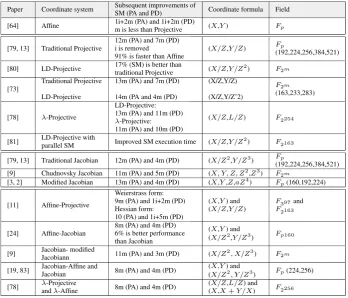
ordinate is better performance (6%) than Jacobian co-ordinate. In the mixed coordinate, point addition con-sumes 8m and 3s (12 modular reductions) while point doubling consumes 4m and 4s (11 modular reductions). Also, mixed coordinate is used with right-to-left NAF al-gorithm [9], where applied Jacobian is used with point addition and modified Jacobian with point doubling. The author pointed out that modified Jacobian is fast in point doubling but is slow in point addition; therefore, the au-thor used Jacobian in point addition. Through results, this scheme presented efficiency of a scalar by 13.33`m (where`is bits’ length in a scalar) compared with Jaco-bian (15.33`m) and modified Jacobian (14.33`m). But when three fields (temporary) variables additional are used, then the left-to-right binary method described in [3] was a better performance. Jacobian-Affine is faster than other coordinate systems in point addition. Using Jaco-bian coordinate in point doubling and JacoJaco-bian-Affine in point addition [19]. Authors pointed out that Jacobian is the fastest in point doubling and mixed coordinate is the fastest in point addition. Oliveira et al. [78] used mixed coordinate to compute 2P +Q whereλ-Affine was used to representP point andλ-Projective to repre-sentQpoint. They achieved computation cost less than LD-Projective. In 2017, Pan et al. [83] indicated that mixed Jacobian-Affine coordinate is more efficient than Jacobian coordinate. They applied a mixed coordinate with ECDSA to improve the efficiency of computation processes to authenticate users during online registration. Their results indicated that mixed coordinate reduces cal-culations in both point addition and point doubling. Ta-ble 5 shows the successive improvements of different co-ordinate systems in SM such as Affine, Projective, Jaco-bian, and mixed coordinates.
4.3 Efficiency Improvement Via Algorithm Simplifi-cation
This section will show some different approaches to improv-ing ECDSA performance. A set of ideas which researchers used to simplify the algorithm to improve the performance ECDSA includes removing the inversion in the generation of the signature and the signature verification, a collection of signatures, using a few keys and using two points instead of shared three curved points.
ECDSA algorithm is mainly used to provide integration, au-thorisation, and non-repudiation depending on servers’ CA (certification authority) [84]. The authors added an ID, ECDSA threshold and trust value with the public key to au-thorise node to gain access to the information. Also, it was stated that data transmission of ECDSA in the wireless sen-sor network (WSN) consumes more energy than computation operations [85]. To reduce energy consumption, in data trans-mission, all encrypted data aggregated from all sensor nodes are directly sent to the Base station without decryption. This operation leads to reducing energy consumption and increas-ing network lifetime. Encryption and signincreas-ing algorithms are used for the collected data [86, 85]. Encryption algorithm EC-OU (Elliptic Curve Okamoto-Uchiyama) is used to maintain confidentiality and ECDSA algorithm to maintain integration, both algorithms are used during homomorphic. The idea be-hind this scheme is that encryptions, signatures and public
keys gathered together from all nodes are sent to aggregator (CH), then these aggregators are forwarded to the top level (parent aggregators) and so on up BS, that is, it is not the de-cryption or signature verification in the aggregators, but these processes are carried only in BS, that has a high capacity. The authors concluded that this scheme offers energy and time ef-ficiency due to a collection of encryptions and signatures that are sent to the BS. Also, this scheme avoids the signature ver-ification process that takes more time than the signature gen-eration. In addition, it is efficient for large networks. Also, ECDSA algorithm was investigated in detail [16], and con-tains some of the problems that were related to using inver-sion processes in generation and verification of the signature. An inversion process consumes a great deal of time, which affects the calculation. This process consumes 10 times the multiplication process. In this scheme, the inversion process was removed, and the results demonstrated that this scheme is more efficient than the original ECDSA scheme. It had less time and therefore less computation and energy. This scheme was applied to the sensor node Micaz.
Using a few keys saved energy, memory and reduced the com-putation in ECDSA algorithm [87]. Researchers used ECDSA to secure the connection between the gateway and the clus-ter head(CH), and CH and nodes. This scheme broadcasts only session keys (km), which reduces energy, as the session keys are deleted after their account. This operation leads to less memory (only a few keys stored in memory). The pub-lic key of the gateway does not require power, and calcula-tion processes are accomplished through the use of a random number and hash function that require less computation op-erations. This scheme used periodic authentication in session key. Therefore, it prevents attacks and is appropriate for en-vironments of constrained-source. Finally, modified ECDSA algorithm is proposed through using two curve points publicly (public keyQand point of signature verification(x, y)) [88], where the base point G becomes the private point. In this algorithm,sparameter only is used (without usingr parame-ter) thus removingroverheads. The authors pointed out that the modified ECDSA algorithm is less complex (more perfor-mance) using less number of PMs, point addition and point doubling than original ECDSA algorithm.
5. Security Improvement on ECDSA
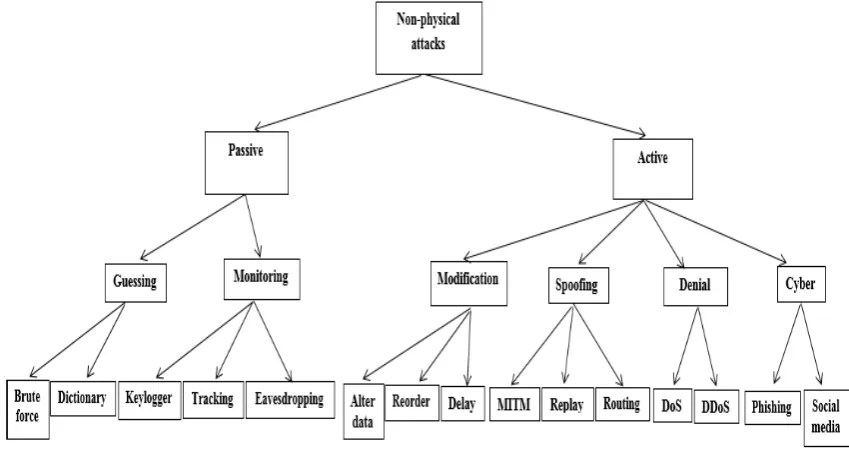
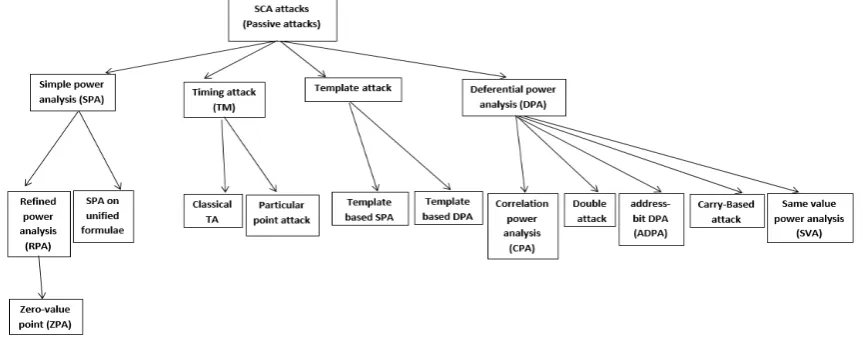
In this section, we will consider the security in the ECDSA algorithm. A list of mechanisms for improving the security in ECDSA is given. In the beginning, we will come across types of attacks, security requirements and countermeasures by cat-egorizing them into non-physical and physical attacks, as each category includes passive and active attacks. We then will of-fer security mechanisms to enhance and protect ECDSA’s sig-natures from tampering.
5.1 Categories of Attacks
First of all, we give a review of the attacks that threaten the security level in the ECDSA algorithm. Attacks are becoming increasingly sophisticated, so at the same time there should be countermeasures against such attacks. But these counter-measures are expensive in terms of time, storage, and complex computations. Also, it is difficult to develop a countermeasure for each attack [89].