For Peer Review Only
VGI and crowdsourced data credibility analysis using spam email detection techniques
Journal: International Journal of Digital Earth Manuscript ID TJDE-2016-0238.R1
Manuscript Type: Original Research Paper
Keywords: VGI, Crowdsourced Data, Credibility, Bayesian Networks, Spam emails
For Peer Review Only
VGI and crowdsourced data credibility analysis using spam email detection
techniques
Abstract
Volunteered Geographic Information (VGI) can be considered a subset of
Crowdsourced Data (CSD) and its popularity has recently increased in a number of
application areas. Disaster Management is one of its key application areas in which the
benefits of VGI and CSD are potentially very high. However, quality issues such as
credibility, reliability and relevance are limiting many of the advantages of utilising
crowdsourced data. Credibility issues arise as CSD come from a variety of
heterogeneous sources including both professionals and untrained citizens. VGI and
CSD are also highly unstructured and the quality and metadata is often undocumented.
In the 2011 Australian Floods, the general public and disaster management
administrators used the Ushahidi Crowd-mapping platform to extensively communicate
flood related information including hazards, evacuations, emergency services, road
closures and property damage. This study assessed the credibility of the Australian
Broadcasting Corporation’s (ABC) Ushahidi Crowdmap dataset using a Naïve
Bayesian network approach based on models commonly used in spam email detection
systems. The results of the study reveal that the spam email detection approach is potentially useful for CSD credibility detection with an accuracy of over 90% using a
forced classification methodology.
Keywords: VGI, Crowdsourced Data, Credibility, Bayesian Networks, Spam emails 3
For Peer Review Only
1. Introduction
Volunteered Geographic Information (VGI) (Goodchild 2007), with its geographic context, is
considered a subset of Crowdsourced Data (CSD) (Howe 2006; Goodchild and Glennon
2010; Heipke 2010; Koswatte, McDougall, and Liu 2016). In recent times, there has been an
increased interest in the use of CSD for both research and commercial applications. VGI
production and use have also become simpler than ever before with technological
developments in mobile communication, positioning technologies, smart phone applications
and other infrastructure developments which support easy to use mobile applications.
However, data quality issues such as credibility, relevance, reliability, data structures,
incomplete location information, missing metadata and validity continue to limit its usage
and potential benefits (Flanagin and Metzger 2008; De Longueville, Ostlander, and Keskitalo
2010; Koswatte, McDougall, and Liu 2016). Therefore, researchers are now seeking new
approaches for improving and managing the quality of VGI and CSD in order to increase the
utilisation of this data.
VGI quality can be described in terms of quality measures and quality indicators (Antoniou
and Skopeliti 2015). The quality measures of spatial data have largely focused on quantitative
measures such as completeness, logical consistency, positional accuracy, temporal accuracy
and thematic accuracy whilst the quality indicators are often more difficult to measure and
refer to areas such as purpose, usage, trustworthiness, content quality, credibility and
relevance (Senaratne et al. 2016). However, in CSD it may not always be appropriate to trust
the information provided by the volunteers as their experience and expertise varies
dramatically and assessing the credibility of the provider may be impractical. In particular,
the volunteers in a disaster situation are often extremely heterogeneous and their input only
occurs during a short period. Hence, it is difficult to profile these contributors, unlike many
users of Twitter which may have a long history of activity. Therefore, a key challenge is to
For Peer Review Only
assess the credibility of the provided data in order to utilise it for future decision making.
A popular approach to assess credibility in spam email detection is to numerically estimate
the "degree on belief" (Robinson 2003) by analysing the email content using natural language
processing and machine learning techniques. Natural language processing is a commonly
used term to describe the use of computing techniques to analyse and understand natural
language and speech. These approaches have been successfully applied to the detection of
spam in Twitter messages (Wang 2010). The objective of this research is to investigate and
test the use of spam email detection processes for credibility detection of crowdsourced
disaster data.
The data for this research was collected through the Uhsahidi1 CrowdMap platform which
has been successfully used in a range of disasters including the 2011 Australian floods, the
Christchurch earthquake and the 2011 tsunami in Japan. The Ushahidi platform was initially
developed to easily capture crowd input via cell phones or emails (Bahree 2008; Longueville
et al. 2010) and was utilised to report the election violence in Kenya. Over time, its
popularity has increased and the platform has been successfully deployed in a number of
disasters around the world.
This paper discusses the use of a Naïve Bayesian network based model to detect the
credibility of CSD using a similar approach to spam email detection. The paper is structured
as follows: Section two discusses the background of CSD credibility detection and the use of
Naïve Bayesian networks for spam email detection. Section three explores the methods used
in the study. Section four details the results of the study and discusses their implications.
Finally, section five provides some concluding remarks and some future suggestions for
research.
1
https://www.ushahidi.com 3
For Peer Review Only
2. Crowdsourced data credibility
Hovland, Janis, and Kelley (1953) defined credibility as “the believability of a source or
message” which comprises primarily of two dimensions, trustworthiness and expertise.
However, as identified by Flanagin and Metzger (2008), the dimensions of trust and expertise
can also be considered as being subjectively perceived, as the study of credibility is highly
interdisciplinary and the definition of credibility varies according to the field of study. While
the scientific community view credibility as an objective property of information quality, the
communication and social psychology researchers treat credibility more as a perceptual
variable (Fogg and Tseng 1999; Flanagin and Metzger 2008). According to Fogg and Tseng
(1999) credibility is defined as "a perceived quality made up of multiple dimensions such as
trustworthiness and expertise" or simply as believability.
Credibility analysis approaches and the methods will vary depending on the context. Studies
conducted by Bishr and Kuhn (2007), Noy, Griffith, and Musen (2008), Janowicz et al.
(2010), Sadeghi-Niaraki et al. (2010), and Shvaiko and Euzenat (2013) have identified the
importance and usefulness of spatial semantics and ontologies in assessing the quality of
CSD. Most approaches tackle CSD quality by qualifying contributors and contributions
(Brando and Bucher 2010). Various authors have investigated the classification of users
based on their purpose (Coleman, Georgiadou, and Labonte 2009), their geographic location
(Goodchild 2009) and trust as a reputational model (Bishr and Kuhn 2007). Quality based on
contributions has mostly been validated using rating systems (Brando and Bucher 2010;
Elwood 2008) or using a reference data set (Haklay 2010; Goodchild and Li 2012).
Longueville et al. (2010) proposed an approach which consisted of a workflow that used prior
information about the phenomenon. The key to their approach was to extract valid
information from CSD using cross validation, cluster processing and ranking. A similar but
extended approach for the automated assessment of the quality of CSD was proposed by
For Peer Review Only
Ostermann and Spinsanti (2011).
Given the variability of contributors of CSD during a disaster event, and the complexities in
qualifying the expertise or experience of contributors, it was decided that a content analysis
approach would provide the greatest likelihood of success for this research.
2.1. Statistical approaches for CSD credibility detection in disaster management
Disaster related CSD is quite different in the sense of its lifetime and contributors. Data are
often collected over a very short period of time with many different contributors during the
event. Recent research conducted by Hung, Kalantari and Rajabifard (2016) identified the
possibility of using statistical methods to assess the credibility of VGI. They used the 2011
Australian flood VGI data set as the training data and the 2013 Brisbane floods data as the
testing data set. Their approach was to use binary logistic regression modelling to achieve an
overall accuracy 90.5% for a training model and 80.4% accuracy for the testing data set. They
highlighted the potential of using statistical approaches for efficiently analysing the CSD
credibility and for rapid decision making in the disaster management sector even without
real-time or near real-time information.
Kim (2013) developed a framework to assess the credibility of a VGI dataset from the 2010
Haiti earthquake based on a Bayesian Network model. The outcomes of this earthquake
damage assessment study were compared with the results from official sources. The author
reported that 'the experiments have not only demonstrated microscopic effects on the
individual data, but also showed the macroscopic variations of the overall damage patterns by
the credibility model'. Both of these models were identified as being more suitable for post
disaster management purposes.
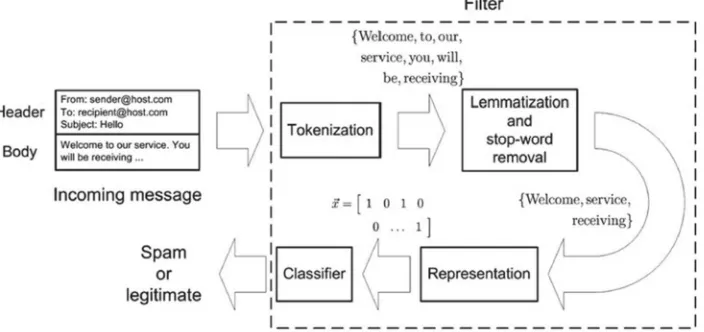
In filter based classification processes, it is important to simplify the message content using
For Peer Review Only
transformations including tokenizing, stemming and lemmatizing (Figure 1) which may
improve the classification accuracy and performance (Guzella and Caminhas 2009). This
research followed a similar approach by incorporating natural language processing techniques
and enhancing a 'bag of words' model with tokenizing (extracting words), stemming
(removing derivational affixes), lemmatizing (remove inflectional endings and returning the
[image:7.612.132.469.257.436.2]base or dictionary form of the word) and removing stop-words (Common words in English).
Figure 1: Main steps involved in filter based email classification (Guzella and Caminhas
2009)
Credibility can be calculated and rated into different levels which may be useful for disaster
management staff. However, in critical events such as disaster management, a binary form of
credibility representation would be simpler and less confusing for the general public
(Ostermann and Spinsanti 2011). This research has adopted a similar binary approach by
classifying the credibility using a “credible/credibility unknown” labelling. The term
“credibility unknown” is used to describe those messages or reports that were not classified
as “credible”.
For Peer Review Only
2.2. Why use spam email detection as an approach for CSD credibility detection?
Spam email is considered as 'unsolicited bulk email' in its shortest definition (Blanzieri and
Bryl 2008). Spam emails cost industries billions of dollars annually through the misuse of
computing resources and the additional time required by users to sort emails. Spam emails
can often carry computer viruses and also violate users’ privacy (Blanzieri and Bryl 2008).
Compared to the spam emails, CSD has some similarities and differences. Firstly, CSD also
has a mixture of content that varies in credibility and the CSD events often generate large
volumes of data. Emails, including spam emails, often have a specified structure (sender,
body text and header), however, CSD often lacks structure. Finally, the aim of the filtering
data to identify legitimate or credible content is similar in both cases.
Spam email detection (Pantel and Lin 1998; Cranor and LaMacchia 1998; Metsis,
Androutsopoulos, and Paliouras 2006; Robinson 2003; Lopes et al. 2011), junk-email
detection (Sahami et al. 1998) or anti-spam filtering (Androutsopoulos et al. 2000; Schneider
2003) research has a long history which grew from the commercialization of the internet in
mid 1990s (Cranor and LaMacchia 1998). Researchers have explored various approaches
with Content Based Filters (CBF) or Bayesian filters being the most popular anti-spam
systems (Lopes et al. 2011). Wang (2010) tested a Bayesian classifier for spam detection in
Twitter and confirmed that Bayesian classifiers performed highly in terms of weighted recall
and precision, and outperformed the decision tree, neural network, support vector machines,
and k-nearest neighbour’s classifications.
Castillo, Mendoza, and Poblete (2011) analysed the news worthiness of tweets using a
supervised classifier whilst Kang, O'Donovan, and Höllerer (2012) analysed the “credible
individual tweets or users” based on three models (social model, content model and hybrid
model) using Bayesian and other classifiers. These studies support the use of a modified
For Peer Review Only
Bayesian approach for assessing the credibility of crowd sourced data.
2.3. A Naïve Bayesian network based model for CSD credibility detection
The Bayesian Networks (BN) were initially identified as powerful tools for knowledge
representations and inference. With the advent of Naïve Bayesian networks, which are simple
BNs that assume all attributes are independent, the classification power of BNs were
expanded (Cheng and Greiner 1999). The credibility CSD detection engine proposed in this
research was developed using a Naïve Bayesian based spam detection model.
A credibility detection function can be defined as,
, =
where is a message to be classified, is a vector of parameters, and and
are tags to be assigned based on the threshold T to the messages.
The vector of parameters is the result of training the classifier on a pre-collected dataset:
= Θ
= ,, , , … ,", ∈ , $ "
where , … are previously collected messages, , … are the corresponding
labels, and Θ is the training function.
As Guzella and Caminhas (2009) defined; if a given message is represented by %& =
[%, % , … %] which belongs to class ) ∈ *: *,-, : ./0 0- . , the probability Pr )|%&
that a message is classified as c and represented by %& can be written as,
if , > 5 message is credible
Otherwise message classified as credibility unknown
For Peer Review Only
67)|%& =89&|∙889& =89&|;∙8;<89&|∙889&|∙8$Where;
Pr ) is overall probability that any given message is classified as c
Pr %& is the a priori probability of a random message represented by %&
Pr %&|* and Pr%&| are the probabilities that a message is classified as spam or legitimate
respectively
Pr * and Pr are overall probabilities that any given message is classified as spam or
legitimate respectively.
The naïve classifier assumes that all feature in %& are conditionally independent to every other
feature and the probability 67 %&|) can be defined considering N number of messages as,
67%&|) = = 67%|) >
?
So, the equation (1) becomes,
67%&|) =∏ 67% ∏ 67%>? |c. 67 ) |*
>
? . 67* + ∏ 67%>? |. 67
with 67 %|), ) ∈ [*, ] given by,
67 %_0│) = 67 F_0 = %_0│) = 67 |), G , %
Where function depends on the representation of the message. The probability
67 |), G is determined based on the occurrence of term in the training dataset G. (1)
(2)
(3)
For Peer Review Only
3. Methods
During the 2011 Australian Floods, the Australian Broadcasting Corporation2 (ABC)
developed a customised version of the Ushahidi Crowdmap to report/map disaster
communications (Koswatte, McDougall, and Liu 2016). This data comprised primarily of text
based content that was submitted by volunteers during the flood event. The data included
input from a heterogeneous range of volunteers who submitted reports during a relatively
short period of time (approximately 7 days) via various channels including a mobile app, a
website, SMS messages, emails, phone calls and Twitter.
3.1. CSD credibility detecting algorithm based on spam email detection approach
An algorithm for the CSD credibility detection based on the Naïve Bayesian network was
developed for the analysis. The Java3 programming language was used for coding the system
within the NetBeans4 Integrated Development Environment (IDE). The pseudo code of the
algorithm consisted of two phases including training and testing, and is listed below.
Phase 1: Start training
Select Classifier and Training Data set
for each Message mi in Training Dataset Dtrdo for each Word in the Corpus do
Calculate the Credible and Credibility unknown Probabilities and store in
Hash Table
end for
end for
End training
Phase 2: Start classification
Select Classifier, Testing Dataset and Hash Table
2
www.abc.net.au
3
https://java.com 4
https://netbeans.org/ 3
For Peer Review Only
for each Message mi in the Training Dataset Dtrdo for each Word in the Corpus do
Calculate the Word Probability for being Credible and Credibility unknown
Update Hash Table
end for
Calculate combined Probability for the Message
if combined Probability > Threshold
Label Message as Credible
else
Label Message as Credibility unknown
end if
end for
End classification
The probability threshold was determined after the initial testing and was set at the 0.9
probability level.
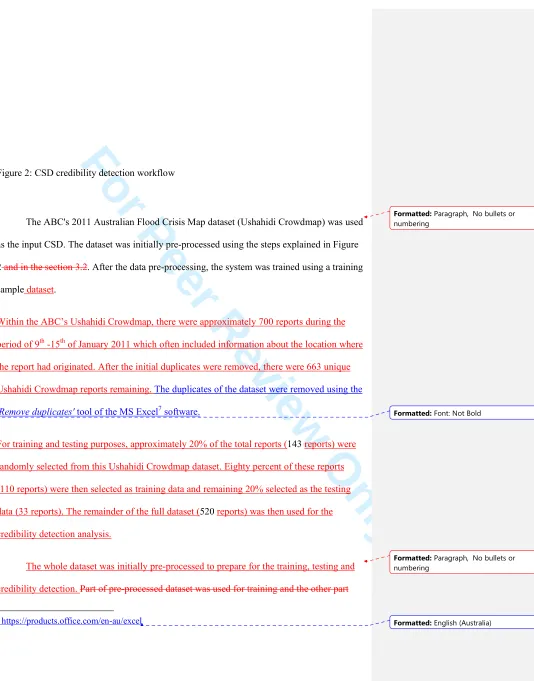
Figure 2 illustrates the key steps in CSD credibility detection approach based on the Naïve
Bayesian network and the classical “bag of words” model popular in email spam detection.
For Peer Review Only
Figure 2: CSD credibility detection workflow
The ABC's 2011 Australian Flood Crisis Map dataset (Ushahidi Crowdmap) was used as the
input CSD. The dataset was initially pre-processed using the steps explained in Figure 2.
After the data pre-processing, the system was trained using a training sample dataset.
Within the ABC’s Ushahidi Crowdmap, there were approximately 700 reports during the
period of 9th -15th of January 2011 which often included information about the location where
the report had originated. After the initial duplicates were removed, there were 663 unique
Ushahidi Crowdmap reports remaining. The duplicates of the dataset were removed using the
CSD Input
Use pre -identified samples of credible messages and samples where the credibility is unknown to train the system
Credible Data store Training
Training Data
Detection of
Credible Data Credibility detection engine based on content analysis and Naïve Bayes theorem
Quality
Acceptable No
Yes
R
e-tr
ai
n
1. Removing unwanted contents
(e.g. numbers, units, time, date, hashtags, Twitter user accounts and URLs)
2. Tokenization and Normalization - Split the sentence in to tokens, analyse and convert abbreviations and short forms commonly used in Twitter messages to normal form
(e.g. B4>>Before, BTW >> By the way, LOL>>Laugh out loud)
3. Stemming and Lemmatization: Adjusting to the base form (e.g. closed>>closing>>close)
4. Stop word removal: common English words (e.g. of, and, the etc.)
5. Removal of non-words: Numbers, punctuations, whitespaces (e.g. tabs, newlines, spaces)
P
re
-P
ro
ce
ss
in
g
For Peer Review Only
'Remove duplicates' tool of the MS Excel5 software.
For training and testing purposes, approximately 20% of the total reports (143 reports) were
randomly selected from this Ushahidi Crowdmap dataset. Eighty percent of these reports
(110 reports) were then selected as training data and remaining 20% selected as the testing
data (33 reports). The remainder of the full dataset (520 reports) was then used for the
credibility detection analysis.
The whole dataset was initially pre-processed to prepare for the training, testing and
credibility detection. The training data set was classified through a manual decision process
which identified messages that where either credible or where the credibility was unknown
based on the credibility of terms within the message. The classification was undertaken by a
reviewer who had local and expert knowledge of the disaster area.
Some examples of the manually classified credible messages and messages where the
credibility was classified as unknown are shown below:
Credible Message:Queensland Police Service: The D'Aguilar Highway at Kilcoy is now
closed in both directions. Police remind motorists not to attempt to cross flooded roads or
causeways.
Message where credibility unknown:thanks local baker keep spirit keep bake provide
bread otherside town picture nothing
The system was then trained and tested using the testing data set under two different
environments namely, unforced and forced conditions, to test the accuracy and performance
improvements.
In the unforced training, the data processing of the test data followed the normal
5
https://products.office.com/en-au/excel 3
For Peer Review Only
processing steps and was then used directly for refining the training of the system. The results
of this unforced training provided a report on the level of possible false positives in the
classification. A high level of false positives is indicative of a possible bias in the
classification process and is often referred to as Bayesian poisoning (Graham-Cumming
2006). The purpose of the forced training was then to review the false positives and other
classified data to improve the quality of the classification process and hence re-train the
system. In some instances, a number of terms which had artificially increased the credibility
of the messages were identified and removed. This enabled the training of the system to be
further refined and to more effectively distinguish the credible messages. The forced training
process consisted of the following stages:
• The location terms were removed/disabled from both the credible and credibility
unknown messages
• Highly credible terms such as flooding, evacuation centre, road close, police,
hospital etc. were removed from messages where the credibility was unknown to
give more weight to similar terms in the credible messages and to avoid Bayesian
poisoning
• Removing remaining messages which could cause a high False Positive rate and
therefore avoid Bayesian poisoning
When location terms appeared frequently in messages, these terms tended to increase the
probability of the message being credible when in reality this was not the case. This impacted
both the credible and credibility unknown messages. This impact was reduced by removing
all the location terms in both credible and credibility unknown training sample messages. The
Queensland Place Names Gazetteer was used as the basis for removing location terms as it
provided a list of registered geographic locations and places. All incoming message terms
For Peer Review Only
were cross checked against the gazetteer list and discarded if found.
The full message structure from the Ushahidi reports included information on message
number, incident title, incident date, location, description, category, latitude and longitude.
For example:
"101, Road closure due to flooding, , 9/01/2011 20:00, Esk-kilcoy Rd, Fast running water
over the road at the bottom of the decent below lookout, Roads Affected, -27.060215,
152.553593".
Some of the message descriptions were very brief in the Ushahidi Crowdmap data. The
content of these messages were further reduced when some of the pre-processing activities
were undertaken including the removal of numbers, units, time, dates, hashtags, Twitter user
accounts and URLs. If the number of characters of these messages were less than 30
characters, the data columns "Incident Title" and "Description" were combined (see Table 1)
to make the descriptions more comprehensive and meaningful.
Table 1: Example of the combination results of the Incident title and Description of the
Ushahidi Crowdmap message fields
Incident title Description Combined message
Road Closed-Manly Rd between new
Cleveland Rd and Castlerea St, Manly
Road closed due to
flooding
Road Closed-Manly Rd between new
Cleveland Rd and Castlerea St, Manly road
closed due to flooding
In some cases, this combination did not provide a meaningful result and did not satisfy the
above condition. Therefore, the "Location" column was also combined in these situations (see
Table 2) to improve the message meaning. However, a small number of messages had to be
discarded as they did not succeed in any of the above operations.
For Peer Review Only
Table 2: Example of the combination result of the Incident title, Description and Location of
the Ushahidi Crowdmap message fields
Incident title Description Location Combined message
Roads Affected Not passable Gailey Rd, St Lucia Roads Affected Not passable Gailey Rd, St
Lucia
The following example shows how the original Ushahidi Crowdmap message was processed
after tokenisation, stemming, lemmatisation and stop-word removal before being used for
training, testing and credibility detection.
Original Ushahidi Crowdmap message:
'Access to Stanthorpe town is severely restricted and all residents along Quart Pot Creek have
been ordered to evacuate'.
Tokenized, stemmed and lemmatized message:
'access to Stanthorpe town be severely restrict and all resident along Quart Pot Creek have be
order to evacuate'.
Stop word removed message:
'access stanthorpe town severely restrict resident along quart pot creek order evacuate'.
4. Results and discussion
4.1. Results of initial training and testing using different sized training data
The system was initially trained using two different sized training data sets to assess any
variations in the outcomes based on the size of the training data set. The first training data set
consisted of 35 messages of which there were 25 credible messages and 10 messages where
the credibility was unknown. The second training set was a larger training sample and
consisted of 77 messages with 53 credible messages and 24 messages where the credibility
For Peer Review Only
was unknown.
A dataset of 33 messages was then tested using both the smaller and larger training data sets
to training the system under both forced and unforced conditions. The test dataset was also
manually pre-classified to identify credible messages and messages where the credibility was
unknown in order to confirm the accuracy and performance during the testing. Tables 3 to 6
show the classification results for the four test environments. Test 1 utilised the smaller
training data set (35 messages) with the 33 test messages under unforced training conditions.
Test 2 utilised the smaller training data set (35 messages) with the 33 test messages under
forced training conditions. Test 3 utilised the larger training data set (77 messages) with the
33 test messages under unforced training conditions. Finally, Test 4 utilised the larger
training data set (77 messages) with the 33 test messages under forced training conditions.
The terms True Positive (TP), True Negative (TN), False Positive (FP) and False Negative
(FN) were used to compare the results of the classification. A True Positive result correctly
predicts a “Credible” outcome when it is “Credible”, a True Negative result correctly predicts
a “Credibility unknown” outcome when the “Credibility is unknown”, a False Positive result
falsely predicts a “Credible” outcome when the “Credibility is unknown”, and finally, a False
Negative result falsely predicts a “Credibility unknown” outcome when it should be
“Credible”.
Table 3: Test 1 – Unforced training using the small training sample (35 messages) and 33 test
messages.
Classified credible
Classified as credibility
unknown Total
Actually credible 24 (TP) 1 (FN) 25
Actual credibility
unknown 7 (FP) 1 (TN) 8
Total 31 2 33
For Peer Review Only
Table 3 results indicates that the system correctly classified 24 out of 25 credible messages
during unforced training, but only one out of the eight messages where the credibility was
unknown was correctly classified. This outcome resulted in a high number of False Positives
for the unforced training which indicated that further training was required.
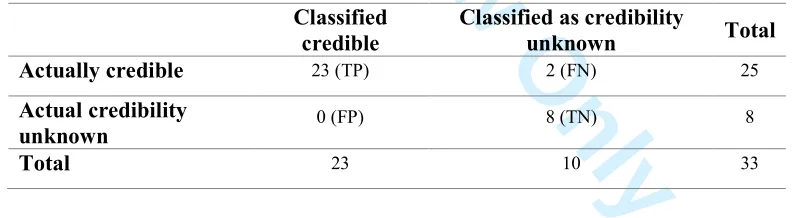
When the system utilised the same training data set but ran under forced training conditions
the results as expected varied (Table 4). Of the 25 credible messages 23 messages were
correctly classified and only two messages incorrectly classified. These results only varied
slightly from the unforced training outcomes in regard to detecting credible messages
correctly. However, there was a significant improvement in the correct detection of messages
where the credibility was unknown with all messages being correctly classified during this
test. Overall, the results were considered acceptable with a high classification accuracy for
both the credible messages classification and the classification where the credibility of the
messages was unknown and hence validated the forced training conditions.
Table 4: Test 2 - Forced training using small training sample (35 messages) and 33 test
messages.
Classified credible
Classified as credibility
unknown Total
Actually credible 23 (TP) 2 (FN) 25
Actual credibility unknown
0 (FP) 8 (TN) 8
Total 23 10 33
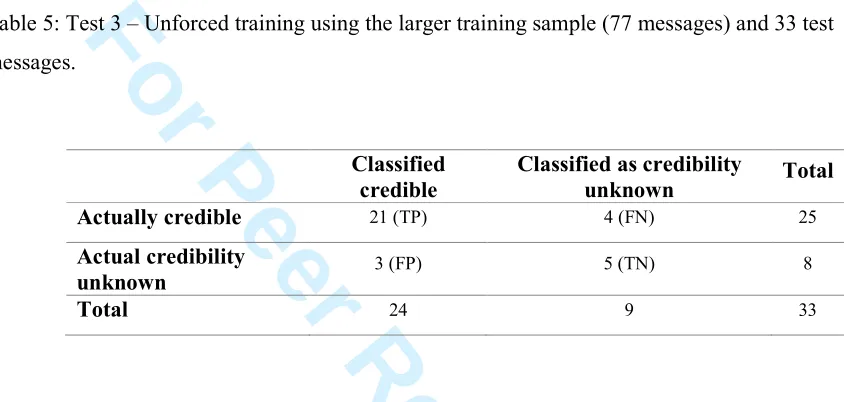
Next, the size of the training sample was increased from 35 messages to 77 messages and
then the unforced and forced training was repeated on the same test data set. The results of
unforced training are shown in Table 5 and identify that for the credible message
classification, 21 out of 25 messages were correctly classified which was a small decrease in
For Peer Review Only
accuracy compared to the previous result (Table 3). However, the classification accuracy
where the credibility of the message was unknown, improved from one correctly classified
[image:20.612.101.526.189.390.2]message to five correctly classified messages out of the eight to be classified.
Table 5: Test 3 – Unforced training using the larger training sample (77 messages) and 33 test
messages.
Classified credible
Classified as credibility
unknown Total
Actually credible 21 (TP) 4 (FN) 25
Actual credibility
unknown 3 (FP) 5 (TN) 8
Total 24 9 33
Finally, Table 6 shows the results of the classification using the larger training data set under
forced training conditions. The results of the testing are identical to the forced training using
the smaller training data set with 23 out of 25 credible messages correctly classified and all
eight messages where the credibility was unknown were also correctly classified. This
indicated that the forced training conditions were consistent and were not impacted by the
changed training sample size.
Table 6: Test 4 - Forced training using the larger training sample (77 messages) and 33 test
messages.
Classified credible
Classified as credibility
unknown Total
Actually credible 23 (TP) 2 (FN) 25
Actual credibility unknown
0 (FP) 8 (TN) 8
Total 23 10 33
For Peer Review Only
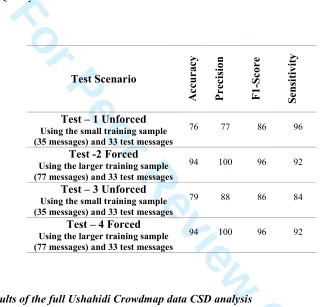
A number of measures such as accuracy, precision, sensitivity and the F1 score provided an
indication of each classification’s effectiveness. The accuracy, which is the ratio of correctly
predicted observations, was calculated by the formula (TP+TN)/(TP+TN+FP+FN). The
precision or Positive Predictive Value (PPV) is the ratio of correct positive observations. The
PPV was calculated by TP/(TP + FP). The F1 score (F1) is used to measure classification
performance using the weighted recall and precision, where the recall is the percentage of
relevant instances that are retrieved and was calculated by 2*TP / (2*TP + FP + FN). The
sensitivity or True Positive Rate (TPR) was calculated by TP / (TP + FN).
The classification quality for the four tests are summarised in Table 7. The accuracy and
precision was higher for the forced training outcomes for both training sample sizes and
indicates the importance of the forced training. It can also be seen that the classification
accuracy and precision increased slightly for the unforced training outcomes when the larger
training sample size was utilised. However, the precision and accuracy outcomes for the
forced training were similar and indicate that there may be a lesser dependency on the size of
the training data set when force training is utilised. The F1-Score did not change with the
sample size but the measures indicate that the forced training again performed better than the
unforced training scenarios. Finally, the classification sensitivity remained constant for the
forced training for both training sample sizes but dropped slightly with the larger training
sample size for the unforced training test outcomes.
For Peer Review Only
Table 7: Quality of the CSD classification
4.2. Results of the full Ushahidi Crowdmap data CSD analysis
After the training testing of the system was completed to an acceptable classification quality,
the full Ushahidi Crowdmap sample of remaining 433 messages was analysed for credibility.
As the Figure 3 (a) indicates, 54% (234 out of 433) of the messages were identified as
credible using an unforced training classification. However, when the system was run under
forced conditions, 77% (334 out of 433) of the messages were identified as credible (Figure 3
(b)). This was a more confident value than the previous result as the accuracy and precision
of the credibility detection was higher. Test Scenario
A
c
c
u
r
a
c
y
P
r
ec
is
io
n
F
1
-S
c
o
r
e
S
e
n
si
ti
v
it
y
Test – 1 Unforced Using the small training sample (35 messages) and 33 test messages
76 77 86 96
Test -2 Forced Using the larger training sample (77 messages) and 33 test messages
94 100 96 92
Test – 3 Unforced Using the small training sample (35 messages) and 33 test messages
79 88 86 84
Test – 4 Forced Using the larger training sample (77 messages) and 33 test messages
94 100 96 92
For Peer Review Only
Figure 3: Credibility of 2011 Australian flood's Ushahidi Crowdmap data
5. Conclusion
The CSD message credibility detection is a challenging task due to the high degree of
variability of the data, the lack of a consistent data structure, the variability of the data
providers and the limited metadata available. This study identified that Bayesian spam email
detection approaches can be applied successfully to the challenge of classifying the
credibility of CSD. However, the training approaches and the size of the training data set can
influence the quality and performance of the training outcomes.
Due to the variability of the data, it is recommended that forced training is undertaken to
achieve the highest accuracy and performance. In particular, the forced training provided a
higher level of confidence in eliminating the number of False Positive (FP) outcomes which
were the incorrect classification of messages. The size of the training data set was found to
be less critical when a forced training approach was utilised with the results of the
classification outcomes being similar for both the smaller and larger training data sets.
54% 46%
Credibility under Unforced environment
Credible Dubious
77% 33%
Credibility under Forced environment
Credible Dubious
(a) (b)
For Peer Review Only
However, if the system training was unforced, a larger training data set is recommended.
Although this study focussed on the issue of credibility, it should be recognised that the
relevance of that dataset is another critical dimension in the quality assessment of the crowd
sourced datasets. It is often not enough to just have a credible source of information as it is
also important that the information is relevant to the purpose of the operational activity. For
example, in the case of a flood disaster, the relevant information should relate to useful and
relevant data regarding the support of the flood operations or emergency services. It is
therefore important that future studies analyse both the credibility and the relevance of the
crowd sourced datasets.
Acknowledgments
Authors wishes to acknowledge the Australian Government for providing support for the
research work through the Research Training Program (RTP) and Monique Potts, ABC –
Australia for providing the 2011 Australian Flood's Ushahidi Crowdmap data.
References
Androutsopoulos, Ion , John Koutsias, Konstantinos V Chandrinos, and Constantine D Spyropoulos. 2000. An experimental comparison of naive Bayesian and keyword-based anti-spam filtering with personal e-mail messages. Paper presented at the Proceedings of the 23rd annual international ACM SIGIR conference on Research and development in information retrieval.
Antoniou, V, and A Skopeliti. 2015. "Measures and Indicators of Vgi Quality: AN Overview." ISPRS Annals of Photogrammetry, Remote Sensing and Spatial
Information Sciences II-3/W5:345-51. doi: 10.5194/isprsannals-II-3-W5-345-2015.
Bahree, Megha. 2008. "Citizen Voices." Forbes Magazine 182 (12):83.
Bishr, Mohamed, and Werner Kuhn. 2007. "Geospatial information bottom-up: A matter of trust and semantics." In TThe European information society: Leading the way with
geo-information, edited by S Fabrikant and M Wachowicz, 365-87. Berlin: Springer.
Blanzieri, Enrico, and Anton Bryl. 2008. "A survey of learning-based techniques of email spam filtering." Artificial intelligence review 29 (1):63-92.
Brando, Carmen, and Bénédicte Bucher. 2010. Quality in user generated spatial content: A matter of specifications. Paper presented at the Proceedings of the 13th AGILE International Conference on Geographic Information Science, Guimarães, Portugal.
For Peer Review Only
Castillo, Carlos, Marcelo Mendoza, and Barbara Poblete. 2011. Information credibility on twitter. Paper presented at the Proceedings of the 20th international conference on World wide web.
Cheng, Jie, and Russell Greiner. 1999. "Comparing Bayesian network classifiers." In
Proceedings of the Fifteenth conference on Uncertainty in artificial intelligence,
101-8. Stockholm, Sweden: Morgan Kaufmann Publishers Inc.
Coleman, David J, Yola Georgiadou, and Jeff Labonte. 2009. "Volunteered geographic information: The nature and motivation of produsers." International Journal of
Spatial Data Infrastructures Research 4 (1):332-58.
Cranor, Lorrie Faith, and Brian A. LaMacchia. 1998. "Spam!" In Communications of the ACM, 74-83.
De Longueville, Bertrand, Nicole Ostlander, and Carina Keskitalo. 2010. "Addressing vagueness in Volunteered Geographic Information (VGI)–A case study."
International Journal of Spatial Data Infrastructures Research 5:1725-0463.
Elwood, Sarah. 2008. "Volunteered geographic information: future research directions motivated by critical, participatory, and feminist GIS." GeoJournal 72 (3-4):173-83. Flanagin, Andrew J, and Miriam J Metzger. 2008. "The credibility of volunteered geographic
information." GeoJournal 72 (3-4):137-48.
Fogg, BJ, and Hsiang Tseng. 1999. The elements of computer credibility. Paper presented at the Proceedings of the SIGCHI conference on Human Factors in Computing Systems. Goodchild, Michael F. 2007. "Citizens as sensors: the world of volunteered geography."
GeoJournal 69 (4):211-21. doi: 10.1007/s10708-007-9111-y.
Goodchild, Michael F. 2009. "NeoGeography and the nature of geographic expertise."
Journal of Location Based Services 3 (2):82-96. doi: 10.1080/17489720902950374.
Goodchild, Michael F., and J. Alan Glennon. 2010. "Crowdsourcing geographic information for disaster response: a research frontier." International Journal of Digital Earth 3 (3):231-41. doi: 10.1080/17538941003759255.
Goodchild, Michael F., and Linna Li. 2012. "Assuring the quality of volunteered geographic information." Spatial Statistics 1:110-20. doi: 110-120. doi:
10.1016/j.spasta.2012.03.002.
Graham-Cumming, John. 2006. "Does Bayesian poisoning exist." In Virus Bulletin, 69. Guzella, Thiago S., and Walmir M. Caminhas. 2009. "A review of machine learning
approaches to Spam filtering." Expert Systems with Applications 36 (7):10206-22. doi: 10.1016/j.eswa.2009.02.037.
Haklay, Mordechai. 2010. "How good is volunteered geographical information? A
comparative study of OpenStreetMap and Ordnance Survey datasets." Environment
and planning. B, Planning & design 37 (4):682-703. doi: 10.1068/b35097.
Heipke, Christian. 2010. "Crowdsourcing geospatial data." ISPRS Journal of
Photogrammetry and Remote Sensing 65 (6):550-7. doi:
10.1016/j.isprsjprs.2010.06.005.
Hovland, Carl I, Irving L Janis, and Harold H Kelley. 1953. "Communication and persuasion; psychological studies of opinion change."
Howe, Jeff. 2006. "The rise of crowdsourcing." In Wired magazine, 1-4.
Hung, Kuo-Chih, Mohsen Kalantari, and Abbas Rajabifard. 2016. "Methods for assessing the credibility of volunteered geographic information in flood response: A case study in Brisbane, Australia." Applied Geography 68:37-47. doi:
10.1016/j.apgeog.2016.01.005.
Janowicz, Krzysztof, Sven Schade, Arne Broring, Carsten Kebler, Patrick Maue, and Christoph Stasch. 2010. "Semantic enablement for spatial data infrastructures."
Transactions in GIS 14 (2):111-29. doi: 10.1111/j.1467-9671.2010.01186.x.
For Peer Review Only
Kang, Byungkyu, John O'Donovan, and Tobias Höllerer. 2012. Modeling topic specific credibility on twitter. Paper presented at the Proceedings of the 2012 ACM international conference on Intelligent User Interfaces.
Kim, Heejun. 2013. "Credibility assessment of volunteered geographic information for emergency management: a Bayesian network modeling approach." University of Illinois.
Koswatte, Saman, Kevin McDougall, and Xiaoye Liu. 2016. "Semantic Location Extraction from Crowdsourced Data." ISPRS-International Archives of the Photogrammetry,
Remote Sensing and Spatial Information Sciences:543-7.
Longueville, Bertrand De, Gianluca Luraschi, Paul Smits, Stephen Peedell, and Tom De Groeve. 2010. "Citizens as sensors for natural hazards: A VGI integration workflow."
Geomatica 64 (1):41-59.
Lopes, Clotilde, Paulo Cortez, Pedro Sousa, Miguel Rocha, and Miguel Rio. 2011.
"Symbiotic filtering for spam email detection." Expert Systems with Applications 38 (8):9365-72. doi: 10.1016/j.eswa.2011.01.174.
Metsis, Vangelis, Ion Androutsopoulos, and Georgios Paliouras. 2006. Spam filtering with naive bayes-which naive bayes? Paper presented at the CEAS.
Noy, Natalya F, Nicholas Griffith, and Mark A Musen. 2008. "Collecting community-based mappings in an ontology repository." In The Semantic Web-ISWC 2008, edited by A. Sheth, S Steffen, M Dean, M Paolucci, D Maynard, T Finin and K Thirunarayan, 371-86. Springer.
Ostermann, Frank O, and Laura Spinsanti. 2011. A conceptual workflow for automatically assessing the quality of volunteered geographic information for crisis management. Paper presented at the Proceedings of AGILE, University of Utrecht, Utrecht Pantel, Patrick, and Dekang Lin. 1998. Spamcop: A spam classification & organization
program. Paper presented at the Proceedings of AAAI-98 Workshop on Learning for Text Categorization.
Robinson, Gary. 2003. "A statistical approach to the spam problem." Linux journal 2003 (107):3.
Sadeghi-Niaraki, Abolghasem, Abbas Rajabifard, Kyehyun Kim, and Jungtaek Seo. 2010. Ontology Based SDI to Facilitate Spatially Enabled Society. Paper presented at the Proceedings of GSDI 12 World Conference.
Sahami, Mehran, Susan Dumais, David Heckerman, and Eric Horvitz. 1998. A Bayesian approach to filtering junk e-mail. Paper presented at the Learning for Text Categorization: Papers from the 1998 workshop.
Schneider, Karl-Michael. 2003. A comparison of event models for Naive Bayes anti-spam e-mail filtering. Paper presented at the Proceedings of the tenth conference on European chapter of the Association for Computational Linguistics-Volume 1.
Senaratne, Hansi, Amin Mobasheri, Ahmed Loai Ali, Cristina Capineri, and Mordechai Haklay. 2016. "A review of volunteered geographic information quality assessment methods." International Journal of Geographical Information Science:1-29. doi: 10.1080/13658816.2016.1189556.
Shvaiko, Pavel, and Jérôme Euzenat. 2013. "Ontology Matching: State of the Art and Future Challenges." IEEE Transactions on Knowledge & Data Engineering 25 (1):158-76. doi: 10.1109/TKDE.2011.253.
Wang, Alex Hai. 2010. Don't follow me: Spam detection in Twitter. Paper presented at the Security and Cryptography (SECRYPT), Proceedings of the 2010 International Conference on, 26-28 July 2010.
For Peer Review Only
Figure 1: Main steps involved in filter based email classification (Guzella and Caminhas 2009)
71x37mm (300 x 300 DPI)
For Peer Review Only
Figure 2: CSD credibility detection workflow
111x89mm (600 x 600 DPI)
For Peer Review Only
Figure 3: Credibility of 2011 Australian flood's Ushahidi Crowdmap data
20x7mm (600 x 600 DPI)
For Peer Review Only
VGI and crowdsourced data credibility analysis using spam email detection techniques
Abstract
Volunteered Geographic Information (VGI) can be considered a subset of
Crowdsourced Data (CSD) and has recently becomeits popularity has recently
increased in many fieldsa number of application areas. Disaster Management is one of
its key application areas in which the benefits of VGI and CSD are potentially very
high. However, quality issues like such as credibility, reliability and relevance may be
reducingare limiting many of real the advantages of utilising crowdsourcedingof data.
Credibility issues arise as CSD come from a variety of heterogeneous sources captured
includingby both of professionals and untrained amateursuntrained citizens. Moreover,
VGI and CSD are also highly unstructured and the quality and metadata is often
undocumented. In the 2011 Australian Floods, the general public and disaster
management administrators used the Ushahidi Crowd-mapping platform to extensively
communicate flood related information including hazards, evacuations, help emergency
services, road closures and property damage. This study has assessed the credibility of
the Australian Broadcasting Commission’s Corporation’s (ABC) Ushahidi Crowdmap
dataset using aa Naïve Bayesian Network network based on a model approach which
based on ismodels commonly used in spam email detection systems. The results of the
study reveal that the spam email detection aapproachesisarepotentially feasible useful
for CSD credibility detection with an accuracy of approximately over 80% of the
reports identified as credible and a detection accuracy close to 905% using a forced
classification methodology.
Keywords:VGI, Crowdsourced Data, Credibility, Bayesian Networks, Spam emails
Formatted: Font: 11 pt, Pattern: Clear
Formatted: Font: 11 pt, Pattern: Clear
Formatted: Font: 11 pt, Pattern: Clear
For Peer Review Only
1. Introduction
Volunteered Geographic Information (VGI) (Goodchild 2007),with its geographic context, is
considered a subset of Crowdsourced Data (CSD) (Howe 2006; Goodchild and Glennon
2010; Heipke 2010; Koswatte, McDougall, and Liu 2016).as it comes with a geographic
reference and In recent times, has there has been angained increased interest in popularityin
the use of CSD for both research and commercial utilisation and researchapplications. The
VGI production and use have also become simpler than ever before with technological
developments in the areas of mobile communication, computingpositioning technologies,
software appssmart phone applications and other infrastructure developments which
supporting easy to use mobile applications. However, data quality issues like such as
credibility, relevance, reliability, data structuresal limitations, incomplete location
information, documentation missing metadata and validity continue to limit its usage and its
potential benefits (Flanagin and Metzger 2008; De Longueville, Ostlander, and Keskitalo
2010; Koswatte, McDougall, and Liu 2016). Research in the field of VGI is now very active
and Therefore, researchers are now seeking to find the meansnew approachesof for
improving and managing its the quality of VGI and CSD in order to open upincrease the
utilisation of application avenues. this data.
CSD and VGI quality can be described improvement research has identified two themes. One
theme is to assess the spatial quality measures (accuracy) and the other is assessing the
quality of the information (credibility) (Antoniou and Skopeliti 2015)in terms of quality
measures and quality indicators (Antoniou and Skopeliti 2015).. The spatial quality measures
can be limited as the VGI and CSD spatial quality and metadata are largely undocumented.
Hence, the general of spatial data have accuracy assessment parameters likelargely focused
on quantitative measures such as completeness, logical consistency, positional accuracy,
temporal accuracy and, thematic accuracy whilst the quality indicators are often more
Formatted: Pattern: Clear
For Peer Review Only
difficult to measure and refer to areas such as purpose, usage, trustworthiness, contentquality, credibility and relevance, purpose, usage, lineage (Senaratne et al. 2016)(Antoniou
and Skopeliti 2015) (Haklay 2010; Girres and Touya 2010; Goodchild and Li 2012) ,
attribute accuracy (Girres and Touya 2010), semantic accuracy (Goodchild and Li 2012),
definition, coverage, legitimacy and accessibility (Kim 2013) are still questionable in
VGI/CSD quality assessment based on accuracy. Another commonly tested approach for VGI
and CSD quality assessment is based on information quality in terms of credibility. However,
the existing methods and processes in this area of research are still relatively immature.
Credibility detection can be defined as filtering of irrelevant and dubious information to
identify useful and credible information. In general, if the source can be trusted the
information can also be trusted, so from a statistical perspective, there is a higher probability
of the information being credible if the source is credible. However, in CSD it may not
always be appropriate to trust the information source as the information providers vary with
the situation being considered.provided by the volunteers as their experience and expertise
varies dramatically and assessing the credibility of the provider may be impractical. In
particular, the volunteers in a disaster situation are often extremely heterogeneous and their
input only occurs during a short period. Hence, it is difficult to profile these contributors,
unlike many users of Twitter which may have a long history of activity. Therefore, a key
challenge is to assess the credibility of the provided data in order to utilise it for future
decision making.It is also the case during a particular event that the information provider's
input may be limited to a specific time span. Therefore, assessing the source credibility may
be impractical for CSD for an event like a flood. In such events, a possible approach for
identifying credibility is to assess the content of the message.
A popular approach to assess credibility in spam email detection is to numerically estimate
Formatted: Pattern: Clear
Formatted: Font: 12 pt
Formatted: Font: 12 pt
Formatted: Font: 12 pt
For Peer Review Only
the "degree on belief" (Robinson 2003) by analysing the email content using natural language
pprocessing and machine learning techniques. Natural language processing is a commonly
used term to describe the use of computing techniques to analyse and understand natural
language and speech. These same approaches haves been successfully applied for to spam the
detection of spam in Twitter messages by (Wang 2010). The purposes objective of this
research isare t to: (1)identify the similaritiesinvestigate and test the use of spam email
detection processes forandCSD credibility detection of crowdsourced disaster data., and (2)
examine the possibility of using spam email detection techniques to assess the credibility of
CSD.
The data for this research was collected through the Uhsahidi1 CrowdMap platform which
has been successfully used in a range of disasters including the 2011 Australian floods, the
Christchurch earthquake and the 2011 tsunami in Japan. The Ushahidi platform was initially
developed to easily capture crowd input via cell phones or emails (Bahree 2008; Longueville
et al. 2010) and was utilised to report the election violence in Kenya. Over time, its
popularity has increased and the platform has been successfully deployed in a number of
disasters around the world.
This paper discusses the use of a Naïve- BayesiannNetwork based model to detect the
credibility of CSD using a similar approach to spam email detection. The remainder of the
paper is structuredis as follows: Section two discusses the background of CSD credibility
detection and the use of Naïve Bayesian nNetworks for spam email detection. Section three
explores the methods used in the study. Section four describes details the results of the study
and discusses their implicationsion of the study. Finally, section five provides the some
concluding remarks along withandthe some future suggestions for researchdirections.
1
https://www.ushahidi.com
Formatted: Pattern: Clear
Formatted: Pattern: Clear
Formatted: Pattern: Clear
Formatted: Pattern: Clear
Formatted: Pattern: Clear
For Peer Review Only
2. The Ccrowdsourced data credibility
THovland, Janis, and Kelley (1953) defined credibility as “the believability of a source or
message” which comprises primarily of two dimensions, trustworthiness and expertise.
However, as identified by Flanagin and Metzger (2008), the dimensions of trust and expertise
can also be considered as being subjectively perceived, as the study of credibility is highly
interdisciplinary and the definition of credibility varies according to the field of study
(Flanagin and Metzger 2008). While the scientific community view credibility as an objective
property of information quality, the communication and social psychology researchers treat
credibility more as a perceptual variable (Fogg and Tseng 1999; Flanagin and Metzger 2008).
According to Fogg and Tseng (1999) credibility is defined as "a perceived quality made up of
multiple dimensions such as trustworthiness and expertise" or simply as believability.
Credibility analysis approaches and the methods will vary depending on the context. Previous
Sstudies conducted by Bishr and Kuhn (2007), Noy, Griffith, and Musen (2008), Janowicz et
al. (2010), Sadeghi-Niaraki et al. (2010), and Shvaiko and Euzenat (2013) have identifiedy
the importance and usefulness of spatial semantics and ontologies in assessing the quality of
CSD. Most approaches tackle CSD quality by qualifying contributors and contributions
(Brando and Bucher 2010). Various authors have investigated the classification of users
based on their purpose (Coleman, Georgiadou, and Labonte 2009), their geographic location
(Goodchild 2009) and trust as a reputational model (Bishr and Kuhn 2007). The qQuality
based on contributions hasare mostly been validated using rating systems (Brando and
Bucher 2010; Elwood 2008) and or using a reference data set (Haklay 2010; Goodchild and
Li 2012). Longueville et al. (2010)'sproposed an approach which consisted of a workflow
thatwhich useds prior information about the phenomenon. The key to their approach was to
extract valid information from CSD using cross validation, cluster processing and ranking. A
similar but extended approach for the automatedically assessment of the quality of CSD was
Formatted: Pattern: Clear (Background 1)
Formatted: Pattern: Clear (Background 1)
For Peer Review Only
proposed by Ostermann and Spinsanti (2011).
Given the variability of contributors of CSD during a disaster event, and the complexities in
qualifying the expertise or experience of contributors, it was decided that a content analysis
approach would provide the greatest likelihood of success for this research.
2.1. Statistical approaches for CSD credibility detection in disaster management
Disaster related CSD is quite different in the sense of its lifetime and contributors. Data are
often collected over aover a very short period of time and thewith many different contributors
duringmay also vary with the event. Credibility analysis through source reputation analysis
can be highly challenging in this context and often can be very problematic. A more feasible
option is the analysis of information credibility.
Recent research conducted by Hung, Kalantari and Rajabifard (2016) identified the
possibility of using statistical methods to assess the credibility of VGI. They used the 2011
Australian flood VGI data set as the training data and the 2013 Brisbane floods data as the
testing data set. Their approach was to use binary logistic regression modelling at a threshold
of 0.917 to achieve an overall accuracy 90.5% for a training model while and 80.4% accuracy
was achieved for the testing data set. They highlighted the potential of using statistical
approaches for efficiently analysing the CSD credibility and for rapid decision making in the
disaster management sector even without real-time or near real-time information.
Kim (2013) developed a framework to assess the credibility of a VGI dataset from the 2010
Haiti earthquake based on a Bayesian Network model. The outcomes of this earthquake
damage assessment study has beenwere compared with the results from official sources. The
author reported that 'the experiments have not only demonstrated microscopic effects on the
individual data, but also showed the macroscopic variations of the overall damage patterns by
Formatted: Pattern: Clear
For Peer Review Only
the credibility model'. Both of these models are were identified as being more suitable for
post disaster management purposes. The proposed model is more suitable for post disaster
management purposes as the model specifically focused on natural disaster damage
assessments and includes a number of manual processing steps.None are capable of
assessing the credibility in real-time or near-real-time context which is important in time
critical applications like disaster management.
In filter based classification processes, it is important to simplify the message content using
transformations like including tokenizing, stemming and lemmatizing (Figure 1) which may
improve the classification accuracy and the performance (Guzella and Caminhas 2009). This
research followed a similar approach by incorporating natural language processing techniques
and enhancing a 'bag of words' model with tokenizing (extracting words), stemming
(removing derivational affixes), lemmatizing (remove inflectional endings and to returning
the base or dictionary form of the word) and removing stop-words (Common words in
[image:36.612.69.432.364.610.2]English).
Figure 1: Main steps involved in filter based email classification (Guzella and Caminhas
2009)
Formatted: Not Strikethrough
For Peer Review Only
Credibility can be calculated and rated into different levels which may be useful for disaster
management staff. However, iIn critical events like such as disaster management, a binary
form of credibility representation would be more simpler and less confusing for the general
public (Ostermann and Spinsanti 2011). To avoid confusion Tthis research has adopted a
similar binary approach bylooks to classifying the credibility in binary format using a
“credible/credibility dubiousunknown” labelling. The term “credibility unknown” is used to
describe those messages or reports that were not classified as “credible”.
2.2. Why use spam email detection as an approach for CSD credibility detection?
SA spam email is considered as 'unsolicited bulk email' in its shortest definition (Blanzieri
and Bryl 2008). Spam emails cost industries billions of dollars annually through the misuse
of computing resources and the additional time required by users to sort emails. Spam emails
can often carry computer viruses and also violate users’ privacy Direct marketers send spam
emails to thousands of recipients without any cost, advertising anything from vacations to
get-rich schemes (Androutsopoulos et al. 2000; Sahami et al. 1998) uses numerous issues
such as direct financial losses, misuse of computer resources, wasting manpower to sort
additional mails and violating privacy rights etc. (Blanzieri and Bryl 2008). Compared to the
spam emails, CSD has some similarities and differences. The Firstly, CSD is also has a
mixture of content of that varies in credibility and the CSD events often generate credible and
dubious messages and it comesin large volumes of data. The sEpam emails, including spam
emails,are highly targeted andoften have a specified structure (sender, body text and header),
h business oriented, however, CSD in general, often lacks structure. is created by the general
public for different purposes. Finally, the aim of the filtering data is similar in both cases,
which is to identify the legitimate or credible content is similar in both cases.messages by
filtering the spam content.
For Peer Review Only
The Sspam email detection (Pantel and Lin 1998; Cranor and LaMacchia 1998; Metsis,Androutsopoulos, and Paliouras 2006; Robinson 2003; Lopes et al. 2011), junk-email
detection (Sahami et al. 1998) detection or anti-spam filtering (Androutsopoulos et al. 2000;
Schneider 2003) research has a long history as the issuewhichbegan growinggrewwith from
the commercialization of the internet in mid 1990s (Cranor and LaMacchia 1998).
Researchers have exploredworking on various approaches with with the Content Based
Filters (CBF) or the Bayesian filters being the most popular anti-spam systems (Lopes et al.
2011). Wang (2010) tested a Bayesian classifier for spam detection in Twitter and confirmed
that the Bayesian classifiers as having the best overall performanceperformed highly in terms
of F-measure (also called F1-Score) which is an indicator used to measure the test's accuracy
calculated by weighted recall and precision, and (where recall is the fraction of relevant
instances that are retrieved while precision is the fraction of retrieved instances that are
relevant as defined in Wikipedia2). In this comparison, the Bayesian classifier outperformed
the decision tree, neural network, support vector machines, and k-nearest neighbour’s
classifications. This finding provides support for the use of same approach for assessing the
credibility of CSD.
Castillo, Mendoza, and Poblete (2011) analysed the news worthiness of tweets using a
supervised classifier andwhilst Kang, O'Donovan, and Höllerer (2012) analysed the “credible
individual tweets or users” based on three models (i.e. social model,: positive credibility
indicators from social networks, content model: probabilistically identifying positive
retweets and user ratings, and hybrid model: a combination of the above) using Bayesian and
other classifiers. which are also identified as significant for the scope of this study.These
studies support the use of a modified Bayesian approach for assessing the credibility of crowd
2
https://en.wikipedia.org/wiki/Precision_and_recall
Formatted: Pattern: Clear
Formatted: Not Strikethrough, Pattern: Clear
Formatted: Not Strikethrough
For Peer Review Only
sourced data.2.3. A Nnaïve Bayesian nNetwork based model for CSD credibility detection
The Bayesian Networks (BN) were initially identified as powerful tools for knowledge
representations and inference. With the advent of Naïve- Bayesian networks, which are
simple BNs which that assume all attributes are independent, the classification power of BNs
were revealed expanded (Cheng and Greiner 1999). The credibilitye CSD detection engine
proposed in this research wasis developed using a Naïve -Bayesiantheorem based email
spam detection systemmodel. There are number of Bayesian network probabilistic event
models based on the first Naïve-Bayes network based anti-spam classifier proposed by
Sahammi et al. (1998).
With reference to the machine learning aA credibility detection function can be defined as,
, =
where is a message to be classified, is a vector of parameters, and and
are tags to be assigned based on the threshold T to the messages.
The vector of parameters is the result of training the classifier on a pre-collected dataset:
= Θ
= , , !,! , … , #, ∈ , % #
where , !… are previously collected messages, , !… are the corresponding
if , > ' message is credible
Otherwise message classified as
dubiouscredibility unknown
Formatted: Line spacing: single
For Peer Review Only
labels, and Θ is the training function.
As Guzella and Caminhas (2009) defined; if a given message is represented by () =
[(, (!, … (] which belongs to class , ∈ -: -/0, : 123 30 1 , the probability Pr ,|()
that a message is classified as c and represented by () can be written as,
78,|() =9:)|∙99:) =9:)|∙9<9:)|∙99:)|∙9%
Where;
Pr , is overall probability that any given message is classified as c
Pr () is the a priori probability of a random message represented by ()
Pr ()|- and Pr()| are the probabilities that a message is classified as spam or legitimate
respectively
Pr - and Pr are over