Neodymium-Doped Cladding-Pumped
Aluminosilicate Fiber Laser Tunable
in the 0.9-
m Wavelength Range
Daniel B. S. Soh, Seongwoo Yoo, Johan Nilsson, Jayanta K. Sahu, Kyunghwan Oh, Seungin Baek,
Yoonchan Jeong
, Member, IEEE
, Christophe Codemard, Pascal Dupriez, Jaesun Kim, and Valery Philippov
Abstract—A tunable high-power cladding-pumped neodymium-doped aluminosilicate fiber laser is demonstrated. The maximum power reached was 2.4 W with a slope efficiency of 41% and a threshold pump power of 1.68 W, both with respect to launched pump power, when cladding pumped by two 808-nm diode pump sources at both fiber ends. The dependence of the tuning range on the fiber length is investigated. The tuning range changed from 922 to 942 nm for a 25-m-long fiber to 908–938 nm with a 14-m-long fiber, because of reabsorption effects. The output linewidth was 0.26 nm in a diffraction-limited beam. Operation on the challenging 0.9- m three-level transition in neodymium-doped double-clad fiber laser was facilitated by a W-type core refractive index profile. This filtered out the unwanted and competing strong transition at 1.06 m while guidance of 0.9 m remained intact.
Index Terms—Neodymium, optical fiber lasers, waveguide filters.
I. INTRODUCTION
N
EODYMIUM-DOPED fibers have been front runners in the development of fiber lasers since the very beginning due to the excellent spectroscopic characteristics and high optical efficiency. Thus, the first fiber laser [1], the first single-mode fiber laser [2], and the first cladding-pumped fiber laser [3] were all Nd-doped. Most of the research ac-tivity was focused on the relatively strong emission band at1.06–1.09 m . With conventional 808-nm
pumping, this corresponds to a four-level laser scheme. There is also a 0.9- m transition which terminates on the ground level . The three-level nature and associated ground-state absorption (GSA) makes it rather difficult to make lasers with this transition. Still, with traditional core-pumping, it is relatively easy to excite a sufficient fraction of the Nd ions to achieve gain on the 0.9- m transition. Published results include a 42-mW core-pumped fiber laser tunable from 892 to 936 nm [4]. While the 1.1- m gain will still exceed the 0.9- m gain in most cases, the difference can be small enough to be reversed with wavelength-selective end-reflectors in
Manuscript received March 18, 2004; revised May 28, 2004.
D. B. S. Soh, J. Nilsson, J. K. Sahu, S. Baek, Y. Jeong, C. Codemard, P. Dupriez, J. Kim, and V. Philippov are with the Optoelectronics Research Centre, University of Southampton, Southampton SO17 1BJ, U.K. (e-mail: [email protected]).
S. Yoo and K. Oh are with the Department of Information and Communica-tions, Gwangju Institute Science and Technology, Gwangju 500-712, Korea.
Digital Object Identifier 10.1109/JQE.2004.833230
case of core pumping. However, because of the low power of suitable pump sources, the powers that can be reached with core pumping are rather low. Cladding pumping is the preferred approach for power scaling of fiber lasers, and many potential applications would benefit from the higher powers that cladding pumping could enable. This includes single-mode sources for core pumping of ytterbium-doped active fiber devices [5], water sensing [6], and frequency doubling to the data storage wavelength of 458 nm in the blue [7]. However, cladding pumping of three-level transitions is difficult: Although the power from appropriate multimode pump sources is high, the intensity is relatively low, which makes it difficult to excite a sufficient fraction of Nd ions. The pump saturation intensity at which 50% of the Nd ions are excited is approximately kW cm mW m , which corresponds to a power of W in a fiber with a 100- m-diameter inner cladding diameter. We would however typically operate on the long wavelength side of the emission peak, where the emission cross-section is larger than the absorption cross section. Be-cause of this quasifour-level characteristic, it is sufficient to excite, say, 10–20% of the ions rather than 50% to reach gain and threshold inversion. On the other hand, efficient pumping of an extended fiber implies that the pump power must be high enough to produce gain even after a significant fraction of it has been absorbed. Thus, several watts of pump power is required for efficient cladding pumping of a 0.9 m Nd-doped fiber laser (NDFL) with a 100- m inner cladding diameter. Currently available pump sources can fulfill this, but there is still another obstacle: The low overlap between the pump beam in the inner cladding and the Nd-doped core means that long fibers are required to absorb the pump. This compounds the problem with GSA, in that the competing four-level gain at 1.06–1.09 m can reach unacceptably large values before the GSA at the three-level transition is overcome. Therefore, the emission at 1.06–1.09 m must be suppressed in an efficient cladding-pumped 0.9 m neodymium-doped fiber laser. Several approaches have been demonstrated, often in combination.
One option is to reduce the GSA. At low temperatures, the reduced thermal population of the Stark sublevels that the transition terminates on enables a neodymium-doped fiber to act as a four-level system at 0.9 m when cooled to liquid nitrogen temperatures. Recently, a cladding-pumped
a small inner-cladding-to-core-area ratio that allows the pump to be absorbed in shorter fibers with less GSA [11]. However, if the core size is enlarged to achieve this, then the fiber eventually becomes multimoded, which is normally undesired. Yet another approach is to use a filter that rejects four-level 1.06–1.09- m emission. The filter must be distributed along the fiber, since the gain within the fiber is so high that strong amplified emission and/or spurious lasing will otherwise effectively clamp the population inversion in the fiber and thus prevent 0.9- m lasing. A fiber with a W-type core refractive index profile can provide the required filtering, and is the method used in this paper. Such W-profile cores were studied thoroughly in the 1970s [12], mostly for dispersion compensa-tion purposes. However, it is also well known that a W-profile core can act as a low-pass filter since even the fundamental P mode can have a nonzero cutoff [13]. This is in contrast to conventional step-index cores. W-profile cores have been used with germanosilicate neodymium-doped fibers, then allowing a smaller, single-mode, core to be used [14]. However, because of quenching, the maximum neodymium concentration in ger-manosilicate is limited to 0.1% by weight [9], and in particular with small cores, this leads to undesirably long fibers in which background loss can degrade the performance significantly. Thus, while a W-profile core allows a small, single-mode core to be used, the low permissible Nd-concentration can lead to a low efficiency in a germanosilicate host. Instead, one can use an aluminosilicate host, which allows for higher neodymium concentrations. On the other hand, the spectroscopy is less favorable, but with a W-profile core with good enough rejection of four-level emission (at m in a germanosilicate host), 0.9- m operation is still possible, and higher efficiencies have been obtained than with germanosilicate neodymium-doped fibers. [15], [16]. Differences in spectroscopy also mean that aluminosilicate neodymium-doped fiber lasers typically emit at shorter wavelengths than germanosilicate neodymium-doped fiber lasers do.
[image:2.612.327.525.58.215.2]In this paper, we investigate the spectroscopic and tuning characteristics of an aluminosilicate neodymium-doped fiber laser tunable in the 0.9- m wavelength range. The wavelength-dependence of the waveguide filter and of the ground-state absorption lead to complex spectral character-istics, which combined with the requirements of different applications for different specific wavelengths and the potential of broadband tuning of a glass host gain medium, makes this investigation all the more interesting. A W-profile core was used to suppress guidance, and hence stimulated emission, at 1.06 m. The laser was tunable from 922 to 942 nm when a longer fiber was used and from 908 to 938 nm when a shorter fiber was used. The maximum output power reached 2.4 W
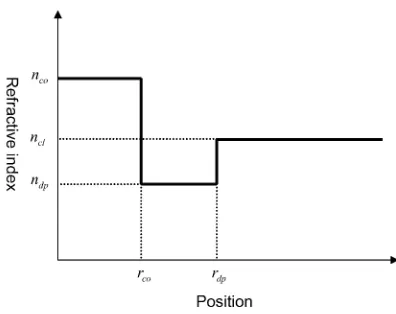
Fig. 1. Schematic diagram of a W-type core refractive index profile.
with a slope efficiency of 41% and a threshold pump power of 1.68 W, both with respect to launched pump power. The core was strictly single mode and the output beam was diffraction limited. This paper is organized as follows: Section II describes the design of the fiber and includes the spectroscopy of the Nd-doped aluminosilicate fiber. Section III presents the details and results of the fiber laser experiments. Brief conclusions are given in Section IV.
II. FIBERDESIGN
In order to suppress undesired 1.06- m emission, a careful design of the W-profile is needed to suppress the guidance at this wavelength. When the 1.06- m emission is no longer guided, its overlap with the doped core is small. This reduces the amount of stimulated emission from excited Nd-ions. Next, we review the characteristics of a W-profile core, as described in [13]. Consider then a W-type refractive index profile according to Fig. 1, with raised core refractive index , depressed (first cladding) refractive index , and second cladding refractive index . (Note that in cladding-pumping terminology, the first and second cladding would constitute the inner cladding.) The core radius is , and the outer radius of the depressed region is . Then, assuming weakly guiding condition and linearly polarized (LP) modes, the radial dependence of the transversal field component becomes [13]
(1)
where is the radial position, is a
constant, and are Bessel functions,
Fig. 2. Measured refractive index profile for W-type fiber used in the experiments.
continuous on the two boundaries, and . This condition leads to the characteristic equation as follows [13]:
(2)
where ( represents Bessel functions) and
.
All the mode parameters are functions of the propagation con-stant , so (2) can be solved numerically for the quantized prop-agation constant . Then the mode parameters as well as the mode profiles can be readily computed. Here, however, we are primarily interested in whether the P mode has a (posi-tive) cutoff wavelength. It can be shown [13] that this is the case when
(3)
where and .
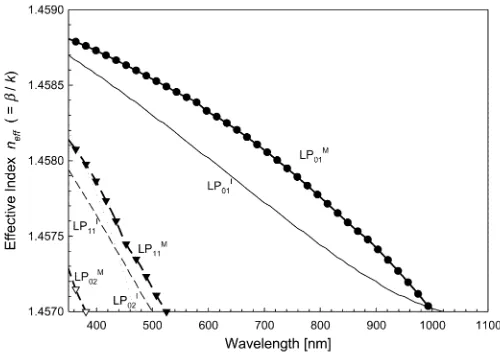
[image:3.612.40.287.63.241.2]We fabricated a neodymium-doped fiber with a W-type core refractive index profile. The refractive index profile was measured and is shown in Fig. 2. The diameter of the second cladding was 100 m. The fiber had a low-index polymer coating that acted as an outer cladding and enabled pump waveguiding within the glass fiber structure (core and first and second claddings), with a nominal NA of 0.49. We evaluated the average refractive index in the core to 1.4590 and the average refractive index of the depressed region to 1.4546. Thus, we approximated the actual refractive index profile with an ideal W-profile. The core radius was 3.5 m and the outer radius of the depressed region was 8.7 m. Fig. 3 shows numerical solutions of the propagation constant , or equivalently, the effective refractive index , of LP modes using the characteristic equation in (2) for a fiber with our idealized parameters (lines, labeled with superscript “I”). The fundamental P mode is cut off from 1 m and above,
Fig. 3. Core guiding characteristics of a W-type refractive index fiber. Effective refractive indices for idealized refractive index profile (lines superscripted with “I”) and those for measured refractive index profile (connected dots superscripted with “M”).
meaning that the core does not guide light at wavelengths above 1 m. The core supports a single mode from 0.5 to 1 m. Interestingly, the effective index of the P mode is higher than that of the P modes for wavelengths below 400 nm as pointed out in [13].
However, the measured refractive index profile, shown in Fig. 2, indicates a large deviation from the idealized index profile in Fig. 1. In order to see the effect of nonidealized W-type profile, which has a large dip in the middle as shown in Fig. 2, we calculated the effective indices of guided modes based on the measured refractive index profile shown in Fig. 2. For this, we employed a mode solver for circularly symmetric structures with arbitrary index profile. It was based on the weakly guiding one-dimensional Helmholtz equation as in [17]. For the calculation, the measured refractive index profile was sampled into 50 points. For comparison, Fig. 3 shows the modal effective indices for the measured refractive index profile (lines with symbols, labeled with superscript “M”), in addition to those of the idealized index profile.
Beside the similar waveguide filter cut-offs ( m), two things are noticed. Firstly, the P -mode cutoff of the measured refractive index profile occurs at much shorter wavelength than that of the idealized refractive index profile, due to the dip in the middle. Secondly, the effective index of the fundamental P is larger than with the idealized index profile for the laser wave-lengths (908–942 nm). This suggests that the measured profile reduces the sensitivity to bending losses.
Fig. 4. Core transmission characteristics of W-profile NDF used in the experiments. The bent section was 1-m long.
Fig. 4 shows a measured core transmission spectrum through a 1-m-long piece of our fiber. This confirms that the core does not guide wavelengths over 1 m while guidance is good below 1 m. Hence, it is clearly shown that our designed W-type fiber has cut off at 1 m. We also measured the bending loss charac-teristics with different bending radius. Since the fiber transmis-sion characteristic is sensitive to bending loss, one can induce a wavelength-dependent bending loss that shifts the effective cutoff to shorter wavelengths, and possibly improves the sup-pression at 1.06 m without incurring any penalty at 0.9 m. From Fig. 4, it seems that the 33-cm bend diameter used exper-imentally did improve the suppression at 1060 nm. On the other hand, filtering loss appears negligible over the laser emission range up to 942 nm.
However, suppressing 1.06 m is not enough to achieve ef-ficient high-power 0.9- m oscillation. It is also necessary to launch enough pump power so that the pump intensity is suffi-cient to reach population inversion, even after absorbing most of the pump power. Otherwise, it would not be possible to operate the laser with a high pump absorption, as is required for efficient operation. For the pump power and pump intensity, we rely pri-marily on the availability of high-power, high-brightness, pump sources.
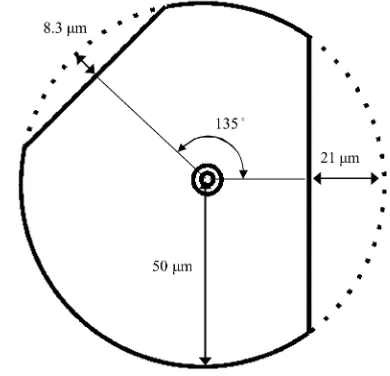
Pump absorption can be a problem, as well, if it is low com-pared to background losses. This can be the case in a fiber with a core diameter as small as 7 m, in particular in neodymium-doped fibers which are relatively susceptible to concentration-quenching. We shaped our fiber to a doubly truncated cross section, as is shown in Fig. 5. It is well known that a doubly-truncated or a singly-doubly-truncated cladding geometry enhances the pump absorption significantly, by eliminating cladding modes with poor overlap with the core [18]. Using this method, we suc-ceeded to increase the pump absorption in the cladding from 0.5 to 0.8 dB/m when measured with a fiber length of 14 m, which is the shortest fiber used in the laser experiments. The trunca-tion does however come at a price. The inner cladding becomes smaller, by 19% in this case. This by itself increases the pump absorption by reducing the inner-cladding-to-core area ratio. We estimate that this effect explains one third of the improvement
Fig. 5. Schematic of the fiber transversal cross-section geometry for the NDF used in experiments.
Fig. 6. Absorption (solid line) and emission (dashed line) cross-section spectra of aluminosilicate NDF used in the experiments.
Fig. 7. Setup for 0.9-m tunable NDFL.
12 dB of pump absorption. This leads to a decisive difference in performance. Note that though one can in principle increase the pump absorption in a circular fiber by scrambling pump modes using fiber bending, this was impossible in this case because of signal bending loss as shown in Fig. 4.
[image:5.612.272.546.68.369.2]Finally, quenching and background losses must also be con-trolled for good conversion efficiency. The use of an alumi-nosilicate host makes this easier than with a germaalumi-nosilicate host, as larger neodymium concentrations can be incorporated before concentration quenching via Nd cross relaxation sets in. Nd can also be quenched by OH , so the OH -content should be low. We measured the Nd-concentration to 1.645 10 ions/cm , and the fluorescence lifetime to 491 s. This does not deviate from the unquenched lifetime of 500 s.
Fig. 6 shows emission and absorption cross sections, as eval-uated for our aluminosilicate NDF (neodymium-doped fiber). The emission cross-section spectrum peaks at 906 nm while the absorption spectrum peaks at 880 nm, within the
transition. The spectroscopy indicates that it is possible to tune the laser oscillation at least between 870–940 nm, provided that pump intensity reaches the threshold population inversion for 0.9- m oscillation. The fraction of Nd ions that has to be excited will be high for short wavelengths because of the high GSA, as well as for long wavelengths because of the low-emis-sion cross section.
III. LASEREXPERIMENT ANDRESULTS
The experimental laser configuration we used is shown in Fig. 7. The Nd-doped fiber was pumped by two 808 nm diode sources in a double-sided end-pumping scheme. The pump beams were focused onto the fiber ends by lenses with 8 mm focal length and 0.5 NA. The used NA was estimated to 0.4, as determined by the diameter of the pump beams incident on the lenses. Diode pump source A (PUMA, New-Optics, 808 nm) provided 4 W of launched pump power into a 100- m-diameter inner cladding while pump source B (Unique Mode, 808 nm) provided 3.5 W of launched pump power. Dichroic mirrors separated the pump and signal beams at both ends of the fiber. The 4% Fresnel reflection from a perpendicularly cleaved fiber end and an external diffraction grating formed the laser cavity. To avoid laser instability caused by multiple reflection points, the grating end of the fiber was angle cleaved. The grating efficiency was measured at 915 nm and found to be 62% to the first order. We tuned the lasing wavelength by changing the angle of the diffraction grating. We used a relatively long fiber, 14 m or more, that provided adequate pump absorption (at least 12-dB operational pump absorption), to suppress pump
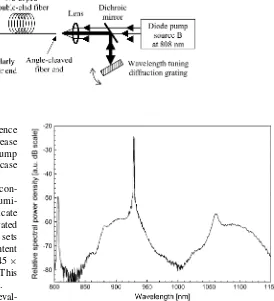
Fig. 8. Example of power spectrum of the 0.9-m tunable fiber laser measured by OSA with resolution 1 nm (fiber length 14 m).
crosstalk and prevent one pump source from damaging the other.
Fiber length is an important parameter of any fiber laser. For example, because of the wavelength dependence of the GSA, it will influence the tuning range [11]. We therefore report the laser characteristics at different fiber lengths. We started with a 25-m—long fiber and cut it back several times to finally stop at 14 m. For every fiber length, we determined the slope efficiency and the threshold pump power as well as the wavelength tuning range. At 14 m fiber, the operating, hot cavity, pump absorp-tion was 12.1 dB. The maximum laser power occurred when the wavelength was tuned to 926 nm. The slope efficiency was 41% and threshold pump power was 1.62 W, both with respect to launched pump power. The maximum output power was 2.4 W. This was the highest power achieved. Fig. 8 shows a typical laser output spectrum, measured with an optical spectrum an-alyzer with a resolution bandwidth of 1 nm. The suppression of the competing 1.06- m transition was excellent. The laser linewidth was 0.26 nm (FWHM) as measured with a resolu-tion of 0.05 nm. The beam propagaresolu-tion parameter was 1.05 when the output power was 2 W, i.e., the output was diffraction limited.
Fig. 9. Laser power characteristics at different fiber lengths.
Fig. 10. Tuning range and maximum output power for different fiber lengths.
if we further shortened the fiber, but this would jeopardize the pump sources so we refrained from doing this. However, with a smaller inner cladding, the pump absorption per unit length would increase. We could then use shorter fibers, with which the slope efficiency would probably be higher.
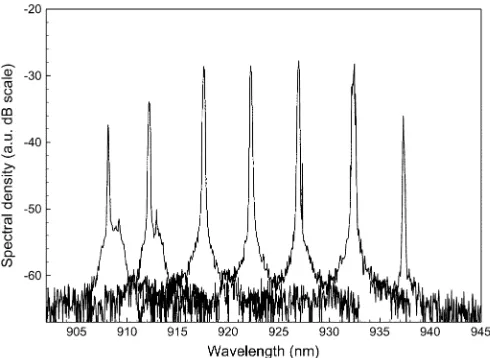
As expected, the tunability also changed with fiber length. This is shown in Fig. 10. The tuning range shifted to shorter wavelengths for shorter fibers, as is typical for long-wavelength (quasifour-level) operation of fiber lasers with GSA [11]. Thus, the tuning range was 908–938 nm for a 14-m-long fiber, and 922–942 nm for a 25-m-long fiber.
[image:6.612.42.288.61.246.2]Fig. 11 shows the tuning curve at full pump power for a 14-m-long fiber. The maximum power occurred at 926 nm. The power at the edge of the tuning range dropped significantly be-cause of the increasing threshold, also shown in Fig. 11. By con-trast, variations in slope efficiency were small across the tuning range. This conclusively demonstrates that the waveguiding loss induced by W profile is negligible within the wavelength range of the laser, since any such loss would be negligible. A lim-iting factor for the tunability was, in practice, a strong gain at 926 nm. This appeared when the diffraction grating was tuned to the edge of the tuning range, because of the large fraction of
Fig. 11. Maximum output power and threshold pump power versus wavelength.
Fig. 12. Tunable laser spectrum of 14-m fiber (OSA resolution 0.05 nm).
excited Nd-ions needed for lasing at the edge. As a consequence, 926 nm could start lasing from spurious reflections, e.g., from the angle-cleaved fiber end or the diffraction grating. We found that for better tunability the minimization of reflection from the angled-cleaved fiber end was critical. Such behavior is typical at high gains of 30 dB or more, which then suggests that our fiber would be capable of high-gain amplification at 926 nm. Finally, Fig. 12 shows laser output spectra for different tuning wavelengths between 908–938 nm, measured with 0.05-nm res-olution. The measured linewidth was in each case 0.26 nm.
IV. CONCLUSION
[image:6.612.41.289.281.456.2] [image:6.612.305.550.282.461.2]ACKNOWLEDGMENT
The authors thank Dr. A. Grudinin for helpful advice and for the provision of a pump source.
REFERENCES
[1] E. Snitzer, “Optical maser action of Nd in a barium crown glass,”
Phys. Rev. Lett., vol. 7, no. 12, pp. 444–446, 1961.
[2] R. J. Mears, L. Reekie, S. B. Poole, and D. N. Payne, “Neodymium-doped silica single-mode fiber lasers,”Electron. Lett., vol. 21, no. 17, pp. 738–740, 1985.
[3] E. Snitzer, H. Po, F. Hakimi, R. Tumminelli, and B. C. McCollum, “Double-clad offset core Nd fiber laser,” inProc. Optical Fiber Sensors, 1988, Paper PD5.
[4] A. L. Cook and H. D. Hendricks, “Diode-laser-pumped tunable 896-939.5-nm neodymium-doped fiber laser with 43-mW output power,”
Appl. Opt., vol. 37, no. 15, pp. 3276–3281, 1998.
[5] L. B. Fu, M. Ibsen, D. J. Richardson, and D. N. Payne, “Three-level fiber DFB laser at 980 nm,” inProc. Optical Fiber Communication Confer-ence, Los Angeles, CA, Feb. 22–27, 2004, Paper MF22.
[6] M. A. Noginov, G. B. Loutts, B. D. Lucas, D. Fider, P. T. Higgins, A. Truong, N. Noginova, N. P. Barnes, and S. Kuck, “Development of Nd-doped solid-state laser materials for 944-nm operation,”IEEE J. Quantum Electron., vol. 37, pp. 469–481, Mar. 2001.
[7] E. F. Wassermann, M. Thielen, S. Kirsch, A. Pollmann, H. Weinforth, and A. Carl, “Fabrication of large scale periodic magnetic nanostruc-tures,”J. Appl. Phys., vol. 83, no. 3, pp. 1753–1757, 1998.
[8] J. Dawson, R. Beach, A. Drobshoff, Z. Liao, D. Pennington, S. Payne, L. Taylor, W. Hackenberg, and D. Bonaccini, “938 nm Nd-doped high power cladding pumped fiber amplifier,”Adv. Solid-State Photon., vol. 83, pp. 118–121, 2003.
[9] P. D. Dragic and G. C. Papen, “Efficient amplification using the
F ! I transition in Nd-doped silica fiber,”IEEE Photon. Technol. Lett., vol. 11, pp. 1593–1595, Dec. 1999.
[10] J. W. Dawson, R. Beach, A. Drobshoff, Z. Liao, D. M. Pennington, S. A. Payne, L. Taylor, W. Hackenberg, and D. Bonaccini, “Scalable 11 W 938 nm Nd doped fiber laser,” inProc. Advanced Solid-State Photonics, Santa Fe, NM, Feb. 2–5, 2004, Paper MD8.
[11] J. Nilsson, W. A. Clarkson, and A. B. Grudinin, “High-power wave-length-tunable cladding-pumped rare-earth-doped silica fiber lasers,”
Opt. Fiber Technol., vol. 10, pp. 5–30, 2004.
[12] S. Kawakami and S. Nishida, “Characteristics of a double clad optical fiber with a low-index inner cladding,”IEEE J. Quantum Electron., vol. 10, pp. 879–887, Dec. 1974.
[13] M. Monerie, “Propagation in doubly clad single-mode fibers,”IEEE J. Quantum Electron., vol. QE-18, pp. 535–542, Apr. 1982.
[14] D. B. S. Soh, S. W. Yoo, J. K. Sahu, L. J. Cooper, S. Baek, J. Nilsson, and K. Oh, “A cladding pumped neodymium-doped fiber laser tunable from 932 nm to 953 nm,” inProc. Advanced Solid-State Photonics, Santa Fe, NM, Feb. 2–5, 2004, Paper MD10.
[15] T. J. Kane, G. Keaton, M. A. Arbore, D. R. Balsley, J. F. Black, J. L. Brooks, M. Byer, L. A. Eyres, M. Leonardo, J. J. Morehead, C. Rich, D. J. Richard, L. A. Smoliar, and Y. Zhou, “3-Watt blue source based on 914-nm Nd:YVO4 passively-Q-switched laser amplified in cladding-pumped Nd:fiber,” inProc. Advanced Solid-State Photonics, Santa Fe, NM, Feb. 2–5, 2004, Paper MD8.
[16] M. J. Söderlund and S. K. Tammela, “A depressed-index cladding filter for suppressing 1.06m emission in a Nd-doped silica fiber amplifier,” inProc. Optical Fiber Communication Conference, Los Angeles, CA, Feb. 22–23, 2004, Paper FJ6.
[17] K. Morishita, “Numerical analysis on pulse broadening in graded index optical fibers,”IEEE Trans. Microwave Theory Tech., vol. MTT-29, pp. 348–352, Apr. 1981.
[18] L. Philippe, V. Doya, R. Philippe, P. Dominique, M. Fabrice, and L. Olivier, “Experimental study of pump power absorption along rare-earth-doped double clad optical fibers,”Opt. Commun., vol. 218, pp. 249–254, 2003.
Daniel B. S. Sohreceived the B.Sc. degree in elec-trical engineering and the M.Sc. degree in automatic control engineering from Seoul National University, Seoul, Korea, in 1997 and 1999, respectively. He is currently working toward the Ph.D. degree in the Optoelectronics Research Centre, University of Southampton, Southampton, U.K.
He served in the Korean Air Force as an Officer from 1999 to 2002. He is currently working on high-power fiber lasers and amplifiers, waveguide design and analysis, and multimode fiber modal behavior. His work has resulted in 23 published technical papers.
Mt. Soh received the Best Thesis Award for his M.Sc. thesis. His Ph.D. study is jointly supported by a Korean Government Scholarship and an Overseas Re-search Studentship from the British Government.
Seongwoo Yoowas born in Seoul, Korea. He received the B.Sc. degree in in-organic engineering in 1999 from Hanyang University, Seoul, Korea, and the M.Sc. degree in information and communications in 2001 from Gwangju In-stitute Science and Technology (GIST), Gwangju, Korea, where he is currently working toward the Ph.D. degree.
His research interests are in specialty fibers and their applications in fiber lasers and medicine.
Johan Nilssonreceived the Doctorate in engineering sciences from the Royal Institute of Technology, Stockholm, Sweden, in 1994, for research on optical amplification.
Since then, he has worked on optical amplifiers and amplified lightwave systems, optical commu-nications, and guided-wave lasers, first at Samsung Electronics and now at the Optoelectronics Research Centre, University of Southampton, Southampton, U.K. His research has primarily focused on devices but has also covered system, fabrication, and materials aspects. He is at present leading a group in the field of high-power active fiber devices and applications. His work has resulted in 200 publications. He is a cofounder of Southampton Photonics, Inc.
Dr. Nilsson is currently a Member of the Technical Program Committees of the Advanced Solid State Photonics Topical Meeting and Photonics West’s Fiber Laser Systems Technology and Applications Conference.
Jayanta K. Sahureceived the Ph.D. degree from the Indian Institute of Technology, New Delhi, India, in 1997.
Processing. His major research interests include pho-tonic devices for optical communications and sensory systems utilizing fiber optics. He has research experience with Bell Labs, Lucent Technologies, and Rutgers University in the U.S., the University of Southampton, Southampton, U.K., The University of Tokyo, Tokyo, Japan, and National Chiat Tung Univer-sity, Taiwan, R.O.C.
Dr. Oh was an Alexander von Humboldt Research Fellow in Germany, a Chevening Scholar in the U.K., and a Japan Society for the Promotion of Sci-ence Invited Fellow in Japan.
Seungin Baekreceived the B.Sc. and M.Sc. degrees in 1999 and 2001, respectively, from the School of Electrical Engineering, Seoul National University, Seoul, Korea, where he is currently working toward the Ph.D. degree.
Since March 2003, he has been a Visiting Research Student in the Optoelectronics Research Centre, Southampton University, Southampton, U.K., where he will work until August 2004. His primary research interests are in the areas of fiber laser/amplifiers, waveguide theory, and optical grating structures.
Yoonchan Jeong(S’97–M’99) received the B.Sc., M.Sc., and Ph.D. degrees in electrical engineering from Seoul National University, Seoul, Korea, in 1994, 1996, and 1999, respectively.
In 2001, he joined the Optoelectronics Re-search Centre (ORC), University of Southampton, Southampton, U.K. His early research covered the quantum theory of light, the grating-structured media, all-optical processing, volume homographic memory systems, and three-dimensional displays. Following these initial wide experiences, his research interests moved to ultrahigh-power optical fiber lasers and amplifier systems while at the ORC. He has been realizing the most powerful optical fiber laser and amplifier systems in the world. He has authored over 100 publications, including several invited and post-deadline papers.
Dr. Jeong is a Member of the Optical Society of America.
high-power amplifiers and 1550- and 980-nm lasers. His research areas include rare-earth doped high-power double-clad fiber lasers and amplifiers for CW and pulsed amplification and novel structures for high-power Raman-based devices.
Pascal Dupriezreceived the Diplome d’Ingenieur in opto-electronics from the Ecole Nationale Su-perieure de Sciences Appliquees et de Technologies (ENSSAT), Lannion, France, and the Master’s degree in applied physics from the University of North Carolina, Charlotte, in 2000. He is currently working toward the Ph.D. degree in the Optoelec-tronics Research Centre, University of Southampton, Southampton, U.K.
He spent one year as an Engineer with Corning Inc., Corning, NY, working on system modeling for metropolitan optical networks, and two years with Waveguide Solutions, Charlotte, NC. He is currently a Research Student in the Optoelectronics Research Centre, University of Southampton, Southampton, U.K. His research areas include high-power fiber lasers, large-core-area fibers, and optical nonlinear effects.
Jaesun Kimreceived the B.Sc. and M.Sc. degrees in material engineering from Hanyang University, Hanyang, Korea. He is currently working toward the Ph.D. degree in the Optoelectronics Research Centre, University of Southampton, Southampton, U.K.
He worked on the development of new optical fibers in the Fiber and Telecom-munication Research Centre of LG Cable, Korea, from 2001 to 2003. His inter-ests are in the development of optical fibers with a variety of compositions and structures for high-power laser and telecommunication applications.
Valery Philippovwas born in St. Petersburg, Russia, in 1960. He received the M.Sc. degree (Hons.) in radiophysics and electronics and Ph.D. degree in quantum electronics from St. Petersburg State Technical University, St. Petersburg, Russia, in 1983 and 1988, respectively.
He was with Department of Radiophysics, St. Petersburg State Technical University, from 1983 to 1998. From 1998 to 2002, he was a Researcher at the Centro de Investigaciones en Optica, Leon, Mexico. Since 2002, he has been with the Optoelectronics Research Centre, University of Southampton, Southampton, U.K. His research interests include fiber-optical sensors, modulators, fiber lasers, and amplifiers.