This is a repository copy of Reasoning about memoryless strategies under partial
observability and unconditional fairness constraints.
White Rose Research Online URL for this paper:
http://eprints.whiterose.ac.uk/94360/
Version: Accepted Version
Article:
Busard, S., Pecheur, C., Qu, H. et al. (1 more author) (2015) Reasoning about
memoryless strategies under partial observability and unconditional fairness constraints.
Information and Computation, 242. pp. 128-156. ISSN 0890-5401
https://doi.org/10.1016/j.ic.2015.03.014
Article available under the terms of the CC-BY-NC-ND licence
(https://creativecommons.org/licenses/by-nc-nd/4.0/)
[email protected] Reuse
Unless indicated otherwise, fulltext items are protected by copyright with all rights reserved. The copyright exception in section 29 of the Copyright, Designs and Patents Act 1988 allows the making of a single copy solely for the purpose of non-commercial research or private study within the limits of fair dealing. The publisher or other rights-holder may allow further reproduction and re-use of this version - refer to the White Rose Research Online record for this item. Where records identify the publisher as the copyright holder, users can verify any specific terms of use on the publisher’s website.
Takedown
If you consider content in White Rose Research Online to be in breach of UK law, please notify us by
Reasoning about Memoryless Strategies
under Partial Observability
and Unconditional Fairness Constraints
Simon Busarda,1, Charles Pecheura, Hongyang Qub,2, Franco Raimondic
a
ICTEAM Institute, Universit´e catholique de Louvain, Louvain-la-Neuve, Belgium
b
Dept. of Automatic Control and Systems Engineering, University of Sheffield, Sheffield, United Kingdom
c
Dept. of Computer Science, Middlesex University, London, United Kingdom
Abstract
Alternating-time Temporal Logic (ATL) is a logic to reason about strategies that a set of agents can adopt to achieve a specified collective goal. ATL can also be used to specify what agents can do in open systems, where they can interact with their environment in many different ways.
A number of extensions for this logic exist; some of them combine strategies and partial observability, some others include fairness constraints, but to the best of our knowledge no work provides a unified framework for strategies, partial observability and fairness constraints. Integration of these three concepts is of particular importance when reasoning about the capabilities of agents that do not have full knowledge of a system, for instance when the agents can assume that the environment behaves in a fair way.
In this work we presentAT LKirF, a logic combining strategies under partial
observability in a system with fairness constraints on states. We introduce a model-checking algorithm forAT LKirF by extending the algorithm for a
full-observability variant of the logic and we investigate its complexity. We validate our proposal with a detailed experimental evaluation, using an implementation that we make publicly available.
Keywords: alternating-time temporal logic, partial observability, fairness constraints, model checking
Email addresses: [email protected](Simon Busard),
[email protected](Charles Pecheur),[email protected](Hongyang Qu),
[email protected](Franco Raimondi)
1
This work is supported by the European Fund for Regional Development and by the Walloon Region.
2
1. Introduction
Alternating-time Temporal Logic (AT L) is a logic for reasoning about the strategies of a subset of agents in a system, and the goals they can achieve using these strategies [1]. AT L can be used to reason about the capabilities of the agents in an open system. AT Lconsiders that the agents have full knowledge of the system and its execution—that is, in every particular state of the system, the agents know the full information about it. This hypothesis about the agents is calledfull observability orperfect information. On the other hand, some logics extendingAT Lallow to reason about agents that do not have the full knowledge of the system; in any particular state of the system, the agents only see a part of it. This situation is calledpartial observability orimperfect information.
Starting from [2], partial observability has been investigated by many authors, see for instance [3] and references therein. For example, Jamroga and van der Hoek proposed, among other logics, ATOL, combining partial observability with strategies of agents [4]. Along the same lines, Schobbens studiedAT Lir [5], seen
as the minimalAT L-based logic for strategies under partial observability [6]. Furthermore, some efforts have been made on bringing fairness toAT L. For instance, the work of Alur et al. [1], or the work of Kl¨uppelholz and Baier [7] introduce the notion of fairness constraints inAT L. But, to the best of our knowl-edge, no work provides a unified framework for strategies, partial observability and fairness constraints.
This paper proposesAT LKirF, a logic for reasoning about strategies under
partial observability and epistemic properties of agents in a system with uncondi-tional fairness constraintson states; these fairness constraints areunconditional
because they ask states to appear infinitely often, without condition (compared to strong and weak fairness constraints, that ask for states to appear infinitely often if other states appear). This paper also presentsAT LKIrF, a variant of
AT LKirF with full observability and fairness constraints. Furthermore, this
paper provides model-checking algorithms for both logics.
AT LKIrF and AT LKirF have been named by following the notations of
AT Lir. Indeed, the subscriptsirofAT Lirmeansimperfect informationfor thei,
compared toIstanding forperfect informationor full observability, andimperfect recallfor ther, compared toRforfull recallor memory-full strategies. AT LKIrF
has the subscripts for perfect information (or full observability), imperfect recall, andF has been added forfairness. Similarly,AT LKirF has the subscripts for
imperfect information, imperfect recall, and fairness.
Furthermore,AT LKirF is restricted to memoryless strategies. Other cases
While some other extensions of AT L—such as AT OLor CSL[4, 3]—are rich enough to speak about all kinds of observability capabilities of the agents,
AT LKirF focuses only on one kind of observability. Nevertheless, the general
principles presented in this paper also apply to other variants and the logic could be easily modified to reason about other kinds of observability capabilities. Some variations ofAT LKirF are discussed in Section 6.
To motivate the need for fairness constraints inAT Lunder partial observabil-ity, consider the simple card game example in [4]. The game is played between a player and a dealer. It uses three cards,A,K andQ;Awins over K, Kwins overQandQwins overA. First, the dealer gives one card to the player, keeps one and leaves the last one on table, face down. Then the player can keep his card or swap it with the one on the table. The player wins if his card wins over the dealer’s card. Figure 1 presents the graph of the game, where the dealer first chooses both cards, then the player can keep his card or swap it with the third one.
−,−
Q, K
f c1
A, K
f c2
A, Q
f c3
K, Q
f c4
K, A
f c5
Q, A
f c6
Q, K A, K A, Q K, Q K, A Q, A
−,−
player player
[image:4.612.129.476.312.529.2]player
Figure 1: The graph of the card game. Circles are states, with pairs of cards (K, Ameans player hasK, dealer hasA). Arrows are transitions (actions of both agents are easily infered). The waved edges link states that are indistinguishable for the player. Fairness constraintsf ci label the intermediate states.
First of all, if the player has full observability, he knows the card of the dealer and thus knows what to do (keeping his card or swapping with the one on table) to win the game. On the other hand,AT Lir considers uniform strategies.
Such strategies choose the same action in all states that are indistinguishable for the agents. UnderAT Lir semantics, we say that a group of agents can enforce
for the player will choose to keepK andA and to change when he hasQ. It cannot, however, choose a different action when the player hasK but the dealer has different cards, because the player does not see the dealer’s card until the end of the game. UnderAT Lir, the player has no winning uniform strategy: he
cannot distinguish between, for example,hA, KiandhA, Qi(whereha, bimeans “player has carda, dealer has cardb”) and thus has to make the same action in
both states, with a different result in each case.
Consider now a variation of this game: the game does not terminate after the first round. Instead, cards are redistributed at the end of the game. In this case, too, the player has no eventually winning strategy, even after an infinite number of plays: for instance, he will have to choose between keeping or swapping cards inhA, KiandhA, Qi, so he will not be able to enforce a win because the dealer (that chooses the given cards) can be unfair and always give the losing pair.
But if we add one fairness constraint per intermediate state—that is, the states where the dealer has just dealt the cards—the player has a strategy to eventually win the game. In this case, we only consider paths along which all fairness constraints are met infinitely often: this situation corresponds to a fair dealer, giving all the possible pairs infinitely often. The player can thus eventually win becausehA, Kiwill eventually happen—even if he cannot distinguish it from
hA, Qi—, so he knows a strategy to eventually win a round: keeping his card. In fact, in this particular system, any strategy of the player wins since all the situations have to eventually happen.
Another example of application of fairness constraints inAT L under partial observability is Multi-Agent Programs [9]. These programs are composed of concurrent agent programs and fairness constraints are used to avoid unfair sched-ules. Dastani and Jamroga express fairness as formulas of the logicEAT L+p [9], a variant of AT L∗ for multi-agent programs that restricts the objectives of coalitions of programs to Boolean combinations of temporal operators. The present paper, instead, deals only withAT Land therefore fairness constraints cannot be expressed as formulas of the logic. By adding fairness constraints to only consider executions along which the scheduler allows all programs to run infinitely often, AT LKirF allows the user to reason about the strategies
of these programs under fair schedules. The situation is similar to the case of
LT LversusCT Lmodel checking: in the first case, model checking fairness is reduced to model checking a more complex formula using the same verification algorithms; in the second case fairness is incorporated into bespoke verification algorithms. The advantage of restricting the logic toAT L, that is, to objectives restricted to single temporal operators, lies in the complexity of model checking the logic. Indeed,EAT L+p has been shown to be ∆P
3-complete, while the logic this paper proposes is only ∆P
2-complete3.
Other works such as the originalAT Lpaper [1] and the work of Kl¨uppelholz and Baier [7] introduce fairness constraints on actions, asking for an infinitely
3
A ∆P
2-complete problem needs a polynomial number of calls to aN P oracle (∆
P
2 =P
N P ); a ∆P
3-complete problem needs a polynomial number of calls to a Σ2P oracle (∆P3 =P
often enabled action to be taken infinitely often. On the other hand, forCT L
and derived branching logics such as epistemic logics, fairness constraints are commonly provided on states [10]; this kind of fairness constraints allows the user to model, for example, a lossy channel that would not lose all the messages and would actually send the messages infinitely often. Furthermore, it has been shown that (weak, strong or unconditional) fairness constraints on actions can be reduced to (weak, strong or unconditional, respectively) fairness constraints on states getting a penalty on the number of states of the system (see [11, Chapter 5], for instance). AT LKirF combinesCT Loperators withAT L ones and it is
thus natural to speak about fairness constraints on states in this framework. The rest of the paper is structured as follows: Section 2 presents the syntax and semantics of our logics. Section 3 and Section 4 present algorithms for model checking these logics. Section 5 studies the complexity of the two model-checking problems. Section 6 discusses some issues and limitations of both logics and Section 7 describes implementation details and presents some experiments. Section 8 discusses the recent related work. Finally, Section 9 summarizes the contribution and draws some future work.
2. Syntax and Semantics
This section presents the syntax and semantics ofAT LKIrF andAT LKirF,
two extensions ofAT Lwith full and partial observability, respectively, under fairness constraints on states.
2.1. Syntax
Both logics share the same syntax, following this grammar:
φ::=true|p| ¬φ|φ∨φ|Eψ | hΓiψ|Kiφ|EΓφ|DΓφ|CΓφ
ψ::=Xφ |φ U φ|φ W φ
wherepis an atomic proposition of a setAP, Γ is a subset of a set of agentsAg,
iis an agent ofAg.
Other operators can be defined in terms of these ones:
f alse≡ ¬true
φ1∧φ2≡ ¬(¬φ1∨ ¬φ2)
φ1 =⇒ φ2≡ ¬φ1∨φ2
φ1 ⇐⇒ φ2≡(φ1 =⇒ φ2)∧(φ2 =⇒ φ1)
Aψ≡ ¬E¬ψ
In particular,
¬hΓiφ1U φ2≡[Γ](¬φ2)W(¬φ1∧ ¬φ2)
¬hΓiφ1W φ2≡[Γ](¬φ2)U(¬φ1∧ ¬φ2).
The logics combine temporal operators (EX,AF,EG, etc.) fromCT L[12, Chapter 3], standard knowledge operators (Ki,EΓ,DΓ,CΓ) [13] and strategic operators (hΓiX, [Γ]G, etc.) fromAT L[1].
Intuitively, theEψ CT Lpath quantifier says that there exists a path satisfying the path formulaψ. A path satisfiesXφif its second state satisfies φ. A path satisfiesφ1U φ2 ifφ1is true along the path untilφ2is true, andφ2is eventually true. Similarly, a path satisfiesφ1 W φ2 if φ1 is true until φ2 is true, butφ2 does not have to be eventually true.
Furthermore, a statessatisfies Kiφif the agentiknows thatφis true ins.
ssatisfiesDΓφif, by sharing their knowledge ofs, the agents of Γ know thatφ is true. ssatisfiesEΓφif all the agents of Γ know thatφis true, independently.
ssatisfiesCΓφifφis common knowledge among agents of Γ [13].
Finally, a statessatisfies hΓiψif Γ have a strategy inssuch that all paths enforced by the strategy satisfyψ.
Note that, unlike forCT L, the path operatorW (Weak until) is needed for expressing the dual operator forhΓiφ1U φ2 [14]. Furthermore, the standard Gφ path operator can be expressed asφ W f alse. We can thus limit ourselves to the minimal set of path operators composed ofX,U andW.
2.2. Models and notation
AT LKIrF andAT LKirF formulas are interpreted overmodels
M =hAg, S, Act, T, I,{∼i}i∈Ag, V, F Ci (1)
where
• Ag is a set ofnagents;
• S⊆S1×...×Sn is a set ofglobal states. Each global state sis composed
ofnlocal statess1, . . . , sn, one for each agent;
• Act⊆Act1×...×Actn is a set ofjoint actions, each of which is composed
ofnactions, one for each agent. We call apartially joint actionan element
aΓ ofActΓ=Qi∈ΓActi, for Γ⊆Ag;
• T ⊆S×Act×S is a transition relation between states inS labelled with joint actions (we writes−→a s′ for (s, a, s′)∈T). We define the function
img :S×Act→2S asimg(s, a) ={s′∈S|s−→a s′}, that is, img(s, a) is
the set of states reached in one step fromsthrougha;
• {∼i}i∈Agis a set of equivalence relations between states, one for each agent
i∈Ag. ∼i partitions the set of states in terms of knowledge of agent i.
s∼is′ iff si =s′i, that is, two states are indistinguishable for agent iif
they share the same local state fori;
• V :S→2AP labels states with atomic propositions ofAP;
• F C ⊆2S is a set offairness constraints, each of which is a set of states.
Given a set of agents Γ⊆Ag,∼Γ=Ti∈Γ∼iis called thedistributed knowledge
relation;∼E
Γ= S
i∈Γ∼i is called theeveryone knows orgroup knowledge relation;
∼C
Γ is the transitive closure of the relation∼EΓ and is called thecommon knowledge relation. Intuitively,s∼Γ s′ if no one in Γ can distinguishsands′ ands∼EΓ s′ if someone in Γ cannot distinguishsands′.
A joint action a = (a1, ..., an) completes a partially joint action aΓ = (a′i, ..., a′j) composed of actions of agents in Γ ⊆Ag—written aΓ ⊑a—if the actions inafor agents in Γ correspond to the actions inaΓ. Given two disjoint subsets of agents Γ and Γ′, and two partially joint actions a
Γ = (ai, ..., aj) and
a′
Γ′ = (a′k, ..., a′l) for Γ and Γ′ respectively,aΓ⊔a′Γ′ is the (partially) joint action
composed of the actions of both joint actionsaΓ anda′Γ′.
We define the function
enabled(s,Γ) ={aΓ∈ActΓ|∃s′∈S, a∈Acts.t. aΓ⊑a∧s−→a s′}, (2)
returning the set of partially joint actions for the group of agents Γ that can be played by them ins. We also writeenabled(s, i), whereiis a single agent, for
enabled(s,{i}).
A model M represents a non-deterministic system where each agent has imperfect information about the current global state. A first restriction is made onT:
∀s∈S, enabled(s, Ag) = Y
i∈Ag
enabled(s, i), (3)
that is, in every state, the choices of actions for each agent is not constrained by the choices of other agents. Another restriction made onT is
∀s, s′∈S, s∼is′ =⇒ enabled(s, i) =enabled(s′, i). (4)
This means that the actions an agent can perform in two epistemically equivalent states are the same. These two restrictions ensure that an agent needs only his own knowledge of the current state to choose his action, and he will be able to choose his action, whatever the others choose.
A path in a model M is a sequence π = s0 a
1
−→ s1 a
2
−→ ... such that (si, ai+1, si+1) ∈ T for all i ≤ 0. We use π(d) for sd. A state s is
reach-able inM if there exist a pathπandd≥0 such thatπ(0)∈I andπ(d) =s. A pathπisfair according to a set of fairness conditionsF C={f c1, ..., f ck} if
thatπ(d)∈f c. A statesisfair if there exists a fair path starting ats. A fair reachable state is thus a state belonging to a fair path starting at an initial state.
Amemory-full strategy for a group of agents Γ is a functionfΓ :S+→ActΓ where, for any path prefixπ=s0...sm, fΓ(π)∈enabled(sm,Γ); a memory-full
strategy maps the sequence of visited states to an enabled action for Γ. A
memoryless strategy for a group of agents Γ is a memory-full strategyfΓ such that, for any two path prefixesπ=s0...sm andπ′=s′0...s′m′,fΓ(π) =fΓ(π
′) if
sm=s′m′; that is, a memoryless strategy only needs to know the current state
to produce the next action, and can be viewed as a functionfΓ:S→ActΓ. A
memoryless uniform strategy for the group Γ—abbreviated as uniform strategy for Γ in the sequel—is a memoryless strategyfΓ where∀s, s′∈S, s′ ∼Γ s =⇒
fΓ(s) =fΓ(s′), that is, the group cannot choose two different actions for two indistinguishable states. Intuitively, a strategy is uniform for Γ if Γ can effectively run it, that is, in every state, Γ only need to share their knowledge of the current global state to know which action to choose. In the sequel, we mainly speak about memoryless uniform strategies.
Thestrategy outcomesfrom a statesfor a strategyfΓ, denoted without(s, fΓ), is the set of paths a strategy can reach, that is,out(s, fΓ) ={π=s0 a
1
−→s1...|s0=
s∧ ∀d≥0, sd+1∈img(sd, ad+1)∧fΓ(s0...sd)⊑ad+1}.
Note that the models described above are a generalization of standardAT L
andAT Lirmodels, namely (imperfect information) concurrent game structures
((i)CGS in short) [1, 5]. First, fairness constraints are added to the model to specify which paths are fair. Second, our models describe a non-deterministic transition relation: for a state and a joint action, there can be several successors. On the contrary, (i)CGS are described such that the transition relation is deterministic, that is, for any given state and joint action, there is at most one successor.
This generalization to non-deterministic transition relations does not add expressivity to the models. It is possible to transform any non-deterministic model into a deterministic one by adding a new agent to the model responsible for breaking the non-determinism when needed. More precisely, we can add a new agentN Dand update the transition relation such that, for any given state
sand partially joint actionaAg\N D (for all agents exceptN D),N D can choose
a different action for each possible successor ofsthroughaAg\N D. In this way,
for any given state and joint action, there is only one successor; the model thus becomes deterministic and is equivalent to an (i)CGS.
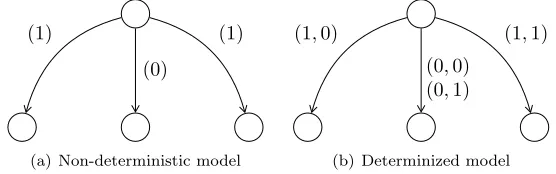
given in Equation 3, that is, the set of enabled joint actions in any state (in this case, the top state) is the cartesian product of the sets of each agent’s enabled actions.
(1)
(0)
(1)
(a) Non-deterministic model
(1,0)
(0,0) (0,1)
(1,1)
[image:10.612.165.443.176.263.2](b) Determinized model
Figure 2: Determinizing a non-deterministic model with one agent. Vertices are states; edges are transitions, labelled with joint actions.
On the other hand, while this generalization to non-deterministic transition relations adds no expressivity to the model, it can be used to abstract away agents of a system. For example, the scheduler of a multi-agent program can be modeled as part of the non-deterministic environment. Another application is the case of lossy communication channels: using non-deterministic transitions, the lossy channels do not have to be defined as different agents, and the fact that a message sent on a channel is lost or not is non-deterministically handled by the environment.
2.3. Semantics
The semantics of both logics are defined over states of a modelM by the rela-tionsM, s|=IrF φandM, s|=irF φ, forAT LKIrF andAT LKirF, respectively.
M is omitted when clear from the context.
Both relations share a part of their definition; we write s |=rF φ when
s|=IrF φands|=irF φare defined in the same way. The relationss|=IrF φand
s|=irF φare recursively defined over the structure ofφand follow the standard
interpretation for most of the operators:
s|=rF true
s|=rF p⇔p∈V(s)
s|=rF ¬φ⇔s6|=rF φ
s|=rF φ1∨φ2⇔s|=rF φ1 ors|=rF φ2
s|=rF Eψ⇔there exists afair path πsuch thatπ(0) =sandπ|=rF ψ
s|=rF Kiφ⇔s′|=rF φfor alls′ s.t. s∼is′ ands′ is a fair reachable state
s|=rF DΓφ⇔s′|=rF φfor alls′ s.t. s∼Γs′ ands′ is afair reachable state
s|=rF EΓφ⇔s′|=rF φfor alls′ s.t. s∼EΓ s′ ands′ is a fair reachable state
The relationπ|=rF ψover pathsπof the model is defined as:
π|=rF Xφ⇔ π(1)|=rF φ
π|=rF φ1U φ2⇔ and for allthere exists d≥0 such thatπ(d)|=rF φ2
e < d, π(e)|=rF φ1
π|=rF φ1W φ2⇔
there exists d≥0 such thatπ(d)|=rF φ2 and for alle < d, π(e)|=rF φ1,
or for alld≥0, π(d)|=rF φ1.
The meaning of thehΓioperator is different in the two semantics:
s|=IrF hΓiψ⇔ there exists asuch that for allmemoryless strategyfair paths fΓ for Γ,
π∈out(s, fΓ), π|=IrF ψ;
s|=irF hΓiψ⇔
there exists auniform strategy fΓ for Γ, such that for alls′ ∼
Γ s, for allfair paths π∈out(s′, f
Γ), π|=irF ψ.
The first semantics can be viewed, in the case of strategic operators, as a particular case of the second one where the equivalence relation used for uniform strategies distinguishes all states. The first semantics allows Γ to know everything about the system when choosing and playing their strategies, while the second one restricts them to knowledge they effectively have.
Intuitively, both semantics say that s satisfies hΓiψ if agents in Γ have a collective strategy—that is, a choice of a Γ partially joint action in every state— such that, whatever the action of the other agents is, the objectiveψwill be satisfied by all the resulting fair paths. The main difference with the standard
AT Lsemantics is the fact that only fair paths are considered. We can understand it the following way: ssatisfieshΓiψif Γ have a strategy to enforceψ, assuming all other agents will act fairly, that is, the other agents only follow fair paths. For example, in the case of multi-agent programs,ssatisfieshΓiψif the programs in Γ have a strategy to enforceψ, assuming that the scheduler—modeled as another agent of the system, or as the environment—is fair, that is, each program will run infinitely often.
Furthermore, AT LKirF compares to AT LKIrF like AT Lir compares to
vanillaAT L: AT LKirF restricts Γ to only use strategies that they can effectively
apply, according to their (shared) knowledge of the system [5]. This notion of applicable strategies is out of the scope of this paper and is further discussed in [4].
The proposed semantics forAT LKirF considers the group of agents Γ as
controlled by a unique controller, able to use their distributed knowledge to gain more information about the current state of the system. The implicit universal quantification over all Γ-indistinguishable starting states captures the fact that the agents of Γ know that they have a uniform strategy to win; together with the restriction to uniform strategies, this amounts to reasoning about strategies that Γ can effectively play, as exposed by Jamroga and van der Hoek in [4]. The fact that Γ is considered as a single agent is further discussed in Section 6.2.
Note that the restriction to memoryless strategies in both semantics is strong. Nevertheless, it is necessary in the case of partial observability: it has been shown that the problem of the existence of a memory-full uniform strategy under partial observability is undecidable [8]. On the other hand, the restriction to memoryless strategies in the case of full observability is not an actual restriction: Section 3.3 will show that there exists a winning memoryless strategy if and only if there exists a winning memory-full one. We express the semantics in terms of memoryless strategies for the sake of homogeneity with the partial observability case.
There are redundancies between the temporal and the strategic operators. The formulaEψcan be expressed in vanillaAT Las [∅]ψ: there is a path satisfying
ψif the empty set of agents cannot avoidψ, that is, all the agents can cooperate to lead to at least one path satisfyingψ[1]. Similarly,Aψcan be expressed as
h∅iψ, that is, all paths satisfyψ if, whatever all agents do,ψis enforced. The same equivalences apply underAT LKIrF andAT LKirF. Nevertheless, both
kinds of operators are kept in the logics to clearly separate operators about the pure execution of the model (the temporal ones) and operators speaking about strategies (the strategic ones). Furthermore the model-checking algorithms for
AT LKirF presented in this paper are clearly more efficient when dealing with
temporal operators than with strategic ones.
Because we deal with non-deterministic models with fairness constraints (see Section 2.2), some equivalences that exist in AT Lare not kept: Aψ 6≡[Ag]ψ
andEψ6≡ hAgiψ. These equivalences are broken because of non-determinism, but also because of fairness constraints. Let us illustrate this with two examples. The first example is given in Figure 3. This model is composed of one agent and the transition relation is non-deterministic because, in the top state, the joint action (1) leads to two successors. In this top state, the propertyEX pis true, because there is a successor wherepis true. But the propertyhAgiX p
is not true because the (single) agent has no strategy to enforce that the next states satisfyp: playing action 1 may lead to either successor, and pis false in the right one. Dually, the top state does not satisfyAX p, but it satisfies [Ag]X p.
The second example is given in Figure 4. In this case, the model contains no fair path since the right state can be visited at most once. In the top state of this model, the propertyEX pis trivially false because there is no fair path (at all) satisfyingX p; on the other hand, the property hAgiX p is vacuously true becauseAg has a strategy such that all fair paths (there are none) satisfy
p ¬p
(1) (1)
[image:13.612.257.354.124.223.2](1) (1)
Figure 3: A model with one agent where the equivalencesAψ6≡[Ag]ψandEψ6≡ hAgiψare broken due to non-determinism. Vertices are states, labelled with propositions true in this state; edges are transitions, labelled with joint actions. The bold states belong to the (single) fairness constraint of the model (all paths are fair).
should be avoided in meaningful models. The problem of vacuous strategies will be further discussed in Section 6.3.
¬p p
(1) (1)
(1)
(1)
Figure 4: A model with one agent where the equivalencesAψ6≡[Ag]ψandEψ6≡ hAgiψare broken due to presence of fairness constraints. Vertices are states, labelled with propositions true in this state; edges are transitions, labelled with joint actions. The bold state belongs to the (single) fairness constraint of the model.
3. Model Checking Strategies under Full Observability
This section presents a model-checking algorithm forAT LKIrF and a proof
of correctness for this algorithm. We first present the algorithm for the variant with full observability because the model-checking algorithm for the variant with partial observability is based on this one.
3.1. A model-checking algorithm using fixpoint computations
The proposed model-checking algorithm for AT LKIrF is defined by the
functionevalIrF :AT LKIrF →2Sreturning the set of states of a given (implicit)
model M satisfying a given AT LKIrF property. This function is defined in
[image:13.612.243.367.328.424.2]The evaluation for strategic operators relies on functionsP re[.]: 2Ag×2S → 2S andReach
[.]: 2Ag×2S×2S →2S defined as
P re[Γ](Z) ={s|∀aΓ ∈enabled(s,Γ),∃as.t. aΓ ⊑a∧img(s, a)∩Z6=∅}, (5)
Reach[Γ](P1, P2) =µY.P2∪(P1∩P re[Γ](Y)). (6)
Intuitively, P re[Γ](Z) returns the set of states in which Γ cannot avoid to reach a state ofZ in one step; that is, the set of states in which, whatever Γ do, the other agents have a way to potentially reach Z by choosing the right action. Furthermore, Reach[Γ](P1, P2) returns the set of states from which Γ cannot avoid a finite path to a state ofP2through states ofP1.
The [Γ] operators are evaluated as follows:
evalIrF([Γ]Xφ) =P re[Γ] evalIrF(φ)∩F air[Γ] (7)
evalIrF([Γ]φ1U φ2) =Reach[Γ] Φ1,Φ2,F (8)
evalIrF([Γ]φ1W φ2) =
νZ.Φ2,F ∪
Φ1∩ T
f c∈F C
P re[Γ]
Reach[Γ] Φ1,Φ2,F ∪(Z∩f c)
(9)
where
Φ1=evalIrF(φ1), (10)
Φ2,F =evalIrF(φ2)∩F air[Γ], (11)
F air[Γ]=νZ. \
f c∈F C
P re[Γ] Reach[Γ](S, Z∩f c)
. (12)
µZ.τ(Z) andνZ.τ(Z) are the least and greatest fixpoints of functionτ(Z). Note that all functionsτ involved in the fixpoint computations are monotonic; sinceS is finite, then
µY.τ(Y) =[
i
τi(∅) =τ∞(∅) (13)
νY.τ(Y) =\
i
τi(S) =τ∞(S), (14)
whereτi+1(Z) =τ(τi(Z)) andτ0(Z) =Z [12, Chapter 6].
The other [Γ] andhΓioperators are expressible thanks to the ones above and the¬operator (see Section 2.1).
Intuitively,F air[Γ] returns the set of states in which Γ cannot avoid a path going through all fairness constraints infinitely often, that is, a fair path. We say thatsis Γ-fair ifs∈F air[Γ].
evalIrF([Γ]Xφ) is the set of states from which Γ cannot avoid a Γ-fair
evalIrF([Γ]φ1W φ2) is the set of states from which Γ cannot avoid a path of states satisfyingφ1 and going through allf c∈F C infinitely often, or a path of states satisfyingφ1until a Γ-fair state satisfying φ2is reached.
Note that thehΓioperators can be evaluated using the [Γ] and¬operators, but can also be computed directly using the dual forms of the ones above. More precisely, let
P rehΓi(Z) =P re[Γ](Z)
={s|∃aΓ∈enabled(s,Γ) s.t. ∀a, aΓ⊑a =⇒ img(s, a)⊆Z} (15)
be the dual of theP re[Γ] function returning the set of states in which Γ can surely reachZ in one step, and
N F airhΓi=F air[Γ]=µZ. [
f c∈F C
P rehΓi νY.(Z∪f c)∩P rehΓi(Y) (16)
be the set of states in which Γ can avoid fair paths. Using these two new functions, the direct computation ofhΓioperators can be written as
evalIrF(hΓiXφ) =P rehΓi evalIrF(φ)∪N F airhΓi
(17)
evalIrF(hΓiφ1U φ2) =
µZ.Φ1,2,N∩
Φ2∪ S
f c∈F C
P rehΓi
νY.Φ1,2,N∩(Z∪f c)∩ Φ2∪P rehΓi(Y)
(18)
evalIrF(hΓiφ1W φ2) =νZ.Φ1,2,N∩ Φ2∪P rehΓi(Z) (19)
where
Φ2=evalIrF(φ2), (20)
Φ1,2,N =evalIrF(φ1)∪evalIrF(φ2)∪N F airhΓi. (21)
3.2. Correctness of the algorithm
This section proves the correctness of the model-checking algorithm presented in the previous section, that is, it proves that for any statesof a given (implicit) modelM and anyAT LKIrF formulaφ,
s∈evalIrF(φ) iffs|=IrF φ. (22)
In the sequel, we say that Γ cannot avoid xif for any strategy fΓ, xcan happen. For example, Γcannot avoid a fair path satisfyingF φinsiffor any strategy fΓ, there exists a fair pathπ∈out(s, fΓ)satisfyingF φ.
Before proving the correctness of the algorithm for the different strategic operators, we need to show some intermediate results.
Lemma 1. Reach[Γ](P1, P2)computes the set of states in whichΓcannot avoid
a finite path of states ofP1 to a state of P2.
Proof. We can prove this lemma by induction over the computation of the least fixpoint of functionτ(Y) =P2∪(P1∩P re[Γ](Y)). Indeed, it is easy to show that
τi(∅) computes the set of states in which Γ cannot avoid a finite path of length
at mosti−1 of states ofP1to a state ofP2. Thus, ins∈τ∞(∅), Γ cannot avoid to reachP2 throughP1in a finite number of steps.
Lemma 2. F air[Γ] computes the set of states in which Γcannot avoid a fair
path.
Proof. We can prove this lemma by induction over the computation of the greatest fixpoint of functionτ(Z) =T
f c∈F CP re[Γ](Reach[Γ](S, Z∩f c)). Indeed, it is easy to show thatτi(S) computes the set of states in which Γ cannot avoid to reach any fairness conditionf c∈F C at leastitimes, in at least one step. Thus, ins∈τ∞(S), Γ cannot avoid to visit anyf c∈F C infinitely many times, that
is, Γ cannot avoid a fair path.
We can now prove the correctness of the algorithm for the three strategic operators [Γ]Xφ, [Γ]φ1U φ2 and [Γ]φ1W φ2.
Lemma 3. evalIrF([Γ]Xφ) returns the set of statess of M in which for any
memory-full strategyfΓ forΓ, there exists a fair path π∈out(s, fΓ)such that
π|=Xφ.
Proof. The proof is trivial by definition of P re[.] and Lemma 2.
Lemma 4. evalIrF([Γ]φ1U φ2)returns the set of statessofM in which for any
memory-full strategyfΓ forΓ, there exists a fair path π∈out(s, fΓ)such that
π|=φ1U φ2.
Proof. evalIrF([Γ]φ1U φ2) computes the set of states in which Γ cannot avoid a finite path through states satisfying φ1 to a Γ-fair state satisfying φ2, by Lemma 1.
Lemma 5. evalIrF([Γ]φ1W φ2) returns the set of states s of M in which for
any memory-full strategyfΓ forΓ, there exists a fair pathπ∈out(s, fΓ)such
Proof. We can prove this lemma by induction over the computation of the greatest fixpoint of function
τ(Z) =
(evalIrF(φ2)∩F air[Γ])∪(evalIrF(φ1)∩
T
f c∈F CP re[Γ](Reach(
evalIrF(φ1),
(evalIrF(φ2)∩F air[Γ])∪(Z∩f c) )))
. (23)
Indeed, it is easy to show that τi(S) computes the set of states in which Γ
cannot avoid to reach a Γ-fair state satisfyingφ2 through states satisfyingφ1, or in which Γ cannot avoid to visit any fairness conditionf c∈F C at leasti
times through states satisfyingφ1, in at least one step. Thus, ifs∈τ∞(S), Γ cannot avoid to reach either a Γ-fair state satisfyingφ2, or to visit anyf c∈F C infinitely many times, through states satisfyingφ1, thus Γ cannot avoid a fair path satisfyingφ1U φ2 or a fair path satisfyingGφ1, that is, they cannot avoid a fair path satisfyingφ1W φ2.
Lemmas 3, 4 and 5 can be now combined into Theorem 6 saying that the algorithm is correct regarding the existence of memory-full strategies winning the objectives.
Theorem 6. Let s be the state of a model M and ψ be an AT LKIrF path
formula,s∈evalIrF(hΓiψ) iff, ins, Γhave a memory-full strategy fΓ such
that all fair pathsπ∈out(s, fΓ)satisfy ψ.
Proof. The proof directly follows from Lemmas 3, 4 and 5 and the equivalence [Γ]ψ≡ ¬hΓi¬ψ.
Theorem 6 says that the proposed model-checking algorithm effectively computes, for strategic operators, the set of states in which Γ have a memory-full strategy to win. Nothing in the computation or in the proof restricts Γ to always play the same action in any given state. But AT LKIrF is about
memoryless strategies. The next section shows that there is a memory-full strategy to win iff there is a memoryless one, ending the proof of correctness.
3.3. AT LKIrF and memoryless strategies
This section gives the outline of the proof that the model-checking algorithm presented in Section 3.1 is correct according to the existence of winning memo-ryless strategies, that is, it effectively computes the set of states in which Γ have a memoryless strategy to win. To show that, we use results from game theory about memory of strategies for different objectives. The full proof is available in Appendix A. This full proof uses results from the work of E. Gr¨adel [16] and W. Thomas [17], and gets inspiration from results presented in [18].
First, given a model and a strategicAT LKIrF propertyhΓiψ, we can build a
in a states, a new statesaΓ for 1 is created, representing the fact that Γ chose
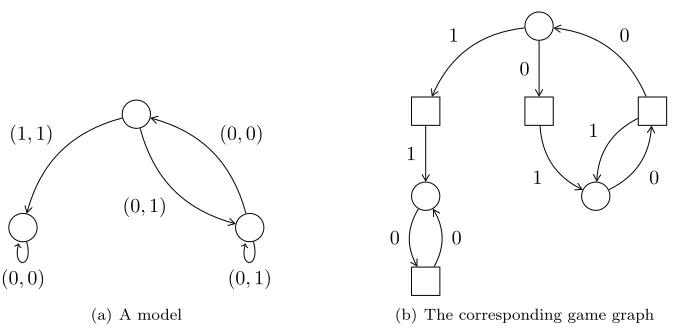
the corresponding action; in these states for 1, Γ can then choose the next state. This mapping is illustrated in Figure 5.
(1,1)
(0,1)
(0,0) (0,1)
(0,0)
(a) A model
1
1
0 0
0
1 0
1 0
[image:18.612.137.475.177.311.2](b) The corresponding game graph
Figure 5: A model and its corresponding game graph. Γ is the first agent, Γ is the second one. Vertices are states; circles in the game graph are player 0 states, squares are player 1 states; edges are transitions, labelled with actions (for clarity, in the game graph).
On the other hand, theAT LKIrF property is translated into an objective
for the corresponding two-player turn-based game, and we can show that, to a strategy for 0 winning the objective on the game, there corresponds a strategy for Γ in the original model. Indeed, whenever the player 0 chooses a successor in the game, there exists a corresponding action in the original model, and every path enforced in the game by the winning strategy can be mapped to a path in the original model, enforced by the corresponding strategy.
Furthermore, using standard results in game theory about memoryless strate-gies of particular objectives, we can show that our objectives do not need memory to be won in such games. For this, we propose custom algorithms to find all the winning states of the game; by the way the algorithms compute these states, we can show that there exists a winning memoryless strategy in these states, and so the player does not need memory to win the game. Thus, since there exists a correspondance between winning strategies in the game and winning strategies in the original model, agents do not need memory either in the cases ofAT LKIrF objectives on our models.
Finally, the correctness of the model-checking algorithm forAT LKIrF follows
from Theorem 7.
Theorem 7. evalIrF(hΓiψ)returns the set of states ofM satisfyinghΓiψunder
AT LKIrF, that is
∀s∈S, s|=IrF hΓiψ if and only ifs∈evalIrF(hΓiψ). (24)
Proof. From Theorem 6, we know thatevalIrF(hΓiψ) computes the set of states
a memoryless one. Thus, we can conclude that in the states computed by
evalIrF(hΓiψ), Γ have a memoryless strategy to win, and that the algorithm is
correct for strategic operators.
Note that for other operators, the algorithm follows the standard algorithms and the proof is the same (see [12, Chapter 6], for example).
4. Model Checking Strategies under Partial Observability
This section presents three model-checking algorithms forAT LKirF. The
first one splits the model into uniform strategies and uses the model-checking algorithm forAT LKIrF to get states satisfying the property. The second one
improves the approach by alternating between splitting the model and filtering out losing actions. Finally, Section 4.3 discusses the ideas behind the two algorithms, generalizes them and proposes a third algorithm combining the advantages of the two first approaches.
4.1. Splitting then filtering
A first algorithm for model checkingAT LKirF strategic properties is
pre-sented in Algorithm 1. It relies on the model-checking algorithm forAT LKIrF
and uses two sub-algorithms: Splitand a modified version of evalIrF. Split
divides the transition relation of the model into uniform strategiesstrat and
evalIrF performs the model-checking algorithm forAT LKIrF on the fraction of
the model restricted tostrat. Note that for the other operators (CT L opera-tors, Boolean connecopera-tors, etc.) model checkingAT LKirF is identical to model
checkingAT LKIrF, andevalirF works asevalIrF.
Algorithm 1: evalirF(hΓiψ)
Data: M a given (implicit) model, Γ a subset of agents ofM,ψan
AT LKirF path formula.
Result: The set of states ofM satisfyinghΓiψ.
sat={}
forstrat∈Split(S×ActΓ)do
winning=evalIrF(hΓiψ, strat)
sat=sat∪ {s∈winning|∀s′ ∼
Γ s, s′ ∈winning}
returnsat
Intuitively, Algorithm 1 gets all the possible uniform strategies for Γ thanks toSplit. Then, for each of these strategies, it calls the model-checking algorithm for AT LKIrF, restricted to the strategy. Finally, it only keeps the states for
which all equivalent states satisfy the property in the given strategy.
TheevalIrF algorithm is modified by adding an argumentstrattoP rehΓi,
where, givenstrat⊆S×ActΓ andZ⊆S,
P rehΓi(Z, strat) =
s
∃aΓ∈enabled(s,Γ) s.t. hs, aΓi ∈strat
∧ ∀a, aΓ ⊑a =⇒ img(s, a)⊆Z
P rehΓi(Z, strat) isP rehΓi(Z) restricted to states and actions allowed bystrat.
Furthermore,evalIrFrecursively callsevalirF on sub-formulas, instead ofevalIrF.
More precisely,
evalIrF(hΓiXφ, strat) =P rehΓi evalirF(φ)∪N F airhΓi(strat), strat
(26)
evalIrF(hΓiφ1U φ2, strat) =
µZ.Φ1,2,N ∩
Φ2∪ S
f c∈F C
P rehΓi
νY. Φ1,2,N∩(Z∪f c)∩
Φ2∪P rehΓi(Y, strat)
, strat
(27)
evalIrF(hΓiφ1W φ2, strat) =νZ.Φ1,2,N∩ Φ2∪P rehΓi(Z, strat) (28)
where
Φ2=evalirF(φ2), (29)
Φ1,2,N =evalirF(φ1)∪evalirF(φ2)∪N F airhΓi(strat), (30)
N F airhΓi(strat) =µZ.
[
f c∈F C
P rehΓi(νY.(Z∪f c)∩P rehΓi(Y, strat), strat).
(31)
TheSplitalgorithm is given in Algorithm 2. Split(S×ActΓ) returns the set of uniform strategies for Γ, where each strategyfΓ is represented by the action
fΓ(s) for group Γ allowed in each states. This action needs to be the same for each state in the same equivalence class. We call amove an element ofS×ActΓ; such an elemenths, aΓicorresponds to Γ choosing the actionaΓ in state s.
We say that two moves hs, aΓi and hs′, a′Γi are conflicting, and we write
hs, aΓi⊥hs′, a′Γi, if both states are equivalent (s ∼Γ s′) and the actions are different (aΓ 6=a′Γ). Given a set of moves SA⊆S×ActΓ,
Conf licts(SA) ={m∈SA|∃m′∈SAs.t. m⊥m′} (32)
returns the set of conflicting moves ofSA.
Intuitively,Splitgets all the conflicting equivalence classes. If there are no such conflicts, SA represents a uniform strategy. Otherwise, Splitpicks one conflicting equivalence classequivalent, gets all the possible actionsactionsin this class and, for each of these actionsaΓ, creates a new strategy by computing the cross product of the strategy playing aΓ in the equivalence class, and the strategiessubstratsfor other equivalence classes recursively computed by
Split. In other words,Splititeratively splits conflicting equivalence classes and computes the cross product of all the splittings to build all possible uniform strategies of the model.
Algorithm 2: Split(SA)
Data: Γ a given (implicit) subset of agents,SA⊆S×ActΓ.
Result: The set of all the largest subsetsstratofSAsuch that no conflict appears instrat.
conf licting=Conf licts(SA)
if conf licting=∅then return {SA} else
hs, aΓi=pickone element inconf licting
equivalent={hs′, a′
Γi ∈SA|s′ ∼Γ s}
actions={a′
Γ∈ActΓ|∃hs, a′Γi ∈equivalent}
substrats=Split(SA\equivalent)
strats={}
foraΓ∈actionsdo
equivStrat={hs′, a
Γi ∈equivalent}
strats=strats∪ {equivStrat∪substrat|substrat∈substrats} returnstrats
Lemma 8. Split(SA)computes the set of all the largest subsets stratofSA⊆ S×ActΓ such that no conflicts appear in strat.
Proof. We can prove the correctness of Splitby induction over the number of conflicting equivalence classes ofSA. If SA does not contain any conflicting equivalence classes, SA is its own single largest subset in which no conflicts appear. Otherwise, let us assume thatSplit(SA\equivalent), withequivalent
a conflicting equivalence class of SA, returns the set of all the largest non-conflicting subsets ofSA\equivalent. Then, Splitreturns the cartesian product between all the largest non-conflicting subsets ofequivalentand all the largest non-conflicting subsets ofSA\equivalent. Because these cannot be conflicting as they belong to different equivalence classes, we can conclude thatSplitreturns the set of the largest non-conflicting subsets ofSA.
The correctness of Algorithm 1 is then given by the following theorem.
Theorem 9. Given an (implicit) modelM, a subsetΓ of agents ofM and an
AT LKirF formulahΓiψ,
∀s∈S, s|=irF hΓiψ if and only ifs∈evalirF(hΓiψ). (33)
Proof. First, Split(S×ActΓ) returns all the possible uniform strategies of the system, where a uniform strategy is represented by the only action allowed in each equivalence class of states (states equivalent in terms of the knowledge of Γ), this action being the same for every state of the class. Indeed, the set of the largest non-conflicting subsets of S×ActΓ is the set of possible uniform strategies.
Furthermore,winning =evalIrF(hΓiψ, strat) returns the set of states for
algorithm, restricted to actions instrat. It thus returns the set of states for which there is a (not necessarily uniform) winning strategy instrat. As stratis, by construction, a uniform strategy for Γ,winning is the set of states for which there exists a uniform winning strategy—in fact, it isstratitself.
Finally, the set{s∈winning|∀s′ ∼
Γs, s′∈winning} is the set of statess for which stratis a winning strategy for all s′ ∼
Γ s. sat accumulates all the statessfor which there is a winning strategy for all states indistinguishable from
s. As this is exactly the semantics of the property, that is,sat is exactly the set of states of the system satisfying the property, the proof is done.
Note that for other operators, the model-checking algorithm forAT LKirF
follows the standard algorithms, like the one forAT LKIrF, and the proof is the
same.
4.2. Alternating between splitting and filtering
One problem of the algorithm presented in the previous section is the number of uniform strategies it considers. This number can be very huge (see Section 5) while the number of winning strategies can be small. This comes from the fact thatevalirF blindly splits equivalence classes in which no winning strategy exists,
increasing drastically the number uniform strategies to consider.
A solution presented in this section is to filter out states and actions that surely cannot be winning. For this, we use the AT LKIrF model-checking
algorithm to filter out states and actions that are not part of a (not necessarily uniform) strategy; because the filtered states (and actions) cannot be part of a winning strategy, they cannot be part of a winning uniform strategy. More precisely, the proposed improvement consists in alternating between filtering out states and actions that cannot be part of a strategy, and splitting remaining conflicting equivalence classes. The filtering is performed using a modified version of theAT LKIrF model-checking algorithm presented in Section 3. Note that
we can filter states that do not satisfy the property underAT LKIrF semantics
since they cannot satisfy the property underAT LKirF semantics neither.
The improved algorithm is presented in Algorithm 3. Using this algorithm, we can compute the set of states satisfyinghΓiψasevalirFimproved(hΓiψ, S×ActΓ). This algorithm uses the functionevalmoves
IrF . This function is a modification of
theevalIrF function restricted to a set of moves and where moves are returned
instead of states. More precisely, let
M ovesΓ(Z, SA) ={hs, aΓi ∈SA|s∈Z∧aΓ∈enabled(s,Γ)} (34)
returning the moves composed of states ofZ and the enabled actions that are allowed bySA. Let
P removeshΓi (Z, SA) =
hs, aΓi ∈SA
aΓ ∈enabled(s,Γ)
∧∀a, aΓ⊑a =⇒ img(s, a)⊆Z
(35)
SA. That is, the set of moves ofSA allowing Γ to surely reachZ in one step. Let
N F airmoveshΓi (SA) =µZ. [
f c∈F C
P removeshΓi νY. M oves∩ Γ(Z∪f c, SA)) P removes
hΓi (Y, SA)
, SA
!
(36)
be the set of states in which Γ can avoid fair paths thanks to moves ofSA, with the actions involved in the possible strategies.
Given a set of movesSA,evalmoves
IrF is defined as
evalmoves
IrF (hΓiXφ, SA) =
P removes
hΓi
M ovesΓ(evalirF(φ), S×ActΓ)∪N F airmoveshΓi (SA), SA
(37)
evalmoves
IrF (hΓiφ1U φ2, SA) =
µZ.Φ1,2,N∩
Φ2∪ S
f c∈F C
P removes
hΓi
νY. Φ1,2,N∩M ovesΓ(Z∪f c, SA) ∩ Φ2∪P removeshΓi (Y, SA)
, SA
(38)
evalmovesIrF (hΓiφ1W φ2, SA) =νZ.Φ1,2,N∩ Φ2∪P removeshΓi (Z, SA)
(39)
where
Φ1,2,N =
M ovesΓ(evalirF(φ1), SA)∪M ovesΓ(evalirF(φ2), SA)∪N F airmoveshΓi (SA), (40)
Φ2=M ovesΓ(evalirF(φ2), SA). (41)
Intuitively,evalmoves
IrF (hΓiψ, SA) returns the states satisfyinghΓiψassociated
to the actions ofSA that allow them to do so, restricted to the ones ofSA. Note that in the expression for hΓiXφ, the set of moves extracted from
evalirF(φ) is not restricted toSA. This is necessary because these moves do
not belong to a strategy to winXφ. As the idea of the algorithm is to filter out moves until the result is a uniform strategy, the set of moves extracted from
evalirF(φ) do not belong to such strategy; on the other hand, the corresponding
states are necessary for the computation ofevalmoves
IrF (hΓiXφ).
Algorithm 3: evalimprovedirF (hΓiψ, SA)
Data: M a given (implicit) model, Γ a subset of agents ofM,ψan
AT LKirF path formula,SA⊆S×ActΓ.
Result: The set of states ofM satisfyinghΓiψinSA.
1 SA′ =evalmoves
IrF (hΓiψ, SA)
2 conf licting=Conf licts(SA′)
if conf licting=∅then
4 return{s∈S|∀s′∼Γs,∃aΓ∈ActΓ s.t. hs′, aΓi ∈SA′}
else
6 hs, aΓi=pickone element inconf licting 7 equivalent={hs′, a′
Γi ∈SA′|s∼Γ s′} 8 actions={aΓ∈ActΓ|∃hs, aΓi ∈equivalent}
sat={}
foraΓ∈actionsdo
11 strat={hs′, aΓi ∈equivalent} ∪(SA′\equivalent)
12 sat=sat∪evalimproved
irF (hΓiψ, strat)
returnsat
Algorithm 3 returns the set of states satisfying the property in SA, that is, statessin which Γ has a uniform strategy using only actions inSAthat is winning for all states equivalent tos. So, to get the states of the model satisfying the property, we have to take all the states for which there is a winning uniform strategy inS×ActΓ.
The correctness of Algorithm 3 is given by the following theorem.
Theorem 10. evalirFimproved(hΓiψ, S×ActΓ) computes the set of states of M
satisfyinghΓiψ, i.e.
∀s∈S, s∈evalimprovedirF (hΓiψ, S×ActΓ)iffs|=irF hΓiψ. (42)
Proof. First, evalmoves
IrF (hΓi, SA) computes the moves of SA composed of the
states for which there exists a winning strategy inSA, and actions that compose these winning strategies. In other words,evalmoves
IrF (hΓi, SA) filters out fromSA
the states for which there is no winning strategy inSA, and the actions that are not part of a winning strategy. Indeed, the fixpoint computations ofevalmoves
IrF
correspond to the fixpoint computations ofevalIrF where theP removeshΓi operator
only consider moves available inSA. Thus, the states returned by these fixpoint computations are the states for which there exists a winning strategy in SA
instead of in the whole system.
Furthermore, we can show, with a proof similar to the ones of Lemmas 1 to 5, that a move ofSAis returned byevalmovesIrF iff this move belongs to a winning strategy ofSA. Indeed,P rehΓi computes, through fixpoint computations, the
states for which there exists a winning strategy;P removes
hΓi computes, in addition,
Second, evalimprovedirF (hΓi, SA) computes the states for which there exists a winning uniform strategy in SA. Indeed, if SA′ contains no conflict, this
means thatSA′ represents a (unique) winning uniform strategy. The states
satisfyinghΓiψinSA′ are the ones for which all equivalent states are in SA′,
and this is what is computed and returned at Line 4. On the other hand, ifSA′
contains some conflicts,SA′ represents several uniform strategies. In this case,
the algorithm splits one conflicting equivalence class and tries all the possible splittings for this class, thus missing no potential uniform strategy.
Finally, evalimprovedirF (hΓi, S×ActΓ) is the set of states satisfyinghΓiψsince the whole model is considered.
4.3. Mixing splitting and filtering
The two algorithms presented above can be viewed as particular cases of algorithms mixing filtering and splitting. Indeed, Algorithm 1 first splits all conflicting equivalence classes of the model—by using theSplitsub-algorithm— and then filters out states that are losing for each strategy to get all states satisfying the property. On the other hand, Algorithm 3 alternates between filtering out states that are losing for the current subset of strategies, and splitting the current subset of strategies into uniform ones, one conflicting equivalence class at a time, until the strategy is uniform and the remaining states are winning. We can imagine other variants of mixing filtering and splitting. In particular,
evalF SFirF (hΓiψ)—given as Algorithm 4—first filters out states that have no winning strategy, as well as losing moves, then splits all equivalence classes and ends by, for each resulting uniform strategy, filtering out the states for which the strategy is losing4. Compared to the first solution, this algorithm gains much from the first filtering, giving fewer equivalence classes to split, while gaining from the second solution by avoiding to filter between each equivalence class splitting. This algorithm really combines the advantages of both approaches in practice, as shown by experimental results presented in Section 7.
Algorithm 4: evalF SF irF (hΓiψ)
Data: M a given (implicit) model, Γ a subset of agents ofM,ψan
AT LKirF path formula.
Result: The set of states ofM satisfyinghΓiψ.
sat={} SA=evalmoves
IrF (hΓiψ, S×ActΓ)
forstrat∈Split(SA)do
winning=evalIrF(hΓiψ, strat)
sat=sat∪ {s∈winning|∀s′ ∼
Γ s, s′ ∈winning}
returnsat
4
The correctness of Algorithm 4 is given by the following theorem. The proof is similar to the ones for the two previous algorithms.
Theorem 11. evalF SF
irF (hΓiψ)computes the set of states of M satisfying hΓiψ,
i.e.
∀s∈S, s∈evalF SFirF (hΓiψ) iffs|=irF hΓiψ. (43)
Proof. First, the proof of Theorem 10 showed thatevalmoves
IrF do not lose winning
moves. So, the moves of (S×ActΓ)\evalIrFmoves(hΓiψ, S×ActΓ) cannot be part of a winning uniform strategy and there exists a winning uniform strategy from a given statesinS×ActΓif and only if there exists a winning uniform strategy from s in evalmoves
IrF (hΓiψ, S ×ActΓ). Furthermore, the proof of Theorem 9 showed that enumerating all uniform strategies inS×ActΓ and accumulating the states for which these strategies are winning correctly computes the set of states satisfyinghΓiψ. Thus, since we showed that filtering out losing moves does not ignore winning uniform strategies, Algorithm 4 correctly computes the set of states satisfyinghΓiψ.
5. Complexity Considerations
This section discusses complexities ofAT LKIrFandAT LKirFmodel-checking
problems. While the first one is in P, the second is one is ∆P
2-complete. A problem is in ∆P
2 =P NP
if it can be solved in deterministic polynomial time with subcalls to anNP-oracle.
5.1. AT LKIrF model-checking complexity
This section shows that the model-checking problem forAT LKIrF is inP,
that is, there exists an algorithm to solve the problem that is polynomial in terms of the size of the model and of the formula. Let us show that the algorithm proposed in Section 3 is effectively polynomial in terms of the size ofM andφ. This section only focuses on the evaluation of strategic operators; for the other operators, standard literature already discusses the problem.
First, the computation of theP re[Γ](Z) operator is polynomial: given any set of statesZ, it is necessary to check each state and transition of the system at most once to get all the states belonging toP re[Γ](Z). Second,Reach[Γ](P, Q) can be computed in polynomial time: τ(Z) =Q∪(P∩P re[Γ](Z)) is monotonic, thus the least fixpoint ofτ(Z) is reached in at most|S|steps. Each step computes the P re[Γ] operator, thus the P re[Γ] operator is evaluated at most |S| times, hence the polynomial time complexity ofReach[Γ]. Third,F air[Γ] can also be computed in polynomial time: it is composed of a greatest fixpoint of aτfunction evaluating Reach[Γ] for each fairness constraint f c ∈ F C. The τ function is monotonic, thus only a polynomial number of calls toReach[Γ]are needed, hence a polynomial time complexity.
5.2. AT LKirF model-checking complexity
This section shows that the model-checking problem for AT LKirF is ∆P2 -complete.
Model checkingAT Lwith perfect recall and partial observability is an unde-cidable problem [8], while model checkingAT Lir is a ∆P2-complete problem [6]. Let us show that AT LKirF subsumes AT Lir in the case of two agents; its
model-checking problem is therefore ∆P
2-hard, since the model-checking problem forAT Lir is already ∆P2-complete for only two agents [6].
Intuitively, anyiCGS—a model over whichAT Lirproperties are interpreted—
can be transformed into a model with only one fairness constraint composed of the full state-space; the corresponding model shares the same labeled graph as theiCGS and fairness constraints say that any path of the model is a fair path. It is obvious that there exists a uniform strategy for an agentiin an iCGS
such that all enforced paths satisfyψif and only if there exists a uniform strategy for the same agent in the corresponding model such that all enforced fair paths satisfyψ, since every path of the model is fair.
Note that there is a difference in the definition of strategies for a group of agents in AT Lir and AT LKirF: collective strategies in AT Lir are tuples of
individual strategies for the agents of the coalition, while strategies inAT LKirF
consider Γ as a single agent. This difference has no impact on the complexity of
AT LKirF model checking since the proof of ∆P2-hardness ofAT Lir is based on
a two-agents game [6], andAT Lir andAT LKirF coincide when Γ is composed
of only one agent.
Let us now show that there is a ∆P
2 algorithm for model checkingAT LKirF
property, thus that the problem is ∆P
2-complete. The proposed algorithm uses a deterministic variant of Algorithm 1 where the uniform strategies are non-deterministically chosen among the possible ones. More precisely, the proposed algorithm uses Algorithm 5 to compute the states of the model satisfying a given strategic operator.
Algorithm 5: evalN D irF(hΓiψ)
Data: M a given (implicit) model, Γ a subset of agents ofM,ψan
AT LKirF path formula.
Result: The set of states ofM satisfyinghΓiψ.
states=S strat={}
while states6=∅ do
s= pickone element instates states=states\{s′|s′∼
Γs}
6 aΓ= chooseone action inenabled(s,Γ)
strat=strat∪ {hs′, a
Γi|s′ ∼Γ s}
winIrF =evalIrF|strat(hΓiψ)
return{s∈S|∀s′∼
Algorithm 5 is effectively non-deterministic: thechooseoperation at Line 6 is a non-deterministic choice among the enabled actions of Γ ins. Furthermore, this algorithm is polynomial: thewhileloop is repeated at most|S|times since the size ofstatesis decreased by at least one at each step. Furthermore, as shown in the previous section, the evalIrF|strat(hΓiψ) algorithm runs in polynomial
time, thus Algorithm 5 is inNP.
Finally, the model-checking problem forAT LKirF is in ∆P2 since we need to call anNPalgorithm for each subformula of the formula to check, thusPcalls to anNPprocedure. We can then conclude that model checkingAT LKirF is a
∆P
2-complete problem.
6. Discussion
This section discusses two choices that have been made when designing
AT LKIrF and AT LKirF semantics: the type of fairness constraints and the
knowledge relations used for uniform strategies. Furthermore, it discusses the issue of vacuous strategies and presents possible solutions.
6.1. Fairness constraints
This section presents the fairness constraints chosen in the semantics of
AT LKIrF and discusses alternatives. It also discusses the link between fairness
and strategies.
Let us remind the semantics ofAT LKIrF strategic operators. Given a state
sof a modelM =hAg, S, Act, T, I,{∼i}i∈Ag, V, F Ciand a path property ψ,
s|=IrF hΓiψ⇔ there exists amemoryless strategy
fΓ for Γ,
such that for allfair paths π∈out(s, fΓ), π|=IrF ψ; (44)
where a path isfair iff it meets all fairness constraintsf c∈F C infinitely often. This kind of fairness definition is calledunconditional fairness and is standard in the framework ofF air CT Land is used in the family of SMV model checkers (e.g. NuSMV) [12]. There exist other kinds of fairness such as strong and
weak fairness, expressed on actions or on states. For example, a strong fairness constraint over actions says that a pathπis fair iffan action that is enabled along states of πinfinitely many times must be taken infinitely many times; a weak fairness constraint says that a path is fair iffan action that is eventually enabled permanently must be taken infinitely many times. While fairness constraints can be expressed on actions or on states, it has been shown that fairness constraints on actions can be reduced to fairness constraints on states, thus it is sufficient to limit ourselves to fairness constraints on states [11, Chapter 3].
often [9]. In the same vein, weak and strong fairness constraints can be used to reason about strategies of agents under particular circumstances. For example, suppose a multi-agent program where one particular program controls a mutex in the system; if an agent needs to lock this mutex to achieve its task, it cannot win its objective without the cooperation of the controlling program. On the other hand, by adding strong fairness constraints to ensure that if the agent asks infinitely often for a mutex, the controlling program will grant it, the agent has a strategy to win its objective.
The advantage of unconditional fairness, compared to strong and weak fairness, is that it does not differentiate between memoryless and memory-full strategies, that is, we can only focus on memoryless ones without losing any expressive power. On the other hand, it has been shown that in the case of strong and weak fairness, memory is necessary to win the objectives: two variants on ATL have been proposed, both needing memory [1]. Nevertheless, the amount of memory needed to win the objectives under weak and strong fairness is finite. Furthermore, we know that strategies that are allowed to use a bounded amount of memory for choosing the next action can be reduced to memoryless strategies in a derived model where the memory is encoded in the states [4, 5], allowing the reasoning to be restricted to memoryless strategies.
Another concern about fairness constraints is about the set of agents that must enforce fair paths. InAT LKIrF semantics, Γ win if they have a strategy
such thatall fair paths satisfy the objective; in this case, Γ have to produce fair paths that violate the objective to prevent Γ to win. Let us call this semantics theweak-strategy semantics. Another choice is possible: Γ win if they have a strategy such thatall enforced paths are fair and satisfy the objective; in this case, Γ have to enforce only fair paths to win, and Γ can prevent them to win by avoiding fair paths (regardless of the objective). Let us call this new semantics thestrong-strategy semantics.
While weak strategy objectives do not need memory to be won (see Section 3.3 and Appendix A), strong-strategy ones need memory to be won. For example, let us consider the model presented in Figure 6 and the propertyhAgiF p. The model contains only one agent that can play two different actions in the top state. For a path to be fair, both the left and right states must be visited infinitely often. Under the weak-strategy semantics, the property is true in the top state: by playing 0 in the top state, the agent will enforce no fair path (the only enforced path never meets the right state), and the property is vacuously true. Note that if the agent can use memory, the result is the same, the agent still has a strategy to win. On the other hand, under the strong-strategy semantics, the agent has a memory-full strategy to win the objective in the top state—for example, play 0 and 1 alternatively—but no memoryless strategy to win. He has to stick to the same action in the top state, and will never meet the other state. Thus, in the case of the strong-strategy semantics, memory makes a difference.
When designingAT LKIrF semantics, we kept the weak-strategy semantics
p ¬p
(0) (1)
[image:30.612.229.385.124.201.2](1) (1)
Figure 6: A model with one agent where the agent needs memory to win under the strong-strategy semantics. Vertices are states, labelled with propositions true in this state; edges are transitions, labelled with joint actions; the bold state belongs to one fairness constraint, the double-lined one to another.
allows the user to reason about the strategies of the programs while assuming a fair scheduler.
6.2. Knowledge relations
This section presents the different knowledge relations used in the semantics ofAT LKirF, discusses alternatives and motivates the choice made forAT LKirF.
Let us remind the semantics ofAT LKirF strategic operators. Given a state
sof a modelM =hAg, S, Act, T, I,{∼i}i∈Ag, V, F Ciand a path property ψ,
s|=irF hΓiψ⇔
there exists auniform strategyfΓ for Γ, such that for alls′ ∼
Γ s, for allfair paths π∈out(s′, f
Γ), π|=irF ψ.
(45)
There are two different knowledge relations used in this semantics. The first one is about the states in which the strategy must start: the property is satisfied insif there is a strategy that wins in all statess′ equivalent tos. In the sequel,
this equivalence relation is called thestarting-point equivalence relation. In the case ofAT LKirF, this relation is the distributed knowledge relation ∼Γ.
The second knowledge relation used inAT LKirF semantics is the one used in
the definition of uniform strategies. AT LKirF only considers uniform strategies,
that is, strategies that play the same action in two different equivalent states. In the sequel, this equivalence relation is called thestrategy-points equivalence relation. In the case ofAT LKirF, this relation is also the distributed knowledge
relation∼Γ.
Several equivalence relations could be used in place of the starting point and the strategy-points equivalence relations. For example, AT Lir diverges
fromAT LKirF by defining a collective strategy for Γ as a tuple of strategies
for agents of Γ; this can be seen as using the individual knowledge relation of each agent to define the strategy-points equivalence relation. The intuition behindAT LKirF semantics (already explained in Section 2.3) is that the group

![Figure 3: A model with one agent where the equivalences Aψ ̸≡ [Ag]ψ and Eψ ̸≡ ⟨Ag⟩ψ arebroken due to non-determinism](https://thumb-us.123doks.com/thumbv2/123dok_us/7872803.182361/13.612.243.367.328.424/figure-model-agent-equivalences-aps-eps-arebroken-determinism.webp)