UNIVERSITI TEKNIKAL MALAYSIA MELAKA
MODELLING AND FORECASTING THE ELECTRICITY
DEMAND IN ADMINISTRATION BUILDING AT
TECHNOLOGY CAMPUS UTeM BY USING STATISTICAL
ANALYSIS
This report is submitted in accordance with the requirement of Universiti Teknikal Malaysia Melaka (UTeM) for the Bachelor of Electrical Engineering Technology
(Industrial Automation & Robotics) with Honours
by
NORSURIANA BINTI SHAMSUDDIN B071310289
910703-06-5672
UNIVERSITI TEKNIKAL MALAYSIA MELAKA
BORANG PENGESAHAN STATUS LAPORAN PROJEK SARJANA MUDA
TAJUK MODELLING AND FORECASTING THE ELECTRICITY DEMAND IN ADMINISTRATION BUILDING AT TECHNOLOGY CAMPUS UTeM BY USING STATISTICAL ANALYSIS
SESI PENGAJIAN: 2016/2017 Semester 1
Saya NORSURIANA BINTI SHAMSUDDIN
mengaku membenarkan Laporan PSM ini disimpan di Perpustakaan Universiti Teknikal Malaysia Melaka (UTeM) dengan syarat-syarat kegunaan seperti berikut:
1. Laporan PSM adalah hak milik Universiti Teknikal Malaysia Melaka dan penulis. 2. Perpustakaan Universiti Teknikal Malaysia Melaka dibenarkan membuat salinan
untuk tujuan pengajian sahaja dengan izin penulis.
3. Perpustakaan dibenarkan membuat salinan laporan PSM ini sebagai bahan pertukaran antara institusi pengajian tinggi.
4. **Sila tandakan ( )
SULIT
TERHAD
TIDAK TERHAD
(Mengandungi maklumat yang berdarjah keselamatan atau kepentingan Malaysia sebagaimana yang termaktub dalam AKTA RAHSIA RASMI 1972)
(Mengandungi maklumat TERHAD yang telah ditentukan oleh organisasi/badan di mana penyelidikan dijalankan)
Alamat Tetap:
No. 185 Blok 2 Felda Keratong 6,
26700 Muadzam Shah,
Pahang.
Tarikh: ________________________
Disahkan oleh:
Cop Rasmi:
Tarikh: _______________________
iv
DECLARATION
I hereby, declared this report entitled “Modelling and Forecasting the Electricity Demand in Administration Building at Technology Campus UTeM by Using
Statistical Analysis” is the results of my own research except as cited in references.
v
APPROVAL
This report is submitted to the Faculty of Engineering Technology of UTeM as a partial fulfillment of the requirements for the degree of Bachelor of Engineering Technology (Industrial Automation & Robotics) (Hons.). The member of the supervisory is as follow:
vi
ABSTRAK
vii
ABSTRACT
viii
DEDICATION
ix
ACKNOWLEDGEMENT
Alhamdulillah, I would like to thanks to Allah S.W.T, the Most Merciful, and all praises to Allah for His blessing in completing this thesis. Special appreciation to my supervisor, Pn. Nor Hafizah Binti Hussin for supervised and guiding me throughout the experimental and thesis works.
x
TABLE OF CONTENT
Abstrak vi
Abstract vii
Dedication viii
Acknowledgement ix
Table of Content x List of Table xiii
List of Figures xiv
List Abbreviations, Symbols and Nomenclatures xvi
CHAPTER 1: INTRODUCTION 1
1.0 Introduction 1 1.1 Project Background 1
1.2 Objective 3
1.3 Problem Statement 4
1.4 Project Scope 5
CHAPTER 2: LITERATURE REVIEW 6
2.0 Introduction 6
2.1 Market of Electricity Load Demand 6
2.2 Types of Load Forecasting 10
2.2.1 Short-Term Load Forecasting (STLF) 11
2.2.2 Medium-Term Load Forecasting (MTLF) 14
2.2.3 Long-Term Load Forecasting (LTLF) 15
2.3 Factor of Load Demand 16
2.4 Electricity Rate 19 2.4.1 Tariff Electricity Charges in Malaysia 19 2.5 Statistic Review for Load Demand 23
2.5.1 Autoregressive (AR) Model 24
xi
2.5.3 Autoregressive Integrated Moving-Average (ARIMA) Model 25
2.5.4 Artificial Neural Network (ANN) 27
2.5.5 ARAR Algorithm 27
CHAPTER 3: METHODOLOGY 30
3.0 Introduction 30
3.1 Chart of Research 30
3.2 Flow Chart of Collecting Data 32
3.3 Methodology 33
3.3.1 Data on Kilowatt Meter 33
3.3.2 Mini-Tab Software 34
3.3.3 ARIMA Modelling 35
CHAPTER 4: RESULT & DISCUSSION 40
4.0 Introduction 40
4.1 Data Collected 40
4.2 Phase 1 (Model Identification) 41
4.2.1 Checking for Stationary 41 4.2.2 Checking for ACF and PACF to detect Potential Model 44
4.3 Phase 2 (Estimation & Validation) 47
4.4 Phase 3 (Model Application) 51
4.5 Forecasting Electricity Demand 53
CHAPTER 5: CONCLUSION 57
5.0 Introduction 57
5.1 Summary Research 57
5.2 Achievement of Research Objectives 58
5.3 Significance of Research 59
5.4 Problem Faced During Research 59
xii
REFERENCES 61
APPENDICES
xiii
LIST OF TABLES
2.1 Types of Load Forecasting 10
2.2 Industrial Tariff Pricing in Malaysia (source: Tenaga Nasional Berhad
20
2.3 Industrial Tariff Pricing in Malaysia (source: Tenaga Nasional Berhad
21
4.1 The list of potential ARIMA model for Faculty of Engineering Technology (FTK)
48
4.2 The list of potential ARIMA model for Faculty of Mechanical Engineering (FKM)
51
4.3 Result for forecasting load demand in 20 days at Faculty of Engineering Technology (FTK) and Faculty of Mechanical Engineering (FKM)
54
xiv
LIST OF FIGURES
2.1 Relationship between economic activity (GDP), population, and primary energy demand between 1970 until 2010
7
2.2 World Marketed Power Demand 8
2.3 Overall Power Demand in Malaysia 9
2.4 Power Demand in Industrial Sector in Malaysia 9
2.5 The main purpose of short-term load forecasting is to give information that became the main input to the booking capacity and disconnected security analysis
12
2.6 Input Data Sources for the Short-Term Load Forecasting Model 13 2.7 Annual Electricity Consumption Graphs for Long-Term Load
Forecast
16
2.8 Malaysia’s electricity consumption (1971-2008) 17
2.9 Components of electricity tariff revision in January 2014 22
2.10 ARAR Algorithm process 29
3.1 Flowchart of Research 31
3.2 Flowchart of Collecting Data 32
3.3 Element in MINI-TAB Software 34
3.4 Process in the ARIMA model 39
4.1 (a) Time series of non-stationary graph for Administration Building in Faculty of Engineering Technology (FTK)
42
4.1 (b) Time series of stationary graph for Administration Building in Faculty of Engineering Technology (FTK)
42
4.2(a) Time series of non-stationary graph for Administration Building in Faculty of Mechanical Engineering (FKM)
43
4.2 (b) Time series of stationary graph for Administration Building in Faculty of Mechanical Engineering (FKM)
xv
4.3 (a) Autocorrelation Function (ACF) plot for Administration Building at Faculty of Engineering Technology (FTK)
45
4.3 (b) Partial Autocorrelation Function (PACF) plot for Administration Building at Faculty of Engineering Technology (FTK)
45
4.4 (a) Autocorrelation Function (ACF) plot for Administration Building at Faculty of Mechanical Engineering (FKM)
46
4.4 (b) Partial Autocorrelation Function (PACF) plot for Administration Building at Faculty of Mechanical Engineering (FKM)
47
4.5 (a) AIC for model ARIMA (1,1,1) of FTK 48
4.5 (b) AIC for model ARIMA (1,1,2) of FTK 48
4.6 (a) AIC for model ARIMA (1,1,1) of FKM 49
4.6 (b) AIC for model ARIMA (2,1,1) of FKM 49
4.6 (c) AIC for model ARIMA (1,1,2) of FKM 50
4.6 (d) AIC for model ARIMA (2,1,2) of FKM 50
4.7 Linear trend analysis for original electricity load demand at Faculty of Engineering Technology (FTK)
52
4.8 Linear trend analysis for original electricity load demand at Faculty of Mechanical Engineering (FKM).
52
4.9 Forecasting electricity demand for next 20 days result at Faculty of Engineering Technology (FTK)
55
4.10 Forecasting electricity demand for next 20 days result at Faculty of Mechanical Engineering (FKM)
xvi
LIST OF ABBREVIATIONS, SYMBOLS AND
NOMENCLATURE
STLF - Short-Term Load Forecasting MTLF - Medium-Term Load Forecasting LTLF - Long-Term Lad Forecasting
ARIMA - Autoregressive Integrated Moving Average UTeM - Universiti Teknikal Malaysia Melaka FTK - Faculty of Engineering Technology FKM - Faculty of Mechanical Engineering ISO - Independent System Operators KWh - Kilowatt per Hour
GWh - Gigawatt per Hour TNB - Tenaga NAsional Berhad SESB - Sabah Electricity Sdn Bhd ICPT - Imbalance Cost Pass-Through
AR - Autoregressive
ARMA - Autoregressive Moving Average ANN - Artificial Neural Network ACF - Autocorrelation Function
PACF - Partial Autocorrelation Function AIC - Akaike’s Information Criterion MSE - Mean Square Error
RMSE - Root Mean Square Error
1
CHAPTER 1
INTRODUCTION
1.0 INTRODUCTION
Forecasting electricity demand is a key undertaking for the arranging of power system and effective operation. Electricity demand forecasting is concerned with the expectation of hourly, day by day, week by week and yearly estimations of the peak demand and system demand. Forecast have three categorized that is short-term load forecasting (STLF), medium-term load forecasting (MTLF), and long-term load forecasting (LTLF) depending upon a time horizon.
1.1 PROJECT BACKGROUND
2
Load forecasting assists electric utilities to settle on vital choices, including the choice to purchase and produce electric power, load exchanging, and infrastructure development. The subject of load determining has been around for quite a long time to predict or estimate future demand.
This some portion of research work is essential to determine the model of electricity demand for Administration Building at Technology Campus Universiti Teknikal Malaysia Melaka (UTeM) using statistical analysis. The best model will be selected to forecast the future electric demand. Autoregressive Integrated Moving Average (ARIMA) model is used to select the best model. Time series forecasting is an essential region in which observations and figures of similar factors were gathered and analyzed to build up a model that describes the fundamental relationship. One of the time-series model that is the most imperative and generally utilized model is the autoregressive integrated moving average (ARIMA). ARIMA model's popularity is because of its measurable also known in Box-Jenkins technique in the model building process. The ARIMA model is very adaptable in that they can represent some kind of time series.
3
1.2 OBJECTIVES
This project is a study to modelling and forecasting the electricity demand in Administration Building at Technology Campus Universiti Teknikal Malaysia Melaka (UTeM) by using statistical analysis. Data on kilowatt meter will be taken every Monday until Friday to complete this project. The objectives of this project are as follows,
1. To study electricity demand for Administration Building at Technology Campus Universiti Teknikal Malaysia Melaka (UTeM)
2. To select the best model using statistical analysis.
4
1.3 PROBLEM STATEMENT
Power assumes an increasingly important part in our lives and in the economy that encourages us. The main objective when creating electricity regulators of the electricity market is to reduce electricity costs through competition. Power demand forecast is considered as one of the basic variables for economic operation of power system load forecasting accurately holds the potential for huge saving for electric utility partnerships. The most extreme saving can be accomplished when the load forecast is utilized to control the operations and the aftereffect of such unit duty and fuel allocation, financial dispatch and on-line network analysis. Be that as it may, this situation can’t be accomplished without the full cooperation of power demand.
5
1.4 PROJECT SCOPE
In this project, the first thing to focus is to study electricity demand in the Administration Building at Technology Campus. Data on kilowatt meter will be taken every day for at the Administration Building to find out how many users have been using electricity every day. The data will be taken the same time every day for 60 days. After completing the data collection, the next process in this project is to model the electricity load demand in Technology Campus.
The second thing to focus is to select the best model. The best model will be selected using statistical analysis. The project has been trying to predict the short-term power demand for Administration Building Campus Technology in Universiti Teknikal Malaysia, Melaka, a developing country that lies between 2°11’45.60” latitudes (northern) and between 102°14’25.8” longitude (east), type tropical atmosphere with temperature variety between 24°- 32° Celsius consistently and normal yearly of 3540mm, by using multivariate time series so that all the key variables that influence the nation’s power demand can be considered.
6
CHAPTER 2
LITERATURE REVIEW
2.0 INTRODUCTION
In chapter two, the literature review is a content of a logical, which incorporates current learning including substantive discoveries, and commitments to the hypothesis of a specific subject. This chapter consists of market that demands the electrical load, type of load forecasting, short-term price forecasts, long term price forecasts, medium-term price forecasts, factors of load demand, electricity rates, and statistic review for load demand such as AR, ARMA, ARIMA, ANN and ARAR.
2.1 MARKET OF ELECTRICITY LOAD DEMAND
7
commercializing substances to accomplish a base level of state demand for consumer participation. The problem now is how to track spending, most effective way to reach the minimum change in the level of demand for energy comply with the reduction in short-term market with quick response (Guillamon A, et al, 2009).
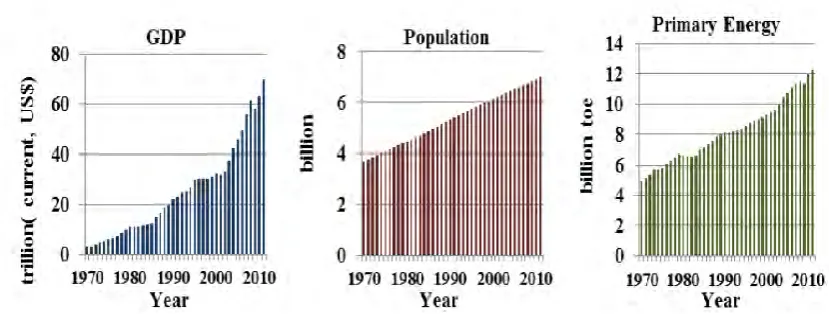
[image:22.595.138.553.451.608.2]Energy is the establishment that backings the improvement of socio-economic of a nation. Sustainable advancement is impractical without sustainable sources of energy and improvement is unrealistic without energy. Subsequently making arrangement for future energy demand is essential. Different nations may have different methodologies in arranging their future energy demand. In additional, future energy demand is constantly impacted by different factors for example energy approach is not population growth, energy prices, economic growth and the use of innovative advances (Tan C.S, et al, 2016). At the worldwide level, the most central relationship in GDP stay hearty, more individual with more income implies that the creation and use of energy will increase as appeared in Figure 2.1.
Figure 2.1: Relationship between economic activity (GDP), population, and primary energy demand between 1970 until 2010 (source: electricity energy
8
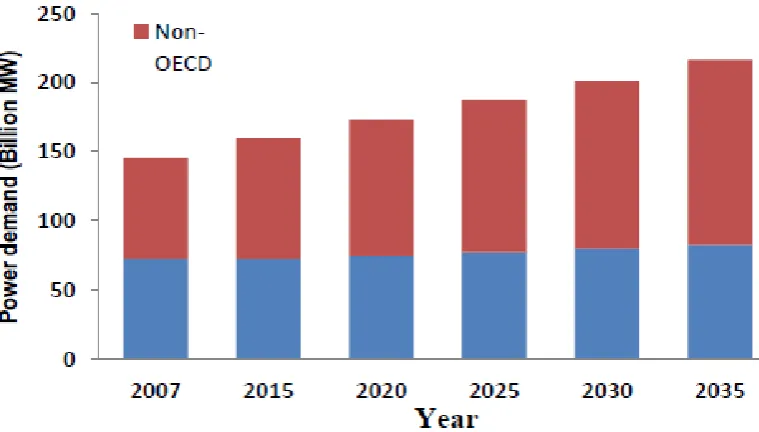
[image:23.595.144.524.252.468.2]Electricity is the primary information and requirements for improvement, automation, financial development and modernization. Therefore, worldwide interest for power is increasing quickly and this concern is tended to globally to fill the demand for power for world’s future. Figure 2.2 demonstrates the power demand of the world market. World demand for power expanded from 145 billion MW in 2007 to 218 billion MW in 2035 (i.e. an increments of 49 %) (Hasanuzzaman. M., et al, 2012).
Figure 2.2: World Marketed Power Demand (source: energy situation in Malaysia: presents and its future, Rahim N.A, et al, 2012)
9
[image:24.595.159.494.148.293.2]demand from 1990 to 2009 in Malaysia expanded roughly three times from 1990 to 2009 (NEBM, 2009).
Figure 2.3: Overall Power Demand in Malaysia (source: energy situation in Malaysia: presents and its future, Rahim N.A, 2012)
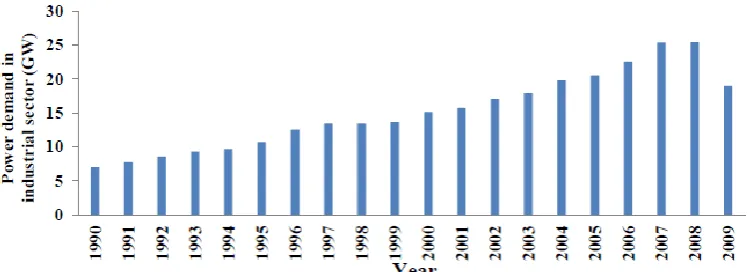
The one of the significant energy consumers in Malaysia is industrial sector. Industrial power demand in 1990-2009 is shown in Figure 2.4. The rate of increase of power demand of the industrial sector is much higher than the overall rate of growing demand in Malaysia between 1990 and 2009 (NEBM, 2009).
[image:24.595.146.524.534.670.2]