This is a repository copy of Haar wavelet-based adaptive finite volume shallow water solver.
White Rose Research Online URL for this paper: http://eprints.whiterose.ac.uk/90532/
Version: Accepted Version Article:
Haleem, D.A., Kesserwani, G. and Caviedes-Voullième, D. (2015) Haar wavelet-based adaptive finite volume shallow water solver. Journal of Hydroinformatics, 17 (6). pp. 857-873. ISSN 1464-7141
https://doi.org/10.2166/hydro.2015.039
This is an author produced version of a paper subsequently published in Journal of
Hydroinformatics. Uploaded in accordance with the publisher's self-archiving policy. ©IWA Publishing 2015. The definitive peer-reviewed and edited version of this article is published in Journal of Hydroinformatics, 17 (6) 857-873, 2015 10.2166/hydro.2015.039 and is available at www.iwapublishing.com.
[email protected] https://eprints.whiterose.ac.uk/
Reuse
Unless indicated otherwise, fulltext items are protected by copyright with all rights reserved. The copyright exception in section 29 of the Copyright, Designs and Patents Act 1988 allows the making of a single copy solely for the purpose of non-commercial research or private study within the limits of fair dealing. The publisher or other rights-holder may allow further reproduction and re-use of this version - refer to the White Rose Research Online record for this item. Where records identify the publisher as the copyright holder, users can verify any specific terms of use on the publisher’s website.
Takedown
If you consider content in White Rose Research Online to be in breach of UK law, please notify us by
*Email correspondence to: [email protected]
Haar waveletbased adaptive finite volume shallow water
solver
Short title:
Waveletbased adaptive shallow water solverDilshad A. Haleem, Georges Kesserwani* and Daniel CaviedesVoullième
Pennine Water Group, Department of Civil & Structural Engineering, University of Sheffield, Sheffield, UK
Abstract
This paper presents the formulation of an adaptive finite volume model for the
shallow water equations. A Godunovtype reformulation combining the Haar wavelet
is achieved to enable solutiondriven resolutionadaptivity (both coarsening and
refinement) by depending on the wavelet's thresholdvalue. The ability to properly
model irregular topographies and wetting/drying are transferred from the (baseline)
finite volume uniform mesh model, with no extra notable efforts. Selected hydraulic
tests are employed to analyze the performance of the Haar wavelet finite volume
shallow water solver considering adaptivity and practical issues including choice for
the thresholdvalue driving the adaptivity, mesh convergence study, shock and
wet/dryfront capturing abilities. Our findings show that Haar wavelet based adaptive
finite volume solutions offer great potential to improve the reliability of multiscale
shallow water models.
Keywords: finite volume method, Haar wavelets, multiresolution, shallow water
1.
Introduction
Within Computational Hydraulics, the Finite Volume (FV) Godunovtype method has
been extensively used for modelling shallow water flows due to its desirable
properties such as locality, numerical mass conservation and ability to inherently
incorporate discontinuous flow transitions within the numerical solution (Bouchut,
2007, Toro, 2001, Toro and GarciaNavarro, 2007).
The original Godunov method for the gas dynamic equations assumes that
the representation of the numerical solution over each discrete control volume is
piecewiseconstant. Connecting these approximate solutions via fluxes obtained
from the solution of Riemann Problems between cells lead to make the scheme well
suited for solving nonlinear equations containing discontinuities (Harten et al., 1983).
Further theoretical and numerical considerations have been given to apply Godunov
type FV methods to shallow water flow problems in order to properly incorporate
source terms (main the bed slope term) and model evolving wet/dry fronts
(Kesserwani, 2013, Liang and Marche, 2009, Liang and Borthwick, 2009, LeVeque
and George, 2004). Following decades of research, FV Godunovtype methods have
become widely applied to simulate realscale flooding and have been adopted into
commercial hydraulic modelling software packages such as TUFLOWFV and
RiverFlow2D PLUS. Nevertheless, real large scale shallow flows have complex flow
features such as shocks, contact discontinuities and a wide range of spatial scales.
Typically, the computational domain is discretised uniformly using a large number of
cells, given that the position of flow features is usually unknown and capturing
certain small scales within a coarse mesh simulation maybe difficult without causing
to improve modelling efficiency and capture the various physical scales involved in
shallow water flows.
Various adaptive techniques have been developed within the FV framework
applied to solve shallow water equations (SWE). These include moving mesh
methods (Skoula et al., 2006) or static grids with locally refinement methods (Nikolos
and Delis, 2009, CaviedesVoullième et al., 2012) . However, most of the present
techniques to date are achieved over patch of grid, in a decoupled manner, which
controversially gives rise to many problematic effects (Nemec and Aftosmis,
2007),(Liang et al., 2008, Kesserwani and Liang, 2012a, Kesserwani and Liang,
2015, Mocz et al., 2013). For example they require errorsensors and multiple user
chosen parameters (e.g. for setting up grid resolution coarsening vs. refinement),
which introduce sensitivity (e.g. can lead to inadequate or excessive resolution),
inflexibility and problemdependency (e.g. due to the need to tune many parameters
for each simulation problem). They also lack a rigorous strategy to accommodate
flow data transfer and recovery between various inner resolution scales (given the
changing nature of the mesh). Therefore, the design of a more integrated adaptation
approach, which can address such problems, is still a crucial challenge
(Hovhannisyan et al., 2014) and is the aim of this work.
The classical wavelet theory for local decomposition/reconstruction of (self
similar) functions (by translation and dilatation of a single mother function, or
wavelet, at finer resolution) offers a natural way for adaptive compression of data.
Mathematicians and engineers have widely used the multiresolution capabilities of
wavelets in many applications (e.g. signal processing and denoising) (Gargour et al.,
2009) including the solution of partial differential equations (PDEs). The true power
constant data can be described as a set of scaling coefficients encapsulating higher
resolution details thereby allowing (Harten, 1995, Keinert, 2003): a) genuine
information exchange between those (heterogeneous) elements with matching
resolution (promotion and demotion of the details via application of high and low
pass filters), b) achievement of grid resolution adaptivity by selecting certain details
from the local compression dataset and c) quantitatively control the variation of the
adaptive mesh solution with reference to the underlying uniformmeshsolution
relevant to the finest resolution.
In the context of the FV Godunovtype modelling, a couple of papers have
successfully integrated the wavelet theory for adaptive solution of homogenous
conservation law (scalar and system) (Harten, 1995, Müller, 2003). However, the
implementation and implication of this idea in addressing practical aspects of shallow
water flow simulation is unexplored yet. To fulfill this gap, the Haar Wavelet basis is
used to reformulate a FV Godunovtype method to obtain a new adaptive
multiresolution scheme, which will be referred to HWFV. The technical development
of the HWFV solving the one dimensional (1D) SWE with source term and wetting
and drying is described. Particular focus is mainly put on how waveletbased
adaptivity is achieved within the HWFV SWE numerical solver. Selected test cases
are used to systematically verify the performance of the HWFV scheme addressing
issues of adaptivity parameterizations, modelling of irregular topography with/without
wetting and drying, accuracy preservation and mesh convergence.
The rest of the paper is organized as follows: Section 2 presents a brief
overview of one dimensional (1D) SWE and Section 3 describe the baseline FV
method that will be used. In Section 4, the multiresolution analysis and its
wavelets basis and its scaling basis are incorporated into the Godunovtype method.
In Section 6, the performance of the HWFV model is tested, analyzed and
discussed. Section 7 draws the conclusions.
2. Shallow Water Equations (SWE)
The 1D shallow water equations considering the bed source term can be cast in a
conservative matrix form:
•tU- •xF U S U( )? ( ) (1)
Ç È Ù É Ú ? h q U , -Ç È Ù È Ù È Ù É Ú
? 2 2
2
( ) gh q q h F U , / • Ç È Ù É Ú ? 0 x gh z S (2)
Where t is the time (s),x is space (m) and U, F(U) and S are the vectors containing
the conserved variables, the fluxes and the bed source terms respectively, in which h
is the water depth (m), q is the flow rate per unit width ( / )m s2
, g is the acceleration
gravity ( /m s2)
and z is the bed elevation ( )m .
3. Overview of the Finite Volume (FV) Godunovtype framework
In this section, the Godunovtype FV method is briefly presented (Fraccarollo et al.,
2003, GarciaNavarro and VazquezCendon, 2000, Bouchut, 2007). The
computational domain is divided into N0 uniform and nonoverlapping cells. A cell i
is defined as Ii ?[xi/1/ 2,xi-1/ 2] with a cell sizeF ?x xi i-1/ 2/xi/1/ 2 and a centrexi ?(xi-1/ 2-xi/1/ 2)/2
. Integrating equation (1) in space over the ith
cell and time interval [tk?t,tk-1? - Ft t]
yields the following conservative discrete form of the SWE:
*
+
-- / F ? / /F
- F
1
1/ 2 1/ 2 .
k k k k k
i i i
i
t t i i
t t t t
x
t
SU
U
F
F
Where
U
itk-1 and ki
t
U are piecewiseconstant average representing the local
numerical solution at the present and the next time level, respectively. Fi‒1/ 2 are the
numerical fluxes at cell interfaces, which are approximated according to a two
arguments numerical flux function, F which is based on the approximate Riemann
solver of Roe (Roe, 1981), and m
i
t
S includes the bed slope source term. Alternatively,
Eq. (3) can be rewritten in the following semidiscrete form:
-?
-
F
1
i i i
k k k
t t
t
tU
U
L
(4)/
-Ã Ô
Ä Õ
Å Ö
? /
F
1/
1-
1
(
k, ) ( ,
k k k)
i i
k t t t t k
i i i i
t t
i
x
L
F U U
F U U
S(5)
The techniques adopted for wellbalanced discretization of the bed slope source
term with wetting and drying are wellestablished and verified. For more details see
(Liang and Marche, 2009, Kesserwani and Liang, 2012b, Kesserwani, 2013). Herein,
the threshold for dry cell definition is fixed to g ?10/6
dry . The stability condition on the
time step size (Cockburn and Shu, 2001) is controlled by a CourantFriedrichLewy
(CFL), which is chosen to be equal to 0.98 for simulations involving fully wet domains
and 0.5 when wet/dry fronts are present.
4.
Multiresolution analysis
In this section, the multiresolution framework, along with the choice of basis
functions for the HWFV scheme, is presented. The key feature of multiresolution
analysis (MRA) is the separation of the behaviour of functions at different
resolutions. For simplicity, MRA over each cell Ii is presented for the reference
interval [1, 1] on which each cell is rendered. For example, any function f supported
on a baseline interval V0 can be described on a dyadic subdivision of the baseline
particular, this property is valid for a function space V0?
}
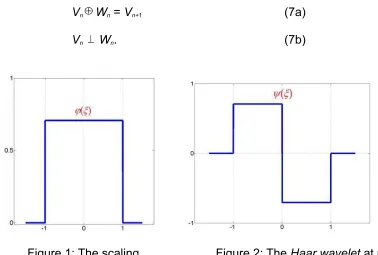
f f x: ( ) ([ 1,1])Π/ that can bespanned by a scaling basis h (Figure 1). From the father basis h, it is possible to
span any subspace Vn via dilation and translation (Keinert, 2003):
h
h ( ) 2? / 2 (2 ( - /1) 2 1)/ j
n x n n x j
*
n?0,1,.., ; 0,1,...2 1m j? n/+
(6) where n is the dilation index and j is the translation index.The wavelet subspaces Wn (n ≥ 0) come into play as an orthogonal
complement of Vn in Vn+1 and they satisfy the conditions:
Vn¸Wn = Vn+1 (7a)
[image:8.595.109.487.271.526.2]Vn ` Wn. (7b)
Figure 1: The scaling
function at resolution n?0. Figure 2: The Haar waveletn?0. at resolution
Taking the Haar wavelet { as a mother basis that spans W0 (Figure 2), any sub
space Wn can also be spanned via its dilation and translation:
{ ( ) 2? / 2{(2 ( - / /1) 2 1)
j n
n x n x j
*
n?0,1,.., ; 0,1,...2 1m j? n/+
(8)From Eq. (6), the function f can be described in any space Vn as a linear combination
of scaling bases hjn and scaling coefficients snj:
l
/
? ?
 Â
2 10 0
n
m n n
j j
n j s
This is called the singlescale expansion of f at resolution n, where snj can be computed (or initialized) as: l / / -/ - /
-?
Ð
1 2 11( 1)1 2 ( ) ( ) n
n j
n n
j j j
s f x x dx
(10)
Due to the nested sequence of subspaces and the use of Eqs (6), (7), (8) and (10),
an alternative expression of f can be obtained by means of the coarse description in
V0 (i.e. at resolution n = 0) and its complementary details dnj in spaces Wn1:
l -
 Â
? 2 1?/ { 0 00 0 0 0
n
m n n
j j n j
s d
f
(11)This representation is called the multiresolution expansion of f at resolution n, where
the detail coefficients dnj can be computed (or initialized) as:
{
/
/
-/ -
/
-?
Ð
1 2 11( 1)1 2
( ) ( )
n
n
j
n n
j j j
d
f x
x dx
(12)
In the expansion (11), the representation of the function f at higher resolution (n > 0)
is enabled by the detail coefficients n j
d when they are nonzero.
4.1 Two scale transforming coefficients
Due to the orthonormality and the compact support properties of hjn and {jn, rigorous
exchange of data across two resolution levels can be obtained by the socalled two
scale transformation. To do so, two types of filter bank coefficients (a common term
in the field of signal processing) are needed. For simplicity, the twoscale
transformation is explained for data transfer between the resolution (0) and (1). The
first type of coefficients {k0, k1} is associated with lowpass filters, i.e. Eq (13);
whereas the second type of coefficients {g0, g1} is associated with highpass filters,
i.e. Eqs. (14):
h h h h
/
? 0 1 ?
Ð
0 0 1 0 0, 0 1 0( ) ( )x 0 x dxh h h h
? 0 1 ?
Ð
1 0 11 0, 1 0 0( ) ( )x 1 x dx
k (13b)
h { h {
/
? 0 1 ?
Ð
0 0 1 0 0, 0 1 0( ) ( )0g x x dx (14a)
h { h {
? 0 1 ?
Ð
1 0 1 1 0, 1 0 0( ) ( )1g x x dx (14b)
Lowpass filter coefficients {k0, k1} are used to merge the two scaling coefficients at
resolution (1) into one scaling coefficient at resolution (0), (this is referred to as
demoting):
?
-0 1 1
0 0 0 1 1
S k S k S (15a)
Highpass filter coefficients {g0, g1} are used to obtain (or actually store) the
complement details (or detail coefficients) of the scaling coefficients at resolution (1)
in resolution (0):
?
-0 1 1
0 0 0 1 1
d g S g S (15b)
Combined use of both filter coefficients allow to compute the scaling coefficients at
resolution (1) from the scaling coefficients at resolution (0) and their (stored)
complement detail coefficients (this is referred to as promoting):
-?
1 0 0
0
0 0 0 0
S k S g d (16a)
?
-1 0 0
1 1 0 1 0
S k S g d (16b)
By recursive application of the twoscale transform equations, the expansion of
scaling coefficients describing a function f can be demoted or promoted across any
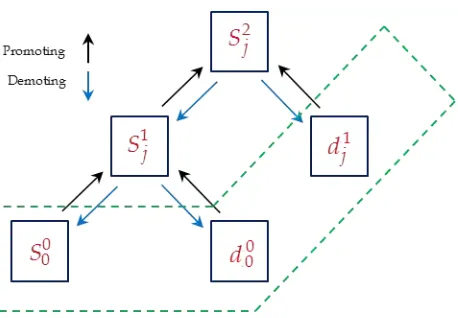
different resolutions (Figure 3). Consequently, promoting and demoting the
coefficients across different resolutions, i.e. by using the Eq. (15) and (16), is the
Figure 3: The promoting and demoting of the scaling coefficients numerical solution
across different resolutions
5. Haar Wavelets Finite Volume method (HWFV)
This section shows how to exploit the multiresolution description of function f (recall
Section 4) to decompose the local piecewiseconstant solution Ui (recall Section 3)
as a compressed dataset of the solution’s information, which drives adaptivity. The
strategy is to first generate a FV discretization at the highest resolution (herein
presented for n = 2 without loss of generality) to produce a fineuniformreference
mesh. Then, over this mesh, MRA is performed to select up to which resolution the
local numerical solution needs to be described (i.e. form a heterogeneous grid for
actual FV calculations). In doing so, three main steps are needed: prediction for
careful mesh refinement, multiresolution FV update and thresholding step for mesh
coarsening through solution decompression.
5.1 Multiresolution FV formulation
Following to the discretization presented in Section 3, a higher resolution mesh is
introduced. Each cell of the baseline coarse mesh, i.e. presented in Section 3, is
spatial resolution F ?xn 2/nFx
. A subcell centre is denoted by xni j, ?xi/1/ 2-Fxn(j-1/ 2)
? /
(j 0,1,...,2n 1). Figure 4 shows the multiresolution stencil. In this multiresolution
setting, the FV formulation, described in Eqs. (4) and (5), can be rewritten as:
-? -F
1
, k , k ,
i j i j i j
n t n t tLn
U
U
(17)/ -/ -Ã Ô Ä Õ Ä Õ Å Ö ? / /
F
-
.1 1
. . 2 2 ( 1. , . ) ( . , 1.)
i i n i j i i i Roe Roe
i j i j i j i j i j I
n n n
n n
n
x
F
U UF
U US
hL
(18)
Here the translating index j is related to the resolution level of the local cell n.
Figure 4. Local multiresolution stencil {Ii jn, } embedded within cell Ii.
Eqs. (17) and (18) need to be only applied at a local level resolution (i.e. on the
adaptive mesh). This mesh can be selected by, first, casting each local solution as in
Eq. (11). This requires demoting highresolution data in order to store detail
coefficients and produce the scaling coefficient at level (0). Then, a mesh prediction
step is needed to locally promote the solution and refine the grid. This will yield the
performed to reduce the density of the mesh by discarding all nonsignificant details
that fall below a certain thresholdvalue (details in the sections below).
5.2. Prediction step for mesh refinement
Since the flow field is evolving in time, the prediction step must be performed after
each time step to guarantee no significant features of the numerical solution are
omitted in the next time step. The prediction strategy is only based on the
information available at the current time level (Müller, 2003, Müller and Stiriba,
2007). Generally, the detail coefficients of predicted cells are not available. Thus, the
local solution over the predicted cells is promoted by simply setting zero detail
coefficients (Harten, 1995). To do this, the following algorithm is used to identify
those neighbourhood cells that needs to be further refined:
a) Find the scale coefficients of the conserved variables at leveln?0.
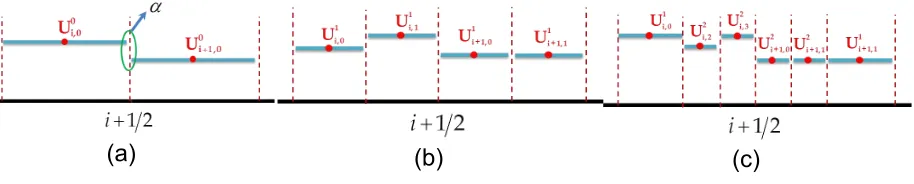
b) Compute the normalized gradient c between the local cell and its neighbour
cell (see Figure 5a).
c? /
-0 0 ,0 1,0
0 ,0
max(1, )
i i
i
U U
U (19)
c) Introduce two indicators to compare c values and decide the resolution levels
of neighbouring cells that have significant details. Here, the values of c ? 0.1
and c ?0.05 are chosen as indicators for all numerical test cases. The
decision for the local refinement mesh will take the following form according to
the value of c . If c 0.1 the adaptive mesh is as in Figure 5(c). If
c
@
(a) (b) (c)
Figure 5: Mesh prediction cases
5.3. Thresholding step for the decompression of mesh
Thresholding is applied on the detail coefficients after each update to decompress
the mesh. The values of detail coefficients (Dni j, ) become small when the numerical
solution is smooth. Therefore, they can be cancelled without substantially affecting
the accuracy of the numerical solution. To do so, all detail coefficients whose
absolute values are below a normalised leveldependent threshold value are
discarded, i.e. if they satisfy
g
/
> .
.
2 max(max ,1)
i j
i j
m n
n
n
D
U (20)
The components in Dni j, are associated with the components of the conserved
variables in Uni j, (i.e. h and q). In real computations, it is impossible to know the
optimal threshold value but a range of options is feasible (Hovhannisyan et al., 2014,
Gerhard and Müller, 2013) as will be investigated in the following section. By default,
in this work, the thresholdvalue (at the coarsest level) is set to g?0.01 and it is
normalized according to the resolution levels. In addition, the magnitudes of the
detail coefficients are scaled according to the maximum value of the numerical
solution.
The topography is projected into the highest resolution (n = 2) in the same way as
the conserved variables. Thus the compressed dataset of bed information over each
cell is obtained. Finally, the adaptive bed mesh is obtained by applying the
thresholding step. But the topography adaptation is performed once (i.e. initially
when t?0) and it remains constant throughout the simulation time. To ensure the
preservation of an accurate water surface elevation and mass conservation across
levels, the bed mesh should be considered as a reference, this means that the
HWFV scheme does not allow demoting the local numerical solution to coarsen the
mesh to a resolution level lower than the topography refinement, even if the local
numerical solution allows for a lower refinement level.
6. Numerical results
This section shows the ability of the new HWFV scheme to solve 1D shallow water
problems with fewer cells when comparing to the reference FV scheme, while
retaining accuracy, total mass in the system, wellbalancing and positivity of water
depth. Five wellknown benchmark problems are considered for validation of HWFV
scheme. Furthermore the Root Mean Square Error (RMSE) and the Relative Mass
Error (RME) are computed. Two of the test cases are idealized dambreak cases
over frictionless beds (regular and irregular), the third and fourth test cases consider
steady flow over a hump (transcritical flow with shock and supercritical flow) and the
fifth test case considers a deeper analysis on the test case of the oscillatory flow in a
parabolic bowl.
The purpose of this case is to test the capability of the HWFV scheme to efficiently
and accurately solve the homogenous shallow water equations. The solution is
compared to the exact solution, using the Root Mean Square Error (RMSE) and the
maximum error metrics. A 1D channel with a horizontal frictionless bed is
considered. The length of the channel is 2000m and an imaginary dam is located at
1000 m from the upstream end. Initially, the upstream water level is 20 m whereas
at the downstream end, the water level is 5.0m. The initial discharge was set to zero
in every cell. Boundary conditions, although set to be numerically transmissive, are
effectively irrelevant in this case as the propagating wave does not reach the
boundary. At the instant of dam failure, water is released producing a shock wave
travelling downstream meanwhile a rarefaction wave is formed propagating
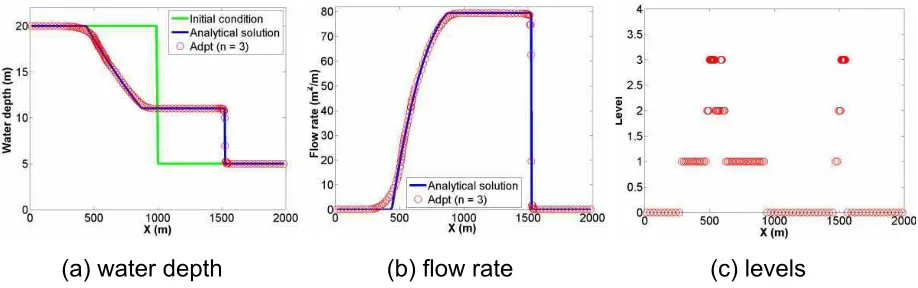
upstream. The computational domain at the coarse level (n = 0) is discretised with 71
uniform cells and the computational model was run up to 40 second after the dam
break. Since the HWFV model allows for up to 3 levels of mesh refinement, the size
of the reference fine uniform mesh is 568 cells. The numerical results are illustrated
in Figure 6. The highest level of resolution is noted to be reached at the shock wave
and the kink at the tail of the rarefaction wave. The other zones of the rarefaction
wave are achieved with the intermediate resolution levels 1 and 2. Meanwhile, at the
rest of the domain, where the solution is smooth, the HWFV has retained the
baseline coarse level. In this test, the adaptive solution required a maximum of 124
(a) water depth (b) flow rate (c) levels Figure 6: HWFV adaptive numerical solution to the idealized dam break flow Further quantitative analysis is performed via calculating the RMSE for both water surface and flow rate, i.e.:
*
+
/ ? ? ? / ?ÂÂ Â
0 2 1 2 , , 1 0 0
ˆ n
N m
i j i j
i j n n n h h h RMSE AC (21)
*
+
/ ? ? ? / ?ÂÂ Â
0 2 1 2
, , 1 0 0
ˆ n
N m
i j i j
i j n n n q q q RMSE AC (22)
In which ACis the total number of active cells forming the adaptive mesh, hi jn, ,qi jn,
are the numerical results and hˆi jn, ,ˆi j,
n
q
are the reference data (from the analytical
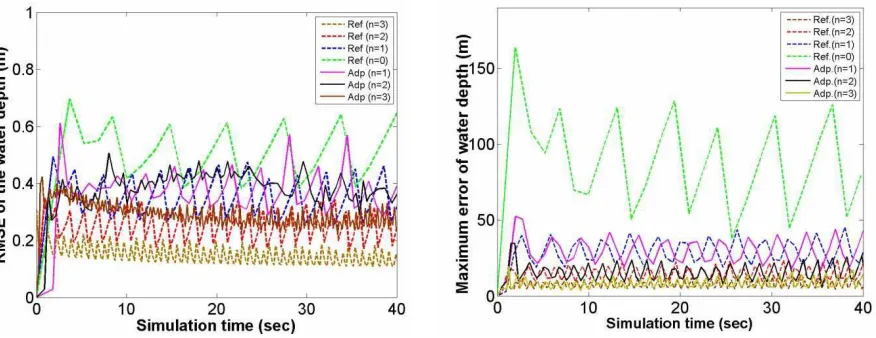
solutions). Figure 7 and Figure 8 compare the depth's RMSEs and Maximum
absolute errors (in Linfinity norm), respectively, for the different uniform and adaptive
meshes considering up to a maximum resolution level of n = 3. Clearly, both error
profiles show a decrease in error magnitude with an increase in baseline mesh
resolution, which is expected due to grid convergence properties. The variations of
the RMSEs resulting from the adaptive HWFV models are bounded between the
RMSEs obtained from the coarsest baseline uniform mesh model and the finest
uniform mesh models. Such bounding of the adaptive RSMEs is expected because
an adaptive mesh scheme at a resolution n is set to further allow lower resolution
down to the baseline resolution 0. However, since the maximum depth errors are
governed by the highest resolution (due to shock presence), their error trends are
resolution n shows comparable error range to the reference uniform counterpart and
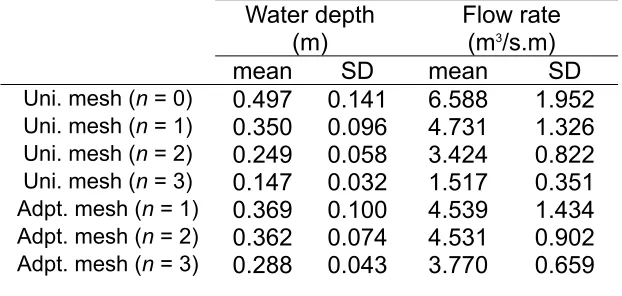
(ii) the variation of the adaptive errors are consistent levelwise. In addition, a more
quantitative analysis is considered via tabulating the mean and standard deviation
(SD) of the RMSEs (see Table 1). These results show decreasing trend for the
means accompanied by a faster reduction in their SDs with more profound
refinement levels in adaptive scheme. Therefore, the HWFV framework performs the
adaptivity process without introducing any additional errors to the numerical solution
and is able to sensibly decide resolution level in track with the dynamics of the flow.
For this test, the adaptive model simulation cost around 78 % less, in computational
efforts, than the simulation on the finest uniform mesh.
In the following test cases, the highest level will be fixed to n = 2 and the focus
[image:18.595.83.521.413.582.2]will be put on exploring applied aspects that are relevant to hydraulic modelling.
Figure 7: RMSE evolution for the dam
break case.
Figure 8: Max error evolution for the dam
Table 1: The mean and standard deviation of RMSE for Dambreak test case
Water depth
(m) Flow rate (m3/s.m)
mean SD mean SD
Uni. mesh (n = 0) 0.497 0.141 6.588 1.952
Uni. mesh (n = 1) 0.350 0.096 4.731 1.326
Uni. mesh (n = 2) 0.249 0.058 3.424 0.822
Uni. mesh (n = 3) 0.147 0.032 1.517 0.351
Adpt. mesh (n = 1) 0.369 0.100 4.539 1.434
Adpt. mesh (n = 2) 0.362 0.074 4.531 0.902
Adpt. mesh (n = 3) 0.288 0.043 3.770 0.659
6.2. Steady flow over a hump
This case is employed to test the performance of the current scheme in reproducing
a steady flow over nonuniform topography in a frictionless rectangular channel 1m
wide and a 25m long. The analytical solution was supplied by Goutal and Maurel
(Goutal and Maurel, 1997) and the bed reads:
Ê / /
Í ? Ë ÍÌ
2
0.2 0.05( 10) 8 12 0
b x x
z
otherwise (23)
6.2.1. Transcritical case involving shock
The initial water surface and flow rate per unit width are set to h + z = 0.33 m and q =
0.18 m2/s, respectively. Physical boundary conditions consisted of the steady
discharge at the inflow and the initial water level at the outflow. The coarse baseline
mesh comprised 50 uniform cells and simulations are noted to converge at around t
= 170s. For this test, the adaptive HWFV model has been further implemented and
assessed along with the upwind discretisation of the source term (VázquezCendón,
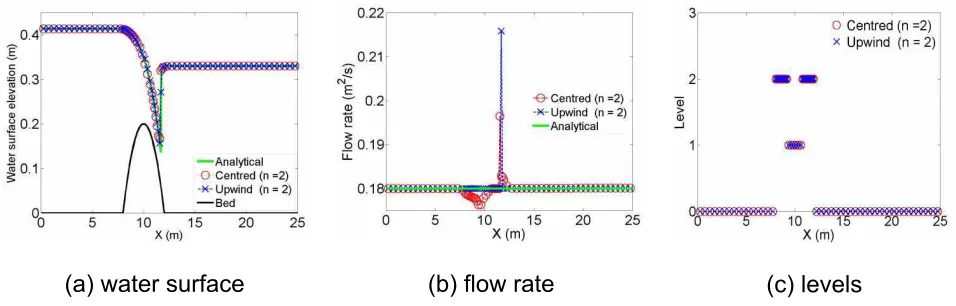
1999). Figure 9 presents the numerical results of the adaptive scheme (with n = 2)
as compared to the analytical solutions. The numerical water surface profile shows a
very good agreement with the analytical solution for both the upwind and the
rate, it seems to be typically improved by the upwind source term discretization apart
from the peak caused by the presence of the water jump. Arguably, this is a known
deficiency in standard finite volume schemes and, thus, does not relate the proposed
waveletbased adaptivity (GarciaNavarro and VazquezCendon, 2000, Toro and
GarciaNavarro, 2007)). In this case, the majority of the domain features required
coarse resolution level except at the hump, which dictated local level 1 of refinement
from the onset and at the discontinuities (i.e. starting kink of the transcritical
transition and shock) where the level was refined to highest.
[image:20.595.61.539.296.449.2](a) water surface (b) flow rate (c) levels
Figure 9: HWFV adaptive numerical solution for the steady transcritical flow over a hump.
6.2.2 Supercritical flow case
In order to ensure that the disturbances observed in the discharge in the previous
test case (Figure 9) are not induced by adaptivity over the local cells (see Section 4),
the supercritical flow case over hump is also considered. Channel geometry and bed
topography are identical to the previous test case, but the unit inflow rate and
elevation water surface at the upstream of the channel are set to h + z = 2 m and q =
25.0567 m2/s, respectively. Herein, both of these physical values are used as steady
state inflow boundary conditions; whereas a free outlet is numerically set. The
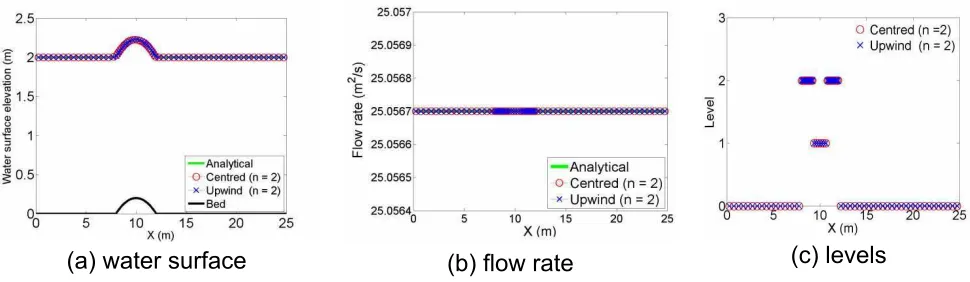
results are shown in Figure 10. The constant flow rate and surface water profile
compared with the analytical solution are well captured. Again, the mesh refinement
was obtained only in the regions where both bed elevation and flow are varying.
However, no artefacts are noted in the prediction of the discharge for both the
upwind and cellcentred discretisation. Consequently, the two test cases
demonstrate the good performance of the adaptive shallow water flow model in
reproducing wellbalanced steady flows over topography, and in performing selection
of resolution levels in relevance with flow and topographic regions.
[image:21.595.63.548.303.444.2](a) water surface (b) flow rate (c) levels Figure 10: HWFV adaptive numerical solution for the suppercritical flow over a hump.
6.3. Dambreak over over a triangular hump
This test case is employed to verify the capability of HWFV to preserve the total
mass in the system in order to ensure that the adaptivity process does not introduce
or lose mass even in the presence of shocks and wet/dry fronts. A hypothetical dam
Figure: 11 Dam break over a triangular hump
The length of the horizontal flume is 38m and a dam is located at 15.5 m
from the upstream end. A reservoir with a water surface elevation of 0.75m is
located upstream from the dam and the rest of the domain is dry. Mesh resolution at
the coarse level consisted of 13 cells. Reflective boundary conditions are set at the
both ends of the channel. At t = 0 s the dam is assumed to fail causing violent wave
propagation; namely, the wetting front rushes into the floodplain, overtops and
interacts with the obstacle creating a reflectedwave that will again be reflected by
the boundary walls. Since the system is closed, the initial mass of water should be
conserved. During the simulation, the total mass of water at time t (M.t) is computed
and compared with the total initial discrete mass (M,0) according to the Relative
Mass Error (RME) below:
/ ? , 0
0 RME Mt M
M (24)
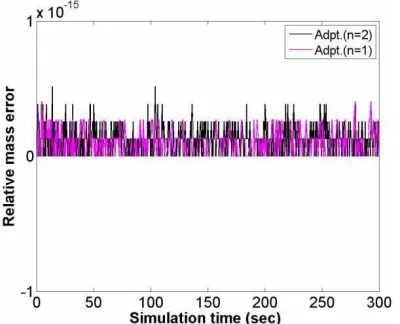
The results in Figure 12 show that the adaptive HWFV models conserve the initial
total mass in the system and the magnitude of RME is within the range of machine
precision (1 10· /15) throughout the entire computational time. However, since in the
HWFV scheme the mesh resolution is not fixed, the real physical mass (M,R) is also
used, as a reference, to show the ability of HWFV to preserve the same amount of
mass as compared to the corresponding uniform mesh size; this has been done
according to the Eq. (25) below:
/ ?
R t R
R M M ME
M (25)
In Figure 13, the results show that the RME profiles for both the adaptive mesh
not introducing any additional mass error beyond the capability of the discretization
[image:23.595.301.510.136.299.2]relative to the fine reference uniform scheme.
Figure 12: RME evolution for dam break
over a triangular hump (compared with
the projected mass t = 0).
Figure 13: RME evolution for dam break
over a triangular hump (compared with the
physical real mass)
6.4. Oscillatory flow in a parabolic bowl
This case is well known and recognised as a challenging test case for numerical
models because it involves both moving wet/dry interfaces and it has an uneven
topography. It is selected here to study accuracy and mesh convergence abilities of
the adaptive HWFV scheme and to explore the sensitivity of the HWFV model, i.e. in
performing the adaptivity process, considering various choices for the threshold
value parameter and for the baseline coarsest mesh.
The bed is described by z x h x a( )? 0
* +
2 with constants h0?10 and a?3000. Itconsists of an oscillatory flow taking place inside a parabolic bowl. The transient
analytical solution was proposed by Thacker (Thacker, 1981):
j( , )? 0/ 2cos(2 )/ 2 / cos( )
4 4
B B x
x t h st Bs st
[image:23.595.65.265.139.301.2]?
( , ) sin(2 )
u x t B st (27)
where B? 5 is a constant value and s?1 2 8a gh0 is the frequency. Under these
conditions the oscillation period is T?1345.94s. The case was simulated on the
domain [5000m; 5000m] using different computational mesh cells at coarse level (
0
N ). Simulations were run up to 1.5T. Boundary conditions are irrelevant because
the flow never reaches the boundaries. They were set as transmissive boundaries.
6.4.1 Threshold sensitivity
To understand the effect of the threshold value parameter on the adaptivity process,
a baseline mesh with N0? 40 cells is fixed, while considering the following threshold
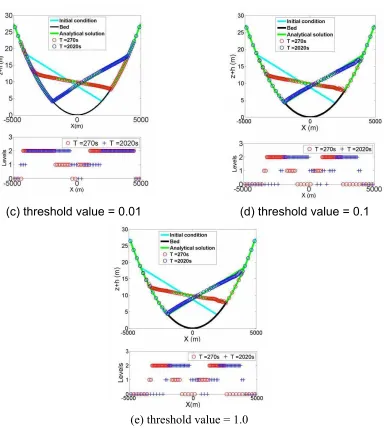
values: g? 0.0, 0.001, 0.01, 0.1 and 1.0. In Figure 14, the numerical water surface
profiles at t? 275s (T/ 5) and t?2020s (1.5T ) are compared with the analytical
solution. As seen in the figure, the HWFV scheme refines in the region where the
wet/dry interface is moving through. Meanwhile, other parts of the domain stay at the
coarsest and the intermediate levels of refinement. Furthermore, it can be seen that
varying the threshold value leads to different refinement patterns. In particular it is
shown that, as g increases fewer cells are refined to higher levels during the
simulation, since smaller detail coefficients are selectively omitted. In Figure 14(a), it
is clear that the adaptive HWFV scheme activates all the details coefficients when
g? 0.0 and all the computational cells go to the highest level, thus resulting in a
uniform mesh. Figure 14(b) shows an almost uniform mesh prediction when g?
0.001. Hence, it is not reasonable, in terms of efficiency, to use a threshold value g>
0.001. A sensible refinement is obtained with g?0.01 (Figure 14(c)). For g? 0.1 and
g?1.0 (shown in Figure 14(de) respectively) poor predictions at the wet/dry
leads to omit some small detail coefficients, relevant to the wet/dry front, during the
6.4.2 Baseline meshes.
The choice of a baseline mesh with N0? 40 is rather arbitrary, and it might be already
too fine, or on the contrary, never allow for a fine enough mesh for this test case.
This may affect the performance of the adaptivity process. Therefore, the influence
of the baseline mesh should be studied. Several baseline meshes at coarse level
?
0
N 20, 40, 80,160 and 320 are introduced to address this. The same settings of the
threshold value as reported in Figure 14 are used. The evolution of the number of
active cells is presented in Figure 15. The results confirm that all considered
combinations of N0and g are able to perform the adaptive solutions. Moreover, when
refining the baseline mesh, the HWFV requires a reduction of the threshold value to
better perform adaptivity process. This is due to the fact that most of the flow region
results in rather smooth solutions; therefore the value of the detail coefficients is
small. In Figure 15, N N/ 0 reduces as the baseline mesh is refined, regardless of the
varying threshold. However, in Figure 15 (de) for g?0.1 and g?1.0, the magnitude of
0
/
N N is relatively the same and with values bounded between 1.0 and around 2.5.
These values are less when compared to other threshold values, but they strongly
influence the quality of the numerical solution. Notably, with g? 0.01, regardless of
0
N , optimal results are obtained, in comparison to other threshold values. The value
of N N/ 0is bounded between around 1 to 4. This case shows a particular trend of
how the pattern of active cells varies withN0. This trend indicates that g? 0.01 is the
most sensitive toN0. Because of this sensitivity, this threshold value allows for a
wide, automatic response of the adaptive process (contrary, to, for example g?0.1)
and therefore is likely to be the best to perform adaptivity in a prompt way. It is clear
that an inefficient adaptive process is obtained with g? 0.001 except in Figure 15(e),
6.4.3. Mesh convergence
Mesh convergence is also studied in terms of the L1norm as defined in Eq. (28).
Simulations were performed up to 2020 s and for analysis the t?270s (T/5) and t?
2020s (1.5T) are selected. Several baseline meshes at coarse level N0? 10, 20, 30,
40, 80,160 and 320 are introduced with using the same threshold values as defined
previously. It can be seen in Figure 16 that the behaviour of the L1norm is
asymptotic regardless of N0 and g. The uniform mesh (g?0.0) is taken as a
reference curve for comparison. Each point within a curve is associated with each
baseline mesh. The difference between the convergence curve for g? 0.001 and the
reference are relatively small. For g ? 0.01 the convergence is slightly better than all as shown in Figure 16 (a) and Figure 16(b). The large error obtained with g? 1.0 and
?
0
N 20, 30 cells and this is due to too few cells being activated during the adaptivity
process (overfiltering). Thus the quality of the numerical solution is affected.
Nevertheless, the magnitude of the error becomes smaller as N0 increases but still
remains larger than the error of the reference curve. Furthermore, the better results
are obtained for g? 0.1 but with sensible differences compared to g? 1.0. The
magnitude of the L1norm is increased from Figure 16(a) to Figure 16(b). This is
merely because of numerical diffusion which is an anticipated issue for finite volume
firstorder schemes. In Figure 17, the same analysis, as the one reported in Figure
16, is considered to illustrate the Relative Performance of CPU time (RPCPU).
Figure 17(a) shows the ratio of the CPU times of the adaptive schemes to the CPU
time obtain from the associated fine uniform reference schemes (i.e. g? 0.0); while
Figure 17(b) further describes the normalised CPU times, which are obtained by
clearly that when g @ 0.0, less time is required for achieving a simulation as the baseline mesh N0 density increases. They also show that the efficiency of the
adaptive HWFV schemes is near their equivalent uniform mesh FV schemes when
the baseline mesh has a size N0 ≤ 40 and despite the choice of g.
For g = 0.001 the RPCPU and normalised CPU time are noted to be inefficient
despite the choice of the baseline mesh N0. In contrast, for g = 0.01, 0.1 and 1.0 they
start to significantly decrease in proportion with an increase in the density of the
baseline mesh N0. However, for g = 0.1 and 1.0 the RPCPU tend to remain close for
N0 ≥ 40; whereas, with g = 0.01 the RPCPU showed consistent decrease in line with
the refinement of the baseline mesh N0; this suggest that a threshold value of g =
0.01 enables best selection among the magnitude of the detail coefficients, and so
allows optimal efficiency and accuracy in the context of the proposed HWFV model
for a baseline mesh of around 40100 cells.
*
+
/
? ? ?
/
?
ÂÂ Â
0 2 11
, , , 1 0 0
ˆ norm
n
N m
i j i j i j
i j
n n n
n dx h h
L
(28)
(c) threshold value = 0.01 (d) threshold value = 0.1
[image:29.595.108.492.66.495.2](e) threshold value = 1.0
Figure 14: numerical solution against the analytical solution in parabolic bowl flow (
?
0
N 40), considering different threshold values.
(c) N0? 80 (d) N0? 160
[image:30.595.74.526.67.490.2](e) N0? 320
Figure 15: time evolution of active cells for various baseline meshes in parabolic
(a) t?270s
[image:31.595.130.463.76.350.2](b) t?2020s
Figure 16: Comparisons of L1norm for parabolic bowl. Each highlight point is
(a) (b)
Figure 17: Comparisons of the relative CPU time for parabolic bowl
7. Conclusions
Adaptive mesh refinement schemes are useful tools to efficiently model various
scales of shallow water flow. A new adaptive formulation is proposed, which
combines the Haar wavelets with the FV method (HWFV). The appeal of the
formulation can be easily exploited to drive spatial resolution adaptation from the
solution itself according to a single threshold value . A series of numerical tests
have been performed, considering issues of wellbalanced property, convergence of
scheme, sensitivity relating to different choice of the thresholds values and ability to
treat wet/dry fronts.
Numerical evidence confirms that the proposed HWFV scheme can accurately solve
the shallow water equations with source term. Adaptive solutions are shown to be
mass conservative. Notably, the new model is proven to be able to selfdecide
appropriate resolution levels following the dynamics of the flow, including shocks,
of integrating the friction source term in a wellbalanced manner, exploring sensitivity
issues in relation of increasing the resolution levels with varying threshold values and
extending the approach to 2D.
Acknowledgments
The first author acknowledges the support of the Kurdistan Regional Government,
ministry of high education and scientific research. The research is further supported
by the UK Engineering and Physical Sciences Research Council (grant ID:
EP/K031023/1) and by the Pennine Water Group platform grant (grant ID:
References
Bouchut, F. 2007. Efficient numerical finite volume schemes for shallow water models.
Edited Series on Advances in Nonlinear Science and Complexity, 2, 189256.
CaviedesVoullième, D., GarcíaNavarro, P. & Murillo, J. 2012. Influence of mesh structure on 2D full shallow water equations and SCS Curve Number simulation of rainfall/runoff events. Journal of Hydrology, 448–449, 3959.
Cockburn, B. & Shu, C.W. 2001. Runge–Kutta discontinuous Galerkin methods for convectiondominated problems. Journal of scientific computing, 16, 173261.
Fraccarollo, L., Capart, H. & Zech, Y. 2003. A Godunov method for the computation of erosional shallow water transients. International journal for Numerical Methods in fluids, 41, 951976.
GarciaNavarro, P. & VazquezCendon, M. E. 2000. On numerical treatment of the source terms in the shallow water equations. Computers & Fluids, 29, 951979.
Gargour, C., Gabrea, M., Ramachandran, V. & Lina, J.M. 2009. A short introduction to wavelets and their applications. IEEE circuits and systems magazine, 9, 5768.
Gerhard, N. & Müller, S. 2013. Adaptive multiresolution discontinuous Galerkin schemes for conservation laws: multidimensional case. Computational and Applied Mathematics, 129.
Goutal, N. & Maurel, F. 1997. Proceedings of the 2nd workshop on dambreak wave simulation, Electricité de France. Direction des études et recherches.
Harten, A. 1995. Multiresolution algorithms for the numerical solution of hyperbolic conservation laws. Communications on Pure and Applied Mathematics, 48, 1305 1342.
Harten, A., Lax, P. D. & Leer, B. V. 1983. On upstream differencing and Godunovtype schemes for hyperbolic conservation laws. SIAM review, 25, 3561.
Hovhannisyan, N., Müller, S. & Schäfer, R. 2014. Adaptive multiresolution discontinuous galerkin schemes for conservation laws. Mathematics of Computation, 83, 113151. Keinert, F. 2003. Wavelets and multiwavelets, CRC Press.
Kesserwani, G. 2013. Topography discretization techniques for Godunovtype shallow water numerical models: a comparative study. Journal of Hydraulic Research, 51, 351367. Kesserwani, G. & Liang, Q. 2012a. Dynamically adaptive grid based discontinuous Galerkin
shallow water model. Advances in Water Resources, 37, 2339.
Kesserwani, G. & Liang, Q. 2012b. Locally Limited and Fully Conserved RKDG2 Shallow Water Solutions with Wetting and Drying. Journal of scientific computing, 50, 120 144.
Kesserwani, G. & Liang, Q. 2015. RKDG2 shallowwater solver on nonuniform grids with local time steps: Application to 1D and 2D hydrodynamics. Applied Mathematical Modelling, 39, 13171340.
Leveque, R. J. & George, D. L. 2004. Highresolution finite volume methods for the shallow water equations with bathymetry and dry states. In: Proceedings of LongWave Workshop, Catalina, page to appear, 2004. Citeseer.
Liang, Q., Du, G., Hall, J. & Borthwick, A. 2008. Flood Inundation Modeling with an Adaptive Quadtree Grid Shallow Water Equation Solver. Journal of Hydraulic Engineering, 134, 16031610.
Liang, Q. & Marche, F. 2009. Numerical resolution of wellbalanced shallow water equations with complex source terms. Advances in Water Resources, 32, 873884.
Mocz, P., Vogelsberger, M., Sijacki, D., Pakmor, R. & Hernquist, L. 2013. A discontinuous Galerkin method for solving the fluid and magnetohydrodynamic equations in astrophysical simulations. Monthly Notices of the Royal Astronomical Society, stt1890.
Müller, S. 2003. Adaptive multiscale schemes for conservation laws, Springer.
Müller, S. & Stiriba, Y. 2007. Fully Adaptive Multiscale Schemes for Conservation Laws Employing Locally Varying Time Stepping. Journal of scientific computing, 30, 493 531.
Nemec, M. & Aftosmis, M. J. 2007. Adjoint error estimation and adaptive refinement for embeddedboundary Cartesian meshes. AIAA Paper, 4187, 2007.
Nikolos, I. & Delis, A. 2009. An unstructured nodecentered finite volume scheme for shallow water flows with wet/dry fronts over complex topography. Computer Methods in Applied Mechanics and Engineering, 198, 37233750.
Roe, P. L. 1981. Approximate Riemann solvers, parameter vectors, and difference schemes.
Journal of computational physics, 43, 357372.
Skoula, Z., Borthwick, A. & Moutzouris, C. 2006. Godunovtype solution of the shallow water equations on adaptive unstructured triangular grids. International Journal of Computational Fluid Dynamics, 20, 621636.
Thacker, W. C. 1981. Some exact solutions to the nonlinear shallowwater wave equations.
Journal of Fluid Mechanics, 107, 499508.
Toro, E. F. 2001. Shockcapturing methods for freesurface shallow flows, Wiley.
Toro, E. F. & GarciaNavarro, P. 2007. Godunovtype methods for freesurface shallow flows: A review. Journal of Hydraulic Research, 45, 736751.
VázquezCendón, M. A. E. 1999. Improved Treatment of Source Terms in Upwind Schemes for the Shallow Water Equations in Channels with Irregular Geometry. Journal of computational physics, 148, 497526.