Analysis and Design of
Future Wireless Networks
Jing Guo
August 2016
A thesis submitted for the degree of
Doctor of Philosophy of
The Australian National University
Research School of Engineering
College of Engineering and Computer Science
The Australian National University
c
Copyright by Jing Guo 2016
The contents of this thesis are the results of original research and have not been submitted for
a higher degree to any other university or institution.
Much of the work in this thesis has been published or has been submitted for publication as
journal papers or conference proceedings.
The research work presented in this thesis has been performed jointly with Dr. Salman Durrani
(The Australian National University), Dr. Xiangyun Zhou (The Australian National
Univer-sity) and Prof. Halim Yanikomeroglu (Carleton UniverUniver-sity). The substantial majority of this
work was my own.
Jing Guo
Research School of Engineering,
College of Engineering and Computer Science,
The Australian National University,
Canberra, ACT 2601,
AUSTRALIA
The work presented in this thesis would not have been possible without the support of a number
of individuals and organizations and they are gratefully acknowledged below:
• First of all, I would like to express my heartfelt gratitude to my supervisors and friends
Drs. Salman Durrani and Xiangyun Zhou, for their guidance, support and
encourage-ment throughout my PhD studies. Their rigor and conciseness shaped my style and
improved my skills in presenting complex technical ideas in papers. It is my pleasure
and honor to be their student.
• I would like to thank Prof. Halim Yanikomeroglu from Carleton University for kindly
welcoming me to visit his research group for four months, i.e., Dec. 2014 to Apr. 2015.
It was a valuable experience in my PhD, where I learnt about the industry perspective of
future wireless communications. Prof. Halim has been very helpful during my visit to
Carleton University and helped me to strengthen my research skills.
• It is my great pleasure to study in the communications group at the Research School of
Engineering. I would like to thank everyone for making the group a friendly and relaxing
research environment. Special thanks to Drs. Nan Yang, Wen Zhang, Profs. Parastoo
Sadeghi, Rodney A. Kennedy and Thushara D. Abhayapala. I would also like to thank
my colleagues Wanchun Liu, Hanchi Chen, Biao He, Yirui Cong, Xiaohui Zhou, Yifei
Huang and Alice Bates for providing a friendly environment and stimulating company.
• Thanks must go to The Australian National University for providing the PhD
schol-arship, stipend, and a 2014 ANU Vice Chancellor’s Travel Grant for supporting my
conference attendance, living expenses, and Carleton University visit, respectively.
• I would like to give my most sincere gratitude to my parents for their continuous
sup-port in general. My every little success would not have been possible without their
encouragement. I would like to give my special thanks to my boyfriend Xiao Li for his
encouragement and understanding. Finally, I would like to thank my friends in Canberra,
who provided me with a homely environment overseas.
This thesis focuses on the modeling, analysis and design of future wireless networks with smart
devices, i.e., devices with intelligence and ability to communicate with one another
with/with-out the control of base stations (BSs). Using stochastic geometry, we develop realistic yet
tractable frameworks to model and analyze the performance of such networks, while
incorpo-rating the intelligence features of smart devices.
In the first half of the thesis, we develop stochastic geometry tools to study arbitrarily
shaped network regions. Current techniques in the literature assume the network regions to
be infinite, while practical network regions tend to be arbitrary. Two well-known networks
are considered, where devices have the ability to: (i) communicate with others without the
control of BSs (i.e., ad-hoc networks), and (ii) opportunistically access spectrum (i.e.,
cogni-tive networks). First, we propose a general algorithm to derive the distribution of the distance
between the reference node and a random node inside an arbitrarily shaped ad-hoc network
region, which helps to compute the outage probability. We then study the impact of boundary
effects and show that the outage probability in infinite regions may not be a meaningful bound
for arbitrarily shaped regions. By extending the developed techniques, we further analyze the
performance of underlay cognitive networks, where different secondary users (SUs) activity
protocols are employed to limit the interference at a primary user. Leveraging the
informa-tion exchange among SUs, we propose a cooperainforma-tion-based protocol. We show that, in the
short-term sensing scenario, this protocol improves the network’s performance compared to
the existing threshold-based protocol.
In the second half of the thesis, we study two recently emerged networks, where devices
have the ability to: (i) communicate directly with nearby devices under the control of BSs
(i.e., device-to device (D2D) communication), and (ii) harvest radio frequency energy (i.e.,
energy harvesting networks). We first analyze the intra-cell interference in a finite cellular
region underlaid with D2D communication, by incorporating a mode selection scheme to
re-duce the interference. We derive the outage probability at the BS and a D2D receiver, and
propose a spectrum reuse ratio metric to assess the overall D2D communication performance.
We demonstrate that, without impairing the performance at the BS, if the path-loss
exponen-t on cellular link is slighexponen-tly lower exponen-than exponen-thaexponen-t on D2D link, exponen-the specexponen-trum reuse raexponen-tio can have
negligible decrease while the average number of successful D2D transmissions increases with
the increasing D2D node density. This indicates that an increasing level of D2D
communi-cation is beneficial in future networks. Then we study an ad-hoc network with simultaneous
wireless information and power transfer in an infinite region, where transmitters are wirelessly
charged by power beacons. We formulate the total outage probability in terms of the power and
channel outage probabilities. The former incorporates a power activation threshold at
transmit-ters, which is a key practical factor that has been largely ignored in previous work. We show
that, although increasing power beacon’s density or transmit power is not always beneficial for
The work in this thesis has been published or has been submitted for publication as journal
papers. These papers are:
Journal articles
J1. J. Guo, S. Durrani and X. Zhou, “Outage Probability in Arbitrarily-Shaped Finite Wireless Networks,”IEEE Trans. Commun., vol. 62, no. 2, pp. 699–712, Feb. 2014.
J2. J. Guo, S. Durrani, and X. Zhou, “Performance Analysis of Arbitrarily-Shaped Underlay Cognitive Networks: Effects of Secondary User Activity Protocols,”IEEE Trans. Com-mun., vol. 63, no. 2, pp. 376–389, Feb. 2015.
J3. J. Guo, S. Durrani, X. Zhou and H. Yanikomeroglu, “Outage Probability of Ad Hoc Net-works with Wireless Information and Power Transfer,”IEEE Wireless Commun. Lett., vol. 4, no. 4, pp. 409–412, Aug. 2015.
J4. J. Guo, S. Durrani, X. Zhou and H. Yanikomeroglu, “Device-to-Device Communication Underlaying a Finite Cellular Network Region,” submitted toIEEE Trans. Wireless Com-mun., Oct. 2015 (revised Mar. 2016 and Aug. 2016).
The following publications are also the results from my PhD study but not included in this
thesis:
Journal articles
J5. Z. Khalid, S. Durrani andJ. Guo, “A Tractable Framework for Exact Probability of Node Isolation and Minimum Node Degree Distribution in Finite Multi-hop Networks,”IEEE Veh. Tech., vol. 63, no. 6, pp. 2836–2847, Jul. 2014.
J6. X. Zhou,J. Guo, S. Durrani and I. Krikidis, “Performance of Maximum Ratio Transmis-sion in Ad Hoc Networks with SWIPT,”IEEE Wireless Commun. Lett., vol. 4, no. 5, pp. 529–532, Oct. 2015.
shaped Underlay Cognitive Networks,” in Proc. IEEE GLOBECOM, Dec. 2014, pp. 961–966 (selected as one of best 50 papers at GLOBECOM 2014).
C2. C. Wang, S. Durrani,J. Guoand X. Zhou, “Call Completion Probability in Heterogeneous Networks with Energy Harvesting Base Stations,” inProc. ICT, Apr. 2015, pp. 191–197. C3. D. Marshall, S. Durrani,J. Guo, and N. Yang, “Performance Comparison of
AWGN additive white Gaussian noise
BPP Binomial point process
BS base station
CDF cumulative distribution function
CUE cellular user
D2D device-to-device
DRx D2D receiver
DUE potential D2D user in underlay D2D mode
FT Fourier transform
ICIC inter-cell interference coordination
IT information transmission
i.i.d. independently and identically distributed
i.u.d. independently and uniformly distributed
MGF moment generating function
PB power beacon
PDF probability density function
PPP Poisson point process
PT power transfer
PU primary user
PU-Rx PU receiver
PU-Tx PU transmitter
p-DUE potential D2D user
QoS quality-of-service
RF radio frequency
RLPG reference link power gain
Rx receiver
SINR signal-to-interference-plus-noise ratio
SIR signal-to-interference ratio
SNR signal-to-noise ratio
SU secondary user
A network region
|A| area of network region
M number of nodes
R radius of disk
Pout outage probability
γth SINR or SIR threshold
α path-loss exponent
ρ receiver sensitivity of Rx
P transmit power
G,H fading power gain
N additive white Gaussian noise power
γ0 average SNR
I interference
R2 two-dimensional Euclidean domain
N set of natural numbers
\ set exclusion operator
λ node density
Φ point process
Pr(·) probability measure
Pr(·|·) conditional probability measure
fX(x) PDF of a random variableX
FX(x) CDF of a random variableX
EX{·} expectation operator with respect toX
Ept
X{n,l,u} n-th order partial moment ofXcalculated within the interval[l,u]
Lx(s),LfX(x)(s) Laplace transform of the PDF fX(x)
LFX(x)(s) Laplace transform of the CDFFX(x)
MX(s) MGF of a random variableXwith PDF fX(x)
µX(n) n-th moment ofX
κX(n) n-th cumulant ofX
i imaginary number√−1
abs(·) absolute value 1(·) indicator function min(·,·) the minimum value
[f(x)]ba f(b)− f(a)
Γ[x] complete Gamma function,R0∞tx−1exp(−t)dt
Γ[a,x] incomplete upper Gamma function,Ra∞tx−1exp(−t)dt
Γ[a,x1,x2] generalized incomplete Gamma function,Γ[a,x1]−Γ[a,x2] 2F1[·,·;·;·] Gaussian or ordinary hypergeometric function
Declaration iii
Acknowledgments v
Abstract vii
List of Publications ix
Acronyms xi
Notations xiii
1 Introduction 1
1.1 Motivation . . . 1
1.1.1 Research Challenges . . . 3
1.1.1.1 Network Modeling . . . 3
1.1.1.2 Network Geometry . . . 4
1.1.1.3 Network Complexity . . . 6
1.2 Background . . . 6
1.2.1 Point Process Model and Stochastic Geometry . . . 6
1.2.2 Key Performance Metrics . . . 8
1.2.3 Techniques for Performance Analysis . . . 9
1.3 Related Work . . . 10
1.3.1 Ad-hoc Networks . . . 10
1.3.2 Cognitive Networks . . . 12
1.3.3 Device-to-Device Communication Networks . . . 13
1.3.4 Energy Harvesting Networks . . . 15
1.4 Thesis Overview and Contributions . . . 17
2 Outage Probability in Arbitrarily Shaped Finite Ad-hoc Networks 23 2.1 Problem Formulation and System Model Assumptions . . . 24
2.2 Proposed Frameworks . . . 25
2.2.1 Moment Generating Function-based Framework . . . 25
2.2.2 Reference Link Power Gain-based Framework . . . 27
2.3 Outage Probability for BPP and Nakagami-mFading Channels . . . 29
2.3.1 MGF-based Framework . . . 30
2.3.2 RLPG-based Framework . . . 31
2.3.3 Need for the Two Frameworks . . . 32
2.4 Outage Probability in a Disk Region . . . 32
2.4.1 MGF-based Framework . . . 33
2.4.2 RLPG-based Framework . . . 34
2.5 Outage Probability in Regular Polygons and Arbitrarily Shaped Convex Polygons 35 2.5.1 Center of Polygon . . . 35
2.5.2 Arbitrarily Shaped Convex Polygon Region . . . 36
2.6 Numerical and Simulation Results . . . 38
2.6.1 Computational Aspects of the Frameworks . . . 38
2.6.2 Validation of the Proposed Two Frameworks . . . 39
2.6.3 Importance of Having the Two Frameworks . . . 40
2.6.4 Boundary Effects in a Disk Region . . . 41
2.6.5 Boundary Effects in Polygon Regions . . . 43
2.6.6 Outage Probability in an Arbitrarily Shaped Convex Region . . . 44
2.7 Summary . . . 45
3 Performance Analysis of Arbitrarily Shaped Underlay Cognitive Networks 47 3.1 System Model . . . 48
3.1.1 Guard Zone Protocol . . . 50
3.1.2 Threshold-based Protocol . . . 50
3.1.3 Cooperation-based Protocol . . . 51
3.2 Mathematical Framework . . . 52
3.2.1 Assumptions . . . 52
3.2.2 Distance Distributions . . . 53
3.2.3 Moment Generating Function . . . 53
3.2.4 n-th Cumulant . . . 54
3.2.5 Outage Probability at the PU-Rx . . . 54
3.3 Interference Analysis . . . 55
3.3.1 Guard Zone Protocol . . . 55
3.3.2 Threshold-based Protocol . . . 57
3.3.3 Cooperation-based Protocol . . . 58
3.4 Average Number of Active Secondary Users . . . 59
3.5.1 Validation of Cooperation-based Protocol Analysis . . . 61
3.5.2 Moments of Aggregate Interference at the Primary Receiver . . . 62
3.5.3 Outage Probability at the Primary Receiver . . . 64
3.5.4 Comparison of Secondary User Activity Protocols . . . 65
3.6 Summary . . . 67
4 Device-to-Device Communication Underlaying a Finite Cellular Network Region 69 4.1 System Model . . . 70
4.2 Outage Probability Analysis . . . 72
4.2.1 Mathematical Framework . . . 72
4.2.2 MGF of the Aggregate Interference at the BS . . . 73
4.2.3 MGF of the Aggregate Interference at a Typical DRx . . . 74
4.3 D2D Communication Performance Analysis . . . 76
4.3.1 Average Number of Successful D2D Transmissions . . . 76
4.3.1.1 Mathematical Framework . . . 76
4.3.1.2 Density Function of DRxs . . . 76
4.3.1.3 Probability of being in D2D Mode . . . 77
4.3.2 Spectrum Reuse Ratio . . . 78
4.3.3 Summary . . . 79
4.4 Results . . . 79
4.4.1 Model Validation . . . 80
4.4.2 Outage Probability at DRx: Location-dependent Performance . . . 82
4.4.3 Effects of D2D User’s Density . . . 82
4.4.4 Effects of D2D User’s Receiver Sensitivity . . . 84
4.5 Summary . . . 86
5 Outage Probability of Ad-Hoc Networks with Wireless Information and Power Transfer 89 5.1 System Model . . . 90
5.2 Outage Probability Formulation and Analysis . . . 91
5.2.1 Power Outage Probability . . . 92
5.2.2 Channel Outage Probability . . . 93
5.2.3 Total Outage Probability . . . 96
5.3 Results . . . 97
5.3.1 Accuracy of Derived Analytical Results . . . 97
5.3.2 Effect of Power Beacon’s Node Density . . . 98
5.3.4 Effect of Power Receiver Activation Threshold . . . 100
5.4 Summary . . . 101
6 Conclusions and Future Research Directions 103 6.1 Conclusions . . . 103
6.2 Future Work . . . 105
A Appendix A 107 A.1 Derivation of the Distance Distribution fR(r) . . . 107
A.1.1 Reference Receiver Located at VertexV2in Figure 2.2 . . . 108
B Appendix B 111 B.1 Proof of Theorem 1 and Corollary 1 . . . 112
B.2 Proof of Theorem 2 and Corollary 2 . . . 112
B.3 Proof of Proposition 1 and Corollary 3 . . . 113
B.4 Proof of Theorem 3 . . . 115
C Appendix C 117 C.1 Derivation of Equation (4.4): Outage Probability . . . 117
C.2 Derivation of Proposition 2: MGF of the Interference at BS . . . 118
C.3 Derivation of Proposition 3: MGF of the Interference from p-DUE . . . 118
C.4 Derivation of Corollary 4: MGF of the Interference from CUE . . . 120
C.5 Derivation of Proposition 4: Average Number of Successful D2D Transmis-sions . . . 121
C.6 Derivation of Proposition 5: Node Density of DRxs . . . 122
C.7 Derivation of Proposition 6: the Probability of being in D2D Mode . . . 123
C.7.1 Same Path-loss Exponent . . . 124
C.7.2 Different Path-loss Exponent . . . 125
1.1 Illustration of the multiple-access network model. The desired link is
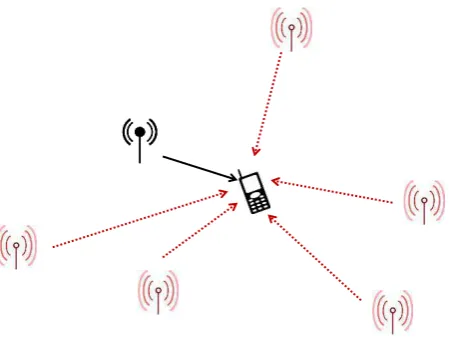
connect-ed by solid line and interfering links are connectconnect-ed by dashconnect-ed lines. . . 3
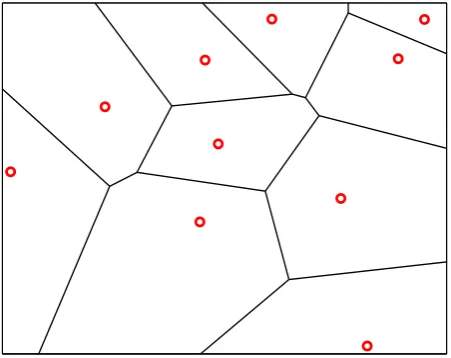
1.2 An example of the shape of Voronoi cells (•=base station). . . 5 1.3 Illustration of a homogeneous PPP in a square region for three different
real-izations. . . 7
1.4 Illustration of a uniform BPP in a square region for three different realizations. 7
2.1 Illustration of a finite wireless network with arbitrary location of reference
receiverY0 in a disk region of radiusR(+ =center of disk, •=interfering node,N=reference receiver,=reference transmitter). . . 33 2.2 Illustration of an arbitrary location of a reference receiver in an arbitrarily
shaped finite wireless network, with side lengths S1 =
√
3W,S2 =
√
3W,
S3 = p
7−3√3−√6W andS4 = W and verticesV1,V2,V3andV4. The areasB1(shaded in horizontal lines), lines) andC2(intersection of horizontal and diagonal lines) are defined in Appendix A.1 (• =interfering node,N =
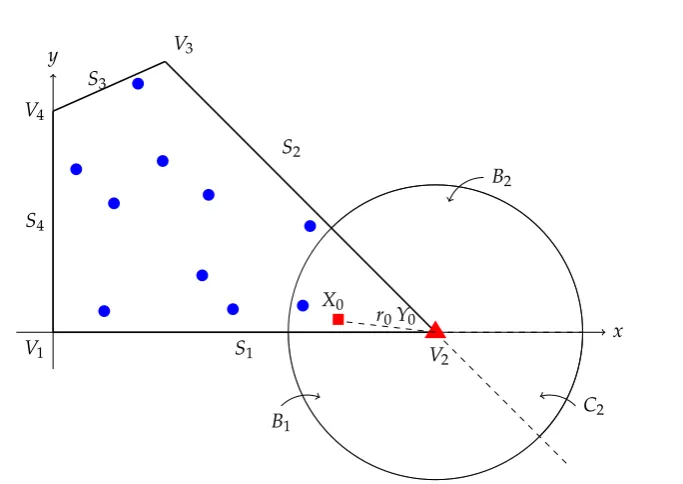
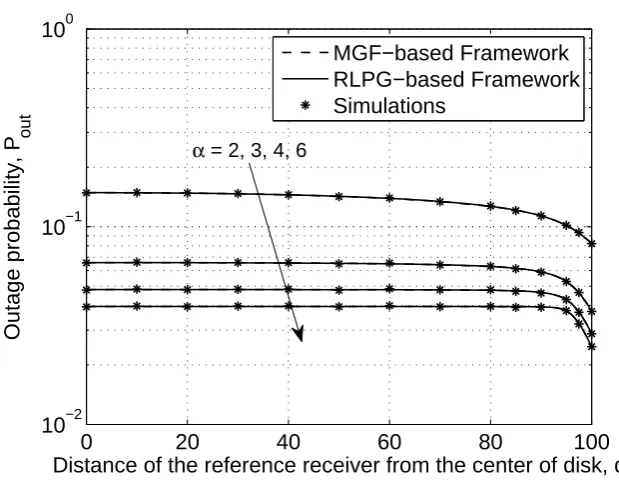
reference receiver,=reference transmitter). . . 36 2.3 Outage probability,Pout, versus the distance of the reference receiver from the
center of disk,d, for M = 10interferers i.u.d. in a disk of radiusR = 100, with reference link distancer0 = 5, path-loss exponentsα = 2, 3, 4, 6, i.i.d. Rayleigh fading channels (m0 = m = 1), SINR threshold γth = 0 dB and
SNRγ0 =20dB. . . 39 2.4 Outage probability,Pout, versus the signal-to-noise ratio,γ0, for i.i.d.
Nakagami-mfading channels andm0= m=0.5, 1, 1.5, 2, withM=10interferers i.u.d. in a disk of radius R = 100, reference link distancer0 = 5 and reference receiver located at the center of the network, path-loss exponent α= 2.5 and SINR thresholdγth =0dB. . . 40
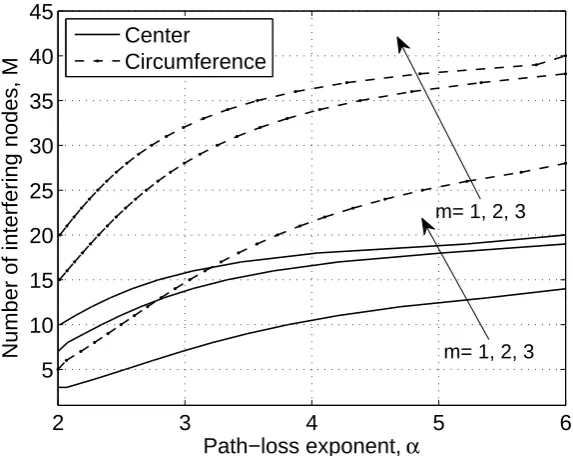
2.5 The number of interfering nodes M versus path-loss exponentα in order to meet a fixed outage probability constraint ofPout =0.05for the reference node
located at the center and the circumference, respectively, of a disk region with
radiusR = 100, i.i.d. Nakagami-mfading channels (m = 1, 2, 3), reference link distancer0 =5, SINR thresholdγth=0dB and SNRγ0=20dB. . . 41
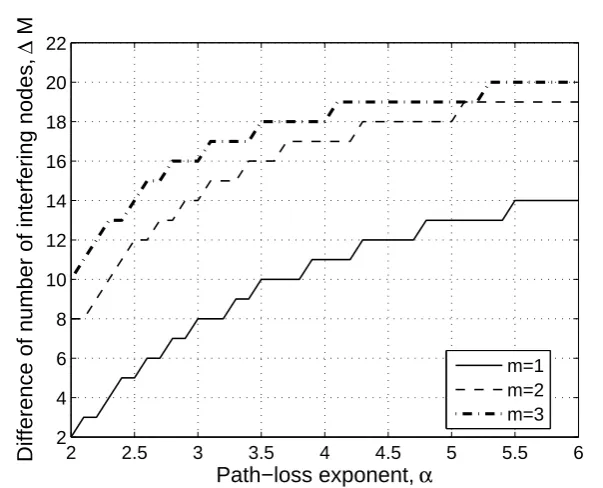
2.6 The difference in the number of interferers between the reference receiver
lo-cated at the circumference and the center of a disk region, versus the path-loss
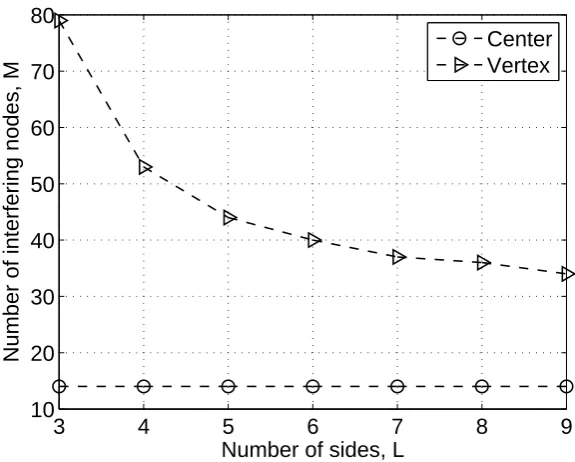
exponentα, with the same parameters as in Figure 2.5. . . 42 2.7 The number of interfering nodes M versus the number of sides Lin order to
meet a fixed low outage probability constraint ofPout =0.05for the reference
node located at the center and the corner, respectively, of a L-sided polygon
(L=3, 4, 5, 6, 7, 8, 9) having a fixed area|A|=π1002, with i.i.d.
Nakagami-mfading channels (m0= m=3), path-loss exponentα= 2.5, reference link distancer0=5, SINR thresholdγth =0dB and SNRγ0=20dB. . . 44 2.8 Outage probability, Pout, versus the signal-to-noise ratio, γ0, with arbitrary
locations of the reference receiver inside the arbitrarily shaped finite region
defined in Figure 2.2 having area |A| = 13143, M = 10 interferers, i.i.d. Rayleigh fading channels (m0 = m = 1), path-loss exponent α = 2.5 and SINR thresholdγth =0dB. For the PPP node distribution, the node density is
λ=10/13143=7.6086×10−4(which is the same as for the BPP). . . 45 3.1 Illustration of secondary user spatial activity protocols in underlay cognitive
network (N = interfered PU-Rx, =PU-Tx, ◦ = inactive secondary user, • = active secondary user). Sj and Vj (j = 1, 2, 3, 4) denote the side and
vertex, respectively. . . 49
3.2 Outage probability at the PU-Rx,Pout, versus the normalized radius of the
co-operation range, rc
R/100, for the cases that the PU-Rx is located at the center and circumference, respectively, of a disk region with different radius and number
of SU pair values(R,M)(i.e.,(150 m, 225),(100 m, 100)and(50 m, 25)). . 62 3.3 Number of SUs, M, versus the outage probability at the PU-Rx, Pout, for the
scenario defined in Section 3.5.2 withW =150m. . . 64 3.4 Average number of active SUs,Mactive, versus the outage probability at the
PU-Rx,Pout, when the PU-Rx is located at the intersection point of two diagonals
inside the arbitrarily shaped finite region specified in Section 3.5.2 withW =
150m. . . 66
4.1 Illustration of the network model (N=BS, =CUE, =DUE (p-DUE in D2D mode), = p-DUE in other transmission mode,• = DRx. Note that p-DUE and its corresponding DRx are connected by a dashed line). . . 70
4.2 Outage probability at the BS and average number of successful D2D
transmis-sions versus the mode selection thresholdξforRD =10m andRD =50m,
4.3 Outage probability at the DRx,PoutDRx(γth,d), versus the distance between the
BS and the DRx,d, forRD =10m andRD =50m, respectively. . . 82 4.4 Average number of successful D2D transmissionsM¯ and spectrum reuse ratio
τ versus the node density of p-DUEs λ, with different receiver sensitivity of DRxρD, and QoS constraintPoutBS(γth) =10−2. . . 83
4.5 Average number of successful D2D transmissionsM¯ and spectrum reuse ratio
τversus the DRx’s receiver sensitivityρD, with different receiver sensitivity of
BSρBS, and QoS constraintPoutBS(γth) =10−2. . . 85
5.1 Illustration of the network model (•=power beacon,=active transmitter,
=inactive transmitter,N =reference receiver). . . 90 5.2 Illustration of the harvest-then-transmit architecture. . . 91
5.3 The channel outage probability versus the SINR thresholdγth. . . 97
5.4 The channel outage probability and total outage probability versus the PB’s
node density. . . 98
5.5 The channel outage probability and total outage probability versus the PB’s
transmit power. . . 99
5.6 The channel outage probability and total outage probability versus the power
receiver activation threshold. . . 100
C.1 Illustration of results in Proposition 5. . . 122
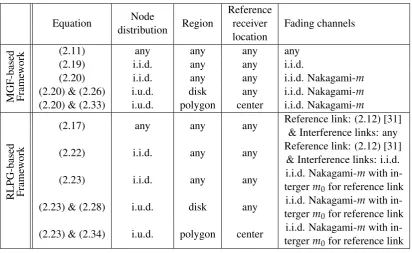
2.1 Summary of the Main Outage Probability Results. . . 38
3.1 Main System Parameter Values. . . 61
3.2 Validation of the 1st, 2nd and 3rd moment of the three SU activity protocols. . . 63
4.1 Main System Parameter Values. . . 80
Introduction
1
.
1
Motivation
Recent years have witnessed the exponential growth in the number of wireless mobile devices
and the resulting mobile data traffic [1]. It has been reported by Cisco that there are 7.4 billion
mobile devices world wide in 2014, which will increase to 11.5 billion mobile devices in
2019 [2]. In addition, the average data traffic generated by fourth generation (4G) network is
2.2 GB per month in 2014, which is expected to increase to 5.5 GB per month in 2019 [2]. To
meet this demand in the future, fifth generation (5G) networks are envisioned to provide [1, 3]:
• higher data rate (i.e.,1000×increase from 4G to 5G);
• low end-to-end latency (i.e., supporting a roundtrip latency of about 1 ms, compared to
current 4G roundtrip latencies of the order of about 15 ms);
• higher energy efficiency (i.e., about100×decreasing in Joules per bit and cost per bit
for each data link);
Presently there is a broad consensus in academic and industry that these requirements
simply cannot be achieved by a mere evolution of current network systems [4], e.g., strategies
such as cell densification and cell shrinking resulting in small cells, will play an important
part in 5G, but need to be supplemented by other solutions. As a result, novel technology
directions have been envisioned for 5G. Among these novel technologies is the concept of
smart devices, which is the focus of this thesis. In traditional 2G-3G-4G cellular networks,
the base station (BS) infrastructure takes control of communication and has complete control
over mobile devices. In 5G systems, it is expected that the devices will be endowed with
intelligence. This intelligence has major implications for the modeling, analysis and design of
future wireless networks.
The simplest form of intelligence is perhaps the ability to bypass BSs completely and
communicate with other devices without any central control. This gives rise to the concept
of ad-hoc networks, the basic idea of which has been around for a few decades. The
recen-t proliferarecen-tion of wireless devices and recen-technologies for shorrecen-t range communicarecen-tion (such as
Bluetooth) indicates that ad-hoc networks are attractive for 5G system, especially for the
de-velopment of small cell scenarios [5, 6]. In ad-hoc networks, users are equipped with wireless
transceivers which can directly communicate with each other [7, 8], which implies that these
smart devices are no longer under the control of BSs. Without the infrastructure set up and
administration, the users can create and join networks anytime and anywhere [9].
A more sophisticated form of intelligence can be the ability to flexibly use the licensed
spectrum, i.e., cognitive networks. In cognitive networks, unlicensed secondary users (SUs)
access the licensed spectrum band in an efficient and opportunistic fashion, without impairing
the performance of licensed primary users (PUs) [10, 11, 12, 13]. In order to achieve this,
the SUs are equipped with cognitive capability so that they can adjust their operating system
parameters, e.g., transmission power, frequency, modulation type, according to the surrounding
wireless environment [10, 11].
Besides opportunistic accessing the spectrum band as in cognitive networks, a smart
wire-less device can also explore its co-location with other devices for local communication, under
the control of the BS. An evolution of the concept of ad-hoc networks and cognitive networks
is device-to-device (D2D) communication networks [14]. In traditional cellular networks, the
communication between any two mobile devices is established by traversing through the BS or
core network, even if these two mobile devices are very close to each other, which can be very
inefficient if high data rate applications such as video games or virtual reality are involved.
Allowing direct communication established between nearby users, under the control of the BS,
is envisioned as a key aspect of smart devices in 5G networks [15, 16].
Beyond the 5G networks, smart devices are predicted to evolve even further and incorporate
more sophisticated intelligence in the form of ability to harvest energy from radio frequency
(RF) signals. Devices with RF energy harvesting capability can lead to the establishment of
truly perpetual wireless networks, eliminating the need to replace batteries for devices. Such
intelligent capability is treated as a promising solution to address the critical issue of
pro-longing the life time of nodes in wireless networks, especially in energy-constrained wireless
networks [17, 18].
The introduction of smart devices in future wireless networks, possibly together with the
requirements for such devices to operate in smaller size cells, poses significant challenges for
the modeling, analysis and design of such networks. These challenges are discussed in the next
Figure 1.1: Illustration of the multiple-access network model. The desired link is connected by solid line and interfering links are connected by dashed lines.
1.1.1 Research Challenges
Consider a smart device operating in a multiple access network (i.e., a wireless network with
multiple links sharing the same spectrum band), as illustrated in Figure 1.1. In such a multiple
access network, a smart device can receive not only the signal from its desired transmitter (Tx),
but also the unwanted signal from other Txs using the same spectrum band. These
unwant-ed signal powers are callunwant-ed interference. For the purpose of correct information recovery, the
signal-to-interference-plus-noise ratio (SINR) at the receiver (Rx) side should exceed a certain
level. It is noteworthy that the SINR at the Rx is not merely determined by the location and
sur-rounding environment of the Tx and Rx pair itself. The location and sursur-rounding environment
of other interfering Txs also impact the SINR. Thus the SINR is a function of the locations
of all Txs, the transmit powers for all Txs and fading channels. Under such a scenario, the
network performance, which is mainly determined by the SINR, becomes quite challenging,
as discussed below.
1.1.1.1 Network Modeling
The first challenge for performance analysis is network modeling, i.e., how to model the
phys-ical location of smart devices, the fading channels and so on. Several analytphys-ical modeling
approaches have been proposed in the literature to analyze wireless network performance,
par-ticularly large-scale cellular networks. One popular model is the Wyner model [19], in which
The Wyner model can simplify the analysis and provide tractable analytical results in
wire-less networks, however since the SINR is always fixed and deterministic, sometimes it is not
suitable to model certain network scenarios, for example for the case with one or two strong
interferers [20, 21].
Another well-known model is the traditional grid-based model, i.e., the hexagonal grid
model. This deterministic model allows for the modeling of large-scale cellular networks.
However, it has been shown that in practice the locations of BSs do not exactly follow the
grid-based model and this type of modeling leads to the optimistic assessment of system
per-formance [21]. At the same time, the grid-based model cannot properly capture the network
properties for those networks with inherently random topologies, such as ad-hoc networks.
Additionally, it does not lead to tractable results and has to be used in conjunction with the
exhaustive Monte Carlo simulations, which can be quite time consuming.
To better model the network and to avoid the exhaustive Monte Carlo simulations, the point
process model was proposed in [22]. Under the point process model, the wireless network is
abstracted to be a set of nodes, where the appearance at each location is subject to a certain
distribution. With the help of stochastic geometry, tractable analytical expressions for the
network performance in such random topologies, can be derived. The detailed discussion of
the point process model and stochastic geometry will be given in Section 1.2. In this thesis, we
will employ the point process model to analyze the network performance with smart devices.
1.1.1.2 Network Geometry
The second challenge that impacts the performance analysis is the network geometry. Network
geometry is known as the geometric pattern formed by network devices (i.e., Txs and/or Rxs).
With the stochastic geometry, the difficulty in investigating the random geometric pattern is
reduced.
For analytical convenience, most works in the literature considered large-scale wireless
networks (e.g., [23, 24, 25, 26, 27, 28, 29, 30, 31, 32, 33, 34, 35] in ad-hoc networks, [36, 37,
38, 39, 40] in cognitive radio networks, [41, 42, 43, 44, 45, 46, 47, 48, 49, 50] in D2D
commu-nication networks and [51, 52, 53, 54, 55, 54, 56] in energy harvesting networks), in which the
locations of network devices are modeled as a homogeneous Poisson Point Process (PPP) in
an infinite region. This homogeneous PPP shares some nice properties such as the stationary
property where the node distribution is invariant under translation, and the isotropic property
where the node distribution is rotationally invariant with respect to the origin. These give rise
to the location-independent performance. For example, the typical Rx is generally assumed
to be at the origin and the statistical characteristics (such as mean aggregate interference and
Figure 1.2:An example of the shape of Voronoi cells (•=base station).
the analysis complexity resulting from the network geometry. Some other works concentrated
on the finite region [39, 57, 58, 59, 60, 61, 62, 63]. However, to utilize the isotropic property,
the network region is typically assumed to be a disk and the reference node1 is placed at the
center.
In practice, the shape of the network can be arbitrary and need not be a disk only. A typical
example is the shape of Voronoi cells, which is generally an arbitrarily shaped convex polygon
as shown in Figure 1.2. Note that the consideration of an arbitrarily shaped network region is
especially relevant for emerging ultra-dense small cell deployment scenarios [64].
When mobile devices are confined in a finite region, the network performance is strongly
affected by the network geometry (e.g., the shape of the network region and the location of the
reference node). For example, the nodes located close to the physical boundaries of the wireless
network experience different network characteristics (such as mean aggregate interference and
average outage probability) as compared to the nodes located near the center of the network.
Such phenomenon is known as the boundary effect and it has been ignored by homogeneous
PPP model, since infinite region is not impacted by the boundary effect. Hence, the results
derived under the homogeneous PPP model cannot accurately capture the network performance
in a finite region. Deriving general results in finite wireless networks is challenging because
the performance metric (e.g., outage probability) is determined by the distance distribution of
a node to the reference node. This distance distribution, in turn, depends on the shape of the
network region as well as the location of the reference node. Unlike the homogeneous PPP
assumption, the distance distribution is the key hurdle in applying stochastic geometry to the
analysis of finite wireless networks. Hence, we will come up with an algorithm, which is based
on finding the overlap region of a disk and the arbitrarily shaped network region as inspired
from [65, 66], to accurately compute the distance distribution for an arbitrarily shaped network
region with an arbitrarily located reference node.
1.1.1.3 Network Complexity
The introduction of smart devices with intelligence, which results in the special requirements,
is a key challenge and increases the network analysis complexity. This is in contrast to
tra-ditional cellular networks, where BSs play the dominant role in communication systems and
are in charge of handling traffic and signaling, etc. As such, the analysis of traditional cellular
networks is relatively simple.
For example, in the underlay cognitive networks, since secondary users share the same
spectrum with license users, which can impact the performance of license users, the secondary
users must ensure that they will not generate severe interference and the primary network can
work normally [67]. With the interference threshold requirement, the locations of SUs are
related to the location of the primary user, which introduces the distance-correlation to the
system analysis. Similarly, in D2D communication networks, additional protocols are needed
to protect the BS and D2D users from the interference between cellular users and D2D users.
In energy harvesting networks, it is important to ensure that the energy can activate the energy
harvesting circuit, which has been ignored in most works for analytical convenience. The
incorporation of such aspects into the network model increases the overall complexity and
makes performance analysis very complicated.
This thesis aims to address the challenges identified above and apply the stochastic
geom-etry to model, analyze and design future wireless networks (i.e., ad-hoc networks, cognitive
networks, D2D communication networks and energy harvesting networks). In the remainder
of this chapter, we first provide background information on the point process model and
s-tochastic geometry. Then we discuss relevant existing results in the literature on the networks
with smart devices. Finally, the scope and contributions of the thesis are summarized.
1
.
2
Background
1.2.1 Point Process Model and Stochastic Geometry
Point process models circumvent the inadequacy of the existing network models (e.g., Wyner
model and deterministic grid-based model), when dealing with topological randomness. In a
Figure 1.3:Illustration of a homogeneous PPP in a square region for three different realizations.
Figure 1.4:Illustration of a uniform BPP in a square region for three different realizations.
place (generally in two-dimensional space), which comprises of Txs and Rxs. The locations
of these nodes are not fixed but subject to uncertainty [22]. From the modeling perspective,
although it is reasonable to assume that users are randomly located due to their mobility, the
BSs’ locations are generally fixed and it is less acceptable to assume that the locations of BSs
come from a point process. However, as established in [68], the results from the point process
model are quite accurate when compared to an actual 4G network deployment. More
impor-tantly, compared with previous models, the point process model allows for the computation of
tractable results, which can provide design insights.
Clearly, in the point process model, the performance metrics (i.e., interference and SINR)
are changing from one realization to another realization. As a result, the distribution or average
result of them can better highlight their characterizations. Stochastic geometry, as a powerful
mathematical tool dealing with random spatial patterns, permits the computation of the
distri-bution and spatial average of such quantities [21]. Note that the spatial average indicates that
the average is taken over a large number of realizations of nodes, whose occurrences follow
certain probabilities [32, 69].
In the stochastic geometry analysis, there are several types of point processes that have
been employed in the literature to capture the main features of wireless networks. The two
most famous processes are the Poisson Point Process and Binomial Point Process (BPP) [70].
In the PPP, a set of nodes is randomly and independently distributed in an infinite region
the node density is constant (i.e., nodes are randomly, independently and uniformly distributed
(i.u.d.) in the entire region), the PPP is known as the homogeneous PPP. An example of a
homogeneous PPP is given in Figure 1.3. Note that for any disjoint area in a PPP, the number
of nodes is independent. This independence property in stochastic geometry also brings about
other nice properties and well-known theorems, which makes the PPP easy to analyze and
provides tractable results [70, 71].
The BPP model is closely related to the PPP [71]. In the BPP, rather than a random number
of nodes, there are a fixed number of nodes that are randomly and independently distributed
within a finite region. Similarly, when the node density is constant, the general BPP reduces
to the uniform BPP. An example of a uniform BPP in a square region is given in Figure 1.4.
The BPP is an appropriate model for the finite region when the number of nodes is known. For
example, a fixed number of sensor nodes are dropped from an aircraft [21]. Similar to the PPP
model, it maintains the analytical tractability of the analysis. In this thesis, both the PPP and
BPP will be considered.
1.2.2 Key Performance Metrics
In the stochastic geometry analysis, the SINR (or signal-to-interference ratio, SIR, under
interference-limited scenarios) is the most fundamental and important metric to evaluate the
network performance, as it is closely related to the channel capacity according to Shannon’s
theorem. In the following, we define two basic SINR-related performance metrics or quantities
that are employed in this thesis.
• Outage probability: It is the probability that the SINR at the Rx is below a certain threshold γth. The mathematical definition of outage probability is given by Pout =
Pr(SINR<γth). It can also be viewed as the cumulative distribution function (CDF)
of SINR.
• Moment generating function of aggregate interference: It is an alternative interpre-tation of aggregate interference’s distribution. Its mathematical formulation is given as
MI(s) =EI[exp(−sI)], where theIis aggregate interference from all interferers
shar-ing same spectrum. The general expressions ofMI(s)under different point processes are available in [32, 71]. When it is not easy to find the distribution of the aggregate
interference, the moment generating function (MGF) can provide other available
infor-mation. For example,
is related to then-th cumulant of the aggregate interference by
κI(n) = (−1)n
dnlnI dsn
s=0
. (1.1)
– The outage probability. When the reference link experiences Rayleigh fading, it is well known that the outage probability can be derived using MGF [70], i.e.,
Pout =Pr
G0P¯
I+N <γth
=1−exp
−γthN
¯
P
MIγth
¯
P
, (1.2)
whereP¯is average received power from the typical Tx,G0is the fading power gain on the reference link andN is the additive white Gaussian noise (AWGN) power.
In this thesis, we will use the outage probability and the MGF of the aggregate interference to
analyze the effect of system parameters and the network performance.
1.2.3 Techniques for Performance Analysis
As summarized in [21], there are generally five techniques used in the literature to analyze the
network performance, when dealing with the point process model. These five techniques are
listed as follows [21]:
Technique 1: Resort to Rayleigh fading assumption
By assuming that the reference link experiences Rayleigh fading, the outage
probability can be directly linked to the MGF of the aggregate interference as
shown in (1.2). The computation of MGF is relatively easy compared to the
computation of the distribution of interference, through exploiting the
proper-ties of point process models.
Technique 2: Resort to dominant interferers by region bounds or nearestninterferers
Rather than including all interferers, a lower bound on the outage
probabili-ty can be derived by only considering the dominant interferers. This kind of
technique can reduce the complexity of the analysis.
Technique 3: Inversion
The distribution function of the interference can be derived using the inverse
Fourier transform of the Fourier transform (FT) of the interference’s
MI(s) = EI[exp(−sI)], s ∈ real number, while LI(s) = EI[exp(−sI)],
s ∈complex number.
Technique 4: Resort to the approximation of the probability density function (PDF) of the aggregate interference
When it is not easy to find the closed-form distribution for the aggregate
inter-ference, the distribution can be approximated by one of the known distributions
instead. The parameters for certain distribution are generally determined by the
statistics (i.e., moments and cumulants).
Technique 5: Resort to the Plancherel-Parseval theorem
This technique is an alterative way to find the exact distribution of the
interfer-ence through integrating FT of interferinterfer-ence’s distribution, based the
Plancherel-Parseval theorem [72].
The techniques adopted and developed in this thesis advance the knowledge in the domain
of Techniques 1 and 3. In particular, for Technique 1, rather than limiting the fading on reference link being Rayleigh fading, we extend it to the more general fading scenario. The
details will be presented in Chapters 2, 3 and 4.
1
.
3
Related Work
In this section, we review the relevant work in the literature on the performance analysis of
smart device networks using stochastic geometry, divided into four main categories, i.e., ad-hoc
networks, cognitive networks, D2D communication networks and energy harvesting networks.
1.3.1 Ad-hoc Networks
In ad-hoc networks, users are free to move and this property renders the point process model
as suitable for this network. There has been a lot of works done in the literature to
investi-gate the performance of ad-hoc networks from different perspectives. For example, the
distri-bution of interference and/or outage probability in large scale ad-hoc networks were studied
in [23, 24, 25, 26], especially the exact PDF of the aggregate interference under the path-loss
exponentα = 4 and the location of interfering nodes being the homogeneous PPP was de-rived in [23] for deterministic fading gain and [24] for Rayleigh fading channel model. This
aggregated interference distribution was shown to be the Lévy distribution. The transmission
capacity, which measures the spatial intensity of successful transmissions per unit area, subject
and lower bounds on the transmission capacity for wireless ad-hoc networks without/with
ran-dom channels were derived in [27, 28], respectively. The basic mathematical framework was
provided in [29] to investigate the outage probability and transmission capacity. Their work
has been further extended to incorporate different aspects such as the interference cancellation
technology in [30] and spatial diversity in [31]. Other works targeted to improve the ad-hoc
network performance with the consideration of opportunistic medium access scheme [73], and
power control [33, 34, 35], and so on. Note that afore-mentioned works considered the large
scale wireless network (i.e., infinite network region) and homogeneous PPP for the sake of
analytical convenience and tractability.
However, in practical wireless networks, the network region tends to be arbitrarily shaped.
Unlike infinite wireless networks, deriving general results on the outage probability in finite
wireless networks is a very difficult task because the outage performance depends strongly on
the shape of the network region as well as the location of the reference receiver.
Since it is difficult to derive general results on the outage probability in arbitrarily shaped
finite wireless networks, most prior works focused on a specific shape (such as a disk) and
computed the outage probability at a specific location (such as the center of the network
re-gion). A few recent studies presented outage characterizations at the center of a uniform BPP
network with more general shapes [57, 58, 59]. Specifically, the analytical expression for the
moment generating function of the aggregate interference seen at the center of a uniform BPP
network was presented in [57]. The results were extended for the case of spatial multiplexing
with the maximal ratio combining and zero forcing schemes in [59]. Using the PDF of the
nearest neighbor in a uniform BPP, a lower bound on the outage probability at the center of
the wireless network for a simple path-loss model was computed in [58]. The exact
closed-form outage probability in a class of networks with isotropic node distribution (i.e., the node
distribution is invariant under rotation) was derived in [74]. For finite networks, the results
in [74] can only be applied to very limited cases preserving the isotropic node distribution,
such as a disk-shaped network. The outage probability at an arbitrary location of an arbitrarily
shaped finite wireless network was studied in [75]. This work focused on deriving closed-form
expressions for theconditional outage probability, which is conditioned on the locations of all the interfering nodes in the network. For the (unconditional) outage probability averaged
over the spatial distribution of nodes, the authors in [75] presented the analytical result for the
special case of an annular-shaped network with the reference receiver at the center. For other
shapes and receiver locations, the authors in [75] suggested the use of Monte Carlo simulations
to compute the outage probability. Therefore, it is still largely an open research problem to find
general frameworks for deriving the outage probability at an arbitrary location of a finite
wire-less network with an arbitrary shape. This thesis aims to analyze the performance of ad-hoc
5G networks.
1.3.2 Cognitive Networks
Cognitive networks allow unlicensed secondary users to access the spectrum of licensed
pri-mary users in an intelligent way. Depending on the spectrum access strategy, there are three
main cognitive radio network paradigms: interweave, overlay and underlay [67]2.
Ininterweave cognitive networks, SUs are not allowed to cause any interference to PUs. Thus, SUs must periodically sense the environment to detect spectrum occupancy and transmit
opportunistically only when PUs are silent [79, 80]. Ideally, the PU will not receive any
inter-ference from SUs. When the SU fails to detect the PU in certain spectrum bands, it is however
possible that the PU is interfered by these SUs. Thus several papers studied the network
per-formance in the case of the appearance of miss-detection in interweave case. For example,
the statistical quantities of the aggregate interference from SUs were analyzed in [36] under
infinite network region assumption and in [60] with disk network region assumption. By
con-sidering Nakagami-mfading channels and disk region, it was found in [61] that the distribution
of the aggregate interference from SUs can be approximated by a Gamma distribution. The
outage probability at the PU with different sensing techniques was further investigated in [37].
In overlay cognitive networks, there is tight interaction and active cooperation between PUs and SUs. Thus, SUs use sophisticated signal processing and coding to maintain or
im-prove the PUs’ transmissions while also obtaining some additional bandwidth for their own
transmissions [81, 82, 83].
Inunderlay cognitive networks, SUs can concurrently use the spectrum occupied by a PU. Compared to overlay cognitive networks, underlay cognitive networks do not require SUs to
facilitate the transmissions of PUs [67]. Compared to interweave cognitive networks,
under-lay cognitive networks have better spectrum efficiency since the concurrent transmissions are
allowed. Hence, we focus on underlay cognitive networks in this work. Note that the SUs
in underlay paradigm have to guarantee that the interference at the PU is below some
accept-able threshold [84, 85]. That is to say, SUs must know the signal strengths to PUs and are
also allowed to communicate with each other in order to sense how much interference is being
created to PUs [86]. Thus, it is very important to study the interference arising from the SUs
to a PU for underlay cognitive networks. The interference and outage in underlay cognitive
networks have been recently investigated in the literature [38, 39, 62, 63], especially from the
perspective of reducing the interference at PU. Specifically, the aggregate interference at a
typ-ical PU and a typtyp-ical SU inside an infinite area cognitive network, taking the exclusion region
around PUs into account, were presented in [38] and bounds on the outage probability were
also derived. The closed-form results for the MGF of the aggregate interference and the mean
interference at an annulus-center-located PU were derived in [39]. A framework for
character-izing the aggregate interference in cognitive networks was proposed in [62] for the disk region
under Rayleigh fading channel assumption. Therein, closed-form results were obtained for the
special case that the path-loss exponent is2or4with an arbitrary location of PU inside a disk
region. However, in practice the shape of network can be arbitrary and need not be a disk only.
This is especially relevant for emerging ultra-dense small cell deployment scenarios [64]. In
addition, the PU may be located anywhere inside the network region. When SUs are confined
within an arbitrarily shaped finite region, the aggregate interference and the outage
probabil-ity are strongly influenced by the shape of region and the position of the PU. In this context,
a method of calculating the approximation ofn-th cumulant inside a non-circular region by
dividing the areas into infinitesimal circular sections was suggested in [63] but no explicit
for-mulation was provided. Therefore, it is still largely an open research problem to find general
frameworks for analyzing the interference and outage probability in arbitrarily shaped finite
underlay cognitive networks.
For underlay cognitive networks, there are several ways proposed in the literature to
con-trol the interference generated by SUs in order to satisfy the interference threshold, e.g., using
multiple antennas to guide the SU signals away from the PU [86], using resource (i.e., rate
and power) allocation among the SUs [84] or using spread spectrum techniques to spread the
SU signals below the noise floor [85]. Perhaps the simplest solution to control the interference
generated by the SUs is to employ the SU activity protocols, i.e., to simply limit the
num-ber of active SUs [38, 39, 63]. In this context, an exclusion or guard zone around PUs was
considered in [38, 39] and SUs within the exclusion/guard zone are not allowed to transmit.
A threshold-based protocol was proposed in [63], where the activity of each SU depends on
the instantaneous power received at the SU from the PU. Note that if no activity constraint is
imposed on SUs then this is equivalent to the well-studied case of wireless ad-hoc networks
where all users can transmit [57, 87, 88]. In this thesis, we aim to study the network
perfor-mance (both primary network and secondary network) in an arbitrarily shaped region with the
incorporation of SU activity protocols.
1.3.3 Device-to-Device Communication Networks
D2D communication is generally established under the control of the BS, which is
fundamen-tally different from ad-hoc networks and cognitive radio networks [89]. In cellular networks
with D2D communication, the cellular and D2D users can share the spectrum resources in
communica-tion can be further divided into two categories: overlaywhere the cellular and D2D users use orthogonal (i.e., dedicated) spectrum resources, andunderlaywhere D2D users share the same spectrum resources occupied by cellular users, which will be considered in this thesis.
Because of the different types of users and the spectrum sharing in D2D communication,
the analysis of network performance becomes challenging, especially in underlay case. Some
papers have recently examined the interference and outage performance in D2D
communica-tion. For example, the spectrum sharing in both in-band and out-band scenarios was considered
in [41], where the analytical expressions of the outage probability at a cellular user and a D2D
user were derived. Then the work was extended to study the resource optimization in [42],
the multicast of D2D communication in [43] and power control in [49]. A concept of
opera-tional region was proposed in [44] and it is defined as a set of system parameters for which the
incorporation of a D2D mode can increase the network performance. The outage probability
by considering the mode selection scheme was studied in [45, 46]. Therein, a user decides to
operate in cellular mode or D2D mode according to the pilot signal strength received from its
nearest BS in [45], while in [46], the model selection decision was based on the comparison
of the cellular link and D2D link. The effect of mode selection schemes was then compared
in [47]. In [48], the analytical expressions of outage probabilities were derived by considering
Rician fading channel. Additionally, a framework to model the interference in D2D
com-munication was proposed in [50], where the closed-form approximation results for SIR were
obtained.
For traditional cellular networks with universal reuse frequency, where the same spectrum
is used among all the cells, the inter-cell interference coordination (ICIC) and its enhancements
can be used to effectively manage the inter-cell interference. Thus, dealing with intra-cell
interference in D2D-enabled cellular networks becomes a key issue. Existing works have
proposed many different approaches to manage the interference, which have been summarized
in [15]. The main techniques include: (i) Using network coding to mitigate interference [91].
However, this increases the implementation complexity at the users. (ii) Using interference
aware/avoidence resource allocation methods [48, 92, 93, 94, 95]. These can involve advanced
mathematical techniques such as optimization theory, graph theory or game theory. (iii) Using
mode selection which involves choosing to be in underlay D2D mode or not. In this regard,
different mode selection schemes have been proposed and analyzed in infinite regions using
stochastic geometry in [41, 44, 46, 47, 50]. These schemes generally require knowledge of the
channel between cellular and D2D users. (iv) Using other interference management techniques
such as advanced receiver techniques, power control, etc. [49, 96, 97, 98, 99].
Since D2D communication is envisaged as the short-range direct communication between
nearby users, it is also very important to model D2D-enabled cellular networks as finite
the location-dependent performance of users (i.e., the users at cell-edge experience different
interference compared with users in the center). In this regard, it is a highly challenging open
problem to analytically investigate the intra-cell interference in a D2D-enabled cellular
net-work and the performance of underlay D2D communication when users are confined in a finite
region.
This thesis aims to investigate the outage probability at the BS and a typical D2D user, and
the spectrum utilization for D2D communication in a finite cellular network region, where a
mode selection scheme is included to minimize the intra-cell interference.
1.3.4 Energy Harvesting Networks
For a network with simultaneous wireless information and power transfer (SWIPT), the system
can perform two functions at the same time, namely i) information transmission and ii) power
transfer (i.e., devices harvest energy from radio frequency signal). The concept of SWIPT was
first proposed in [100, 101] and it has emerged as an attractive solution to power devices in
future wireless networks [102, 103]. There are currently three architectures for SWIPT [103]:
integrated, closed-loop and decoupled.
Inintegrated SWIPT, information and power are extracted from the same signal transmitted by a base station. Some papers have employed the integrated SWIPT for cellular, ad-hoc,
relay, cooperative and other communication scenarios. In the context of stochastic geometry,
a cooperative network with multiple resources and sinks and one energy harvesting relay was
considered in [51] and the outage probability was characterized, where the cooperation among
users was modeled as a canonical game. This work was then extended to [104] by involving the
multiple relays scenario and different relay schemes. The outage probability and the average
harvested energy inside a large scale network with non-cooperative/cooperative relay schemes
were investigated in [52], where relays receive energy and information from Txs. The authors
in [53] formulated the feasibility problem of SWIPT in small cell networks and analyzed the
feasibility in special and practical scenarios.
In closed-loop SWIPT, the downlink from BS to users is utilized for power transfer (P-T), while the uplink is used for information transmission (IT). As this structure involves the
distance correlation of uplink and downlink, the analysis was mainly concentrated on the
per-formance optimization with fixed location configuration, e.g., see [105][106] and references
therein.
In decoupled SWIPT, traditional wireless networks are overlaid with special facilities to provide dedicated PT, such as the power beacons (PBs) which do not require backhaul links.
There are several papers that studied the network performance using stochastic geometry [54,
powered by PUs. Using the Markov-chain model, the outage probability at both PU and SU,
under steady state, was derived. The feasibility of deployment of PBs for powering a cellular
network, subject to certain outage constraint on the uplink data transmission, was analyzed
in [55]. In [56], the worst-case study for both power and transmission outage probabilities was
performed in a sensor network. This sensor is powered by ambient RF energy sources under
the free space scenario, and then transmit information to data sink.
Among these possible structures of SWIPT, although decoupled SWIPT requires an
ad-ditional infrastructure in the form of PBs, no backhaul links are required for PBs and the
resultant low cost make it suitable to support efficient power transfer by the dense deployment
of PBs [102, 103]. Hence, we focus on the decoupled structure in this thesis. To the best of
our knowledge, the outage probability of ad-hoc networks with decoupled SWIPT has not yet
been derived in the literature.
Additionally, for analytical simplicity, a common assumption made in previous work (i.e.,
[17, 51, 52, 93, 104, 105, 106, 107]) is that they did not take into account the power receiver
activation threshold and the power outage probability. Therein, the power receiver activation
threshold is known as the minimum RF energy required to activate the energy harvesting circuit
and power outage is the event where the harvested energy cannot activate the energy
harvest-ing circuit. This kind of assumption is not realistic especially in the context of point process
modeling, where the received power is a random variable and generally has a large dynamic
range. Ignoring the power outage probability in analysis can lead to the incomplete or even
inaccurate characterization of such smarter device’s performance. Thus, it is necessary to
in-corporate this factor into system set-up. A few papers have considered the minimum required
RF energy in the system model and formulated the power outage probability. For example, the
authors in [54] define the charging area as disk regions formed around the primary users and
only the secondary user entering these region can perform energy harvesting. Otherwise, the
secondary user without charging cannot transmit information. The power outage probability
defined in [55] measures the chance of the harvested power at the mobile user being insufficient
to support its transmission. And it is treated as a controlled parameter set to zero or a
suffi-ciently small value to ensure uninterrupted transmission (and hence interference) from mobile
users. The power outage probability in [56] is defined as the event that the received power at
the single sensor is less than a threshold under the free space environment. In this thesis, we
aim to analyze the outage performance (including both power outage and channel outage) in
ad-hoc networks with decoupled SWIPT by considering practical factors (i.e., power receiver
1
.
4
Thesis Overview and Contributions
The main focus of the thesis is on the modeling, analysis and design of future wireless
network-s unetwork-sing network-stochanetwork-stic geometry. In particular, we connetwork-sider ad-hoc networknetwork-s, cognitive networknetwork-s,
device-to-device communication networks and energy harvesting networks as examples of
s-mart device networks with different level of device intelligence. In the first half of the thesis
we use uniform BPP model and study the arbitrarily shaped ad-hoc and cognitive networks.
In the second half of the thesis, we use PPP model and study D2D communication networks
in disk shaped finite region and energy harvesting networks in infinite region. The specific
contributions of each chapter are detailed below:
Chapter 2-Outage Probability in Arbitrarily Shaped Finite Ad-hoc Net-works
Chapter 2 focuses on the outage probability analysis for a reference Tx-Rx link in the presence
of M interferers and additive white Gaussian noise in a finite wireless ad-hoc network. We
present analytical frameworks for computing the outage probability at an arbitrary location in
an arbitrarily shaped finite wireless network. The outage probability is spatially averaged over
both the fading distribution and the possible locations of interferers. The spatial averaging
means that the outage probability is not tied to a particular realization of the network and the
channel conditions. Specifically, we make the following contributions:
• We propose two general frameworks for the exact calculation of the outage probability
in arbitrarily shaped finite wireless networks in which the reference Rx can be located
anywhere.
– The first framework, named the moment generating function-based (MGF-based) framework, is based on the numerical inversion of the Laplace transform of the
CDF of an appropriately defined random variable (related to the SINR at the
refer-ence Rx). It is inspired from the mathematical techniques developed in [108, 109]
and is valid for any spatial node distribution and any fading channel distribution.
To the best of our knowledge, this is the first time that such an approach has been
applied in the context of finite wireless networks.
– The second framework, named the reference link power gain-based (RLPG-based) framework, exploits the distribution of the fading power gain between the reference
Tx and Rx. It is based on the combination and generalization of the frameworks
proposed in [57, 75] and is valid for any spatial node distribution and a general
• In order to demonstrate the use of the proposed frameworks, we consider the case where
nodes are independently and uniformly distributed in a finite wireless network, with
the node locations modeled by a uniform BPP. The fading channels between all links are
assumed to be independently and identically distributed (i.i.d.) according to a
Nakagami-mdistribution. We use the probability density function of the distance of a random node from the reference Rx in uniform BPP networks [65] to accurately capture the boundary
effects in the two frameworks.
– We demonstrate the use of the two frameworks in evaluating the outage probability for the important case of a reference Rx located anywhere in a disk region. We
show that the known outage probability results in the literature for the disk region
arise as special cases in our two frameworks.
– We further consider the case of an arbitrary located reference Rx in a convex poly-gon region and present an algorithm for accurately computing the outage
probabil-ity. This fundamentally extends the prior work dealing with the outage probability
analysis in finite wireless networks.
– We show that the impact of boundary effects in finite wireless networks is location-dependent and is enhanced by an increase in them0 = mvalue for Nakagami-m fading channels or an increase in the path-loss exponent. We also show that due to
the boundary effects, the outage probability using PPP model does not provide any
meaningful bounds for the outage probability in an arbitrarily shaped finite region.
This highlights the importance of the proposed frameworks, which allow accurate
outage probability computation for arbitrarily shaped finite wireless networks.
The results in this chapter have been presented in [88], which is listed again for ease of
reference:
J1. J. Guo, S. Durrani and X. Zhou, “Outage Probability in Arbitrarily-Shaped Finite Wireless Networks,”IEEE Trans. Commun., vol. 62, no. 2, pp. 699–712, Feb. 2014.
Chapter3-Performance Analysis of Arbitrarily Shaped Underlay Cognitive Networks: Effects of Secondary User Activity Protocols
In Chapter 3, we propose a general framework for analyzing the performance of arbitrarily
shaped underlay cognitive networks, with arbitrary location of the PU and different SU activity
protocols. We make the following major contributions:
• We utilize cooperation among SUs in underlay cognitive networks to come up with a