Householder bushfire preparation:
decision-making and the implications for risk
communication.
Timothy David Prior, MAppSci, BSc(Hons)
School of Psychology
University of Tasmania
Submitted in fulfilment of the requirements for the Degree of
Doctor of Philosophy,
ii
Statement of Contributions of Others
This research was made possible with financial support from the Bushfire Co-operative Research Centre. I was supported by a Bushfire CRC scholarship, and gained funding support from the CRC to print and distribute my surveys.
I was provided valuable assistance from members of the fire services with whom I have collaborated. In particular, Chris Tomes and Damien Killalea from the Community Education branch of the Tasmania Fire Service, and Terry Kirkpatrick of the Critical Incident Support Unit with the New South Wales Fire Brigades. Without their contributions to siting survey locations, and in providing feedback on survey content, I surely would not have had such a successful householder response to my research.
iii
Acknowledgements
Many people contributed to the progress and completion of this thesis.
In particular I would like to thank my supervisors, Douglas Paton and Alison Cottrell. I regularly visited Douglas full of anxiety and confusion, but on leaving his office I was always re-inspired and assured that I must be learning and moving forward if I was anxious and confused. Alison put me on this path, and helped me to navigate the obstacles and recognise the opportunities.
Without the interest of the members of the public who received and returned my survey, this research would certainly not have been possible. Most people were happy to fill out my lengthy questionnaire, and even some people who weren’t so happy about it did so anyway. While I don’t know most of you, I do know your mailboxes! Thank you.
Thanks to those people who read through chapter drafts and manuscripts when I could no longer bring myself to do it: Chloe Lucas, Sally Cooper, Karin Büchler, Brandt Foster and Neil Young. Thanks also to Neil for always being available on Skype to share and talk about the trials and tribulations that a PhD student endures. I must also thank Alex Boyce for her great proof reading while tending to twins!
I’d like to thank my fellow “Annexe” residents whose distraction was mostly welcome, sometimes constructive, but always entertaining. The job of packing, licking and sealing thousands of surveys was made faster and more fun by those of you who helped me – I hope the distraction ultimately improved your own productiveness (wishful thinking?).
I would like to extend my sincerest thanks to Karin Büchler for her love, support and encouragement throughout my time as a PhD student. I know, I should listen to you more. Guess what? I’d also like to thank my family: Merv, Marg, Sean and Marty, who are always there.
iv
Table of Contents
STATEMENT OF CONTRIBUTIONS OF OTHERS...II
ACKNOWLEDGEMENTS...III
ABSTRACT...VI
1.RISK COMMUNICATION AND BUSHFIRE HAZARD... 1
1.1INTRODUCTION... 1
1.1NATURAL HAZARDS,RISK AND RISK COMMUNICATION... 6
1.2WHY IS BUSHFIRE PREPARATION IMPORTANT? ... 16
1.4WHY DON’T PEOPLE PREPARE FOR BUSHFIRE?... 21
1.5EXAMINING PREPAREDNESS DECISION-MAKING FROM A SOCIO-COGNITIVE PERSPECTIVE... 33
1.6WHY IS THIS RESEARCH NECESSARY? ... 36
1.7THESIS AIM... 38
1.8THESIS STRUCTURE... 39
2.GENERAL METHODOLOGY... 42
2.1INTRODUCTION... 42
2.2QUALITATIVE DATA... 52
2.3QUANTITATIVE DATA... 56
2.4SUMMARY... 67
3.BUSHFIRE PREPAREDNESS IN HOBART AND SYDNEY... 68
3.1INTRODUCTION... 68
3.2METHODOLOGY... 71
3.3RESULTS... 72
3.4DISCUSSION... 96
3.5CONCLUSION... 105
4.CUES INFLUENCING THE DECISION TO PREPARE FOR BUSHFIRE... 106
4.1INTRODUCTION... 106
4.2METHODOLOGY... 108
4.3OUTLINE OF PREPAREDNESS DECISION CUES FROM HOUSEHOLDER INTERVIEWS... 123
4.4PREPAREDNESS DECISION CUES OBSERVED FROM SURVEY DATA (2006 AND 2007) ... 148
4.5DISCUSSION... 156
4.6CONCLUSIONS... 164
5.TESTING BUSHFIRE PREPAREDNESS DECISION THEORY... 166
5.1INTRODUCTION... 166
5.2METHODOLOGY... 169
5.3RESULTS... 173
5.3DISCUSSION... 179
5.4CONCLUSION... 186
6.PROGRESSING BUSHFIRE PREPAREDNESS THEORY... 190
v
6.2ADISCUSSION OF FUTURE MODELLING DIRECTION... 193
6.3CONCLUSION... 210
7.GENERAL DISCUSSION... 216
7.1THE “PREPAREDNESS DICHOTOMY” ... 218
7.2AN EXCEPTION OR THE NORM?... 219
7.3BUSHFIRE PREPARATION IS GENERALLY HAPHAZARD... 224
7.4COLLECTIVE ACTION IN COMMUNITY BUSHFIRE PREPAREDNESS... 227
7.5FROM RISK COMMUNICATION TO RISK ENGAGEMENT?... 232
7.6SUMMARY OF IMPLICATIONS FOR BUSHFIRE RISK COMMUNICATION... 237
7.7RESEARCH LIMITATIONS... 239
7.8POSSIBLE DIRECTIONS FOR FUTURE RESEARCH... 241
7.9CONCLUSION... 243
REFERENCES... 245
APPENDIX A:BUSHFIRE PREPAREDNESS SEMI-STRUCTURED INTERVIEW SCHEDULE... 258
APPENDIX B:BUSHFIRE PREPAREDNESS SURVEY,2006 ... 259
APPENDIX C:BUSHFIRE PREPAREDNESS SURVEY,2007 ... 279
APPENDIX D:SAMPLING LOCATIONS IN HOBART AND SYDNEY (2006/07) ... 295
vi
Abstract
In order to minimise the impact of bushfire hazard consequences on the Australian community it is important to promote protective behaviours among those members of society living in at-risk locations. The adoption of protective behaviours is a core component of contemporary bushfire risk management, and is known to increase the capacity of individuals to maintain or regain prior levels of functioning following significant hazard activity. However, although considerable effort has been directed towards encouraging preparedness for bushfires in Australia, this effort has largely been unrewarded, and levels of household preparation remain low. In particular, research examining a broad range of hazards has demonstrated that neither susceptibility to a hazard and perception of risk, nor providing information about a hazard or its consequences results in a significant increase in preparation. These discontinuities point to the influence of additional motivational and interpretive (social-environmental) factors in the preparation decision, and suggest a need to move beyond examinations of the antecedents of behaviour to an exploration of the cognitive processes that bring about behaviour change. This thesis examines the decision cues that influence individual socio-cognitive processing in the decision to prepare for bushfires.
Information about people’s attitudes to bushfires and bushfire preparation was obtained using 36 in-depth telephone interviews in January 2006 and between March and April 2007. Grounded theory was used to build a substantive model of bushfire preparedness decision-making. Surveys were distributed (2006/07 and 2007/08) systematically to houses within 100 metres of the bushland fringe in suburbs identified as being at risk from bushfire with assistance from local fire agencies. Quantitative data were used to validate and test the suitability of the substantive model developed from the interview data using confirmatory Structural Equation Modelling.
vii Modelling the decision cues shows that individuals living in high bushfire risk areas are making a clear distinction between the decision to prepare and the decision not to prepare for bushfire, but the relative importance of the decision cues vary between communities and over time. The decision not to prepare was primarily driven by negative outcome expectancy. Positive outcome expectancy leads to strong beliefs in the value of making bushfire preparations.
1. Risk Communication and Bushfire Hazard
1.1 Introduction
Bushfire in Australia is inevitable. As a natural process, it represents an essential component of the Australian ecology. However, as human settlement expands and encroaches on areas previously regarded as wilderness, fire in the bush has become one of Australia’s most frequent natural hazards. Each summer, huge swathes of the Australian bush are razed by both natural and human-induced fire. While many fires burn unchecked in uninhabited areas, every year several fires burn close to human populations – threatening property and lives. In the south-eastern states, human population expansion, particularly in “peri-urban” environments, brings ever greater numbers of people into situations where bushfire can threaten their lives and livelihoods – localities where the hazardous potential of bushfire may be converted into disastrous consequences.
many households who lost properties in the “Black Saturday” fires of Victoria, February 2009). Most importantly, the diversity of people living in peri-urban areas poses significant difficulties for the emergency management agencies tasked with managing and mitigating bushfire risk (e.g. do people who choose to live in the peri-urban zone for lifestyle reasons require different information to encourage preparation than people moving there for purely economic reasons?)(COAG, 2004; McLeod, 2003).
As Australian cities and towns expand into the surrounding bushland, the extent of this peri-urban fringe also increases. Paton (2006b, p. 1) recognises that “even if the probability and intensity of bushfire hazard activity remains constant, continuing population growth and economic and infrastructure development, particularly within the peri-urban environment, results in a concomitant increase in the potential magnitude and significance of loss and disruption associated with bushfire activity”. That is, the risk is increasing at a rate that has outstripped the development of knowledgeable and prepared communities. Unfortunately, the probability of fires occurring in susceptible areas, and their intensity, is likely to increase and this shift has important implications for many communities.
Future bushfire predictions do not seem promising for Australia’s highly populace south-eastern communities (Keping & McAneney, 2005; Lucas, Hennessy, Mills, & Bathols, 2007; Nicholls & Lucas, 2007; Williams, Karoly, & Tapper, 2001). Lucas et al., (2007) argue that the number of ‘extreme’ fire danger days will increase 5-25% by 2020, and 10-50% by 2050 based on current International Panel for Climate Change low-risk climate change projections. Although recent, these projections are already finding an empirical footing, suggesting that fire seasons in New South Wales, Victoria and Tasmania are beginning earlier, extending longer, and are characterised by a mix of more frequent, more intense and longer-lasting bushfires (Lucas, et al., 2007; Nicholls & Lucas, 2007). However, these projections must be accurately validated.
while “fire agencies and some land management agencies have statutory responsibilities for managing bushfires… the steps that householders take to prepare for bushfires are crucial to the protection of their life and property”. This policy clearly identifies society’s shared role in Australian bushfire risk management, where traditional agency fire-fighting must be supported by a bushfire prepared community. But while this message is clear and widely understood at the agency level, the reality of shared bushfire risk management in our society has not fully been realised to date (Cottrell, 2005; Paton, 2006b; Paton, et al., 2008a; Paton, et al., 2006a; Prior & Paton, 2008; Proudley, 2008).
important to understand exactly how people use and respond to risk information, and to understand how people’s experiences, attitudes and beliefs contribute to their decisions about bushfire preparation. To understand the importance of the shared approach to bushfire management and mitigation, it is also extremely important to recognise how people interact within their communities and within society, and how these interactions shape their understanding and behaviour.
Examining human preparedness behaviour from an holistic point of view falls within the field of community psychology (Dalton, Elias, & Wandersman, 2001; Orford, 2008). A community psychology approach is well suited to examining bushfire preparedness because bushfire affects individuals and communities in different ways than other natural hazards (Paton, 2006b; Paton, et al., 2008a; Paton, et al., 2006a). While all natural hazards pose threats to individuals and communities, preparations for these threats are undertaken by the household, for the household. Preparing for bushfire is unique in that one household’s preparations (or lack thereof) may influence the neighbour’s experience of bushfire consequences: two well-prepared neighbours may be less likely to suffer adverse consequences from bushfire activity than if only one was well-prepared – in which case the unprepared property contributes to the bushfire risk of the well-prepared property (Paton, 2006b). Similarly, home owners who are well-prepared and share interests in preparing are likely to work together to improve their ability to defend their properties (e.g. in the case of controlled burning) (Paton, 2006b; Paton, et al., 2008a). Also, examining bushfire preparedness at the level of the community, through the lens of the individual provides an excellent means by which to understand how different community characteristics, dynamics and discourses influence the way bushfire risk is addressed in those communities (Brenkert-Smith, Champ, & Flores, 2006).
attitudes of the individual, and places considerable value in the need to enlighten the ways in which the influence of community manifests in individual behaviour, and contributes to, or hinders behaviour change (Shinn & Toohey, 2003). The authors suggest that without examining the contextual nature of human behaviour and decisions within communities, our research is conducted in a blinkered fashion that yields “impoverished theory” (Shinn & Toohey, 2003, p. 428). They also note that overlooking the complexity of social interplay, which includes between community members, and between community members and the civil structures that develop social programs and policies designed to assist society, can significantly obstruct the success of these programs or policies.
In the case of natural hazards, interactions between different levels of society (individual, community and institution) has been well shown to strongly influence individual behaviour and decision-making. For example, McIvor and Paton (2007) demonstrated the important role significant others (family, friends etc) played in decisions about adopting protective behaviours in response to earthquake threat in New Zealand. They point out that establishing discourse with regard to the adoption of protective measures, which targets communities, groups, families and friends, rather than the individual in isolation, will lead to sustained adoption of preparedness behaviours. Similar findings have been established in the contexts of volcanic (Dominey-Howes & Minos-Minopoulos, 2004; Gregg, Houghton, Paton, Swanson, & Johnston, 2004; Paton, Johnston, Bebbington, Lai, & Houghton, 2001a; Paton, Smith, Daly, & Johnston, 2008c), tsunami (Johnston, et al., 2005), cyclone (Anderson-Berry, 2003), flooding (Grothmann & Reusswig, 2006; Siegrist & Gutscher, 2006, 2008) and bushfire hazards (Paton, 2007b; Paton, et al., 2008a; Paton, et al., 2006a; Prior & Paton, 2008).
are discussed in more detail below). After a severe bushfire on the east coast of Tasmania, Prior and Paton (2008) showed that householders were often reluctant to trust the advice of fire management agencies because of past disagreements or confusion resulting from bushfire threat warnings from those agencies. Ballantyne and colleagues (2000) presented data indicating that the actions of emergency management agencies in constructing and disseminating preparedness and warning information could reduce perceptions of vulnerability by transferring responsibility to these agencies (Johnston, et al., 1999; Kumagai, Bliss, Daniels, & Carroll, 2004; Paton, et al., 2006a; Paton, Smith, & Johnston, 2000a). These examples demonstrate how important it is that hazard management agencies accept that the quality of their relationship with a community is as important as the information they provide. Consequently, understanding the nature of interactions between community members and civic agencies can shed light on reasons why the former may choose not to follow the advice of the latter.
In light of the importance of the influence of community and society on individual beliefs and attitudes, and of the importance of engendering more extensive bushfire preparedness among the members of at-risk communities, this thesis examines the current state of community bushfire preparedness in south-eastern Australia. It focuses particularly on elaborating the factors that influence the choice to prepare or not. To accomplish this, the thesis takes a community psychology approach to understanding people’s reasoning behind bushfire preparedness: by exploring the relationships between individuals, their interactions within their communities, with civil structures, and with the wider society (Dalton, et al., 2001; Orford, 2008), and how these interactions may influence preparedness reasoning. It examines the practical underpinnings of hazard preparedness, and uses this knowledge to explore the mechanisms by which preparedness may be encouraged through improved risk communication techniques.
1.1 Natural Hazards, Risk and Risk Communication
our society. This potential distinguishes the hazard from a disaster, which presents the reality of that potential or threat, and the losses and disruption associated with it (Tobin & Montz, 1997). As such, the hazard is therefore the cause of a disaster, and in many cases this cause is uncontrollable. For example, Australians living in areas of high bushfire risk have no control over bushfire started during lightning storms, or even deliberately lit fires. However, while the cause of bushfires may not be controlled by the individual, their consequences can be, and distinguishing uncontrollable cause from controllable consequences has become a key component in effective risk communication (Paton, et al., 2008a).
Natural hazard activity and the risk it poses to our society is probabilistic by nature (Fischhoff, Slovic, & Lichtenstein, 1982; Gardner, Cortner, & Widaman, 1987; Siegrist, 1997; Sjöberg, 1979; Slovic, 1978, 1987). Some natural hazards are rare (earthquakes or tsunamis), others are seasonal (bushfire or floods), most are partly or wholly unpredictable. Certainly, there exists no fail-safe ability or mechanism to successfully predict when natural hazards will occur, where they might occur, what intensity or consequences they may have, or how long their activity will last. However, all natural hazards can be attributed some value of likelihood.
The effect of hazard activity (or risk) is a product of the likelihood of a hazard’s actual occurrence and the consequences of the incident:
Risk = Likelihood*Consequence
occur (based on feelings reflected by several participants of the current research who experienced the fires of 1967). Householders may also ignore information concerning the likelihood of bushfires because they feel that they have no influence over probabilistic messages (Fischhoff, et al., 1982; Siegrist, 1997; Zakay, 1983). By contrast, because the individual can influence the consequences of bushfire (e.g. by being well-prepared), it is much easier to consider and evaluate the manageability of those consequences (Paton, 2006b).
Risk communication must address such circumstances as perceived low probability and the confusion between uncontrollable cause and controllable consequence. Risk communication can be used as an effective substitute where knowledge about risk and consequence may usually be obtained through experience (which is important given the infrequent nature of events), familiarity or social/familial connections, but may also provide the public with a formal source of comprehensive information that can complement their other information sources. The process of communicating to the public about risk then becomes a mechanism aimed at generating the appropriate understanding, risk acceptance and risk response (e.g., mitigation, preparedness) (Grothmann & Reusswig, 2006; Mileti & O'Brien, 1993; Paton, 2003, 2006b; Paton, Smith, Johnston, Johnston, & Ronan, 2004).
information aimed at informing or influencing public decision-making (Atman, Bostrom, Fischhoff, & Morgan, 1994).
Information about risk is provided to those vulnerable members of society who have the potential to be exposed to a particular risk or hazard activity, and is aimed at reducing their vulnerability and increasing their resilience to the risk they are threatened by. In this way, risk communicators target their information at an audience they feel most requires that information, which is based on the agency’s experience, knowledge of the risk or hazard behaviour, and knowledge of the public’s capacity to deal with that risk. So, in communicating about risks, natural hazard management agencies have dual objectives: to reduce public vulnerability to potential threats (CDRSS, 2006; Grothmann & Reusswig, 2006; Paton, et al., 2000b; Thomalla, et al., 2006), and to increase the resilience of the public exposed to a threat (Paton, 2006a; Paton, et al., 2001a; Paton, et al., 2006b; Paton, et al., 2001b; Paton, et al., 2000b; Tobin, 1999; Tobin & Whiteford, 2002; Vermaak & van Niekerk, 2004). Both objectives – reducing vulnerability and increasing resilience – can be achieved by promoting hazard preparedness, and this has become the fundamental goal of risk communication.
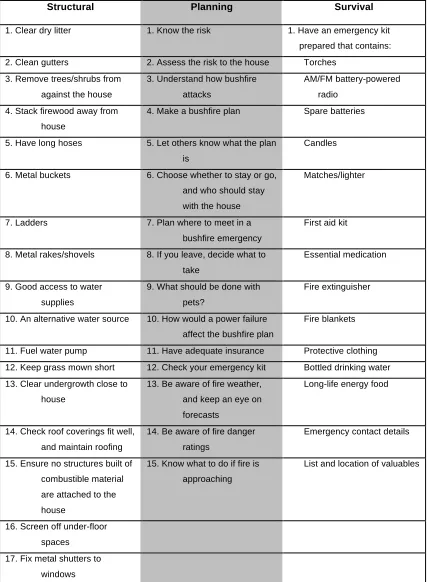
Preparation is important because it encompasses a wide variety of protective behaviours that experience has shown can contribute to reduction of vulnerability and increases in resilience to a broad variety of hazards (CDRSS, 2006; Collins, 2005; Longhurst, 1995; Paton, 2006a; Paton, et al., 2001b; Paton, et al., 2000b; Thomalla, et al., 2006; Thomalla & Schmuck, 2004; Whittaker, 2008). In the case of bushfire, preparing may include, among many things (see table 1.1, page 17), tidying up the yard, trimming vegetation that hangs close to the house, removing leaf litter from guttering, obtaining a fuel-driven water pump and ensuring an alternative source of water from the mains is readily available. But the key benefit that preparation brings to the individual, whatever the hazard, is the ability of such action to mitigate the consequences of hazard activity. Based on the simple formula of Risk introduced earlier (page 7), minimising the consequences of a hazard through effective preparation can contribute significantly to minimising the ultimate effects of hazard activity, and increasing the ability to cope with and adapt to hazard consequences (Paton, 2006a).
and its activity and the complex and unpredictable consequences that may result from its action. Promoting preparedness is not a simple task. For threats like crossing the road, which we encounter on a daily basis, the job is significantly easier than promoting preparedness for natural hazards. We are taught from an early age that crossing the road is dangerous, and the risk communication information we receive from our parents and elsewhere is ingrained in us during our early road-crossing experiences, and practised daily throughout our lives. Conversely, where a threat is rare and complex, when personal relevance of the threat is low (Bright & Manfredo, 1997), when it is unpredictable (Bennett, 1996; Fox & Irwin, 1998; Paoli & Bass, 1997; Powell, Dunwoody, Griffin, & Neuwirth, 2007; Sjöberg, 2007), or where people do not perceive a risk as being salient in their daily life (Paton, 2003; Tierney, Lindell, & Perry, 2001), each being the case for natural hazards, individuals are less likely to attend to, recognise the importance of, or act on risk communication information. As noted previously, the public’s often pervasive inability to distinguish the controllable consequences of natural hazards from their uncontrollable causes also contributes to an individual’s choice not to do anything to mitigate risk from natural hazard, instead taking a fatalistic attitude to the threat (McClure, Allen, & Walkey, 2001; McClure, Walkey, & Allen, 1999), and hoping that low probability equals never.
A large and growing body of evidence suggests that those people who receive risk information do not automatically act on it (Bord & O'Connor, 1990; Breakwell, 2000; Cottrell, 2008; Eiser, 1998; Finucane, 2002, 2008; Fischhoff, 1995; Fox & Irwin, 1998; Graffy & Booth, 2008; Grothmann & Reusswig, 2006; Jardine & Hrudey, 1997; Johnson & Slovic, 1994; Keller, Siegrist, & Gutscher, 2006; Otway & Wynne, 1989; Paton, 2003, 2008b; Prior & Paton, 2008; Slovic, 1986). While this information is directed at members of the public known to be at risk, and assumed to be cognisant of that risk, many individual, community and institutional level factors contribute to the incorporation of this information into an individual’s frame of reference.
avoided through active mitigation (Breakwell, 2000; Eiser, 1998; Paton, et al., 2006b). One of the objectives in this thesis is gaining an understanding of the way at-risk individuals make sense of bushfire risk, which is closely related to their knowledge about that risk (Breakwell, 2000). People with minimal knowledge or a basic awareness about bushfire (or any other risk) are not necessarily cognisant of risk, and therefore have less ability to place their own circumstances into a risk context that enables them to make meaning out of risk information, which permits or induces the intended actions advocated in risk messages (Breakwell, 2000; Finucane, 2002; Fisher & Chen, 1996).
Even people who do have sufficient knowledge about the consequences of risk, which might allow them to make sense of those consequences and act to mitigate them, are not necessarily going to do so (Grothmann & Reusswig, 2006; Lee, Lemyre, Mercier, Bouchard, & Krewski, 2005; McIvor & Paton, 2007; Mulilis, 1998; Paton, 2008b; Sandman, Miller, Johnson, & Weinstein, 1993; Siegrist & Gutscher, 2008). While the individual might find the risk information important enough to do something about, they may also consider that other things in their lives require more urgent attention – especially if the risk is unpredictable or unforeseeable (Eiser, 1998; Fox & Irwin, 1998; Kunruether & Pauly, 2004; Powell, et al., 2007; Weinstein, 1989). So, while risk communicators pass information with the intention of changing the behaviour of an at-risk public, their efforts are not always rewarded as anticipated.
For the agencies or organisations who produce and present risk information, communicating the need to prepare is straightforward and obvious (McLeod, 2003; Ripley, 2006), but this is not necessarily the case for the public. While risk communicators completely understand the necessity for risk communication because their business is to know risk thoroughly, the public rarely shares such objective knowledge or beliefs about risk (Fischhoff, et al., 1982; Slovic, 1986). A consequence of this is a poor translation of risk communication into behaviour change and greater public preparedness levels (Grothmann & Reusswig, 2006; McGee & Russell, 2003; Paton, 2003, 2006b; Paton, et al., 2000a, 2005; Thomalla, et al., 2006; Tierney, et al., 2001).
involves a process where individuals “subjectively or intuitively comprehend, estimate and evaluate the probabilities and consequences of risks” (Krewski, Somers, & Birkwood, 1987, p. 175). Risk perception research has followed in two primary veins: psychometric examinations of the way individuals consider risk; and explorations of risk perception based on cultural influence. The former, termed psychometric theory, has concentrated on developing an understanding of how an individual views risk and is based largely on several explanatory scales that characterise risk (Fischhoff, Slovic, Lichtenstein, Read, & Combs, 1978), of which known versus unknown (“new-old”), “dread” and “number of exposed” have been found to be the most commonly important since the model was originally developed (Sjöberg, 2000). While popular, the psychometric model of risk perception has its detractors (who suggest its ability to describe risk perception might be a function of overlap between the psychometric measurement scales used), and considering risk perception using cultural theory provides an alternative descriptive tool (Douglas & Wildavsky, 1983).
Cultural theory specifies four types of people (egalitarian, individualist, hierachist and fatalist) who are likely to respond partly, or not at all, to different risks based on their social context and how this might govern their beliefs about those risks. It is clear that our social, cultural and political ties influence the way we think about and act on risks (Brenkert-Smith, et al., 2006; CDRSS, 2006; Clarke & Short, 1993; Graffy & Booth, 2008; Hansson, 2007; Holstein & Miller, 2006; Kohler, Behrman, & Watkins, 2007; Lee, et al., 2005; Lupton, 1999; Paton, 2003; Short, 1984), however the proposition that this response may be determined by a person type has received mixed empirical support (Boholm, 1996; Marris, Langford, & O'Riodan, 1998; Rippl, 2002; Sjöberg, 1998, 2000).
2005; Owen, Colbourne, Clayton, & Fife-Schaw, 1999; Paton, 2006a; Paton, et al., 2006b; Slovic, 1986). As Slovic (1986, p. 403) identifies, the primary difficulties in risk communication are overcoming “the idiosyncrasies of the human mind” and “finding comprehensible ways of presenting complex technical material that is clouded by uncertainty, and is inherently difficult to understand”. In a preparedness context, to be effective risk communicators must identify mechanisms that translate expert information and knowledge into messages or education materials that marry technical risk analysis with subjective individual thinking about risk. This means engaging an audience, who may not be receptive, with information that they find meaningful and understandable (Paton, 2006b; Paton, et al., 2000a).
Risk communication techniques that are based on the perception of risk are further confounded by the recognition that perception of risk (particularly likelihood information) does not necessarily spur protective behaviour (Barnett, et al., 2005; Carter-Pokras, Zambrana, Mora, & Aaby, 2007; Graffy & Booth, 2008; Miceli, Sotgiu, & Settanni, 2008; Paton, 2003; Paton, et al., 2008a; Paton, et al., 2001a; Paton, et al., 2006a; Paton, et al., 2008c; Paton, et al., 2005). Recent studies (Paton, 2006b; Paton, et al., 2008a; Paton, et al., 2006a; Paton, et al., 2008c; Paton, et al., 2005) contend that while risk perception may be an antecedent of behaviour change, it does not determine the adoption of risk mitigation actions, and that socio-cognitive processes “underpin behaviour change and its maintenance over time” (Paton, 2003, p. 210). Therefore, simply providing “targeted” risk information and relying on the receiver’s perception of their risk as a means to increase preparedness for natural hazards does not yield sufficient public behaviour or attitude change (Grothmann & Reusswig, 2006; Paton, 2006b; Tierney, et al., 2001) and an examination of the socio-cognitive determinants of decision-making and behaviour change is necessary (Paton, 2003). Such research can help risk communicators to comprehend the reasons why individuals make the decisions they do (which may be counter-intuitive to expert advisers like bushfire Community Education Managers), and identify mechanisms that enable risk communicators to better influence this decision process and reach the objectives they seek.
mental model is an internal representation of external reality, which encapsulates the meanings that an individual constructs to predict or explain the information, experiences or other stimuli with which they interact that is developed over time from accumulated experience (Atman, et al., 1994; Bostrom, Fischhoff, & Granger Morgan, 1992; Werner & Scholz, 2002; Zaksek & Arvai, 2004). As new information comes to hand it is interpreted and sometimes integrated into this mental model, which contributes to the individual’s construction of reality and is used to inform his or her decisions. People are also likely to “squeeze” new data into their existing mental models, even when that information doesn’t “fit” (contradicts other information that was used in the individual’s initial construction of the model) (Atman, et al., 1994; Bostrom, et al., 1994a; Zaksek & Arvai, 2004). Understanding the mechanisms that determine whether change in a mental model actually takes place is a challenging process (Bostrom, Morgan, Fischhoff, & Read, 1994b; Zaksek & Arvai, 2004). As such, mental models or cognitive schema play an important role in how the individual interprets and responds to risk information (Severtson, Baumann, & Brown, 2006; Zaksek & Arvai, 2004). What makes the development of useful mental models regarding natural hazard preparedness more difficult and complex is the fact that individuals rarely have direct exposure to these hazards, and must therefore rely on other mechanisms by which to inform their thinking.
Cox, et al., 2003; Severtson, et al., 2006; Zaksek & Arvai, 2004). While mental models are used to quickly represent the “state of affairs”, they are formed piece-meal, meaning the information on which they are based may not be complete from the perspective of the expert (Bostrom, 2008; Johnson-Laird, 1983; Leventhal, Brissette, & Leventhal, 2003; Severtson, et al., 2006; Wylie & Sheehy, 1999; Zaksek & Arvai, 2004), although they are adequate for the individual to make decisions. Once formed individuals are unlikely to alter their mental model unless it is challenged by new information or evidence that contradicts their current beliefs, or that can be easily incorporated into their model (Johnson-Laird, 1983).
Rather than relying on perception of risk as an instigator of action, risk communicators must design messages that contribute to the accuracy of the layperson’s knowledge about risk (Severtson, et al., 2006). Atman and colleagues identify the necessity for risk communicators to understand how an individual’s mental model is formed, and complete it by “adding critical information and dispelling misconceptions” that may influence decision-making in the wrong way (1994, p. 779). New risk information, provided through trustworthy channels (Breakwell, 2000; Paton, 2007b, 2008b; Siegrist & Cvetkovich, 2000; Slovic, 1993; Van Swol & Sniezek, 2005), will contribute beneficially to the at-risk individual’s mental model of risk and how they act to mitigate the risk’s consequences (Atman, et al., 1994; Bostrom, et al., 1994a).
from a socio-cognitive perspective, using a community psychology approach, can yield the type of comprehensive information necessary for developing risk communication techniques and messages that engender more widespread and comprehensive community bushfire preparedness in those areas under potential threat.
1.2 Why is Bushfire Preparation Important?
All natural disasters exact a significant impact our societies. At the very least they can cause major disruption to our lives and lifestyles. They frequently damage or destroy our property, and in the worst cases, may take many lives. The recent events of “Black Saturday” in Victoria (February, 2009) provide an all-too-real indication of the ferocity and disastrous potential of bushfire in peri-urban areas. Such hazard activity also highlights the need for society to develop or refine the mechanisms that are used to confront these hazards.
Household preparation for bushfire is one component in a whole-of-community bushfire risk management strategy that involves cooperation between home owners, emergency and land management agencies (AFAC, 2005). Shared bushfire risk management necessarily reflects the various geographical scales at which different societal members operate. For example, land management agencies (e.g. state national parks and forestry services) often manage large but non-contiguous parcels of land at the scale of the state. State-based metropolitan fire brigades (e.g. New South Wales Fire Brigades, Metropolitan Fire Brigade – Melbourne) share responsibility for bushfire management in peri-urban areas with volunteer-based bushfire brigades (e.g. New South Wales Rural Fire Service, Country Fire Authority – Victoria). Many of these community-based brigades serve smaller regional and rural areas. Community groups (formal and informal) may organise fire management activities on the scale of a street or neighbourhood. At the finest scale, householders play a role managing bushfire around individual properties. As noted previously, the nature of bushfire hazard as a community threat requires all sectors of society to work together effectively in order to successfully manage bushfire risk, and mitigate the possible consequences of bushfire hazard activity (Paton, 2006b), but this is not always how risk communication is viewed.
vegetation and fuels management, building codes and fire-resistant building materials, land-use regulations, insurance, warning systems, public education and community preparedness. Social features involve better decision-making and management in the organisation of community and agency response activity, as well as the provision of effective support to the community when assessing and choosing structural responses, particularly in relation to preparedness and the “prepare, stay and defend or leave early” policy advocated by Australian bushfire management agencies (AFAC, 2005; Tibbits & Whittaker, 2007). Clearly, not all of these measures are under the control of, or available to the householder, yet well-prepared householders must consider how many of these bushfire management components may impact on their lifestyles and their ability to live safely in bushfire risk areas.
Table 1.1. Structural, planning and survival bushfire preparations suggested by bushfire management
agencies (bushfire preparedness scale from Paton et al., 2006).
Structural Planning Survival
1. Clear dry litter 1. Know the risk 1. Have an emergency kit
prepared that contains:
2. Clean gutters 2. Assess the risk to the house Torches
3. Remove trees/shrubs from
against the house
3. Understand how bushfire
attacks
AM/FM battery-powered
radio
4. Stack firewood away from
house
4. Make a bushfire plan Spare batteries
5. Have long hoses 5. Let others know what the plan
is
Candles
6. Metal buckets 6. Choose whether to stay or go,
and who should stay
with the house
Matches/lighter
7. Ladders 7. Plan where to meet in a
bushfire emergency
First aid kit
8. Metal rakes/shovels 8. If you leave, decide what to
take
Essential medication
9. Good access to water
supplies
9. What should be done with
pets?
Fire extinguisher
10. An alternative water source 10. How would a power failure
affect the bushfire plan
Fire blankets
11. Fuel water pump 11. Have adequate insurance Protective clothing
12. Keep grass mown short 12. Check your emergency kit Bottled drinking water
13. Clear undergrowth close to
house
13. Be aware of fire weather,
and keep an eye on
forecasts
Long-life energy food
14. Check roof coverings fit well,
and maintain roofing
14. Be aware of fire danger
ratings
Emergency contact details
15. Ensure no structures built of
combustible material
are attached to the
house
15. Know what to do if fire is
approaching
List and location of valuables
16. Screen off under-floor
spaces
17. Fix metal shutters to
windows
fire management agencies whose role is the protection of lives, property and infrastructure from bushfire damage.
For individual householders, the benefits of preparing are manifold, but chief among them is the ability of threatened householders to defend their own property (AFAC, 2005; Collins, 2008; Cottrell, 2005; Paton, 2006b; Paton, et al., 2008a; Paton, et al., 2006a; Tibbits & Whittaker, 2007). Additionally, bushfire preparation is the favoured policy in Australia (AFAC, 2005; COAG, 2004; McLeod, 2003) and many parts of the United States (Field & Jensen, 2005; Jakes, 2002; McCaffrey, 2004a, 2004b; Nelson, Monroe, & Fingerman Johnson, 2005; Steelman, Kunkel, & Bell, 2004). Effective bushfire preparation yields two valuable commodities in a bushfire context: the ability to increase the likelihood of defending the property (or reducing losses) reduces the householders’ vulnerability to bushfire, and increases their resilience to bushfire hazard. The combination of lowered vulnerability and increased resilience means the well-prepared household and community will return to normal daily functioning more quickly following severe bushfire activity (Paton, 2006a; Paton, et al., 2000b; Thomalla, et al., 2006; Tobin, 1999; UN/ISDR, 2004; Whittaker, 2008). Preventing or reducing losses and being able to regain normal functioning following hazard activity are important factors influencing the disastrous nature of many natural hazards (CDRSS, 2006; Paton, 2006a; Paton, et al., 2001b; Paton, et al., 2000b; Thomalla, et al., 2006).
knowledge about how to address bushfire threat, and an interest in sharing the burden of preparing their communities to meet the possible threat of bushfire exhibit a higher level of community resilience. Their interactions concerning bushfire preparedness also increase their capacity to understand and address the uncertainty and challenging nature of events like bushfire activity (Eng & Parker, 1994; Hardin & Higgins, 1996; Lion, Meertens, & Bot, 2002).
Household and community bushfire preparedness eases the pressure on bushfire management agencies to protect property and lives. Current bushfire policy no longer expounds the “fire-fighter to the rescue” paradigm in bushfire management. While fire management agencies still retain many statutory responsibilities for managing bushfires, they also recognise the role householders and communities must play in their own protection, particularly when dealing with large fires whose intensity, size and duration present a hazard that exceeds the capacity of available resources. The Australian Fire Authorities Council (2005, p. 4) points out that “the steps that householders take to prepare for bushfires are crucial to the protection of their life and property”. Bushfire management agencies clearly must still play a central role in controlling and combating bushfire, but this role is now focused more on providing support and assistance during bushfire activity, which can be hindered when householders have not adequately prepared their properties. This change in agency operations from “command and control” to co-operation has largely coincided with a realisation that individuals and communities can and should contribute to bushfire management and mitigation, and that in some cases no amount of fire-fighting resources can ensure the complete safety of the community. It has not, however, been matched at the level of risk communication. Thus, understanding the complex relationships between at-risk community members and civic agencies, through in-depth examination of preparation decision-making from a community psychology perspective, will be imperative when developing risk communication techniques that can manage and utilise these relationships (between people, communities and agencies) in a positive and productive manner.
However, although the benefits of preparing for bushfire are easily demonstrable here, and heavily communicated to at-risk community members through bushfire risk communication, householders continue to demonstrate poor knowledge of hazards and protective measures and a reluctance to adopt preparedness actions.
1.4 Why Don’t People Prepare for Bushfire?
The movement toward the “shared responsibility” paradigm in Australian bushfire risk management has been supported by an increase in preparedness-focussed bushfire risk communication over the last decade. Risk communication is the key mechanism by which risk management agencies deliver information to the community about the community’s role in mitigating bushfire risk. Yet despite the seasonal effort fire agencies and other risk managers (e.g. local government) invest in the formulation, production and dissemination of bushfire risk information, household and community bushfire preparedness levels remain low (Cottrell, 2005; McGee & Russell, 2003; Paton, 2006b; Paton, et al., 2008a; Paton, et al., 2006a; Paton & Wright, 2008; Prior & Paton, 2008).
Concomitant increases in population expansion that bring people closer to the bushfire-prone locations of Australia, and predictions of more intense bushfires in the future (Lucas, et al., 2007), mean communicating the need for householders to prepare is becoming ever more important. There are many reasons why people do not prepare for bushfire (or indeed many other hazards), and these are chiefly connected to the techniques of risk communication used (Breakwell, 2000; Eiser, 1998; Graffy & Booth, 2008; Jardine & Hrudey, 1997), the social construction of risk (Bostrom, 2008; Bostrom, et al., 1994a; Dake, 1992; Finucane, 2002; Kreuter, Clark, Oswald, & Bull, 1999; Lee, et al., 2005; Lupton, 1999; McIvor & Paton, 2007; Olsen & Shindler, 2007), and the response of individuals to hazards as uncertain and unpredictable (Bennett, 1996; Keller, et al., 2006; Kunruether & Pauly, 2004).
1.4.1 A universal message?
These processes focus more on the messages provided to the community rather than on producing information that is both understandable and meaningful, two characteristics that catalyse action by enabling people to connect with the information and realise its value within the context of their lives. Importantly, it is not information per se that determines action, but how people interpret it (e.g., render it meaningful) in the context of their experiences, beliefs and expectations (Dake, 1992; Lion, et al., 2002; Marris, et al., 1998; Rippl, 2002). People apply these interpretive frameworks to information about hazards, the actions proposed to mitigate their adverse consequences, and the sources that provide the information (Paton, 2008b).
An example illustrates the complex nature of the link between risk communication and preparedness in a natural hazards context. Researchers have shown that individuals often transfer their own responsibility for preparedness onto emergency management agencies (Ballantyne, et al., 2000; Johnston, et al., 1999; Paton, et al., 2000a). These authors suggest that the actions of emergency management agencies in constructing and disseminating preparedness and warning information may reduce perceptions of vulnerability, because risk communication is often suggestive of the emergency services’ presence and capacity. This can transfer the community’s responsibility for their own safety solely to emergency management agencies. This represents a form of cognitive bias known as risk compensation (Etkin, 1999; Fischhoff, 1995; Lupton, 1999), which reflects how people balance their perceptions of how safe the environment is with their need to act to enhance their safety – the presence of, or communication by fire management agencies causes people to believe they are at less risk, and consequently overlook the need to undertake protective behaviours.
significantly increase resilience and assist fire services to tackle situations given that resources for dealing with fires are finite. Consequently, community preparedness for natural hazards, perceptions of risk and the relationships that exist between different agents (person, community, institution) are inseparable and must be studied accordingly.
Irrespective of whether messages are understandable or meaningful, a failure to accommodate the relationship between the risk communicator and the information receiver can be a major limitation to the effectiveness of a risk message. Because risk messages are communicated to people who already have developed experiences, beliefs and expectations about bushfire and its management, they are often subject to circumstantial interpretation. For example, Prior and Paton (2008) observed that some older members of a community affected by a severe bushfire were unlikely to seek or respond to current risk communication information because they felt they had gained sufficient knowledge about bushfire through their previous experiences, even if that knowledge was outdated and contrary to current risk messages. Householders’ previous experiences with the veracity of risk messages (Graffy & Booth, 2008; Olsen & Shindler, 2007; Paton, 2008b), or agency warnings (Emdad Haque, 2000), their experiences with the people who deliver these messages (Graffy & Booth, 2008), and their own perceptions about the likelihood of bushfire activity may all contribute to the extent individuals listen to or rely on the information contained in risk messages. Most importantly, individuals receiving risk information must have confidence that the actions detailed in that information are safe and, based on positive past experiences, demonstrate a “common sense” (where sensible is determined by the individual based on their experience, beliefs, attitudes etc) approach to mitigating risk: if not, the information is unlikely to be acted on.
In general, many of the failings of passive, mass risk communication techniques lie partly with their inability to reach every individual all of the time, and partly because the message is not universally meaningful. People’s emotions, beliefs, experiences and attitudes towards natural hazards, as well as their interaction with other people, all determine how people interpret, respond to and act on the information with which they are provided. As such, one risk message, structured in one way, and delivered using one or two inflexible media can never hope to inspire an effective and broad-scale response (e.g., interviews conducted as part of this research suggested that while some people receiving the Tasmania Fire Service’s
Prepare to Survive information kit found it a useful information source, this positive response was by no means unanimous). In order to understand how people react to a risk or threatening situation, it is therefore necessary to delve into the individual characteristics that determine their perception of risk and the way in which they construct risk based on their own circumstances. Deeper examinations of the construction of risk in this way, that include examinations of the socio-cognitive processes involved in risk judgments and perception, can more fully inform the development of more effective risk communication development and identify why risk beliefs may be markedly different between agency and citizen.
1.4.2 The social construction of risk
As such, the channels through which this information is distributed may have a considerable impact on its use and usability.
Communities of place (locational), or interest (relational) are inherently different (Bell & Newby, 1974). Communities of place are groups that form because of geographic closeness, while communities of interest establish around shared beliefs, attitudes, cultures or interests. Research suggests that where once communities were predominantly locational, they are increasingly becoming relational (Forrest & Kearns, 2001; Trewin, 2006). Most suggest this change is a result of the current “communication age”, which allows individuals to more easily maintain social networks that are not geographically based (Forrest & Kearns, 2001; Morrison, 2003; Putnam, 2000; Trewin, 2006). This has significant implications relating to the availability of place-based information from other members of the locational community that could be used to interpret and understand risk information. Particularly in the case of bushfire, which directly affect locations, if the residents are not well connected to their neighbours, the community may have less collective capacity to meet the threat of bushfire (Indian, 2008; Paton, et al., 2008a).
Many individuals rely on other people to help them interpret risk information (Bishop, Paton, Syme, & Nancarrow, 2000; Carroll, Cohn, Seesholtz, & Higgins, 2005; McIvor & Paton, 2007; Paton, et al., 2008a; Paton, et al., 2006a; Prewitt Diaz & Dayal, 2008; Prior & Paton, 2008; Vieno, Santinello, Pastore, & Perkins, 2007). People’s involvement in locational (place-based) or relational (interest-based) communities (or both) may have positive or negative influences on how those people receive and act on risk messages (Paton, et al., 2008a).
colleagues (from outside their neighbourhood) is therefore an important consideration in the development and distribution of risk messages.
Members of society or societal institutions each bring their own interpretative processes to bear on the task of understanding and reacting to risk. Hazards are dealt with in a socially constructed fashion (Cottrell, et al., 2008), where hazard risk is considered in light of culture, knowledge, beliefs and experiences. Although there is always an objective level of risk associated with a hazard, public perception of that risk may be clouded by social and cultural processes. Risk management agencies often find it difficult to reconcile their objective assessments of risk with the socially constructed understandings of the community members for whom they target risk information. Unsurprisingly, many risk communication efforts fail to engender their intended result (Emdad Haque, 2000; Grothmann & Reusswig, 2006; Löfstedt & Renn, 1997; Prior & Paton, 2008) - like ships in the night, the objective risk communicated by agencies sails directly past the subjective nature of the community member’s risk-related beliefs.
awareness, and this is true in many risk-related phenomena (Berkman, 1995; Clarke & Short, 1993; Cottrell, et al., 2008; Kohler, et al., 2007).
Importantly, just living in an area known to be a high bushfire risk location is not enough to engender a risk averse attitude to that environment, risk acceptance, or the adoption of behaviours designed to mitigate that risk. Decisions about interpreting risk and how to address it, are not made in isolation, but with respected or significant others (particularly when the issues are complex, uncertain or rare) (Bishop, et al., 2000; Flora, 1998; Kohler, et al., 2007; McIvor & Paton, 2007; Morrison, 2003; Obst, Smith, & Zinkiewicz, 2002; Paton, et al., 2008a; Paton, et al., 2006a; Prewitt Diaz & Dayal, 2008; Vieno, et al., 2007). Individuals with less knowledge or experience of risk rely on family, friends or neighbours to interpret the risk presented by the environment where they live. Consequently, the social construction of risk becomes an extremely important consideration for risk management agencies. Without specifically contemplating the social construction of risk, the objective of increasing community preparedness may be consistently frustrated. Community engagement in the development and delivery of risk education programs will be a key mechanism for engendering better interpretation and understanding of risk messages among the wider community (Prior & Paton, 2008). Identifying and instituting such a process requires the development of an appropriate theoretical framework from which to research this aspect of risk communication, and will be a key concern in this thesis.
1.4.3 The inherent uncertainty of natural hazards
People often do not reach rational decisions as a result of their cognitive reasoning – partly because of the social construction of risk, and partly because active cognition is undertaken with the information at hand, and often with deduction aimed not at reaching a rational outcome, but to reach the most agreeable outcome (Finucane, Alhakami, Slovic, & Johnson, 2000; Loewenstein, Hsee, Weber, & Welch, 2001; Tversky & Kahneman, 1974, 1981). It is quite clear that an individual’s judgement can be biased by their beliefs, attitudes, feelings and emotions at the time the decision is made (I liked the car’s colour and forgot to look under the bonnet), leading to illogical choice (Bechara, Damasio, Tranel, & Damasio, 1997; Donovan & Blake, 1992; Jones, 1999; Kahneman, 2003; Simon, 1955). Tversky and Kahneman (1974) showed that individuals rely heavily on affect heuristics to guide their judgement, enabling them to simplify otherwise difficult choices. But once the choice is simplified in this way, judgemental errors are likely to become more common (Finucane, et al., 2000; Jones, 1999; Kahneman, 2003; Sjöberg, 1982; Slovic, et al., 2004; Tversky & Kahneman, 1974). This plays a role even in choices familiar to the decision maker (Tversky & Kahneman, 1974), but in familiar circumstances individuals are likely to be able to better judge the possible outcomes and estimate how likely these are to occur, giving them some ability to choose advantageously to avert risk (Bechara, et al., 1997; Finucane, et al., 2000; Fox & Levav, 2000; Kahneman, 2003; Keller, et al., 2006; Sjöberg, 1982).
On the other hand, natural hazards are rare, unpredictable, and pose unfamiliar risks (Emdad Haque, 2000; McCaffrey, 2004b; Mileti & Fitzpatrick, 1992; Ripley, 2006; Slovic, 1987). Under such ambiguity our choices can’t be informed by familiarity because we have no experience, we often can’t conceive of the effects of such threats, and it’s difficult to respond to them given we have little knowledge about how or when to do so (Basili, 2006; Basili, Chateauneuf, & Fontini, 2005). In these circumstances uncertainty and unfamiliarity contribute to the hazardous nature of the circumstances in which people find themselves. What confounds our decision-making further is the fact that the consequences we face, if we have made poor judgements or have not processed the available information adequately when a natural hazard actually occurs, can be life threatening.
(judgements are based on similarities with known elements), availability (frequency by which events can be recalled) and anchoring (judgements about an event are determined based on perceived starting points) provide workable mechanisms by which individuals formulate ideas about uncertain events, they mostly result in judgemental errors. Whether people employ such heuristic principles to educate their conceptualisations of risk and probability is not a function of their desire to understand uncertain events, but simply to compensate for the little knowledge they possess about these events, whose effects might be clarified if they can develop some idea as to why or how they might operate.
Therefore, uncertainty is essentially a state of “not knowing” (Kahneman & Tversky, 1982; Powell, et al., 2007; Tversky & Kahneman, 1974). Members of the public are generally limited by their own knowledge, the knowledge of others, the knowledge that exists around them, an inability to find out (and having to rely on second-hand information) or a combination of these. Under these circumstances we attribute probabilistic judgements (Fischhoff, et al., 1982; Siegrist, 1997; Tversky & Kahneman, 1973) to risks in order to legitimise our “not knowing” by asserting that although unpredictable, a risk is nevertheless possible within some future time frame. Risk communicators have often resorted to communicating probabilities in order to engender responses to environmental risk, yet these techniques are now shown to be next to useless (Siegrist, 1997) partly because they perpetuate these states of “not knowing”.
whether they should act to mitigate the effects of that risk. So the uncertainty of natural hazards plays a key role in determining how we respond to the threat such risks pose.
1.4.4 How do we make decisions?
In order to make a decision an individual must be presented with at least two alternative choices. Each alternative poses the individual with a different set of consequences and it could be assumed that the individual applies their knowledge and reasoning ability to decide on the most rational course of action to reach the most satisfactory outcome based on their preferences (Simon, 1955; Ward, 1954). However, this is not strictly the case (Finucane, et al., 2000; Jones, 1999; Kahneman & Tversky, 1979, 1982; Machina, 1987; Simon, 1955; Sjöberg, 1982; Tversky & Fox, 1995; Tversky & Kahneman, 1974, 1981). Individuals are active information gatherers (Nisbett & Ross, 1980), and as such we make decisions that reflect the environment in which we live – our decision-making does not always result in the same decisions because we interpret the information we have using a mental model and in the context of the situation we find ourselves.
1999, p. 298). “Rational” choice is confounded by the “overt or covert” cognitive processing that individuals engage in when making risk-related decisions (Loewenstein, et al., 2001, p. 267).
That individuals make decisions bounded by their own rationality, situational influences and the social construction of risk poses difficulties for those agencies producing standardised outreach material designed to encourage householders to mitigate the impacts of bushfire. Risk communicators and householders exist together on a rationality continuum that is perceived differently by each player. What is considered a rational choice by one, may not be viewed in the same way by the other. The result is likely to be miscommunication, misunderstanding or misinterpretation of risk communication information (Grothmann & Reusswig, 2006; Mulilis, 1998; Paton, 2003, 2006b; Recchia, 1999; Slovic, 1986). Kahneman and Tversky (1979) supported the contention that individuals are not entirely rational, showing that decisions made under uncertainty in particular often violate the principles of risk aversion, and that individuals “identify consequences as gains or losses relative to a neutral point” (Kahneman & Tversky, 1982, p. 137), rather than as static outcomes with specific costs or benefits. They describe the ability of the individual to learn and form knowledge structures, or heuristics, that enable them to process complex information quickly, with minimal effort, but sometimes mistakenly.
This is a view direct from the expert’s objectively rational mind. Because people process information quickly, based on their own situational reality (and mental model), they come to decisions that are not necessarily “mistaken”, but which simply reflect fundamentally different reasoning processes from experts (Bostrom, et al., 1994a; Bostrom, et al., 1992; Cox, et al., 2003; Fischhoff, et al., 1982; Zaksek & Arvai, 2004). The concept of the “mental model” (Bostrom, et al., 1994a; Zaksek & Arvai, 2004), or the notion that people tend to assemble their knowledge of risks into a conceptual map of ideas provides a basis from which to begin to understand how laypeople’s perceptions and actions concerning a risk may differ so dramatically from experts that they are then deemed to be mistakes.
information they provide is based primarily on that experience. The material risk communicators produce and distribute is therefore elucidated by the communicator’s mental model of risk, and considered to be objectively rational. Risk communicators expect those people who receive their information to follow the advice logically and rationally. In the eyes of the fire-fighter, leaving a defendable house when flames are within view would be considered an irrational choice.
The householder’s bushfire mental model may either reflect or contradict the risk communicator. Many people who receive risk information perceive they live at risk, recognise the logic on which the risk communication information is based and act “rationally”. However, a large proportion of the people receiving risk information act in a manner that can differ radically from how risk communicators would expect them to act. As discussed previously, the way these people interpret their situation is directed by their own reasoning about bushfire, which is strongly influenced by their intrinsic state of mind concerning bushfire: Is bushfire good or bad? Can bushfire be controlled or managed? What impact will it have? Is it a threat to my life or lifestyle? It is also a product of their social interactions and their social construction of risk. In a hypothetical situation, a householder living in a peri-urban fringe area prepares their house as they see fit; the bushfire arrives but it is far bigger than they expected; they question their preparations and the rationality of waiting for a bushfire to “burn over them” and quickly get in their car with the intention to outrun the fire. Sadly, this is not a hypothetical example, but occurs repeatedly with every major bushfire event in Australia (Handmer & Haynes, 2008).