Tool Auctions
Janosch D¨ocker
University of T¨ubingen Germany
Britta Dorn
University of T¨ubingenGermany
Ulle Endriss
ILLC, University of AmsterdamThe Netherlands
Ronald de Haan
ILLC, University of AmsterdamThe Netherlands
Sebastian Schneckenburger
University of T¨ubingenGermany
Abstract
We introducetool auctions, a novel market mechanism for constructing a cost-efficient assembly line for producing a desired set of products from a given set of goods and tools. Such tools can be used to transform one type of good into a different one. We then study the computational complexity of tool auctions in detail, using methods from both classical and parameterized complexity theory. While solving such auctions is intractable in general, just as for the related frameworks of combinatorial and mixed auctions, we are able to identify several special cases of practical interest where designing efficient algorithms is possible.
1
Introduction
“It looked to Sacharissa that the only tools a dwarf needed were his axe and some means of making fire. That’d eventually get him a forge, and with that he could make simple tools, and with those he could make complex tools, and with complex tools a dwarf could more or less make anything.”
—Terry Pratchett,The tRuth
Auctions, and combinatorial auctions in particular, are a pow-erful family of market mechanisms for allocating resources, which have been studied in depth in Economics, Operations Research, and AI (Cramton, Shoham, and Steinberg 2006). We propose a novel type of combinatorial auction that allows the auctioneer to purchase a number oftoolsas well as other goods. She can then use these tools to produce further such tools and goods. Her objective is to pick a set of tools and then to execute a suitable sequence of actions, each consisting of an application of one of the tools she has access to, so as to eventually obtain the set of goods she desires. A secondary objective is to find a sequence that is as short as possible.
Our model may be interpreted as a restricted—and thus computationally less demanding—instance of the model of mixed multi-unit combinatorial auctions of Cerquides et al. (2007), which has applications in the domain of industrial supply-chain management. In a mixed auction, the auctioneer can purchasetransformations, frominput goodstooutput goods, to compose a sequence of such transformations to obtain the goods she desires. Ourtool auctionsare mixed auctions in which, for each transformation, there is only a
Copyright c2018, Association for the Advancement of Artificial Intelligence (www.aaai.org). All rights reserved.
single good that occurs both in the input set and the output set: the tool. For example, in the context of the transformation mapping{mixer,melon}to{mixer,juice}, themixeris the tool, whilemelonandjuiceare ordinary goods. In addition to limiting each transformation to just one tool, to control the complexity of the problem faced by the auctioneer, we also put certain restrictions on the number of non-tool goods involved in a single transformation.
Fully expressive mixed auctions are highly complex. The winner determination problem, i.e., the problem of finding a sequence that produces the desired set of goods at a given price, is NP-complete (Cerquides et al. 2007). Fionda and Greco (2013) have analysed this problem, as well as the re-latedfeasibility problem, where we ignore prices and simply want to findsomesequence that does the job, in great detail. They were able to identify a number of so-calledtractability islands, i.e., restrictions of the general setting where solving an auction is possible in polynomial time. For example, they were able to show that, when every transformation only ad-mits a single input good and a single output good, then the feasibility problem is polynomial. But even permitting two output goods (and still just one input good) already turns the problem NP-complete. In general, existing tractability results only apply under very severe restrictions. The fundamental intuition inspiring our new auction model is that introducing constraints on the types of goods—toolsvs.ordinary goods— whilst at the same time relaxing constraints on the number of goods involved in a transformation constitutes a promising trade-off between tractability and expressivity.
The core of this paper is devoted to testing this intuition. We provide a detailed complexity analysis of both the feasi-bility and the winner determination problem for tool auctions. While solving tool auctions, just like most other kinds of combinatorial auctions, is intractable in general, we are able to identify several special cases of practical interest where de-signing efficient algorithms is possible. In particular, we show that several relevant decision problems are either polynomial-time solvable or fixed-parameter-tractable.
dis-a
a taa,b
b
a
a
B=b1. . . bk
taa,B
b1. . . bk
a
a
b
ta,b a,c
[image:2.612.55.292.55.123.2]c single-output tool multi-output tool tabac tool
Table 1: Tools
cussion of a number of variants of our model and an outlook on possible directions for future work.
2
The Model
In this section we introduce our model of tool auctions.
2.1
Notation and Terminology
Fix a finite setGofgoods. Abundleis a multiset of goods, i.e., a functionB:G→N, which we also write asB∈NG,
mapping each good to the multiplicity with which it occurs in the bundle (we useNto denote the natural numbers, to-gether with 0). We use standard set-theoretic notation also for multisets:x∈Bis short forB(x)>0;B ⊆B0 for∀x∈
G : B(x) 6B0(x);B∪B0 forx 7→ max{B(x), B0(x)} (i.e., for the function mapping anyx∈Gto the maximum ofB(x)andB0(x));B∩B0 forx 7→ min{B(x), B0(x)};
B \ B0 for x 7→ max{0, B(x)−B0(x)}; |B| = k for P
x∈GB(x) = k; and B = ∅ for |B| = 0. We also
use]to denote multiset addition, i.e.,B]B0 is short for
x 7→ [B(x) +B0(x)].B is called asingle-unit bundle if |B(x)|61for allx∈G.
We use triplest =hτ,I,Oi ∈G×NG×NGwithτ 6∈ I ∪ OandI ∩ O=∅to describe availabletransformations, withτbeing thetoolrequired to use the transformation,I theinput goods, andOtheoutput goods. By a slight abuse of terminology, we use the term ‘tool’ not only forτbut also fort. In this paper, we focus on three types of transformations that impose certain constraints onI andO:single-output toolswithI =∅and|O|= 1;multi-output toolswithI =∅; andtabac toolswith|I| =|O| = 1. These are visualised in Table 1. In line with this visualisation, we sometimes use
tτ,τ,IOas an alternative representation forhτ,I,Oi.
Anauction instance is a triplehT,Uin,Uouti, where T is the set of transformations available to the auctioneer to choose from,Uin∈NGis the bundle she owns initially, and Uout ∈NGis the bundle she hopes to end up with.
To solve an auction instance, we now considersequences
Σ = t1, t2, . . . , t`of applications of the available
transfor-mations inT. We refer to each suchti, which is of the form hτi,Ii,Oii, as anactionin the sequence. Importantly, two
different actions inΣcould be applications of the same trans-formation (i.e., transtrans-formations can be reused). Thelength ofΣis|Σ|=`. We use multisetsMi∈
NGto keep track of the goods held by the auctioneer after theith action inΣ:
M0 := U
in,
Mi := (Mi−1\ Ii) ] Oi fori∈ {1, . . . , `}.
We call a sequenceΣlegal, if at any stage of the process the auctioneer does in fact hold all the goods required to perform
Uin c1 d1
a b c3 tcc33,d1d2 Uout
c2 d2
ta a,b
ta,b a,c1
tbb,c2
tc1
c1,d1
tc2
c2,c3
tc2
c2,d2
Figure 1: Visualisation of Example 1
the next action, including the relevant tool, i.e., if
Ii⊆ Mi−1andτi∈ Mi−1for alli∈ {1, . . . , `}.
We say thatΣachievesthe desired outputUoutifUout⊆ M`.
In this case, we writeΣ;Uout.
We are now ready to define the two decision problems we are going to analyse (see Table 2). FEASIBILITYasks whether there is a way to achieve the desired outcome. WINNER
DETERMINATION(or WINDETfor short) asks whether the
same is possible using a sequence of at most K actions, for someK ∈N. We may think ofKas a bound on time available to the auctioneer (if each action takes up one time unit) or as a budget (if each action costs one currency unit).
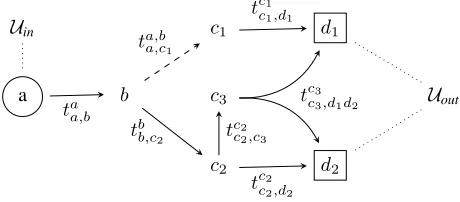
Example 1. Consider the goods
G={a, b, c1, c2, c3, d1, d2}
and the auction instancehT,{a},{d1, d2}i, where
T ={taa,b, ta,ba,c1, tc1
c1,d1, t
b b,c2, t
c2
c2,d2, t
c2
c2,c3, t
c3
c3,d1d2}.
So the auctioneer initially only holds the goodaand wants to end up with the bundle{d1, d2}. Figure 1 visualises this scenario.Σ1=taa,b, t
a,b a,c1, t
c1
c1,d1 is the shortest sequence to achieve{d1}, andΣ2=taa,b, t
b b,c2, t
c2
c2,d2is the shortest one to achieve {d2}. By combining the two, we obtain a first legal solution: for Σ = ta
a,b, ta,ba,c1, t
c1
c1,d1, t
a
a,b, tbb,c2, t
c2
c2,d2, which has length 6, we getΣ ; {d1, d2}. Notably some, but not all, permutations of Σ are also legal solutions; e.g., tb
b,c2 only can be applied as action t
i if b ∈ Mi.
For one permutation of Σ, one application of ta
a,b is
un-necessary, which leads to the improved solution Σ0 =
taa,b, tbb,c 2, t
c2
c2,d2, t
a,b a,c1, t
c1
c1,d1 of length 5. But the best solu-tion isΣ∗=ta
a,b, t b b,c2, t
c2
c2,c3, t
c3
c3,d1d2 of length 4.
2.2
Design Choices
Next, we highlight some of the design choices made in setting up our model and discuss possible alternatives. For all of them, alternative choices are possible and worth investigating.
Free disposal. By only requiringUout ⊆ M` rather than Uout=M`, we are making the assumption that the auctioneer can freely dispose of unwanted goods.
[image:2.612.325.555.58.159.2]FEASIBILITY
Instance: an auction instancehT,Uin,Uouti.
Question:is there a legal sequenceΣs.t.Σ;Uout?
WINNERDETERMINATION(WINDET)
Instance: an auction instancehT,Uin,Uoutiand a numberK∈N.
Question:is there a legal sequenceΣs.t.|Σ|6KandΣ;Uout?
Table 2: Decision Problems for Tool Auctions
equally expensive to execute. Alternatively, one could specify a price for each transformation and ask for the sum of the prices of the actions inΣto not exceedK.1
Unlimited use of transformations.We assume that every transformation can be used any number of times—although the auctioneer has to ‘pay’ for every single application of it. Alternatively, one could specify for each transforma-tion how often it can be used at most. Going further, one could define abidding languageto express constraints on acceptable combinations of actions (Cerquides et al. 2007; Nisan 2006), e.g., to say that the auctioneer has to either purchase all or none of a given set of transformations.
Single-unitvs.multi-unit auctions.There are multiple iden-tical copies of each good inG. In particular,Uin,Uout, and the output bundles of multi-output tools are, in general, multisets. However, we are sometimes going to focus on the special case in which the specification of an auction instance only involves single-unit bundles. We refer to this as the single-unit restriction. Observe that, while also under the single-unit restriction the auctioneer might obtain two identical copies of the same good (e.g., by applying the same single-output tool twice), she neverneedsto do so: under the single-unit restriction, for any legal sequenceΣof length`=|Σ|with Σ ; Uout there exists a legal sequenceΣ0 with|Σ0| 6 ` andΣ0 ; Uout for which the auctioneer never has to hold multiple copies of the same good, i.e., for which allMiare
single-unit bundles as well.
No typing of goods.Tools and ordinary goods are all ele-ments ofG. We distinguish them by theirusewithin a trans-formation, not by their essence. Thus, somex∈Gcould play the role of a tool for one transformation and the role of a good being produced for another transformation. Alternatively, one could have one set of tools and one set of ordinary goods, and only use each for their special purpose. In particular, one could forbid that tools are consumed by tabac tools and thus are unavailable later on inΣ.
For some of our results, we are going to impose this latter restriction, which we refer to as the nonconsumable-tool restriction. Formally, it requires thatGcan be partitioned intoGaandGbsuch that (1) for all tabac toolstabac ∈ T it
holds thata ∈ Ga andb, c ∈ Gb, and (2) all single- and
multi-output tools inT only involve goods inGa.
1Lifting this assumption does not affect the complexity results
reported later on in this paper: for WINDET, all hardness results carry over immediately to the more general case (having a cost of 1 is a special case of having arbitrary costs). All membership results can also be extended to the case of arbitrary costs of transformations. In particular, the tractability results of Theorems 12 and 13 can be extended to this case because we can encode arbitrary costs in the reduction to the min-cost network flow problem.
Single tools. We restrict the number of tools required to execute a transformation to 1. Alternatively, one could also permit requiring multiple tools for a single transformation.
Tools only.We restrict attention to scenarios where the only actions available to the auctioneer consist in applying a tool to obtain certain goods. In practice, this should be combined with the option to simply purchase a bundle of goods. By including some default good?inUinand ensuring that?is never consumed by a tabac tool, we can simulate the option of purchasing the bundleB via the multi-output toolt??B. Hence, in fact this is not a restriction.
3
Complexity Results
In this section, we present our results on the computational complexity of tool auctions.
These results show that FEASIBILITYis tractable for set-tings with only single- or only multi-output tools, while WINDETis not. For settings where tabac tools are allowed, even FEASIBILITY is not tractable in general. In fact, it is PSPACE-complete. For the complexity of WINDETin the presence of tabac tools, the encoding ofK is relevant. When K is encoded as a binary number, then the prob-lem is PSPACE-complete, while it is NP-complete when
K is encoded as a unary number. All of our intractability results apply even under the single-unit restriction. Under the nonconsumable-tool restriction, on the other hand, if only tabac tools are allowed (i.e., if goods are typed), both FEASI
-BILITYand WINDETare tractable. Refer to Table 3 for an
overview of these results.
Transformations FEASIBILITY WINDET
single-output tools in P (Prop 1) NP-c (Thm 2) multi-output tools in P (Prop 3) NP-c (Thm 4)
tabac tools
PSPACE-c (Thm 8)
PSPACE-c (Kin binary)
(Prop 7) NP-c (Thm 9)
(Kin unary)
tabac tools
in P (Prop 11) in P (Thm 12) with typed goods
Table 3: Overview of Complexity Results
namely the maximum length of the solutionK > |Σ|, is not a good choice. WINDETfor multi-output tools param-eterized byK is W[2]-hard and WINDETfor tabac tools parameterized byKis W[1]-hard. A better choice for a pa-rameter is the sum of the solution lengthK and the maxi-mum number of goods that appear in any multi-output tool (maxhτ,I,Oi∈T |O|). Another good choice is the size|Uout| of the desired output. For either one of these two parameters, WINDETfor multi-output tools is fixed-parameter tractable (FPT). Finally, under the nonconsumable-tool restriction and for the parameter that is the sum of the number of tools which are used in a tabac tool and the number of tools appearing in Uout, WINDETis FPT for any combination of our three types of transformations. Table 4 summarises our FPT results.
Transformations Parameter Result
single-output tools |Σ| FPT (Cor 6) multi-output tools |Σ| W[2]-h (Thm 5) multi-output tools |Uout| FPT (Cor 6) multi-output tools |Σ|+ max|O| FPT (Cor 6) tabac tools |Σ| W[1]-h (Thm 10)
mixed tools under |{a|tabac∈ T }|+ FPT (Thm 13) noncons.-tool restr. P
a∈GaUout(a)
Table 4: Parameterized Complexity Results for WINDET
3.1
Results for Single-Output Tools
For auction instances that only involve single-output tools,
FEASIBILITYis easy, but WINDETis already hard.
Proposition 1. If all transformations are single-output tools,
thenFEASIBILITYcan be decided in polynomial time.
Proof. We describe a greedy algorithm to constructΣ. We use a multisetMto keep track of the bundle held by the auctioneer by the end of the prefix ofΣconstructed so far. At any given point,Uout\ Mis the bundle we still need to obtain. InitialiseMwithUin, andΣwith the empty sequence. Then, while there is someta
abwitha∈ Mandb6∈ M, addt a abto
the end ofΣ, and add a copy ofbtoM. After termination, report success if there is nog∈ Uoutwithg6∈ Mand failure otherwise. This algorithm is easily seen to be correct and to run in polynomial time (for every element inGwe have to inspect every transformation inT at most once).
Theorem 2. If all transformations are single-output tools, thenWINDETis NP-complete, even under the single-unit restriction.
Proof (sketch). To show membership in NP, it suffices to see that if a feasible solution exists, there is also a be feasible solution where any good is added at most once to the auc-tioneer’s bundle. Thus only sequencesΣof length at most |Σ|=|G\ Uin|have to be considered.
Next, we prove NP-hardness under the single-unit restric-tion by reducrestric-tion from 3SAT. Letϕ={c1, . . . , cm}be a
3CNF formula with variablesx1, x2, . . . , xn. Without loss
of generality, we may assume thatϕcontains the clauses
(xi∨ ¬xi)for alli ∈ {1, . . . , n}. We now construct an
in-stance of WINDET. We letG={z} ∪ {xi,¬xi, cj|16i6
n,16j 6m},Uin={z},Uout={c1, c2, . . . , cm},T = Tlit∪ TclwhereTlit={tz
z,xi, t
z
z,¬xi|16i6n}andTcl=
{txi
xi,cj |xi∈cj, cj∈ϕ} ∪ {t
¬xi
¬xi,cj | ¬xi ∈ cj, cj ∈ ϕ}.
Finally, we letK =n+m. It is straightforward to verify that this reduction is correct.
3.2
Results for Multi-Output Tools
Next, we are going to see that, while the basic complexity results for multi-output tools mirror those for single-output tools, when considering the problem under the parameterized lens, additional sources of complexity become apparent.
Proposition 3. If all transformations are multi-output tools,
thenFEASIBILITYcan be decided in polynomial time.
Proof (sketch). We can adapt the algorithm given in the proof of Proposition 1. The only difference is that in each round we have to look for a transformationta
aBwitha∈ Mand either
B∩(Uout\ M)6=∅orB∩({x∈G|txxy∈ T } \ M)6=∅
(and then addBtoM).
Observe that every single-output tool is a special case of a multi-output tool, so FEASIBILITY for combinations of single- and multi-output tools is polynomial as well.
Theorem 4. If all transformations are multi-output tools, thenWINDETis NP-complete, even for the single-unit re-striction.
Proof (sketch). NP-hardness follows from Theorem 2, as single-output tools are also multi-output tools. NP-member-ship can be shown by adapting the proof of Theorem 2.
While WINDETis FPT with respect to the length ofΣwhen only single-output tools are used (see Corollary 6 below), this is unlikely to be the case for multi-output tools.
Theorem 5. If all transformations are multi-output tools, thenWINDETis W[2]-hard when parameterized by|Σ|. This remains true even under the single-unit restriction.
Proof (sketch). We describe an fpt-reduction from the W[2]-complete problem SETCOVER. For this problem, inputs con-sist of triples(U,S, k), whereUis a finite set,S ∈ P(P(U)) is a set of subsetsSi ⊆U ofU, andkis a positive integer.
The question is whether there exists a setS0 ⊆ Sof size at mostksuch thatSS0 =U.
Let(U,S, k)be an arbitrary instance of SETCOVER. We construct an instance of WINDETusing only multi-output tools. We let G = {?} ∪U,Uin = {?},Uout = G. For eachSi∈ S, we introduce a multi-output toolt??,Si.
The legal sequencesΣof length at mostksuch thatΣ; Uoutare in one-to-one correspondence with the subsetsS0⊆ Sof size at mostksuch thatS
S0=U.
Corollary 6. If all transformations are single- or multi-output tools, thenWINDETis fixed-parameter tractable when parameterized either (1) by|Uout|, or (2) by|Σ|plus the max-imum number of goods that appear in any multi-output tool (maxhτ,I,Oi∈T |O|).
3.3
Results for Tabac Tools
When using (only) tabac tools, solving a tool auction can become highly intractable. This is true even under the single-unit restriction.
Proposition 7. If all transformations are tabac tools, then
FEASIBILITYis PSPACE-complete, even under the
single-unit restriction.
Proof (sketch). Membership in PSPACE can be shown rou-tinely, by giving a nondeterministic algorithm that solves the problem in polynomial space. To show PSPACE-hardness, we can use a reduction that has been used to show that propo-sitional planning is PSPACE-hard (Bylander 1994, Thm 3.1), reducing an arbitrary problem in PSPACE to the satisfiability problem of propositional planning. The planning operators used in this reduction correspond exactly to tabac tools. More-over, the satisfiability problem for propositional planning corresponds exactly to the FEASIBILITY problem. In this reduction, all bundles involved are single-unit bundles.
The complexity of WINDETdepends on how we encodeK, the upper bound on the length of permissible solutions. Theorem 8. If all transformations are tabac tools, then WINDETis PSPACE-complete whenKis encoded in binary. This remains true even under the single-unit restriction.
Proof (sketch). EncodingKin binary allows us to express an exponential bound on the length of solutions. Therefore, the PSPACE-hardness proof of Proposition 7 also works for WINDET. Membership in PSPACE can be shown entirely analogously to the case of FEASIBILITY.
Theorem 9. If all transformations are tabac tools, then WINDETis NP-complete whenKis encoded in unary. This remains true even under the single-unit restriction.
Proof (sketch). Membership in NP follows from the fact that whenKis encoded in unary, we can guess a sequenceΣin polynomial time.
To show NP-hardness, we describe a reduction from WINDETfor the case where all transformations are single-output tools (cf. Theorem 2). Let (G,T,Uin,Uout, K) be an arbitrary instance of WINDET where all t ∈ T are single-output tools. ToGwe addKnew goodsh1, . . . , hK.
Each transformation taab ∈ T we replace by K tabac toolstah1
ab , . . . , t ahK
ab . ToUin, we add the goodsh1, . . . , hK,
andUout, andKwe leave unchanged.
We omit a detailed proof of the fact that there exists a sequenceΣof length at mostKsuch thatΣ;Uoutfor the original instance if and only if such a sequence exists for the newly constructed instance.
Theorem 10. If all transformations are tabac tools, then WINDETis W[1]-hard when parameterized byK, even under the single-unit restriction with|Uout|= 1.
Proof (sketch). We describe an fpt-reduction from the W[1]-complete MULTICOLOUREDCLIQUE(Fellows et al. 2009), which asks, given an undirected graphG= (V, E)the ver-tices of which are coloured withkcolours, whether there is a clique inGcontaining one vertex from each colour class (a multi-coloured clique). The parameter for this problem isk. Given an instance of MULTICOLOURED CLIQUE with G = (V, E)where the vertex setV is a disjoint union ofk
colour classesV1∪ · · ·˙ ∪˙ Vk, andk∈N, we construct an instance of WINDETas follows (we assumek>3, otherwise an easier construction is possible). The set of goods is
G:={?} ∪ {xe|e∈E} ∪ {ze|e∈E} ∪Y
with
Y :={yi,j,`|16i6k,16j < `6k, i6=j, i6=`}, Uin={?}, andUout=Y. The number of goods in the output is|Y|=k k−21
. For eache∈E, we introduce transforma-tionst?? xeandtxe
xeze, where the first transformation allows
production of goodsxeand the second one allows production
of goodszeusingxeas a tool. Note that these
transforma-tions are single-output tools, but they can be transformed into tabac tools as done in the proof of Theorem 9. For each pair
e1 ={vi, vj}, e2 ={vi, v`} ∈ E,withe1 6=e2,vj ∈Vj,
andv`∈V`, we create a tabac toolt xe1ze2
xe1yi,j,`. To put it into
words, the tabac tooltxe1ze2
xe1yi,j,`allows transformingze2into
a goodyi,j,`, usingxe1 as a tool, wheree1ande2share a
vertex in color classi, and have differing vertices in color classesj and`, respectively. We letK = k2
+ 2k k−21 . The only way to produce all goodsyi,j,`within the budgetK
is to first produce the goodsxefor all edgesein a
multi-coloured clique, and then to use them as tools to produce the goodsyi,j,`(with goodszeas intermediate step).
IfGhas a multicoloured clique of sizek, we produce those goods corresponding to the k2edges of the clique by the single-output tools, i.e., we apply the transformationt?
? xe
for each edgeeof the clique. Since there is only one vertex of each colour class in the clique, we can produce in turn all output goodsY with the tabac tools given that we produce the good consumed in each step prior to the application of the tabac tool (which is possible since we have produced all necessary tools before). Hence, we end up with a legal sequenceΣof length k2+ 2k k−21achievingUout.
Conversely, it can be checked easily that it is impossible to produce the entire setY as an output in k2+ 2k k−21steps if there is no multicoloured clique of sizekinG.
To achieve an output of size1, letk0 := k−21kand re-name the elements ofY asy1, . . . , yk0; we createk0−1 ad-ditional goodsy(1,2), . . . , y(1,...,k0)and thek0−1tabac tools
ty(1,...,i)yi+1
y(1,...,i)y(1,...,i+1), where y(1) := y1. Then the new output
setUoutconsists of the single elementy(1,...,k0). To account for this modification of the instance, we have to adapt the parameter toK= k2
+ 2k k−21
+k0−1.
havek00= k2+k k−21since we need one such good for each application of a single-output tool.
3.4
Results for the Nonconsumable Tools
Next, we consider auction scenarios that satisfy the non-consumable-tool restriction (see Section 2.2). As we shall see, under this restriction we can achieve particularly posi-tive results. Intuiposi-tively, the nonconsumable-tool restriction makes both FEASIBILITYand WINDETeasier to solve, be-cause we can separate the application of tabac tools from the application of other transformations.
Indeed, as we shall see next, in such cases we can often solve auctions by reduction to aminimum-cost network flow problem(Ahuja, Magnanti, and Orlin 1993). Inputs for this problem consist of a directed graphG= (V, E)together with a positive integerr∈N. The graphGhas a dedicated source nodes ∈ V (with only outgoing edges) and a dedicated target nodet ∈ V (with only incoming edges). Moreover, each edgee ∈ E is associated with a costce ∈ Nand a capacityue∈N. Anetwork flowforGis a mappingµ:E→ Nsuch that for each e ∈ E it holds thatµ(e) 6 ue and
for eachv ∈ V \ {s, t}it holds thatP
e=(u,v)∈Eµ(e) = P
e=(v,u)∈Eµ(e). We say that thevalueof a network flowµ
isP
e=(u,t)∈Eµ(e), and thecostofµis P
e∈Eceµ(e). The
problem consists of finding a network flow ofGof valuer
that has minimum cost.
Recall thatGbis the set of goods consumed and produced
by tabac tools, andGais the set of all other goods.
Proposition 11. Under the nonconsumable-tool restriction, if all transformations are single-output, multi-output, or tabac tools,FEASIBILITYcan be decided in polynomial time.
Proof (sketch). First, we compute the maximum setG0a ⊆
Gaof goods amongGa that we can obtain fromUin using transformations that are single- or multi-output tools, simi-larly to the algorithm described in the proof of Proposition 3. Then, we discard all tabac toolstab
acfor whicha6∈G0a. We
then decide whether we can produce the desired quantity of goods inGb(according toUout) from the quantities of goods inGb that are available in Uin. We do so by reducing the
problem to an instance of the network flow problem. We create a network containing a dedicated source nodes, a dedicated target nodet, and a nodebfor each goodb∈Gb.
For each b ∈ Gb, we add an arc from stob with
capac-ityUin(b), and an arc frombtotwith capacityUout(b). More-over, for each undiscarded tabac tooltab
ac∈ T, we add an arc
frombtocwith unlimited capacity. There is a network flow fromstot of valueP
b∈GbUout(b)in this network if and
only if there is a legal sequenceΣsuch thatΣ;Uout. Since network flow is solvable in polynomial time (see, e.g., Ahuja, Magnanti, and Orlin 1993), we know that FEASIBILITYis as well. Existence of an integral solution is guaranteed as well, since all capacities are integral.
For WINDET, we cannot hope for a similarly positive result, given that it already is NP-complete for single-output tools alone (cf. Theorem 2), a scenario in which the
nonconsumable-tool restriction does not add any further con-straints. However, when only tabac tools are used, we can still achieve a significant improvement over Theorems 9 and 10.
Theorem 12. Under the nonconsumable-tool restriction, if all transformations are tabac tools,WINDETcan be decided in polynomial time.
Proof (sketch). We can use a similar construction as for the second part of the proof of Proposition 11. Now, to reduce the problem to the minimum-cost network flow problem, we simply assign unit cost to all arcs in the network (except for the arcs from sand the arcs to t, to which we assign cost0).
As argued earlier, if we combine all three types of tools, WINDETis intractable, even under the nonconsumable-tool restriction. However, if we restrict the size of the problem appropriately, then we can construct an efficient algorithm even for this combined setting.
Theorem 13. Under the nonconsumable-tool restriction, if all transformations are single-output, multi-output, or tabac tools,WINDETis fixed-parameter tractable when parameter-ized by (the sum of) the numberk1of different goods inGa
that appear in some tabac tool, and the total numberk2of goods inGathat appear inUout, i.e.,k1=|Ga,tabac|, where
Ga,tabac={a|tabac∈ T }, andk2= P
a∈GaUout(a).
Proof. Take an arbitrary instance of WINDETthat satisfies the condition from the statement above. Let Uout,adenote
the multisetUoutrestricted to goods inGa, i.e.,Uout,a(ga) = Uout(ga)for allga ∈GaandUout,a(gb) = 0for allgb ∈Gb.
Moreover, letTtabacdenote the set of all tabac toolstabac∈ T. The algorithm proceeds in several stages.
In the first stage, we use dynamic programming to com-pute a table with entriesD(s, G1, G2, m), for eachs∈Ga,
eachG1 ⊆ Uout,a, eachG2⊆Ga,tabac, and each16m6 |Ga|. Each such table entry will contain ‘yes’ or ‘no’,
de-pending on whether there exists a sequenceΣof length at mostmthat is legal for the bundleUin,s={s}and achieves
(fromUin,s) some bundleMwithG1 ⊆ MandG2⊆ M.
One could additionally store a witnessing sequence Σfor each entry containing ‘yes.’ The size of this table is bounded by2k1+k2·poly(n)(wherendenotes the input size), and we
can fill its entries, by induction onm, in time polynomial in the size of the table and in the input sizen, using a dynamic programming approach.
In the second stage, we use the table we computed in the first stage to fill a table with entriesD(G1, G2, m), for each G1 ⊆ Uout,a, and each G2 ⊆ Ga,tabac. Each such entry D(G1, G2, m) indicates whether there exists a se-quenceΣof length at mostmthat is legal forUinand achieves some bundleMwithG1 ⊆ MandG2 ⊆ M. Again, one could additionally store a witness for each entry containing ‘yes’ and filling the entries can be done in polynomial time,
using a dynamic programming approach.
Then, in the third stage, we nondeterministically guess a subsetG0a,tabac ⊆Ga,tabacof goods inGathat will occur in
the tabac toolstab
acappearing in sequenceΣachievingUout. (Since there are at most2k1 such setsG0
the algorithm deterministic by simply iterating over all possi-bilities.) LetT0
tabac⊆ Ttabacdenote the set of tabac toolstabac
such thata∈G0
a,tabac. We then find the minimum length` such that the table entryD(Uout,a, G0a,tabac, `)contains ‘yes’. In the fourth, and final, stage of the algorithm, we deter-mine whether we can extend the sequenceΣ0 of length`
that achieves a bundle including bothUout,aandG0a,tabacto a sequenceΣof length at mostKthat achievesUout. We only need to consider (multiple applications of) transformations inT0
tabacto append toΣ0in order to obtainΣ. We encode the
question whether we can obtain a suitableΣby appending at mostK−`transformations toΣ0 as an instance of the
minimum-cost network flow problem.
This encoding is exactly the encoding used in the proof of Theorem 12. For this encoding, we useUin+Uout,a+G0a,tabac as input state. Moreover, we discard all single- and multi-output tools, as well as all tabac tools tabac for which a 6∈
G0a,tabac. Finally, as upper bound on the length of the se-quenceΣ1such thatΣ = Σ0Σ1, we useK−`. This encoding
can easily be done in polynomial time, and the constructed instance of minimum-cost network flow can be solved in poly-nomial time (see, e.g., Ahuja, Magnanti, and Orlin 1993).
We can straightforwardly modify this algorithm to return a legal sequenceΣsuch thatΣ;Uout, if it exists.
4
Related Work
Our model of tool auctions follows prior work on market mechanisms for enabling automaticsupply chain formation (Walsh, Wellman, and Ygge 2000; Walsh and Wellman 2003; Babaioff and Nisan 2004; Cerquides et al. 2007), even if the distinction between tools and ordinary goods has been absent from those earlier contributions. The model of Walsh and Wellman (2003), in particular, is similar to ours in that they also impose strong qualitative constraints on transformations. Their transformations have either exactly one output good (so-called ‘producers’) or no output goods at all (so-called ‘consumers’). Unlike us, they however also impose a strong structural constraint and require the graph defined by the set of transformations to be acyclic. Walsh and Wellman do not analyse the complexity of their model.
Cerquides et al. (2007) show that WINDETis NP-complete formixed auctions. Tool auctions are a restricted form of mixed auctions—except for the fact that we permit unlimited use of transformations (see Section 2.2). This difference is crucial: Proposition 7, establishing PSPACE-completeness, holds only because a solution sequence could be exponen-tially long relative to the number of transformations avail-able. In particular, this result does not contradict the NP-membership result of Cerquides et al. (2007).
Fionda and Greco (2013) analyse the complexity of mixed auctions in great depth. Part of their work focuses on struc-turalrestrictions, such as acyclicity, which we have not con-sidered here. Structural restrictions are of interest when there is empirical evidence that they may be satisfied for typical real-world problem instances. OInstead, our focus has been onqualitativerestrictions, which can be imposed on each transformation in isolation and thus can simply be enforced in practice, by appropriately restricting the protocol used
for communicating bids. Fionda and Greco also establish important results on qualitative restrictions, which however are largely negative. In essence, they show that transforma-tions with a single input and a single output good give rise to tractable problems, while even only allowing a second good at either the input or the output side makes things intractable. Our results show that better results are achievable by intro-ducing the notion of ‘tool’ and using it to impose qualitative constraints between input and output goods.
The idea of trying to identify ‘tractability islands’ for solving combinatorial auctions, i.e., restrictions to the gen-eral setting that are both of practical interest for modelling application scenarios and that allow for optimal solutions that can be computed efficiently, goes back to the work of Rothkopf, Pekeˇc, and Harstad (1998) and has been explored by several other authors since then (Conitzer, Derryberry, and Sandholm 2004; M¨uller 2006; Gottlob and Greco 2007; D¨ocker et al. 2016).
Finally, there is a large body of work on other kinds of combinatorial auctions(Cramton, Shoham, and Steinberg 2006), which we do not review here. We emphasise, how-ever, thatcombinatorial exchanges(Sandholm et al. 2002) differ from both tool auctions and the other auction models discussed here in that they do not require feasible solutions to correspond to asequenceof transformations. Instead, they only require the totality of all output goods to subsume the totality of all input goods.
5
Conclusion
We have introduced tool auctions and provided a detailed complexity analysis of both the feasibility and the winner determination problem of such auctions. With the excep-tion of the feasibility problem for single- and multi-output tools, these problems are intractable in general. However, for the case of tabac tools, we have identified a special case of practical interest where they are polynomial-time solvable. In addition, we have analysed the winner determination problem from a parameterized complexity perspective and identified both tractable and intractable scenarios.
A first direction for future work concerns the devel-opment of practical algorithms for solving tool auctions. Our (fixed-parameter) tractability results point the way for the design of efficient algorithms for certain special cases. For cases that are intractable, techniques such as combi-natorial optimisation and heuristic-guided search should be explored. A natural starting point is prior work on such methods for mixed auctions (Giovannucci et al. 2008; Ottens and Endriss 2008) and other generalisations of the basic combinatorial auction model (Sandholm et al. 2002).
A second direction concerns the analysis of real-world instances of our general model to get a clearer picture of what parameters can be assumed to typically take small val-ues in practice. Besides industrial supply-chain management, possible applications include online freelancing platforms.
References
Ahuja, R. K.; Magnanti, T. L.; and Orlin, J. B. 1993.Network Flows: Theory, Algorithms, and Applications. Prentice Hall. Babaioff, M., and Nisan, N. 2004. Concurrent auctions across the supply chain. Journal of Artificial Intelligence Research (JAIR)21:595–629.
Bylander, T. 1994. The computational complexity of propo-sitional STRIPS planning.Artificial Intelligence69(1):165– 204.
Cerquides, J.; Endriss, U.; Giovannucci, A.; and Rodr´ıguez-Aguilar, J. A. 2007. Bidding languages and winner determi-nation for mixed multi-unit combinatorial auctions. InProc. 20th International Joint Conference on Artificial Intelligence (IJCAI).
Conitzer, V.; Derryberry, J.; and Sandholm, T. W. 2004. Combinatorial auctions with structured item graphs. InProc. 19th National Conference on Artificial Intelligence (AAAI). Cramton, P.; Shoham, Y.; and Steinberg, R., eds. 2006. Com-binatorial Auctions. MIT Press.
Cygan, M.; Fomin, F. V.; Kowalik, L.; Lokshtanov, D.; Marx, D.; Pilipczuk, M.; Pilipczuk, M.; and Saurabh, S. 2015. Parameterized Algorithms. Springer.
D¨ocker, J.; Dorn, B.; Endriss, U.; and Kr¨uger, D. 2016. Com-plexity and tractability islands for combinatorial auctions on discrete intervals with gaps. InProc. 22nd European Conference on Artificial Intelligence (ECAI). IOS Press. Downey, R. G., and Fellows, M. R. 1999. Parameterized Complexity. Springer.
Downey, R. G., and Fellows, M. R. 2013. Fundamentals of Parameterized Complexity. Texts in Computer Science. Springer.
Fellows, M. R.; Hermelin, D.; Rosamond, F. A.; and Vialette, S. 2009. On the parameterized complexity of multiple-interval graph problems. Theoretical Computer Science 410(1):53–61.
Fionda, V., and Greco, G. 2013. The complexity of mixed multi-unit combinatorial auctions: Tractability under struc-tural and qualitative restrictions.Artificial Intelligence196:1– 25.
Flum, J., and Grohe, M. 2006. Parameterized Complexity Theory. Texts in Theoretical Computer Science. Springer. Giovannucci, A.; Vinyals, M.; Rodr´ıguez-Aguilar, J. A.; and Cerquides, J. 2008. Computationally-efficient winner de-termination for mixed multi-unit combinatorial auctions. In Proc. 7th International Conference on Autonomous Agents and Multiagent Systems (AAMAS).
Gottlob, G., and Greco, G. 2007. On the complexity of combinatorial auctions: Structured item graphs and hypertree decomposition. InProc. 8th ACM Conference on Electronic Commerce (EC). ACM.
M¨uller, R. 2006. Tractable cases of the winner determination problem. In Cramton, P.; Shoham, Y.; and Steinberg, R., eds., Combinatorial Auctions. MIT Press.
Niedermeier, R. 2006.Invitation to Fixed-Parameter Algo-rithms. Oxford University Press.
Nisan, N. 2006. Bidding languages for combinatorial auc-tions. In Cramton, P.; Shoham, Y.; and Steinberg, R., eds., Combinatorial Auctions. MIT Press.
Ottens, B., and Endriss, U. 2008. Comparing winner deter-mination algorithms for mixed multi-unit combinatorial auc-tions. InProc. 7th International Conference on Autonomous Agents and Multiagent Systems (AAMAS).
Rothkopf, M. H.; Pekeˇc, A.; and Harstad, R. M. 1998. Com-putationally manageable combinational auctions. Manage-ment Science44(8):1131–1147.
Sandholm, T. W.; Suri, S.; Gilpin, A.; and Levine, D. 2002. Winner determination in combinatorial auction generaliza-tions. In Proc. 1st International Joint Conference on Au-tonomous Agents and Multiagent Systems (AAMAS). Walsh, W. E., and Wellman, M. P. 2003. Decentralized supply chain formation: A market protocol and competitive equilib-rium analysis. Journal of Artificial Intelligence Research (JAIR)19:513–567.