Object to Object
By
Mairi Ward BCA (Hons)
Submitted in partial fulfilment of the requirements for the Degree of
Master of Fine Arts University of Tasmania
Statement of originality
This exegesis contains no material which has been accepted for a degree or diploma by the University or any other institution, except by way of background information and duly acknowledged in the exegesis, and to the best of my knowledge and belief no material previously published or written by another person except where due acknowledgement is made in the text of the exegesis, nor does the exegesis contain any material that infringes copyright.
Mairi Ward
Statement of authority of access to copying
This exegesis may be made available for loan and limited copying in accordance with the Copyright Act 1968.
Abstract
This project explores the relationship between objects, such as the one I, as an object, have with a painting and that this painting, as an object, has on other objects. My work process is about establishing the connection between objects and
investigating what happens as the result of this connection. For the purpose of this project I ask the viewer to read all items made as ‘objects’.
A primary aim of the project was to translate imagery derived from my paintings into a digital format that was suitable to be printed onto other surfaces. It soon became apparent that this would involve establishing collaborations to enable an art/design connection. The material outcomes of the project consist of a range of objects triggered by, based on and viewed with, my paintings. Thus this project ranges across the fields of art and design as an investigation of the change and movement of processes, objects and ideas that occur between these fields. The relationship between maker and object is underpinned by reference to the writings of Barbara Bolt, Martin Heidegger, and Maurice Merleau-Ponty, as well as curators such as Grace Cochrane and Brian Parkes.
Many makers currently working in Australia collaborate, extending their practices into new directions. One of the driving forces of makers is material connection; this is also crucial to my practice. Dinosaur Designs, a group of contemporary makers,
collaborate with others making ranges of things, including fabrics and rugs, inspired by their signature handmade resin jewellery and tableware. Similarly, I drew from my paintings, the handmade, to create surface designs to be used on design-based objects such as fabrics and papers, ottomans and lamps. Once I had the surface designs, I undertook collaborative projects with digital textile manufacturers, printers, fabricators and designer makers.
Key to the process of translation of imagery from one object onto another is
‘simultaneous design’. Simultaneous design is a term that has been used to refer to the work of Sonia Delaunay, in particular her method as she moved between
different surfaces. It is a process of seeing groups of what could be disparate objects as a whole, and/or seeing several different aspects of an object at the same time. I use a process of simultaneous design as my work moves onto different objects. The process is then extended; once these objects are grouped together it becomes hard to separate them. Grouping of objects is important in my project as it creates object relations that help dissolve distinctions not just between the objects but between art and design. ‘DesignArt’, a phrase coined by Alex Coles, is a process of taking art that you would normally only look at and making it into art that you ‘use’. I also refer to other artists who use these processes, such as Marc Newson, Sonia Delaunay and Takashi Murakami. They all use a process of simultaneous design, share an
Acknowledgements
I would like to thank my supervisors Dr. Deb Malor, Prof. Vincent McGrath and Prof. Marie Sierra for their advice, support and encouragement throughout my MFA. I also acknowledge the financial support provided by an Australian Postgraduate Award. I would like to thank my family, Jenny, Ian and Tom Ward and Ani, Pete, Skye and Sierra Mattila and my partner Jason Whatley, for continual encouragement, support and enthusiasm. I am also very grateful to Peter and Julie Whatley for providing me with a fantastic studio space.
Throughout my project I have received support and encouragement from Nancy Kowalski, director of Artifakt Gallery, on a personal and professional level. I also thank Allanah Dopson and the whole team at Handmark Gallery for positive feedback and the opportunity to have two solo exhibitions. I would like to thank Dr. Jane Deeth for including me in projects that allowed for exploration into new areas of my arts practice.
Contents
Statements of originality and authority to access i
Abstract ii
Acknowledgements iii
List of Figures v
Introduction 1
Chapter 1: Process 4
Chapter 2: Paint to Print 13
Chapter 3: Material Connection 19
Chapter 4: Simultaneous Design 34
Conclusion 49
References 51
List of Figures
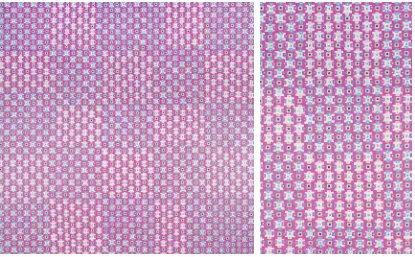
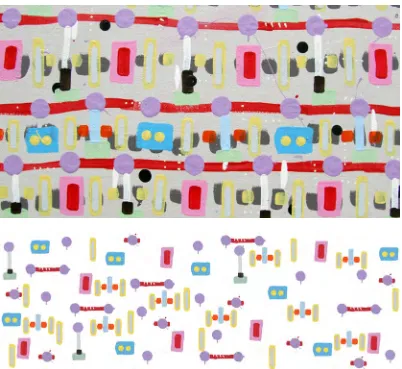
Figure 1: Mairi Ward, Number 03, 2009, house paint on linen, 152 x 152 cm. With detail. Figure 2: Mairi Ward, studio floor, Launceston, 2010
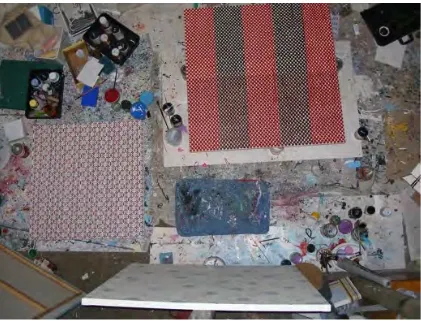
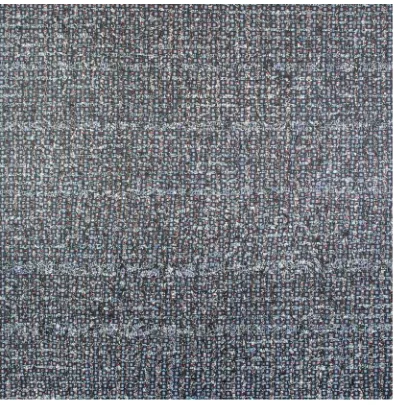
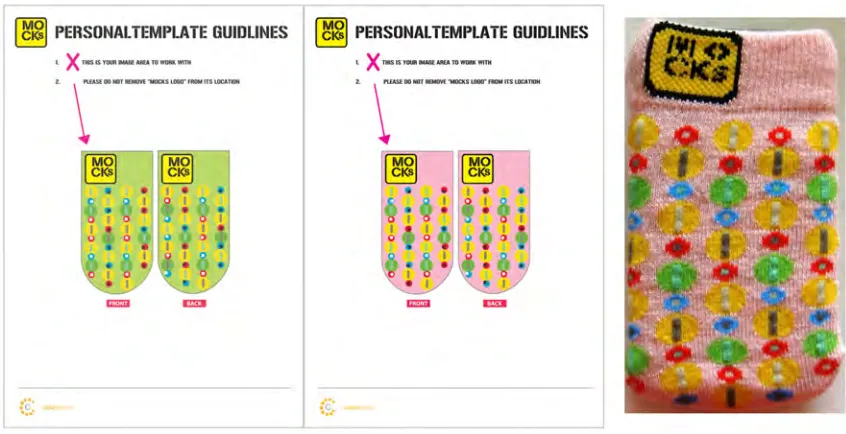
Figure 3: Mairi Ward, Number 05, 2010, ink and house paint on linen, 120 x 120 cm Figure 4: Mairi Ward, Strawberry Mocktail, 2009: initial design; final design; finished Mock Figure 5: Mairi Ward, 2009, Detail of painting and related digital repeat design
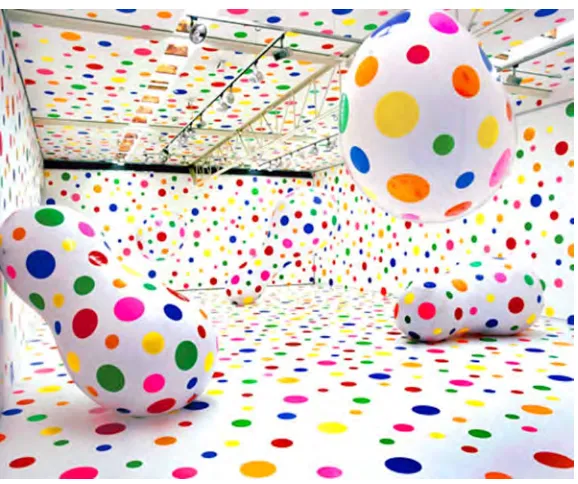
Figure 6: Yayoi Kusama, Dots Obsession – New Century, 2000, 2002, 11 balloons, vinyl dots, dimensions variable, installation, Roslyn Oxley9 Gallery
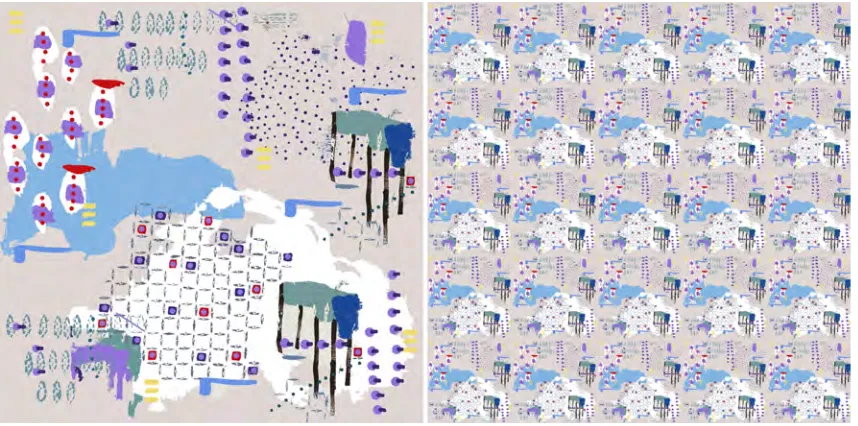
Figure 7: Mairi Ward, Play, 2010, digitalrepeat: individual repeat; example of the design repeated
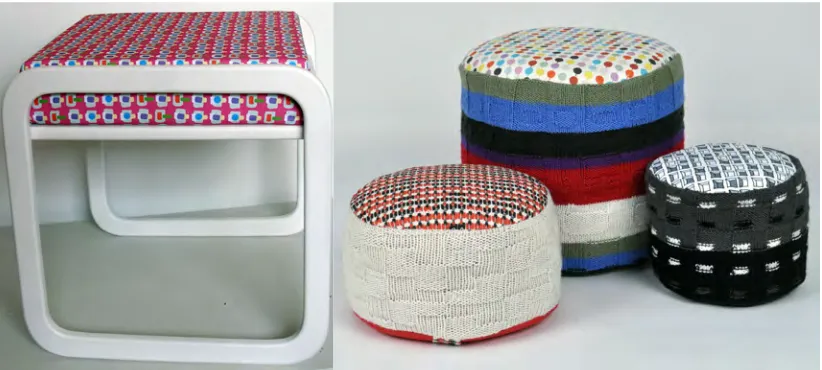
Figure 8: Stool, 2010, painted plywood and cushion, approximately 40x40x40cm. Knitted cushions, 2010, hand knitted wool with digitally printed fabric, various sizes
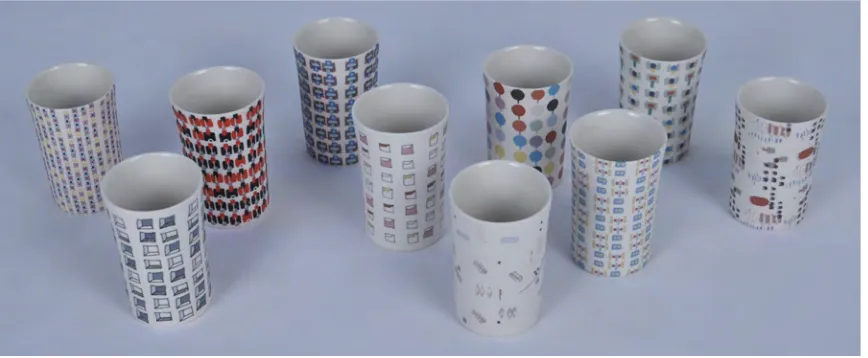
Figure 9: Mairi Ward (decals) & Bernadine Alting (ceramics), 2011, ten slip cast Southern Ice porcelain cups with digital ceramic decals
Figure 10: Mairi Ward, Bits n Bobs pattern, 2010, table lamp with digitally printed cotton, d 15cm, h 35 cm.
Figure 11: Mairi Ward, Splodge pattern, 2011, drum shaped ceiling pendant light shade, d 40cm, h 45cm.
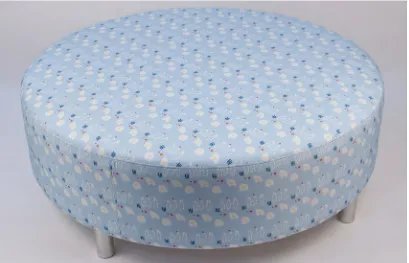
Figure 12: Mairi Ward, Soft Blue pattern, 2010, oversized ottoman with digitally printed 100% cotton upholstery weight twill, d 130 cm, h 45cm.
Figure 13: Dinosaur Designs, Skipping Stones, 2010, 100% New Zealand wool rug. Hanging at the back is one of their resin mobiles. Viewed 14 June 2011
<http://www.australiandesignreview.com/product/finishes/18950-Dinosaur-Designs-for-Designer-Rugs>;
Dinosaur Designs, range of vases, resin. Viewed 20 June 2011
<http://3.bp.blogspot.com/_LT1s706a3WI/SyBv9Em87FI/AAAAAAAAAcQ/gxU21t5B214/s160 0-h/image_for_Extinct.jpg>
Figure 14: Dinosaur Designs: cupboard with resin objects and ottoman made with fabric they designed. Viewed 18 November 2010,
<http://www.powerhousemuseum.com/designersatwork/gallery_single.php?ID=7&img=2>
Figure 15: Mairi Ward: Group of painting and ottoman, 2010
Figure 16: Marc Newson, installation view, 2007, Gagosian Gallery, New York. Viewed 4 January 2011
<http://www.gagosian.com/exhibitions/24th-street-2007-01-marc-newson/#/images/8>
Figure 17: Jorge Pardo, Project, 2000-2001, installation view, Dia Center for the Arts, New York. Viewed 12 June 2010 <http://www.diacenter.org/exhibitions/main/35>
Figure 18: Sonia Delaunay, Simultaneous Dresses, The Three Women, 1925, oil on canvas, Thysen Bornemisza Museum. Viewed 10 June 2011 <http://www.oceansbridge.com/oil-paintings/product/53057/simultaneousdressesthethreewomen1925>
Figure 20: Sonia Delaunay and Citroen, 1925. Viewed 14 January 2011
<http://justacarguy.blogspot.com/2010/03/sonia-delaunay-1925-design-for-clothes.html>; right, Sonia Delaunay and Matra,1968. Viewed 14 January 2011
<http://upload.wikimedia.org/wikipedia/commons/b/b8/MatraM530_SoniaDelaunay.JPG>
Figure 21: Andy Warhol and BMW, 1979. Viewed 14 January 2011
<http://www.seriouswheels.com/pics-abc/BMW-M1-Andy-Warhol-Art-Car-f-lr.jpg>; Takashi Murakami and Mercedes C-Class, 2008. Viewed 14 January 2011
<http://i239.photobucket.com/albums/ff217/paperboy187/takashi_murakami_007.jp>
Figure 22: Takashi Murakami, Eye Love Monogram, 2003, acrylic on canvas. Viewed 26 November 2011 <http://contemporaryartsem.wordpress.com/2008/12/28/modern-painters-2/artwork_images_1047_446413_takashi-murakami>;
Takashi Murakami and Louis Vuitton, Monogram, digital design. Viewed 26 November 2011 <http://nicholasspyer.files.wordpress.com/2010/02/murakami02a.jpg>
Figure 23: Takashi Murakami and Louis Vuitton, Mongramouflage, 2008. Viewed 17 August 2011 <http://www.highsnobiety.com/news/2008/04/03/louis-vuitton-x-takashi-murakami-monogramouflage>
Figure 24: Takashi Murakami and Louis Vuitton, Monogram design, 2008, printed on vinyl. Viewed 17 August 2011 <http://hypebeast.com/2008/11/louis-vuitton-flagship-store-wrapped-up-in-murakami>
Figure 25: Takashi Murakami, Flowerbomb costume, 2009. Viewed 17 August 2011 <http://wrongwroks.wordpress.com/2010/02/25/kirsten-dunst-x-takashi-murakami>
Figure 26: Gwyn Hanssen-Pigott, Cluster With Grey Bowl, 2009, translucent porcelain, 8 pieces. Viewed 12 Febuary 2011
<http://www.rexirwin.com/artists/gallery_artists/pigott/2009/pages/16-GHP-2009-Cluster-with-grey-bowl.htm>
Figure 27: Mairi Ward, Sherbet Forest, 2011, outdoor site specific installation, Greens Beach: Part of InTEERS for the Ten Days on the Island festival, Tasmania
Introduction
In this project I address how art and design converge in such a way that it becomes hard to separate them as processes and products. Starting with painting, the material outcomes of the project are a range of 2D and 3D objects made using imagery from my paintings. My painting practice is the core of this project; it is the driving force. My paintings are primarily abstract with a propensity towards pattern; they are built through a process of laying down many individual marks until patterns start to appear. I follow the processes used in my painting practice, as well as the way in which I move the paintings into a digital format, to create surface designs. The works made document the movement and changes of imagery from one surface to another, using a range of media.
I explore the notion of ‘practice as research and material thinking’, through Barbara Bolt’s ideas (Barrett & Bolt 2007 pp.27-34). I also consider the way I interact with the world, making reference to Martin Heidegger, in particular his notion of the ‘ready-to-hand’ (Heidegger 1962 pp.91-148). I recognise the importance of movement in the way humans connect as a part of the environment, as well as referring to Maurice Merleau-Ponty’s ideas about ‘how we live within the world’ (Merleau-Ponty 1964 p.163).
All things in this project are to be viewed as ‘objects’. I view myself as an object and I am exploring how I, as an object, engage with and impact on/with other objects from the perspective that I, as an object, am ‘caught up in things’ asserting that my ‘body is a thing among things’ (Merleau-Ponty 1964 p.163).
imagery from my paintings into a digital format. Once I had created the repeatable digital surface designs, I explored different applications for them, such as papers, fabrics and ceramic decals. Processes used to combine handmade qualities with the digital, as well as those involving working with manufactures, fabricators and other artist/designer/makers, have also been investigated.
Makers presently working in Australia are identified in the context of importance of the material connection, and how this impacts on the works they create. I consider how areas of my practice relate to this. Many makers work with other
artist/designer/makers, fabricators and manufactures, turning one-off handmade objects into small runs of objects. This leads to issues relating to finding appropriate collaborators and the processes they undertake. Dinosaur Designs, one of
Australia’s leading groups of makers, collaborate regularly. They have designed fabrics and rugs, using their trademark style of handmade resin objects as inspiration for these collaborations. This is similar to my process of taking imagery from my paintings onto other surfaces. Grouping of objects is important to the presentation of these collaborations, tracking how the ideas/imagery move between the different objects.
approaches are closely related to mine as they both have a strong painting practice they draw on when moving between different mediums and processes.
‘Simultaneous design’ is shown to be a key to ‘DesignArt’, where emphasis is placed on the importance of the grouping of objects. DesignArt is the title of a book by Alex Coles (2005), who defines the term as referring to ‘art that you can look at while you are sitting on it’ (Coles 2005 p.8). The book is about taking art that you normally just look at and making it into art that you interact with, drink from, sit on or wear. My practice travels from paintings onto fabrics that are used to cover domestic objects to live with, such as ottomans; moving from something you look at to something you sit on.
Finally, in presenting these objects I explore placement and how this impacts on the way objects are viewed. Artworks created for this project are made of groups of objects that include paintings, digital surface designs printed on archival paper, ottomans and lamps/lampshades, made using fabric that is digitally printed with my surface designs. The objects in each group have the surface design created from the painting within each group; the groups are to be viewed as one work. It is my
Chapter 1: Process
My artwork is inextricably linked to my everyday life. It is inspired by everything from walks along the river, repetition of flower petals, blades of grass or ripples on the water, to walks through department stores, repetitive circles in polystyrene and bubble wrap, repeating rows, windows and tiles. Repetition happens in my paintings as it does in life, from the repetitive action of applying paint to a canvas to that of breathing.
The artworks, whether made with paint, paper, clay, fabric or on a computer, all consist of layering simple marks through movements while watching them evolve and grow through repetition. In a sense the works present as decorative minimalism. Through repeating simple and minimal marks, nearly always made with one
movement, quite lavish and ornate surfaces are created (Fig. 1). The concepts and movements are pared back to almost nothing, just like breathing in and out, and moving backwards and forwards.
[image:11.595.91.506.467.724.2]
Habitual patterns become integral parts of the process. This eliminates the need for decision-making as it has been traditionally conceived. The process becomes intuitive, reflecting Maurice Merleau-Ponty’s idea that:
[O]ur bodies simply respond to given circumstances without the intervention of traditional philosophical conceptions of thought and/or intention. Our actions are solicited by the situations that confront us, in a constantly evolving way (Merleau-Ponty 1996 p.153).
Primarily I am interested in making as experience, as participation in life through movement and material connection.
Martin Heidegger, in his book Being and Time (1962), considers the way we interact with our tools and how people often don’t think about what they are doing until things go wrong. Heidegger’s philosophical methodology deals with things on a practical and immediate basis, which he calls the ‘ready-to-hand’ (Heidegger 1962 pp.91-148). The ‘ready-to-hand’ is a practical relationship to objects in the world, reliant on ‘the equipmental totality of the current equipment-world and of the public environment which belongs to it’ (Heidegger 1962 p.410). When truly engaged in a task, one is immersed in this ‘equipmental totality’ in such a way that one is an integrated component of it, not a conscious commander, a position I consider reflects my experience of making.
result of the more practical relation with the world, the ready-to-hand. It is this
practical engagement with materials that is central to my arts practice, whether using a paintbrush or a computer mouse. I engage with the world through hands-on interaction, that mode of being that Heidegger calls the ready-to-hand. The thinking and conceptualising of an artwork comes through an engagement with the tools of the trade, the materials.
Barbara Bolt talks about how one does not always know what one is doing at the ‘level of actual practice’ (Bolt 2004, p.43). When writing about what it is that ‘takes us out of ourselves…so that the work of art leaves the domain of representation to become experience’ (Bolt 2004, p.43), she suggests:
[I]t is through the handling of materials, methods, tools and ideas in practice, that art becomes experience. Thus it is at the level of eyes and hands that the work of art escapes from the frame of representationalism (Bolt 2004, p.48).
Bolt also talks of moments when one wakes up in the middle of the night and scribbles down words, saying that ‘cascades of words tumble out in a rush’ that are not ‘even necessarily grammatical’ (Bolt 2004, p.43). This is how I feel when I am making.
My making practice does not use a representational logic; it is processing information in a way where it does not have the time or the need to ‘coagulate in a
representation[al]’ way (Bolt 2004 p.44). When making I am improvising in a way that is not dissimilar to a jazz musician, drawing on embodied knowledge, mark-making techniques and habits that have been built up over time. Bolt suggests that when drawing:
emerges a multiplicity where many traces or marks refer back to other traces and the traces of others. In the process of doing, we find we are no longer in the grip of representation (Bolt 2004 p.35).
There are many similarities, both philosophical and material, between my making process and that of dance, because of an interest in the process, which is primarily due to the movement inherent in it. In 2007 choreographer Merce Cunningham was a featured guest at the Melbourne International Arts Festival. Maggi Phillip’s article ‘The simple fact of Merce Cunningham’ refers to Cunningham as ‘one of those artists who concern themselves with the profound mysteries of everydayness, of the
profundity of this act of movement which he fondly refers to as a ‘fact’’ ‘(Phillips 2007). Cunningham, when making a statement on ‘space, time and the dance’, said:
For me, it seems enough that dancing is a spiritual exercise in physical form, and that what is seen, is what it is. And I do not believe it is possible to be ‘too simple.’ What the dancer does is the most realistic of all possible things, and to pretend that a man standing on a hill could be doing everything except standing is simply to divorce – divorce from life…Dancing is a visible action of life (in Phillips 2007).
The objects I make are the outcome of a process that is a physical ‘action of life’. They are traces, or imprints, of my actions. I do not want to separate art from life or life from art. Art is a ‘fact’ of life.
collected (Fig. 2). It is usually not until I am in the studio that I decide what to work with.
Figure 2: Mairi Ward, studio floor, 2010
Making is a process of sensing, and sparks are ignited through the meeting of two objects; these sparks cause an impulse to start something, but once started that ‘something’ often doesn’t end up as imagined at the onset. This change is not an accident or a mistake; it is just the creative process at work. When making I don’t feel a sense of ownership or separation from all that is around me, I am part of the
environment. What’s being made is no more mine than it is that of the studio floor’s or the paintbrushe’s. When making I only see what has been made after I have stopped. There is no time to observe what is being made while making: it is made in the moment, in such a way that actions occur before I have had a chance to
longer be available, hence something of the process would always be lost. What remains of the process are the objects made, the concepts.
I believe my painting style is like punk music: an individual technique is developed, with no particular interest in the tradition of painting, or other mediums for that matter. I am simply doing something repeatedly until it feels right, or because it feels right; the more something is done, the more it is refined, building on its own sensibilities. The same but different; repetition in Western art is this. It is the act of repeating images but given the nature of something handmade every repeat is slightly different. Repetition has a long history in art and is very much a part of contemporary
practices. One definition for the word ‘repetition’, as it is used in art, suggests that repetition is an integral part of creativity:
Repetition may very well be the key concept of the twentieth century – although it certainly predates it. Don Quixote, for example, is an exercise in repetition: the same adventure over and over again, but somehow different each time. Indeed, difference is the key to repetition. After all, if there were no differences, every instance would remain the same thing, rather than be a reproduction of that thing. Repetition then, is a
concept of creativity, perhaps the concept of creativity: it is how the existing world is shaped into new worlds (Art+Culture 2010).
Figure 3: Mairi Ward, Number 05, 2010, ink and house paint on linen, 120 x 120 cm
Writing about art practices involves theorising about actions. It is relating to the world as an observer. I find this to be a very awkward position; it feels like life is
suspended. This is not the same as reflection, as reflection seems to happen naturally; it is a part of being alive. Writing about my art practice is like trying to observe how I exist in the world – a very difficult, I would say impossible, task. The objects made are not representations of anything. They are not about something; they are something. Making is thinking and actions are thoughts; there is no
I think there are lots of different kinds of thinking. Um you know your hands learn to do things that you could spend a whole day trying to write about and articulate. What’s intuition? I mean it’s a kind of thinking. It’s not stupidity (Stockholder 2005).
Being non-verbal is very important in my process and outcome. This is why I shy away from attaching words to a finished work. It is not anything to do with words; as Stockholder notes, ‘at the outset my work was about as non-verbal as you could get’ (Stockholder 2005). The non-verbal nature of my work is important to me. One of the reasons I enjoy making and being in the studio on my own is that there is no
pressure to be verbal, to ‘communicate’ with words.
Stockholder describes working on an installation as being ‘like sitting myself down with a bunch of coloured paints, many things could happen’ (Stockholder 2005). This is what I do. I sit down with a bunch of things around me and start making. I don’t care about the outcome – I just want to make. I have noticed a tendency for people to automatically presume that if you make something that is ‘aesthetically appealing’, the reason you made it was for the outcome. This doesn’t have to be the case; something can look ‘good’ without that being the intention. If I do something neat and orderly it is because that is what emerged, I’m not controlling or forcing anything, it is not contrived. What I always do when making is let things flow without obstruction. For instance, if I were to force my work to appear chaotic when this wasn’t how I felt, then that would be contrived. It is a common misconception that neat/ordered is un-natural. Neat does not have to mean forced! Order can naturally occur through a free flowing process, just as one can often see order within ‘nature’.
pre-determined end’ (Stockholder 2005). Stockholder believes this is what she does, and this is also how I approach my making practice. Stockholder goes on to say that her work is about pleasure, and although it might not always be pleasurable to make, she thinks pleasure is important (Stockholder 2005). Again, this is similar to my
approach, although I tend to use the word ‘happy’, rather than the more loaded idea of ‘pleasure’.
For me, the process is the outcome. It is simply a physical action of life. What is happening in my arts practice is a harmonious exchange between materials and myself, objects colliding in a state of equilibrium with what is. As Merleau-Ponty says, ‘whether a system of motor or perceptual powers, our body is not an object for an ‘I think’, it is a grouping of lived-through meanings which moves towards its equilibrium’ (Merleau-Ponty 1996 p.153)
Chapter 2: Paint to Print
I translate imagery from my paintings onto other surfaces. Transferring imagery/patterns from the paintings involves moving between surfaces, using different materials such as paints and computers. Obviously, an exact reproduction of a painting cannot be done, as printed images have very different qualities to paintings. For example, it is not like making different kinds of ceramic vessels, for even though thrown or slip-cast objects use different processes and have their own unique qualities, they are both made with clay. No related object will be the same as the original, although some will be more similar than others. Moving between
mediums is a process that can be very rewarding, often igniting new ideas and modes of expression in the movement back and forth. My intention with the digital repeat patterns was to keep the original shape/outline from the painting, as this is the visual link to the handmade. Colour and composition were often changed in order to create an outcome that worked and this was decided on the basis of what translated best.
The first digital design project I embarked on was a commission to design two ‘Mocks’, which are socks for mobile phones, in August 2009. This entailed reproducing patterns similar to my paintings in a digital format suitable to be
manufactured. The design brief for this gave me the opportunity to test my ability to work with specific limitations whilst creating something I was happy with. I found having a brief and working in collaboration was an enjoyable challenge. Italian furniture designer Vico Magistretti, when talking about collaboration, says:
far as the design’s realisation is concerned. Design objects are not born on the drawing board, but come into being where they are actually produced, in a continual exchange of
observations and suggestions (Magistretti 1991 p.6).
Designing the Mocks was a great opportunity to learn how to follow a brief and prepare images to be manufactured. It was a steep learning curve and had to be completed in a short time-frame. Originally, the intention was to use images of my paintings and place them into the template provided. It quickly became obvious that this was not an option as the pattern needed to be a repeat pattern, so that there was no noticeable join at the seam. Images were created similar to the paintings in
[image:21.595.90.513.348.565.2]Photoshop, using the basic tools such as the paintbrush tool. I created images that resembled my paintings.
Figure 4: Mairi Ward, Strawberry Mocktail, 2009: left, initial design; centre, final design; right, finished Mock
amount of colours used. The original brief allowed for up to nine colours; however, due to the intricate nature of my designs, and the limitations of the manufacturing technologies, this had to be changed to five colours per line. The challenge became to keep the same look and feel of the original.
The project was done entirely through email communication; it was a four-way conversation between myself (the artist/designer), the Co-op Bookshop (the initiating and commissioning body), Mocks (the company owning the brand) and the
manufacturers (based in China; they have an on-going relationship with Mocks). Once the final design was finished and sent it was only a few weeks until I was holding a product in my hand. It felt a bit like magic. However, the final products didn’t have a strong connection with the paintings, the handmade. For me, this is the crux of my practice; the paintings are what drive my whole approach and I wanted the new objects to have a strong visual connection. It was necessary to return to the drawing board to further explore how to make repeatable designs which retained the handmade feel of the original paintings.
scale of individual pieces is also able to be changed. I feel the process has been successful in achieving the desired outcome of the transferring of images from the paintings to the digital.
Although slight variations happen during the printing process, it is not to the same degree as the handmade.
I draw on a painting to create a repeatable digital image. Once I have created this I then adapt it to suit different mediums. Making something by hand involves working with the materials in collaboration; a push and pull occurs. However, when a machine is making something to a design, it obviously doesn’t have the ability to be sensitive to the materials in the same way. Usually when thinking of multiples of images and reproduction, printmaking is the first thing to come to mind. In the catalogue essay for
The Art of Reproduction Edward Colless states that:
The history of printmaking is made up of the periodic addition of techniques to its repertoire. Most typically, these techniques have not been created for the sake of making art. Lithography’s original intended application was as a cheaper means of
publishing musical manuscripts. Recent tools/techniques for printmaking are the photocopier and the computer; out of the myriad intentions for the micro-chip its exploitation in the field of printmaking certainly wasn’t predominant. Each of these various techniques tends to have certain visual characteristics which give it a particular kind of appearance; this is as true of an image (re)produced out of the photocopier or the computer as it is for an etching or a wood block (Colless 1995 p.10).
In contemporary practice, repetition, the multiple and reproduction has been extended into most art forms. Artist Yayoi Kusama incorporates these elements in her works, for example in her installation Dots Obsession – New Century, 2000 (Fig. 6). Kusama uses multiples of images and reproduction in a new way, with brightly coloured vinyl dots applied to all surfaces in the room as well as a series of
Figure 6: Yayoi Kusama, Dots Obsession – New Century, 2000, 2002, 11 balloons, vinyl dots, dimensions variable, installation, Roslyn Oxley9 Gallery
Initially I simply wanted to be able to transfer imagery from my paintings onto other objects. However, now the process of transferral has become an integrated part of my art practice. As Grace Cochrane, historian and curator notes:
Many craftspeople, like visual artists and designers, have successfully incorporated new tools into their working practices – as indeed, they have always done, from the use of electricity to the insulation materials of the space age (Cochrane 2007 p.12).
The addition of new skills, especially digital imaging and printing, has now become a part of my process, extending it into new directions and possibilities. I have taken imagery from my paintings into a digital format, creating surface designs.
Chapter 3: Material Connection
Material connection is reliant on physical contact with materials when creating the artwork. My work can be seen as part of the movement of many art, craft and design makers currently operating in Australia, away from mass-production and department store selling and back to ‘small specialist businesses producing handmade products for the high end market’, a move referring back to William Morris and the Arts and Crafts movement (Cochrane 2007 p.12).
The concept of the ‘designer maker’ is part of this turn towards artist/designer/ makers working in small studios and making objects for global niche markets. They are often re-learning skills that have been lost and replaced by machines, and must immerse themselves in their materials. This is not unlike William Morris’s approach. Morris believed that mastering material-specific techniques was an important part of being a designer. Morris was not against machines per se, but he was against the poor conditions of the people using them. He believed that beautiful things should be made in beautiful surroundings, by people who enjoyed making them (Kirby 2010). These beautiful objects should also be useful.
Handmade labour-intensive objects belong to a very different market to
In Australia, there is a new breed of artists who prefer to be called ‘makers’, who want to emphasize material connection and to avoid existing elitist stereotypes. These makers are working with manufacturers and embracing cutting-edge
technologies as a part of their practice. In many cases they work simultaneously as designer, maker and marketer. Material connection is what is important to makers; this is also what is important to me. Before the Industrial Revolution objects were made by craftspeople working in small studios/workshops, making limited runs of objects roughly to the same design, but with each piece inevitably a little bit different (Kirby2010). This is what many makers are doing now in Australia.
Object Gallery in Sydney has played an important role in recognising and displaying the work of contemporary Australian makers. In 2006 Object Gallery had a touring exhibition, Freestyle: New Australian Design For Living, an exhibition of Australian designers, put together by Brian Parkes. It was accompanied by a major publication, in which Parkes suggests that in Australia, ‘most successful designers are creating their own particular way of doing things, embracing a freestyle or approach to their practice’ (Parkes 2006 p.14).
Parkes states that ‘Freestyle’s particular emphasis on “design for living” is concerned with objects that are designed and made for use in our everyday domestic life – things that we might choose to clothe or adorn ourselves with or to decorate or use within our homes’ (Parkes 2005 p.15). This is one of the major concerns and emphases of my project/practice: making objects that come about through participation in everyday life, that are then used in everyday life.
making them, much like creating artworks for an exhibition. Makers currently working in this space display much of their work in galleries. Likewise my project involved the creation of small limited runs of objects. The objects I designed are displayed
alongside the painting with which the surface design began.
Parkes suggests that ‘one of the noticeable features of Australian design is the proportionally high percentage of designers who have emerged from, or maintain, a material-specific crafts practice’ (Parkes 2006 p.16). The material-specific practice that I have emerged from is painting; the surface designs that I create are made to reflect the handmade qualities in my paintings. The first step in getting my surface designs into the material world is to work with printers. My first collaboration was with digital textile printers. Digital textile printing allows for short runs of fabric. Digital textile printers are large-format inkjet printers that have been modified to print on fabric. This is a reasonably new technology and is starting to become more popular and in some cases it is replacing more traditional screen-printing methods.
For artist/designer/makers like myself, the ability to print small quantities is crucial. Why digital fabric printing? Initially I started hand-printing fabrics to resemble my paintings. I did this using a screen-printing method. However, after some time doing this I realised that I would prefer to be painting than printing and that this was not something I would pursue. I decided it would be best to take advantage of the digital technologies available to create the fabrics.
comprehensive web pages. The first place I was able to find that could print on natural fabrics, do small runs and allow me to order via the internet was
Imagescience.
Imagescience is a small business based in North Melbourne. They offer digital fabric printing in small runs on a limited range of fabrics, one of the few digital textile printers in Australia that have the technologies to print onto natural fabrics. They can print on cotton, silk or linen, the fabrics adhered to paper in order to make them suitable to go through the printer. The colour matching at Imagescience is incredibly accurate. Files prepared for printing are made to full-scale; for instance, to print a piece of fabric 112 cm wide by 50 cm it is necessary to provide an image of the same size. Imagescience was useful for doing tests and to see how the designs worked on fabrics; however, they had a few drawbacks. They had a limited range of fabrics, none of which were thick enough to do things like upholstery. Also, once printed, even after peeling the fabric off the paper, it retained small amounts of glue; this caused problems when the fabric was heated, for example when ironed.
Not able to source a place in Australia to create small runs of fabric to suit my requirements. I then found an innovative digital textile printer company in North Carolina, USA, called Spoonflower. The company is a part of the movement of makers and crafters producing small amounts of objects for themselves, as well as niche markets. They make it possible for individuals to print their own fabric with virtually no minimum amount. At first I was a little wary about going overseas to
Spoonflower was founded in May 1998. It is classed as a creative work force and receives support from the North Carolina Arts Council as well as the North Carolina State University College of Textiles, amongst others. Stephen Fraser, the co-founder
of Spoonflower, says that ‘one of the amazing things about Spoonflower…is that roughly 25% of our business has actually come from overseas’, from Canada, UK
and Australia (Fraser 2009b). This is quite unusual, as most textile manufacturing is
now done in Asia. Fraser says the company was his wife’s idea. She had wanted to
print her own fabric on a small scale and not been able to find anywhere to do it. Fraser saw no reason why it couldn’t be done, saying:
[Y]ou can digitally produce fabric just as you can digitally produce most things. It’s a little more expensive than mass-producing it. But if you create a front end using the Internet, there’s no reason that you can’t let people sort of do the creative work on their own, and produce a unique one of a kind product just for one person if you need to (Fraser November 2009).
Spoonflower is based in a former sock mill, a good example of a new business re-using old manufacturing facilities.
It has been suggested that ‘Spoonflower promises to be the most exciting and
revolutionary service to come along in the craft world since Etsy’ (Kight 2011), the
premier online market for handmade goods. Companies like Spoonflower have the
potential to revolutionise how small-scale fabric designers work. At Spoonflower they
use premium quality natural fabrics that are wash and light safe; they use
eco-friendly textile printing and there are no limitations to the amount of colours that can
be used. The fabric is printed ‘using pigments that are much safer and more
eco-friendly than typical fabric dyes’ (Fraser 2009a). Spoonflower have a very
shipping. This is important when living in a place like Tasmania, where it is crucial to be able to source materials/manufacturers on the internet, knowing they will arrive in good time.
Figure 7: Mairi Ward, Play, 2010, digitalrepeat: left, individual repeat; right, example of the design repeated
Now I had the fabric, what was next? I worked with printers as well as a range of different makers, including furniture makers, upholsterers, lampshade makers, seamstresses and ceramicists. The first people I worked with were two
seamstresses, Cheryle Houghton and Anna Zimmerman, making coin purses, ties and cushions. I also worked with my father, Ian Ward, who has a degree in fine furniture, to make a stool (Fig. 8, left). I designed the stool in Vector Works, with my father’s help in using the program, and he then handmade it from ply. It was
designed to be suitable to be machine cut out and easy to assemble. The design incorporated a place for a cushion on the top and was intended to mimic the shapes found in my paintings. I also experimented with knitting patterns to mimic my
Figure 8: left, stool, 2010, painted plywood and cushion, approximately 40 x 40 x 40 cm: right, knitted cushions, 2010, hand-knitted wool with digitally printed fabric, various sizes
From these experiences I decided that for this project I would restrict myself to the painting and surface design and work with others when moving into different mediums. I spent time learning basic slip-casting skills, in the hope of getting a feel for what sort of possibilities the ceramic medium had. Finding a ceramicist to collaborate with proved to be a difficult task; it was almost impossible to find
someone willing to make slip-cast ceramic vessels. Those that have the skill are not interested in doing work for others; they prefer to work for themselves.
Local ceramicist Bernadine Atling was happy to make some Southern Ice porcelain vessels and bisque-fire them for me, as a one-off. I then sanded and applied glaze to these before high-firing them in a gas kiln to 1300 degrees. Once they were fired I hand-polished them and applied digital ceramic decals before re-firing to 700 degrees (Fig. 9). To make the decals I uploaded a digital image to the Decal Specialists in Melbourne. This was printed on A3 sheets, which were cut up and applied to the ceramic forms. Although I liked doing this, I am still looking for
Figure 9: Mairi Ward & Bernadine Atling, 2011, 10 slip-cast Southern Ice porcelain cups with digital ceramic decals
[image:34.595.91.500.422.685.2]
Figure 10: left, Mairi Ward, Bits n Bobs pattern, 2010, table lamp with digitally printed cotton, 15 x 35 cm
Figure 11: right, Mairi Ward, Splodge pattern, 2011, drum shaped ceiling pendant light shade, 40 x 45 cm
As I was working with small businesses run by artist/designer/makers I have had to remain aware that they don’t want to be bombarded with too much work, as well as keep in mind the different time frames that operate when having something hand made. Because of this I have had small quantities of objects made at a number of different places. One of the things I like about working with small companies and in collaboration is that it allows each party involved to do the part that is best suited to them. It allows specialisation in one area, while joining forces means something can be achieved that could not be done alone.
Given the handmade nature of my objects, from painting to fabrication, each one captures a unique moment, or many moments. The process of surface design and object making is similar to my painting practice. The objects are built through a series of layers, and like the marks on my paintings, every one of them is different. Even though the fabric is digitally printed, which still has variations, the objects, such as the ottomans and lamps that are made with the fabric, are handmade. The difference in each object is what, to me, makes the process enjoyable. It is a constant
discovery, an unfolding of new ideas/objects.
They began making jewellery with resin early on. Brian Parks talks about Dinosaur Designs in the exhibition catalogue for Freestyle, which he curated, observing that:
They developed their own techniques and machinery to transform this non-precious industrial material into cherished pieces of contemporary jewellery. Casting in resin allowed them to retain the handmade qualities they sought, while providing them with the means to produce in multiple. With the inexhaustible variety of colours and casting techniques they use, and the extensive hand-finishing required, no two pieces are ever the same (Parkes 2006 p.106-7).
Dinosaur Designs has ‘consistently found new and ever-more innovative ways to use the resin in their work and have worked with industry to develop and refine the chemical formulae to suit their specialised needs’ (Parkes 2007 p.86). Handmade qualities have always been central to their work, and although they have been approached by many manufacture’s around the world, they have chosen to produce in-house and predominantly by hand.
Even though Dinosaur Designs is already a collaboration they also collaborate with others outside the organisation on a regular basis. In 2003 they collaborated with Woven Image to create a range of fabrics (Dinosaur Designs 2010). In 2004 they collaborated with Louis Vuitton to design resin chess pieces for a cancer fund-raiser auction. In 2006 they released a range of handmade 100 per cent New Zealand wool rugs and have since designed a range of six more rugs, featuring big bold shapes and bright colours (Fig. 13, left). The inspiration for these designs has come from the shapes of their signature resin homewares and jewellery. Using their three
Figure 13: Dinosaur Designs: left, Skipping Stones, 2010, 100 per cent, New Zealand wool rug. Hanging at the back is one of their resin mobiles; right, range of vases, 1992-2001, resin
Figure 14: Dinosaur Designs: cupboard with resin Figure 15: Mairi Ward: painting and objects and ottoman made with fabric they designed ottoman, 2010
Dinosaur Designs’ processes are similar to mine. The process involves taking a handmade object and then using this as a trigger to create works in different mediums that can be made in collaboration with others. Dinosaur Designs nearly always display their work in groups. These groupings are often a combination of their pieces alongside others from collaborations. Parkes, when talking about Dinosaur’s homewares, says ‘they could take a specific idea or theme and apply it across a multitude of functional objects’ (Parkes, in Dinosaur Designs 2010). Dinosaur Designs are among the growing number of makers presently working in Australia who display their objects at markets, in shops/retail outlets and in commercial and non-commercial galleries.
As I have already observed, there is a growing global interest in handmade objects produced on a small scale. In 2007 Grace Cochrane curated an exhibition entitled
[image:38.595.92.488.72.342.2]Australian and New Zealand artist/designer/makers, and was:
[A]bout design that reflects the values of the handmade. It looks at the decisions that a number of imaginative and enterprising people are making in putting handmade work into production. What has the handmade to do with design and industry these days? The reach of industry is increasingly global, and the handmade is, well – so personal and local. Or is it? (Cochrane 2007 p.8).
In this project I dealt with many of the issues that are addressed in Smart works, issues such as: local versus global, handmade versus machine-made, small
quantities versus mass production, just to name a few. I chose to keep things locally made, when possible. Obviously, in a small place like Tasmania, manufacturing and fabricating possibilities are going to be limited. Because of this I have looked for places that allow for ordering to be done via the internet, recognising it is important to acknowledge that every community is local to somewhere. This is neither a new nor a simple state of affairs, as Cochrane points out:
There are continual swings of interest between the traditional and the new – and for those in the southern hemisphere, even the issues of here and there. The interaction and sometimes contradictions, of how people choose to work and who they make their work for, resonate across centuries (Cochrane 2007 p.9).
Works of a similar nature to those in my project fit within a developing global niche market that celebrates the handmade while embracing new technologies. These global niche markets support objects being made on a small and intimate scale. For ‘those working on a small scale like those represented in Smart works, one solution is to enter that global manufacturing and marketing system in some way’ (Cochrane 2007 p.8).
to be certain that no one was being unfairly treated. I have no problem with having things made in places such as China, Thailand, or India, as long as the conditions of workers are good. In some cases choosing to have something made in a poor community and setting up a source of income can be of great benefit. Having the Mocks that I designed made in China and not knowing where was of concern. I would like to think it was an ethical company, but I don’t know. This egged me on to really think about these sorts of issues.
The appropriate means of producing designs is going to vary greatly in different mediums as well as in different regions of the world. I had fabric manufactured in the USA with a company that has ethical and environmental approaches which I agree with. I ordered my decals and other ceramic supplies from Melbourne. The lamps were handmade in Sydney and Queensland. Ottoman fabrication and upholstery was done in Launceston. I chose to work with people who are environmentally
responsible and have a similar attitude to the handmade to mine.
Chapter 4: Simultaneous Design
As my paintings are predominantly pattern based, this gives them a natural
propensity towards design. In this chapter I will discuss DesignArt and its relation to simultaneous design. I will discuss Marc Newson, internationally acclaimed
artist/designer/maker, in relation to the movement of Australian makers discussed in the previous chapter, and how his work fits into the category of DesignArt. I will also discuss the works and processes of Sonia Delaunay and Takashi Murakami in relation to my project. Delaunay and Murakami are particularly relevant as they both have strong painting practices to which they refer in creating other objects. They use a process of simultaneous design and move seamlessly between art, design and everyday life. I will briefly refer to Japanese textile designer Junichi Arai, in particular how he combines the handmade and new technology. The placement of the ‘same’ object in different contexts and how this impacts on the reading of it will also be considered.
Marc Newson is an artist/designer/maker who is very much a part of the current movement of Australian makers. This is confirmed with such comments as ‘I was always interested in process and materials’ and ‘my work is about a direct link between my head and my hands’ (Cochrane 2007 p.9). Newson works internationally, creating everything from small household items to jet plane interiors, but still he ‘continues to value and acknowledge his hands-on approach to design’ (Cochrane 2007 p.9). He places importance on material connection, the handmade and the use of modern technologies; this combination is where my practice sits,
although my products are not those of Newson. Newson approaches design as ‘a highly tactile and exacting exploration of materials,
activities in exclusive and mass production for more than twenty years’, at ‘a time when the distinctions between art and design are becoming increasingly blurred and hotly debated’ (Gagosian Gallery 2010).
In 2007 Newson had an exhibition of ‘unique pieces’ at Gagosian Gallery, New York (Fig.16). Gagosian is a high-end gallery, specialising in ‘art’. The inspiration for this exhibition was materials, Newson stating that ‘sometimes I start with the material, sometimes the idea. In this case the materials were the inspiration’ (Newson 2007). Newson’s exhibition
[image:42.595.90.518.401.711.2]Transport at Gagosian Gallery in September 2010 had people arguing about how to categorise his work, asking: is it art or design? Viewers found it problematic that he was ‘straddling both [worlds]’, making his objects hard to define (Luscombe 2011).
Newson’s web page has different categories for the types of objects he makes/designs. These are: products; interiors; transport; unique pieces; and
timepieces. Having the distinctions between the different types of objects he makes is interesting, as it highlights that one person can have many different modes of making and that these can come together to form a holistic practice. It is refreshing to see that one person does not need to be restricted to one means of creation.
Newson is ‘known internationally as the undisputed star of DesignArt’ (Newson 2009). DesignArt is a process of combining elements which would usually be specific to either art or design. John Heskett, in his book Design – A Very Short Introduction
(Heskett 2005 p.2), says that design as a word ‘is common enough, but it is full of incongruities, has innumerable manifestations, and lacks boundaries that give clarity and definition’. He goes on to say: ‘As a practice, design generates vast quantities of material, much of it ephemeral, only a small proportion of which has enduring quality’ (Heskett 2005 p.2). To me, this sounds much like ‘art’. Making a distinction between art and design is always difficult. I am convinced that art and design are no more different than one object, such as a painting or a chair, is to another.
Alex Coles in his book DesignArt says that:
Some people like to just gaze at art, others like to sit on it. To a large extent it depends on what kind of art it is and what you want from it. Of course, both approaches are valid, but in a way this book is about the type of art that you can look at while you’re sitting on it (Coles, 2005 p.8).
such as Gagosian: ‘Since specificity need not be forfeited just because an idea spans disciplines and media, a strategic simultaneity is thus a vital part of a design artist’s make-up’ (Coles 2005 p.47).
Figure 17: Jorge Pardo, Project, 2000-2001, installation view, Dia Center for the Arts, NYC
‘collaged into a blaze of simultaneous radiance’ (Vreeland 1986 p.9). Sonia Delaunay’s favourite word was ‘simultanée’, as this,
[image:45.595.185.411.232.526.2][C]ould mean seeing several things at once or seeing several aspects of one thing. To Sonia Delaunay, it also meant seeing a new creation from the sharp juxtaposition of previously disparate elements. Everybody who was truly modern knew that the world fused many strange and diverse perceptions; one had to respect them all while incorporating them as one (Vreeland 1986 p.9).
Figure 18: Sonia Delaunay, Simultaneous Dresses, The Three, 1925, oil on canvas
I have been making objects to live with, by which I mean objects that can be used in everyday life. The underpinning idea in my project is that art, design and life are not separate. Delaunay ‘coerced art, fashion and life into a single bold partnership; clothes were at last to be given the power and self-assurance of paintings’ (Vreeland 1986 p.8). This had already happened in other cultures, in Japan with the kimono for example, which simultaneously holds aesthetic and symbolic power. Japan has ‘always embraced the popular and the everyday while also celebrating craft skills’ (Sparke 2009 p.30).
This project involved me putting into practice the idea that art need not be separate from life, by creating paintings, fabrics, ottoman, lamps and so on. This was done with the aim that, when grouped together, the collective work becomes hard to separate into individual items, hence making it hard to define and categorise the objects. Sonia Delaunay had a similar notion and believed that art need ‘not be restricted to the studio or exhibition hall but should be integrated into all phases of life’. She confidently translated ‘her artistic theories into practice’, trespassing ‘freely across the border between fine and applied art, making her vision available in many media’ (Vreeland 1986 pp.7-8). In her ‘designs she incorporated the most radical aspects of her painting’, helping to create a new approach to art in the west (Vreeland 1986 pp, 7-8).
Figure 19: Mairi Ward, Red Group, 2010-2011: left, painting detail; top right, table lamp and ceramic vessels; bottom right, ottoman.
Figure 20: left, Sonia Delaunay and Citroën, 1925; right, Sonia Delaunay and Matra,1968
Many artists since Delaunay have collaborated with car companies. In 1979 Pop artist Andy Warhol collaborated with BMW by hand-painting one of their cars (Fig. 21). BMW has a history of ‘art cars’, having collaborated with other artists including Rauschenberg, Calder and Lichenstein. In 2005 Japanese pop artist Takashi Murakami, founder of ‘Superflat’, collaborated with Mercedes, applying digitally printed stickers/vinyl to a car (Fig.21).
Figure 21: left, Andy Warhol and BMW, 1979; right, Takashi Murakami and Mercedes C-Class, 2008
Like Delaunay, Murakami is ‘close to Warhol and Matisse in the way he rides the notion of simultaneity, opting to collaborate with others on…projects to effectively extend his ideas into new domains’ (Coles 2005 p.34). Murakami collaborates regularly with Louis Vuitton; one of their most wellknown collaborations being a limited edition range of handbags. Murakami adapted the original Louis Vuitton
[image:48.595.91.491.428.542.2]Figure 22: left. Takashi Murakami, Eye Love Monogram, 2003, acrylic on canvas; right, Takashi Murakami and Louis Vuitton, Monogram, digital design
In 2008 Vuitton and Murakami collaborated again, making a range of exclusive handbags, leather accessories, jewellery and clothing (Word is Bomb 2008). This collection features ‘the Mongramouflage which is a combination of a
camouflage pattern and Louis Vuitton’s famous monogram’ (Fig. 23) (Word is Bomb 2008).
Figure 23: Takashi Murakami and Louis Vuitton, Mongramouflage, 2008
In 2008 the same monogram design that was used in the 2003 handbag was used to cover the Louis Vuitton store on Fifth Avenue in New York. The building was
wrapped in large vinyl prints of Murakami’s monogram. The use of digital printing technologies has opened up so many possibilities for artists. I see a future for
[image:49.595.91.492.399.577.2]Figure 24: Takashi Murakami and Louis Vuitton, monogram design, 2008, printed on vinyl
Murakami keeps a range of icons on his computer that he uses to design surfaces for everything from wallpaper and handbags to stationery. He makes artworks as well as commercial products, all using similar imagery. Some of the commercial products are limited editions and others are not. I also have a range of small icons on the
computer that I use to create surface designs. These can be adapted to many different uses and I can mix and match small sections of different paintings together.
A snippet from a newspaper article about Murakami, wearing a costume made with his Flowerbomb design (Fig. 25) says:
Prolific contemporary Japanese artist Takashi Murakami had a good time at Art Basel Miami. We like to see an artist take his work seriously but at the same time be lighthearted too. Murakami did just that when he dressed himself up in a queer flowery suit of characters, green tights and flower covered kicks. Murakami is well known for blurring the lines between fine art and digital and commercial media. He takes pop culture motifs and turns them into thirty-foot sculptures, ‘Superflat’ paintings, or marketable commercial goods such as figurines or phone caddies. In Miami he caught our attention by taking a walk outside the box and getting us to laugh along with him. Thanks for some silly-ness man (Imagine Lifestyles 2008).
I find Murakami’s approach refreshing; he is determined to enjoy life and bring some fun and silliness to others too. His ‘SuperFlat’ style is very much about the ‘surface’, which also relates strongly to my work.
[image:51.595.91.252.387.641.2]
Figure 25: Takashi Murakami, Flowerbomb costume, 2009
almost as fine artists, capable of acts of creativity and poetry’ (Sparke 2009 p.33). Japanese weaver Junichi Arai has had a lasting impact on contemporary makers, having had a significant impact on Japanese design through the 1970s and 1980s. As a textile designer he ‘brought Japanese traditions…into the modern era’ (Sparke 2009 p.29). In the late 1970s ‘he was using computers to innovate’ as well as having a ‘continuing respect for Japanese tradition’ (Sparke 2009 p.29). This was:
reflected in his collaborations with the local craftspeople that create his products. His ability to cross the boundaries between art, craft, technology, and fashion renders the distinctions between those categories redundant (Sparke 2009 p.29).
Like Arai, I wish to combine the handmade with new technologies seamlessly. As new environments, mediums and techniques arise, so do new outcomes.
It is a ‘traditional Japanese belief that design should make everyday life more beautiful and more efficient’ (Sparke 2009 p.35). This is a belief echoing that of the earlier British Arts and Crafts movement, which I share. I am interested in making objects that make happy, positive and peaceful spaces. Obviously, this is limited to my own subjective sensibilities. The head designer at Ford says the function of kinetic design is to put a smile on your face and that the ‘objects we use in our everyday life tell a story of how we live as well as creating how we live’ (Kirby 2010). Objects create our world and they are our world.
Besson 2010). Each element needs another to create/reveal its potential. She is creating her own object language.
Figure 26: Gwyn Hanssen-Pigott, Cluster With Grey Bowl, 2009, translucent porcelain, 8 pieces
I undertook two significantly different projects while exploring the idea of
Figure 27: Mairi Ward, Sherbet Forest, 2011, outdoor site specific installation, Greens Beach: part of InTEERS for the Ten Days on the Island festival, Tasmania
The other project involved creating works for an exhibition in a traditional gallery space. This also gave me the opportunity to display the objects made in collaboration alongside hand-painted objects (Fig. 28). For me, this process of positioning objects in different contexts was been invaluable. I gained an understanding of how
Figure 28: Mairi Ward, installation shot of solo exhibition, 2011, paintings, ottoman, ceiling light and ceramics, Handmark Gallery Hobart, Tasmania
The grouping and positioning of objects was an integral part of my project. I was interested in building relationships between what could be seen as clashing or contradictory objects/ideas, and pushing through the often arbitrary boundaries and definitions that have been created for art, design and life. I hoped to pull these elements together in such a way that they become difficult to separate.
Conclusion
My process starts with the handmade, moves through the digital and then returns to the handmade. I move from painting to digital imaging to digital printing onto 2D surfaces, to the handmade 3D objects such as ottomans and lamps. The process does not end with the finished individual objects; an integral part is the selection, grouping and display. This defines how they relate to each other and the space they are situated in. The objects come together as a finished work in the installation and the groups of objects are to be viewed as one work. This notion of simultaneity is central to my work, shaping the way it is understood and read.
Being handmade, each one of my objects captures a unique moment. I am an artist who embraces digital technologies and working with others. The objects I make are very simple generic forms that show the surface pattern without distraction. It is my intention that the surface design becomes the object, in the same way it does on a painting.
objects, in a playful and experimental way, moving in new directions and combining elements of design and art in a way that they become a part of everyday life. This is done in the use and making of the objects. These are also the key ideas in my work.
The way in which I make and what I make reflects a way of engaging in life. I work as an artist/designer/maker. My practice is about being happy; I use colour and shape to create ‘happy’ objects. I would like the objects to communicate that it is okay to be happy and to play. If my artwork says anything, I would like it to be that it is important to enjoy life. I find happiness in making, but also in the presence of the objects made.
I’m happy to make use of digital printing technologies and work with others to fabricate objects if/when appropriate. I do not wish to make the same thing over and over. I like playing with the materials I use and this leads to changes. While making I am simply a cog in the machine/process. This is why material connection is crucial, as it is when I, as material object, collide with other material so that the making process exists.
Reference list
Art+Culture 2010, Repetition, viewed 10 January 2011, <www.artandculture.com/keywords/62>.
Bolt, B 2004, Art Beyond Representation: The Performative Power of The Image, IB Tauris, London and New York.
Barrett, E, Bolt, B (eds) 2007, Practice as Research: Approaches to Creative Arts Enquiry, IB Tauris, London and New York.
Cochrane, G (ed.) 2007, Smart Works: Design and the Handmade, Powerhouse Publishing, Sydney.
Coles, A (ed.) 2005, Design and Art, MIT Press, Cambridge, Mass, Whitechapel, London.
Colless, E 1995, Art of Reproduction, exhibition catalogue, Plimsoll Gallery, Hobart, Tasmania.
Dinosaur Designs 2010, Press & Projects: Collaborations, viewed, 26 June 2010, <http://www.dinosaurdesigns.com.au/press/page-100/image-9>.
Fraser, S 2009a, Printing Fabric Using Spoonflower, YouTube video, viewed 10 January 2011, <
http://www.youtube.com/watch?v=ZwW57bT6iOE&feature=related>.
Fraser, S 2009b, The Creative Workforce: Spoonflower, YouTube video, viewed 10 January 2011, < http://www.youtube.com/watch?v=grNSRHZI8xo>.
Galerie Besson 2010, Gwyn Hanssen Pigott: 9 June – 8 July 2010, viewed 5 June 2010, <http://www.galeriebesson.co.uk/hanssenpigott2010.html>.
Gagosian Gallery 2010, Marc Newson: Artist Biography, viewed 9 July 2010, <http://www.gagosian.com/artists/marc-newson>.
Heidegger, M 1962, Being and Time, J. Macquarrie & E. Robinson (trans), Blackwell , Oxford.
Heskett, J 2005, Design: A Very Short Introduction, Oxford University Press, Oxford. Luscombe, B 2011, ‘From Sydney to Sputnik: The design curve of Marc Newson’, Art & Australia, vol. 48, no. 4, winter 2011, pp.690-695.
Imagine Lifestyles 2008, Just Laughable: Artist Takashi Murakami, viewed 19 June 2010, < http://www.imaginelifestyles.com/luxuryliving/2008/12/just-laughable-artist-takashi-murakami#>.
Kight, K 2011, ‘Spoonflower’, blog, True Up: All Fabric, All the Time, viewed 10 January 2011, < http://www.trueup.net/fabric-news/spoonflower>.
Magistretti, V 1991, Vico Magistretti: Elegance and Innovation in Postwar Design:
Collaboration, compiled by Pasca, V, Thames, London.
Merleau-Ponty, M 1964, ‘Eye and mind’, in JM Edie (ed.), The Primacy of Perception and Other Essays on Phenomenological Psychology, the Philosophy of Art History, and Politics, trans. C Dallery, Northwestern University Press, Evanston
Merleau-Ponty, M 1996 (1945), Phenomenology of Perception, trans. C.Smith, Routledge, London.
Newson, M 2007, Marc Newson, Gagosian Gallery, viewed 9 July 2010, <http://www.gagosian.com/exhibitions/24th-street-2007-01-marc-newson>.
Newson, M 2009, Artscape – Marc Newson In Conversation 2009, ABC television, 15 September, interview with Fenella Kernebone.
Parkes, B 2006, Freestyle: New Australian Design for Living, Object – Australian Centre for Craft and Design, Sydney and Melbourne Museum.
Parkes, B 2007, ‘Dinosaur Designs’ in G Cochrane (ed.), Smart Works: Design and the Handmade, Powerhouse Publishing, Sydney.
Phillips, M 2007, ‘The simple fact of Merce Cunningham’, RealTime, no. 81, Sept – Oct, p.8.
Roslyn Oxley9 Gallery 2011, Yayoi Kusama – Dots Obsession, viewed 5 June 2011, <http://www.roslynoxley9.com.au/news/releases/2005/01/25/84>.
Sparke, P 2009, Japanese Design, Museum of Modern Art, New York.
Spate, V 1979, Orphism: The Evolution of Non-Figurative Painting in Paris, 1910 – 1914, Clarendon Press, Oxford.
Spoonflower 2010, About Spoonflower, Durham, USA, viewed 15 July 2010, <http://www.spoonflower.com/about>.
Stockholder, J 2005, interview with Art:21, Play, viewed 20 January 2011, <http://video.pbs.org/video/1239627128>.
Roslyn Oxley9 Gallery 2011, Yayoi Kusama 2002: Press release, viewed 8 June 2011, <http://www.roslynoxley9.com.au/news/releases/2002/04/11/21>.
Vreeland, D 1986, ‘Foreword’, Sonia Delaunay: Art into Fashion, G Braziller, New York.