City, University of London Institutional Repository
Citation
:
Calvo-Merino, B., Ehrenberg, S., Leung, D. M. H. and Haggard, P. (2010).
Experts see it all: configural effects in action observation. Psychological Research, 74(4), pp.
400-406. doi: 10.1007/s00426-009-0262-y
This is the accepted version of the paper.
This version of the publication may differ from the final published
version.
Permanent repository link:
http://openaccess.city.ac.uk/4519/
Link to published version
:
http://dx.doi.org/10.1007/s00426-009-0262-y
Copyright and reuse:
City Research Online aims to make research
outputs of City, University of London available to a wider audience.
Copyright and Moral Rights remain with the author(s) and/or copyright
holders. URLs from City Research Online may be freely distributed and
linked to.
Psychological Research
Running head: Expertise, configural processing and action perception.
This is the Authors’ Copy of the final post-review manuscript published as:
Calvo-Merino B
, Ehrenberg S, Leung D, Haggard P (2010) Experts see it all: configural effects in
action observation.
Psychological Research
. 74(4), 400-6
DOI: 10.1007/s00426-009-0262-y
Experts see it all: configural effects in action observation
Beatriz Calvo-Merino1, 2, Shantel Ehrenberg3, Delia Leung1, Patrick Haggard2
1 Psychology Department, School of Social Science, City University London, Northampton Square, EC1V
0HB, London, UK
2 Institute of Cognitive Neuroscience, University College London. 17 Queen Square, London, WC1N 3AR,
UK
3 Faculty of Humanities, School of Languages, Linguistics and Cultures, University of Manchester,
Manchester, M13 9PL and Dance Science, Trinity Laban, Creekside, London SE8 3DZ.
Corresponding Author:
Beatriz Calvo-Merino, Institute of Cognitive Neuroscience, University College London. 17 Queen square,
WC1N 3AR London, UK and Psychology Department, City University London, Northampton Square,
EC1V 0HB, London, UK.
Abstract
Biological motion perception is influenced by observers’ familiarity with the observed action. Here we
used classical dance as a means to investigate how visual and motor experience modulates perceptual
mechanism for configural processing of actions. While some ballet moves are performed by only one
gender, male and female dancers train together and acquire visual knowledge of all ballet moves. 24 expert
ballet dancers (12 female) and matched non-expert participants viewed pairs of upright and inverted point
light female and common dance movements. Visual discrimination between different exemplars of the
same movement presented upright was significantly better in experts than controls, while no differences
were found when the same stimuli were presented upside down. These results suggest expertise influences
configural action processing. Within the expert group, effects were stronger for female participants than for
males, while no differences were found between movement types. This observer gender effect could
suggest an additional role for motor familiarity in action perception, over and above visual experience. Our
Introduction
Other people’s actions are a rich stimulus, which is of high biological and social importance, but which pose significant computational problems for the brain’s perceptual systems. Specialised perceptual
mechanisms for movement perception, independent of body morphology, have been studied using point
light displays (Johansson, 1973). Limited motion information is enough for humans to identify not only
actions, but also emotions (Dittrich, Troscianko, Lea, & Morgan, 1996), gender (Cutting & Kozlowski,
1977), and oneself and friends (Loula, Prasad, Harber, & Shiffrar, 2005), even when local motion
information is degraded or masked (Cutting, Moore, & Morrison,1988).
The nature of biological motion perception has been focus of research in many laboratories. A particular
interest has been whether biological motion perception is learned through experience. Early developmental
studies in children between 3-5 month old were not completely able to fully address this issue because
results obtained with infants could always be accounted for by either innate or learning mechanisms.
However, a recent study (Simion, Regolin, & Bulf, 2008) showed innate predisposition for biological
motion in naïve newborn babies, and more interestingly, this effect was orientation-specific (upright
displays were preferred to inverted ones). Despite this evidence for an innate predisposition of the visual
system for biological motion, other studies have suggested that action processing may also involve
perceptual learning, as do most perceptual functions. Several studies showed better visual processing for
human biological actions compared to non-biological, artificial or novel movements (Jastorff, Kourtzi, &
Giese, 2006; Pyles, Garcia, Hoffman, & Grossman, 2007; Hiris, 2007), and for one’s own or friends’
actions compared to strangers (Loula et al, 2005). Biological motion perception might therefore also
depend on prior exposure or familiarity with a stimulus. Casile and Giese (2005) showed in an elegant
study that making an action, without actually seeing it, is sufficient for such familiarity effects (Casile &
Giese, 2005), suggesting that motor expertise has a specific influence on perceptual performance. This
result fits with the classical common coding models for action perception, in which representations of
external visual input overlap with the observer’s own motor representations of the same actions (for a wider
view of this model view Prinz, 1997; Hommel, Musseler, Aschersleben & Prinz, 2001). Evidence of motor
contributions to action perception has been reported using natural bodies (Knoblich & Flach, 2001), and
point lights displays (Loula et al, 2005) in person-recognition tasks.
Moreover, neuroimaging studies of action observation have likewise shown that neural activity is stronger
in premotor areas for familiar than for unfamiliar actions, suggesting a role of ‘motor resonance’ in
perceptual effects of expertise (Merino, Glaser, Grèzes, Passingham, & Haggard, 2005;
Calvo-Merino, Grèzes, Glaser, Passingham, & Haggard, 2006; Cross, Hamilton, & Grafton, 2006). Both visual
and motor familiarity play a role (Calvo-Merino, 2006). However, these studies did not focus on how
Here, we address this point by investigating effects of previous experience on human biological motion
processing, focussing on the distinct contributions of local and configural information processing.
Familiar and biologically relevant stimuli such as faces (Valentine 1988, for a review) and bodies (Reed,
Stone, Bozova, & Tanaka, 2003) are processed not only as local features, but also as complete patterns, or
‘configurations’. A hallmark of configural processing is the processing advantage for canonical (upright) compared to inverted stimuli. Similar inversion effects have been shown during perception of biological
motion. Depiction of point light walkers was harder when presented upside down compared to upright
(Sumi, 1988; Pavlova & Sokolov, 2000), suggesting that similar global configuration mechanisms are
needed for human motion. Although inversion performance improves with practice (Hiris et al, 2005,
Shiffrar & Pinto, 2002), this is due to the use of individual strategies based on local processing of
individual dots rather than a contribution of global mechanism for perceiving human figure. Besides faces,
bodies and actions, individuals with special expertise show the same inversion effect for specific stimuli
where they have acquired perceptual familiarity, such as birds and cars (Gauthier, Skudlarski, Gore, &
Anderson, 2000). However, it still remains unclear whether visuomotor expertise influences visual
processing of actions in a similar manner.
Here we investigate whether visual and motor expertise influence local and configural aspects of action
observation. Because biological motion perception from point-light displays is generally excellent (see
Blake & Shiffrar, 2007 for a review), and presumably improves further still in experts, we increased task
difficulty by using the very stereotyped actions of classical ballet that allow for only minor individual
differences. We used gender-specificity of these actions to dissociate visual and motor familiarity with
these stimuli (Calvo-Merino et al., 2006). In classical ballet, a subset of movements is gender-specific. All
dancers, irrespective of gender, have extended visual experience with all these actions, because of extensive
shared training. In contrast, only dancers of one gender will have motor experience for gender-specific
actions. Therefore, we compared visual discrimination performance for dance actions that varied in the
degree of the observer’s familiarity with the action (expert or non-expert), and in the nature of such
expertise (visual or motor). Finally, we compared performance for upright and inverted stimuli, to assess
whether any expertise effects were specific for actions presented in the canonical orientation (that would
engage configural processing mechanisms), or they represented the use of learned local analysis of the
motion patterns, that could be applied both to the canonical and inverted presentation.
Methods:
Participants: 24 professional ballet dancers (12f, 12m) and 24 aged-matched controls (12f, 12m) with no
dance experience participated (age 18–31). Dancers had at least 3 years of professional-level classical ballet
to participate in the study and were paid for participation. The study was approved by UCL Psychology
Department’s Ethics Committee.
Stimulus generation: Point light displays of standard classical ballet moves were created by modifying
Johansson’s classical technique (1973). Ballet movements were performed by three professional female
dancers wearing tight back clothes to which 13 reflecting markers were attached over major joints and the
head. A metronome ensured the dancers maintained a standard pace. With professional choreographic
assistance, we selected 8 classical ballet movements, balancing criteria of movement speed, extent of
whole-body displacement in space, and whether the movements were specific to female ballet dancers or
common to both genders. Several recordings were made of each dancer performing each movement. As
ballet movements are very stereotyped, the differences between each movement exemplar were small.
Videos were transformed to white dots on black background, and cut to 3 s clips.
We created pairs of videos showing different exemplars of the same ballet movement made by the same
dancer. However, these videos could be 1) identical (the second being a repeat of the first video) or 2)
different (two different exemplars of the same dancer repeating the same ballet movement on different
occasions). The ‘different’ pairs could therefore not be discriminated by morphological body clues, or by
idiosyncratic differences in movement style. Rather, discriminating between pairs of videos required
information about the dynamics of the movements per se (intra-individual differences in the execution of
the same ballet movement by the same performer) and not about differences between the individuals
performing them.
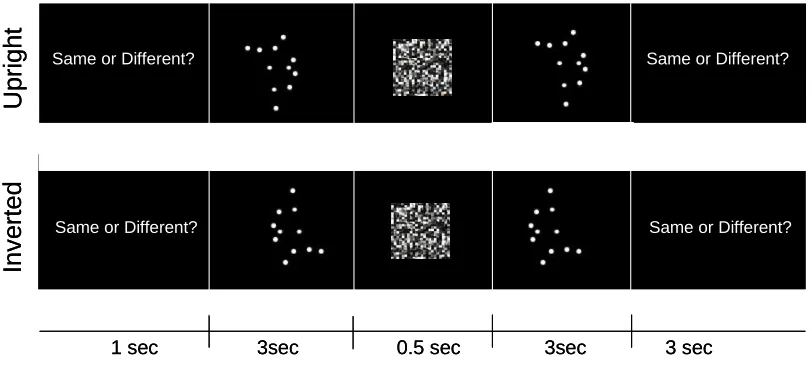
Procedure: Participants judged whether two videos shown in each pair were identical or not. Each trial
started with a black screen and a task reminder that lasted 1 s, followed by a 3 s video clip. A scrambled
mask of 500 ms followed, to avoid any perceptual imprint, followed by a further video clip. This was
obtained by scrambling a series of random black and white squares by means of Adobe Photoshop. The
words “same or different” then invited subjects to indicate unspeeded keypress responses (see Figure 1).
Each participant had brief initial familiarisation with example stimuli. They then performed six blocks of
48 trials each. Identical pairs and different pairs were equiprobable and randomised. Three blocks showed
pairs of point light movies of classical dance in its canonical upright orientation, whereas in the other three
blocks the videos were inverted (180o rotation). Orientation was blocked to encourage a configural mode of processing for upright stimuli. Block order was randomised.
Results
Visual sensitivity and expertise
Each observer’s visual sensitivity for detecting small difference within a pair was calculated as a d-prime
between-subject factors of expertise (expert (dancer); non-expert) and observer gender (female, male), and
within-subject factors of dance movement (female-specific, gender-common) and orientation (upright,
inverted). We found unsurprising main effects of expertise F(1,44)= 6.39; p=.015 and orientation F(1,44)=
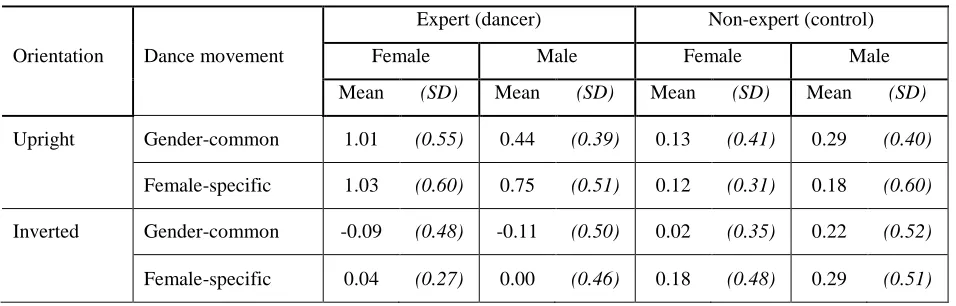
26.44; p<.001 (Figure 2, Table 1). More interestingly, there was a significant interaction between expertise
and orientation F(1,44)= 26.18; p<.001. Expert ballet dancers showed better visual discrimination than
non-experts for upright stimuli, while both groups showed similar sensitivity for inverted stimuli. We also found
an interaction between expertise and observer gender F(1,44)=4.92; p<.05. The observer’s gender had
stronger effects on perception for dancers than for non-dancers. There was no significant main effect of
type of dance movements (female-specific, gender common). No other effects or interactions were
significant.
We made planned comparisons using paired t-tests to reveal differences in visual sensitivity when the
action is presented in its canonical orientation or upside down. We found significantly higher sensitivity for
upright stimuli compared to inverted for both female dancers (t(11)=6.19; p<.001) and male dancers
(t(11)=3.30; p=.007). No inversion effect was found in the controls. Further, in the upright condition,
female dancers showed significant better sensitivity than male dancers (t(22)=2.27; p=.033), than female
controls (t(22)=5.02; p<.001) and male controls (t(22)=4.01; p=.001). Male dancers’ sensitivity in the
upright condition was also significantly higher than control females (t(22)=3.42; p=.002) and males
(t(22)=2.25; p=.035).
However, no group differences were found in the inverted condition. Dancers’ visual discrimination
benefitted from their expertise only when stimuli were presented in the familiar, canonical orientation.
Discussion
Our study investigated the role of experience in action perception by comparing movement experts and
non-experts in visual discrimination of highly stereotyped actions presented as point light displays. Visual
sensitivity measured by d‘ showed that experts were more sensitive than non-experts to the small
differences between movements when these were presented in their canonical orientation, while no group
difference were found for inverted stimuli. This result suggests that visual perception of biological actions
in their canonical orientation may involve configural processing mechanisms, and that this processing is
modulated by observer’s expertise.
We used gender-specificity of ballet moves to investigate whether visual or motor expertise underlies these
perceptual effects. Our female participants had both visual and motor experience of the gender-specific
dance actions performed by the female models, while male participants had only visual experience of these
moves. We found reliable gender differences in the expert group, where females showed higher sensitivity
two results taken together might suggest that purely visual experience of the actions, such as the male dancers in our study had, is sufficient to develop sensitivity to that action within biological motion
perception mechanisms. The better performance of female experts could then indicate an additional
contribution of motor experience to visual configural processing. This possibility should, however, be
considered with caution, because of the lack of significant differences between gender-specific and
common moves in the male dancers, and because our study did not include test male and female dancers’
judgements of movements performed by males. For example, female dancers’ visual discrimination
performance might be better than male dancers because the observed moves are always performed by a
female dancer. Therefore females might undergo stronger resonance than males with the female dancer's
body depicted through the point lights. However, in addition to the question of gender-specificity, our
finding of a clear link between expertise and stimulus orientation suggests a strong role of experience in
action processing and configural mechanism.
Our result has important implications for action perception in three different ways. First, we tested for the
first time discrimination within natural variations across repetitions or exemplars of an action. Other studies
have focussed on person-identification or self-recognition (Loula et al., 2002; Cutting & Kozlowski, 1977;
Dittrich et al., 1996) or sensitivity to instructed modulations of common motor patterns (Casile & Giese,
2006). In contrast, our participants discriminated natural variations of the same action performed by the same individual. Since the actions were highly stereotyped, this strategically pushed action perception to
its processing limits, and indeed d’ values were generally low. Second, we showed that processing of
familiar actions might benefit from configural mechanisms. And finally, these mechanisms are enhanced
by previous motor and visual experience.
Visual and motor expertise enhance biological motion sensitivity
It has previously been reported that motor knowledge is sufficient to perform visual discrimination between
different biological motion patterns (Casile & Giese, 2006; Hecht, Vogt, & Prinz, 2001). Here we show
that both visual and motor expertise significantly improved discriminating between natural variations of the
same action, relative to naïve observation. We also found increased sensitivity in the female dancer group.
This sensitivity might reflect an effect of their motor experience was over and above visual experience of
the observed actions which they shared with male dancers, or an effect of seeing a dancer of your own
gender whose motor experience is closer to your own. The lack of a corresponding difference for the male
dancers limits further conclusions. Overall, these results suggest that both visual and motor experience
plays a major role in biological motion perception.
Loula et al. (2005) recently reported that visual familiarity enhances biological motion perception.
However, their participants had to discriminate between movements displaying strong idiosyncratic
discriminating more stereotyped actions such as walking. Here, we minimised idiosyncratic variability by
using trained performers in produce very stereotyped movement stimuli from the classical ballet repertoire,
and by requiring participants to discriminate between different performances of the same stereotyped
movement made always by the same individual. People often make important decisions based on subtle
features of others’ actions –and sometimes these features seem barely perceptible. Our result shows that our
perceptual system can learn very subtle biological motion perception, based not only on previous visual
experience, but more strongly on motor experience.
Expertise and configural processing
Visual discrimination of very stereotyped actions was only possible when subjects had previous familiarity
with the observed action, and the stimuli were presented in its canonical orientation. Visual discrimination
was extremely difficult for individuals with no familiarity with the actions (control group) in both upright
an inverted conditions. Despite the difficulty of the task, expert observers benefited from a different
mechanism that increases visual sensitivity to the movements only when these were presented in their
canonical orientation. Ever since Yin’s (1968) classical paper, inversion effects have been taken as a
diagnostic for configural processing. Many studies (using faces) have investigated individual components
that might contribute to configural processing or inversion effects: sensitivity to first-order relations,
holistic processing, and sensitivity to second-order relations (for a review, see Maurer et al., 2002).
Although the design of this study does not allow for such precise inferences, analogy with previous studies
of configural and local processing for faces (Valentine, 1988), and bodies (Reed et al., 2003) leads us to
suggest that configural processing is involved in observation of familiar movements. Further, we have
presented evidence that this mechanism could be enhanced by motor familiarity with the observed action. Importantly, the configural information available in our task is information about movement rather than
static form on which most previous studies focussed. Our stimuli contained minimal morphological
information, this information was equally available to both expert and controls groups) and, we compared
movement exemplars performed by the same individual. In these circumstances, configuration is unlikely
to be a property of static body morphology. Our results therefore go beyond the static body inversion effect
(Reed et al., 2003), and point towards an action-inversion effect.
Configural processing has been identified both with influences of visual experience on perceptual
mechanisms (Bukach, Gauthier, & Tarr, 2006), but also with an innate priority system for perceiving
biological relevant stimuli (Farah, Rabinowitz, Quinn, & Liu, 2000). Here we show evidence of a possible
configural mechanism for action processing, over and above other possible parallel mechanisms for configural body processing depicted through the point lights. The surface form of these stimuli was
presumably not highly familiar to our participants. However, dancers, who had previous visual and
and the representations learned go beyond the surface visual characteristics of the image portraying the
action.
We suggest that when observers recognized movements in their canonical orientation, they automatically
use a different mechanism for perceiving -such as configural processing- that facilitates performance. To
this extent, the human brain must contain a distinct category of action representations, distinct from body
representations. These representations are characterised by configural rather than local detail. When an
action is unfamiliar, we might use low-level strategies (for example comparing the relative position of
individual dot pairs) to accomplish the task. This last process appears to be common to experts and
non-experts, and is available whatever the stimulus orientation.
Conclusion
In summary, this study provides experimental evidence that a specific configural perceptual mechanism
boosts biological motion sensitivity when we observe actions that are familiar. This mechanism might be
tuned differentially when the observer had previous motor knowledge or visual experience with the
observed action. Crucially, our design shows that this mechanism processes specific actions rather than individual actors, static body morphologies, local visual details or superficial visual properties of action
images. To this extent, our data support the concept of actions as a distinct perceptual class, processed by
specialised functional modules. Further studies may investigate the relation between these functional
modules and specialised areas or circuits in the human brain that are activated by observation of familiar
actions (Calvo-Merino et al., 2005; Buccino et al., 2004). Dedicated mechanisms for processing the actions
of conspecifics are vital for social interaction. The strong roles of prior motor and visual experience, and of
canonical orientation, in our study suggest that this development occurs at the level of individual
experience rather than at evolutionary scales (Heyes, 2003). Finally, we show that the configural action
perception mechanism benefits from both visual and motor familiarity with the observed action.
Importantly, our data suggest a specific influence of acquired motor representations on basic visual
discrimination processing, over and above purely visual familiarity effects.
Acknowledgements
We are grateful to Andrea Serino, Corinne Jola and Manos Tsakiris for initial discussion, to the Laban
Centre (London) for help in preparing the stimuli and to the dancers that participated in this study. BC-M
and PH were supported by grants from the Leverhulme Trust. BC-M was further supported by the
Economical and Social Research Council (ESRC -PTA-026-27-1587) and a City University Fellowship
References
Blake, R., & Shiffrar, M. (2007). Perception of human motion. Annual Review of Psychology, 58, 47-74. Buccino, G., Lui, F., Canessa, N., Patteri, I., Lagravinese, G., Benuzzi,, F., Porro, C.A., Rizzolatti, G.
(2004) Neural circuits involved in the recognition of actions performed by non-conspecifics: an
fMRI study. Journal of Cognitive Neuroscience, 16, 114-126.
Bukach, C.M, Gauthier, I., & Tarr, M.J. (2006) Beyond faces and modularity: the power of an expertise
framework, Trends in Cognitive Sciences, 10, 4, 159-166.
Calvo-Merino, B., Glaser, D. E., Grèzes, J., Passingham, R. E., & Haggard, P. (2005). Action observation
and acquired motor skills: an FMRI study with expert dancers. Cerebral Cortex, 15, 1243-1249. Calvo-Merino, B., Grèzes, J., Glaser, D. E., Passingham, R. E., & Haggard, P. (2006). Seeing or doing?
Influence of visual and motor familiarity in action observation. Current Biology, 16, 1905-1910. Casile, A., & Giese, M. A. (2006). Nonvisual motor training influences biological motion perception.
Current Biology, 16, 69-74.
Cross, E. S., Hamilton, A. F. D. C., & Grafton, S. T. (2006). Building a motor simulation de novo:
Observation of dance by dancers. Neuroimage, 31, 1257-1267.
Cutting, J. E., & Kozlowski, L. T. (1977). Recognizing friends by their walk - Gait perception without
familiarity cues. Bulletin of the Psychonomic Society, 9, 353-356.
Cutting, J. E., Moore, C., & Morrison, R. (1988). Masking the motions of human gait. Perception & Psychophysics, 44, 339-347.
Dittrich, W. H., Troscianko, T., Lea, S. E. G., & Morgan, D. (1996). Perception of emotion from dynamic
point-light displays represented in dance. Perception, 25, 727-738.
Farah, M J., Rabinowitz, C., Quinn, G. E., & Liu, G.T. (2000) Early commitment of neural substrates for
face recognition. Cognitive Neuropsychology, 17, 1-3, 117-123(7).
Gauthier, I., Skudlarski, P., Gore, J.C., & Anderson, A.W. (2000) Expertise for cars and birds recruits
brain areas involved in face recognition. Nature Neuroscience, 3, 191-197.
Hecht, H., Vogt, S., & Prinz, W. (2001). Motor Learning enhances perceptual judgement: a case for action
perception transfer. Psychological Research, 65, 3-14
Heyes, C. (2003). Four routes of cognitive evolution. Psychological Review, 4, 713-727.
Hiris, E., Krebeck, A., Edmonds, J., & Stout, A. (2005). What learning to see arbitrary motion tells us
about biological motion perception. Journal of Experimental Psychology: Human Perception and Performance, 31, 1096–1106.
Hiris, E. (2007). Detection of biological and nonbiological motion. Journal of Vision, 7 (12):4, 1-16. Hommel, B., Musseler, J., Aschersleben, G., & Prinz, W. (2001). The theory of event coding (TEC): a
framework for perception and action planning. Behavioral Brain Science, 24, 849–937.
Jastorff, J., Kourtzi, Z., & Giese, M. A. (2006). Learning to discriminate complex movements: biological
Johansson, G. (1973). Visual perception of biological motion and a model for its analysis. Perception & Psychophysics, 14, 202-211.
Knoblich, G., & Flach, R. (2001). Predicting the effects of actions: interactions of perception and action.
Psychological Science, 2, 467–72
Loula, F., Prasad, S., Harber, K., & Shiffrar, M. (2005). Recognizing people from their movement. Journal of Experimental Psychology: Human Perception and Performance, 31, 210-220.
Maurer, D., Le Grand, R., & Mondloch, C.J. (2002). The many faces of configural processing. Trends in Cognitive Science, 6, 255-260.
Pavlova, M., & Sokolov, A. (2000). Orientation specificity in biological motion perception. Perception & Psychophysics, 62, 889-899.
Prinz, W. (1997). Perception and action planning. European Journal of Cognitive Psychology, 9, 129–54. Pyles, J. A., Garcia, J. O., Hoffman, D. D., & Grossman, E. D. (2007). Visual perception and neural
correlates of novel 'biological motion'. Vision Research, 47, 2786-2797.
Reed, C. L., Stone, V. E., Bozova, S., & Tanaka, J. (2003). The body-inversion effect. Psychological Science, 14, 302-308.
Simion, F., Regolin, L., & Bulf, H. (2008). A predisposition for biological motion in the newborn baby.
Proceedings of the National Academy of Science, 105 (2), 809-813.
Shiffrar, M., & Pinto, J. (2002). The visual analysis of bodily motion. Common mechanisms in perception and action: Attention and Performance, Vol. XIX. (Prinz, W., & Hommel, B., Eds.) Oxford: Oxford University Press, 381-399.
Sumi, S. (1984). Upside-Down Presentation of the Johansson Moving Light-Spot Pattern. Perception, 13, 283-286.
Valentine, T. (1988). Upside-down faces - A review of the effect of inversion upon face recognition.
British Journal of Psychology, 79, 471-491.
Experts see it all: configural effects in action observation (Calvo-Merino et al.)
Table 1: d’ mean values for performance in upright and inverted conditions as a function of observers’
expertise (expert (dancer); non-expert) and gender (female, male) and within-subject factor of dance
movement observed (female-specific, gender-common), and orientation (upright, inverted).
d’ mean values
Expert (dancer) Non-expert (control)
Orientation Dance movement Female Male Female Male
Mean (SD) Mean (SD) Mean (SD) Mean (SD)
Upright Gender-common 1.01 (0.55) 0.44 (0.39) 0.13 (0.41) 0.29 (0.40)
Female-specific 1.03 (0.60) 0.75 (0.51) 0.12 (0.31) 0.18 (0.60)
Inverted Gender-common -0.09 (0.48) -0.11 (0.50) 0.02 (0.35) 0.22 (0.52)
[image:13.612.89.567.190.343.2]Experts see it all: configural effects in action observation (Calvo-Merino et al.)
Figure 1: Schematic of a typical upright and inverted trial. Pairs of videos showed same or different
exemplars of the same ballet movement performed by the same dancer.
3sec
Up
right
Inve
rted
3sec
0.5 sec 3 sec
1 sec
Same or Different?
Same or Different?
+
+
Same or Different?
Same or Different?
3sec
Up
right
Inve
rted
3sec
0.5 sec 3 sec
1 sec
Same or Different?
Same or Different?
+
+
Same or Different?
[image:14.612.96.502.152.335.2]Experts see it all: configural effects in action observation (Calvo-Merino et al.)
Figure 2: d‘ as a function of factors of participants’ expertise (dancer/non-dancer), gender (female/male)
and stimulus orientation (upright/inverted). Vertical bars indicate standard error. For simplification
purposes, common and gender specific dance movements have been combined. See Table 1 for full
information. -0.2 0.0 0.2 0.4 0.6 0.8 1.0 1.2 1.4 d' Upright stimuli Inverted stimuli
Female Male Experts (dancers)
Female Male Controls (non-dancers) GROUPS -0.2 0.0 0.2 0.4 0.6 0.8 1.0 1.2 1.4 d' Upright stimuli Inverted stimuli
Female Male Experts (dancers)
Female Male Controls (non-dancers)
GROUPS Female Male
Experts (dancers)
Female Male Controls (non-dancers)