City, University of London Institutional Repository
Citation
:
Mamouei, M. H., Kaparias, I. and Halikias, G. (2016). A quantitative approach to behavioural analysis of drivers in highways using particle filtering. Transportation Planning and Technology, 39(1), doi: 10.1080/03081060.2015.1108084This is the accepted version of the paper.
This version of the publication may differ from the final published
version.
Permanent repository link: http://openaccess.city.ac.uk/13114/
Link to published version
:
http://dx.doi.org/10.1080/03081060.2015.1108084Copyright and reuse:
City Research Online aims to make research
outputs of City, University of London available to a wider audience.
Copyright and Moral Rights remain with the author(s) and/or copyright
holders. URLs from City Research Online may be freely distributed and
linked to.
City Research Online: http://openaccess.city.ac.uk/ [email protected]
A quantitative approach to the behavioural analysis of drivers in
highways using particle filtering
Mohammad Mamouei
1School of Mathematics, Computer Science and Engineering, City University London,
London, United Kingdom
Ioannis Kaparias
School of Mathematics, Computer Science and Engineering, City University London,
London, United Kingdom
George Halikias
School of Mathematics, Computer Science and Engineering, City University London,
London, United Kingdom
1 Corresponding author: Mohammad Mamouei
A quantitative approach to behavioural analysis of drivers in
highways using particle filtering
The analysis of driving behaviour is a challenging task in the transport field that
has numerous applications, ranging from highway design to micro-simulation and
the development of advanced driver assistance systems (ADAS). There has been
evidence suggesting changes in the driving behaviour in response to changes in
traffic conditions, and this is known as adaptive driving behaviour. Identifying
these changes and the conditions under which they happen, and describing them
in a systematic way, contributes greatly to the accuracy of micro-simulation, and
more importantly to the understanding of the traffic flow, and therefore paves the
way for introducing further improvements with respect to the efficiency of the
transport network. In this paper adaptive driving behaviour is linked to changes in
the parameters of a given car-following model. These changes are tracked using a
dynamic system identification method, called particle filtering.Subsequently, the
dynamic parameter estimates are further processed to identify critical points
where significant changes in the system take place.
Keywords: adaptive driving behaviour; particle filtering; car-following models;
dynamic system identification, calibration
Acknowledgement:
The research reported has been supported by City University London’s Doctoral
Studentships scheme. The authors would also like to thank the anonymous reviewers for
their constructive comments.
1. Introduction
Studying the body of literature on micro-simulation points to the difficulty of
representing the dynamics of driving under different traffic conditions and for different
drivers by a single mathematical equation. There have been studies reporting that the
behaviour of different drivers is best represented using different model structures
that different drivers drive according to different models. Furthermore, individual
drivers also exhibit different driving patterns in different traffic conditions, a
phenomenon that has been identified by many researchers (Munoz and Daganzo 2002,
Ma and Andréasson 2007, Hoogendoorn, et al. 2006). The very fact that the calibration
of car-following models is highly dependent on the driving condition, as confirmed by
numerous studies (such as Punzo and Simonelli (2007), Ossen and Hoogendoorn (2008)
and Kesting and Treiber (2009)) is further testimony of the existence of this
phenomenon.
Much research has partly addressed the issue of adaptive driving behaviour by
developing multi-regime car-following models, which are able to achieve greater
accuracy in the reproduction of the driving behaviour. Notable examples include the
models proposed by Wiedemann (1974), Yang and Koutsopoulos (1996) and Fritzsche
(1994), implemented in the VISSIM, MITSIM, and Paramics micro-simulation software
tools, respectively. However, while the passive reproduction of driving behaviour is a
significant improvement, important questions that remain open are whether it is possible
to actively identify the conditions under which changes in driving behaviour happen,
and in what way these conditions may be affecting the driving behaviour. As a matter of
fact, being able to identify and represent the drivers’ adaptive behaviour in
micro-simulation would bring about even greater improvements in terms of modelling
accuracy and would deliver a better insight into the traffic flow.
Some previous research in the direction of identifying and modelling adaptive
driving behaviour exists. Notably, Ma and Andréasson (2007) used data collected from
an instrumented vehicle to identify different regimes of driving and applied a fuzzy
clustering method to a combination of accelerations and velocities of lead and follower
Thiemann, Treiber and Kesting (2008) calculated probability density functions for
headways from a large dataset of vehicle trajectories and identified a significant
correlation between the headway and driving-behaviour-related variables, such as
speed, approach speed and traffic condition. Treiber, Kesting and Helbing (2006)
proposed a general adaptation method that can be integrated within a wide range of
car-following models, which essentially states that the headway in smooth traffic flow
increases linearly with variations in the local traffic conditions; a measure for
representing these variations was then given, and the model was calibrated empirically
using data from a Dutch highway. And Hoogendoorn et al. (2006) used a method called
particle filtering to calibrate two car-following models dynamically (the
Gazis-Herman-Rothery (GHR) and the Helly models), which allowed the model parameters to vary at
each time instance in order to minimise the estimate error, as opposed to static system
identification methods requiring the whole set of time series data to be used to find the
single set of parameters resulting in least error.
Building on the work of Hoogendoorn et al. (2006), the aim of this study is to
investigate the possibility of utilising particle filtering for purposes beyond the simple
demonstration of variations in model parameters. Specifically, the main objective is to
analyse whether a link between changes in the model parameters and external stimuli or
driving conditions can be established. Deriving a conclusion in this regard will deliver
two significant benefits: on one hand, such information will help gain a better insight
into traffic dynamics and dynamic driving behaviour, with corresponding improvements
in micro-simulation modelling; on the other hand, it will enable the assessment of the
capabilities of car-following models on the basis of the robustness of their parameter
estimates and of their ability in accounting for different driving phenomena. For
this deficiency will exhibit itself in the form of systematic changes in the model
parameter estimates, when the phenomenon becomes present.
The rest of this paper is organised as follows: the background of the study,
including an overview of previous relevant work on the topics of car-following models,
calibration methods and particle filtering is given in Section 2. Section 3 presents the
application of particle filtering to a simulated dataset and proposes a simple method for
the discretisation of the dynamic parameter estimates, so as to facilitate the
identification and analysis of dynamic driving behaviour. Section 4 then applies the
proposed method on a vehicle trajectory dataset from a real highway and discusses the
results. Finally, Section 5 summarises the conclusions and identifies areas of future
work.
2. Background
Car-following models, and acceleration models in general, describe the behaviour of
human drivers. These models, integrated in simulation software, are used to assess
policy-making in various fields related to transport networks, ranging from highway
design to the evaluation of advanced driver assistance systems (ADAS). However, not
all of these models are developed for the same purpose, and different levels of accuracy
might be required accordingly, and so different car-following models may best serve
different purposes. A large number of car-following models have been developed over
several decades, and comprehensive reviews of the topic are given by Brackstone and
McDonald (1999) and by Ahmed (1999).
System identification is an important aspect for car-following models, as such
models may describe the structure of the stimuli-response processes underlying the
car-following behaviour in a mathematical form, but they need to be adjusted and tailored if
an appropriate dataset. In this section, the Intelligent Driving Model (IDM)
car-following model, used in this work, is presented, followed by a discussion of some of
the considerations related to calibration that need to be made, and by a brief description
of the particle filtering method.
2.1 The IDM car-following model
The IDM car-following model is selected for the present study on the basis of a number
of advantages that it presents over other models. Namely, in addition to being
computationally simple and relying only on a small number of parameters, each with an
intuitive meaning, the IDM has also been found to perform well in terms of both
macroscopic and microscopic calibration (Treiber, Hennecke and Helbing 2000, Treiber
and Kesting 2013, Punzo and Simonelli 2007). Numerous studies on different aspects of
the IDM have been carried out, including calibration, stability and other microscopic
and macroscopic properties, and the advantages have been confirmed (Wilson and Ward
2011, Kesting and Treiber 2009).
The IDM is given by the following general equation:
𝑣̇ = 𝑎 [1 − (𝑣𝑣𝑑)𝛿− (𝑠∗(𝑣,𝑠Δ𝑣))2] (1)
𝑠∗(𝑣,Δ𝑣) = 𝑠
0 + 𝑠1√𝑣𝑣𝑑+ 𝑇𝑣 +
𝑣Δ𝑣 2√𝑎𝑏
Δ𝑣 = 𝑣 − 𝑣𝑝
which calculates the value of the output variable 𝑣̇, denoting the acceleration of the
subject vehicle, as a function of the following input variables: the speed of the subject
vehicle 𝑣; the speed of the preceding vehicle 𝑣𝑝; and the distance headway 𝑠. The model
acceleration 𝑎; the desired speed 𝑣𝑑; the acceleration exponent 𝛿; the jam distances in
fully-stopped and in high-density traffic 𝑠0 and 𝑠1 respectively; the safe time headway
𝑇; and the comfortable deceleration 𝑏.
2.2 Calibration of car-following model
Many factors must be taken into account in the calibration of a car-following model,
including the choice of the dataset, the calibration method employed and the purpose for
which the calibrated model is to be used. When a certain level of accuracy in the
collective behaviour or traffic flow is required to reproduce the same flow-density
characteristics as observed in the real data, a certain set of model parameters for a given
car-following model may work best (Treiber, Hennecke and Helbing 2000). However,
for the different purpose of modelling microscopic behaviour of individual drivers,
including details such as the velocity and spacing of individual vehicles, another set of
model parameters may work best, which would be different from the former (Treiber
and Kesting 2013). Even for the same driver, significant inconsistencies between the
calibration results with different trajectory data can be found. This means that if one
intends to reproduce accurate trajectories for a given driver in a specific driving
condition on a specific highway (e.g. upstream of a bottleneck, taking into account the
traffic flow and density, weather conditions, etc.), the data used for the calibration must
match the specific scenario under investigation in terms of traffic characteristics.
Even excluding the question of intra-driver inconsistencies, this gives rise to the
so called phenomenon of over-fitting, which means that the model is so accurately
adapted to a given specific scenario that it loses its generality, delivering inaccurate
results even for very slight variations in the driving scenario. Over-fitting means that the
resulting model is rendered unreliable for making any predictions, which makes the
regarding calibration include the choice of error measurement (e.g. travel time, spacing,
velocity, acceleration), system identification method (e.g. Maximum-Likelihood
Estimation (MLE), Least Squares Estimation (LSE), nonlinear optimisation methods),
and error tests (e.g., Root Mean Square error (RMSe), Root Mean Square Percentage
error (RMSQe), and Theil’s inequality coefficient (U)). Comprehensive reviews of
some of these considerations have been carried out by Punzo and Simonelli (2007),
Ossen and Hoogendoorn (2008), Treiber and Kesting (2013), and Ranjitkar, Nakatsuji
and Asano (2004).
2.3 Particle filtering
Sequential Monte-Carlo filtering or particle filtering (PF) can be used to tackle the
difficulty associated with the estimation of states or parameters in nonlinear,
non-Guassian filtering. The state-space representation of such a system is denoted below:
𝑥𝑡 = 𝑓(𝑥𝑡−1, 𝑣𝑡−1), 𝑦𝑡 = ℎ(𝑢𝑡, 𝑥𝑡, 𝑛𝑡) (2)
where 𝑥𝑡 is the state of the system that evolves under the nonlinear function 𝑓(. ). The
previous state of the system is denoted by 𝑥𝑡−1, and 𝑣𝑡−1 is an independent and
identically distributed (i.i.d) random noise, that is known as the process noise. The true
state of the system is almost always hidden from the observer, however one can deduce
a good estimate of it through successive observations and measurements {𝑦𝑡, 𝑡 ∈ ℕ}.
This, in fact, is the ultimate purpose of filtering. These observations are dependant on
the control input 𝑢𝑡, the true state of the system 𝑥𝑡, and an i.i.d noise 𝑛𝑡, known as the
measurement noise. This dependency is denoted by the function ℎ(. ).
The method of PF is based on the principles of Bayes theorem, which provides a
data on the observed states of the system at each time instance. In Bayesian estimation,
the quantity of interest is the probability distribution function of the state variable given
the sequence of observations made 𝑝(𝑥𝑡| 𝑦0:𝑡), which is known as the posterior
distribution.
In algorithms such as the Kalman Filter and the Extended Kalman Filter, the following
two assumptions are made: the system is linear, or a locally linearised system provides a
good enough approximation (in the case of EKF); and the underlying noise is Gaussian.
Under these assumptions the characteristics of the posterior, namely the mean and
covariance, can be optimally derived. The term optimal in this context means that the
resulting estimator leads to Minimum Mean-Square Error (MMSE). However, when the
system of interest exhibits highly nonlinear behaviour and the noise is non-Gaussian,
the performance of KF and EFK deteriorates.
PFs provide an alternative way to linearisation and holding assumptions about
the underlying noise distribution. In these methods a number of samples, that are
referred to as particles, are propagated through the nonlinear system using simulation
techniques, and then these samples are used to extract the characteristics of the
posterior. An important step in this method is importance sampling, where an estimate
of the ratio below is calculated:
𝑤𝑡 =𝑝(𝑦1:𝑡|𝑥0:𝑡)𝑝(𝑥0:𝑡)
𝑞(𝑥0:𝑡|𝑦1:𝑡) (3)
where 𝑤𝑡 is the importance weight, 𝑝(𝑦1:𝑡|𝑥0:𝑡) is the conditional probability of the
observations 𝑦 given the states 𝑥; 𝑝(𝑥0:𝑡) is the probability distribution of states; and
A sequential relationship for the importance weight can be drawn, as shown by
van der Merwe, et al. (2000), namely:
𝑤𝑡 = 𝑤𝑡−1𝑝(𝑦𝑡|𝑥𝑡)𝑝(𝑥𝑡|𝑥𝑡−1)
𝑞(𝑥𝑡|𝑥0:𝑡−1, 𝑦1:𝑡) (4)
which gives rise to the popular choice of the proposal distribution
𝑞(𝑥𝑡|𝑥0:𝑡−1, 𝑦1:𝑡) = 𝑝(𝑥𝑡|𝑥𝑡−1) (5)
which results in the simplification of equation (4).
In PF the estimate of the posterior is based on a number of randomly selected
weighted samples. The great potential of this method in dealing with complex
nonlinear non-Gaussian systems has been pointed out by van der Merwe et al. . (2000)
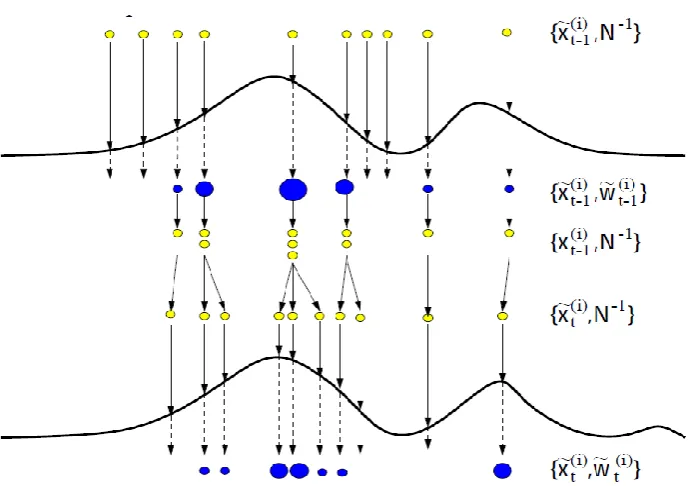
and by Arulampalam et al. (2002), and a schematic representation is given in Figure 1.
At the first step of the algorithm (sampling) 𝑁 random particles (samples) are drawn
from a proposal distribution. These particles are then propagated through the nonlinear
system and are subsequently associated with weights 𝑊̃ according to their fitness, i.e.
equation (4). This step is known as importance sampling. Subsequently, a resampling of
particles with respect to their associated weights is carried out, as a result of which
particles with high weights are split into a number of unweighted particles and particles
with low weights are eliminated. Finally, the introduction of a random noise to the
group of particles at the third step results in local variety in the samples. This process is
visualised in the fourth row of particles in Figure 1. Since, this step provides an
unweighted distribution of particles that mimic the prior distribution, it is referred to as
Figure 1. Illustration of the three stages of importance sampling, resampling, and
prediction in PF, figure from van der Merwe et al. (2000)
In the present study, the application of PF for parameter tracking is of particular
interest. Given a car-following model and a set of data, one can update the estimates of
model parameters upon the receipt of new data. As a result, one will obtain
time-varying estimates of the model parameters. Naturally, these time-time-varying estimates
cannot be used for modelling and simulation purposes, but they can provide a good
insight into some of the very important model characteristics that may otherwise remain
hidden in cumulative error terms. In particular, in simulation-based applications the
parameters are constant, and hence the use of a parameter tracking method gives
information about how a model parameter should deviate from its nominal value to
compensate for modelling flaws. This concept is closely related to model-based fault
detection (Isermann 1984, Venkatasubramaniana, et al. 2003). There is a possibility that
in some cases general patterns in changes of the model parameters are observed (e.g.
[image:12.595.107.453.91.334.2]driving phase), and this type of information can then be used to improve the quality of
modelling and simulation.
3. Methodology
In this section PF is applied to simulated data to investigate the extent to which the
properties of the adaptive driving can be identified using this method. The section first
introduces the simulated dataset, and then goes on to present the results of the
application. The choice of the objective function for the calibration is also described,
and a simple method for the discretisation of the estimates is proposed. The
discretisation of the dynamic estimates is an important step in the interpretation of the
raw estimates obtained initially and in the linkage of the changes in the model
parameters to the traffic conditions.
3.1 Simulated dataset
In this section the application of particle filtering to simulated data is investigated to
illustrate the extent to which this method can be utilised for the purpose of
“meaningful” parameter tracking in car-following models. The additional constraint
arising from the term “meaningful” refers to the fact that, sometimes by calibrating a
number of model parameters simultaneously, an error in the estimate of one model
parameter may be compensated by an error in another. This could happen due to the
existence of correlation between model parameters and the fact that the information
available is less than what is required for the determination of the unknowns uniquely,
thus causing erroneous tracking of model parameters.
For the data simulation, the trajectories of a specific vehicle from the enhanced
NGSIM I-80 dataset (Montanino and Punzo 2013) were selected. The NGSIM I-80
stretch of an interstate freeway in the San Francisco Bay area, CA (Halkias and Colyar
2006), and the enhanced dataset has been made available by the MULTITUDE project
(Montanino and Punzo 2013). The selected trajectories were then used to generate
trajectories for follower vehicles with the IDM model proposed by Treiber, Hennecke
and Helbing (2000), and a specific parameter profile was used for this purpose. In the
profile used, certain parameters were varied at certain points in time, and particle
filtering was applied to the simulated trajectories to generate dynamic estimates of the
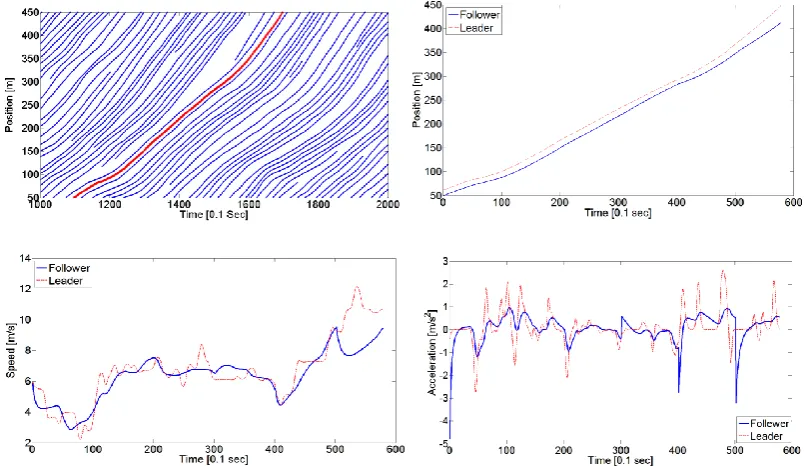
model parameters. Figure 2 illustrates the trajectories used for the leader vehicle.
Figure 2. a) Trajectory of the lead vehicle selected from NGSIM data Lane 2 b,c,d)
Position trajectories, velocities, and accelerations of the lead vehicle and synthetized
follower in dashed red line and blue line respectively
The parameter profiles used for the simulation of the trajectories shown were as
follows: the default model parameters reported by Treiber, Hennecke and Helbing
(2000) were used up to Time = 30 𝑠 , i.e. 𝑎 = 0.73𝑠𝑚2, 𝑏 = 1.67𝑠𝑚2, 𝑣𝑑 = 33.3𝑚𝑠, 𝛿 = 4,
[image:14.595.86.491.321.554.2]changed to the given values: 𝑏0 = 1.5𝑚𝑠2, 𝑎0 = 1
𝑚
𝑠2, 𝑣𝑑 = 60
𝑚
𝑠 , 𝑇 = 0.5 𝑠. As such,
the simulation includes the case of having erroneous estimates for some of the model
parameters while another one is being tracked. Additionally, the value of the parameter
𝑇 changes again to the values 𝑇 = 1 𝑠 and 𝑇 = 3 s at time points 𝑡 = 40 𝑠 and 𝑡 =
50 𝑠, respectively.
3.2 Sensitivity analysis
One important consideration in the model calibration is addressing the question of how
the dataset used reflects the characteristics of the model parameters. This is especially
of importance in models, such as IDM, where some degree of orthogonality between
model parameters exists, and different model parameters are best set according to
different types of data in different regimes of driving (Treiber and Kesting 2013). If
this question is not addressed, misleading estimates of model parameters or unnecessary
high computational complexity may result (Ciuffo, Punzo and Mon 2014).
Global sensitivity analysis is used for this purpose, and the more representative
“total sensitivity indices” are used, that capture the impact of parameters across all the
feasible regions in the hyperspace of parameter values (Ciuffo, Punzo and Mon 2014,
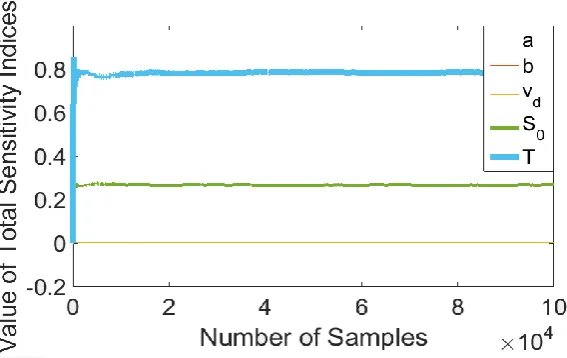
Saltelli, et al. 2010, Jacques , Lavergne and Devictor 2006). Figure 3 illustrates the
results for total sensitivity as a function of the number of samples used for the same
trajectory as above. As expected, the results for other vehicles were also found to be
consistent with the ones illustrated, as well as those reported by Ciuffo, Punzo and Mon
(2014). The parameter related to headway, 𝑇, has the highest impact with a total
sensitivity index value of 0.788, and the parameter related to spacing in jam traffic, 𝑠0,
has the second highest impact, with a total sensitivity index value of 0.268. The rest of
coinciding with the x-axis. The upper boundary (UB) and lower boundary (LB) values
for parameters are given in Table 1.
[image:16.595.88.372.155.334.2]Figure 3. Total sensitivity indices for the simulation scenario
Table 1 Lower and upper boundary
Parameters LB UB
𝒂 1 3
𝒃 1 3
𝑽𝒅 20 50
𝒔𝟎 2 10
𝑻 0.5 3
As pointed out by Ciuffo, Punzo and Mon (2014), since the assumption of
parameter independence for such models is unlikely to hold, the results may be subject
to bias. Nonetheless, the conclusions were also verified through a local sensitivity
analysis around the calibrated parameter values, as well as through investigation of the
tracking. Furthermore, an additional justification to the choice of the parameter used in
this study is the physical meaning of it.
3.3 Application of particle filtering to simulated data
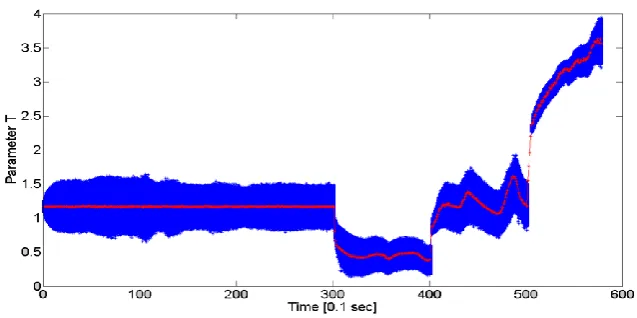
Figure 4 shows the results of the application of particle filtering to the simulated dataset.
For this purpose, all of the model parameters are set to their default values, except for
parameter T, which is to be estimated dynamically.
As was seen, a reason for focusing on T in parameter tracking is that it was
found that no other parameter was capable of tracking the changes in driving behaviour
for multiple trajectories when selected alone. Also, variations in this model parameter
remain low compared to other model parameters. Furthermore, one of the advantages of
IDM is that the parameters have intuitive meanings, and if one parameter is to be
selected among others representing comfortable deceleration, maximum acceleration,
desired velocity, etc., the choice of parameter T, representing headway, is most sensible.
This parameter was also used in Treiber, Hennecke and Helbing (2000) to generate
variations in traffic conditions, and hence driving behaviour, and by doing so the
empirical data related to the formation of traffic jams were successfully simulated.
Figure 4. The result for estimation of the parameter T. The blue shadow denotes the
[image:17.595.92.411.556.715.2]It can be seen that up to time 𝑡 = 30 s, the estimation of parameter T is almost
error-free and stable. Also, the subsequent changes at the times 𝑡 = 30 𝑠, 𝑡 = 40 𝑠, and
𝑡 = 50 𝑠 can be identified from Figure 4 by “jumps” in the values of the parameter at
these times, compared to the smooth curves in the intervals between the changes. The
estimations of parameter T at times after 𝑡 = 30 𝑠, unlike before, are unstable and
fluctuate around a certain value. This is due to the fact that beyond time 𝑡 = 30 s, other
model parameters were changed to values other than the ones used in the estimation
process. As a result, the effect of this false estimation needs to be compensated by
overestimations and underestimations of parameter T.
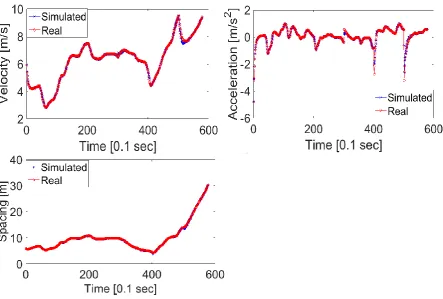
Using the parameter estimation given by the application of particle filtering
(Figure 4), an almost perfect estimation of the spacing (𝑅2 = 0.995), velocity (𝑅2 =
0.993) and acceleration (𝑅2 = 0.91) can be derived, despite the errors in the other
Figure 5. The comparison of real trajectories with simulated trajectories when the
dynamic estimation of the parameter T, given by particle filtering, is used.
It should be noted that the IDM car-following model was used to generate
trajectories for the follower vehicles, and the same car-following model was used in the
calibration process. In the application to real data, this is the equivalent of assuming
knowledge of the model underlying the behaviour of human drivers. Although this is
obviously not the case, the findings of Ossen and Hoogendoorn (2008) may justify use
of such simulated data. Therein, it was found that the characteristics of the followers’
behaviour can be recovered by calibrating a car-following model to the data, even when
the real model is different to the model used for calibration.
3.4 Objective function
The objective function defines a measure of error that is intended to be minimised. For
[image:19.595.74.518.70.369.2]spacing, speed, and acceleration, in addition to an appropriate error test (functional form
of the defined error), such as root mean square error (RMSe) and root mean square
percentage error (RMSPe), as outlined in numerous studies in the literature (Punzo and
Simonelli 2007, Ossen and Hoogendoorn 2008, Treiber and Kesting 2013, Ranjitkar,
Nakatsuji and Asano 2004).
In Punzo and Simonelli (2007) the inter-vehicle spacing was suggested as the
most reliable MOP. In this work, however, it was found that the best result is obtained
when a combination of errors on spacing, velocity, and acceleration was used in the
objective function instead of a single variable. This is due to the use of the information
available on all variables, which avoids outliers and non-smooth modelled data in any
of the three measures individually. In Ossen and Hoogendoorn (2008), in addition to the
different variables for calibration, the use of a combination of speed and spacing in the
objective function was investigated. Therein, despite the fact that the use of a
combinatory objective function including both the spacing and the velocity was found
to be dependent on the specific model used, it was, concluded that when such prior
information about the model is lacking, the use of an objective function including both
speed and spacing could be advantageous. Here, a uniformly weighted sum of squared
errors of all three variables was used, which is an extension to the suggestion made by
Ossen and Hoogendoorn (2008). The accuracy of the acceleration trajectories in the
NGSIM data is somewhat questionable, as pointed out by Thiemann, Treiber and
Kesting (2008), but excluding the acceleration error between the predicted values and
the real values from the objective function results in randomly fluctuating estimates of
acceleration with unrealistically large values of jerk. This can be avoided by including
the acceleration error in the objective function with a low weight to suppress the
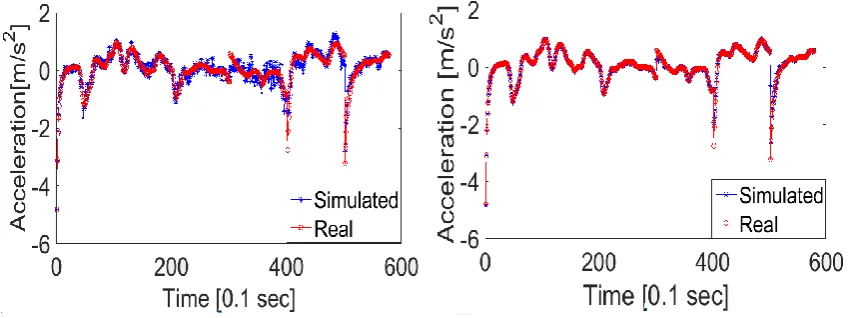
illustrates the simulated acceleration trajectory when the acceleration error is excluded
from the objective function. Although in this case a slight improvement in the simulated
velocity and spacing trajectories is obtained, this improvement comes at the cost of the
acceleration, as can be seen from the figure.
Figure 6. Comparison of the simulated accelerations with the real values when the
acceleration error is: a) excluded from the objective function; b) included in the
objective function.
3.5 Interpreting dynamic parameter estimations
As was shown in Figure 4, although the “jumps” in the values of the model parameters
are visually identifiable, the resulting estimates are much harder to interpret when the
method is applied to real data. This makes the identification of the points where sudden
changes in the model parameters take place difficult, which is due to two reasons: 1) the
actual underlying model is not known in advance; and 2) the changes are much smaller
but more frequent. As one would expect from human drivers, they do not drive in a
crisp and deterministic fashion, and neither do they immediately change their
underlying driving attributes as soon as they reach a different traffic condition; instead a
[image:21.595.85.510.210.369.2]Hence, a way to identify significant changes and to filter out the smooth
fluctuations from the dynamic model parameter estimate is required. A simple approach
is adopted here for this purpose, whereby the points where maximum changes in the
subsequent values of the parameter under estimation are identified. These points are
referred to as “breaking points”. Following that, the model parameter under
investigation is separately calibrated for each interval between the breaking points.
The detection of breaking points is governed by two conditions, both of which
must hold for a breaking point to exist:
1) The change in the value of model parameter is greater than a certain value,
set to be 0.5 𝑠𝑒𝑐 for parameter 𝑇 here.
2) The distance between each two breaking points is greater than a certain
value. This condition is imposed to avoid frequent changes of the parameter
in a short interval, and its implementation may also be justified by the fact
that frequent and sudden changes in driving behaviour and driving
parameters in a short time interval are highly unlikely among human drivers.
The value of 5 seconds (50 time steps for the NGSIM dataset) is used here.
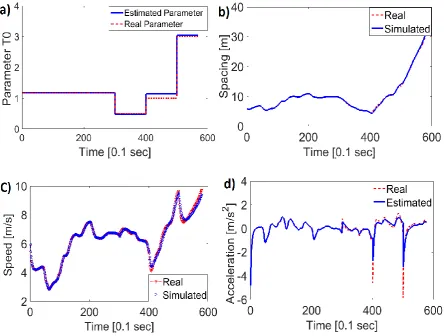
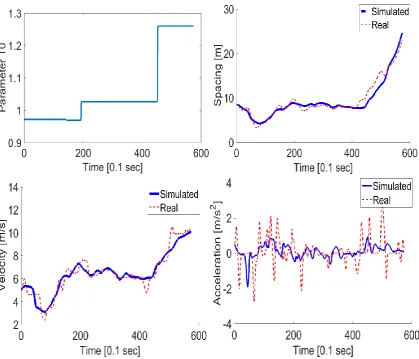
The application of the proposed discretisation method to the result illustrated in Figure 4
leads to the correct identification of the jumps. Subsequently, parameter T is
recalibrated in separate time intervals: [0, 300], [300, 400], [400, 500], and [500, 600].
Figure 7. Comparison of the simulated trajectories when averaging between the
breaking points is applied with real results for: a) the estimation of parameter T; b)
spacing; c) speed; d) acceleration.
It can be seen that not only the points where the parameter is changed are
identified correctly, but also that the values of the parameter within corresponding
intervals are estimated with very high accuracy. Hence, the acceleration, velocity, and
spacing trajectories are generated with significantly better accuracy than any
conventional calibration method.
4. Results
In the previous section it was shown that using the particle filtering along with the
proposed discretisation method, the changes in the model parameters can be identified
[image:23.595.73.518.71.407.2]this method is applied to the NGSIM trajectory dataset to investigate the question of the
identification of the adaptive driving behaviour.
4.1 Application to the NGSIM dataset
The functionality of the proposed method was illustrated using simulated data. In this
section the proposed method is applied to a platoon of nine vehicles driving in the
second lane to investigate the following two issues: 1) whether the assumption of
systematic changes in driving attributes can be validated; and 2) whether these changes
can be identified using car-following models, such as the IDM, and a dynamic system
identification method, such as particle filtering. The procedure is as follows:
1. The five model parameters {𝑎, 𝑏, 𝑣𝑑, 𝑠0, 𝑇} are calibrated using a genetic
algorithm to minimise the sum of squared errors across all the three variables,
namely, spacing, speed, and acceleration (Equation 6).
𝑈 = ∑ ((𝑠𝑖𝑜𝑏𝑠 − 𝑠
𝑖𝑚𝑜𝑑𝑒𝑙) 2
+ (𝑣𝑖𝑜𝑏𝑠− 𝑣
𝑖𝑚𝑜𝑑𝑒𝑙) 2
+ (𝑎𝑖𝑜𝑏𝑠− 𝑎
𝑖
𝑚𝑜𝑑𝑒𝑙)2) 𝑛
𝑖=1 (6)
where: the abbreviations “obs” and “model” denote the observed value and the
modelled value respectively; 𝑛 is the number of sample points; and 𝑠, 𝑣, and 𝑎
denote the spacing, velocity, and acceleration respectively. The objective
function above is the sum of the squared Euclidean distances between the
three-dimensional observed states and the modelled states.
2. At the second step, the parameters {𝑎, 𝑏, 𝑣𝑑, 𝑠0} are fixed to their calibrated
values, while parameter 𝑇 is being tracked given the lead vehicle’s trajectory
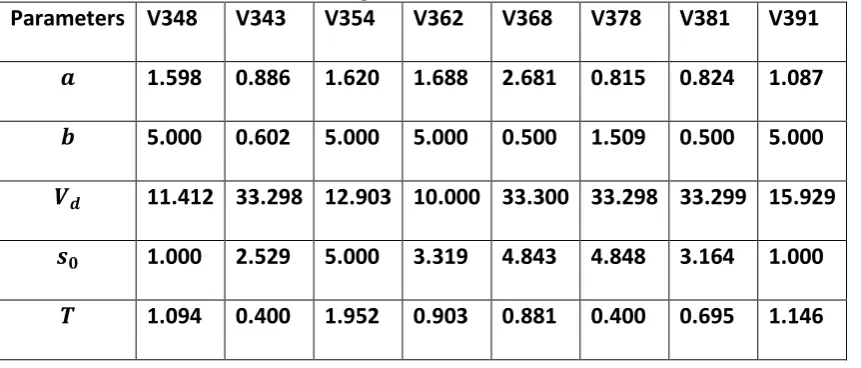
and the real trajectory of the follower vehicle. The calibrated values for all the
3. The dynamic estimates of parameter 𝑇 in several runs are then analysed using
the method described in Section 3.5 to identify the breaking points.
4. Once the breaking points are identified, parameter 𝑇 is then calibrated once
[image:25.595.80.511.223.407.2]more for each time interval between the breaking points.
Table 2 The calibrated values of the parameters
Parameters V348 V343 V354 V362 V368 V378 V381 V391
𝒂 1.598 0.886 1.620 1.688 2.681 0.815 0.824 1.087
𝒃 5.000 0.602 5.000 5.000 0.500 1.509 0.500 5.000
𝑽𝒅 11.412 33.298 12.903 10.000 33.300 33.298 33.299 15.929
𝒔𝟎 1.000 2.529 5.000 3.319 4.843 4.848 3.164 1.000
𝑻 1.094 0.400 1.952 0.903 0.881 0.400 0.695 1.146
All the vehicles observed remain in the platoon for the whole duration of the
experiment, which means that the dynamics are undisturbed by any lane changing
attempts. Figure 8 illustrates the application of the proposed method to one of the
vehicles, and the top-left graph illustrates the discretised parameter estimate.
It should be noted that when applied to the dynamic parameter estimates for real
trajectories, the proposed discretisation method yields breaking points that are less
robust compared to the investigated case of simulated data. In other words, the breaking
points are not always uniquely identified, and while some are detected with a high level
of certainty, others may only be detected in a small percentage of cases. Herein, only
the points that were detected in more than 50% of cases were selected.
The discretised parameter profile is subsequently used to simulate the driving
speed, and acceleration) with the real states points to the accuracy of the simulated
behaviour. The reason why the acceleration estimates are less solid than the spacing and
speed estimates is due to the low weight of the acceleration variable in the objective
function, as explained earlier.
An interesting finding of this work that can be identified from Figure 8, is the
correlation between the estimate of parameter T, and speed. This will be explained
[image:26.595.88.508.262.621.2]further in the following section.
Figure 8. Trajectories resulting from application of the proposed method to vehicle no.
4.2 Analysis of the parameter estimates
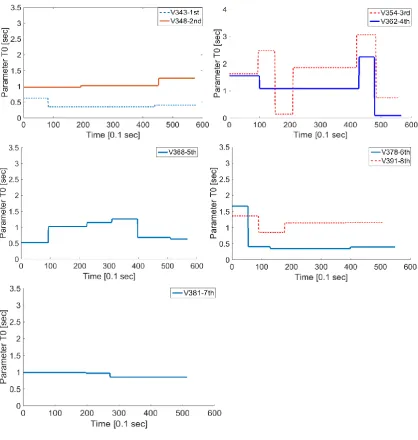
Figure 9 illustrates the resulting parameter estimates for the vehicles, based on which
highly accurate estimates of the spacing and velocity trajectories can be obtained. Table
2 summarises the errors in the estimation of velocity and spacing.
[image:27.595.87.506.203.644.2]Table 3. Measures regarding quality of fit for each of the vehicles in the platoon
V348 V343 V354 V362 V368 V378 V381 V391
Average absolute
error for spacing 0.7366 0.8333 1.8907 1.0251 0.5108 0.7039 0.8268 1.7798
Average absolute
error for speed 0.3885 0.5072 0.6117 0.5066 0.4249 0.5032 0.4805 0.6909
One of the interesting findings is that in the majority of investigated trajectories,
a noticeable relationship between the average speed and estimate of parameter T can be
observed. In particular, from the parameter estimates related to vehicles with IDs 348,
354, 362, and to a lesser extent 343, 378, 391, it can be seen that with the increases in
the average speed, the estimate of parameter 𝑇 increases, and that sudden drops in the
average speed results in drops of parameter 𝑇. The detection of common patterns is an
encouraging result, as it points to a driving phenomenon that the car-following model
fails to account for.
However, interestingly, two other patterns can be observed within the estimates
for this platoon: 1) the inverse relation with the average speed, as in the case of vehicle
no. 368; and 2) irrelevant or no changes in the estimated parameter with respect to
average speed, which is the case for vehicle no. 381. Similar patterns are observed in
many other examined vehicles, and can be most likely be attributed to differences in
driving styles, intentions (such as preparation for performing a lane change), or maybe a
more complicated relation between the average speed and spacing, which could
describe the changes in the model parameter better. Moreover interestingly, in a
statistically significant number of cases, the breaking points are detected at a point in
time where there has been a change in the driving conditions. For instance, considering
breaking points identified correspond to points where: 1) there is a transition from
driving through a shockwave into more homogeneous congested traffic, at about 𝑡 =
20 𝑠; and 2) there is a transition from homogenous congested traffic to a less congested
state where the vehicle starts accelerating at about 𝑡 = 43 𝑠.
It should be acknowledged here that, indeed, the random nature of driving may
be amplified at low speeds and under stop-and-go conditions, and therefore decisive
conclusions can only made when sufficiently large numbers of suitable data are
analysed. A suitable dataset for this purpose would be one consisting of trajectories with
long observation times, where large enough numbers of drivers can be tracked through
different driving conditions. The implementation of the proposed framework on such a
dataset would enable the analysis and interpretation of the jumps in the parameter
values in a broader perspective, and would allow the modification of the method and its
parameters for better performance. The further investigation of these topics and the
application of the method to more trajectories will shed more light on some of these
issues.
5. Conclusions and future work
In this paper, particle filtering was utilised to examine the dynamic behaviour of drivers
in different traffic conditions. In order to interpret the estimates given by the particle
filtering process, a simple discretisation method was used, and promising results from
its application to simulated and real data were obtained. This helped isolate minor
fluctuations, which could be due to the fuzzy and stochastic nature of human driving, or
minor errors in the modelling of car-following behaviour, and to convert the raw
estimates given by the particle filtering process to an interpretable form.
The application of this method to real data delivered interesting results.
speed and the parameter under investigation was observed. This frequent pattern may
point to a common driving behaviour that may not be addressed by the mathematical
structure of the model under investigation. Moreover, two additional patterns were,
interestingly, observed: 1) an inverse relation with the average speed; and 2) no relation
with average speed. Additionally, in a significant number of cases the points that were
detected as breaking points seemed to be the ones where, indeed, a change in the driving
condition took place. Therefore, the employed framework was found to have great
potential in investigating the properties of traffic flow, as well as in examining the
robustness and performance of car-following models.
In future work, the application of suitable clustering methods, such as
consolidated fuzzy clustering (Ma and Andréasson 2007) will be considered for
grouping the estimation results. Moreover, due to the stochastic nature of particle
filtering, the values of the breaking points identified are subject to changes in
consecutive runs. The uncertainty arising from this issue could be tackled by calculating
confidence intervals for these values. Finally, in order to draw reliable conclusions
about how driving behaviour may change with reference to car-following models, an
analysis of larger groups of trajectory data needs to be carried out.
References
Ahmed, K. I. 1999. “Modeling drivers' acceleration and lane changing behavior”PhD
Thesis, Massachusetts Institute of Technology.
Arulampalam, M. S., S. Maskell, N. Gordon , and T. Clapp. 2002. “A tutorial on
particle filters for online nonlinear/non-Gaussian Bayesian tracking.” IEEE
Brackstone, M., and M. McDonald. 1999. “Car-following: a historical review.”
Transportation Research Part F: Traffic Psychology and Behaviour 2, no. 4:
181–196.
Ciuffo, B., V. Punzo, and M. Mon. 2014. “Global sensitivity analysis techniques to
simplify the calibration of traffic simulation models. Methodology and
application to the IDM car-following model.” IET Intelligent Transport Systems
8, no. 5: 479 – 489.
Fritzsche, H.T. 1994. “A model for traffic simulation.” Traffic Engineering and
Control: 317–321.
Halkias, John, and James Colyar. 2006. NGSIM Interstate 80 Freeway Dataset.
Washington, DC, USA: US Federal Highway Administration,
FHWA-HRT-06-137.
Hoogendoorn, S., S. Ossen, M. Schreuder , and B. Gorte. 2006.“Unscented Particle
Filter for Delayed Car-Following Models Estimation.” Proceedings of the IEEE
ITSC 2006 IEEE Intelligent Transportation Systems Conference. Toronto,
Canada.
Isermann, R. 1984. “Process Fault Detection Based on Modeling and Estimation
Methods-A Survey.” Automatica 20, no. 4: 387–404.
Jacques , J., C. Lavergne, and N. Devictor. 2006. “Sensitivity analysis in presence of
model uncertainty and correlated inputs.” Reliability Engineering & System
Safety 91, no. 10-11: 1126–1134.
Kesting, A., and M. Treiber. 2009. “Calibrating Car-Following Models by Using
Trajectory Data: Methodological Study.” Transportation Research Record:
Ma, Xiaoliang , and I. Andréasson. 2007. “Behavior Measurement, Analysis, and
Regime Classification in Car Following.” IEEE TRANSACTIONS ON
INTELLIGENT TRANSPORTATION SYSTEMS 8, no. 1: 144-156.
Montanino, M., and V. Punzo. 2013. “Making NGSIM Data Usable For Studies On
Traffic Flow Theory.” Transportation Research Record: 99-111.
Montanino, M., and V. Punzo. 2013. Reconstructed NGSIM I80-1. COST ACTION
TU0903 - MULTITUDE. http://www.multitude-project.eu/exchange/101.html.
Munoz, J. C., and C. F. Daganzo. 2002. “MOVING BOTTLENECKS: A THEORY
GROUNDED ON EXPERIMENTAL OBSERVATION.” Transportation and
Traffic Theory in the 21st Century. Proceedings of the 15th International
Symposium on Transportation and Traffic Theory. Adelaide, Australia. 441-461.
Ossen , S., and S. Hoogendoorn. 2008. Calibrating car-following models using
microscopic trajectory data. Delft, Netherlands: Delft University of Technology.
Ossen, S., and S. P. Hoogendoorn. 2007. “Car-following behavior analysis from
microscopic trajectory data.” Transportation Research Record: Journal of the
Transportation Research Board Volume 1934 / 2005 Traffic Flow Theory 2005:
13-21.
Punzo, V., and F. Simonelli. 2007. “Analysis and comparison of microscopic traffic
flow models with real traffic microscopic data.” Transportation Research
Record: Journal of the Transportation Research Board 1934, no. 1: 53-63.
Ranjitkar, P., T. Nakatsuji, and M. Asano. 2004. “Performance Evaluation of
Microscopic Traffic Flow Models with Test Track Data.” Transportation
Research Record: Journal of the Transportation Research Board 1876 , no. 1:
Saltelli, A., P. Annoni, I. Azzini, F. Campolongo, M. Ratto, and S. Taranto. 2010.
“Variance based sensitivity analysis of model output. Design and estimator for
the total sensitivity index.” Computer Physics Communications 181, no. 2: 259–
270.
Thiemann, C., M. Treiber , and A. Kesting. 2008. “Estimating Acceleration and
Lane-Changing Dynamics Based on NGSIM Trajectory Data.” Transportation
Research Record: Journal of the Transportation Research Board 2088: 90-101.
Treiber, M., A. Hennecke, and D. Helbing. 2000. “Congested traffic states in empirical
observations and microscopic simulations.” Physical Review E 62, no. 2 : 1805–
1824.
Treiber, M., A. Kesting, and D. Helbing. 2006. “Understanding widely scattered traffic
flows, the capacity drop, and platoons as effects of variance-driven time gaps.”
Phys. Rev. E 74, no. 1: 016123.
Treiber, M., and A. Kesting. 2013. “Microscopic Calibration and Validation of
Car-Following Models – A Systematic Approach.” 20th International Symposium on
Transportation and Traffic Theory (ISTTT 2013). Noordwijk, Netherlands, 922–
939.
van der Merwe, R., A. Doucet , J . F. de Freitas, and E. Wan. 2000. The unscented
particle filter, Technical Report CUED/F-INFENG/TR 380, . Cambridge
University Engineering Department.
Venkatasubramaniana, V., R. Rengas, K. Yinc, and S. N. Kavurid. 2003. “A review of
process fault detection and diagnosis: Part I: Quantitative model-based
Wiedemann, R. 1974. Simulation des Strassenverkehrsflusses. Karlsruhe, Germany:
Schriftenreihe des Instituts für Verkehrswesen der Universität Karlsruhe, Band
8.
Wilson, R. E., and J. A. Ward. 2011. “Car-following models: fifty years of linear
stability analysis – a mathematical perspective.” Transportation Planning and
Technology 34, no. 1: 3-18.
Yang, Q., and H. N. Koutsopoulos. 1996. “A microscopic traffic simulator for
evaluation of dynamic traffic management systems.” Transportation Research C