City, University of London Institutional Repository
Citation
:
Walker, S., Scamell, M. and Parker, P. M. (2016). Principles of physiological breech birth practice: a Delphi study. Midwifery, doi: 10.1016/j.midw.2016.09.003This is the accepted version of the paper.
This version of the publication may differ from the final published
version.
Permanent repository link: http://openaccess.city.ac.uk/15347/
Link to published version
:
http://dx.doi.org/10.1016/j.midw.2016.09.003Copyright and reuse:
City Research Online aims to make research
outputs of City, University of London available to a wider audience.
Copyright and Moral Rights remain with the author(s) and/or copyright
holders. URLs from City Research Online may be freely distributed and
linked to.
Principles of physiological breech birth practice: a Delphi study
Shawn Walkera MA, BA, RM, Dr Mandie Scamell a PhD, RM, Professor Pam Parker b, PhD, RN
a Centre for Maternal and Child Health Research, City University London, Northampton
Square, London, EC1V 0HB, UK; [email protected]; [email protected]
b
Department for Learning Enhancement and Development, City University London, Northampton Square, London, EC1V 0HB, UK; [email protected]
Corresponding author
Shawn Walker
Centre for Maternal and Child Health Research, City University London, Northampton Square, London, EC1V 0HB, UK
Tel 020 7040 5874
Abstract
Objective: to establish a multi-professional consensus on shared principles underlying the practice of physiological breech birth.
Design: three-round Delphi e-survey.
Setting: multi-national.
Participants: a panel of thirteen obstetricians and thirteen midwives,
experienced in facilitating physiological breech births in varied settings, and involving varied maternal birthing positions, and two service user representatives.
Methods: an initial survey contained open-ended questions. Answers were coded, amalgamated and categorised. A total of 164 statements were put to the panel in the second round, and 9 further statements were proposed in the third round. The panel indicated the extent of their agreement using a 5-point Likert scale. The pre-determined level of consensus was 70% of respondents indicating 4 or 5 on the Likert scale (agreement or strong agreement).
Findings: the panel indicated consensus on 37 of 66 proposed statements under the theme, ‘Principles of Practice.’ Negative data (29/66 statements) are also reported, highlighting areas of divergence. The findings suggest a paradigm shift away from management strategies based on prediction and control, and towards facilitation strategies based on relationship and response.
Conclusion
Concepts of breech-specific normality require further exploration. The principles articulated in this research can be used to design further researcher exploring the influence of physiological breech practices on neonatal and maternal outcomes, including women’s experiences of maternity care.
Keywords
Highlights
Upright positioning is a tool, and not a rule, of physiological breech birth In physiological birth, locus of greatest efficacy perceived within
mother-baby unit
Clinical ability to enable rather than control birth process is linked to experience
Calm, supportive relationships in birth environment considered a key safety factor
Introduction
1 2 3
This paper outlines a set of guiding principles for the practice of physiological
4
breech birth, as determined by a Delphi consensus technique survey involving
5
experienced midwives, obstetricians and service user representatives. It
6
addresses an apparent disparity between practices which have been thoroughly
7
researched, and thus used to provide evidence-based guidelines, and differing
8
practices as described by a group of professionals and women experienced in
9
physiological breech birth, which have been much less thoroughly researched. In
10
order to create meaningful studies to determine the safety of these new
11
practices, it is useful to consider how physiological breech practices differ from
12
mainstream practices at the most fundamental and even philosophical levels,
13
which often remain tacit when more practical guidelines and training manuals are
14
written.
15
16
Breech presentation at term, where the fetus presents bottom- or feet-first at the
17
time of birth, affects approximately 1:25 women (Ferreira et al, 2015). Mode of
18
birth is controversial (Caughey, 2007), with many breech presenting infants being
19
born by caesarean section, but there is renewed interest in vaginal breech birth
20
(Marko et al, 2015). Prior to this research, professional literature indicated some
21
midwives and obstetricians were facilitating vaginal breech births (VBBs) in ways
22
differing significantly from the assisted breech delivery protocols used in
23
randomised controlled trials informing practice recommendations internationally
(Advanced Life Support in Obstetrics (ALSO), 2010; PROMPT, 2012; RCOG,
25
2006). Practitioners advocating fundamental changes in practice have argued
26
that upright maternal positioning, in particular, promotes spontaneous
27
physiological birth (Banks, 2007; Cronk, 1998; Evans, 2012; Krause, 2006;
28
Reitter et al, 2014). Additionally, anecdotal and women’s advocacy literature
29
indicates that at least some women preferred a more active, physiological
30
approach to VBB (Berkley, 2006; Sanders and Lamb, 2015). However, the most
31
recent Cochrane Review comparing the safety of VBB with caesarean section
32
delivery (CS) made clear the results cannot be generalised to ‘methods of breech
33
delivery which differ materially from the clinical delivery protocols used in the
34
trials reviewed’ (Hofmeyr et al, 2015, p. 3), in which supine maternal positioning
35
and routine assistance were standard practices. This point has also been made
36
previously by midwifery critics (Fahy, 2011). Therefore, a meaningful gap in the
37
evidence exists concerning whether or not use of upright maternal positioning
38
constitutes a ‘materially different’ VBB method, and whether or not such
39
differences result in materially different outcomes.
40
41
Although the Cochrane review suggests that ‘materially different’ methods may
42
affect the outcomes of planned VBB, to date only a small study by Bogner et al
43
(2015) has provided outcome data concerning the use of upright positioning. In
44
Bogner et al’s study, use of hands/knees maternal positioning appeared to be
45
similarly safe for the infant as supine positioning, however they reported a
46
significant variation between rates of perineal damage for upright VBB (14.6%)
and lithotomy VBB (61%). This suggests a material difference between either the
48
necessity or the inclination to perform an episiotomy when upright positioning is
49
used, which affects maternal morbidity outcomes. In order to affirm or discount
50
this variation, future research would need to acknowledge and measure this
51
difference in practice. Because other differences may produce similar important
52
changes in outcomes, establishing a set of agreed principles underpinning the
53
practice of physiological breech birth using a multi-professional consensus
54
technique is an essential step towards improving practice, evaluation and
55
research design in this area of care.
56
57
The primary purpose of this Delphi study was to establish such a consensus on
58
standards of competence for the practice of upright breech birth, defined as a 59
VBB in which the woman is encouraged to be upright and active throughout 60
labour and able to assume the position of her choice for the birth, and the results
61
of this aspect of the study have been reported separately [Supplementary
62
Information 1]. However, due to the potential material differences as described
63
above, it was necessary to explore the underlying principles of practice as they
64
emerged in the research, and not assume that upright VBB will share such
65
principles with mainstream assisted breech delivery methods. In the process, it
66
became immediately apparent that participants perceived upright positioning
67
itself to be a product of the underlying principle of optimising labour and birth
68
physiology, rather than an essential feature of practice – upright positioning is a
69
tool and not a rule of physiological VBB practice. Therefore, adopting this
participant-led focus, a secondary aim in the research was to establish a set of
71
guiding principles for the practice of physiological VBB. These principles of
72
practice are reported in this paper.
73
74
Methods
75
76
This research consisted of a three round Delphi e-survey, conducted from June
77
2014 – June 2015, involving an initial round of open-ended questions, followed
78
by two rounds in which participants rated their level of agreement with an
79
aggregate set of statements in order to establish a consensus [Supplementary
80
Information 1]. Participants were recruited by purposive, network and social
81
media sampling, and worked in a wide variety of settings internationally. The
28-82
member panel which participated in the Delphi study included 13 midwives and
83
13 obstetricians working in the following countries: Australia, Austria, Brazil,
84
Canada, Germany, Mozambique, New Zealand, United Kingdom, and the United
85
States of America. At least half worked primarily in hospitals, but the panel’s
86
experience included home and birth centre settings. The professionals’ mean
87
years of experience was 27 (range of 5-50) and mean number of total breech
88
births attended was 135 (range of 20-400). The research also involved two
89
service user representatives identified as leaders of national advocacy
90
organisations. These women were also considered ‘experienced’ due to their
91
personal encounters with breech pregnancy and their extensive involvement
92
supporting other women planning VBBs, albeit the nature of their experience was
different from the professionals’. Ethical approval for this study was obtained
94
from the Research Ethics Committee of City University London (Ref:
PhD/14-95
15/13).
96
97
A more detailed account of the methods and recruitment process of this study
98
have been reported in a complementary paper, along with results pertaining to
99
the theme, Standards of Competence [Supplementary Information 1]. This paper
100
reports results from the same study under the theme, Principles of Practice.
101
Results have been reported separately to enable a fuller discussion of the
102
philosophical implications of these principles. This paper includes one variation
103
from the previously reported methods. In the second round (R2), a
multiple-104
choice question (MCQ) was added to ascertain the variety of participants’
105
experience with maternal birthing positions described in the first round, in
106
answers to open-ended questions. The MCQ enabled all relevant options to be
107
checked and included an ‘other’ box. The principles of Practice theme included
108
66 statements grouped into the following categories: first principles (14
109
statements), maternal positioning (12 statements and 1 MCQ), birth environment
110
(18 statement), fetal positions (14 statements), and safe progress (8 statements).
111
This theme contained 60 statements and 1 MCQ in R2 and 6 statements in R3.
112
113
The findings reported below also differ from classical Delphi methods in an
114
important way. Items failing to reach a 70% rate of agreement (negative results)
115
were removed from further consideration, rather than re-evaluated in R3. Instead,
6 modified statements formed from the panel’s feedback were included in R3.
117
Negative results are also reported in this paper. Delphi studies have been
118
criticised for tending to force a consensus and masking evidence of dissent, such
119
as bimodal results indicating a meaningful split in opinion (Thangaratinam and
120
Redman, 2005). To avoid a potential bias toward consensus, this study has
121
reported the significant number of positive results where a strong (>70%)
122
consensus was achieved, as well as the statements which were not supported at
123
this level.
124
125
The experienced panellists participating in this Delphi survey research returned a
126
consensus-level agreement on 37 statements under the Principles of Practice
127
theme. These statements are reported under the categories they were grouped
128
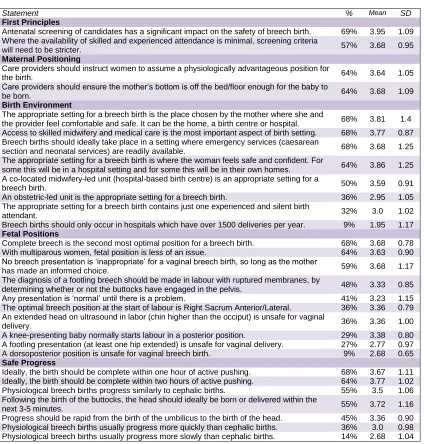
into during the research in Table 1, along with the percentage of respondents
129
who agreed with that statement, the mean of the responses on a 5-point Likert
130
scale (1=strongly disagree; 5=strongly agree) and the standard deviation (SD).
131
Negative results, those which did not achieve a minimum 70% rate of agreement
132
among respondents, are reported in Table 2. Language taken directly from the
133
consensus statements is in italics in the text descriptions below.
134
135
Participant responses in the first round, including comments about the research
136
question, indicated that most viewed upright maternal positioning to be a product
137
of a facilitative approach aiming to optimise physiology. Responsiveness to
138
feedback and member checks is a central aspect of trustworthiness in Delphi
research (Hasson and Keeney, 2011). Therefore, most statements proposed
140
reflected the panellists’ orientation and used the phrase, physiological breech 141
birth, rather than imposing the researcher’s original language, upright breech 142
birth.
143
144
Findings
145
146
First Principles 147
148
Participants in the research referred to first principles and the teaching of 149
principles in their responses. Therefore, statements concerning fundamentals or
150
philosophical approaches to practice were grouped into this category for
151
consideration. The panel strongly agreed that the purpose of upright positioning
152
was to optimise physiology, facilitating the mother’s ability to birth her baby with
153
maximum efficiency, and that optimising this physiological process could
154
increase the safety of VBB for both mother and baby. The principles achieving
155
consensus in this study reflect a philosophy of care which recognises the locus of
156
greatest efficacy as lying within the mother-baby unit, as opposed to the active
157
management strategies and procedures performed by professionals, which are
158
the subject of most contemporary guidelines. The phrases power from above,
159
uncompromised baby moves in ways which assist his/her own birth, the mother’s
160
attitude, no routine manoeuvres, uncommon to need to do anything, woman-led 161
positions, all suggest a perceived effectiveness inherent to the physiological
process, dependent on contributions from both mother and baby. The
163
participants’ consensus statements suggested they perceive a strong but not
164
absolute tendency toward success within this physiological process, which again
165
differs significantly from training programmes suggesting spontaneous breech
166
birth at term is uncommon (PROMPT, 2012).
167
168
Although in this approach attendants may appear to ‘do’ less than they would in
169
an assisted breech delivery, the panellists’ view that the attendance of skilled and 170
experienced professionals significantly impacts the safety of VBB gained the
171
highest level of consensus in this category. Clinical actions consistent with a
172
physiological VBB approach may be facilitative, using judicious guidance to
173
contribute to physiological optimisation, or they may be responsive to a perceived
174
problem. In contrast, although the result was borderline, the panel did not reach a
175
consensus-level agreement around the view that antenatal screening … has a
176
significant impact on the safety of VBB, nor did they recommend stricter
177
screening criteria as a means of reducing risk where available skill and
178
experience were minimal. The results in the first principles category emphasised
179
relationship, such as within the mother-baby unit and with caregivers, and
180
response, such as the experienced attendant’s on-going assessment of steady
181
progress. They de-emphasised models of care based on prediction of risk, the
182
foundation of antenatal screening, and control, such as further limiting the ability
183
of women to access VBB based on narrower selection criteria, although this
strategy is a mainstay of national-level breech delivery guidelines (RCOG, 2006,
185
Kotaska et al, 2009).
186
187
Maternal Positioning 188
189
The statements which achieved consensus in this category reflected an
190
approach to maternal positioning which was enabling and responsive, rather than
191
prescriptive and directing. Again, the locus of greatest efficacy was within the
192
mother-baby unit, with attendants recognising this inherent ability and responding
193
to the unfolding process rather than controlling it. Phrases such as variety of 194
maternal positions, judicious guidance … to resolve delay, the mother’s ability to
195
move, and spontaneous positioning … guided by interactions with the baby,
196
encapsulated this philosophy within the consensus statements. The embodied
197
knowledge of mother and baby was privileged in the caregiving relationship, and
198
the clinical ability to enable the birth process, rather than control it, was linked to
199
skill which develops with time and experience.
200
201
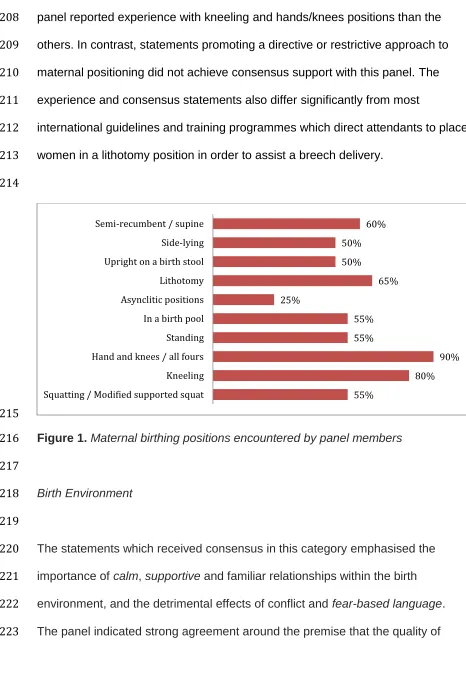
The participants reported experience supporting VBBs in a variety of maternal
202
positions, including water births. Figure 1 illustrates the percentage of
203
respondents (n=20) reporting experience with the 10 different maternal birthing
204
positions described; one service user declined to respond as her baby had been
205
born by CS. This variety confirmed the panel’s initial feedback that upright
206
position was a tool and not a rule of physiological VBB, although more of the
panel reported experience with kneeling and hands/knees positions than the
208
others. In contrast, statements promoting a directive or restrictive approach to
209
maternal positioning did not achieve consensus support with this panel. The
210
experience and consensus statements also differ significantly from most
211
international guidelines and training programmes which direct attendants to place
212
women in a lithotomy position in order to assist a breech delivery.
213
214
[image:14.612.53.519.62.744.2]215
Figure 1. Maternal birthing positions encountered by panel members
216
217
Birth Environment
218
219
The statements which received consensus in this category emphasised the 220
importance of calm, supportive and familiar relationships within the birth 221
environment, and the detrimental effects of conflict and fear-based language. 222
The panel indicated strong agreement around the premise that the quality of 223
55%
80% 90% 55%
55% 25%
65% 50%
50% 60%
relationships, between women and caregivers, and breech attendants and the 224
wider multi-professional community, impacts both the physiological process and 225
the overall safety of VBB. Although the panel clearly valued skilled and
226
experienced professional attendance, they did not agree that access to skilled
227
midwifery and medical care is the most important aspect of birth setting. This
228
appeared to be because the panel considered that attitude and other 229
environmental factors also contribute significantly to birth safety. The panel did 230
not return a consensus on any statements regarding particular birth location, 231
which probably reflects the multi-professional diversity and differences in practice 232
settings within the panel. However, they did agree that restrictive policies and 233
negative attitudes affect the ability of both women and skilled providers to access 234
hospital-based birth settings. 235
236
Fetal Positions
237
238
The statements achieving consensus in this category reflected a new approach 239
to evaluating the relative safety of proposed VBB in relation to fetal position. A 240
consensus-level number of the panel were willing to support the range of 241
longitudinal fetal positions (legs extended / frank, legs flexed / incomplete, one or 242
more hips extended / footling) as potential candidates for a safe VBB, although 243
not necessarily recognising them all as ‘normal.’ Negative data indicated that
244
strategies of attempting to predict outcomes from supposed static fetal positions 245
the panel supported the more open and responsive approach of assessing the 247
advisability of proceeding with a VBB throughout labour, using criteria similar to 248
those used in cephalic births – lack of descent or lack of fetal well-being at the
249
time of labour. This also contrasts many contemporary guidelines which permit a
250
trial of labour for only frank or complete breech presentations, and sometimes 251
only frank breech presentations. 252
253
Safe Progress
254
255
Only one statement in this category achieved consensus-level agreement. Panel 256
members considered a period of passive second stage, a pause after full
257
dilatation and before active pushing begins, to be common and unproblematic.
258
The variety of statements which failed to reach a consensus again suggests the 259
panel’s preference for a responsive, rather than prescriptive, approach to 260
assessing progress within the unique complex of each individual birth, and in 261
relation with each individual woman. 262
263
Discussion
264
265
This is the first research to describe a set of principles underpinning the practice
266
of physiological VBB agreed by an experienced multi-professional panel
267
including both midwives and obstetricians. In areas of professional practice
268
where experimental evidence is not available, use of a consensus method like
the Delphi survey makes the process of expert opinion development transparent
270
and collaborative.The significant number of statements which achieved 100%
271
consensus in this process demarcate a clear common ground in the practice of
272
physiological VBB among obstetricians and midwives working in very disparate
273
settings, which is unlikely to be attributable to a localised cultural norm. Four out
274
of the ten universally agreed statements contained the word ‘safety.’ We
275
therefore propose that this common ground can be used to inform the design of
276
future research to test the safety of practices based on these principles, using
277
quantified methods.
278
279
The negative results reported in this paper also enable the identification of areas
280
where further research is needed to answer questions which were important to
281
this panel, but remained undecided. One of these areas concerned what sort of
282
progress in labour should be considered ‘normal for breech,’ as evaluation of
283
normal progress was considered a key safety concern. As the negative data
284
[Table 2] indicate, the panel’s open-ended responses in R1 suggested that the 285
progress of breech labours could be generally quicker, slower, or roughly similar
286
to cephalic labours, but none of the associated statements achieved a
287
consensus-level agreement. Similar discrepancies occurred in the fetal positions
288
category. This suggests that these topics require further consideration using
289
different methods. Descriptive studies involving a population of unmedicated
290
labours and births attended by experienced physiological practitioners would be
291
a useful contribution to the research basis concerning what is ‘normal for breech.’
293
The lack of a clear consensus that antenatal screening significantly improves 294
safety was an unanticipated finding, although it is important to note that this 295
result was borderline, and the principle did still achieve majority support. 296
Professional guidelines and research reports commonly list a set of criteria used 297
to identify a sub-group of women and breech-presenting fetuses for whom a VBB 298
is considered to pose comparatively less, or more, perinatal risk, usually based 299
on expert opinion (Kotaska, 2009; RCOG, 2006). Strict application of selection 300
criteria is credited with improved perinatal morbidity and mortality outcomes 301
observed in some settings (Borbolla Foster et al, 2014; Goffinet et al., 2006), 302
although criteria and rates of VBB vary considerably between settings (Michel et 303
al, 2009). However, some before-and-after studies have indicated that stricter 304
application of selection criteria and an increased CS rate has not resulted in 305
improved perinatal outcomes among the remaining VBBs (Hartnack Tharin et al, 306
2011; Hehir et al, 2012; Vlemmix et al, 2014). The panel’s consensus statements 307
suggested that, while physical variables pertaining to women and their babies 308
may correlate with certain birth outcomes, other variable characteristics 309
pertaining to provider, environment and relationships may affect the safety of 310
VBB. These elements deserve further attention to balance the current focus on 311
‘risk factors’ in assessing suitability for VBB. 312
313
The finding that 91% of a panel with this level of experience feel that episiotomy
314
is never, or rarely, needed to assist an upright breech birth is significant, given
that cutting a timely episiotomy has been identified as a key skill in assisted 316
breech delivery in other research (Jordan et al., 2016; Maslovitz et al., 2007; 317
Secter et al., 2015). This suggests that the lower maternal morbidity noted in 318
Bogner’s study (2015) is likely to be replicable in further research into 319
physiological VBB practices. Similarly, the panel’s consensus that the mother’s
320
attitude and approach to birthing a breech baby is a significant safety concern
321
resonates with research indicating that strength of preference for vaginal birth is 322
significantly predictive of ultimate mode of birth (Wu et al., 2014). Future VBB 323
research should take account of maternal attitudes and self-perceived efficacy as 324
potential safety factors, and take into consideration the likelihood that women 325
with a strong preference for a particular mode of childbirth are less likely to 326
consent to randomisation. 327
328
Considered in light of their divergence from most current international guidelines 329
and research, the findings of this consensus research suggest within this panel a 330
shift away from programmes of management based on prediction and control, 331
and toward a philosophy of facilitation based on relationship and response. This 332
is particularly evident in the openness around maternal birth position. . Although 333
a enabling approach to positioning is often associated with greater maternal 334
satisfaction (Priddis et al, 2012, Thies-Lagergren et al, 2013), the panel’s 335
consensus statements associate it with greater safety, a position which warrants 336
further investigation. A responsive approach is also suggested in other areas 337
being as the main indicators of appropriateness for vaginal birth, compared to the 339
current emphasis on predictive selection criteria based on generalised relative 340
risk. 341
342
Conclusion
343
344
Within this panel’s physiological VBB model, the locus of greatest efficacy is 345
considered to be within the mother-baby unit. Caregiver activities are primarily 346
aimed at enhancing the mother-baby unit’s self-efficacy, by judicious guidance 347
and the maintenance of a facilitative environment, founded on supportive, 348
collaborative relationships. In the facilitative approach described, perceived 349
safety depends on the attendant’s ability to recognise and respond to actual 350
emerging problems in the individual situation, rather than anticipate potential risk 351
based on generalised quantified data. This panel viewed attendants’ ability to do 352
less and enable more as a function of skill and experience, the need for which 353
achieved the highest level of agreement as a safety concern. These elements 354
are difficult to measure in quantitative studies based on clinical criteria and 355
outcome data, but more creative methods of assessing competence and clinical 356
decision-making surrounding VBBs may be fruitful. Given evidence that some 357
care providers are actively obstructive to women wishing to attempt a VBB and 358
the professionals supporting them (Catling et al., 2015; Powell et al., 2015), and 359
the possibility raised in this research that such failure to collaborate has safety 360
measurement of environmental and relationship factors perceived by women and 362
professionals within the care episode. 363
364
This Delphi study reports the consensus agreements of a very experienced panel
365
by modern standards. A 2007 survey of Australian obstetric specialist trainees
366
indicated final-year trainees had attended a mean of 12 VBBs (Chinnock and
367
Robson, 2007), compared to the panel’s mean of 135. However, it is important to
368
remember that the agreed principles of an experienced panel are not equivalent
369
to safety data. Rather, the results of this research should be used to guide future
370
research into the safety outcomes associated with these practices. The results
371
may also be used to enable individual practitioners and institutions to consider
372
the principles which underpin their own breech practices, and whether they are
373
based on stronger evidence than presented here. Given the preference for
374
physiological birth strategies expressed by at least some women requesting a
375
VBB, individuals and institutions may also want to consider whether they are
376
open to change by reflecting and comparing their own principles and strategies to
377
those presented here.
378
379
Acknowledgments
380
381
Thank you to the experienced professionals who contributed to this research 382
[Table 3 – not included in blinded peer review]. This work was supported by the
383
University of East Anglia, for her help in developing this research in its early 385
stages. 386
387
Declaration of Interests
388
389
The first author has been funded to provide physiological breech birth training, as 390
well as obstetric emergencies training in assisted breech delivery. 391
392
agreement, Likert mean and standard deviation (SD)
Likert scale: 5 = strongly agree, 4 = agree, 3 = neutral, 2 = disagree, 1 = strongly disagree
Statement % Mean SD
First Principles
Ensuring skilled and experienced professionals attend the birth has a significant impact on the safety of
breech birth. 100 4.82 0.39
The primary purpose of upright breech birth is to optimise physiology, e.g. facilitate the mother's ability
to birth her baby with maximum efficiency. 100 4.77 0.43
The safest breech birth exhibits optimum physiology: e.g. labour begins spontaneously at or near term
and progresses steadily. 100 4.77 0.43
Power from above is safer than pulling from below. 100 4.73 0.46
In a physiological breech birth, a healthy, uncompromised baby moves in ways which assist his/her
own birth. 100 4.64 0.49
Optimising the physiological process increases the safety of breech birth for the baby. 96 4.68 0.57 The mother's attitude and approach to birthing a breech baby has a significant impact on the safety of
breech birth. 96 4.55 0.60
Optimising the physiological process increases the safety of breech birth for the mother. 91 4.55 0.67 Episiotomy is never, or rarely, needed to assist an upright breech birth. 91 4.50 0.67 In a physiological breech birth, there should be no touching of mother or baby unless there is a
problem requiring assistance. There are no routine manoeuvres. 91 4.43 0.81
It is the mother’s ability to move at the time of expulsive efforts that supports the physiological process. 87 4.35 0.71 It is uncommon to need to do anything in physiological breech birth, that is, non-medicated woman,
baby at term, spontaneous labour with woman-led positions. 74 3.95 0.95
Maternal Positioning
Care providers should develop skills to facilitate breech births safely in a variety of maternal positions. 100 4.86 0.36 Sometimes maternal-led positioning is most conducive; sometimes judicious guidance is appropriate,
especially to help resolve delay. 100 4.61 0.50
Care providers should not disturb women's spontaneous movements in an otherwise normally
progressing breech birth. 95 4.73 0.55
Ability to support breech births in a variety of maternal positions is a skill which develops with time and
experience. 95 4.55 0.60
Care providers should share the evidence base concerning the affect of birth positioning on outcomes
for women and their babies. 95 4.55 0.60
Care providers should share their preferences and experience levels regarding maternal birth
positions. 91 4.32 0.65
Care providers should actively support a woman not to push if a premature urge to push occurs, such
as in a footling birth. 86 4.09 0.75
Mother-led positioning offers the greatest physiological advantages. 82 4.18 0.85
When the mother is able to move freely during birth, her spontaneous positioning can be guided by
interactions with the baby. 77 4.23 0.81
When facilitating a physiological breech birth, care providers proactively use maternal position (or
change in position) to promote normal descent. 77 3.95 0.79
Birth Environment
The appropriate setting for a breech birth is in a calm and supportive room with competent and kind
caregivers. 100 4.86 0.35
A calm, quiet, warm environment enhances a woman's ability to give birth. 100 4.82 0.39 Having to fight to be ‘allowed’ to birth her baby physiologically over the last few weeks of her
pregnancy is frequently detrimental to the physiological processes that occur during this time and therefore will effect the birth.
100 4.30 0.47
Many doctors and midwives who attend breech births face extreme hostility for doing so, and this
sometimes limits their access to facilities and the skills of the multi-professional team. 96 4.48 0.73 The introduction of strangers in the birth environment interferes with a woman's ability to give birth. 95 4.27 0.70
Birth environment affects a woman's ability to give birth. 95 4.67 0.58
Conversations about risk and fear-based language in the birthing space interfere with a woman's ability
to give birth. 91 4.50 0.80
A suboptimal birth environment leads to unnecessary intervention. 91 4.41 0.67
While non-interference in a well-progressing birth is an important principle, some women appreciate
and benefit from supportive, encouraging touch during labour. 91 4.26 0.92
Mothers are aware of hospital politics and negativity towards breech birth, and this is a deterrent for
some mothers who might otherwise prefer to be there. 86 4.38 0.86
Fetal Positions
An incomplete breech (one leg up, one leg folded) can be born safely but requires attentive
professional support. 91 4.09 0.68
A diagnosis of 'abnormal' breech position (unsafe for vaginal delivery) should be determined by lack of
descent or lack of fetal well-being at the time of labour. 82 4.00 1.07
Frank breech is the optimal position for a breech birth. 77 4.00 0.69
A footling presentation can be born safely but requires attentive professional support. 77 4.05 0.84
Safe Progress
[image:23.612.76.525.104.719.2]Table 2.Negative data: Statements on principles of practice for professionals attending physiological breech births which did not achieve consensus – Percentage of panel in agreement, Likert mean and standard deviation (SD)
Likert scale: 5 = strongly agree, 4 = agree, 3 = neutral, 2 = disagree, 1 = strongly disagree
Statement % Mean SD
First Principles
Antenatal screening of candidates has a significant impact on the safety of breech birth. 69% 3.95 1.09 Where the availability of skilled and experienced attendance is minimal, screening criteria
will need to be stricter. 57% 3.68 0.95
Maternal Positioning
Care providers should instruct women to assume a physiologically advantageous position for
the birth. 64% 3.64 1.05
Care providers should ensure the mother’s bottom is off the bed/floor enough for the baby to
be born. 64% 3.68 1.09
Birth Environment
The appropriate setting for a breech birth is the place chosen by the mother where she and
the provider feel comfortable and safe. It can be the home, a birth centre or hospital. 68% 3.81 1.4 Access to skilled midwifery and medical care is the most important aspect of birth setting. 68% 3.77 0.87 Breech births should ideally take place in a setting where emergency services (caesarean
section and neonatal services) are readily available. 68% 3.68 1.25
The appropriate setting for a breech birth is where the woman feels safe and confident. For
some this will be in a hospital setting and for some this will be in their own homes. 64% 3.86 1.25 A co-located midwifery-led unit (hospital-based birth centre) is an appropriate setting for a
breech birth. 50% 3.59 0.91
An obstetric-led unit is the appropriate setting for a breech birth. 36% 2.95 1.05 The appropriate setting for a breech birth contains just one experienced and silent birth
attendant. 32% 3.0 1.02
Breech births should only occur in hospitals which have over 1500 deliveries per year. 9% 1.95 1.17
Fetal Positions
Complete breech is the second most optimal position for a breech birth. 68% 3.68 0.78
With multiparous women, fetal position is less of an issue. 64% 3.63 0.90
No breech presentation is ‘inappropriate’ for a vaginal breech birth, so long as the mother
has made an informed choice. 59% 3.68 1.17
The diagnosis of a footling breech should be made in labour with ruptured membranes, by
determining whether or not the buttocks have engaged in the pelvis. 48% 3.33 0.85
Any presentation is ‘normal’ until there is a problem. 41% 3.23 1.15
The optimal breech position at the start of labour is Right Sacrum Anterior/Lateral. 36% 3.36 0.79 An extended head on ultrasound in labor (chin higher than the occiput) is unsafe for vaginal
delivery. 36% 3.36 1.00
A knee-presenting baby normally starts labour in a posterior position. 29% 3.38 0.80 A footling presentation (at least one hip extended) is unsafe for vaginal delivery. 27% 2.77 0.97 A dorsoposterior position is unsafe for vaginal breech birth. 9% 2.68 0.65
Safe Progress
Ideally, the birth should be complete within one hour of active pushing. 68% 3.67 1.11 Ideally, the birth should be complete within two hours of active pushing. 64% 3.77 1.02 Physiological breech births progress similarly to cephalic births. 55% 3.5 1.06 Following the birth of the buttocks, the head should ideally be born or delivered within the
next 3-5 minutes. 55% 3.72 1.16
References
Advanced Life Support in Obstetrics (ALSO), 2010. The ALSO Course Syllabus. American Academy of Family Physicians, Leawood, Kansas.
Banks M, 2007. Active breech birth: The point of least resistance. New Zealand College of Midwives Journal 36, 6.
Berkley A, 2006. Stepping into the breech: the mother’s story. The Practising Midwife 9, 16–18.
Bogner G, Strobl M, Schausberger C, Fischer T, Reisenberger K, Jacobs, V.R., 2015. Breech delivery in the all fours position: a prospective observational comparative study with classic assistance. Journal of Perinatal Medicine 43, 707–713.
Borbolla Foster A, Bagust A, Bisits A, Holland M, Welsh A, 2014. Lessons to be learnt in managing the breech presentation at term: An 11-year single-centre retrospective study. Australia and New Zealand Journal of Obstetrics and Gynaecology 54, 333–339.
Catling C, Petrovska K, Watts N, Bisits A, Homer CSE, 2015. Barriers and facilitators for vaginal breech births in Australia: Clinician’s experiences. Women Birth. Midwifery 29, 138-143.
Caughey AB, 2007. Counseling patients about obstetric risk: the breech experience. J Perinatol. 27,139–40.
Chinnock M, Robson S, 2007. Obstetric trainees’ experience in vaginal breech delivery - Implications for future practice. Obstetrics and Gynecology 110, 900–903.
Cronk M, 1998. Midwives and breech births. Pr. Midwife 1, 44–45.
Evans J, 2012. Understanding physiological breech birth. Essentially MIDIRS 3, 17–21.
Fahy K, 2011. Do the findings of the Term Breech Trial apply to spontaneous breech birth? Women Birth 24, 1–2.
Ferreira JCP, Borowski D, Czuba B, Cnota W, Wloch A, Sodowski K, et al., 2015. The evolution of fetal presentation during pregnancy: a retrospective,
Scandinavica 94, 660-663.
Goffinet F, Carayol M, Foidart J M, Alexander S, Uzan S, Subtil D, Breart G, 2006. Is planned vaginal delivery for breech presentation at term still an option? Results of an observational prospective survey in France and Belgium. American Journal of Obstetrics and Gynecology 194, 1002–1011.
Hartnack Tharin JE, Rasmussen S, Krebs L, 2011. Consequences of the Term Breech Trial in Denmark. Acta Obstetricia et Gynecologica Scandinavica 90, 767–771. doi:10.1111/j.1600-0412.2011.01143.x
Hasson F, Keeney S, 2011. Enhancing rigour in the Delphi technique research. Technological Forecasting and Social Change 78, 1695–1704.
Hehir M P, O’Connor H D, Kent E M, Fitzpatrick C, Boylan P C, Coulter-Smith S, Geary M P, Malone F D, 2012. Changes in vaginal breech delivery rates in a single large metropolitan area. American Journal of Obstetrics and
Gynecology 206, 498 e1–4.
Hofmeyr G J, Hannah M, Lawrie T A, 2015. Planned caesarean section for term breech delivery, Cochrane Database of Systematic Reviews. John Wiley & Sons, Ltd, Chichester, UK, p. Art. No.: CD000166.
doi:10.1002/14651858.CD000166.pub2
Jordan A, Antomarchi J, Bongain A, Tran A, Delotte J, 2016. Development and validation of an objective structured assessment of technical skill tool for the practice of breech presentation delivery. Archives of Gynecology and
Obstetetrics. doi:10.1007/s00404-016-4063-4
Kotaska A, Menticoglou S, Gagnon R, Farine D, Basso M, Bos H, Delisle M F, Grabowska K, Hudon L, Mundle W, Murphy-Kaulbeck L, Ouellet A., Pressey T, Roggensack A, 2009. SOGC clinical practice guideline: Vaginal delivery of breech presentation: no. 226, June 2009. Int J Gynaecol Obs. 107, 169– 176.
Krause M, 2007. Der Vierfüßlerstand - eine optimale Gebärhaltung bei Beckenendlage. Die Hebamme 20, 164-167.
Marko KI, Lewis L, Kapner MD, Clausen M, Casillas S, Pinger WA, 2015. Cesarean Delivery Prevention: The Vaginal Breech Initiative at the George Washington University Hospital. Obstetrics & Gynecology 125:42S.
Michel S, Drain A, Closset E, Deruelle P, Subtil D, 2009. [Evaluation of decisional elements of vaginal delivery in case of breech presentation in 19 university hospitals in France]. European Journal of Obstetrics and Gynecology and Reproductive Biology 38, 411–420.
Powell R, Walker S, Barrett A, 2015. Informed consent to breech birth in New Zealand. New Zealand Medical Journal 128, 85–92.
Priddis H, Dahlen H, Schmied H, 2012. What are the facilitators, inhibitors, and implications of birth positioning? A review of the literature. Woman and Birth 25, 100-6.
PROMPT 2012. PROMPT Course Manual, 2nd ed. Cambridge University Press, Cambridge.
RCOG 2006. The Management of Breech Presentation, RCOG Green-top Guidelines, No. 20b. Royal College of Obstetricians and Gynaecologists, London.
Reitter A, Daviss B-A, Bisits A, Schollenberger A, Vogl T, Herrmann E, Louwen F, Zangos S, 2014. Does pregnancy and/or shifting positions create more room in a woman’s pelvis? American Journal of Obstetrics and Gynecology 211, 662.e1–662.e9.
Salmond SW, 1994. Orthopaedic nursing research priorities: a Delphi study. Orthopaedic Nursing 13, 31–45.
Sanders R, Lamb K, 2015. The six Cs of the breech experience. MIDIRS Midwifery Digest 25, 459–465.
Secter MB, Simpson AN, Gurau D, Snelgrove JW, Hodges R, Mocarski E, Pittini R, Windrim R, Higgins M, 2015. Learning From Experience: Qualitative Analysis to Develop a Cognitive Task List for Vaginal Breech Deliveries. Journal of Obstetetrics and Gynaecology Canada 37, 966–974.
Thangaratinam S, Redman CW, 2005. The Delphi technique. The Obstetrician and Gynaecologist 7, 120–125.
Thies-Lagergren L, Hildingsson I, Christensson K, Kvist L J. Who decides the position for birth? A follow-up study of a randomised controlled trial. Women and Birth 16, e99-e104.
affect neonatal outcome? A population-based cohort study. Acta Obstetricia et Gynecologica Scandinavica 93, 888–896.