MULTI UNIT PARTICULATE SYSTEM FOR CONTROLLED RELEASE OF GLIPIZIDE
Dissertation submitted to
THE TAMILNADU DR. M.G.R. MEDICAL UNIVERSITY, CHENNAI-32
In partial fulfillment for the award of the degree of
MASTER OF PHARMACY IN
PHARMACEUTICS
Submitted by
Register Number: 261210017
UNDER THE GUIDANCE OF
Dr. M. BHANU PRASAD (Industrial Guide)
Dr. GRACE RATHNAM M.Pharm. PhD., (Institutional Guide)
DEPARTMENT OF PHARMACEUTICS,
C.L.BAID METHA COLLEGE OF PHARMACY, (AN ISO 9001-2000 certified institute),
THORAIPAKKAM, CHENNAI-600097.
CERTIFICATE
This is to certify that the dissertation work entitled “MULTI UNIT
PARTICULATE SYSTEM FOR CONTROLLED RELEASE OF GLIPIZIDE”
submitted to THE TAMILNADU DR. M. G. R. MEDICAL UNIVERSITY,
CHENNAI-32 for the award of the degree Master of Pharmacy in Pharmaceutics
is a bonafide research work done by Register Number: 261210017 under my
Guidance in the Department of Pharmaceutics, C. L. Baid Metha College of
Pharmacy, Chennai-600097 during the academic year 2013-2014.
Place: Chennai-97 Dr. Grace Rathnam, M.Pharm, PhD., Date: Principal &HOD, Department of Pharmaceutics, C.L. Baid Metha College of pharmacy,
DECLARATION
I here by declare that the thesis entitled “MULTI UNIT
PARTICULATE SYSTEM FOR CONTROLLED RELEASE OF GLIPIZIDE”
has been originally carried out by me under the supervision and guidance of Dr. M.
Bhanu Prasad (Industrial guide) and Dr. Grace Rathnam M.Pharm.PhD.,
(Institutional Guide) principal & HOD, Department of Pharmaceutics,
C.L.BaidMetha college of Pharmacy,Chennai-97 during the academic year
2013-2014.
Place: Chennai-97 Register Number: 261210017, Date: Department of Pharmaceutics,
C.L.Baid Metha College of Pharmacy,
NOMENCLATURE
% Percentage
Conc Concentration
Hr Hour
Min Minute
μg/ml Microgram/milliliter
Sec Seconds
API Active pharmaceutical ingredient
g/ml gram/milliliter
ABBREVIATIONS
API Active Pharmaceutical Ingredient
IP Indian Pharmacopoeia
CR Controlled release
ER Extended Release
EC Ethyl Cellulose
GIT Gastro Intestinal Tract
HPMC Hydroxy Propyl Methyl Cellulose
ICH International Conference On Harmonisation
IPA Iso Propyl Alcohol
MUPS Multiple Unit Particulate System
PVP Poly Vinyl Pyrrolidone
PEG Poly Ethylene Glycol
SR Sustained Release
UV Ultra Violet
ACKNOWLEDGEMENT
It is a great time for me to acknowledge those without whom, this work
would not have been fruitful.
It gives me an immense pleasure in expressing my deep sense of
gratitude to my respected guide Dr. Grace Rathnam M.Pharm. PhD., Principal&
HOD, Department of Pharmaceutics C.L.Baid Metha College of pharmacy for her
remarkable guidance, constant encouragement and every scientific and personal
concern throughout the course of investigation for the successful completion of
this work.
I would like to express my immense gratitude to my industrial guide
Dr. M. Bhanu Prasad, Pashamylaram Industrial Area, Hyderabad for providing
the great opportunity to carry out the project in Pellets Pharma Ltd., Hyderabad for
his valuable guidance and support in each and every aspect of the project.
I would like to thank Pellets Pharma Ltd., Hyderabad for giving
me an opportunity to perform my project work in their organization which helped
me to mould my project work into a successful one.
I would like to thank to Dr. Vinay Rao M.Pharm. PhD.,
Mr. Nagendran M.Pharm.PhD., Mr. Sai M.Pharm., and Mr. Radhakrishna
M. Pharm., for giving me the great opportunity to carry out the project work in
Pellets Pharma Ltd., Hyderabad.
I feel proud to express my hearty gratitude and appreciation to all my teaching and
non-teaching staff members of C.L.Baid Metha College of Pharmacy Chennai-97
I feel proud to express my hearty gratitude to all my friends. Also I want
to thank all of those, whom I may not be able to name individually, for helping me
directly or indirectly.
Last but not the least I wish to express my deepest sense to respect and
love to my parents and sisters for their constant support and encouragement
throughout.
(Register Number: 261210017)
CONTENTS
S. NO. TITLE PAGE NO.
1 Introduction 1
2 Literature Review 17
3 Aim and Objective 26
4 Drug and excipients Profiles 27
5 Plan of work 33
6 Materials and Methods 34
7 Results and Discussions 42
8 Summary and Conclusion 66
Dedicated to
My
1. INTRODUCTION
1.1 Drug Delivery Systems 1
Drug release systems are the modified dosage forms used to increase the
therapeutic efficacy and safety of drugs, thereby reducing both the size and number
of doses administered.
1.1.1 Ideal drug delivery system:
• Should deliver drug at a rate dictated by the needs of the body over the period of the treatment.
• Should channel the active entity solely to the site of action.
1.1.2 Types of Drug delivery systems:
Sustained release drug delivery system: Sustained released dosage forms are designed to achieve a prolonged therapeutic effect by continuously
releasing medication over an extended period of time after administration of a single
dose. In case of injectable dosage forms, this period may vary from day to months.
In case of orally administrator forms, however this period is measured in hours and
critically depends on residence time of the dosage form in the gastro intestinal tract.
Advantages:
• For drugs having specific window for absorption increased
bioavailability can be attained by localizing the SRDF in that
• Constant blood levels achieve desired effect and this effect is
maintained for an intended period of time.
• Better management of disease state is achieved by reduction or
elimination of fluctuation in drug blood levels.
• Drug susceptible to enzymatic inactivation or by bacterial
decomposition can be protected by encapsulation in polymer
system suitable for SR.
• Controlled release drug delivery system: Oral controlled drug delivery
system is a delivery system that provides the continuous oral delivery of
drugs at predictable and reproducible kinetics for a determined delivery
throughout the course of GI transit. These systems deliver the drug at a
predetermined rate and /or to a location according to the needs of the
body and disease states for a definite period of time.
Advantages:
• Reduce dosage frequency.
• Reduce fluctuation in circulating drug level.
• Increase patient compliance.
• Avoidance of night time dosing.
• More uniform effect.
• Reduction in GI irritation and dose related side effects.
• Delayed Release Dosage Form: dosage form releases a discrete portion
of drug at a time or times other than promptly after administration,
although one portion may be released promptly after administration.
• Targeted-release drug products: A dosage form that releases drug at or
near the intended physiologic site of action. Targeted-release dosage
forms may have either immediate-or extended-release characteristics.
• Repeat Action Dosage Forms: It is a type of modified release drug
product that is designed to release one dose or drug initially followed by
a second dose of drug at a later time.
• Prolonged Action Dosage Forms: It is designed to release the drug
slowly and to provide a continuous supply of drug over an extended
period of time.
1.2 Pellets4:
Pellets can be defined as small, free flowing, spherical or semi-spherical
solid units intended for oral administration, which are manufactured by the
agglomeration of fine powders or granules of active ingredient & excipients using
appropriate processing equipment.
Pellets are usually of diameter range 0.5 mm to 1.5 mm.
1.2.1 Ideal properties of pellets:
• Spherical shape and smooth surface texture.
• Particle size should be of range of 0.5 mm to 1.5 mm
• The quantity of the active ingredient should be maximum so as to
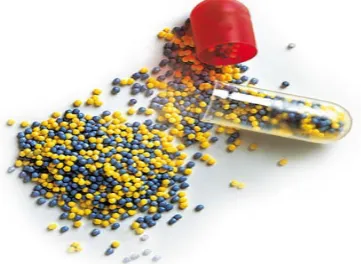
Fig 1. Pellets
1.2.2 Advantages:
• Improved flow properties and ease of packing resulting in uniform
and reproducible fill weight of tablets and capsules.
• Improved appearance of products.
• Improved safety and efficacy of active ingredient.
• Decreased handling hazards and easier transport.
• Decreased hygroscopicity.
• High bulk density.
• Little abrasion and decreased friability.
• Uniform size with narrow size distribution.
• High drug loading capacity without producing extensively large
particles.
• When formulated as modified release preparations pellets are less
susceptible to dose dumping, thus lowering the risk of side effects.
• Pelletization prevents accumulation of drugs in GIT, which in turn
• Pellets disperse freely in GIT fluids due to their small size,
producing larger surface area for drug absorption and also reduce
peak plasma fluctuations
• Pelletization is used for taste masking of unpalatable drugs.
• Separation of incompatible drugs and/or excipients, such
ingredients can be formed into pellets and delivered in a single dose
after encapsulation.
• In chemical industries, pelletization an effective method of
avoiding powder dust
1.2.3 Disadvantages:
• Pellets are rigid and so cannot be easily compressed into tablets.
• Production of pellets is an expensive process due to requirement of
highly specialized equipment and trained personnel.
• The control of production process is difficult (e.g the amount of
water added and time is critical for the quality of pellets as over
wetting can occur easily).
1.2.4 Significance of pellets:
Pellets may have varied applications in varied industries. It just requires
an innovative bend to use it to derive maximum profitability. The smooth surface &
the uniform size of the pellets allow uniform coating not only for each pellet but also
from batch to batch.
• Improved appearance of the products. Coating of pellets can be
done with different drugs to enable a controlled release rate.
• In case of immediate Release Products larger surface area of pellets
• Chemically incompatible products can be formed into pellets &
delivered in a single dose by encapsulating them.
• In the chemical industries it is used to avoid powder dusting.
• Pellets ensure improved flow properties, and flexibility in
formulation development and manufacture.
• The coating material may be colored with a dye material so that the
beads of different coating thickness will be darker in color and
distinguishable from those having fewer coats.
• The thickness of the coat on the pellets dictates the rate at which the drug/ contents are released from the coated particles.
1.2.5 Rationale for pelletization:
The use of pellets as a vehicle for drug delivery at a controlled rate has
recently received significant attention, pellets disperse freely in gastrointestinal tract,
so they invariably maximize drug absorption, reduce peak plasma fluctuation, and
minimize potential side effects without appreciably lowering drug bioavailability,
pellets also reduce variation in gastric emptying rates and overall transit times,
which is common with single unit regimens, is minimized, high local concentration
of bioactive agent, which may inherently be irrigative or anaesthetic, can be avoided,
when formulated as modified release dosage form, pellets are less susceptible to
dose dumping than the reservoir type single unit formulation, better flow properties,
narrow particle size distribution, less friable dosage form and uniform packaging.
1.2.6 Theory of pelletization:
It is important to understand the fundamental mechanisms of granule
formation and growth. Different theories have been postulated related to the
mechanism of formation and growth of pellets. The most thoroughly studied and
most classified pelletization process, which involves a rotating drum, a pan or a
• Nucleation
• Transition
• Ball growth.
However, based on the experiments on the mechanism of pellet
formation and growth, the following steps were proposed:
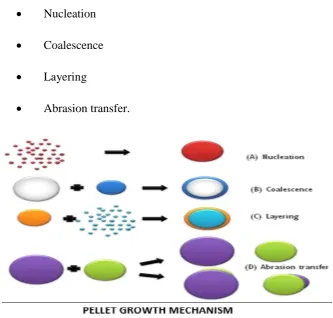
• Nucleation
• Coalescence
• Layering
[image:15.595.138.472.246.564.2]• Abrasion transfer.
Fig 2. Pellets growth mechanism
1.2.6.1 Nucleation:
Fine powders can readily be formed into agglomerates by the
introduction of a liquid phase followed by suitable agitation or tumbling. The liquid
and solid phases are brought into close contact; this allows binding forces to develop
and successful adherence of primary feed particles onto which particles collide and
attachés themselves. This result in pellet growth formation.
When two particles come into close contact, the cohesive forces that hold
the particles together are:
• Intermolecular attractive forces: these are very short range
attractions, van-der Walls dispersive forces make the most
significant contribution.
• Electrostatic attractive forces: these are almost always present in particulate systems. They are produced primarily by inter-particle
friction. Although these forces are generally less than those
experienced in other binding mechanisms, the net effect is to hold
or orient particles in a contact region for sufficiently long for other,
more dominant mechanism to operate.
• Liquid bridge modes: these are three physical situations in which
the amount of liquid present produces cohesive forces between
particles. The contributing mechanisms are adsorbed liquid layers,
mobile liquid bridges, and viscous or adhesive binders.
Oncesufficient liquid is present to produce liquid bridges in an
assembly of particles, the cohesive strength of the material
increased.
Nucleation is a common stage in all pelletization processes and occurs
whenever a powder is wetted with liquid. The primary particles are drawn together
to form three-phase air-water-liquid nuclei and are attached together by liquid
bridges which are pendulum in nature.
1.2.6.2 Transition:
• Coalescence is defined as the formation of large-sized particles by
random collision of well-formed nuclei, and the mechanism
requires slight excess moisture on the nuclear surface.
• Although the number of nuclei is progressively reduced, the total
mass of the system remains unchanged during this step.
• Layering is a slow growth mechanism and involves the successive
addition of fragments and fines on an already formed nucleus. In
the layering step, the number of particles remains the same, but the
total mass in the system increases due to increasing particle size as
a function of time.
1.2.6.3 Ball growth:
In the ball growth phase the main mechanism affecting the slow growth
of agglomeration is the abrasion transfer which involves the transfer of materials
from one granule formed to another without any preference in either direction. The
particles, however, undergo a continuous change in size as long as the conditions
that lead to the transfer of material exist.
1.2.7 Mechanism of action:
• Enteric coated capsule dissolves and releases coated pellets.
• The pellets which are resistant to the gastric juice due to the
polymer coating, are gradually distributed in the stomach.
• Because of their small size, the pellets pass easily through the
Fig 3. Mechanism of action
The specific milieu of the duodenum with pH levels 6-7, causes the
enteric-coating to disintegrate, and the active pharmaceutical ingredient is rapidly
absorbed.
1.2.8 Pelletization Techniques:
• Pelletization by extrusion-spheronization
• Drug layering (dry powder layering & solution and suspension
layering)
• Cryo-pelletization
• Freeze pelletization
• Globulation
• Compression
1.2.8.1 Solution/Suspension layering:
Fig 4. Coating suspension and solution layering process
The Wurster coating process had evolved through elaborate design modifications and tenement into ideal equipment for the manufacture of pellets by solution/ suspension layering. The high drying efficiency inherent in quid-bed
equipment, coupled with the innovative and efficient design features of the Wurster process, has allowed the machines to hold center stage in pharmaceutical processing
technology.
[image:19.595.343.503.476.652.2]
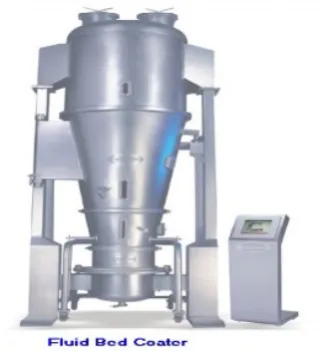
Fig 5. Fluid bed coater
Not only have the manufacture and coating of pellets become routine and
processing technique, has proved to be predictable and economically feasible. The
primary features that distinguish Wurster equipment from other quid-bed equipment
are the cylindrical partition located in the product chamber and the configuration of the air distributor plate, also known as the orifice plate. The latter is congaed to allow most of the fluidization or drying air to pass at high velocity around the nozzle and through the partition, carrying with it the particles that are being layered on.
Once the particles exit the partition, they enter the expansion chamber, where the
velocity of the air is reduced below the entrainment velocity, and the particles fall
back to the area surrounding the partition (referred to as the down bed).
The down bed is kept aerated by the small fraction of air that passes through the small holes on the periphery of the orifice plate. The particles in the down bed are transported horizontally through the gap between the air distributor
plate and the partition by suction generated by the high air velocity that prevails
around the nozzle and immediately below the partition. The volume of air that
passes through the down bed outside the partition is just enough to generate modest
particle movement. Because the spray direction is concurrent with particle
movement, and particle motion is well-organized under optimum conditions,
uniform layering of drug substances is consistently achieved. Because the partition height, that is, the gap between the partition and the orifice plate, controls the rate at which the particles enter the spray zone, it is an important variable that needs to be
optimized for every batch size. For instance, at a given load size and fluidization air
volume, the partition height can be reduced or increased to provide either a well-
controlled particle motion that produces the desired pellet movement or a bubbling
down bed that leads to disorganized particle movement and inefficient process.
1.2.8.2 Advantages:
• Innovative processes for coating of products.
• Film coating; lipid hot melt coating, Coating of granules, pellets,
tablets.
• Specific manipulation of the particle surface characteristics,
• Specific manipulation of the way in which the particle dissolves the
decomposition or the release of active ingredients.
• Process advantages: Uniform, continuous product coating. Aqueous
or organic coatings can be applied.
• Coating and drying take place in one machine. In terms of Total
Containment, the coating process and the filling and emptying of
the machine can be carried out in complete isolation and without
product spreading into the environment.
1.2.8.3 Principle:
Principle involved in fluid bed coater is particles are fluidized and the
coating fluid sprayed on and dried. Small droplets and a low viscosity of the spray
medium ensure an even product coating.
1.2.9 Types:
• Top Spray Coating
• Bottom Spray Coating (Wurster Coating)
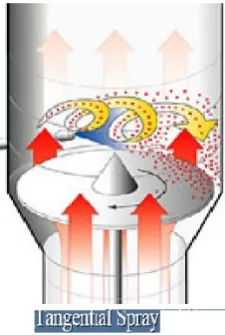
• Tangential Spray Coating (Rotor Pellet Coating.
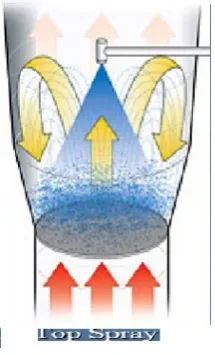
• Top spray coating:
This process is used for general coatings right up to enteric coating. With
top spray coating in the fluid bed (batch and continuous), particles are fluidized in
the flow of heated air, which is introduced into the product container via a base
plate. The coating liquid is sprayed into the fluid bed from above against the air flow
(countercurrent) by means of a nozzle. Drying takes place as the particles continue
to move upwards in the air flow. Small droplets and a low viscosity of the spray
medium ensure that the distribution is uniform. Coating in the continuous fluid bed
is particularly suitable for protective coatings/color coatings where the product
Fig 6. Top spray
The product is continuously fed into one side of the machine and is
transported onwards via the sieve bottom by means of the air flow. Depending on
the application, the system is sub-divided into preheating zones, spray zones and
drying zones. The dry, coated particles are continuously extracted.
Bottom spray coating (Wurster coating):
This process is particularly suitable for a controlled release of active
ingredients. In the Wurster process, a complete sealing of the surface can be
achieved with a low usage of coating substance. The spray nozzle is fitted in the
base plate resulting in a spray pattern that is concurrent with the air feed.
[image:22.595.247.366.555.704.2]By using a Wurster cylinder and a base plate with different perforations,
the particles to be coated are accelerated inside the Wurster tube and fed through the
spray cone concurrently. As the particles continue traveling upwards, they dry and
fall outside the Wurster tube back towards the base plate.
They are guided from the outside back to the inside of the tube where
they are once again accelerated by the spray. This produces an extremely even film.
Particles of different sizes are evenly coated.
Bottom spray coating (Continuous fluid bed):
Particularly suitable for protective coatings/color coatings where the
product throughput rates are high. The product is continuously fed into one side of
the machine and is transported onwards via the sieve bottom by means of the air
flow. Depending on the application, the system is sub-divided into pre-heating
zones, spray zones and drying zones whereby spraying can take place from below in
the form of a bottom spray. The dry, coated particles are continuously extracted.
Tangential spray coating (Rotor pellet coating):
Ideal for coatings with high solid content. The product is set into a spiral
motion by means of a rotating base plate, which has air fed into the powder bed at its
edge. The spray nozzle is arranged tangentially to the rotor disc and also sprays
concurrently into the powder bed. Very thick film layers can be applied by means of
Fig 8. Tangential spray
Limitations:
The disadvantage of the Wurster process is the inaccessibility of the
nozzles. If the nozzles are clogged at any time during the layering process, the
operation has to be interrupted, and the spray guns must be removed for cleaning.
The problem can be alleviated by screening the formulation or by using a spray gun
with a bigger nozzle. Another aspect of the process that is challenging when
multiple nozzles are used is the potential overlap of adjacent spray zones.
Although the position of the nozzle is fixed, the spray zone over- lap can
2. LITERATURE REVIEW
1. NS Dey et al11, reviewed that the multiparticulate drug delivery systems are especially suitable for achieving controlled or delayed release oral formulations
with low risk of dose dumping, flexibility of blending to attain different release
patterns as well as reproducible and short gastric residence time. The release of drug
from microparticles depends on a variety of factors including the carrier used to
form the multiparticles and the amount of drug contained in them. Consequently,
multiparticulate drug delivery systems provide tremendous opportunities for
designing new controlled and delayed release oral formulations, thus extending the
frontier of future pharmaceutical development.
2. HP Patel et al12, formulated multiple unit particle system (MUPS) of stabilized ramipril and hydrochlorothiazide pellets which produced better dissolution
of the system for better bioavailability with improving stability and bioavailability
of ramipril. More particularly, the present invention was directed for stabilized
ramipril against decomposition into degradation products, namely ramipril-DKP and
ramipril-diacid, during formulation and storage conditions. Simple ramipril
formulation showed 15.15% related impurities after 3-month accelerated stability
study, which was minimized to 2.07%, related impurities in ramipril pellets after 6
month accelerated stability study. By making MUPS of ramipril pellets,
hydrochlorothiazide showed better dissolution (100.4% of ramipril and 97.9% of
hydrochlorothiazide within 60 min) to produce better bioavailability. So, making
MUPS containing ramipril pellets with polymer coating and hydrochlorothiazide and
other excipients showed better stability of ramipril along degradation and synergistic
effect among hypertension in immediate delivery.
is a novel drug delivery system; a technique which converts fine powder particles
into pellets. Review deals with the pellet and its various types of pelletization
techniques like spheronization and extrusion, pelletization by layering, pelletiztion
by solution layering &direct pelletization. The advantages, disadvantages & various
applications of above mentioned techniques.spheronization and extrusion
pelletization by layering are most widely used techniques. The study also deals with
factors and evaluation of pellets.
4. Branka Ivic et al 14 developed diclofenac sodium extended release compressed matrix pellets and optimized using Generalized Regression Neural
Network (GRNN). According to Central Composite Design (CCD), ten formulations
of diclofenac sodium matrix tablets were prepared. Extended release of diclofenac
sodium was acomplished using Carbopol® 71G as matrix substance. The process of
direct pelletisation and subsequently compression of the pellets into MUPS tablets
was applied in order to investigate a different approach in formulation of matrix
systems and to achieve more control of the process factors over the principal
response — the release of the drug. The investigated factors were X1 -the percentage
of polymer Carbopol® 71 G and X2- crushing strength of the MUPS tablet. In vitro
dissolution time profiles at 5 different sampling times were chosen as responses.
Results of drug release studies indicate that drug release rates vary between different
formulations, with a range of 1 hour to 8 hours of dissolution.
5. Phale et al 15reviewed the use of Multiunit particulate systems (MUPS)
in recent years as a controlled drug-delivery method. The current review describes
the role and selection of excipients, pellet core, coating materials, and compression
with various cushioning agents. MUPS technology enables firms to achieve the
desired and therapeutic release with minimal side effects. Thus, MUPS could open a
new area of research for scientists with many opportunities for the formulation of
controlled- and delayed-release oral dosage forms.
6. Manuel Efentakis et al 16 reviewed the compared the release behavior of single-unit (tablets, capsules) and multiple-unit (minitablets in capsules)
which contained the swellable hydrophilic polymers sodium alginate (high viscosity)
and Carbopol 974P, were compared. Swelling and erosion experiments showed a
high degree of swelling and limited erosion for the Carbopol preparations, whereas
less swelling but greater erosion was observed for the sodium alginate preparations.
The sodium alginate preparations were eroded in 6 hours, while Carbopol
preparations exhibited limited erosion within this period of time. These results
appeared to be attributed to the physicochemical characteristics of the polymers used
in this study. Polymer characteristics greatly influenced the release of furosemide
(model drug) from the formulations prepared and tested. Sodium alginate had a less
pronounced sustained release effect compared with Carbopol (ie, in 8 hours all 3
sodium alginate dosage forms displayed complete release of furosemide, while only
30% of the drug was released from Carbopol dosage forms). Finally, all 3 Carbopol
dosage forms (single- and multiple-unit) displayed similar release behavior while
sodium alginate dosage forms displayed a different and more distinctive behavior.
Mini tablets and tablets showed a greater sustained release effect compared with
capsules. Evaluation of the release data indicated that the release mechanism for
sodium alginate formulations may be attributed to erosion/dissolution, while for
Carbopol it may be attributed mainly to polymer relaxation and diffusion of the drug
from the polymer surface.
7. Gaurav Tiwari1 et al 17 prepared glipizide (GPZ) and GPZ-HPC solid dispersion (SD) pellets and characterized for drug release mechanisms from a
multi-unit erosion matrix system for controlled release. Solid dispersion with HPC was
prepared by co-evaporation method and characterized by Fourier transform infra red
spectroscopy (FT-IR), scanning electron microscopy (SEM), differential scanning
calorimetry (DSC), hot-stage microscopy (HSM), x-ray diffraction (XRD), stability
studies. Release rate of glipizide from solid dispersion was measured by the rotating
basket method (JP XII). FT-IR study indicated the presence of hydrogen bonding in
solid dispersion. SEM confirms the amorphous form in solid dispersion. In DSC
melting peak in solid dispersion shifted slightly to lower temperature with respect to
drug alone indicated the conversion to amorphous form which was further proved in
melted HPC to dissolve the crystal of GPZ at increasing temperatures. The release
rate of GPZ from solid dispersion granules was markedly larger than that from GPZ
powder, and it was larger with a lower HPC molecular weight. The stability study
showed that SD systems were not significantly different during six month of
accelerating condition storage.
8. Phutane P et al 18 formulated microspheres of glipizide were developed by the emulsion solvent diffusion-evaporation technique by using the modified
ethanol,-dichloromethane co-solvent system. The polymer mixture of ethyl cellulose
and Eudragit® S100 was used in different ratios (1:0, 1:1, 2:3, 1:4 and 0:1) to
formulate batches F1 to F5. The resulting microspheres were evaluated for particle
size, densities, flow properties, morphology, recovery yield, drug content, and in
vitro drug release behavior. The formulated microspheres were discrete, spherical
with relatively smooth surface, and with good flow properties. Among different
formulations, the fabricated microspheres of batch F3 had shown the optimum
percent drug encapsulation of microspheres and the sustained release of the
Glipizide for about 12 h. Release pattern of Glipizide from microspheres of batch F3
followed Korsmeyers-Peppas model and zero-order release kinetic model.
9. Shailesh et al 19 reviewed a drug delivery system that can have the entire various active pharmaceutical ingredients in one capsule and can deliver the drug at
right time and in proper amount according to body’s circadian rhythm. According to
recent pharmaceutical applications involving pulsatile delivery the multiparticulate
dosage forms are getting much favor over single unit dosage form because of their
smaller particle size these systems have capacity for passing through the G.I. tract
easily, leading to less inter as well as intra subject variability.
10. N Pandya et al 20 formulated floating multi particulate systems that have been utilized to obtain prolonged and uniform release of drug in the stomach
for development of once-daily formulations. A controlled-release system designed to
increase residence time in the stomach without contact with the mucosa was
achieved through the preparation of floating microspheres by the emulsion solvent
an oral hypoglycemic agent; and (iii) Eudragit® S as polymer. The effects of various
formulations and process variables on the internal and external particle morphology,
micromeritic properties, in vitro floating behavior, drug loading, and in vitro drug
release were studied. The microspheres were found to be regular in shape and highly
porous. The prepared microspheres exhibited prolonged drug release (~8 h) and
remained buoyant for >10 h. The mean particle size increased and the drug release
rate decreased at higher polymer concentrations. No significant effect of the stirring
rate during preparation on drug release was observed. In vitro studies demonstrated
diffusion-controlled drug release from the microspheres. Microsphere formulation
CS4, containing 200 mg calcium silicate, showed the best floating ability (88%
buoyancy) in simulated gastric fluid. The release pattern of glipizide in simulated
gastric fluid from all floating microspheres followed the Higuchi matrix model and
the Peppas-Korsmeyer model.
11. Pahwa et al 21 prepared the gastroretentive floating multiple-unit drug delivery system for glipizide as a model drug for prolongation of gastric residence
time. Floating microspheres were prepared by ionotropic gelation method using
polymeric material such as chitosan. D-optimal design was utilized to investigate the
joint influence of two variables: drug to polymer ratio (X1) and concentration of
effervescent agent (X2) on the drug entrapment efficiency, percentage buoyancy,
and cumulative percentage drug release. Particle size and surface morphology of
prepared microspheres were characterized by optical and scanning electron
microscopy respectively. Formulated microspheres exhibited prolonged drug release
and remained buoyant for more than 12 h.
12. Nagarjuna Naik R et al 22 formulated and evaluated enteric coated multi particulate systems for Esomeprazole magnesium dihydrate to reduce the
gastrointestinal tract side effects. The delayed release multiple units were prepared
by using fluid-bed Wurster technology. These multiple units were prepared by seal
coating, drug coating and enteric coating and were evaluated for assay, acid
resistence, drug release, dissolution. This stud concluded that Esomeprazole
magnesium dihydrate could be prepared by using combination of polymers and
13. Anuranjita Kundu et al 23 formulated norfloxacin as a suitable micro particulate system of Norfloxacin for controlled release delivery system by varying
the alginate concentrations, calcium chloride concentrations and curing time.
Norfloxacin microbeads were prepared by ionotropic gelation technique. Prepared
microbeads were evaluated for granulometric studies, micrometric, scanning
electron microscopy, drug entrapment efficiency, swelling studies and in-vitro
dissolution studies. The prepared beads were free flowing and white in color. The
drug loaded beads showed 37.26% to 91.73% drug entrapment, which was found to
increase with increase in alginate concentration. In vitro drug release study of these
microbeads indicated controlled release for Norfloxacin 96.19 – 97.83% release
after 12 hours. From this study it could be concluded that the free flowing
microbeads of Norfloxacin could be successfully prepared by ionotropic gelation
technique with high entrapment efficiency and prolonged release characteristics.
14. K Senthil Kumaran et al 25 formulated mosapride-controlled release beads with the help of the ionotropic gelation method, using sodium alginate
containing KHCO 3 as the gas-forming agent. The physical characterization of the
mosapride beads was examined by SEM. The results showed that the shape and
texture of the beads were uniform before and after dissolution. The percentage of
mosapride drug entrapment efficiency ranged from 97.4 ± 0.08 to 99.1 ± 0.04. The
percentage of mosapride content from the beads was determined by
high-performance liquid chromatography (HPLC) and ranged from 97.9 ± 0.08 to 99.6 ±
0.01.The in-vitro percentage release of mosapride from the beads at the end of 14
hours ranged from 90.0 ± 0.2 to 99.5 ± 0.12. The formulated beads in formulations 1
and 3 were sealed in vials and kept for 90 days at 40°C / 75% RH. After 90 days of
exposure the percentage drug content was found to be 99.2 ± 0.04. The floating
beads designed for the gastroretentive dosage form could be suitable for controlled
drug delivery.
15. Tanmoy Ghosh et al 24 studied different subcoats containing calcium chloride, citric acid or Eudragit E, respectively for immediate release theophylline
modifying subcoat ingredients and the shellac coating was investigated using FT-IR
spectroscopy. All formulations with modifying subcoat prolonged drug release.
Whereas the effect of calcium chloride was a result of ionic interactions with
shellac, the effect of citric acid was a reduction of the degree of dissociation of
shellac. The influence of Eudragit(®) E was explained by the solubility
characteristics of this basic polymer. The application of modifying subcoats was an
easy and effective means to achieve sustained release from shellac-coated dosage
forms. The choice of a suitable substance and the adjustment of its concentration
allow tailor made sustained release profiles.
16. Sachin B Somwanshi et al 29 reviewed the multiparticulate drug delivery systems suitable for achieving sustained or delayed release oral formulations with
low risk of dose dumping, flexibility of blending to attain different release patterns
as well as reproducible and short gastric residence time. One of the approaches
toward this goal was to develop the floating multiparticulates so as to increase the
gastric retention time. Such systems have more advantages over the single-unit
dosage forms. The development of floating multiparticulates involved different
solvent evaporation techniques to create the hollow inner core. In this review, the
current status of floating multiparticulate drug delivery systems including hollow
microspheres (micro balloons), low density floating micro pellets and floating micro
beads (acrylic resin based), microcapsules etc, their evaluation parameter,
advantages, application, limitation and future potential for oral sustained release
drug delivery were discussed.
17. M. Thriveni et al 26 formulate and evaluated tizanidine hydrochloride sustained release pellets. Tizanidine hydrochloride is an immadazole α2-adrenergic
agonist used in the management of increase in muscle tone associated with
spasticity. It has short biological half-life of 2-2.5 h and is rapidly eliminated from
the body. Sustained release dosage form of Tizanidine hydrochloride was developed
for reduction in total amount of dose administration, to improve patient compliance,
and increase efficiency in the treatment. The pellets were prepared by pan coating
and fluidized bed coating technique (Wurster type) using hydroxy propyl methyl
isopropyl alcohol, methylene dichloride as solvents. The pellets were filled in
capsules and evaluated for weight variation, content uniformity, moisture content,
lock length, disintegration and in-vitro dissolution tests and the results were found to
be within the limits. A comparative study of dissolution profile of different batches
with marketed product was performed. The dissolution data was fitted with various
kinetic models, and the optimized formulation followed zero order kinetics by
non-Fickian case-II diffusion process. Stability studies were conducted for 3 months
according to ICH guidelines and found to have good results.
18. Keerthi Kancharla et al 27 prepared and evaluated multiparticulate floating drug delivery system of aceclofenac. The microspheres were prepared by
emulsification solvent evaporation technique using Eudragit RS 100 as a release rate
controlling polymer in the ratios 1:1, 1:2 and 1:3. The prepared microspheres were
evaluated for drug-polymer compatibility, micromeritic properties, drug entrapment
efficiency, in-vitro buoyancy and drug release studies. The mean particle size
increased with increase in the polymer concentration, when compared to pure drug
and it was lying between 14.71-25.93 µm. The micromeritic properties were found
to be improved when compared to pure drug .Scanning electron microscopy
confirmed the hollow structure with smooth external surface. The drug and polymer
were found to be compatible as seen in IR studies. The entrapment efficiency
considerably decreased with increase in the polymer concentration ranging from
78-36 % respectively. The microspheres floated up to 12 h over the surface of the
gastric buffer medium and the buoyancy percentage was found to be in the range of
85-94%. In-vitro drug release studies showed that the prepared microspheres
exhibited prolonged drug release for more than 12 hours. The mechanism of drug
release was found to be a combination of both Peppas and zero order release
kinetics. The developed floating microspheres of aceclofenac may be used for
prolonged drug release for at least 12 h for maximizing the therapeutic efficacy
along with patient compliance.
polymeric material such as chitosan. D-optimal design was utilized to investigate the
joint influence of two variables: drug to polymer ratio (X1) and concentration of
effervescent agent (X2) on the drug entrapment efficiency, percentage buoyancy,
and cumulative percentage drug release. Particle size and surface morphology of
prepared microspheres were characterized by optical and scanning electron
microscopy respectively. Formulated microspheres exhibited prolonged drug release
and remained buoyant for more than 12 h.
20. Manas Tripathi et al 30 Formulated and evaluated the gastro-retentive floating microballoons of glipizide using hydrophilic polymers hydroxypropyl
methylcellulose (HPMC) and Eudragit RS100 (RS 100) by emulsion solvent
evaporation technique. The floating microballoons were evaluated using
micromeritic properties,buoyancy, in vitro drug release, scanning electron
microscopy and stability studies. The densities of floating microspheres
(0.475-0.975 g/cm3) were found to be less than the density of gastric fluid (1.004 g/cm3),
therefore showed an extended floating time of more than 12 h over the gastric fluid.
The entrapment efficiency of prepared floating microspheres was satisfactory
(41.32-76.19%). The scanning electron microscopy confirmed the hollow nature of
microspheres with pores on the surface which imparted floating properties to the
prepared floating microballoons. Among all formulations, F4 (Drug:HPMC:RS
100::1:4:3) was found to be the best as it exhibited highest drug release (99.12%) in
12 h followed by diffusion mechanism and was stable for three months at ambient
3. AIM AND OBJECTIVES
3.1 Aim:
Glipizide is one of the most widely used oral hypoglycemic agents in the
control of diabetes mellitus. It belongs to the class sulphonyl urea and is available as
an immediate release tablet and controlled release tablet for once a day dosing. The
innovator controlled release product of glipizide is glucotrol XL which is based on
the osmotic drug delivery system is difficult to formulate and expensive to scale up
since it involves investment in putting up a laser drill for drilling the hole required
for the fluid to permeate into the system.
The current work is aimed at formulating a drug delivery system which
will deliver the drug over 24 hours at the same rate of delivery as that of glucotrol
XL but using the micro porous membrane drug delivery system and the multi unit
particulate platform (MUPS).
3.2 Objectives:
(1) To standardize a procedure for loading drug on to non peril pellets.
(2) To determine the optimum level of ethyl cellulose needed to coat
the pellets in order to get nearly zero order drug release from the
pellets.
(3) To study the role of two different types of pore formers in
modulating drug release to match to the target product profile. This
4. DRUG PROFILE
Drug : Glipizide8
Description : It is white odorless powder.
Molecular structure:
Molecular formula : C21H27N5O4S
Molecular weight : 445.535
Solubility: Practically insoluble in water, sparingly soluble in acetone
and soluble in ethylene chloride (Dichloromethane), chloroform and diethyl form
amide.
Pka Value: Pka (strongest acidic) = 4.32
Pkb (strongest basic)=0.059
Category: Oral blood-glucose-lowering drug of the sulfonylurea class
Anti-diabetic agent.
Dose : 5-20 mg in once or twice daily.
4.1 Mechanism of action2 :
Sulfonylurea’s likely bind to ATP-sensitive potassium-channel receptors
on the pancreatic cell surface, reducing potassium conductance and causing
depolarization of the membrane. Depolarization stimulates calcium ion influx
through voltage-sensitive calcium channels, raising intracellular concentrations of
calcium ions, which induces the secretion, or exocytosis of insulin.
4.2 Pharmacokinetics3:
Absorption: Gastrointestinal absorption is uniform, rapid, and essentially complete.
Distribution (protein binding): 98-99%, primarily to albumin.
Metabolism: Hepatic. The major metabolites of glipizide are products of aromatic
hydroxylation and have no hypoglycemic activity. A minor metabolite which
accounts for less than 2% of a dose, an acetylaminoethylbenzene derivatives is
reported to have 1/10 to 1/3 as much hypoglycemic activity as the parent compound.
Elimination: 70 to 80% through urine.
4.3 Doses8:
Dose: 5-20 mg in once or twice daily.
Administer glipizide in fixed combination with metformin once daily
with a meal.
Individualize initial dosage of glipizide; usually 5–10 mg daily. The
other oral antidiabetic agent may be discontinued abruptly..
For more severe hyperglycemia (i.e., fasting plasma glucose
concentrations of 280–320 mg/dl), 2.5 mg of glipizide and 500 mg of metformin
EXCIPIENT PROFILES
4.4 Hydroxyl propyl methyl cellulose7 :
Non-proprietary names : JP : Hydroxyl propyl methylcellulose
BP : Hypromellose
Ph Euro : Methyl hydroxyl propyl cellulosum
USP : Hypromellose
Chemical Name : Cellulose, 2-hydroxypropyl methyl ether.
Synonyms : Methyl Hydroxyl Propyl Cellulose, Propylene Glycol
ether of methylcellulose, Mythical, Met lose, E464,
Pharmacia, Culminal MHPC.
Structural Formula:
OR
CH2OR
O
O O
O
O
OR
OR OR
CH2OR
Where R is H, CH3 or CH3-CH(OH)-CH2
Physical and chemical properties:
Molecular weight : 10,000 – 15, 00,000
Color : White to creamy-white
Nature : Fibrous or granular powder
Taste : Tasteless
Density : 0.3-1.3 g/ml
Specific gravity : 1.26
Solubility : Soluble in cold water, practically insoluble
Chloroform, ethanol (95%) and ether but Soluble in
mixture of ethanol and Dichloromethane.
Viscosity : HPMC 5cps, HPMC-K4M-3,000-5600mPas, K15M:
12,000-21,000 maps, K100M: 80,000-1, 20,000 maps.
Melting point : Browns at 190-200°C, chars at 225-230°C, Glass
transition temperature is 170-180°C.
Functional category : Coating agent, film-forming, rate-controlling polymer for
sustained release, stabilizing agent, suspending agent,
tablet binder, viscosity-increasing agent.
Stability & storage : Stored in an air-tight container in a cool and dry place.
It is stable although it is slightly hygroscopic.
4.5.1 Applications:
In oral product HPMC is primarily used as tablet binder, in film
coating and as an extended release tablet matrix. Concentration
between 2-5% w/w may be used as a binder in either wet or dry
granulation process. High viscosity grade may be used to retard the
release of water-soluble drug from a matrix.
HPMC is used as an adhesive in plastic bandage and as a wetting
agent for hard contact lenses. It is widely used in cosmetics and
food products. In addition, HPMC is used as an emulsifier,
suspending agent and stabilizing agent in topical gels and
particle from coalescing or agglomerating thus, inhibiting the
formation of sediments.
4.5.3 Polyethylene Glycol5:
Molecular formula : C18 H38 O10.
Molar mass : 380-420 gm/mol.
Density : 1.128g/cm3
Melting point : 4-8 0oc
Viscosity : 90 cst at 250c, 7.3 cst at 99 0c
PEG-4000 is low molecular weight grade of PEG. It is clean, colorless.
viscous liquid, due in part to its low toxicity. PEG-4000 is widely used in variety of
pharmaceutical formulation . more recently, it has been used to make” E-liquid” for
electronic cigarettes (personnel vaporizers).
Chemical Properties:
PEG-4000 strongly hydrophilic. The partition-coefficient of PEG-4000
between hexane and water is 0.000015(log=-4.8),indicating that when PEG-4000 is
mixed with water and hexane there are only 15 parts of PEG-400 in the hexane layer
per 1 million parts of PEG-400 in the water layer.
PEG-400 is soluble in water, acetone, alcohols, benzene, glycerin, glycol
4.5.4 Polyvinyl pyrrolidone6:
Polyvinyl pyrrolidone (PVP), also commonly called Polyvidone or
Povidone, is a water-soluble polymer made from the monomer N-vinylpyrrolidone:
Properties:
PVP is soluble in water and other polar solvents. When dry it is a light
flaky hygroscopic powder, readily absorbing up to 40% of its weight in atmospheric
water. In solution, it has excellent wetting properties and readily forms films. This
makes it good as a coating or an additive to coatings.
4.5.5 Uses:
It is used as a binder in many pharmaceutical tablets. It simply passes
through the body when taken orally.
PVP added to iodine forms a complex called providence-iodine that
possesses disinfectant properties. This complex is used in various products like
4. PLAN OF WORK
Literature survey
Analytical method development.
Pre formulation studies
Drug and excipient profile.
Base coated Drug loading to pellets (FBC).
Assay of drug coated pellets.
Functional coating (FBC).
Evaluation of final coated pellets
•
Dissolution studies using pH-7.2 phosphate buffer.
•
DOE
Stability studies
6. MATERIALS AND METHODS
6.1 Table No 1: List of materials /excipients /chemicals
Chemical Manufacturer/supplier
Glipizide Emcoind , Hyderabad
Isopropyl alcohol Merck India
HPMC 5cps Dow Chemicals
Dichloromethane Luzenac, U.S
Ethylcellulose Evonik Industries
Polyvinylpyrrolidone Evonik Industries
PEG-400 Merck India
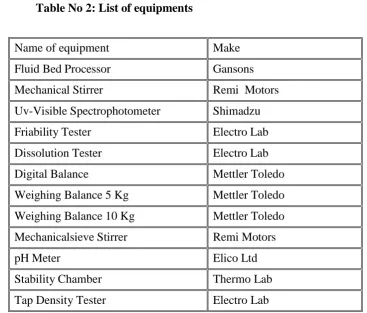
6.2 Table No 2: List of equipments
Name of equipment Make
Fluid Bed Processor Gansons
Mechanical Stirrer Remi Motors
Uv-Visible Spectrophotometer Shimadzu
Friability Tester Electro Lab
Dissolution Tester Electro Lab
Digital Balance Mettler Toledo
Weighing Balance 5 Kg Mettler Toledo
Weighing Balance 10 Kg Mettler Toledo
Mechanicalsieve Stirrer Remi Motors
pH Meter Elico Ltd
Stability Chamber Thermo Lab
[image:42.595.119.487.443.756.2]6.3 Formulation development10:
Glipizide controlled release pellets :
In this work, the method used for preparing Glipizide layered release
pellets was solution/suspension- layering technique.
The three main steps followed in solution/suspension layering technique
to prepare controlled release pellets of Glipizide were,
i. Drug loading.
ii. Seal coating.
iii. Functional coating.
6.3.1 Drug loading:
2 g of glipizide was taken in a beaker and 35 ml of isopropyl alcohol and
15 ml dichloromethane was added. The contents were mixed thoroughly by using
mechanical stirrer. Then the drug solution was sprayed onto non-pareil sugar seeds
(25 g) by using fluidized bed-dryer technique.
6.3.2 Seal coating:
5 g of HPMC was taken in beaker and 35 ml of isopropyl alcohol and 15
ml dichloromethane was added. The contents were mixed thoroughly by using
mechanical stirrer. During stirring 0.5 ml of PEG-400 was added drop by drop to
the solution. Then the seal coated solution was sprayed onto sugar seeds drug loaded
pellets using fluidized bed-dryer technique.
6.3.3 Functional coating:
The functional coating was done using ethyl cellulose and using two pore
Functional coating plays most important role in controlling drug release.
The first type of functional coating is as given below.
1. Composition of functional coating on are given in Table No. 3.
Ethyl cellulose and PEG-400 was taken in beaker and
dichloromethane was added. The contents were mixed thoroughly
by using mechanical stirrer. Then the coating solution was sprayed
onto seal coated pellets by using fluidized bed-dryer technique.
The second type of functional coating with PEG 4000 as pore former is
as given below.
2. Composition of functional coating is given in Table No. 4. Ethyl
cellulose and PEG-4000 were taken in beaker and dichloromethane
was added. The contents were mixed thoroughly by using
mechanical stirrer and during stirring PEG-400 were added drop by
drop to the solution. Then the coating solution was sprayed onto seal
coated pellets by using fluidized bed-dryer technique.
The third type of functional coating with PVP as pore former is as given below.
3. Composition of functional coating is given in Table No. 5. Ethyl
cellulose and PVP were taken in beaker and dichloromethane was
added. The contents were mixed thoroughly by using mechanical
stirrer and during stirring PEG-400 were added drop by drop to the
solution. Then the coating solution was sprayed onto seal coated
Table No 3: Composition of glipizide pellets using ethyl cellulose:
Ingredients F1
Non-pariel sugar seeds (g) 25
Glipizide (g) 2
HPMC 5cps (g) 5
Isopropyl alcohol (ml) 70
Dichloromethane (ml) 130
PEG-400 (ml) 1
Ethyl cellulose (g) 10
Table No 4: Composition of glipizide pellets using PEG – 4000 as pore former:
Ingredients
F2 F3 F4 F5 F6 F7 F8 F9 F10
LL LM LH ML MM MH HL HM HH
Non-pariel sugar
seeds (g)
25 25 25 25 25 25 25 25 25
Glipizide (g) 2 2 2 2 2 2 2 2 2
HPMC 5cps (g) 5 5 5 5 5 5 5 5 5
Isopropyl alcohol
(ml)
70 70 70 70 70 70 70 70 70
Dichloromethane
(ml)
130 130 130 130 130 130 130 130 130
PEG-400 (ml) 1 1 1 1 1 1 1 1 1
PEG-4000 (g) 5 5 5 10 10 10 15 15 15
Table No 5: Composition of glipizide pellets using PVP as pore former:
Ingredients
F11 F12 F13 F14 F15 F16 F17 F18 F19
LL LM LH ML MM MH HL HM HH
Non-pariel sugar seeds (g) 25 25 25 25 25 25 25 25 25
Glipizide (g) 2 2 2 2 2 2 2 2 2
HPMC 5cps (g) 5 5 5 5 5 5 5 5 5
Isopropyl alcohol (ml) 70 70 70 70 70 70 70 70 70
Dichloromethane (ml) 130 130 130 130 130 130 130 130 130
PEG-400 (ml) 1 1 1 1 1 1 1 1 1
PVP (g) 5 5 5 10 10 10 15 15 15
Ethyl cellulose (g) 15 20 25 15 20 25 15 20 25
6.4 Analytical methods:
6.4.1 Preparation of glipizide standard stock solution in phosphate buffer solution
PH 7.2:
A standard stock solution of glipizide was prepared by dissolving
accurately weighed 100 mg of glipizide with 10 ml of methanol and the volume was
made up to 100 ml in volumetric flask with phosphate buffer , pH 7.2 to obtain a
stock solution of 1000 µg /ml.
6.4.2 Determination of analytical wavelength:
From the standard stock solution, 1ml was pipette out into 100 ml
volumetric flask. The volume was made up to 100 ml with phosphate buffer, pH 7.2
and the resulting solution containing 10 µg /ml was scanned between 200 and 400 nm
using Schimadzu UV-1601 UV-Visible Spectrophotometer. The λmax was found to
6.4.3 Calibration curve of glipizide in Ph 7.2 Buffer:
Accurately weighed quantity of glipizide (100 mg) was dissolved in little
quantity of pH 7.2 phosphate buffer solution and volume was made up to 100 ml.
From this, 5 ml of solution was pipette out into a volumetric flask and volume was
made up to 50 ml. Appropriate aliquots were taken ( 0.2, 0.5, 1, 1.5, 2 ml) into
different volumetric flasks and volume was made up to 10 ml with pH 7.2 buffer so
as to get drug concentrations of 2, 5, 10, 15, to 20 µg/ml. The absorbance of these
drug solutions were estimated at 226 nm in Schimadzu UV-1601 UV-Visible
Spectrophotometer. This procedure was performed in triplicate to validate the
calibration curve.
6.5 Evaluation of glipizide pellets:
6.5.1 Assay of glipizide 31:
100 mg of drug loaded pellets were taken in 100 ml volumetric flask. To
this required quantity of methanol was added and placed in sonicater to dissolve the
pellets. Then volume was make up to 100 ml using pH 7.2 phosphate buffer. The
solution was filtered, from this 1ml was pipetted out and the volume was made
upto10 ml using pH 7.2 phosphate buffer. The absorbance was measured at 226 nm.
6.5.2 Dissolution of glipizide pellets in 7.2 phosphate buffer 31:
Apparatus : USP-I basket apparatus.
RPM : 100
Temperature : 37 ± 0.50 C
Wave length : 226 nm
Procedure:
900 ml of the dissolution medium was placed in the dissolution
5 mg of glipizide pellets was placed in the basket of the dissolution apparatus and
rotated at 100 rpm. At regular time intervals 5 ml of the dissolution medium was
withdrawn, and replaced with the buffer. The absorbance was measured at 226 nm
in Schimadzu UV-1601 UV-Visible Spectrophotometer. In order to understand the
mechanism and kinetics of drug release, the results of the in vitro drug release study
were fitted with various kinetic equations like zero order (% release vs. t), first order
(log % release vs. t) and Higuchi model (Mt/M∞vs. t1/2). In order to define a model
which would represent a better fit for the formulation, drug release data was further
analyzed by Peppas equation, Mt/M∞=ktn, where Mt is the amount of drug released
at time t and M∞ is the amount released at time ∞, thus the Mt/M∞ is the fraction of
drug released at time t, k is the kinetic constant and n is the diffusional exponent, a
measure of the primary mechanism of drug release. R2 values were calculated for the
linear curves obtained by regression analysis of the above plots.
Fig 9. SP-I basket EI apparatus
6.6 Stability studies31:
The stability studies on formulation scale up batch were carried out
according to ICH guidelines. The design and execution of the stability study
followed the principles outlined in the ICH parent guidelines. The purpose of the
study was to establish, a retest period or shelf life and label storage instructions
applicable to all future batches manufactured and packaged under similar conditions.
proof bottles. They were stored in air tight containers and placed in the humidity
chamber at 40oC ± 2oC/75% ± 5% RH. The accelerated studies were carried out for
three months and the testing frequency was at 0, 1, 2 and 3 months. The
recommended storage condition for Climatic Zone IV was followed which was
40oC±2oC/75% ± 5% RH. The attributes tested were assay and dissolution study.
The following were considered as significant change
• A 5% change in assay from initial value
7. RESULTS AND DISCUSSION
7.1 Calibration curve of glipizide:
The values for the absorbance at different concentration are shown in
Table No 6 and Fig.10. The calibration curve constructed for samples covered a
range of concentrations from 2 to 20 µg/ml and was found to be linear with a linear
regression coefficient value of 0.998.
Table No 6: Calibration curve of glipizide
Concentration (µg/ml) Absorbance
0 0
2 0.102
5 0.256
10 0.512
15 0.768
20 0.978
Fig 10. Calibration curve of glipizide
y = 0.049x + 0.007 R² = 0.998
0 0.2 0.4 0.6 0.8 1 1.2
0 5 10 15 20 25
Ab
so
rb
an
ce
7.2 Assay:
The drug content determined was found to be as shown in Table No 7-9.
Table No 7: Assay of formulation F1
Formulation % drug content
F1 93.2
Table No 8: Assay of formulation F2-F10
Formulation % drug content
F2 96.3
F3 94.2
F4 94.6
F5 98.2
F6 94.0
F7 96.1
F8 92.7
F9 96.8
F10 95.7
Table No 9: Assay of formulation F11-F19
Formulation % drug content
F11 94.3
F12 98.2
F13 96.3
F14 96.7
F15 98.2
F16 97.5
F17 96.9
F18 98.1
7.3 Dissolution parameters of glipizide pellets :
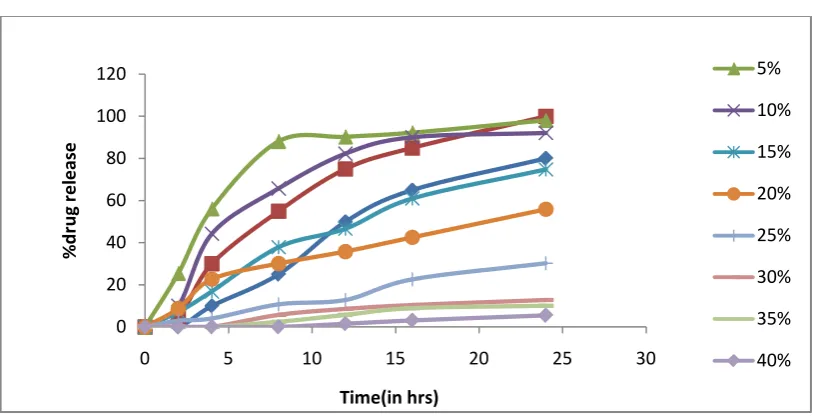
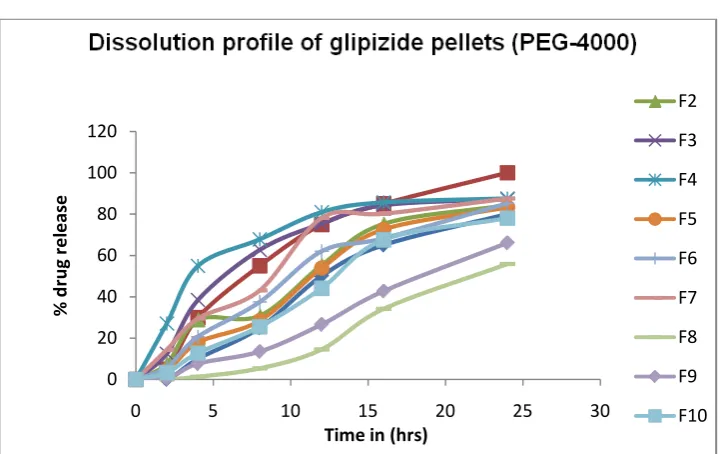
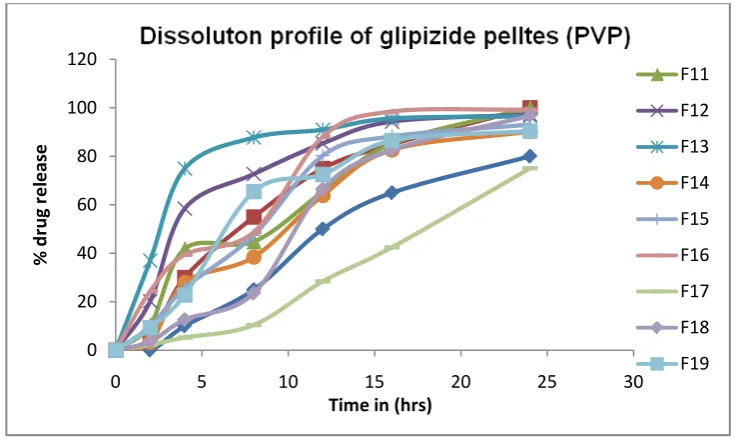
The results of the dissolution profile of the prepared pellets are shown in
Table No 10-13. and represented graphically in Fig.11-13.
The minimum weight gain required for ethyl cellulose coating onto drug
loaded pellets required to seal the pellets was 30 % w/w. Hence all experiments with
pore former were conducted at 30% weight gain.
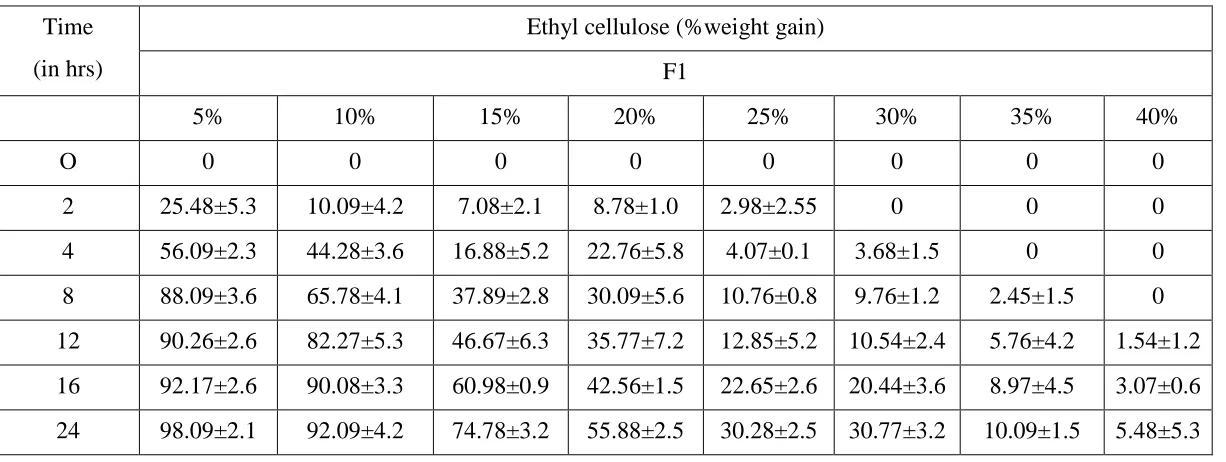
In case of formulation F1, different thickness of coating was applied. As
the percentage of coating increased the rate of dissolution decreased.
When PEG 4000 was used as pore former, formulation with
medium/lower that is medium level of ethyl cellulose (20%), low level of PEG (5%)
(formulation F5) alone was able to give dissolution profile matching to the target
product profiles.
When PVP was used as pore former only medium/low and high/medium
(formulation F14) were matching to the target product profile.
Table No 10: Dissolution profile of glipizide pellets using ethyl cellulose
Time
(in hrs)
Ethyl cellulose (%weight gain)
F1
5% 10% 15% 20% 25% 30% 35% 40%
O 0 0 0 0 0 0 0 0
2 25.48±5.3 10.09±4.2 7.08±2.1 8.78±1.0 2.98±2.55 0 0 0
4 56.09±2.3 44.28±3.6 16.88±5.2 22.76±5.8 4.07±0.1 3.68±1.5 0 0
8 88.09±3.6 65.78±4.1 37.89±2.8 30.09±5.6 10.76±0.8 9.76±1.2 2.45±1.5 0
12 90.26±2.6 82.27±5.3 46.67±6.3 35.77±7.2 12.85±5.2 10.54±2.4 5.76±4.2 1.54±1.2
16 92.17±2.6 90.08±3.3 60.98±0.9 42.56±1.5 22.65±2.6 20.44±3.6 8.97±4.5 3.07±0.6
Fig 11. Dissolution profile of glipizide pellets using ethyl cellulose
Table No 11: Concentration of polymers used coating
POLYMER
CONCENTRATION (%)
L M H
PEG 5 10 15
PVP 5 10 15
Ethyl cellulose 15 20 25
0 20 40 60 80 100 120
0 5 10 15 20 25 30
%d
ru
g re
le
as
e
Time(in hrs)
5% 10% 15%
20% 25% 30%
Table No 12: Dissolution profile of Glipizide pellets using polyethylene glycol-4000
Time
(in hrs) TPP F2 F3 F4 F5 F6 F7 F8 F9 F10
Low High LL LM LH ML MM MH HL HM HH
0 0 0 0 0 0 0 0 0 0 0 0
2 0 5 7.54±1.3 12.45±2.3 27.09±3.3 4.23±4.1 5.87±1.5 14.32±3.2 0 0.37±1.2 3.29±0.9
4 10 30 28.87±2.1 38.45±3.2 54.98±5.2 17.89±6.3 20.61±1.2 29.45±0.6 1.29±2.1 7.58±3.2 12.76±1.2
8 25 55 30.79±2.3 62.67±3.2 67.78±1.8 28.44±5.2 37.45±3.2 43.08±4.2 5.35±2.6 13.49±3.6 25.48±2.1
12 50 75 55.32±2.1 75.34±2.1 80.97±3.2 53.87±1.2 62.07±3.4 78.12±0.9 14.48±2.3 26.55±2.3 44.07±0.8
16 65 85 75.29±1.2 84.35±5.2 85.67±3.1 72.64±5.1 68.34±1.2 80.16±1.21 34.08±5.1 42.78±6.1 67.57±2.1
Fig 12. Dissolution profile of Glipizide pellets using polyethyleneglycol-4000 0
20 40 60 80 100 120
0 5 10 15 20 25 30
% d
ru
g re
le
as
e
Time in (hrs)