Rochester Institute of Technology
RIT Scholar Works
Theses
8-2019
Human Resource Technology and the Changing
Role of Human Resource Professionals
Eris Çunaku [email protected]
Follow this and additional works at:https://scholarworks.rit.edu/theses
This Senior Project is brought to you for free and open access by RIT Scholar Works. It has been accepted for inclusion in Theses by an authorized administrator of RIT Scholar Works. For more information, please [email protected].
Recommended Citation
RIT Kosovo
Human Resource Technology and the Changing Role of
Human Resource Professionals
Honors Project
Advisor: Venera Demukaj, Ph.D.
By: Eris Çunaku
Table of Contents
Acknowledgments 4
Abstract 5
List of Abbreviations 6
List of Tables 7
List of Figures 7
1.0 Introduction 8
1.1 Statement of the Problem 9
1.2 Background Information 10
1.3 Research Hypothesis and Research Question 11
2.0 Methodology 13
2.1 Secondary Data Overview 13
2.2 Primary Data Overview 13
3.0 Literature Review 14
3.1 A Review on HR Literature 14
3.2 The Union Movement 15
3.3 The New Industrial Revolution and the Future of HRM 19
3.4 The Types of HR Technology 22
3.4.1 Human Resource Information Systems 22
3.4.2 E-HRM 24
3.5 Outsourcing of HR Services 27
4.0 Findings and Results 28
4.1 The Impact of HR Technologies: A Global Perspective 28
4.3 Kosovo Case Study 31
5. 0 Discussion 35
5.1 Limitations 37
6.0 Recommendations and Conclusions 38
References 40
Appendix 45
Appendix 1 45
Appendix 2 47
Acknowledgments
First and foremost, I would like to thank my parents, my sister and my family for motivating me through this research paper and always being available for anything I would need help with. Next I would like to thank Professor Venera Demukaj, who was my mentor during this whole journey, and always being available for help during any difficult time. Another thank you goes for Professor Alex Butler for his continued support and availability
to help out with any questions on this topic.
Abstract
The focus of this research is to understand the changing role of HR professional through technological advancements. This includes looking into recruitment technologies which reduce the amount of time it takes recruiters to go through every application.
Additionally, this thesis will focus on understanding these implications in different countries who have introduced these technological advancements and comparing them to a developing
country, such as Kosovo. Kosovo, as a case study, provides an insightful view of how an under-research and under-developed HR program and field can affect the businesses and organizations in the country. The research shows that the role of HR will shift towards training, development and strategic roles for the most part, while also concentrating on reward systems and benefits for the employees. The lack of data on HRM and the lack of HR technologies in Kosovo, make it difficult to understand how citizens of this country view the role of an HR manager. Lastly, it gives recommendations on how this situation can improve in Kosovo and why the use of HR technologies is important in helping to shift these new roles of HR professionals, in the benefit of them but also for the organization and employees.
List of Abbreviations
HRM- Human Resource Management
HR- Human Resource
HRIS- Human Resource Information System
AI- Artificial Intelligence
CEO- Chief Executive Officer
E-HRM- Electronic Human Resource Management
HRO- Human Resource Outsourcing
ASI- American Schools International
List of Tables
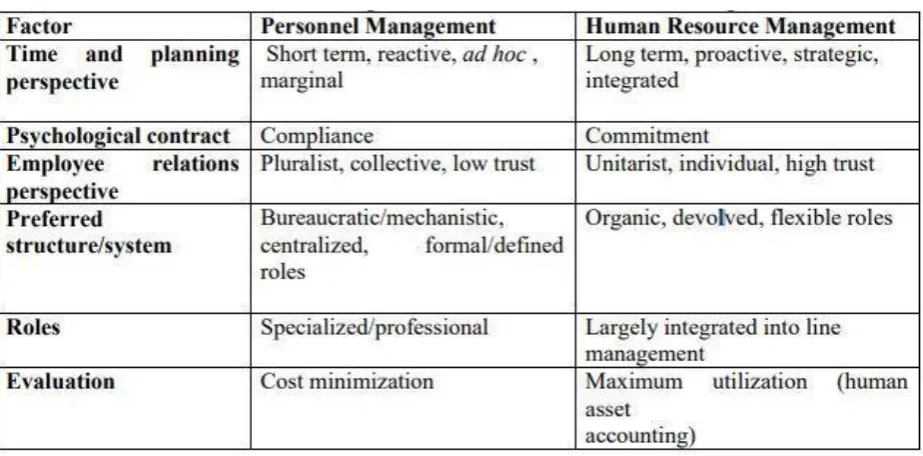
Table 1: The Difference between Personnel Management and Human Resource Management
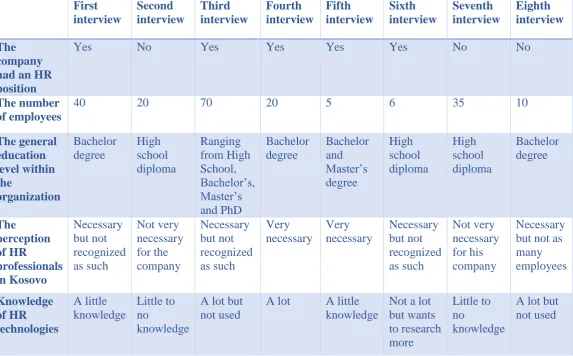
Table 2: Key information taken from the interviews
Table 3: HR Task Importance
List of Figures
Figure 1: Date of establishment of personnel departments, 1900-1922
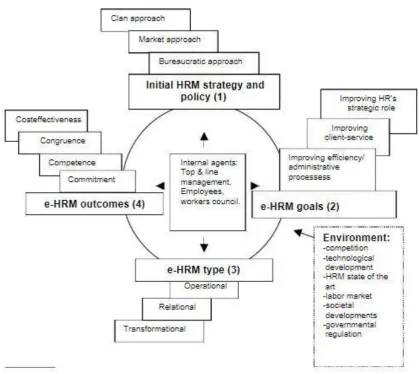
Figure 2: The e-HRM Model
Figure 3: Age demographic
Figure 4: Level of Work Experience
Figure 5: Available HR positions within an organization
1.0 Introduction
Employees are considered to be a company’s greatest strength. Without dedicated and
motivated employees, a company or organization can never reach its goals and objectives. The main tactic for every company or organization to reach their goals and objectives is to have dedicated and motivated employees. However, companies had no way of understanding this correlation before, and therefore, might have mistreated their employees because they knew that there was no one to protect them (Kaufman, 2008). As company’s productivity started to decrease alongside employee’s motivation, employees started to realize their power
in this direct correlation, they started to form unions. Before the development of Human Resource Management as a field of study, little to no importance was given to an employee’s
well-being and fair treatment in the workplace. The idea of what we consider now as Human Resource Management (HRM) was initially known as “the ‘Personnel’ function prior to the
1960s, and the focus sat mainly with the administration of core activities such as payroll or timesheets” (Boroughs, A., Palmer, L., & Palmer, M. L., 2008). Later on, we enter a wave of
union movements, where employee needs are set at a higher priority. With the impact of unions in determining company policies, we also have the development of Human Resource Managers.
For many years, however, HR managers were considered to be “a wolf in sheep’s clothing” and considered as an employee whose loyalty stands with the company (Sharma, 2008). Although, in the beginning, this was certainly the case, however, this perception started to gradually change as HR managers put the interest of their fellow employees first, while also staying loyal to the objectives of the company (Sharma, 2008). Human Resource Management is currently an important function of every company, since it improves the working environment and relationships of its employees with the company. It does this through professional development, fair treatment, appraising, and safety, making sure
employees are happy with their jobs, hence, providing the company motivated and hard-working employees. Human Resource Managers or Departments are almost never present in
has also had a great impact on HR, to bring more focus on talent management, hiring internationally, inclusion and diversity (Tubey, R., Rotich, K. J., & Kurgat, A.,2015).
With all these technological advancements, this paper seeks to understand how the role of HR managers has changed over the years, specifically looking into recruitment technologies, which reduce the amount of time it takes to go through every candidate’s
application. Understanding these aspects from the perspective of businesses in a developing
country, such as Kosovo, is what this thesis will also focus on. The reason why Kosovo is considered as a case study, is to highlight how under-researched and under-developed this field is in Kosovo, while comparing it to other countries who have reached these
technological advancements in HR positions.
1.1 Statement of the Problem
People are and always should be the center of every company’s or organization’s focus. Without the right people, and without the right tools and techniques to keep them motivated, it would be very difficult for organizations to operate. Thus, the job of a Human Resource Manager is crucial for the success of an organization. Tubey, Rotich and Kurgat define Human Resource Management (HRM) “as a strategic and coherent approach to the management of an organization’s most valued assets – the people…” (2015). HR managers
also help the company from committing any crimes by firing employees unfairly, or
recruiting people in an unfair manner, where gender or ethnic diversity should be considered. Therefore, they are advocating for employee’s rights while also keeping in mind the interest
of the company.
Through technology, like many other jobs, the job of a human resource manager has also changed drastically. This includes how a human resources manager takes care of employee needs, recruits, talent management and how development opportunities and
employee benefits are curated. Human resource management is not yet as developed or taken as seriously in many developing countries, such as in Kosovo. A study on the impact of
family run businesses. Nevertheless, even if a business which is not family run, there are little to no employees who deal with HRM (Hashani & Bajrami, 2015). Thus, this paper analyzes how technology has changed the role of human resource manager in the modern era, while also looking specifically if and how these changes have affected the human resource managers in a developing country, such as Kosovo.
1.2 Background Information
The term Human Resource Management developed in the late 1970s. Before that, HRM was also known as Personnel Administration, which was then mostly concerned with payrolls and timesheets, which then evolved to also include hiring and training process for employees (Tubey, Rotich, & Kurgat, 2015). As Sharma (2008) explains, “the move towards
what is today recognized as human resource management was in response to a number of environmental factors such as political, social, economic and technological”. The movements
for better employee management started during the industrial revolution in the 18th century, when machinery was first introduced and workers were starting to understand how this might affect their jobs (Pandian, 2018). That is known as the first industrial revolution where employees started to be replaced by machinery. After a while employees would also start breaking the machinery because they saw it as a threat. With the first revolution ending, the second industrial revolution era, including mass production using electricity, enters. With the impact of electricity and the power it gave people to innovate, we enter the third industrial revolution which started as “the IT and electronics revolution ushered in from 1969, which
gained momentum and evolved into digital technology beyond the 1980s taking us to the edge of the 4th digital revolution, when we see artificial intelligence (AI), biotechnology and the Internet of Things completely change our world” (Tarry, 2018).
Factory workers who were concerned with their working conditions, communications and conflicts with their employers, started to understand how threatening these unifications of
unhappy workers could become. From this, a number of unions emerged, who were threatening these businesses to improve their working conditions. Then different
conducting human resource transactions using the internet technology” (De Alwis, 2010).
There are also have Human Resource Information Systems, or HRIS, which consist of databases, application and software to help with data collection, storage, interpretation and manipulation for HR services (Yu, 2009). This new era of online HR systems “allows
employees to control their own personal information by updating records and making
decisions, and allows managers to access information and data, conduct analyses, make decisions and communicate with others, without consulting the HR department” (De Alwis,
2010). As technology grew, companies started to wonder how it may change the job
description and the role of HR managers. As we have come to see, now HR managers have a more powerful role in reaching company goals and objectives through concentrating in talent management and personal development rather than recruiting and data collection (Kaur, Sidhu, Sharma, Narang, & Kaur, 2014). With that said, it does not mean that technology has reduced the importance of HRM, it simply has shifted its focus to a field of HRM which needs more attention, such as talent management.
“Success of every business depends on adopting itself to the environment within
which its function” (Pandian, 2018). In Kosovo, the importance of HRM is still in its development stages, since many businesses do not have these departments or people to do these jobs. And those who do, are not sufficiently utilizing them. One of the main reasons may also be the fact that most businesses are family businesses, where most of their employees are family members. Another reason may also be the fact that most of the
businesses are small to medium-sized businesses, leaving little to no room for development of an HR department (Hashani & Bajrami, 2015). With that said, most of what people consider HR in most businesses in Kosovo are duties which were part of Personnel Administration.
1.3 Research Hypothesis and Research Question
Evidence from the literature suggests that the reason that advancements on HR,
whether that includes new technologies or even having an HR manager, do not happen within an organization is because these organizations simply do not believe in the necessity for these
For the purpose of this paper, the following question has been addressed:
1. To what extent do HR technologies affect the role of HR managers within an organization?
Following this research question, the following hypothesis has been devised:
1. Human Resource Technologies have had a great impact on the role an HR
manager has within an organization, shifting their focus by affecting what types of jobs they do and how tasks are performed.
2.0 Methodology
This research concentrates on collecting and analyzing available research on human research development and different HR technologies available. Information on Kosovo is collected through primary sources, namely semi-structured interviews and a survey with employed individuals in Kosovo firms.
2.1 Secondary Data Overview
For secondary data, which will be the main source for this qualitative research paper, I used research papers, journals and articles on this topic to help shape the scope of this
research and help build a strong background for the research and findings of this paper. This is done in order to have relevant information to be compared to future findings in this paper. Analyzing HR technologies which are used and determining how they operate within each business in the duties of an HR manager, or how the goals and hierarchy of each company help determine the structure of different HR systems, whether those are online or not.
The paper will also look into the adaptation or the availability of different countries
and then compare it to Kosovo, by also identifying the factors that might cause for the adaptation of HR technologies, such as HRIS and e-HRM, to increase. When learning about HRM, it is important to understand the development of this field in different countries so that there a more thorough understanding of the state of HRM and how it can be improved. For this research there will be an insight on the development of HRM in different countries in different stages of this field and the use of HR technologies. Some of these countries being the United States of America, Turkey, Bangladesh and generally in Europe. The insight taken from these countries will shed light on the importance culture plays in the development and importance of HR in a changing role of HR managers through new HR technologies.
2.2 Primary Data Overview
For the survey, the population sample focuses on people who are have work
experiences with and without a HR position in the workplace. The survey was conducted by 217 participants. More information on the questions of this survey can be found in Appendix 1 of this paper.
HR managers believe these technologies are beneficial for them and the company. Therefore, the objective is to first understand the roles of HR managers in small to medium sized
businesses in Kosovo, then analyze their understanding of HR technology and if they think the role of HR managers has changed in recent years. Additionally, because many small and mid-sized businesses do not usually have HR managers, consulting with the CEO or business
manager will also provide insight into why HR is not a field they give importance to, and if they use any HR technologies instead. This research consists of eight interviews with CEO & HR Managers, which were conducted over a period of four weeks. The interviewees consist of two representatives from private education institutions in Kosovo, and five private
companies. These were semi-structured- interviews with 10 questions which lasted about 30 minutes.
3.0
Literature Review
3.1 A Review on HR Literature
The literature review helps us explore more concepts and build concrete evidence for further understanding the changing role of HR managers in a technologically advanced workplace. Kaufman (2008) writes that “Labor historians were focused on the union
movement and typically gave the corporate personnel function only passing attention, and to that time no business historian had yet written a major scholarly analysis of the early years of HRM”. Even during the beginnings of the development of HRM, one of the most prominent
scholars was Alfred Chandler, who completely neglected writing in regards to labor and the personnel function, and their relation to the developments in the management field. This shows the undermined relevance HRM had before the 1970s. Then, we continue with two contributions by Daniel Nelson and Sanford Jacoby, who treated the first stages of HRM during the periods of World War I and World War II, through the book-length Managers and Workers: Origins of the Twentieth Century Factory System in the United States, 1880-1920
and Employing Bureaucracy: Managers, Unions, and the Transformation of Work in the 20th
Century, respectively. Both authors give insight in the early stages of HRM in the United
movements, the rise of scientific management and industrial welfare work, and Jacoby also highlights the contribution of the vocational guidance movement” (Kaufman, 2008).
Kaufman (2008) elaborated more on the foundations of HRM and the work of historians and intellectuals who helped build this foundation by noting:
“A foundational work on employers’ labor policies and practices in the years 1920-1932 is Irving Bernstein’s The Lean Years. Also providing excellent overviews,
sometimes in the context of the case studies, are books such as David Brody’s
Workers in Industrial America, Lizabeth Cohen’s Making a New Deal: Industrial
Workers in Chicago, 1919-1939, Howard Gitelman’s Legacy of the Ludlow
Massacre: A Chapter in American Industrial Relations, Gerald Zahavi’s Workers,
Managers, and Welfare Capitalism, and Richard Gillespie’s Manufacturing
Knowledge: A History of the Hawthorne Experiments. The most detailed account of
the development of HRM as a practice area in American industry in this period is Jacoby’s Employing Bureaucracy, supplemented by his subsequent book Modern
Manors: Welfare Capitalism since the New Deal. Also available are studies of
individual employers HRM practices during the 1920s. The most notable example concerns employee representations” (p.38).
With that said, it is shown how important literary work is to the development and the importance of a field, such as HRM at the time, and that is what all these works have in common with one another, the shared importance of HRM. Without these works the
importance of HRM would still be undermined by different industries and companies and it would not be where it is today, as a crucial part of an organization and an important tool for the employees and to the company. As mentioned, one of the most important steps towards HRM’s development as a field of study, was the Industrial Revolution.
3.2 The Union Movement
department and officers were brought up to help employees be happy (Sharma 2008). Company unions were started by employers who wanted to impress the government or present a different reality to the public. As Nelson (1982) noted, “Company unions did not bargain for wage increases, have contacts with other workers’ groups, require dues, support officers, strike, or in other ways measure up to trade unions”. Sharma (2008) further explains
Figure 1: Date of establishment of personnel departments, 1900-1922
The above figure describes the number of Personnel Departments which were
established over a 23-year period, from 1900 to 1923. An interesting observation can be made
during the years 1918 to 1923, where we see a drastic increase and an immediate drop to the number of established Personnel Department, within a 5-year period, going from a peak 17, in 1919, to 1, in 1921. “The data here comes from a survey of seventy-four firms done in the
year 1924. These firms are not a representative sample but were selected by the researcher from among companies known to be active in PIR work” (Kaufman 2008). The sudden
happening around the world during that time. Year 1918 marked the end of World War I, which could have been the cause for this increase, while seeing the impact and need of these Personnel Departments after this event. However, it is not very clear as to what caused the drastic decline on 1921-1923. Kaufman also writes that if the same firms were to be surveyed again, “the adoption line would turn up again in 1923 or so and show a distinct rising trend
over the remainder of the decade (2008). With all this said, it is important to understand that events like this, and the ones which will be mentioned later, are the backbone to
[image:19.595.75.537.331.559.2]understanding the future of HRM and how HRM can evolve to something greater. This can also help us understand why HR departments are a crucial part of an organization in some places and not so crucial in others, depending on the history of the country bit also of the organization itself.
Table 1: The Differences between Personnel Management and Human Resource Management
Figure 2, which was retrieved from the article History, Evolution and Development of
Human Resource Management, shows the differences between Personnel Management and
3.3 The New Industrial Revolution and the Future of HRM
HRM is growing as a field in a very rapid pace and“…HR professionals should be able to adopt technologies that allow the reengineering of the HR function, be prepared to support organizational and work-design changes caused by technology…” (Kaur, M., Sidhu, L. S., Sharma, S., Narang, S., & Kaur, R., 2014). However, it is also important to understand how these technological advancements in the field of HRM align with your business needs in the HR department. As Hester Yu (2009) explains, “… a successful HRIS must align with the corporate businesses strategy and corporate technology to build a realistic framework of technology that supports HR activities to meet present and future business requirements, and to build a workable plan to get to there”. With that said, every business wants to create the most profit from their service or product, however, to do that businesses need a motivated workforce to help them reach that goal. Yu (2009) continues by explaining that a big step for
changes in the HR department is first recognizing the importance of HRM and having the support of management to implement HR related projects. Something as simple as a staff retreat, with a team-building activity or training session can bring more happiness than most people think.
Hashani and Bajrami (2015), highlight that countries with developed HR department are more prone to attract foreign investors. With that said, for a developing country like Kosovo, development in the HR department are crucial. Needless to say, “technology can be used to support HR activity across the entire employment cycle…”, however, it should still
be led by professionals who understand these data and know how to handle it (De Alwis, A. C., 2010). Especially when discussing HR technologies, companies or organizations should be ready to implement these technologies by having the adequate staff to run them and know how to interpret certain data for future HR implications.
Humanity is believed to have experienced four industrial revolutions until now. Professor Schwab “defines the first three industrial revolutions as the transport and
mechanical production revolution of the late 18th century; the mass production revolution of the late 19th century, and the computer revolution of the 1960s” (Bawany 2018). As we step into a fourth industrial revolution, which includes the Internet of Things, artificial intelligence (AI) and quantum computing among others, we see the need for a new way of dealing with
common, we enter into a new moral dilemma in determining whether the same benefits and compensation should also apply to robots for doing the same job, or even more, than humans. To what point will technological advances reach ‘human’ capacities, where HRM would have to also consider AI as an area to help these machines reach their greatest potential in the workplace? Would it be ethical not consider AI as an important aspect of a company’s
workforce? Would there be a new field of HRM which deals only with AI and robots or would they be part of HRM? Will automation lead to job losses?
With all these questions, HRM will also have to adapt to these changes in the workforce and find ways to adapt artificial intelligence and robots to their needs and wants. Now, this may seem a huge step for HRM but considering that flexible work schedules, working from home, or company offered trainings were considered a huge step not even a decade ago, shows how much and how important these steps of improvement are to the company. Even something as simple as how companies hire employees has changed
drastically. The importance of a CV or resume has changed a lot over these last few years. As Tom Dunlop, a writer for the Guardian, writes, “This new field of recruitment, dubbed workforce science, is based on the idea that the data individuals create while doing things online can be harvested and interpreted and to provide a better idea of a person’s suitability
than traditional methods” (2017). It is becoming more important the types of skills a person has than where and when he or she graduated from. Dunlop continues with the importance LinkedIn has also played in becoming an important tool for recruitment, through its Talent Solution database, designed specifically for companies to find employees (2017). He further explains how “LinkedIn is a huge repository of information about workers and the skills they have. It is a platform where people can talk to each other about work, advertise their talents, exchange information about their fields of interest and expertise, and communicate privately”
(Dunlop 2017). In other words, LinkedIn is an interesting website which merges the ideas of
a social network and an online recruitment platform with an online CV created by you.
help managers and senior leaders make better decisions for the business” (2018). Therefore, as many have thought of HR in the personnel administration and recruitment aspect for the most part, with these new technological advancements it is clear that HR is also shifting its focus to keeping their employees trained and skilled for these technological advancements and automation of the company.
Furthermore, Dunlop explain how we are stepping into a transition of competition
between humans and machines, and it will affect the lives we live, the type of work we do, and how much time we spend at work (2017). “For humans to thrive in such an environment – this new environment of which recruitment is a leading indicator – we will need to
drastically rethink all aspects of our economy, from education through to social welfare through to retirement. The sooner we start that rethink, the better” (Dunlop 2017). Therefore,
as Teachout mentions, as we go through this transition towards the fourth industrial
revolution, we should start focusing on how we can establish an environment where both AI and humans can work together (2018). In other words, we ought to move past our differences and come together to find ways how we can integrate this new industrial revolution into our workforce and organization structure, with our human capacities.
Consequently, the role of HR in this new era of the industrial revolution of great importance. That is, through understanding how these new technologies can come into play, while also developing trainings and reskilling the workforce, since according to Sushman Biswas, “by 2022, no less than 54% of all employees will require significant re- and
upskilling (2019). As an HR manager, that is a crucial task which will change the focus of what the role of an HR manager will be in this near future. Therefore, not only has the role of HR managers to change because of technological advances within the field, we see the
changing environment of the workforce and industrial revolution have a great effect to the role of an HR managers as well. To accommodate this new task of re-skilling, companies and
HR managers must establish a plan of what skills their employees have and what skills have to be taught for future need (Biswas 2019). Biswas further explains how companies such as AT&T and PwC have spent millions of dollars to upskill their employees, either specifically for their jobs or through other ways of learning technologies (2019). “The skills shortage will
reality, it is crucial for organizations and HR leaders to develop a solid understanding of the skills they already have and the skills they will need in the future” (Biswas 2019).
3.4 The Types of HR Technology
3.4.1 Human Resource Information Systems
As we move into this new business environment, managers and CEOs have to
understand how to use their workforce to make the best business decisions possible, and that can only be done with the involvement of HR departments through human resource
information systems and electronic human resources. Khan explain how the “traditional role
of HR managers in the procurement, deployment, development, appraisal and reward management of the employees has also changed to a great extend in its approach with the paradigm shift in the people management” (2007). According to Renae Broderick and John W. Boudreau, new HR technologies have also helped managers and CEOs determine “how
head count, turnover, skill inventories, or performance ratings affect their units’ business objectives” (1992). Nevertheless, the adequate use of these technologies has to be aligned
with the business objectives and strengthen the importance HR managers have in a company. In establishing a successful human resource information system, we have to everything regarding that company, from its objectives, organization structure, and workforce to even incentivizing changes in the organizational culture itself (Yu, 2009). Therefore, to further understand the establishment of a successful HRIS we will be looking at these aspects which make up an HRIS in greater detail.
Firstly, we must have a clear understanding of the company’s organizational structure, workforce, planning models and general personnel administration knowledge (Yu, 2009). “A company’s organizational structure is the foundation that supports critical business processes by defining the organizational setup and workforce deployment” (Yu, 2009). The HRIS
should serve as a form of following chain of command in order to ease the workflow, access of data, plan costs, and also serve as a template for future restructuring of the organization (Yu, 2009). In regards to the workforce it is crucial to various types of employees, such as full-time, part-time, temporary and so forth, so that through the HRIS the company can organize its workload and workforce in the most efficient way possible.
office, alternative workweek, work at home, compressed workweek, voluntary reduced hours, and contractual work have started taking a concrete shape in the new economic environment”
(Srivastava, 2000). With that said, HR managers, alongside line managers, have to come up with a productive workforce during the day, while considering these flexibilities, which in one hand might hinder the company from being highly effective but in the other hand will
ensure their employee satisfaction within the company and a positive organizational
commitment towards the company. According to Purang, “Organizational Commitment is an important theme that continues to appear in the individual’s psychological attachment to an
organization” (2008). Additionally, as Purang explains, according to many studies, HR departments have a crucial role in increasing an employee’s commitments towards a firm
(2008). That is why, having a well-developed HR department which works with these HRIS for more flexibility in the workplace, will ensure a more committed workforce.
Secondly, one of the great functions an HRIS does is also with personnel
administration, which includes information on payroll, promotions, vacations and more. Currently, most companies which do not have HRIS use Microsoft Excel for storing employee data which is not always very easy to use and does not have the same impact as HRIS databases on personnel administration. Through databases, HR managers can rely on these information to help managers make better decisions. As far as the database goes, “maintenance of data should be designed on a user-friendly online-navigation platform,
coupled with a process-oriented data entry to facilitate speedy and efficient data
maintenance” (Yu, 2009). Of course, all these databases should be designed according to the
preferences and needs of each company and their relevant functions. Additionally, this system needs to also consider in factors such as benefits, payroll, compensation, traveling for business and others, which should all take a crucial part of the system but also of the
personnel administration, and HR role in general. As management of compensation and
payroll are some of the most crucial functions on this database, it is important for this module “to provide users with fixed and variable compensation data to plan and implement a
competitive and motivating reward system” (Yu, 2009).
something that deals more specifically with motivation and team building. As Custer also explain in his article on Rethinking Existing HR Technologies for New Gains in Employee
Engagement and Benefits, through “leveraging resources and technologies already available
in a company’s human resources department, many employers can provide additional
benefits—especially those that promote career growth and flexibility—in a cost-effective and easily managed way” (2013). As with every other job, we are moving towards more
innovative ways of getting that job done, therefore, as Ichniowski, Casey, and Shaw explain on their article Beyond Incentive Pay: Insiders' Estimates of the Value of Complementary
Human Resource Management Practices, what may have been innovative then, such as
having rotational work, might be seen as a common function now (2003). That is why, companies have to move alongside technological advances and HR managers have to push for these new technologies in the field of HR to be implemented within their respective organizations.
3.4.2 E-HRM
A big part of HR technologies is also e-HRM, which focuses on HR functions that can be done through the internet. Ruël et al. (2004) explain how HRIS and e-HRM are
significantly different, since HRIS focuses on improving the processes of HRM, therefore making the target the HR staff, whereas for e-HRM, besides the focus of the business, it also focuses on the employees, and how to help them keep track of their performance and
integration within the company. In their view, “e-HRM is a way of implementing HR
strategies, policies, and practices in organizations through a conscious and directed support of and/or with the full use of web-technology-based channels” (2004). Whereas Yu defines e-HRM as a form of offering “technological support for access to information on HR services
to people outside the HR department, it allows the flow of information and data transactions between relevant stakeholders in order to improve HR practices, reduce costs, and enhance services” (2009). Recognizing this, through the implementation of e-HRM, HR managers and
Next, just like with every market, to understand the types of e-HRM, companies also have to understand their own needs and wants which fit best for their companies. Ruël et al., (2004) acknowledges three types of e-HRM: operational, relational and transformational. They further explain the differences among the three by explaining how the operational e-HRM deals with the administrative aspect such as payroll, the relational type helps with more
advanced activities such as recruitment, training and rewards, and last but not least, the transformational type is concerned with the strategic aspect of the business, in decision-making and management techniques (2004).
Another important characteristic of these e-HRMs are the outcomes that they produce for their respective companies. Beer et al. write about four outcome goals for HRM, which include commitment, competence, cost effectiveness and congruence (1984). As Ruël et al. break down these four characteristics, we understand that commitment is considered to be the aspect of having motivated employees who are willing to connect with higher levels of management for the benefit of the company but also for their fellow workers. With
competence, the idea of learning new tasks and identifying new opportunities within certain circumstances and with cost effectiveness we are looking into the effects of turnover and actions such as strikes (Ruël et al. 2004). Lastly, in regards to congruence, Ruël et al. refer to a structure within the organization which is of interest to all stakeholders, an example of which could be reward systems for employees (2004). Recognizing this, we can observe how these four elements are consistent with the characteristics of e-HRM, in the sense that the focus is still the employee and the interest of the workforce, for the betterment of the company as a whole.
This is portrayed very well in Fig. 2, taken from E-HRM: Innovation or Irritation by
Ruël et al., which looks at e-HRM as a cycle of recognizing goals, types and outcomes. Nevertheless, as businesses and organizations continue to use web based HRM functions, and
even human resource information systems, we find HR departments being affected the most, giving HR managers more time to concentrate on strategic decision-making. As Ruël et al. (2004) explain, “Fewer administrative tasks and a decrease in HR related questions from
Figure 2: The e-HRM model
There are also a few online databases which are worth mentioning and analyzing how they help companies with their HR functions. Most of these systems, since online, provide
Another great online HR database is also NaturalHR, which similar to BambooHR, helps small to medium size companies. Online HR databases such as NaturalHR and BambooHR are certainly important for small to medium size businesses because of their inability to hire an HR manager for such a small number of employees, which is usually the excuse. However, as businesses continue to grow, online HR databases as the previously
mentioned, are not a solution. Even though a great solution for small and medium size businesses, having an HR manager in bigger companies is crucial for the functions of the company, since, as was mentioned before, it helps the company reach its goals and objectives with the help of motivated employees, who are satisfied with their employer and the work that they do.
3.5 Outsourcing of HR Services
Outsourcing of services within a business is become more common every year, especially when it comes to new systems which are now offered to companies through
web-based engagement. The main reasoning for this is that usually it costs companies less money to outsource than to pay their own employees to do a specific job. Pollitt writes how there is a common belief that human resource outsourcing, or HRO, are going to demolish human resource professionals’ jobs and lose the connection with companies (2005). However, Pollitt explains how “HRO arrangements have proven to be strategic partnerships that help to put
people matters at the top of corporate strategic decision-making” (2005). Of course this opportunity may bring advantages and disadvantages. The main advantages for outsourcing HR functions may be the reduced costs, since, as Hamlin explains, “earns more than $75,000
per year, plus benefits” (2019). As was mentioned before, most small business owners run all HR functions on their own, because of the high costs of having an HR manager. However, most of these small business owners do not have any knowledge of HRM, which might be a huge risk when taking into consideration owners might run into legal issues, for which HR professionals have more knowledge of and might save the company thousands of dollars. As Delmotte and Sels explain, “drivers of HR outsourcing are gaining specialized HR expertise, achieving flexibility, reducing risks and enhancing access to advanced technology” (2008).
Wallo and Kock also mention how many companies focus only on the cost effective side of outsourcing, however, when it comes to HR services there are many other implications which a company gains besides the financial aspect, one of which, as was mentioned, is the
4.0
Findings and Results
The results section of this paper concentrates on the results from the secondary research on the development and the state of HRM in different countries around the world and the results from the interviews as part of our primary data on this topic. In this section, these results will only be demonstrated and later analyzed and reviewed in the Discussion section. Because the results of the primary data are mostly focused in Kosovo, this will,
hopefully, serve as a case study for future implications and a form of comparison between Kosovo and other nations.
4.1 The Impact of HR Technologies: A Global Perspective
After defining these new HR technologies and looking at their implications, it is also crucial to look into the impact these technologies have for the role of HR professionals. Similar to every new technology, its main purpose is to improve and ease a job or a service, therefore, even with HR technologies it is expected for these changes to have a positive impact on the roles of HR professionals. According to Bal, Bozkurt & Ertemsir (2012), “the
use of HRIS can provide a number of benefits not only to the HR function, but also line managers, and the wider organization”. They further explain how HRIS gives “an opportunity for human resource professionals to become strategic partners with top management” (2012).
Similarly with web technologies or e-HRM, Bal, Bozkurt & Ertemsir (2012) explain how these HR technologies “will leave HR specialists more time for strategic decision
making and that outsourcing of people-management activities will liberate HR specialists to perform more strategic activities”. With the help of these new technologies, employees can
also do most administrative work on their own. And with less administrative work to be done, “HR professionals can also act as a competency manager by arranging the right people to the right positions at the right time with their new 55 strategic architecture role”, thereby shifting
their administrative or operational roles to strategic ones (Bal, Bozkurt & Ertemsir, 2012).
larger short-term profit, many American companies have faced mounting pressure to streamline operations, focus on core competencies, and reduce cost''. The need to make the HRM function more efficient and cost effective gives great opportunities for HR
technologies. That is why many new businesses are starting off with e-HRM through online websites, so that they can attract the new Generation Y and Z employees, who are always
looking for better ways of HRM within a company.
Turkey is experiencing a shift from a more traditional to a modern form of personnel management. This phenomenon is interesting since a lot of Turkey’s HRM techniques are also determined by the culture and Muslim religion. Syed and Pio (2017) “suggest that there
is no inherent conflict between Islamic faith and modern workplaces, and therefore any potential areas of friction between Islam and contemporary HRM practices can be managed effectively”. This argument, however, might be considered as false, since a workplace’s
culture is shaped by the culture of the people that work in that organization. As Kaufman (2014) mentions, “Islamic philosophy is the basic reason that family and religious belief are of great importance in the Turkish way of doing business”. Another important connection
here is also the way how employer and employee conflicts are solved, where more than 65 percent of these conflicts are resolved through the help of third parties (Kaufman 2014). When it comes to HR technologies, one of the most common uses in Turkey is in the function of recruitment through employment websites, who have provided jobs for more than 500,000 people. Furthermore, Kaufman (2014) mentions that “the spread of e-HR has increased because of Turkish society’s widened across to the Internet, businesses creating their own
web sites and the ability to provide web-based HR applications”.
In Bangladesh we see a need for the digitalization of the HR functions, since the
current ones are not efficient and are politicized. This phenomenon is mostly present in the public sector for which there have been multiple tries of implementing e-HRM systems,
explain how the “majority of studies on e-HRM focused on the developed region, there are fewer studies in less developed countries such as Bangladesh”.
During their research of over 2,000 companies in 23 countries, Strohmeier and Kabst (2008) came up with some interesting findings in the implementation and the factors that affect the adaptation of HR technologies within organizations in Europe. Some of the main factors include the size of the organization, the industry it is a part of and the employee
demography, concentrating on age, gender or level of education. In terms of size and industry Strohmeier and Kabst (2008) mention how “Industries with a high proportion of stationary
and clerical work, like banking, promise an uncomplicated adoption, since there is a high share of workplace computers and computer literate employees”. Therefore, in many cases it is more important to look at the industry rather than the size of the organization. Another crucial factor was the demography of the employees. According to their research, Strohmeier and Kabst (2008) have found that organizations “with a high percentage of young, male, and
educated employees will more frequently adopt e-HRM”. The next important factor to
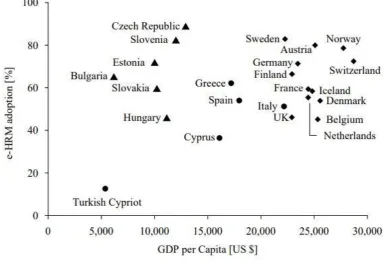
indicate e-HRM adaptation was also GDP or GDP per capita. Below Figure 3, taken from the study of Strohmeier and Kabst (2008), shows the comparison between the level of GDP per capita and the percentage adaptation of e-HRM. However, the case of Bulgaria is interesting since it shows a country with a lower level of GDP per capita and a higher percentage of e-HRM. The opposite is seen in Cyprus, where the GDP per capita is three times higher than in Bulgaria, and their percentage of e-HRM adaption is almost half of Bulgaria’s. This may be due to different laws and regulations which are currently in these countries. Bulgaria’s labour laws are very specific and are constantly changing and improving to adjust to current trends, as can be seen with the Labour Code which “entered into force in 1987 and has been
modified 65 times to date, most recently in February 2010” (Labour Law in Bulgaria, 2014). Whereas the opposite can be seen in Cyprus, where recently improved labour laws mostly
Figure 3: Economic development and adoption of e-HRM
4.2 Kosovo Case Study
The interviews are a crucial part of this study and their results will give us more insight on the current view of the role of HR managers from within an organization, the use of technology within these positions, or their lack of, and also understand how HR managers view their role within the organization. It is also important to mention that whenever a CEO or COO was interviewed, they were seen or considered to be doing the HR related or personnel administrative work. As seen, this would be something very common in Kosovo, therefore leaving room for new technologies, such as e-HRM, to replace these duties.
4.3.1 Interview Results: Perspective from HR Managers and CEOs
Table 2 offers a better understanding at these eight interviews on the perception of
HR managers, the use of HR technologies and also a possible correlation between number of employees and available HR positions, but also a type of jobs within a company and available
HR positions. Table 2 shows how factors such as the level of education within the
First interview Second interview Third interview Fourth interview Fifth interview Sixth interview Seventh interview Eighth interview The company had an HR position
Yes No Yes Yes Yes Yes No No
The number of employees
40 20 70 20 5 6 35 10
The general education level within the organization Bachelor degree High school diploma Ranging from High School, Bachelor’s, Master’s and PhD Bachelor degree Bachelor and Master’s degree High school diploma High school diploma Bachelor degree The perception of HR professionals in Kosovo Necessary but not recognized as such Not very necessary for the company Necessary but not recognized as such Very necessary Very necessary Necessary but not recognized as such Not very necessary for his company Necessary but not as many employees Knowledge of HR technologies A little knowledge Little to no knowledge
A lot but not used
A lot A little knowledge
Not a lot but wants to research more Little to no knowledge
[image:33.595.13.587.131.487.2]A lot but not used
Table 2: Key information taken from the interviews
4.3 Survey Results
The first section of the survey represents the demographic of the participants; section two focuses on the knowledge that the participants have on this topic and the importance they put on an HR professional within an organizations but also understanding which tasks they believe are more important or relevant in regards to this position.
All of the participants were from Kosovo, however, around 72% of those were from Prishtina, Kosovo’s capital. The level of work experience that the participants have is mainly
Figure 4: Level of Work Experience
In regards to the question ‘How would you rate the importance of having an HR
manager in a company?’, which was from a scale of 1 to 5, 1 being the lowers and 5 being the highest, we see that 64.4% of participants rating the importance of an HR manager as 5, 22.2% as 4, 6.7% as 3, and 6.7% as 2, with 0% rating it as 1. This then becomes important when we compare it to the statistics on the question on the number of employees within the organization the participation is or was working for in his/her last job (if not currently employed), the average of which was about 43 employees, which falls in the category of small businesses or organizations. Additionally, I wanted to know how many if the places
they were working in had at least one HR position within the organization. As can be observed in Figure 5, around 22.2% said that all of them had, and another 22.2% said that most of them had an HR Manager. This information however might be difficult to consider since most of the participants has below three years of work experience.
[image:34.595.132.261.586.711.2]Before we look into the perception of HR professional and the main roles of HR professional from our participants, we also have to analyze their perception of how much they believe they know about HRM as a field of study, which enters us into the second section of these results. Figure 6 explains how they would classify their knowledge on Human Resource
Management, which for the majority is above average. This helps us understand that the
results on the perceived roles of an HR manager are well known by the participants and the results are valid, for this demographic.
Figure 6: Level of knowledge on HRM
In the second to last question, participants were asked to rate certain HR tasks on their perceived importance on a scale of 1 to 5 (1 being low importance and 5 being high
importance). The tasks where were presented and the results are portrayed in Table 3. As can be observed some of the main tasks which can be identified are hiring and recruitment,
employment talent management, coordinate and supervise the work of employees, and direct disciplinary procedures. The impact and relevance of these results will be analyzed during the discussion section of this paper, for which we seek to come up with conclusions and
Importance level: 1
Importance level: 2
Importance level: 3
Importance level: 4
Importance level: 5
Recruitment and hiring 0.5% 4% 15% 20.5% 60%
Employee talent management
0% 9% 17% 45% 29%
Resolve issues between management and employees
0% 7% 32% 25% 36%
Coordinate and supervise the work of employees
4% 13% 14% 47% 22%
Direct disciplinary procedures
3% 8% 18% 41% 30%
Come up with training & development
opportunities
3% 11% 39% 19% 28%
Represent the
employee's best interest
5% 19% 42% 10% 24%
Performing job evaluations and job analyses
0% 13% 36% 17% 34%
Establish compensation levels
0% 16% 25% 38% 21%
Establish benefits (health care, retirement plans, bonuses etc)
[image:36.595.37.523.99.522.2]0% 16% 21% 27% 36%
Table 3: HR Task Importance
5. 0 Discussion
workplace. The paper then continues with the findings on the use of HR technologies in different countries so that it can be compared to Kosovo, as a case study. The findings show that the level of income and the awareness about HR functions, are a big indicator on the adaptation of HR technologies. However, Bulgaria and Cyprus show that labour laws also have an impact on these technological advancements. When compared to Kosovo, since there
is still no research done on this topic here, the results are at the preliminary stage. Thus, this current study looked into the current level of HRM to identify steps that can move Kosovo’s organizations to a better level of HRM through the use of HR technologies.
The information from the survey helps acknowledge that there is only a specific audience this study is portraying, and assumptions regarding other groups cannot be made. However, this then shifts the study to a different viewpoint, because it allows to understand how this young generation views the importance of an HR manager and their tasks within the organization. This information is very helpful to businesses who are going to employ these youngsters in the future. With that said, businesses and organizations can have HR
professional tackle this new wave of thinking and look into how HR professionals can work towards creating certain programs, contracts or benefits, or reward systems which have this audience into consideration.
Additionally, this then goes alongside the interviews, which bring light to the different social factors that influence the presence of HR professionals. For example, companies with no HR professional, tend to have employees ranging from 30-50 years old. Whereas, most of the companies with younger employees have an HR manager. It is also important to mention that even though these HR positions were available they did not provide the full capacities to their employees since most of their jobs were still, for the most part, focused on personnel
administration and less on other tasks such as reward systems, training and development opportunities and so forth. Alongside this, in the research done by Hashimi and Bajrami on
5.1 Limitations
The study had a view limitation which are worth mentioning and that should be addressed if this study were to be extended in the future. There are two main limitations, the first one being the lack of information from HR practices in the public sector as HR managers from this sector were not cooperative. Their insight on this topic would have helped this research in identifying both aspects in the public and private sectors. The second limitation would be the range of information from the survey (young age groups), helping us identify trends in other age groups as well, and not only on one specific age group. Even though this age group helps us identify their understanding and helps businesses accommodate
6.0 Recommendations and Conclusions
This study was done with the aim of giving better insight on the topic of HR technologies and how these new technologies are changing the role of HR professionals. Additionally, it sought to shed light on the importance of an HR manager in a developing country like Kosovo. The literature review and findings confirmed the hypothesis that
technology has changed the role of HR professionals, whereas the primary research helped us
correlate with that, in the sense that it brought up the issue of having an HR professional and the adaptation of HR technologies. According to our findings, I can conclude that the same factors are what hinder both the adaptation of HR technologies around the world and the available positions for HR professionals in Kosovo. Therefore, after all this research there are two recommendations I would give to businesses and organizations who do not currently have an HR position available and also businesses who have one but could improve it. The first one being more focused for organizations in Kosovo and the second one for
organizations around the world.
● Outsourcing HR functions
A great opportunity for small and medium business, especially in Kosovo, is to outsource HR functions to help the companies make better decisions, and also reach their goals better through their workforce. Since this is also a very cost-effective way of using HR
professionals with any administrative or other forms of motivating the workforce. This way, HRM can be promoted more among citizens and its importance can also be seen through their
work within the companies or organizations.
● The use of HR Technologies
HR technologies are becoming more and more helpful to HR professionals but also businesses. With that in mind, it can be suggested the use of HR technologies for
administrative tasks, such as payroll, benefits, rewards, days off, and many others, which could possibly be done without an HR professional but by the CEO or Business Manager. This will allow businesses and organizations to not worry about this aspect of their job, which makes it much easier for keeping track of employee performance but also of relevant
their job. This is also the danger of fast technological advancements in developing countries like Kosovo, where we are skipping, for most firms, the importance of having an HR
manager and going straight to these technologies, which replace a very crucial part of an HR professional’s job, in personnel administration and recruitment.
In conclusion, the research confirms that technology has changed the role of HR managers, by offering new ways of getting the job done through databases and web-based
References
Bal, Yasemin & Bozkurt, Serdar & Ertemsir, Esin. (2012). The Importance of Using Human Resources Information Systems (HRIS) and a Research on Determining the Success of HRIS. Retrieved from
https://www.issbs.si/press/ISBN/978-961-6813-10-5/papers/ML12_029.pdf
BambooHR. (2018). Retrieved from
https://www.bamboohr.com/lp/c-hr-saas-
software/?Campaign=capterra&utm_campaign=Capt-DE-LiveDemoRe-20180111-01&utm_content=blank&utm_medium=HUM&utm_source=RS&utm_term=blank
Bawany, S. (2018). What you need to lead in the Industry 4.0. Human Resources Online. Retrieved from https://www.humanresourcesonline.net/what-you-need-to-lead-in-the-industry-4-0/
Beer, M., Spector, B., Lawrence, P., Mills, Q., Walton, R. (1984). Managing Human Assets. New York: The Free Press
Boroughs, A., Palmer, L., & Palmer, M. L. (2008). HR Transformation Technology: Delivering Systems to Support the New HR Model. Retrieved from
https://ebookcentral.proquest.com
Biswas, S. (2019). How to Develop a Winning Skills Strategy in the Fourth Industrial Revolution. HR Technologist. Retrieved from
https://www.hrtechnologist.com/articles/digital-transformation/how-to-develop-a-winning-skills-strategy-in-the-fourth-industrial-revolution/#
Broderick, R., & Boudreau, J. (1992). Human Resource Management, Information
Technology, and the Competitive Edge. The Executive, 6(2), 7-17. Retrieved from http://www.jstor.org.ezproxy.rit.edu/stable/4165061
Custers, M. (2012). Rethinking Existing HR Technologies for New Gains in Employee Engagement and Benefits. Compensation & Benefits Review, 44(6), 332–335.
Retrieved from https://doi.org/10.1177/0886368713476929
Koushos L., Ioannou M., (2019). “Cyprus: Employment & Labour Law 2019”. ICLG.
https://iclg.com/practice-areas/employment-and-labour-laws-and-De Alwis, A. C. (2010). The Impact of Electronic Human Resource Management on the Role of Human Resource Managers. E+M Ekonomie a Management, (4), 47-60. Retrieved from http://search.proquest.com.ezproxy.rit.edu/docview/821979706?accountid=108
Delmotte J., Sels L., (2008). "HR outsourcing: threat or opportunity?”. Personnel Review,
Vol. 37 Issue: 5, pp.543-563. Retrieved from https://doi-org.ezproxy.rit.edu/10.1108/00483480810891673
Dunlop, T. (2017, February 16). The résumé is dead: Your next click might determine your next job. Retrieved from
https://www.theguardian.com/sustainable-
business/2017/feb/16/the-resume-is-dead-your-next-click-might-determine-your-next-
job?fbclid=IwAR0W-UYRAcI4aE-WrMBT5QgHNOeg9AqwiFx7WILWvO7_9BRqUYuDu9ATQHY
Hamlin, K. (2019). The Advantages of Outsourcing HR Functions. Chron. Retrieved from https://smallbusiness.chron.com/advantages-outsourcing-hr-functions-21169.html
Hashani, M., & Bajrami, R. (2015). Roli i burimeve njerëzore në rritjen e investimeve të NVM-ve. 7-32. Retrieved from
https://dspace.aab-
edu.net/bitstream/handle/123456789/324/01-Medain-Hashani-Roberta-Bajrami-Roli-i-burimeve-njer%C3%ABzore-n%C3%AB-rritjen-e.pdf?sequence=1&isAllowed=y
Ichniowski, C., & Shaw, K. (2003). Beyond Incentive Pay: Insiders' Estimates of the Value of Complementary Human Resource Management Practices. The Journal of
Economic Perspectives, 17(1), 155-180. Retrieved from http://www.jstor.org.ezproxy.rit.edu/stable/3216844
Kaufman, B. E. (Ed.). (2014). Development of human resource management across nations: Unity and diversity. Retrieved from https://ebookcentral.proquest.com
Kaufman, B. (2008). Early Human Resource Management: Literature Review. In Managing the Human Factor: The Early Years of Human Resource Management in American
Industry (pp. 36-54). Cornell University Press. Retrieved from
http://www.jstor.org.ezproxy.rit.edu/stable/10.7591/j.ctt7zfmd.5
Retrieved from
http://search.proquest.com.ezproxy.rit.edu/docview/1711124645?accountid=108
Khan, S. (2007). The Future of HR Function and the Challenges before the HR Managers. Indian Journal of Industrial Relations, 42(3), 430-444. Retrieved from
http://www.jstor.org.ezproxy.rit.edu/stable/27768083
Kosovo GDP per capita. (2018). Trading Economics. Retrieved from
https://tradingeconomics.com/kosovo/gdp-per-capita
Labour Law in Bulgaria. (2014). Rechtsanwalt Ruskov. Retrieved from http://www.bulgaria-labour-law.bg/start.html
NaturalHR. (2018). Retrieved from https://www.naturalhr.com/hr-database/
Nelson, D. (1982). The Company Union Movement, 1900-1937: A Reexamination. The
Business History Review,56(3), 335-357. Retrieved from
http://www.jstor.org.ezproxy.rit.edu/stable/3114628
Pandian, S. (2018). Impact of fourth industrial revolution in human resource management.
International Journal for Research Trends and Innovation, 59-61. Retrieved from
http://www.ijrti.org/papers/IJRTI1802010.pdf
Pollitt, D. (2005). Outsourcing and HR. Emerald Publishing Limited. Retrieved from https://ebookcentral.proquest.com/lib/rit/reader.action?docID=233897
Purang, P. (2008). Dimensions of HRD Climate Enhancing Organisational Commitment in Indian Organisations. Indian Journal of Industrial Relations, 43(4), 528-546.
Retrieved from http://www.jstor.org.ezproxy.rit.edu/stable/27768154
Rahman, M., Mordi, C., & Nwagbara, U. (2018). Factors influencing E-HRM
implementation in government organisations. Journal of Enterprise Information Management, 31(2), 247-275.
doi:http://dx.doi.org.ezproxy.rit.edu/10.1108/JEIM-05-2017-0066
10.5771/0935-9915-2004-3-364. Retrieved from
https://www.researchgate.net/publication/5178937_E-HRM_Innovation_or_Irritation_An_Explorative_Empirical_Study_in_Five_Large_C
ompanies_on_Web-based_HRM
Sharma, S. (2008). Human Resource Management-A Profession in Dilemma. Indian Journal of Industrial Relations, 43(3), 438-449. Retrieved from
http://www.jstor.org.ezproxy.rit.edu/stable/27768144
Srivastava, K. (2000). Rethinking HR: Role of HR Professionals in a Changing Business Environment. Indian Journal of Industrial Relations, 35(4), 532-544. Retrieved from http://www.jstor.org.ezproxy.rit.edu/stable/27767684
Strohmeier, S., & Kabst, R. (2009). Organizational adoption of e-HRM in europe: An empirical exploration of major adoption factors. Journal of Managerial Psychology, 24(6), 482-501. Retrieved from
doi:http://dx.doi.org.ezproxy.rit.edu/10.1108/02683940910974099
Summers, N. (2018). 4 Ways the fourth industrial revolution will change HR in East Africa. Sage. Retrieved from https://www.sage.com/africa/newsroom/2018/10/4-ways-the-fourth-industrial-revolution-will-change-hr-in-east-africa
Tarry, A. (2018, July 7). The Role of HR in the 4th Industrial Revolution. UK. Retrieved from https://www.thehrdirector.com/features/revolution/role-hr-industrial-revolution/
Teachout, R. S. (2018). SHRM CEO Says HR in "4th Industrial Revolution". XpertHR. Retrieved from https://www.xperthr.com/news/shrm-ceo-says-hr-in-4th-industrial-revolution/33349/
Tubey, R., Rotich, K. J., & Kurgat, A. (2015). History, Evolution and Development of Human Resource Management: A Contemporary Perspective. European Journal of
Business and Management, VII(9), 139-148. Retrieved from
http://www.eajournals.org/wp-content/uploads/History-Evolution-and-Development-of-Human-Resource-Management-A-Contemporary-Perspective.pdf
Issue: 5, pp.1003-1018. Retrieved from https://doi-org.ezproxy.rit.edu/10.1108/PR-03-2017-0066
Yu, H. (2009). Human Resource Information Systems and E-HR Systems. In Tsui A. & Lai K. (Eds.), Professional Practices of Human Resource Management in Hong Kong:
Linking HRM to Organizational Success (pp. 219-248). Aberdeen, Hong Kong: Hong
Kong University Press. Retrieved from
Appendix
Appendix 2
Questions for HR Managers:
1. How long have you working as an HR Manager? 2. What got you into HR?
3. What is your role as an HR manager? What is important to you as an HR manager? 4. What do you enjoy most about being an HR?
5. What is the general perception of HR managers in your country? 6. Are you familiar with any HR technologies?
7. If yes, what do you use them for? Recruiting?
8. How do you think the role of HR managers has changed over the years? 9. Do you think technology has had an impact in this change? How?
10. How has technology helped HR managers? How has it hindered their jobs?
Appendix 3
Questions for Managers or CEOs:
1. How many employees do you have?
2. Tell us more about your employees? Age? Level of education? 3. What do you understand by HRM?
4. Do you have an HR position available at your firm? 5. What do you believe the role of an HR manager is? 6. Do you think having an HR manager is important? Why? 7. Are you familiar with any HR technologies?
8. How do you do recruiting?
9. Who deals with administrative tasks?