This is a repository copy of Comparative performance evaluation of latency and link dynamic power consumption modelling algorithms in wormhole switching networks on chip.
White Rose Research Online URL for this paper: http://eprints.whiterose.ac.uk/100154/
Version: Accepted Version
Article:
Harbin, James orcid.org/0000-0002-6479-8600 and Soares Indrusiak, Leandro
orcid.org/0000-0002-9938-2920 (2016) Comparative performance evaluation of latency and link dynamic power consumption modelling algorithms in wormhole switching networks on chip. Journal of systems architecture. pp. 33-47. ISSN 1383-7621 https://doi.org/10.1016/j.sysarc.2016.01.002
Reuse
Items deposited in White Rose Research Online are protected by copyright, with all rights reserved unless indicated otherwise. They may be downloaded and/or printed for private study, or other acts as permitted by national copyright laws. The publisher or other rights holders may allow further reproduction and re-use of the full text version. This is indicated by the licence information on the White Rose Research Online record for the item.
Takedown
If you consider content in White Rose Research Online to be in breach of UK law, please notify us by
Comparative Performance Evaluation of Latency and
Link Dynamic Power Consumption Modelling
Algorithms in Wormhole Switching Networks On Chip
James Harbin1,∗, Leandro Soares Indrusiak1
Real-Time Systems Group, Department of Computer Science, University of York, UK
Abstract
The simulation of interconnect architectures can be a time-consuming part
of the design flow of on-chip multiprocessors. Accurate simulation of
state-of-the art network-on-chip interconnects can take several hours for realistic
application examples, and this process must be repeated for each design
it-eration because the interactions between design choices can greatly affect
the overall throughput and latency performance of the system. This
pa-per presents a series of network-on-chip transaction-level model (TLM)
al-gorithms that provide a highly abstracted view of the process of data
trans-mission in priority preemptive and non-preemptive networks-on-chip, which
permit a major reduction in simulation event count. These simulation
mod-els are tested using two realistic application case studies and with synthetic
traffic. Results presented demonstrate that these lightweight TLM
simula-∗Corresponding author: Telephone +44 (0)1904 325550, Fax +44 (0)1904 325599
Email addresses: [email protected](James Harbin),
tion models can produce latency figures accurate to within mere flits for the
majority of flows, and more than 93% accurate link dynamic power
con-sumption modelling, while simulating 2.5 to 3 orders of magnitude faster
when compared to a cycle-accurate model of the same interconnect.
Keywords: network on chip, transaction level modelling, TLM, NoC
modelling, simulation models, dynamic power consumption
1. Introduction
As the number of cores upon on-chip multiprocessors and system-on-chip
(SoC) devices has increased, inter-core communication has become a critical
design issue. The design architecture of the NoC (network-on-chip) is a vital
factor in performance tuning, given the large influence it has upon
commu-nication latency and power consumption. As a result of the highly dynamic
nature of application traffic and the potential for interactions between
traf-fic during transmission, most design flows use simulation rather than static
analysis to evaluate the power and latency performance delivered by a
can-didate NoC architecture. NoC interconnect simulation (as distinct from the
full system simulation including execution of code upon processing elements)
has been identified as an important research issue [1]. The design space of
viable NoCs for multicore or SoC problems spans a wide range of candidate
architectures and topologies, and is further expanded by the possible
vari-ability in application task mapping decisions. Particularly during the early
with as little impact upon accuracy as possible, allowing the design space
to be explored rapidly. Therefore, methodologies other than cycle-accurate
simulation are promising as candidates to rapidly explore the NoC design
space.
This paper specifies and evaluates a family of NoC simulation models
which are both fast and accurate in comparison to cycle-accurate references.
Two NoC architectures are considered which can be accurately described
us-ing transaction-level modellus-ing (TLM). The models assume delay-sensitive
applications that have certain timing constraints, and therefore the
appli-cation model includes priorities used in arbitration decisions. Since these
application models typically require one flow to be prioritised over another,
priority preemptive NoCs following the example of QNoC [2] are the first
architecture assumed. However, given that priority preemptive NoC
archi-tectures have higher silicon area requirements for implementation, a
non-preemptive architecture is also considered and evaluated.
The definition of TLM assumed in this work is that of Cai and Gajski
[3], in which components are either transaction initiators, targets or
inter-connects. The relationship of our models to the TLM definitions specified
by Cai and Gajski is considered in Section 5. Compared to cycle-accurate
models, the proposed TLM algorithms are simplified to reduce the frequency
of simulation events. Events are generated only upon flow admission, flow
removal or when simulation state must be updated to ensure consistency.
every data flit through arbiters, routers and other simulator-level elements
permits the reduction of simulation event count by orders of magnitude.
A fine-grained cycle-accurate model can offer precise simulation of the
NoC internals, including the occupation and free status of particular buffers.
However, in order to improve execution time performance and reduce
simu-lation algorithm complexity, the buffer occupation of intermediate routers is
not considered within the TLM models described in this paper. Even under
the design structure of a transaction level model, several design choices are
possible regarding the abstraction levels chosen, with resulting implications
for timing performance and accuracy. In our earlier work [4], [5], [6] the entire
route was be treated as a single unified abstraction when making contention
decisions. Although this modelling approach is simple and its execution
tim-ing performance favourable, heavy contention requires a more fine-grained
approach to improve timing accuracy.
The major novelty in this paper is the presentation of the TLM model
TLM-NPD, which provides a finer locking granularity at the level of
individ-ual links and the ability to model flow behaviour in single-cycle increments
in case of contention. The further intent of this paper is to comparatively
as-sess and evaluate the simulation latency accuracy and execution time
perfor-mance of our family of transaction level models TLM-PRE [4], [5], TLM-NP
[6] and TLM-NPD, compared to reference cycle-accurate implementations.
These evaluations are performed with test cases incorporating two
The paper is structured as follows. Section 2 surveys the literature on
TLM for NoCs, comparing and contrasting the approaches presented with
the present work. Section 3 motivates the work by describing the difficulties
in accurate latency prediction, particularly in non-preemptive NoCs. Section
4 describes the NoC scenarios, specifying the synthetic and application traffic
models used in the evaluation results. Section 5 specifies in detail the family
of TLM models evaluated in the work, typically via pseudocode
implemen-tations. Section 6 evaluates the accuracy and execution time performance of
the implementation under a variety of traffic models, and provides a
discus-sion of the comparative merits of the various models in view of the results.
Finally, Section 7 details potential extensions to the current work, and
Sec-tion 8 concludes the paper.
2. Literature Review
The goal of transaction level modelling is to improve simulation speed by
the abstraction away of low level events such as individual flit transmissions,
in favour of boundary events. TLM is frequently associated with SystemC
[7] although the methodology is suitably generic to be applied to other
lan-guages and simulation frameworks. The TLM 2.0 [8] framework models a
VLSI system such as a NoC or SoC as groups of transaction initiators or
tar-gets (communicating nodes) and interconnects which transfer transactions
from initiators to targets. In [9], SystemC TLM models are used for NoC
transaction. However, since blocking delays upon the path are only estimated
statistically, accuracy may be compromised in complex application models.
Schirner and D¨omer [10] investigate the tradeoff between TLM accuracy
and simulation speed, finding that TLM may potentially be four orders of
magnitude faster than cycle-accurate models. However, the work introduces
simplifications that reduce accuracy, with a potential average inaccuracy of
35% reported in timing user transactions for their most abstract TLM model.
TLM models have been applied to the individual processing elements, and
can retain accuracy if using a granularity larger than individual instructions
(assisted by an earlier cycle-accurate static analysis phase). The approach
presented in this paper is distinct from this earlier work, as our work involves
the application of TLM to the NoC and not code execution on the PEs.
Bus TLM modelling is considered in Result-Oriented Modelling (ROM)
[11] which optimistically predicts transaction delays, and retroactively
cor-rects in the case of contention. ROM can provide error-free timing prediction,
however, frequent cascading corrections produce a reduction in simulation
event speed and require an increase in modelling complexity. Considering
TLM models for on-chip interconnects, timing points can be identified from
the protocol specifications of the bus [12]. Simulation speed improvements
of up to two orders of magnitude can be obtained while retaining accuracy
in comparison to a cycle-accurate model. This approach relies on accurate
identification of timing points from the bus protocol specification, which is
discovers preemption points for simulation dynamically during simulation,
from the arrival of contending traffic from the application model.
In [13], a speed-up of 50 times for the TLM models predicting NoC
in-terconnect latency compared to the cycle-accurate reference is shown, with
accuracy of 99.9%. This is obtained by using local time references for
in-dividual tasks communicating over the NoC, and only synchronising when
tasks are common initiators or targets of a single transaction. Modifications
to the simulation kernel to use lightweight schedulers [14] with a common
time reference were shown to produce a 38% speed up. However, this
ap-proach requires simulation kernel modifications, which our apap-proach does
not require. In another approach [15], simulation parallelisation has been
explored to take advantage of multiple CPU cores on the host simulation
machine. By effectively dividing the independent tasks, a speedup almost
linearly proportional to the number of cores can be demonstrated.
Existing work has covered simulation of wormhole NoCs [16], which
re-duce the total number of simulation events by simulating only packet headers
and trailers. Our current approach requires the simulation of the progression
of all flits since it is necessary to register their power consumption impact.
Previous works by the current authors introduced a family of fast TLM
al-gorithms which are further clarified in Section 5 and evaluated with new
results. A TLM algorithm for priority preemptive NoCs [4] is referred to
as TLM-PRE within this paper. This model was studied and evaluated
non-preemptive TLM model was applied to application task mapping in [6]. This
non-preemptive model is referred to as TLM-NP in this paper. A more
ad-vanced non-preemptive NoC model was presented in [17], although the model
presented in this current paper as TLM-NPD incorporates signficant
alter-ation to its internal model of how flows advance through the network, in
order to improve latency prediction performance.
3. Problem Description
It is likely that cycle-accurate simulation of NoC interconnect data
trans-mission will prove prohibitive for future realistic application cases,
particu-larly when evaluating a wide design space. In our earlier work on assessing
and improving NoC simulation algorithm execution speed, cycle-accurate
simulation of 2 seconds of execution of a target application required
ap-proximately 10 minutes [5]. Since the cycle-accurate framework operates
at flit granularity, simulator events are required every time a flit advances
through an architectural entity such as an arbiter or buffer. This not only
scales in proportion to the amount of data transmitted, but leads to wasteful
overheads in simulator state management and event scheduling which are
unrelated to the internal state of the NoC models.
A key challenge is to improve simulation speed by reducing overheads,
reducing the number of events that have to be scheduled and processed. By
contrast, in our TLM models events are scheduled upon flow admission or
grow-D
1
S
S
2
Arrival at t + ε
Arrival at t
Flow from S
is blocked
2
(a) Timing advantage for flow fromS1
D
1
S
S
2
Arrival at t + ε Arrival at t
Flow from S
is blocked
1
[image:10.612.112.500.133.378.2](b) Timing advantage for flow fromS2
Figure 1: Small packet arrival timing offsets can determine which flow re-ceives arbitration at contention points, potentially influencing flow latency, particularly in non-preemptive NoCs (based upon [17])
ing with the contention between the flows. However, it is important in this
process to retain the accuracy of the system under network contention.
Fig-ure 1 illustrates a non-preemptive NoC in which two packet headers arrive at
a common router with a small timing offsetǫ. Even a relatively small timing
offset of a few cycles could determine which packet would be granted access
to a contended resource such as an arbiter output port. This would result in
the packet not receiving arbitration suffering blocking, and needing to wait
until the completion of its interferer in order to progress. Correct prediction
im-portant in developing an accurate TLM simulation model. This is especially
critical in a NoC without priority preemption, in which large-scale latency
can be influenced by small-scale timing inaccuracies. By contrast, priority
preemption in the NoC reduces the impact of timing prediction errors upon
higher priority packets, since higher priority packets can always preempt a
lower priority interferer in the case they require access to a contended
re-source. As long as the TLM model correctly respects the priority ordering
in its arbitration decisions, the latency outcome will be close to correct.
However, in a non-preemptive NoC interconnect, the absence of
preemp-tion means that latencies are harder to predict. The most sophisticated TLM
model presented in this paper (TLM-NPD) compensates for this by tracking
the positions of individual flows as they advance and allowing the earliest
flow to arrive at the contending arbiter to receive arbitration, with priority
used as a tie-break in the case of simultaneous arrival. The structures of
the relevant preemptive and non-preemptive NoC models are presented in
Section 4.2.
Another factor that may be affected by inability to predict the precise
con-tention patterns is the dynamic power consumption. In this paper, dynamic
power consumption is evaluated using a simple model considering link wires
as capacitors, and transmission of successive flits as constituting bit
tran-sitions that charge and discharge the link capacitances. This power model
is based upon [18] and its implementation in our model specified more fully
power consumption accuracy, since bit transitions will occur in a different
order. The precise degree of inaccuracy in both power and latency results
will be quantified by the experiments performed in this work.
4. Scenario Description
This section presents various assumptions used in the evaluation of the
transaction level models, together with detailing the NoC interconnect
struc-tures and traffic models that are used for experimental evaluation.
4.1. Assumptions
The following assumptions regarding the NoC interconnect and its
struc-ture and routing behaviour have been made throughout the work presented:
Regular grid topology A regular grid topology, with homogeneous links
XY routing To provide predictability in the routing structure
Wormhole switching In order to reduce intermediate buffering
require-ments, by allowing partially transmitted packets to remain in the NoC
Power model Dynamic power consumption is approximated by the number
of bit transitions upon the NoC links. Although other factors are
im-portant in NoC power consumption, the long length and therefore high
capacitance of NoC links results in link switching activity becoming a
significant proportion (30% or more [19] [20]) of total NoC dynamic
No deadlock is possible It is not possible for the system to be deadlocked,
as long as packets are not injected into the system by the application
model beyond the rate at which they can be serviced. This is assured
since there is a unique priority index for each flow in the system, and
it is possible to establish a total ordering over priorities, preventing
circular waiting and leading to the impossibility of deadlock.
4.2. NoC Arbiter Models
The present work focuses upon two particular architectural constructs
that can be accurately described using TLM; a NoC architecture
incorporat-ing priority preemption, and a non-preemptive NoC architecture. A
descrip-tion of these architectures follows below.
4.2.1. Priority Preemptive Arbiter
In the priority preemptive case it is assumed that the NoC uses a virtual
channel architecture similar to QNoC [2]. In each input port, a different
FIFO buffer stores the flits of packets arriving in different virtual channels
(one VC is statically mapped globally for each priority level). The router
as-signs an output port for each incoming packet according to their destination,
which can be determined simply using XY routing. Credit-based flow control
[23] guarantees that data is only forwarded from one router to the next when
there is sufficient buffer space to hold it. When the requisite buffer space
is available at the recipient, flits for the highest priority virtual channel
flows are always preferred and therefore that their blocking times are the
lowest.
4.2.2. Non-Preemptive Arbiter
The second architectural construct is the non-preemptive NoC, based
upon HERMES [24]. The major disadvantage of a priority preemptive NoC
arbiter is its requirement for virtual channels and their associated buffering,
in order to store flits from different priorities independently. The silicon area
requirements due to increased buffering in preemptive NoCs can be excessive
[25]. Therefore, this non-preemptive NoC arbiter is potentially a more viable
solution for practical synthesis. A key difference from the architecture in
HERMES is that although the system is non-preemptive, priorities are used
as a tiebreak during arbitration when multiple flows arrive and contend for
a busy output port upon the same arbiter.
4.3. Application Traffic Models
The primary challenge that makes static analysis of NoC interconnect
throughout and latency performance infeasible is that such results can be
heavily influenced by the traffic patterns employed. Synthetic test traffic
generated according to statistical workload distributions may fail to capture
realistic dependencies that exist between tasks, therefore failing to account
for sequential interactions, such as one task transmitting packets in response
to a request from an earlier task. On the other hand, timing or mapping
one particular architecture. Therefore, three traffic models are considered in
this paper, to incorporate the best features of both realistic scenarios and
synthetic traffic as a system testing tool.
4.3.1. Autonomous Vehicle Application
The autonomous vehicle application [26] consists of 38 communicating
tasks representing the multimedia processing (for video camera analysis,
nav-igation and communication processing) of an autonomous vehicle. The AV
application is used with a static task mapping as employed in our previous
work [5], intended to manually balance the load within the NoC.
The original AV application model assumed the presence of release jitter,
as a fixed percentage of the flow transmission period, typically 10%. Given
that the communication latency of flows during transmission is short relative
to the periods between transmission of the same flow, release time jitter was
disabled for the simulations performed in this paper. This results in the
si-multaneous admission of bursts of flows to the network, increasing contention
as in the situation described in Figure 1.
4.3.2. H264 Decoder
This test application consists of an implementation of the H264 decoder
(h264dl_mesh_4x4.rtp) from version 1.1 of the MCSL benchmark suite [27],
providing 51 tasks that model the distributed decoding of a multimedia
pro-cess. The tasks are organised as a branching tree structure, and the decoding
rep-resenting the arrival of data into the system. This represents the decoding
of multimedia data via a distributed SoC. Although the original benchmark
structure did not include priorities, flow priorities have been assigned, in
or-der of the flow identifiers provided in the H264 benchmark definition. The
only alteration that has been introduced is the use of a modified task
map-ping in order to produce additional contention, and to ensure that no
source-destination pairs are mapped onto the same cores.
4.3.3. Synthetic Traffic
The synthetic traffic generator injects tasks during system execution. A
fixed number of tasks are generated within the system everytask generation
interval, and assigned a fixed number of peers. Task peers, priorities and
mes-sage sizes are chosen randomly, given an initial seed value that allows
com-patibility to be ensured between experimental and reference cycle-accurate
models. Newly created tasks are dynamically mapped to the network
pro-cessing elements according to a simple load minimisation mapping that seeks
to balance the task loading across individual NoC cores. The advantage of
this traffic model is that its random selections generate significant contention
between flows of widely varying priorities and lengths. This serves to test the
latency accuracy of the different TLM models with increasing levels of load as
the network is populated during execution, with some packets experiencing
5. Models and Implementation
5.1. Overview
This section defines the transaction level (TLM) and cycle-accurate
ref-erence models that are investigated and contrasted within the paper. In this
section the fundamental design decisions and structure of each model are
explained and justified, together with general algorithm descriptions that
specify their underlying logic. Details of the reference implementation of the
particular model within the simulation framework are also provided. For
clarity the five models are referred to as CA-PRE, CA-NP, TLM-PRE [4]
[5], TLM-NP [6] and TLM-NPD. CA-NP and CA-PRE are the reference
cycle-accurate implementations, while TLM-PRE, TLM-NP and TLM-NPD
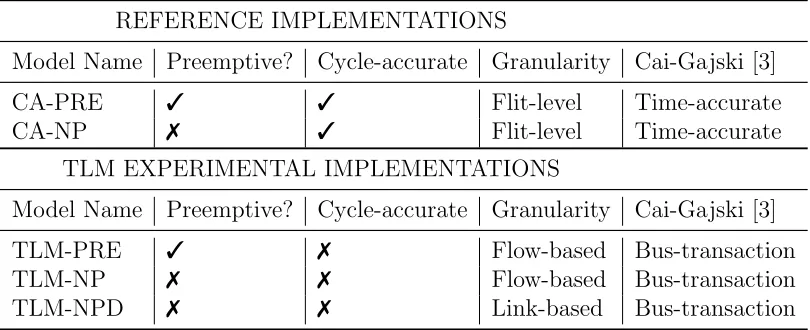
are the experimental TLM models evaluated here. Table 1 summarises the
key characteristics of these models. Criteria used for classifying the
mod-els include their priority preemption behaviour (priority preemptive or
non-preemptive), their cycle-accuracy (whether they function as a reference or
an experimental test model) and, for the TLM models, their granularity of
modelling. The granularity of modelling refers to whether the models store
and use individual link state in their NoC modelling decisions, or whether the
complete flow and its associated source-destination route is the fundamental
abstraction.
The relationship of the models to Cai and Gajski’s TLM classification [3]
is also defined in Table 1. The reference models CA-PRE and CA-NP are
model, in that they provide a cycle-accurate model of communication but an
abstraction of computation on the processing elements. The TLM-PRE,
TLM-NP and TLM-NPD models are examples of bus-transaction models,
in that they also approximate communication timings using the mechanisms
defined in Sections 5.4, 5.5 and 5.6.
REFERENCE IMPLEMENTATIONS
Model Name Preemptive? Cycle-accurate Granularity Cai-Gajski [3]
CA-PRE 3 3 Flit-level Time-accurate
CA-NP 7 3 Flit-level Time-accurate
TLM EXPERIMENTAL IMPLEMENTATIONS
Model Name Preemptive? Cycle-accurate Granularity Cai-Gajski [3]
TLM-PRE 3 7 Flow-based Bus-transaction
TLM-NP 7 7 Flow-based Bus-transaction
[image:18.612.111.516.250.415.2]TLM-NPD 7 7 Link-based Bus-transaction
Table 1: The characteristics of the NoC models
Throughout the paper, the concept of flows is employed. A flow is
de-fined as a sequence of associated flits from the same source and destination
which travel together to their destination. Flows have an associated route,
which represents the links that they traverse on the route to their
destina-tion. Packets therefore represent the simplest example of a flow (being the
complete sequence of flits including a header and all transmitted data),
al-though a flow can also represent a partial packet which has not completely
entered its final flit into the NoC. All the TLM models presented track the
of the header flit of the packet along its route from the source node to its
destination. Flit position is required in the tracking of power consumption as
well as latency, since it provides information on the position of individual flits
relative to the links upon the route it traverses. Consider the progress of a
single packet under transmission from source to destination via intermediate
routers in an otherwise idle NoC, as shown in Figure 2.
Src
R
Dst
0
R
1R
2R
30
Src
2
2
R
01
R
10
R
2R
3Dst
0
Src
1
R
00
R
1R
2R
3Dst
Src
R
Dst
0
2
R
11
R
20
R
33
Src
4
R
03
R
12
R
21
R
30
Dst
Src
R
0R
1R
2R
3Dst
Src
R
0R
1R
2R
3Dst
2
1
3
4
Src
R
0R
1R
24
R
33
Dst
Src
R
0R
1R
2R
34
Dst
2
3
4
T
i
m
e
[image:19.612.133.481.264.636.2]Link index along route to destination
Potential values for flit position at a given time are in the range 0≤Fp < N+H−1,
in which the hop count of the route is given by H and N refers to the total
number of flits (including header flits) that the packet contains. A growing
phase occurs when Fp < H −1, in which data flits are in progress to the
destination, but some links further along the route can be idle as data flits
have not yet reached them. Following completion of the growing phase, every
link on the route has transmitted a header flit for this flow, and the
worm-hole process can continue to operate normally. The flow finally experiences
a shrinking phase in which Fp ≥ N. In this phase no additional data flits
are being injected, but the final flits are still in progress and have not yet
reached their destination. During transmission in the example in Figure 2
this flow goes through flit positions from 0 to 8 at successive time intervals.
5.2. CA-PRE - Preemptive Cycle-Accurate
The first model considered is a preemptive cycle-accurate model, referred
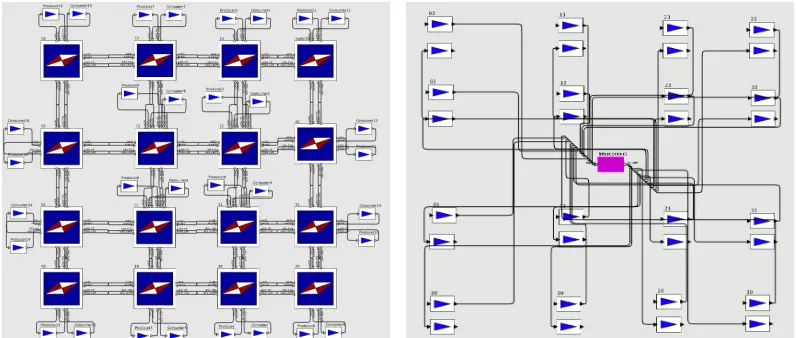
to as CA-PRE (Figure 3a). The figure shows the implementation of a test
NoC within the Ptolemy II simulation environment [28].
The CA-PRE model is structured to represent NoC components such as
arbiters, buffers and their associated ports as entities within the simulator.
On each transmission of a flit from one network component to another,
sim-ulator events have to be scheduled in order to process the arriving flit. For
example, flits arriving at an arbiter go through a simulated arbitration
virtual channels) which processes the virtual channels in priority order, and
ensures that the highest priority requesting arbitration is sent out upon the
relevant output port. Priority sorting ensures that each output port is only
used once for transmission per cycle, and port multiplexing state is tracked to
model the arbitration delays. Credit based flow control is used to control the
propagation of data through the network, allowing additional flits to enter
input buffers as they empty.
Delays are defined and timing information is tracked such that the
propa-gation of flits through the system is cycle accurate, but due to the requirement
for simulation events to model the propagation of each flit through multiple
simulation entities such as arbiters and buffers, time consumed in simulation
scales in proportion to the amount of data sent. This model is therefore used
as a reference implementation to validate the execution time performance
and accuracy of the TLM-PRE TLM model for preemptive NoCs. Although
the current implementation uses the Ptolemy II simulation environment, the
model structure is sufficiently generic to be applied to any simulator that has
objects with state, and port connections between them that trigger events
upon message arrival.
5.3. CA-NP - Non-preemptive Cycle-Accurate
The second model considered is a non-preemptive cycle-accurate model,
referred to as CA-NP. The fundamental structure of the CA-NP model at
(a) CA-PRE cycle-accurate simulation model (peer to peer NoC router topology)
[image:22.612.114.512.135.304.2](b) TLM-PRE TLM simulation model (entire NoC as single central entity)
Figure 3: The implementations of the simulation models for CA-PRE and TLM-PRE
within the arbitration code, in that their ports do not model the independent
buffering provided by virtual channels. In the alternative non-preemptive
design employed instead, the first flit to use a particular output port locks
that input-output port combination until the transmissions have finished.
All other requesting flows awaiting transmission on that output port of the
arbiter are blocked until completion of the in-progress flow, and therefore
cannot access the output port requested regardless of their priority level.
However, the fact that the input ports are processed in priority order ensures
that when two flows contend simultaneously for an output port, the priority
5.4. TLM-PRE - TLM Preemptive Single-Flow Activity
The TLM-PRE TLM preemptive model presented in this section is
de-scribed more fully in [4], [5] and [29]. The goal of the algorithm is to simulate
a priority preemptive NoC with a greatly reduced frequency of events. Events
are only processed upon flows entering or exiting the interconnect, or at
an-ticipated completion times for existing flows, in which simulation state must
be updated to ensure consistency. In the implementation of this and the
other TLM algorithms, an abstraction of the entire NoC is represented as a
single simulation entity (depicted centrally in Figure 3b). All abstractions of
processing elements are directly connected to this Interconnect entity.
The TLM-PRE algorithm is presented in Listing 1. The algorithm
oper-ates upon the set of currently active flows, processing them in priority order.
The algorithm uses the concept of interference sets in defining contention
between flows:
Definition 5.1. The interference setof f lowi is composed of flows of higher
priority than f lowi with routes sharing at least one link with the route of
f lowi. Flows are considered to be in the interference set regardless of whether
flits from an interfering flow request arbitration on those shared links
simul-taneously with f lowi.
For a particular f lowi, the algorithm tracks its current activation status
activei, and its remaining flits for transmission f litstosendi. During the
time tai. Completed flows are removed from the flow table. Activation of
any flows in the interference set of f lowi inactivates f lowi, preventing it
from transmitting. Flows without any active members of their interference
set are activated. Iteration over the flow set proceeds in priority order from
the highest to the lowest, ensuring that the activation decisions respect flow
priority. A further update event is scheduled at the expected completion
time of f lowi. Therefore, simulation events only occur when flows enter or
leave the NoC, or to update state at an expected flow completion time.
The trackPower function (Listing 2) is responsible for dynamic power
consumption modelling for a particular flow. It allows dynamic power
con-sumption of multiple flits to be tracked in a single simulator event, over a
time window in which it was known that the flow had exclusive access to
particular links. The trackPower function is invoked in two circumstances
during the update function; when f lowi completes, or when another higher
priority flow inactivates f lowi.
The trackPower function operates as follows. Firstly, the flowing time
can be computed by subtracting the current time from its last activation
time. The number of flits transmitted over this flowing time is computed
us-ing the flow’s flit transmission rate, which is by default assumed equal to the
system clock speed. A range of flits between startF litP os and endF litP os
is therefore determined. Iterating over both flit position and link index upon
the route, the flits which crossed a link are looked up from the flow’s
Listing 1: Pseudocode for updating a list of flows with power tracking (from [5])
1 update ( currentTime ) {
2 f o r each f lowi i n f l o w l i s t {
3 i f (activei) {
4 f litstosendi = f litstosendi − s e n t F l i t s ( currentTime −
tai) ;
5 tai = currentTime ;
6 i f (f litstosendi == 0 ) {
7 remove f lowi from f l o w l i s t ;
8 trackPower (f lowi) ;
9 }
10 f o r each f lown i n interf erencei {
11 i f (activen) {
12 activei = f a l s e ;
13 trackPower (f lowi) ;
14 }
15 }
16 } e l s e {
17 i f ( ! a c t i v e n f o r a l l f lown i n interf erencei) {
18 activei = t r u e ;
19 r e q u e s t U p d a t e ( currentTime + b a s i c L a t ( f l i t s t o s e n d i ) ) ;
20 }
21 }
22 }
Listing 2: Pseudocode for TLM dynamic power tracking (from [5]) 1 trackPower (currentF lowi) {
2 f lowing time = currentTime − tai;
3 endF litP os = startF litP os + f lowingtime ∗
f l i t T r a n s m i s s i o n R a t e (currentF low i) ;
4 f o r (f lit index = s t a r t F l i t P o s t o endF litP os) {
5 f o r (link index = 0 t o hopLength (currentF low i) ) {
6 f lit f or link = f lit index − link index;
7 i f (f lit f or link >= 0 and
8 f lit f or link < e n d F l i t L i m i t (currentF low i) ) {
9 link = g e t L i n k ( c u r r e n t F l o w i , link index) ;
10 f lit = g e t F l i t (f lit f or link) ;
11 r e g i s t e r T r a n s m i s s i o n (link, f lit) ;
12 }
13 }
14 }
15 s e t F l i t P o s (currentF lowi, endF litP os) ;
registerTransmission. This function handles dynamic power consumption
tracking for a particular flit and link, by tracking and accumulating bit
tran-sitions between sequential flits using a particular link. Since the algorithm
iterates over flit indices in its outer loop and along the route links in its inner
loop, the power consumption impact of previous flits will have been registered
in advance. It is therefore possible to extend the present work to apply more
advanced power models which incorporate cross-coupling between adjacent
links, e.g. [30] [31].
The example in Figure 2 shows a particular example of power
track-ing execution. Ustrack-ing a conventional cycle-accurate model in which every flit
transmission is directly modelled using low-level simulation events, simulator
events would be required upon every grey arrow. The TLM power tracking
described is able to model every flit transmission depicted with a single
simu-lation event, as long as the flow is not preempted during transmission. In the
case of preemption, an additional simulation event would be required, which
would handle modelling the completed flits up to the preemption point.
Consider Figure 2 to represent the algorithm’s internal processing.
Mov-ing from left to right along the horizontal axis (modelled in the inner loop of
Listing 2) represents advancing flits in single steps along their route to their
destination, with each gray arrow representing a power registration event for
a single flit. The rows represent sequential time-steps, which are handled in
the outer loop of Listing 2. Therefore, the link from processing core Src to
reg-istration. No link activity is modelled upon the vacant links closest to the
destination for flit positions 0 to 3, since the flow is still in its growing phase
and its flits have not reached this point yet. Correspondingly, the shrinking
phase occurs when the links closest to the source are idle.
5.5. TLM-NP - TLM Non-Preemptive Single-Flow Activity
In a preemptive NoC, it is always possible for a newly arriving higher
pri-ority flow to preempt another transmission in progress. The TLM simulation
model presented in this section, referred to as TLM-NP [6], operates upon
non-preemptive NoCs which do not permit such preemption. Upon flow
ad-mission, flows calculate their interference sets and activation status with any
other flow, in order to determine which flows will potentially interfere.
The pseudocode for the TLM-NP algorithm is the same as the previously
described TLM-PRE (Section 5.4), with a modification to the sorting order.
Instead of sorting flows for processing in order of priority, flows are sorted
on their distance to the next contention point (the link in the NoC at which
the routes of the two flows intersect). Priority is used as a secondary sorting
criterion if the distances to the next contention point are equal. For example,
two simultaneously arriving flows which wish to use the same link are sorted
such that the closest one to the contending router is processed first. Priority
is used as a tiebreak if their arrival at the point of contention would be
simultaneous. During the update event the flow processed first will reach the
passed through the contention point, then the model assumes that it cannot
be preempted and will flow until its f litsT oSendis zero.
5.6. TLM-NPD - TLM Non-Preemptive Dynamic Link Claiming
When one or more flows which share a link in common are active in the
network simultaneously, the TLM simulation algorithms presented in the
pre-vious sections have only allowed one of the them to be active simultaneously.
This may result in the simulation producing overestimates of latency, since
the model is too conservative in the temporal separation it provides. In the
real hardware implementation of a non-preemptive wormhole switching NoC,
both flows could advance through the arbiters along their routes in parallel,
until the latest of the two reaches the arbiter at which they are blocked or
contend for an output port. In the case of simultaneous arrival at an arbiter,
flow priorities would determine which would receive arbitration.
The TLM-NPD model is introduced in order to compensate for this, by
allowing individual links upon the route to be claimed dynamically. The
TLM-NPD model is the most sophisticated presented within this work, since
it models this situation by allowing multiple flows upon intersecting routes
to proceed simultaneously, claiming the links upon their arbiters up until the
point at which they will be blocked. This is therefore much more likely to
accurately predict latency in the problem case defined in Figure 1.
An earlier form of this non-preemptive NoC model (TLM-NPD) was
im-prove latency prediction performance under contention, by restricting flow
advancement during the growing phase to a single flit at a time. By contrast,
when a number of growing flows existed which attempt to request access to
multiple links, the early version of the algorithm described in [17], would
advance system time in a single operation, granting access to the contended
links to whichever flow was selected. This selection criteria was based on a
criterion of dominance, which considered flit positions to calculate distances
to the first contention point, as well as priorities. The dominance ordering
was computed up front and used as a sorting order. The necessity to
ad-vance system time in relatively course steps while assigning dominance in
this form produced problems in accurate link claiming prediction in complex
scenarios, when high contention lead to multiple blocking events occurring
over the update interval. The dynamic flow advancement in single flit steps
in the algorithm presented here as TLM-NPD solves this problem.
The increased reliance upon dynamic calculations means that the logic
for flow admission using in TLM-NPD is simplified. Upon admitting a flow
to the NoC, it is merely added to the flow table. Route intersection checking
or interference set (Definition 5.1) calculation is no longer required during
flow admission, since the dynamic flow move calculation during the update
events replaces them. The simulation now uses a time window start
lastUp-dateTime which records the time over which the interval should be
recon-structed. During flow admission, if no other flows are present in the system,
Listing 3: Pseudocode for the TLM-NPD algorithm: update of a list of flows 1 update ( currentTime ) {
2 i n t a r b i t e r P l u s L i n k P e r i o d s = a r b i t e r P e r i o d s + 1 ;
3 double time = lastUpdateTime ;
4
5 while ( time <= currentTime ) {
6 // P r o c e s s f l o w s s o r t e d i n p r i o r i t y o r d e r 7 f o r e a c h (f lowi s o r t e d by p r i o r i t y ) {
8 i f (f lowi. isGrowing ( ) ) {
9 headLink = f lowi. h e a d L i n k A t F l i t P o s i t i o n ( ) ;
10 i f ( headLink != n u l l and ! headLink . i s C l a i m e d ( ) )
11 tryGrowAdvance (f lowi, time , headLink ) ;
12 } e l s e tryFlowAdvance (f lowi, time ) ;
13 }
14 time += minFlowPeriod ( ) ;
15 }
16
17 lastUpdateTime = currentTime ; 18
19 f o r e a c h (f lowi s o r t e d by p r i o r i t y ) {
20 i f ( (f lowi. f l i t P o s i t i o n F i n i s h e d ( ) ) ) {
21 removeFlow (f lowi, currentTime ) ;
22 } e l s e {
23 completionTime = f lowi. timeToCompletion (
currentTime , a r b i t e r P l u s L i n k P e r i o d s ) ; 24 scheduleUpdateAt ( completionTime ) ;
25 }
26 }
Listing 4: Pseudocode for the TLM-NPD TLM function tryGrowAdvance 1 tryGrowAdvance (f lowi, time , headLink ) {
2 i f ( time >= (f lowi. lastMoveTime+minFlowPeriod ( )∗
a r b i t e r P l u s L i n k P e r i o d s ) ) {
3 // Claim i t
4 headLink . c l a i m L i n k (f lowi, time ) ;
5 // Move f o r w a r d s one , u p d a t e move time , t r a c k power
6 moveForwardTrackPower (f lowi, 1 , time ,
currentTime ) ;
7 }
Listing 5: Pseudocode for the TLM-NPD TLM function tryFlowAdvance 1 tryFlowAdvance (f lowi, time ) {
2 i f ( time >= (f lowi. lastMoveTime + f lowi. f l o w P e r i o d )
) {
3 // Move f o r w a r d s one , u p d a t e move time , t r a c k power
4 moveForwardTrackPower (f lowi, 1 , time ,
currentTime ) ; 5
6 i f (f lowi. i s S h r i n k i n g ( ) ) {
7 // Flow t a i l l i n k s can be r e l e a s e d 8 t a i l L i n k = f lowi. t a i l L i n k ( ) ;
9 i f ( t a i l L i n k != n u l l ) {
10 t a i l L i n k . r e l e a s e L i n k (f lowi, time ) ;
11 }
12 }
13 }
The pseudocode for update is presented in Listing 3. The first section
of the algorithm operates differently to the other TLM algorithms, in that
it is based upon advancing all flows simultaneously through the network in
single-flit steps as blocking permits, rather than computing the maximum
move limited by time and then advancing the flow in a single operation.
This is necessary in order to accurately model the claiming and releasing of
link locks when shorter flows are present in the network, since the release
of the lock upon a link may allow another flow behind it to advance. The
outer loop of the algorithm between lines 5 and 15 advances time forwards
in increments of the minimum processing period of flows in the network (by
default, this is equal to the system clock speed). The inner loop in lines 7
to 13 iterates over all active flows in priority order. This priority-ordered
iteration ensures that the all the higher priority flows in a flow’s interference
set (Definition 5.1) have been considered to check if they are eligible to claim
a link under contention, which respects the priority-favouring design of the
real hardware system.
If the flow is in its growing phase (in which it has not yet acquired all
the necessary links on the route to its destination), then the next link that
will be required by the advancing head is tested to determine if it is free
or claimed. If it is free, then tryGrowAdvance (Listing 4) is executed. This
compares the iteration time with the time of the flow’s next permitted move,
in order to determine if it can proceed yet. If this condition is met, then
consists of claiming the relevant link at the head. This is followed by (in the
function moveForwardTrackPower) incrementing the flow flit position, and
tracking the power impact of registering the single flits in one move.
If the flow is not in its growing phase (that is, its header has claimed
all the links to its destination) then it is immune to blocking given that the
NoC design assumed is non-preemptive. Therefore,tryFlowAdvance (Listing
5) is called to determine whether the flow can move forward. tryFlowAdvance
verifies that the time elapsed since the last move is equal to or greater than
the flow processing period, and if so advances the flow. If the flow is in its
shrinking phase, then it is also necessary to free the link at the tail every
time it moves forwards.
The last step for update in lines 17 to 26 of Listing 3 is to register the
time of this last update, and to work out which flows have completed and
which need to be scheduled for further processing. Accordingly, the code
iterates over all flows within the network, testing their flit positions to
deter-mine whether these flows have already completed. If they have completed,
then they are removed from the network. If not, then their estimated
com-pletion time (assuming no further blocking events occur) is computed. An
additional update is scheduled at this time in order to handle their remaining
transmissions.
One particular issue involved that may produce inaccuracies in the
TLM-NPD model is consideration of buffering in the network. In the reference
attached to particular input ports (one buffer per virtual channel in the
priority-preemptive NoC). This allows several flits to be stored within one
arbiter input buffer, which can produce a bunching up of multiple flits at
intermediate buffers. However, for modelling simplicity, the concept of flit
position used for the TLM models assumes that all flits are arranged
sequen-tially along their respective route, without bunching up within the buffers of
intermediate routers. This therefore can lead to some incorrect predictions
of flit position and the resulting preemption behaviour by the TLM models,
as examined in the results.
6. Results
This section presents simulation results to evaluate the simulation
execu-tion time performance, latency and power consumpexecu-tion modelling accuracy
of the various TLM models compared to the cycle-accurate reference. The
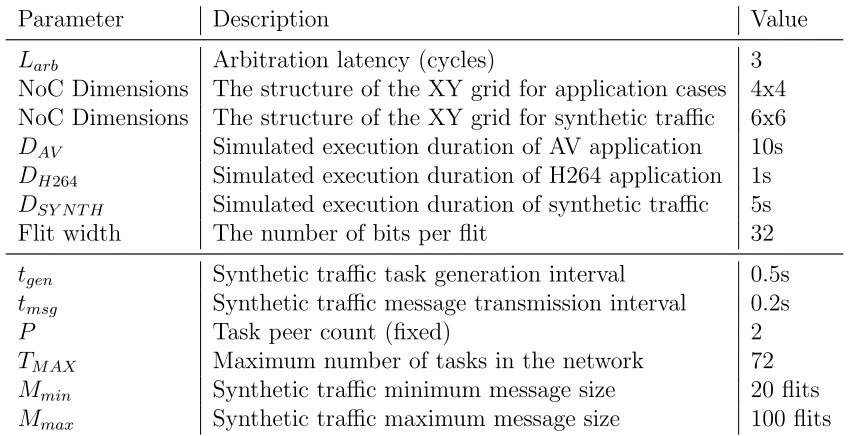
default parameters used throughout the simulations are given in Table 2. If
alternatives to these default parameters are used in any particular simulation
run, it will be specified during the description of the particular experiment.
6.1. Simulation Execution Time Performance Results
A major issue for NoC simulations is improving their overall execution
time while retaining accuracy, in order to allow realistic application cases
to be simulated. This subsection considers the wall-clock execution times of
Parameter Description Value
Larb Arbitration latency (cycles) 3
NoC Dimensions The structure of the XY grid for application cases 4x4 NoC Dimensions The structure of the XY grid for synthetic traffic 6x6
DAV Simulated execution duration of AV application 10s
DH264 Simulated execution duration of H264 application 1s
DSY N T H Simulated execution duration of synthetic traffic 5s
Flit width The number of bits per flit 32
tgen Synthetic traffic task generation interval 0.5s
tmsg Synthetic traffic message transmission interval 0.2s
P Task peer count (fixed) 2
TM AX Maximum number of tasks in the network 72
Mmin Synthetic traffic minimum message size 20 flits
[image:36.612.108.532.127.345.2]Mmax Synthetic traffic maximum message size 100 flits
Table 2: Parameters for the overall simulation methodology, and for synthetic traffic generation
against reference cycle-accurate models for the three application cases
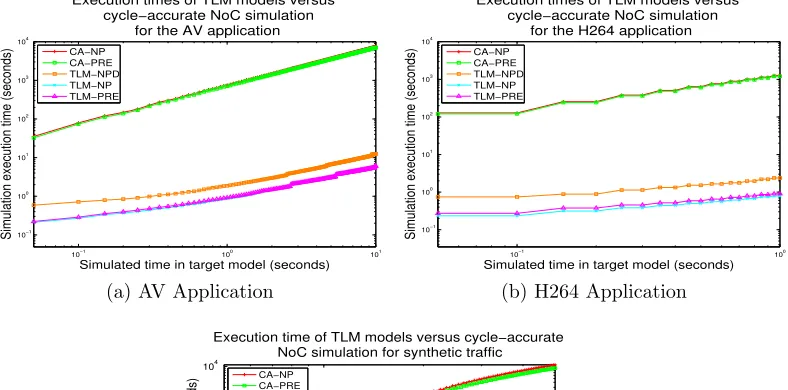
consid-ered. Figure 4a illustrates the execution time performance of the TLM and
reference models for the AV application, indicating that the simpler TLM-NP
model is approximately 3.1 orders of magnitude faster than cycle-accurate.
The TLM-NPD algorithm is approximately 2.7 orders of magnitude faster.
This relative reduction in speed for TLM-NPD compared to TLM-NP occurs
due to the requirement for the TLM-NPD algorithm to iterate in a nested
loop forwards over the time window and also over all active flows, which is
more time-consuming than the logic of TLM-NP. Considering the
preemp-tive models for the AV application, the TLM-PRE algorithm has effecpreemp-tively
10−1 100 101 10−1 100 101 102 103 104
Simulation execution time (seconds)
Simulated time in target model (seconds)
Execution times of TLM models versus cycle−accurate NoC simulation
for the AV application
CA−NP CA−PRE TLM−NPD TLM−NP TLM−PRE
(a) AV Application
10−1 100 10−1 100 101 102 103 104
Simulation execution time (seconds)
Simulated time in target model (seconds) Execution times of TLM models versus
cycle−accurate NoC simulation for the H264 application
CA−NP CA−PRE TLM−NPD TLM−NP TLM−PRE
(b) H264 Application
100 10−1 100 101 102 103 104
Simulation execution time (seconds)
Simulated time in target model (seconds)
Execution time of TLM models versus cycle−accurate NoC simulation for synthetic traffic
CA−NP CA−PRE TLM−NPD TLM−NP TLM−PRE
[image:37.612.117.511.141.336.2](c) Synthetic Traffic
Figure 4: Performance of the transaction-level model simulations compared with a cycle-accurate reference model
both algorithms are very similar. Similarly, the preemptive cycle-accurate
reference PRE displays very similar execution time performance to
CA-NP, since their simulation structure and event counts are very similar.
Figure 4b illustrates the execution time performance of the H264
applica-tion. The simulation duration is much shorter, and there is a smaller increase
applica-tion produces lower contenapplica-tion. The TLM-NP and TLM-PRE models exhibit
3.1 orders of magnitude execution time performance improvement over the
CA-NP and CA-PRE cycle-accurate simulations. The TLM-NPD model
de-livers 2.7 orders of magnitude improvement. The vertical steps shown in the
results arise due to the staggered release of packets from the central
trig-gering clock of the H264 application, which produces variations in network
loading at different sampling intervals.
Figure 4c illustrates the equivalent execution time performance for the
synthetic traffic generator, starting with the injection of the first tasks into
the system. Since tasks are generated dynamically for this simulation starting
with an empty network, at the beginning of the simulation model-independent
features such as simulation setup, data generation and packet generation are
dominant over the modelling of simulation transmission events. Therefore,
at the start the execution timing performance advantage of the TLM
simula-tions over cycle-accurate is comparatively low. However, as additional tasks
are generated as simulation execution progresses, the load placed upon the
NoC and total flit transmission rate throughout the NoC increases. Since
the cycle-accurate models require simulation events per every flit
transmit-ted, the advantage of the TLM models becomes greater, producing
approxi-mately 3.3 and 3.1 orders of magnitude timing performance improvement for
the TLM-NPD and TLM-NP models over cycle-accurate. As in the AV
ap-plication case, TLM-PRE provides an equivalent execution time performance
6.2. Latency Accuracy
The communication latencies produced during simulation by the TLM
models will vary according to how their algorithms handle the contention
between flows. This section presents and compares the normalised
laten-cies delivered for preemptive and non-preemptive TLM simulation models,
grouping packets according to their priorities. Normalised latency refers to
the latency per flit, that is, the total communication latency divided by the
number of flits transmitted. The total latency experienced by a packet
dur-ing transmission depends on the contention experienced durdur-ing transmission,
which may change due to the activities of other flows at the transmission
in-terval. Therefore, a maximum-minimum range is specified at each priority
level. Priorities are defined so that the low priority index values represent
the highest priorities (e.g. priority 1 is therefore the highest priority in the
system). All packets transferred between a source-destination pair in the
application model use the same priority.
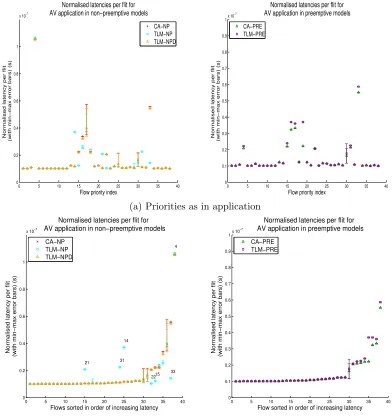
The latencies for the autonomous vehicle application are considered in
Figure 5a, covering results occurring over 10 seconds of simulation runtime.
The results show that the accuracy of the TLM-NPD algorithm is
over-all very high, with the largest error in the maximum normalised latency
under-estimation upon flow priority 17 corresponding to 15 flit-times (0.25
flit-times per message flit, with a message size of 60 flits). By contrast the
TLM-NP model exhibits large latency errors in several flow priorities,
0 5 10 15 20 25 30 35 40 0 0.2 0.4 0.6 0.8 1
x 10−7
Flow priority index
Normalised latency per flit
(with min−max error bars) (s)
Normalised latencies per flit for AV application in non−preemptive models
CA−NP TLM−NP TLM−NPD
0 5 10 15 20 25 30 35 40
0 0.1 0.2 0.3 0.4 0.5 0.6 0.7 0.8 0.9 1x 10
−7
Flow priority index
Normalised latency per flit
(with min−max error bars) (s)
Normalised latencies per flit for AV application in preemptive models
CA−PRE TLM−PRE
(a) Priorities as in application
0 5 10 15 20 25 30 35 40
0 0.2 0.4 0.6 0.8 1
x 10−7
21 31
14
2215 33
4
Flows sorted in order of increasing latency
Normalised latency per flit
(with min−max error bars) (s)
Normalised latencies per flit for AV application in non−preemptive models
CA−NP TLM−NP TLM−NPD
0 5 10 15 20 25 30 35 40
0 0.1 0.2 0.3 0.4 0.5 0.6 0.7 0.8 0.9
1x 10
−7
Flow sorted in order of increasing latency
Normalised latency per flit
(with min−max error bars) (s)
Normalised latencies per flit for AV application in preemptive models
CA−PRE TLM−PRE
[image:40.612.114.506.159.576.2](b) Flows sorted in latency order
33. This occurs since the simpler TLM-NP algorithm in incapable of
track-ing precisely where contention occurs durtrack-ing the progression of a flow durtrack-ing
its growing phase. In the preemptive case, the TLM-PRE algorithm is more
accurate, since a preemptive architecture is inherently more predictable in its
timing. The only flow priority for which the latency is particularly
inaccu-rate is 19, in which there is an underestimate since the TLM-PRE algorithm
cannot model accurately contention during the growing and shrinking phases
of routes, conservatively assuming the route is active throughout. Figure 5b
shows the flows from the same simulation rearranged in order of increasing
mean normalised latency (in the cycle-accurate reference model), to
demon-strate the general trend in TLM simulation accuracy for flows with increasing
contention.
For the TLM-PRE algorithm for the AV application case, the normalised
latencies are overall a closer match to the cycle-accurate case, since the
sce-nario is overall more predictable. The largest latency error occurs for
prior-ity 19, in which the normalised latency is approximately 66% higher for the
cycle-accurate reference.
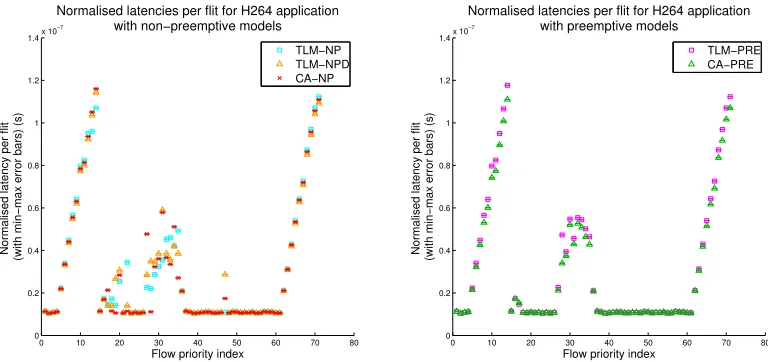
For the H264 application (Figure 6) in the non-preemptive case, both
TLM-NP and TLM-NPD correctly model overall structure of the latency
’ramp-up’ effect with priority that exists for low and high priorities. This
feature of the application arises as a result of the fan-out inherent in two
places in the H264 application, in which one source task transmits
0 10 20 30 40 50 60 70 80 0 0.2 0.4 0.6 0.8 1 1.2 1.4x 10
−7
Flow priority index Normalised latency per flit (with min−max error bars) (s)
Normalised latencies per flit for H264 application with non−preemptive models
TLM−NP TLM−NPD CA−NP
0 10 20 30 40 50 60 70 80
0 0.2 0.4 0.6 0.8 1 1.2 1.4x 10
−7
Flow priority index Normalised latency per flit (with min−max error bars) (s)
Normalised latencies per flit for H264 application with preemptive models
[image:42.612.113.497.126.307.2]TLM−PRE CA−PRE
Figure 6: Latency results for the H264 application under both preemptive and non-preemptive models
simultaneous application release, the model is very sensitive to cascading
latency errors, and for both TLM-NP and TLM-NPD there are two
trans-missions that are predicted incorrectly (priority 22 for TLM-NP and priority
28 for TLM-NPD). For the H264 preemptive case, the overall application
structure is more predictable since the NoC is preemptive and there is less
dependence on exact details of timing. This produces lower errors between
TLM-PRE and the CA-PRE cycle-accurate reference.
For the synthetic traffic simulations, results are displayed using flow
re-sorting (in order of increasing mean cycle-accurate latency) only. Since the
flow priorities are randomly selected and there is no defined application
struc-ture to the network, flow patterns are difficult to process intelligibly without
resorting. Figure 7 displays the resorted normalised latency of flows. For the
markers in addition to the NP data series. It is clear that the
TLM-NP algorithm provides a very poor estimate of latency in the non-preemptive
case, in that there is no relation between the shape of the cycle-accurate curve
and the TLM model. This occurs since the synthetic traffic produces much
higher contention than the other application examples, given that the task
peering relationships and mappings are randomly generated. Many flows
are blocked two or more times during their growing phase, which given the
wide variety of flow lengths and mappings can produce normalised latencies
per flit up to five times higher, or twice as low as the cycle accurate
(CA-NP) reference. By contrast, TLM-NPD provides much closer estimations
of cycle-accurate latency, with an overall close correspondence between the
mean values for TLM-NPD and the cycle-accurate reference. This is due
to its ability to track the timings and advancements of flows and therefore
anticipate which flow will receive arbitration in the event of a small timing
offset.
In the CA-PRE and TLM-PRE model comparison, it is notable that in
most cases the TLM model produces a latency above the reference
cycle-accurate model. However, occasionally the minimum latency is below the
minimum latency of the cycle-accurate reference. This can occur due the
dependencies between flows, in which a latency prediction error for one flow
in the TLM model can cause a dependent flow to miss contention that would
0 20 40 60 80 100 120 140 0.2 0.4 0.6 0.8 1 1.2 1.4 1.6 1.8
x 10−7
Flows sorted by mean normalised latency Normalised latency per flit (with min−max error bars) (s)
Normalised latencies per flit for synthetic traffic with non−preemptive TLM models
TLM−NP TLM−NPD CA−NP
0 20 40 60 80 100 120 140
0.2 0.4 0.6 0.8 1 1.2 1.4 1.6 1.8
x 10−7
Flows sorted by mean normalised latency Normalised latency per flit (with min−max error bars) (s)
Normalised latencies per flit for synthetic traffic with preemptive TLM models
[image:44.612.119.498.123.307.2]CA−PRE TLM−PRE
Figure 7: Latency results for synthetic traffic under both preemptive and non-preemptive models
6.3. Worst Case Latency Errors
As a summary, the maximum worst-case normalised latencies (per-flit
latency) errors generated by the various TLM models are presented in Table
3. These errors are computed by comparing the peak normalised latency
produced a TLM model against the latency produced by the relevant
cycle-accurate model. The priority level which produced the latency error is also
annotated.
It is notable that considering the non-preemptive cases, the TLM-NPD
model is significantly more accurate than the TLM-NP model predictions in
the AV application and synthetic traffic cases. Particularly in the synthetic
traffic case, there are a large number of priority levels which produce a high
relative error for TLM-NP (as depicted in Figure 7) in addition to the worst
mapping and the significant admission of packets to multiple destinations,
the worst case normalised latencies of the two models are approximately
equal.
Application TLM-NP TLM-NPD TLM-PRE
AVApp -74.3% (priority 33) -5.2% (priority 17) +66% (priority 19) H264 +218.0% (priority 22) +218.0% (priority 28) +39% (priority 28) Synthetic traffic +687% (priority 76) +32% (priority 29) +42% (priority 70)
Table 3: Maximum latency errors experienced by the TLM models
6.4. Link Transition Modelling Accuracy
This section considers the error in NoC link dynamic power consumption
modelling for the various TLM models, compared to the cycle-accurate
ref-erence. The dynamic power consumption on the links is approximated using
a model which counts the number of bit transitions upon the NoC links.
Although this does not include power consumption effects obtained from
switching logic or power coupling costs, due to the length of NoC links they
comprise a significant individual source of NoC dynamic power consumption
[18] [32] [21] [22] [19]. The results are presented as histograms indicating the
proportion of links in the network which exhibited the indicated error, which
allows the distribution of link errors to be examined.
Figure 8a demonstrates the link bit transition errors for the AV
appli-cation for the TLM-NP model, indicating that the majority of links have
−2.50 −2 −1.5 −1 −0.5 0 5 10 15 20 25
Histogram of bit transition error count between TLM model and cycle−accurate reference
Percentage error in transition count of TLM model
Percentage of links with error
(a) TLM-NP model for AVApp
−2.50 −2 −1.5 −1 −0.5 0 5
10 15 20 25
Histogram of bit transition error count between TLM model and cycle−accurate reference
Percentage error in transition count of TLM model
Percentage of links with error
[image:46.612.117.511.136.314.2](b) TLM-PRE model for AVApp
Figure 8: Histogram of link bit transition estimation errors for TLM models relative to cycle-accurate reference in AV application
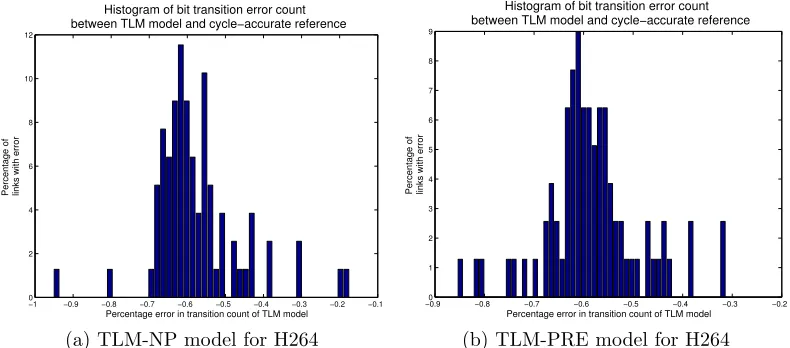
−1 −0.9 −0.8 −0.7 −0.6 −0.5 −0.4 −0.3 −0.2 −0.1 0 2 4 6 8 10 12
Histogram of bit transition error count between TLM model and cycle−accurate reference
Percentage error in transition count of TLM model
Percentage of links with error
(a) TLM-NP model for H264
−0.90 −0.8 −0.7 −0.6 −0.5 −0.4 −0.3 −0.2 1 2 3 4 5 6 7 8 9
Histogram of bit transition error count between TLM model and cycle−accurate reference
Percentage error in transition count of TLM model
Percentage of links with error
(b) TLM-PRE model for H264
Figure 9: Histogram of link bit transition estimation errors for the TLM models relative to cycle-accurate reference for H264 application
of individual links is in the small cluster around a 2.5% underestimate. These
links are however carrying only a small amount of data, so this relative
[image:46.612.116.511.377.551.2]![Figure 1: Small packet arrival timing offsets can determine which flow re-ceives arbitration at contention points, potentially influencing flow latency,particularly in non-preemptive NoCs (based upon [17])](https://thumb-us.123doks.com/thumbv2/123dok_us/7844391.177196/10.612.112.500.133.378/osets-determine-arbitration-contention-potentially-inuencing-particularly-preemptive.webp)
![Figure 2: Structure of the algorithm and flow progression to the destination(based upon [5])](https://thumb-us.123doks.com/thumbv2/123dok_us/7844391.177196/19.612.133.481.264.636/figure-structure-algorithm-ow-progression-destination-based.webp)