This is a repository copy of
The Ostrogothic Military
.
White Rose Research Online URL for this paper:
http://eprints.whiterose.ac.uk/110306/
Book Section:
Halsall, Guy Richard William orcid.org/0000-0002-8981-4355 (2016) The Ostrogothic
Military. In: Arnold, Jonathan, Bjornlie, Shane and Sessa, Kristina, (eds.) A Companion to
Ostrogothic Italy. Brill , Leiden , pp. 173-199.
[email protected] https://eprints.whiterose.ac.uk/ Reuse
Items deposited in White Rose Research Online are protected by copyright, with all rights reserved unless indicated otherwise. They may be downloaded and/or printed for private study, or other acts as permitted by national copyright laws. The publisher or other rights holders may allow further reproduction and re-use of the full text version. This is indicated by the licence information on the White Rose Research Online record for the item.
Takedown
If you consider content in White Rose Research Online to be in breach of UK law, please notify us by
1
The Ostrogothic Military
Guy Halsall
Abstract
This chapter explores the place of the army and military organisation within the Ostrogothic kingdom. It is divided into three chronological phases: the conquest, the kingdom of Italy, and the
Gothic Wars. Whether the Ostrogoths themselves were
settlement and salary in Italy, and ethnic identity in the formation of the army are all discussed. The army itself has rarely been studied as a separate institution, which may be because,
O
nature and the fate of that polity.
Introduction
The Ostrogothic Kingdom was created and destroyed by conquest and the army remained a central feature of its politics and society. Discussing military affairs in Gothic Italy therefore requires attending to seemingly unmilitary issues like the settlement and its nature, and the ethnic politics, which have been the focus of sometimes fierce recent debate. This chapter is organised according to three main chronological phases: the period of the conquest; Theoderic reign as king of Italy; and finally the Gothic wars. This permits examination of change, as well as allowing the analysis of issues specific to each sub-period. Although the Ostrogothic Italian kingdom endured for only three generations, we must remember that Theoderic was a long reign by any standards. The troops who accompanied him across the Isonzo in 489 were very different from those undertaking the military operations of his last years and entirely unlike those of the Gothic Wars.
A: The Army of the Conquest
Theoderic
s Goths Army or People
Theoderic in 489 had developed out of several Gothic groupings. Principally they originated in Theoderic armed following and in that of his namesake, Theoderic Strabo ( the Squinter ).1 Neither group can be considered as the Gothic people , although later sources, from within the Italian kingdom and outside, attempted to create that image. Leaving aside the contemporary existence of the Toulouse V oths , the fact that two Balkan Gothic groups existed gives the lie to such a supposition. Rather than being the only two such groups, these were simply the most numerous and, therefore, the most politically and militarily significant.
These bands originated in the instability that followed A -lived
trans-Danubian empire in the 450s. In A polyglot realm, his subjects possessed several levels of ethnicity beneath a unifying Hunnic identity. In a justly famous story, the East Roman ambassador
1
2
Pr G A 2 but this Greek also fully regarded himself as a Hun. It has long been pointed out that most of the known Huns bear Gothic names, not least Attila and his brother Bleda. The material culture associated with the Hunnic kingdom emerges from a mixture of
local Roman and traditions. A A
and other former commanders. Often depicted as a rising of subject peoples , it seems more reasonably described as a succession crisis. Opponents of the Attilan dynasty adopted non-Hunnic identities, bringing back to the surface lower-level ethnicities, like the Greek identity of P
interlocutor, which had always existed. F A , a bewildering array of
peoples came fleetingly into view in the H wreckage.3 For some, even a solid historical existence can be questioned. Only three named Skiri are known: Odovacar, his father, and his brother.4 It is difficult to decide whether Skirian identity ought to be considered ethnic or familial. Nonetheless, a successful family might attract enough followers for its kin-group identity to be adopted and become an identity that operated in uncontrovertibly ethnic fashion. After all, historians are accustomed to describing post-imperial Gaul, its people, and culture between the late 5th and 8th centuries using a familial identity originating O : Merovingian. The families of the two Theoderics seem to have stressed a Gothic identity, just as other people with Gothic names had adopted, or continued to proclaim, Hunnic ethnicity. Others made political claims based around Gepidic, or Herulian, or Rugian, identity. Whether any faction should be considered a revival or reappearance of a tribe with a long pedigree seems questionable.
Recent debate has concerned whether the Goths formed a people on the move , as in traditional
Völkerwanderung interpretations, or, as in more recent works, simply an army. This is incapable of easy resolution.5 Extreme interpretations are unsatisfying, not least because army and people are rather trickier terms to define than might be assumed. Consequently, between the polar readings, conclusions are more difficult to pigeon-hole as army or people . Nevertheless the issue is of considerable relevance.
Gothic factions (like, presumably, the others) are described having women and children in tow.6 This has been taken as proving that they were a migrating people .7 This does not necessarily follow. Roman armies took women and children with them too, as did most armies until well into the
2
Priscus, frag. 11.2 (Blockley), pp. 266-75.
3 Fehr & von Rummel, Die Völkerwanderung, pp. 75-80; Heather, Goths and Romans, pp. 240-51; Heather,
Goths, pp. 124-9; Pohl, Die Völkerwanderung, pp. 118-25; Thompson, Huns, pp. 167-76; Wolfram History of the Goths, pp,258-68; Wolfram, Roman Empire, pp. 139-43.
4
Goffart, Barbarian Tides, pp. 203-5.
5T A G O A
P H The Goths (Oxford, 1996), pp. 169-78. For discussion of the earlier Goths, many points of which can be made, by analogy, for the Ostrogoths, see Liebeschuetz, A Goths: Nation or army? H Barbarian Migrations, pp. 189-94; Kulikowski,
Nation versus army
6
For the Ostrogoths, see Malchus, fr.20 (Blockley); Ennodius, Pan. 26-7,
7
3
twentieth century.8 This note of caution, however, does not authorise us to disallow seeing the Goths as a people on the move . The factional interpretation permits an intermediate course. We might envisage a social group including women and children, but with young male warriors serving more established leaders nevertheless forming the most important element.9
After a long period of almost constant campaigning, in and out of official East Roman service, three consequences can readily be imagined. One is the knitting of warrior bands into established, quasi-permanent bodies of men,living together year-round, practising weapon-use and regularly fighting alongside one another. These would acquire most of the significant attributes of regular military units. The whole organisation would have resembled a permanent army. Indeed the Ostrogoths largely functioned as an army in Balkan politics in the 470s and 480s. The second consequence, however, will have been the acquisition of wives, children and, doubtless, camp followers. Paradoxically, then, as the Goths increasingly took on the form and functions of an army, they will have become more socially varied. The third consequence is that young warriors got older; mature warriors became old and possibly infirm. Without an established place in Eastern Roman social, military and political structures, they could not settle down. They had little option but to continue to move and as long as they could fight with the rest. This too made the Goths, even if originating, organised and functioning as an army , much more like a people than most military forces. Therefore, to see the force heading for Italy in 489 as, by then, looking rather more like a people
than a normal army , one need not envisage Theoderic G that upped
and moved en masse. Once the dynamics of the situation are thought through, even a narrowly
G ultimately see the force that
arrived in Italy as something more socially variegated. That must impact significantly upon how we understand Gothic settlement.
Italian Background
The loss of direct imperial control over Africa in the 420s and 430s was critical in producing changes in Italian politics.10 The seaborne threat from Carthage meant that significant forces had to be stationed throughout Italy, rather than (as hitherto) just in the north. A key element of fifth-century politics was the increasing separation and rivalry between Italian and Gallic aristocracies. However, whereas the fourth-century Italian aristocracy had had little option but to accept the de facto shift of the imperial core to the Rhine frontier, it now had an armed force to help ensure its control of the centre of politics and patronage. The Italian army became crucial in peninsular politics, as ‘
long period of dominance makes very clear. Although unable to establish itself over the Gallic factions based upon the Goths of ToulouseandBurgundians on the Rhône, the Dalmatian army, or the Vandals in Africa, it nevertheless dominated Italy, expelling the Gallic/Gothic faction in 457 and the (legitimate) Dalmatian claimant in 475, as well as fending off attacks from African Vandals and trans-Alpine Alamanni.
8 Halsall, Barbarian Migrations, pp. 190-1. See also CTh 7.1.3. 9
See Halsall, Barbarian Migrations, pp. 439, 444, 447 for the importance of age.
10
For this, see Halsall, Barbarian Migrations, pp. 257-83 for Italian political history, and 328-338 for social and
4
Recruitment remained problematic, however. Lacking effective fiscal control beyond Provence and the Narbonnaise in Gaul or Tarraconensis in Spain, any Italian emperor was greatly reduced. The peninsula became a political hot-house as the senators, likewise cut off from properties and revenues abroad, competed with lower-order aristocrats for honours, titles and patronage, especially where local wealth differences were now much reduced. This made the ility to levy troops as well as taxes more problematic. Therefore, taxes were used to pay for military recruitment outside Italy, especially in trans-Danubian barbaricum. These troops, at least initially, lacked local ties and were more easily employed as a coercive force. Unsurprisingly, the resources used to pay the army were referred to as the fiscus barbaricus.11
Nonetheless, crucial dynamics operated here too. ‘ remuneration had always involved land. Late Roman forces, as noted, lived, and sometimes moved, accompanied by wives and children. Recruits like Goths got older, married and settled down. Hereditary military service12 meant that any childrenfollowed their fathers into the army, which, over time, became as integrated into peninsular society and politics as any other group. The soldiery that serially deposed Julius Nepos and Romulus Augustulus doubtless contained significant numbers of men born and raised in Italy, even if serving in units with titles: second-generation Italo-barbarians .
This discussion casts the confrontation between Odovacar and Theoderic somewhat differently from the clash of armies sometimes imagined. Both sides originated in a very specific, fifth-century imperial context. Their similarities doubtless explain the drawn-out, long-indecisive nature of the struggle and the common changing of sides.13 N T
troops military experience and long practice operating as units, was probably crucial to their eventual victory.14 .
Hospitalitas
Crucial to understanding the military G I hat has been dubbed, perhaps
Hospitalitas 15 The name hospitalitas (loosely, hospitality) came from a late Roman billeting law, describing the division of billets into thirds, the householder taking two and the soldier the other.16 Procopius Wars allege that the s appropriated a third of the land
11C
Il regno di Odoacre “ Variae 1.19 for its successor, the fiscus gothicus.
12
CTh 7.1.5, 7.1.8.
13
Anonymous Valesianus, pars posterior, 10.50-56; Cassiodorus, Chronicle 1320-31; Consularia Italica (a collection of annalistic texts grouped by Theodor Mommsen under this title, highly misleading in almost every way but convenient for citation) 639-49; Ennodius, Life of Epiphanius, 109-19. Heather, Goths, pp. 219-20; Wolfram History of the Goths, pp. 281-4.
14 A G V decisively broke O T P A
Valesianus, pars posterior 11.53). Whether this represented pan-Gothic cooperation is unlikely. It may be preferable to see the Gallic faction chancing its arm in Italian politics in established fifth-century tradition, with Alaric II following his uncle T II example.
15
Halsall, Barbarian Migrations, pp. 422-47, for summary of the debate to c.2005 and references. Goffart, Barbarian Tides, pp. 119-86.
16
5
of Italy, and C Variae allude to Gothic thirds or shares . It was long understood that Italy was similarly divided into three according to that billeting law, with one third going to the Goths . This idea fit then dominant paradigms, seeing the principal feature as violent
conquest and viewing the barbarians as land- tribes .
W G Barbarians and Romans undermined that consensus. Goffart shaped his general
using the Italian evidence, rather than the Burgundian as had hitherto been more usual. The Italian data were more contemporary, if in some ways less detailed than the relevant clauses of the Burgundian Code. Aquitanian Gothic and Burgundian settlements were separated from the documents that described them by time and several phases of development. Ennodius and Cassiodorus s offered a direct view of how troops were settled in a Roman province. G more famous, move placed the settlement within the context of Roman taxation. He proposed that the Gothic settlers were granted not thirds of land but thirds of tax-revenue.
Goffart showed that the Roman law of hospitalitas had concerned the temporary provision of shelter, not salary, provisioning or settlement. He dismissed P politically-motivated. The Wars manifest J ideological campaign, claiming that the West required reconquering, having been lost to barbarian invasion . Procopius may have distorted evidence to paint Theoderic in a bad light. His reference to a third of the land may even be no more than hyperbole, and have no relationship with the tertia referred to elsewhere. Goffart turned instead
E C directly contemporary rhetorical statements that the Goths had been settled without Roman landowners feeling any loss.17 It was difficult, said Goffart, to envisage such pronouncements if the senators had really been stripped of a third of their estates.
Goffart then analysed C Variae and the technical terms illatio tertiarum and
millennarius.18 The illatio tertiarum had previously been read as a levy of one third of the revenue of the land of landowners who had not had their estates partitioned to provide land for a Goth.
Alongside actual expropriation, E C rhetorical
statements extremely insensitive; this would have represented a serious burden on the Italian aristocracy. The latter clearly retained its fifth-century prosperity under the Ostrogoths - difficult to envisage if their revenues had been reduced by this level. Goffart suggested that the illatio was a third of the usual tax revenues, diverted to the payment of the Goths. The third (tertia) referred to this. 19
A millenarius20 had been assumed to be, a chiliarch, a comander of 1000 men. The term does mean this but Goffart pointed out that a millena was also a Roman notional tax assessment unit, still used
17
Ennodius, Epist. 9.26; Cassiodorus, Variae 2.16
18 Goffart, Barbarians and Romans, pp. 73-80. The loci classici are Variae 1.14 & 2.16-17. 19
See Bjornlie, elsewhere this volume, for the straightforward fiscal connotations of the illatio tertiarum. Relating the tertia in question to the fiscal payment schedule simplifies the situation further.
20
6
in Ostrogothic Italy.21 Such units, in specific numbers and perhaps drawn from particular fiscal assets, were set aside for designated purposes. For Goffart, a millenarius was a Goth paid with a
millena of tax-revenue.22 Conflicts between Gothic soldiers and Italian taxpayers arose where the former attempted to convert a legitimate right to receive a salary into the illegitimate ownership of the land from which that salary was raised.23
Goffart reading has considerable advantages, not least simplicity. No longer did one need to envisage hordes of agrimensores touring the Italian peninsula, assessing estates and their relative value before assigning measured portions to specific Goths. The state gained a standing army and lost nothing; revenue collection was simplified. Nonetheless, most historians have remained unconvinced.24 The most important problem was that, as originally formulated, Goffart thesis required readers to understand terra as meaning fiscal revenue from the land . Critics argued that this was rather forced. In response, Goffart drew attention to the fact that even straightforward-looking references to land in modern legal documents are not simple. Land comes with a web of relations and obligations. This excluded any simple proclamation that terra was unambiguous , as though land were itself straightforward. Furthermore G relied upon more than new translatons of words like terra. It accounted for many other relationships, frequently ignored by anti-Goffartian critiques.
The main G s that the traditional view was rooted in the appearance of tripartite divisions in the Roman law of hospitalitas and in some texts discussing
settlement. Goffart decisively showed that the Theodosian Code discussion of hospitalitas had no bearing on the issues confronted in fifth- and sixth-century texts describing tertia and
the rest. T G we cannot return to
old-style expropriationist theses , based ultimately on that hospitalitas law. -
G not unproblematic; his most recent contribution certainly does not definitively settle the debate.25 Some ground-clearing is necessary. We must rigorously keep to the precise issue under debate and to the particular data relevant to it. Evidence, for example, of Gothic land-owning does not contradict Goffart thesis, which concerned the settlers salary
and thus their relations with the state. It discussed accommodation in that precise sense, not whether the barbarians owned land.
Furthermore, we need not suppose that all the land of Italy was encompassed in the discussion of thirds . The only text to talk in those P Wars. If, like Goffart , one rejects that testimony, one must logically reject it all. One cannot pick and choose details from it. The most one
21
See Variae 2.37
22M O “
-4, related millenarii to millenae L D
-6, thought millenarii were officers. Generally, however, it had been assumed that a millena was a fixed amount of land.
23
Goffart Romans and Barbarians, pp. 89-100.
24
Principal critiques include: ...
25
7
might say is that P a third might have been motivated by the legal
arrangements employed. The documents do not necessary imply a universal, peninsula-wide arrangement. They need imply only that those relationships applied to those lands or resources necessary for the G payment. Indeed, all we need assume is that those relationships applied to the lands or resources necessary to pay those Goths who were paid in that way. There is no inference that all Goths were remunerated entirely in the fashion discussed in the handful of relevant documents in the Variae. Critics of Goffart hypothesis have made the point before that it is unlikely that all Goths received the same payment, albeit on the mistaken assumption that a standard salary, rather than a standard means of paying a salary, was im G .
N G illatio, tertia, sortes and millenarii seems reasonable. Late imperial Roman precedents existed for his suggested system; they had apparently been used to pay elite field armies, such as, in a general sense, the Goths were.26 A Gothic warrior would be paid by a draft on taxation,27 which he would collect from designated tax-payers, and, as Gothic status seems to have equated more or less with service in the army, this relationship would be inherited by his sons. Most of key elements derived from the late imperial military. The relationship between Goth and Roman was, crucially, that of government official to taxpayer. No other relative status was implied. A Goth may have been of a higher or lower standing than the Roman/s ear-marked to pay him his salary.
The Goffart thesis is its insistence that this single system entirely sufficed in all cases, in Ostrogothic Italy and elsewhere.28 That requires complex and sometimes less convincing argumentation. It is simpler to propose that, while G system provided the Ostrogothic essential salary, it was not necessarily the only means used. Different Gothic status-groups may have wanted payment in different forms.29 The resources of the sacrae largitiones and res privata, including landed estates and palaces as well as revenues, surely passed directly to Theoderic. At least one Gothic family (the Amals) received land to live upon... It is plausible that Theoderic, like the emperors, rewarded some of his followers from these resources. Grants of fiscal land on long-term, emphyteutic leases are reasonably well attested as a form of imperial patronage.30 Theoderic had other entirely traditional resources within the sacrae largitiones and res privata. Confiscating defeated enemies was normal after a civil war.31 It
O with their land used to reward
26
CTh 7,4.20, 22.
27
That such a system for payment was employed in Ostrogothic Italy is suggested by ET 126 and, especially, 144.
28
See Halsall, Barbarian Migrations, pp. for discussion of the problems with this assumption.
29 García Gallo, Notas sobre el reparto de t ; Wolfram, History of the Goths, p.224. 30
Jones, Later Roman Empire, pp. 417-20.
31
Variae 4.32 assigns the property of the proscribed to the fisc. The Edictum Theoderici
8
some of Theoderic .32 Contemporary sources mention massacres of Odovaca 33 These men had probably been paid according to a system like that proposed by Goffart but they also had to live somewhere and that landed property fell to Theoderic to retain or redistribute. We can
easily imagine Theoderic land-grants.
However, this has no bearing on the documents discussed by Goffart or the precise situations they describe, or to normal Gothic military salary.
A considerable swathe of agri deserti (lacking registered tax-payers) also existed.34 The late Roman state had rewarded retiring veterans with land.35 Employing the agri deserti, yielding no tax revenue, for this purpose cost the government nothing. Indeed, enmeshing them in a system of military obligations extended fiscal resources. Note, though, that this is also irrelevant to discussions of
sortes or tertia, which relate to tax revenue. Some dynamics within the Gothic army are relevant
here. Not all Theoderic . Some had campaigned for twenty
years and doubtless expected to settle down. Others may have fought on into old age, or accompanied the army as infirm ex-warriors, for the protection provided. These would not normally draw an annual salary, plus periodic donatives, in return for military service.36 Land was a more appropriate reward. Nonetheless, because Gothic soldiers status and duties were heritable, lands so used were automatically entwined in military obligations, especially when inherited.
Imagine an elderly companion of Theoderic and perhaps Thiudimir his father, rewarded with an Italian ager desertus. No longer militarily active, he has a son in the army, who collects his salary from designated taxpayers according to Goffart system; he is a millenarius. When the old Goth dies, the son inherits his land.37 But, because he inherited his Gothic status and obligations from his father, that land is now subject to military service. This mature Goth now supports himself from the
ager (no longer desertus) and his millena/e, both ultimately granted by the government. Imagine a young Goth who joined Theoderic during his campaigns, with no elderly relatives to support. After the conquest, he is paid from a designated millena. He marries an Italian woman and has children. He may or may not buy land but, when he retires, he is rewarded in Roman fashion, with a landed allotment. The same features pertain as with the first Goth. His sons inherit his identity and military duties. When they inherit the ager, that land becomes part of a new type of fiscal resource land held tax-free, in return for military service and they too have two sources of sustenance.
32
Variae 1.18 seems to refer more easily to the distribution of expropriated land (and abuses of that situation), when Theoderic conquered Italy, than to illegitimate claims on tax-revenue.
33
Moorhead, Theoderic, pp. 26-27.
34 Jones, Later Roman Empire, pp. 812-23, is the classic basic account. 35
CTh 7.8.1.
36
See Variae 5.36.
37
9
This hypothetical reconstruction seems plausible. Note, that there has been no expropriation of any
Roman landlord. Further G
salary remains entirely intact. No revision is required G ading of the texts dealing with the illatio, tertiae, or millena/millenarii.
Crucially, however, this system contained the seeds of potential change. Indeed, recognition of change over time are essential to a full understanding of the issue. Within a generation Gothic soldiers draw their salary not just from taxation; land with attached military obligations has come into the equation. This situation resembles that visible slightly later in sixth-century Merovingian Gaul .38 The growing connection between Gothic troops and landed communities is precisely the dynamic suggested earlier, whereby earlier recruits had become fixed in the Italian landscape. The power relations remain; the government retained a standing, salaried army while simplifying aspects of revenue-collection and distribution. The advantage of this reconstruction is its dynamism. Over time, salaried Gothic soldiers settled in communities with their families, with social ties beyond those of tax-payer and tax-collector. They nevertheless remained an essentially military body. This allows us to retain Goffart interpretation and avoid having either to explain away references to Gothic land-ownership or, alternatively, see them as compelling the rejection of
G .
Goffart pointed out another dynamic: the temptation to transfer a right to collect a salary from a designated fiscal asset into outright ownership. This would completely change the relationships involved, making the tax-payer G . Some documents apparently represent attempts to prevent, or investigate allegations of, such abuses.39 During weak, especially minority, government these can easily be imagined. This dynamic may underlie changes in Merovingian Frankish aristocratic landholding and power during a period of stress largely brought on
by royal minorities around 600.40I P it may even have been behind the
demands that led to O downfall, though, as mentioned, rejection of the whole story is probably the most consistent approach. Yet another dynamic is the purchase or other acquisition of landed properties, which a Goth would own in the usual way. Unlike land granted as remuneration for service, these would be liable for the capitatio and other relevant fiscal obligations. Goths might however want to extend tax-exemption to all their lands.41 This would be a source of conflict.42 Overall, we should not see the system used to settle the Gothic army after 492 as taking a single form or imagine that the initial state of affairs remained unchanged
existence.
38 Halsall, Warfare and Society, pp. 46-50 and refs. 39
Variae, 8.28.
40H F ‘ 41
Such a desire may lie behind the situations described in Variae 1.26 and 4.14.
42
10
B: The Army of the Ostrogothic Kingdom
The army in the governance of the kingdom
After his victory over Odovacar, Theoderic was how to unify and govern Italy. Roman aristocratic power, especially below the level of the old senatorial nobility, where authority was probably more intensive within specific localities, and the potential threat posed by leading Gothic families, aggravated the difficulties to communication and the exercise of power posed by
I 43
Theoderic illustrate his approach to
this problem. To maintain authority, the king had to scatter his forces throughout the peninsula. Yet, this potentially exacerbated the problem just described. A local commander (perhaps with as good a claim to nobility or even royalty as Theoderic troops, perhaps in alliance with the
aristocrats, to challenge royal authority.
One solution might be to ensure that Goths did not perform military service in regions where they held millenae, though whether such a solution was practical in Italy is doubtful.44 Theoderic seems instead to have imaginatively employed patronage and propaganda.45 The army was seemingly assembled regularly in the principal, northern royal centres: Pavia, Milan and Ravenna. Here, Theoderic paid donatives (a supplementary cash salary), rewarded those who had done well and punished those who had not.46 This enabled the continuous distribution and redistribution of royal patronage, not only in the circulation of offices but also in the geographical redeployment of personnel, preventing any family or faction from establishing a local power-base. Furthermore, it made Gothic noble or royal families compete for royal favour with lower-born rivals.
When assembled for these purposes, the army was subject to manifestations of royal ideology aurally, in speeches, panegyrics and so on, and visually, in the pictorial and epigraphic decoration of the buildings used.47 The Senegallia Medallion demonstrates that some of the largesse distributed carried Theoderician propaganda.48 As C writings show, these ideological productions
a pillar of civilitas and consequently the requirement for harmonious relations between Gothic troops and Roman civilians.49 They also stressed Theoderic claim (at least by the latter half of the reign) to represent an ancient, uniquely royal dynastic claim to power.50
43
For T , see Variae 1.29, 2.19, 4.47, 5.5, etc.
44
Burgundian Code (54.1) suggests something similar being practised in that, smaller realm.
45
W H T K G pp. 152-65.
46Variae 5.27: bonos enim laus malos querula comitatur. See also Variae 4.14, 5.26-27, 5.36. 47H T K G
pp. 162-3. Some settings for Theoderician ritual are analysed by Annabel Wharton, Refiguring the PostClassical City, pp. 105- “ W T
(which W pp. 263-77). On
ideology, see Heydemann elsewhere in this volume.
48A T 49
Variae 2.8, 3.16, 3.24, 3.38, 5.26.
50
11
Royal association or authorisation, trumped all other claims to legitimate authority but competition for this entailed subscription to Theoderic .51 This process undermined pre-existing Gothic social distinctions and ensured that Theoderic royal writ penetrated the geographically disparate local communities of Italy. Simultaneously, it assured the army continuing function, in spite of increasingly complex and deeper-seated social ties, as a state-controlled coercive force.
None of this meant uniformly harmonious relations between army and local society ; such had hardly existed even under the Empire. The Variae mention numerous conflicts and complaints arising fr 52 Gothic troops, Cassiodorus repeatedly enjoined, should not molest, harass or steal from the provincials in areas where they were stationed or through which they were marching.53 The provincials of the Cottian Alps were compensated for depredations committed as the army passed through the region en route to Gaul in 508.54 Like Roman troops, Goths on campaign were supplied with food and other necessities (annonae) by the fisc. For the kingdom s mountainous northern frontier garrisons this was especially important. Hungry troops could easily start to take what they wanted from their civilian neighbours. Cassiodorus had to write several documents ordering the rapid and effective payment of annonae.55
Organisation
The Variae, a rich source for the place within Theoderic a clear impression of continuity from the late imperial situation into Ostrogothic Italy. Other than the army Gothic composition, the Variae provide no a priori evidence that much had changed at all. Gothic, like late Roman, soldiers were subject to their own jurisdiction.56 It seems preferable to read the texts discussing jurisdiction over Goths and Romans in this way rather than assuming that they refer to ancient Gothic tribal custom.
Serving Gothic soldiers were possibly distinguished from civilians (as in other kingdoms) by their long hair (as capillati), a survival from the late Roman military.57 Whether this meant a particular hairstyle or simply referred to typically hirsute appearance (cp. the French poilu) is unclear. The heavy chlamys also continued to signify military authority.58 A possible role in male
51
ET 43-44 and 46 undermine the use of patronage to influence legal cases.
52
Most clearly perhaps in Variae 4.36.
53
Variae 3.38, 4.13, 4.36, 5.10-11, 5.13, 5.26, 6.22, 7.4.
54Variae... 55
Variae 2.5, 3.41.
56
ET 145.
57Variae 4.49, though Gothicness is not specifically mentioned. See discussion in Amory, People and Identity,
pp. 344-6; Wolfram, History of the Goths, p.103; Arnold, Theoderic and the Roman Imperial Restoration, pp. 113-15.
58
Variae 6.15. Cp. CTh 14.10.1. However, the military identification of the donor/s of Variae 1.26 is itself
lacerna) in
12
socialisation will be discussed later but the late Roman army had long espoused real or invented signs of identity. Its jargon incorporated Germanic terms and the capillati long hair might also have manifested barbarian chic .59 The army had been a bastion of the Arian creed in late imperial Italy.60 Overall, it was well suited to maintaining the signifiers of Gothic identity, like Arian belief and the use (at least for specialised technical terms) of Gothic speech.
The army is unclear. Theoderic is said to have disbanded the Roman guard regiments as useless ceremonial units.61 However, the text cited to support the claim says the opposite, although the rank of comes domesticorum vacans was certainly honorific.62 The Variae refer to
domestici and scholares.63 Royal bodyguards are mentioned, albeit with atticising Greek terms (hypaspistai, doryphoroi), in accounts of the Gothic Wars. The reference to the horse- and foot-guards as domestici patres equitum et peditum, which perplexed Hodgkin,64 may hint at an important structuring element in the Gothic army, to which I will return.
The late Roman army had been organised into a field army (comitatenses) and frontier troops (limitanei or ripenses). Whether this division persisted in Gothic Italy is unknown. A text in the Variae
held to illustrate the existence of limitanei does not support the suggestion.65 Troops were certainly stationed in frontier forts; Theoderic referred to their function of keeping out the barbarians using traditional Roman vocabulary. The Variae, however, give no hint that they were recruited differently from the field army. The term miles is sometimes used when Goths are not referred to. Goths are
more often mentioned in the exercitus, on campaign. G
Roman field armies, this might support the notion. However, the formula for the appointment of the duke of the frontier province of Raetia makes clear that milites are, simply enough, soldiers in the
exercitus, contrasting them with Romani and provinciales.66 Nonetheless, fifth-century Roman aristocrats C -grandfather had raised and commanded local defence
59
Halsall, Barbarian Migrations, pp. 101-10.
60
Amory, People and Identity, pp. 236-76. The idea was formidably rebuked in ‘ M review of
A , Journal of Theological Studies 49 (1998), pp. 414-7.
61
Jones, The Later Roman Empire, p.256; Moorhead, Theoderic, p.254. Halsall carelessly repeats the statement, on the basis of these authorities: Warfare and Society, p.45 and n.24.
62
Procopius, Secret History 26.27- J
generously left in place by Theoderic, despite their uselessness.
63
Variae 1.10, 7.3.
64
Variae, 1.10, HodgkinLetters of Cassiodorus, p.150, n.2.
65 Wolfram, History of the Goths, pp. 316-7, referring to Variae 1.11 claims (without explanation) that the
milites commanded by Servatus, dux of Raetia, G H Gens and regnum , p.118, n.89, builds on this (mis- “ limitanei (i.e.
Variae 1.11 mentions neither limitanei nor Romans.
66
13
forces67 and it is likely that city garrisons included Roman as well as Gothic soldiers. A distinction remains possible.
The ethnic component has been hotly debated, especially since Patrick Amory proposed that Gothic identity was essentially a professional appellation founded in late imperial ideology; to be a Goth was simply to be a soldier.68A rational choice interpretation has been forcefully criticised by Peter Heather, who contends that the Goths were a people, whose ethnic identity was
grounded in a class of freemen.69A
H m is too crude.
At the heart of the controversy is failure to appreciate two points.70 Ethnic change does not imply a straight exchange of one monolithic identity for another. Ethnicity is multi-layered; change involved adding another level, not the wholesale rejection and replacement of
ethnic identity. Different levels of identity can be situationally reordered in importance. An identity can become that according to which one normally acts and is categorised, without one necessarily ever abandoning other identities. This process was illustrated earlier, in the formation of Theoderic Goths from A realm. The second, related point is that the process whereby a person or, better, a family might change from identifying primarily as Roman to primarily self-identifying as Gothic, could take a long time: a generation, perhaps two or three. This problem is accentuated by the Ostrogothic kingdom . Although long, Theoderic
than two generations. The subsequent succession crises and instability and, especially, the outbreak
of the Gothic Wars (still only forty- G I doubtless put a
brake on these processes. Thus it is hardly surprising that one cannot document clear-cut instances of complete ethnic change.
Nonetheless, the Ostrogothic evidence reveals the dynamics of such change visible elsewhere in the post-imperial West. One index is the attestation of individuals with Gothic and Roman names. It must be remembered that adding a name was hardly uncommon in Late Antiquity, especially when associated with a change of status. Gregory of Tours added the name Gregorius when he entered the priesthood; his maternal great-uncle Gundulf doubtless took that Germanic name when he entered the service of the kings of Austrasia.71 This was one means of gradually changing primary ethnic identification. Amory also drew attention to the aristocrat Cyprian, who had had his sons instructed in weapon-use and even had them taught Gothic.72 This, significantly, took place thirty years or so after Theoderic I . The competition for royal patronage and the advantages associated with military service were seemingly causing even wealthy Italo-Romans to
67Variae 1.4. 68
Amory, People and Identity, esp. pp. 149-94.
69A H
Gens and regnum H M
70 Halsall, Barbarian Migrations, pp. 35-62, 332-6, for full discussion. See also Swain, this volume. 71
Gregory of Tours, Histories 6.11.
72
14
adopt Gothic identity. Service in local garrisons could bring a senior Gothic warrior
entry into a military household and thence inclusion in the exercitus. On that basis, a Gothic identity might be adopted and eventually become dominant. Had the Amal kingdom lasted as long as the Merovingian these dynamics would likely have had similar results to those observable in the writings of Gregory of Tours.
The life-cycle was possibly important within Gothic military service, as already intimated. The Variae
mention that adolescent Goths came of age when they were liable to serve in the army,73 plausibly at fifteen. Cassiodorus mentions the training of iuvenes, apparently archers (saggitarii), and a mobilisation order commands the Goths to bring forth their young men. Here the mention of
domestici patres takes on an added significance, possibly as a reference to older warriors.74 Comparison with other post-imperial situations permits the suggestion that when he came of age a Goth learnt his trade either in the household of an older Gothic warrior or in units commanded by such veterans (like, perhaps, the archers of Salona). Adoption by arms was possibly important at this stage and would further bind military communities.75 Merovingian comites had followings of
pueri; the domestici in attendance on Theoderic possibly to be seen in the same way.76 Clearly, they were paid by the fisc. At some point they may have graduated to more established units of milites, with a salary provided as outlined earlier. Finally, they may have married, acquired lands and settled down, becoming older warriors called out only for specific campaigns but training their own households. This system looks superficially primitivising , making
G ) impis. In fact it fits a range of evidence across post-imperial Europe. Even the late Roman army twinned regiments of iuniores
and seniores might imply similar careers.77 The distinction between doryphoroi and hypaspistai
among B (whatever their actual designation) may suggest a similar life-cycle-based career within a regular army.78 The suggested role of the life-cycle adds to other dynamics to underline change through time and the evolution of military identities and systems of remuneration.
Theoderic carefully ensured his armies were well equipped and supplied. Cassiodorus frequently refers to the upkeep of proper military camps, regular provision of annonae and the supervision of armourers. The king also took a close interest in making sure of his cities proper fortification.
73
Variae 1.38.
74
Mommsen read the text as domestici partis equitum et peditum. This may seem more logical but is not grammatically satisfactory. Patres appears to be the more common form but the manuscripts do not really allow a decision. I am grateful to M. Maxime Emion for discussion of this point.
75
Variae 4.2.
76
Variae 5.14, 9.13.
77
“ N O M Y G
78
15
Archaeological Evidence
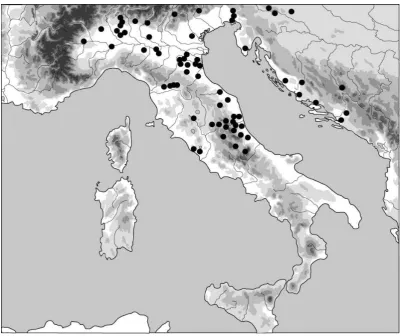
The areas where the Gothic army was settled have sometimes been suggested from the archaeological record.79 Zones of Gothic settlement have been extrapolated from the distribution of particular types of metalwork, usually from inhumations containing such objects (figure 1). Such a straightforward interpretation cannot stand. The origins of most of the material in question (largely feminine) does not necessarily authorise its designation as Ostrogothic .80 Furthermore, archaeological material does not have an ethnic identity, so, even if such material demonstrably came from the trans-Danubian Gothic homelands, one would not know whether someone interred with these objects was a Goth who had accompanied Theoderic to Italy, or was descended from one such. Perhaps most importantly, the material is found in very small quantities. If the costume associated with these objects was Gothic, clearly not all Goths were buried in this fashion. The rite cannot therefore simply reflect Gothic settlement. Why were some people buried like this when the vast majority were not?
The context of such isolated finds is, consequently, crucial. Most items were deliberately and publicly deposited with the dead. Although, as figure 1 shows, about fifty sites in Italy and Dalmatia contain such burials, there are usually only one or two such graves on each site. Some are from urban cemeteries, notably at major centres like Rome, Ravenna, Aquileia and Milan and frequently associated with churches.
If these artefacts were associated with Gothic holders of political and military power, their display in the burial ritual must be significant. Pre-Ostrogothic weapon-burials and other furnished inhumations exist, especially in peripheral areas of Italy, , so the custom of displaying a dead
perso . Nonetheless, earlier troops do not generally seem
to have manifested their ethnicity like this. That the Goths did so must therefore somehow illustrate the impact of imperial collapse and Gothic conquest upon Italian social relationships. Furnished inhumation was a public display.81 In the suburban church burials with possible Gothic connotations, its audience was possibly made up of the politically powerful. In rural contexts, as perhaps (if the find does not represent a hoard) with the lavish female burial at Domagnano (San Marino),82 that audience might have comprised local landowners and lesser people.
That women as well as (if not more often than) men were buried like this argues that the deaths of all members of certain kindreds could be marked by such displays. It also suggests a particular gendering of power. The families employing the ritual demonstrated the basis of their pre-eminence: their association with the Gothic holders of political and military power. This could be linked with competition for royal patronage within local communities and among the political élite. We must also, however, surely conclude that people adopting this costume in public ritual were not necessarily (possibly they were unlikely to have been) Danubian incomers. Nonetheless, these fairly limited number shows that, while the death of a family member produced stress, the
79
E.g. Moorhead, Theoderic, pp. 68-69.
80
von Rummel, Habitus Barbarus, pp. 323-37.
81
Halsall, Cemeteries and Society, passim.
82
16
threat posed to local standing was not critical. These displays nevertheless illustrate the tensions involved in establishing local power-structures. The distribution thus most likely reveals the areas where such stress and competition were most common. It is highly likely that these included
areas where Gothic newcomers were settled, but need have absolutely no
relationship to that of Gothic settlements overall. The evidence, almost invariably discovered long ago in obscure and even dubious circumstances, is of such poor quality that more detailed social and chronological analyses are impossible.Nonetheless, in however attenuated a form, these data show that the political and military power associated with the Goths reached down to local societies and their power-struggles. That the objects which seemingly manifested a connection with Theoderic government were feminine as often as masculine further supports the suggestion that, however they were salaried, Gothic soldiers and their families became, over time, a fixed component of such communities and their politics.
The archaeological record permits few statements about the equipment of Theoderic . Weapons are rare in the find complexes just discussed, not least because so many of them are female burials. Those which are known are unremarkable: lance-heads. Lavish items of horse-harness confirm the written sources that cavalry were a key element of the Gothic army. Several fortifications were occupied in the Ostrogothic period. Invillino (Friuli) is one of the best known and most thoroughly excavated. Although no phase was directly related to the Ostrogothic period, its Period III encompassed that era.83
Theoderic Ostrogothic army was clearly highly organised and efficient. Its Gallic, Spanish and Balkan campaigns were well-organised, well-led and usually victorious. Success breeds success, of course. Warriors continued to join Theoderic and the repeated experience of victory made Gothic troops battle-hardened and confident.
C: The Gothic Wars
Accounts of the cataclysmic downfall T in the Gothic Wars provide much detailed, if problematic, data on the Gothic army in action but we cannot use P to shed light upon the nature of the Goths who entered Italy in 489. Numerous dynamics were at work that made the armed forces of the 530s to 550s quite different from those of the 480s and 490s.
The Goths , P , owe their nature to the working through of
those processes.
P demands care. Although filled with the sort of detail beloved by military historians and generally absent in early medieval western Europe84 it cannot be taken as straightforward description, even if Procopius witnessed some events himself. The Wars are enmeshed in very traditional classical ethnographic stereotyping and Procopius wrote in learned Attic Greek, striving to liken his account to the great examples of the historical genre: Thucydides and Polybius.85 Hence the appearance of doryphoroi and hypaspistai in Roman and Gothic armies.86
83
Bierbrauer, Invillino-Ibligo.
84
Halsall, Warfare and Society, pp. 1-6, 177-80.
85
17
P at least initially was heavily imbued with Justinianic ideology about the rightness of the reconquest. His accounts of the Gothic forces, especially in the set-pieces of the siege of Rome, must therefore be handled with caution. Procopius mocked those barbarians who wanted to be Romans. Thus the tragicomic accounts of incompetently-deployed Gothic siege towers and Gothic generals who fail to note the allegedly decisive military difference between the two armies, which Belisarius spotted early in the campaign: that the Romans have mounted archers and the Goths do not.87 Some descriptions are surely hyperbolic. P Gothic oplitoi
must surely be heavily ironic.88 Although an apt description of an armoured close-fighting spearman protected by a large round shield, the the Attic hoplite, civilised citizen-soldier par excellence and its incongruity when applied to warriors besieging Rome would not have been lost on Procopius . Procopius less critical attitude towards Totila may stem as much from Totila correctly performing the role of warlord allotted to him by Graeco-Roman ethnography unlike the comic philosopher-king Theodahad or Wittigis, bumbling would-be poliorcetes as from any disillusionment with Justinianic policy.89
Close scrutiny suggests that the two sides were very alike. The possible distinction between older and younger warriors, the former acting as officers for the latter, especially within bodyguard units, has been mentioned. Warriors on both sides shared the ability to fight mounted or on foot according to the situation. This fluidity, rather than a formal division into units of infantry and cavalry, is characteristic of the early medieval west.90 That the Gothic army, as Cassiodorus makes clear, was a well-organised, more or less regular army on the Roman model, rather than the horde often envisaged in Byzantine accounts or uncritical modern studies based on the latter,91 also brought the two sides closer together. Indeed, given the predominance of troops recruited from beyond the frontier in the East Roman army, the Gothic army may have been considerably more Roman than the forces opposing them. This irony seems to be heavily played
P . The similarities between the armies certainly facilitated (as in
Theoderic . Soldiers in the opposing forces
could be barely distinguishable from each other.92
The G dismal showing in the earliest phase of the war probably attests to the previous decade of political stresses and a lack of active campaigning. Most of the experienced Gothic troops were located outside Italy, in the Balkans (where they scored some important early successes
86
These are terms which appear in the accounts of classical Greek hoplite warfare and, in the case of the hypaspistai P A M
87
Procopius, Wars, 5.18.42, resolved at Wars, 5,27.25-8.
88H F pp. 111-2.
89H F
pp. 112-3
90
Halsall, Warfare and Society, pp. 180-8.
91
E.g. Thompson
18
against the invading Romans), in Provence and in Spain, where they were probably involved in sometimes successful campaigning against the Franks.93 Their opponents, by contrast, were battle-hardened and confident veterans, used to victory under Belisarius (even if frequently more by luck than judgement). The dynamics of the earlier Theoderician period were reversed. They would turn back again when T forces experienced a long and unbroken run of success.
The Gothic warrior was characteristically equipped with horse, sword and shield, as written and archaeological evidence from Theoderic . Some used bows, at least when dismounted, and spears were thrown from a distance as well as used in hand-to-hand fighting.
T P
believed) made sound sense in the context of the battle of Busta Gallorum. A rapid charge directly into close-combat would avoid the fatal temptation to exchange missiles with the Romans, who had the advantage of numbers, especially in archers.94
The effects on the Italian peninsula are well-known.95 Any dynamics that might have led to ethnic changes like those in Gaul and Spain (and embryonically attested in Theoderic ) were surely arrested. Sharper boundaries emerged between Goths and Romans, although almost certainly more on the basis of political allegiance than biological descent. Most of the rank and file of the 520s will have been born and grown up in Italy, making them significantly different from warriors born and raised within the peripatetic Ostrogothic army in the post-Hunnic Balkans. Only a handful of
those mustered in Theoderic patres domestici, will have had any
clear memory of life outside the seemingly stable confines of Romano-Gothic Italy. It would be yet
more mistaken to see the soldiers facing B confronted Narses,
as shaped by anything other than late antique Italian, Provençal or Dalmatian culture. Marriage further blurred familial and genealogical distinctions. The processes discussed earlier had already led to Italo-Romans joining the army and perhaps adding a Gothic dimension to their own hierarchy of identities. The Goths had always incorporated other groups, sometimes retaining an ethnic label,96 sometimes not. Byzantine deserters joined them during the wars, doubtless also adding a Gothic identity. Those who returned to the East Romans surely abandoned it again. None of this implies incomplete assimilation 97 or solid boundaries between Goths and others. We do not know
whether Roman J were the same men as had deserted
earlier. A Roman deserting to the Goths became, in some ways, a Goth, although the
93
Gregory of Tours, Histories G V T
T “ V T
94
Eighteenth- and nineteenth-century commanders similarly ordered troops to attack with unloaded muskets
95
Brown, Gentlemen and Officers, pp. 1-60, is classic.
96 Like the Gepids of Variae 5.10-11. Late imperial units frequently bore ethnic titles. Many of these troops
doubtless had Gepidic origins but one ought not to assume that they than late imperial regiments of Franci, Alamanni or Parthi, similarly redeployed with their wives, children and camp followers.
97
19
Italian and frequently indeed non-imperial origin continued to mark them out. Given the Italian upbringing of most Goths, it was easier for a Goth deserting to Narses to become Roman.
The dynamics stressed throughout this chapter permit a more subtle reading of the G ultimate downfall than that recently championed.98 The final demise has been claimed to reveal that the Goths were a people with a defined identity founded in a large class of freemen with a direct link to the king. The decisive results of the defeat of a portion of the Gothic army, and the threat to wives and children posed by Eastern Roman military operations has been presented as sufficient proof of this contention. This conclusion, however, does not emerge naturally from the evidence. The revival of the discredited Germanist notion of a class of Königsfreie need not detain us.99 The Gothic armies stratification and inclusion of more numerous rank and file than leaders is hardly surprising; nor is the idea that the latter had a political role.100 Gothic military communities were embedded within peninsular society and politics. The edges of these communities doubtless hardened during the wars and it is unsurprising that the families of serving Goths should have been more at risk than in the peaceful conditions of Theoderic . It might have been safer to take them on campaign than to leave them behind, giving some Gothic forces a character resembling those of 489. The consequences of the Gothic forces serious defeats similarly have no necessary bearing on the nature of the Italian Goths. The destruction of its field army at Adrianople (378) had rendered the Eastern Empire with far greater military manpower reserves than the Italian kingdom
effectively incapable of offensive military action for perhaps a decade. The
slaughter at the Frigidus was decisive ; the West never had a sufficient breathing space to rebuild a substantial force of the same standard.101 Troops can be replaced in numbers but not necessarily in quality and Procopius makes clear that limited manpower was a worry for both sides, dictating Gothic strategy in the 540s and 50s. The men accompanying Totila in his desperate charge at Busta Gallorum or who died with Teïas in the cataclysmic battle of Mons Lactarius were doubtless the
G best warriors. Others still died in the disastrous naval defeat of Sena Gallica in the Adriatic.102 That these defeats effectively ended Gothic resistance is considerably less surprising than the fact that it took three bloody engagements to do so and that some Gothic garrisons continued to hold out even then.
The Goths subsequent disappearance from history103 is easily encompassed within the dynamics discussed throughout this chapter, albeit in reverse. Although primarily military in composition and function, the Goths had been more than simply an army when they invaded Italy. By the time of
T T , sixty-odd years later, they had unsurprisingly changed in many ways.
98 Heather, The Goths, pp. 321-6. 99“
A reconsideration
100
It is, again, politically revealing to represent the suggestion that the Gothic rank and file did not blithely as a surprising and defining feature of Gothic society.
101
Halsall, Barbarian Migrations, pp. 199-200, 243.
102
Procopius, Wars 8.29-32 (Busta Gallorum); 8.35 (Mons Lactarius); 8.23 (naval defeat).
103
20
Their primarily military character had, however, endured throughout. A kingdom created by the sword had perished by it.
21
Primary Works
Anonymous Valesianus: Ammianus Marcellinus, vol. 3, ed. & trans. Rolfe, J.C., London, 1939, pp.506-69.
Burgundian Code:The Burgundian Code, trans. Drew, K.F., Philadelphia, 1972.
Cassiodorus, Chronicle:MGH Auctores Antiquissimi vol.11, Chronica Minora saec. IV. V. VI. VII, vol.2, ed. Mommsen, T., Berlin, 1894, pp.109-61.
Cassiodorus, Variae
:
MGH Auctores Antiquissimi vol.12, Cassiodori Senatoris Variae, ed. Mommsen, T., Berlin, 1894;(selection) Cassiodorus: Variae trans. Barnish, S.J.B, Liverpool, 1992; (summaries with some translations) The Letters of Cassiodorus: Being a Condensed Translation of the Variae Epistolae of Magnus Aurelius Cassiodorus Senator, trans. Hodgkin, T., London, 1886. Codex Theodosianus (CTh): The Theodosian Code and Novels and the Sirmondian Constitutions, trans. Pharr, C., Princeton, NJ, 1952.
Consularia Italica : MGH Auctores Antiquissimi vol.9, Chronica Minora saec. IV. V. VI. VII, vol.1, ed. Mommsen, T., Berlin, 1892, pp.249-339.
Edictum Theoderici (ET): MGH Legum Vol.5, ed. Bluhme, F., Hannover, 1875-89, pp.145-79; Lafferty, S.D.W., Law and Society in the Age of Theoderic the Great: A Study of the Edictum Theoderici, Cambridge, 2013, pp.243-94.
Ennodius, Life of Epiphanius: MGH Auctores Antiquissimi vol.7, Ennodi Opera, ed. Vogel, F., Berlin, 1885, pp.84-109; The Life of Saint Epiphanius by Ennodius. A Translation with an Introduction and Commentary, trans. Cook, G.M., Washington DC, 1942.
Ennodius, Epistulae: MGH Auctores Antiquissimi vol.7, Ennodi Opera, ed. Vogel, F., Berlin, 1885.
Gregory of Tours, Histories: MGH Scriptores Rerum Merovingicarum 1/1 ed. B. Krusch & W. Levison, Hannover, 1951. Gregory of Tours: The History of the Franks, trans. L. Thorpe, Harmondsworth, 1974.
Malchus: The Fragmentary Classicizing Historians of the Later Roman Empire, ed. & trans. Blockley, R.C., Liverpool, 1981, vol.2, pp.401-462.
Priscus: The Fragmentary Classicizing Historians of the Later Roman Empire, ed. & trans. Blockley, R.C., Liverpool, 1981, vol.2, pp.221-400.
Procopius, Secret History: Procopius, ed. & trans. Dewing, H.B., vol.6, London, Procopius, Wars: Procopius, ed. & trans. Dewing, H.B., vols.1-5, London, 1914-28.
Secondary Literature
Amory, P., People and Identity in Ostrogothic Italy, 489-554. Cambridge, 1997.
Arnold, J.J., T Journal of Late Antiquity 6.1 (2013) : 152-83
Bierbrauer, V., Invillino-Ibligo in Friaul. Die römischer Siedlung und das spätantik-frühmittelalterlische Castrum. Munich, 1987.
Bierbrauer, V., Archeologia degli Ostrogoti in Italia , in I Goti, ed. Bierbrauer, V., von Hessen, O., & Arslan, E.A., Milan, 1994, pp.170-213.
Brown, T.S., Gentlemen and Officers: Imperial Administration and Aristocratic Power in Byzantine Italy, A.D. 554-800, Rome, 1984.
22
Cesa, M., Il regno di Odoacre: la prima dominazione germanica in Italia , in Germani in Italia, ed. Scardigli, B., & Scardigli, P., Rome, 1994, pp.307-20.
Fehr, H., & von Rummel, P., Die Völkerwanderung. Stuttgart, 2011.
García Gallo, A., Notas sobre el reparto de terras entre Visigodas y Romanos. Hispania 1 (1940-41) : 40-63.
Goffart, W., Barbarians and Romans AD 418-585: The Techniques of Accommodation. Princeton, 1980.
Goffart, W., Barbarian Tides: The Migration Age and the Later Roman Empire. Philadelphia, 2006.
Goffart, W., Administrative Methods of Barbarian Settlement in the Fifth Century: The Definitive Account. Gallien in Spätantike und Frühmittelalter Kulturgeschichte einer Region, ed. S. Diefenbach & G. M. Müller (Millennium Studien zu Kultur und Geschichte des ersten Jahrtausends n. Chr. Vol.43), Berlin, 2013, pp.45-56.
Halsall, G. Funny foreigners: Laughing with the barbarians in late antiquity , in Humour, History and Politics in Late Antiquity and the Early Middle Ages, ed. Halsall, G., Cambridge 2002, pp.89-113.
Halsall, G., Warfare and Society in the Barbarian West, 450-900. London, 2003. Halsall, G., Barbarian Migrations and the Roman West, 376-568. Cambridge, 2007.
Halsall, G., Cemeteries and Society in Merovingian Gaul. Selected Studies in History and Archaeology, 1992-2009 (Leiden, 2010).
Heather, P., Goths and Romans, 332-489. Oxford, 1991.
Heather, P., Theoderic, king of the Goths. Early Medieval Europe 4.2 (1995) : 145-73. Heather, P., The Goths. Oxford, 1996.
Heather, P., Gens and regnum among the Ostrogoths in Regna and Gentes: The Relationship between late Antique and Early Medieval Peoples and Kingdoms in the Transformation of the Roman World, ed. Goetz, H-W., Jarnut, J., & Pohl, W., Leiden, 2003, pp.85-133.
Heather, P., Merely an ideology? Gothic identity in Ostrogothic Italy , in The Ostrogoths, from the Migration Period to the Sixth Century, ed. Barnish, S.J., & Marazzi, F., (Woodbridge, 2007), pp.31-60.
Humphries, M., Italy, AD 425-605 , in Cambridge Ancient History vol.14, Empire and Successors, A.D.425-600, ed. A.M. Cameron, B. Ward-Perkins & M. Whitby, Cambridge, 2000, pp.525-51.
Jones, A.H.M., The Later Roman Empire, 284-602. Oxford, 1964.
Kaldellis, A., Procopius of Caesarea: tyranny, history and philosophy at the end of antiquity. Philadelphia, 2004.
Kulikowski, M., Nation versus army: a necessary contrast? in On Barbarian Identity: critical Approaches to Ethnicity in the Early Middle Ages, ed. A. Gillett, Turnhout, 2002, pp.69-84. Liebeschuetz, J.H.W.G., A G N in Fifth-Century Gaul: A Crisis of
Identity, ed. J.F. Drinkwater & H. Elton (ed.), Cambridge, 1992, pp.75-83.
Lot, F., D R B P H 7 (1928):
975-1011.