This is a repository copy of
The effect of grading the atomic number at resistive guide
element interface on magnetic collimation
.
White Rose Research Online URL for this paper:
http://eprints.whiterose.ac.uk/103720/
Version: Accepted Version
Article:
Alraddadi, R. A B, Robinson, A. P L, Woolsey, N. C. orcid.org/0000-0002-2444-9027 et al.
(1 more author) (2016) The effect of grading the atomic number at resistive guide element
interface on magnetic collimation. Physics of Plasmas. 072706. ISSN 1089-7674
https://doi.org/10.1063/1.4959037
[email protected] https://eprints.whiterose.ac.uk/ Reuse
Items deposited in White Rose Research Online are protected by copyright, with all rights reserved unless indicated otherwise. They may be downloaded and/or printed for private study, or other acts as permitted by national copyright laws. The publisher or other rights holders may allow further reproduction and re-use of the full text version. This is indicated by the licence information on the White Rose Research Online record for the item.
Takedown
If you consider content in White Rose Research Online to be in breach of UK law, please notify us by
The effect of grading the atomic number at resistive guide element interface on
magnetic collimation
R. A. B. Alraddadi,
1A. P. L. Robinson,
2N. C. Woolsey,
1and J. Pasley
1, 21)
York Plasma Institute, University of York, York YO10 5DD,
United Kingdom
2)
Central Laser Facility, STFC Rutherford-Appleton Laboratory, Didcot,
OX11 0QX, United Kingdom
Using 3 dimensional numerical simulations, this paper shows that grading the atomic
number and thus the resistivity at the interface between an embedded high atomic
number guide element and a lower atomic number substrate enhances the growth
of a resistive magnetic field. This can lead to a large integrated magnetic flux
den-sity, which is fundamental to confining higher energy fast electrons. This results in
significant improvements in both magnetic collimation and fast-electron-temperature
uniformity across the guiding. The graded interface target provides a method for
I.
INTRODUCTION
Plasma resistivity induces a significant magnetic field inside an overdense plasma when a
shear in the fast electron current density or resistivity gradient exists. This is described by
the induction equation in the hybrid approximation
1,
@ ~
B
@t
=
⌘
(
r ⇥
~j
f) + (
r
⌘
)
⇥
~j
f(1)
where
B
~
is the flux density of the magnetic field,
⌘
is the resistivity and
~j
fis the fast
electron current density. The first term on the right-hand side generates a magnetic field that
directs electrons towards regions of higher current density, and thus, acts to collimate the
fast electron beam. The second term, which forms the basis of resistive guiding concept
2,3,
generates a magnetic field at resistivity gradients which acts to keep the fast electrons within
regions of higher resistivity. The resistivity gradient is created by a transition between two
materials with different atomic number Z. This can be in the form of high-Z solid wire (the
guide) embedded in a lower-Z substrate
4. The resistivity gradient is in transverse direction
to that of the fast electron beam propagation. The fast electrons are generated within the
guide and the magnetic field at the interface between this guide and the substrate (of lower
Z material) will deflect the electrons and keep them inside the high-Z material.
The ability of a resistive guide to confine fast electrons depends on the ratio of the fast
electron Larmor radius to the generated azimuthal magnetic field width
L
φ. The confinement
condition of the fast electrons along the guide is expressed as
2,5,
B
φL
φ≥
P
fe
(1
−
cos
✓
d)
(2)
where
B
φis the azimuthal magnetic flux density,
P
f=
γ
fv
fm
eis the fast electron
momen-tum,
γ
fis the Lorentz factor,
v
fis the fast electron velocity and
✓
dis the fast electron
divergence angle. This implies that the product of
B
φL
φneeds to be larger than the fast
electron momentum to reflect the fast electrons back towards the guide axis
2,4. For fast
electrons entering the guide at an angle of
✓
d= 30
◦with energy of 1.8 MeV, a
B
φL
φof
10
−3Tm is needed for confinment. The product of
B
φ
L
φneeds to be larger than this when
either the entrance angle or the fast electron energy increases. For example,
B
φL
φhas to be
about
⇡
7
⇥
10
−3Tm for 4.5 MeV fast electrons with angle of
✓
The resistive guide has been suggested for applications such as the Fast Ignition approach
to the inertial confinement fusion scheme
6,7where the energetic fast electrons need to be
guided through an overdense stand-off distance of 100
µ
m or more
8and deposited into the
compressed core of DT plasma. It has been suggested that a resistive guide element can
also be used as a driver in hydrodynamic experiments
4,9since strong heating occurs where
the fast electron beam is collimated. Robinson
et al.
4have investigated analytically and
numerically the most significant parameters that affect the heating of the resistive guide
element. They find for example, the ratio of the guide radius to the laser spot radius needs
to be comparable in order to obtain good heating. In a real laser system, this condition
is difficult to achieve due to the limitation of the laser pointing stability. If the laser hits
the edge of the resistive guide element rather than its centre, the guide will not achieve
its aim as a collimator and the fast electrons will couple into the substrate. Therefore,
a larger radius guide is needed. However, numerical work
4,9shows that by using a larger
radius guide magnetic fields develop within the guide close to its axis degrading heating
uniformity. These “ interior ” magnetic fields are due to inhomogeneous propagation of the
fast electrons
10. They produce annular transport pattern which leads to preferential heating
of the outer regions of the guide.
Hitherto, the resistive guide in all previous experimental
11,12and numerical
4,9studies has an
engineered step-like atomic number interface between the guide and the substrate regardless
of the guide geometry. We will refer to this configuration as “step-like” resistive guide
configuration. Since the resistive magnetic field is produced at the guide-substrate interface,
changing the interface resistivity away from a step-like interface offers a means to improve
electron guiding and enable heating of a larger radius guide. We find that grading the
atomic number across a layer at the guide-substrate interface (so that the atomic number,
and thus the resistivity, decreases with increasing radius) enhances the growth of resistive
magnetic field. This cladding layer can lead to a larger integrated magnetic flux density,
which improves the magnetic collimation of the fast electrons. Furthermore, as a result
of this, simulations show an improvement in radial heating uniformity in the larger radius
guide.
This paper is structured as follows; Sec. II contains a description of the different
resis-tive guide designs. Sec. III outlines the simulation set up and the simulation results and
II.
GRADING THE ATOMIC NUMBER AT THE INTERFACE OF THE
GUIDE ELEMENT
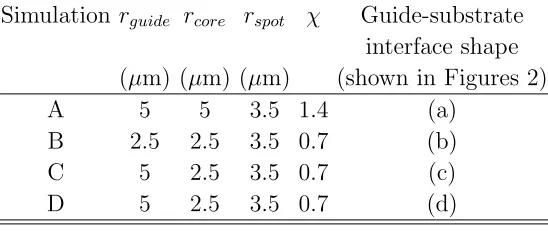
To highlight the impact of a graded-interface, four simulations are reported. Two use a
step-like interface (simulation A and B in Table 1) and two use shaped or graded interface
(C and D in Table 1). The aim of these simulations is to compare the resulting magnetic
collimation and radial temperature profiles in the guides. The guide is a cylindrical wire in
all simulations as summarised in Table 1.
r
guideis the total radius of the embedded guide
while
r
coreis the radius of the core of the guide. The core has not been graded.
χ
is the ratio
of the radius of the core
r
coreto the laser radius spot
r
spot. It was found that for
graded-interface targets that this ratio needs to be less than 1. When
χ >
1 the fast electron beam
breaks into filaments inside the guide resulting in non-uniform radial heating of the guide.
Simulation
r
guider
corer
spotχ
Guide-substrate
interface shape
(
µ
m) (
µ
m) (
µ
m)
(shown in Figures 2)
A
5
5
3.5 1.4
(a)
B
2.5
2.5
3.5 0.7
(b)
C
5
2.5
3.5 0.7
(c)
[image:5.612.168.442.329.448.2]D
5
2.5
3.5 0.7
(d)
Table I: Table of guide geometric parameters
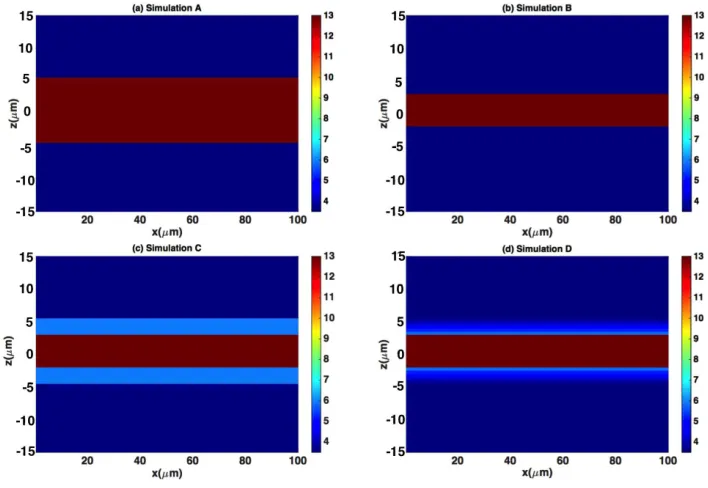
Figures 1 (a)-(d) show 2-dimension z-x plane slices of the target Z profile for targets A to
D. These figures are taken in the mid
y
-direction at
−
15
< z <
15 along the
x
-direction.
The materials used in simulations A and B are solid density (2
.
7 gcm
−3) aluminium guide
(Z = 13) embedded into a solid (1
.
0 gcm
−3) CH plastic (Z = 3.5) substrate. The difference
between simulations A and B is the guide radius, which is 5
µ
m and 2
.
5
µ
m respectively.
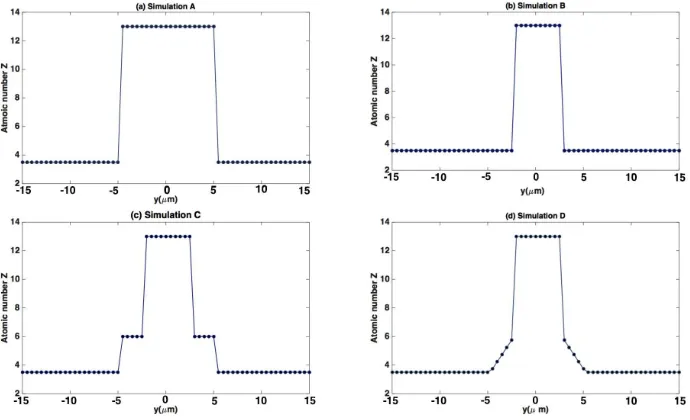
The resistive guide design in simulation C (Figure 1(c)) is an Al guide clad in a carbon
(density 2
.
2 gcm
−3) layer. This resembles a co-axial cable design. We refer to this design as
“co-axial ” resistive guide and the overall radius of this co-axial guide is 5
µ
m. Simulation D,
Figure 1(d), uses an Al guide of radius 2
.
5
µ
m clad in a graded layer of material of linearly
decreasing Z from Z= 6 to Z = 3.5 between radial positions of 2
.
5
µ
m and 5
µ
m. The overall
radius of the guide (with cladding) is 5
µ
m. This is embedded in a CH plastic substrate.
Figure 1: Figures (a)-(d) show the target Z profile for simulations A to D respectively. Simulations A and B use a step-like interface and the difference between the two is only in the guide radius. Simulation C use a shaped interface resembling a co-axial cable design. Simulation
D uses the graded interface resistivity cladding guide.
injected into the guide from the left hand side at
x
= 0 and the centre of
y
and
z
.
III.
SIMULATION SET UP
The simulations were performed using the 3 dimensional particle hybrid code ZEPHYORS
4,13which is based on the hybrid method developed by Davies in a series of publications
13,14.
ZEPHYORS is used to simulate the 3D relativistic motion of electrons under the influence
of self-generated resistive electric and magnetic fields, as well as collisions. The fast electron
current
~j
fpropagate into the plasma when it is spatially coincident and nearly-balanced with
cold return electron current
~j
rthat is drawn from the background
15, i.e.
~j
f⇡ −
~j
r. The
resistive electric field is estimated from Ohm’s law,
E
=
−
⌘~j
f, with displacement current
dropped from Amp‘ere’s law. Ignoring displacement current relies on the assumption that
the change in the electric field with time is slow. This is valid since the width of the beam, i.e.
the fast electron bunch radius, is much smaller than the length of the fast electron bunch.
Figure 2: Figures (a)-(d) show the radial atomic number profile for simulations A to D respectively. Simulations A and B use Aluminium guide. Simulation C uses an Al guide clad in a
carbon layer. Simulation D uses an Al guide clad in a graded layer of material of linearly decreasing Z. All the guides are embedded into the CH plastic substrate.
reason for this is the contribution of the electric field from this term is small by about two
orders of magnitude compared to the electric field that obtained from resistive term. Thus,
from Faraday’s law the resulting resistive magnetic field arising due to the fast electrons
can be written as (1). The return electron current heats the background plasma, via Ohmic
heating, with power density
~j
r.E
⇡
⌘j
f2. The background electrons are treated as a static
fluid that experience heating, ionisation and change in resistivity. The static treatment of
the background is reasonable as the hydrodynamic displacement is about 0
.
1
µ
m in 1 ps
for targets heated to 100 eV, assuming that the sound speed is 10
5m
/
s. Thomas-Fermi
model is used to obtain the ionisation and specific heat capacity of the background. The
resistivity is temperature dependent and based on that of Lee and More resistivity model
16.
The temperature is calculated by the energy deposition due to the slowing down of the fast
electrons and the Ohmic heating induced by the return electron current. The fast electron
population is described kinetically using the Vlasov equation, which is solved via the PIC
method. Collisions are included using the Fokker-Planck collisional operators, which account
generated by the background electrons. The mathematical expressions of the collisional
operators are obtained from Davies
13equations (1) and (2). More details about the physics
of hybrid code can be found in Robinson
et al
8.
A 200
⇥
100
⇥
100 grid was used with a 0
.
5
µ
m cell size in each direction. The number
of macroparticles injected into each of the cells was 126. This helped to reduce statistical
noise. The target, as described above, consisted of a CH plastic substrate within which a
guide of radius
r
guidewas embedded. This guide is co-linear along the
x
-axis and centred
on
y
and
z
as shown in Figures 1. The laser irradiation intensity was 1
.
27
⇥
10
20Wcm
−2with a pulse duration of 2 ps and the laser wavelength of 1
µ
m. It is assumed that 30% of
the laser energy was coupled to the fast electrons. The temporal profile of the fast electron
beam is top-hat shaped and the transverse profile is
/
exp[
−
2rr22spot
], where
r
spot= 3
.
5
µ
m.
The choice of
r
spot= 3
.
5
µ
m was to ensure the electron beam source is within the resistive
guide of 5
µ
m. It worth mentioning that these choice of small sizes of both
r
spotand
r
guidewere to minimise the simulation time. The fast electron angular distribution is uniform over
a solid angle and defined by the half-angle of divergence 50
◦. The energy distribution of the
fast electrons is from the reduced Wilks’ ponderomotive scaling
17, giving
T
f
= 2
.
7 MeV
18.
The resistivity uses the Lee and More model and a minimum mean free path as 5
r
s, where
r
sis interatomic spacing. From Table I, it can be seen that simulations A, C and D have
total
r
guide> r
spotensuring that the electron beam source is within the guide. This is not
the case in simulation B where
r
guide< r
spot. However,
r
corein simulation B is identical to
simulations C and D.
IV.
RESULTS
A.
The effect of design on the azimuthal magnetic field rate
Figures 3 (a)-(d) show an
x
-
z
slice taken at the mid-plane of
y
of the generated magnetic
field at 2
.
2 ps for simulations A to D. Generally, an azimuthal magnetic field has been
generated at the interface between the guide and the CH plastic substrate. This field provides
collimation for the fast electrons. Radial expansion of the fast electron beam is evident
from the formation of the magnetic field in the CH plastic substrate outside the guide. In
close to the axis and are most noticeable occurring between
x
= 20
µ
m and
x
= 40
µ
m.
Here the
r
guide> r
spotand
χ
is larger than 1. This “interior” magnetic field is due to the
inhomogeneous propagation of the fast electrons
10. The generation of these fields within the
guide is undesirable and inhibits radially uniform fast electron heating.
Magnetic fields interior to the guide are not observed in simulations B, C and D where
χ <
1
although
r
guide> r
spotin simulations C and D. This implies that more uniformity of the
fast electron propagation is obtained in these guides. In simulation C, the co-axial resistive
guide, two azimuthal magnetic fields are observed, the first is between the guide and the CH
plastic substrate at radial positions of 5
µ
m and the second is between the carbon cladding
and the aluminium core, i.e. at radial position of 2
.
5
µ
m. Because of this, the fast electrons
are confined at three individual positions, between
−
5
µ
m and
−
2
.
5
µ
m,
−
2
.
5
µ
m and
+2
.
5
µ
m and +2
.
5
µ
m and +5
µ
m as shown in Figure 3(c). The azimuthal magnetic fields
in simulations B and D shown in Figures 3 (b) and (d) respectively are similar although
the total guide radius in simulation D is twice that in simulation B. In simulation D, the
azimuthal magnetic field is generated along the graded region of the guide and located along
the interface with the core of the guide. The observation that the magnetic flux density in
simulation D is higher than that in simulation B, which has a step-like interface, by 10
3T is notable and important. Simulation D also indicates that changing the interface shape
does not significantly affect the width of the magnetic field.
Figure 4 shows the resulting product
B
φL
φas a function of time which is extracted at
x
= 10
µ
m, and in the
y
mid-plane for all the simulations. The product
B
φL
φis calculated
from the peak of the magnetic field and the FWHM. Simulation D has the largest product
B
φL
φof all simulations and indicates that this guide can confine higher energy electrons. A
high value of
B
φL
φ(10
−3Tm at 200 fs in simulation D) is important to collimation of the fast
electron beam and subsequent heating of the guide. Simulation B achieves a similar
B
φL
φby 300 fs however, since
r
guide< r
spotmore fast electrons escape the guide and move into
the CH plastic substrate. This reduces the
B
φL
φproduct further limiting the fast electron
confinement. The
B
φL
φproduct in simulation C is inferior to that in simulation A as the fast
electrons are confined in multiple regions of the guide as shown in Figure 3(c). Nevertheless,
we find (see in Sec. IV B) that the radial heating within the guide in simulation C is more
uniform than in simulation A. This is because electron beam filamentation is suppressed
Figure 3: x-z slice of the magnetic field (T) in the y midplane at 2.2 ps for simulations A to D.
Time (fs)
0 500 1000 1500 2000
B? L?
(T
m
)
#10-3
0 0.5 1 1.5 2 2.5 3 3.5 4 4.5
Simulation A Simulation B Simulation C Simulation D
Figure 4: The product ofBφLφ near the head of the beam x= 10µm at different times in fs.
guide using a graded interface increases the magnetic flux density and produces a significantly
larger
B
φL
φproduct. This enhances electron confinement.
B.
The effect of design on the guide heating
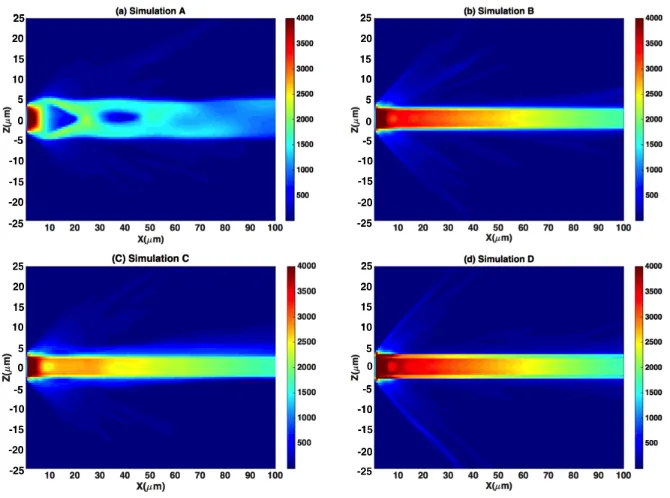
Figure 5 shows an
x
-
z
slice of the background temperature in eV taken in the mid
y
-plane
[image:10.612.190.421.403.553.2]where the fast electrons are collimated. There is a gradient in temperature with depth along
the guide (
x
-direction) which is observed in all simulations. However, this gradient differs
in each simulation due to electron confinement which results from the differences in the
generated azimuthal magnetic field. Non-uniform radial heating is observed in simulation A
with striking annular temperature profiles at
x
= 20
µ
m and
x
= 40
µ
m. This corresponds
to the location of the interior magnetic field previously noted (see Figure 3(a)). More
uniform heating is obtained in simulation B, this is due to the small radius of the guide and
similar results are noted by Robinson
et al
.
4. The heating in simulation B is comparable
to simulation D which has twice the guide radius. This result is important and identifies a
possible method for designing targets that are tolerant of laser pointing stability. The key is
to increase the guide radius using a graded resistivity cladding. The laser pointing stability
in this design will be subject of future work as we will closely examine this in more detail.
The resulting guide has good radial temperature uniformity and relatively unstructured
decrease in temperature along the depth. The resistivity grading between the guide core
and plastic substrate with
χ <
1 ensures that the fast electrons with diverging trajectories
are redirected towards the higher resistivity regions. Temperatures in simulation C is lower
and more structured than in simulations B and D. This is expected based on the simulated
B
φL
φ. The temperature in simulation C is higher than in simulation A although the
B
φL
φproduct is lower. This results from the lack of internal magnetic field in co-axial target
design.
Cross-section from Figure 5 are shown in Figure 6. These are taken at 2.2 ps along the guide
depth at the centre of
y
and
z
axies. The effect of the internal magnetic field excluding fast
electrons and leading to poor heating at
x
= 20
µ
m and
x
= 40
µ
m in the centre of the guide
in simulation A is evident. An important comparison is between simulations B, C and D
where
χ <
1. There is oscillation in their temperature profiles within 15
µ
m of the surface.
This is due to inhomogeneity in the fast electron propagation near the injection region.
After this, a gradual reduction in the temperature occurs. The differences in temperature
between simulations B and D is due to the fact that that
r
guide> r
spotin simulation D while
r
guide< r
spotin simulation B.
It is worth mentioning that the fast electrons heat the resistive guide structure to high
tem-peratures in few picoseconds. As discussed in Sec. III, the hydrodynamic motion becomes
Figure 5: x-z slice of the background temperature (eV) in the y midplane at 2.2 ps for simulations A to D.
x(7m)
10 20 30 40 50 60 70 80 90 100
T
(e
V)
0 500 1000 1500 2000 2500 3000 3500 4000
Simulation A Simulation B Simulation C Simulation D
Figure 6: Line-out of the background temperature in eV at 2.2 ps in simulations A to D along
x-direction at the centre of y andz.
It is expected that a strong hydrodynamic expansion of the guide and the thermal electron
transport into the surrounding material will have significant role on the multi-piecosecond
timescale. In addition, depending on the choice of different parameters the strong heating of
the resistive guide may potentially lead to the generation of strong shocks into the
surround-ing material
4. Our simulations only capture the dominant physics in the regime of interest
[image:12.612.190.422.398.552.2]hydrodynamic motion occurs or thermal transport.
V.
DISCUSSION AND CONCLUSION
In this paper, we have investigated the effect of changing resistivity (by changing Z) in
cladding layer around the core of a fast electron guide. We find that a cladding layer leads
to superior guiding of electrons than in structures with a step-like change in resistivity. We
find a linear gradation in Z enhances the growth of resistive magnetic field, leading to
im-provement in the magnetic collimation. The product
B
φL
φbecomes significantly larger with
a graded-interface compared to step-like and co-axial resistive guides. The graded-interface
configuration is beneficial for four reasons; it helps to collimate the fast electrons uniformly
in the core of the guide. Secondly, a larger guide radius is possible using graded interface.
This is more tolerant to the laser pointing stability. Thirdly, an increases in the
B
φL
φproduct early in the electron injection into the guide promotes fast electron confinement.
Fourthly, it helps reduce interior magnetic fields. The condition for best performance of the
graded interface resistivity cladding is when the ratio between the core of the guide and the
laser spot radius is less than 1.
The fabrication of the graded interface resistivity cladding guides is possible using the
al-loys. Our simulations suggest that improved heating uniformity afforded by a fast electron
guide with a graded resistivity cladding is of considerable benefit. Although the fabrication
processes are not easy task compared to the step-like resistive guide,the gains obtained from
this type of design mean that the fabrication development effort will be worthwhile. The
development in micro-scale target fabrication indicates that target fabricators will soon be
able to manufacture such targets.
VI.
ACKNOWLEDGMENTS
The authors are grateful for the use of computing resources provided by STFC’s Scientific
Computing Department. RABA would also like to thank the King Saud University, Saudi
Arabia for PhD funding. APLR is grateful for support from the ERC via STRUCMAGFAST
REFERENCES
1
A. Bell, J. Davies, and S. Guerin, Phys. Rev. E
58
, 2471 (1998).
2
A. Robinson and M. Sherlock, Phys. Plasmas
14
, 083105 (2007).
3
A. Robinson, H. Schmitz, J. Green, C. Ridgers, and N. Booth, Plasma Phys. Control.
Fusion
57
, 064004 (2015).
4
A. Robinson, H. Schmitz, and J. Pasley, Phys. Plasmas
20
, 122701 (2013).
5
A. Robinson, M. Sherlock, and P. Norreys, Phys. Rev. Lett.
100
, 025002 (2008).
6
M. Tabak, J. Hammer, M. E. Glinsky, W. L. Kruer, S. C. Wilks, J. Woodworth, E. M.
Campbell, M. D. Perry, and R. J. Mason, Phys. Plasmas
1
, 1626 (1994).
7
M. Tabak, D. Clark, S. Hatchett, M. Key, B. Lasinski, R. Snavely, S. Wilks, R. Town,
R. Stephens, E. Campbell, et al., Phys. Plasmas
12
, 057305 (2005).
8
A. Robinson, D. Strozzi, J. Davies, L. Gremillet, J. Honrubia, T. Johzaki, R. Kingham,
M. Sherlock, and A. Solodov, Nuclear Fusion
54
, 054003 (2014).
9
A. Robinson, H. Schmitz, J. Green, C. Ridgers, N. Booth, and J. Pasley, Phys. Plasmas
22
, 043118 (2015).
10
A. Robinson and H. Schmitz, Phys. Plasmas
20
, 062704 (2013).
11
S. Kar, A. Robinson, D. Carroll, O. Lundh, K. Markey, P. McKenna, P. Norreys, and
M. Zepf, Phys. Rev. Lett.
102
, 055001 (2009).
12
B. Ramakrishna, S. Kar, A. Robinson, D. Adams, K. Markey, M. Quinn, X. Yuan,
P. McKenna, K. Lancaster, J. Green, et al., Phys. Rev. Lett.
105
, 135001 (2010).
13
J. R. Davies, Phys. Rev. E
65
, 026407 (2002).
14
J. Davies, A. Bell, M. Haines, and S. Guerin, Physical Review E
56
, 7193 (1997).
15
A. R. Bell, J. R. Davies, S. Guerin, and H. Ruhl, Plasma Phys.Control. Fusion
39
, 653
(1997).
16
Y. Lee and R. More, Phys. Fluids
27
, 1273 (1984).
17