Open Access
Research article
The implementation of quality management systems in hospitals: a
comparison between three countries
C Wagner*
1, L Gulácsi
2, E Takacs
3and M Outinen
4Address: 1Nivel, Netherlands institute for Health Services Research, The Netherlands, 2Department of Public Policy and Management, Budapest
University of Economic Sciences and Public Administration, Hungary, 3National Health Insurance Fund Administration, Hungary and 4National
Research and Development Centre for Welfare and Health STAKES, Finland
Email: C Wagner* - [email protected]; L Gulácsi - [email protected]; E Takacs - [email protected]; M Outinen - [email protected]
* Corresponding author
Abstract
Background: Is the implementation of Quality Management (QM) in health care proceeding satisfactorily and can national health care policies influence the implementation process? Policymakers and researchers in a country need to know the answer to this question. Cross country comparisons can reveal whether sufficient progress is being made and how this can be stimulated.
The objective of the study was to investigate agreement and disparities in the implementation of QMS between The Netherlands, Hungary and Finland with respect to the evaluation model used and the national policy strategy of the three countries.
Methods: The study has a cross sectional design, based on measurements in 2000. Empirical data about QM-activities in hospitals were gathered by a self-administered questionnaire. The questionnaires were answered by the directors of the hospitals or the quality coordinators. The analyses are based on data from 101 hospitals in the Netherlands, 116 hospitals in Hungary and 59 hospitals in Finland.
Outcome measures are the developmental stage of the Quality Management System (QMS), the development within five focal areas, and distinct QM-activities which were listed in the questionnaire.
Results: A mean of 22 activities per hospital was found in the Netherlands and Finland versus 20 QM-activities in Hungarian hospitals. Only a small number of hospitals has already implemented a QMS (4% in The Netherlands,0% in Hungary and 3% in Finland). More hospitals in the Netherlands are concentrating on quality documents, whereas Finnish hospitals are concentrating on training in QM and guidelines. Cyclic quality improvement activities have been developed in the three countries, but in most hospitals the results were not used for improvements. All three countries pay hardly any attention to patient participation.
Conclusion: The study demonstrates that the implementation of QM-activities can be measured at national level and that differences between countries can be assessed. The hypothesis that governmental legislation or financial reimbursement can stimulate the implementation of QM-activities, more than voluntary recommendations, could not be confirmed. However, the results show that specific obligations can stimulate the implementation of QM-activities more than general, framework legislation.
Published: 11 April 2006
BMC Health Services Research 2006, 6:50 doi:10.1186/1472-6963-6-50
Received: 14 March 2005 Accepted: 11 April 2006
This article is available from: http://www.biomedcentral.com/1472-6963/6/50
© 2006 Wagner et al; licensee BioMed Central Ltd.
Background
Since the 1990s, there is a general trend for stakeholders to put more pressure on hospitals for accountability, transparency and equity of access to health. The govern-ments of various European countries have, therefore, stimulated the use of Quality Mangement systems (QMS) and external evaluation in healthcare. Former research has identified four principal models and national variants of external evaluation, e.g. medical speciality-driven visita-tion, traditional accreditation against explicit standards, European Quality Awards based on the model of the European Foundation of Quality Management (EFQM), and certification using ISO standards (ISO 9000 series)[1]. Although the evaluation models have common roots, their standards have been developed in response to national legislation, economics, culture and demand. The models share common principles and values, but have a different focus and are differently detailed. The perceived appropriateness of every model for hospitals is only one element influencing the prevalence of one approach over another [2,3]. Legislation also affects the use and develop-ment of external evaluation of hospitals. Some countries (e.g. Greece, Portugal and the UK) have no legal require-ment for hospitals to meet specific organizational stand-ards, whereas in other countries (e.g. Germany, France and Austria) governments have legislated some form of internal and/or external assessment of hospital services [4,5].
The objective of the study was to investigate agreement and disparities in the implementation of QMS between The Netherlands, Hungary and Finland with respect to the evaluation model used and the national policy strategy of the three countries.
In this article, QMS is broadly defined as 'all the proce-dures explicitly designed to monitor, assess and improve the quality of care'. Examples are for example peer review, patient satisfaction surveys, complaints handling, audits, compiling a quality manual. The QM-activities that con-stitute a QMS were listed in a questionnaire. Disparities between the Netherlands, Hungary and Finland were expected due to the stimulating effects of the national quality policy and the Quality Acts and recommendations implemented. The most common evaluation model, the national policies and the country-specific quality legisla-tion are explained below. Figure 1 shows the differences between the three countries.
Dutch hospitals: quality policy and legislation
National quality requirements for Dutch hospitals are laid down in the 1996 Care Institutions Quality Act. This Act obliges all care organizations to set up a QMS to improve the quality of care. The QMS should reflect a cyclic process for monitoring, evaluating and, if necessary, improving
the quality of care. The Act only provides a framework, no standards. It is up to hospitals to develop their own QMS and choose their own QM-activities and procedures; for example using protocols and guidelines, peer review, audits, benchmarking, satisfaction surveys. The Quality Act, however, requires that all care institutions provide clarity on the QM-activites and the quality of care by pub-lishing an annual quality report which must be sent to the Ministry of Health, the Health Inspectorate and the regional patient/consumer organizations.
More and more hospitals are implementing the quality assurance standards of NIAZ (The Netherlands Institute for Accreditation of Hospitals). These standards contain requirements for the organization of a hospital. They describe what has to be regulated in a hospital in order to warrant that the quality of care delivered is not depending on individuals or left to chance. 35 Department-specific standards have been developed and one standard for the whole organization. Accreditation is a form of self-evalu-ation and peer review, and is aimed to enhance quality improvement. In addition, some hospital departments, such as laboratories, have an ISO certificate. There are no hospitals that have received an ISO certification for the whole organization. Hospitals are not no financially com-pensated for the implementation of QMS by health insur-ance funds or the Ministry of Health.
Since 1993, the Individual Health Care Professions Act governs the quality of professional practitioners. A statu-tory title protection and registration has been introduced for a number of professional practitioners, such as physi-cians, nurses, dentists and physical therapists. Continuous quality improvement by practitioners is required. The Act also contains a number of provisions to protect patients against incompetent treatment. Various procedures, such as administering injections, are restricted to a limited group of professionals. The medical specialists emphasise visitation, an external evaluation of peers, focusing on organisational aspects of the care process, and evidence-based guidelines [6,7].
Hungarian hospitals: quality policy and
legislation
In Hungary, the "Act CLIV of 1997 on Health" has a chap-ter entitled "Professional requirements for health care services" [8]. This chapter makes the operation of a QMS obligatory for every hospital. In addition, the implemen-tation of ISO:9002 was financially stimulated.
The Act CLIV (1997) [9] sets out the objective of the QMS. According to paragraph 121 the aims of a QMS are:
b) to reveal insufficiencies of delivery in time and to take and control necessary measures,
c) to explore the causes of insufficiencies, to decrease damages and expenses incurred by these,
d) to meet professional and quality requirements and to develop the institutions' own requirements.
The Act does not identify what kind of QM-activities should be performed in the daily practice, what kind of processes should be created, what kind of indicators should be set related to the structure, process or outcome [10].
• Hospital Care Standards
In addition to the diffusion of ISO systems, health-specific systems are even more needed [11]. This gap was filled by Hospital Care Standards which are the adaptation of standards of the American Joint Commission. The manual for Hospital Care Standards was finally published in the Official Gazette of the Ministry of Health in 2001. The
standards will be revised by the Ministry of Health every year according to change of law, experience and profes-sional opinions. The main problem is that there is no clear accreditation because hospitals can only be certified by Hospital Care Standards. (Accreditation is only for labs in Hungarian health care. There is no Hungarian hospital accreditation body.)
EFQM model of excellence
Approximately 10% of the hospitals carry out a self assess-ment based on the EFQM model. There is no health spe-cific national quality award yet [12-14].
Finnish hospitals: quality policy and legislation
In Finland, the municipalities (local authorities) are responsible for organizing and funding both primary and specialised care. Therefore, the responsibility is highly decentralised. There are approximately 450 municipali-ties, some of these are small with less than 2000 inhabit-ants. The municipalities have so far provided primary care in their own health centres, alone or together with neigh-bouring municipalities.
QM-activities obliged by law (The Netherlands), financial stimulation (Hungary), recommendations (Finland)
Figure 1
QM-activities obliged by law (The Netherlands), financial stimulation (Hungary), recommendations (Finland)
The Netherlands
Hungary
Finland
Quality Act with requirements
such as:
- annual quality report;
- client council;
- measuring quality of care;
- complaint registration
Quality Act with NO requirements.
ISO financially stimulated
Complaint registration is obliged
Recommendations to implement a
QMS – NO requirements
Handling of adverse incidents caused
by medical devices is obliged
Voluntary accreditation of the
Dutch Hospital Accreditation
Institute (NIAZ) is possible based
on hospital standards per
department.
Typical ISO requirements:
- quality action plan
- quality manual
- guidelines
- care plan management
- incidentreporting
- internal audit
- management information
- management controls
- user satisfaction
All activities are voluntarily.
Recommendations concerning:
- customer participation;
- leadership;
- high quality personnel;
- management of processes;
- management information;
For the provision of specialised care Finland is divided into 21 hospital districts. Every municipality still has to belong to a hospital district for the provision of special-ised care. The municipalities are the owners of the hospi-tal districts through membership in the federations of the hospital districts.
The regulatory and monitoring role of the state has decreased along with the dismantling of norms and rela-tive decrease in health care funding. The basic nature and operating framework for the health care services is laid down in law, but detailed questions of the scope, content, organization or quality of services are not included. Dif-ferences in health service provision from one municipality to another may occur.
No quality legislation has been passed in Finland, but national recommendations have been issued. The quality policy at national level is based on 'steering by informa-tion'. In stead of quality acts, four national recommenda-tions have been issued in the years 1994–1999. In the most recent recommendation (1999) the recommenda-tions are organized according to eight topics:
1 customer participation in QM;
2 leadership for the steering of quality;
3 personnel as a prerequisite for high quality;
4 QM for preventive as well other activities;
5 management of processes as a basis for QM;
6 information as a basis for the continuous enhancement of quality;
7 systematisation of QM;
8 detailed recommendations and quality criteria support quality management.
In addition to the quality management recommenda-tions, there are several acts that can be considered as qual-ity related acts, for example the Act Concerning Health Care Professionals (title protection, registration and disci-plinary rules). For the legal protection of patients, Finland has issued the Status and Rights of the Patient Act in 1993. This Act includes a mandatory patient ombudsman and complaint handling, as well as use of care/treatment plans. The Patient Injury Act safeguards patients' interest in the event of malpractice. Handling of adverse incidents caused by medical devices is mandatory (Medical Devices Act).
Hospitals use several QM models and criteria for the development of their QMS. The Finnish Quality Award based on the EFQM-model is used in about 50 % of the hospitals as are ISO 9000 standards. But, only one hospi-tal has an ISO-certificate for the whole hospihospi-tal. The Finn-ish health care accreditation model is based on the King's Fund model (UK). It is used in about 20% of central, regional and private hospitals (15).
Most of the hospital clinical laboratories have received laboratory accreditation by FINAS and the majority of pathology departments a Pathology Quality Mark [15]. External audits became mandatory in radiology units in 2000, based on the Radiation Act.
Hypothesis
The main underlying assumption in this article is that, in general, the three countries develop the same QM-activi-ties, but, (expected) governmental legislation or financial stimulation can stimulate the use of QM-activities better than recommendations alone. Therefore, it was hypothe-sized that hospitals in a country with governmental legis-lation have a more developed QMS and develop more QM-activities. The second expectation is that financial stimulation is more effective than legislation only.
Methods
The data for this study were collected in the winter of 1999/2000. A questionnaire was sent to all hospitals in the Netherlands, Hungary and Finland (a population sur-vey). The addressees of the questionnaires were the man-aging directors of the hospitals, but, has been filled in most of the hospitals together with the quality manager. The questionnaire measured the extent of the implemen-tation of QM-activities.
The questionnaire was developed in the Netherlands in 1995 and further improved in 1999. The reliability and validity of the questionnaire were tested in 1995 and are described elsewhere (16). The questionnaire had a closed, Likert-type format with two to four ordinally scaled response options per item.
A non-response analysis was conducted by telephone in 2000. The non-respondents were asked three questions: does the hospital have a quality manager, a quality policy and a guideline for patient information. It appeared that the non-respondents reported fewer QM-activities com-pared to the respondents. Therefore, a slightly positive bias in the results cannot be excluded.
Data collection
five focal areas, with the reliability coefficients given below.
Analyses
For the description of QM-activities, percentages, means and ranges were used. For the analysis of the development of the QMS, the QM-activities were grouped into five focal areas. Per focal area and for the QMS as a whole, a score was computed. The reliability coefficients were:
1) the availability of quality policy documents (Cron-bach's alpha .78)
2) human resources management (Cronbach's alpha .76)
3) using guidelines (Cronbach's alpha .71)
4) patient participation in QM (Cronbach's alpha .86).
5) quality improvement activities (Cronbach's alpha .80)
For the items in the first four focal areas, we used the affirmative answers (yes, this QM-activity is present in the organization). In the fifth focal areas, the items had three response options as follows: The quality improvement procedure: 1) is not present 2) is present, but not entirely operational 3) is present and operational. Operational was defined as meaning that the information obtained
from peer review, audits or satisfaction surveys for exam-ple, is systematically used to make improvements. For the purposes of this article we combined the responses options 2 (present) and 3 (present and operational).
All missing values were recorded as zero, assuming that missing implied that the QM-activity was 'not present' in the organization. Hospitals with more than 5 missing activities were left out. Differences between countries were described if the differences were greater than 10%.
Results
Response
A total of 366 questionnaires was sent to hospitals in the Netherlands (N = 149), Hungary (N = 134) and Finland (N = 83). All hospitals were approached, including uni-versity hospitals, county hospitals and regional hospitals. 278 Questionnaires were returned. The overall response was 76%. The response rate in the Netherlands was 68% (N = 101), in Hungary 94% (N = 116) and in Finland 71% (N = 59).
[image:5.612.65.545.98.340.2]QM-activities
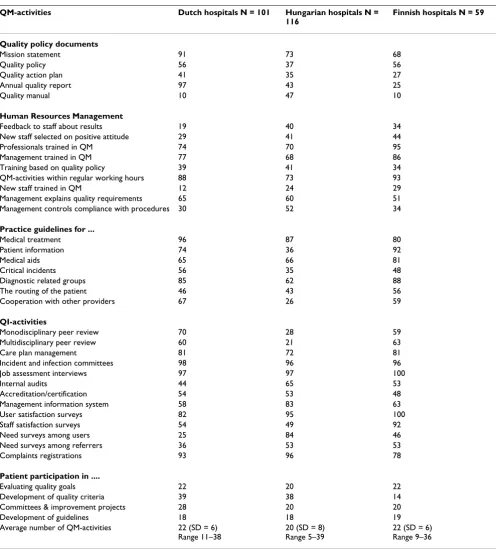
Table 1 gives an overview of the 38 QM-activities investi-gated and shows the percentage of hospitals in The Neth-erlands, Hungary and Finland performing these activities. The QM-activities are clustered into the focal areas:
qual-QM-activities divided into five focal areas and four developmental stages
Figure 2
QM-activities divided into five focal areas and four developmental stages Policy and strategy HRM Practice guidelines
for:
Systematic quality improvement
Participation of patients Stage 0 Mission statement
Annual quality report
Encouraging professional development
Medical treatment Peer review Care plans
Patient is not involved
Stage 1 Written Quality policy exists Quality action plan under development
Training staff Training managers QM-activities within regular working hours
Management explains quality requirements
Patient information Medical aids Diagnostic related groups
Complaints registration Committees Job assessment interview
Evaluating quality goals
Stage 2 Quality action plan developed
New staff selected on quality attitude New staff trained Management controls
Critical incidents Cooperation with other providers
Satisfaction research Needs analysis Management information system Accreditation
Development of quality criteria or guidelines
Stage 3 Quality action plan and Quality manual
Training based on quality policy and Systematic feedback
Routing of the patient and critical incidents
Internal audit and satisfaction research
Table 1:
QM-activities Dutch hospitals N = 101 Hungarian hospitals N = 116
Finnish hospitals N = 59
Quality policy documents
Mission statement 91 73 68
Quality policy 56 37 56
Quality action plan 41 35 27
Annual quality report 97 43 25
Quality manual 10 47 10
Human Resources Management
Feedback to staff about results 19 40 34
New staff selected on positive attitude 29 41 44
Professionals trained in QM 74 70 95
Management trained in QM 77 68 86
Training based on quality policy 39 41 34
QM-activities within regular working hours 88 73 93
New staff trained in QM 12 24 29
Management explains quality requirements 65 60 51 Management controls compliance with procedures 30 52 34
Practice guidelines for ...
Medical treatment 96 87 80
Patient information 74 36 92
Medical aids 65 66 81
Critical incidents 56 35 48
Diagnostic related groups 85 62 88
The routing of the patient 46 43 56
Cooperation with other providers 67 26 59
QI-activities
Monodisciplinary peer review 70 28 59
Multidisciplinary peer review 60 21 63
Care plan management 81 72 81
Incident and infection committees 98 96 96
Job assessment interviews 97 97 100
Internal audits 44 65 53
Accreditation/certification 54 53 48
Management information system 58 83 63
User satisfaction surveys 82 95 100
Staff satisfaction surveys 54 49 92
Need surveys among users 25 84 46
Need surveys among referrers 36 53 53
Complaints registrations 93 96 78
Patient participation in ....
Evaluating quality goals 22 20 22
Development of quality criteria 39 38 14
Committees & improvement projects 28 20 20
Development of guidelines 18 18 19
Average number of QM-activities 22 (SD = 6) Range 11–38
20 (SD = 8) Range 5–39
ity policy documents, human resources management, guidelines, QI-activities and patient participation.
Quality policy documents
Compared to Finland and Hungary, more hospitals in The Netherlands report that they have drawn up quality policy documents such as a mission statement (91%) and an annual quality report (97%). Nearly every hospital in the Netherlands publish an annual quality report, which is required by law. In Hungary and Finland 10% publishes such a report. In Hungary, more hospitals have written a quality manual (47%), but few have developed a written quality policy (37%). In general, less Finnish hospitals are concentrating on quality policy documents.
Human resources management
Overall, most attention has been spent on QM-training for professional staff and managers, and less to the train-ing of new staff. The latter is important for the continuity of QM-activities. In Finland, more than 85% of the profes-sionals and managers are trained in quality management. Compared to the Netherlands, fewer managers in Finland explain quality requirements to their staff (51% vs. 65%). In Hungary, more managers, i.e. 52% compared to 30% and 34%, control the compliance of staff with existing quality procedures. In the Netherlands, less attention is paid to new staff, i.e. 12% vs 24% and 29%. Minor differ-ences exist with regard to training based on the quality policy.
Guidelines
More guidelines are reported in the Netherlands and in Finland compared with Hungary, e.g. patient informa-tion, critical incidents, diagnostic related groups and the cooperation with other health care providers. In Finland, most hospitals have guidelines for patient information and medical aids. In the three countries, most hospitals have guidelines for medical treatment. Less common are guidelines for the routing of the patient trough the hospi-tal and for critical incidents.
Quality improvement(QI)- activities
It must be noted that the figures in the table represent the hospitals that apply the QI-activities, as well as the hospi-tals that use the results of the QI-activities for improve-ments of the care process.
In the Netherlands, more hospitals use mono-disciplinary peer review and fewer hospitals use need surveys among users and referrers. In Hungary, hospitals use more often internal audits, a management information system and need surveys among users. Finnish hospitals use more often satisfaction surveys among users and staff, and less often the complaint registration. Minor differences exist
in the use of incident and infection committees, job assessment interviews, and user satisfaction surveys.
Patient participation
Minor differences exist with regard to patient participa-tion between the three countries, except for the develop-ment of quality criteria. Nearly 40% of the hospitals in the Netherlands and Hungary invite patients for the develop-ment of quality criteria, whilst in Finnish hospitals this is only 14%. In general, the table shows that few hospitals invite patients to evaluate quality goals, participate in committees and improvement projects, or in the develop-ment of guidelines. Only in the Netherlands hospitals are obliged to have a client council and to discuss important topics with regard to the quality of care. In practice 63% of the Dutch hospitals have a client council (not in table 1).
The average number of QM-activities that have been developed in the three countries is 22 in the Netherlands and Finland, and 20 in Hungary.
Country profile
Figure 3 gives an overview of the QM-activities that 75% of the hospitals of a country have developed. This figure, therefore, shows the strong points in the QMS of the hos-pitals. In the Netherlands, 75% of the hospitals have developed at least one QM-activity in the focal areas Qual-ity policy, human resources management, guidelines, and cyclic QI-activities. In Hungary, the hospitals are concen-trating more on the focal area QI-activities. Finnish hospi-tals are concentrating on training (HRM), guidelines for professionals and QI-activities. None of the three coun-tries is concentrating on patient participation.
The weak points (<25%) in the Netherlands are the qual-ity manual, feedback about results, training new staff and patient participation. Weak points for Hungary are the training of new staff, multidisciplinary peer review and patient participation. For Finland the weak points are the quality manual and patient participation.
the professionals are mainly responsible for quality assur-ance. At stage 1, hospitals create the conditions necessary for systematic quality assurance and improvement. At stage 2, hospitals develop different kinds of QM-activities and improvement projects. The purpose is to cross the boundaries of separate disciplines using the quality improvement cycle. At stage 3, the hospital reaches the stage of integration and establishment. Quality manage-ment is no longer an experimanage-mental activity, but is inte-grated into normal business operations. The results of QM-activities in one focal area will be used for changes and improvements in other focal areas. Therefore, it is necessary that hospitals develop activities simultaneously on more than one focal area.
Table 2 shows the developmental stage of the QMS for each focal area. Dutch hospitals are further with the par-ticipation of patients and one third of the hospitals has reached stage 3 for the focal area "Guidelines". Nearly one third of the Hungarian hospitals is in stage 3 for the focal area "Quality policy documents" and "QI-activities". Like the Dutch hospitals, more than one third of the Finnish hospitals has reached stage 3 for the focal area "Guide-lines". A hospital can only reach a specific stage if it has developed the QM-activities of that stage. For example: a hospital can reach stage 3 of focal area "Quality policy documents" if it has developed a quality action plan and a quality manual (see Figure 2). Stage 3 hospitals have developed most of the QM-activities of the earlier stages.
Strong points: QM-activities that 75% of the hospitals of a country has developed
Figure 3
Strong points: QM-activities that 75% of the hospitals of a country has developed
The Netherlands
Hungary
Finland
Quality policy documents:
- Mission statement
- Annual quality report
Quality documents:
No document
Quality documents:
No document
HRM:
- Management trained in QM
HRM:
No activity
HRM:
- Professionals trained in QM
- Management trained in QM
Practice guidelines for:
- medical treatment
- diagnostic related groups
Guidelines for:
medical treatment
Guidelines for:
- medical treatment
- patient information
- medical aids
- diagnostic related groups
QI-activities:
- Care plan management
- Incident and infection committee
- Job assessment interview
- User satisfaction survey
- Complaint registration
QI-activities:
- Incident and infection committee
- Job assessment interview
- Management information system
- User satisfaction survey
- Need surveys among users
- Complaint registration
QI-activities:
- Care plan management
- Job assessment interview
- User satisfaction survey
- Staff satisfaction survey
- Complaint registration
Patient participation
No activity
Patient participation
No activity
Patient participation
Based on table 3, a small majority of Dutch hospitals (57%) has reached stage 2, 62% of the Hungarian hospi-tals have reached stage 1, and in Finland, half of the hos-pitals has reached stage 1 and half has reached stage 2.
Table 3 shows that there is no Hungarian hospital that has reached stage 3 for the overall QMS, despite the larger number of hospitals that has reached stage 3 of a specific focal area. These results seam to contradict each other. The explanation based on table 2 and table 3 is that a small group of Hungarian hospitals focuses on specific focal areas. They fulfil the requirements of a QMS within that area, but neglect the other areas. For the QMS as a whole, the five focal areas are equally important.
Discussion and conclusion
The object of this study was to investigate agreement and disparities in the implementation of quality management systems (QMS) between the Netherlands, Hungary and Finland with respect to the quality model used and the national policy strategy of the three countries. The main assumption was that the three countries develop the same QM-activities, but that governmental legislation or finan-cial stimulation are more effective in stimulating the use of QM-activities. Therefore, it was hypothesized that hos-pitals in a country with governmental legislation are fur-ther with the implementation of a QMS and the required QM-activities than hospitals in countries with recommen-dations. Another assumption was that financial stimula-tion will be even more effective.
Strengths and weaknesses of the study
The main strength of the study is the measurement instru-ment which was thoroughly tested in former research
[16,17]. The instrument provides detailed information about QM-activities, independent of specific characteris-tics of sub-sectors and independent of the quality model used by an organization (ISO, EFQM or other models).
The study's weakness is inherent in investigations con-ducted by questionnaires. We measured whether or not a QM-activity was present in an organization. The question-naire approach did not permit us to assess the effective-ness of these activities in serving the purpose of quality assurance. The occurrence of social desirability in the responses could not be excluded. To diminish this effect, the hospital could report the activities anonymously to the researchers and it received individual feedback on the own results compared to the results of all the other hospi-tals (The Netherlands). Furthermore, social desirability seems unlikely because no sanctions were imposed on non-compliance with the Act in The Netherlands and in Hungary.
The comparison between the three countries
In general, the differences between the three countries in the implementation of QMS and QM-activities are not as great as one would expect because of the different history of the countries and health care systems. The average number of QM-activities that have been developed in the three countries is 22 in the Netherlands and Finland, and 20 in Hungary. One specific activity of the Netherlands, the client council, does not exist in Finland or Hungary. All other activities are to some extent present in all the three countries.
The assumption was that hospitals in countries with a legal requirement of QMS would be further with the
Table 2:
Focal area Dutch hospitals N = 101 Hungarian hospitals N = 116 Finnish hospitals N = 59 Stage 2 Stage 3 Stage 2 Stage 3 Stage 2 Stage 3 Quality policy documents 80 9 52 32 83 3
HRM 57 11 39 28 44 22
Practice guidelines 49 32 24 22 32 39
QI-activities 21 7 3 32 20 17
[image:9.612.54.557.643.725.2]Participation of patients 15 28 23 16 20 10
Table 3:
Developmental stage QMS Dutch hospitals N = 101 Hungarian hospitals N = 116 Finnish hospitals N = 59
Stage 0 - 8
-Stage 1 37 62 46
Stage 2 57 30 51
Stage 3 4 - 3
implementation of QMS than hospitals in countries where the implementation of QMS is voluntary. There-fore, hospitals in the Netherlands and Hungary are expected to be further than hospitals in Finland. This is not the case for Hungary.
The results show that only a minority of hospitals (less than 5%) has developed a QMS (stage 3). There is no real difference between the Netherlands and Finland – most hospitals have implemented various QM-activities, but only 3% – 4% have implemented an integral QMS. On the other side, hospitals in Hungary are less far than hos-pitals in Finland. Despite the ISO-certification of 30% of the Hungarian hospitals, most Hungarian hospitals are still in the preparation stage, whereas most Finnish hospi-tals have started with the implementation of the QMS. This means that the hypothesis has to be rejected.
An explanation for the little influence of national quality policy and legislation could be the broad definition of QMS. In the Netherlands and in Hungary, the Quality Act is only a framework legislation that states that hospitals should have a QMS, but it does not give information on the QM-activities that are needed for an integral system. Furthermore, this means that any kind of control or inspection whether hospitals fulfil the requirements of the law, is difficult and no sanctions are taken in both countries.
In addition, the results show that only the QM-activities that are stated by name in the Dutch Quality Act are present in more than 90% of the hospitals, e.g. annual quality report, infection and incident committee, and complaint registration. It seems that only clearly stated QM-activities have been implemented by the majority of the hospitals.
In Hungary, the implementation of ISO:9002 was finan-cially stimulated. In order to receive the money, the man-agement of the hospital had to show which QM-activities the hospital had developed. Therefore, it can be expected that a majority of the Hungarian hospitals have developed the typical requirements and activities mentioned in the ISO:9002 standard (Figure 1). The results do not entirely confirm this expectation. Less than half of the hospitals have implemented the necessary quality policy docu-ments.
Overall, the results show that there is a lack of patient par-ticipation in the Dutch, Hungarian and Finnish hospitals. The results indicate that a law or financial reimbursement have some influence on the implementation of QM-activ-ities if they are specific enough. More general, notions about QMS or quality improvement depend on intrinsic motivation of health care providers and hospitals and a
QMS will not be implemented by the majority of the hos-pitals. More pressure seems to be necessary. On the other hand, Finland has no legislation stating mandatory meas-ures and despite this, hospitals have implemented QM-activities and developed QMS.
Future
In line with the conclusions, the national quality policy in the Netherlands and in Hungary is changing and the pres-sure on hospitals is increasing. In the Netherlands, a new national quality programme has been launched to stimu-late hospitals and the healthcare inspectorate is asking for performance indicators.
In Hungary, the Health Care Act was completed by "The guideline of Health Ministry about internal quality man-agement system of health care providers and connected requirements" and published in the Official Gazette of the Ministry of Health in 2002. This guideline sets out recom-mendations concerning the following fields:
a) managerial decisions to lead and coordinate,
b) providing human resources,
c) providing and using up material and financial resources,
d) planning, operating, evaluating and developing service processes,
e) evaluating internal quality system.
This guideline has a specific manual for implementation and was developed on the basis of ISO 9000:2000 stand-ards, the EFQM model and the Hungarian Hospital Care Standards (12).
Competing interests
The author(s) declare that they have no competing inter-ests.
Authors' contributions
The authors contributed equally to this work
Note
Table 1 Percentage hospitals with QM-activities in the Netherlands, Hungary and Finland
Table 2 Percentage hospitals in stage 2 and stage 3 of the five focal areas of a QMS
Publish with BioMed Central and every scientist can read your work free of charge
"BioMed Central will be the most significant development for disseminating the results of biomedical researc h in our lifetime."
Sir Paul Nurse, Cancer Research UK
Your research papers will be:
available free of charge to the entire biomedical community
peer reviewed and published immediately upon acceptance
cited in PubMed and archived on PubMed Central
yours — you keep the copyright
Submit your manuscript here:
http://www.biomedcentral.com/info/publishing_adv.asp
BioMedcentral
Acknowledgements
The authors would like to thank U.Nabitz for his contribution.
References
1. Shaw C: External assessment of health care. BMJ 2001,
322:851-854.
2. Wagner C, Groenewegen PP, Bakker de DH, Wal van der G: Envi-ronmental and organizational determinants of quality man-agement. Quality Management in Health Care 2001, 4:63-76. 3. Sluijs EM, Wagner C: Progress in the implementation of
Qual-ity Management in Dutch health care 1995–2000. Int J Qual Health Care 2003, 15:223-234.
4. Heaton C: External peer review in Europe an overview from the ExPeRT Project. Int J Qual Health Care 2000, 12:177-182. 5. Sluijs EM, Outinen M, Wagner C, Liukko M, de Bakker DH: The
impact of legislative versus non-legislative policy in health care a comparison between two countries. Health Policy 2001,
2:99-119.
6. Klazinga NS: Quality management of medical specialist care in The Neth-erlands, an explorative study on its nature and development Dissertation. Belvedere, Overveen; 1996.
7. Lombarts MJMH: Visitatie of medical specialists: studies on its nature, scope and impact Amsterdam, AMC; 2003.
8. Az Egészségügyi Minisztérium szakmai irányelve az egészségügyi szolgál-tatók belső minőségügyi rendszeréről, azok követelményeiről. (Guideline of Health Ministry about internal quality management system of health care providers and connected requirements) Egészségügyi Közlöny (Official Gazette of the Ministry of Health); 2002.
9. Egészségügyi Közlöny (Official Gazette of the Ministry of Health). CLIV tv az Egészségügyről (Hungarian Act CLIV of 1997 on
Health) 1997.
10. Belicza , Éva , Takács , Erika , Boncz , Imre : A minőségfejlesztés támogatása.Indikátorok az egészségügyi szolgáltatások értékelésére. (Supporting quality improvement. Indicators for evaluation health care services). Kórház 2004, 10–11:20-22. 11. Horváth A, Mogyorósy G, Sinka M, Szy I: Klinikai audit projekt a szaktárca minőségfejlesztési programjában (Clinical audit project in the quality improvement program of the minis-try). Egészségügyi Menedzsment 2003, 5(3):36-40.
12. Ministry of Health, Social and Family Affairs. In Minőségügyi
helyzetfelmérés az egészségügyben, 2002. év (Quality survey in health care, 2002) Boedapest: Ministry of Health, Social and Family Affairs; 2002.
13. Puskás , Julianna : Minőségügyi helyzet az egészségügyben, 2003.
kérdőíves felmérés alapján készült összefoglaló (The position of quality in health care, summary of survey results) Boedapest:National Health Insurance Fund; 2003.
14. Szy I, Sinka M: Az egészségügyi minőségfejlesztés jelenlegi ker-etrendszere (Present framework of quality improvement in health care). Egészségügyi Menedzsment 2003, 5(2):59.
15. Outinen eM, Mäki T, Siikander S, Liukko M: Laatu kannattaa – mikä kannattaa laatutyötä? Selvitys laadunhallinnasta sosiaali- ja terveydenhuol-lossa Aiheita 8/2001. Helsinki: Stakes; 2001.
16. Wagner C: Implementation and effectiveness of quality systems in Dutch health care organizations (Thesis) Utrecht: Nivel; 1999.
17. Sluijs EM, Wagner C: Quality systems in health care organizations. The state of affairs in 2000 (in Dutch) Utrecht: Nivel; 2000.
Pre-publication history
The pre-publication history for this paper can be accessed here: