
White Rose Research Online URL for this paper:
http://eprints.whiterose.ac.uk/124716/
Version: Accepted Version
Article:
Andel, B., Andreyev, A. N. orcid.org/0000-0003-2828-0262, Antalic, S. et al. (28 more
authors) (2017) Detailed α-decay study of 180Tl. Physical Review C - Nuclear Physics.
054327. ISSN 1089-490X
https://doi.org/10.1103/PhysRevC.96.054327
[email protected] https://eprints.whiterose.ac.uk/ Reuse
Items deposited in White Rose Research Online are protected by copyright, with all rights reserved unless indicated otherwise. They may be downloaded and/or printed for private study, or other acts as permitted by national copyright laws. The publisher or other rights holders may allow further reproduction and re-use of the full text version. This is indicated by the licence information on the White Rose Research Online record for the item.
Takedown
If you consider content in White Rose Research Online to be in breach of UK law, please notify us by
B. Andel,1,∗ A. N. Andreyev,2, 3, 4 S. Antalic,1 A. Barzakh,5 N. Bree,6 T. E. Cocolios,6, 4 V. F.
Comas,7 J. Diriken,6 J. Elseviers,6 D. V. Fedorov,5 V. N. Fedosseev,8 S. Franchoo,9 L. Ghys,6, 10
J. A. Heredia,7 M. Huyse,6 O. Ivanov,6 U. K¨oster,11 V. Liberati,12 B. A. Marsh,8 K. Nishio,3 R.
D. Page,13 N. Patronis,6, 14 M. D. Seliverstov,6, 4 I. Tsekhanovich,15, 16 P. Van den Bergh,6 J.
Van De Walle,4 P. Van Duppen,6 M. Venhart,17 S. Vermote,18 M. Veselsk´y,17 and C. Wagemans18 1
Department of Nuclear Physics and Biophysics, Comenius University in Bratislava, 84248 Bratislava, Slovakia 2
Department of Physics, University of York, York YO10 5DD, United Kingdom 3
Advanced Science Research Center, Japan Atomic Energy Agency, Tokai-mura, Ibaraki 319-1195, Japan 4
ISOLDE, CERN, CH-1211 Geneve 23, Switzerland 5
Petersburg Nuclear Physics Institute, NRC Kurchatov Institute, 188300 Gatchina, Russia 6
KU Leuven, Instituut voor Kern- en Stralingsfysica, University of Leuven, B-3001 Leuven, Belgium 7
GSI-Helmholtzzentrum f¨ur Schwerionenforschung GmbH, 64291 Darmstadt, Germany 8
EN Department, CERN, CH-1211 Geneve 23, Switzerland 9
Institut de Physique Nucl´eaire, IN2P3-CNRS/Universit´e Paris-Sud, F-91406 Orsay Cedex, France 10
Belgian Nuclear Research Center SCK•CEN, Boeretang 200, B-2400 Mol, Belgium 11
Institut Laue Langevin, 6 rue Jules Horowitz, F-38042 Grenoble Cedex 9, France 12
School of Engineering and Science, University of the West of Scotland, Paisley, PA1 2BE, United Kingdom 13
Department of Physics, Oliver Lodge Laboratory, University of Liverpool, Liverpool L69 7ZE, United Kingdom 14
Department of Physics, University of Ioannina, GR-45110 Ioannina, Greece 15
School of Physics and Astronomy, University of Manchester, Manchester M13 9PL, United Kingdom 16
Centre d’Etudes Nucleaires de Bordeaux Gradignan, F-33175 Gradignan Cedex, France 17
Institute of Physics, Slovak Academy of Sciences, 84511 Bratislava, Slovakia 18
Department of Physics and Astronomy, University of Gent, Proeftuinstraat 86, B-9000 Gent, Belgium
A detailed α-decay spectroscopy study of 180
Tl has been performed at ISOLDE (CERN). Z-selective ionization by the Resonance Ionization Laser Ion Source (RILIS) coupled to mass separation provided a high-purity beam of180
Tl. Fine-structureαdecays to excited levels in the daughter176
Au were identified and an α-decay scheme of 180
Tl was constructed based on an analysis of α-γ and
α-γ-γ coincidences. Multipolarities of several γ-ray transitions de-exciting levels in 176
Au were determined. Based on the analysis of reduced α-decay widths, it was found that allαdecays are hindered, which signifies a change of configuration between the parent and all daughter states.
I. INTRODUCTION
Odd-odd nuclei in the Z= 82 region are well known for a complex pattern of closely-spaced multiplet states at low excitation energy arising from coupling of the odd proton with the odd neutron (e.g. [1–3] and references therein). The relative position of the states within the multiplet may depend on the neutron number, see dis-cussion in [4]. As α decay is very sensitive to changes of spin, parity or configuration between initial and final states, α-decay spectroscopy is a valuable technique for investigating complicated level schemes [5]. The method is especially effective for identification of low-lying ex-cited levels in daughter nuclei whenα-γcoincidences are also measured. Evaluation of reduced α-decay widths (hindrance) for specificα-decay transitions and determi-nation of γ-ray multipolarities can provide information on the configuration of the nuclear states involved.
This study of 180Tl continues our systematic work on
the series of odd-odd Tl isotopes investigated at ISOLDE:
178Tl [6],180Tl [7–9],182,184Tl [5,10,11]. A common
fea-ture in all these studies was a persistent hindrance for all observedαdecays between the parent and daughter nu-clei, which signifies their different configurations, see the detailed discussion in the above-mentioned references.
Previous α-decay studies of 180Tl were performed at
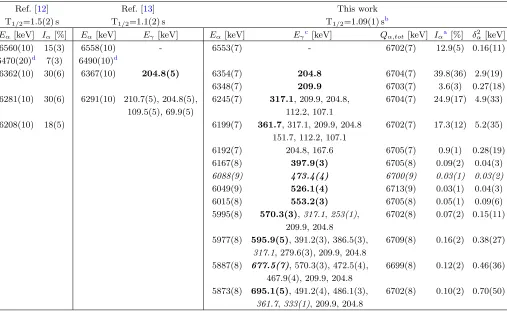
the Argonne Tandem Linac Accelerator System (ATLAS) facility at Argonne National Laboratory in two exper-iments [12, 13]. In both cases, fusion-evaporation re-actions were employed and products separated by the Fragment Mass Analyzer (FMA) were implanted into a double-sided silicon strip detector. Statistics collected in each experiment were of the order of several hundred counts. Deducedα-decay energies are listed in TableI. In the second experiment,α-γ coincidences were also mea-sured.
In our study, we registered≈8×10⁵ αdecays of180Tl,
which, in combination withα-γcoincidence analysis, al-lowed us to identify many weak fine-structure decays to excited states in176Au. The data were collected in the
same experiment in which theβ-delayed fission [7,9] and
βdecay [8] of180Tl were studied. The present paper
TABLE I. Alpha-decay properties of180
Tl deduced in this work, in comparison with the previous studies. Alpha-decay energies (Eα), coincidentγ-ray transitions (Eγ), Qα,totvalues, relative intensities ofα-decay transitions (Iα) and their reduced decay
widths (δ2
α) are listed. Relative intensities were determined fromα-γcoincidences
a
(except for the 6553-keV decay). Single-step
γ-ray transitions directly de-exciting levels in176
Au and thus defining their energies are in bold. Coincidences shown in italics are tentative.
Ref. [12] Ref. [13] This work
T1/2=1.5(2) s T1/2=1.1(2) s T1/2=1.09(1) s
b
Eα [keV] Iα[%] Eα [keV] Eγ[keV] Eα [keV] Eγ
c
[keV] Qα,tot[keV] Iα
a [%] δ2
α[keV]
6560(10) 15(3) 6558(10) - 6553(7) - 6702(7) 12.9(5) 0.16(11)
6470(20)d
7(3) 6490(10)d
6362(10) 30(6) 6367(10) 204.8(5) 6354(7) 204.8 6704(7) 39.8(36) 2.9(19)
6348(7) 209.9 6703(7) 3.6(3) 0.27(18)
6281(10) 30(6) 6291(10) 210.7(5), 204.8(5), 6245(7) 317.1, 209.9, 204.8, 6704(7) 24.9(17) 4.9(33)
109.5(5), 69.9(5) 112.2, 107.1
6208(10) 18(5) 6199(7) 361.7, 317.1, 209.9, 204.8 6702(7) 17.3(12) 5.2(35)
151.7, 112.2, 107.1
6192(7) 204.8, 167.6 6705(7) 0.9(1) 0.28(19)
6167(8) 397.9(3) 6705(8) 0.09(2) 0.04(3)
6088(9) 473.4(4) 6700(9) 0.03(1) 0.03(2)
6049(9) 526.1(4) 6713(9) 0.03(1) 0.04(3)
6015(8) 553.2(3) 6705(8) 0.05(1) 0.09(6)
5995(8) 570.3(3),317.1,253(1), 6702(8) 0.07(2) 0.15(11) 209.9, 204.8
5977(8) 595.9(5), 391.2(3), 386.5(3), 6709(8) 0.16(2) 0.38(27) 317.1, 279.6(3), 209.9, 204.8
5887(8) 677.5(7), 570.3(3), 472.5(4), 6699(8) 0.12(2) 0.46(36) 467.9(4), 209.9, 204.8
5873(8) 695.1(5), 491.2(4), 486.1(3), 6702(8) 0.10(2) 0.70(50) 361.7,333(1), 209.9, 204.8
a
Determined multipolarities ofγ-ray transitions are listed in TableII. To evaluate lower limits of the transition intensities in the cases of ambiguous or unknown multipolarities, internal conversion coefficients for specific multipolarities were chosen as described in TableII. Intensities for transitions with known multipolarities are therefore upper limits. However, we determined multipolarities for the most intenseγ-ray transitions and possible shifts ofα-decay intensities caused by the unknown character of remaining (mostly higher-energy)γdecays would be small. For simplicity we thus state resultingα-decay intensities as values instead of limits. b
the half-life value determined from the same data set in our previousβ-decay study of180 Tl [8] c
the uncertainty ofγ-ray transition energies is 0.2 keV, if not stated otherwise d
proposed in our work as being due toα+e−summing (see SectionIII A)
II. EXPERIMENT
The measurement was performed at the ISOLDE fa-cility (Isotope Separator On Line DEvice) at CERN [14,
15]. Nuclei of 180Tl were produced in proton-induced
spallation reactions in a 50 g/cm2 thick UC
xtarget. The
beam of 1.4 GeV protons with an intensity up to 2.1µA was supplied by the Proton-Synchrotron Booster (PSB). The nuclei produced diffused through the target heated to≈2300 K and effused via the heated transfer line into a hot cavity, where Tl isotopes were selectively ionized to a charge state of 1+ by the Resonance Ionization Laser
Ion Source (RILIS) [16]. Subsequently, the ions were extracted and accelerated to 30 keV by extraction elec-trodes and mass separated by the High Resolution Sep-arator (HRS). By Z-selective ionization and separation
according to mass-to-charge ratio, a pure beam of180Tl
nuclei was obtained.
To detect decays of180Tl, the Windmill detection
sys-tem was employed [7,18]. The beam was implanted into one of ten thin carbon foils (20µg/cm2) mounted on a
ro-tatable wheel. At the implantation position, two silicon detectors of 300µm thickness were placed in close geome-try around the foil to detectαparticles, fission fragments and electrons. The annular detector mounted in front of the foil had a circular hole of 6 mm diameter to let the beam through to reach the foil. The active area of the annular detector was 450 mm2, while the active area of
the circular detector placed behind the foil was 300 mm2.
2 10
3 10
4 10
5 10
6 10
7 10
8 10
spectrum
-decay
α
(a)
5748 Pt
176
5861 Hg
180
6119 Hg
180
Tl
180
6199
6245 6348 6354
6474 6553 6287+
Au
176
400 500 600 700
coinc.
γ
-α
(b)
695 678
596 570
553
Au)
176
( 500
Au)
176
( 475
491, 486
473, 468 526
473
398
Tl)
180 + β
511 (
Tl)
180 + β
/
ε
434 (
5800 6000 6200 6400 6600
0 100 200 300
coinc.
γ
-α
(c)
362
317
210 205
168 Tl)
180
Au,
176
152 (
112 107
x rays
β
,
α
Au K-Au)
176
237 ( Hg)
180
264 ( 280
316* 391, 387
Hg)
180
180 (
= 45
E ∆
[keV]
αE
Counts / 4 keV
[keV]
γE
FIG. 1. (color online)(a): All α decays registered in both silicon detectors at the implantation position. The strongestα decay of the low-spin state in176
Au at 6287(7) keV, marked with a plus sign, is taken from [17]. (b): α-γ coincidences for
γ-ray energies in the range of 380 – 760 keV. (c): α-γcoincidences for γ-ray energies of 0 – 380 keV. For better presentation in
(c), a smaller size of points was used and their density was decreased (5×). Dotted blue diagonal lines enclose α-γ groups yielding the same totalQα,tot= 6702(7) keV as the 6553-keVαdecay, see the main text. The dotted lines mark the region of
Qα,tot±40 keV. In (b) and (c), the labeledγ-ray transitions originate afterαdecays of 180
Tl if not specified otherwise. The α-γcoincidences from180
Hg and176
[image:4.612.74.537.75.617.2]100 200 300 400 500 600 700 0
2000 4000 6000 8000 10000
0 4 8
205
210 317 362
398 434+
473 511+ 526 553 570 596 678 695
Counts / 1 keV
[keV]
γ
E
12 16 20
FIG. 2. Gamma rays in coincidence withαdecays along the line ofQα,totof the 6553-keVαdecay±40 keV (a projection to
γ-ray axis from the area between diagonal lines in Fig.1). For better presentation, a different scale (1:500) is used for counts
above energy of 380 keV. Tentative transitions have labels in italics, while backgroundγ-ray peaks are marked by a plus sign.
this measurement. Our experiment received from 4 to 10 pulses per supercycle. At the end of each supercy-cle (25.2 s), the wheel with foils was rotated so that a “fresh” foil was moved to the implantation position and remaining longer-lived daughter products were removed. For the energy calibration of silicon detectors, the highest-energy α-decay transitions in 180Hg, 180Tl and 176Pt were the most suitable. However, the
litera-ture values for 176Pt vary from E
α = 5741(8) keV to
Eα = 5756(5) keV [19] and values for 180Tl have
un-certainties of 10 keV [12, 13]. Therefore, we first per-formed a calibration of the detectors with the data from a run at mass number A= 178 with αdecays of 178Hg,
Eα= 6429(4) keV [20] and174Pt,Eα= 6039(3) keV [19].
Based on this calibration, we deduced energies for176Pt,
Eα = 5748(7) keV and the highest-energy α decay of
180Tl, E
α = 6553(7) keV in the A= 180 run, which
fol-lowed shortly after the run withA= 178. Consistency of the calibration for theA= 180 run was tested on180Hg,
whereby our deduced value Eα = 6119(7) keV was in
agreement with the tabulated value ofEα= 6119(4) keV
from [20]. The whole data set forA= 180 was then cali-brated using our values for176Pt and180Tl along with the
known value for180Hg. The uncertainty of high-intensity
α-decay peaks is defined by the systematic uncertainty of our calibration, which was 7 keV.
To detect γ and x rays, a Miniball type germanium cluster detector consisting of three independent crystals was mounted outside the vacuum behind the implanta-tion posiimplanta-tion. Energy and relative efficiency calibraimplanta-tions of the cluster detector were performed using 152Eu and 133Ba γ-ray sources. The relative efficiency curve was
scaled by the absolute efficiency value determined from
α(6354 keV)-γ(205 keV) coincidences from 180Tl decay.
[image:5.612.102.523.56.236.2]The systematic uncertainty of γ-ray energy calibration was 0.2 keV.
TABLE II. Relativeγ-ray (Iγ) and transition (It) intensities
and multipolarities for most intenseγdecays following theα decay of180
Tl. The whole energy range of180
Tl fine-structure decays (5830 – 6550 keV) was used as theαgate. Forγ rays marked with asterisks, only narrowα gates for specific α-γ groups were used to avoid mixing withγ rays of similar en-ergy and to decrease the background. For ambiguous “M1 and/orE2” multipolarities, lower limits of the transition in-tensities were evaluated using internal conversion coefficients
forE2 multipolarities. Forγ rays with unknown
multipolar-ity, lower limits of the transition intensities were evaluated using conversion coefficients forE1 multipolarities. All inten-sities are relative to the intensity of the 205-keVγrays, which is taken as 100 %.
Eγ[keV] Iγ [%] Multipolarity It[%]
107 3.9(4) M1 19.4(23)
112 4.3(5) M1 19.3(23)
152* 5.5(6) M1 and/orE2 ≥8.2(9)
168 1.7(2) ≥1.4(2)
205 100 E2 100
210 39.9(47) E2 39.1(46)
280* 0.13(3) ≥0.10(2)
317* 3.2(5) M1 and/orE2 ≥2.6(4) 362 7.6(12) M1 and/orE2 ≥6.0(9)
398* 0.16(4) ≥0.12(3)
570 0.19(5) ≥0.14(4)
III. RESULTS
[image:5.612.342.532.459.614.2]and granddaughter (176Pt). Allα-decay transitions
pre-viously attributed to 180Tl in studies [12, 13] (listed in
Table I) are present in our data. We note that there is a small (≈10 keV) shift in theα-decay energies between our experiment and the results from [12,13]. Most prob-ably, this shift stems from the difference in α-decay en-ergies used for calibration in our and previous studies. Our calibration procedure is described in detail in Sec-tionII, while no information on the calibration energies was provided in [12,13]. A larger shift in the case of the 6245-keV transition is discussed in SectionIII B.
The detection system provided means for the investi-gation ofα-γ and α-γ-γ coincidences, which allowed us to deduce several new fine-structure (f.s.) α decays of
180Tl. The time window used in the coincidence analysis
was ∆t(α-γ) = 400 ns. Since there is a large difference in intensity betweenα-decay transitions to lower-lying lev-els and those to higher-lying levlev-els in176Au, for a better
presentation the matrix of α-γ coincidences was divided into two panels: Fig.1(b)and(c). In Fig.1(c), a smaller size of points was used and their density was decreased 5×compared to Fig.1(b). Several f.s.αdecays followed by a single-step γ-ray transition to the state fed by the highest energy (6553-keV) decay of180Tl can be readily
identified based on the same totalQα,tot=Qα+Eγvalue.
The respective α-γ coincidence groups are enclosed by the dotted blue lines drawn atQα,tot±40 keV.
For a better identification of the single-step transitions, we produced a projection from the region between the dotted lines to the γ-ray axis, presented in Fig. 2. The spectrum atEγ <400 keV has a number of high-intensity
γ-ray peaks, e.g. at 205, 210, 317 and 362 keV. The part above 500 keV is very pure, which allows a number of low-intensityγ-ray peaks to be identified, although some of them have just a few counts. Their origin will be confirmed by the analysis in following sections. The re-gion between 400 – 480 keV has a somewhat higher back-ground due to randomγ-ray coincidences with the most intense α decay at 6119 keV from 180Hg, see Fig. 1(a).
The 434-keVγ-ray peak in the region of this background belongs to the most intense transition (2+ → 0+ in 180Hg) followingε/β+decay and the 511-keVγrays come
fromβ+decay of180Tl [8]. The fullγ-ray spectrum from
the same data set can be found in Fig. 3 of Ref. [8], which was dedicated to theβ-decay study of180Tl.
Based on Fig. 2 we established excited states at 205, 210, 317, 362, 398, 473, 526, 553, 570, 596, 678 and 695 keV in 176Au, see the proposed decay scheme in
Fig. 3. The decay scheme was further developed based onγ-ray energy and intensity balance, determination of multipolarities for a number of transitions andα-γ-γ co-incidence analysis (see following text). Deduced energies of the 180Tl f.s. α transitions and populated levels in 176Au are listed in TableIalongsideQ
α,totvalues. Forγ
decays in cascades in our decay scheme we investigated a possibility of energy summing in the same Ge detec-tor, which would create artificial cross-over transitions. This effect was found to be negligible. Relative γ-ray
and transition intensities deduced fromα-γ coincidence data and multipolarities for the most intense γ decays following theαdecay of180Tl are given in Table II.
A. The 205- and 210-keV levels in176 Au
The 205-keV and 210-keV levels in 176Au were
es-tablished based on the observation of α(6354(7)
keV)-γ(205 keV) andα(6348(7) keV)-γ(210 keV) coincidentα
-γpairs. The 205-keV level is in agreement with the pre-viousα-decay study [13] and both the 205- and 210-keV levels were suggested in an in-beam measurement [23].
Internal conversion of the 205-keV transition (dis-cussed below) results in emission of K-shell conversion electrons (CE) withECE = 124 keV in coincidence with
the feeding 6354-keVαdecay. If both the CE andα par-ticle are registered in the same silicon detector, anα+CE summing peak at ≈6478 keV is created. Therefore, we propose that the peak withE = 6474(7) keV present in
α-decay spectrum (Fig.1(a)) is the result ofα+CE sum-ming. The conclusion is supported also by coincidences of the 6474-keV peak with Au K-x rays (see Fig.1(c)). Most probably, this summing peak corresponds to the 6470(20)/6490(10)-keV transition reported in the previ-ous studies [12,13]. In those experiments, nuclei of180Tl
were directly implanted into a silicon detector, which sig-nificantly enhances the probability of α+CE summing. Based on the discussion above, we also rule out the exis-tence of the 64 keV level, which was suggested to be fed by the 6490-keV decay in [13].
Fig. 4 showsγ rays in coincidence with the 6354 and 6348-keV α decays. The α-energy gate of 6310 keV to 6530 keV was used to cover also the region ofα-CE sum-ming events. Due to the prompt character of the 205-and 210-keV γ decays, we limit their possible multipo-larities toE1,M1 orE2. We can determine limits of the K-conversion coefficient,αK(205 keV), from the number
of Au K-x rays and 205-keVγ rays in Fig. 4 (after cor-recting both numbers for detection efficiency), by assum-ing different multipolarities for the remainassum-ing possible source of K-x rays, the 210-keV decay. To obtain an upper limit ofαK(205 keV), we assume anE1
multipo-larity for the 210-keV decay, which corresponds to the lowest αK(210 keV) value. To obtain a lower limit, we
assume that the 210-keV transition has an M1 multi-polarity, which corresponds to the highestαK(210 keV)
2 0 5 E2 2 1 0 E2 3 1 7 M1 /E 2 3 6 2 M1 /E2 1 1 2 M1 1 0 7 M1 1 5 2 M1 /E 2
6553 (6702) 12.9(5) 0.16(11) 6354 (6704) 39.8(36) 2.9(19) 6348 (6703) 3.6(3) 0.27(18) 6245 (6704) 24.9(17) 4.9(33) 6199 (6702) 17.3(12) 5.2(35)
180Tl [ s
1/2 h9/2]
4-176Au [ d
3/2 f7/2] 4,5-205
210 317 362
398 6167 (6705) 0.09(2) 0.04(3)
3 9 8 526 553 570 695 5 2 6
6049 (6713) 0.03(1) 0.04(3) 6015 (6705) 0.05(1) 0.09(6) 5995 (6702) 0.07(2) 0.15(11) 5873 (6702) 0.10(2) 0.70(50)
5 5 3 5 7 0 6 9 5 2 5 3 4 9 1 4 8 6 3 3 3 5 9 6
596 5977 (6709) 0.16(2) 0.38(27)
6088 (6700) 0.03(1) 0.03(2) 473
4
7
3
372 6192 (6705) 0.9(1) 0.28(19)
1 6 8 3 8 7 3 9 1
E Q tot I rel [keV] [keV] [%]
678
5887 (6699) 0.12(2) 0.46(36)
[image:7.612.68.553.52.339.2]6 7 8 4 7 3 4 6 8 (4 5 ) E2 (M1 +E2 ) 2 8 0 (1 0 8 ) δ2 α [keV]
FIG. 3. Proposedα-decay scheme of180
Tl. Tentative levels and transitions are denoted by dashed lines. Transitions with energies in brackets were not observed, but they were placed into decay scheme based on indirect evidence, see text for details. LabelsM1/E2 denote the possibility ofM1,E2 or mixed multipolarity. The configuration of the ground state in180
Tl is taken from [21]. The tentative configuration of the daughter state in176
Au is taken from [22] and is discussed in SectionIV.
40 60 80 100 120 140 160 180 200 220 240
0 2000 4000 6000 8000 205 210 69 78 x rays β , α Au
K-Counts / 1 keV
[keV]
γ
E
FIG. 4. Gamma rays in coincidence with the 6354- or 6348-keVαtransitions. Theα-particle energy range used for gating was 6310 – 6530 keV.
B. The 317-keV level
The 6245(7)-keV αdecay feeding the 317-keV level is in coincidence with the 107-, 112-, 205-, 210- and 317-keV γ rays (Fig. 5(a)). By using an α-γ-γ coincidence analysis (Fig. 5(b) and(c)), we established that as well as the direct 317-keV transition this state also de-excites via two parallel cascades of the 107-210-keV and
112-205-TABLE III. Comparison of experimental K-conversion coeffi-cientsαK(exp) and theoreticalαKtaken from [24] for possible
multipolarities of listedγ decays. The αK(205 keV) was
de-duced fromα-γcoincidences. The rest were determined using
α-γ-γcoincidences.
Eγ [keV] αK(exp) αK(E1) αK(M1) αK(E2)
205 ≤0.163(8) 0.0556(8) 0.780(11) 0.1597(23) ≥0.105(7)
107 4.3(9) 0.281(4) 4.91(7) 0.620(9) 112 3.3(6) 0.251(4) 4.30(6) 0.584(9)
keVγrays.
[image:7.612.56.295.420.554.2] [image:7.612.326.550.480.549.2]par-1000 2000 3000 4000
coincidences
γ
(6245)-α
(a)
317
210
205
112
107
78
69
x rays
β
,
α
Au
K-5 10 15 20 25
coincidences
γ
(210)-γ
(6245)-α
(b)
0 50 100 150 200 250 300 350
10 20 30 40
coincidences
γ
(205)-γ
(6245)-α
(c)
[keV]
γ
E
Counts / 1 keV
FIG. 5. Gamma rays in coincidence with: (a) the 6245-keV
α-decay transition, (b) the 6245-keVαand 210-keVγ decay
and (c) the 6245-keV α and 205-keV γ decay. The energy range used as theαgate was 6220 – 6320 keV.
ity, the 317-keV transition bypassing the cascade has to be of an M1 and/or E2 multipolarity. For the same reasons and also arguments stated in Section III A, the 210-keV decay from the second cascade parallel to the 317-keV decay must be of anE2 multipolarity.
The deduced multipolarities for the 107- and 112-keV decays can be further verified by using an alternative method as described below. Neglecting the most proba-bly very weak transition between the 210-keV and 205-keV levels, subsequent γ decays in the cascades of 107-210-keV and 112-205-keVγ rays must have the same in-tensity (after corrections for conversion and efficiency). This characteristic allowed us to evaluate total conver-sion coefficients (αtot) of the 107- and 112-keV decays.
Results listed in Table IV confirm dominantM1 multi-polarity for both transitions. Although αtot(112 keV) is
by 56 % higher than the theoretical αtot(M1), M2 and
higher multipolarities are excluded due to the prompt character of the transition. Additionally, their theoreti-cal conversion coefficients are several times higher than our experimental value: αtot(M2) = 41.0(6),αtot(E3) =
67.7(10) [24]. We cannot completely rule out the pos-sibility of a small E0 admixture to the 112-keV decay, although the K-conversion coefficient does not support such admixture (Table III). Relative γ-ray and transi-tion intensities ofγ decays de-exciting the 317-keV level are given in TableV.
Internal conversion of the 107- and 112-keV transitions leads to emission of K-shell electrons with energies of 26.3 keV and 31.3 keV [24], respectively. Due to α-CE summing with the feeding 6245-keV α decay, artificial summing peaks at the energies of≈6271 and≈6276 keV are expected. These values are close to theα-decay
en-TABLE IV. Comparison of experimental total conversion co-efficientsαtot(exp) and theoreticalαtotvalues taken from [24]
for possible multipolarities of the 107 and 112 keVγdecays.
Eγ[keV] αtot(exp) αtot(E1) αtot(M1) αtot(E2)
107 5.9(6) 0.350(5) 5.98(9) 3.93(6) 112 8.2(7) 0.312(5) 5.25(8) 3.27(5)
ergy of 6281(10) keV reported in [12] or 6291(10) keV from [13]. As discussed in connection with the 6474-keV summing peak in SectionIII A, theα-CE summing should be significantly stronger in the measurements at the FMA with activity directly implanted into a sili-con detector. Furthermore, both the 107 and 112-keV transitions have over 4× higher probability to decay via K-conversion than via γ-ray emission (see theoreti-calαK(M1) in TableIV). Therefore we propose that the
6281(10)/6291(10)-keV activity observed in [12, 13] was an artificial peak created by full-energy summing of CE with the 6245-keV decay. On these grounds, we rule out the 275-keV level proposed to be fed by the 6291-keV transition in the previous study [13]. In agreement with the non-existence of this level, we also did not observe the 70-keVγ rays proposed in [13] to de-excite the 275-keV level. We note that based onα-decay energies of 6281(10) and 6208(10) keV from [12] and observation of the 283-and 360-keV γ rays in the in-beam spectrum of 176Au,
the levels at 283- and 360-keV were proposed in [23] to be fed by theseαdecays. However, we did not find ev-idence for either of these states populated by α decays of180Tl and did not observe the 283- or 360-keVγrays.
[image:8.612.55.298.53.256.2]Since there is no shift inγ-ray energy calibration (as can be seen for example for the 205- and 210-keVγrays) be-tween our measurement and the in-beam study [23], we
TABLE V. Relativeγ-ray and transition intensities of decays de-exciting the 317- and 362-keV levels. Internal conversion coefficients forE2 multipolarities were used to evaluate tran-sition intensities for decays with multipolarity “M1 and/or E2”.
317-keV level
Eγ [keV] Iγ[%] Multipolarity It [%]
107 34(3) M1 46(5)
112 40(3) M1 48(5)
317 26(3) M1 and/orE2 5.8(8)
362-keV level
Eγ [keV] Iγ[%] Multipolarity It [%]
(45)a
16(1) M1 +E2 orE2 40(3) 152 37(4) M1 and/orE2 36(3) 362 46(7) M1 and/orE2 24(3)
a
[image:8.612.332.545.98.137.2] [image:8.612.345.525.541.689.2]500 1000 1500 2000 2500
coincidences
γ
(6199/6192)-α
(a)
362
317
210
205
168
152
112
107
78
69
x rays
β
,
α
Au
K-5 10 15 20 25
coincidences
γ
(210)-γ
(6199)-α
(b)
0 50 100 150 200 250 300 350
2 4 6 8 10 12 14
coincidences
γ
(205)-γ
(6192)-α
(c)
[keV]
γ
E
Counts / 1 keV
FIG. 6. Gamma rays in coincidence with: (a) the 6199-keV or 6192-keVα-decay transition, (b) the 6199-keVαand 210-keV γ decay and (c) the 6192-keV α and 205-keVγ decay. The energy range used as theαgate was 6150- 6210 keV.
rule out a possibility that the previously-proposed 360-keV level is the same state as the 362-360-keV level discussed in SectionIII C.
C. The 362-keV level
In addition to a direct 362-keVγray to the state fed by the 6553-keVαdecay, the 6199(7)-keVαdecay is in coin-cidence with the 107-, 112-, 152-, 205-, 210- and 317-keV
γ rays (Fig. 6(a)). Gating on the respective 107-, 112-, 205-, 210- and 317-keV γ peaks confirmed that these γ
rays are indeed in coincidence with the 6199-keVαdecay and do not come only from overlapping of theα-energy gate with the 6245-keV decay. Thus there has to be a 45-keV transition between the 362- and 317-keV states, which was not observed, presumably due to its high con-version. From the level of the background around the energy of 45-keV and the number of the 107-, 112- and 317-keVγrays in coincidence with the 6199-keVαdecay, we deduced a limit of total conversion coefficient for the 45-keV decay, αtot ≥50. The value is between
theoret-ical values αtot(M1) = 13.43 andαtot(E2) = 210.1 [24],
which means the 45-keV transition has a mixture ofM1 +E2 or a pureE2 multipolarity. We can rule out higher multipolarities, since this transition competes with the prompt parallel 362-keV decay. As theM1 andE2 mul-tipolarities and the subsequent 317-keV decay do not change parity, the 362-keV decay has to be ofM1 and/or
E2 multipolarity. The 152- and 210-keV transitions form a cascade parallel to the 362-keV decay (Fig. 3), which is shown byα-γ-γcoincidences (Fig.6(b)). For the same reasons as for the 362-keV decay, the 152-keV transition
100 200 300 400 500 600 700 800 900 0
20 40 60 80 100
x rays
β
,
α
Au
K-237+
253
280
168
152
205
210
316* + 317
362 553 570 596
Counts / 1 keV
[keV] γ E
350 400 450 500 550 600 0
5 10 15
316* + 317
342* 362
398
387 391 553 570 596
Counts / 1 keV
[keV]
γ
[image:9.612.317.563.49.214.2]E
FIG. 7. Gamma rays in coincidence withα decays in the region of 5944 – 6035 keV. The inset shows an expanded part of the spectrum for the energy region of 300 – 650 keV. The transition marked with the plus sign originates from theα de-cay of176
Au, transitions marked by asterisks are unassigned. Remaining γ-ray peaks are assigned as coincident to 5977-or 5995-keVαdecays of 180
Tl. The label in italics denotes tentative assignment.
cannot change parity and possible multipolarities areM1 and/orE2. Relativeγ-ray and transition intensities ofγ
decays de-exciting the 362-keV level are listed in TableV.
D. The 372-keV level
While gating on theα-energy region around the 6199-keV transition, we observed 168-6199-keVγrays in coincidence with the 205-keVγ decay (Fig.6(c)). The sum of these two γ-ray transitions gives the energy of 372.4(3) keV, therefore this cascade cannot originate from de-excitation of the 362-keV level. A 372 keV level was thus estab-lished. We did not observe any clear α-γ coincidences involving the 372-keV γ-ray transition, so to determine the energy (and also intensity in TableI) ofα-decay feed-ing the 372-keV level, we gated on the 168-keV γ rays. The resultingα-transition energy was 6192(7) keV.
E. Higher-lying levels
The available statistics forα-γ coincidences, which es-tablished levels above the 372-keV state in Fig.3, ranged from a few counts up to a few dozens of counts (Fig.1(b)
[image:9.612.56.296.52.256.2]γ-ray cascades through lower-lying (e.g. 205-, 210-keV) states and/or via single-step transitions, which is further corroborated by our data, as shown below.
Theαdecay feeding the 596-keV level is, within statis-tical uncertainty, in coincidence with the 596-, 391-, 387-, 280-, 210-, 205-keV and weakly also with the 317-keVγ
rays (Fig.1(b),(c) and Fig. 7). Based on energy sums, we propose that as well as by the 596-keVγ decay, the level de-excites via parallel cascades of the 391-205-, 387-210- and 280-317-keV decays (Fig.3). From coincidences with the 596-, 391-, 387- and 280-keVγ rays, the energy of the α-decay transition feeding the 596-keV level was determined to be 5977(8) keV.
Using the same approach as in the previous case, we suggest additional decay paths for the 678- and 695-keV levels, which are shown in the decay scheme in Fig. 3. Parallel cascades of the 473-205-, 468-210- and (108)-570-keVγdecays were proposed for de-excitation of the 678-keV state, while cascades of the 491-205- and 486-210-keVγ rays were suggested for decay of the 695-keV level. The 108-keV γ-ray transition between the 678-and 570-keV states was not observed, but its presence was indicated by coincidences of the 570-keVγrays with
αdecays of approximately the same energy as decays in coincidence with the 678-keV γ rays. The energy of the
αdecay feeding the 678-keV level was then determined to be 5887(8) keV from coincidences with the 678-, 570-, 473- and 468-keVγ-ray transitions, while the energy of the decay feeding the 695-keV state was deduced to be 5873(8) keV based on coincidences with the 695-, 491-and 486-keV γ rays (Fig. 1(b) and Fig. 8). Two addi-tional connecting transitions to lower lying levels were tentatively assigned due to observation of the 253-keVγ
rays in coincidence with α decays in the energy region around 5995 keV (Fig.7) and the 333-keVγ rays in co-incidence withαdecays around 5873 keV (Fig.8).
F. Alpha decay of 176
Au and172 Ir
In our experiment,176Au could be produced only byα
decay of 180Tl. Previously, the α decay of 176Au was
studied in [23, 25–27], with the most recent and de-tailed investigation performed at SHIP in GSI [17]. Since two α-decaying isomers are known in 176Au and it is
not yet established which one is the ground state, we refer to them as “low-spin” (176Auls) and “high-spin”
(176Auhs) isomers. In our study, α-decay transitions
from 176Au are hidden by parent decays of 180Tl in the
singles α-decay energy spectrum in Fig. 1(a). The ex-pected position of the strongest transition of the176Auls
at 6287 keV is marked in the figure. However, we could clearly see the decay of 176Auls viaα-γ coincidences in
Fig. 1(b) and (c), namely α-γ groups reported previ-ously [17]: α(5798(10) keV)-γ(500 keV), α(6054(7)
keV)-γ(237 keV) and α(6138(7) keV)-γ(152 keV). We did not observe any α-γ coincidences from the 176Auhs.
There-fore we conclude that the observed α decays of 180Tl
100 200 300 400 500 600 700 800 900 0
20 40 60 80 100 120 140 160
251* 280
264+
210
205
316* 362 398
x rays
β
,
α
Au + Pt
K-570 678 695
Counts / 1 keV
[keV] γ E
400 500 600 700 0
2 4 6 8 10 12 14
333 362 398
468 473
486 491 570 678 695
Counts / 1 keV
[keV]
γ
[image:10.612.316.563.49.224.2]E
FIG. 8. Gamma rays in coincidence withα decays in the region of 5830 – 5910 keV. The inset shows an expanded part of the spectrum for the energy region of 320 – 740 keV. Tran-sitions marked by asterisks are unassigned. The 264-keVγ rays marked by the plus sign originates from theαdecay of
180
Hg. The remainingγray peaks are assigned as coincident with 5873- or 5887-keVαdecays of180
Tl. The labels in italics denote tentative assignments.
populate only176Auls and a range of higher-lying levels
de-exciting to this state. This fact will be used in the dis-cussion of the possible spin and configuration of176Auls
(see SectionIV).
Additionally, due to higher statistics than in the pre-vious study [17], we identified a coincidence group of
α(5806(10) keV)-γ(475 keV) in Fig. 1(b), which has an
α-decay energy close toα(5798(10) keV)-γ(500 keV) coin-cidences from176Auls. Therefore, we tentatively suggest
these two γ decays to be in coincidence with the same f.s.α decay. It would mean that there is either a 475-keV level, above the172Irls, fed by an unobserved 25-keV
transition from the 500-keV level, or a 25-keV level fed by the 475-keV transition from the 500-keV state. However, we lack additional evidence to clarify the situation.
The low-spin isomer in 172Ir is populated by the α
decay of 176Auls [17]. It was reported to decay via a
5510(10)-keV transition to an excited state in 168Re,
which then de-excites by the 90-, 123- and 136-keV
γ rays [28]. Ordering of these three γ decays was not established. In our experiment, the α decay of
172Irls overlapped with the fine α-decay transition from 176Pt with an energy of 5527(7) keV (tabulated value
is 5530(3) keV [19]), which feeds a 228-keV level in
172Os [19]. However, we clearly observed coincidences
ofαdecays around the energy of 5510 keV with the 90-, 123- and 136-keV γ rays, confirming the presence of the172Irls. Due to insufficient statistics forα-γ-γ
coinci-dences, no further information on the placement of these
G. Additionalα-γ coincidences
We identified six more α-γ coincidence groups;
α(5896(7) keV)-γ(316 keV) is present in Fig. 1(c), while the remaining groups are too weak to be visible in Fig. 1(c), but γ rays from them are shown in Fig. 7
and 8: α(6030(10) keV)-γ(316 keV), α(6007(8)
keV)-γ(362 keV), α(5881(8) keV)-γ(362 keV), α(6000(8)
keV)-γ(342 keV),α(5890(8) keV)-γ(251 keV).
The three groups withα-decay energies below 6000 keV yield Qα,tot values of 6275(8) keV and higher, which in
combination with the high purity of the ion beam in-dicates that these coincidences come from the decay of either 180Tl or 176Au. The remaining α-γ groups yield
Qα,tot values above 6470 keV and should originate only
from decay of180Tl. Further, if we assume that the
316-keVγrays come from the same level in both groups, and make the same assumption for the 362-keVγ rays, then all of these α-γ(316 keV) and α-γ(362 keV) groups have to originate from the decay of180Tl.
We note, that the 316- and 362-keVγ rays add up to the energy of the 678-keV level. However, considering theQα,tot(180Tl), the higher-energyαdecay (6030 keV)
in coincidence with the 316-keV transition could popu-late only levels up to≈540 keV. Furthermore, following the decay scheme in Fig.3and relative intensities in Ta-bleV, theαdecays in coincidence with the 316-keV tran-sition would have to be in coincidence also with the 362-and 152-keVγ rays with intensities of≈40 % compared to the intensity of the 316-keV decay. Please note that the 152-keV γ rays may have even higher intensity due to possible admixture of known γ rays following α de-cay of176Au, see Fig. 1 and SectionIII F. Yet, only the
362-keV decay is in coincidence with the lower-energyα -decay (5896 keV) from the twoα-γ(316 keV) coincidence groups, while the 152-keVγrays are not visible above the background (Fig. 8). Hence, we did not place the 316-keVγ-ray transition into the decay scheme. The absence of the 152 keVγ rays also leads us to conclude, that the 362-keV peak in Fig. 8is a doublet formed by the tran-sition from the 362-keV level and additionalγ rays with similar energy and unknown origin. The slightly broader distribution of events in the peak supports this conclu-sion.
Due to similar energies of coinciding α decays, the groups containing the 362-keV γ rays may come from decay of the 678- and 553-keV levels, while the 342-keV γ rays may be in decay path of the 570-keV state. Nevertheless, we lack connecting transitions to form de-excitation cascades. Since there are several f.s.αdecays of the180Tl in this energy region, we refrain from
defini-tive placements into the decay scheme based on any of theα-γ coincidences discussed in this section.
IV. DISCUSSION
Configurations of ground states (g.s.) and low-spin isomeric states in odd-odd neutron-deficient Tl isotopes were already discussed in our previous papers dedicated to 178−184Tl [5, 6, 8], therefore here we briefly
summa-rize the main features. In the heavier even-A Tl iso-topes, e.g.186−194Tl, configurations [π3s
1/2⊗ν1i13/2]7+
and [π3s1/2⊗ν3p3/2]2− and/or [π3s1/2⊗ν2f5/2]2− were
suggested as dominant for the ground or low-lying iso-meric states [2, 29–32]. Recently, 2− and 7+ states in 184Tl (N= 103) and the low-spin state in182Tl (N= 101)
were identified as well [5]. In lighter Tl isotopes with
N ≤ 100, a change of the neutron configuration to
ν1h9/2 is expected due to complete depletion of the
or-bitals ν1i13/2 and ν3p3/2 [6]. Configurations
contain-ing the ν1h9/2 orbital were already proposed in other
N= 99 isotones, e.g. for the g.s. in 181Pb [33] and the
low-lying excited state in179Hg [34, 35]. Indeed, the β
-decay study of 180Tl constrained the spin and parity of
the low-spin α- and β-decaying state to 4,5− and the
configuration of [π3s1/2⊗ν1h9/2]4,5− was suggested [8].
Finally, our recent laser-spectroscopy study supported the [π3s1/2⊗ν1h9/2] configuration,Iπ = 4− and nearly
spherical shape for the g.s. of180Tl [21].
Reduced α-decay widths, δ2
α, deduced in our study,
for the five highest-energy decays of 180Tl (calculated
using the Rasmussen approach [36], assuming ∆L = 0 transitions) are listed in Table VI. All transitions have δ2
α<∼5 keV, which means they are hindered
com-pared to unhindered decays of neighboring isotopes, e.g.179g,179mTl withδ2
αvalues of 50(3) and 89(4) keV [37, 38] or183Tl withδ2
α= 41(6) keV [39]. When compared to
the average of quoted values, theδ2
αvalue for the
highest-energy transition of180Tl (6553 keV) yields a hindrance
factor of ≈400. We already ruled out the population of a high-spin isomer in 176Au (with suggested
config-uration of [π11/2−(h
11/2)⊗ν7/2−(h9/2f7/2)]8,9+ [17])
based on the absence ofα-γcoincidences from its decay. Further, as no isomeric α decay was observed in180Tl,
this 6553-keVαtransition is assigned as connecting the
180Tl g.s. and 176Au low-spin state. Thus, we rule out
the previously-suggested configuration of [π1/2+(s 1/2)⊗
ν7/2−(h
9/2f7/2)]3,4− [13,17,23] for
176Auls, as it would
not be in agreement with the deduced hindrance fac-tor of ≈400. This earlier-suggested dominant configu-ration of the176Auls overlaps to a large extent with the
g.s. configuration of180Tl proposed by laser-spectroscopy
studies [21]. Therefore, the αdecay between these two configurations would be quasi unhindered. However, our recent laser-spectroscopy measurement and extracted magnetic moment suggest a different configuration of [πd3/2⊗νf7/2], Iπ = (4,5−) and spherical shape for 176Auls [22]. This configuration means that both
pro-ton and neutron have to change orbitals (πs1/2→πd3/2
and νh9/2 → νf7/2), which is likely the reason for the
TABLE VI. Alpha-decay energies and reduced widths of α decays for180
Tl and low-spin states in neighboring odd-odd Tl isotopes. Only the five highest-energy decays are shown for180
Tl.
178
Tl [6] 180
Tl [This work] Eα [keV] δ
2
α[keV] Eα [keV] δ 2 α [keV]
6862(10) 0.30(15) 6553(7) 0.16(11) 6693(10) 13.0(17) 6354(7) 2.9(19) 6595(10) 10.2(24) 6348(7) 0.27(18)
6245(7) 4.9(33) 6199(7) 5.2(35)
182
Tl [5] 184
Tl [5] Eα [keV] δ
2
α[keV] Eα [keV] δ 2 α [keV]
6406 >0.017 6161 0.57(6) 6360(6)
6165(6)
>0.019
>0.45
5988(12) 5964(12) 2.4(4)
a
6046(5) >2.3 5810(12) 0.9(1) 5962(5) >2.4 5748(12) <0.09
a
a common value for both the 5988- and 5964-keVαdecays was stated. The dominant contribution was from the 5988-keV decay
The 176Auls then decays to the 172Irls by unhindered
or only weakly hindered α decay with δ2
α=25(3) [17].
Therefore, these states are expected to have the same parity and configuration, and the same or similar value of spin.
Most of the f.s.α decays of 180Tl feeding the excited
states of176Auls(TableI) are strongly hindered withδ2
α
values below 1 keV, some of them are even below 0.1 keV. This fact indicates that also states populated by these de-cays have significantly different configurations compared to the g.s. of 180Tl. The 6354-, 6245- and 6199-keV
de-cays are exceptions with δ2
α values of a few keV, which
suggest that states fed by these decays have more simi-lar structure to the g.s. of180Tl than other levels above 176Aulsidentified in this work (e.g. there may be a change
of only the proton or neutron configuration). We note that there is a similar pattern in 178Tl, where the
full-energy decay (6862(10) keV) to the low-spin isomer in
174Au is strongly hindered, while the decays to the
173-and 273-keV states above174Aulsare hindered only
mod-erately with δ2
α≈10 keV [6]. Although we determined
multipolarities for some of theγ-ray transitions following f.s.αdecays of180Tl, we refrain from detailed discussion
ofIπ and configurations for states above theα-decaying
176Aulssince the exact spin of this state is not yet
estab-lished and various competing configurations may arise from coupling of unpaired proton and neutron in this nu-cleus.
Systematics ofδ2
αvalues forαdecays of low-spin states
in odd-odd thallium isotopes 178,180,182,184Tl are shown
in TableVI. All decays are hindered, although two decays of 178Tl are hindered only moderately. Overall,
transi-tions in these isotopes (see also Table I for all decays of180Tl) can be divided into three groups according to
their δ2
α-values. Decays in the first group have δ2α of a
few keV (with the exception of178Tl with values around
10 keV), values in the second group are from the range of 0.1 keV< δ2
α < 1 keV and in the third group δα2 are
smaller than 0.1 keV. The highest-energyαdecay for each isotope is strongly hindered, with values ofδ2
α<0.6 keV,
which emphasizes that in all four cases the structures of the parent and daughter states are significantly different. However, only a detailed study of the ground-state prop-erties of the even-AAu isotopes would allow the reasons behind this general trend to be revealed.
V. CONCLUSIONS
A detailed α-decay study of 180Tl was performed
em-ploying α-γ coincidence measurements. Several new fine-structure α decays leading to excited states in the daughter-nuclide 176Au were identified. Multipolarities
of a fewγtransitions de-exciting levels in176Au were
de-termined, which allowed a more extended decay scheme of180Tl to be established. Reduced widths ofα decays
were evaluated and compared with values from neighbor-ing even-Aisotopes. A strong hindrance factor of ≈400 for theα-decay transition connecting the ground state in
180Tl and the low-spin state in176Au was observed. The
hindrance was explained by significant change in configu-ration between the initial and final state. A similar trend of hindered α decays was previously identified also in
182,184Tl [5]. Combined knowledge from α-decay studies
of Tl isotopes and upcoming laser-spectroscopy studies (charge radii, magnetic moments, spins ...) of Au iso-topes may give rise to a global description of Tl to Auα
decays.
ACKNOWLEDGMENTS
[1] A. N. Andreyevet al.,Eur. Phys. J. A18, 55 (2003). [2] P. Van Duppenet al.,Nucl. Phys. A529, 268 (1991). [3] M. Huyseet al.,Phys. Lett. B201, 293 (1988).
[4] J. Van Maldeghem and K. Heyde, Fizika22, 233 (1990). [5] C. Van Beverenet al.,J. Phys. G: Nucl. Part. Phys.43,
025102 (2016).
[6] V. Liberatiet al.,Phys. Rev. C88, 044322 (2013). [7] A. N. Andreyev et al., Phys. Rev. Lett. 105, 252502
(2010).
[8] J. Elsevierset al.,Phys. Rev. C84, 034307 (2011). [9] J. Elsevierset al.,Phys. Rev. C88, 044321 (2013). [10] E. Rapisarda et al., J Phys. G: Nucl. Part. Phys. 44,
074001 (2017).
[11] C. Van Beverenet al.,Phys. Rev. C92, 014325 (2015). [12] K. S. Tothet al.,Phys. Rev. C58, 1310 (1998). [13] F. G. Kondevet al.,EPJ Web Conf.63, 01013 (2013). [14] M. J. G. Borge and B. Jonson, J Phys. G: Nucl. Part.
Phys.44, 044011 (2017).
[15] E. Kugler,Hyperfine Interact.129, 23 (2000).
[16] V. N. Fedoseyev et al., Hyperfine Interact. 127, 409
(2000).
[17] A. N. Andreyevet al.,Phys. Rev. C90, 044312 (2014). [18] M. D. Seliverstovet al.,Phys. Rev. C89, 034323 (2014). [19] “ENSDF, Evaluated Nuclear Structure Data File,”
http://www.nndc.bnl.gov/ensdf.
[20] F. G. Kondevet al.,Phys. Rev. C62, 044305 (2000). [21] A. E. Barzakhet al.,Phys. Rev. C95, 014324 (2017). [22] A. E. Barzakh. Private communication.
[23] J. T. M. Goon, Ph.D. thesis, University of Tennessee, Knoxville (2004), (unpublished).
[24] T. Kib´edi et al., Nucl. Instrum. Methods A 589, 202
(2008),http://bricc.anu.edu.au/.
[25] C. Cabotet al.,Nucl. Phys. A241, 341 (1975).
[26] J. Schneider, Ph.D. thesis, GSI-report GSI-84-3, 1984 (unpublished).
[27] M. W. Roweet al.,Phys. Rev. C65, 054310 (2002). [28] W. D. Schmidt-Ottet al.,Nucl. Phys. A545, 646 (1992). [29] A. J. Kreineret al.,Phys. Rev. Lett.47, 1709 (1981). [30] R. Mengeset al.,Z. Phys. A341, 475 (1992).
[31] C. Ekstr¨om, G. Wannberg, and Y. S. Shishodia,
Hyper-fine Interact.1, 437 (1975).
[32] C. Bengtssonet al.,Phys. Scr.30, 164 (1984).
[33] A. N. Andreyevet al.,Phys. Rev. C80, 054322 (2009). [34] F. G. Kondevet al.,Phys. Lett. B528, 221 (2002). [35] D. G. Jenkinset al.,Phys. Rev. C66, 011301(R) (2002). [36] J. O. Rasmussen,Phys. Rev.113, 1593 (1959).
[37] A. N. Andreyevet al.,Phys. Rev. C87, 054311 (2013). [38] A. N. Andreyevet al.,J Phys. G: Nucl. Part. Phys.37,
035102 (2010).


![TABLE IV. Comparison of experimental total conversion co-efficientsfor possible multipolarities of the 107 and 112 keV αtot(exp) and theoretical αtot values taken from [24] γ decays.](https://thumb-us.123doks.com/thumbv2/123dok_us/1998327.161922/8.612.345.525.541.689/table-comparison-experimental-conversion-ecientsfor-possible-multipolarities-theoretical.webp)


![The mixed valent copper thiolate complex hexakis{μ3 2 [(1,3 dimethylimidazolidene)amino]benzenethiolato}dicopper(II)tetracopper(I) bis(hexafluoridophosphate) acetonitrile disolvate dichloromethane disolvate](data:image/gif;base64,R0lGODlhAQABAIAAAP///wAAACH5BAEAAAAALAAAAAABAAEAAAICRAEAOw==)