Implementation of Distributed Power Flow
Controller to Improve Power Quality for
220KV Transmission Line
Gaurav V. Waghulde
1, Prasad D. Kulkarni
2PG Student [EPS], Dept. of EE, KCE‟s College of Engineering, Jalgaon, Maharashtra, India1
Assistant Professor, Dept. of EE, KCE‟s College of Engineering, Jalgaon, Maharashtra, India2
ABSTRACT:In the last few decades the usage of electric power is increasing day by day, the operation of power systems has become complex due to growing consumption and increased number of non-linear loads because of which compensation of multiple power quality issues has become a compulsion. Hence the power companies are concentrating not only on quantity of the power but also the quality of the power with increase in complexity in system. Here the new component within the flexible AC-transmission system (FACTS) family, called distributed Power-flow controller (DPFC) is presented in this paper. The main power quality problems like voltage sag and swell are studied in this paper. The DPFC is modified from UPFC, by eliminating common DC link between series and shunt converters from UPFC. The three-phase series converter is split into number of single-phase series distributed converters through the line. The active power is exchange between the series and shunt converter at third harmonic frequency through transmission line in DPFC.
The 220KV transmission line from Bhusawal to Dhule is taken for study. The model of transmission line with and without DPFC is modelled in MATLAB/Simulink. From the model, it is seen that the power quality improved with the help of DPFC with higher controllability and reliability compare to other FACTS devices.
KEYWORDS:FACTS, Distributed Power Flow Controller, Power Quality, Sag and Swell Mitigation.
I.INTRODUCTION
In the last few decades, the main concerns of the power companies are about power quality issues. The index which both the demand and delivery of electrical power affect on the performance of electrical apparatus is known as power quality. From the consumer point of view, any problem occur about current, voltage or the frequency deviation that results in power failure is called power quality problems. The power quality improvement mainly affect by the power electronics devises used by consumers and used in FACTS devices. Generally, customer power devices like dynamic voltage restorer (DVR), are used in medium to low voltage levels to improve customer power quality [7].
Most serious threats for sensitive equipment in electrical grids are voltage sags (voltage dip) and swells (over voltage) [5]. These disturbances occur due to some events, e.g., short circuit in the grid, inrush currents involved with the starting of large machines, or switching operations in the grid In this paper, a distributed power flow controller, introduced in as a new FACTS device, is used to mitigate voltage and current waveform deviation and improve power quality in a matter of seconds. The DPFC Structure is derived from the UPFC structure that is included one shunt converter and several small independent series converters, as shown in Fig.1 [6][4]. The shunt converter is similar to the STATCOM while the series converter employs the D-FACTS concept. The DPFC has same capability as UPFC to balance the line parameters, i.e., line impedance, transmission angle, and bus voltage magnitude [4].The concept of DPFC is introduced by
Zhihui Yuan in 2010 with control range of DPFC also its modelled was explained by
Figure-1: DPFC structure
II. DPFC PRINCIPLE
In the Unified Power Flow Controller (UPFC) is structured from SSSC and STATCOM. Both are coupled by DC storage capacitor via a common DC link. In comparison with UPFC, the main advantage offered by DPFC is eliminating the huge DC-link and instate using 3rd-harmonic current to active power exchange [2]. Theoretically the third, sixth, and ninth harmonic frequency can be used to exchange active power in the DPFC, which are generally zero sequence frequencies. The capacity of a transmission line to deliver power depends on its impedance. The transmission line impedance is inductive and proportional to the frequency, so the high transmission frequencies will cause high impedance. Because of this the third harmonics frequency is selected which is lowest zero sequence harmonic frequency. In the following subsections; the DPFC basic concepts are explained.
A. DC Link Elimination and Power Exchange: In the DPFC, instead of common DC link, the transmission line is used as a connection between the terminal of series converters and DC terminal of shunt converter, for power exchange between converters [2] [6]. The power theory of non-sinusoidal components is used to exchange power in DPFC. A non-sinusoidal voltage or current can be presented as the sum of sinusoidal components at different frequencies is based on Fourier series. The multiplication of current and voltage components gives the active power. Since the integral of some terms with different frequencies are zero, so the active power equation is given as:
P = 𝑉𝑖𝐼𝑖cos𝜙𝑖 ∞
𝑖=1 ………... (1)
Where 𝑉𝑖and 𝐼𝑖are the voltage and current at the 𝑖𝑡ℎharmonic, respectively, and 𝜙
𝑖 is the angle between the voltage
andcurrent at the same frequency. Equation (1) expresses theactive power at different frequency components is independent.
From the above equation (1), the current and voltage in one frequency has no influence on the active power at other frequencies. The active power at different frequencies is isolated from each other.
So by this concept the shunt converter in DPFC can absorb active power from the grid at the fundamental frequency and inject the current back into the grid at a harmonic frequency. Based on this fact, a shunt converter in DPFC can absorb the active power in one frequency and generates output power in another frequency, and also according to the amount of active power required at the fundamental frequency, the DPFC series converter generate the voltage at the harmonic frequency there by absorbing the active power from harmonic components.
Assume a DPFC is placed in a transmission line of a two-bus system, as shown in Figure 1. While the power supply generates the active power, the shunt converter has the capability to absorb power in fundamental frequency of current. In the three phase system, the third harmonic in each phase is identical which is referred to as “zero sequence”. The zero sequence harmonic can be naturally blocked by Y-Δ transformer as shown in figure 3.
So the third harmonic component is trapped in Y-Δ transformer. Output terminal of the shunt converter injects the third harmonic current into the neutral of Δ-Y transformer. Consequently, the harmonic current flows through the transmission line. This harmonic current controls the DC voltage of series capacitors. Fig. 2 illustrates how the active power is exchanged between the shunt and series converters in the DPFC.
Figure-3: Utilize grounded Y-∆ transformer to filter zero-sequence harmonic
The third-harmonic is selected to exchange the active power in the DPFC and a high-pass filter is required to make a closed loop for the harmonic current. The third harmonic current is trapped in trapped in Δ-winding of transformer. Hence, no need to use the high-pass filter at the receiving-end of the system. In other words, by using the third-harmonic, the high-pass filter can be replaced with a cable connected between delta winding of transformer and ground. This cable routes the harmonic current to ground as shown in figure 4.
Figure- 4: Route the harmonic current by using the grounding of the Y-∆ transformer
B. The DPFC Advantages:
The DPFC has some advantages as comparison to other FACTS devices, given as follows:
i. High Control Capability: The DPFC similar to UPFC, it can control all parameters of transmission network, like transmission angle line impedance, and bus voltage magnitude.
ii. High Reliability: The division of series converters in number of part increases the DPFC reliability during converters operation. It means that if one of series converters fails, the others can continue to work.
III.DPFC CONTROL 1. Control Strategies:
The DPFC has three control strategies
a. Central Control: In this control strategy, the reference signal sends by DPFC to both series and shunt converter. The central control gives corresponding reactive current signal for the shunt converter and voltage reference signals for the series converters as per requirement. All the reference signals are generated by central control are at the fundamental frequency.
Figure- 5: Central Controls
b. Series Control:Each single-phase converter has its own series control through the line. The controller is used to maintain dc voltage of a capacitor by using third harmonic frequency and to generate series voltage at a fundamental frequency which is prescribed by central control. Because of single phase series converter voltage ripple will occur whose frequency depends on frequency of current that flows through converter. So eliminate this ripples there are two possible ways one is increasing of turns ratio of single phase transformer and the second is use of dc capacitor of large capacitance. Any series controller has a low-pass and a 3rd pass filter to create fundamental and third harmonic current, respectively. Two single-phase phase lock loop (PLL) are used to take frequency and phase information from network [5]. The PWM-Generator block manages switching processes.
Figure- 6: Block diagram of the series converters in Matlab/Simulink
c. Shunt Control:
The shunt converter includes a three-phase converter connected back-to-back to a single-phase converter. The three-phase converter absorbs active power from grid at fundamental frequency and controls the dc voltage of capacitor between this converter and single-phase one. Other task of the shunt converter is to inject constant third-harmonic current into lines through the neutral cable of Δ-Y transformer.
Figure- 7: The shunt control configuration
(a) For fundamental frequency (b)For third-harmonic frequency
IV. POWER QUALITY IMPROVEMENT
To find the improvement in power quality by using DPFC, case study of original transmission line from Bhusawal to Dhule is taken, which is 220KV 100 KM line. The system contains a three-phase source connected to a nonlinear RLC load through parallel transmission lines with the same lengths. The DPFC is placed in transmission line, which the shunt converter is connected to the transmission line in parallel through a Y-Δ three-phase transformer, and series converters is distributed through this line. To simulate the dynamic performance, a three phase fault is considered near the load. The time duration of the fault is 0.2 seconds [3][8]. The MTLAB simulation model is develop for the line and find the power quality improvement by DPFC. The MATLAB model with DPFC is shown in fig.8.
As shown in Fig.9, significant voltage sag and current swell is observable during the fault, without any compensation. The voltage and current waveform at transmission line without compensation are also shown in fig.10. The voltage sag value is about 0.7 per unit and load current swell is about 1.5 per unit. The fault is considered for 0.15 to 0.35 second. After adding a DPFC, load voltage sag and current swell can be mitigated effectively, as shown in Fig.11 at transmission line receiving end.
Fig.9: Three phase voltage sag and current swell waveform without DPFC
Fig.10: Transmission line voltage and current waveform without DPFC
OBSERVATION TABLE I:
Without DPFC With DPFC
Transmission line Voltage Before Fault (At 0.1 sec) 220KV 220KV
Transmission line Current Before Fault (At 0.1 sec) 409A 409A
Transmission line Voltage at the time of Fault (At 0.15 sec) 171.5 KV 222.2KV
Fig.11: Transmission line voltage and current waveform with DPFC, (Mitigate voltage sag and current swell)
VI. CONCLUSION
To improve power quality in the power transmission system, there are some effective methods. In this paper, the voltage sag and swell mitigation, using a new FACTS device called distributed power flow controller (DPFC) is presented.The DPFC has a high control capability to balance the line parameters like transmission angle, line impedance and bus voltage magnitude. Also the DPFC has some advantages, such as high reliability, high control capability and low cost. The DPFC is modelled and three control loops, i.e., central controller, series control, and shunt control are design. The original 220KV, 100 km transmission line was taken for study of system with and without DPFC from Bhusawal to Dhule. It is shown that the DPFC gives an acceptable performance in power quality issue mitigation and power flow control.
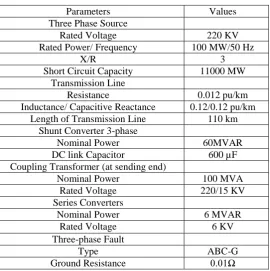
TABLE II:
Simulation system parameters
Parameters Values
Three Phase Source
Rated Voltage 220 KV
Rated Power/ Frequency 100 MW/50 Hz
X/R 3
Short Circuit Capacity 11000 MW
Transmission Line
Resistance 0.012 pu/km
Inductance/ Capacitive Reactance 0.12/0.12 pu/km
Length of Transmission Line 110 km
Shunt Converter 3-phase
Nominal Power 60MVAR
DC link Capacitor 600 µF
Coupling Transformer (at sending end)
Nominal Power 100 MVA
Rated Voltage 220/15 KV
Series Converters
Nominal Power 6 MVAR
Rated Voltage 6 KV
Three-phase Fault
AKNOWLEDGEMENT
I would like to express the deepest appreciation to my guide Prof. P.D. Kulkarni for their help to complete this paper. I would also like to thank my HOD Prof. K.R. Patil for their great support, also thanks to KCE‟s Engineering College to provide lab and instrument to me for my work. At last but not least, I would like to thanks the MSETCL Dhule substation for give me the chance to work with them and provides all required data. At least but not last, I am thankful my parents who support and encourage me for this works.
REFERENCES
[1] Ahmad Jamshidi, S. MasoudBarakati, 2012, “Power Quality Improvement and Mitigation Case Study Using Distributed Power Flow Controller”, IEEE. pp.464-468
[2] Mr. N. Peddaiah, Mr. K. VeeraSekhar, Mr. J. Lakshman and Mr. G. Rajashekhar,April-2013‟“A Revolutionary Idea to Improve Power Quality by Using Distributed Power Flow Controller [DPFC]”, „International Journal of Emerging Trends in Electrical and Electronics (IJETEE) Vol. 2, Issue. 1. pp.1-5.
[3] Bhim Singh, Kamal Haddad, October 1999, “A Review of Active Filters for Power Quality Improvement”, IEEE Transactions on Industrial Electronics, Vol. 46. pp. 960-971.
[4] Ch. Pushpanadham, Tegala. SrinivasaRao, October 2013,“A Novel Power Quality Improvement Technique Using Multi-Connected Distributed Power Flow Controller (MC-DPFC)”, „International Journal of Advanced Research in Electrical, Electronics and Instrumentation Engineering‟, Vol. 2, Issue 10. pp.5232-5242.
[5] Sai Lakshmi K, Mrs G. Ujwala, Dr. K. Ramesh Reddy, July 2014,“Mitigation Of Voltage Sag And Swell For Power Quality Improvement Using Distributed Power Flow Controller”, „International Journal of Professional Engineering Studies‟ Volume Ii/Issue 4. pp.78-84.
[6] P. Ramesh, M. Damodara Reddy, 2012,“Power Transfer Capability & Reliability Improvement in a Transmission Line using Distributed Power Flow Controller”, „International Journal of Electrical and Computer Engineering (IJECE)‟, Vol.2, No.4. pp. 553-562.
[7] S. MasoudBarakati, ArashKhoshkbarSadigh and EhsanMokhtarpour, 2011, “Voltage Sag and Swell Compensation with DVR Based on Asymmetrical Cascade Multicell Converter”, North American Power Symposium (NAPS), pp.1-7.
[8] Alexander Eigels Emanuel, John A. McNeill 1997, “Electric Power Quality”. Annu. Rev. Energy Environ, pp. 263-303.
[9] P. Pohjanheimo and E. Lakervi, “Steady state modeling of custom power components in power distribution networks,” in Proc. IEEE Power Engineering Society Winter Meeting, vol. 4, Jan. 2000, pp. 2949–2954.
[10] Zhihui Yuan, Sjoerd W.H de Haan, Braham Frreira and DaliborCevoric “A FACTS Device: Distributed Power Flow Controller(DPFC)” IEEE Transaction on Power Electronics, vol.25, no.10, October 2010.
[11] Zhihui Yuan, Sjoerd W.H de Haan and Braham Frreira “DPFC control during shunt converter failure” IEEE Transaction on Power Electronics 2009.