International Journal of Innovative Technology and Exploring Engineering (IJITEE) ISSN: 2278-3075, Volume-8 Issue-12, October 2019
QOS Modelling for Software Service Improvement
using Adaptive Learning
Chinnam Subbarao, I. Ramesh Babu,
ABSTRACT: In this paper, we discussed about quality of service (QoS) related to software implementation for outsourced applications. Quality of service is key challenge to produce distributed software services and mainly focused on relative service provide based on possessions usage of distributed environment. In this work, we presented effective QOS Machine Learning approach to calculate and predict quality of service with respect to outside environment conditions. We also presented depth analysis on relative and successive correlations with enhanced performance of resource classification. Improve and maintain quality of service for dynamic resource utilization and perform application level semantic data relation. The objective of research work is to provide a hybrid learner’s resolution that increases the precision while keeping prototype complication passable. Our proposed experimental results give more accurate and efficiency with respect to traditional approaches.
Keyword: Adaptive Learning, Quality of service (QoS), Control Primitive, Hybrid Multi-Leaners, Cloud-based Software, Linear Regression and Machine Learning.
I. INTRODUCTION
The flexibility of Cloud-Based Software is responsible for a model change in the way we handle and constantly develop cloud-based application solutions. However, it would be a challenge for application technicians and Cloud-Based Software technicians to estimate the extensive difference of behaviors that application facilities can understanding while operating on a distributed and on-request atmosphere like Cloud-Based Software. It is principally hard we may predict the highly effective variations in quantity of work and the run time requirements of cloud-based application solutions. Its reality indicates that it gets more complicated to ensure the Quality of Support (QoS) once technological innovation cloud- view point’s resolutions. The strategy of off-line and guide organization techniques for QoS are simple complicated if possible exertion to accomplish. Through such viewpoint in attention, the important issue, that facility suppliers expression is in what way to handle run time QoS by automatic climbing to the finest collection of device principles on-the-fly. Identifying several essential difficulties of QoS acting in the Cloud-Based Software, which have not been or have only been partly regarded in past perform.
Some of the major traditional approaches for escalation of QoS are introduced and they are analytical or simulated oriented and semi trained or dynamic software services. Semi supervised methodologies focus on flexible and powerful applications for primitive relations in connection to quality facility, which implies the application changes based to the QoS variations.
Revised Manuscript Received on October 05, 2019.
Chinnam Subbarao, Research Scholar, CSE, Acharya Nagarjuna
University, Guntur.
Dr. I. Ramesh Babu, Research Supervisor, CSE, Acharya Nagarjuna University, Guntur
However, existing collection and disconnected
circumstances to increase eminence of facility that can be reliable with virtual semi dynamic operations. So in this paper, we extend software process improvement i.e. Enhanced and Dynamic QOS Machine Learning Modeling to support dynamic data service processing in distributed computing based server applications.
The Research article is structured as follow: Segment II deliver summary of related theory in Cloud based Software Service Implementation. Section III states the Implementation of QoS adaptive learning approach. In Segment IV, relates the demonstration of our projected method against various other schemes. Lastly, Segment V designates the conclusions of this paper.
II. RELATED THEORY
Frequently, administrations and multi-level utilizations can have numerous imitations for different resolutions in the cloud. For instance, benefit separation, stack regulating and so forth. Along these lines we accept that every level in a multi-levels application, comprising of solid administrations S1, S2, ... Si, can have different imitations conveyed on
various Virtual Machines even PMs. In this effort, we suggest to the imitations of durable organizations as direction occurrences: the kth profit circumstance of the lth durable organization is specified by Skl. Numerous
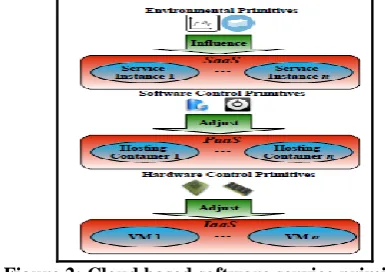
[image:1.595.319.512.530.666.2]administration examples are conveyed on a cloud programming stack working on VM that can be format utilizing different device handles. These device handles can be whichever shared among the administration occasions running on a Virtual Machines or particular to one administration example (e.g., strings of an administration case).
Figure 2: Cloud based software service primitives The populaces in cloud plug in as the important influences of a QoS presentation. Deprived offail of all inclusive statement, we decay the idea of natives into 2 noteworthy areas: these are Environmental Primitive (EP) and Control Primitive (CP). Control Primitives are the inward device handles and can be any programming or equipment that can be overseen by the cloud suppliers to help QoS. In
particular, programming
device natives are
the significant designs in cloud, for example, the quantity of strings in string group of administration/application, the cradle dimension and capacity adjusting strategies and so on. Though, equipment control natives are computational assets, for example, memoryand CPU. As appeared in Figure 2, programming and equipment device natives depend on the IaaS and PaaS deposits individually. Specifically, it is non-unimportant to study programming device natives while displaying QoS in the cloud as they have been appeared to be very significant highlights for QoS. Then again, Environmental Primitives allude to the outer jolt that reason flow and vulnerabilities in the cloud; for cases, workload and unusual approaching information and so on. On the off chance that the cloud supplier can control the nearness of the boost, at that point these can be considered as control natives. To enhance precision and avoid clamors, choosing the correct natives as sources of info is basic for QoS demonstrating in the cloud. In any case, the trouble is that the crude sources of info, which are significant and valuable for displaying QoS, have a tendency
to be energetic. In such setting, conceivable contributions of a QoS prototype can be the natives that have a tendency to specifically impact the QoS, it can likewise incorporate the natives that have a place with the co-found administration cases and the co-facilitated VMs; Explicitly, all conceivable natives assistances for demonstrating the QoS traits of an administration occasion shape a space, which is named conceivable significant group space.
III. QOS ADAPTIVE LEARNING APPROACH
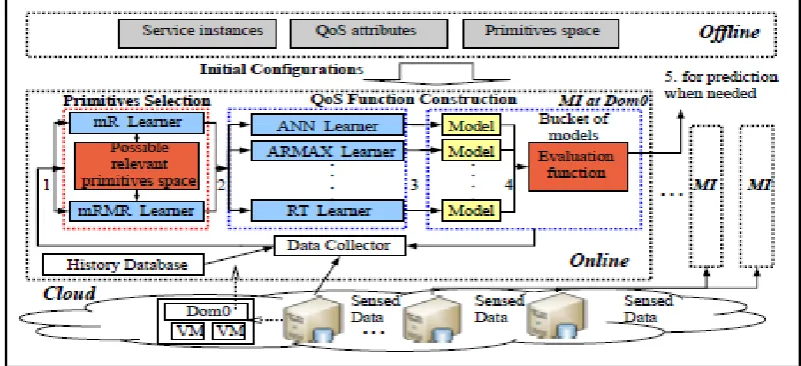
[image:2.595.105.506.282.465.2]Main progression of the projected approach is demonstrated in Fig.2, the administration cases run on different virtual services with primary machines are overseen by a devoted instance of middleware (MI), which is joined to the root area of PM. Every MI is individual-versatile as the criticism circle turns ceaselessly to retain methodologies are refreshed. Projected approach is intended for web service oriented situations; the main offline planning is to characterize the present administration occurrences.
Figure 2: Overview of the proposed approach working with distributed computing based software services.
Inside the input circle, Data Collector constantly screens and supplies info tests of service quality and natives from the administration occurrences / random virtual machines run on primary machines, and those from alternate PMs within the sight of utilitarian reliance. It can be accomplished by getting to the distributed computing to pre-defined environments. It is important that the displaying interim can be processed with the inspecting interim. Upon each demonstrating interim, quality is an administration occurrence, every single chronicled datum is passed with native’s choice stage for figuring out which and when
natives correspond with service quality at organization running time. There are two main steps to reveal quality of service utilization in web services. They are Hybrid learner for software services, QOS function for adaptive multi-learner. We segment the natives that give distinctive parts of data on different service quality applications; it conveys about p + 1 allotments where p is equivalent to the quantity of natives in the immediate group space; in staying single parcel alludes to the circuitous crude space. Procedure for hybrid web services learned as follows.
Algorithm 1: Basic representative process communicate to hybrid data processing Input: Given Vector B relates to QoS associated with direct primitive parameters.
Initialization: direct primitives with respect to associated attributes Independent attributes representations for different attribute parameters.
the line records of the chosen relevant attributes in matrix
SP t
kij( )
k (t)
1: begin primitives selection
International Journal of Innovative Technology and Exploring Engineering (IJITEE) ISSN: 2278-3075, Volume-8 Issue-12, October 2019
3: Cdirect := argmax
( , )
G Y
based on above equations4: Cindirect: =argmax
( , )
G Y
connected with above equivalences.5: end primitives selection
Particularly, main objective functions relate to our proposed application the subsequent deviations will seem centered on dissimilar purposes:
, '
( , )
1
( ,
')
k N S
N N S
V A B
V A A
Multi-predictive parameter sequences relate to provide web services.
2
, '
( , ) (
1)
2
( ,
')
k N S
N N S
V A B
n
k
k
V A A
Average service utilization via software based distributed computing services
Where A0 is vector representation of different types of relative & primitive attributes, already discussed in above sections. It is defined to filter un-relevant and predefined attributes and process quickly. These parameters give maximal relevance for different attributes as follows:
max
( , ),
( , ), , . ( , )
0
n
N G
G Y
V A B s t V A B
Where G signifies direct primary space relates and supports for other direct parameter sequences to support for both relevant and irrelevant primitives. Machine learning calculations contain effective nature in different levels of quality of service work capacity maintenance and evaluation of adaptive services to explore finest index data. So that, Introduce a versatile multi-apprentices method for refreshing QoS function.
IV. EXPERIMENTAL ANALYSIS
This section describes performance evaluation; we experimentally define multi-learner data representation to access software services with respective learning model sequences. To increase accuracy in advance of service implementation based on intensive data against software primitives. We implement this application in standard computer configurations. To take out the impedance caused by displaying, we designated single CPU center and 1.2GB RAM to Dom0, that has a tendency to be adequate. To reenact QoS obstruction caused by the VMs while not debilitating assets, we run 3 co-facilitated VMs on every PM; the rest of the assets are equitably designated to the co-facilitated VMs. We discussed classification accuracy with respect to different resources like CPU, Memory, Mean, Prediction Accuracy and Time analysis of projected approach in terms of different services utilized by clients. As specified in above sections, we pre-process the data related distributed computing oriented resources to process dissimilar consistency client’s data.
[image:3.595.94.491.525.722.2]To reproduce a sensible workload inside the limit of our test bed, we change the quantity of customers relatively concurring to the FIFA98 capability that is packed in the mode that the change of a day in the pattern relates to 200 secs for our situation. This setup can create up to 400 parallel solicitations; we trust that such pressure is sensible and sufficiently substantial to reenact QoS impedance in an open cloud. The examining and demonstrating interims are both 119secsthrough the aggregate of 499 interims where the initial 150 interims utilize a static what's more, steady capability slant going for giving some basic information to the displaying; while the back 350 interims take after the FIFA98 drift. This arrangement can create one original example for every interim for refreshing the model.
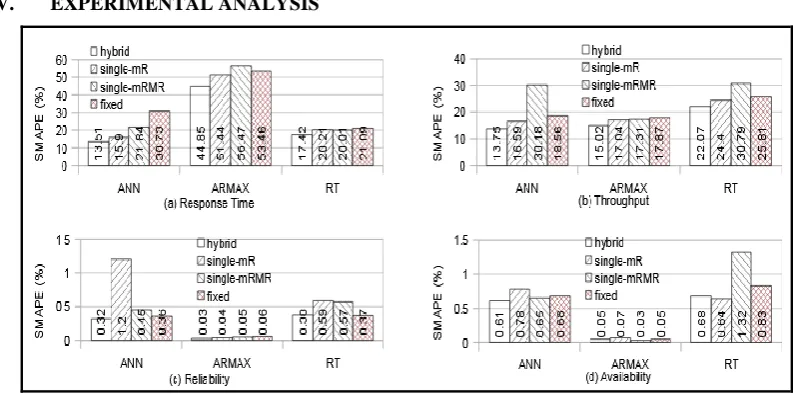
Figure 3:Precision of distinct QOS facilityconstraints with distinctqualities.
To survey our cross breed multi-students (indicated as HYBRID) for natives purpose, we contrast its impact on
solitary learner with mR (meant as SOLITARY - MR), solitary student with mRMR (signified as SOLITARY-M RMR) and the Settled strategy that statistical utilizes assured natives (memory and CPU for our situation) as information sources. For entire circumstances, we relate3 broadly utilized knowledge intentions (i.e., RT, ARMAX and ANN) for QoS work preparing under entire QoS properties. Fig. 3(a) demonstrates the outcome for reaction time. Specifically, the diminishment on expectation mistake varieties from 3.93% (12.61% to 14.8% in contradiction of SOLITARY-MR on ANN) to 16.33% (12.61% to 31.337% in contradiction of SECURE on ANN). Comparative
outcome can be seen in Fig. 3(b) that demonstrates the precision for production. The HYBRID is better than the others for all calculations with change running from 1.99% (14.67% to 16.89% in contradiction of SOLITARY - MR on ARMAX) to 15.33% (14.45% to 29.81% in contradiction of SOLITARY - M RMR on ANN). The precision for unwavering quality and accessibility are outlined in Fig. 3(c) and 3(d). The HYBRID is over superior to the others on ARMAX and ANN for unwavering quality; it is additionally the finest solitary on ANN for accessibility.
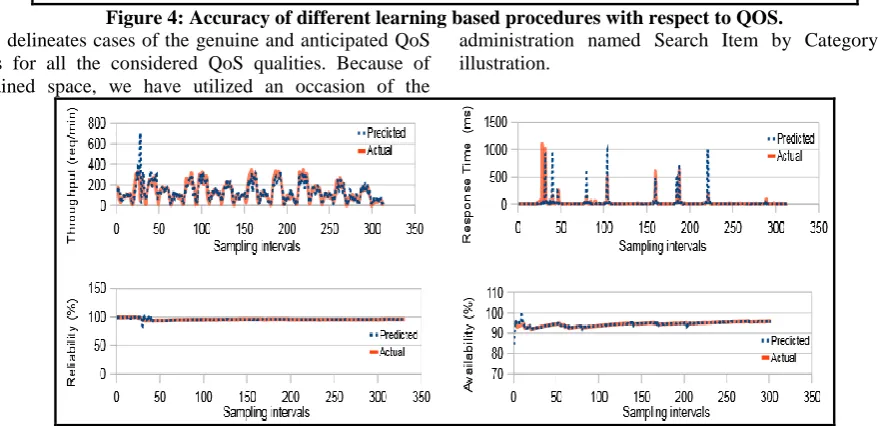
[image:4.595.92.508.189.298.2]Figure 4: Accuracy of different learning based procedures with respect to QOS. Fig. 4 delineates cases of the genuine and anticipated QoS
regards for all the considered QoS qualities. Because of constrained space, we have utilized an occasion of the
administration named Search Item by Category as the illustration.
[image:4.595.75.516.295.508.2]Figure 5: Predictive QOS standards for distributed software atmosphere.
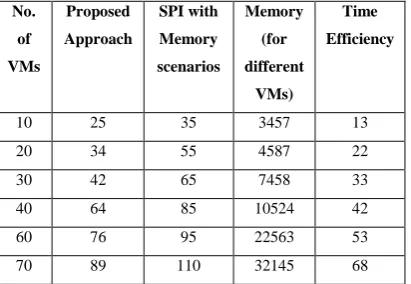
Fig. 5-6 and table 1 show that the CPU utilization in resource provisioning in distributed computing with different services .
Figure 6 CPU Utilization based on different virtual services in distributed computing.
Table 1: CPU Utilization values for different VMs with respect to memory
[image:4.595.111.478.544.694.2]International Journal of Innovative Technology and Exploring Engineering (IJITEE) ISSN: 2278-3075, Volume-8 Issue-12, October 2019
No.
of
VMs
Proposed
Approach
SPI with
Memory
scenarios
Memory
(for
different
VMs)
Time
Efficiency
10 25 35 3457 13
20 34 55 4587 22
30 42 65 7458 33
40 64 85 10524 42 60 76 95 22563 53 70 89 110 32145 68
[image:5.595.78.284.50.192.2]Memory usage for different services specified in Fig. 7, it shows different memory storage with different services based on virtual machine readings.
Figure 7: Memory interpretation for dissimilar virtual machine conditions.
Execution time for different services from different virtual machines loading and running different services for different
users may appear in Fig. 8 with different resource operations.
Figure 8: Time efficiency for virtual machine utilization based on different services.
Finally, methods related to neural networks with an ideal and basic measure yield predominant forecast precision than mathematical Linear Regression presentations. To accomplish more classification accuracy in projection, the plotted graph models to be prepared by the creation information in a customary interim; along these lines have recursive data in arbiter relations. Be that as it may, since the preparation of Neural network configuration methodologies take noteworthy time, the recurrence of the preparation ought to be resolved in light of the fundamental asset utilization conduct of the application in outsourced distributed computing based software services.
V. CONCLUSION
Quality of service is key challenge in cloud to produce distributed software services and mainly focused on relative service provide based on possessions usage of distributed environment. In this work, we projected and advanced enriched and self- adaptive framework to improve delivery quality in distributed computing based software application developments. To track dynamic updates from relates to define service quality and interference, for that we use both multi attribute primitive learners to train different services running on distributed manner to satisfy accuracy. We define different learning procedures significantly increase QoS with their attributes based on fluctuative parameters. The objective of research work is to provide a hybrid learner’s resolution that increases precision while keeping prototype difficulty passable
and dynamic service
[image:5.595.130.470.241.373.2]attributes with aggressive and technical data representations. Our proposed experimental results give more accurate and efficient results when compare to formal procedures with different parameters like CPU utilization, memory and time efficiency in different applications.
REFERENCES
1. R. Bahsoon and T. Chen, "Self-adaptive and sensitivity-aware QoS modeling for the cloud" In the 8th SEAMS, pp. 43 –52, May 2013. 2. S. Chase, S.B. Jeffrey and H.C. Lim, "Automated Control for Elastic
Storage," In 10th Conference on Autonomic Computing, 2010. 3. C. J. Stone, R. A. Olshen, J. H. Friedman and L. Breiman,
"Classification and Regression Trees", Wadsworth, Belmont, 1984. 4. H. Ghanbari et al, "Tracking Adaptive Performance Models Using
Dynamic Clustering of User Classes”, In 2nd conference on
performance engineering, 2011.
5. T. JinandM. Arlitt, "A workload characterization study of the 1998 world cup web site," IEEE Network, 14(3), pp. 30 –37, May 2000. 6. Y. Jiang et al, "Self-adaptive Cloud Capacity Planning" In 9th IEEE
International Conference on Services Computing, 2012.
7. G.C. Reinsel, G.M. Jenkins and G.Box, "Time series analysis: forecasting and control", third edition. Prentice-Hall, 1994.
8. E. Frank and I.H. Witten, "Data mining: practical machine work learning tools and techniques", Morgan Kaufmann: Los Altos, CA, 2005.
9. B.E. Flores, "A pragmatic view of accuracy measurement in forecasting," Omega (Oxford), vol. 14, no. 2, pp. 93-98, 1986.
AUTHORS PROFILE
Chinnam subbarao MTech(CSE) Assistant professor of Department of computer
science Hindu college of Engineering and technology Amaravathi road Guntur Andhra Pradesh working as principal incharge and contributing several activities. His publications in national and international journals are more than 5
Prof. I. Ramesh babuB.E(ece),M.E (computer engg.), Ph.D (computer science & engg) Professor