Abstract: Mobile Ad-hoc Network (MANET) is a collection of self sustaining mobile nodes which are connected through many wi-fi links to form a temporary communication for sharing information between the users. Mobile nodes behave as a host as well as router. As nodes in MANET posse’s mobility in traits frequently leads to irregular link between the nodes. Link failure directs a significant routing overhead during high mobility and also maintaining all the information associated with nodes and routing paths are considered as an extra overhead on the table. In order to overcome these issues, the routing algorithm to eliminate stare routed in routing cache. The neighbor degree centrality table is introduced to recognize the valuable nodes, using the valuable nodes the routes are discovered and link failure information are disseminated across the network wide. The results and findings show that the elimination of stale routes leads to significant reduction in routing overhead which in turn reduces the route error propagation delay.
Keywords : Stale Routes, Route Cache, Degree, Centrality measure, Route Error
I. INTRODUCTION
M
obile Ad-hoc Network (MANET) is a collection of independent mobile nodes which are connected through many wireless links to form a temporary communication for sharing information among the users. The uniqueness of ad hoc networks are dynamic topology, self-configuring and infrastructure less networks, brings the effect of advancement in wireless technology. These properties are elevated ad hoc networks to in the emerging application such as military, commercial and rescue operation. The swift growth of ad-hoc networks can also have some of the issue. Mobile nodes on the network communicate with each other with the help of routing protocols. Routing is technique of discovering an optimal route to attain the destination. The routing protocols are playing a vital part to obtain the routing process. Consider, the source node (S) wants to convey a information to the intended node(D). The source nodes unaware of the destination, the routing protocols are applied to acquire the information about the destination. In Mobile Ad-hoc Network based on the information update mechanism the routing protocols are categorized as table driven protocols, onRevised Manuscript Received on October 04, 2019. * Correspondence Author
P.Tamilselvi, Research Scholar, PG and Research Department of Computer Science, Periyar E.V.R. College (Autonomous) (Affiliated to Bharathidasan University),Tiruchirappalli,India,Tamilnadu,
Email :[email protected]
Dr.T.N.Ravi, Assistant Professor, PG and Research Department of Computer Science, Periyar E.V.R. College (Autonomous) (Affiliated to Bharathidasan University),Tiruchirappalli,India,Tamilnadu..
Email: [email protected]
- demand routing protocols and hybrid protocols. The table driven routing protocols uses the routing table to find the route to reach the destination. On demand routing protocols initiate the route discovery process when there is a need. The major advantages of these protocols are routing overhead reduction due to the on demand action. The efficient dynamic routing protocols in MANET are Ad hoc On-Demand Distance Vector, Dynamic Source Routing, and Temporally Ordered Routing Algorithm. Reactive protocols comprises of two segments such as path finding and path maintenance segment. In path finding segment source node on the network transmit the RREQ packet to its corresponding neighbors to locate the route to obtain the destination. Path maintenance handles the topological changes notification. Link and node failure notification are carried out. AODV routing protocols maintain its active path in the routing table where as DSR routing protocols paths are maintained in the cache memory. AODV protocols maintain a Timer based state to erase the routes which are not recently used. It also uses the sequence number to identify the fresh route. But in DSR there is no special constrain to identify the fresh route and stale routes. The research paper examines the related works in Section II , based on that Section III describes the problem formulation Section IV highlights the proposed methodology and the followed Sections illustrate the result and discussion, performance evaluations.
II. RELATEDWORK
Deepadasarathan et.al proposed [4] the stale route cache problem is solved using dynamic source and opportunistic routing scheme. The reactive protocols do not restore the route failure within the network. The occurrences of connection failure is intimated to the previous forwarded node, that node identify the alternative path to get the destination by considering the stable link life time. The source routing avoids the loops and opportunistic routing avoids the stale routes. Route cache is used to avoid the initiation of the path finding process, which reduces routing overhead. The proposed method in [5] uses the concept of active route time out constraint to specify how long the routes are valid which is helped to avoid the stale routes. The Time to Live value is set to small to avoid the access of invalid route cache. The cache size is increased to avoid the discovery operation. When there will be increment in network size and node mobility the cache routes become stale routes. Aijaz Ahmad.et.al[6] proposed an algorithm to make a fast search on single and multiple paths on the cache using generic searching algorithm and associative cache memory organization and to avoid the stale route inconsistency cache
coherence handling scheme can be utilized. In DSDV routing
Routing Algorithm To Eliminate Stale Routes
(RAESR) In Mobile Ad Hoc Networks
protocol two identical paths are differentiated using the sequence number to avoid the stale routes. In AODV routing protocols unused paths are expired using the timer. In DSR the route error packets is forwarded by the concern node to the source node and other nodes which node had previously used this link. So, that the concerned broken link is removed from the cache or routing tables. V.V.Mandhare and R.C.Thool[7] suggested that DSR uses path cache and link cache to store the information. Path cache stores the route to contact the destination; link cache holds information related to the available link. Here the size of the cache and expiry time is considered as the major factor. The expiration time specify how long the stale route can present in the route cache. Author proposed a novel approach called disseminated route cache update algorithm, in which the link failure information is intimated to each and every node present on the environment and the route cache is updated in a distributed manner. A.Vijay vasanth et.al uses Cache refreshing policies to enhance the QOS performance of MANET[8]. The route caching reduces the latency of searching of paths. The cache routing reduces the route discovery process and routing overhead. Even though if it has the advantages some of the issues are No expiry, broken link notification, Timer base route expiry renew stale route. The problem can be solved by cache refreshing policies. Dynamically the cache information are updated. Reputation aware multi -hop routing protocol calculate the trust value of the node using additive increase and multiplicative decrease to determine the reliability of a node. It uses the distributed cache replace algorithm by providing the external RERR notification of size sixth bytes to all its neighbors. The author recommend three various techniques [9] to improve the correctness of cache. There are wide error notification, route expiry mechanism and use of negative cache. For wide error notification the route error packet is broadcasted to all of its neighbors on the network. Upon receiving the route error broken links are truncated from the source route and intimated to all the nodes and its neighbors. For route expiry mechanism well chosen static value is set as expiration time. The time out time is calculated based on the maximum of average route life time and time since last link breakage. The cached routes which are not used for ∆t time is pruned. In the negative cache technique before adding entry in the cache the existence of failed links are removed. By assigning an adaptive timeout period for every node based on the hop count of the route is intended in [10]. Two major parameters are used to determine the time out period. There are path life time and hop count. The optimal path life time is the ratio between the radio range and maximum speed of the node. Timeout of the route can be determined as the ratio between default life times and hop count. For larger hop route time out was less. For lesser hop route the time out period was highly assigned. According to the timeout notification the stale routes are eliminated. In[11] the performance of DSR protocol and route reply packets always depends on the cached route. Due to the high mobility and high traffic natureonly 59% of the RREP packets carry the correct routes. Because the route may broke down which does not guarantee to get 100% correct route to forward the route reply packets. DSR cannot have any mechanism to differentiate fresh route and stale routes in the route cache. The stale route causes adverse effect on the network. Routing overhead can also incurred during the generation of route error. Soon Don Kwon.et.al divided the cache capacity into
four parts and time out period for the route cache is also determined according to that the cache priority is assigned [12]. When the node receives the similar path which is available on the route cache increase the time out period and assigning the highest priority of the route and rejecting the route reply packet information. When the cache memory is full then it filters the shortest remaining time holding routes and the new routes will be registered. Zifen Yang.et.al anticipated a three phase novel algorithm with the combination of energy, mobility and degree of the status in order to obtain the stable routing path and to prolong the life time of MANET [13]. The Minimum connected dominating set acted as a backbone for routing. The main advantage of CDS is to restrict the search space, reduce the flooding stream, routing overhead and energy consumption. DSR routing protocols are optimized using Ant – colony optimization algorithm in order to provide efficient routing [14]. DSR-Ant provides improved result in case of end to end delay, throughput hop count. DSR-ant algorithm also reduces the search for shortest path identification. The transmitting power of the node and hop counts determines the selection of path in [15]. The transmitting power of each node is compared with the set of threshold power value set. The node which has the highest power than the threshold power, select the minor hop count and choose the shortest path. The node which has the lower power than the threshold power, select the larger hop count and choose the longer path for routing. Based on the reviews the stale routes are avoided either by specifying the route expiration time or by propagating the route error message to all the nodes. The proposed work concentrates on the Route Error message notification broadcasting with certain conditions, because to reduce duplicate error notification and redundant updating on the route cache.
III. PROBLEMFORMULATION
In DSR the source node holds the entire path of the destination. It also stores several paths for the same destination in its route cache. Route cache is also an important feature in DSR, due to that routing overhead and latency is reduced in low mobility environment. This benefit also causes some of the issues. With the high mobility environment and high traffic the cached route became stale route. In case any node on the network follows the stale route it does not get its destination. Due to that the node re-initiate path finding process which increase delay, packet loss and routing overhead The main root causes for the generation of the stale routes problems are
i)
Insufficient Error Intimation to all the neighbour nodesii) No Expiration Time of the Cached Route
Whenever a link failure occurs on the network, the route error message is unicasted and transmitted only to the source node. The Source node alone will be aware of the link failure, but the intermediate nodes are unaware of it. DSR does not maintain any of the time states for erasing the old routes as well as it does not uses any sequence numbers to distinguish the old routes and fresh routes.
propagating the Error message along the network wide.
IV. PROPOSEDMETHOD
The DSR routing protocols doesn’t have any mechanism for route entry invalidation or route prioritization once there is a selection of multiple routes. Hence, the proposed study concentrates on two factors.
i) To reduce the routing table entries ii) Eliminate the stale routes by invoking the propagation of Route Error packet on network wide Both can be achieved with the help of centrality measures on the network. Centrality measures are mainly related to the network analysis. The degree centrality procedure, is used to identify the most significant and valuable nodes within the network. The valuable nodes are elected based on the basic measures of highest number of neighbors and the node which has the highest flow on the network. In the route discovery procedure route request packet is forwarded to the neighbor nodes to find the destination node. Multiple paths are discovered to reach the same destination and all routes are stored in the path cache. Based on the degree centrality the highest valuable nodes involving paths are prioritized by rejecting all valuable nodes including paths. Because of that selection, in case of any failures, alternative routes can be easily found from the source. Separate neighbor degree table is maintained to make the comparison.
A. Reduce route table entries using degree centrality measures
Degree Centrality
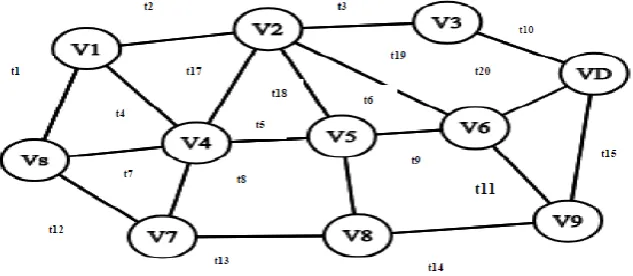
The network is considered as a graph G(V,E). The vertices (V) are represented as mobile nodes and the connection between the vertices are represented as edge E. Assume that the nodes are within the radio range and each node has a sufficient energy, bandwidth. Degree means that how many number of edges connected with the node and it measures opportunity of the node’s influential communication.
nj ij
di
a
C
0
Where Cdi is the degree of centrality, aij is the adjacency
matrix. The adjacency matrix is constructed dynamically to know about the connection between the nodes. When the nodes are within the range then it can have the connected edges otherwise there is no connection exist between the nodes. The existence of path between the nodes is represented as 1 in the adjacency matrix. The non existence of path is represented as 0. Consider the following network graph for the computation of degree centrality. Degree of nodes associated on the network, is computed with the multiplication of the adjacency matrix aij and the unit matrix.
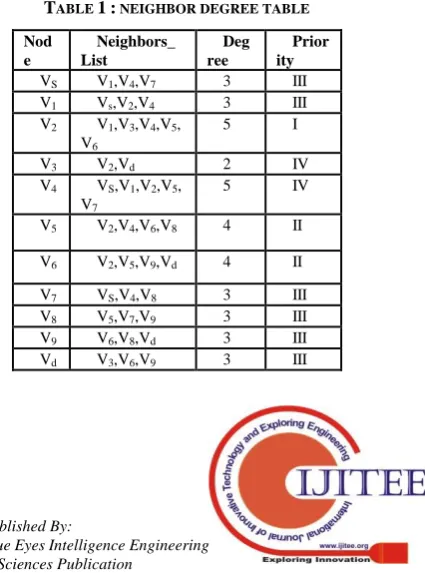
Based on the highest degree the most important nodes are ranked. The ranks are denoting the priority of the node. The node which is having the maximum number of neighbor is considered as the most influential node and has assigned the highest priority. The next lowest number of neighbors holding node is having the next highest priority. The proposed scheme mainly concentrated on first two highest priority holding nodes for the selection of the path. The neighbor degree table describes the degree of the nodes on the network which is listed in Table 1. Here the highest priority holding nodes are V2, V4, V5, and V6. The source node Vs
wants to transmit data to destination node Vd. The source
node transmit route request packet
[image:3.595.321.531.181.345.2]Fig 1: Network scenario
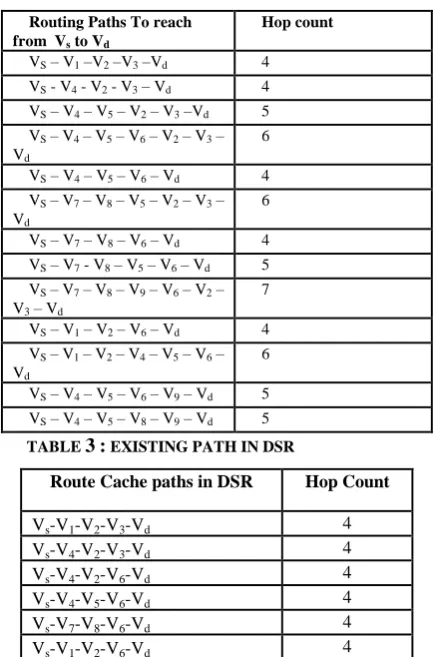
Figure 2 : Degree Centrality Computation To learn about the destination. The number of paths generated from Vs to Vd are listed in Table 2 DSR routing protocol
selects six best routes with minimum hop count paths from the thirteen available paths and store it in the route cache are depicted in Table 3. In the proposed method the paths are filtered using the valuable node participation and its prioritization. The prioritization is listed in Table 4.
Case 1: The path which contains all the paths are filtered using the valuable nodes is given the highest priority and included in the selection list.
Case 2: The path which contains next maximum number of valuable nodes is given the next priority and included in the selection list.
Case 3: If the routing route does no longer have any precious nodes reject the path.
TABLE 1: NEIGHBOR DEGREE TABLE
Nod e
Neighbors_ List
Deg ree
Prior ity
VS V1,V4,V7 3 III
V1 Vs,V2,V4 3 III
V2 V1,V3,V4,V5,
V6
5 I
V3 V2,Vd 2 IV
V4 VS,V1,V2,V5,
V7
5 IV
V5 V2,V4,V6,V8 4 II
V6 V2,V5,V9,Vd 4 II
V7 VS,V4,V8 3 III
V8 V5,V7,V9 3 III
V9 V6,V8,Vd 3 III
[image:3.595.338.551.548.835.2]TABLE 2: EXISTING PATHS TO REACH VS TO VD
Routing Paths To reach from Vs to Vd
Hop count
VS – V1 –V2 –V3 –Vd 4
VS - V4 - V2 - V3 – Vd 4
VS – V4 – V5 – V2 – V3 –Vd 5
VS – V4 – V5 – V6 – V2 – V3 –
Vd
6
VS – V4 – V5 – V6 – Vd 4
VS – V7 – V8 – V5 – V2 – V3 –
Vd
6
VS – V7 – V8 – V6 – Vd 4
VS – V7 - V8 – V5 – V6 – Vd 5
VS – V7 – V8 – V9 – V6 – V2 –
V3 – Vd
7
VS – V1 – V2 – V6 – Vd 4
VS – V1 – V2 – V4 – V5 – V6 –
Vd
6
VS – V4 – V5 – V6 – V9 – Vd 5
VS – V4 – V5 – V8 – V9 – Vd 5
TABLE 3: EXISTING PATH IN DSR
Route Cache paths in DSR Hop Count
Vs-V1-V2-V3-Vd 4
Vs-V4-V2-V3-Vd 4
Vs-V4-V2-V6-Vd 4
Vs-V4-V5-V6-Vd 4
Vs-V7-V8-V6-Vd 4
Vs-V1-V2-V6-Vd 4
In the existing work six paths are stored in the path cache. But in the proposed work only four entries are pruned out using the most valuable nodes. The most valuable nodes are V2,V4,
V5, and V6. The pruned routes are listed in Table 5. Because
of this cache search time and cache path updating time is also reduced. The purpose of keeping multiple routes is, after the link failure notification there is no need of initiating the route discovery process because the alternative route is obtained in the source itself to reach the destination. This is the prerequisite to avoid the route discovery.
TABLE 4: ROUTE CACHE PATH SELECTIONS USING RESAR
Number of
valuable
Priority for route cache Route Cache in
DSR
Hop count
Nodes in the path
(V2,V4,V5,V6)
Vs-V1-V2-V3-Vd 4 1 III
Vs-V4-V2-V3-Vd 4 2 II
Vs-V4-V2-V6-Vd 4 3 I
Vs-V4-V5-V6-Vd 4 0 IV
Vs-V7-V8-V6-Vd 4 2 II
Vs-V1-V2-V6-Vd 4 3 I
TABLE 5:PRUNED ENTRIES USING RAESR
Route cache entries in RAESR
Vs-V4-V2-V3-Vd
Vs-V4-V2-V6-Vd
Vs-V7-V8-V6-Vd
Vs-V1-V2-V6-Vd
[image:4.595.60.279.62.391.2]
B) Elimination of stale routes using RERR packet Reactive routing protocols do not locally repair the broken links. In DSR the occurrences of link failure are informed by RERR packet to the source using reverse path propagation. The route error packet contains the broken link information. Only the source node aware of the broken links other intermediate nodes unaware about the broken link. So the proposed method propagates the route error to all its neighbors using the degree centrality measures. The highest neighbor holding nodes spread the information very fast so the propagation priority goes to the highest degree holding nodes. Blind broadcasting of RERR packet also causes much overhead due to the duplicate copy of packet received by the same neighbor. Consider the broken link between V3 and Vd.
Figure 3: Link failure between nodes V3 and VD
The path cache stored path does not cause any harmful effects on the network. In case the path cache stored path is Vs-
V1-V2-V3-Vd then the packet cannot reach the destination.
Now V3 or Vd checks its nearest influential node for the
propagation. V3 elect V2 as the most influential node, V2
propagate the link failure notification to V1, V4, V5 and V6 and
also these covered nodes are carried along the route error packet. Now the covered nodes are V3, Vd, V2, V1, V4, V5 and
V6. Before transmitting the RERR the node has to check the
covered list. If the node is within the covered list then route error packet cannot be propagated to the same node. Next V4
transmit the route error packet to Vs, V7. V7 propagate the
information to V8 and Vd informs to V9. Thus all the nodes
acquired the intimation of the broken link. The broken link is discarded on the cache and the intermediate link cache. Thus the stale routes are eliminated. While on the same time alternate route can also be recognized with the help of highest degree holding nodes.
V. RESULTANDDISCUSSIONS
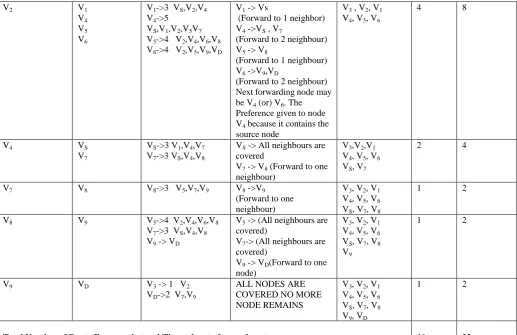
In RAESR method the routing table entries are pruned using the degree centrality measure and the link failure notification also spread through the highest neighbor holding nodes. Existing algorithm stored six paths in the route cache but in proposed method it uses only four routing paths in the route cache. Updating of link failure is also happened only in few entries not in all the entries associated in the routing cache. Consider the Network consist of 11 nodes and time taken to travel between the nodes are represented as t1,t2, t3.... and so on. When node V3 transferring data to node VD , Node v3
does not receive any message from VD which denotes the link
failure between the nodes V3 and VD. The number of route
[image:4.595.337.515.242.318.2] [image:4.595.50.266.522.764.2]proposed methods are listed in Table 6 and Table 7.
Figure : 4 Time Taken to Travel Between the nodes
Table 6: Number of RERR Notification and Time Taken for propagating RERR in Existing method
Initial Route Error forwarding Node
Neighbor Node
Number of RERR packet
Time to update
(in msec) each node takes 1msec
Total Time taken to forward the error
V3 V2 1 t3 2
V2 V1,V3,V4,V5,V6 4 t2+t17+t18+t19 8
V1 VS,V4, V2 3 t1+t4+t2 6
VS V1,V4,V7 3 t1+t4+t12 6
V4 V1,V2,VS,V5,V7 5 t16+t17+t4+t5+t12 10
V5 V4,V8,V6,V2 4 t5+t9+t6+t18 8
V6 V2,V5,V9,Vd 4 t19+t6+t11+t20 8
V7 VS,V8 2 t12+t13 4
V8 V5,V9 2 t9+t14 4
V9 V6,Vd 2 t11+t20 4
Total Number of Route Error
30 60 msec
T
able 7: Number of RERR Notification and Time Taken for propagating RERR in proposed method Route ErrorForwarding initiating node
Neighbors List Neighbors Degree and its neighbour
Next Route Error Forwarding initiating Node Selection
Forwarded Node list
No.of Route Error
Total Time taken to Forward RERR
V3
(Generating the RERR Packet)
V2, Vd
(Don’t consider VD)
V2 ->5
V1,V3,V4,V5,V6
V2 - V1,V4,V5,V6
(Forward to 4 neighbors)
[image:5.595.48.558.291.649.2]V2 V1
V4
V5
V6
V1->3 VS,V2,V4
V4->5
VS,V1,V2,V5V7
V5->4 V2,V4,V6,V8
V6->4 V2,V5,V9,VD
V1 -> Vs
(Forward to 1 neighbor) V4 ->VS , V7
(Forward to 2 neighbour) V5 -> V8
(Forward to 1 neighbour) V6 ->V9,VD
(Forward to 2 neighbour) Next forwarding node may be V4 (or) V6. The
Preference given to node V4 because it contains the
source node
V3 , V2, V1
V4, V5, V6
4 8
V4 VS
V7
VS->3 V1,V4,V7
V7->3 VS,V4,V8
VS -> All neighbours are
covered
V7 -> V8 (Forward to one
neighbour)
V3,V2,V1
V4, V5, V6
VS, V7
2 4
V7 V8 V8->3 V5,V7,V9 V8 ->V9
(Forward to one neighbour)
V3, V2, V1
V4, V5, V6
VS, V7, V8
1 2
V8 V9 V5->4 V2,V4,V6,V8
V7->3 VS,V4,V8
V9 -> VD
V5 -> (All neighbours are
covered)
V7-> (All neighbours are
covered)
V9 -> VD(Forward to one
node)
V3, V2, V1
V4, V5, V6
VS, V7, V8
V9
1 2
V9 VD V3 -> 1 V2
VD->2 V7,V9
ALL NODES ARE COVERED NO MORE NODE REMAINS
V3, V2, V1
V4, V5, V6
VS, V7, V8
V9, VD
1 2
Total Number of Route Error packet and Time taken to forward route error 11 22msec
[image:6.595.44.562.49.384.2]The proposed algorithm RAESR is compared with RAMP algorithm. Number of route paths pruned, stale routes updated, Number of route errors generated and time taken to propagate the route errors are depicted in figure 5 and figure 6.
Figure: 5 Total Number of Routing paths in Route Cache and Number of Stale Route Updated in Existing Vs Proposed
Figure 6: Total Number of Router Error and Route Error Propagation Time in Existing Vs Proposed
VI. PERFORMANCEEVALUATION
[image:6.595.316.535.537.696.2]The simulation is carried out the usage of NS-2.34 Simulator. The speed and number of nodes are two parameters varied to estimate the performance. The simulation area is fixed as 500 X 500sqm with varied node density. The node density viewed as are 10, 20, 30, 40 and 50 and communication range is set as 250m. The mobile nodes follows random way mobility model. The values and setting are tabulated in Table 8.
Table 8 Simulation parameter and Values for RAESR
Parameters Values
Node Density 10,20, 30, 40 and 50
Area Size 500m x 500m
MAC Protocol 802.11 Transmission Range 250m Simulation Time 100ms Traffic Source FTP Packet Size 512 Bytes
Mobility Model Random Way Point
Author-1 Photo
Author-2 Photo
VII. CONCLUSION
Stale routes are considered as the old route when there is a link failure occurs on the path. These stale routes cause unnecessary inconsistencies while routing the packets from the transmitting node to the receiving node. The proposed work focused on two main things the first one is reducing the routing entries and avoiding the duplication of route error packet while forwarding the route error. In order to minimize the stale route entries, the route which has maximum priority and its next lowest priority alone is maintained. To convey the message about the link failure the route error message is forwarded to the most influential node which appears nearer to the source node. The main aim of the proposed work is to minimize the delay while searching, updating the paths and conveying the link error message. In order to transfer any message the proposed work focused on the most valuable and most influential nodes this may increase the energy consumption.
REFERENCES
1. David B.Johnson and David A.Maltx “Dynamic Source Routing In adhoc Wireless Networks”, Computer science Department, Carnegie Mellon University.
2. D. B. Jagannadha Rao,Karnam Sreenu, Parsi Kalpana “ A Study on Dynamic Source Routing Protocol for Wireless Ad Hoc Networks” International Journal of Advanced Research in Computer and Communication Engineering,Vol. 1, Issue 8, October 2012. 3. N. Prasath,J. Sreemathy “Optimized dynamic source routing protocol
for
MANETs” Cluster Computing, January 2018 .
4. Deepadasarathan, Dr.P.Nirmal Kumar “A Novel Method to Avoid Stale
Route Cache Problem of Dynamic Source Routing Protocol for Mobile Ad hoc Network”, International conference on current Trends in Engineering and Technology, IEEE 2013.
5. Narinderjeet Kaur, Mahinder singh “Caching Strategies in MANET routing Protocols” , International Journal of Scientific and Research publications, volume2, Issue 9 , September 2012.
6. Aijaz Ahmad Anchari Asifa Amin, suhail Ashraf “Routing Problems in Mobile Ad hoc networks(MANET)”, International journal of computerScience and Mobile computing,Vol.6, Issue 7, pg.no 9 – 15 ,july 2017 .
7. V.V.Mandhare, R.C.Thool , “Improving QoS of Mobile Ad-hoc Network using Cache Updae Scheme in Dynamic source routing protocol” , International Conference on communication computing and Virtualization 2016 science Direct.
8. A.Vijay vasanth et.al “An Efficient Cache refreshing Policy to Improve Qos in MANET through RAMP” Second International Conference on computational Intelligence and Informatics in Intelligent Systems and Computing, chapter 10 , 2018
9. Mahesh K. Marina Samir R. Das “Performance of Route caching strategies on dynamic Source Routing“,21st international conference on distributed computing workshop, IEEE Explorer august 2002. 10. M.Tamilarasi, T.G.Palanivelu, Sanjeev Kumar Das ““HART: Hop
count based Adaptive Route cache Timeout for efficient routing using
DSR in MANETs”, IETE technical review volume 4, issue 6, pg.no 475-480 November 2007.
11. Naseer Ali Husieen+, Osman B Ghazali, Suhaidi Hassan, Mohammed M. Kadhum “Route Cache Update Mechanisms in DSR Protocol – A Survey” International conference on Information and network technology, April 2011.
12. Soon Don Kwon, Jung Shin Park, Jai Yong Lee, “A New route Cache Scheme in On-Demand Routing Protocols for MANET”, ICITA 2002. 13. Zifen Yang, Deqian Fu, Lihua Han,and Seong Tae Jhang, “Improved Route Discovery Based On Constructing Connected Dominating Set In MANET”, Hindawi Publishing Corporation, International journal of distributed Sensor Networks, volume 2015.
14. Thiyam Romila Devi, Rameswari Biswal, Vikram Kumar, Abhishek Jena, “Implementation Of Dynamic Source Routing (Dsr) In Mobile Ad Hoc Network (Manet)”, International Journal of Research in Engineering and technology”,Volume 2, Issue 11, November 2013. 15. Xu Zhang, Zhi-Hong Qian, Yu-Qi Guo, Xue Wang,” “An Efficient
Hop Count Routing Protocol for Wireless Ad Hoc Networks”, International journal of automation and computing, Feb 2014.
16. Natarajan Meghanthan, “Correlations between centrality measures for Mobile Ad hoc Networks”, International Journal Of Wireless Network and Broadband Technologies,4(2), 15-27, April-june 2015.
AUTHORSPROFILE
Ms.P.Tamilselvipursued Master of Computer Science from Alagappa University in the year of 2003. She is currently pursuing Ph.D and working as Assistant professor, Department of Computer Science, Cauvery college for women, Trichy, TamilNadu, India. She has 12 years of teaching experience. Her main research work focuses on Mobile Ad Hoc Network and Social Networks.