COLLEGE OF ARTS AND SOCIAL SCIENCES
Research School of Humanities and the Arts
SCHOOL OF ART & DESIGN
VISUAL ARTS GRADUATE PROGRAM
DOCTOR OF PHILOSOPHY
STEPHEN JON NEWTON
THE SHAPE OF TIME: A PRACTICE-LED INQUIRY INTO AFFECTIVE WEATHERING AND
MATERIAL MUTABILITY
A THESIS SUBMITTED FOR
THE DEGREE OF THE
DOCTOR OF PHILOSOPHY
OF THE AUSTRALIAN NATIONAL UNIVERSITY
ii
Declaration of Originality
I, Stephen Newton, hereby declare that the thesis here presented is the outcome of the
research project undertaken during my candidacy, that I am the sole author unless
otherwise indicated, and that I have fully documented the source of ideas, references,
quotations and paraphrases attributable to other authors.
iii
Acknowledgments
I thank my supervisors, Wendy Teakel, Sarah Scott and Amanda Stuart for their belief in the
project and their wealth of insight and guidance throughout my candidacy. I thank my first
chair, Paul Hay, for supporting the potential of the project. I thank my children, Rocco and
Iggy, for their unconditional love and humour. Finally, my deepest thanks go to my wife
Kellee, for her unwavering strength, support and patience. This research is supported by an
iv
Abstract
This practice-led research project investigates weathering as a sculptural process and studies
how changes in material can embody memory and suggest place. The idea developed from a
connection to Moreton Island, a small sand island off the east coast of Australia, shaped by
natural phenomena and the elements. In the research Moreton Island is a departure point
underpinning a philosophy of change and impermanence. The intention of the project is to
engage time-based, phenomenal methodologies with wood as a way to generate
unexpected and unplanned forms. This approach to making sculpture circumvents ideas
about the art object and its agency. In contrast to a dualistic model of making and
perception, the research in this project is underpinned by the Japanese Mono-ha
philosophy, meaning ’school of things’. The Mono-ha philosophy rejects representation in
favour of revealing material properties and conditions. The results of this research project
are discrete groups of sculpture in wood which have been affected by sun, wind, fire, water,
abrasion and oxidation. These natural processes involve maker, tool and material in a
correspondence which attempts to shape sculpture devoid of representation and referents.
The resulting sculptures are indications of time and change, ongoing systems trailing
material history and provenance. They are forms which invite one to reflect on the nature of
v
Contents
List of Illustrations ... vii
List of Exhibited Works ... x
Glossary of Terms ... xi
Introduction Mutability ... 1
Locating the Field ... 2
Project Outline ... 3
Philosophical Context: Correspondence and Phenomenology ... 6
Embodied Memory and Remembering Place ... 9
The Work of Other Artists ... 10
Chapter 1 – Being in Place and Tracing the Paths of Becoming Introduction ... 15
Returning to Place ... 16
Natural Environment as Cultural Habitat ... 17
Being in Place: Phenomenology and the Asymmetry of Difference ... 18
Moreton Island: A Topography ... 20
Fieldwork: From a Topography into Discursive Terrain ... 20
The Materiality of Memory (2015) ... 21
The Cape Moreton Lighthouse: axis mundi ... 24
Poetic Space ... 27
Summary: The Materiality of Memory ... 31
Conclusion: Refining Methodology ... 31
Chapter 2 – Correspondence and Agency Introduction ... 34
Wood: Matter and Material ... 35
The Agency of Material ... 37
Agents (2015) ... 40
Initial Experiments ... 40
vi
Memory ... 46
Relative (2015) ... 47
Shigeo Toya and David Nash ... 50
Conclusion ... 53
Chapter 3 – Principles of Action Introduction ... 55
Mono-ha ... 56
Evidence (2018) ... 58
The Fragment ... 58
Charring and Transformation in the Work of David Nash and Toshikatsu Endo ... 61
Occurrence (2018) ... 64
Rhythm, Repetition, Pressure and Time ... 68
The Hand and the Tool ... 69
Shigeo Toya and David Nash ... 70
Conclusion ... 75
Chapter 4 – Implication and Absence Introduction ... 77
The Vast Exterior/The Vast Interior (2017) ... 77
Not-Making ... 80
There is No Body in a Void ... 82
Emergent (2018) ... 83
David Nash and Shigeo Toya ... 86
Condition (2015-2018) ... 89
Michelle Stuart and Susan Derges ... 94
Conclusion ... 100
Bibliography Works Cited ... 103
vii
List of illustrations
All images not otherwise attributed are of the authors own work.
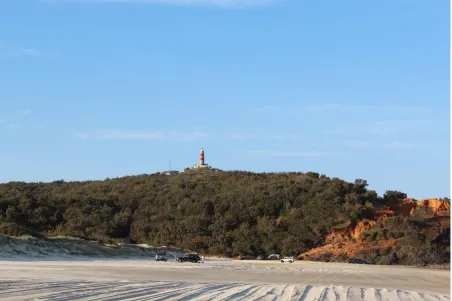
Fig. 1. Moreton Island. View of the lighthouse from the eastern beach. 2015.
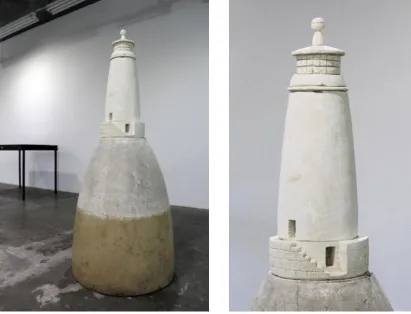
Fig. 2. The Materiality of Memory. 2015. Installation view. Limestone lighthouse on
reclaimed fibreglass base, reclaimed wardrobe, pumice stone, antique plumb bobs, sound
recording, reclaimed plan drawer containing works on paper, reclaimed plan drawer
containing sand, found ceramic and glass fragments.
Fig. 3. Lighthouse. 2015. Detail. Limestone, weathered fibreglass.
Fig. 4. Lighthouse. 2015. Detail. Limestone, weathered fibreglass.
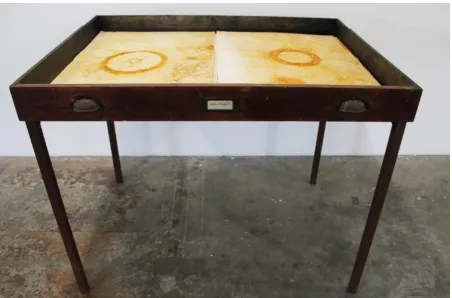
Fig. 5. Axis Mundi. 2015. Reclaimed plan drawer, rusted steel legs, seven rust on paper
works. 62 cm x 78 cm.
Fig. 6. Axis Mundi. Detail. 2015.
Fig. 7. Axis Mundi. Detail. 2015.
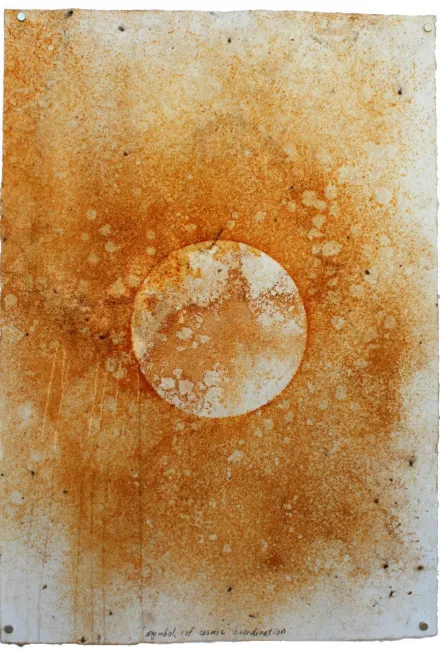
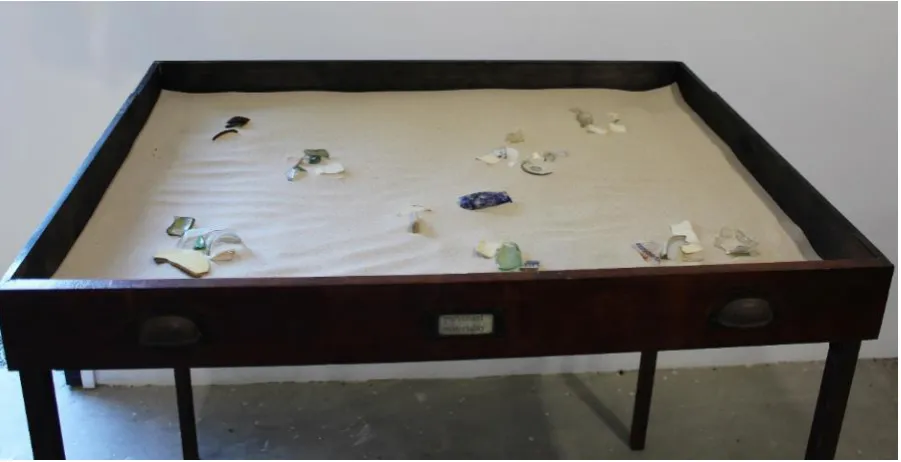
Fig. 8. Symbol of Cosmic Coordination. 2015. Rust on paper. 62 cm x 78 cm.
Fig. 9. Provenant Materiality. 2015. Reclaimed plan drawer, rusted steel legs, sand from
Moreton Island, fragments of glass and ceramic excavated from the Cape Moreton
headland.
Fig. 10. Provenant Materiality. 2015. Detail.
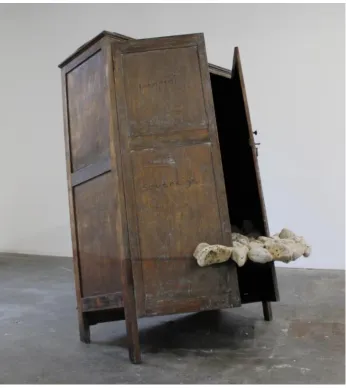
Fig. 11. The Materiality of Memory. 2015. Reclaimed wardrobe, pumice stone, antique
plumb bobs, sound recording.
Fig. 12. The Materiality of Memory. 2015. Detail.
Fig. 13. The Materiality of Memory. 2015. Detail.
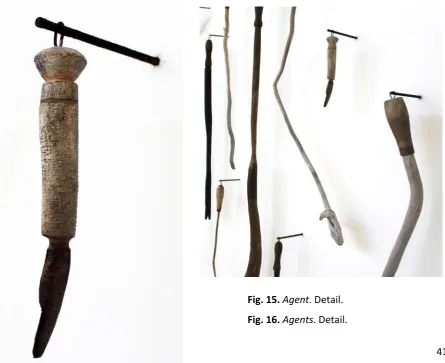
Fig. 14. Agents. 2018. Wood, rusted steel. 36 pieces. Overall installation 460 cm wide x 240 cm high.
Fig. 15. Agent. 2018. Detail.
Fig. 16. Agents. 2018. Detail.
Fig. 17. Martin Puryear. Some Tales. 1975-77. Ash and Yellow Pine. Neal Benezra, Martin
Puryear (Co-published by Thames and Hudson Ltd, London and The Art Institute of Chicago,
viii Fig. 18. Martin Puryear. Stripling, 1976, Ash. 215 x 25 cm. Neal Benezra, Martin Puryear
(Co-published by Thames and Hudson Ltd, London and The Art Institute of Chicago, 1993), 63.
Fig. 19. Martin Puryear. Untitled, 1975-77, Ash and Yellow Pine. 150 x 198 x 2.5 cm. Neal Benezra, Martin Puryear (Co-published by Thames and Hudson London and The Art Institute
of Chicago, 1993), 71.
Fig. 20. Relative. 2018. Wood. 34 pieces. Overall dimensions 180 cm diameter x 130 cm high. Fig. 21. Relative. 2018. Detail.
Fig. 22. Shigeo Toya. Woods. 2016. Wood, wood ash, acrylic. 220 x 31 x 31 cm each, 30
pieces. http://shugoarts.com/en/artist/166/, accessed January 23, 2018.
Fig. 23. Shigeo Toya. Woods. 2016. Detail. http://shugoarts.com/en/news-en/792/, accessed
23 January 2018.
Fig. 24. David Nash. Shatter Dome. 2000. Smashed oak. Sarah Coulson, ed., David Nash at
Yorkshire Sculpture Park. (Yorkshire Sculpture Park: United Kingdom, 2010), 62.
Fig. 25. David Nash. Beaver Chew Dome. 2000. Cottonwood. Coulson, Sarah, ed. David Nash
at Yorkshire Sculpture Park. (Yorkshire Sculpture Park: United Kingdom, 2010), 63. Fig. 26. Evidence. 2018. Wood. Seven pieces between 170 cm and 290 cm high. Floor
dimensions 600 cm x 400 cm.
Fig. 27. Evidence. 2018. Detail.
Fig. 28. Evidence. 2018. Detail.
Fig. 29. David Nash. Crag and Cave. 2001. Charred yew. Sarah Coulson, ed., David Nash at
Yorkshire Sculpture Park. (Yorkshire Sculpture Park: United Kingdom, 2010), 28.
Fig. 30. David Nash. King and Queen. 1991. Charred oak. Sarah Coulson, ed., David Nash at
Yorkshire Sculpture Park. (Yorkshire Sculpture Park: United Kingdom, 2010), 68.
Fig. 31. Toshikatsu Endo. Void (cylindrical). 2013. Wood, iron, earth, air, fire. 204 cm high x
458 cm diameter. http://artfrontgallery.com/en/exhibition/archive/2010_08/428.html,
accessed June 25, 2018.
Fig. 32. Occurrence. 2018. Turpentine corbels. Eight pieces. Overall dimensions 120 cm
diameter x 150 cm high.
Fig. 33. Occurrence. 2018. Detail.
ix Fig. 35. Shigeo Toya. Interface III. 1993. Wood, wood ashes, acrylic. 95 x 95 x 95 cm each,
nine pieces. https://www.artbasel.com/catalog/artwork/23921/Shigeo-Toya-Interface-III,
accessed January 27, 2018.
Fig. 36. David Nash. Eighteen Thousand Tides. 1996. Recycled oak groynes. Twelve pieces.
http://www.publicsculpturesofsussex.co.uk/object?id=63, accessed March 15, 2017).
Fig. 37. The Vast Exterior/The Vast Interior. 2017. Forest Red Gum. Fig. 38. The Vast Exterior/The Vast Interior. 2017. Detail
Fig. 39. Nobuo Sekine. Phase – Mother Earth. 1968. Earth. 270 cm deep x 220 cm diameter.
http://www.nobuosekine.com/image/phase-mother-earth-1968/, accessed April 12, 2018.
Fig. 40. Suga Kishio. Infinite Situation I. 1970/2012. Wood. 261.6 x 29.2 x 29.2 cm.
https://www.kishiosuga.com/installations-infinite-situation-i-window-1970/, accessed July
24, 2018.
Fig. 41. Emergent. 2017. Camphor Laurel. 90 cm diameter.
Fig. 42. Emergent. 2017. Detail.
Fig. 43. David Nash. Wooden Boulder. 1978. Wood, wood ash, acrylic. 90 × 98 × 92 cm.
http://ntwelshcoast.blogspot.com/2013/11/the-rediscovered-boulder.html, accessed
November 18, 2017.
Fig. 44. Shigeo Toya. Mass of Folds II. 2015. Wood, wood ash, acrylic. 60 × 60 × 62 cm.
https://www.artbasel.com/catalog/artwork/31816/Shigeo-Toya-Mass-of-Folds-II, accessed
July 22, 2018.
Fig. 45. The Moreton Archives. 2016. Artist books, wood table, steel.
Fig. 46. Selection of experimental works on paper. 2015-2018.
Fig. 47. Condition. 2018. Rust on paper. Three pieces on wall and floor. Each piece 110 cm
wide x 350 cm high.
Fig. 48. Condition. Detail.
Fig. 49. Michelle Stuart. Moray Hill. 1974. Graphite on muslin mounted paper. 365 x 157 cm.
https://www.alisonjacquesgallery.com/artists/197-michelle-stuart/works/16566/, accessed
August 14, 2018.
Fig. 50. Susan Derges. Shoreline. 1998. Photograph. 100 x 250 cm.
x
List of Exhibited Works
1 Agents. 2018. Wood, 36 pieces. Overall dimensions 460 cm wide x 240 cm high.
2 Relative. 2018. Wood, 34 pieces. Overall dimensions 180 cm diameter x 130 cm high.
3 Evidence. 2018. Wood, seven pieces. Approximate floor dimensions 600 cm x 400
cm. Height range from 170 cm – 290 cm.
4 Occurrence. 2018. Wood, eight pieces. Overall dimensions 120 cm diameter x 150 cm
high.
5 Emergent. 2018. Wood. 90 cm diameter.
6 Condition. 2018. Rust on paper, three pieces on wall and floor. Each piece 110 cm
xi
Glossary of Terms
Phenomenology
Phenomenology is a branch of perceptive philosophy which studies the interconnectedness
between the subject and the world which is perceived. This research is based on the
theories of Maurice Merleau-Ponty, which have been applied by archaeologist Christopher
Tilley and anthropologist Tim Ingold. Artists of the Japanese Mono-ha movement discussed
in this exegesis were also influenced by the theories of Merleau-Ponty. Throughout the
project Phenomenological methodology has been used as a perceptive and reflective
instrument.
Becoming
Becoming refers to the ongoing and changing vitality of all matter and material. The concept
originated with the Greek philosopher Heraclitus who said that ‘nothing in this world is
constant except change and becoming.’1 To understand becoming is to accept that matter
and material are in continuous flow with the phenomenal world. The concept of becoming
has been advanced by anthropologist Tim Ingold to describe the ongoing nature of
materials, and how this influences the maker, the process of making and subsequently the
final form. This project aligns the concept of becoming to a material’s mutability, and is used
to explain the change in a material through time and space in the phenomenal world.
Correspondence
The term correspondence is used to describe the physical relationship between the artist
and the material during the act of making. Correspondence is a process which is led by the
material and followed by the maker and the tool. It is a physical and reciprocal activity
requiring all the senses of the body.
1 Joshua J. Mark, “Definition: Heraclitus of Ephesus”. Ancient History Encyclopaedia, (accessed February 9,
xii Encounter
Encounter refers to a momentary experience one has with an object or an environment. It is
not based on a purely visual or aesthetic experience. It cannot be planned in advance and
can occur anywhere in time or place. To know we are experiencing an encounter is to
become aware of our physical relationship with the interdependency of material elements
and the surrounding space. More than just an experience in, or of, the world, an encounter
helps us understand our connection to the immediate environment and subsequently the
world. The theory of encounter originated in phenomenology. In this research I refer to
encounter as it was advanced by Lee Ufan from the Mono-ha art movement, who used it to
describe the relationship of the viewer to a sculpture. In this context the sculpture acts as a
mediator between the viewer and the immediate environment. I have explored how an
encounter with a weathered and mutable sculpture invites the viewer to consider their
connection not only to the immediate environment, but the natural world.
1
Introduction
Mutability
Man's yesterday may ne'er be like his morrow; Nought may endure but Mutability.2
Everything that exists undergoes continual change and transformation. We experience this
mutability in ourselves and witness it in everyone and everything throughout our lives. How
much or how little things change can be determined by the rhythms and cycles of natural
forces; the repetition and duration of phenomena upon all sentient and non-sentient
matter. Change is all around us; what we call the present is given shape by an accumulation
of a past which continually presses against us. Over time, the past manifests, becoming
embedded in matter and material. From a time-worn patina to the transformative effects of
abrasion, charring, bleaching and rusting, natural phenomenon act repeatedly upon all
matter and material, constantly affecting change.
This practice-led research project embraces change and impermanence as a methodology.
Its research purpose is to engage with material as it already exists; which is in a state of
mutability; and to use affective weathering as a way to perpetuate the appearance of this
state. As a result of the methodology, unplanned forms evolve with the potential to reveal
the shape of time in the material. The medium selected for this research project comes from
our most enduring and life-sustaining organism – the tree. In my practice as a sculptor the
mutability of the material is a metaphor for the mutability of the self as we negotiate our
ongoing relation to the natural world.
In chapter one I explain how I developed a methodology of change and impermanence. I
explain my first body of research, a broad investigation into materiality inspired by place.
Chapter two establishes a detailed context for the project. It questions the sculptural object
as an artefact with an ascribed agency, and explores the activity of making as a
2
correspondence between the artist and the material. In chapter three I describe two bodies
of sculpture which explore encounter, embodiment and memory. These sculptures contrast
two different weathering techniques which have been investigated in relation to the
physicality of making. Chapter four introduces one sculpture and a series of three large
works on paper. Both artworks are analysed with relation to the phenomenal landscape
which connects us to the lived world.
Locating the Field
This project exists within a contemporary western model of sculpture and three dimensional
practice. The research has been informed by current debates relating to sculpture, place,
materiality and memory. These debates are underpinned by contemporary artists’ work and
theories involving art and anthropology, materiality, making and embodiment, and finally
place and site. The artists whose work I reference have been selected for their investigations
into place, memory, and making. All the artists maintain a substantial studio practice, and
the sculptors I have referenced dedicate their practice primarily to the medium of wood. All
the artists discussed in the exegesis investigate relationships with the natural environment,
and advocate the criticality of this relationship in their research and artwork.
In my research I use the term materiality, which refers to an artworks physicality and how its
matter and material can be sensed and verified by the body. I also use materiality to refer to
the process of art-making and the physical correspondence between artist and material. In
the research materiality and physicality are directly linked to the works content and
subsequently, its meaning.
My research aims to reveal ways in which the weathering and abrasion of wood can present
itself both as a metaphor for memory as well as invoking the cognitive act of remembering.
Memory is then implied through affected forms and surfaces which reveal their own
mutability. Led by the properties of the medium and guided by an underpinning philosophy
of change, this practice-led research project examines ideas of materiality, mutability,
3
Because the development of the practice-led component of the project occurred in
chronological fashion, it seemed logical for the exegesis to follow the same structure, and is
presented across four chapters. Chapter one presents a body of preliminary research and
provides a methodology. Chapters two, three and four each explain the methodology of six
bodies of sculptural work and one body of work on paper.
Project Outline
My intention is to examine weathering processes and reductive techniques as a way to
produce sculpture in wood. The project was inspired by Moreton Island, a heritage-listed
sand island off the east coast of Queensland, Australia. I have camped at the same location
on this island for over twenty years. During this time, the islands natural environment,
geology and history have influenced my working process. Its constantly moving, sand-based
morphology has contributed to a philosophy of change and impermanence in my sculptural
practice which has, in turn, inspired the research topic.
Moreton Island is inscribed with indigenous and European history. Middens, gravesites,
military ruins, a lighthouse, shipwrecks, and all manner of historical and modern human
interventions have slowly merged with the morphology of the island. This amalgamation of
history and place has inspired me to reflect on the nature of memory and material, leading
to the primary research questions – how can the appearance of a time-worn material invite
an act of remembering beyond the agency of the object? Could a process of remembering
also be revealed in a material’s mutability and morphology? Ultimately, I wanted to know
how a sculpture, devoid of representation and referents, could embody memory and
suggest place through its materiality alone.
In this exegesis, Moreton Island is explained in relation to concepts of place. Establishing
place provides a stepping-off point into the main body of research. I then proceed to explore
ideas concerning material and memory and the separation from place. In the early stage of
the research I investigated the influence of Moreton Island with place-related concepts such
as: site-specific, place-inspired, site-activated, and place-generated; to name but a few
examples used in current literature. In my research I use a term which defines the nature of
4
acknowledges the importance of place in the project, while excluding any inference to an
objective topology.
The projects methodology therefore, is set within a framework of remembering. The
framework affects my relationship with materials and tools as well as the correspondence of
making. During making, my remembering and the material’s remembering echo and
correspond with one other. A portion of my research lies in exploring this correspondence as
it occurs during the physical actions of making. The research will be explained in a
chronological fashion which reflects the time-based philosophy of the project. Each body of
research will be presented with reference to prototypes, experiments and ongoing studio
development over the project’s six year duration.
Because I am asking how I can embody memory and suggest place by weathering wood, a
significant challenge I faced was to develop a methodology which could be articulated
through making. This process had to allow the wood to change of its own accord as a result
of weathering, while at the same time allow me to be an active contributor to that change. I
wanted to retain the material’s inherent history and condition, while at the same time guide
that material into a sculptural form.
The second challenge was to understand that a sculptural form could not be predetermined,
but had to evolve as a result of a physical correspondence between myself and the material.
This meant that the research could not be determined or evaluated against formal or
aesthetic precepts. As the correspondence between myself and the material evolved
through weathering and abrasion and the material’s mutability, the wood is transformed
into forms which literally reveal the shape of time.3
The strongest memories I have of Moreton Island come from a total body and senses
experience involving touch, movement, sound, and feeling, in other words immersion. The
same embodied experience of immersion occurs in the studio during making, as I am
3 This phrase is borrowed from George Kubler’s book, The Shape of Time ‒ Remarks on the History of Things.
5
conscious of my memory as it filters the resonances, residues and traces of place which pass
to my hand, into the material and return as a material led correspondence through my hand
and back into my body. Each group of sculpture evidences a journey through forms which
appear impermanent, incomplete and in a stage of morphology. While I have been
conscious to avoid representation and associations, there are some evocations of
momentary or partial resemblances of a tool, a shape, or a structure. However, the works
are not static forms which assume a single identity. Titled Agents, Relative, Condition,
Emergent, Evidence, and Occurrence, each work has an underpinning philosophy
encompassed by its material state of being and its potential, or what Tim Ingold refers to as
the materials ‘becoming’.4
Although the project’s methodology is process-based, the research outcome is
medium-specific and object-oriented. I have therefore investigated the agency of the object and its
connection to the viewer via the spatial conditions of viewing. In this I consider the
relationship between the object and the viewer to be one involving movement and physical
acuity, leading to a potentially transformative experience involving memory and place. In
each body of research the type of weathering, the resulting sculptural form and the spatial
context together establish the conditions of viewing. These conditions invite an embodied
relationship with the work.
Philosophical Context: Correspondence and Phenomenology
In a fundamental sense, and in my research, sculpture can be defined as an object. In a
different sense the object can also be seen as an artefact. These two strands of inquiry led to
an investigation into the nature of matter, material and materiality and how memory is
invoked. Grounded in the philosophy of embodiment, I have explored these concerns in
visual art, anthropology, geography, and archaeology. What I found is the shared belief that
ideas about object, artefact, material and place are evolving and interconnected concepts.
Tim Ingold is an anthropologist whose interests include environmental perception, the
connections between anthropology and art, materiality, place and making. He explores the
4 Tim Ingold, Making: Anthropology, Archaeology, Art and Architecture. (Routledge: London. 2013), 25, 28, 31,
6
human as an organism which 'feels' its way through the world that "is itself in motion";
constantly creating and being changed by spaces and places as they are encountered.5
Ingold uses the term becoming in describing this evolving process of matter and material in
motion. In my research I use this term to describe the mutable nature of wood as a result of
weathering. Ingold’s writing has also informed my research in the way he describes the
correspondence between the maker and the material. This correspondence recognizes a
precondition, which is that material will always be on a journey of becoming. Ingold
describes this journey as ‘a continuous modulation of form.’6 In his book Making, he explains
how the shifting nature of form is a journey which can only be followed in the material, not
arrested and contained in a fusion of form and matter called an object or artefact.
These philosophical underpinnings have helped me to understand that my methodology,
though rigorously planned and executed, is at the same time an intuitive journey involving
my body and the material. This journey is more aligned with the ideas put forward by
philosophers Gilles Deleuze and Felix Guattari when they state that:
Artisans … who follow the flow are, in effect, itinerants, wayfarers, whose task is to enter the grain of the worlds becoming and bend it to an enveloping purpose. Theirs is ‘intuition in action.’7
This research sets out to explore the ontological similarities between natural weathering
forces shaping a material and the making of sculpture as a physical, intuitive and
experiential activity. The term correspondence can be used to describe this relationship and
what happens in the space between the artist and the material. In this context
correspondence is associated with using one’s hands and the handmade, which bears some
similarity with how a traditional craftsperson might work with their material.
5 Tim Ingold, The Perception of the Environment: Essays in Livelihood, Dwelling and Skill, (London: Routledge,
2000), 155.
6 Tim Ingold, Making-Anthropology, Archaeology, Art and Architecture. (Routledge: London and New York,
2013), 25.
7 Gilles Deleuze and Felix Guattari, A Thousand Plateaus: Capitalism and Schizophrenia, translation by Brian
Massumi, (London: Continuum, 2004), 452. Cited in Tim Ingold, Making: Anthropology, Archaeology, Art and
7
Correspondence is also a term used in phenomenology. Phenomenology is both a
philosophy and a methodology which studies our conscious connection with the world as it
is felt through the active body. Phenomenology believes that we only truly know our body
and our self through an ever-changing correspondence with the world. This correspondence
occurs through the dynamism of motion, and the ways in which the human body touches
and is touched by things in the world. In phenomenology this type of correspondence
reveals the ambiguity of boundaries between subject and object at the moment of touch.
Phenomenology therefore acknowledges the ‘in-between’ spaces which govern
relationships between an object and a subject, as well as between the perceiver and the
perceived.
The intertwining between subject and object to which phenomenology subscribes is
expressed by Ingold who cites the tree as a poignant example of connectedness. In this he
asks: Is the tree then, an object? If so, how should we define it? What is tree and what is
not-tree? Where does the tree end and the rest of the world begin? 8 The writings of Ingold
are situated in phenomenological theory, as is the work of other artists and theorists
discussed throughout this exegesis.
Over the course of the project and throughout the exegesis, phenomenological theory has
been used to examine place, making and viewing, as well as underpin the correspondence
between myself and the material. I have always been mindful and maintained an awareness
of the life in the material, especially since wood is clearly a living material with ascribed
organic potential. My approach to making sculpture therefore, is not about imposing an idea
on a perceivably inert material. Instead I engage in a physical correspondence, with the
outcome being a mutual resolve arising from this exchange. This resolve is merely one of a
potential of possible resolutions which might have occurred during making. Ingold explains
the correspondence of making as ‘not the imposition of pre-conceived form on raw material
substance, but the drawing out or bringing forth of potentials in a world of becoming. In the
8 Tim Ingold, “Bringing Things to Life: Creative Entanglements in a World of Materials.” Realities, Working
Paper #15, University of Aberdeen. (July, 2010), 4.
8
phenomenal world, every material is such a becoming, one path or trajectory through a
maze of trajectories.’9
Ingold cites Martin Heidegger’s essay on The Thing, describing the idea of ‘thingness’ as
something which is ‘going on’, stating that ‘to observe a thing is not to be locked out but to
be invited into the gathering.’10 This argument positions ‘thingness’ as different to
‘objectness’, which is the wilful melding of matter and form to serve a specific purpose. In
my research the concept of ‘thingness’ is used to describe the ongoing and phenomenal
nature of the research outcomes. As a result of these processes the sculptures function as
things or ‘systems’ intended to highlight and advance specific material conditions. With
regards to the research attempting to embody memory and suggest place, I argue that the
activity of remembering is not merely symbolic and representational, but draws upon one’s
own physical being during the act of recollection. In other words, just as the experience of
place involves the whole body, so too does the act of remembering.
Embodied Memory and Remembering Place
In her book Remembering Places: A Phenomenological Study of the Relationship between
Memory and Place, Janet Donohoe explains how our experience of place builds up over
time, like layers constantly shaping a memory of place. 11 In this project Moreton island is a
memory shaped by the experiences of a place I have returned to regularly over the past
twenty years. Those years have shaped the island into what Janet Donohoe calls a
‘habituated place’. This is a place which can exist both as a reality and as a memory, because
it is built on years of experiences which have helped to make that place familiar.12 In the
research I apply this idea of habituation to the artist’s familiarity with their material and the
repetitious use of the tool. This habituation contributes to the correspondence between
maker and material, spoken of earlier. During my correspondence with the material I am
remembering place through the habituated, repetitious gestures of the tool. Donohoe
suggests that because of our distance from place over time ‘the body memory is never
9 Ingold, Making, 31.
10 Ingold, “Bringing Things to Life”, 4.
11 Janet Donohoe, Remembering Places: A phenomenological Study of the Relationship between
Memory and Place. (Lanham, Maryland: Lexington Books, 2014), 3.
9
exactly as it was’13. She describes how this distance contributes to the resonance or echoing
we experience with memory and remembering:
Neither place, nor body, nor memory remain stable because they are all intertwined . . . changes of the body, changes of the material environment, changes in interpretation. The interpretation is as much bodily interpretation as it is memorial or cognitive interpretation.14
The idea of interpreting place through body memory interests me greatly and contributes to
the projects methodology. In the methodology, remembering place and the making of
sculpture exist as one embodied act. As phenomenology is a way of thinking through the
body in its participatory relation with the world, movement and action are important factors
in this project’s methodology because of the way they connect with ideas about place,
space, making and memory.
The practice-led component of the project has been conducted in my sculpture studio. The
project did not require me to return to Moreton Island to conduct further research or field
work. Instead, drawing on twenty years of tacit knowledge through the act of remembering
became an important part of the project’s methodology, hence my earlier use of the term
place-remembered as a way to define the nature of the project. In the end, each body of
sculpture explores the mutability of material affected by weathering and abrasion, time and
change, and utilises this as a way to embody memory and suggest place.
The Work of Other Artists
My search for artists was not concerned with establishing a historical lineage or locating a
grand concept within which to locate the topic. Instead, I searched for those artists whose
work involves deeply embodied ways of responding to the nature of material, memory,
place and space. These artists engage in a physical relationship with a material, and employ
simple tools and repetitive techniques. What follows is a brief introduction to the art
movement, artists and theories which have inspired, influenced and helped contextualise
the research.
10
The Japanese Mono-ha movement was a pioneering art movement that emerged in Tokyo in
the mid-1960s. Mono-ha loosely translates as ‘School of Things’. As a result of its translating,
it is important to note that the term ‘things’ refers to not only real objects, but to concepts
and theories as well. Mono-ha involved a loosely connected group of artists who explored
materials and their properties as a reaction to what they saw as the ruthless development
and industrialisation of Japan. 15 Consequently, the Mono-ha philosophy is deeply
embedded in a Japanese cultural consciousness, one which incorporates nature and spiritual
philosophies into a human beings relationship with the world.
The philosophies of Mono-ha also underpin the research project through their belief that
sculpture should be a continuum of matter in space, and that the artist is an anonymous
entity who simply reveals the conditions of things. In Mono-ha the role of the artist shifts
from being the creator of a work to a facilitator of material conditions. In this role the artist
does not create anything, he or she only rearranges and affects that which already exists.16
The Mono-ha movement negated the modernist notion of the individual artist/creator,
asserting that ‘the artist is but a medium of circumstantial events within a larger, continuous
process.’17 The Mono-ha philosophy allowed me to circumvent generally held ideas involving
the art object and its agency, and my understanding of the Mono-ha philosophy has allowed
me to conduct my research unencumbered by a dualistic model of making and perception.
Korean Artist Lee Ufan is one of the major theoretical and practical proponents of the
Mono-ha group. Lee made work using raw physical materials that had barely been
manipulated, leaving them to scatter, lean, drop, or break according to their situation. Lee
applied phenomenology and Asian metaphysics in a dialogue with international
Post-Minimalist practices. He developed a radical artistic language revolving around the notion of
encounter which means seeing the bare existence of what is actually before us and focusing
15 Tate Modern. “Art and Artists: Art Term.” http://www.tate.org.uk/art/art-terms/m/mono-ha.
(accessed June 7, 2018)
16 Mika Yoshitake, Lee Ufan and the Art of Mono-ha in Postwar Japan (1968-1972). (E Scholarship: University of
California, PhD. Diss., 2012), 159, https://escholarship.org/uc/item/55h0p4rt (accessed June 12, 2018).
11
on "the world as it is."18 Ufan’s original training was in philosophy, subsequently his art is
rooted in an Eastern appreciation of the nature of materials and also in modern European
phenomenology.19 Driven by Ufan’s theories, Mono-ha engaged phenomenology as a way to
examine the exchange between subject and object. This exchange is embodied and
reciprocal, or what French philosopher Maurice Merleau-Ponty refers to using terms such as
reversibility and the asymmetry of difference.20 Mono-ha develops these ideas by making
artwork in which space and time become contingent elements in defining the subject object
exchange.
Martin Puryear is an American artist known for his devotion to traditional wood-craft. He
engages in physical labour using basic tools and traditional methods. Puryears’ reductive
techniques and reflective approach constitutes a correspondence which extends the
physical and metaphorical boundaries of his materials. Puryear explores the variety, density
and tactile strength of wood, as well as its organic vitality. This organic vitality is one which
forever remains subject to movement and change in response to different environments
and methods of handling.21
Another artist whose work explores the inherent nature of wood, trees and the natural
environment is English sculptor David Nash. As an artist who works in and with the
landscape, Nash embraces the provenance and connections of the tree with its
environment. Nash also challenges ideas of connection by also exploring the nomadic nature
of wood, as matter detached from the earth, affected by natural elements and constantly
evolving. Nash’s sculptures are made using the repetitive, reductive action of the chainsaw.
He then uses fire to transform the material into unexpected shapes.
18 Guggenheim Collection Online, https://www.guggenheim.org/artwork/artist/lee-ufan
(accessed November 1, 2018)
19Kim Mi Kyung, “Study on Sekine Nobuo Ron” by Lee Ufan. Art journal Sansai, Japan, (June, 1969). Cited in
Journal of Korean Modern Art History, (Association for Education of Korean Art History, Seoul, Korea, 2005),
234-78.
20 See Maurice Merleau-Ponty, Phenomenology of Perception. (Abingdon, Oxon; New York: Routledge, 1962).
Also Maurice Merleau-Ponty, The Primacy of Perception. (Evanston: Northwestern University Press, 1964).
21 Robert Storr, Martin Puryear: The Hands Proportion. Cited in Neal Benezra, Martin Puryear (Co-published by
12
Shigeo Toya is a Japanese artist who also uses a chainsaw in his sculpture to explore
expressive forms with subconscious narratives. Toya graduated from Aichi Prefectural
University of Fine Arts in 1975, which immediately succeeded the Mono-ha movement.
Although Mono-ha rejected the prevailing conventions of Western style expressionism in
favour of an unconditional acceptance that material and the world should exist as it is,
Shigeo Toya rejected the strict literalism of his Mono-ha predecessors by creating
expressive, large scale works in wood which explore nature, place and embodiment. Toya
uses the chainsaw to delicately carve the wood in a search for allegorical and symbolic form,
often drawing our attention to the place of trees in the cycle of life.
Material and spiritual transformation are key themes in the work of Toshikatsu Endo, who
creates monumental sculptures and installations using the elements of nature such as
water, wood, soil, and fire. Influenced both by Shinto attitudes toward nature and Zen
aesthetics, as well as by Western Minimalism, Endo frequently creates forms from scorched
wood, suggesting ancient rituals which connect the work in time and place. In this exegesis I
focus on Endos’ exploration of the void, and how charring transforms the wood into a
material loaded with myth and memory. Like his contemporary, Shigeo Toya, Endos’
sculptures are rooted in a Japanese world view, which incorporates nature and humankind
into a single connection with the world.
I focus on embodiment and connection in the work of Michelle Stuart, a contemporary
American artist who, since the mid 1970’s, has been producing works that synthesize land
art, drawing and sculpture.22 Stuarts work is rooted in areas of anthropology, archaeology
and mythologies of earth and place, which she expresses through earthworks, books,
frottage, and multimedia installations. 23 In chapter four I refer to one of Stuarts’ large
frottage scrolls, describing it as a work which articulates a profound engagement with the
physicality of landscape and space. In Stuarts scroll the development of the work is
determined by the earth itself, rather than the artists hand or ego.
22 Melissa Fielding, “Michelle Stuart: Trace Memory Selected Works 1969-2015.” Paraffin, United Kingdom,
Press Release, 2015. http://www.parafin.co.uk/assets/pfn_stuart_press.release.pdf (accessed June 12, 2018).
13
Susan Derges establishes unmediated relationships with the world. An English artist
specialising in camera-less photographic processes, she conducts most of her work
outdoors, often working with natural landscapes at night. Derges uses only natural and
assisted light and photographic paper as a way to conduct a physical and unmediated
relationship with place. Although her images can be highly aesthetic, her focus is on the
embodied nature of making and the unmediated way that natural phenomena become
absorbed into the surface of the photographic paper, appearing as a ghostly trace or
residue. In chapter four I compare Michelle Stuart’s and Susan Derges’ methodologies to my
own, by highlighting the interdependence of the artist, the material, and the phenomenal
world.
14
Chapter 1 – Being in Place and Tracing the Paths of Becoming
Introduction
This chapter begins with an investigation into my connection with Moreton Island as place.24
As I have visited the island every year for the past twenty years, I feel it’s important to
indicate the relevance of Moreton Island to the research project by explaining how it
inspired the projects philosophy and methodology. Because this investigation is conducted
in the context of practice-led research, I will explain why I chose phenomenology as the
philosophical lens through which to explore Moreton Island and my connection to it. I will
explain how Merleau-Ponty’s theory of reversibility, re-evaluated by Christopher Tilley,
helped to contextualise my relationship with Moreton Island as a natural environment.
I will outline how Miwon Kwon’s survey of current practices that constitute site-specificity
inspired me to engage with a broad scope of inquiry in the early stages of the project. I will
then describe the first body of work made during this time, which was a response to my
twenty year connection to Moreton Island. This first experimental body of work was
conducted with the following questions in mind: How can I formulate a sculptural response
to place? And: What part would material and making play in such an inquiry?
I conclude the chapter by reflecting on the installation as a site-remembered experiment,
and explain how it consolidated the project’s methodology. This methodology and the
subsequent bodies of research are then fully examined in chapters two, three and four.
24 Moreton Island is a 37km long sand island located in Moreton Bay, off the coast of south-east Queensland,
15 Returning to Place
I’ve returned again and it’s dark. The ocean wind hisses through the dune grass, the
casuarinas click-clack above my head as I trudge along the sand. I am an insignificant nothing, enveloped in a vast, speckled dome. The place I’m in is unaffected by my presence. I am alone and unafraid, for this is my place of return, and we are old friends; though this friend doesn’t know that I exist. And that’s how I like it; it has always been that way. I come here, to my place of return, to be affected and inspired. The shifting sands of time exist on Moreton Island. Compared to the life of a human being, the island may not appear to change much, but it never stops changing. So here I walk, upon poetry in slow- motion, on an island composed entirely from sand.25
I first came to ‘Moreton’ twenty years ago, and set up camp on the north-eastern beach; the
surf side; with a view of the Cape Moreton lighthouse (fig. 1). I have returned to the same
place every year since. Moreton is only accessible by barge from the mainland, then by four
wheel drive. You have to bring your own food, water and firewood. I brought my art satchel
loaded with drawing materials and paper, and every year for twenty years I camped at the
same place on the island and made works on paper. Moreton Island was going to be the
focus of my research project, the centre of an exploration into material, process and place. I
wanted to investigate how the island affected my approach to making sculpture and to see
where a research methodology could be developed based on my experiences of the island. I
was wondering what forms this sculpture would take, and how it could address the place I
was in? My experiences on Moreton Island have all occurred at the same location which is
on the north-eastern tip of the island. It is to this place that I return to camp, make works on
paper, and simply be on the island. Moreton Island is a natural environment composed of
incredibly complex elements. Light, sound, atmosphere, smell and temperature operate in
sync with the island’s flora and fauna; organic systems integrated into the geology and
morphology of the island. These systems have left a deep imprint of place upon me, an
accretion of immersive encounters grounded in movement, perception and response.
16
[image:29.595.73.526.80.381.2]
Fig. 1. Moreton Island. View of the lighthouse from the eastern beach.
Natural Environment as Cultural Habitat
Nature is not the external ‘other’ with which the sentimental urban dweller engages in moments of existential despair, but part of the intrinsic internal ‘self’ of each person.26
I believe that nature is not a separate entity existing outside the internal, perceiving self. I
cannot separate myself from nature, just as I cannot separate myself from culture. In
Landscape and Memory, Simon Schama claims that although we are accustomed to separate
nature and culture into two realms, they are, in fact, indivisible. Before it can ever be the
repose for the senses, landscape is the work of the mind, with its scenery built up as much
from strata of memory as from layers of rock.27 I further argue that the layers of memory to
which Schama refers, are layers built upon a cultural perception of place. It is in these layers
26 Jay Appleton, The Experience of Landscape (John Wiley and Sons: London and New York, 1975). Cited in
Sasha Grishin, John Wolseley: Land Marks II, (Craftsman House: Sydney, Australia, 2006), 116.
17
of perception that we find our deeper connection to the natural environment. In relation to
my research, Moreton Island is a place which activates an inherent part of my deeper self,
and over time has become a part of my cultural habitat. Australian author Sasha Grishin
claims that a relationship with the natural environment is based on an intrinsic
predisposition and that our internal self has an archetypal connection to certain
landscapes.28 Grishin cites Jay Appleton’s The Symbolism of Habitat: An Interpretation of
Landscape in the Arts, who explains that there are places with which we are innately
familiar, even upon our first encounter. These places exist as an archetype produced by our
cultural conditioning.29 I would suggest that our cultural conditioning is based upon our
understanding and experience of places we have lived and visited. While drawing on our
perception and cultural conditioning, an experience of place also accumulates through our
body’s movement and senses. Though we may be very familiar with a place, each return
activates a new, embodied encounter.
An aspect of my research is investigating how an encounter with sculpture would transpire.
This encounter is analogous to my experiences on Moreton Island, which is grounded in
embodiment and cultural conditioning. In my research I am weathering wood by emulating
and accelerating natural weathering processes. What my research attempts to do is use
weathered and affected material as a way to involve the viewer in an embodied encounter
underpinned by cultural conditioning. This encounter is as an invitation to reflect on the
nature of time, memory and place.
Being in Place: Phenomenology and the Asymmetry of Difference
My relationship to Moreton Island has developed within a paradigm of cultural cognition,
embodiment and movement. There is a reciprocal relationship at play between my
perception of the island and the islands’ imprint on me. This relationship is mediated
through my bodily and sensory encounters. British archaeologist Christopher Tilley contends
that ‘places are contexts for human experiences, constructed in movement, memory,
28 Appleton, Jay, The Experience of Landscape, Chichester: John Wiley and Sons, cited in Grishin, Sasha, John
Wolseley: Land Marks II (Craftsman House: Australia, 2006), 12.
18
encounter and association.’30 He explains how an embodied perception of place is rooted in
phenomenology, a mode of perceiving our relationship to the world based on the sensing
body. Tilley explains how we come to know place through this embodied encounter,
explaining that:
The human body provides the fundamental mediation point between thought and the world. The world and the subject reflect and flow into each other through the body that provides the living bond with the world. Notions of 'object' and 'subject', 'nature' and 'consciousness' are dialectically related moments of a totality which is constituted through the Being of the body in the world. The body constitutes a way of relating to, perceiving and understanding the world.31
This relationship between the body and the world engages all the receptive complexities of
our living body. Meaning then is constantly being formulated through the immersive and
embodied act of moving and ‘being’ in the world. Tilley emphasises this reflexive act of
perception, arguing that ‘we see with the whole body, just as we think with our (whole)
body, rather than part of it’.32 Tilley uses the term ‘the asymmetry of difference’ to describe
a continuum of variation between subject and object, and between the sentient and
non-sentient nature of space and the environment.33 Tilley developed this term from
Merleau-Ponty’s thesis of reversibility, in which Merleau-Ponty highlights the cycles and exchanges
which occur between the lived body and the world.34 The asymmetry of difference is an
important concept in my research as it explains how my relationship with Moreton Island is
formed out of an evolving, immersive and embodied act. In Chapters Two, Three and Four, I
apply the concept of asymmetry and reversibility to describe the correspondence between
artist and material during the process of making.
30 Christopher Tilley, The Materiality of Stone- Explorations in Landscape Phenomenology (Berg: Oxford, 2004),
18.
31 Ibid, 18. 32 Ibid, 19. 33 Ibid, 19.
19 Moreton Island: A Topography
Moreton Island is a unique natural environment which lies 58 kilometres northeast off the
Queensland capital, Brisbane. The third largest sand island in the world, it represents one of
the most outstanding records of continuing geological, geomorphological and biological
processes that formed the sand island masses of South East Queensland.35 In addition to
these unique environmental characteristics, Moreton Island has a history of human
occupation which has continued for over two thousand years. It can be defined as a
complete ecological unit that functions as a natural system without human intervention. The
natural dune processes of erosion, accretion, stabilisation by vegetation and the
development and infilling of lakes and swamps on Moreton Island has continued relatively
undisturbed by human activities. The whole of Moreton Island is national park (other than
5% which are freehold areas such as townships) and is protected under the Nature
Conservation Act of 1992. Together with Fraser Island, Moreton Island forms the largest
sand structure in the world.36
While understanding the geology and human history of Moreton Island enriched my
knowledge of place, this information is not in the scope of my research. Instead, this
knowledge exists as a factual indication of time, change and impermanency. Together with
the islands natural dune processes make the island a mutable topography which advances in
the present while simultaneously resonating with memory.
Fieldwork: From a Topography into Discursive Terrain
I would generally state that artists who leave their studio for another place where they can
research, record and respond are engaging in fieldwork. Depending on the situation,
fieldwork could be a short-term activity lasting hours or a significant project lasting years.
While fieldwork techniques vary across disciplines, they all necessitate methods of
35 Frank McBride, et. al., Brisbane: 150 Stories. (Brisbane: Brisbane City Council, 2009), 262–263.
http://www.visitmoretonisland.com/about. (accessed September 4, 2016).
36 The Aboriginal name for Moreton Island is Moorgumpin meaning 'place of sandhills'. Extensive site surveys
20
recording, interpreting and responding. Fieldwork involves the collection of raw data
gathered from first-hand observation and experience. Fieldwork data is generally analysed,
interpreted and presented in other formats after the fieldwork has concluded. At the
beginning of this research project I define my past twenty years of returning to Moreton
Island as conducting fieldwork. This was done to avoid connecting the project to one specific
place (Moreton Island). This decision instantly shifted the project into ideas involving the
place-remembered, and this first body of research investigated how I could formulate a
sculptural response to a remembered place. The outcome of compartmentalising twenty
years of experience in one place as fieldwork forced me to evaluate raw data to extract a
methodology to take forward into the project.
While this long association with place was an important factor in forming the research topic,
I wanted the project to have a view forward, rather than retrospectively examine a history
of my connection to place. Defining artistic practice as fieldwork was a way to categorise,
analyse and archive past artwork. This activity also confirmed that the main focus of the
project would not be located in a place, but in the memory of place. To move forward I
needed to investigate the concept of the place-remembered in the studio. This investigation
culminated in an eclectic collection of made and found objects. Every item was in a state of
wear, change and decay. I displayed these things in one room as an installation. The
installation was intended to open up my field of inquiry by exploring the concept of place,
not as a geographic location, but as a site of memory. Through the made and the found, the
mutability of matter and material was explored in as many ways as possible, for its potential
to reveal unchartered, discursive terrain.
The Materiality of Memory (2015)
The first body of practice-led research takes the form of an installation titled The Materiality
of Memory (fig. 2). The installation comprises of a diverse collection of materials and objects
inspired by place. In a material sense the installation is an accretion of weathered surfaces
and forms, intended to engage the viewer bodily by inviting direct physical contact with the
senses of sight, touch and sound. The line of investigation I followed was to see if an
encounter with the mutable nature of a variety of materials could embody Moreton Island
21
objects, fragments and works on paper as a multilayered and hybrid-media work. The
provenance of some of the materials has been considered for their direct association with
Moreton Island. However, as objects they carry no specific agency or meaning explaining
this. Some objects can be associated with certain types of landscapes such as the coastline,
but the installation avoids any direct reference to place. All the items were produced in the
studio under the framework of the place-remembered. There were no tangible objects or
materials explored from the fieldwork explained earlier, only a philosophy of change and
impermanency.
Weathered objects and fragments already suggest temporality, change and decay. Part of
my methodology was to use materials already imbued with patina and evidencing the wear
of time. However, I also made sculptures and objects which I weathered and affected in the
studio. Weathering an object or sculpture, implied the loss of information that may have
once been embedded in the object. Consequently, the object is now in a stage of transition
or becoming. The worn and degraded materials in The Materiality of Memory release some
of their original meaning as well as generate new associations through a process of
deterioration. In this slow decay new associations with time and place are potentially
revealed. This visible process of mutability, waning and decay imbue the installation with a
sense of fading physicality. In his book, Industrial Ruins: Space, aesthetics and materiality,
cultural geographer Tim Edensor likens the concepts of ruination and decay as offering
ghostly glimpses into the past and a tactile encounter with space and materiality. Edensor
describes decay as a slow-motion archaeology that exposes the true nature of matter and
material, producing a defamilarised landscape in which the formerly hidden emerges.37
The Materiality of Memory investigates the potential of weathered materials to reveal an
interior structure, which invites reflection on memory and place. These associations are
made between the inevitable entropic processes of decay and deterioration and the activity
of remembering. The remainder of this chapter explains the conceptual and philosophical
dimensions of the key components of the installation.
22
Fig. 2. The Materiality of Memory. 2015. Installation view.
23 The Cape Moreton Lighthouse: axis mundi
In The Materiality of Memory, a 60 centimetre scale version of the Cape Moreton lighthouse
has been carved from limestone (figs. 3 & 4). The lighthouse sits on top of a reclaimed,
truncated fibreglass dome, which adds another 120 cm of height to the lighthouse, placing it
at eye level. Together both objects become a single totemic form, making a strong
connection to the ground as they rise upwards. This work is a simple, perhaps dryly ironic,
material statement; a lighthouse carved from limestone, a material composed of skeletal
fragments of marine organisms. The lighthouse is recognizable and represents place, but
only insofar as making reference to the environment where one finds a lighthouse. I have
used the lighthouse to symbolise a personal marker of place or axis mundi in the installation.
The axis mundi is an object operating as the physical and spiritual centre for a specific
people, religion or belief. It offers a connection between heaven and earth. In a way a
lighthouse is a celestial and geographic pole, expressing a point of connection between sky
and earth where the four compass directions meet.38
Over the duration of my fieldwork on Moreton Island the Cape Moreton Lighthouse became
an orientation point and a welcoming landmark. In the installation the lighthouse assumes a
metaphysical position for its ability to connect the realms of the natural and the cultural.
The architecture and function of the lighthouse also implicate the physical, psychological
and metaphoric dimensions of the lighthouse. In The Materiality of Memory there are other
elements which investigate metaphorical and poetic spatial associations. These elements
include an old wardrobe containing a sound recording, pumice stone, antique plumb bobs,
and two archival plan drawers, one containing sand and broken crockery, and the other a
series of rust on paper artworks.
38 Mircea Eliade, “Symbolism of the Centre” in Images and Symbols (Princeton: Princeton University Press,
24
Fig. 5. Axis Mundi. 2015.
25
[image:38.595.83.524.78.731.2]
26
One reclaimed plan drawer’s identification label reads axis mundi, and is used to contain
seven artworks made with rust on paper (fig. 7). The drawer has been made into a table with
four heavily rusted steel legs. The works on paper have been made using metal particles and
salt water, which encourages oxidation and rust. Each work is evenly rusted except for a
more rusted, circular area in the middle of each page. The idea for this circle originated from
the structural footprint on the lighthouse’s architectural plan. Inscribed by hand at the
bottom of each page are words adapted fromLucien Steil’s essay, Metaphysical Archaeology
of Lighthouses (fig. 6).39 While the use of text is a poetic reference to a lighthouse, the works themselves are not directly related to place, but to the memory of place, with the rust stains
on the paper acting as a residue or trace, evidence of something which was once there.
Rusting signifies ruination and decay, and the act of turning each of the seven works over
like pages in a book sets up a visual echo through the act of remembering. The axis mundi
works on paper are intended to suggest the bare traces of a form in an imaginary landscape.
The second plan drawer’s identification label reads Provenant Materiality (fig. 9). It is lined
with sand from Moreton Island and littered with fragments of old ceramic and glass. These
fragments were sourced from the sand near the Cape Moreton lighthouse. Some of the
fragments carry the English Willow pattern found on domestic crockery, while others are
fragments of old bottles and jars. This plan drawer relates to human presence and
occupation, but also to a sense of loss evidenced through material fragments. The label
Provenant Materiality, refers to the origin of the contents contained within, and suggests
that the materials have a history and come from a specific place. Together both drawers
become settings for collective remembering, inviting the viewer’s cultural memory to
crystallise around objects, images and material.
Poetic Space
The Materiality of Memory installation investigates material, place and space by engaging a
sculptural, spatial methodology. This spatial methodology is an important part of each
object in the installation including the lighthouse, the wardrobe and the plan drawers, all of
39 Lucien Steil, “Metaphysical Archaeology of Lighthouses.” American Arts Quarterly, (Spring 2010), Volume 27,
27
Fig. 9. Provenant Materiality. 2015. Detail.
[image:40.595.74.522.351.652.2]28
which imply stages of material mutability as well as functioning as metaphors for liminal
zones. The largest object in the installation is a small, old, two-door wardrobe. The legs of
the wardrobe have been cut so it tilts back, suggesting it is floating on water or sinking into
sand. The wardrobe is empty of drawers or shelves, and the interior is a painted matt black,
suggesting a cavernous interior. Built into the lower part of the wardrobe and jutting out of
the two partly opened doors is a thin, wood support which holds a field of pumice stone.
Unlike the tilting wardrobe, the support is level. There are two antique plumb bobs
connected to the wardrobe, one hangs on the inside, the other on the outside corner.
Emanating from within the wardrobe is a looped soundscape of ocean and wind, recorded at
the foot of the Cape Moreton lighthouse.
I have explored this wardrobe as a symbolic and metaphoric object loaded with cultural
memory and material which embodies memories of place. The wardrobe I have used is a
humble object with no provenance, leaving itself open (in both senses of the word) to both
personal and collective cultural associations. In his book The Poetics of Space, Gaston
Bachelard explores the metaphysical symbolism of architecture and spatial forms such as
the attic, the cellar and the wardrobe. In considering the wardrobe, Bachelard likens it to the
organs of a secret, psychological life. He refers to wardrobes and drawers as ‘hybrid objects’
or ‘subject objects’, stating that a wardrobe’s inner space, which is deep, is also an intimate
space, and the lock of a wardrobe is a psychological threshold.40 The wardrobe in The
Materiality of Memory illustrates Bachelard’s ideas, even though the threshold has been
breached. As a subject-object it embodies both human presence and absence. It is an
invitation, to anyone who remembers a wardrobe, to psychologically enter its intimate and
deep spaces. Having long given up its status as useful household object, the wardrobe is now
a hybrid-object, merged with natural materials, objects and sound. The degraded surfaces
and fading physicality of the assemblage is intended to conjure up an atmosphere of
temporality, change and decay.
29
Fig. 11. The Materiality of Memory. 2015.