
Managing Grid Messaging Middleware
Harshawardhan Gadgil, Geoffrey Fox, Shrideep Pallickara, Marlon Pierce
(hgadgil, gcf, spallick, marpierc) @indiana.edu
Community Grids Lab, Indiana University, Bloomington – IN, 47404
Abstract: Management in distributed systems has gained much importance in recent years. With the increasing complexity of applications, there is a need for effective management of components of the application. As application components span different administrative domains, differing security policies restrict access to these components. The problem gets more complicated in a dynamic environment where application components and the environment is in a constant state of flux, so that failure is the norm. In this paper we explore the issues related to management in dynamic and heterogeneous environments. We propose a scalable, fault-tolerant Web Services - compliant management architecture that addresses these issues of management and also illustrate the functioning of our framework with respect to the NaradaBrokering messaging middleware.
KEYWORDS: Messaging middleware, Web Services Management, Fault tolerance
1 Introduction
Management in distributed systems has gained much importance in recent years. With the increasing complexity of applications, there is a need for effective management of components of the application. Management usually involves common operations such as the ability to control the resource (e.g. start, stop), ability to configure the resource for a specific task and monitor the status (e.g. heartbeat) of the resource. The Web Service community has recently introduced two competing specifications, namely, WS-Management [1] and WS-Distributed Management [12] for service-oriented management. The key idea inherent to both these specifications is modeling manageable resources as Web Service endpoints and managing these services by sending an appropriate message to this endpoint. In heterogeneous environment, the ability to manage a resource is restricted by presence of network address translation devices, firewalls and restricted transports. In this paper we address issues related to management and show how we can make management scalable, fault-tolerant.
1.1
Scalable and Fault-tolerant Management Framework
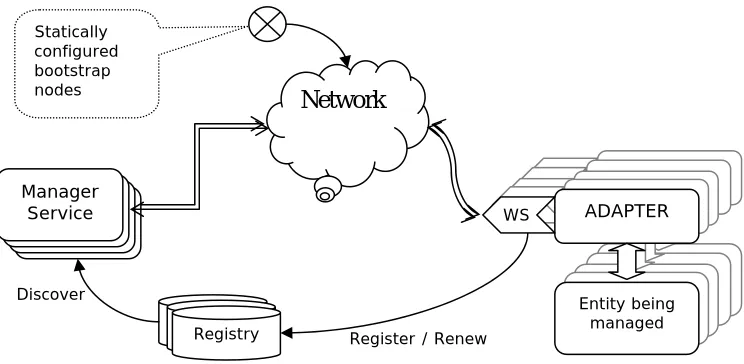
Figure 1 shows the various components of our framework. The entity being managed is any application specific component. We term such a resource as a manageable resource. Typically, existing Web Services would be augmented with specific ports for enabling remote management. A service adapter or a proxy is required when the entity being managed is not a Web Service. In such cases, the service adapter provides a Web Service interface for such entities. Thus this adapter is an entity specific proxy that has a Web Service interface on one end and an entity-specific interface on the other end. The adapter serves as translator of messages to commands specific to the entity being managed.
In our architecture, we assume there could be multiple such services that require management. Examples of systems with large number of manageable resources are cell phone networks, large clusters of machines or even brokers in distributed brokering systems. The scheme should be scalable and incorporate management of a large number of manageable resources.
Network
Registry Discover
Registry Registry
ADAPTER
Entity being managed WS ADAPTER
Entity being managed WS ADAPTER
Entity being managed WS ADAPTER
Entity being managed WS ADAPTER
Entity being managed WS
Statically configured bootstrap nodes
Register / Renew
[image:2.612.92.464.69.251.2]Manager Service Manager Service Manager Service Manager Service
Figure 1: A Basic Management Framework
A Manager Service is the component of management architecture responsible for actually managing the manageable resources and usually represents the user responsible for managing the resources. The manager service itself should be fault-tolerant. If one or more manageable resources are unreachable (possibly because the manager and the manageable resources lie in different administrative domains), then the manager should try alternate means of transport for reaching the manageable resource. To achieve scalability, the system contains multiple manager services. Assignment of manageable resources to managers can be handled using one of the popular load balancing techniques.
The system also contains a set of statically configured bootstrap nodes which can be leveraged to start discovering the system components and tying them together. This is akin to the DNS (Domain Name Service) system where, if one DNS Server is unavailable, the client tries the next DNS service to achieve fault-tolerance. Thus failure of one of these nodes does not affect the entire management system and we expect that the failed node can be restored in finite amount of time.
1.2 Desiderata
We now summarize the desired characteristics of the management architecture, below:
Remote Management: The management system should enable us to manage resources irrespective of their location as long as there exists a way to access the resource.
Traverse firewalls and NAT: Application components may span administrative domains. The presence of firewalls and network address translation further complicates management by preventing specific transports and / or blocking access to internal machines. Frequently, by providing correct authentication, it is possible to tunnel messages, such as over the HTTP transport. The management architecture should work equally well in such heterogeneous environments by leveraging available transports.
Extensible: Management interfaces are generally resource specific. As the application infrastructure evolves, it should be possible to incorporate management of newer services with little or no modification. We address this issue by employing service-oriented management architecture.
scalable in terms of the number of resources managed. We show how we can leverage a distributed messaging middleware to achieve scalability.
Fault-tolerant: The management architecture should itself be fault-tolerant. Failure of any services or transport should automatically trigger search for next possible transport. As an illustration, a resource may become unreachable due to various network conditions such as blocked ports, disabled transport such as UDP or multicast and failed services. In these cases the management adapter should try to avoid faulting by doing a best-effort-try to check for alternate means of services and transports.
In this paper we apply the above concepts in managing a distributed messaging infrastructure. This is particularly of interest since it employs a large number of distributed dynamic peers. We present results on the overhead introduced by our system and present ways to improve performance. The rest of the paper is organized as follows. We introduce NaradaBrokeringand discuss the need for management in Section 2. We describe the broker management architecture in Section 3. Section 4 presents the resources modeled using WS-Management. We present results obtained by testing our prototype implementation in Section 5. Section 6 is conclusion.
2
Managing the Distributed Brokering Infrastructure
Messaging based distributed brokering infrastructures have gained much popularity in recent years in the distributed computing community. They have been instrumental in helping to provide clear demarcation between the application logic and Quality of Service aspects such as reliable delivery, security, persistent storage, compression / decompression and fragmentation / de-fragmentation of messages. These brokering systems employ a large number of connected peers called brokers which form a messaging substrate. To get the maximum benefit from the services provided by the messaging substrate, it is required to setup these brokers and connect them in topologies specific to the application.
Various topologies [2] on connecting these peers exist, each based on differing routing, fault-tolerance and cost characteristics. Run-time metrics are gathered using monitoring techniques [3] which measure various aspects of the system that enable us to understand the performance of the system and in some cases, provide hints on improving the performance. This naturally leads to re-deployment of the brokering network with a different configuration. To summarize, we need an architecture that enables us to rapidly bring-up and tear down a broker network. It is also required to set specific configuration settings for every broker and have the ability to change the configuration on-the-fly. We term these actions collectively, as management of the brokering infrastructure.
2.1 Example
Brokering Network
…
…
400 Participants
…
400 Participants
…
400 Participants A single participant sends audio/video to multiple subscribers
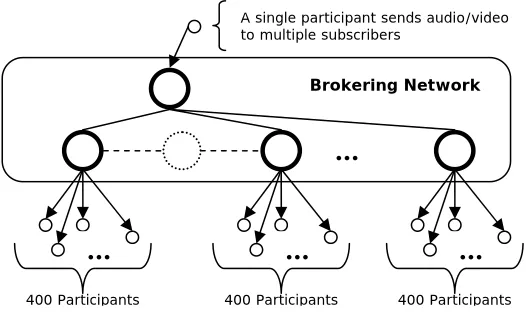
[image:4.612.92.355.72.228.2]A teacher-student web collaboration where the teacher participant sends audio/video to multiple students
Figure 2: Teacher - student relationship based collaborative session
2.2 NaradaBrokering
NaradaBrokering [6] - [9] is an open-source, distributed messaging infrastructure based on the publish/subscribe paradigm. The smallest unit of this distributed messaging substrate intelligently processes and routes messages, while working with multiple underlying communication protocols. We refer to this unit as a broker. The broker network in NaradaBrokering is based on hierarchical, cluster-based structure [6]. This cluster-based architecture allows NaradaBrokering to support large heterogeneous client configurations. The routing of events within the substrate is very efficient [9] since for every event, the associated targeted brokers are usually the only ones involved in disseminations. Furthermore, every broker, either targeted or en route to one, computes the shortest path to reach target destinations while eschewing links and brokers that have failed or have been failure-suspected.
The substrate incorporates support for both JMS and the WS-Eventing specification. Work is currently underway on incorporating support for the WS-Notification suite of specifications. The NaradaBrokering substrate also incorporates support for ReliableMessaging [10] and WS-Reliability [11] that facilitates reliable messaging between Web Services. Subscription formats supported within the substrate include “/” separated Strings, Integers, <tag, value> pairs, regular expressions, XPath and SQL queries. In NaradaBrokering entities can also specify constraints on the qualities of service (QoS) related to the delivery of events. The QoS pertain to the reliable delivery, playbacks, order, duplicate elimination, global timing services, security and size of the published events and their encapsulated payloads. Additional information regarding NaradaBrokering can be found in Refs [6] - [9].
2.3 Related
Work
Management of resources has been growing in importance in recent times. To make management more general, the Grid community has been implementing support for Web Service Distributed Management (WSDM) by treating all managed resources as a WS-Resource. WSDM [12] based management leverages the Web Service Resource Framework [13] principles to create managed resources with specific lifetimes. Our architecture does not specify lifetimes for created resources (brokers) and we expect the broker resource to remain available and running until the machine hosting the broker goes down or the broker is explicitly killed by sending an appropriate message. The brokering network uses other mechanisms such as topic lifetime to determine the period until when a peer may subscribe to receive specific events.
TreeP [14] uses a B+-Tree based topology for range querying. Baton [15] is a Peer-to-Peer (P2P)
use a fixed tree structure topology to connect individual peers. P2P systems based on distributed hash table such as Chord [16] use a bootstrap node to get a node address. Future additions automatically get address from one or more previously initialized nodes when they join the network. CAN [17] uses a similar approach where an incoming node contacts a bootstrap node to retrieve a set of randomly chosen nodes. The new node then connects to a randomly chosen node from the retrieved set. However, CAN and Chord do not take network distances in to account when creating the routing table. This may result in certain lookups resulting in overlay hops spanning the entire diameter of the network. Tapestry [18] and Pastry [19] construct and maintain locally optimal routing tables at initialization that helps reduce routing stretch.
3 Architecture
We now describe the application of the management framework from the broker management point of view. The architecture consists of two main components, the Broker Service Adapter (henceforth, BSA) for configuring and initializing brokers and the Broker Network Manager (henceforth BNM) that functions as a client to the BSA and helps deploy specific topologies. A BSA is required because NaradaBrokering brokers are not Web Services.
We have modeled the most commonly used management actions on brokers using simple GET, PUT, CREATE and DELETE verbs from the WS – Transfer [20] specification of WS-Management. Since the broker does not create extensive log of activities, we do not require support for WS – Enumeration [21] in the BSA. A broker however may wish to send notifications on events such as broker liveness (heartbeat) and link failure which may help the BNM take decisions at runtime.
3.1
Broker Service Adapter (BSA)
The Broker Service Adapter (shown in Figure 3) is the component that wraps a broker and is responsible for invoking management related commands on the broker. Specifically, the Broker is the managed entity and the BSA functions as the adapter. For purposes of or architecture, we assume that the BSA instantiates a broker (when it receives a CREATE message) in the same JVM as the BSA. The BSA models various properties of the Broker as resources as specified by WS Management.
Specifically, we model the following characteristics of the Broker interface, namely, Broker, Link and Configuration. Additional resources that have been modeled is the NetworkAddress and GatewayAddress that are required whenever a broker which does not have a network address connects to a broker which has a network address.
.
Broker Service Adapter
Modeled Resources
• Broker
• Link
• Configuration
• …
Web-Service
Management Interface • Multiple transport
interfaces possible
Response Buffer Service
Broker
WS-Management Interface SOAPTransport
• HTTP
• NaradaBrokering
Figure 3: Broker Service Adapter Architecture manages NaradaBrokering brokers
3.2
Broker Network Manager (BNM)
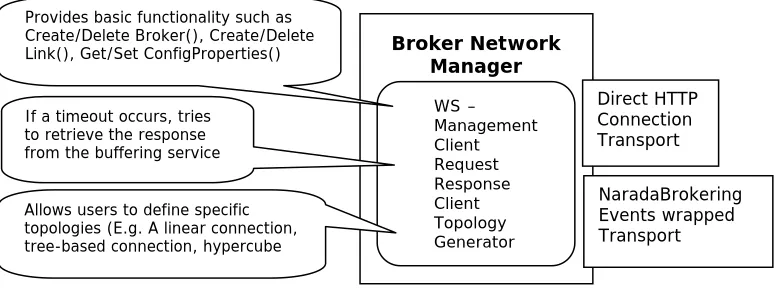
A broker network manager (Refer Figure 4) functions as a client to the BSA. This component essentially provides 2 services, (1) provide a function interface to manipulate various resources managed by the BSA and (2) provide an interface to deploy arbitrary topologies. The TopologyGenerator, allows users to create application specific topologies given a set of BSA endpoints. This topology is then translated to appropriate commands by the broker network manager. In case a certain action cannot be carried out, the broker network manager throws an exception and allows the user to take corrective action.
Broker Network Manager
• WS –
Management Client • Request
Response Client • Topology
Generator
NaradaBrokering Events wrapped Transport Direct HTTP Connection Transport
Allows users to define specific topologies (E.g. A linear connection, tree-based connection, hypercube If a timeout occurs, tries
to retrieve the response from the buffering service
[image:6.612.91.481.316.461.2]Provides basic functionality such as Create/Delete Broker(), Create/Delete Link(), Get/Set ConfigProperties()
Figure 4: Broker Network Manager (aids in deployment of Broker network)
The broker network manager also has a HTTP to NaradaBrokering transport mapper that wraps SOAP messages and publishes it to a specific topic. This scheme is described in more detail in Section 3.3.2. The HTTP Mapper service can either be part of the static broker or a separate process running on the same host as the static broker.
3.3 Deploying
topologies
Registry
Simple registry of available BSAs and access information
BSA-4
BSA-2
BSA-3
BSA-5 BSA-1
Broker Broker
Broker
A static broker network
Listen on specific topics
Register BSA with global registry
BNM
[image:7.612.90.494.70.308.2]BNM communicates with the BSAs via SOAP Messages Static (bootstrap) brokers are used for SOAP Message delivery to remote (directly unreachable) brokers BSAs register their endpoints in a simple registry
Figure 5: Overall Architecture
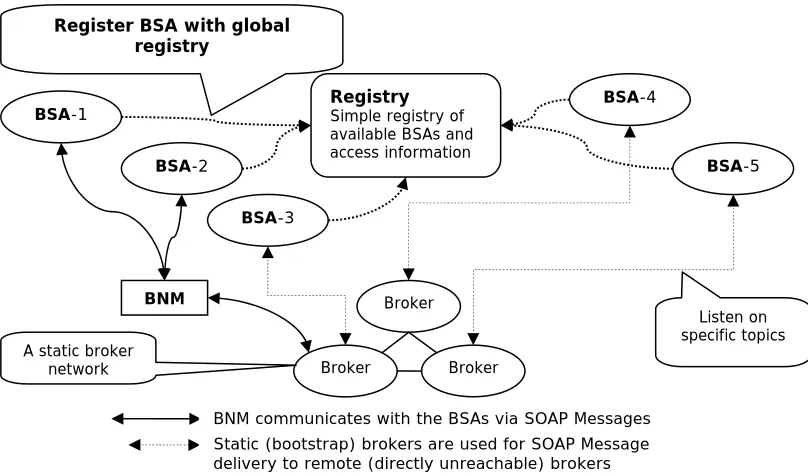
Consider the 5 BSAs shown in above figure. These BSAs are distributed over different machines. BSAs (1 and 2) are directly accessible and hence the broker network manager may communicate directly with these services. BSAs (3 – 5) however are possibly in different administrative domain with respect to the broker network manager. The broker network manager then leverages NaradaBrokering wrapped message delivery for sending and receiving SOAP messages. Although the broker network manager may directly behave as a client to the static brokers, we use a HTTP Mapper service to wrap SOAP Message as an NaradaBrokering Event. This process is detailed in Section 3.3.2.
3.3.1 Registering BSAs
When the BSA starts up, it can be started to either use the direct HTTP transport or leverage the brokering network to transfer SOAP messages. The advantage of the later is that BSA present in a different administrative domain can be accessed by transporting SOAP messages wrapped as NaradaBrokering Events using HTTP tunneling. Once the BSA has initialized, it registers itself in a registry service such as a UDDI registry. For our purpose, we have implemented a simple registry service that stores the endpoint address for each registered BSA.
The BSA cycles through all three static brokers trying connection to each of these brokers. This helps us provide fault-tolerance against unreachable hosts. Broker Discovery mechanism [24] may be used to find the nearest best broker to connect to. As long as the BSA can connect to at least one of the static brokers, it can be managed by the BNM.
3.3.2 Mapping topics to Endpoint References
<wsa:To>http://gridservicelocator.org:6000/12345678-1234-1234-123456789012</wsa:To>
This specifies that the SOAP Message is sent to the HTTP mapper service running on gridservicelocator.org on port 6000 and it should be forwarded to the BSA whose UUID is 12345678-1234-1234-123456789012.
The HTTP Mapper puts its topic as an immutable property in the NaradaBrokering event header while the SOAP message is copied as the payload. This event is then published on the topic BSA/12345678-1234-1234-123456789012.Once the response is generated by the destination BSA, the response is sent back to the HTTP Mapper service which was responsible for forwarding the SOAP message. The BSA uses the HTTP Mapper’s topic represented by the immutable header property in the original event to determine the correct destination.
4
WS – Management based modeling
WS-Management requires all managed resources to be identified by a <ResourceURI>. This has been defined in the BSA schema available at http://www.hpsearch.org/schemas/2005/11/BSA. Our initial model defines the following Resource URIs,
1. BROKER that identifies the broker in question 2. LINK that identifies a link between 2 brokers
3. CONFIGURATION that identifies the broker configuration with which the broker is to be initialized
4. CONFIGURATIONPROPERTY that identifies each individual property in the broker configuration
5. NODEADDRESS that refers to a node address as required by the broker when it joins a broker network
6. GATEWAYADDRESS that refers to a gateway address when a broker in cluster connects to a broker in another cluster
7. BUFFEREDMESSAGE that is used to retrieve the response to a previously sent request from the request buffering service.
The BSA is an implementation of the WS Management processor which is part of a framework for deploying WS-Management compatible management services. Our initial implementation consists of WS – Transfer and WS-Enumeration while we plan on leveraging WS – Eventing [25] provided by NaradaBrokering.
4.1 Management
Operations
In this section we list the various management operations as defined by the BSA. Note that not all resources may support all operations. In the case where an operation is requested on a resource which is not supported, an UnSupportedOperation fault is thrown. The various operations are listed in Table 1.
Resource Operations Supported Operation Detail
Create Initializes a broker using the current configuration and returns a unique BrokerID. This broker is initialized in the same JVM as the BSA.
Delete Kills the broker identified by the BrokerID
BROKER
Get Retrieves information about the broker specified by the BrokerID
LINK Create Creates a link by trying a connection to the specified
a LinkID corresponding to the link Delete Deletes the link identified by the LinkID
Get Retrieves the value(s) of specified configuration property
CONFIGURATION,
CONFIGURATIONPROPERTY Put Replaces the value(s) of the specified configuration with
a new value. If the broker has already initialized we do not allow this operation.
NODEADDRESS, GATEWAYADDRESS
Create When a broker is initialized and connects to an existing broker in the broker network, this operation enables the new broker to request a node address from the broker to which it is connected to. This is a required step because of the inherent design of NaradaBrokering.
BUFFEREDMESSAGE Get Retrieves a previously buffered response
Table 1: Summary of various operations modeled in the Broker Service Adapter
4.2
Enumeration and Eventing
WS-Management allows managed resources to enumerate large set of values from managed containers using the interface defined in WS-Enumeration. Although we provide support in the framework for WS-Enumeration, we do not see any suitable requirement in BSA that requires us to provide any implementation. WS-Management also allows managed resources to publish events that give regular updates on the status of the resources. Although our initial implementation does not provide any support for WS-Eventing, we are currently working on integrating support for WS-Eventing by leveraging the WS-Eventing container recently added in NaradaBrokering.
4.3
Discovery of Managed Resources
WS – Management Catalog [26] defines a metadata format for the discovery of management functionality of resources. Current implementation provides static binding to the BSA’s WS-Management interface in the BNM. We provide discovery by means of a simple registry service that lists the endpoints associated with individual BSAs.
5 Results
WS-Management relies heavily on SOAP 1.2 specification for conveying various faults and details associated with exceptions. During development we noted that the Soap with Attachments API for JAVA (SAAJ API) library provided with JDK 1.4 implements SOAP 1.1 while support for SOAP 1.2 is provided in the newer releases of SAAJ (version 1.3 EA) which is shipped with Java WSDP 2.0. In order to provide maximum compatibility with various leveraged 3rd party softwares we have implemented our own SOAP message sender and receiver.
We benchmarked our architecture with 2 topologies. In both cases, we employed as simple topology generator that generated links such that the ith broker is connected to (i-1)th broker
(for all i > 1). Table 2 summarizes the machine configuration.
Machine Machine Specification Java Version Network
Benchmarking machine
trex.ucs.indiana.edu
Linux, 2.6.5-7.155.29-default, Pentium 4 2.53 GHz 512 MB
RAM Grid Farm machines
in CGL, Bloomington
(gf1.ucs.indiana.edu – gf8.ucs.indiana.edu)
Linux 2.4.22-1.2188.nptlsmp, 4 - Intel Xeon 2.4 GHz CPUs,
2 GB RAM
Java HotSpot(TM) Client VM (build
1.4.2_03-b02, mixed mode)
Linked via 100 Mbps
link
For Testing between different administrative domains (behind a home DSL router)
2.41 GHz, 1 GB RAM Windows XP Pro w/ SP2
Client VM (build 1.4.2_08-b03, mixed mode)
a 1.5 Mbps Home DSL network
Table 2: Test Machine Configuration
For manipulating XML, we leveraged Apache XMLBeans toolkit (version 2.0.0). Table 3 lists the specifications that were implemented during the development phase.
WS - Specification Spec Release Date WS Management June 2005
WS Transfer Sep 2004 WS Enumeration Sep 2004 WS Addressing Aug 2004
SOAP Version 1.2
Table 3: Versions of Web Service related specifications that were implemented.
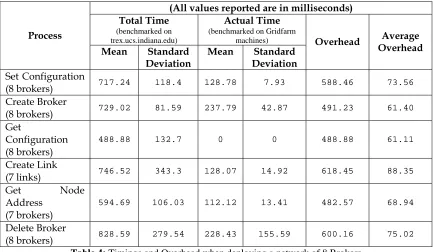
We tested the time it takes to deploy a broker topology consisting of 8 brokers. This test uses direct HTTP transport since all machines are accessible from the machine running the BNM. We first set different configuration in each BSA and then initialize all 8 brokers. Once all of them have initialized, we also time the process of creating links between brokers. Finally we shutdown all brokers. We have used a high resolution timer which reports times to microsecond accuracy to time the various operations.
(All values reported are in milliseconds) Total Time
(benchmarked on trex.ucs.indiana.edu)
Actual Time
(benchmarked on Gridfarm machines)
Process
Mean Standard
Deviation Mean Standard Deviation
Overhead Overhead Average
Set Configuration
(8 brokers) 717.24 118.4 128.78 7.93 588.46 73.56
Create Broker
(8 brokers) 729.02 81.59 237.79 42.87 491.23 61.40
Get
Configuration (8 brokers)
488.88 132.7 0 0 488.88 61.11
Create Link
(7 links) 746.52 343.3 128.07 14.92 618.45 88.35
Get Node Address
(7 brokers)
594.69 106.03 112.12 13.41 482.57 68.94
Delete Broker
[image:10.612.98.535.72.115.2](8 brokers) 828.59 279.54 228.43 155.59 600.16 75.02
Table 4: Timings and Overhead when deploying a network of 8 Brokers
[image:10.612.90.523.333.585.2]and the only work done comprises of marshalling the already existing information as XML and shipping it across to the BNM.
(All values reported are in milliseconds) Total Time
(benchmarked on gf4.ucs.indiana.edu)
Actual Time
(benchmarked on home machine)
Process
Mean Standard
Deviation Mean Standard Deviation
Overhead Overhead Average
Set Configuration
(3 brokers) 517.59 61.2 1.56 0.64 516.03 172.01
Create Broker
(3 brokers) 512.16 46.87 63.61 3.61 448.55 149.52
Get
Configuration (3 brokers)
536.07 27.85 0 0 536.07 178.69
Create Link
(2 links) 308.35 22.78 22.36 4.52 285.99 143.00
Get Node Address
(2 brokers)
290.22 33.14 1.55 0.27 288.67 144.34
Delete Broker
[image:11.612.91.525.101.350.2](3 brokers) 415.67 46.36 21.45 1.74 394.22 131.41
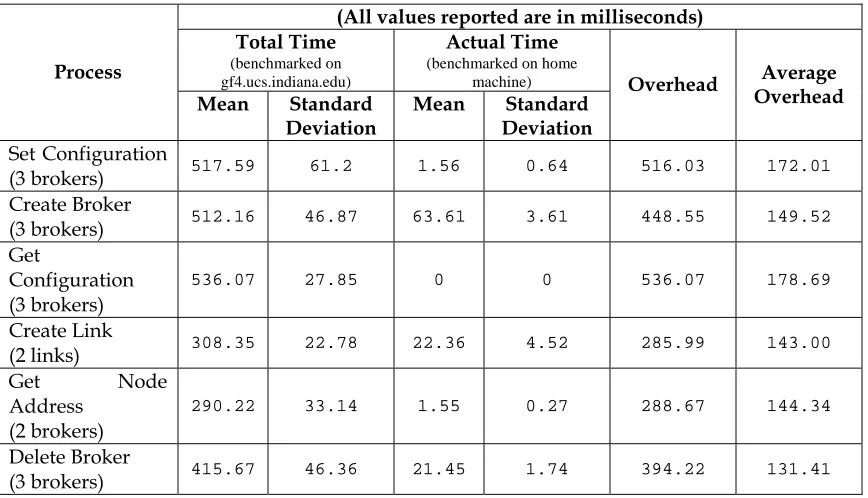
Table 5: Timings and Overhead when deploying a network of 3 brokers within a different administrative domain (behind a home DSL router)
The second test involves using the NaradaBrokering wrapped transport for delivering SOAP Messages. Here we tested with 3 brokers and 2 links. Note that using this particular method of transport, we can access BSAs in different administrative domains. Due to the restriction on the need of IP address for connecting brokers, it may not be always possible for brokers in different administrative domains to be connected together. In this case we propose using a proxy broker that sits in the open network and links the two different broker networks. A set of brokers can however be managed from a different administrative domain. We believe that with the proliferation of IPv6 address space, this problem may be resolved to some extent. Table 5 shows the timing associated with this topology.
To simulate heterogeneous environments with restricted transports and open ports, we turn off the relevant transport links in the bootstrap broker hosted on www.webservicelocator.org. The average overhead was found to be significantly higher than the direct HTTP connection. This was due to wrapping of SOAP message using NaradaBrokering, which resulted in multiple hops between the BNM and the BSA.
We also observe that in both cases all of the operations listed above are executed serially. Certain operations such as setting individual configurations and starting brokers are independent of each other and could be parallelized in order to decrease the total time to deploy the broker network.
6
Conclusion and Future Work
[image:11.612.89.524.101.351.2]various other events that enable the BNM to take runtime decisions. We plan on researching suitable means of effectively providing multiple managers to manage a large set of resources. We also plan on investigating support for WS – Management Catalog for describing BSA interaction schema and set of managed resources.
Acknowledgement
This work is supported by the NASA Advanced Information Systems Technology (AIST) program and NSF Information Technology Research (ITR) program, project Number 0427264. The authors would also like to thank Prof. Gordon Erlebacher ([email protected]) for his critique on the HPSearch project.
References
[1] Web Service Management (WS – Management), Sun, Microsoft, Intel, et al., June 2005. Available from https://wiseman.dev.java.net/specs/2005/06/management.pdf
[2] Network Topologies: http://en.wikipedia.org/wiki/Network_topology, Visited Feb 6, 2006 [3] Gurhan Gunduz, Shrideep Pallickara and Geoffrey Fox An Efficient Scheme for Aggregation and
Presentation of Network Performance in Distributed Brokering Systems to be published in Journal on Systemics, Cybernetics and Informatics 2004
[4] GlobalMMCS (Global Multimedia Conferencing System), Project page: http://www.globalmmcs.org
[5] Ahmet Uyar, Scalable Service Oriented Architecture for Audio/Video Conferencing, Ph.D. Thesis, May 2005
[6] Shrideep Pallickara and Geoffrey Fox. NaradaBrokering: A Middleware Framework and Architecture for Enabling Durable Peer-to-Peer Grids. Proceedings of ACM/IFIP/USENIX International Middleware Conference Middleware-2003.
[7] Geoffrey Fox, Shrideep Pallickara, Marlon Pierce, Harshawardhan Gadgil. Building Messaging Substrates for Web and Grid Applications. In special Issue on Scientific Applications of Grid Computing in Philosophical Transactions of the Royal Society, London, Volume 363, Number 1833, pp 1757-1773, August 2005.
[8] Geoffrey Fox and Shrideep Pallickara. Deploying the NaradaBrokering Substrate in Aiding Efficient Web & Grid Service Interactions. Invited paper for Special Issue of the Proceedings of the IEEE on Grid Computing. Vol 93, No 3. pp 564-577. March 2005.
[9] Shrideep Pallickara and Geoffrey Fox. On the Matching Of Events in Distributed Brokering Systems. Proceedings of IEEE ITCC Conference on Information Technology. April 2004. pp 68-76 Volume II.
[10]Web Services Reliable Messaging Protocol (WS-ReliableMessaging)
ftp://www6.software.ibm.com/software/developer/library/ws-reliablemessaging200403.pdf
[11]Web Services Reliable Messaging TC WS-Reliability. http://www.oasis-open.org/committees/download.php/5155/WS-Reliability-2004-01-26.pdf
[12]Web Service Distributed Management (WSDM), HP ; et al.
[13]The Web Services Resource Framework. http://www.globus.org/wsrf/
[14]B. Hudzia, M-T. Kechadi, and A. Ottewill, "TreeP: A Tree-Based P2P Network Architecture", International Workshop on Algorithms, Models and tools for parallel computing on heterogeneous networks (HeteroPar' 05), Boston, Massachusetts, USA, September 27-30, 2005. [15]H.V. Jagadish, Beng Chin Ooi, Quang Hieu Vu, BATON: A Balanced Tree Structure for
[16]Ion Stoica, Robert Morris, David Karger, M. Frans Kaashoek and Hari Balakrishnan, “Chord: A scalable peer-to-peer lookup service for internet applications” in Proceedings of SIGCOMM, Aug 2001.
[17]Sylvia Ratnasamy, Paul Francis, Mark Handley, Richard Karp and Scott Schenker, “A scalable content-addressable network” in Proceedings of SIGCOMM, Aug 2001
[18]Ben Y. Zhao, Ling Huang, Jeremy Stribling, Sean C. Rhea, Anthony D. Joseph, and John Kubiatowicz Tapestry: A Resilient Global-scale Overlay for Service Deployment, IEEE Journal on Selected Areas in Communications, January 2004, Vol. 22, No. 1
[19]Antony Rowstron and Peter Druschel, “Pastry: Scalable, distributed object location and routing for large-scale peer-to-peer systems” in Proceedings of Middleware, Nov 2001
[20]Web Service Transfer (WS – Transfer), Microsoft et al., September 2004. Available from http://msdn.microsoft.com/library/en-us/dnglobspec/html/ws-transfer.pdf
[21]Web Service Enumeration (WS – Enumeration), Microsoft, BEA, et al., September 2004 Available from http://msdn.microsoft.com/library/en-us/dnglobspec/html/ws-enumeration.pdf [22]Aleksander Slominski, Alexandre di Costanzo, Dennis Gannon, and Denis Caromel.
Asynchronous Peer-to-PeerWeb Services and Firewalls. (To Appear) In 7th International Workshop on Java for Parallel and Distributed Programming (IPDPS 2005), April 2005
[23]Kyle Brown, et al., Web Services Polling, Oct 2005. Available from http://www.w3.org/Submission/ws-polling/
[24]Shrideep Pallickara, Harshawardhan Gadgil, Geoffrey Fox; On the Discovery of Brokers in Distributed Messaging Infrastructure, (To Appear) In Proceedings of the IEEE Cluster 2005 Conference. Boston, MA
[25]Web Services Eventing (WS – Eventing), Microsoft, IBM & BEA, August 2004. Available at http://ftpna2.bea.com/pub/downloads/WS-Eventing.pdf
[26]The Web Services Management Catalog, Sun et al., June 2005 Available from
![105 Java In 60 Minutes A Day [ PUNISHER ] pdf](data:image/gif;base64,R0lGODlhAQABAIAAAP///wAAACH5BAEAAAAALAAAAAABAAEAAAICRAEAOw==)