Abstract: In the field of Wireless Sensor Network (WSN), real time applications, the interesting research emerged in the field of QoS routing. Networks must address resource constraints although providing an accurate guarantee of quality of service (PDR, throughput, energy, End-to-End delay).This document presents the routing protocol compatible with QoS, namely [M3L-C-PFSR] Multilevel, Multi constraint Multi Priority Fuzzy Sensor Routing Protocol which gives priority for important packets of important applications and also ensures the PDR, delay and throughput. Applying a scheme of multi level fuzzy based efficient buffer management to limit packet loss due to overflow. It supports lower throughput for packets which are lower in priority and higher throughput will be given for real-time prioritized packets which are assigned privileged higher priority, thus reducing end-to-end delay. The proposed work performance will be appraised [M3L-C-PFSR] in NS2. The results of the simulation depicts that the proposed protocol [M3L-C-PFSR] effectively minimizes the losses of critical packet, with different traffic conditions, ensuring the reliability and required delivery of data.
Index Terms: WSN, Fuzzy Logic, Reliability, Priority, Buffer Management
I. INTRODUCTION
A Network of Wireless Sensor (WSN) includes sensor nodes, in which, physical environmental parameters communicating to the base station [1, 2, 3]. Sensor nodes are subject to resource constraints because they are equipped with batteries of limited power. The goal is to provide reliable services along with reduced end-to-end delay and lower energy consumption.
In WSN, the detected node’s data can traverse in multiple routes to the destination. The bandwidth available in the channel will be distributed and response times will be very long [4]. With the support of the MAC layer, the availability of multi-priority and non-interfering routes may be available for the routing algorithm. Critical data is time-sensitive and must be transmitted to the destination base station with packets with high reliability. So the immediate corrective and corrective actions could be considered.
Here Multi-level Multi-Path Multi-Constraint Multi Prioritized Fuzzy Sensor Routing [M3L-C-PFSR] for WSN is
proposed.The proposed protocol Multi-level
Multi-constraint Multi-path prioritized Fuzzy Sensor Routing Protocol (M3L-C-PFSR) contains the energy, delay, transmission reliability and distant as different parameter. Clustering is utilized for efficient aggregation of residual
Revised Manuscript Received on July 05, 2019.
Jayashree Agarkhed, Computer science and engineering ,PDAEG-VTU, Kalaburgi, India.
Second Author name, Vijayalaxmi Kadrolli, Computer Science and Engineerign, PDACEG_VTU, Kalaburgin, Indai.
Siddaram Patil, Electronics and ommunication Engineering, PDACEG-VTU, Kalaburgi, India.
energy. Super Cluster Head (SCH) selection algorithm among the CHs based on fuzzy concept is proposed. The parameters are Attempt Rate (AR), Residual Energy (RE) and distance (Dist). For further level, cost function (CF) for the parmeters: average residual energy, average end-to-end delay (ENE-D), average transmission reliability (AR) for multipath routing network is proposed. The sensed data from SCH to a sink by assures minimum end-to-end delay and maximum transmission reliability and maximum residual energy and maximum throughput utilizing buffer management policy along with prioritized packed for critical data while routing.
In the first level Cluster Head concept is used in clustering to elect CH among nodes by considering Residual Energy (RE) and in the next level, among CHs, SCH is selected based on Remaining Energy which is referred as Residual Energy (RE), Transmission Rate(CR), Distance between the Node and Base Station (DNB). These can send only the information to the BS with buffer management policy along with prioritized packets which uses Fuzzy inference engine (Mamdani's rule), be used to choose the possibility to be the routing from the SCH to the sink . Reduction of the overall energy consumption, increase the network lifetime, along with minimum delay and maximum transmission are the benefits of this technique. Among the SCH, the routing is done by the next level fuzzy logic.
In this scenario, the Super Cluster Head nodes (SCH) which are the source nodes and are heavily loaded with a combination of critical and periodic data packets from multiple sources. Source nodes are having periodic information that all data is intended to be collected simultaneously. Since all the originating nodes (SN) begin to transmit data instantaneously. These are heavily loaded with multiple traffic of different priorities and provides the service as the packet arrives without discriminating. Data packets due to the limited memory and high load on the node, the buffer may begin to overflow as shown in Figure
1.
Figure 1. Sensor Nodes, Cluster Head and Super Cluster Head Buffer Management.
Multi-Level Multi-Constraint Multi-Priority
Fuzzy Sensor Routing (M
3
L-C-P
FSR)
The main limitation of the sensor node is energy, but retransmissions will cause an overload of communication, so the sensor nodes can quickly drop out of the energy, causing it to fail. However, if the packets are lost due to a buffer overflow or node failure, the performance decreases. Therefore, the routing protocol cannot transmit the critical data to the end nodes in time. Therefore the proposed QoS routing points to the following:
1. Check the rate of packet drop due to buffer overflow with buffer management.
2. Avoid wasting energy due to the broadcasting of unimportant information..
3. Providing diverse service based on the priority
4. These features could be integrated with the routing algorithms, which help to maximize the reliability of each router's data.
5. Data delivery is influenced by path length of the routing, which Sensors establish a optima routing path.
In order to provide a reliable and guaranteed delivery service in the trusted domains, it is proposed [M3L-C-PFSR] a reliable routing protocol that is efficient in the buffer concept.
The contributions which are considered while designing the protocol are
1. clustering approach to determine the cluster head (CH) among nodes and SCH among cluster head is determined based on fuzzy logic
Buffer management policy
Prioritised packet transmission through optimal paths Energy reserving, reserving reliability
Packet servicing
The assumptions made in this work are given below. All sensors are stationary
According to communication distances, all node are aware about their individual residual energy.
The sensed data by neighbouring nodes are correlative, accordingly the cluster head can join the combined data to decrease the whole data sent
Super cluster head SCH combine the joint data to decrease the total data sent.
The remainder of the paper is ordered as follows. part II presents an overview of the relevant recent research work. Proposed Methodology is described in Part III. Part IV describes the simulation and performance summary. Part V provides a conclusion.
II. RELATED WORK
Latterly, several research projects began to address the WSN quality of service requirements. In this part, it is presented the research that summarizes the reported work and highlights the quality of service concerns that are being discussed. Some quality of service routing approaches is discussed in References [5].
The authors [6] developed an Objective Function (OF) that uses fuzzy logic to dynamically adjust to changeable radio conditions and limited energy issues.
The authors discussed [7] a distributed energy-aware fuzzy logic based routing (DEF) which takes energy metrics and also mapping them to the corresponding cost values for the
estimation of the shortest path which solves the issues of energy efficiency and also balancing the energy
The authors [8,9,10] discussed on multi-path-based routing protocols which enhance the reliability by multiple paths. yet, the main problem is route coupling and there is no addressing the issue of buffer management which further enhances the QoS
The authors [11] proposed a Multi-layer WSN buffer management scheme which decreases the number of packet drop by dividing network topology into three logically layers based on sensors’ information. When the data packet arrives at sensor node, the buffer will then select the packets according to their different layers and information they have.The disadvantage of this approach is that, sensor nodes are assigned to gather three different data packets such as (humidity, temperature and pressure) from the sensing area. The sensor nodes that are assigned to read humidity will accept only the packets containing humidity information and consider them as relevant. Other packets that consist both temperature and pressure values are irrelevant packets and be dropped. Finally, the transmitter queue forwards different packets in FIFO manner.
The authors [12] discussed buffer management policy. This policy classifies the packets into different types as well as prioritizes the buffer for separate queues distinctively and corresponding packets are inserted.
There are many algorithms proposed for buffer management including FIFO, Last-In-First-Out (LIFO) and priority queues to improve packet delivery as well as QoS of network. Algorithms based on FIFO approach are not complicated to be understood and implemented, although their performances might not be ideal.
The authors [13] proposed a Dynamic Multilevel Priority (DMP) packet scheduling algorithm in which a tiered design is considered for sensor nodes, which have precisely equal hop and are placed at the similar hierarchical level. In addition, Time Division Multiplexing Access (TDMA) algorithm is utilized to prioritize packets from various layers. The author [14] proposal, EDEAR "Energy and Delay in Efficient Adaptive Routing", that accumulates data related to energy and delay with continuous learning and routing is introduced in each node. Path travel is based on a multipoint relay, it decreases the overhead generated by a packet. The methodology has four phases: 1) critique of the claims 2) Quality of service in different layers 3) simulation model based on an application scenario, t 4) validation and the decision of decisions by simulation
The authors [15] discussed reliable data transmission and a multipath protocol with energy recognition. The hybrid plan is applied to authenticate messages obtained in each hop that gets higher percentages of packets in the receiver. Protocol overload and network lifetime have also been reduced. It uses the residual energy, the buffer size, and the signal-to-noise ratio (SNR) are used to predict the next genuine hop. The authors [16] discussed reliable multipath routing algorithm taking into account the quality of service namely RQMP. It uses a control message as well as a Send Error Correction (FEC) technique to build a reliable link between source and destination. It maximizes network lifetime by transmitting data over
multiple routes and
balancing the load results in
consumption across the entire network. The RQMP protocol uses the residual energy, available buffer size, the signal-to-noise ratio (SNR) and the distance to predict the best hop.
The author [17,18] discussed a new routing protocol based on energy reservation (ERes-QoS) guarantees an end-to-end delay for critical data from two domains: punctuality and reliability. A set of routers based on angles is built in each node to achieve timely accessibility of the data.it used a local judgment approach in each intermediate node, which applies multi-paths. It provides routing service by assigning priorities to the data packets as per there criticality. It reserves the necessary energy to retransmit the traffic on the dynamically scanned route and employing the packet classifier and multilevel queue priority programming modules at each intermediate node so satisfying reliability and data delivery. The author [19] discussed the problem as an optimal path problem with multiple constraints and propose an algorithm based on a distributed learning automaton (DLA) . It takes into account several QoS routing restrictions, such as end-to-end delay, reliability and delay in route selection. The author [20] discussed on choosing the shortest route for energy efficiency among the multiple paths selected by the particle swarm optimization algorithm. Among these shorter routes, this route is selected and requires a minimum route selection parameter. It uses distance and nodes energy as a parameter to find optimal routes using particle swarm optimization. Of these selected routes, only one optimal route is selected, which reduces the energy requirements of the network.
The authors [21] discussed a Software Defined Network (SDN) to provide a framework (enhanced SD-WSN). It addresses the below problems.
1) Network management for heterogeneous network and the smooth merging of a WSN into IoT. 2) Network coverage that increases the reliability 3) node failure because of several issues, including energy consumption.
The authors [22] discussed the importance of opportunistic routing and the packet reception relationship are majorly considered QoS recognition parameters. It analyzed two main points namely the selection of the route using the routing time algorithm (LRTA) and the transfer of data using the grouping procedure.
The authors [23] discussed a fault-tolerant routing protocol approach for the forest fire detection that investigates network lifetime and network response time to an event.
The authors [24] discussed a new routing protocol with QoS capabilities for WSN. It uses priority queues, to improve packet delivery based on delivery time. The protocol finds the most economical and inexpensive packet transmission mechanism in real time for real-time data with minimal power consumption. To avoid congestion on the network, it eliminates packets that cannot reach their destination within the specified time. The rate of reception of packets is considered as an important parameter (PRR) in the selection of neighboring nodes to achieve the reliability.
The authors [25] discussed on energy efficient routing algorithm (PERA) based on the priority of the WBAN network. In PERA, the primary preference is assigned to emergency data, the next preference is used for on-demand data traffic, and the very next preference is used for periodic data transmission between the nodes.
The authors [26] discussed buffer management strategies to eliminate a message when calculating a single measure. This metric is a combination of message size, arrival time, and the number of hops. It is concluded that an individual metric cannot give a fair selection because the DTNs route, retransmit and destination messages, therefore, focus is needed to define the full metric of different parameters The authors [27] discussed on the reactive drop, messages are automatically ejected from the network. Here it is set a time limit for the transmission copies of messages described Time of Life (TL). When a message cannot reach its destination in TL, it is automatically deleted from all relay nodes, including the source. The TTL has an impact on delivering the message as a message with the highest TTL has major transmission possibilities.
As per the survey, it is observed that most of the existing protocols gives better results for energy, delay, PDR, throughput with reliability. Still the performance can be improved by adopting multilevel approach with fuzzy.
III. PROPOSED METHODOLOGY
A Typical WSN
[image:3.595.310.531.372.517.2]WSN used for event-driven applications as shown in Figure 2. Source Nodes are strong multi-purpose nodes, which identify the event and produce various mtraffic destined to the sink.
Figure 2. A typical WSN scenario considered Definitions: The set of nodes residing in the radio range ‘r’ of node vi , the distance between node vi and vj and is given by 2D Euclidean distance.
Figure 3 illustrates the framework model of the proposed scheme.
[image:3.595.313.548.602.692.2]The whole system is divided in to four parts 1. I st level fuzzy for CH selection
2. II nd level fuzzy for SCH selection
3. IIIrd level Buffer management and packet prioritization 4.IV th level shortest path routing
1. I st level fuzzy for CH selection: Selection o Cluster Head
In first level of cluster based WSN, every sensor node forwards accumulated data to the supervisor cluster. The
parameter considered are Delay, Transmission
Reliability(TR) and Residual Energy (RE). The fuzzy rules 3*3*3=27 rules sets are considered based on the chance value. The Table I shows the fuzzy membership function and Table II represents the fuzzy rules.
[image:4.595.303.553.50.128.2] [image:4.595.61.282.282.399.2] [image:4.595.47.291.416.551.2]Table I. Fuzzy membership functions Table I. Fuzzy membership functions Table I. Fuzzy membership functions
Table II. Fuzzy Rules for selection CH-Membership Function
Sr No Delay TR RE Chance
Value
1 L M H Mc
2 L M M Mc
3 L H H Hc
. . .
27 H L L Lc
H- High, M-Middle, L-Low
2. IInd level fuzzy SCH selection
In first level of cluster based WSN, every sensor node forwards the accumulated data to the supervisor cluster. The
parameter considered are Delay, Transmission
Reliability(TR) and Residual Energy (RE). The fuzzy rules 3*3*3=27 rules sets are considered based on the chance value. The Table II shows the fuzzy rules.
Table III. Fuzzy Rules for selection SCH-Membership Function
Sr. No Delay TR RE Chance
Value
1 L M H Mc
2 L M M Mc
3 L H H Hc
. . .
27 H L L Lc
IV. UNITS
III rd level Buffer Management It has different policy
Multi queuing policy with priority packet and transmission priority policy
Dropping policy Message to live(TTL)
Classification packetThe buffer is divided into four queues; Input prioritized Queue,
Buffer prioritized Queue, Output prioritized Queue and Older prioritized queue.
The Input prioritized Queue: newly arrived packets are kept for a limited period.
The Main Buffer Prioritized Queue: the content of the packet, is considered for all different packets prioritization. Output prioritized Queue: In this queue packets are forwarded.
Older prioritized Queue: This is queue is used to store important prioritized packets that could not be transmitted. The different priorities are in the main buffer are
critical -Cb(priority 1) Heigh-Hb (priority 2) Middle -Mb(priority 3) Low -Lb(priority 4)
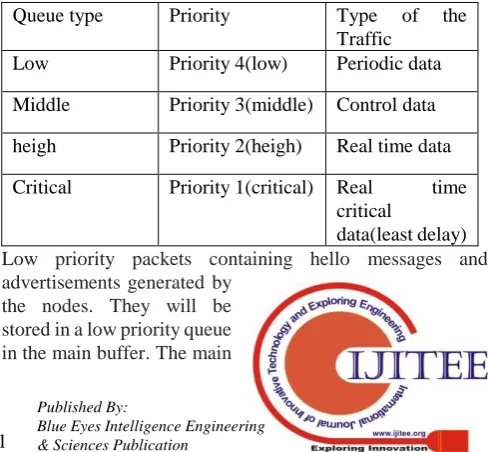
Sensor node categorizes the incoming packets into four different types and are inserted in their respective priority queue. The first priority packets are important packets and hence they will be placed in the critical priority queue as they carry valuable data like tempt and humidity information sent by the base station
The second type of packet are stored in high priority queue is real time data packets contain all types of control packets and The control data packets will be inserted in the middle queue. The periodic data packets will be inserted in the low priority queue. The Packet classification of packets based on priority is shown in the table III.
Table IV. Packet classification based on the priority
Queue type Priority Type of the
Traffic
Low Priority 4(low) Periodic data
Middle Priority 3(middle) Control data
heigh Priority 2(heigh) Real time data
Critical Priority 1(critical) Real time
critical
data(least delay)
Low priority packets containing hello messages and advertisements generated by
[image:4.595.304.549.605.831.2]consent is given on not to lose important packets and letting other packets to get discarded.
Queue Management
Buffer management describes the volume of buffer size available to a particular queue and states how the space is allocated among the different types of queues .The Input Queue stores the new incoming packets and s based on the arrival time packets. And in the Main Buffer Queue packets are arranged and prioritized according to the type and information they have. The output queue gets the main buffer packets in the order of arrival time and tries to transmit them immediately based on the priority. If important packets are not sent by the output queue, they are carried to the old prioritized queue. The packets in the output priority queue are inserted in the lower priority queue for second chance to be retransmitted.
Main Buffer Division on Priority
Consider every sensor node composes buffer size Bs, Tq different types queues in accordance with the expected arriving packet type. The main buffer is divided in to four levels of priority queues (critical, , High, Middle and Low ) Each queue only will accept packets with the matching type considering Cb,Hb, Mb and Lb, Hence, the total size of four queues cannot overreach the total capacity of the main buffer,
Cb+Tb +Mb + Lb <= BTB. (1)
The first priority concerns Critical Priority Packets. Ap and Gp designate important and older packets and are in the priority queue. The second priority is given to real time packets. Bp indicates real time packets and is stored in the medium priority queue. This queue has two types of message classification. 1. packets of the same type are prioritized according to their arrival time, for example, the packets type Bp1, Bp2, Bp3, Bp4.
The other type of packet is Gp (old packages) that shares the queue with Ap. The Middle priority is for control data packets, Cp denotes smaller packets. The low priority packets are periodic data and these are inserted into the low priority queue.
First preference will be given to important packets consisting of packets Ap or Gp. Any packet Ap that can not be transmitted will be tagged as Gp and carried to the older queue.Gp will always be forwarded to the next rank and will be able to be retransmitted because it contains valuable data.
Transmission Priority
In the buffer the packets are prioritized, stored and transmitted.
The greatest opportunity to the packets of the higher priority queue. It is here configured the top queue for more attempts to repetitively send large and important packets than any other queue in the main buffer. However, it allows larger and important packets to be sent four times at a time. The real time data and control data packets of the intermediate queue are assigned so that three and two messages are transmitted in each unit of time respective. In addition, the least important packets of the lower prioritized queue are configured in a single message to be sent for each time slot.
If the outgoing queue can not transmit packets, all other packets are discarded, except for important packets. Then,
important packets are placed in the older queue for future retransmissions. Important packets that have not been sent are considered as old packets, then labeled "Gp to differentiate them from "Ap" packets containing new messages.
If the output queue is occasionally emptied and there is no "Ap" packet in the critical priority queue at this time, it verifies the (TTL) older packets from the older priority queue. A new packet that has not exceeded its expiration period is collected. Subsequently, a second option opportunity is given to the old packets (Gp) that have a value lower than a positive threshold value to retransmit yet again because Gp has more priority than B and C
If the value of TTL <= THR, if Gp packet are inserted in the output priority queue to resend it. If not, the packets remains in the older priority queue. Then it is establishing an expiration scheme for the packets which are not sent and the TTL parameter of the message will be utilized. Gp-packets will expire after 60 seconds if they remain in the older priority queue. Once the expiration period has elapsed, a second chance is not given.
Dropping Policy
The scheme has to do with the rules for accepting or rejecting a new incoming packet and rejecting an existing saved package to make a place for new packets. Selection and evaluation packet is made according to the type of incoming packets. The strategy is based on the dropping policy (DOP) in the buffer.
Newly arrived packages are always placed in their corresponding queues when the buffer is not busy, but the removal strategy will be applied if the buffer is full.
If the Main buffer does not have space available for newly arrived packages, the DOP is applied. If the incoming packet is normal type and the intermediate space of the queue is already full, the oldest packet in the queue will be deleted and replaced by the new received packet. Even so, if the reception packet is large, DOP removes the oldest one from the queue to support the new important packets. All old packets are sent to the low heterogeneous queue to replace the existing packet during the retransmission process.
If the output queue does not transmit the packets, it rejects all other packets, other than important packets. Afterwards these are inserted in the expiration queue and saved for additional action.
Older prioritized queue packets are older "Gp" and "Ap" packets contain new messages.
When the old queue is full, the oldest packet is sent to a low heterogeneous queue and the least important packet is removed, as shown in Figure 4. Therefore, packets labeled with G will always be promoted to higher levels until the retransmission is successfully completed so as not to lose large packets.
Our goal is to maximize the delivery rate of large packages and minimize the number of packet losses to obtain complete packet reception.
Therefore, the removal of essential packets is not important in the proposed algorithm. If the buffer is busy and there is no more place available to accommodate the new incoming packet, the important packets are specified the utmost priority. Therefore, normal
=========================================== ===
Algorithm:
1. Effective proportional buffer allocation based on data priority and size.
2. DOP to eliminate low priority packages. Input: sensed event
Step2: compute the size of the event
Step3: Compute the CH selection by reserving delay and Transmission reliability, Residual energy
Step 4: Computer the SCH selection by delay , Transmission reliability, Residual energy
Step5: Buffer Management policy with packet prioritization, computing the criticality of the event
5.1 If packets are critical assigned as Critical Priority 5.2 If packets are assigned as High Priority
5.3 If packets are assigned as Middle priority 5.4 If packets are assigned Low priority
Step 6: Data transmission from the shortest path Protocol If based on the priority of the events if the
6.1 Data transmitted with packets with critical priority packets if even needs important packets
Else if
6.2 Data transmitted with packets with real time priority packets if event needs real time data
Else if
6.3 Data transmitted with packets with control priority packets if event needs control packets
Else if
6.4 Data transmitted with packets with periodic priority if event needs periodic data
IV. SIMULATION AND PERFORMANCE ANALYSIS Proposed protocol evaluation is done with existing protocols using the NS-2 Network Simulator [29]. Network of 100 nodes used in the simulation model in a 500 m x 500m region with sensor nodes varying from 0-100 nodes and with different traffic. The proposed work is compared with RFBCH [28] and LEACH [30].
Performance Metrics:
Average End to End delay: The average delay of all paths from source to destination.
Average Residual Energy: The average Residual value of the all paths from every sensor nodes to sink.
Average Reliability: Average Reliability of the all the paths from sensor nodes to sink.
The evaluation of the proposed protocol is based on parameters- the number of Throughput, Delay , PDR, packets dropped. The parameter definitions are given below.
TABLE VI.SIMULATION PARAMETERS
V. HELPFUL HINTS parameter considered Value considered Type of channel used wireless type
Radio propagation Two Ray Model used
Model used
Network Interface type Phy /wireless Phy
Mac type Mac/802.11
Interface Queue type used Queue/Drop/PriQueue used Antenna model used Antenna/Omni Antenna Area of the sensor field
used 500x500m
Sensor nodes used 100
Node distribution used Randomly
Initial energy 100J
Simulation time 200s
Traffic Type
CBR
[image:6.595.308.547.50.207.2]PDR v/s Traffic:
Figure 3. PDR v/s Traffic
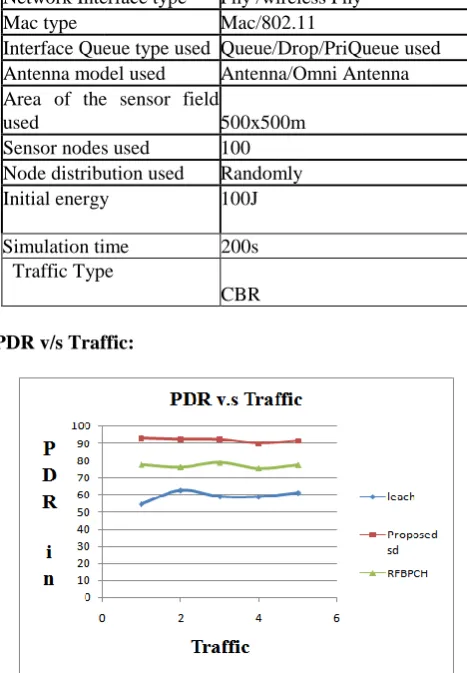
Figure 3 shows the comparison of packet delivery ratio of the proposed protocol with existing protocols. The multilevel, multi constraint with buffer management systems have different packet delivery ratio depending on the increasing amount of traffic on the network. As traffic increases from the packet delivery report for PPHQ, it increases with the existing LEACH and RFBPCH protocols. The proposed work offers enhanced performance in terms of packet delivery ratio compared to the existing protocols. The proposed protocol got increasing improvements over the existing protocols used in WSN.
The reason is that the proposed scheme focus on the fuzzy concept of choosing the nodes as CH and SCH along with buffer management considering the priority to important packets to delivery fast . In addition, when the transmitter can not transmit large packets, multiple retransmission possibilities are offered. All of these scenarios are not considered in the existing work which uses.
[image:6.595.308.542.58.395.2]Figure 4. Delay v/s Traffic
As shown in Figure 4, for all range of traffic configured in the simulation, the average end-to-end delay for proposed scheme is less than the existing protocols in WSN. The proposed one has greater percentage performance compared to LEACH and RFBPCH in WSN. As the proposed considers two level of delay in choosing node and then the shortest path. In the existing protocol the packet delay for WSN is caused by the queue congestion and higher load in the buffer since the output transmitter queue works in FIFO manner. In that case, all different types of packet have equal priority in terms of transmission schedule. On the contrary, in proposed scheme, when packets experience heavy queue congestion, the highest priority is always given to the important packets while other packets are kept waiting to avoid any possible dropping. Therefore, this way has resulted in delivering most important packets to the base station with minimum delay.
[image:7.595.309.546.111.238.2]Residual energy v/s Traffic:
Figure 5. Residual energy v/s Traffic
Figure 5 shows the effect of loading on the performance of a WSN. The results imply different residual energy achieved by both the proposed system and the existing system when the traffic is different. These comparisons indicate that the proposed scheme works better in terms of average residual energy performance compared to the existing WSN network. In fact, the proposed work has performed better than the existing scheme. The reason is that the proposed scheme consider residual energy in two levels and also selects higher priority packets when executing the transfer of packets. The existing work transmits the different types of packets
randomly, with no priority functionality, because the transmitter queue uses the FIFO mode
and also there no consideration of residual energy.
Throughput v/s Traffic:
Figure 6. Throughput v/s Traffic
Fig. 6 shows the effect of load on overall throughput of a WSN. The results imply different efficiency achieved by proposed and existing protocols in WSN scheme. As the traffic increases ,the amount of throughput for the proposed work shows higher throughput compared to the existing protocols in WSN. The reason is that, the proposed work selects delay, residual energy and distance as major parameter in multilevel, multi constraints with fuzzy logic with multi priority packets when forwarding and scheduling packets and also imp packets will be delivered first. In the other hand, the existing protocol transmits the different packet randomly with no priority as the transmitter queue employs FIFO mode
V.CONCLUSION
In this document, the buffer administration system makes efficient use of the storage space of the sensor node. It is based on the classification of packages and the prioritization of the different packages in the buffer. The proposed work gives higher priority to important package types because they contain valuable and detected data. Compared to the existing WSN, our proposed schema has fewer rejected packets for important packet types, and higher throughput and throughput. This is because the considered queue is not based on the FIFO method. Therefore, the highest priority is given to the important packets and can be retransmitted various times compared to other packets. The results shows that the proposed schema exceeds the existing WSN protocol in terms of end-to-end delivery, throughput and PDR performance, and timing. Meaningful packet delivery can be achieved by giving the highest priority and order in which important packets are scheduled and transmitted.
REFERENCES
1. H. Zainol Abidin, N. Md. Din, N. A. Mohamed Radzi, and Z. I. Rizman, “A Review on Sensor Node Placement Techniques in Wireless Sensor Networks,” Int. J. Adv. Sci. Eng. Inf. Technol., vol. 7, no. 1, p. 190, 2017.
2. A. L. I. A. Ali, K. Azmi, and A. B. U. Bakar, “Energy Aware Fault Tolerance Topology,” J. Theor. Appl. Inf. Technol., vol. 96, no. 3, 2018.
3. H. N. Ch and T. N. Hu, “A Comparative Study on Hardware Platforms for Wireless Sensor
[image:7.595.50.285.448.622.2]4. H. Zainol Abidin, N. Md. Din, N. A. Mohamed Radzi, and Z. I. Rizman, “A Review on Sensor Node Placement Techniques in Wireless Sensor Networks,” Int. J. Adv. Sci. Eng. Inf. Technol., vol. 7, no. 1, p. 190, 2017.
5. A. L. I. A. Ali, K. Azmi, and A. B. U. Bakar, “Energy Aware Fault Tolerance Topology,” J. Theor. Appl. Inf. Technol., vol. 96, no. 3, 2018.
6. Fabian, P., Rachedi, A., Gueguen, C., & Lohier, S. (2018, December). Fuzzy-Based Objective Function for Routing Protocol in the Internet of Things. In 2018 IEEE Global Communications Conference (GLOBECOM) (pp. 1-6). IEEE.
7. Al-Kiyumi, R. M., Foh, C. H., Vural, S., Chatzimisios, P., & Tafazolli, R. (2018). Fuzzy logic-based routing algorithm for lifetime enhancement in heterogeneous wireless sensor networks. IEEE Transactions on Green Communications and Networking, 2(2), 517-532.
8. Pourakbar, H., & Ghaffari, A. (2018). Reliable and Real-Time End-to-End Delivery Protocol in Wireless Sensor Networks. arXiv preprint arXiv:1803.03958.
9. Y.M. Lu and V.W.S. Wong, An energy efficient multipath routing protocol for wireless sensor networks, Int. J. Commun. System 20(7) (2007), pp. 747 – 766
10. 10 . Shah and J. Rabaey, Energy aware routing for low energy ad hoc sensor networks, Proceedings of IEEE WCNC’02, Orlando, FL, March (2002), pp. 350 – 355.
11. D. Ganesan, R. Govindan, S. Shenker, and D. Estrin, Highly-resilient, energy-efficient multipath routing in wireless sensor networks, Proceedings of ACM MobiHoc’01, Long Beach, CA, USA, October, (2001).
12. W. Shu, K. Padmanabh, and P. Gupta, “Prioritized buffer management policy for wireless sensor nodes,” in Proceedings - International Conference on Advanced Information Networking and Applications, AINA, 2009.
13. N. Nasser, L. Karim, and T. Taleb, “Dynamic multilevel priority packet scheduling scheme for wireless sensor network,” IEEE Trans. Wirel. Commun., 2013.
14. K. Akkaya and M. Younis, A survey on routing protocols for wireless sensor networks, J. Ad Hoc Networks 3(3) (2005), pp. 325–349 15. D. Chen and P.K. Varshney, QoS support in wireless sensor networks:
A survey, Proceedings of the International Conference on Wireless Networks, ICWN-2004, Las Vegas, Nevada, USA,
16. June, (2004), pp. 227–233.
17. Sumathi, R., & Srinivas, M. G. (2012). A survey of QoS based routing protocols for wireless sensor networks. Journal of Information Processing Systems, 8(4), 589-602[c]
18. Ouferhat, N., & Mellouk, A. (2010, June). Inductive routing based on energy and delay metrics in wireless sensor networks. In Proceedings of the 6th International Wireless Communications and Mobile Computing Conference (pp. 1121-1125). ACM.
19. Martinez, J. F., Garcia, A. B., Corredor, I., Lopez, L., Hernandez, V., & Dasilva, A. (2007, September). Trade-off between performance and energy consumption in wireless sensor networks. In International Workshop on Self-Organizing Systems (pp. 264-271). Springer, Berlin, Heidelberg.
20. Bidgoli, A. M., Pajouhesh, M., & Ahmadi, M. (2011). Reliable data delivery and energy efficient aware multipath routing protocol in wireless sensor network. Life Science Journal, 8(4).
21. Sheyibani, R., Sharififar, E., Khosronejad, M., Mazaheri, M. R., & Homayounfar, B. (2012, September). A reliable and qos aware multi-path routing algorithm in wsns. In 2012 Third International Conference on Emerging Intelligent Data and Web Technologies (pp. 125-132). IEEE.[G]
22. Sumathi, R., & Srinivasan, R. (2009, June). QoS aware routing for end-to-end reliability of delay sensitive events in wireless sensor networks. In Proceedings of the Fourth International ICST Conference on COMmunication System softWAre and middlewaRE (p. 3). ACM.[H]
23. Elappila, M., Chinara, S., & Parhi, D. R. (2018). Survivable path routing in WSN for IoT applications. Pervasive and Mobile Computing, 43, 49-63.
24. Mostafaei, H. (2018). Energy-efficient algorithm for reliable routing of wireless sensor networks. IEEE Transactions on Industrial Electronics. 25. Duan, Y., Li, W., Fu, X., Luo, Y., & Yang, L. (2018). A methodology for reliability of WSN based on software defined network in adaptive industrial environment. IEEE/CAA Journal of Automatica Sinica, 5(1), 74-82.
26. Arafath, M. S., Khan, K. U. R., & Sunitha, K. V. N. (2018). Pithy Review on Routing Protocols in Wireless Sensor Networks and Least
Routing Time Opportunistic Technique in WSN. In Journal of Physics: Conference Series (Vol. 933, No. 1, p. 012016). IOP Publishing.[M]. 27. Moussa, N., El Alaoui, A. E. B., & Chaudet, C. (2018). A novel
approach of WSN routing protocols comparison for forest fire detection. Wireless Networks, 1-11.[N]
28. Zhu, X., Lu, Y., Han, J., & Shi, L. (2016). Transmission reliability valuation for wireless sensor networks. International Journal of Distributed Sensor Networks, 12(2), 1346079.
29. Bamatraf, A., Latiff, M. S. B. A., & Coulibaly, Y. (2017, May). Priority based QoS protocol for heterogeneous traffic routing in WSN. In 2017 6th ICT International Student Project Conference (ICT-ISPC) (pp. 1-5). IEEE.
30. Network Simulator http://www.isi.edu.nsnam/ns
31. Sivakumar, P., & Radhika, M. (2018). Performance analysis of LEACH-GA over leach and LEACH-C in WSN. Procedia Computer Science, 125, 248-256.
AUTHORS PROFILE
Dr. Jayashree V. Agarkhed Currently working as professor in the Computer Science and Engineering Department at Poojya Doddappa Appa College of Engineering, Gulbarga, Karnataka, India. She received the BE degree from Gulbarga University, Gulbarga, Karnataka, India M.Tech. and Ph. D degree from Visveshwaraya Technological University, Belagavi, Karnataka, India in 1999, 2003 and 2013 respectively. He has guided many BE and M.Tech. Projects, and guiding more than 8 Ph.D students. She is a life member of Indian Society for Technical Education (ISTE), India Member of Institute of Electrical and Electronics Engineers (IEEE), Member of Institute of Electronics and Telecommunication Engineers (IETE), India and Member of Institute of Engineers, India. Her research interests are in the area of wireless networking with a Quality of Service (QoS) provisioning, scheduling and routing algorithm design in sensor network, Ad Hoc Networks and cloud computing. She has published more than 125 scientific articles in top-tier journals and conferences, including Springer journal, IEEE conference proceedings and Springer Book chapters. She has chaired various international conferences and is the reviewer for various National and International journals and Conferences. She is the Member of Board of Studies (BOS) and Board of Examiners (BOE) of computer science and engineering department and also the member of IEEE, ACM-W and IEI, life member of CSI and fellow member of ISTE and IETE.
Ms Vijayalaxmi Kadrolli is currently Research Scholar of Computer Science and Engineering department at Poojya Doddappa Appa (PDA) college of Engineering, Kalaburagi, Karnataka, India, an autonomous institute affiliated to Visvesvaraya Technological University (VTU) , Belagavi, Karnataka, Indian. She has obtained M.Tech in Computer Science and engineering in 2004 from PDA college of Engineering from VTU. Her main research areas are in Wireless sensor network, Artificial Intelligence, Soft computing.