MEDICAL IMAGE ENHANCEMENT USING THRESHOLD DECOMPOSITION
DRIVEN ADAPTIVE MORPHOLOGICAL FILTER
Tarek A. Mahmoud, Stephen Marshall
Department of Electronic and Electrical Engineering,
University of Strathclyde, 204 George Street, Glasgow, UK, G1 1XW [email protected], [email protected]
ABSTRACT
One of the most common degradations in medical images is their poor contrast quality. This suggests the use of contrast enhancement methods as an attempt to modify the intensity distribution of the image. In this paper, a new edge detected morphological filter is proposed to sharpen digital medical images. This is done by detecting the positions of the edges and then applying a class of morphological filtering. Moti-vated by the success of threshold decomposition, gradient-based operators are used to detect the locations of the edges. A morphological filter is used to sharpen these tected edges. Experimental results demonstrate that the de-tected edge deblurring filter improved the visibility and per-ceptibility of various embedded structures in digital medical images. Moreover, the performance of the proposed filter is superior to that of other sharpener-type filters.
1. INTRODUCTION
Today, there is almost no area of technical endeavour that is not impacted in some way or another by digital image proc-essing. The area of digital image processing is a dynamic field and new techniques and applications are reported rou-tinely in professional literature and in new product an-nouncements. Digital images are subject to a wide variety of distortions which may result in visual quality degradations. Image enhancement is crucial for many image processing applications. The ultimate goal of image enhancement tech-niques is to improve the visual information of a degraded image in a subjective process.
Image sharpening is a classic problem in the field of image enhancement. The principal objective of image sharpening is to highlight fine details in an image or to enhance details that have been blurred, either in error or as a natural effect of a particular method of image acquisition. Usages of image sharpening vary and include applications ranging from document and medical imaging to industrial inspection and autonomous guidance in military systems [1].
Linear operators have been the dominating filter class throughout the history of image processing. This is triggered by the computational efficiency of linear filtering algorithms. Despite the elegant linear system theory, not all image sharp-ening problems can be satisfactorily addressed through the use of linear filters. Many researchers now hold the view that it is not possible to obtain major breakthroughs in image sharpening without resorting to nonlinear methods [2].
Identifying the edges of low contrast structures is one of the most common tasks performed by those interpreting medical images. Low contrast structures need to be resolved in all kinds of digital medical images; e.g., X-ray imaging, com-puted tomography (CT), magnetic resonance (MR), digital mammography, ultrasound, angiography and nuclear medi-cine [3].
X-rays are the oldest and the most frequently used form of medical imaging. X-ray is a painless medical test, which helps physicians diagnose and treat medical conditions. This medical test involves exposing a part of the body to a small dose of ionizing radiation with the objective of producing pictures for the inside of the body. The bone X-ray makes images of any bone in the body, including the hand, wrist, arm, foot, ankle, knee, leg or spine. X-ray images are main-tained as hard film copy or, more likely, as a digital image that is stored electronically. These stored images are easily accessible and are sometimes compared to current X-ray images for diagnosis and disease management [4].
Most medical images contain important structures, which are characterized with low natural contrast with the surrounding structures. To obtain high contrast in the raw image directly from the imaging device is almost always expensive in ex-amination time or X-ray dose to the patient. Thus, the pro-duction of these images generally involves a compromise between the need for enhanced contrast and its related costs. In these situations, digital post-processing can play a very important role [3].
Mathematical morphology is the name given to a geometrical branch of nonlinear filters. It offers a unified and powerful approach to numerous image processing problems. One of the most appealing aspects of morphological image process-ing lies in addressprocess-ing the image sharpenprocess-ing problem [5]. In this paper, a new method for sharpening low constrast X-ray imaging is proposed. This is utilised by sharpening medi-cal images by extending the edge-detected morphologimedi-cal filter first introduced in [6] for image deblurring. This is done by detecting the positions of the edges and then applying a class of morphological filtering. Since the edge is a promi-nent feature of an image, it is a vital foundation for medical image sharpening.
its performance is compared with that of other sharpener-type filters. Finally, Section 5 contains some concluding remarks.
2. BACKGROUND
2.1 Threshold Decomposition
Threshold decomposition is a powerful theoretical tool, which is used in nonlinear image analysis. Many filter tech-niques have been shown to ‘commute with thresholding’. This means that the image may be decomposed into a series of binary levels, each of which may be processed separately. These binary levels can then be recombined to produce the final greyscale image with identical pixel values to those produced by greyscale processing. Hence a greyscale tion may be replaced by a series of equivalent binary opera-tions. The first threshold decomposition framework for im-age processing was introduced by Fitch et al. in [7]. This was capable of modelling a wide range of filters based on rank ordering such as the median and WOS operators. It was also capable of modelling linear FIR filters with positive weights. The framework was limited to modelling low pass filters or ‘smoothers’.
More recently the framework was modified by Arce in [8]. This modification introduced the ability to model both linear and nonlinear filters with negative as well as positive filter weights. It in effect opened up the possibility to model high pass and band pass filters as well as low pass filters.
Motivated by this success an image sharpening technique is developed and implemented through a framework of thresh-old decomposition. Consider an integer-valued set of samples x1 , x2 , … , xn forming the signal X = (x1 , x2 , … , xn)wherexi
∈
{-m …, -1, 0, 1, … , m}. The threshold decomposition of X amounts to decomposing this signal into 2m binary signals X -m+1, …, X 0, …, X m, where the ith element of x m is defined by Equation (1): < − ≥ = m x if 1 m x if 1 x i i m i (1)
The above threshold decomposition is reversible, such that if a set of threshold signals is given, each of the samples in X can be exactly reconstructed as shown in Equation (2):
∑
+ − = = m 1 m j j i i x 2 1 x (2)Thus, an integer-valued discrete-time signal has a unique threshold signal representation, and vice versa.
2.2 Edge Detection
Edge detection is a fundamental tool, which is commonly used in many image processing applications. This process detects boundaries between objects and background in the image. An edge-detection filter can be used to improve the appearance of blurred or low-contrasted images.
Since edge detection has been an active area for more than 40 years, many effective methods have been proposed such as gradient edge detectors (1st derivative), zero crossing (2nd derivative), Laplacian of Gaussian (LOG) and Gaus-sian edge detectors [9].
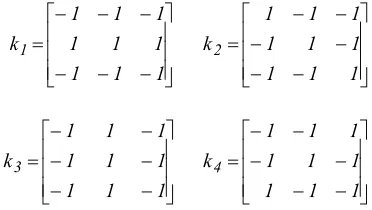
In spite of all these efforts, none of the proposed operators are fully satisfactory in real world applications. They do not lead to satisfactory results when used as a means of identify-ing locations at which to apply image sharpenidentify-ing. In this paper, the enhancement is applied through a framework of threshold decomposition. This has two advantages: it re-duces the edge detection to a simple binary process; and it makes the estimation of edge direction straightforward. Edge detection and direction estimation may be carried out by identifying simple patterns, which are closely related to the Prewitt operators [10]. The operators are sometimes called compass operators because of their ability to deter-mine gradient direction. The gradient is estimated in 8 pos-sible directions (for a 3×3 mask) with a difference of 45o between each direction. The first 4 operators are the four (3×3 mask) shown in Figure 1, the other four can be ob-tained by applying a 45o clockwise rotation. By using the 8 masks of the Prewitt operators, thick edges in the 8 direc-tions can be detected.
− − − = 1 1 1 D D D 1 1 1
h1 0 1 2
− − − = 2 1 0 2 D 1 1 1 D 1 1 1 D h − − − = 1 D 1 1 D 1 1 D 1 h 2 1 0 3 − − − = 1 1 D 1 D 1 D 1 1 h 2 1 0 4
Figure 1 - Four (3×3 mask) of Prewitt operators
where g = {D0 , D1 , D2} is the structuring element used in
mathematical morphology and will be explained later. On the other hand, the 8 masks mentioned in [11] can be used to detect thin edges in the 8 directions. The first 4 op-erators are represented by the four (3×3 mask) shown in Figure 2, the other four can be obtained by negating the elements of these matrices.
− − − − − − = 1 1 1 1 1 1 1 1 1 k1 − − − − − − = 1 1 1 1 1 1 1 1 1 k2 − − − − − − = 1 1 1 1 1 1 1 1 1 k3 − − − − − − = 1 1 1 1 1 1 1 1 1 k4
Figure 2 - Four (3×3 mask) for thin edge detection
[image:2.595.333.519.589.694.2]search-ing for patterns of grey levels consistent with the 8 masks of the Prewitt operators for thick edges, and the 8 masks men-tioned in [11] for thin edges. Thus the sharpening filter is applied only at these detected edges rather than all the pixels of the image.
3. IMAGE SHARPENING BY MORPHOLOGICAL FILTERING
Kramer and Bruckner in [12] define a nonlinear transforma-tion for sharpening digitized greyscale images. The trans-formation replaces the grey level value at a pixel by either the minimum or the maximum of the grey level value in its neighbourhood. The choice is dependent on which one is closer in value to the original grey level intensity.
In mathematical morphology, the transformation which re-places the grey level value at a pixel by the maximum of the grey level value in its neighbourhood is the greyscale dila-tion operator as defined in Equadila-tion (3):
(f ⊕ g)(z) max
[
f( ) g(z )]
2
R µ µ
µ + −
=
∈ (3)
in which function f (x), f : x ∈ R2 → f (x) ∈ R is the origi-nal image, and g (x), g : x ∈ R2 → g (x) ∈ R is the structur-ing element implicitly definstructur-ing the weighted neighbour-hood.
Similarly, the transformation which replaces the grey level value at a pixel by the minimum of the grey level value in its neighbourhood is known as the greyscale erosion operator as defined in Equation (4):
(f g)(z) min
[
f( ) g( z)]
2 R
− − =
∈ µ µ
µ (4)
Note that the dilation operator is extensive: (f⊕ g)(z)≥ f(z) and the erosion operator is anti-extensive: (f g)(z)≤ f(z).
Consider a greyscale signal f(z) and a structuring element g containing the origin. Kramer and Bruckner in [12], and then redefined by Schavemaker et al. in [13], used a flat or concave structuring element and the following discrete nonlinear filter to enhance the local contrast of f(z) by in-creasing its gradient as shown in Equation (5):
Ψ(f(z)) =
(f ⊕ g)(z) if f(z) ≥ ((f ⊕ g)(z)+(f g)(z)) / 2 (5)
(f g)(z) if f(z) < ((f ⊕ g)(z)+(f g)(z)) / 2 According to Equation (5), the output of the filter depends on the relative magnitude of the original signal f(z) as compared to the average of its eroded and dilated versions. If the origi-nal sigorigi-nal f(z) is greater than or equal to this average then the output of the filter Ψfollows the dilation of f(z). If it is lower, then Ψ follows its erosion. The dilation is carried out by a flat or concave structuring element, and tends to be larger than the
original signal close to the gradient. On the other hand, the erosion is lower than the original signal.
Figure 3 shows that the output value of this filter switches between the value of the dilation of f(z) by g(z) and the value of its erosion by g(z). This switch causes the gradient of the signal to increase, which leads to a contrast enhancement.
4. THE PROPOSED SHARPENING FILTER AND EXPERIMENTAL RESULTS
The sequence of applying the proposed filter will be ex-plained before introducing the experimental results. First, the threshold decomposition method introduced in section 2.1 is applied to the low contrast medical image to produce a stack of binary images. At each level, a search is performed for the 16 possible edge directions as described in section 2.2. Binary morphological operations of dilation and erosion are used to increase the contrast in the region and direction of the de-tected edges with the aid of a flat structuring element [14]. A summation is applied over all levels in order to reconstruct the sharpened image. The nonlinear discrete filter is thus used to sharpen only at detected edges, rather than the whole im-age.
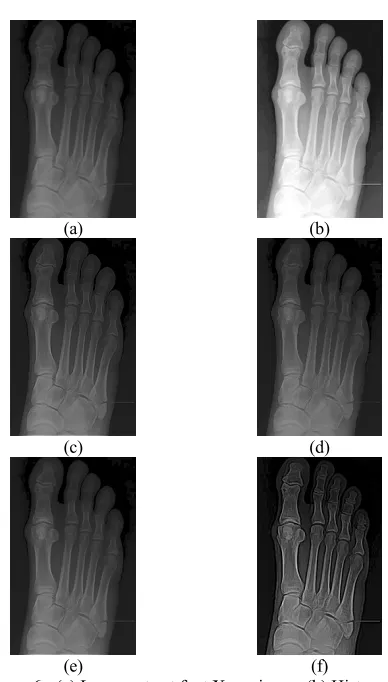
This section presents application results for the contrast en-hancement of medical images. The performance of the pro-posed edge-detected morphological filter is compared with a number of contrast enhancement techniques including histo-gram equalization, modified high-pass filter [15], LUM filter [16], and quadratic weighted median filter (QWM) [17]. The proposed edge-detected morphological filter was tested on three medical images. As a first example, the Chest X-ray image shown in Figure 4(a) was used. Figures 4(b), 4(c), 4(d) and 4(e) show the contrast enhanced image after applying the histogram equalization filter, the modified high-pass filter, the LUM filter and the QWM filter respectively. Figure 4(f) shows the contrast enhanced image after applying the pro-posed edge-detected morphological filter. It can be seen that the latter gives the most distinct features.
As a second example, the Hand X-ray image shown in Figure 5(a) was used. This image demonstrates a fracture to the fifth
f(z)
(f ⊕ g)(z)
(f g)(z)
f(z) Ψ(f(z))
(a) (b)
Figure 3 - (a) Dilation and erosion of a signal f(z)
(b) Contrast enhancement of f(z) by switching between dilation and erosion using
[image:3.595.332.517.106.243.2]metacarpal. Figures 5(b), 5(c), 5(d) and 5(e) show the contrast enhanced image after applying the histogram equalization filter, the modified high-pass filter, the LUM filter and the QWM filter respectively. Figure 5(f) shows the contrast en-hanced image after applying the proposed edge-detected morphological filter. The fracture in this image appears clearer than the other images.
As a third example, the Foot X-ray image shown in Figure 6(a) was used. This image demonstrates a fracture to the base of the fifth metatarsal. Figures 6(b), 6(c), 6(d) and 6(e) show the contrast enhanced image after applying the histogram equalization filter, the modified high-pass filter, the LUM filter, and the quadratic QWM filter respectively. Figure 6(f) shows the contrast enhanced image after applying the pro-posed edge-detected morphological filter. The fracture in this image appears clearer than the other images.
From the figures of the filtered images, it is evident that the resulting images of the proposed edge-detected morphologi-cal filter are noticeably of higher contrast. Even the fractures and small details in the X-ray images have been enhanced. Finally, the execution time of the proposed filter is intro-duced in Table 1. The proposed filter was performed on a Pentium IV processor running at 2.4 GHz with 512 MB RAM and using C++.
5. CONCLUSIONS
This paper introduced a new enhancement filter for digital medical images. In the proposed scheme, the edge detected guided morphological filter succeeded in enhancing low contrasted medical images. This was done by accurately detecting the positions of the edges through threshold de-composition. The detected edges were then sharpened by applying morphological filter using flat structuring ele-ments. By utilising the detected edges, the scheme was ca-pable to effectively sharpening fine details whilst retaining image integrity. The visual examples shown have demon-strated that the proposed method was significantly better than many other well-known sharpener-type filters in re-spect of edge and fine detail restoration.
REFERENCES
[1] R. C. Gonzalez and R. E. Woods, Digital Image Process-ing. Prentice Hall, 2002.
[2] E.R.Dougherty, An Introduction to Nonlinear Image Processing, SPIE Press, 1994.
[3] J. Lu, D. M. Healy Jr., and J. B. Weaver, "Contrast en-hancement of medical images using multi-scale edge repre-sentation," Optical Engineering, vol. 33, pp. 2151-2161, 1994.
[4] "Bone X-ray (Radiography)," Retrieved on May 4 2007, from http://www.radiologyinfo.org.
[5] P. Maragos, "Morphological filtering for image en-hancement and feature detection," in: A. C. Bovik, (eds.), The Image and Video Processing Handbook. Elsevier Aca-demic Press, 2005.
[6] T. A. Mahmoud, and S. Marshall, "Threshold decompo-sition driven adaptive morphological filter for image
sharp-ening," in Proc. VISAPP 2007, Barcelona, Spain, March 8-11. 2007, pp. 40-45.
[7] J. P. Fitch, E. J. Coyle, and N. C. Gallagher, "Median filtering by threshold decomposition," IEEE Transactions on Acoustics, Speech and Signal Processing, vol. 32, pp. 1183-1188, 1984.
[8] G. R. Arce, "A general weighted median filter structure admitting negative weights," IEEE Transactions on Signal Processing, vol. 46, pp. 3195-3205, 1998.
[9] M. Sharifi, M. Fathy, and M. T. Mahmoudi, "A classified and comparative study of edge detection algorithms," in Proc. ITCC 2002, Las Vegas, USA, April 8-10. 2002, pp. 117-120.
[10] J. M. Prewitt, "Object enhancement and extraction," Picture Processing and Psychopictorics, pp. 75-149, 1970. [11] R. Zhang, G. Zhao, and L. Su, "A new edge detection method in image processing," in Proc. ISCIT 2005, October 12-14. 2005, pp. 430-433.
[12] H. P. Kramer, and J. B. Bruckner, "Iterations of a non-linear transformation for enhancement of digital images," Pattern Recognition, vol. 7, pp. 53–58, 1975.
[13] J. G. Schavemaker, M. J. Reinders, J. J. Gerbrands, and E. Backer, "Image sharpening by morphological filtering," Pattern Recognition, vol. 33, pp. 997–1012, 2000.
[14] F. Y. Shih, and O. R. Mitchell, "Threshold decomposition of greyscale morphology into binary morphology," IEEE Transactions on Pattern Analysis and Machine Intelligence, vol. 11, pp. 31-42, 1989.
[15] M. Fischer, J. L. Paredes, and G. R. Arce, "Weighted median image sharpeners for the world wide web," IEEE Transactions on Image Processing, vol. 11, pp. 717-727, 2002.
[16] R. C. Hardie, and C. G. Boncelet, "LUM filters: A class of rank-order-based filters for smoothing and sharpening," IEEE Transactions on Signal Processing, vol. 41, pp. 1061-1076, 1993.
(a) (b)
(c) (d)
(e) (f)
Figure 4 - (a) Low-contrast chest X-ray image (b) Histogram equalization (c) Modified high-pass (d) LUM (e) QWM
(f) Proposed edge-detected morphological filter
(a) (b)
(c) (d)
(e) (f)
Figure 5 - (a) Low-contrast hand X-ray image (b) Histogram equalization (c) Modified high-pass (d) LUM (e) QWM
(f) Proposed edge-detected morphological filter
(a) (b)
(c) (d)
(e) (f)
Figure 6 - (a) Low-contrast foot X-ray image (b) Histogram equalization (c) Modified high-pass (d) LUM (e) QWM
[image:5.595.327.521.61.402.2](f) Proposed edge-detected morphological filter
Table 1 CPU execution time of the proposed filter applied on the examples used
Image Size Width x Height
(pixels)
CPU Time (seconds)
Chest X-ray 300 x 247 8.1
Hand X-ray 183 x 300 5.9
[image:5.595.57.283.71.342.2] [image:5.595.71.262.378.729.2] [image:5.595.312.541.500.573.2]