Evaluating the Alignment Between the RSD Framework and the Effectiveness of
‘Bolted on’ Research Skills Training
Emma Gyuris1
1College of Science and Engineering, James Cook University
Corresponding author email address: [email protected]
A peer reviewed short paper for a presentation at the International conference on Models of Engaged Learning and Teaching (I-MELT), 11-13 December 2017. Available from www.imelt.edu.au
Abstract
This research considers the alignment of the curriculum and assessment design of the subject Research and Communication Skills for the Natural Sciences (SC5055) against the RSD matrix and asks which students benefit most from training in research and communication skills. The impact of SC5055 on students’ achievement and their ability to self-evaluate the development of their skills and understanding is also explored. Potential improvement for the RSD framework is highlighted.
Introduction
Research skills training is a focus of interest in higher education not only for students aspiring to be the producers of new knowledge and understandings but also for those who will access and use such new knowledge and understandings in the course of their professional activities. Critical thinking and written communication skills underlie almost every stage or component of the research endeavour [1, 2, 3]. But, while critical thinking is much discussed, clear definitions of what it is, how it may be developed, practiced and assessed, are seldom clear [1, 4]. In research training, the importance of the linkages between the development of critical thinking skills and critical reflection or reflective judgement, including reflection and judgement on one’s own development, is even less understood.
process [5, 6]. Furthermore, higher order thinking skills – critical thinking and reflective thinking – are prerequisites for the unambiguous and effective communication that is expected by employers and academia alike.
Here, we present exploratory research that considers
1) the alignment of the curriculum and assessment design of SC5055 against Willison’s RSD matrix [7], 2) which students benefit most from training in research and communication skills, and
3) the impact of SC5055 on students’ achievement and their ability to evaluate the development of their own skills and understandings.
Academic setting
At JCU, the majority of postgraduate students use the MSc (coursework) as a pathway to the PhD. Hence, an introductory subject in research methods and communication was seen as an efficient platform to teach, practice and assess critical thinking, critical reflection and science communication skills. The teaching team was challenged to engage a highly diverse body of students with strikingly variable English language skills and with limited exposure to research and research training. Most students have had no or minimal exposure to issues related to the responsible conduct of research. Further, students had highly variable and narrowly focused research interests. As noted previously [8], most students exhibited significant resistance to “wasting time” on learning research and communication skills.
Subject delivery, curriculum and assessment
Offered as a limited attendance, blended learning class, SC5055 was compulsory for all students in the MSc (Coursework). Prior to attending scheduled classes, students were presented with an e-folder containing learning resources and preparatory tasks to be completed.
Assessment consisted of an original research proposal (40% of total marks), an oral communication piece (30%, and not discussed further in this paper) and a learning portfolio (30%) that required self-evaluation of the development of skills relevant to subject learning outcomes [9]. The preparation of these assignments was scaffolded by four workshops, plus two two-hour tutorials bookending the semester. Throughout, team work and collegiality amongst students was stressed.
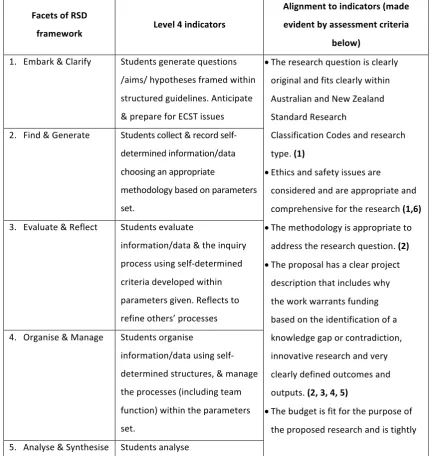
https://www.jcu.edu.au/research/i-want-to/grants/internal-grant-schemes/research-services). The proposal was graded twice. The first submission was graded and commented on by staff and was peer reviewed by at least two fellow students. Students gave and received peer reviews during and following the second workshop that was focused on critical reading and writing [10]. The process of writing an original research grant application fully engaged students with the facets of the RSD framework. This included ethical issues as they relate to research using human or non-human subjects as well as the ethics around peer review and authorship (Table 1).
Table 1. Alignment of RSD level 4 indicators and assessment criteria for the research proposal, one of the major assignments for SC5055. Numbers in brackets in column three denote correspondence with RSD facets, also numbered.
Facets of RSD
framework Level 4 indicators
Alignment to indicators (made evident by assessment criteria
below) 1. Embark & Clarify Students generate questions
/aims/ hypotheses framed within structured guidelines. Anticipate & prepare for ECST issues
•The research question is clearly original and fits clearly within Australian and New Zealand Standard Research
Classification Codes and research type. (1)
•Ethics and safety issues are
considered and are appropriate and comprehensive for the research (1,6)
•The methodology is appropriate to address the research question. (2)
•The proposal has a clear project description that includes why the work warrants funding based on the identification of a knowledge gap or contradiction, innovative research and very clearly defined outcomes and outputs. (2, 3, 4, 5)
•The budget is fit for the purpose of the proposed research and is tightly 2. Find & Generate Students collect & record
self-determined information/data choosing an appropriate
methodology based on parameters set.
3. Evaluate & Reflect Students evaluate
information/data & the inquiry process using self-determined criteria developed within parameters given. Reflects to refine others’ processes 4. Organise & Manage Students organise
information/data using self-determined structures, & manage the processes (including team function) within the parameters set.
information/data & synthesize to fully integrate components, consistent with parameters set. Fill knowledge gaps that are stated by others
aligned with proposed research methods. (4)
•Track record and leadership, relative to opportunity, are clearly
articulated. (5)
•Alignment to university strategic intent made clear. (5)
•The project has a clear objective and the summary is well articulated for the layperson. (6)
•Quality of writing, observance of guidelines and presentation. (6) 6. Communicate &
Apply
Students use discipline-specific language & genres to demonstrate scholarly understanding for a specified audience. They apply the knowledge developed to diverse contexts and specify ECST issues in initiating, conducting &
communicating.
Performance of the 2015 student cohort
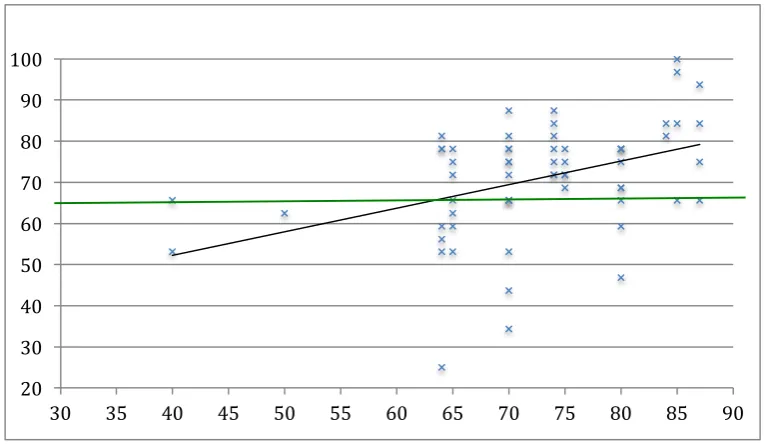
To examine the effectiveness of SC5055 on students’ achievement we took the formative and summative grades obtained for their research proposals. We considered that the difference in grade between the two reflected the impact of engaging with SC5055. Of the 61 students who submitted work for both the formative and summative assessments, 5 students’ summative grades were below the formative grade (i.e. below 0 on the ‘y’ axis), while 32 students improved by 10 marks or more (Figure 1). Students obtaining failing grades for their first submission made the greatest improvement. All 6 students who improved by ≥20 marks scored ≤70 marks for their formative grade (Figure 1), implying that weaker students benefited the most from instruction on proposal writing and critical reading and writing coupled with the extensive feedback provided (Pearson’s r=0.52, P<0.001).
-10 0 10 20 30 40 50
30 35 40 45 50 55 60 65 70 75 80 85 90
Figure 1. Improvement in the research proposal score (vertical axis) as a function of student’s formative score (horizontal axis). The 10-point improvement is highlighted in green.
[image:5.595.125.508.351.573.2]We then probed to see whether students showing the most improvement were more aware of their learning experience than were students who displayed less improvement. We took the grades obtained for the reflective learning portfolio as a proxy measure of students’ ability to understand their own learning and correlated those with the scores for the first submission of the proposal (Figure 2a) and with the improvement in scores between the two submissions (Figure 2b). To address issues of validity and reliability [11], the portfolio consisted of 4 individual reflective pieces and was assessed by 4 different academic teaching staff.
Figure 2a. Scores on learning portfolio as a function of student’s grade for the first submission of the research proposal). Students scoring above 65% (green line) gained grades of Credit, Distinction or High Distinction.
20 30 40 50 60 70 80 90 100
30 35 40 45 50 55 60 65 70 75 80 85 90
Le
ar
n
in
g
po
rt
fo
li
o
sc
or
e
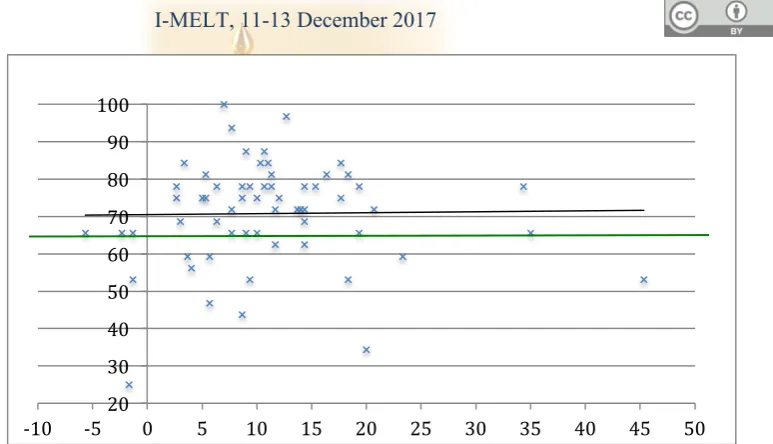
Figure 2b. Scores on learning portfolio as a function of student’s improvement in the research proposal. Students scoring above 65% (green line) gained grades of Credit, Distinction or High Distinction.
Students’ ability to think about their own learning processes was only weakly associated with their scores for the first submission of their proposal (Fig. 2a) (Pearson’s r=0.41, P<0.001) and, importantly, there was no relationship between the improvement achieved for the second submission and the learning portfolio score (Fig. 2b) (Pearson’s r=0.003, P=0.98). This leads to the supposition that a large proportion of students, irrespective of initial performance and improvement, are lacking awareness of their own learning, and that the process of writing the learning portfolio failed to make explicit the mental models and skill awareness, which is an alleged benefit of writing reflective essays and learning portfolios [8].
While it is well known that future performance is quite reliably predicted by past performance, past performance is often a poor predictor of improvement in performance [12]. This is attributed to the
performance heuristic, meaning that instead of critically examining the potential for future improvement in performance, people expect future success or failure to be commensurate with their past performance. Such expectations prevent insights into factors that can shape future performance. This could explain why students with a poor initial performance for the proposal tend to fail to understand their subsequent improvement and show limited awareness of learning and development, scoring low for the learning portfolio. Many others, performing relatively highly in the proposal, also demonstrated poor awareness of their skills and learning. This has the potential to significantly diminish the effectiveness of RSD programs, and the omission by the RSD framework of the ability to critically reflect on one’s own development needs addressing.
20 30 40 50 60 70 80 90 100
-10 -5 0 5 10 15 20 25 30 35 40 45 50
Le
ar
n
in
g
po
rt
fo
li
o
sc
or
e
Given the lack of any relationship between the portfolio score and the improvement achieved for the second submission of the proposal (see Figure 2b), how does one account for the observation that students scoring lower in the first submission tended to show the most improvement for the second submission? There are several possible explanations for this. Firstly, some students, disappointed with their formative grades, may simply seek the assistance of academic study skills advisors and, after implementing the advice given, obtain a much-improved grade for their second submission. In this case low grades would be
expected for the portfolio. Others, satisfied with their formative grade and relying on the performance heuristic, would expect an equally satisfying grade for the second submission, thus limiting their
improvement and scoring low for the portfolio (Fig. 2a). The lack of demonstrated relationship between reflective thinking and academic performance [13] would also explain the widespread of scores for the portfolio amongst students gaining a distinction or high distinction for the first submission of the proposal (see Figure 2a). Furthermore, and as noted by Hosein and Rao [8], it is uncertain if the marking criteria scaffolded the reflective writing of the more academically sophisticated students, that is, those receiving scores >80% for the formative proposal and scoring highly in the portfolio.
References
Dwyer CP, Hogan MJ, Stewart I. An integrated critical thinking framework forthe 21st century. Thinking skills and Creativity. 2014;12:43-52. Epub 18 Jan. 2014.
Ghanizadeh A. The interplay between reflective thinking, critical thinking, self-monitoring, and academic achievement in higher education. Higher Education. 2017; 74:101-14.
Moore T, Morton J. The myth of job readiness? Written communication, employability and the 'skills gap' in higher education. Studies in Higher Education. 2017; 42:591-609. Epub 30 Jul. 2015.
Cargas S, Williams S, Rosenberg M. An approach to teaching critical thinking across disciplines using performance tasks with a coomon rubric. Thinking skills and Creativity. 2017; 26:24-37. Epub 31 May 2017.
Cargill M, Smernik R. Embedding publication skills in science research training: a writing group programme based on applied linguistics frameworks and facilitated by a scientist. Higher Education Research & Development. 2016; 35:229-41. Epub 25 Sep 2015.
McCarthy BD, Dempsey JL. Cultivating advanced techincal writing skills through a graduate level course on writing reseach proposals. Journal of Chemical Education. 2017; 94:696-7-2.
Willison J, Buisman-Pijlman F. PhD prepared: Reseach skill development across the undergraduate years. International Journal for Researcher Development. 2016; 7:63-83.
Hosein A, Rao N. Students’ reflective essays as insights into student centred-pedagogies within the undergraduate research methods curriculum. Teaching in Higher Education. 2017; 22:109-25. Nilson LB. Creating self-regulated learners. Sterling, Virginia: Stylus Publishing. 2013; 56-58.
Gyuris E, Castell L. Tell Them or Show Them? How to Improve Science Students’ Skills of Critical Reading. International Journal of Innovation in Science and Mathematics Education. 2013; 21:70-80.
Moniz T, Arntfield S, Miller K, Lingard L, Watling C, Regehr G. Considerations in the use of reflective writing for students assessment: Issues of reliability and validity. Medical Education 2015; 49:901-8.
Critcher CR, Rosenzweig EL. The performance heuristic: A misguided reliance on past success when predicting prospects for improvement. Journal of Experimental Psychology: General. 2014; 143:480-485.