140 | P a g e
OPTIMAL LOCATION OF SVC, TCSC AND UPFC
DEVICES FORVOLTAGE STABILITY
IMPROVEMENT AND REDUCTION OF POWERLOSS
USING GENETIC ALGORITHM
Naveen Nellikoppad , Smt. Rekha G Padaki
1
M.Tech in Engineering Power Systems ,Dept. of E&E, UBDT College of Engineering
Davanagere, Karnataka, India
2
Assistant Professor, Dept. of E&E, UBDT College of Engineering
Davanagere, Karnataka, India
ABSTRACT
Improving of ATC is an important issue in the current de-regulated environment of power systems. The
Available Transfer Capability (ATC) of a transmission network is the unutilized transfer capabilities of a
transmission network for the transfer of power for further commercial activity, over and above already
committed usage. Power transactions between a specific seller bus/area and a buyer bus/area can be committed
only when sufficient ATC is available. Transmission system operators (TSOs) are encouraged to use the existing
facilities more effectively to enhance the ATC margin. In this paper, the use of TCSC and SVC to maximize
Available Transfer Capability (ATC) generally defined as the maximum power transfer transaction between a
specific power-seller and a power-buyer in a network during normal and contingency cases. In this thesis, ATC
is computed using Continuous Power Flow (CPF) method considering both line thermal limit as well as bus
voltage limits. Real-code Genetic Algorithm is used as the optimization tool to determine the location as well as
the controlling parameter of TCSC or SVC simultaneously. The performance of the Real-code Genetic
Algorithm has been tested on IEEE 14-Bus System and IEEE 24-Bus Reliability Test System.
I. INTRODUCTION
The focus of electric industry reorganize is to encourage vying electric power markets merchandise. Under the
new domain, main outcome of the open-access need is the considerable growth in the transfer. The ATC (A -
Available, T - Transfer, and C -Capability) of transference network is unused transfer abilities of a network
dispatch for further commercial business power transference, in addition to pledged use. Adequate ATC is
required to protect all cost effective undertakings, while adequate ATC is desired to smoothen availability of
141 | P a g e
the system working condition and restrictions. Though, limitations in building latest amenities due to the
inexpensive, nature and societal issues, lowers the action possibilities. It may occasionally lead to a state that the
prevailing transmission provisions are extremely used [8]. According to NERCs interpretation of ATCs
calculations [6], conveyance network can be limited by voltage, stability and thermal controls. In contrast, it is
thoroughly altered that, with the ability of pliable power flow [9], FACTS knowledge has established acute
influence to the conveyance system using effectively with considering those 3 limitations. From stable flow of
state point of view, network does not usually power share in relative amount to its rating, where in majority
circumstances, voltage profiles could not be even. Hence, ATC merits are always constrained by extremely
loaded bus with comparatively small voltage. Idea of FACTS makes it feasible to utilize reactance of circuit,
phase angle as sways and voltage magnitude to reorganize flow of line and profile of voltage are managed.
Conceptually, devices of FACTS could offer an efficacious and assured substitute to traditional ATC methods
intensification. These devices will give latest authority provisions; in active stability sway and stable flow of
power sway. Maintain flow of power in systems of electricity in the absence of production postpones or
topology can enhance network achievement considerable. With acceptable position, the impact of SVC and
TCSC on ATC improvement is considered and illustrated via case studies. Lodging SVC in actual position
would enhance potential profile additionally TCSC and ATC will enhance ATC.
II. OBJECTIVE OF PAPER
The foremost objective is augmenting the ATC from source (generating) zone to sink (accepting) zone in an
uncontrolled abode system utilizing uninterrupted Flow of Power technique in usual and unpredictable
occasions with flawless position and regulate parameters of Devices of FACTS of a kind that SVC or TCSC on
IEEE14-bus and IEEE 24-bus reliability check system. TCSC or SVC Regulating and Location parameter is
measured via the utilization of RGA. ATC is reliant on numerous factors for example system working base case,
network configurations, system working limits, description of contingency etc. Due to restrict on ATC, it has
lesser influence on transmission system uses when compared to FACTS technology. Therefore, extreme
prevailing transmission resource use would be extra worth for operators of transmission system (TSO) and
consumers will get best assistance with minimized expenditure.
III. STRUCTURE OF REAL GENETIC ALGORITHM
In genetic algorithm, individuals are simplified to a chromosome that includes control variables of the problem.
The value of an individual is called fitness which is corresponding to the objective function value that should be
optimized. Figure. 5.2 shows the flow chart of the proposed algorithm that is implemented in this research. As it
142 | P a g e
IV.CASE STUDIES AND DISCUSSION
The Available Transfer Capability (ATC) are computed for a set of source/sink transfers on IEEE 14-bus system
and IEEE 24 reliability test system. The ATC margin can be further increased by proper location and control
parameter of FACTS devices. In this thesis, TCSC and SVC are used as FACTS devices. Real-code Genetic
Algorithm is used to find optimal location and control parameter of TCSC and SVC for maximizing of ATC. In
this thesis, the total study is divided into two cases as:
1. ATC calculation without line outage.
2. ATC calculation with line outage.
The ATC margin is limited by bus voltage magnitude and line flow rating. The voltage magnitude limits of all
buses are set to Vmin=0.95 (p.u) and Vmax=1.15 (p.u). The line ratings of IEEE 14-bus system and IEEE 24-bus
143 | P a g e
IV.1 IEEE 14-bus systemWithout line outage case
Table.-1: ATC without FACTS Device
The Available Transfer Capability (ATC) are computed for a set of source/sink transfers using Continuous
Power Flow (CPF). Table-1 shows the ATCs for IEEE 14-bus system without FACTS device.
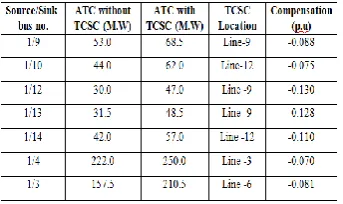
Incorporation of TCSC
When TCSC is incorporated in the system, if we consider all lines of system, there are 20 possible locations for
the TCSC. The location code region are set as 20 integers as 1 to 20. The amount of compensation offered by
TCSC is 0 to 40% (Kd). After using Real Genetic Algorithm proposed in this work, the results obtained are
shown in Table-2. It shows that with the flow control function TCSC increased the ATC significantly.
Table - 2: ATCs after incorporating TCSC
Figure-1 is the convergence characteristic of Real-code Genetic Algorithm and it shows a graph between
generation and fitness function i.e., ATC (M.W) when source/sink transfer is between bus 1 and bus 9. After 89
generations, the optimal value of TCSC location and compensation value are found. It shows a
144 | P a g e
0 10 20 30 40 50 60 70 801 5 9 13 17 21 25 29 33 37 41 45 49 53 57 61 65 69 73 77 81 85 89
Number of Generations
F F (i .e ., A T C ) i n M W
Fig -1: No. of Generations Vs Fitness profile of ATC
Incorporation of SVC
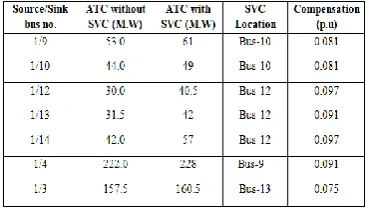
When one SVC is incorporated in the system, if we consider all buses of system, there are 14 possible locations
for the SVC. The location code region are set as 14 integers as 1 to 14. The amount of compensation offered by
SVC is 0 to 0.1 (p.u) i.e., Bsvc. After using Real Genetic Algorithm, the results obtained are shown in Table-3. It
shows that with the flow control function SVC increased the ATC significantly. Figure - 2 shows the voltage
profile for IEEE 14-bus system without and with SVC at bus-9, when ATC is computed for a transaction 1/9.
145 | P a g e
Fig -2: Bus voltage profile for without and with SVC at bus-9With line outage
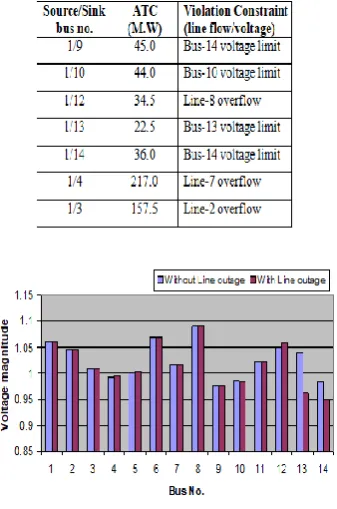
The Available Transfer Capability (ATC) are computed for a set of source/sink transfers using Continuous
Power Flow (CPF), when line-16 is physically removed from the system that is connected between bus-13 and
bus-14. Table-4 shows the ATCs for IEEE 14-bus system without FACTS device, when line-16 is outage.
Figure-3: Shows a graph voltage profile for the IEEE 14-bus system with and without outage cases.
Table-4: ATCs without FACTS Device during Line-16 outage
146 | P a g e
Incorporation of TCSCWhen one TCSC is incorporated in the system, if we consider all lines of system, there are 19 possible locations
for the TCSC. The location code region are set as 20 integers as 1 to 20 except line 16. The amount of
compensation offered by TCSC is 0 to 40% (Kd). After using Real Genetic Algorithm proposed in this work, the
results obtained are shown in Table-5. It shows that with the flow control function TCSC increased the ATC
significantly even under line outage.
Table-5: ATCs after incorporating TCSC during line-16 outage
Incorporation of SVC
When one SVC is incorporated in the system, if we consider all buses of system, there are 14 possible locations
for the SVC. The location code region are set as 14 integers as 1 to 14. The amount of compensation offered by
SVC is 0 to 0.1 (p.u) i.e., Bsvc. After using Real Genetic Algorithm, the results obtained are shown in Table-6. It
shows that with the voltage control function SVC increased the ATC significantly during line-16 outage.
Figure-4 shows the voltage profile for IEEE 1Figure-4-bus system without and with SVC at bus-13, when ATC is computed
for a transaction 1/13.
147 | P a g e
Fig -4: Bus voltage profile for without and with SVC at bus-13IV. II IEEE 24-bus Reliability Test System
Without line outage case
The Available Transfer Capability (ATC) are computed for a set of source/sink transfers using Continuous
Power Flow (CPF). Table-7 shows the ATCs for IEEE 24-bus system without FACTS device.
Table -7: ATC without FACTS Device
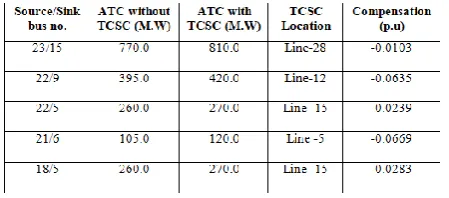
Incorporation of TCSC
Table-8: ATCs after incorporating TCSC
When one TCSC is incorporated in the system, if we consider all lines of system, there are 38 possible locations
for the TCSC. The location code region are set as 38 integers as 1 to 38. The amount of compensation offered by
TCSC is 0 to 40% (Kd). After using Real Genetic Algorithm proposed in this work, the results obtained are
shown in Table-8. It shows that with the flow control function TCSC increased the ATC significantly
Incorporation of SVC
When one SVC is incorporated in the system, if we consider all buses of system, there are 24 possible locations
for the SVC. The location code region are set as 24 integers as 1 to 24. The amount of compensation offered by
SVC is 0 to 0.1 (p.u) i.e., Bsvc. After using Real Genetic Algorithm, the results obtained are shown in Table-9. It
148 | P a g e
Table-9: ATCs after incorporating SVCWith line outage
The Available Transfer Capability (ATC) are computed for a set of source/sink transfers using Continuous
Power Flow (CPF), when line-8 is physically removed from the system that is connected between bus-4 and
bus-9
.
Figure.-5 shows a graph voltage profile for the IEEE 24-bus system with and without outage cases..
Fig-5: Bus voltage profile for without and with line outage cases
Table - 10 shows the ATCs for IEEE 24-bus system without FACTS device, when line-8 is physically removed.
Table-10: ATCs without FACTS Device during Line-8 outage
Incorporation of TCSC
When one TCSC is incorporated in the system, if we consider all lines of system, there are 19 possible locations
149 | P a g e
compensation offered by TCSC is 0 to 40% (Kd). After using Real Genetic Algorithm proposed in this work,
the results obtained are shown in Table-11. It shows that with the flow control function TCSC increased the
ATC significantly even under line outage
Table-11: ATCs after incorporating TCSC during line-8 outage
Incorporation of SVC
When one SVC is incorporated in the system, if we consider all buses of system, there are 24 possible locations
for the SVC. The location code region are set as 24 integers as 1 to 24. The amount of compensation offered by
SVC is 0 to 0.1 (p.u) i.e., Bsvc. After using Real Genetic Algorithm, the results obtained are shown in Table-12.
It shows that with the flow control function SVC increased the ATC significantly during line-8 outage.
Table-12: ATCs after incorporating SVC during line-8 outage
V.CONCLUSION
In unregulated power systems, available transfer capability (ATC) analysis is currently a critical issue either in
the operating or planning because of raised area interchanges among utilities. Adequate ATC should be
guaranteed to support free market trading and maintain a cost efficient and secure operation over a wide range
of system conditions. Nevertheless, tight restrictions on the construction of new facilities due to the rising
difficult economic, environmental, and social problems, have led to a much more rigorous shared use of the
existing transmission facilities by utilities and independent power producers (IPPs). Based on operating
drawbacks of the transmission system and control capabilities of FACTS technology, technical feasibility of
applying FACTS devices to boost ATCs are analysed and identified.The ATC is computed for various
transactions using Continuous Power Flow method on IEEE 14-bus test system and IEEE 24-reliability test
system during normal and contingency cases considering line thermal limit as well as bus voltage limit. The
150 | P a g e
IEEE24 reliability test system during normal as well as contingency cases.The location and control parameter of
TCSC and SVC in the system also affects the enhancement of ATC. Implementation of the proposed Real code
Genetic Algorithm has performed well when it is used to determine the location and compensation level of
TCSC or SVC with the aim of maximizing the Available Transfer Capability. From the results, it is shown that
installing SVC as FACTS device will improve voltage profile as well as resulting ATC enhancement, whereas
TCSC can improve ATC in both thermal dominant case and voltage dominant case. Finally, it is clearly shows
from the results that TCSC is more effective than SVC in improving ATC under both normal and contingency
conditions.
REFERENCES
[1] IEEE Reliability Test System, IEEE transactions on power apparatus and systems, Vol.PAS-98, No.6, Nov/Dec. 1979
[2] Power Electronics in Electric Utilities: Static Var Compensators Proceedings of the IEEE, VOL. 76, NO. 4, APRIL 1988.
[3] V. Ajarapu, and C. Christie, “The continuation power flow: a practical tool for tracing power system steady state stationary behavior due to the load and generation variations,” IEEE Trans. Power Systems, Vol. 7, No. 1, Feb. 1992,416-423.
[4] M.Noroozian, G.Anderson, “Power Flow Control by Use of Controllable Series Components”, IEEE Transactions on Power
Delivery, VO1.8, No.3, July 1993, 1420-1428.
[5] Vladimiro Miranda, J.V. Ranito, L. M. Proenca, “Genetic Algorithms in Optimal Multistage Distribution Network Planning”,
IEEE Trans. Power Systems, Vol. 9, o. 4, Nov. 1994, 1927-1933.
[6] Transmission Transfer Capability Task Force, “Available transfer capability Definitions and determination,” North American Electric Reliability Council, NJ, June 1996.
[7] G. C. Ejebe, J. Tong, J. G. Waight, J. G. Frame, X. Wang, and W. F. Tinney, “Available transfer capability calculations,” IEEE
Trans. Power Systems, Vol. 13,
No.4, Nov.1998, 1521-1527.
[8] Y. Dai, J. D. McCalley, V. Vittal, “Simplification, expansion and enhancement of direct interior point algorithm for power system maximum loadability”, Proc. 21st Int. Conf.Power Ind. Comput. Applicat, pp. 170-179, 1999.
[9] Richard D. Christie, Bruce F. Wollenberg and Ivar Wangensteen, “Transmission Management in the Deregulated Environment”, Proceedings of the IEEE, Vol.88, No.2, February 2000.
[10] Y. Xiao, Y. H. Song, Y. Z. Sun, “Available Transfer Capability Enhancement Using FACTS Devices”, Proceedings of the 2000
IEEE/PWS Summer Meeting,, Seattle, vol.1, pp. 508-515, July 2000.
[11] Wang Feng, G.B.Shrestha “Allocation of TCSC Devices to Optimize Total Transmission Capacity in a Competitive Power Market” IEEE Trans. Power Systems, Feb 2001, 587-592.
[12] Stephane Gerbex, Rachid Cherkaoui, and Alain J. Germond, "Optimal Location of Multi-Type FACTS Devices in a Power System
by Means of Genetic Algorithms," IEEE Trans. on Power Systems, vol. 16, no. 3, August 2001.
[13] Dr. Tapan Kumar Saha “Required Shunt Compensation for an EHV Transmission Line” The University of Queensland,
Australia, May 2003.