This is a repository copy of
Low-complexity Lattice Reduction Aided Detection for
Generalised Spatial Modulation
.
White Rose Research Online URL for this paper:
http://eprints.whiterose.ac.uk/102786/
Version: Accepted Version
Proceedings Paper:
Bao, Y, Zhang, L, Xie, R et al. (1 more author) (2016) Low-complexity Lattice Reduction
Aided Detection for Generalised Spatial Modulation. In: Proceeding of the International
Symposium on Wireless Communication Systems. Thirteenth International Symposium on
Wireless Communication Systems (ISWCS), 20-23 Sep 2016, Poznań, Poland. IEEE , pp.
253-257. ISBN 978-1-5090-2061-4
https://doi.org/10.1109/ISWCS.2016.7600910
© 2016 IEEE. This is an author produced version of a paper published in 2016
International Symposium on Wireless Communication Systems (ISWCS). Personal use of
this material is permitted. Permission from IEEE must be obtained for all other uses, in any
current or future media, including reprinting/republishing this material for advertising or
promotional purposes, creating new collective works, for resale or redistribution to servers
or lists, or reuse of any copyrighted component of this work in other works. Uploaded in
accordance with the publisher's self-archiving policy.
[email protected] https://eprints.whiterose.ac.uk/
Reuse
Unless indicated otherwise, fulltext items are protected by copyright with all rights reserved. The copyright exception in section 29 of the Copyright, Designs and Patents Act 1988 allows the making of a single copy solely for the purpose of non-commercial research or private study within the limits of fair dealing. The publisher or other rights-holder may allow further reproduction and re-use of this version - refer to the White Rose Research Online record for this item. Where records identify the publisher as the copyright holder, users can verify any specific terms of use on the publisher’s website.
Takedown
If you consider content in White Rose Research Online to be in breach of UK law, please notify us by
Low-complexity Lattice Reduction Aided Detection
for Generalised Spatial Modulation
Yumeng Bao
ゆょ, Li Zhang
ゆ, Renhong Xie
ょ, Raymundo Ramirez-Gutierrez
ゆ ゆSchool of Electronic and Electrical Engineering, University of Leeds, Leeds, UKょSchool of Electronic and Optical Engineering, Nanjing University of Science and Technology, Nanjing, China
Email:{[email protected], [email protected], [email protected], [email protected] }
Abstract—Generalised spatial modulation (GSM) was first introduced with the maximum-likelihood (ML) optimum decoder. However, ML decoder may be infeasible for practical implementation due to its exponential complexity especially when the number of antennas or the constellation size is large. Lattice reduction (LR) aided linear decoders are known to have much lower complexity while achieving near-optimal bit-error-rate (BER) performance in MIMO V-BLAST systems. In this paper, LR-aided linear decoders are applied to GSM systems for the first time, but the simulation results demonstrate unsatisfactory BER performances. Thereby, two improved LR-aided linear decoders are proposed in this work. The proposed schemes achieve significant BER performance enhancement compared to that of conventional LR-aided linear decoders as well as linear decoders including zero forcing (ZF) detection and minimum mean square error (MMSE) detection. Compared to the ML decoder, the proposed schemes can provide fairly lower complexities with small BER performance degradation.
Keywords—Generalised spatial modulation; Lattice Reduction; linear detection; lattice reduction aided precoding;
I. INTRODUCTION
Spatial modulation (SM) is a MIMO transmission technology to increase spectral efficiency (SE) by transmitting extra information using antenna index compared to single input multiple output (SIMO) systems [1]. SM mitigates inter-channel interference (ICI) [1], reduces implementation complexity [9] and energy consumption [10] by activating only a single antenna to convey information in each symbol period. In SM, the input data bits are divided into two groups, one of which is used to select active antenna and the other determines the transmitted symbol. Therefore, a total SE of �og
�og is achieved, where and are the number of transmit antennas and modulation order respectively.
However, SM has its limitations. The number of transmit antennas has to be a power of two and the logarithm increase in spectral efficiency requires a large number of transmit antennas due to its sub-optimality in SE [11]. Generalised spatial modulation (GSM) [2] is an extension of SM to overcome the limitation in and continues to offer higher SE by activating more than one antennas in each symbol period to simultaneously transmit data symbols. Research in [12] shows that GSM increases the achievable SE while maintaining all the advantages of SM. Therefore, GSM is considered as a
promising candidate for future MIMO systems [12]-[14]. A number of detection schemes have been studied for GSM. The maximum likelihood (ML) decoder achieves optimal performance but requires extremely high complexity which increases exponentially with the number of transmit antennas. Low-complexity linear decoders can be used to detect GSM, but their performances are not comparable to that of the ML decoder. Considering that a linear equalizer is optimal for an orthogonal channel matrix, the Lattice Reduction (LR) technique is utilised to improve the channel orthogonality and LR-aided linear equalizers are proposed for V-BLAST systems in [8], [3],where simulation results demonstrated near-optimal performance with low-complexity.
For the first time, this paper studies the applicability of utilising the low-complexity LR-aided linear decoders in GSM systems. Firstly, the conventional LR-aided linear equalizers are applied to GSM, but simulation results show unsatisfactory BER performance which is due to the noise enhancement at the receiver. Therefore, the improved novel LR-aided linear decoders are proposed for GSM in this work. Unlike the conventional LR-aided linear decoders, the proposed LR-aided linear decoders can avoid the noise enhancement at the receiver by employing a simple LR-aided precoding at the transmitter. With the help of this precoding, LR-aided linear decoders can achieve near-optimal BER performance with lower complexity in GSM systems.
II. GSM SYSTEM MODEL
Consider a GSM system equipped with transmit antennas and receive antennas. GSM activates only
from transmit antennas to convey the same complex symbol while the other antennas remain idle in each symbol period. Alternatively, the active antennas in GSM also can be designed to transmit different data symbols to increase the
SE. Among possible combinations of activating from transmit antennas, only N combinations can be used, where �og , and is the floor operation. In this paper, only the first N active antenna combinations are legitimate, and the research about active antenna combination selection will be presented in our future work.
In GSM, the transmitted data bits are divided into groups containing � bits in each of them, where
The remaining bits are mapped to a conventional modulation symbol chosen from the constellation diagram of M-QAM modulation. Thus, the incoming data bits are modulated to:
, (1)
where consists of columns chosen from the identity matrix, and the ordinals of the chosen columns correspond to the antenna indices in each active antenna combination. contains all possible . is the set of all possible data symbol vectors, where each vector has same complex-valued symbols chosen from the constellation points of the conventional modulation schemes (eg. 4-QAM,
j j ).
The modulated signal is then transmitted through a MIMO flat-fading channel with complex independent and identically distributed (i.i.d) entries according to CN (0, 1). The received vector is given by:
, (2)
where represents the additive white Gaussian noise (AWGN) vector with complex i.i.d entries according to CN (0,1).
At the receiver, the joint ML decoder for GSM is denoted as:
arg�in , (3) where represents the estimated set of the indices of the active antennas, and is the estimated value of each symbol in .
Substitute into (3), then it can be simplified to [2]:
arg�in
arg�in , (4)
where is the
sub-channel matrix containing columns chosen from the channel matrix , and is the i -th column of the channel matrix . is the r-th row of . is the set of all possible . Furthermore, is the -th entry of the received signal , and is as that defined in (1).
III. LATTICE REDUCTION
Based on the fact that the channel matrices are inherently complex-valued, we only introduce the concept of complex lattice in this paper. If we interpret
as a basis, then a complex lattice spanned by this basis is given by [6]:
, (5)
where is the co-efficient vector constituted by Gaussian integer weights, is the set of Gaussian integers ,
As can be seen from (1), the transmit vector are drawn from Gaussian integer space j (e.g. QAM constellation). Given the system model in (2), if we interpret the columns of as the basis of a lattice, then belongs to a lattice spanned by the columns of [3].
As we know, when the lattice basis is orthogonal, linear equalizer has the same performance as ML decoder. However, in general is not orthogonal which degrades the performance of linear equalizer. Note the orthogonality deficiency (od) of a
matrix is defined in [3] to quantify the orthogonality. In a word, the closer is to an orthogonal matrix, the smaller performance gap will be between the linear equalizer and the ML decoder. Therefore, if we can find another basis with better orthogonality than to describe the same lattice and use linear equalizer based on , the performance should be closer to that of ML compared with linear equalizer based on . Lattice reduction (LR) is such a technique used to find a more orthogonal matrix given a matrix .
In MIMO systems, a new channel matrix can generate the same lattice as that of , if and only if the square matrix of order is unimodular [5], i.e. all elements of are Gaussian integers and ��t .
is uni�o�u�ar . (6)
Thereby, in MIMO systems, using lattice reduction to find a more orthogonal matrix given means to find a unimodular matrix to transform basis into a new basis with roughly orthogonal basic vectors. And in MIMO system, it is beneficial to have the basis vectors as short as possible. A famous and efficient reduction criterion named LLL algorithm is first proposed in [5] which finds a vector not much longer than the shortest nonzero vector. Since LLL was originally introduced in real-valued lattice, while lattices in digital communications are complex-valued. A standard approach to deal with this problem is to convert complex lattices into real lattices, but this nearly doubles the computational complexity. Therefore, the complex LLL (CLLL) algorithm was proposed by [3],[6] to reduce the complexity by directly using complex basis rather than converting it into real basis. Later, a modified CLLL algorithm with less complexity and negligible BER performance loss was proposed in [7]. Note that, in this work, we utilize the CLLL algorithm described in [7].
IV. LR-AIDED DETECTION FOR GSM
Fig1. GSM system model with proposed LR-aided linear decoders.
MMSE which are termed as ZF and PGSM-LR-MMSE. Note that all the above LR aided linear detection schemes need more receive antennas than transmit antennas, unless the underdetermined equation would cause error floor of BER performance.
A. GSM-LR-ZF and GSM-LR-MMSE
As aforementioned, a linear equalizer is optimal with an orthogonal channel matrix. With the newly generated channel matrix using CLLL algorithm, the received signal (2) can be rewritten as:
, (7)
where . The idea behind LR aided linear detection is to firstly perform linear detection based on instead of , then calculate using . The estimated are obtained as:
, (8)
, (9)
Thus the estimated can be calculated as:
, (10)
. (11)
Note that the estimated vectors and are not
necessarily the legal constellation points in the three-dimensional constellation diagram of GSM, so they need to be rounded off to the closest point in the constellation diagram by quantization operation. And the quantized symbol vector are expressed as and , where means the quantization operation.
B. Proposed PGSM-LR-ZF and PGSM-LR-MMSE
Precoding can be viewed as some kind of decoding at the transmitter. In this section, two novel LR-aided decoders with LR-aided precoding at the transmitter are proposed for GSM. In this research, we consider the MIMO system in Time Division Duplex (TDD) mode as suggested by many massive
MIMO investigations. In TDD mode MIMO systems, due to the channel reciprocity, the channel state information at transmitter (CSIT) can be acquired directly at the transmitter.
The proposed GSM system is depicted in Fig 1. In PGSM-LR-MMSE/PGSM-LR-ZF system, the input bits Q are modulated to after GSM mapping, then the modulated vector is multiplied by the precoding matrix . After that, the transmitted signal is emitted through the flat fading channel. At the receiver, a simplified LR-aided linear decoder is employed.
The transmitted signal can be formulated as:
, (12)
where and is generated by CLLL algorithm given the channel matrix . is the same as that defined in (1). The received signal in (2) can be rewritten as:
, (13)
Then, the estimated modulated vectors, i.e. and can be formulated as:
, (14)
. (15)
Then the estimated transmitted vector and are quantized to the closest point in the constellation diagram of GSM.
V. COMPUTATIONAL COMPLEXITY ANALYSIS OF PGSM-LR-ZF AND PGSM-LR-MMSE
In this section, the receiver computational complexities of GSM-ML, PGSM-LR-ZF and PGSM-LR-MMSE are analyzed. The complexity is computed as the number of required complex addition and multiplication operations at the receiver.
A.GSM-ML Decoder
addition operations are required to compute the Euclidean distance which needs to be
computed times. As a result, the overall complexity for GSM with ML decoder is
(16) B. PGSM-LR-ZF and PGSM-LR-MMSE
The complexity of PGSM-LR-ZF is mainly caused by calculating (14). complex multiplication
operations and complex addition
operations are required to compute given the new channel matrix . And multiplication operations and addition operations are required to calculate in (14) given . Thus the receiver complexity of PGSM-LR-ZF is
. (17)
Similarly, the complexity of PGSM-LR-MMSE is obtained as:
(18) It can be observed that
, and the difference is caused by computing in (15).
VI. SIMULATION RESULTS
In this section, Monte Carlo simulation results for at least flat fading channel realisations are presented to compare the BER performances and computational complexities of GSM-ML, PZF/PMMSE and GSM-LR-ZF/GSM-MMSE. 4-QAM is considered for all the simulations. The performances of GSM-ZF/GSM-MMSE are also provided for reference.
1. BER comparisons between GSM-ML, PGSM-LR-ZF/PGSM-LR-MMSE and GSM-LR-ZF/GSM-MMSE.
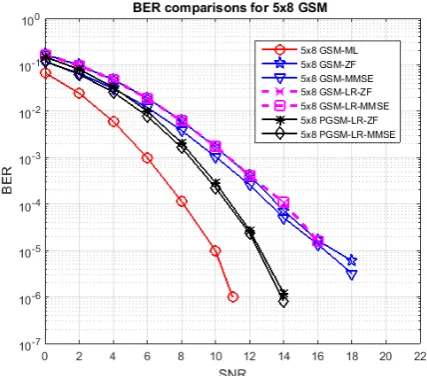
Fig. 2 and Fig.3 show the BER comparisons between GSM-ML, GSM-MMSE/GSM-ZF,GSM-LR-MMZE/GSM-LR-ZF, and PGSM-LR-MMSE/ PGSM-LR-ZF for
and respectively. It can be observed that the performances of the ZF and GSM-LR-MMSE are unsatisfactory. GSM-LR-MMSE and PGSM-LR-ZF achieve significant performance improvements compared to that of GSM-MMSE/GSM-ZF and
GSM-LR-MMSE/GSM-LR-ZF. For example,with
PLR-MMSE provides 5 dB and 4.5 dB SNR gains over GSM-MMSE and GSM-LR-GSM-MMSE respectively. And from Table I, the computation complexity of PGSM-LR-MMSE is slightly lower than that of GSM-LR-MMSE. The BER performance gap between the proposed PGSM-LR-ZF/PGSM-LR-MMSE
[image:5.595.321.540.275.454.2]and GSM-LR-ZF/GSM-LR-MMSE is due to the noise enhancement at the receiver when is estimated from . In PGSM-LR-ZF and PGSM-LR-MMSE systems, this kind of noise enhancement can be avoided with the help of LR-aided precoding at the transmitter. Among the proposed schemes, the performance of PGSM-LR-MMSE is slightly better than that of PGSM-LR-ZF. Compared to that of GSM-ML, PGSM-LR-ZF /PGSM-LR-MMSE provides fairly lower complexity with small BER performance degradation. More specifically, according to the computational complexities shown in Table 1, PGSM-LR-ZF offers 50% and 60% complexity reductions compared to that of GSM-ML under conditions with 4 and 5 transmit antennas respectively. More impressive complexity reduction can be observed in Fig.3. The ML detection provides 4 dB SNR gain over PGSM-LR-ZF and PGSM-LR-MMSE schemes at the BER of with , and this SNR gain reduces to 2.5 dB when .
Fig. 2. BER versus SNR in the case of , , and 4-QAM modulation with 4bit/s/Hz.
[image:5.595.328.542.489.677.2]2. Complexity comparisons between PGSM-LR-ZF/PGSM-LR-MMSE and GSM-ML.
Fig.4 Computational Complexities of PGSM-LR-ZF, PGSM-LR-MMSE, and GSM-ML
Fig.4 compares the computational complexity of ML, PGSM-LR-ZF and PGSM-LR-MMSE with different numbers of transmit antennas and different modulation orders. It can be obviously observed that the complexity of ML decoder is much higher than that of the other two decoders. For example, in a system with , PGSM-LR-MMSE offers more than 90% complexity reduction compared to that of GSM-ML. Furthermore, the complexity of PGSM-LR-ZF/PGSM-LR-MMSE is mainly determined by and . However, the complexity of GSM-ML is greatly affected by
and M.
TABLE 1COMPUTATIONAL COMPLEXITY OF EACH DETECTION SCHEME WITH
SPECIFIC SYSTEM PARAMETERS
System Parameters
Detection schemes 4 5
4 8
2 2
M 4 4
Number of Complex operations
GSM-ML 368 1504
GSM-LR-ZF 216 647
GSM-LR-MMSE 328 872
PGSM-LR-ZF 188 602
PGSM-LR-MMSE
300 827
VI. CONCLUSIONS
In this paper, we introduced the conventional Lattice reduction (LR) aided linear decoders in GSM systems for the first time and proposed two LR-aided detection schemes with LR-aided precoding at the transmitter for GSM. Their BER and complexity performances for different system parameters are investigated. BER and complexity performances of GSM with ZF, MMSE, and ML decoders are also introduced for
comparison. Simulation results show that the conventional LR-aided linear decoders are not suitable to be directly applied to GSM. The proposed PGSM-LR-ZF/PGSM-LR-MMSE achieves significant BER improvements compared to that of GSM-LR-ZF/GSM-LR-MMSE with even lower complexity. Compared to that of GSM-ZF/GSM-MMSE, PGSM-LR-ZF/PGSM-LR-MMSE offers much better BER performance with the same complexity. Moreover, PGSM-LR-ZF/PGSM-LR-MMSE provides fairly lower complexity with a small BER performance degradation compared to that of GSM-ML.
REFERENCES
[1] R. Mesleh, H. Haas, S. Sinanovi´c, C. W. Ahn, and S. Yun, “Spatial Modulation,” IEEE Trans. on Veh. Tech., vol. 57, no. 4, pp. 2228 –2241, Jul. 2008.
[2] A. Younis, N. Serafimovski, R. Mesleh, and H. Haas, “Generalised Spatial Modulation,” in Asilomar Conf. on Signals, Systems, and Computers, Pacific Grove, CA, USA, Nov. 2010.
[3] X. Ma and W. Zhang, "Performance analysis for MIMO systems with lattice-reduction aided linear equalization," IEEE Trans. Commun., vol. 56, no. 2, pp. 309-318, Feb. 2008.
[4] C. P. Schnorr and M. Euchner, “Lattice basis reduction: Improved practical algorithms and solving subset sum problems,” Math. Programming, vol. 66, pp. 181–191, 1994
[5] A. Lenstra, H. Lenstra, and L. Lov´asz, “Factoring polynomials with rational coefficients,” Mathematische Annalen, vol. 261, no. 4, pp. 515– 534, 1982.
[6] Y.H. Gan, C. Ling, and W.H. Mow, "Complex lattice reduction algorithm for low-complexity full-diversity MIMO detection," IEEE Trans. Signal Processing, vol. 57, pp. 2701-2710, 2009.
[7] S. Shahabuddin et al, "A Customized Lattice Reduction Multiprocessor for MIMO Detection", in 2015 IEEE Int. Symp. on Circuits and Systems (ISCAS), Lisbon, 2015, pp. 2976 - 2979.
[8] D. Wübben, R. Böhnke,V. Kühn, and K. Kammeyer, “Near-maximum likelihood detection of MIMO systems using MMSE-based lattice reduction,” IEEE Conf. on Commun., vol. 2, pp. 798-802, June. 2004. [9] J. Jeganathan, A. Ghrayeb, L. Szczecinski, and A. Ceron, “Space shift
keying modulation for MIMO channels,” IEEE Trans. Wireless Commun., vol. 8, no. 7, pp. 3692–3703, July 2009.
[10] A. Stavridis, S. Sinanovic, M. D. Renzo, H. Haas, and P. Grant, “An energy saving base station employing spatial modulation,” in Proc. 2012 IEEE CAMAD, pp. 231–235.
[11] M. Di Renzo, H. Haas and A. Ghrayeb, "Spatial modulation for generalized MIMO: challenges, opportunities and implementation", Proc. IEEE, vol. 102, no. 1, pp. 56-103
[12] A. Younis, D. A. Basnayaka, and H. Haas, “Performance Analysis for Generalised Spatial Modulation,” in Proc. of European Wireless Conf. (EW 2014), Barcelona, Spain, 2014, pp. 207–212.
[13] A. Younis, R. Mesleh, M. Di Renzo, and H. Haas, “Generalised spatial modulation for large-scale MIMO,” in Proc. European Signal Process. Conf. 2014 (EUSIPCO’14), 2014, pp. 346-350.