2016 International Conference on Wireless Communication and Network Engineering (WCNE 2016) ISBN: 978-1-60595-403-5
Analysis of Cascading Failures of Interdependent
Networks under Random Attacks
An-wei SHEN
*, Ji-lian GUO and Zhuo-jian WANG
Air Force Engineering University, Xi’an 710038 China
*Corresponding author
Keywords: Interdependent network, Cascading failure, Robustness, Complex system.
Abstract. With continuous deepening of researches on complex network problems, the cascading failure problem of interdependent networks becomes one of the hot research topics in this field at present. This paper establishes a cascading failure model of interdependent networks based on a load-capacity model. And then we focus on the robustness problem of interdependent networks under random attacks based on four different network combinations. At last, an interdependent coupling network constituted of two networks with the node quantity of ten is taken as the example to verify conclusions obtained in this paper. Research results show that under random attacks, robustness of the asymmetric interdependent networks is similar with the previous research results, namely, robustness of the networks decreases with the increase of removal proportion and increases with the increase of tolerance coefficient. In addition, BA-BA interdependent networks and disassortative link networks perform better than other network combinations and coupling manners.
Introduction
In recent years, reliability of complex systems and safety forecasting technology become one of the hot research topics of domestic and foreign scholars. If Agents in a complex system are corresponding to points in a complex network and interactions among the Agents are corresponding to connection edges, structure characteristics and dynamic evolution of the complex system can be represented by a complex network. The complex structure of a complex network and diversity of dynamic behaviors can be used to research a complex system effectively.
We will never forget the huge influences caused by accidents such as North America interconnection blackout in 2003 and China snow and ice disaster in 2008. These accidents are very likely caused by that some tiny emergencies had triggered the “domino-like” network linkage failures of relevant complex systems. With the rise of network science researches in recent years, the cascading failure problem of complex networks has attracted extensive attention. Specifically, it means that failures of one or multiple nodes may cause collapse of the whole network [1]. Till now, research achievements of cascading failures of complex networks are mainly concentrated in establishment of a cascading failure model [2][3][4], control and prevention strategies [5][6] and network attack strategies as well as applications in actual networks [7][8], etc.
networks. Network robustness refers to that most nodes in a network are still communicated after removal of some nodes. Under such case, we can say that the network has robustness for node failures [10].
This paper has the following chapters: In the second part, a cascading failure model of asymmetric interdependent networks is established based on a load-capacity model is defined for cascading failures of interdependent networks. In the third part, the robustness problems of four different interdependent networks under random attacks are analyzed based on the above model; influences brought by tolerance coefficient of network nodes, coupling manners of interdependent networks and network removal proportion to network robustness are researched. The fourth part makes a conclusion of the paper.
Establishment of Cascading Failure Model Based on Asymmetric Interdependent Networks
In this paper, the interdependent networks are constituted of a network A and a network B which have
the same nodes, wherein the node quantity satisfies NANBN. The network A and the network B
are Barabasi-Albert (BA) scale-free network or Watts-Strogatz (WS) small-world network, wherein connection edges inside them are undirected edges and the network average degree satisfies
A B
k k k . Meanwhile, directed coupling dependent edges exist between some nodes of
network A and network B. If the start point of a dependent edge fails, the end point will fail, and thus the dependent edge will disappear; however, if the end point of dependent edge fails, the start point will not be influenced at all, while the dependent edge will disappear. The network coupling
probability (0p p 1) is defined as the proportion of a dependent edge in the network size N ,
wherein when p1, independent nodes without dependent edges exist in the network, while their
failure is only related to their own network. Meanwhile, a node in network has one directed interdependent edge at most. Without consideration of multiple dependent edges, this paper only takes into account a few of dependent edges of interdependent networks, so that the research is simplified in that the direction of an interdependent edge is acquiescently pointed from A to B, namely, failures of nodes in network A will be transmitted to network B via the interdependent edges, while the contrary situation will not happen.
Definition of initial load of a node is similar with the method proposed in Reference [11]. The load can be jointly decided by betweenness of the node degree and neighbor nodes. Hence, as defined in
the paper, the initial load of a node i in the network is as follows:
i
i i m
m
L d B
(1)
where: refers to an adjustable parameter. As acquiesced in the paper, 1, di refers to the degree
of node i, i refers to a set of neighbor nodes of the node i, m is one of the neighbor nodes of the
node i, and Bm is the betweenness of the node m. In addition:
= i st m
s i t st
B
(2)
where: st denotes the total quantity of reachable shortest routes from the node s to the node t in the
network; sti denotes the quantity of routes which pass the node i.
In general, the capacity Ci of the node i is in direct proportion to the initial load of the node:
(1 )
i i
C L
( 0)
denotes a tolerance coefficient. Obviously, when some nodes are removed or fail in the
network, loads on these nodes will be transmitted to their adjacent nodes according to a certain proportion. When loads of neighbor nodes exceed a capacity limit, more extensive cascading failures will be caused.
Load on the failure node i is redistributed to its neighbor node j according to a certain proportion,
as shown in the following rules:
( )
j
i i n
j m
m j
j
n n q
n n q
d B
L PL
L d B
(4)Hence, the failure judgment criterion of the node j is as follows:
j j j
L PL C
(5)
At this moment, node j also fails.
Simulation and Analysis
According to measures of the above cascading failure model of interdependent networks, we can find
that the average quantity P of remaining nodes reflects robustness of networks. The larger P
indicates the smaller occurrence scope of cascading failures and the better robustness of interdependent networks. As for different sub-networks, we set their average degrees to be
6
A B
k k uniformly, and set the network scale to be NANB500 uniformly.
At first, generation rules of the Barabasi-Albert (BA) scale-free network are used to generate a network A and a network B. Parameters of the BA scale-free network are as follows: the initial node
satisfies m03; the quantity of newly generated edges is 3
2
A
k
m when new nodes are
introduced each time; network scale is NNA500 after the node increase. The coupling
probability between the sub-networks A and B is p0.8. Coupling is realized randomly, namely,
certain nodes in the network A are randomly selected according to the probability p to be coupled
with certain nodes in the network B. When nodes of a certain proportion are removed randomly from
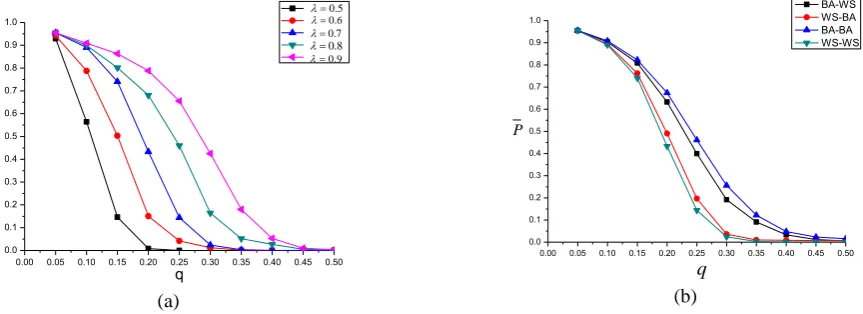
the network A and the tolerance coefficient is respectively 0.5, 0.6, 0.7, 0.8 and 0.9, the relation
between the average remained node quantity and the network removal proportion P q is shown in
Figure 1(a).
0.00 0.05 0.10 0.15 0.20 0.25 0.30 0.35 0.40 0.45 0.50
0.0 0.1 0.2 0.3 0.4 0.5 0.6 0.7 0.8 0.9 1.0 P 0.9
0.8
0.7 0.6
q
0.5
(a)
0.00 0.05 0.10 0.15 0.20 0.25 0.30 0.35 0.40 0.45 0.50
0.0 0.1 0.2 0.3 0.4 0.5 0.6 0.7 0.8 0.9 1.0 q P BA-WS WS-BA BA-BA WS-WS (b)
[image:3.595.84.516.592.749.2]It is shown in the Figure 1 that under the random attack mode, the average quantity P of remained
nodes decreases with the increase of removal proportionq. In addition, when a key removal
proportion qqc exists, the average quantity P of remained nodes tends to be 0. It is shown in
Figure 2 that with continuous increase of the tolerance coefficient, the average quantity of remained
nodes in the network also increases continuously, qc increases continuously and network robustness
is improved continuously, indicating that the network resistance to attacks is strengthened. Such character is similar with the results about cascading failure problems in interdependent networks, as shown in other references.
Simulation results shown in Figure 2 are based on the Barabasi-Albert (BA) scale-free network. Except for it, many other networks also exist in the reality, wherein the most typical model is the Watts-Strogtz (WS) small-world network. Here, it is assumed that forms of networks A and B are a BA scale-free model or a WS small-world model. Due to asymmetry of interdependent edges, four different types of interdependent networks including BA-BA interdependent network, WS-WS interdependent network, BA-WS interdependent network and WS-BA interdependent network are formed.
In order to keep the average degree which is the same with the scale-free network, we define the following generation parameters of the small-world network: total quantity of nodes in the
nearest-neighbor network is NNA500 ; the neighbor quantity of each node in the
nearest-neighbor coupling network is K kA 6; probability of randomized reconnection is
0.8
ws
p .
In order to verify influences brought by different network combinations to interdependent network cascading failures, simulating calculation is carried out to the relations about variation of the average remained node quantity of interdependent networks along with the removal probability under the
tolerance coefficient of 0.7. Results are shown in Figure 1(b).
It is shown in the diagram that under the random attack mode, the average quantities of remained nodes in the four network combinations decrease continuously with the increase of removal
proportionq. Meanwhile, the decrease of BA-BA network is slowest, while the network has the best
robustness. The WS-WS network has the poorest robustness. Robustness of the mixed network falls in between.
Above coupling manners of interdependent edges are random. Next, the paper considers three manners including Assortative Link (AL), Disassortative Link (DL) and Random Link (RL) in order to compare and analyze influences brought by different coupling manners to cascading failures of asymmetric interdependent networks. Therein, the connection manner of AL refers to: node with the largest load in network A is connected to node with the largest load in network B, node with the second largest load in network A is connected to node with the second largest load in network B…till
p N interdependent edges are formed totally in the two networks. The connection manner of DL
refers to: node with the largest load in network A is connected to node with the smallest load in network B, node with the second largest load in network A is connected to node with the second
smallest load in network B…till p N interdependent edges are formed totally in the two networks.
0.00 0.05 0.10 0.15 0.20 0.25 0.30 0.35 0.40 0.45 0.50 0.0
0.1 0.2 0.3 0.4 0.5 0.6 0.7 0.8 0.9 1.0
P
q
[image:4.595.226.376.665.773.2]WS-WS(AL) WS-WS(DL) WS-WS(RL) BA-BA(AL) BA-BA(DL) BA-BA(RL)
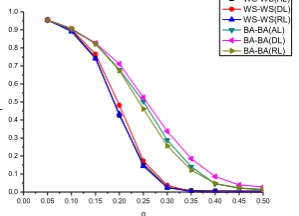
In order to verify influences brought by different coupling manners to interdependent network
cascading failures, different P q relation curves under the tolerance coefficient of 0.7 are shown
in the Figure 2. It is shown in the diagram that, the average quantity of remained nodes is the largest under the DL mode in both the BA-BA interdependent network and the WS-WS interdependent network, indicating that the interdependent network has the best robustness under the asymmetric dependency DL mode.
Conclusion
The paper establishes an interdependent network cascading failure model based on asymmetric dependency, puts forward a load-capacity model in networks for interdependent network cascading failures. Based on the network model, the paper researches network robustness based on different network combinations, different coupling manners in networks, different network tolerance coefficients and different removal proportions. Research results show that under the random attack mode, the network robustness decreases with the increase of removal proportion and increases with the increase of tolerance coefficient, while the BA-BA interdependent network and the DL network perform better than other network combinations and other coupling manners.
Acknowledgement
The work described in this paper is supported by the National Natural Science Foundation of China (71501185).
References
[1]D. J. Watts and S. H. Strogatz, “Co1lective dynamics of small-world networks,” Nature, vol. 393,
no. 6684, pp. 440-442, 1998.
[2]L. Barabasi and R. Albert, “Emergence of scaling in random networks,” Science, vol. 286, no.
5439, pp. 509- 512, 1999.
[3]L. Zhang, J. Cao, and J. Li, “Complex networks: statistical properties, community structure, and
evolution,” Mathematical Problems in Engineering, vol. 2015, Article ID 590794, 7 pages, 2015.
[4]S. H. Strogatz, “Exploring complex networks,” Nature, vol. 410, no. 6825, pp. 268-276, 2001.
[5]R. Cohen, K. Erez, D. ben-Avraham and S. Havlin, “Breakdown of the internet under intentional
attack,” Physical Review Letters, vol. 86, no. 16, pp. 3682–3685, 2001.
[6]J. Zhao, H. Zhou, B. Chen, and P. Li, “Research on the structural characteristics of transmission
grid based on complex network theory,” Journal of Applied Mathematics, vol. 2014, Article ID 261798, 12 pages, 2014.
[7]X. G. Wang, S. G. Guan and C. H. Lai, “Protecting infrastructure networks from cost-based
attacks,” New Journal of Physics, vol.11, Article ID 053039, 2009.
[8]P. Holme, B. J. Kim, C. N. Yoon and S. K. Han, “Attack vulnerability of complex networks,”
Physical Review E, vol. 65 no. 5, Article ID 056109 ,2002.
[9]M. Perc, “Evolution of cooperation on scale-free networks subject to error and attack,” New
Journal of Physics, vol 11, Article ID 033027, 2009.
[10]E. Motter, “Cascade control and defense in complex networks,” Physical Review Letters, vol.
93, no. 9, Article ID 098701, 4 pages, 2004.
[11]M. Khoury, S. Bullock, G. Fu, and R. Dawson, “Improving measures of topological robustness