Int. J. Electrochem. Sci., 9 (2014) 6431 - 6437
International Journal of
ELECTROCHEMICAL
SCIENCE
www.electrochemsci.org
Short Communication
Experiment Study on Effect of Different Parameters Pulses on
the Battery Plate Sulfuration
YANG Gang, ZHU Dao-wei, ZHU Shi-shun Sun Yan
Military Vehicle Department, Military Transportation University, Tianjin 300161, China *
E-mail: [email protected]
Received: 11 March 2014 / Accepted: 11 August 2014 / Published: 25 August 2014
Sulfuration of lead-acid battery negative plates is main fault which cause batteries failure. For this failure mechanism, pulse maintenance method is given. But experiment study on effect of pulses on the battery plate sulfuration is lack. In this paper, the effect of pulses on the battery plate sulfuration is found by using adjustable pulse parameter maintenance devices designed independently and some test means and methods. At last, the effect can provide bases to define parameters of battery maintenance devices.
Keywords: lead-acid battery; Sulfuration; pulse maintenance; experiment study
1. INTRODUCTION
Lead-acid batteries have developed for about a hundred years and become the most widely used chemical energy in world. Although lead-acid batteries are interior to new batteries in specific capacity and specific power, but they have several advantages such as good reversibility, safety, low cost, long life and other characteristics and are still going on technological innovation and development[1]. One of the lead-acid battery technology development trend is to extend the service life. To extend the service life there are online maintenance technology and sulfidation repair technology[2-3]. And these two technologies are based on the pulse method[4]. In this article, effect of different parameters pulses on the battery plate sulfuration is researched through experiment.
2. THE SULFIDATION FAILURE MECHANISM OF LEAD-ACID BATTERY PLATE AND PULSE REPAIR TECHNOLOGY
The following reactions of lead-acid battery occur during charge and discharge courses:
Positive plate: PbO2+3H++HSO4-+2e PbSO4+2H2O (1) Negative plate: Pb+HSO4- PbSO4+H++2e (2)
discharge charge discharge
From reaction (1) and (2), during the battery discharging the active substance is converted to lead sulfate by chemical reaction. The lead sulfate shows loose sponge-like texture in microcosmic, and the plate is in a high potential state. If lead-acid batteries are not charged in time and place too long in the state of power loss, the lead sulfate on the plates will shift from unstable state of high potential to stable state of low potential. And the polycrystal tends to decrease the surface free energy. So the porous lead sulfate crystals in the dual role gradually transformed into sulfide layer composed by coarse lead sulfate crystals. The large crystals have more solubility than small crystals, resulting in failure of the active material on the plates. Since the oxygen atom of the positive plate produced in the charging process has strong oxidation ability, lead sulfate is oxidized to the original active substance. So the sulfuration occurs only on negative plate[5].
3. THE DESIGN OF PULSE MAINTENANCE DEVICE
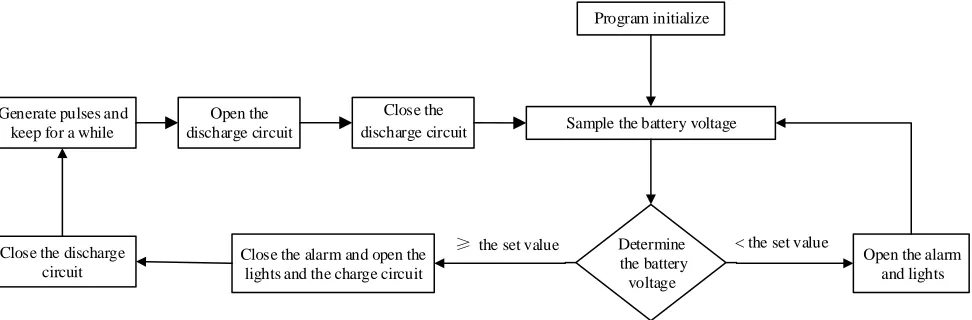
Battery maintenance device hardware system consists of a pulse DC/DC module, detection module, signal indication module, controller module, boost module and MOS transistor module, as shown in Fig 1.The workflow of the device is shown in Fig 2[6-7].
Battery
Boost module MOS transistor module
in charging circuit
MOS transistor module in discharging circuit
Controller module Detecion module
[image:2.596.188.409.389.510.2]DC/DC module Indication module
Figure 1. Pulse maintenance device hardware system chart
Program initialize
Sample the battery voltage
Determine the battery
voltage
Open the alarm and lights < the set value
≥ the set value Close the alarm and open the
lights and the charge circuit Generate pulses and
keep for a while
Close the discharge circuit Open the
discharge circuit
Close the discharge circuit
[image:2.596.59.545.552.712.2]
The pulse maintenance device uses battery as energy. Workflow is as follows, firstly the battery voltage is sampled and determined, when the voltage is normal, it is boosted by the boost module, then charge the capacitor, after waiting some time, the energy flows through the discharge circuit to the battery. This is a complete process. The controller module control MOS transistors in the charging and discharging circuit to adjust the frequency of the pulse. And the amplitude of the pulse is adjusted by changing the feedback resistance of the boost module. When the battery voltage is too low, the battery power is low and the device can produce sound and light alarm, prompting operators to charge the battery in time.
4. EXPERIMENT METHOD
In order to explore effect of different parameters pulses on the battery plate sulfuration, we need maintenance devices with different parameters to experiment. Different frequencies and amplitudes pulse can be get through adjusting the feedback resistor and control program. A kind of 12V30Ah battery was studied in the experiment. When the voltage is boosted too large the power consumption of the device itself will increase and affect the battery performance. So the boosted voltage is not too large.
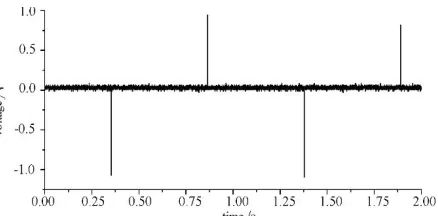
[image:3.596.66.534.507.599.2]During the experiment several devices with different combinations of the pulse amplitude and pulse frequency were tested. When the parameters are very close the results are very close too and are not easy to distinguish. Therefore, some devices with results of the relatively large difference were chosen to study. Their parameters are shown in Table 1.
Table 1. Maintenance pulse parameters
Frequency (Hz)
Boost voltage (V)
Battery voltage (mV) Current of the device (A)
Up Down Charge Discharge
1 14 250 750 10 2.5
1 25 900 1100 15 7
1000 14 250 250 2.5 2.5
1000 25 900 700 9 6
Voltage waveform of 14V boosted voltage at 1Hz Voltage waveform of 25V boosted voltage at 1Hz
[image:4.596.315.534.67.175.2]
Current waveform of 14V boosted voltage at 1Hz Current waveform of 25V boosted voltage at 1Hz
Figure 3. Voltage and current waveforms of 14V and 25V boosted voltage at 1Hz
Voltage waveform of 14V boosted voltage at 1000Hz Voltage waveform of 25V boosted voltage at 1000Hz
[image:4.596.309.530.384.486.2]
Current waveform of 14V boosted voltage at 1000Hz Current waveform of 25V boosted voltage at 1000Hz
Figure 4. Voltage and current waveforms of 14V and 25V boosted voltage at 1Hz
reduced. Thereby the boost voltage and current is reduced gradually.
As the active substance in the plate of the new battery is not recrystallized in initial phase, the sulfuration occurs by the crystals accumulating gradually. So the test cycle of inspecting maintenance of the device is very long. To solve this problem, according to the law of temperature change will accelerate the process of crystallization, a method of the environment temperature alternating is proposed to shorten the test cycle. Multiple comparison tests conducted under the same conditions to eliminate the influence of environmental change on the active substance crystallization. Batteries connected the maintenance were placed in 40 0C and -20 0C environment for 90 days with three days of a cycle. After 90 days, the active substance on the plate was sampled and researched.
The size magnitude of the lead sulfate crystals is 10-6 meters and the electron microscope can be used to observe crystal size and determine effect of different parameters pulses on the battery plate sulfuration[8]. In experiments, the scanning electron microscopy TDCLS4800 is used to observe crystals.
5. RESULTS AND ANALYSIS
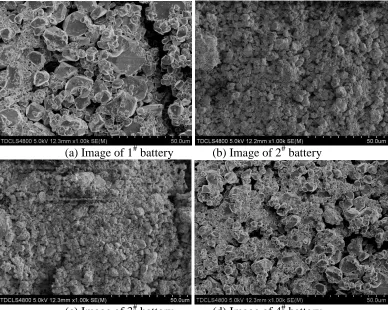
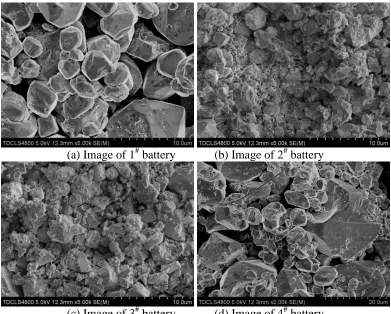
After 90 days, the active substance samples in the same position of the battery plates were taken and observed using the SEM. Fig 5 and Fig 6 show the images of the samples from 1# to 4# battery in the 1000 magnification and 5000 magnification.
(a) Image of 1# battery (b) Image of 2# battery
[image:5.596.105.494.418.728.2](c) Image of 3# battery (d) Image of 4# battery
(a) Image of 1# battery (b) Image of 2# battery
[image:6.596.103.494.68.382.2](c) Image of 3# battery (d) Image of 4# battery
Figure 6. Images of batteries in 1000 magnification
Parameters of the maintenance device used in 1# battery and 2# battery are 14V boost voltage, 1Hz and 14V boost voltage, 1000Hz. As can be seen from Fig 5(a), Fig 6(a) and Fig 5(b), Fig 6(b) the active substance in the plate of 1# battery crystallized very seriously. But the active substance in the plate of 2# battery crystallized individually. Parameters of the maintenance device used in 3# battery are 25V boost voltage and 1000Hz. As can be seen from Fig 5(b), Fig 6(b) and Fig 5(c), Fig 6(c) crystals of 2# battery and 3# battery are very similar in size. Parameters of the maintenance device used in 4# battery are 25V boost voltage and 1Hz. As can be seen from Fig 5(a), Fig 6(a) and Fig 5(d), Fig 6(d) crystals of 1# battery are bigger than crystals of 4# battery. So 1# and 4# battery have sulfuration but the 1# is more serious.
6. CONCLUSION
Experimental on effect of different parameters pulses on the battery plate sulfuration were carried out by using the maintenance device independently designed whose pulse amplitude and frequency can be changed by adjusting the circuit and program and SEM through the method of the environment temperature alternating. The main conclusions are as follows:
(1) The higher the pulse amplitude the better the maintenance effect and the greater the power consumption of the device. Hence the appropriate pulse amplitude is needed to minimize the performance impact on batteries.
(2) The higher the pulse frequency the better the maintenance effect. By the pulse frequency increasing the power consumption increasing is not obvious. However, the frequency of the circuit can be achieved is limited, excessive frequency will affect the stability of the circuit. Hence the appropriate frequency is needed.
(3) Through experiment research, the maintenance device should adopt a high frequency and low amplitude pulse. In this way, the device can maintain the battery and minimize the performance impact on the battery.
References
1. Zhu Song-ran. Version 2 of the lead-acid battery briefly. Beijing: Machinery Industry Press, 2002: 211.
2. Liu Dong-sheng; Liu Fang, Ordnance Industry Automation, 11 (2010) 55-56
3. Detchko Pavlov.Lead-Acid Batteeies: Science and Technology. Amsterdam, Elsevier Science Ltd, 2011
4. Shishun Zhu; Jianwei Cheng; Daowei Zhu; Gang Yang, Journal of Academy of Military Transportation, 8 (2013) 1928-1937
5. Detchko Pavlov.Lead-Acid Batteries: Science and Technology, Amsterdam, Elsevier Science Ltd, 2011.
6. Zhang Yue-bin; Wang Xing-bo; Ren Yong-le, Hoisting and Converying Machinery, 10 (2007) 23-26.
7. Sun Xiao-juan, Journal of Baoji University of Arts, 6 (2010) 68-69,73.
8. Chen Yu-hong.Analysis and testing technology lead acid battery, Beijing: Chemical Industry Press, 2011, p205.