City, University of London Institutional Repository
Citation
:
Mishra, J. K., Priye, V. & Rahman, B. M. (2015). Error probability performance of
a short-reach multicore fiber optical interconnect transmission system. Optics Letters,
40(19), pp. 4556-4559. doi: 10.1364/OL.40.004556
This is the accepted version of the paper.
This version of the publication may differ from the final published
version.
Permanent repository link:
http://openaccess.city.ac.uk/14657/
Link to published version
:
http://dx.doi.org/10.1364/OL.40.004556
Copyright and reuse:
City Research Online aims to make research
outputs of City, University of London available to a wider audience.
Copyright and Moral Rights remain with the author(s) and/or copyright
holders. URLs from City Research Online may be freely distributed and
linked to.
City Research Online:
http://openaccess.city.ac.uk/
[email protected]
Error probability performance of a short reach
multicore fiber optical interconnect transmission
system
JITENDRA K. MISHRA,
1,*
VISHNU PRIYE,
1
AND B. M. A. RAHMAN
2
1
Department of Electronics Engineering, Indian School of Mines, Dhanbad, 826004, India
2
Department of Electrical and Electronic Engineering, City University London, London EC1V 0HB, UK *Corresponding author: [email protected]
Received XX Month XXXX; revisedXX Month, XXXX; accepted XX MonthXXXX; posted XX Month XXXX (Doc. ID XXXXX); published XX Month XXXX
A stand alone module for rectangular array multicore fiber (MCF) based optical interconnect (OI) is realized, which includes inherent inter–core crosstalk and
provides space division multiplexed (SDM)
coupling/decoupling of optical power. The module is integrated in a short reach communication system to provide bit error probability (BEP). Next, closed form equation for BEP applicable to MCF OI with inter–core crosstalk is derived. For characteristic parameters of the module, results obtained by two approaches agree within 1% for 40 Gbps per channel and predicts error free transmission of aggregated data rate of 2.5 Tbps through the MCF OI under consideration. © 2015 Optical Society of America
OCIS codes: (200.4650) Optical interconnects; (060.4080) Modulation; (060.4230) Multiplexing; (060.2360) Fiber optics links and subsystems; (060.2330) Fiber optics communications.
http://dx.doi.org/10.1364/OL.99.099999
Optical interconnect (OI) is fast becoming one of leading technologies to overcome capacity requirements of emerging heterogeneous and bandwidth-intensive short reach communication links [1]. Bandwidth scaling, have so far been sustained by mature technologies of fiber ribbons or individual fibers, but may not be enough to exploit huge optoelectronic bandwidth disparity existing between requirement and availability in forthcoming era of big data and high speed internet traffic [2]. To combat fast growing internet traffic and commensurate increase in data rate, researchers are compelled to explore novel means for signal transmission in next generation exa–bandwidth OIs [3]. OI configuration based on multicore fiber (MCF) shows promise to cope with the cable-size limitation in data centers, terabit switches, core routers and digital cross connect systems which necessitate high fiber count and high density cable [4]. Space division multiplexing (SDM) employing MCF has sparked tremendous interest among researchers as a leading candidate for future exaflop (1018) high
performance computing systems as well as silicon photonic transceiver chip [4]. Furthermore, rectangular array MCF is more compatible with edge coupling requirement of chip-to-chip, rack-to-rack, box-to-box, and board-to-board interconnect applications [5, 6]. In contrast to other SDM systems, MCF is less sensitive to fundamental
limits imposed by fiber non-linearity due to small power concentration per core [7]. In this case, a multitude of cores can be introduced at different positions in the aggregated fiber cross-section that decreases power concentration inside the core for a given input power [7]. However, inter–core crosstalk is one of the critical issues associated with the efficient usage of MCF as OI [8].
Next issue that has to be addressed is how inter-core crosstalk will affect bit error probability (BEP) performance in MCF OI that will be required to support multi dimensional modulation formats in impending high data traffic. Recently, crosstalk performance on SDM signals modulated by quadrature phase-shift keying (QPSK) and quadrature amplitude modulation (QAM) over 7–core MCF has been reported [9]. Subsequently, impact of core-coding with QPSK (CC-QPSK) and QAM (CC-QAM) on the performances of the SDM signal using 7–core MCF for long distance transmission has been experimentally demonstrated [10]. It is shown that higher order multi –level modulation formats increases capacity per fiber at the cost of concurrent decrease in crosstalk tolerance [9, 10]. The economics of increasing inter–core distance in MCF is not favorable in improving crosstalk tolerance. Furthermore, it is widely known that the performance of higher order modulation format is more susceptible to fiber nonlinearities [7]. Recently, data rate of 103.125 Gbps in an optical interconnect is reported [11] that employs standard single core fiber OI and on off keying modulation. However, using single core fiber with advanced modulation format, data rates of 100 Gbps and 400 Gbps can be achieved [12, 13].
format is more vulnerable to inter-core crosstalk of MCF and fiber nonlinearities [9]. Thus, implementing MCF based short reach OI system with above properties may make BPSK a preferred modulation format. In this letter, recently reported rectangular array 8-core MCF [5, 6] is thoroughly investigated for application in short reach OI that can support high data rates with BPSK modulation. Firstly, a stand alone module of MCF OI is configured in Rsoft OptSim that not only simulates typical features of a realistic 8–core MCF OI but is also compatible with complex optical communication system available in the software. BEP performance of complete communication system with proposed MCF OI module is simulated for different performance parameters. Next, standard digital communication theory to evaluate error probability for BPSK [19, 20] is modified to incorporate inter–core crosstalk and new closed form equations are obtained for MCF OI. Error probabilities obtained by simulations and theory are compared for various parameters and are found to agree well. Both the approaches predict that aggregate data rate of 2.5 Tbps can be supported by short reach MCF OI having 8 cores of 5 µm diameter each and 100 m overall length.
Commercially available simulation software is important as it provides a platform to evaluate advantages and shortcomings of a device when it is included in a system and allows to optimise much before it is put into an expensive practical set up. For a device to operate in a complete system such as communication system, an equivalent practical model has to be realized that predicts its performance features rather than its physical properties based on theory. Here, a simulation module for MCF OI is designed that can be interfaced easily with other relevant blocks/tools of the simulation software (Rsoft OptSim in the present case).
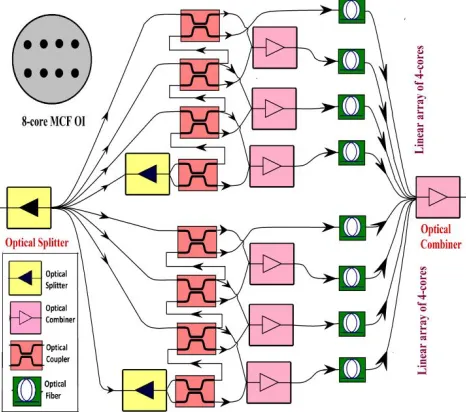
The proposed MCF OI simulation module of 8-core MCF (see inset) is shown in Fig. 1. The OI has rectangular array of eight identical step index MCF [5, 6] arranged in two linear rows of four single mode optical fibers as depicted in Fig. 1. Inter–core crosstalk is emulated by connecting optical couplers and combiners (combines several input lines into a single output line) in proper order to specify the coupled power between neighboring cores of MCF OI. Optical couplers are connected in such a way that there is coupling between adjacent cores of the same row. In 8-core MCF, the coupling of power between different rows (linear array of 4-cores) is minimal [6] and is ignored here. Crosstalk in a given core is ratio of power coupling from adjacent core to the signal power guided in the core considered. Thus, crosstalk between adjacent cores in the OI can be easily taken into account for any alteration in fiber parameters occurring due to bends, twists, and
Fig. 1. Equivalent simulation model of 8-core MCF OI. The schematic of
[image:3.612.328.564.52.144.2]rectangular array 8-core MCF is shown in inset [5, 6].
Fig. 2. Simulation setup for BPSK modulated short reach transmission
system using 8-core MCF. TX: transmitter, RX: receiver, MUX: multiplexer, DEMUX: demultiplexer.
other random perturbations, by adjusting the coupled power ratio of the optical coupler. Two optical splitters provide two inputs to optical coupler representing the outer core of the linear row.
To obtain degree of coupling between adjacent cores commercial finite element analysis software FemSIM is adopted to simulate the electric field distribution of 8-core MCF model and then obtained data is integrated in MATLAB to figure out the mode coupling co-efficient. The crosstalk between neighboring cores of OI over a length 100 m is estimated by coupled mode theory [8] under perturbation conditions such as bend and/or twist of MCF. Individual cores of MCF have diameter 5µm, relative refractive index difference 0.8%, core to core pitch 50 µm and cladding refractive index 1.45 [6]. In the equivalent model, individual cores are represented by standard single mode fiber of 100 m and having chromatic dispersion of 18 ps/nm/km. All other parameters are set to zero. A typical method to utilize 8-core MCF for short reach transmission is to use each core as an independent SDM channel and connect it to a single mode fiber called fan–in fan–out (FIFO) [21]. FIFO based coupling to a single mode fiber is incorporated in present model shown in Fig. 1 by a 1:8 splitter and a 8:1 combiner, respectively.
The simulation setup of BPSK modulated SDM OI transmission system is depicted in Fig. 2. It consists of eight transmitters, multiplexed in a single channel consisting of MCF OI configured in Fig. 1 and a fixed gain optical amplifier. The signals generated by eight transmitters are coupled into the MCF OI by multiplexing, which enables multiplication of capacity. At the output eight receivers are connected to the channel through demultiplexer. At the transmitter, eight channels of 10 Gbaud non-return-to-zero BPSK signals with channel spacing of 50 GHz are generated at 1550 nm operating wavelength. Optical data rates of 2.5 Gbps and 40 Gbps fit within existing channel spacing of 50 GHz, specified by International Telecommunication Union (ITU) standards. In practice, channel spacing affects the spectral efficiency of the optical communication system. To suppress the spectral side lobes and to minimize the effects of the inter-channel crosstalk, a 4th-order super Gaussian filter with 3 dB bandwidth of 45 GHz (90% of channel spacing) is employed for each channel. An individual transmitter comprises of continuous wave laser diode of linewidth 100 kHz and modulated with BPSK signal pseudo-random bit sequence (PRBS) of period 215 −1. As standard
fiber is used in MCF OI, fiber nonlinearities are ignored and received OSNR improves by increasing the input laser power.
[image:3.612.61.294.530.736.2]pre-convergence is processed by constant modulus algorithm (CMA) [22] followed with decision directed least-mean squares (DD-LMS) method for equalization and bit error probability is obtained.
In the proposed theoretical analysis, variation due to inter–core crosstalk (XT) in MCF is considered as stochastic at every
phase-matching point which significantly fluctuates by scant random perturbations of bends and twists [8]. The probability density function of the crosstalk distribution is expressed as [8]
4 2
(
)
exp
4
2
T T
T
X
X
f X
, (1)here, 2represents variance of normally distributed polarization
modes of coupled power. The co-ordinates of the transmitted signal pair over a MCF in a coherent BPSK system can be written as
b E
and Ebto represent bit '0' and '1' [19, 20] respectively,
where Eb represents the transmitted energy per bit. Inter-core
crosstalk is considered as virtual additive white Gaussian noise [8], and hence signal at receiver when bit '0' is transmitted is given as
y
E
b
X
T. (2)As MCF OI is less sensitive to fiber nonlinearities it is disregarded in present calculation of BEP. The conditional error probability at the receiver, for bit ‘0’ transmission is obtained for inter–core crosstalk by using Eqs. (1), (2) and method outlined in Refs. [19, 20]. It is given as
(1 0) 4 exp 2
4 2
T
b b
X
y E y E
P dy
, (3)
where, XTµ is mean value of crosstalk distribution calculated by
coupled mode theory [8]. The conditional error probability at the receiver is obtained below by integrating Eq. (3)
(1 0) 3 2 exp 2 2
2 2
b b
E E
P
(4)
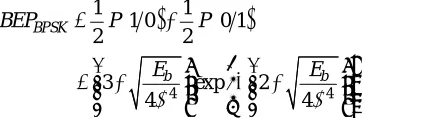
Due to symmetry of BPSK signal constellation, for bit '1' transmission, probability of error is P (0/1) = P (1/0) [19, 20]. Since, '0's and '1's are equiprobable at input of MCF OI system (see Fig. 2), the average BEP for coherent BPSK can be expressed as
1
1
1 0
0 1
2
2
BPSK
BEP
P
P
4 4
3 exp 2
4 4
b b
E E
(5)
The above analytical expression of BEP is used to validate the proposed MCF OI simulation model (Fig. 1) integrated in a short reach communication system (Fig. 2) that calculates BEP using OptSim .
[image:4.612.329.547.50.243.2]Variation of BEP for a 40 Gbps BPSK system with OSNR is calculated by Eq. (5) and simulation model of Fig. 2. Both the results are plotted in Fig. 3. The BEP is obtained by taking the average of error probability in all eight channels of 100 m long MCF, while in simulation each core is replaced by 100 m single core fiber (see Fig. 1). The crosstalk between two neighboring cores in a row with bending radius of 15 cm is calculated to be -52 dB from coupled mode theory [8]. Accordingly coupled power ratio of optical couplers in Fig. 1 is adjusted. It can be observed from Fig. 3 that BEP significantly decreases with increase in OSNR. Intersection of BEP curve and forward-error correction (FEC)
Fig. 3. BEP as a function of OSNR for BPSK system at 40 Gbps data rate.
Fig. 4. Variation of BEP with launch power for various BPSK
modulated Signal.
limit having typical value 2.1×10⁻³ [23] gives threshold sensitivity of
the receiver above which receiver performance will be degraded. OSNR estimated from Fig. 3 at threshold receiver sensitivity is 16.4 dB from both the approaches. It is worth noting that the simulated result is in good agreement with theoretical BEP calculated from Eq. (5) and there is maximum difference of about 0.3 dB in OSNR below FEC justifying the validity of proposed MCF OI simulation model.
Next, for same parameters as mentioned above, dependence of BEP on launched power in MCF OI is evaluated using simulation set up of Fig. 2 and analytically by Eq. (5). Figure 4 shows that average BEP of all the channels in a 8-core MCF OI BPSK system decreases with increase in launched input power for different data rates. Moreover, for same input power BEP is more for high data rates. At threshold receiver sensitivity, it can be concluded that launching power required is as low as −9.5 dBm at 40 Gbps BPSK signal and such low sensitivity is suitable
for short reach transmission to avoid nonlinear effect. Furthermore, for same launched power, error probabilities are below FEC limit for 2.5 Gbps and 10 Gbps ascertaining almost error free transmission of BPSK data for 8-core MCF OI system. At high launch power and low data rate error in simulated value of BEP is approximately 3.4%.
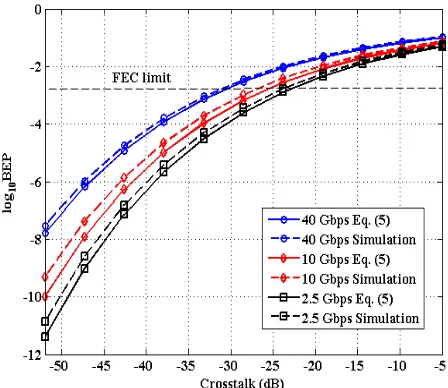
Finally effect of inter-core crosstalk on BEP is evaluated and is plotted in Fig. 5. The crosstalk variation from −52 dB to −5 dB is
[image:4.612.323.559.276.473.2] [image:4.612.67.283.554.613.2]Fig. 5. BEP vs inter-core crosstalk for various BPSK modulated Signal.
a given data rate BEP increases with inter-core crosstalk. For any value of crosstalk, the BEP is lower for 2.5 Gbps per channel and increases with data rate. It can be inferred that error probability for high bit rate is more pronounced and has lower tolerance to the crosstalk than that of low bit rate. Using simulation setup of Fig. 2 and Eq. (5), threshold receiver sensitivity as a function of the inter-core crosstalk at the launch power of 0 dBm is investigated. The reason for its effect on BEP performance for BPSK approach may be due to the proximity of cores in rectangular configuration. Most of the experimental results reported pertain to hexagonal configuration. The crosstalk level less than the threshold receiver sensitivity is required to achieve error free transmission.
From Fig. 5, it is observed that for 40 Gbps, at threshold receiver sensitivity, crosstalk is approximately −30.8 dB. Moreover, the receiver threshold sensitivity increases to the crosstalk of −23.1 dB for 2.5 Gbps per channel. To achieve even high data rate and lower cost per bit, 40 Gbps per channel is highly desired for a practical OI system.Figure 5 shows that for 40 Gbps crosstalk of less than −30.8 dB is required for error free transmission in proposed system. The BEP curves shown in Fig. 5 at 40 Gbps agrees well for theoretical and simulated approaches. For 2.5 Gbps an error less than 5 % is observed for low crosstalk and agrees within 1% for high crosstalk. This trend is followed for 10 Gbps and 40 Gbps as well. Error free transmission (BEP < 10 −7) upto 40
Gbps for all channels is achieved at crosstalk of −52 dB. For single wavelength, phase matching between modes of adjacent cores will increase resulting in higher crosstalk and BEP. However, it can be investigated in future where excitation of modes by fan-in fan-out technique is considered. Other system characteristics, such as, required OSNR penalty, spectral efficiency, and receiver sensitivity may account for such differences. Moreover, with 8-core MCF, the overall capacity can be increased upto 2.5Tbps (8 cores × 8 λ × 40 Gbps BPSK) over 100 m of single MCF for OI applications which is much higher than data rates reported recently [11-13, 15].
To summarise, a stand alone simulation model of MCF OI is proposed which will find application in configuring complex communication systems based on MCF OI. Although, the present model is for rectangular array of 8–core MCF, it can be easily modified to include any configuration such as seven core MCF. Critical to its design is incorporating practical features such as inter-core crosstalk and power coupling with fan–in fan–out (FIFO) concept. Inter–core crosstalk is realized using optical couplers and combiners in a pertinent order and is in commensurate with theoretical predictions. FIFO is taken into account by careful design of SDM MUX and DEMUX having 1:8 splitter and 8:1 combiner respectively. To make sure that the stand alone model can be integrated into a communication system,
error probability estimation of BPSK modulated short reach OI system is considered. Important performance features from receiver point of view such as variation of BEP with OSNR, launching power and inter– core crosstalk is simulated for different data rates of 2.5 Gbps, 10 Gbps and 40 Gbps. To validate simulation results, closed form equation for error probability of BPSK modulated SDM signals contaminated by inter-core crosstalk of MCF, is derived and is being reported for the first time. The error probability equation assumes inter-core crosstalk in MCF to be virtual additive white Gaussian noise. To compare the error probabilities obtained by two distinct methods receiver threshold sensitivity is defined, below which receiver performance is considered to be reliable. For all the three performance parameters considered, the simulated and theoretical results agree well within an error of 5 % for low data rate (2.5 Gbps) and 1% for high data rate (40 Gbps). Present results clearly substantiate that the proposed simulation module and derived closed form equation for error probability will find application in designing next generation practical optical interconnects and silicon photonic transceivers.
Authors (JKM and VP) who are currently at City University London, UK under AREAS+ Erasmus Mundus mobility, acknowledge the financial support from European Commission.
References
1.M. A. Taubenblatt, J. Lightwave Technol. 30, 448 (2012).
2.S. Abrate, R. Gaudino, C. Zerna, B. Offenbeck, J. Vinogradov, J. Lambkin, and A. Nocivelli, in Proceedings of IEEE Photonics Conference (IEEE, 2011), pp. 230.
3.J. A. Kash, A. Benner, F. E. Doany, D. Kuchta, B. G. Lee, P. Pepeljugoski, L. Schares, C. Schow, and M. Taubenblatt, in Optical Fiber Communication Conference and Exposition (OFC/NFOEC), 2011 and the National Fiber Optic Engineers Conference, OSA Technical Digest Series (Optical Society of America, 2011), paper OWQ1.
4.V. Francois and F. Laramee, J. Lightwave Technol. 31, 4022 (2013). 5.D. L. Butler, M. J. Li, S. Li, K. I. Matthews, V. N. Nazarov, A. Koklyushkin, R. L.
McCollum, Y. Geng, and J. P. Luther, in proceeding of IEEE Optical Interconnects Conference (IEEE, 2013), pp. 9.
6.J. K. Mishra and V. Priye, Opt. Commun. 331, 272 (2014).
7.T. Morioka, Y. Awaji, R. Ryf, P. Winzer, D. Richardson, and F. Poletti, IEEE Commun. Mag. 50, s31 (2012).
8.T. Hayashi, T. Taru, O. Shimakawa, T. Sasaki, and E. Sasaoka, Opt. Express
19, 16576 (2011).
9.J. H. Chang, H. G. Choi, and Y. C. Chung, Opt. Express 21, 14262 (2013). 10.B. J. Puttnam, T. A. Eriksson, J.-M. D. Mendinueta, R. S. Luís, Y. Awaji, N.
Wada, M. Karlsson, and E. Agrell, Opt. Express 22, 32457 (2014). 11.J. Lee, N. Kaneda, T. Pfau, A. Konczykowska, F. Jorge, J.-Y. Dupuy, and Y.-K.
Chen, in Optical Fiber Communication Conference 2014, OSA Technical Digest Series (Optical Society of America, 2014), paper Th5A.5.
12.K. Zhong, X. Zhou, T. Gui, L. Tao,Y. Gao, W. Chen, J. Man, L. Zeng, A. P. T. Lau, and C. Lu, Opt. Express 23, 1176 (2015).
13.X. Xu, E. Zhou, G. N. Liu, T. Zuo, Q. Zhong, L. Zhang, Y. Bao, X. Zhang, J. Li, and Z. Li, Opt. Express 23, 492 (2015).
14.B. G. Lee, D. M. Kuchta, F. E. Doany, C. L. Schow, P. Pepeljugoski, C. Baks, T. F. Taunay, B. Zhu, M. F. Yan, G. E. Oulundsen, D. S. Vaidya, W. Luo, and N. Li, J. Lightwave Technol. 30, 886 (2012).
15.P. Westbergh, J. S. Gustavsson, and A. Larsson, IEEE Photon. Technol. Lett. 27, 296 (2015).
16.M. Koga and A. Mizutori, IEEE Photon. Technol. Lett. 26, 319 (2014). 17.B. Glance, J. Lightwave Technol. 4, 228 (1986).
18.K.-P. Ho, Phase-Modulated Optical Communication Systems, (Springer-Verlag, 2005).
19.J. G. Proakis, Digital Communications, Chapter 5 (McGraw-Hill, 2001). 20.S. Haykin, Communication Systems, Chapter 6 (Wiley, 2001).
21.Y. Abe, K. Shikama, S. Yanagi, T. Takahashi, Electron. Lett. 49, 711 (2013). 22.S. Savory, Opt. Express 16, 804 (2008).
[image:5.612.62.286.54.248.2]References
1.M. A. Taubenblatt, "Optical interconnects for high–performance computing," J. Lightwave Technol. 30, 448–457 (2012).
2.S. Abrate, R. Gaudino, C. Zerna, B. Offenbeck, J. Vinogradov, J. Lambkin, and A. Nocivelli, "10Gbps POF ribbon transmission for optical interconnects," in Proceedings of IEEE Photonics Conference (IEEE, 2011), pp. 230–231.
3.J. A. Kash, A. Benner, F. E. Doany, D. Kuchta, B. G. Lee, P. Pepeljugoski, L. Schares, C. Schow, and M. Taubenblatt, "Optical interconnects in future servers," in Optical Fiber Communication Conference and Exposition (OFC/NFOEC), 2011 and the National Fiber Optic Engineers Conference, OSA Technical Digest Series (Optical Society of America, 2011), paper OWQ1.
4.V. Francois and F. Laramee, "Multicore fiber optimization for application to chip–to–chip optical interconnects," J. Lightwave Technol. 31, 4022– 4028 (2013).
5.D. L. Butler, M. J. Li, S. Li, K. I. Matthews, V. N. Nazarov, A. Koklyushkin, R. L. McCollum, Y. Geng, and J. P. Luther, "Multicore optical fiber and connectors for high bandwidth density, short reach optical links, " in proceeding of IEEE Optical Interconnects Conference (IEEE, 2013), pp. 9– 10.
6.J. K. Mishra and V. Priye, "Design of low crosstalk and bend insensitive optical interconnect using rectangular array multicore fiber," Opt. Commun. 331, 272– 277 (2014).
7.T. Morioka, Y. Awaji, R. Ryf, P. Winzer, D. Richardson, and F. Poletti, "Enhancing optical communications with brand new fibers," IEEE Commun. Mag. 50, s31–s42 (2012).
8.T. Hayashi, T. Taru, O. Shimakawa, T. Sasaki, and E. Sasaoka, "Design and fabrication of ultralow crosstalk and low-loss multi-core fiber," Opt. Express 19, 16576–16592 (2011).
9.J. H. Chang, H. G. Choi, and Y. C. Chung, "Achievable capacity improvement by using multi-level modulation format in trench-assisted multi-core fiber system, " Opt. Express 21, 14262–14271 (2013). 10.B. J. Puttnam, T. A. Eriksson, J.-M. D. Mendinueta, R. S. Luís, Y. Awaji, N.
Wada, M. Karlsson, and E. Agrell, "Modulation formats for multi-core fiber transmission," Opt. Express 22, 32457–32469 (2014).
11.J. Lee, N. Kaneda, T. Pfau, A. Konczykowska, F. Jorge, J.-Y. Dupuy, and Y.-K. Chen, "Serial 103.125-Gb/s transmission over 1 km SSMF for low-cost, short reach optical interconnects," in Optical Fiber Communication Conference 2014, OSA Technical Digest Series (Optical Society of America, 2014), paper Th5A.5.
12.K. Zhong, X. Zhou, T. Gui, L. Tao,Y. Gao, W. Chen, J. Man, L. Zeng, A. P. T. Lau, and C. Lu, "Experimental study of PAM-4, CAP-16, and DMT for 100 Gb/s short reach optical transmission systems," Opt. Express 23, 1176– 1189 (2015).
13.X. Xu, E. Zhou, G. N. Liu, T. Zuo, Q. Zhong, L. Zhang, Y. Bao, X. Zhang, J. Li, and Z. Li, "Advanced modulation formats for 400-Gbps short reach optical inter-connection," Opt. Express 23, 492–500 (2015).
14.B. G. Lee, D. M. Kuchta, F. E. Doany, C. L. Schow, P. Pepeljugoski, C. Baks, T. F. Taunay, B. Zhu, M. F. Yan, G. E. Oulundsen, D. S. Vaidya, W. Luo, and N. Li, "End–to–end multicore multimode fiber optic link operating up to 120 Gb/s," J. Lightwave Technol. 30, 886–892 (2012). 15.P. Westbergh, J. S. Gustavsson, and A. Larsson, "VCSEL arrays for
multicore fiber interconnects with an aggregate capacity of 240 Gb/s," IEEE Photon. Technol. Lett. 27, 296–299 (2015).
16.M. Koga and A. Mizutori, "Decision-directed costas loop stable homodyne detection for 10-Gb/s BPSK signal transmission," IEEE Photon. Technol. Lett. 26, 319-322 (2014).
17.B. Glance, "Performance of homodyne detection of binary PSK optical signals," J. Lightwave Technol. 4, 228 - 235 (1986).
18.K.-P. Ho, Phase-Modulated Optical Communication Systems, (Springer-Verlag, 2005).
19.J. G. Proakis, Digital Communications, Chapter 5 (McGraw-Hill, 2001). 20.S. Haykin, Communication Systems, Chapter 6 (Wiley, 2001).
21.Y. Abe, K. Shikama, S. Yanagi, T. Takahashi, "Physical-contact-type fan-out device for multicore fibre," Electron. Lett. 49, 711–712 (2013). 22.S. Savory, "Digital filters for coherent optical receivers," Opt. Express
16, 804–817 (2008).