
Taking stock of structural funds implementation : current challenges and future opportunities
54
0
0
Full text
(2) European Policies Research Centre University of Strathclyde Graham Hills Building 40 George Street Glasgow G1 1QE United Kingdom Tel: +44-141-548 3339/4906 Fax: +44-141-548 4898 E-mail: [email protected] [email protected] http://www.eprc.strath.ac.uk/eprc/default.htm http://www.eprc.strath.ac.uk/iqnet/iq-net/index.html. Revised October 2003.
(3) The Added Value of the Structural Funds. Preface The research for this paper was undertaken in preparation for the first meeting of Phase III of IQ-Net, the exchange of experience network for Objective 1 and 2 Structural Fund programmes. The meeting took place in Dortmund, Nordrhein Westfalen, Germany from 19-21 February 2003. The paper has been subsequently revised in line with the conference discussion and partner comments. This paper is a product of desk research and fieldwork visits among national and regional authorities in Member States (notably in member regions of the IQ-Net consortium) in Autumn 2002. The field research team comprised: Ø. Ruth Downes (Austria, Sweden). Ø. Laura Polverari (Italy, Spain). Ø. Professor Henrik Halkier (Denmark). Ø. Philip Raines (Sweden, UK). Ø. François Josserand (France). Ø. Douglas Yuill (Germany). Many thanks to everyone who participated in the research. The European Policies Research Centre also gratefully acknowledges the financial support provided by participating regions and by the European Commission (through European Regional Development Fund co-financing for regional subscriptions) in funding the production of this report and the organisation of the Dortmund meeting. The Centre also expresses its thanks to the Nordrhein Westfalen authorities for their special financial assistance in making the meeting possible. For further information about IQ-Net, and access to the full series of Thematic Papers, visit the IQ-Net website: http://www.eprc.strath.ac.uk/iqnet/iq-net/index.html.. IQ-Net Thematic Paper 12(1). i. European Policies Research Centre.
(4) The Added Value of the Structural Funds. IQ-Net Thematic Paper 12(1). ii. European Policies Research Centre.
(5) Taking Stock of Structural Fund Implementation: Current Challenges and Future Opportunities. Taking Stock of Structural Fund Implementation: Current Challenges and Future Opportunities TABLE OF CONTENTS Executive Summary................................................................................................. v 1.. Introduction.................................................................................................. 1. 2.. Recent developments in programme implementation .............................. 1. 3.. Financial progress and N+2 risk ................................................................. 2 3.1 3.2. 4.. Decommitment risk ................................................................................................... 2 Actions against decommitment................................................................................. 9. Programme mid-term evaluations ............................................................ 17 4.1 4.2 4.3. 5.. Progress in the mid-term evaluation process since June 2002.............................. 17 Approaches............................................................................................................. 21 Problems and issues .............................................................................................. 25. Simplification of the Structural Funds...................................................... 29 5.1 5.2 5.3. 6.. The Commission’s note .......................................................................................... 29 National and regional involvement in the debate ................................................... 33 Content of the debate: national and regional priorities........................................... 35. Annex 1: Other initiatives of specific interest.......................................... 40 6.1 6.2 6.3. Ex post evaluation of past Objective 2 programmes .............................................. 40 Acting towards accountability: SEP’s Customer satisfaction survey (West of Scotland, UK) ......................................................................................................... 42 More effectiveness in the implementation of financial engineering schemes ........ 43. IQ-Net Thematic Paper 12(1). iii. European Policies Research Centre.
(6) Taking Stock of Structural Fund Implementation: Current Challenges and Future Opportunities. IQ-Net Thematic Paper 12(1). iv. European Policies Research Centre.
(7) Taking Stock of Structural Fund Implementation: Current Challenges and Future Opportunities. Taking Stock of Structural Fund Implementation: Current Challenges and Future Opportunities EXECUTIVE SUMMARY Introduction This paper highlights several themes which have informed programme management since the IQ-Net meeting in June 2002, held in Luleå, Sweden. First, it provides an overview of the main developments in programme implementation and the financial execution of programmes, including an exploration of the risks of automatic decommitment faced by the programmes. Second, it describes the progress made with the mid-term evaluations, following on from the IQ-Net thematic paper on this subject presented at the Luleå conference.1 Third, it presents an overview of the current EU-level debate on simplification, highlighting the views of the network’s partners as well as, where available, the Member States. Recent development in programme implementation Since the IQ-Net meeting in Luleå, important developments at the European level have informed programme implementation: first, in May 2002, DG Regional Policy issued a Communication on the ‘Application of the “n+2” rule’2; second, the Commission produced a ‘Note on the simplification of structural policy management’ as a background to the ministerial meeting which was held in Brussels on this theme in October 2002. Programme secretariats have continued to be engaged with the day-to-day implementation of the programmes. This includes the launch of the mid-term evaluations; the adaptation of monitoring systems, indicators and targets; activities to support project generation; the implementation of procedures for accelerating expenditure; the approval of programme adjustment; the launch of new programmes/projects; the participation in the debate over the simplification of Structural Fund implementation; the redefinition of project selection criteria and other activities (eg. specific initiatives for accountability and better programme management performance). All programmes are also implementing their publicity and communication strategies (on this theme see parallel thematic paper). N+2 risk The number of programmes facing some risk of decommitment is significant. This includes programmes from Austria, France, Germany and the UK. Looking beyond current IQ-Net membership, early feedback from the. 1. Raines P and Taylor S (2002) Mid-term Evaluation of the 2000-06 Structural Fund Programmes, IQNet Thematic Paper 11(2), June 2002. 2 Available on-line from Inforegio’s website at: http://europa.eu.int/comm/regional_policy/sources/docoffic/working/doc/c_2002_1942_en.pdf. IQ-Net Thematic Paper 12(1). v. European Policies Research Centre.
(8) Taking Stock of Structural Fund Implementation: Current Challenges and Future Opportunities. Commission indicates that at least 20 programmes ‘may be affected in 20023, with a sharp increase in decommitment risk for subsequent years. Problems are attributable to several factors: Ø contextual reasons, eg. the overall economic slowdown over the past year is having an impact on programmes spending potential, especially as regards business schemes (eg. Austria, Italian OP for Local Entrepreneurial Development) and repercussions in the identification of national match-funding (Nordrhein Westfalen, West of Scotland); Ø strategic reasons, eg. inconsistency of the programmes’ strategic focus with changing conditions, changes in the strategic environment or shifts of policy direction have also caused spending underperformance (West of Scotland, Italian OP for Local Entrepreneurial Development). Also the character of Structural Fund maps and the treatment of transitional areas, and the difficulties in identifying match-funding are representing a challenge for some programmes (East of Wales, West of Scotland); Ø procedural reasons, eg. the move away from the previous systems of advance payments in response to the interpretation of the 2000-06 regulations has been a major challenge for programme management in Nordrhein Westfalen. In East Wales, on the other hand, the bottleneck of programme implementation is represented by the partnership system that delivers the programme; Ø measure specific reasons, eg. in West of Scotland the venture capital/business investment fund is not progressing as forecasted, because of the main applicant being slow to develop its business plan; while in Toscana, some delays were experienced in relation to the pending approval of a number of aid schemes by DG Competition. All programme secretariats are implementing actions to avoid decommitment risks or, at least, to limit the extent to which it may occur. In some cases, programme managements have identified solutions to tackle specific problems (eg. procedures to speed up expenditure claims were set up for the Italian OP for Local Entrepreneurial Development); while in others, more holistic approaches are being adopted (eg. in France, where the decommitment problem is an issue for many programmes, a wholesale simplification exercise has been promoted by the national government). The activities undertaken to minimise the risk of the decommitment which are carried out by the individual programmes can be categorised under five headings: Ø actions to stimulate project generation are being implemented by a number of secretariats, eg. by strengthening ‘animation’ efforts (France), implementing targeted Action Plans (UK) or ‘softening’ project selection criteria (Niederösterreich); Ø procedures to accelerate expenditure are being implemented in virtually all programmes, ie. also where commitment levels are relatively high, to make sure that the commitments become certified expenditure in due time; Ø programme adjustments are anticipated or have been made to try to tackle spending problems raised in respect of specific programme areas in Steiermark, Nordrhein Westfalen, Toscana, East Wales and in the Italian OP for Local Entrepreneurial Development; 3. Bachtler J (2002) Aide-mémoire on the simplification debate, European Policies Research Centre.. IQ-Net Thematic Paper 12(1). vi. European Policies Research Centre.
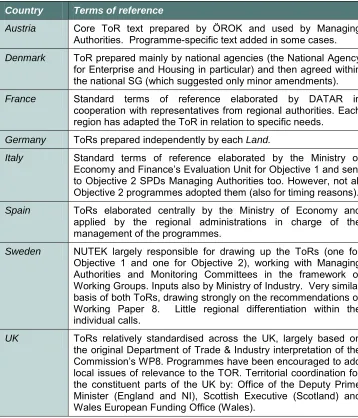
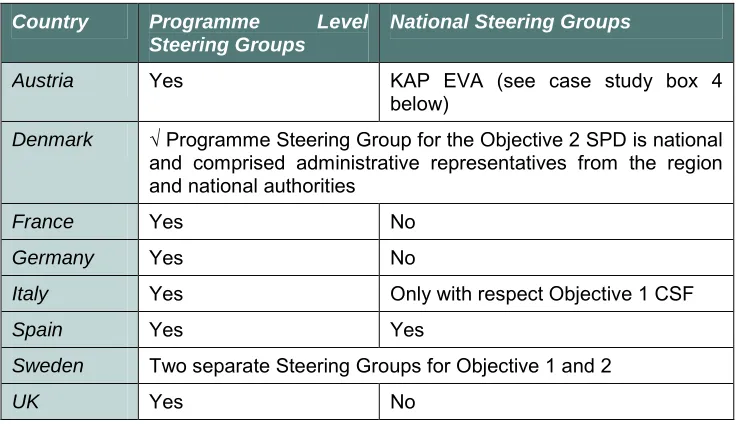
(9) Taking Stock of Structural Fund Implementation: Current Challenges and Future Opportunities. Ø the launch of new programmes/projects with high spending potential was undertaken in a number of cases, eg. in Steiermark, Nordjylland and East Wales; Ø the re-allocation of responsibilities for the administration of schemes such as changes in the administration of particular problem schemes (eg. in Steiermark an ESF co-funded measure) or the introduction of more decentralised allocation of responsibilities for programme delivery (eg. Alsace and France more generally) is also one of the measures implemented by programme managements to contrast decommitment risks. Programme mid-term evaluations Mid-term evaluations have to date been commissioned and launched everywhere. Despite the fact that the responsibility for the undertaking of mid-term evaluation lies with the programme Managing Authorities, there has in most cases been some national coordination in issuing terms of reference (the most notable exception being represented by Germany). Steering Groups were created and made operational everywhere at the programme level and/or nationally, by Objective. An interesting example of a national Steering Group is represented by KAP-EVA in Austria, a coordination and working platform which has been set up by ÖROK to coordinate and accompany primarily the process of on-going evaluation of the Structural Fund programmes. In terms of overall approach, compliance with the Commission Working Paper 8 – which was pursued in all cases - has not always implied that the programme managements are implementing mid-term evaluation in the ‘discrete form’ which was suggested by the Commission. In some cases - eg. in Austria, Italy and Ireland - the programmes have opted for approaches to evaluation which are more integrated across the programming period, ie. for various kinds of on-going evaluations. However, even where programme evaluations are undertaken according to the approach suggested by the Commission (and in the regulations) some innovative element can be found, eg. the benchmarking exercise included as integral part of the mid-term evaluations of Nordrhein Westfalen, West of Scotland and East of Scotland. Overall, evaluations appear to be running smoothly for most programmes. However some problems have been met or persist in specific areas: Ø selection of evaluation teams and procurement procedures, eg. in Scotland, where the adoption of Scottish Executive procurement regulations meant that indicative budgets were not issued, resulting in limiting the pool of potential bids to a small group of ‘usual suspects’; Ø involvement of project implementers in the evaluation process, it has been felt by some (eg. Nordrhein Westfalen) that despite the general improvement of evaluation culture, it is still difficult engage project implementers positively in evaluation studies; Ø overall evaluation philosophy, eg. in Germany due to the subsumed character of Structural Fund implementation, Structural Fund evaluations have a limited scope;. IQ-Net Thematic Paper 12(1). vii. European Policies Research Centre.
(10) Taking Stock of Structural Fund Implementation: Current Challenges and Future Opportunities. Ø evaluation timing and potential for use of the results, eg. for Nordrhein Westfalen and the Italian Objective 2 SPD the delays in the approval and launch of the programmes are limiting the scope of the mid-term evaluations; in other cases, where programme implementation is very advanced (eg. Swedish programmes) or where resources are concentrated in the first years of programming (eg. Italian OP for Local Entrepreneurial Development) the problem is opposite, ie. the limited impact that mid-term evaluation can have on programme management; Ø the availability and reliability of data and the adequacy of targets is a problem common to many programmes (eg. Italian OP for Local Entrepreneurial Development, East of Wales); more general problems are also being met in the implementation of the monitoring systems (eg. Norra Norrland, Nordrhein Westfalen). Simplification of the Structural Funds Simplification was one of the main objectives of Agenda 2000 and the Berlin Council agreement. However, in practice, the process of implementing the Structural Funds has become more complex. Decentralised management has been accompanied by stricter requirements with respect to financial control, audit, monitoring and evaluation. Based on the experience of the first 2-3 years of the new programming period, Member States have put pressure on the Commission to simplify the implementation process. In response to such pressures, in autumn 2002 the Commission launched a debate on the simplification of Structural Fund mechanisms, with a view to reforming the operational rules for a more efficient and effective management. Following high-level discussions within the Commission, which took place in Summer 2002, a Ministerial Meeting was held in Brussels on 7 October 2002 to discuss a wide range of simplification proposals, relating to the following themes: Ø procedures for revising the programmes Ø procedures for inspections and control Ø mid-term evaluations and reviews Ø reporting activities Ø monitoring indicators (in particular for the purpose of impact assessment) Ø Performance Reserve allocation Ø annual meetings with the Commission Ø Commission’s role in Monitoring Committees Ø financial management and automatic decommitment procedures. Not all Member States are dealing with the simplification debate in the same way. The main differences between countries relate to: Ø the way in which the debate has been dealt with nationally, ie. in some cases there has been widespread involvement of national and regional administrations in charge of managing the funds (eg. Italy), while in others the process is being managed predominantly centrally (eg. UK); Ø the scope of the debate, while in some cases the debate has largely been concentrated on simplification and Structural Fund management themes. IQ-Net Thematic Paper 12(1). viii. European Policies Research Centre.
(11) Taking Stock of Structural Fund Implementation: Current Challenges and Future Opportunities. (eg. Denmark), in others this theme has been merged with those of the consequences of enlargement and the future of the funds (eg. UK); The Commission note was generally received positively by Member States and programme authorities, at least as acknowledgment that a problem exists. There is widespread consensus on the fact that the note does actually reflect the main key issues. While the substance behind the Commission’s proposals will only become apparent in the discussions yet to take place, the document has provided a good framework for the debate and demonstrated the Commission’s understanding of the Member States’ concerns. However a number of perplexities have been raised: Ø doubts have been expressed relating to the need to see how (and if) the Commission’s resolutions will effectively feed through – and if they will, under what timeframe (Galicia, Nordrhein Westfalen, Norra Norrland, West of Scotland); Ø the content of the note appears sometimes too general and not ready to be operationalised, eg. in relation to controls and inspections, (Galicia, Italian Ministry of Productive Activities/IPI); Ø there is criticism that the note has omitted one fundamental issue for future Structural Funds to be able to operate effectively and efficiently: the interrelationships between Structural Fund maps and national aid maps (East of Wales); Ø concern exists in some quarters about the limited scope of the reform, given that it has to be implemented within the framework of existing Structural Fund regulations (Galicia, DATAR, Ministry of Productive Activities/IPI, Norra); Ø the timing for the debate is not considered entirely appropriate (DATAR, Ministry of Productive Activities/IPI) as it may be too late to have an impact on the current programming period, while for the future, a broader revision of the regulations appears necessary; Ø concerns have been expressed over the capacity of the Commission to respect the timescales outlined in various parts of the note (Austria, Italy, Sweden). At the same time, it will be interesting to see if the deadlines for the simplification actions outlined in the paper (some of which are already overdue) will prove to be realistic.. IQ-Net Thematic Paper 12(1). ix. European Policies Research Centre.
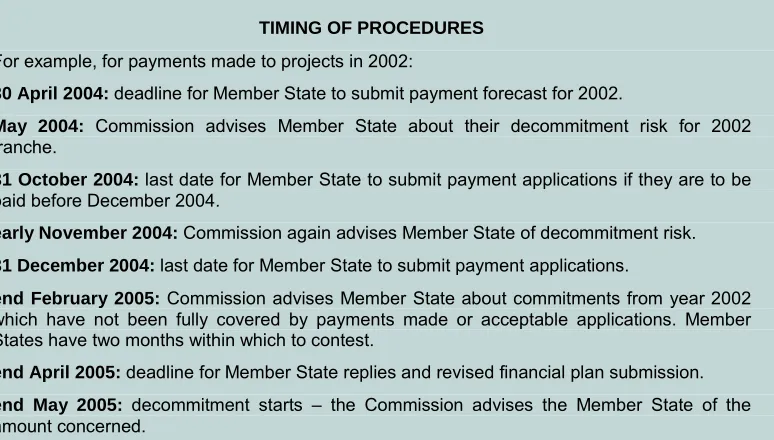
(12) Taking Stock of Structural Fund Implementation: Current Challenges and Future Opportunities. Taking Stock of Structural Fund Implementation: Current Challenges and Future Opportunities 1.. INTRODUCTION This paper highlights several themes which have informed programme management since the IQ-Net meeting in June 2002 in Luleå, Sweden. First, it provides an overview of the main developments in programme implementation and the financial execution of programmes, including an exploration of the risks of automatic decommitment faced by the programmes. Second, it describes the progress made with the mid-term evaluations, following on from an earlier IQ-Net thematic paper.4 Third, it presents an overview of the current EU-level debate on simplification, highlighting the views of the network’s partners as well as, where available, the Member States. In an annex to the main report, several other interesting developments are also illustrated, in particular, a synthesis of the preliminary findings of the ex post evaluations which have been carried out for the previous Objective 1 and 2 programmes, as well as a number of programme-level initiatives which have taken place recently.. 2.. RECENT DEVELOPMENTS IN PROGRAMME IMPLEMENTATION When the update paper for the last IQ-Net meeting in Luleå was drafted (June 2002), two important issues were still unresolved: the application of the N+2 rule and the debate on simplification. On the application of the decommitment rule, the paper reported the positions of the IQ-Net countries and/or regions, considering the interpretation that each gave of the Regulation’s text on this matter. It was also pointed out that clarification was needed on the part of the Commission on how the N+2 rule should be applied. On the issue of simplification, on the other hand, the paper referred in particular to a document prepared by the Committee of the Regions (11th Annual Report on the Structural Funds) which represented a call for simplification and urged the Commission to reconsider procedures and simplify them in light of cost benefit considerations. Several important developments with respect to these themes represent the starting point for the current paper. (i). In May 2002, DG Regional Policy, in agreement with the DGs for Employment and Social Affairs, Agriculture, Rural Development and Fisheries, and the Budget issued a Communication on the ‘Application of the “n+2” rule under article 31.2 of Regulation 1260/1999’5.. 4. Raines P and Taylor S (2002) op. cit. Available on-line from Inforegio’s website at: http://europa.eu.int/comm/regional_policy/sources/docoffic/working/doc/c_2002_1942_en.pdf. 5. IQ-Net Thematic Paper 12(1). 1. European Policies Research Centre.
(13) Taking Stock of Structural Fund Implementation: Current Challenges and Future Opportunities. (ii). The Commission produced a ‘Note on the simplification, clarification, coordination and flexibility of structural policy management in the period 2000-06’ as a background to the ministerial meeting which was held in Brussels on this theme in October 2002.. From a programme-level perspective, programme secretariats have continued to be engaged with the day-to-day implementation of the programmes. This has included financial management, project selection and monitoring, implementation of the publicity and communication strategies and evaluation activities. More specifically, programme implementation over the last few months has been concerned with the following main activities: Ø Launch of the mid-term evaluations Ø Revision/adaptation of monitoring systems/indicators and of targets Ø Stimulation of project generation Ø Implementation of procedures for accelerating expenditure Ø Programme adjustment Ø Launch of new programmes/projects Ø Accountability initiatives and initiatives for improving management performance Ø Participation in national discussion fora on the future of the Structural Funds Ø Re-definition of project selection criteria Ø Continued implementation of publicity and communication strategies (for more detailed discussion, see IQ-Net Thematic Paper 12(2) on this theme6).. 3.. FINANCIAL PROGRESS AND N+2 RISK. 3.1. Decommitment risk After the publication of DG Regio’s Communication on the application of the N+2 rule, it is now clearer to Member States and programme Managing Authorities on what basis the decommitments will be made (see Box 1).. 6. Taylor, S and Raines, P (2003) Getting the Message? Structural Fund Publicity and Communication, IQ-Net Thematic Paper 12(2), February 2003. IQ-Net Thematic Paper 12(1). 2. European Policies Research Centre.
(14) Taking Stock of Structural Fund Implementation: Current Challenges and Future Opportunities. Box 1: DG Regio’s note on the N+2 rule The "N+2" rule stipulates that the annual financial instalment of a programme co-financed by the Structural Funds must be spent before the end of the second year following the commitment ('n' being the year of commitment). The rule applies for the first time from 31 December 2002. Appropriations not used within this period are permanently lost to the Member State, apart from in exceptional circumstances. In a communication published in May 2002, the Commission attempted to clarify the rule as follows. Ø Date of application: At the end of each budget year, the Commission will inform the Member States of the dates of the commitments made under each fund during that budget year. Commitments must then be settled by 31 December of the second year following the acceptance of the commitment in the Commission’s accounts. Commitments may be settled by payment on account or by submitting an application for expenditure actually paid out to the Commission (various submission methods are acceptable and date of document submission can be is used). Member States must also advise the Commission of operations for which automatic decommitment would not apply (see below) by this date. Ø. Multi-fund programmes: For multi-fund programmes, where there may be different dates of commitment for each fund, the date of the last commitment is used for the purposes of the decommitment rule.. Ø. Subsequent Commission decisions: Where part of an annual budget tranche is not paid out because further Commission authorisation is required for a measure or operation (eg. for an aid scheme or major project), this amount is left out of the decommitment calculation. The relevant decommitment date for the omitted sum will be the end of the second year after the required decision is taken.. Ø. Transfers between funds/programmes: For each programme, there is one commitment (tranche) each year for each fund. Current and future annual tranches for each fund can be modified within any budgetary year (with any increase matched by a corresponding decrease) as long as the annual ceiling is not exceeded. However, there can be no transfers after the end of the year of commitment between fund tranches.. Ø. Informing the Member States: The Commission will warn Member States of their risk of automatic decommitment on two occasions per year: once after receiving the updated payment forecast (to be submitted by 30 April n+2, ie. in the second year following the year of commitment); and again after 31 October n+2.. Ø. Procedures and appeals: Where payment to a project is delayed due to judicial procedure or appeal, this part of the commitment will not be subject to the n+2 rule. Member States must provide supporting documentation for each such case. Normally acceptable cases include proceedings which: delay the implementation of projects; delay payments on projects; or delay the recognition of payments as eligible for EU co-funding.. Ø. Treatment of irregularities: So long as any payment claim containing amounts relating to irregularities is backed up by suitable declarations, there will be no effect on n+2 decommitment.. Ø. Commission procedures: Where the Commission undertakes legal proceedings involving a suspension of payments, automatic decommitment will not apply to the corresponding commitment (so long as an otherwise acceptable payment application is submitted on time). Where a payment claim is reduced or refused by the Commission, but the Member State then provides a satisfactory response to the Commission’s queries, the initial payment claim will be considered to be an acceptable application.. IQ-Net Thematic Paper 12(1). 3. European Policies Research Centre.
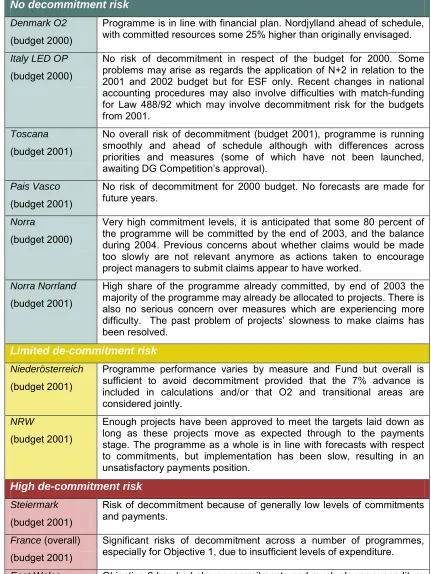
(15) TIMING OF PROCEDURES For example, for payments made to projects in 2002: 30 April 2004: deadline for Member State to submit payment forecast for 2002. May 2004: Commission advises Member State about their decommitment risk for 2002 tranche. 31 October 2004: last date for Member State to submit payment applications if they are to be paid before December 2004. early November 2004: Commission again advises Member State of decommitment risk. 31 December 2004: last date for Member State to submit payment applications. end February 2005: Commission advises Member State about commitments from year 2002 which have not been fully covered by payments made or acceptable applications. Member States have two months within which to contest. end April 2005: deadline for Member State replies and revised financial plan submission. end May 2005: decommitment starts – the Commission advises the Member State of the amount concerned.. Table 3-1 below describes the decommitment situation of each programme. As the table shows, the number of programmes, within the IQ-Net network, facing some risk of decommitment is significant, especially given that the French programmes are globally dealt with in the chart. Looking beyond current IQ-Net membership, early feedback from the Commission indicates that at least 20 programmes ‘may be affected in 2002 and a much greater number of programmes (and significant level of resources) could be affected in 2004. If true, it is obvious that the political consequences would be damaging at every level – Commission, Member State and programme’. 7. 7. Bacthler, J (2002) Aide-mémoire on the simplification debate. European Policies Research Centre, p. 10.. IQ-Net Thematic Paper 12(1). 4. European Policies Research Centre.
(16) Taking Stock of Structural Fund Implementation: Current Challenges and Future Opportunities. Table 3-1: Decommitment risk in IQ-Net partner regions. No decommitment risk Denmark O2 (budget 2000) Italy LED OP (budget 2000). Programme is in line with financial plan. Nordjylland ahead of schedule, with committed resources some 25% higher than originally envisaged. No risk of decommitment in respect of the budget for 2000. Some problems may arise as regards the application of N+2 in relation to the 2001 and 2002 budget but for ESF only. Recent changes in national accounting procedures may also involve difficulties with match-funding for Law 488/92 which may involve decommitment risk for the budgets from 2001.. (budget 2001). No overall risk of decommitment (budget 2001), programme is running smoothly and ahead of schedule although with differences across priorities and measures (some of which have not been launched, awaiting DG Competition’s approval).. Pais Vasco. No risk of decommitment for 2000 budget. No forecasts are made for future years.. Toscana. (budget 2001) Norra (budget 2000). Norra Norrland (budget 2001). Very high commitment levels, it is anticipated that some 80 percent of the programme will be committed by the end of 2003, and the balance during 2004. Previous concerns about whether claims would be made too slowly are not relevant anymore as actions taken to encourage project managers to submit claims appear to have worked. High share of the programme already committed, by end of 2003 the majority of the programme may already be allocated to projects. There is also no serious concern over measures which are experiencing more difficulty. The past problem of projects’ slowness to make claims has been resolved.. Limited de-commitment risk Niederösterreich (budget 2001). NRW (budget 2001). Programme performance varies by measure and Fund but overall is sufficient to avoid decommitment provided that the 7% advance is included in calculations and/or that O2 and transitional areas are considered jointly. Enough projects have been approved to meet the targets laid down as long as these projects move as expected through to the payments stage. The programme as a whole is in line with forecasts with respect to commitments, but implementation has been slow, resulting in an unsatisfactory payments position.. High de-commitment risk Steiermark (budget 2001) France (overall) (budget 2001) East Wales (budget 2001) West of Scotland (budget 2001). Risk of decommitment because of generally low levels of commitments and payments. Significant risks of decommitment across a number of programmes, especially for Objective 1, due to insufficient levels of expenditure. Objective 2 has had slower commitments and much slower expenditure than desired, resulting in concern about meeting ‘N+2’ obligations for the end of 2003. At its present rate of project generation, it is estimated that the programme would be able to meet 85 percent of its expenditure targets by the end of 2003.. IQ-Net Thematic Paper 12(1). 5. European Policies Research Centre.
(17) Taking Stock of Structural Fund Implementation: Current Challenges and Future Opportunities. As can be seen from the table above, the situation is quite diverse across countries, with IQ-Net partner regions in Denmark, Italy, Sweden and, to some extent, Spain not affected by the problem of decommitment while partner regions in other countries, including Austria, Germany and the UK, are experiencing more potential difficulties. Various factors have contributed to the risk faced by the programmes; these can be categorised as (i) contextual, (ii) strategic, (iii) procedural and (iv) measure specific. 3.1.1. Contextual reasons At a general level, the overall economic slowdown over the past year is having an impact on programme spending potential, especially as regards business schemes. Firms are increasingly reluctant to make investments which are not strictly necessary and even the incentive represented by aid schemes seems not to be sufficient to stimulate enterprises towards more active investment policies. This has resulted in some programmes receiving lower rates of applications than expected. In Austria, for example, there has been an overall decline in projects involving commercial investment which is related to the current economic climate (exacerbated by the impact of the recent flooding which affected Niederösterreich). Many businesses are only undertaking activities which are absolutely necessary and this is affecting the range and quality of projects which are being submitted. A similar problem is being met in Italy, by the Local Entrepreneurial Development OP for example. Whilst no decommitment risk is for the budget for 2000 (current expenditure exceeds the N+2 targets), the OP is registering lower than expected expenditure levels in relation to the budgets for 2002 and 2003. This is primarily due to the recessive economic cycle, which is having an impact on the investments made by firms in the Mezzogiorno and, subsequently, on their demand for aid. The low growth rates are also a problem in Nordrhein Westfalen, where fewer projects than expected have come forward for support. In addition, the economic slowdown has reduced the tax receipts of municipalities in the programme area; in turn, this is causing difficulties in match-funding and subsequent delays in project implementation. Match-funding is also a concern for a number of programmes in the United Kingdom. Difficulties in attracting match-funding (for a number of reasons) have been the overwhelming cause of insufficient project generation in several programmes. Ø First, the spending profile of Structural Funds appears to be out of line with the major capital project generation cycles. The development of such projects appears to be ‘lumpy’: ie. there is rarely a constant stream of new capital projects because of the planning required and the commitment of large domestic financial resources. For West Scotland, many major capital projects are still being co-financed as part of the ‘tail’ of the 199799 Objective 2 programme. New projects have been slow to appear: this is unfortunate timing, as there are major capital projects likely to come on line at the end of the programming period (eg. the redevelopment of Glasgow harbour and the regeneration of the old Ravenscraig steel site). Ø Second, recent changes in decision-making arrangements in the main public sector co-financing agencies have resulted in less flexibility in local domestic policy spending. For example the development agency, Scottish Enterprise has increasingly centralised its spending decisions, removing. IQ-Net Thematic Paper 12(1). 6. European Policies Research Centre.
(18) Taking Stock of Structural Fund Implementation: Current Challenges and Future Opportunities. the autonomy of decision-making from the Local Enterprise Companies which used to be an important source of co-financing for Structural Fund projects. Similarly, the Scottish Higher Education Funding Council appears to have put a moratorium on new spending on higher education capital projects in the Glasgow area until the outcome of a series of local HEI mergers of higher education institutions. Ø Third, the declining intervention rates permitted by the Structural Funds, together with the tougher eligibility criteria and the higher audit responsibilities and administrative burdens associated with Structural Fund awards have also meant that even when available, resources may be channelled through alternative routes. 3.1.2. Strategic reasons In some cases, inconsistency of the programmes’ strategic focus with changing conditions or changes in the strategic environment or shifts of policy direction have also caused spending underperformance. For example, in the West of Scotland, the declining scope of the programme, its greater geographical focus (especially on Social Inclusion areas) and sectoral emphasis (on growth industries) may have contributed to the lack of projects by narrowing co-funding opportunities too much. In particular, the Scottish Enterprise strategy on which the SPD was based has been recently replaced by a new strategy with different priorities than those of the SPD (eg. a significantly less pronounced emphasis on cluster development, which features extensively in the West Scotland SPD). In Italy, a factor which is contributing to the under-performance of the LED OP is the displacement caused by a new aid scheme introduced in 2001 (a tax credit under Law 388/2000). The new scheme is automatic and provides support to firms investing in the designated aid areas, with no other selection criteria (eg. sectoral) or targets. The scheme is much simpler and less demanding for entrepreneurs than Law 488/92 (the main measure of the OP), and for this reason, and also because of more relaxed control procedures, it has been very successful. A number of entrepreneurs are opting out of Law 488/92, resulting in reductions in its expenditure. The new scheme, however, is not consistent with the general framework of incentive and regional policy in Italy and is not clearly targeted toward the achievement of the development goals of the CSF (nor to any goals more generally). Difficulties have occurred also in relation to the eligible programme areas. This is a crucial problem in the East of Wales programme. The map of the Objective 2 area is a patchwork of ‘mainstream’ and transitional areas, where award rates can vary significantly. Administering a scheme that can adjust to such numerous geographical rules can be off-putting for project managers. This has also been raised as an issue in the East and West Midlands Programmes, where it has even been suggested that it would be preferable to forego Objective 2 money if the State aids maps were more flexible and integrated. In addition, the East Wales programme is suffering a ‘shadow’ effect from the neighbouring Objective 1 programme (West Wales & the Valleys): more attractive award rates, higher budgets and a greater attention to the Programme at public, political and bureaucratic levels have led to the East Wales Programme being viewed as something of a ‘poor relation’. For example, most of the partnership areas in the East Wales Programme border Objective 1 areas, meaning that there has been a strong temptation to place projects under Objective 1 instead.. IQ-Net Thematic Paper 12(1). 7. European Policies Research Centre.
(19) Taking Stock of Structural Fund Implementation: Current Challenges and Future Opportunities. The treatment of transitional areas has been problematic for some programmes. In certain cases, these areas are seen as having award rates that are low and unattractive (East of Wales). In other cases, the share of funding received has been higher than the areas have been able to absorb. This applies to the West of Scotland, where transitional areas have received a larger than expected share of funding because the distribution has taken place on a per capita basis, despite the fact that, historically, few Structural Fund applications have come from these areas (in large part due to the reluctance of the public sector to provide match-funding). 3.1.3. Procedural reasons In some regions, it is for mostly procedural, operational reasons that projects and expenditure are not coming forward as forecast. For Nordrhein Westfalen, for example, the move away from the previous systems of advance payments in response to the interpretation of the 200006 regulations has been a major challenge for programme management. The previous approach had been useful in helping to speed up payments (by about four months on average). Introducing the new system has inevitably caused delays under the payment regime: first, because payments are now made later; and second, because the increased liquidity problems have caused project implementers to delay some projects. This change is not yet definite in that the modifications proposed by the Commission at the November 2002 CDCR meeting (to allow advances to be paid out to ultimate recipients) have still to be approved. If this approval process does not end positively, it would be almost inevitable that the Italian programmes would lose a very significant amount of resources. Most of the aid schemes which are operating in the country, in fact, are based on advances. In particular, the OP LED would be one of the most affected programmes: it is composed essentially of the main Italian aid scheme (Law 488/92) and has a budget concentrated in the first four years of the programming period. The OP is also being affected by difficulties relating to the recent change of national accounting procedures for Law 488/92, and by the recent cuts to national resources allocated to the Law. These may generate problems of match-funding in future. In some cases, the bottleneck is caused by the partnership system delivering the programmes. In East Wales, for example, the locally-based partnerships in charge of delivering parts of the programme and responsible for project decisions have, in some cases, proved incapable of pursuing adequately project generation.. 3.1.4. Measure-specific reasons Measure-specific problems have also arisen in various cases. In the West of Scotland programme, for example, the venture capital/business investment funds are not progressing as forecast, because the main applicant, Scottish Enterprise, has been slow to develop its business plan.8 In Toscana, some (minor) delays were experienced in relation to the pending approval of a number of aid schemes by DG Competition. For example, by October 2002, all financial engineering schemes were still to be launched. This issue has also led the programme secretariat to modify the financial allocation attributed to some measures, as will be seen in section 3.2.3.. 8. Part of the problem has been that Scottish Enterprise has been focused on setting up another venture capital fund which is not linked to the Structural Funds.. IQ-Net Thematic Paper 12(1). 8. European Policies Research Centre.
(20) Taking Stock of Structural Fund Implementation: Current Challenges and Future Opportunities. 3.2. Actions against decommitment All programme secretariats are implementing actions to avoid decommitment risks or, at least, to limit the extent to which it may occur. In some cases, programme managements have identified solutions to tackle specific problems, while in others, more holistic approaches are being taken. In the case of the Italian LED programme, for example, some activities have been put into action by the Secretariat to make sure that expenditure runs as forecast and to solve particular problems related to a few measures which are underperforming (namely the training measure co-funded by ESF and the environmental ranking list for Law 488/92). In other cases, such as in France where the decommitment problem is an issue for many programmes (especially Objective 1), there has been a more holistic approach. In Summer 2002, the government launched a package of measures aimed at increasing the pace of commitment and expenditure of the programmes, consisting of a substantial simplification of procedures, the intensification of activities for ‘animation’ and a greater involvement of local authorities and regions in the management of the funds. Because of the comprehensiveness of the approach, these activities are illustrated in more detail in the case study below (Box 2).. IQ-Net Thematic Paper 12(1). 9. European Policies Research Centre.
(21) Taking Stock of Structural Fund Implementation: Current Challenges and Future Opportunities. Box 2: Government initiative in France to accelerate Structural Fund expenditure Facing the problem of a lower than expected level of commitment and expenditure of French programmes, the French government launched a programme of simplification of procedures and stimulation of expenditure in the Summer 2002. This programme was outlined in three Circulaires: • On 15 July 2002 the Prime Minister issued a circular on ‘Improving the management, monitoring and control systems for the programmes co-financed by the European structural funds’ which gave a general framework for new simplification measures‘ • On 31 July 2002 the Minister for the Civil Service, the Reform of the State and Spatial Planning presented to the Council of Ministers a communication on ‘Improving access to Community regional programmes and simplifying the implementation of structural funds’ • On 7 August 2002, the Prime Minister sent a letter to Regional Prefects to publicise the decisions made during that Council of Ministers. These decisions were detailed in three subsequent interdepartmental circulars of 19 August, 27 November and 24 December 2002 to all Regional Prefects and local paymasters [Trésoriers-Payeurs Généraux]. The resulting framework introduced a series of simplifications in the management of Structural Fund programmes which, still within the limits imposed by EC Regulations, embrace all phases of programme implementation: Modification of programmes: the possibility is introduced of modifying programmes even before the 2004 term, with the aim of opening the funds to new categories of beneficiaries; increasing rates of awards; and, if possible, integrating new eligibility fields (for instance, mobile telephony); making better use of the possibility to support infrastructure projects and to take into account the spatial development strategies put forward by the new agglomérations and pays. Strengthen Animation: Setting up animation systems to support the generation of projects and assist project applicants in preparing applications. Specific actions include a study commissioned to define recommendations for the development of such systems in each region; the deployment of animation teams in each region with the task to intervene on the basis of needs identified by Regional Prefects and local partnership; the definition of an animation strategy presented by the programme management authorities; the creation of a national network for regional teams, as part of the National Technical Assistance Programme, to support the exchange of experience and the dissemination of good practice in this area. In addition to these activities, the delegation of certain control functions to external bodies is meant to allow the Managing Authorities (SGARs) to concentrate on their animation function and their role as advisers to project applicants. Simplification of application procedures: Substantial simplification of applications for subsidies less than €100,000 (standard form to be filled by the applicant and reduced list of required annexed documents); encouragement of application of available maximum award rate; modification of the decree of December 1999 on State subsidies for investment projects to make it possible to subsidise projects whose implementation has started before the application is submitted but which are not completed at the date of the programming committee. Simplification of commitment procedures: Acceptance of letters of intent from local authorities in lieu of formal deliberations to attest commitments; elimination of the need to provide bank certifications to prove commitment for loan-related subsidies. Simplification of payments procedures: Creation of local competitive funds, allowing Regional Prefects to receive European funds directly and quickly within a timeframe of one week, without going through the central accounts of Ministries responsible; possibility, for Managing Authorities, to allocate the functions of payment authorities to the Public Revenue Department [Trésor public] or, after appraisal, to other competent public body; increase of the amount of the advances paid after the decision to grant a subsidy (their level was limited to 5 percent and will be increased to 20 percent in cases in which the beneficiary does not have sufficient cash flow to start his/her project). Stronger involvement of local authorities: Decentralisation Pilot Scheme, implemented to experiment the transfer of management authority function to a Region (application of the Alsace Region).. IQ-Net Thematic Paper 12(1). 10. European Policies Research Centre.
(22) Taking Stock of Structural Fund Implementation: Current Challenges and Future Opportunities. On a more detailed level, the activities undertaken to minimise the risk of the decommitment rule being applied can be categorised under five headings: Ø Actions to stimulate project generation Ø Procedures to accelerate expenditure Ø Programme adjustments Ø Launch of new programmes/projects with high spending potential Ø Re-allocation of responsibilities for the administration of schemes 3.2.1. Stimulation of project generation Programme secretariats have been engaged in activities to generate projects since the launch of the programmes. These activities have been strengthened and intensified in cases where a low level of applications is perceived as a serious threat. Particular examples of this type of activity can be found in the French and UK programmes. As noted above (see Box 2), French programme management is enhancing its animation efforts by setting up systems to support the generation of projects and assist project applicants in preparing applications. A similar effort is being made in many UK programmes: all Scottish programmes and several English programmes have set out Action Plans for avoiding the application of N+2 rule, mainly focused on the improvement of project generation. The Action Plans are overseen by task forces led by the Secretariats, and also involve the programme partnerships. Interestingly, these Plans have also been drawn up for programmes which are not at risk of decommitment (for example, Scottish programmes other than the West of Scotland), with the aim of ensuring that they remain on track in meeting their obligations and have a system in place to guarantee adequate monitoring of progress. In Wales, the Objective 2 East of Wales programme is making a general concerted effort to improve project generation. The Programme will make a major effort on Priorities 2 and 3 early in 2003, in collaboration with the local partnerships. The Secretariat is also working on a Marketing Plan for release in early 2003 – the equivalent of the West of Scotland Action Plan. The key actions are expected to involve the use of ‘advertorials’ in local newspapers, showcasing projects as a way of inviting further project applications. As illustration of the activities included in the Action Plans, the case study box below summarises the objectives and activities planned by the West of Scotland Programme.. IQ-Net Thematic Paper 12(1). 11. European Policies Research Centre.
(23) Taking Stock of Structural Fund Implementation: Current Challenges and Future Opportunities. Box 3: The West of Scotland Action Plan for improving project generation In the West of Scotland, the programme Secretariat has established an internal ‘N+2’ committee, which has drawn up an action plan to improve project generation. The plan has seven operational objectives: •. to improve programme expenditure performance;. •. to improve the level of applications to the programme, particularly in the transition areas;. •. to assist with the effective implementation of the Business Process Review (the review to be led by the Scottish Executive in 2003);. •. to investigate other approaches to resolving N+2 issues;. •. to improve communication on N+2 issues;. •. to pursue potential EC process improvements through information for ministerial lobbying; and. •. to pursue discussions with regards to increasing the availability of flexible co-finance.. Each of these objectives has a set of actions linked to their achievement, along with the timescale and the staff likely to be involved. Selected key actions include the following. •. Improving the speed with which payments are made, in consultation with the Scottish Executive, which handles claims.. •. Holding special workshops to showcase projects to potential applicants. The ‘Sharing Experience’ workshops were singled out in the customer survey as a particularly effective way of showing how projects can be developed and co-financed and successful applications put together through the use of practical, specific case studies, described by the actual participants. Separate workshops were held for ERDF and ESF and about 100 individuals came to each. The success of these seminars has prompted the Secretariat to plan successive ones.. •. Initiating intensive consultation with public sector stakeholders in the transition areas to ascertain the scope for more applications and more readily-available co-financing.. •. Exploring the scope for encouraging ‘specific projects’ to meet output targets, such as special property development projects, in which a single major development may lead to a bundle of successive/related project bids.. •. Investigating good practice in dealing with the ‘N+2’ problem in other Member States (particularly through IQ-NET).. •. Inquiring whether an extension of the EC expenditure declaration deadline to June 2004 can be secured to maximize 2003 spend.. All the actions were to be completed by the end of 2002, with the ‘N+2’ Action Group to review the progress of the Action Plan at regular intervals.. Some ‘relaxation’ of project selection criteria is also being introduced to increase the number of projects generated. In Niederösterreich, for example, some funding agencies are softening earlier requirements or targets for funding in order to attract a sufficient number of projects. Under one measure to support new firm formation and relocating firms, for instance, the original intention had been to focus on the promotion of new firms as a way of stimulating genuinely additional economic growth. However, the lack of projects means that it has not been possible to maintain this focus as clearly as had originally been hoped. Interestingly, the Swedish case appears to counter this trend - the large number of incoming applications has meant that project selection has dominated secretariat business over the past few months and selection procedures have been ‘tightened’ in order to screen project applications more efficiently.. IQ-Net Thematic Paper 12(1). 12. European Policies Research Centre.
(24) Taking Stock of Structural Fund Implementation: Current Challenges and Future Opportunities. 3.2.2. Procedures to accelerate expenditure Delays and slow expenditure are common concerns for programmes at risk of decommitment and also, although less markedly, for those that are not facing particular risks associated with the N+2 rule. In some programmes, for example in the Italian LED OP or in Nordrhein Westfalen, it is considered that although the commitment levels are generally high, it is still important to take all possible precautions to make sure that these commitments become certified expenditure in due time. Although it is generally acknowledged that it is difficult for officials to influence directly the speed of project payments (which essentially depend on the rate of project progress) several activities are taking place with this aim. For the Italian LED OP, for example, the fact that there has been a very large 488/929 call for tenders in 2000 – which committed almost the entire NOP budget - means that there was immediately a high absorption of resources. However, not all commitments become expenditure, as some projects are not brought to completion (because of implementation problems or because the project implementers opt for the simpler and newly introduced tax credit). For this reason, the Ministry of Productive Activities is pressurising the banks and enterprises in order to accelerate the processing of expenditure claims. In addition, consideration is being given to making applicants’ spending forecasts on the application forms binding (but this is apparently strongly opposed by the entrepreneurs). In the case of Nordrhein Westfalen, the introduction of the new ex post payment system has caused considerable delays. In response to this, programme managers are constantly reminding project implementers of the decommitment rule and that they will lose money if they do not keep to the decommitment rule timescale. Similarly, in the Austrian programmes the programme management and coordination bodies are raising awareness of decommitment issue with the individual funding agencies and encouraging action. Informal contact between funding agencies and programme management is also frequent, so that an overview of the situation is maintained. In particular, funding agencies are being encouraged to ensure that payments are made within an appropriate timespan. The late start of the programmes has not helped in this regard – many of the projects funded by the SFG (Styrian economic development agency) in Steiermark, for example, generally run for two years before invoices are submitted. This will cause difficulties in a decommitment context and the SFG is now encouraging project owners to submit invoices as soon as requisite project expenditure has been incurred to allow payments to be made sooner. Intensive work to speed up expenditure has been undertaken in Sweden over the last few months. For example, six months ago, the main concern of the Norra Norrland Objective 1 Programme was the slowness of projects to submit claims, raising fears that the payment criteria of ‘N+2’ might not be met. This problem has largely been addressed in the intervening period. A combination of the secretariat being more pro-active in sending reminder letters to projects and a better capacity among projects to respond to the payments issue means that the programme is no longer considered at risk of decommitment. The secretariat accelerated the process by holding special workshops for those individuals within projects responsible for processing. 9. Law 488/1992 is the national incentive scheme which, co-financed by the Structural Fund both in Objective 1 and 2 programmes, incorporates about 80 percent of the total budget of the OP for Local Entrepreneurial Development.. IQ-Net Thematic Paper 12(1). 13. European Policies Research Centre.
(25) Taking Stock of Structural Fund Implementation: Current Challenges and Future Opportunities. claims (not always the project manager). The workshops have targeted new administrators of EU projects as well as those projects which have been ‘repeat offenders’. They concentrated on the importance of submitting claims as well as how to fill out the forms (by going through a package of information forwarded to the projects) and appear to have been well received by the c. 40 participants. As a side issue, the secretariat noted its own slowness in processing claims and auditing projects, and considered whether they had perhaps been over-ambitious with their procedures for checking projects: for example, auditing most of them. As already discussed, the revision of claim procedures to accelerate expenditure is a crucial part of the French response to decommitment pressures (see Box 2). 3.2.3. Programme adjustments In some cases, programme adjustments are anticipated or have been made to try to tackle spending problems raised in respect of specific programme areas. In Steiermark, as has been mentioned, the scale of the programme is considered problematic in some quarters. The background to this is partly political, as national funding agencies tried to secure budgets to 2006 by linking them to ERDF co-financing; resulting in a large programme with often low levels of ERDF co-finance being provided. This means that, even with a flow of project applications, the programme volume is not being sufficiently absorbed. One option currently under consideration is to raise of ERDF cofinance rates (which are sometimes as low as 5-10 percent) to absorb more programme resources with the same number of project applications. For both Austrian programmes, moreover, virement of resources between priorities and measures will be considered if necessary even before the completion of the mid-term evaluation process. In Nordrhein Westfalen, a number of programme changes are in preparation. One reason is that low growth rates have led to low levels of new firm formation. To tackle this, the proposal is to shift support from mediumterm and long-term measures to encourage entrepreneurship (eg. consultancy support for new firm formation, support to encourage entrepreneurship in colleges) to short-term measures which will have an immediate effect. In particular, the proposal is that the Meister start-up premium for SMEs (Measure 1.4) should be given a wider sectoral coverage and that it should have fewer restrictions attached to it. This will imply the transfer of funds between budgetary heads, but it is hoped that the move will improve new firm formation three or four-fold. Changes are also planned in respect of aspects of the phasing-out programme, which has used up its infrastructure funding but has underspent with respect to the development of competences. There is a plan to transfer funds between these priority headings but it is not clear whether the Commission will agree to this. In Italy, to accelerate spending on measure 1.1 of the OP LED (law 488/92), consideration was given to including the patti territoriali that are being implemented in the Objective 1 region in the measure. The selection procedures of the patti are the same as for Law 488/92, but supplemented with criteria which are defined in each programme. The patti have already been launched and are well advanced in terms of expenditure. They represent a financial resource of around €300 million immediately available for claiming. Moreover, introducing co-financing of these projects under Law 488/92 would mean linking the OP more closely to the development needs of. IQ-Net Thematic Paper 12(1). 14. European Policies Research Centre.
(26) Taking Stock of Structural Fund Implementation: Current Challenges and Future Opportunities. the region, which is one of its strategic objectives. After informal contacts with the Commission, a written procedure was approved in December introducing this modification to the description of Measure 1.1. Another written procedure was carried out for the same programme to solve the problem of ESF underspending, by re-modulating the resources for each year.10 In Toscana, one large environmental intervention (measure 3.5 wastes – private implementers) was suppressed with agreement of Monitoring Committee and its resources (€5.5 million) transferred to a parallel measure. The reason for suppressing the scheme was the lack of approval by DG Competition: the Secretariat did not want to risk having the resources decommitted and also risk losing further funds because of the repercussions that the delay would have had on the allocation of performance reserve resources. Finally, in the programme for East Wales, the scope for changing the broad distribution of funding between the Local Action Plans for the Programme is being explored to reallocate funding to those sub-regions that are making better progress in project generation. 3.2.4. Launch of new programmes/projects In some cases, new interventions have been introduced in the programmes to improve the programme spending profiles. In Steiermark, this was done by substituting for an ESF measure (measure 4.2 - innovative qualification in firms) which had experienced extensive problems. This measure is being administered by the SFG (Styrian economic development agency) - the first time that this organisation had been involved with ESF funded initiatives. The SFG drew up a new scheme (Richtlinie) for the domestic co-financing entitled “Qualification – sector-specific qualification in networks” which was launched in mid-2001. This scheme has stringent eligibility requirements relating to networking and it has proved extremely difficult to attract project applications despite a targeted marketing campaign. In the light of this, the SFG is continuing this scheme with national money but has drafted two, new, training related schemes to co-finance the ESF measure. One will be available across Steiermark (with ESF co-financing for applicants in the eligible area) and will provide training at a very basic level in firms. The second is targeted at higher level training of individuals in management positions and will be available in the Objective 2 area only. In Denmark, the Secretariat of the Nordjylland sub-programme has successfully launched two new programmes in the intervening period. The first is an ‘export programme’ which provides grant support for firms throughout Nordjylland for buying consultancy support such as market intelligence in preparation for export activities. The programme is planned for a three-year period and has already been oversubscribed. Interestingly, the initiatives are run both in the designated Objective 2 and transition areas and (using local and regional government funding) in the un-designated Hjørring district. The programme operates with a separate managing committee, thereby removing the handling of a large number of relatively small applications from the mainstream Objective 2 process, and it uses the TIC Erhvervscenter Nord regional development agency (Business Development Centre North Denmark) as its main handling agent and thus taps into its firm-. 10. This maintains the total ESF and ERDF as in the financial plan across the six years, and the same funding across funds for each year, but with adjustments between the two funds in each year – eg. in the first year, ESF has been reduced and ERDF increased, while in the last year, the opposite will happen to rebalance the total in the long run.. IQ-Net Thematic Paper 12(1). 15. European Policies Research Centre.
(27) Taking Stock of Structural Fund Implementation: Current Challenges and Future Opportunities. level business management expertise. The second programme is the Framework programme for power electronics, new materials, and medicoand nano-technology. This latter scheme aims at creating links between university research and private firms in order to develop commercial applications of leading-edge knowledge to enhance the long-term legacy of the Structural Funds programmes in Nordjylland and prepare for the decline of the mobile phone market. The East of Wales programme is considering the introduction of ‘umbrella’ schemes for bundling together a series of related project awards within integrated packages (outside of the Local Action Plans used by the local partnerships). 3.2.5. Re-allocation of responsibilities for the administration of schemes In situations where management or administrative problems are considered to be the reason for unsatisfactory payment levels, programme managements have introduced changes to the allocation of management responsibilities of specific measures/schemes. For example, in Steiermark, measure 4.1 – (qualification of people threatened with exclusion from the labour market) had a zero commitment level at the end of 2001 for primarily administrative reasons. The measure is now being implemented through a new structure which was set up in the course of 2001. The change in the management of the measure seems to have been able to solve the bottleneck since project applications are now coming forward and no major problems for the future are anticipated. More generally, as has been seen (Box 2) in France, there is a move toward more decentralised administration of the schemes with the launch of a pilot scheme in Alsace, to experiment with the transfer of Managing Authority functions to a Regional administration.. IQ-Net Thematic Paper 12(1). 16. European Policies Research Centre.
(28) Taking Stock of Structural Fund Implementation: Current Challenges and Future Opportunities. 4.. PROGRAMME MID-TERM EVALUATIONS Mid-term evaluations have to date been commissioned and launched virtually everywhere. Starting from the position described in the IQ-Net thematic paper prepared in June 200211, this section briefly describes the progress made since June 2002 in the mid-term evaluation process, the main differences between programmes in relation to how the process is being undertaken, and the problems faced by programme managers in carrying out this programming task.. 4.1. Progress in the mid-term evaluation process since June 2002 As illustrated in Table 4-1, mid-term evaluations have been launched for almost all programmes across the IQ-Net regions. By November 2002, when the fieldwork for this IQ-Net paper was conducted, only two Austrian Objective 2 programmes (Oberösterreich and Wien), some French and Spanish programmes, four Italian Objective 2 SPDs (Abruzzo, Lazio, Trento and Emilia Romagna) and four British programmes (South Yorkshire, Yorkshire and Humber, Gibraltar and the Peace programmes) had still not commissioned the mid-term evaluations. The forecast at the time was that the evaluations for the remaining programmes would be awarded by the end of the year and this seems to have been fulfilled. In most cases, the tendering process ran relatively smoothly, with programmes being facilitated by the Commission’s Working Paper 8. This document was well received by programme secretariats and national coordination administrations; indeed, in many cases it represented the basis for national guidance documents. In France, the DATAR elaborated a guidance note on mid-term evaluation, based on the Commission’s Working Paper, and presented it to the SGARs and the Regional Councils in a series of seminars which took place in early 2002. In Italy, the Ministry of Economy and Finances issued two framework documents in June 2001 to assist Objective 1 Managing Authorities in commissioning and overseeing the interim evaluations. These two documents, which were also disseminated among Objective 2 regions, incorporated templates of terms of reference.12. 11. Raines P and Taylor S (2002) op. cit. The documents are: Unità di Valutazione degli Investimenti Pubblici (2001) Orientamenti per l’Organizzazione della Valutazione Intermedia dei Programmi Operativi, Rome, June 2001; Unità di Valutazione degli Investimenti Pubblici (2001) Linee Guida per la Valutazione Intermedia dei Programmi Operativi, Rome, June 2001. All documents are available on line in the web site of the Ministry of Economy and Finances at http://www.tesoro.it/web/docu_indici/QCS/valutazione_intermedia.htm. The two templates relate to the two different procedures available, open procedure – bando aperto - and restricted procedures/invitations to tender – procedura ristretta.. 12. IQ-Net Thematic Paper 12(1). 17. European Policies Research Centre.
(29) Taking Stock of Structural Fund Implementation: Current Challenges and Future Opportunities. Table 4-1: Progress in mid-term evaluation in IQ-Net countries Country. Responsible body. Selection process. Award of contracts. Austria. Managing Authority in each region. July 2002. Denmark France. Danish agency for industry and trade Managing Authority in each region (SGAR). Germany. BMF for GFK (CSF), sectoral programmes in the individual federal ministries, Länder for the rest. May 2002 Public call for tenders between July and October 2002 Public call for tenders. Seven out of 9 contracts were to be awarded in September 2002. September 2002 Between September and December 2002. Italy – Objective 1. Italian Evaluation Unit co-ordinating the process. Objective 2. Each region is responsible. Public calls for tender for OP evaluations in Autumn 2001. CSF call for tender published 19.11.2002 (deadline 13.01.03). st Tenders published in 1 quarter 2002. Spain. Ministry of Economy. Tendering procedure launched in April 2002. Sweden. NUTEK is co-ordinating. Call about to be launched for both Objective 1 and 2. (November 2002). UK England. ODPM co-ordinating 12 English Regions. Scotland Wales. Scottish Executive co-ordinating 4 regions Welsh European Funding Office (WEFO) coordinating two regions Dept. of Finance and Planning responsible for the Transitional Objective 1, Special EU Programmes Body for PEACE. Northern Ireland. All four Objective 2 programs will tender together for one contractor to all four evaluations. However, there will be four separate evaluations Restricted tenders published in OJ. For Objective 1 all contracts have been awarded (April – September 2002) For Objective 2 most contracts have been awarded and all will be awarded by the end of November 2002. Contracts awarded in December 2001/January 2002 for all regions except Molise which awarded in September 2002. 4 out of 10 awarded. Abruzzo, Lazio and Trento foreseen to be awarded by end October and Emilia Romagna by end year. Most contracts awarded in September 2002; the balance will be awarded by the end of the year Not yet awarded.. Publication in OJ June 2002 Published in OJ. 10 out of 13 contracts awarded. 2 are retendering (South Yorkshire &Yorkshire & Humber) and Gibraltar will be tendered at the end of the year. All 4 contracts awarded in September Contracts awarded in September. Framework Contract used for Objective 1; Publication in OJ for PEACE. Objective 1 - Contract awarded in July PEACE contract to be awarded in November. Source: DG Regio, November 2002.. IQ-Net Thematic Paper 12(1). 18. European Policies Research Centre.
Figure

+5


Related documents
The transitions sdm1 , sdm2 , and sdm3 describe state transitions and their ef- fects on observations when an honest principal sends a message of type 1, 2 or 3. Therefore
The objective of this study is to record the site and size of tympanic membrane perforation, quantify the hearing loss with pure tone audiogram and to assess the hearing gain
The study recommends that rural water should be made available and that informal training through extension services should be conducted to educate farmers on sustainable
Two and three dimensional compressible flow simulations were also conducted at NDSU on an incident tolerant blade design to look at the effect of incidence angle, Reynolds number,
Keywords: linear actuators; self-contained cylinders; electro-hydraulic systems; passive load-holding; proportional directional control valves; load-carrying applications; modeling
I partecipanti sono soggetti adulti con disturbo dello spettro autistico ad alto funzionamento seguiti presso il Labo- ratorio Autismo dell’Università di Pavia o inviati a tale
Police, currently assigned to the Criminal Investigation Division where he supervises the Computer Crimes Unit, a specialized investigative unit dedicated to the investigation
The ‘ Detecting and Diagnosing Atrial Fibrillation ’ (D 2 AF) study will determine the yield of an intensive case-finding strategy and the diagnostic accuracy of three index tests
