Horizontal Saddle Supported Storage Vessels:
A Parametric Study of Plastic Collapse Loads
A S Tooth, G C M Chan, J Spence and D H Nash
Department of Mechanical Engineering, University of Strathclyde, 75 Montrose Street, Glasgow, G1 1XJ, UK
ABSTRACT
Previous work by the present authors compared various theoretical methods with simple experiments for the plastic collapse load on end supported vessels loaded centrally by rigid saddles. It was found that the best agreement was obtained by using an elastic-plastic finite element analysis approach. In the present paper the elastic-plastic method has been used to examine the effect of various geometric parameters on the collapse load. A symmetrical model which replicated the geometric features of the experiments can be used to give an indication of the effect of specific isolated geometric variables but for others and for the purposes of undertaking a full parametric survey the model was modified to reflect an actual twin saddle supported vessel.
It was found that when the saddle width and/or the saddle embracing angle increased, the collapse load increased; also when the overall length of the vessel increased, the collapse load decreased. An important parameter dictating the plastic collapse load for actual vessel geometries is the distance from the vessel head to the saddle centre. With the modified model a theoretical parametric survey was conducted on a range of vessel geometries with both welded and loose saddle configurations. The collapse loads from the survey are presented as a series of graphs and also in the form of simple equations for use in design.
NOTATION
A Longitudinal distance to the saddle support centre line from the end of the cylindrical shell (mm)
b1 Width of saddle (mm)
LS Longitudinal distance between saddle supports (mm)
R Mean radius of vessel (mm)
t Shell thickness of vessel (mm)
y Tensile yield strength of shell material (N/mm2)
2 Saddle embracing angle (degrees or radians)
P Parametric collapse load by elastic-plastic analysis (kN)
1 INTRODUCTION
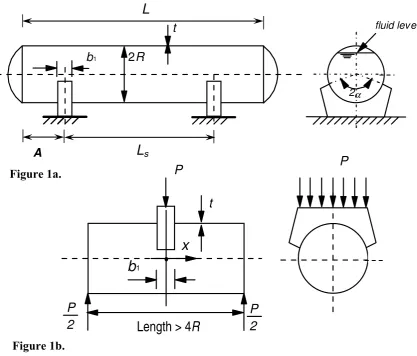
Horizontal vessels are widely used as storage vessels for liquids or gaseous products. Such vessels are commonly supported above ground by twin saddle supports, Fig 1(a). The saddle supports are normally welded on to the vessels or loosely placed. Present design rules (1) can greatly underestimate the carrying capacity of the vessel as the stresses are highly localised in the region of the saddle horns whilst the rest of the vessel is only moderately stressed. An alternative approach is to base the design of the vessel on the maximum carrying capacity, i.e., the collapse load. The advantage of this approach is that it provides the designer with a method of finding an allowable load directly by dividing the collapse load by a factor, usually 1.5. This procedure avoids the necessity of categorising the maximum stresses. This method is, of course, only useful if fatigue is not included in the design requirements.
The experimental plastic collapse loads of end supported vessels loaded centrally through a “rigid” saddle, Fig. 1(b), which is either welded or placed loosely on the vessel have been examined previously by the authors (2). This arrangement is termed “the end supported inverted case”. It was found that there are two main modes of failure, a plastic collapse mode and a more sudden elastic buckling mode. Plastic collapse occurred when the vessel's radius to shell thickness was relatively small (R/t<214) and is characterised by the gradual formation of plastic hinges which cause the eventual collapse of the vessel.
A number of theoretical approaches to the plastic collapse load for this inverted arrangement for both welded and loose saddles have been reported (3). The methods examined include various limit analysis and finite element approaches. The paper concluded that the best estimate of the collapse load was obtained from an elastic-plastic finite element method. The good comparisons with experiments provided the justification for the application of the method to a wider range of vessel parameters.
The main purpose of this present paper is to report the results of a parametric survey on saddle supported vessels for the plastic collapse load using the elastic-plastic method. Both welded and loose saddles are covered and the effects of saddle embracing angle, saddle width, vessel length and head to saddle centre distance have been investigated.
2 FINITE ELEMENT MODEL - end supported inverted case
finite element package used throughout was ANSYS (4). The F.E. model was developed to replicate the experimental set-up of a cylindrical vessel loaded centrally by a saddle at its mid-span, see Fig. 1(b). Essentially this assumes that collapse is a local phenomenon and a model length of approximately 4R is sufficient to avoid interaction effects from the ends of the model as suggested originally by Zick (5). This will be discussed later. Symmetry boundary conditions were applied to the longitudinal and transverse sections of the geometry to produce a quarter model. Convergence tests (6) were conducted by varying the mesh density and the element numbers to arrive at a suitably efficient model with 254 elements, Fig.2. The open ends of the model were constrained in the circumferential direction but were free to deform in the radial direction or rotate in their plane. This is an approximation to the experimental boundary conditions (1) where there a degree of radial restraint imposed by thin rings inserted into the open ends of the test cylinder. It is assumed that the load on the saddle is equivalent to half the total load (vessel and contents as appropriate). The vessel was loaded incrementally via pressure acting on the base of the saddle, simulating the applied load. A large deflection analysis was performed and an elastic perfectly plastic stress-strain relationship was assumed. The twice elastic slope method was used as a basis of obtaining the collapse load. This was obtained from a graph plotting the applied total load on the saddle and the vertical displacement of a node on top (i.e. the base) of the saddle.
For the purpose of investigating the effect of various geometric parameters some exploratory calculations were conducted with this end supported inverted model.
2.1 Variation with overall length
To study the variation of the collapse load with the vessel's length and the various saddle parameters, only a welded saddle was considered. For modelling purposes the saddle is "welded" to the vessel by merging the nodes on the boundary of the vessel/saddle interface. The nodes in the interface were not merged together.
The basic dimensions of the model used in this investigation had a vessel radius R of 130mm, a shell thickness t of 1.57mm and a yield stress y of 222.2 N/mm2. The vessel was loaded
centrally with a rigid saddle with an embracing angle 2 =120û and a saddle width b1 of
10mm. The dimensions reflect an actual end supported experimental vessel which failed by plastic collapse and reported in (2). Twenty-four different cases were explored with the total length varying from R to 54R. The collapse load results obtained are given in Fig. 3 (with a trendline through the points).
Figure 3 shows that the vessel length has a significant effect on the collapse load. It should be noted that the previous studies based on a length of approximately 4R, while useful for comparisons between theory and experiment, might need to be treated with care when considering actual vessels.
Two almost linear portions are evident in Fig. 3. The steep slope indicates the effect of the end boundary condition restraint stiffening the vessel; the lower slope portion is considered to be due to the “beam” effect of a long vessel.
Using the same welded saddle model as in the previous section, the influence of the saddle width b1 and the saddle embracing angle 2 on the collapse load of the end supported vessel
was examined. The following parameters were used, R=130mm, t=1.57mm, y=222.2 N/mm2,
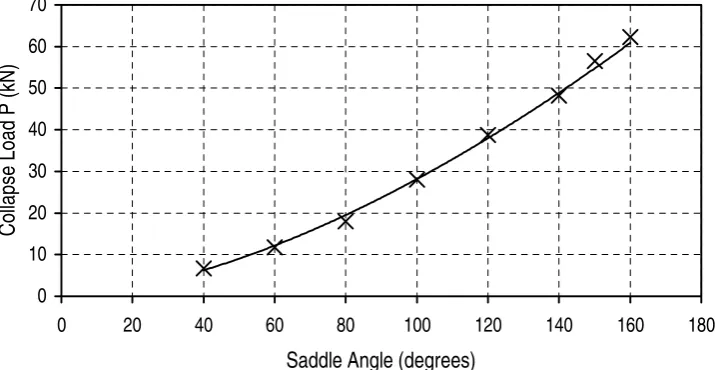
with a length of 4R as before. In order to observe the variation of the saddle embracing angle, the width of the saddle was kept constant at 10mm and the saddle embracing angle increased from 40û to 160û. The collapse results are shown in Figure 4 again with a trendline shown. The results show a higher collapse load for a larger saddle embracing angle. This is expected as a larger saddle angle would have a higher contact area and consequently a longer plastic hinge would form as the vessel collapses. More importantly, the graph shows that the increase in collapse load is significant. If the saddle angle is increased from 120û to 150û, the collapse load increases from 38.7 kN to 56.45 kN, an increase of 46%. The variation is also slightly non-linear.
The variation of the collapse load with the saddle width was examined by maintaining the saddle angle at 120û and varying the total saddle width b1 from 10mm to 50mm. As the
saddle widths were relatively large, in this case the F.E. model was altered to have three brick elements through the thickness of the saddle. The results are given in Table 1. An increase of 5 times the saddle width (from 10mm to 50mm) results in an increase in collapse load of only 12%.
3 FINITE ELEMENT MODEL - "actual" vessel case
The F.E. models used so far have represented the end-supported inverted case as it relates to the previous experiments reported in (2). It is now proposed to apply the elastic-plastic analysis to a "actual" twin saddle supported vessel for both welded and loose saddle configurations. The vessel has two planes of symmetry about its centre which together divide the vessel into a convenient quarter model as shown in Fig. 5. The F.E. model of this quarter vessel requires different boundary conditions at each extremity. The "head" end was constrained in the circumferential direction (as before). At the "centre" of the vessel, symmetry boundary conditions were applied. The other details of the model in terms of the element types, the loading procedure, material assumptions and definition of collapse load were similar to those used for the end supported inverted case.
In order to represent the welded case, nodes at the vessel/saddle boundary were fully connected. However in the loose saddle case, contact elements were used for all nodes at the interface. These were point-to-point elements and represent two surfaces which may maintain or break physical contact and may slide relative to each other. This contact element is only capable of supporting compression in the radial direction and shear in the circumferential direction; because of a lack of constraint at the vessel/saddle interface, the nodes at the centre line of the saddle were coupled together. This restrains the saddle from moving longitudinally along the vessel. Convergence tests were performed and a final convergent model with 480 elements was selected.
3.1 Comparisons with end supported vessels
extends from the centre line of the vessel to the junction with the head). The parameters for these models were selected from experimental tests on end supported vessels (2) on the basis that they collapsed in a plastic manner. The geometry of the vessels and the comparisons of the results with the end supported and "actual" cases are tabulated in Table 2. Experimental results from the end supported inverted experiments are included in the table for completeness although they should not be compared directly with the F.E. results from the “actual” model. The table shows that for the welded saddles, the collapse load results for the "actual" F.E. model was about two thirds those of the end supported inverted case F.E. model. However, the collapse load for the loose saddle was similar for both end supported inverted cases and "actual" cases.
Whilst this is not unexpected, an explanation for this difference can be found from a consideration of the development of the plastic zones with increase in load. In the case of a welded model the stiffening effect of the welded saddle allows plastic zones to spread almost throughout the model especially towards the centre. In the case of the loose saddle the development of plastic behaviour and the collapse itself is a rather more local phenomenon. These results confirm that the “actual” vessel model is necessary for the parametric study.
3.2 Tests on different saddle position
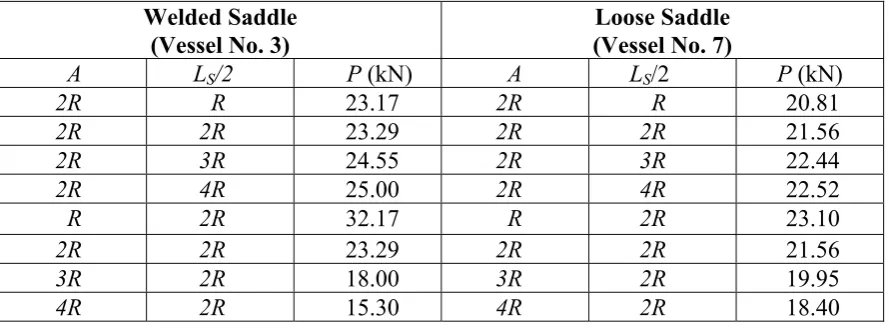
In Section 3.1 the saddles were positioned at the quarter points on the vessel which is common practice. However on occasions, the position of the saddle may be moved nearer to the "head" end of the vessel or towards the vessel centre. To investigate the effect of this change, various models of a "real" vessel (based on a vessel with R=130mm, t=1.57mm,
y=222.2 N/mm2, 2 =120û and b1=10mm) with a welded saddle were analysed with different
vessel lengths such that the position of the saddle was moved from the quarter point. Similar calculations were carried out for loose saddles (R=130mm, t=1.55mm, y=275 N/mm2,
2 =120û and b1=10mm). The resulting collapse loads are tabulated in Table 3. The lengths
used in the F.E. models such as the distance from "head" to saddle, A, and the distance between saddles (LS) are expressed in terms of factors of the vessel radius, R.
Examination of the collapse results of the welded saddle show that when the distance to the "head", A, is held constant (at 2R) and the semi-centre span, LS/2, increased from R to 4R, the
collapse load varies from 23.17 kN to 25 kN. When the span is held constant (at 2R) and the distance from the saddle to the head increased from R to 4R, the collapse load reduces from 32.17 kN to 15.3 kN. It is evident that the distance of the saddle from the "head" is an important factor when collapse loading is considered.
The loose saddle cases show a similar trend. When the distance to the "head", A, is held constant and the centre span, LS/2, increased from R to 4R, the collapse loads vary from 20.81
kN to 22.52 kN. When the centre semi-span, LS/2, is held constant (at 2R) and the distance to
the head, A, is increased from R to 4R, the collapse load reduces from 23.1 kN to 18.4 kN. The drop in collapse load when A is varied is not as large in the loose saddle case as in the case of the welded saddle. This could again be attributed to the localised nature of collapse for loose saddles. However, this drop is still larger than when LS/2 is varied. Thus it may be
concluded that for both welded and loose saddles, a dominant factor in the determination of the collapse load is the distance of the saddle to the "head" of the vessel.
A recap on the work done so far indicates that, in addition to the basic R/t ratio, the main factors influencing the collapse of horizontal vessels supported on twin saddle supports are:
(a) the fixture of the saddle and vessel, i.e. welded or loose (b) saddle embracing angle (2 )
(c) saddle width (b1)
(d) total length of the vessel (L)
(e) distance of the saddle centre profile from the vessel "head" (A)
In order to set the boundaries to a parameter survey to determine the collapse load for a range of vessels, information was used from a survey conducted some years ago by Tooth (7) of actual vessels, built by major vessel fabricators in the U.K. and the U.S.A.
Based on this survey, vessels of A/R ratio equal to 0.5, 1.0, 2.0 and 6.0 and values of R /b1
(where is in radians) of 2.0, 3.5, 5.0, 7.5 and 10.0 were examined. This latter grouping is the ratio of half the circumferential saddle length (Rα) to the width of saddle (b1) and is
similar to the parameter used for stress plots for local loads given in Annex G of the British Standard PD 5500 (1). Various vessel radii of 130mm, 500mm, 1000mm and 4000mm were used. The saddle location was restricted to the quarter point on the vessel but with the vessel's total length varying from 2R, 4R, 8R and 24R (representing A/R of 0.5, 1.0, 2.0 and 6.0). The saddle embracing angle was restricted to between 120û and 150û as this corresponds to the extremes of the recommended angles suggested by the Standard (1). The saddle width, saddle embracing angle and the vessel's radius were varied such that the ratio R /b1 varies
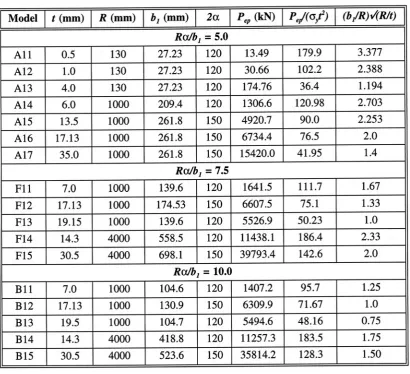
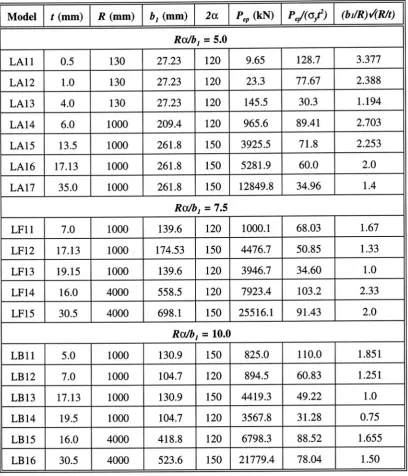
from 2, 3.5, 5.0, 7.5 and 10.0. The thickness of the vessels was such that the R/t ratio does not exceed 300 to ensure the cases correspond to plastic collapse. The material property of the shell is assumed to be elastic-perfectly plastic with a yield strength of 300N/mm2. A total of 105 vessels with welded saddles and 113 vessels with loose saddles were analysed to determine the various collapse loads.
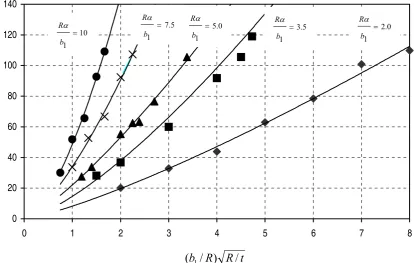
The resulting collapse loads were normalised (by dividing by yt2) and plotted against
. 1
t R R b
This parameter has the merit of combining two variables at the expense of some
minor scatter. The results are given in Figs 6(a)-(d) for the welded saddle cases for A/R of 0.5, 1.0, 2.0 and 6.0, respectively. The loose saddle results are given in Figs 7(a)-(d). For the case where A/R is 0.5, only three values of R /b1 are used (5.0, 7.5 and 10.0) as the vessel's
total length is small. A best-fit line has been shown through all the results for each value of
R /b1. The details of all the geometric cases considered together with the calculated collapse
loads are given in the Appendix, Table A1.
Analysis of the welded and loose saddle graphs show that as the vessel becomes longer (larger A/R) the collapse load reduces. Increasing the saddle angle, , (with other parameters constant) results in an increase in collapse load, i.e., R /b1 increases resulting in a steeper
curve. Increasing the ratio R /b1 seems to imply that by reducing the saddle width, b1, the
collapse load would increase; however, the ratio t R R
b1
also reduces. In fact, when the
around the origins represent vessels which have a very low R/t ratio and are too thick to be relevant for plastic collapse.
The welded saddle cases have higher collapse loads than the loose saddles. The differences tend to be larger for smaller R/t ratios and also as the R /b1 ratio increases. The survey also
shows that as A/R is increased (a longer vessel), the differences in collapse load between welded and unwelded cases are smaller. When A/R=6.0, the collapse results for both welded and loose saddles are almost identical and even when A/R=2.0 the results are very similar. It can be concluded that there is little difference in collapse load when long vessels are employed (A/R>6.0). The difference between welded and unwelded reduce with lower R /b1
(see R /b1=2.0 for A/R=1.0, 2.0 and 6.0), i.e. when saddles are wide and/or saddle angles are
small.
5 DESIGN CONSIDERATIONS
From the point of view of application in design situations, it may be useful to have the parametric results in a more directly useable form. Accordingly the best fit curves (8) for the data in Figure 6 and 7, have been characterised in terms of a simple power law of the form,
n y b R K t P ⎟⎟ ⎠ ⎞ ⎜⎜ ⎝ ⎛ = 1 1 2 α σ
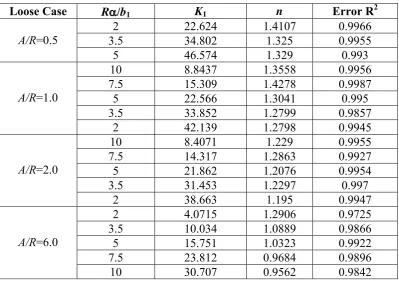
Values of K1 and n are given in Tables 4 and 5 for the welded and loose saddle cases
respectively. Regression coefficient values, R2, are also included. The ‘R2’ is an indicator (not to be confused with R, the radius of the vessel) which may range from zero to one and is a measure of how closely the estimated values for the trendline correspond to the actual data. A trendline is most reliable when the R2 value is at or near 1. Mathematically it is defined as
(
) (
)
p Y Y SST Y Y SSE SST SSE R j j j j 2 2 2 and ) ( where 1∑
∑
∑
− = − = − = & &where Yj is the “actual” FE value, Ÿj is the curve fit equation result and p is the number of
points in the sample. For power law trendlines, Excel uses a transformed regression model. In fact, the error values are remarkably good so that the simple power law equations may be used directly to give estimates of the collapse load. The values of the constants have been given to four decimal places; little is lost if these are rounded to two decimal places.
It is in fact possible to further condense the parametric collapse load results by increasing the combination of geometric parameters, albeit this results in some additional scatter. The results are shown in Figures 8 and 9 for the welded and loose saddle cases against the grouped
parameter ⎟⎟
⎠ ⎞ ⎜⎜ ⎝ ⎛ 1 1 b R Rt b α
. This has the merit of allowing all the results to be shown neatly on
m y b R Rt b K t P ⎥ ⎥ ⎦ ⎤ ⎢ ⎢ ⎣ ⎡ ⎟⎟ ⎠ ⎞ ⎜⎜ ⎝ ⎛ = 93 . 0 1 1 2 2 α σ
for the welded case and
m q y b R Rt b K t P ⎥ ⎥ ⎦ ⎤ ⎢ ⎢ ⎣ ⎡ ⎟⎟ ⎠ ⎞ ⎜⎜ ⎝ ⎛ = 1 1 2 2 α σ
for the loose saddle case.
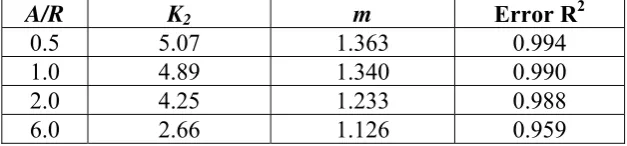
The values of K2 and m are given in Table 6 for the welded case and in Table 7 for the loose
saddle case with the values of q identified in Fig. 9.
6 CONCLUDING COMMENTS
The results in Figures 6 and 7 and the associated reduced data in Tables 4 and 5, Figures 8 and 9 and Table 6 and 7, are useful tools in determining the collapse load of twin saddle supported vessels that may fail by plastic collapse. The validity of these curves is restricted to vessels supported by saddles with embracing angles of 120û to 150û and to the range of parameters covered. They are only valid for failure by plastic collapse; they are not relevant to situations where elastic buckling or fatigue are likely failure modes.
Although the parametric results are for vessels that are supported by twin saddles at the quarter points, they may also be used for vessels, which are not supported at the quarter points. Some guidance can be obtained from Table 3. A simple approach would be to use the
A/R ratio for that particular vessel since the distance between the supports does not greatly influence the collapse load. When using this approach one must ensure that the appropriate load is used in the calculation.
7 REFERENCES
1 British Standard PD5500: 2000, ‘Specification for unfired fusion welded pressure vessel, British Standards Institution’.
2 Chan, G.C.M., Tooth, A.S. and Spence, J., ‘An experimental study of the collapse of horizontal saddle supported storage vessels.’ Proc Instn Mech Engrs, Vol. 212, 1999, Part E, pp183-195.
3 Tooth, A.S., Chan, G.C.M., Spence, J. and Nash, D.H., ‘Horizontal saddle supported storage vessels: Theoretical and experimental comparisons of plastic collapse loads’,
Pressure Vessel Technology – Theory and Practice, Eds. Banks, W M and Nash, D H, IMechE, May 2003
4 ANSYS Finite Element Program, ANSYS Inc. Houston, PA
5 Zick, L.P., ‘Stresses in large horizontal cylindrical pressure vessels on two saddle supports’, The Welding Research Supplement IX, Sept 1951, pp435-444.
6 Chan, G.C.M., ‘A design study of the collapse of saddle supported vessels.’ PhD thesis, Dept. of Mechanical Engineering, Univ. of Strathclyde, Glasgow, 1995.
7 Tooth, A.S. Unpublished survey 1968.
8 Excel 97, Microsoft Corporation Ltd.
ACKNOWLEDGEMENTS
APPENDIX Tables A 1. Details of vessels and parametric collapse load results
Table 1. Variation of collapse load with the saddle width (welded saddle).
Saddle Width b1 (mm) Collapse Load P (kN)
b1(10) 38.70
2 b1(20) 39.07
3 b1 (30) 40.50
4 b1 (40) 42.52
[image:18.595.67.563.268.474.2]5 b1 (50) 43.31
Table 2. Comparison of collapse loads for experimental and F.E. end supported inverted case models with F.E. "actual" models.
Welded Saddle (R=130mm, L=555mm, 2 =120û, b1=10mm)
Collapse load (kN)
Vessel No. t (mm) y (N/mm2) Experimental F.E. end supported F.E. "actual"
1 0.97 160.5 16.61 16.20 10.01
2 1.22 222.2 29.85 28.12 17.77
3 1.57 222.2 44.50 38.70 23.29
4 2.08 214.0 64.52 53.43 35.70
Loose Saddle (R=130mm, L=555mm, 2 =120û, b1=10mm)
Collapse load (kn)
Vessel No. t (mm) y (N/mm2) Experimental F.E. end supported F.E. "actual"
5 0.97 160.5 7.55 7.28 7.28
6 1.13 275.0 17.00 14.50 14.33
7 1.55 275.0 24.47 22.48 21.56
8 2.08 214.0 32.73 28.55 28.10
Table 3. Variation of collapse load with the position of the saddle (See text for geometric parameters)
Welded Saddle (Vessel No. 3)
Loose Saddle (Vessel No. 7)
A LS/2 P (kN) A LS/2 P (kN)
2R R 23.17 2R R 20.81
2R 2R 23.29 2R 2R 21.56
2R 3R 24.55 2R 3R 22.44
2R 4R 25.00 2R 4R 22.52
R 2R 32.17 R 2R 23.10
2R 2R 23.29 2R 2R 21.56
3R 2R 18.00 3R 2R 19.95
[image:18.595.66.511.541.705.2]Table 4. Graph curve-fit constants for welded saddle geometries
Welded Case Rα/b1 K1 n Error R2
2 72.159 1.5324 0.9880
3.5 49.541 1.5512 0.9984
A/R=0.5
5 26.104 1.5582 0.9959
10 71.198 1.4604 0.9994
7.5 45.598 1.5391 0.9989
5 27.737 1.4136 0.9964
3.5 16.301 1.4558 0.9970
A/R=1.0
2 7.6067 1.4741 0.9981
10 71.257 1.4752 0.9993
7.5 45.598 1.5391 0.9989
5 27.737 1.4136 0.9964
3.5 16.301 1.4558 0.9970
A/R=2.0
2 7.6067 1.4741 0.9981
2 32.791 0.905 0.9657
3.5 25.264 0.8655 0.9764
5 16.77 1.0175 0.9866
7.5 10.916 1.0386 0.9926
A/R=6.0
10 4.5069 1.2345 0.9852
Table 5. Graph curve-fit constants for loose saddle geometries
Loose Case Rα/b1 K1 n Error R2
2 22.624 1.4107 0.9966
3.5 34.802 1.325 0.9955
A/R=0.5
5 46.574 1.329 0.993
10 8.8437 1.3558 0.9956
7.5 15.309 1.4278 0.9987
5 22.566 1.3041 0.995
3.5 33.852 1.2799 0.9857
A/R=1.0
2 42.139 1.2798 0.9945
10 8.4071 1.229 0.9955
7.5 14.317 1.2863 0.9927
5 21.862 1.2076 0.9954
3.5 31.453 1.2297 0.997
A/R=2.0
2 38.663 1.195 0.9947
2 4.0715 1.2906 0.9725
3.5 10.034 1.0889 0.9866
5 15.751 1.0323 0.9922
7.5 23.812 0.9684 0.9896
A/R=6.0
[image:19.595.93.493.447.728.2]Table 6. Graph curve-fit constants for welded saddle condensed data
A/R K2 m Error R2
0.5 2.58 1.56 0.993
1.0 3.00 1.47 0.996
2.0 3.22 1.30 0.983
6.0 3.08 1.08 0.952
Table 7. Graph curve-fit constants for loose saddle condensed data
A/R K2 m Error R2
0.5 5.07 1.363 0.994
1.0 4.89 1.340 0.990
2.0 4.25 1.233 0.988
[image:20.595.148.462.234.307.2]Figure 1. Geometric details of saddle supported vessel and simple test arrangement
Figure 2. Finite element model of “end supported inverted case” vessel
d fluid level
2α b1 2R
t
P P
t
P
2 P
2
x
b
1 dL
L
sA
Figure 1a.
Figure 1b.
[image:21.595.223.369.497.678.2]0 10 20 30 40 50 60 70
0 10 20 30 40 50 60
Vessel Length (factor x R mm)
[image:22.595.120.480.64.252.2]Collapse Load P (kN)
Figure 3. Variation of the collapse load with vessel length (welded case)
0 10 20 30 40 50 60 70
0 20 40 60 80 100 120 140 160 180
Saddle Angle (degrees)
[image:22.595.121.479.300.485.2]Collapse Load P (kN)
Figure 4. Variation of the collapse load with saddle angle (welded case)
[image:22.595.215.383.534.691.2]0 20 40 60 80 100 120 140 160 180 200
[image:23.595.110.518.90.353.2]0.0 0.5 1.0 1.5 2.0 2.5 3.0 3.5 4.0
Figure 6a. Collapse curves for welded saddle vessels for A/R=0.5
0 20 40 60 80 100 120 140 160 180 200
0 1 2 3 4 5 6 7 8
Figure 6b. Collapse curves for welded saddle vessels for A/R=1.0 t
R R
b / ) /
( 1 2 t P y σ 5 . 7 1 = b Rα 0 . 5 1 = b Rα 5 . 3 1 = b Rα 0 . 2 1 = b Rα 10 1 = b Rα t R R
b / ) /
[image:23.595.78.521.432.701.2]0 20 40 60 80 100 120 140
[image:24.595.106.521.104.367.2]0 1 2 3 4 5 6 7 8
Figure 6c. Collapse curves for welded saddle vessels for A/R=2.0
0 10 20 30 40 50 60
0 1 2 3 4 5 6 7 8
Figure 6d. Collapse curves for welded saddle vessels for A/R=6.0
5 . 7 1 = b Rα 0 . 5 1 = b Rα 5 . 3 1 = b Rα 0 . 2 1 = b Rα 10 1 = b Rα t R R
b / ) /
( 1 2 t P y σ 5 . 7 1 = b Rα 0 . 5 1 = b Rα 5 . 3 1 = b Rα 0 . 2 1 = b Rα 10 1 = b Rα t R R
b / ) /
[image:24.595.86.517.449.699.2]0 20 40 60 80 100 120 140
[image:25.595.87.517.79.349.2]0.0 0.5 1.0 1.5 2.0 2.5 3.0 3.5 4.0
Figure 7a. Collapse curves for loose saddle vessels for A/R=0.5
0 20 40 60 80 100 120 140 160
0 1 2 3 4 5 6 7 8
Figure 7b. Collapse curves for loose saddle vessels for A/R=1.0 t
R R
b / ) /
( 1 2 t P y σ 5 . 7 1 = b Rα 0 . 5 1 = b Rα 5 . 3 1 = b Rα 0 . 2 1 = b Rα 10 1 = b Rα t R R
b / ) /
[image:25.595.110.521.410.684.2]0 20 40 60 80 100 120
[image:26.595.79.520.78.349.2]0 1 2 3 4 5 6 7 8
Figure 7c. Collapse curves for loose saddle vessels for A/R=2.0
0 10 20 30 40 50 60
0 1 2 3 4 5 6 7 8
Figure 7d. Collapse curves for loose saddle vessels for A/R=6.0
5 . 7 1 = b Rα 0 . 5 1 = b Rα 5 . 3 1 = b
Rα 2.0 1 = b Rα t R R
b / ) /
( 1 2 t P y σ 5 . 7 1 = b Rα 0 . 5 1 = b Rα 5 . 3 1 = b Rα 0 . 2 1 = b Rα 10 1 = b Rα t R R
b / ) /
[image:26.595.76.521.421.704.2]0 20 40 60 80 100 120 140 160 180 200
0 2 4 6 8 10 12 14 16 18
[image:27.595.113.516.81.371.2]A/R=0.5 A/R=1.0 A/R=2.0 A/R=6.0
Figure 8. Condensed Plot of Collapse Loads for Welded Saddle Cases
0 20 40 60 80 100 120 140 160
0 2 4 6 8 10 12 14 16 18
A/R=0.5 A/R=1.0 A/R=2.0 A/R=6.0
Figure 9. Condensed Plot of Collapse Loads for Loose Saddle Cases 2 t P y σ 93 . 0 1 1 ⎟⎟ ⎠ ⎞ ⎜⎜ ⎝ ⎛ b R Rt b α q b R Rt b ⎟⎟ ⎠ ⎞ ⎜⎜ ⎝ ⎛ 1 1 α 2 t P y σ
q=0.7 q=0.7
q=0.8
[image:27.595.115.507.423.708.2]