Tupleware: A Distributed Tuple Space for the
Development and Execution of Array-based
Applications in a Cluster Computing Environment
by
Alistair Kenneth Atkinson, BComp(Hons).
Submitted in fulfilment of the requirements for the Degree of
Doctor of Philosophy (Computing)
University of Tasmania
Declaration
I, Alistair Kenneth Atkinson, certify that this thesis contains no material which has been accepted for the award of any other degrees or diploma in any tertiary insti-tution, except by way of background information and duly acknowledged in the thesis, and that to the best of my knowledge and belief this thesis contains no mate-rial previously published or written by another person except where due reference is made in the text of this thesis, nor does the thesis contain any material which infringes copyright.
...
Statement of Authority of Access
This thesis may be made available for loan and limited copying in accordance with the Copyright Act 1968.
...
Abstract
This thesis describes Tupleware, an implementation of a distributed tuple space which acts as a scalable and efficient cluster middleware for computationally inten-sive numerical and scientific applications. Tupleware is based on the Linda coor-dination language (Gelernter 1985), and incorporates additional techniques such as peer-to-peer communications and exploitation of data locality in order to address problems such as scalability and performance, which are commonly encountered by traditional centralised tuple space implementations.
Tupleware is implemented in such as way that, while processing is taking place, all communication between cluster nodes is decentralised in a peer-to-peer fashion. Communication events are initiated by a node requesting a tuple which is located on a remote node, and in order to make tuple retrieval as efficient as possible, a tuple search algorithm is used to minimise the number of communication instances re-quired to retrieve a remote tuple. This algorithm is based on the locality of a remote tuple and the success of previous remote tuple requests. As Tupleware is targetted at numerical applications which generally involve the partitioning and processing of 1-D or 2-D arrays, the locality of a remote tuple can generally be determined as being located on one of a small number nodes which are processing neighbouring partitions of the array.
Furthermore, unlike some other distributed tuple space implementations, Tuple-ware does not burden the programmer with any additional complexity due to this distribution. At the application level, the Tupleware middleware behaves exactly like a centralised tuple space, and provides much greater flexibility with regards to where components of a system are executed.
The design and implementation of Tupleware is described, and placed in the context of other distributed tuple space implementations, along with the specific requirements of the applications that the system caters for. Finally, Tupleware is evaluated using several numerical and/or scientific applications, which show it to provide a sufficient level of scalability for a broad range tasks.
en-able a tuple space to be efficiently and transparently distributed across the nodes in a cluster. Central to this is the use of an algorithm for tuple retrieval which minimises the number of communication instances which occur during system exe-cution. Distribution transparency is ensured by the provision of a simple interface to the underlying system, so that the distributed tuple space appears to the programmer as a single unified resource.
List of Figures
2.1 The message passing model. . . 11
2.2 The shared-memory model. . . 17
2.3 Example of OpenMP’s fork/join parallelism (Chapman et al. 2008). 20 2.4 The client/server architecture. . . 24
2.5 The peer-to-peer architecture. . . 24
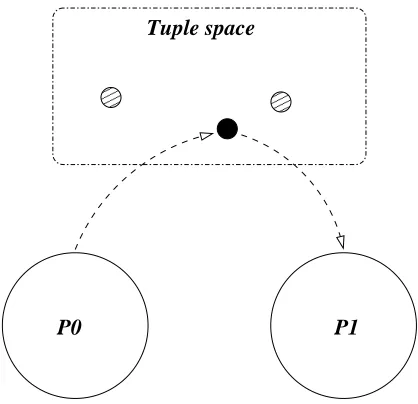
3.1 An example tuple space system. . . 27
3.2 Disjoint, nested, and overlapping tuple spaces. . . 40
4.1 Local tuple storage using a hashtable. . . 49
4.2 Architecture of a Tupleware system. . . 60
4.3 Example of a tuple production operation. . . 65
4.4 Single tuple retrieval from both a local and remote segment of tuple space. . . 66
4.5 Batch retrieval operations. . . 67
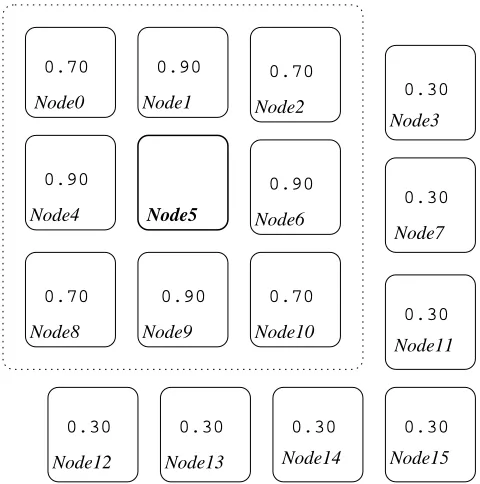
4.6 Grouping of neighbouring nodes based on success factor. . . 70
4.7 Overview of example system with five nodes. . . 80
5.1 Updating panel boundary values. . . 86
5.2 A complete parallel sorting application. . . 91
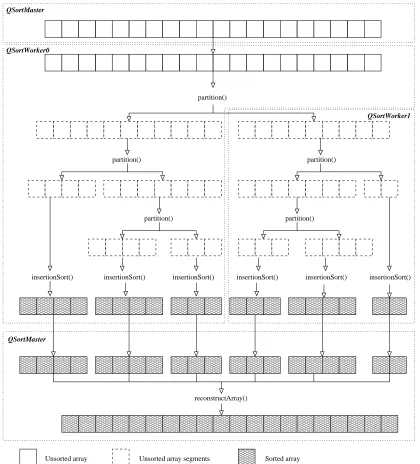
5.3 Flow of array segments through the modified quicksort application. . 94
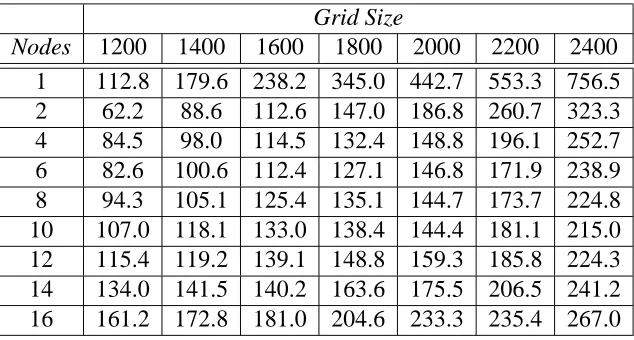
6.1 Total runtimes (secs) for the ocean model. . . 103
6.2 Overall ocean model speedup. . . 105
6.3 Sequential runtimes (secs) for varying number of nodes in the ocean model. . . 106
6.4 Sequential runtimes (secs) in terms of the total number of grid points.107 6.5 Parallel execution runtimes of the ocean model. . . 108
6.6 Speedup of the ocean model with varying number of nodes. . . 109
6.7 Total runtimes of the parallel sorting application. . . 113
6.9 Sorting application’s parallel execution runtimes. . . 117 6.10 Speedup of parallel phase of sorting application execution. . . 117 6.11 Efficiency of the sorting application on a varying number of nodes. . 119 6.12 Communication and computation times (secs) of the parallel phase
List of Tables
2.1 TCP/IP Protocol Stack Layers . . . 12
3.1 Summary of WCL operations. . . 37
4.1 Summary of the Tupleware API. . . 64
6.1 Total grid points and data size. . . 101
6.2 Complete runtimes of ocean model. . . 102
6.3 Total Runtimes (secs) of ocean model. . . 103
6.4 Overall speedup of ocean model. . . 104
6.5 Runtime (secs) of sequential stages of ocean model. . . 104
6.6 Ocean Model parallel runtimes (secs). . . 107
6.7 Speedup of the ocean model’s parallel phase. . . 108
6.8 Efficiency of the ocean model. . . 110
6.9 Total runtimes (secs) of the sorting application. . . 112
6.10 Total speedup of the sorting application. . . 113
6.11 Sorting application’s initialisation times (secs). . . 115
6.12 Parallel runtime data (secs) of the sorting application. . . 116
6.13 Parallel speedup of the sorting application. . . 118
Acknowledgements
Completing this thesis has easily been one of the most difficult things I’ve ever undertaken. During the course of this work, my supervisors, Vishv Malhotra, Julian Dermoudy, and John Hunter have been extremely supportive, and have displayed a great deal of patience in helping me to reach the finishing line. They have my sincere gratitude for their assistance and guidance.
To all those at the School of Computing, particularly those at the Launceston campus, I’d like to thank them for making my years studying there so enjoyable and rewarding. In particular, thanks to my fellow PhD candidate Brad Goldsmith for enduring having to share an office with me for several years, and to the “Dodgy Tackle” indoor soccer team, who, despite suffering frequent demoralising defeats, prompted me to get away from the keyboard on a Wednesday night and get some exercise.
The final phase of this thesis was completed while working at EIT Hawke’s Bay, New Zealand, and I thank them for their understanding in allowing me the time and flexibility to complete the write-up process over the course of the last two years.
Most of all though, I’d like to acknowledge my family. My parents, Barry and Helene, have been nothing but loving and supportive for my entire life, and I’d never have gotten this far if it weren’t for them. And my deepest gratitude goes to my wife, Bonne, who has been nothing but unbelievably patient and encouraging over these years that I’ve been a seemingly professional student.
Contents
Declaration i
Abstract iii
List of Figures vi
List of Tables vii
Acknowledgements viii
1 Introduction 1
1.1 Motivation & General Aims of this Research . . . 2
1.2 Limitations of this Research . . . 3
1.3 Overview of Methodology . . . 4
1.4 Contributions of this Research . . . 4
1.5 Thesis Structure . . . 5
1.6 Publications derived from this research . . . 6
2 Parallel & Distributed Computing 7 2.1 Introduction . . . 7
2.2 Platforms . . . 7
2.2.1 Clusters . . . 8
2.2.2 Wide Area Networks . . . 8
2.2.3 Grid Computing . . . 9
2.2.4 Summary . . . 10
2.3 Models of Distributed Computing . . . 11
2.3.1 Message Passing . . . 11
2.3.1.1 Sockets . . . 12
2.3.1.2 Other message passing implementations . . . 15
2.3.1.3 Summary of the message passing model . . . 16
2.3.2.1 Threads . . . 18
2.3.2.2 OpenMP . . . 19
2.3.2.3 Summary . . . 21
2.3.3 Remote Procedure Calls . . . 22
2.3.4 Distributed System Architectures . . . 23
2.4 Summary . . . 25
3 Coordination Models 26 3.1 Background & Overview . . . 26
3.2 Fundamental Concepts . . . 26
3.2.1 Tuple Space . . . 26
3.2.2 Associative Lookup . . . 27
3.2.3 Loosely-Coupled Interaction . . . 27
3.3 Linda Operations . . . 28
3.4 Programming with Linda . . . 28
3.4.1 Distributed Data Structures . . . 29
3.4.2 Task Parallelism . . . 29
3.5 Related Work . . . 30
3.5.1 MTS-Linda . . . 31
3.5.2 Jada . . . 32
3.5.3 LIME . . . 33
3.5.4 SwarmLinda . . . 34
3.5.5 WCL . . . 35
3.5.6 JavaSpaces . . . 37
3.5.7 Other Java-based Linda implementations . . . 39
3.5.8 Scope . . . 39
3.6 Performance & Scalability Issues . . . 41
3.7 Summary . . . 43
4 Tupleware Implementation 44 4.1 Aims . . . 44
4.2 How these aims will be addressed . . . 45
4.2.1 Scalability & Performance . . . 45
4.2.2 Ease of Programmability & Logical Integration of Distributed Tuple Spaces . . . 46
4.3 Basic Components . . . 47
4.3.1 Tuples & Templates . . . 47
4.3.2.1 Tuple Storage & Lookup . . . 48
4.3.2.2 Local Space Synchronisation . . . 50
4.4 Distribution of Tuple Space . . . 54
4.4.1 Inter-node Communication . . . 54
4.4.1.1 Tuple Space Service . . . 54
4.4.1.2 Tuple Space Stubs . . . 54
4.4.1.3 Communication Protocol: Request & Response Objects . . . 55
4.4.1.4 Stub/Service Interaction . . . 56
4.4.2 Runtime System . . . 58
4.4.3 Application Processes: Master & Workers . . . 60
4.4.4 Summary . . . 60
4.5 Runtime System . . . 61
4.5.1 Runtime System API . . . 61
4.5.2 Tuple Production . . . 63
4.5.3 Single Tuple Retrieval . . . 65
4.5.4 Bulk Tuple Retrieval . . . 66
4.5.5 Tuple Search Algorithm . . . 67
4.5.5.1 Rationale . . . 68
4.5.5.2 Request Success Factor . . . 68
4.5.5.3 Searching for a Remote Tuple . . . 69
4.5.5.4 Strengths and Weaknesses of the Search Algorithm 72 4.5.6 Summary . . . 72
4.6 Deployment & Execution . . . 73
4.6.1 Initialisation . . . 73
4.6.2 Task Submission . . . 74
4.6.3 Execution . . . 74
4.6.4 Gathering Results . . . 75
4.6.5 Fault tolerance & dynamic reconfigurability . . . 75
4.7 Application Development . . . 77
4.7.1 Implementation with Tupleware . . . 77
4.7.1.1 Master Process Implementation . . . 77
4.7.1.2 Worker Process Implementation . . . 79
4.7.1.3 Load Balancing & Skewed Access Considerations 80 4.7.1.4 Implementation Summary . . . 82
5 Applications 84
5.1 Ocean Model . . . 84
5.1.1 Equations . . . 84
5.1.2 Implementation . . . 86
5.1.3 Application Components & Execution . . . 87
5.1.4 Summary . . . 87
5.2 Sorting . . . 88
5.2.1 Overview & Characteristics . . . 88
5.2.2 Implementation . . . 89
5.2.3 Sorting Summary . . . 92
5.3 Summary . . . 93
6 Performance Evaluation 95 6.1 Performance Metrics . . . 95
6.1.1 Speedup . . . 95
6.1.2 Efficiency . . . 96
6.1.3 Amdahl’s Law . . . 97
6.1.4 Gustafson’s Law . . . 98
6.1.5 Scalability . . . 98
6.1.6 Summary . . . 99
6.2 Evaluation Methodology . . . 99
6.3 Ocean Model . . . 99
6.3.1 Execution Environment . . . 100
6.3.2 Experimental Details . . . 100
6.3.3 Total Runtimes . . . 103
6.3.4 Sequential Runtime . . . 104
6.3.5 Parallel Runtime . . . 106
6.3.6 Analysis & Summary . . . 109
6.4 Sorting . . . 111
6.4.1 Execution Environment . . . 111
6.4.2 Experimental Details . . . 111
6.4.3 Total Runtime . . . 112
6.4.4 Initialisation . . . 114
6.4.5 Parallel Runtime . . . 115
6.4.5.1 Efficiency . . . 118
6.4.6 Analysis & Summary . . . 121
6.5 Comparison with other systems . . . 121
7 Conclusions & Further Work 123
7.1 Conclusions . . . 123
7.1.1 Scalability & Performance . . . 123
7.1.2 Ease of programmability . . . 124
7.1.3 Contribution of the research . . . 125
7.2 Further Work . . . 125
References 127 A Tupleware Source Code 131 A.1 Tuple . . . 131
A.2 TupleTemplate . . . 132
A.3 TupleSpace . . . 133
A.4 TupleSpaceImpl . . . 133
A.5 TupleSpaceRequest . . . 137
A.6 TupleSpaceResponse . . . 138
A.7 TupleSpaceStub . . . 139
A.8 TupleSpaceService . . . 142
A.9 TupleSpaceRuntime . . . 146
B Application Source Code 157 B.1 Ocean Model . . . 157
B.1.1 OceanModelMaster . . . 157
B.1.2 OceanModelWorker . . . 159
B.1.3 Panel . . . 161
B.1.4 Original FORTRAN version of Ocean Model . . . 165
B.2 Sorting . . . 169
B.2.1 QSort . . . 169
B.2.2 QSortMaster . . . 172
Chapter 1
Introduction
This thesis describes the research undertaken in order to develop a scalable dis-tributed tuple space-based platform which is able to provide increased performance for certain types of scientific and numerical applications in a cluster computing environment, while retaining a high degree of simplicity for the application pro-grammer.
The fundamental problems being addressed by this thesis is that of simplify-ing the task of developsimplify-ing parallel applications for a distributed computsimplify-ing envi-ronment, and providing these applications with increased performance using a dis-tributed tuple space platform. Despite the fact that disdis-tributed computing platforms and technologies have been around for many years, these are still often viewed as inherently complex exercises. This has lead to the aims stated above; put simply, this research aims to provide a platform to distributed system development with a low barrier of entry for the programmer.
Distributed computing is a field of growing importance; it has for a long time been used for solving large problems, such as scientific simulations, digital ren-dering, and any job of sufficient size that it was more practical or cost-effective to approach the problem using a distributed solution as opposed to a standalone supercomputer.
desirable features of a platform is a low barrier of entry while still providing perfor-mance benefits. This is the area that this research aims its focus.
It should be noted that we are not trying to present a system which provides the absolute optimal performance for applications; MPI and PVM have long been con-sidered the de-facto standards for achieving this. However, the barrier of entry for the application programmer has been seen as an issue with systems such as these, and as such the tuple space approach has been chosen for use due to the characteris-tics which enable us to hide many of the issues of distribution and parallelism from the programmer. What this research seeks to explore is how to provide an apprecia-ble level of performance gains while keeping the barrier of entry as low as possiapprecia-ble to the application programmer.
1.1
Motivation & General Aims of this Research
The middleware presented in this thesis implements a distributed tuple space which can provide a scalable platform for the development and execution of large, compu-tationally intensive scientific and numerical applications.
Tuple space systems have long been recognised as being an effective tools for parallelising coarse-grained, or embarrassingly parallel applications where there are few dependencies between each parallel task. Such applications tend to have man-ageable communication requirements, and therefore provide opportunities to deliver speedup benefits by controlling the overhead introduced by transmitting data over the network, and from the computer hosting tuple space having to service requests. In general, this overhead imposes a serious limit to the scalability of a distributed tuple space system when it is used to run application which are more finely-grained, and have numerous dependencies between tasks and more frequent communication. Inevitably, a centralised tuple space implementation will become overwhelmed trying to service requests as the number of processes in the system and/or commu-nication frequency becomes large. Therefore, at some point it becomes necessary to decentralise the tuple space, and to spread the load of servicing requests between those computers which host each part of the distributed space.
the space.
The system presented in this paper addresses these issues using techniques out-lined in subsequent sections. Further, it aims to not place any extra burden on the application programmer due to the distribution of tuple space. As far as is practi-cable, the distribution of the tuple space should be transparent to the programmer, and, from the programmer’s perspective, behave exactly like a global tuple space.
1.2
Limitations of this Research
The research presented in this thesis was an investigation into how the tuple space model can be adapted for a cluster computing environment so that it can provide a scalable platform for scientific and numerical applications, and so that these ap-plications can obtain performance benefits from using the system. As such, this research did not set out to address any of the following:
• Geographically distributed systems: Tupleware was not designed to meet the unique requirements of wide area network environments. It is aimed solely at cluster computing environments (which may also include networks-of-workstations (NOWs)).
• Security: The research aims do not extend to any provision of security, and are targetted exclusively at scalability, programmability, and performance. Whilst security is undoubtedly an important consideration for production sys-tems, it is peripheral to the research problem being explored.
• Use for general-purpose applications: Tupleware is targetted toward appli-cations which perform array-based processing. This self-imposed limitation allows the system to include optimisations that benefit this particular class of application, rather than try to fulfil the requirements of general-purpose distributed applications.
can be relatively complex. Tupleware aims, as far possible, to preserve the simplicity of the Linda coordination language.
1.3
Overview of Methodology
Based on the limitations of tuple space-based systems outlined in Chapter 3 from which the aims outlined above were identified, we sought to implement a distributed tuple space with the goal of providing a scalable yet simple platform for the develop-ment and execution of distributed array-based applications. The aims of the system were used to inform the design and implementation decisions made, and which are detailed in Chapter 4.
In order to whether the system was successful in meeting its aims, its perfor-mance was evaluated using two applications with contrasting characteristics and requirements: an ocean model and a parallel sorting application. Using these ap-plication, the behaviour of Tupleware was evaluated in terms of its runtimes of var-ious relevant parts of its operation, including time spent performing initialisation, computation, communication, and final result gathering tasks. From these measure-ments we evaluate the performance gains and scalability of the system.
A thorough description of the Tupleware application programming interface is also included in order to outline the usage and semantics of the operations provided, and to highlight their simplicity and consistency with the operations found in Linda.
1.4
Contributions of this Research
In the author’s opinion, the tuple space is an understudied topic in the area of dis-tributed computing. As we will see in the review of coordination models presented in Chapter 3, there are many different variations on the tuple space which have been implemented or proposed. However, many of them are intended to be a general-purpose distributed computing platform, focussing on issues such as availability and fault-tolerance. Others are presented as theoretical models which have not been implemented, and offer few clues as to how such an implementation might be approached. Applied research into how the tuple space may be implemented for distributed environments while preserving the simplicity of the original Linda language is lacking.
a completely decentralised, peer-to-peer fashion. One of the outcomes of this re-search is to highlight techniques and approaches which may be used to allow a sys-tem structured like this to provide a scalable and efficient platform for distributed applications.
Central to this contribution is the development and implementation of a tuple search algorithm which is used to retrieve tuples from remote segments of tuple space. This algorithm aims to minimise the instances of network communication, the main source of poor performance in a distributed system, by targeting requests for remotely hosted tuples to those nodes which have the highest probability of being able to fulfil the request. This probability is represented as a success factor, which is calculated based on the success or failure of previous requests. The search algorithm allows the system to dynamically adapt, at runtime, to the communication characteristics of an application.
The other main contribution of this research is to implement the distributed tu-ple space in such a way that the comtu-plexity is hidden from the application pro-grammer. A layered architecture was used when designing and implementing Tu-pleware, central to which was a middleware layer which implements the underlying system logic. Applications interact with the lower-level Tupleware system through this middleware, which in turn provides the application with a simple application programming interface on which to develop an application. As we will show, the operations provided by Tupleware are semantically consistent to their original Linda equivalents, and do not add any complexity beyond what would be found in a non-distributed, centralised tuple space such as Java Spaces. This contribution is im-portant: one of the strengths of the original Linda model was its simplicity, and the future adoption of the tuple space as a distributed and/or parallel programming tool will not be aided by adding complexity. It is hoped that this research in some way furthers this cause.
1.5
Thesis Structure
This chapter has provided an overview of the research, and has described the general aims, limitations and contributions of this thesis. The remainder of the thesis is structured as follows:
• Chapter 2 provides an introduction and overview to the field of parallel and distributed computing,
• Chapter 4 describes Tupleware, and includes a complete discussion of its aims, design, implementation, operation and its application programming in-terface,
• Chapter 5 details the applications, and ocean model and a parallel sorting application, which were implemented on Tupleware in order to evaluate its scalability and performance,
• Chapter 6 contains the results and analysis of the performance evaluations which were undertaken,
• Chapter 7 summarises the research and contributions of this thesis, and iden-tifies some further work which could be undertaken in the future.
1.6
Publications derived from this research
The following refereed conference papers have been published as a result of the work undertaken during this research:
Atkinson, A 2008, ’Tupleware: A Distributed Tuple Space for Clus-ter Computing’, Proceedings of the Ninth InClus-ternational Conference on
Parallel and Distributed Computing, Applications and Technologies,
University of Otago, Dunedin, pp. 121-126.
This paper provided a general overview of the Tupleware system, and relates to the entirety of this thesis.
Atkinson, A 2009, ’A Dynamic, Decentralised Search Algorithm for Efficient Data Retrieval in a Distributed Tuple Space’, to appear in the Proceedings of the Eighth Australasian Symposium on Parallel and
Distributed Computing, Queensland University of Technology,
Bris-bane.
Chapter 2
Parallel & Distributed Computing
2.1
Introduction
Distributed computing is the study of the methods involved in enabling networked autonomous computers to cooperate in order to carry out a common task. It is closely related to the field of parallel computing, which is concerned with running separate parts of a program on different processors in order to achieve increased execution speed. It follows, then, that a distributed computing system may also be a parallel computing system, where each discrete part of a program is executed on a different computer on a network. It is this intersection of the two fields which is the main focus of this chapter.
This chapter firstly provides an overview of the fundamental models used in constructing a distributed system, and concludes with a survey of some of the more notable distributed computing platforms.
2.2
Platforms
Distributed systems may be deployed on a wide variety of platforms. Each of these platforms have the following in common: discrete parts of the system will execute on individual computers (or nodes), and communicate via a network to carry out some common task. Apart from this, a distributed system platform may have a number of differences, often centred around the type of network used to connect each node. These variations often dictate the suitability of particular applications for each platform. For example, applications which require large data transfers will perform better when deployed on a platform with large amount of available network bandwidth.
platforms, including clusters and wide-area networks, briefly covers grid computing and finally details two common distributed application architectures: client/server and peer-to-peer.
2.2.1
Clusters
A cluster is defined by Pfister (1998, p. 72) as a collection of interconnected in-dividual computers which are used as a single, unified computing resource. This definition may encompass clusters which are specifically designed and assembled with specialised hardware and high speed interconnects, through to systems which consist of inexpensive personal computers and which are connected via an Ethernet LAN.
The common characteristic of a cluster is that parallel applications which are executed on them treat the cluster as though it is a single system rather than a col-lection of individual computers. To achieve this, usually a piece of software known as a middleware is required. Middleware software controls access to the cluster’s resources by applications, usually in a transparent way, so that the application logic does not need to account for the physical location of individual hosts or other system resources.
The main advantages of using a cluster as a platform for distributed computing are that they are relatively cheap and simple to construct, especially if commodity components are used, and can nonetheless provide high performance computational capability using a range of easily obtained cluster middleware software.
2.2.2
Wide Area Networks
Whilst Internet-scale distributed systems clearly provide access to vast numbers of nodes at minimal financial cost, they are not without their limitations. The wide geographic distribution of nodes, lack of centralised administrative control and use of an open network such as the Internet mean that WAN-based distributed systems are inherently less reliable than clusters, and security becomes an important consid-eration. Furthermore, the use of low speed networks is a limiting factor in the types of applications which are suited to a WAN environment; communication and data transfer are more expensive and thus need to be minimised in order for the system to scale. This means that tightly-coupled applications which require frequent commu-nications will not experience the same speedup as loosely-coupled, embarrassingly parallel applications such as those deployed on the SETI@Home and distributed.net platforms.
Despite the limitations outlined above, WANs are an inexpensive way to to har-ness the unused processing capacity of idle computers, on the condition that people are willing to volunteer their idle computers to join the system.
2.2.3
Grid Computing
Grid computing is a form of distributed computing which makes it possible for ge-ographically distributed resources, such as clusters and data storage devices, to be accessed as a single computing resource (Foster & Kesselman 2003). The term ini-tially referred to a pervasive, ”on-demand” model of distributed computing which provided access to vast amount of processing power and data. However, another im-portant feature of grid computing is its ability to federate the computing resources of separate organisations into a single virtual organisation (Foster & Kesselman 2003, p. 38). As such, grids can not only allow access to high-performance com-puting resources, but also collaborative comcom-puting and resource sharing between organisations.
Several software toolkits exist to allow developers to create computing grids, an example of which is the Globus Toolkit created by the Globus Alliance (Globus 2008). Globus performs the integration of all of the resources on the grid, transpar-ently providing the appearance of a single unified computing resource.
quantities of data produced by the LHC, which is expected to generate up to 15 Petabytes of data annually when it is fully operational (CERN 2008). The grid also allows scientists from other organisations to access the data so that they can analyse the data produced.
As an example of the scope of the inter-organisation resources that are a part of the WLCG, consider the following facts taken from (CERN 2008):
• The grid’s computing resources are located in more than 140 computing cen-tres in 33 countries,
• It is able to harness the capacity of 100 000 processors,
• It is expected to be used to run over 100 million computer programs by 2008,
• It will provide access to data for 5000 participating scientists in approximately 500 research organisations worldwide.
As we can see from this example, grid computing is capable of providing a very large scale distributed computing platform, and is able to integrate geographically distributed computing resources from across the world.
2.2.4
Summary
2.3
Models of Distributed Computing
There are numerous distributed computing technologies which enable the creation of a distributed system, ranging from simple TCP sockets through to sophisticated Grid computing systems such as Globus. Each individual technology is unique in some way, whether it be domain-specific or general purpose, be designed for a specific architecture or be cross platform, or whether or not it is easily transferable to a particular programming paradigm.
Nonetheless, these technologies often share some common properties, which al-low us to group technologies based on the general model of distributed computing they support. Leopold (2001, p. 20) defines a distributed computing model as hav-ing a ”high degree of abstraction” and are used to ”express the important concepts of a field”. This section presents three of the fundamental models of distributed computing: message passing, shared memory and remote procedure calling.
2.3.1
Message Passing
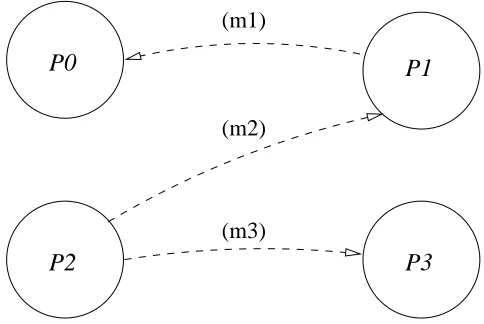
The message passing model involves two or more processes running in parallel, and communicating by sending and receiving messages. Each process maintains its own local memory, and must coordinate their communication so that every send operation has a corresponding receive operation. Message passing may be used to carry out exchange of data or the synchronisation of actions between processes. The message passing model is shown in Figure 2.1.
(m3) (m1)
P2
P0 P1
P3
[image:25.595.204.446.503.665.2](m2)
Figure 2.1: The message passing model.
Thus, processes must be known to each other before messages can be exchanged, and, as the message is transmitted directly between the two processes, both pro-cesses must be in existence at the time the message is sent.
2.3.1.1 Sockets
At perhaps the lowest level, the message passing model can be implemented using Internet Protocol (IP) sockets. IP, which operates in conjunction with either the higher-level Transmission Control Protocol (TCP) or the User Datagram Protocol (UDP), is the dominant network protocol for LANs and WANs at the time of writ-ing, significantly due to it being the protocol used on the Internet. TCP, UDP, IP and their other associated protocols are sometimes referred to as the Internet Protocol
Suite. Note that, for the purposes of this section, discussion will be limited to the
more common IP version 4, and ignore the newer IP version 6. For information on IP version 6 see Deering & Hinden (1998).
Overview of the Internet Protocol Suite
IP is a network layer protocol which encapsulates data from a higher level protocol into packets. Each host in an IP network has a unique 32 bit IP address. An IP address is represented using dotted-decimal notation (four octets separated by a dot (’.’) character).
IP is a connectionless protocol which does not guarantee the delivery of packets to their destination. Rather, it is a store-and-forward protocol which simply attempts to route a packet to a node nearer to its intended destination. It is not uncommon for packets to be dropped on the way to their destination, as IP allows this to happen when network congestion is encountered. Also, packets may arrive out of order, or their data payload may be corrupted while being transmitted. Finally, IP is a host-to-host packet delivery protocol, rather than process-to-process or application-to-application, as the IP address refers only to an individual host on the network. All of these reliability issues are handled by a higher level protocol, such as TCP.
OSI Layer Internet Protocol Suite
Application HTTP, FTP, SMTP etc
Transport TCP, UDP
Network IP
Data Link Ethernet, 802.11a/b/g, ATM etc Physical Optic fibre, Twisted Pair etc
TCP exists at the transport layer, and is a connection-oriented, stream-based protocol used by most of the Internet’s application protocols such as HTTP. Data to be transmitted from an application is packaged into a TCP segment, which, among other header fields, also contains a port number denoting the port of the receiv-ing application. The use of a port number allows for communication between net-worked applications, rather than simply between hosts as is the case at the IP level. TCP guarantees the reliable, ordered delivery of a stream of data to its destina-tion. These features, however, do come at the cost of additional communications overhead. The receipt of each TCP segment is acknowledged by the receiving ap-plication, and packets are retransmitted in the event of a packet being lost. This makes TCP unsuitable for some applications, including real-time applications such as streaming media. For applications such as these, UDP is often the preferred choice of transport layer protocol.
Like TCP, UDP provides application-to-application communications using ports. However, unlike TCP, it does not guarantee the reliable delivery of a message (called a datagram in relation to UDP), nor does it provide for ordered delivery of messages. The only error detection included in UDP is a 16-bit checksum header field used to detect the corruption of any of the datagram’s header fields or data payload. UDP is not a connection-oriented protocol, and datagrams are stateless (ie. not part of a specific connection or data stream. As such, the receipt of delivered datagrams are not acknowledged, and undelivered datagrams are not retransmitted. Also, UDP datagrams do not contain as much overhead as TCP segments in the form of header fields. This results in UDP being a more efficient protocol, and it is suited for use in real-time applications such as VOIP, DNS and networked games.
For further information on TCP, UDP or IP refer to Comer (2003).
The Socket Interface
Sockets provide a full-duplex communications channel between two processes ex-ecuting on computers connected by an IP network. Peterson & Davie (2000, p. 43) state that sockets can be though of as ”the point where a local application pro-cess attaches to the network”. Sockets are an abstraction provided originally by the 4.2BSD UNIX operating system, and now in the majority of modern operating systems including Microsoft Windows, Mac OS X and GNU/Linux. Libraries for accessing sockets are available in most programming languages.
A socket consists of the following components:
• Local IP address, • Local port number,
• Remote IP address (for established connections), and • Remote port number (for established connections).
When a socket is first created by a process it is in an unconnected, or unestab-lished state. A connection must be estabunestab-lished to another socket (usually on a re-mote host) in order to create a socket pair. The establishment of a socket pair involves one host opening a socket and waiting for a connection to be initiated by some other host. The former is referred to as the server, and the latter as a client. The following examples (using Java) illustrate the process of creating a socket pair. Firstly, the server must instantiate ajava.net.ServerSoketobject and bind
it to a local port. Then, it uses the accept() method to wait for an incoming connec-tion request from a client.
ServerSoket srvSok = new ServerSoket();
Soket inoming = srvSok.aept();
// soket pair has now been reated
Secondly, the client creates ajava.net.Soketobject which it uses to connect
to the server.
Soket lientSoket = new Soket(SERVER_ADDRESS, PORT);
Once the connection has been established, both server and client may obtain input and output streams for the socket and begin communication. For example, the client would perform the following:
ObjetOutputStream out =
new ObjetOutputStream(lientSoket.getOutputStream());
out.flush();
ObjetInputStream in =
new ObjetInputStream(lientSoket.getInputStream());
Sockets Summary
2.3.1.2 Other message passing implementations
The Message Passing Interface (MPI) (Snir et al. 1996) is a standard for message passing on computing clusters; the most common implementation of the standard being the MPICH library for C, C++ and FORTRAN, although libraries for other programming languages have been developed. For the purposes of this section, we will not make a distinction between the MPI standard and its specific implementa-tion.
At its core, MPI provides a mechanism to allow processes running in parallel to exchange messages via send and receive routines (MPI_Send() andMPI_Rev()
respectively). These operations are quite low level in nature, and require the pro-grammer to specify details such as the type and size of data being sent or received, addresses of buffers being used, and identity of the process being communicated with. Also, it is necessary for these parameters to match in order for communica-tion to be successful (Leopold 2001, p. 102).
As mentioned in Section 2.3.1, in the message passing model for every send op-eration there must be a corresponding receive opop-eration, or else the send opop-eration will block indefinitely. MPI handles this problem by providing a number of block-ing modes which can be chosen by the programmer. These modes allow both send and receive operations to return before they have been fully completed, before be-ing completed at a later stage, usbe-ingMPI_ISEND()andMPI_IRECV() respectively
(Snir et al. 1996, pp. 49-60). These operations post the initial data included in the message, before being completed with eitherMPI_WAIT()orMPI_TEST().
Parallel Virtual Machine (PVM) is a software tool for developing parallel appli-cations for computing clusters (Geist et al, 1994). It consists of a complete frame-work, including libraries and runtime system, for the development of applications in C, C++, and Fortran.
Like MPI, PVM is an implementation of the message passing model, and it contains the operations pvm_send() and pvm_rev() to allow a message to be
sent and received respectively. PVM also contains operations for spawning new processes, group (multicast) communication, and synchronisation.
2.3.1.3 Summary of the message passing model
The main benefits of message passing models such as MPI and PVM are that they can provide a high level of speedup for broad classes of applications, and that they give the programmer control at a low level over the communication characteristics of a system. This allows applications to be optimised in order to maximise the performance of a system.
However, this low level of control can also be a drawback: applications which utilise message passing can become very complex and difficult to understand and debug. Gorlatch (2004) argues that message passing imposes too much difficulty for developing a parallel system, and suggests that message passing be replaced by a more structured form of parallel programming in much the same way that the goto statement was phased out of sequential programming languages in favour of a more structured approach.
Much of the complexity inherent in the message passing model stems from the tightly-coupled interaction between processes. In order for two processes to com-municate, the address or name of each process must be known, and processes must both exist at the same point in time. Nonetheless, the performance gains provided by these systems must be weighed against these disadvantages when evaluating their suitability for a given parallel application.
2.3.2
Shared Memory
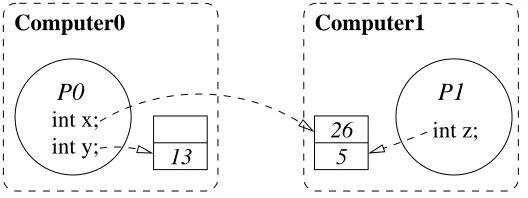
The shared memory model involves two or more processes running in parallel, and communicating by reading from and writing to variables in a shared memory. In a traditional shared memory system, processes execute on the same computer, and share this computer’s memory. In a distributed shared memory (DSM) system, the shared memory may be accessed by remote processes, or even be comprised of areas of memory located on more than one computer in the distributed system. These two approaches to shared memory are illustrated in Figure 2.2, which show firstly two processes sharing the a memory region on a single computer, and secondly a distributed shared memory across two computers. Each process contains one or more variables which reference a particular memory location.
P1 P0
Computer0
Computer1 Computer0
P1 P0
Distributed shared memory on two computers.
13
26 5
int x;
int y; int z;
int x; int x;
int y;
24 58
[image:31.595.191.455.258.357.2]Shared memory on a single computer.
Figure 2.2: The shared-memory model.
Possible disadvantages inherent to this model are those associated with syn-chronisation and locality. In the former case, it is possible for parallel processes to access a shared variable simultaneously, possibly leading to corruption of the vari-able’s data, or for a race condition to occur. These problems introduce the need for a synchronisation mechanism to coordinate and sequentialise process’ access to shared variables, such as, for example, Dijkstra’s semaphores (Dijkstra 1968) or Java’s synchronized keyword (Lea 2000, pp. 75-79). This, however, introduces the need for the programmer to include explicit synchronisation in their program when-ever a shared variable is accessed, increasing the complexity of the program and also the difficulty in tracing bugs. Synchronisation also introduces the possibility of deadlock, whereby two or more processes may be waiting for the other to release a resource (in this case, a shared variable), leading to both (or all) processes blocking indefinitely.
location, taking into consideration the locations of the executing processes. The efficiency of accessing shared data is obviously highly dependent on the underlying network of the distributed system, in particular its latency. Of course, these factors are not known to the programmer, who has limited control of the locality of data. Therefore it is the responsibility of the DSM’s runtime system to ensure that shared data is stored in a location as close to optimal as possible.
The shared memory model is a form of inter-process communication more com-monly used between processes executing on the same physical machine, mostly due to the problems associated with data locality. Nonetheless, platforms do exist which allow processes on separate machines to communicate and synchronise their activ-ities using a shared-memory approach. The following is an overview of two of the common technologies used in the creation of a distributed system using shared memory: threads and OpenMP.
2.3.2.1 Threads
Threads represent a sequence of program commands, much like a process. How-ever, a process may consist of multiple threads, each of which shares the process’ address space. A process with two or more threads is said to be multithreaded. In single-processor computers, a multithreaded process will run concurrently, with each thread being independently scheduled by the operating system to execute on the processor. On multiprocessor or multi-core computers, a multithreaded process may run in truly parallel fashion, with threads executing simultaneously on separate processors or cores.
The main advantage of using threads rather than multiple processes for con-currency is that threads can communicate via their shared address space, whereas processes running concurrently must use some other form of inter-process commu-nication such as UNIX pipes or sockets. Also, due to threads sharing an address space and other process state information, context switching between threads is generally faster than switching between processes.
Threads may be made available to the programmer by a library, such as the standard POSIX threads (Pthreads), or be natively supported by the programming language, such as in Java.
this purpose. For more on Java’s synchronisation mechanisms see Lea (2000).
2.3.2.2 OpenMP
OpenMP is an API developed for the purpose of enabling the development of portable shared memory parallel applications (Chapman et al. 2008, p. 23). The API is defined by the OpenMP Architecture Review Board (OpenMP Architecture Review Board 2008), which consists of a group of computer software and hardware vendors, who came together to address their common cause of defining a standard parallel programming platform. OpenMP consists of compiler directives, environment vari-ables and library functions for the FORTRAN, C and C++ programming languages. It is important to note that OpenMP is not intended as a distributed computing plat-form; it is a tool for multithreaded programming on shared memory multiprocessor computers. However, it a higher-level language than plain threads, as we will see below.
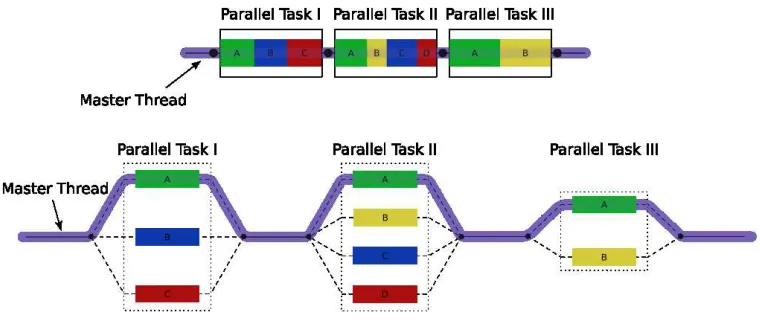
Parallelism is most commonly expressed in OpenMP using the fork/join model, which lends itself to the development of SPMD parallel applications. OpenMP ap-plications begin with a single sequential thread, known as the initial thread (Chap-man et al. 2008, p. 24). Sections of code, such as loops, may be marked as being parallelisable using (for C syntax) the compiler directive#pragma omp parallel
{...}to indicate the parenthesised code block is to be parallelised. An example of
the usage of this is demonstrated in the code listing below, which shows a parallel section in which each thread will obtain its number and print out the resultant value:
#pragma omp parallel {
n = omp_get_thread_num();
printf("I am thread number %i", n);
}
Figure 2.3: Example of OpenMP’s fork/join parallelism (Chapman et al. 2008).
This approach allows the programmer to express parallelism in a high-level, ab-stract way, and it also gives the advantage of parallelism to be added to a sequential program in an iterative way. That is, a program need not be completely parallelised at inception, but rather sections of code may be parallelised as they are identified as being suitable for doing so. This also allows the programmers to maintain a single codebase for the application, rather than separate sequential and parallel versions.
OpenMP also caters for the MPMD style of parallelism using the #pragma
omp setions {...}compiler directive in addition to#pragma omp parallel.
Each specific task is specified inside the parentheses using#pragma omp setion
{...}directive. This usage of OpenMP will result in each thread executing a
dif-ferent section of the code. As an example, consider the code listing below:
#pragma omp parallel {
#pragma omp setions {
#pragma omp setion
foo();
#pragma omp setion
bar();
}
}
In this example code listing, two parallel sections are specified with the end result being that one thread will execute the foo() function, and the other will
execute thebar()function.
pro-cessing, where each thread may compute individual segments of the array. The following code listing, which computes the product of two arrays, demonstrates the use of the#pragma omp parallel fordirective for parallelised loops:
#pragma omp parallel for
for(i = 0; i < 20; i++)
a[i℄ = b[i℄ * [i℄;
This loop will be parallelised by assigning a chunk of iterations to each thread to be executed. How these chunks are assigned will depend on which scheduling algorithm is being used; there are four algorithms available to the programmer, but for the purposes of this discussion we will classify them as either static or dynamic (Leopold 2001, p. 87). The programmer is able to choose which algorithm and/or chunk size is used, or they may leave it up to the OpenMP system to decide.
To explain the way the choice of scheduling algorithm influences the assign-ment of chunks of iterations, assume we have four threads that have been created to execute this loop. If a static scheduling algorithm were being used, then the assign-ment of chunks would be determined at compile-time. Therefore, a chunk size of five would assign five iterations of the loop to each thread: thread0would perform
iterations 0 to 4, thread1would perform iterations 5 to 9 and so on. If a dynamic
scheduling algorithm were to be used, then the chunk size is determined at run-time, by the OpenMP system. The chunk size may be determined at the beginning of the loop and not alter, or alternatively, it may vary during execution of the loop based on the application characteristics.
In summary, OpenMP allows both SPMD- and MPMD-style parallel programs to be written using high-level programming constructs for shared memory parallel computers. Like threads, it is not a mechanism to distributed shared memory, but it does allow multithreaded programs to be expressed in a more abstract manner.
2.3.2.3 Summary
The shared memory model of parallel computing has several advantages, which can be summarised as follows (Leopold 2001, p. 74):
• The memory model used for these programs is the same as for ordinary se-quential programs, thus being easier to understand for the programmer,
• The programmer is not burdened with the problems of specifying any details related to communication nor the location of data storage.
carry out the underlying operation of the system and hide complexities from the programmer.
Disadvantages of the shared memory model relate to synchronisation and the locality of stored data (Leopold 2001, p. 75). Firstly, as there is no direct com-munication between processes in a shared memory system, all interaction between processes occurs via creating and modifying data stored in the shared memory. In order to ensure consistency of data and that operations on a shared variable do not overlap, it is necessary for these systems include synchronisation constructs to serialise access to shared variables. However, this synchronisation introduces an overhead to the system due to this serialisation, and may also introduce problems such as deadlock and race conditions by making it difficult to ensure the correctness of a program.
The other issue of data locality has a large bearing on the performance of a shared memory system. There is a time penalty for accessing data, and to ensure op-timum performance data that is required frequently should be stored near to where it will be used. In an ordinary shared memory computer, we wish for frequently used data to remain in cache to the fullest extent possible: in a distributed shared memory system, we wish for frequently used data to be stored on the node which is accessing it to avoid any inter-node communication from taking place. Because the shared memory model is relatively high level compared to message passing, often the programmer does not have complete control over these issues, and instead must use techniques such as program restructuring to minimise the negative effects of this problem.
2.3.3
Remote Procedure Calls
Remote procedure calling (RPC) is a form of inter-process communication which aims to make the act of communicating with remote processes as transparent as possible to the programmer. It does this by retaining the usual semantics of proce-dure calling in imperative programming languages when invoking the proceproce-dures of remote processes.
Tanenbaum & Steen (2002, p. 69) suggest, however, that “subtle problems ex-ist” with this idea. Firstly, the calling and called procedures in an RPC are on different machines, and hence in different address spaces. This complicates the passing of parameters and accessing return values to and from procedures. For ex-ample, consider parameters that are pointers. Also, it is inevitable that either one of the computers will crash or the network connection will be lost during a remote procedure call, thereby causing the system to experience partial failure.
The concept introduced by RPC to address these problems and enable RPC to to work effectively are stubs. Stubs on a client machine act as a proxy for a re-mote procedure, providing a local interface for the programmer to use to make a remote procedure call. The client stub will handle all of the details of sending mes-sages over the network, including packing parameters into valid network mesmes-sages (known as marshalling) and unpacking (unmarshalling) any values returned. Once the remote procedure call has been made, the stub will wait for a response from the corresponding server stub (Tanenbaum & Steen 2002, pp. 71-72).
A server stub is analogous to a client stub, characterised by Tanenbaum & Steen (2002, p. 71) as “a piece of code that transforms requests coming in over the net-work into local procedure calls.” A server stub unmarshalls any parameters needed for the procedure call, makes the actual procedure call, and then marshalls any val-ues returned before sending them over the network back to the client stub.
The client and server stubs provide conversion facilities if they are situated on incompatible systems; for example, if one system interprets bytes using the big en-dian format, and the other uses little enen-dian. These compatibility issues are handled by the stubs on either machine. Stubs also handle the problem of passing pointers as parameters mentioned earlier; usually the pointers are dereferenced and passed by value.
RPC was an innovative technology that simplified the complex task of develop-ing a distributed system. It introduced many concepts that are still in use in many current distributed technologies, including remote method invocation systems such as Java RMI (Sun Microsystems 2008) and CORBA (Object Management Group 2008).
2.3.4
Distributed System Architectures
In the first instance, a client/server, or centralised, architecture implies the ex-istence of at least one server node, which provides some service for one or more client nodes. In order to access this service, the client will send a request to the server, which will process the request and send the server back an appropriate re-sponse. The particular service being provided by a server can vary widely, but may include things such as data storage or transfer, processing, or a centralised point of communication with other nodes. The client/server architecture is illustrated in Figure 2.4.
Server
Client0 Client1 ClientN
Figure 2.4: The client/server architecture.
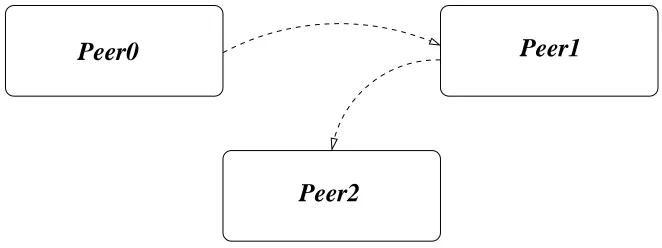
In the second instance, peer-to-peer, or decentralised, architectures do not make the distinction between client and server nodes, but rather each node is treated as being equal, and most often acts as both a client and a server at different times. A good example of this is peer-to-peer file sharing programs such as Gnutella and Bittorrent (Bittorrent.org 2008), whereby each node in the system may be simulta-neously downloading and uploading data from and to other nodes. The peer-to-peer architecture is illustrated in Figure 2.5.
Peer0
Peer2
[image:38.595.160.491.509.633.2]Peer1
Figure 2.5: The peer-to-peer architecture.
such as the World Wide Web, are inherently centralised, and so techniques such as load balancing must be used to spread client requests amongst multiple servers thus reducing the load on each individual server. On the other hand, peer-to-peer systems will generally perform more poorly in small systems, but may scale more effectively to larger sizes.
Another point of difference between the two architectures is that of fault toler-ance. Client/server systems are centralised; that is, there are one or more servers servicing multiple clients. The server(s) in such a system can become a point of failure, and the loss of a server can cause the failure of the entire application. On the other hand, peer-to-peer systems are decentralised and do not rely on any central servers, and as such tend to be more fault tolerant. Most peer-to-peer applications can continue to function after the failure of even several nodes.
Finally, the administration of client/server systems tends to be simpler than for peer-to-peer networks, because the application logic can be contained in a small number of servers rather than distributed across all nodes participating in the sys-tem. Thus, the server has more control over matters such as task assignment and load balancing.
2.4
Summary
In this chapter we have described the main models and architectures of distributed and parallel systems. The broad categories of platform have been discussed, includ-ing clusters, grids and wide area networks. The main communication models have also been presented, including message passing, shared memory and remote proce-dure calling. The models covered here will inform much of the later discussion of the design and operation of Tupleware.
Chapter 3
Coordination Models
3.1
Background & Overview
Coordination models were first proposed by Gelernter (1985) in his coordination language, Linda. Coordination models were proposed as a method of ”building programs by gluing together active pieces” (Carriero and Gelernter 1990, p. 8). As this implies, these models provided distinction between the computation which occurs in an individual process, and the interaction which occurs between processes, whether they are running on the same computer or on different computers on a network.
3.2
Fundamental Concepts
Coordination models are based on two concepts which distinguish them from other distributed programming abstractions: the idea of a tuple space, and generative
communication as the means of process interaction.
3.2.1
Tuple Space
Tuple space is an an associative shared memory, by which processes may commu-nicate, store data and coordinate their actions. More specifically, tuple space stores tuples; these are ordered lists of typed data of arbitrary length. For example, the tuple<data, 1.3>contains two fields. The first field is a string, and the second
00 00 00
11 11 11
00 00 00
11 11 11
P0 P1
[image:41.595.221.430.82.284.2]Tuple space
Figure 3.1: An example tuple space system.
3.2.2
Associative Lookup
Unlike most other parallel shared memory systems, tuple stored in tuple space are not explicitly addressed. Rather, they are accessed via associative lookup. This lookup process makes use of a tuple template, which is the same as a tuple except that some of its fields may be assigned a null value. These null values may act as wildcards, matching against any given value in the corresponding field of a tuple. A template is said to match a tuple provided the following two conditions are true: a) the template is the same length as the tuple, and b) any values specified in the template are equal to the tuple’s values in their corresponding fields.
As an example, consider the tuple template <data, null>. This template
would match the tuple <data, 6.3> due to the equality of their length and
of their first field. It would not, however, match the tuples <hello, 2.1> or
<data, 6.3, rw>due to field equality and unequal lengths in each
respec-tive instance.
3.2.3
Loosely-Coupled Interaction
Processes in a tuple space system do not interact directly. Rather, all communi-cation is performed via tuple space, which provides persistent tuple storage space independent of other processes in the system.
time in order for them to communicate, due to the persistent nature of tuple space. It is possible for a process to place a tuple in tuple space and then terminate, only for another process to be created and consume the tuple at some later point in time.
3.3
Linda Operations
Linda is comprised of just a few fundamental operations, which are detailed be-low, and these operations were intended to be embedded into other conventional programming languages. Originally, Linda was embedded into the C programming language to create a variant named C-Linda. Linda consists of six operations: out(),
rd(), in(), rdp(), inp() and eval(). The functionality of each is listed below.
• out() places a new tuple into tuple space,
• in() retrieves a tuple from tuple space which matches the given tuple template, permanently removing it from the space. If a matching tuple does not exist, then the operations blocks until one is placed into the space,
• rd() behaves exactly like in(), except that it retrieves a copy of a matching tuple rather than removing the tuple permanently,
• inp() and rdp() behave as in() and rd() respectively, except they do not block if a matching tuple is not available, and null values are simply returned.
• Finally, eval() is used to spawn a new process. This operation, though in-cluded in the original Linda model, tends to be exin-cluded from most other implementations in favour of more traditional process creation mechanisms, usually largely influenced by the host implementation language.
3.4
Programming with Linda
Linda was designed to provide a clear separation between a program’s computation and coordination code. The fundamental concept was that parallel system could be constructed by ”gluing together active pieces” (Carriero & Gelernter 1990, p. 181), where the active pieces are processes written in the host language, and the ”glue” is the coordination and communication mechanisms provided by Linda.
3.4.1
Distributed Data Structures
A distributed data structure is a data structure whose values are stored in tuple space, with each value or element encapsulated in a tuple (Carriero & Gelernter 1990, pp. 49-50). The most common example of this are so-called ”position-accessed structures” (Carriero & Gelernter 1990, pp. 53-59), which are used to represent a the elements of an array in tuple space.
Distributed data structures such as these consist of a series of tuples which rep-resent each element of the array, and use certain fields within the tuple for access. Typically the first field of the tuple is the name of the array, the following fields specify the index or indices of the array element, and the remainder of the tuple contains the data values stored in the array element.
So, as an example, if we wish to store the two-dimensional array A as a dis-tributed data structure in tuple space, we would use a series of tuples such as the following:
<"A", 1, 1, (element data)> <"A", 1, 2, (element data)>
<"A", 2, 1, (element data)> <"A", 2, 2, (element data)>
...
If we wish to retieve a copy of one of the elements of A, then a template such as the one below would be used:
rd("A", 2, 2, ? data);
This would retrieve a copy of the element at A[2][2]and assign its value to the variabledata. The use of distributed data structures allows all processes
participat-ing in the system to share access to the data stored in them, and remove the need for data to be stored locally within the process itself. This gives a clean separation be-tween processes and highlights the loosely-coupled nature of tuple space systems. A distributed data structure approach such as this maps well to a data parallelism style of system. Each process may be performing the same task, yet operating on different parts of the data simultaneously.
Position-access structures such as these are relevant to this thesis in that they are employed for the applications presented in Chapter 5.
3.4.2
Task Parallelism
A process would retrieve this task, compute its result, and return the result to tuple space as follows:
in("task", ? task);
result = ompute(task);
out("result", result);
The tasks completed by each process may be different or the same, depending on the specification of the task given in the task tuple.
3.5
Related Work
Tuple space systems have long been recognised as being an effective tools for paral-lelising coarse-grained, or embarrassingly parallel applications where there are very few dependencies between each parallel task. Such applications tend to require less communication, and therefore do not suffer from the overhead introduced by trans-mitting data over the network, and from the computer hosting tuple space having to service requests.
However, this overhead imposes a serious limit to the scalability of a distributed tuple space system when it is used to run applications which are more finely-grained, and as such have greater dependencies between tasks and more frequent communication. Inevitably, a centralised tuple space implementation will become overwhelmed trying to service requests as the number of processes in the system and/or communication frequency becomes large. Therefore, it is desirable to de-centralise the tuple space, and to spread the load of servicing requests between those computers which host each part of the distributed space.
Distribution of the tuple space presents several challenges which must be ad-dressed in order to maintain, and hopefully improve, the performance of parallel applications which utilise it. Namely, the time taken to search for and retrieve tuples from the space must not increase too dramatically compared to a single centralised space. To this end, tuples need to be stored in the distributed space in such a way that requests are, as evenly as possible, spread amongst the computers which host each part of the space.
major drawback of this approach is that each of these services exist completely independently. They do not coordinate their actions to provide optimal servicing of client requests, and therefore it becomes the programmer’s responsibility to add extra functionality to the application in order to utilise the additional services.
A more beneficial and appropriate approach to this situation would be to aggre-gate all of the JavaSpace services into a single, distributed space. This distributed space would appear to the programmer to behave as though it were a single, cen-tralised space; that is, the distribution of the space should be completely transpar-ent at the application level. A distributed space such as this would result in less complexity in the application code, and, hopefully, a more adaptable and scalable distributed system.
There have been quite a few implementations of the Linda model which have attempted to address similar issues. Some of the more notable systems are explored in the remainder of this section.
3.5.1
MTS-Linda
Multiple Tuple Space Linda (Nielsen & Slrensen 1994) (usually abbreviated to MTS-Linda) was one of the earliest attempts to add multiple tuple spaces to the original Linda model. MTS-Linda incorporates tuple spaces which are treated as first class objects, and can be manipulated by the programmer to fulfil applications’ specific needs. The use of multiple tuple spaces allowed data (represented as pas-sive tuples), and processes (active tuples) to be grouped and manipulated as a whole. As tuple spaces are treated as first class objects, each tuple space is simply concep-tualised as a ”local data structure within a process” (Nielsen & Slrensen 1994, p. 12), which goes some way towards raising the level of transparency of the system’s distribution.
Tuples which reside in other (non-local) tuple spaces may also be accessed, pro-vided they are within the ”context tuple space” of the process making the access re-quest. That is, multiple tuple spaces may belong to the same context, and processes may opt to retrieve tuples from either its local tuple space, or from a tuple space contained in the same context. In this way, multiple tuple spaces are added in a hi-erarchical manner, rather than the flat, or disjoint way they have been incorporated in some other systems.