A Robust Class of Context-Sensitive Languages
Salvatore La Torre
Universit`a di Salerno, Italy
[email protected]
P. Madhusudan
University of Illinois
Urbana-Champaign, USA
[email protected]
Gennaro Parlato
Universit`a di Salerno, Italy
University of Illinois (UC), USA
[email protected]
Abstract
We define a new class of languages defined by multi-stack automata that forms a robust subclass of context-sensitive languages, with decidable emptiness and closure under boolean operations. This class, called multi-stack visibly pushdown languages (MVPLs), is defined using multi-stack pushdown automata with two restrictions: (a) the push-down automaton is visible, i.e. the input letter determines the operation on the stacks, and (b) any computation of the machine can be split into k stages, where in each stage,
there is at most one stack that is popped. MVPLs are an extension of visibly pushdown languages that captures non-context free behaviors, and has applications in analyzing abstractions of multithreaded recursive programs, signifi-cantly enlarging the search space that can be explored for them. We show that MVPLs are closed under boolean op-erations, and problems such as emptiness and inclusion are decidable. We characterize MVPLs using monadic second-order logic over appropriate structures, and exhibit a Parikh theorem for them.
1. Introduction
Linear labeled structures play an important role in mod-eling information in computer science. Explicit linear rep-resentations of data (like a text document) and implicit linear representations of behavior (like the linear-time be-havior of a system) motivate the study of robust classes of linear structures. Regular word languages have played an important role in this regard, and have found appli-cations in searching documents, defining logics for be-haviors, and algorithms for model-checking systems (see [8, 11, 19, 20, 22]).
In certain linear models, there is an implicit relation on the positions in the model that can be inferred from its la-bels. A standard example of these are XML/SGML
The author was partially supported by MIUR grants ex-60% 2005 and 2006 of Universit`a degli Studi di Salerno.
ments where open- and close-tag annotations form a nesting
relation on the linear document, capturing the hierarchical tree structure of the data it represents. When studying the
linear behaviors of a recursive sequential program, there is again a nesting relation naturally present, which relates calls to procedures with their corresponding returns. Viewing the nesting structure as explicit edges in the document led to the recently studied theory of nested words ([1, 2]). The notion of regularity for nested words captures a different class of languages than regular word languages (i.e. regular nested word languages can be context-free when the nesting edge relation is ignored), but forms a robust class closed under boolean operations and with decidable decision problems.
In this paper, we delve deeper into defining tractable classes of word languages, where the tractability stems from explicit relations between positions that simplifies the in-ternal complexity of the word. The class of languages we discover in this paper is a robust and tractable subclass of context-sensitive languages, defined using a restricted class of multiple nesting relations on words. The class is closed under all boolean operations, and admits tractable decision procedures for the problems of emptiness and inclusion.
From an automata-theoretic perspective, the regular class of words with a single nesting relation is captured using
visibly pushdown automata (VPA) [1]. A VPA works on
words over an alphabet that is partitioned into three
parts, called the call-alphabet, the return-alphabet, and the internal-alphabet. A word over such a partitioned alpha-bet implicitly defines a nesting relation, formed by match-ing the call-letters with the correspondmatch-ing return-letters in a nested fashion. A VPA working over such a word is con-strained to push exactly one symbol onto its stack on call-letters, to pop exactly one symbol on return-call-letters, and to not touch the stack on internal-letters. The class of lan-guages accepted by these automata are called visibly push-down languages, and corresponds exactly to the class of reg-ular languages over nested words ([1, 2]).
The class of languages we study in this paper is de-fined using visibly pushdown automata working with
finite set of stacks (saynof them), where the input
alpha-bet determines the operations allowed on the stack. More precisely, the input alphabet is partitioned intonsets of call
alphabets ( i
) and return alphabets (
i
r), and an internal
al-phabet (
int), and the automaton pushes or pops from the i’th stack only when it reads a call from
i
or a return in
i
r
, respectively. The automaton hence retrieves, using one stack for each nesting relation, the nesting edges present in the word.
Multi-stack visibly pushdown automata can be seen as encoding the runs of a multi-stack automaton, and it is easy to see that the emptiness problem for them is undecidable (since a Turing machine can be simulated using two stacks). Consequently, any naturally-defined notion of regularity on multiple nested words is bound to be intractable. We restrict the class of words in the following way. We fix a uniform boundk, and only consider words that can be decomposed
intoksub-words, where each sub-word has at most one kind
of return nodes. In other words, the automaton working over such a word proceeds in kphases, where in each phase it
pops at most from one stack (but it can push onto all stacks). We dub these automata and the languages they accept ask
-phase multi-stack visibly pushdown automata (languages). The class of k-phase MVPLs (k-MVPLs) is a subclass
of context-sensitive languages. It includes non-context-free languages such asf(a
1 a
2 )
n
b n
1 b
n
2
jn 2Ng, which can be
accepted using only two phases, ifa 1and
a
2are calls
cor-responding to two different stacks, andb 1and
b
2are the
re-turns from these stacks. The MVPAaccepting this language pushes thea
1’s and a
2’s onto the two stacks, and then when
readingb
1’s, pops symbols from the first stack, and then in
the second phase, readingb
2’s pops symbols from the
sec-ond stack.
The main theorem of the paper is that the emptiness prob-lem for MVPAs is decidable. The proof lies in a fairly com-plex encoding ofk-phase words into trees, and hence
re-ducing it to tree automata emptiness. As a consequence, we also obtain the result that for normal (not visible) multi-stack pushdown automata that use at mostk-phases on any
word, the emptiness problem is decidable.
We show thatk-phase MVPLs are effectively closed
un-der union, intersection, and complement (with respect tok
-phase words), and using decidability of emptiness, it fol-lows that the inclusion and equivalence problems are decid-able for MVPLs. While closure of MVPLs under union and intersection are easy, closure under complement is more in-volved as MVPLs are not determinizable. The closure under
complement is shown by mapping any MVPLinto a regular language of trees, complementing the automaton with re-spect to the class of all trees that representk-phase words,
and translating the resulting automaton back to an MVPA. Delving further into the language theory of this class, we show that it corresponds exactly to the class of monadic
second-order logic onn-nested words withkphases, where
the logic hasnbinary relations corresponding to then
nest-ing relations on the word.
In order to understand which subclass of context-sensitive languages MVPLs capture, we note that our map-ping ofk-phase words into trees essentially rearranges the
letters in the word so that the language becomes tree-regular. We formalize this by proving a Parikh’s theorem for MVPLs, namely that the commutative image of every MVPLis the commutative image of a regular language. This can be used to show that certain languages are not accepted by multi-stack automata; for example, we can show that
fa 2
n
jn2Ngis not accepted by any multi-stack
automa-ton with a bounded number of phases (over the non-visible alphabetfag), although it is a context-sensitive language.
One application of multi-stack automata with bounded phases is for the model-checking of concurrent recursive
programs. When verifying concurrent programs, a common
paradigm is to abstract the program into a finite model (say using predicate abstraction), and subject the model to algo-rithmic verification. The model however preserves the con-trol flow accurately, and hence preserves recursion, leading to essentially a multi-stack pushdown automaton. Reach-ability checking for this model is of course undecidable. However, recent papers in verification make the observa-tion that many errors are already found after a few num-ber of context-switches (switches between stacks), and in fact for anyk, checking if an error state is reached withink
context switches is decidable [16]. Context-bounded check-ing of concurrent recursive programs has shown to discover several errors in programs (see [5, 16, 17]). MVPLs gener-alize this result by showing that checking whether an error state is reached within k phases, where in each phase all
processes can evolve, but only one of them is allowed to re-turn from procedures, is decidable. Technically, our result is more sophisticated as we can show that the set of config-urations reached ink-phases is not regular. Other results on
deciding reachability, including bounded-context switching and nested locks, crucially rely on the fact that the reach-able sets are regular ([3, 4, 12, 16]). (In [4] the forward reachable sets are not regular, but backward reachable sets are.) We believe that analyzingk-phase executions of a
pro-gram model explore a much larger space of configurations thank-context switches do, and may lead to more thorough
model-checking algorithms.
The paper is structured as follows. Bounded phase multi-stack visibly pushdown languages are defined in Section 2. Section 3 is devoted to proving that the emptiness prob-lem is decidable for MVPLs. Closure under boolean op-erations and non-determinazability of MVPLs are shown in
Section 4, while decision problems are discussed in Sec-tion 5. In SecSec-tion 6, we present a logical characterizaSec-tion of
conclude with a few remarks in Section 7.
2. Preliminaries
Multi-Stack Visibly Pushdown Languages.
Given two positive integersiandj,ij, we denote with
[i;j℄the set of integerskwithikj, and denote by[j℄
the set[1;j℄. Letwbe a word on some alphabet. We denote
withjwjthe length ofw, and hence[jwj℄denotes the set of
positions ofw. Given two positionsj 0
;j ofw,j 0
j, we
denote withw[j℄thej-th symbol ofw, and withw[j 0
;j℄the
sub-word ofwformed from positionj 0
to positionj, both
inclusive (whenj 0
>j,w[j 0
;j℄=).
An n-stack call-return alphabet is a tuple e n = hf( i ; i r )g i2[n℄ ; int
iof pairwise disjoint finite alphabets.
For anyi2[n℄, i
is a finite set of calls of the stacki, i
r
is a finite set of returns of stacki, and
intis a finite set
of internal actions. For any such e
n, let = S n i=1 i , r = S n i=1 i r, i = i [ i
r, for every
i 2 [n℄, and
= [ r [ int.
A multi-stack visibly pushdown automaton over such an alphabet must push on the i’th stack exactly one symbol
when it reads a call of the i’th alphabet, and pop exactly
one symbol from thei’th stack when it reads a return of the
i’th alphabet. Also, it cannot touch any stack when reading
an internal letter.
Definition 1 (MULTI-STACK VISIBLY PUSHDOWN AU
-TOMATON) A multi-stack visibly pushdown automaton (MVPA) over the n-stack call-return alphabet
e n = hf( i ; i r )g i2[n℄ ; int
i, is a tupleM =(Q;Q I
; ;Æ;Q
F )
whereQis a finite set of states, Q I
Qis the set of
ini-tial states, is a finite stack alphabet that contains a spe-cial bottom-of-stack symbol?,Æ (Q
Q( n
f?g))[(Q
r
Q)[(Q
int
Q), andQ F
Q
is the set of final states.
Let us fix ann-stack alphabet e
nfor the rest of the paper.
A transition(q;a;q 0
;), wherea 2 i
and
6=?, is
a push-transition with the meaning that on readinga, is
pushed onto stackiand the control changes from stateqto
q 0
. Similarly, (q;a;;q 0
)witha 2 i
r
is a pop-transition where is read from the top of the stackiand popped (if
the top of stackiis?, then it is read and not popped), and
the control changes fromqtoq 0
.
A stack is a nonempty finite sequence over where the bottom-of-stack symbol ? appears always and only
in the end; let us denote the set of stacks as St =
( n f?g)
f?g. A configuration of an MVPA M
over e
n is a tuple hq;
1 ;:::;
n
i withq 2 Q and each
i
2 St. For a word w = a 1
:::a
m in
, a run of M on w is a sequence of m+1 configurations =
hq 0 ; 0 1 ;:::; 0 n
i;:::;hq
m ; m 1 ;:::; m n
i, where q 0 2 Q I, 0 i
=?for everyi2[n℄, and for everyj2[m℄the
follow-ing holds:
[Push] Ifa j
2 i
(i.ea
j is a call of stack
i), then9 2
such that (q j
;a
j ;q
j+1
;) 2 Æ, j+1 i = j i , and j+1 h = j h
for everyh2([n℄nfig).
[Pop] Ifa j
2 i
r
(i.e.a
jis a return of stack
i), then92
such that(q j
;a
j ;;q
j+1
) 2 Æ, j+1 h = j h for every
h2([n℄nfig), and either6=?and j i = j+1 i , or j i = j+1 i =?.
[Internal] If a j
2
int is an internal action, then (q j ;a j ;q j+1
)2Æ, and j+1
h =
j
h
for everyh2[n℄.
A run = hq 0 ; 0 1 ;:::; 0 n
i;:::;hq
m ; m 1 ;:::; m n i is
accepting if the state in the last configuration is final, i.e., ifq
m 2Q
F. A word w2
is accepted by an MVPAM
if there is an accepting run ofM onw. The language ofM,
denotedL(M), is the set of all words accepted byM.
Given a wordw2
, we denote withRet(w)the set of
all returns inw. A wordwis a phase ifRet(w) i
r
, for somei 2[n℄, and we say thatwis a phase of stacki. Let
us now definek-phase words, which are words formed by
concatenating at mostkphases.
Definition 2 (PHASES) For any k, a k-phase word
1 is a
word w 2 +
such that w can be factorized as w =
w
1 w
2 :::w
k 0 where
k 0
kand w
h is a phase, for every h 2 [k
0
℄. Such a factorizationw 1
;w
2 ;:::w
k
0 is called a
k-factorization ofww.r.t. e
n. Let
Phases( e
n
;k)denote
the set of allk-phase words over e
n.
Definition 3 (MULTI-STACK VISIBLY PUSHDOWN LAN
-GUAGES WITH PHASES) For anyk, ak-phase multi-stack
visibly pushdown automaton (k-MVPA) over e
n is a tuple A = (k;Q;Q
I ; ;Æ;Q
F
)where M = (Q;Q I
; ;Æ;Q
F )
is an MVPA over e
n. The language accepted by A is
L(A)=L(M)\Phases( e
n
;k). A language accepted by a
k-MVPAis called ak-phase multi-stack visibly pushdown
language (k-MVPL).
Example 1 Figure 1 gives a formal definition of a2-MVPA
Aover e
2that accepts the language f(a 1 a 2 ) t b t 1 b t 2 jt0g.
The automaton A checks whether the input word has the
form (a 1 a 2 ) b 1 b 2
using its control states. For i = 1;2:
whenAreads a calla
i, it pushes onto stack S
i symbol $,
if it is the first occurrence ofa
i, and symbol
#, otherwise;
then, reading the return symbolb i,
Apops a symbol from
stackS
iuntil symbol
$is popped; when$is popped form
stackS
2, it enters the accepting state.
Multi-stack pushdown automata.
A multi-stack pushdown automaton (MPA) over a normal
1We ignore the empty word
1
=fa
1 g;
1
r =fb
1 g;
2
=fa
2 g;
2
r =fb
2 g;
int =
;;A=(2;fq i
ji2[0;6℄g;fq
0
g;f#;$g;Æ;fq
0 ;q
6 g)
Æ :=f (q
0 ;a
1 ;q
1 ;$);(q
1 ;a
2 ;q
2 ;$);(q
2 ;a
1 ;q
3 ;#);
(q
2 ;b
1 ;#;q
4 );(q
2 ;b
1 ;$;q
5 );(q
3 ;a
2 ;q
2 ;#);
(q
4 ;b
1 ;#;q
4 );(q
4 ;b
1 ;$;q
5 );(q
5 ;b
2 ;#;q
5 );
(q
5 ;b
2 ;$;q
6 )g:
Figure 1. A2-MVPAforf(a 1
a
2 )
t
b t
1 b
t
2
jt0g.
(non-visible) alphabet is simply ann-stack automaton,
withmoves, that can push and pop from any stack
read-ing any letter. Also, we define thek-phase version of these
(calledk-MPAs). A k-MPA is an MPA that uses at most
k-phases on any word (i.e. any run on any word can be
de-composed into at mostkphases, where in each phase the
MPApops at most from one stack). For example, the lan-guagefa
n
b n
n
jn 2Ngis accepted by a2-phase2-stack
MPAthat pushes a symbol onto both stacks while reading
a’s (using-moves) and matches the b’s against one stack
and the’s with the other. It is easy to see that the language
is not ak-MVPL for any partition of the lettersa,b and
into call-return alphabets over multiple stacks.
Trees and Monadic Second-Order Logic.
We briefly recall trees and some well known results on trees and monadic second-order logic.
The trees we deal with are finite, binary, and labeled by a finite alphabet. An-labeled tree is a structureT =
(V;), whereV f0;1g
is a finite prefix-closed set, and
: V ! is a labeling function. The setV represents
the nodes ofT, whereis the root ofT, denotedroot(T).
The edge-relation ofT is implicit: edges are pairs(v;v:i),
wherev;v:i 2V;i 2 f0;1g. The nodev:0(v:1) is called
the left-child (right-child) ofv. LetT
denote the set of all -labeled trees.
We assume standard nondeterministic top-down au-tomata on trees [6].
Definition 4 (REGULARTREES) A set of-labeled treesL
is regular if there is some tree automatonAwithL=L(A).
We will use the standard monadic-second order logic on trees, which allows quantification over nodes and sets of nodes of a tree, with interpreted relations for the left-child and right-child, and boolean operators [20].
The following theorem relates the class of regular trees and the class of trees definable by MSO.
Theorem 1 ([7, 18]) A tree language is regular iff it is MSO definable.
3. The Emptiness Problem
Given ak-MVPAAover e
n, the emptiness problem for Ais to decide whetherL(A)is empty. In this section, we
show that the emptiness problem fork-MVPLs is decidable
in double exponential time by reducing it to the emptiness problem for finite tree automata.
We need some definitions. A word w 2 +
is i-well
matched if it is generated by the context-free grammar:
S!SS jaSbjdj
whereS is the only variable, a 2 i
;b 2
i
r
, and d 2
n
i
. Letw2 +
andj;j 0
be two positions ofwwithj<
j 0
. The pair (j;j 0
)is a matching pair ofwiff there exists i2[n℄such thatw[j℄2
i
,w[j 0
℄2 i
r
, andw[j+1;j 0
1℄
isi-well matched.
Ak-phase word can be factored in several ways; we fix
a unique factorization that will simplify the technical expo-sition. We say that ak-factorizationw
1 ;:::;w
k
0 of a word
w w.r.t. e
n is tight if: (1) the first symbol of w
h is a
re-turn, for everyh2[2;k 0
℄, (2) ifk 0
>1thenRet(w 1
)6=;,
and (3)w hand
w
h+1are phases of different stacks, for
ev-ery h 2 [k 0
1℄. It is easy to see that, for every word
w2Phases( e
n
;k), there is a unique tightk-factorization
ofww.r.t. e
n.
Given a word w 2 Phases( e
n
;k), we define the map phase
w
: [jwj℄ ! [k℄ as follows: phase w
(j) = h iff
w
1 ;:::;w
k
0 is the tight
k-factorization ofww.r.t. e
nand j
is a position ofw h.
Our proof is structured as follows. We first define a rep-resentation of k-phase words using trees labeled over the
alphabet([k℄). The vertices in the tree correspond to
po-sitions in the word such that the returns in the word are the right-children of the matching calls. While the call-return matching relation of the k-phase word is immediately
re-coverable in the tree, the positions in the word get arranged haphazardly in the tree, and retrieving the linear ordering of the word in the tree gets considerably complex. We ex-hibit how to recover the linear order of the word from
the tree using MSO on trees. The correctness of this re-lation is not shown immediately. We first show that it de-fines some linear order on the vertices of any tree in which the phase numbers are monotonically non-decreasing along any path. Using this linear order, we characterize the set of stack trees: intuitively, the characterization looks at the wordwformed using the linear order, and checks whether
the nesting relations defined by the right-child relation agree with the call-return matching inw. We show that if a treeT
satisfies the characterizing conditions of the stack tree, then the wordwobtained is indeed such that its stack tree isT.
This formally establishes the correctness of the linear order (Lemma 2).
is exponential, and the complexity of checking whether a tree is a stack-tree is double exponential in the number of phases. Finally, using the-ordering, we show how to
sim-ulate an MVPA on the word obtained from the tree using a tree automaton of size double exponential ink. The
com-plexity of checking emptiness of MVPAthen follows from emptiness checking for tree automata.
The embedding of words into trees and the recovery of the linear relation forms the main technical crux of the pa-per, and is the hardest part of our proofs. The linear order is not recoverable unless the phase number of each letter is also encoded in the tree, and this is precisely why our em-bedding does not work for unboundedly many phases (un-derstandably so, since unbounded number of phases leads to an undecidable emptiness problem).
Mapping nested structures into trees.
We define a function that maps every word w 2
Phases( e
n
;k)into a([k℄)-labeled tree that has a node
for each position of w. The node corresponding to
posi-tion j ofwencodes in its label the symbol and the phase
of positionjinw. The root corresponds to position1, and
for all positions j, if (j 0
;j) is a matching pair ofw then
the node corresponding to position j is the right-child of
the node corresponding to positionj 0
; otherwise, the node corresponding to positionjis the left-child of the node
cor-responding to position j 1. The formal definition below
simultaneously defines a 1-to-1 correspondenceposthat
re-lates positions in the word with the nodes in the tree.
Definition 5 (TREEREPRESENTATION) For any word
w 2 Phases( e
n
;k)withjwj = m, the word-to-tree map
ofw,wt(w), which is a([k℄)-labeled tree(V;), and
the bijection mappos w
:V ![m℄are inductively (onjwj)
defined as follows:
Ifm=1, thenV=fg,()=(w;1), andpos w
()=1.
Otherwise, let w 0
= w[1;m 1℄ and wt(w 0
) =
(V 0
; 0
). Then:
– V =V 0
[fvgwithv62V 0
.
– (v)=(w[m℄;phase w
(m));
(v 0
)= 0
(v 0
), for everyv 0
2V 0
.
– If there is somej 2 [m 1℄such that(j;m)is
a matching pair inw, thenvis the right-child of
pos 1
w 0
(j).
Otherwisevis the left-child ofpos 1
w 0
(m 1).
– pos w
(v) = m and pos w
(v 0
) = pos
w 0
(v 0
), for
everyv 0
2V 0
.
A tree T such that T = wt(w) for some w 2
Phases( e
n
;k) is called a k-stack tree, and the set of k
-stack trees is denoted bySTree( e
n ;k).
Example 2 Consider 1
= fag; 1
r
= fag; 2
=
fg; 2
r
=fgand int
=feg, andw=aeaaaaaea.
Forw 1
=aeaaaaa;w
2
=e, andw 3
=a,w 1
;w
2 ;w
3
is a tight3-factorization ofww.r.t. e
2. Thus, phase
w (j)=
1for everyj 2 [9℄,phase w
(j)=2for everyj 2[10;12℄,
and phase w
(13) = 3. The set of all matching pairs of
ww.r.t. e
2is
f(1;6);(3;12);(4;5);(8;10);(9;13)g.
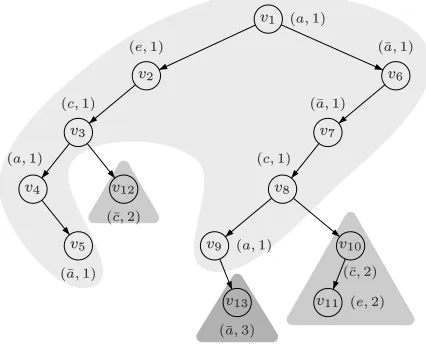
Fig-ure 2 shows the([3℄)-labeled treewt(w). Observe that,
pos(v
i
)=i, for everyi2[13℄. Note that the linear
order-ing on the word is very non-local on the tree. For example,
v
12is the successor of v
11and yet they are far away in the
tree.
v1 (a;1)
v
2 (e;1)
v
3 (;1)
v
4 (a;1)
v5
(a;1) v
12
(;2)
v
6 (a;1)
v
8 (;1)
v9 (a;1) v10
(;2)
v
11 (e;2) v
13
(a;3)
v
[image:5.612.315.528.231.403.2]7 (a;1)
Figure 2. The treewt(aeaaaaaea).
Recovering the linear order
In this section, we define a relation on nodes of([k℄)
-labeled trees, denoted, which (we will eventually show)
recovers the linear order inwfrom the stack treewt(w).
LetT =(V;)be a([k℄)-labeled tree. Givenx;y2
V, we say thatx < prex
y iffxprecedesy in the prefix
traversal ofT. We define two maps,sym : V ! and
phase
T
:V ![k℄as:sym(x)=aandphase T
(x)=hiff (x) =(a;h). For a nodex2 V, we denote withT
xthe
largest subtree ofTcontainingxand such that all its nodes
are labeled with the same phase number.
Definition 6 Let T = (V;)be a ([k℄)-labeled tree
withphase T
(x)phase
T
(parent(x)), for everyx2V n
fg. For everyh2[k℄, we inductively define the relations <
h
V V and< [h℄
V V, as follows:
x <
h
y iffphase T
(x) = phase
T
(y) =hand either
(1)T x
=T
yand x<
prex
y, or (2)T x
6=T
y, h>1
andparent(root(T y
))<
[h 1℄
parent(root(T
x )).
x<
[h℄
yiff either (1)phase T
(x);phase
T
(y)<hand
x<
[h 1℄
y, or (2)phase T
(x)=phase
T
(y)=hand
x<
h
y, or (3)phase T
(x)<handphase T
(y)=h.
Consider the treeT from Figure 2. On this tree, relation
<
1, and thus <
[1℄, simply corresponds to the ordering
re-sulting from a prefix traversal of the subtree of all nodes of phase1, i.e. the sequencev
1 ;v
2 ;:::;v
9. To determine
rela-tion<
2, observe that there are two separate subtrees which
are formed by nodes of phase2. Within each subtree the
relation<
2is defined according to the prefix traversal. To
relate nodes of different subtrees we compare the parents of the roots of the respective subtrees. For example, con-sider nodesv
11 and v
12. We have that v
10 is the root of v
11’s subtree and v
12itself is the root of its subtree. Since parent(v
12 ) <
[1℄
parent(v
10
)(i.e., v 3
<
[1℄ v
8), we can
conclude thatv 11
<
2 v
12 (note that we have inverted the
direction of the inequality moving from two nodesx;y of
different subtrees toparent(root(T x
));parent(root(T
y ))).
Thus,<
[2℄is given by the ordering v
1 ;v
2 ;:::;v
12. Since
we only have one node of phase 3, the relation< [3℄, and
thus, is given by the linear orderingv 1
;v
2 ;:::;v
13.
We now show that is a regular relation on the tree,
i.e. expressible in MSO over the tree, using the inductive definition ofgiven in Definition 6 above.
The MSO formula for the relation, called
, is a
for-mula with two free variablesxandy, and holds precisely
whenxy. We define it below using an inductive
defini-tion of formulasless [h℄
less
[h℄
(x;y):=LessPhase(x;y)
_(InSamePhaseSubTree(x;y)^less
prex (x;y))
_(:LessPhase(x;y)^:InSamePhaseSubTree(x;y)
^9z9z 0
(ParentRootInPhaseSubTree(z;x)
^ParentRootInPhaseSubTree(z 0
;y)
^less
[h 1℄ (z
0
;z)))
(x;y)=less
[k℄ (x;y)
with the understanding thatless 0
(x;y)isfalse.
In the above, the auxiliary subformulas are defined as follows: LessPhase(x;y) holds iff the phase of
x (read from its label) is less than the phase of y; InSamePhaseSubTree(x;y) holds if x and y are of the
same phase and belong to the same-phase subtree (i.e.T x
=
T
y); less
prex
(x;y)holds iffxoccurs beforeyin the
prefix-order of the tree;ParentRootInPhaseSubTree(z;x)holds
iffzis the parent of the root of the subtreeT x.
A brief note on complexity. The auxiliary sub-formulas
above can be written easily in MSO using only disjunc-tions and existential quantificadisjunc-tions, and a number of con-junctions that is only polynomially many (in k, n, and
) atomic formulas. Consequently, they can be
imple-mented using nondeterministic tree automata with a poly-nomial number of states. The nondeterministic tree automa-ton finally obtained for is however exponential, because
of the two conjunctions before the recursive application to
less
[h 1℄. These conjunctions contribute a series of 2k
con-junctions, and causes the automaton to be exponential ink
(2
O(klogk)
).
Though we cannot establish the correctness of yet,
we can show now thatalways defines some linear order
on a tree, provided phase numbers are monotonically non-decreasing along any path in the tree. Intuitively, <
prex
linearly orders all elements of a subtree that corresponds to the same phase, elements of two different phases get or-dered uniquely, and nodes of the same phase but in different subtrees get ordered according to the reverse ordering of the nodes where their subtrees hang.
Lemma 1 LetT =(V;)be a([k℄)-labeled tree with
phase
T
(x)phase
T
(parent(x)), for everyx2(Vnfg).
Then the relationis a linear ordering onV.
Regularity of stack trees.
All trees obviously do not correspond to stack trees of words. In this section, we establish the regularity of the set of all stack trees. We give first a characterization of stack trees, and then argue that it can be expressed in MSO. In-tuitively, if a treeT is a stack tree, then we should be able
to recover the wordwcorresponding to it using the
rela-tion on the tree, and we expect that the right-child relarela-tion in the tree captures the nesting edges between calls and re-turns inw. Apart from other checks onw, we would need
to make sure thatwwith the phase numbers inherited from
corresponding vertices inT gives a tight factorization. Let
T-tight denote the (regular) set of words over([k℄)that
correspond to a tightk-factorization.
Lemma 2 LetT =(V;)be a([k℄)-labeled tree. Then
T 2STree( e
n
;k)iff the following hold:
1. Phase numbers are monotonically non-decreasing along any path, i.e. phase
T (x)
phase
T
(parent(x)), for everyx2(V nfg).
2. Right-children are always returns and their parent is always a call: i.e. ifyis a right-child ofx, thenyis a
return andxis a call of the same stack asy.
3. Unmatched calls cannot be followed by unmatched re-turns (from the same stack):
i.e. there is no x;y such thatx y, (x)is a call
of stacki,y is a return of stacki,xdoes not have a
right-child, andyis not a right-child of any node.
4. Nesting relations are proper: Letybe a right-child of
xandzbe a node betweenxandyin theorder.
Ifzis a call of the same stack asx(andy), thenz
must have a right-child which is betweenz 1and yin theorder.
Analogously, ifzis a return of the same stack as
xandy, thenzmust be the right-child of a node
5. The word formed according to theorder isT-tight.
Furthermore, if a treeT satisfies the conditions above,
then the wordwobtained using theorder is such that the
stack-tree ofwisT.
Lettw denote the function that maps any stack tree T
to the wordw obtained using theordering. The above
lemma shows that iftw(T)=w, thenwt(w)=T, i.e. wt
andtware inverses of each other. This establishes thatis
indeed the correct linear order on stack trees. We can now show the regularity ofSTree(
e
n ;k).
Theorem 2 The setSTree( e
n
;k)is MSO definable.
More-over, there is a tree automaton with a number of states dou-ble exponential ink, that acceptsSTree(
e
n ;k).
Proof The proof proceeds by expressing the characterizing properties of stack-trees in MSO. Properties (1),(2),(3) and (5) are easy to express. The first property in (4) (the second property is similar) can be expressed as:
:9x;y;z
1 ;z
2
:RightChild(x;y)^IsCall(z
1 )
^
(x;z
1 )^
(z
1 ;y)
^[(: 9z
3
:RightChild(z
1 ;z
3 ))_
(RightChild(z
1 ;z
2 )^(
(z
2 ;z
1 )_
(y;z
2 )))℄
Sincexytakes an exponential-sized automaton to check,
the above checks can be effected by a tree automaton of size
double exponential ink. 2
Solving emptiness
We are now ready to prove that for any class of words ac-cepted by a k-MVPA, the class of trees corresponding to
them forms a regular tree language.
Theorem 3 IfLis ak-MVPL, thenwt(L)is regular.
More-over, if A is ak-MVPA accepting L, then there is a tree
automaton that accepts wt(L) with number of states at
most exponential in the size ofAand double exponential in
the number of phasesk(more precisely,exp(jAj2 O(kl ogk)
)
states).
Proof The MSO sentence 'definingwt(L)consists of a
conjunction of two MSO sentences ' 1 and
'
2, where '
1
enforces the treesTto belong toSTree( e
n
;k)and' 2
guar-anties thattw(T)is a word of L. By Theorem 2, we just
need to show' 2.
For ak-MVPAA,'
2simply guesses the transitions that Atakes along an accepting run. LetÆ=fÆ
1 ;:::;Æ
t gbe the
set ofAtransitions. Then,'
2is of the form 9Y
1 :::9Y
t
(unique^init^trans^a^nonempty):
We use the variableY
i to guess all tree nodes where
tran-sition Æ
i is taken (along a run). Checking whether such
a guess corresponds to a valid run is along standard lines
(see [20] for similar proofs). The formulaunique checks
that each node is associated with exactly one transition,init
checks that the transition labeling the root starts from an ini-tial state, andaensures that the last state on the run is a
final state. The formulatransis more interesting. It verifies
the validity of each transition in the run by checking that: (i) at each node labeled by the symbolais associated a
transi-tion ona, (ii) when a symbol is pushed onto the stack then
at the corresponding return (if it occurs) the same symbol is popped (this can be easily accomplished as the matching return for a call is its right-child in any stack tree), and (iii) for each pair of nodesx;y ofwt(w)corresponding to two
consecutive symbols ofw, the target of the transition taken
atxis the source of the transition taken aty. This last
prop-erty can be stated as:
:9x9y
su(x;y)^: W
(i;j)2I (x2Y
i
^y2Y
j )
;
whereIis the set of all pairs(i;j)such that the target of
Æ
i coincides with the source of Æ
j. Expressing
su(x;y)
using would lead to an extra exponential blow-up than
needed. However, we can show that there is a nondetermin-istic automata of size double exponential inkthat traverses
the tree according to the linear ordering and checks if all the state transitions are correct.
The formula'
2can be translated to a corresponding tree
automaton of size double exponential inkand exponential
in the size ofA(see [20]), and hence also the automaton for
'
1 ^'
2.
2
We can now show the main result of this section, which follows from the above theorem and the fact that tree au-tomata emptiness is solvable in linear time [6].
Theorem 4 (EMPTINESS FOR k-MVPLS) The emptiness
problem for k-MVPLs is decidable in double exponential
time.
We can generalize the emptiness result to k-phase
multi-stack automata over non-visible alphabets as well:
Theorem 5 (EMPTINESS OF k-MPAS) The emptiness
problem is decidable in double-exponential time for k
-MPAs.
Proof Consider the runs of the multi-stack automaton, by taking each transition as a new letter, and associating with it a type as to whether it is a call/return/internal depending on what it does to the stack. The set of runs is accepted by a multi-stack visibly pushdown automaton with k-phases,
and the original automaton accepts some word iff the latter does. Hence emptiness can be decided using Theorem 4.2
4. Closure Properties
We now show closure properties ofk-MVPLs. We start
A renaming of e
n to e
nis a function
f :!such
that f( i
)
i
, f(
i
r
)
i
r, for every
i 2 [k℄, and f(
int )
int. A renaming
f is extended to words over in the natural way:f(a
1 :::a
m )=f(a
1
):::f(a
m ).
Theorem 6 (CLOSURE) LetL 1 and
L
2 be two
k-MVPLs
over e
n. Then, L
1 [L
2and L
1 \L
2are
k-MVPLs over e
n. Moreover, if
f is a renaming of e
n to e
n, then f(L
1 )
is also ak-MVPLover e
n.
Proof LetA 1
;A
2be two
k-MVPAs such thatL(A 1
)=L
1
andL(A 2
)=L
2.
Closure under union follows by taking the union of the state and transitions ofA
1 and A
2(assuming they are
dis-joint) and taking the new set of initial states (final states) to be the union of the initial states (final states) ofA
1and A
2. L
1 \L
2can be accepted by an MVPA
Athat has as its set
of states the product of the states ofA 1and
A
2, and as its
stack alphabet the product of the stack alphabets ofA 1and A
2. When reading a call of stack i, ifA
1pushes
1and A
2
pushes
2, respectively on their
i-th stack, thenA pushes (
1 ;
2
)onto itsi-th stack. The set of initial (final) states is
the product of the initial (final) states ofA 1and
A
2.
Given L
1 accepted by the
k-MVPA A and a renaming f,f(L
1
)is accepted by the k-MVPA obtained fromA by
transforming each transition onato a transition onf(a).2
An MVPA M = (Q;Q I
; ;Æ;Q
F
) is deterministic
if jQ I
j = 1, and jf(q;a;q 0
) 2 Æg [ f(q;a;q 0
;) 2
Æg [f(q;a;;q 0
) 2 Ægj = 1, for every q 2 Q and a 2 . A k-MVPA A = (k;Q;Q
I ; ;Æ;Q
F
) is
de-terministic if the MVPA (Q;Q I
; ;Æ;Q
F
) is
determinis-tic. MVPAs cannot be determinized. In fact we can show that for e
2 = (
1
;
1
r ;
2
;
2
r
;;), with 1
= fag;
1
r
= f;dg; 2
= fbg; 2
r
= fx;yg, the language L = f(ab)
i
j
d i j
x j
y i j
ji 2 N;j 2 [i℄g is accepted by
a non-deterministic2-MVPA but not by any deterministic
k-MVPA.
Theorem 7 (NON-DETERMINIZABILITY) The class ofk
-MVPLs is not closed under derterminization.
Let Lbe a k-MVPL over e
n; the complement of L is
defined with respect to allk-phase words:L=(
nL)\
Phases( e
n
;k). We show that thoughk-MVPLs cannot be
determinized, they can be complemented. First we give a technical result for translating any regular language of stack trees to an MVPAthat accepts the corresponding words.
Lemma 3 IfL STree( e
n
;k)is regular, thentw(L)is
ak-MVPL. Moreover, ifLis accepted by an automaton of
sizes, then the correspondingk-MVPAis of size polynomial
ins.
We can now show complementation ofk-MVPAs:
Theorem 8 (COMPLEMENTABILITY) The class of k
-MVPLs is closed under complementation. That is, ifL is
ak-MVPLover e
n, then
Lis also ak-MVPLover e
n.
Proof By Theorem 3, the tree setwt(L)is regular. Since
tree automata are closed under complementation,wt(L)is
also regular (see [19]), and by Theorem 1 there is an MSO sentence'defining it. Now, if is an MSO formula
defin-ingSTree( e
n
;k)(the existence of is guaranteed by
The-orem 2), then it is simple to show that the MSO sentence
'^ defines the set of treeswt(L). To conclude the proof,
observe that by Lemma 3tw(wt(L))is ak-MVPL, and by
Lemma 2,tw(wt((L))=L. 2
The following table summarizes and compares closure properties for CSLs, CFLs, VPLs, MVPLs and regular lan-guages (see [11]).
Closure properties
[ \ Complement Determ.
Regular Yes Yes Yes Yes
VPL Yes Yes Yes Yes
CFL Yes No No No
CSL Yes Yes Yes Not known
MVPL Yes Yes Yes No
5. Decision Problems
The membership problem fork-MVPAs is to check, for
any fixedk-MVPAAover e
n, whether a given word w 2
is accepted byA.
Theorem 9 (MEMBERSHIP) The membership problem for
k-MVPLs is NP-complete.
Proof Showing membership in NP is trivial. A nondeter-ministic polynomial-time algorithm just need to guess a run and simulate it on a given input word. To show NP-hardness we reduce satisfiability of boolean formulae. Fix a for-mula over variablesfx
1 ;:::;x
k
g. We define a 2-stack
k-MVPAAthat accepts a particular word inPhases( e
2 ;k)
iffholds. AutomatonA, starts in phase1reading the
for-mula from the tape and storing it in stack1. Then, in phase
h, h 1, A guesses a truth value for variablex h, pops
the content of the stack of the current phase and pushes it onto the other stack rewriting each occurrence of x
h with
the guessed value. Finally, in phasek, while rewriting the
stack content,Aalso evaluates the obtained expression (all
variables have been substituted with a truth value) and thus accepts iff it evaluates to true. We remark that theO(jj:k)
operations concerning the stacks are driven by the input
word to the MVPA. 2
The universality problem for k-MVPLs is to check
Phases( e
n
;k). The inclusion problem is to find whether,
given twok-MVPAsA 1and
A
2over e
n, L(A
1
)L(A
2 ).
Theorem 10 (UNIVERSALITY, INCLUSION) The univer-sality and the inclusion problems are decidable.
Proof Using closure ofk-MVPAs under complement, it
fol-lows that universality and inclusion ofk-MVPAs reduce to
the emptiness problem, and thus are decidable. 2
We can show an EXPTIMElower bound for the emptiness problem and a 2EXPTIMElower bound for the universality and inclusion problems. We conjecture that emptiness is complete for double exponential time.
The following table summarizes the results we have shown on the complexity of the main decision problems for MVPLs, and recalls known results for CSLs, CFLs, VPLs and regular languages. In this table, NLOGstands for NLOG-complete, and so on for the other complexity classes.
Decision Problems
Membership Emptiness Univ./ Equiv./Incl.
Reg. NLOG NLOG PSPACE
VPL PTIME PTIME EXPTIME
CFL PTIME PTIME Undecidable CSL NLINSPACE Undecidable Undecidable MVPL NP IN2EXPTIME IN3EXPTIME
EXPTIME-HARD 2EXPTIME-HARD
6. Language Theoretic Properties
6.1 . A Logial Charaterization
In this section, we define a logic on words over an n
-stack call-return alphabet e
n which has in its signature
re-lations that capture thennesting relations.
In this context, a wordwoveris a structure over the
universeU = f1;:::;jwjg, the set of positions inw. We
use unary predicates P a
(i), for a 2 , which stand for w[i℄ = a. Also, we havenbinary relations
j (
j 2 [n℄)
overU, where
j corresponds to the matching relation of
calls and returns according to thej’th nesting relation. Let
us fix a countable infinite set of first-order variablesx;y;:::
and a countable infinite set of monadic second-order (set) variablesX;Y;:::.
The monadic second-order logic (MSO) over e
nis
de-fined as:
':=P
a
(x)jx2Xjxyj
j
(x;y)j:'j'_'j9x'j9X'
wherej 2[n℄,a2,x;yare a first-order variables andX
is a set variable.
The models are words over. The semantics is the
natu-ral semantics on the structure for words defined above. The first order variables are interpreted over the positions ofw,
and the second-order variables range over sets of positions. We recall that a sentence is a formula which has no free variables. The set of all words ofPhases(
e
n
;k)that
sat-isfy a sentence'is denotedL k
(')and we say'defines this
language. Using standard techniques to convert MSO to au-tomata (given that the auau-tomata are closed under boolean operations and projection), we get (see [20]):
Theorem 11 A languageLis ak-MVPLover e
niff there
is an MSOsentence 'over
e
nwith L
k
(')=L.
6.2. A Parikh Theorem
The Parikh mapping, introduced by Parikh [15], asso-ciates a word with the vector of natural numbers that re-flect the number of occurrences of the symbols in the word. Formally, the Parikh image of a word w, over the
alpha-bet fa 1
;:::;a
`
g, denoted by(w), is the tuple (w) = (#a
1
;:::;#a
`
) where#a
i is the number of occurrences
of the symbol a i in
w. We extend the Parikh image to
languages in the natural way: (L) = f(w)jw 2 Lg.
Parikh’s theorem [15] states that for each context-free lan-guageLoverthere is a regular languageL
0
oversuch
that the Parikh image ofLandL 0
coincide, that is,(L)=
(L 0
). For example, the languageL = fa i
b i
ji 2 Ng has
the same Parikh image of the regular languageL 0
=(ab)
, i.e. (L) = (L
0
) = f(i;i)ji 2 Ng. Moreover, given a
context-free languageL, it is effective to find a regular
lan-guageL 0
such(L)=(L 0
); that is, there is an algorithm
that takes as inputLand gives as outputL 0
. The next theo-rem shows that the same properties also hold fork-MVPLs.
Theorem 12 For every k-MVPL L over e
n, there exists
a regular language L 0
over such that(L 0
) = (L).
Moreover,L 0
can be effectively computed.
Proof Recall that for any context-free grammarG, we can
construct a right-linear grammarG 0
such that(L(G)) =
(L(G 0
))[15]. Thus, for any k-MVPL L, we just need
to construct a context-free grammar Gsuch that(L) =
(L(G)). From Theorem 3, we can construct a tree
au-tomatonAacceptingwt(L). Viewing the transition rules of
a tree automaton as productions of a context free grammar, we can construct starting from Aa context free grammar
that generates a languageL 0
such that(L)=(L 0
). 2
The above result can be used to show that certain lan-guages are not recognized by k-MVPAs or even k-phase
MPAs. For instance, consider the language over the (non-visible) alphabet =fag,L =fa
2 n
j n2 Ng. We can
show thatLis not accepted by anyk-phasen-stack MPA.
Assume by contradiction that it is accepted by a k-phase
n-stacks MPA. Let us first change the MPAso that it does
stack moves only on-transitions. Then, let’s augment the
alphabet with symbolsf(;i);(r;i)jing[fintg, and let
us transform the MPAby relabeling eachpush-transition
onto stackito(;i), eachpop-transition from stackito
(r;i)and each transition that doesn’t touch the stack to int. The resulting MPAis an MVPAwhose language
the Parikh image of the language accepted by the MVPAis equivalent to the image of a regular languageR. Projecting
RtofagisLand must be regular, which is a contradiction.
7. Discussion
We have defined and studied a robust and tractable sub-class of context-sensitive languages. There are various other extensions of context-free languages that have been shown to be tractable. Bounded context-switching reachability of multistack automata [16] and concurrent pushdown au-tomata interacting using nested locks [12] are known to ad-mit decidable reachability problems, but crucially rely on the fact that the set of reachable configurations of such au-tomata are regular. MVPAs with bounded phases strictly generalize both these classes of languages, and the ability algorithm is more sophisticated. The set of reach-able configurations ofk-phase MVPAs are, for example, not
regular or even context-free. For instance, consider the de-terministic 2-phase MVPA that reads (ab)
n
:(
ba) n
:(a) n
, pushes the symbolsa,b andonto three different stacks,
and then transfers theb’s and’s back to the first stack
read-ing
ba anda repeatedly. The resulting set of
configura-tions hasa n
b n
n
on the first stack with the other two stacks empty, which is a non-context-free set of configurations.
Other extensions of context-free languages include the class of languages accepted by stack automata [9] and those accepted by higher-order pushdown automata [13]. While these classes have a decidable emptiness problem, they are not robust (for example, they are not closed under comple-ment). We do not know whetherk-MVPLs are contained in
these classes, but we conjecture that they indeed are. Several future directions are interesting. First, the class of multiple nested word languages with a bounded num-ber of phases is of bounded tree-width (this is the prop-erty that allows us to embed them in trees). It would be interesting to characterize naturally the exact class of mul-tiple nested words that have bounded tree-width. Secondly, we believe that our results have applications to other areas in verification, for instance in checking parallel programs that communicate with each other using unbounded FIFO queues, as multiple stacks can be used to simulate queues. Thirdly, propositional dynamic logic (PDL) has been shown to be decidable when regular expressions in the logic are replaced with particular classes of non-regular languages. The non-regular but context-free language extensions that were known to be decidable [10] were recently general-ized in [14], where it was shown that PDL with visibly-pushdown language modalities is decidable. Whether one can obtain a generalization of the small number of decid-able extensions of PDL with non-context-free languages, using the class of automata presented in this paper, is an interesting open problem.
References
[1] R. Alur and P. Madhusudan. Visibly pushdown languages. In STOC, pages 202–211, 2004.
[2] R. Alur and P. Madhusudan. Adding nesting structure to words. In DLT, LNCS 4036, pages 1–13, 2006.
[3] A. Bouajjani, J. Esparza, S. Schwoon, and J. Strejcek. Reachability analysis of multithreaded software with asyn-chronous communication. In FSTTCS, LNCS 3821, pages 348–359, 2005.
[4] A. Bouajjani, M. M¨uller-Olm, and T. Touili. Regular sym-bolic analysis of dynamic networks of pushdown systems. In CONCUR, LNCS 3653, pages 473–487, 2005.
[5] S. Chaki, E. M. Clarke, N. Kidd, T. W. Reps, and T. Touili. Verifying concurrent message-passing C programs with re-cursive calls. In TACAS, LNCS 3920, pages 334–349, 2006. [6] H. Comon, M. Dauchet, R. Gilleron, F. Jacquemard, D. Lugiez, S. Tison, and M. Tommasi. Tree automata tech-niques and applications, 1997.
[7] J. Doner. Tree acceptors and some of their applications. J. Comput. Syst. Sci., 4(5):406–451, 1970.
[8] E. A. Emerson. Temporal and modal logic. In [21], pages 995–1072.
[9] S. Ginsburg, S. A. Greibach, and M. A. Harrison. One-way stack automata. J. ACM, 14(2):389–418, 1967.
[10] D. Harel and D. Raz. Deciding properties of nonregular pro-grams. SIAM J. Comput., 22(4):857–874, 1993.
[11] J. E. Hopcroft and J. D. Ullman. Introduction to Automata
Theory, Languages, and Computation. Addison-Wesley,
1979.
[12] V. Kahlon, F. Ivancic, and A. Gupta. Reasoning about threads communicating via locks. In CAV, LNCS 3576, pages 505–518, 2005.
[13] T. Knapik, D. Niwinski, and P. Urzyczyn. Higher-order pushdown trees are easy. In FoSSaCS, LNCS 2303, pages 205–222, 2002.
[14] C. L¨oding and O. Serre. Propositional dynamic logic with recursive programs. In FoSSaCS, LNCS 3921, pages 292– 306, 2006.
[15] R. Parikh. On context-free languages. J. ACM, 13(4):570– 581, 1966.
[16] S. Qadeer and J. Rehof. Context-bounded model checking of concurrent software. In TACAS, LNCS 3440, pages 93– 107, 2005.
[17] S. Qadeer and D. Wu. Kiss: keep it simple and sequential. In PLDI, pages 14–24. ACM, 2004.
[18] J. W. Thatcher and J. B. Wright. Generalized finite automata theory with an application to a decision problem of second-order logic. Math. Sys. Theory, 2(1):57–81, 1968.
[19] W. Thomas. Automata on infinite objects. In [21], pages 133–192.
[20] W. Thomas. Languages, automata, and logic. In Handbook of Formal Languages, Volume 3, pages 389–455. Springer-Verlag New York, Inc., New York, NY, USA, 1997. [21] J. van Leeuwen, editor. Handbook of Theoretical Computer
Science, Volume B. Elsevier and MIT Press, 1990.