
Rochester Institute of Technology
RIT Scholar Works
Theses
12-2018
A Technique for the Optimization of Actuation
Characteristics of Ionic Polymer-Metal Composites
Vaughn Varma
Follow this and additional works at:https://scholarworks.rit.edu/theses
Recommended Citation
A Technique for the Optimization of Actuation
Characteristics of Ionic Polymer-Metal Composites
by
Vaughn Varma
THESIS
Presented to the Faculty of the Department of Mechanical Engineering
Kate Gleason College of Engineering
Rochester Institute of Technology
in Partial Fulfillment
of the Requirements
for the Degree of
Master of Science in Mechanical Engineering
A Technique for the Optimization of Actuation
Characteristics of Ionic Polymer-Metal Composites
APPROVED BY
SUPERVISING COMMITTEE:
Dr. Kathleen Lamkin-Kennard, Supervisor
Dr. Michael Schrlau
Dr. Mario Gomes
Abstract
A Technique for the Optimization of Actuation
Characteristics of Ionic Polymer-Metal Composites
Vaughn Varma, M.S.
Rochester Institute of Technology, 2018
Supervisor: Dr. Kathleen Lamkin-Kennard
Ionic-Polymer-Metal Composites (IPMCs) are a subset of Electroactive
Polymers (EAPs), which are an actively-researched class of electromechanical
actuator. IPMCs are similar in function to piezoelectric actuators, however
require substantially lower input voltage, requiring as little as 1V to
actu-ate , and with a very high maximum no-load strain of over 300%. IPMCs
can be built from biocompatible materials, and do not require the use of any
permanent magnets, making them suitable for medical applications, or for
use in environments subject to strong or fluctuating magnetic fields. IPMCs
are additionally soft and flexible, and are suitable for wet environments,
fur-ther improving their biocompatibility. This, along with their ofur-ther properties,
makes IPMCs ideal for small robotic applications and for biomimetics.
which can be provided by piezoelectric actuators or other types of EAPs. This
study expands on previous efforts to improve IPMC performance by proposing
a method for optimizing desired aspects of IPMC performance with respect to
any number of input parameters by applying the method of Gradient Descent
utilizing the Backtracking Line Search. This method is outlined generally and
demonstrated here, showing the process used through most of one iteration
to optimize for IPMC blocking force with respect to changes in the amount
of platinum used during the primary and secondary plating procedures. The
incomplete backtracking line search led to performance comparable with the
initial results (within 0.7% of this initial guess, 2.38 [mN] vs 2.37 [mN]), with
an IPMC made during the initial gradient estimation exhibiting 30%
improve-ment over this initial guess, 3.13 [mN], indicating that subsequent iterations
of the backtracking line search could lead to further improvements in IPMC
blocking force. It was additionally found that the sanding process in
partic-ular, as a process excluded wholesale from the gradient descent search used,
had a relatively large impact on the IPMC blocking force, and thus should
be controlled more carefully when continuing or extending the method carried
Table of Contents
Abstract iii
List of Tables vii
List of Figures viii
Chapter 1. Introduction and Literature Review 1
1.1 Introduction of Problem . . . 1
1.2 Literature Review . . . 4
Chapter 2. Background 16 2.1 The Gradient Descent Algorithm . . . 16
2.1.1 Gradient Estimation . . . 18
2.1.2 Selection of Sample Points for Gradient Estimation . . . 19
2.1.3 Step Size . . . 22
2.2 Testing Equipment . . . 26
2.2.1 Test Rig . . . 26
2.2.2 Data Acquisition . . . 28
Chapter 3. Methods 31 3.1 Sample Production . . . 31
3.2 Materials and Equipment . . . 35
3.3 Sensor Calibration . . . 37
3.4 Sample Testing . . . 43
3.4.1 Data Collection and Processing . . . 44
Chapter 4. Results and Discussion 49 4.1 Sample Production . . . 50
4.2 Results and Interpretation . . . 52
Chapter 5. Conclusion and Future Work 58
5.1 Conclusion . . . 58 5.2 Future Work . . . 58
Appendices 60
Appendix A. 61
Appendix B. 62
Appendix C. 63
Appendix D. 65
Appendix E. 67
List of Tables
4.1 A list of IPMC samples prepared for gradient estimation (two 1 [cm] x 3 [cm] samples for each pair of values), from Section 3.1. The first coordinate is mass of platinum salt in step 5 (initial electrode reduction step) of sample preparation, and the second coordinate is the mass of platinum salt in step 11 (secondary electrode developing process), for the full 1 [cm] x 6 [cm] sample manufactured. . . 52 4.2 Blocking forces (in [mN]) of each half of each prepared specimen 52 4.3 Blocking forces (in [mN]) of each half of the initial best guess
~
List of Figures
1.1 IPMC operating principle (from [17]) . . . 1
1.2 IPMC blocking force vs membrane thickness [9] . . . 5
1.3 Diagram showing the effects of the addition of a secondary elec-trode layer (via gold sputtering) on IPMC performance by re-ducing surface resistivity [11] . . . 12 1.4 SEM images of the nafion surface after various roughing [21] . 13
1.5 Improvements in IPMC blocking force from Orthogonal Array
Optimization [22] . . . 13
1.6 Scanning Electron Microscope (SEM) images of IPMC
elec-trode penetration resulting from different platinum concentra-tions during manufacturing [22] . . . 14 1.7 Example of the coordinate descent algorithm applied to an
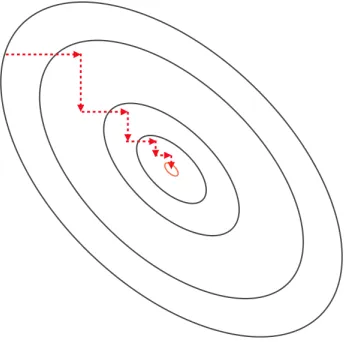
el-liptical paraboloid [14] . . . 15 1.8 Examples of Gradient Descent algorithm for poorly-scaled (left)
and well-scaled (right) coordinate frames. Figures 9.14 and 9.15 from [1] . . . 15
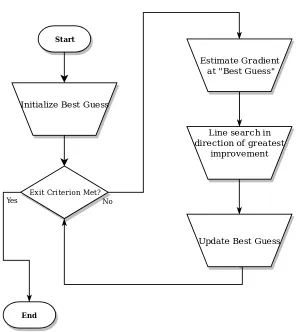
2.1 Flowchart outlining the Gradient Descent method at a high level 17 2.2 Possible positions of points to sample for gradient estimation in
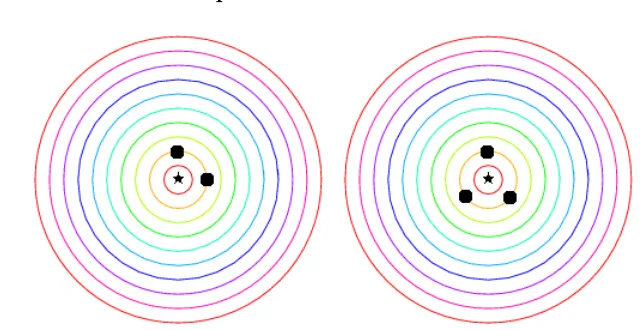
a 2D input space using n points (left) and n+1 points (right), with the best guess (?) already at the minimum cost . . . 19 2.3 Diagram showing iterations of the Gradient Descent algorithm
with too large (left) and too small (right) of a fixed step [4] . . 22 2.4 Diagram showing iterations of the Gradient Descent algorithm
with variable step sizes selected via Backtracking Line Search [4] 23 2.5 Diagram illustrating the exit condition for the Backtracking
Line Search [4]. . . 24 2.6 Fixture used for testing IPMC blocking force. . . 26 2.7 IPMC specimen set up for testing . . . 27 2.8 Diagram of force sensor used to measure IPMC blocking force [2] 28 2.9 IPMC fixture used to mount and supply power to IPMC samples
2.10 Layout of sensor showing strain gauge configuration and attach-ment to the nitinol wire. . . 30 2.11 Layout of sensor showing strain gauge positioning on the nitinol
wire. . . 30
3.1 Sensor setup during calibration . . . 38 3.2 Calibration sensor setup showing transparent box used to
pro-tect setup from drafts . . . 39 3.3 Sensor Calibration Data (incl. discarded data). Applied loads
given in grams-force ([gf]) . . . 40
3.4 Sensor Calibration Data with Linear Fit . . . 41 3.5 Dynamic sensor response to large deflection ( 2 [cm] at tip) . . 42 3.6 Undesired transient effects in sensor readings . . . 43 3.7 Normal Test Data, no visible transient effects . . . 44 3.8 Hysteresis in measured IPMC force for low input voltages . . . 45 3.9 Hysteresis observed in IPMC displacement as a function of input
voltage [8] . . . 46 3.10 Transient shift in data baseline leads to what appears to be
a large amount of hysteresis, which can be corrected by post-processing data . . . 48
4.1 Appearance of IPMC during step 5 of preparation (initial re-duction process); this differs from the description provided in [15] . . . 50 4.2 Appearance of aluminum foil lid after step 11 of IPMC
prepa-ration (secondary plating process) . . . 51 4.3 Sample Test Data, with error bars representing the 95%
Confi-dence Interval for the sensor readings . . . 57
C.1 Script used to sample sensor and drive IPMC specimen, 1/2 . 63
C.2 Script used to sample sensor and drive IPMC specimen, 2/2 . 64
C.3 Test Script Front Panel . . . 64
D.1 Early completed IPMC sample (left) and later sample (right). Boiling longer in 2N hydrochloric acid and additional sanding reduced the amount of surface area of the IPMC covered by the visible dark splotches. . . 65 D.2 Untrimmed specimen edge (left) compared against trimmed edge
Chapter 1
Introduction and Literature Review
[image:11.612.216.411.270.495.2]1.1
Introduction of Problem
Figure 1.1: IPMC operating principle (from [17])
IPMCs offer advantages over many other material actuators due to
their low actuation voltage and high strains under actuation (in some cases,
beyond 90◦ deflection in a cantilever configuration)[9]. However, the range of
applications for IPMCs is still relatively limited, since the actuator force is low
to improve the maximal actuator force, and forces up to approx. 0.3 N [16]
have been observed, however the forces are still too small to find widespread
use. Furthermore, the ratio of output force to input voltage is much less than
for more widely-used actuators, such as piezoelectric actuators. Most research
into the optimization of IPMC performance to date is centered around varying
a few design variables at a time, such as actuator thickness [9] or variations in
the properties of a few chemical processes involved in IPMC manufacturing,
such as the concentration of a reducing agent [22], with only one or a few
different outputs to optimize for a given study, such as blocking force [9] or
response time [13]. Several aspects of the performance of IPMCs, such as
saturation voltage and steady-state power draw have received relatively little
attention, and could be used as metrics in classifying the utility of IPMCs as
actuators. This study seeks to build on previous research to expand knowledge
related to optimization of IPMC performance.
In order to optimize any performance metric of IPMCs, without a valid
analytical model relating that performance metric to a select set of input
pa-rameters, a technique must be used which operates totally independently of
such a model. Several of these exist and are used in practice for different
applications, such as Gradient Descent, Coordinate Descent, Genetic
Algo-rithm, and Simulated Annealing. These methods are most frequently used
in simulation, rather than in conjunction with experimentation, and are
typ-ically designed under the assumption that it takes a relatively small amount
parameters. IPMCs can, however, take several days each to make, and thus
a technique is desired which requires the preparation of a minimal number of
samples. This study seeks to utilize such an optimization technique to make it
suitable for use in optimizing IPMC performance. To that end, the following
was performed:
• Aggregated existing research on the optimization of IPMC performance
– Selected 2 process parameters to target: the concentrations of
plat-inum salt in the initial reduction and secondary developing
pro-cesses in IPMC preparation.
– Selected Gradient Descent as a suitable optimization technique to
use
– Selected blocking force as an appropriate performance metric to
optimize
• Demonstrated the chosen optimization technique as applied to improving
the selected performance metric over the parameters targeted
– Fabricated 2 IPMC samples for an initial set of values for the
tar-geted parameters
– iterated on these values according to the gradient descent technique,
using multiple samples for each set of parameter values required for
1.2
Literature Review
EAPs have potential as actuators due to their large deformation under
small input voltages and have generated sifnigifcant interest within the last ten
years [19]. During this time, new materials were developed which drastically
improved the potential for EAPs, specifically IPMCs, for practical use. There
is, however, still a substantial amount of improvement necessary to overcome
current limitations of EAPs (such as low actuation force and mechanical
en-ergy density [19]) before they can see more widespread use. Several previous
authors have explored the notion of altering various parameters related to
IPMC fabrication for better performance. Labrador [9] found, for example,
that doping the actuator in an LiCl solution drastically increased the amount
of strain exhibited under actuation. There exists a consensus among authors
who have included membrane thickness as a design variable in an
optimiza-tion study that there is inverse relaoptimiza-tionship between membrane thickness and
maximum deflection [13, 16, 19] as well as between membrane thickness and
response time [11, 16]. In addition, it is generally seen that, along with a
de-crease in maximum deflection, a thicker membrane leads to a higher maximum
actuator force [9, 11, 16]. Ruiz [19] found, however, that, at least for the case
of a rod-shaped IPMC actuator, the blocking force does not increase in an
unbounded fashion with respect to thickness; i.e. there is a finite thickness for
which the actuator force is maximum. The result was, however, derived
indi-rectly from a computational model of an IPMC and was not diindi-rectly verified
the relationship between space-charge density (which Ruiz argues is analogous
to blocking force) and specimen radius changes, if at all, with respect to other
parameters. For example, the thickness yielding maximum blocking force for
an IPMC actuator may depend on the length of the specimen. Other
re-Figure 1.2: IPMC blocking force vs membrane thickness [9]
searchers have also looked at altering different chemical properties of IPMCs
to improve actuator performance. Labrador [9] found, for instance, that
dop-ing the Nafion membrane in LiCl before manufacturdop-ing the actuator resulted
in an increase in maximum deformation of two orders of magnitude vs.
non-doped Nafion. Another approach to altering IPMC chemistry is changing the
electrode material. Researchers have used everything from Buckypaper [9] to
pure platinum [22] to palladium-platinum (Pd-Pt) [16] to gold-sputtered
[image:15.612.121.539.217.436.2]spite of the fact that so many different approaches exist for fabricating IPMC
electrodes, it is difficult to directly compare the performance of different
mate-rials against one another, as there exists no controlled set of parameters under
which a wide variety of materials have been tested. Each study uses IPMCs
of a varying sizes, with varying input voltages and with inconsistent
manu-facturing processes. Along with the chemical composition of the electrodes,
different methods have been explored to improve the electrical properties of
the electrodes. In general, increasing the amount of electrode material seems
to improve actuator force without significantly affecting maximum deflection
[22]. Yu et al. [22] found that increasing the concentration of platinum during
themanufacturing stage, where an electrode is chemically grown on the Nafion
membrane, can allow the electrode to be more thoroughly embedded into the
membrane, significantly reducing the overall resistance at the interface
be-tween the electrode and the nafion membrane. The decrease in resistance was
found to lead to a significantly higher blocking force.
In general, IPMCs seem to perform better when the resistance in each
electrode is reduced, and the penetration depth of the electrode is increased.
However, researchers have yet to quantify the effects of penetration depth in
any meaningful way. One further property of the interface between the
mem-brane and electrode, which seems to be of importance along with electrode
penetration depth, is surface roughness of the ionic membrane onto which the
electrode is deposited. Some researchers have included surface roughing
but have not included any experimental justification for doing so. Wang et
al. [21] specifically observed the effectiveness of surface roughing on
actua-tor performance. Wang et al. highlighted several methods for roughing the
nafion membrane (Figure 1.2, and of these selected sandblasting, which
intro-duced an added step in IPMC manufacturing, where residual granules must
be chemically rinsed from the membrane before plating. Results from the
study demonstrated that using rougher sandblasting powder, over a longer
period of time, yields both higher maximum deflection and higher blocking
force. Plasma etching, while more costly than sandblasting, could avoid the
aforementioned complexity in manufacturing introduced during sandblasting
while potentially improving IPMC performance further. Kim et al. [7] found
that plasma etching can somewhat improve IPMC performance, however
over-treatment can reduce the actuator performance when compared against that
of an untreated specimen. Zhang et al. [23] directly compared the
effective-ness of plasma etching against sand blasting as a method for improving IPMC
performance. Zhang et al. [23] found that, while plasma etching can
out-perform sandblasting in both maximum deflection and blocking force of the
IPMC, plasma etching also greatly increases the dependence of each of those
characteristics on voltage. It is unclear, however, by the work done by Zhang
et al., how each of these treatments compares to an untreated specimen or
how the altered dependence on voltage behaves over the entire range of useful
input values (from minimum voltage for actuation to saturation voltage), as
due to the increased sensitivity of the output characteristics to changes in the
input voltage for plasma treatment. However, if this sensitivity drops off as
the voltage approaches the saturation voltage, and plasma etching can provide
consistently superior actuator performance for a range of input voltages, then
it can still be considered a viable option for improving IPMC performance, for
cases in which the input voltage can be held near or within that range during
operation.
There has been relatively little research performed to date into the
ef-ficacy of using existing optimization methods to optimize various metrics of
IPMC performance. Lacking an accurate analytical representation of these
metrics as a function of process parameters used when manufacturing the
IPMCs, optimization techniques designed for black-box testing are an
attrac-tive option, as they explicitly operate without this prior knowledge. Yu et al.
[22] sought to improve IPMC performance using Orthogonal Array Testing, a
technique traditionally used for fault testing in software [18]. This technique,
for a set of discrete inputs, seeks to find the set of inputs which leads to some
particular output (i.e. the presence of some fault) without needing to test every
single combination of inputs. The technique requires selection of orthogonal
combinations of inputs, that is inputs that are both balanced and that are
dis-similar from one another. To improve IPMC performance, Yu et al. [22] used
a set of three possible values for each of three process parameters. Low, center
and high values used were used for the concentration of reducing agent for
dur-ing this process, and the concentration of Tetraethyl Orthosilicate (TEOS),
which was mixed into Nafion solution and then cast as such into the shape
of a sample. The technique provided large improvements in blocking force
(Figure 1.5), and provided some insight into the sensitivity of the blocking
force and displacement of IPMCs subject to changes in these parameters, with
the platinum salt concentration (Figure 1.2) and TEOS concentration having
a substantially larger impact than reducing agent concentration on blocking
force and maximum deflection. However, the approach taken by Yu et al. [22]
was limited in resolution, as the input variables must be discretized roughly
to avoid excessive testing. The technique is thus most suitable for situations
where the desired variables to test are already discrete, as techniques designed
for continuous variables can often not be applied for discrete variables. Some
examples of such variables are type of metal to plate onto IPMC, cation
el-ement, and the addition of some extra manufacturing step. However, such a
technique designed for continuous variables is desireable where the variables
are, in fact, continuous, as useful information can be gained in between
adja-cent discrete steps.
Lee et al. [10] used a simple form of such a method, and attempted to
improve the blocking force of a simulated actuator assembly constructed from
multiple IPMCs, although the technique used can also be applied to physical
IPMCs as opposed to simulated ones, and can be applied to optimize the
blocking force of a single cantilevered IPMC rather than an actuator assembly.
single parameter (IPMC length), given that the other parameters were all
fixed. However, this does not translate well to higher-dimensional parameter
space, as the desired output parameter may not depend on each input variable
independently of one another. Thus, if this technique were extended even to
just two parameters to vary, varying one at a time, each time a best value
is found for one parameter, another search would need to be performed with
the other parameter (Figure 1.2), until some convergence criterion is met for
both parameters. The approach could lead to a high number of iterations as
the algorithm zig-zags or spirals in on the combination of values which, when
combined, produce the best overall result (in this case, the highest blocking
force). The generalization of this technique is referred to as Coordinate Ascent,
or Descent if it is desired to minimize the output metric.
The technique of Gradient Descent described by Boyd & Vandenberghe
[1] serves as an iterative method for optimizing any quantifiable, continuous
performance metric resulting from any finite number of continuous input
pa-rameters, and avoids some of the issues arising from a more na¨ıve approach
when used for higher dimensions. The technique involves finding the gradient
of the desired output metric (cost), then iteratively performing a line search in
the direction of greatest descent and recalculating the gradient until a
conver-gence criterion is met. The approach is similar to coordinate descent/ascent,
but each line search is performed in a direction believed to give the greatest
improvement in cost.
algorithm, and highlights some of the challenges associated with the method.
If the cost is much more sensitive to changes in some directions than others,
the algorithm will have difficulty converging, and may do so very slowly. In
addition, the gradient descent method is a convex optimization technique.
Thus, it is only guaranteed to find the true minimum of the cost if the cost
is a convex manifold over the set of input parameters, ensuring that any local
minimum is also a global minimum. Otherwise, the technique may converge to
a local minimum which is not the true global minimum, providing improvement
Figure 1.4: SEM images of the nafion surface after various roughing [21]
Figure 1.7: Example of the coordinate descent algorithm applied to an ellipti-cal paraboloid [14]
[image:25.612.421.573.410.594.2]Chapter 2
Background
In order to improve some quantified attribute (e.g. financial cost,
effi-ciency, impact toughness) of a process, device or system lacking a closed-form
solution by varying some controllable parameter or set thereof, numerical
tech-niques are often utilized. The most common approaches are variants of the
Gradient Descent Algorithm, which is used to iteratively drive some arbitrary
cost toward a local minimum with respect to any number of continuous input
variables. Because of the generality of this method, it is investigated here in
further depth. In addition, because any numerical technique as applied here
depends on precision in recorded measurements, a test setup is required which
is sensitive to incremental differences in loads of the scale of those supplied by
IPMCs (e.g. sufficient to differentiate between samples with 1 [mN] and 1.2
[mN] blocking force); such a test rig is described here based on [2].
2.1
The Gradient Descent Algorithm
The general outline for the gradient descent algorithm is as follows:
1. Decide on a numerical calculation to minimize (for applications where
Figure 2.1: Flowchart outlining the Gradient Descent method at a high level
generator, simply take the negative of the calculation to minimize)
2. Begin with some ”best guess”, i.e. estimate of the optimal input
param-eters (i.e. the set of input paramparam-eters estimated to produce an optimal
cost)
3. Estimate the gradient of the cost with respect to the input parameters,
4. Move the best guess some amount in the direction of the steepest descent
of the gradient
5. Repeat steps 3-4 until some convergence criterion is met, or some
maxi-mum number of iterations is reached
2.1.1 Gradient Estimation
Step 3 of the above process is performed in several ways, depending on
the application and specific implementation of the gradient descent algorithm.
Here, the gradient is approximated by predictably sampling points near the
best guess and summing the vectors representing the shifts in input parameters
between the best guess and each sample. The vector is then normalized and
weighted by the improvement in the cost as follows:
~
∇C|~xi ≈
1
n
n X
j=1
(C(~x∗
j)−C(~xi))∗(~x∗j −~xi)
||~x∗j −~xi||
(2.1)
where C is the cost function,~xi is a vector of parameter values for theith best
guess, and ~x∗j is the vector of parameters for the jth sampled point near ~xi.
To calculate the euclidian norm||~x∗j−~xi||, there must be equivalence of units
across every parameter in~xi. For applications where the units do not naturally
equate, some equivalence factor must be used. For example, if one parameter
is temperature, and a second is concentration of a chemical, it could be decided
that a change of 1 mmol is ’equivalent’ to a change of 0.3 ◦C. Ideally, these
should be selected such that a change of one “unit” in any direction from the
irrespective of which variable or variables are changed.
[image:29.612.148.470.170.335.2]2.1.2 Selection of Sample Points for Gradient Estimation
Figure 2.2: Possible positions of points to sample for gradient estimation in a 2D input space using n points (left) and n+1 points (right), with the best guess (?) already at the minimum cost
For cases where sampling a single point is time-consuming, such as in
the production of IPMC samples, which takes multiple days, it is desirable
to sample as few points as possible while still ensuring that there exists
suffi-cient information at each iteration for the gradient descent algorithm. Na¨ıve
thinking would indicate that n points in n-dimensional space (i.e. for varying
n different parameters to improve cost) should suffice, where each point lies
along an axis aligned with the input parameters, but in the numerical case,
this may be insufficient, and may prevent the gradient descent algorithm from
converging properly. To illustrate this for a simple case, if a current best guess
truly lies on a local minimum of a smooth cost function in 2 input dimensions
de-scribed would indicate that the cost decreases most steeply in the direction
(-x, -y), when, in fact, the gradient should be approximately 0 (indicating
convergence). Thus, it is necessary that the points selected be roughly evenly
spaced about the best guess. However, if only 2 points are selected for 2 input
variables, and they are spaced evenly around the best guess, they will be
di-rectly opposite one another, and will provide no information in the transverse
direction. This can be avoided by adding a single point to sample. As a result,
for n input variables, at least n+1 points must be sampled to have sufficient
information to allow the gradient descent algorithm to function properly. The
problem of placing a minimum number of points about the current best-guess
thus becomes the problem of placing n+1 points evenly on an n-dimensional
hypersphere. A convenient method for doing this follows without proof:
1. Select one point a distance of one unit along the first input parameter
(~x∗1 = [1 0 · · · 0]T)
2. Assign a value of −1
n−1 for the first index of every remaining point (this
ensures that the arithmetic mean of the set of n vectors is the zero vector)
3. For the second point, assign the second coordinate a value such that the
magnitude of the vector is 1, and all values after the second coordinate
are 0 (for the 4D case, where ~x∗1 = [1 0 0 0]T, ~x∗2 = [−41
√
15 4 0 0]
T.
4. For the remaining n-1 points, select the second coordinate as a uniform
value such that the arithmetic mean across the second coordinate is 0
5. Continue this process for all remaining coordinates and vectors. For
the last two vectors, there should be two possible values for the final
coordinate such that it has a magnitude of 1 (a positive and a negative);
these are the values for the last coordinate of each of the last two vectors.
For the 4D case, the vectors are thus:
1 0 0 0 , −1 4 √ 15 4 0 0 , −1 4
−q5 48 q 5 6 0 , −1 4
−q5 48
−q5 24 q 5 8 , −1 4
−q5 48
−q5 24
−q5 8 (2.2)
6. Using the previously set equivalence factors, convert each value of each
vector into a corresponding input parameter with units
7. This set of vectors represents perturbations from the best guess. The
entire set may be scaled by a constant factor to ensure the following:
• That the changes in input values are large enough they produce
a measurable change (i.e. large enough with respect to all noise
resulting from process and measurement uncertainty) in the overall
cost, and
• That the perturbations are not so large as to skip over important
features of the cost over the input space (e.g. local extrema).
Gen-erally speaking, the smaller the perturbations, the closer the
ap-proximation is expected to be to the true gradient, but also the
8. Add to the set of vectors the current best guess, and these are the points
to sample at each iteration.
The perturbation vectors do not depend on the current best guess, so these
can be precomputed once and used for every iteration, meaning only the last
step is necessary to perform at every iteration.
[image:32.612.157.475.296.451.2]2.1.3 Step Size
Figure 2.3: Diagram showing iterations of the Gradient Descent algorithm with too large (left) and too small (right) of a fixed step [4]
Once the estimate of the gradient has been calculated, the best guess
must be moved in the direction of steepest descend (opposite the gradient
vector) by some amount. There are several methods for determining the step
size to use, such as simply using a fixed scalar multiplied onto the magnitude of
the gradient (Figure 2.1.3), but using a fixed step size requires precise tuning
Figure 2.4: Diagram showing iterations of the Gradient Descent algorithm with variable step sizes selected via Backtracking Line Search [4]
There exist, however, methods which choose a step size adaptively, and one
such method is used here, namely the Backtracking Line Search as described
by Boyd & Vandenberghe [1]. This method is more robust than a fixed step
size to deviations in the scale of the gradient, is relatively simple, and tends
to select an appropriate step size without too many iterations (Figure 2.1.3).
The Backtracking Line Search is carried out as follows:
• Select parameters 0 < α <0.5 and 0< β < 1
– α is related to the exit condition for the backtracking line search,
and is recommended by Boyd & Vandenberghe [1] to be selected
between 0.01 and 0.3 (0.1 used here)
– β relates to how quickly the step size decreases (values closer to
1 decrease more slowly). Boyd & Vandenberghe [1] recommend
respectively. A slightly more crude search (0.4) is to be used here for
the initial line search, to balance the number of iterations required
for the line search with the desire to take a suitably large step, which
can reduce the number of times the gradient must be estimated, and
thus reduce the number of samples required overall.
• begin with a parameter t =t0, and do the following:
1. If the exit condition
C(~xi−t ~∇C(~xi))≤C(~xi)−αt∗ ||∇C~ (~xi)||2 (2.3)
is satisfied (Figure 2.1.3), exit the search with the new best guess
as~xi−t ~∇C(~xi)
2. Otherwise, updatet :=βt (this requires the production of an
[image:34.612.186.447.461.603.2]addi-tional sample) and repeat.
Figure 2.1.3 provides a visualization of the Backtracking exit condition. The
slope of the lower dashed line is the gradient of the cost at t=0, f(x) is the cost
along the direction of the gradient, and the upper dashed line is the threshold
for the line search. t is updated until the sampled pointf(x+t∆x) lies below
the upper dashed line.
The entire gradient search is carried out until some exit criterion is
reached. There are a few commonly used ways to formulate this exit condition,
such as a threshold on the proportion of improvement of cost between one
iteration and the next, i.e. ∆CC ≤ , where is a cutoff threshold, such as
= 10−4. Another common condition is that the gradient have a sufficiently small magnitude, e.g. ∇~CC < ). These two exit criteria are similar for the
gradient descent method, as the step size at any iteration is proportional to
the magnitude of the gradient. The exit criterion ∆CC ≤ may cause the algorithm used here to exit earlier than desired for a given , in particular if
the β selected for the backtracking search is small and α is large, as this can
cause the line search to take a step which is especially small proportional to
the gradient when compared with other steps taken, causing a smooth cost
function to have very similar values between iterations of the gradient descent
search, leading to undesired termination. The gradient descent search is not
carried out for multiple iterations in this study, and thus the selection of an
2.2
Testing Equipment
[image:36.612.154.474.162.550.2]2.2.1 Test Rig
Figure 2.6: Fixture used for testing IPMC blocking force.
For testing the blocking force of the IPMC samples produced, a test rig,
shown in Figure 2.2.1 and slightly modified from that described by Chiu [2],
Figure 2.7: IPMC specimen set up for testing
opposing strain gauges affixed to the wired with JB Weld (Figures 2.2.1,2.2.1)
as a voltage divider to measure bend in the wire, and thereby applied force
at the tip of the wire. The IPMC specimen was screwed between two pads
made of 1/8” graphite gasket, each of which is connected to a wire lead with
Nickel-based conductive glue (Figure 2.2.1). The connection was sealed with
Amazing Goop all-purpose adhesive to prevent oxidation of exposed copper
Figure 2.8: Diagram of force sensor used to measure IPMC blocking force [2]
during testing, as seen in 2.2.1, along with the tip of the nitinol wire, which
was set at a distance of 1.065 [in] from the top of the graphite pads for all
tests performed. The nitinol was angled such that an IPMC sample would not
easily lose contact with the wire during testing. In order to allow the bottom
of the assembly to be submerged while mimimizing the amount of exposed
metal kept underwater to reduce rust formation, and to fit the bottom part
of the test rig into the available glassware, a new bracket (Appendix A) was
designed and 3D printed to replace the lower aluminum bracket in [2] holding
the IPMC sample.
2.2.2 Data Acquisition
An NI MyDAQ with a 10-bit Analog-Digital Converter (ADC) was
used to capture data. Both the signal pin as well as the voltage source for
the voltage divider were measured, and the sensor signal was taken to be the
signal pin voltage divided by the source voltage at every time step. The process
was done to keep the signal constant with respect to variations in the input
Figure 2.9: IPMC fixture used to mount and supply power to IPMC samples during testing
although due to the MyDAQs relatively low current limit on the analog output
pins, an op-amp circuit with unit gain was used as a buffer (Appendix B), so
that the current could be supplied by a secondary power supply rather than
the MyDAQ. Fairly severe current-limiting was still observed for higher input
voltages and for certain IPMC samples, and so the second channel of the op
amp integrated circuit (IC), as well as both channels of six additional identical
LM2094N op amps, also with a unit gain, and the outputs were connected to
Figure 2.10: Layout of sensor showing strain gauge configuration and attach-ment to the nitinol wire.
Chapter 3
Methods
3.1
Sample Production
In order to execute the gradient descent search, several IPMC samples
must be prepared and measured. For this study, IPMC samples of size 6cm x
1cm x - were made using a tweaked version of the IPMC cookbook provided by
NASA JPL [16], outlined Below. All values are presented per [cm2] of sample
area and all values were multiplied by 6 [cm2] for the samples used here. The
approach used was to:
1. Sand and cut IPMC sample to size from Nafion sheet. Each sample
was sanded lightly with 150 grit sandpaper, then vigorously with 800
grit sandpaper until the IPMC took on a matte, minimally translucent
appearance. In future studies, this should be replaced, ideally, with a
process which can be more precisely controlled, such as sandblasting.
Oguro [15] recommends fine glass beads in a dry sandblasting process
for 1 [s] per [cm2] of area of the IPMC sample.
2. The sample was cleaned in DI water in an ultrasonic cleaner for 1-3
3. The sample is set in boiling 2M HCl for 30 minutes
4. The sample is rinsed in DI water, then set in boiling DI water for 30
minutes.
5. The sample is immersed in Pt solution comprised of ≥3[cmmg2] Platinum
salt in 2[cmmL2] DI water
6. After immersing in Pt solution, 601[cmmL2] 10% Ammonium Hydroxide
so-lution is added to balance the soso-lution’s pH. This soso-lution is left to sit
overnight.
7. Sample is placed in 6 [cmmL2] stirring water at 40
◦C
8. Every 30 minutes, 7 times, 151 [cmmL2] 5% Sodium Borohdyride is added to
the stirring water, gradually increasing the temperature to 60◦C at the
end of the 7th 30-minute period.
9. 23[cmmL2] Sodium Borohydride is added to the stirring water 30 minutes
after the 7th addition in step 8, and the solution is left to stir at 60◦C
for 90 minutes.
10. The sample is rinsed in DI water and immersed in 0.1M HCl for 1
hour. After this, the specimen was rinsed and allowed to sit in DI water
overnight. This step may be skipped, but was included here to allow the
11. The sample is immersed in a stirring solution comprising 4[cmmg2] Pt salt,
8[cmmL2] DI water, and
1 12[
mL
cm2] 10% Ammonium Hydroxide, at 40
◦C.
12. Every 30 minutes, 8 times, 15[cmmL2] 5% Hydroxylamine Hydrochloride and
1 10[
mL
cm2] 20% Hydrazine Hydrate were each added to the stirring solution,
while gradually increasing the temperature to 60◦C. At the end of the
8th 30-minute period, some of the stirring solution was sampled along
with some sodium borohydride. The solution was brought to a boil in
a water bath. If black flecks formed, the temperature of the stirring
solution was maintained at 60◦C, and more hydroxylamine
hydrochlo-ride and hydrazine hydrate were added. Periodic sampling was done
to test for the formation of black flecks. Additional hydroxylamine
hy-drochloride and hydrazine hydrate were added until said flecks no longer
formed.
13. The sample was rinsed in DI water and boiled in 0.1M HCl for 30 minutes
14. The sample was allowed to soak in 1.5M LiCl solution at room
temper-ature for 3 days.
15. The edges of the sample were trimmed by hand with a sharp knife to
remove platinum from the edges of the sample. Trimming prevented
current from routing around the Nafion due to the voltage difference
between the faces of the IPMC. Instead, it is sent through the Nafion,
inducing mechanical action. The amount of deflection was visibly much
performing this so it was been performed for each subsequent sample.
The exact effects thereof are not quantified here. The amount trimmed
off was as little as possible while ensuring that no more platinum on
the edges of the IPMC was visible (Appendix D). Ideally, this should
be performed in some more precise way than by hand with a knife,
but trimmings of width 0.008 [in] were achieved in this manner. For
the purposes of this study, to reduce the number of separate sample
preparation procedures, each sample was additionally cut in half (to
make two 1 [cm] x 3 [cm] samples), and each half was tested separately.
The cost function was selected as the negative of the IPMC blocking force,
thus maximizing the blocking force. Steps 5 and 11 were selected to vary
for the Gradient Descent algorithm, varying the mass of platinum salt during
each step while keeping the volume of water fixed. It was desired that sanding
also be included as a varying parameter, however due to the unavailability
of a suitable sandblaster, this became a difficult parameter to appropriately
quantify and vary precisely, and was thus excluded from the graident descent
search. Because the two parameters to be varied have identical units, the
conversion factors comparing the units of each parameter to one another is
unnecessary. One could be used if it was predicted that the cost would be
much more sensitive to changes in one step as compared with the other, but
lacking that insight here, this was omitted. Points were sampled at a radius of
2 [mg] from the current best guess, with an ”equivalency factor” of the same
allows that||~x∗j−~xi||= 1 for all j. The coordinates were ordered with the steps
chronologically. Thus, using the method outlined in 2.1.1, the perturbation
vectors are as follows:
~ δx∗1 =
2 0
[mg], ~δx∗2 =
−1
√
3
[mg], ~δx∗3 =
−1
−√3
[mg] (3.1)
Selecting the initial best guess as 25 mg Pt for both parameters (for an IPMC
with area 6 [cm2]), the points to sample for the gradient approximation are
thus:
~x∗1 =
27 25
[mg], ~x∗2 =
24 26.73
[mg], ~x∗3 =
24 23.27
[mg] (3.2)
IPMC samples were prepared for each of the above, as well as the best guess
itself.
3.2
Materials and Equipment
The materials used to create the IPMC samples as per Section 3.1 are
as follows:
• 2N Hydrochloric Acid (HCl)
• 0.1N HCl
• Nafion 117 from DuPont
• Platinum Salt (Tetraammineplatinum(II) chloride hydrate)
• Hydrazine Hydrate 20%
• Sodium Borohydride 5%
• Deionized (DI) water
• Ammonium hydroxide 10%
The equipment used during the manufacturing of IPMC samples is as follows:
• Digital Scale
• Fisher Scientific IsoTemp hot plate/stirrer with closed-loop control
(tem-perature input with resolution 5◦C)
• Thermo Scientifict Chermical fume hood
• Small pocket knife
• Branson 2510 ultrasonic cleaner
• 800 grit sandpaper
• 150 grit sandpaper
• assorted beakers and test tubes
• Eppendorf 1000 µL pipette and tips
• Aluminum foil
The materials and equipment used in testing the manufactured samples is as
follows:
• 7x LM2904N dual-channel digital op-amp
• 4x 10kΩ resistors, 5% tolerance
• Omega TrueRMS SuperMeter multimeter
• MPJA 14601PS DC power supply
• Shenzhen Mastech HY3003-3 dual-channel DC power supply
• Weller General-Duty Soldering Iron
• Assorted header pins and wires
• National Instruments MyDAQ module with LabView 2014
3.3
Sensor Calibration
To calibrate the sensor, it was removed from the test rig and clamped
to a table as shown in Figure 3.1. In Figure 3.1, a loop string was affixed to
the end of the nitinol wire with a small dab of glue. Weights of various masses
(0.05 [g] to 1.2 [g]) were cut from scrap wire to hang on this loop, and were
massed via a digital scale. While the sensor data was being collected, the setup
was covered with a plastic box jutting over the edge of the table, as shown in
Figure 3.2, to prevent drafts in the room from impacting sensor readings. A
Figure 3.1: Sensor setup during calibration
supply voltage pins at 1 [kHz] for 10 [s]. The script displayed a graph of the
set of measurements (as Vs Vi, i.e.
Vsignal
Vsupply) for visual verification, and reported the
arithmetic mean of the sensor signals. All loads were measured as the ratio of
these signals, during calibration as well as data acquisition. This helps prevent
noise in the input voltage as well as changes from touching the power supply’s
voltage knobs from impacting the sensor reading.
The sensor was measured with various combinations of weights hanging
from it, beginning and ending with none, and the results were collected in an
Excel spreadsheet. It was found that the sensor did not initially produce
meaningful results. As shown in Figure 3.3, there is a cluster of relatively
unorderd data points with no clear trend. This occured during initial loading
and unloading of the sensor and tended to drive the sensor readings toward
Figure 3.2: Calibration sensor setup showing transparent box used to protect setup from drafts
sensor, and the data taken before the readings settled to a consistent no-load
value were discarded. Because the order in which the data were collected was
preserved, and the slippage occurred only near the beginning of the calibration
procedure, the rejected data were selected as those data having been recorded
on or before the last clear outlier, as determined visually. A linear regression
was performed on the remaining data (Figure 3.4), and the slope was used
Figure 3.3: Sensor Calibration Data (incl. discarded data). Applied loads given in grams-force ([gf])
from [gf] and the slope of the curve was found to be 54.4 [N]. The sensor was
only calibrated in one direction, as all samples can be set up to press into
the nitinol wire from the same direction. Testing in a single direction is also
performed to prevent the sensor from continuing to slip after settling initially.
It was noted that, if the nitinol whisker was deflected too much (≥ 2
[cm] at the tip) during setup or during manual adjustment of the IPMC setup,
the zero-weight reading may change significantly and unpredictably. Upon
further investigation, this appears to have nonnegligible dynamic behavior
(Figure 3.5). It is believed that this is due to the nitinol wire slipping against
Figure 3.4: Sensor Calibration Data with Linear Fit
bend in the nitinol wire. Ideally, the nitinol wire should be clamped in such
a way that it cannot slip (e.g. by epoxy). In this study, to allow the nitinol
wire to be removed or adjusted if necessary, the sensor was left with just set
screws fixing the nitinol wire in place. To prevent the slippage from altering
data, the weights were added and removed carefully, and the sensor was tested
with no weights both before and after all other sensor readings to ensure this
value had not changed during testing. During testing of the IPMCs, this
dynamic sensor behavior was avoided in a similar way, by not disturbing the
sensor during testing, and by testing loading conditions in the increasing and
Figure 3.5: Dynamic sensor response to large deflection ( 2 [cm] at tip)
slippage from altering test readings, the test procedure was performed without
recording data, until the LabView display showed no signs of transient effects
in the sensor readings outside of those expected, i.e. when the data look
like Figure 3.7 as opposed to Figure 3.6. Later, post processing of the data
was performed to correct for this slipping (Section 3.4.1) thereby reducing the
number of tests necessary to gather the required data. The apparent square
wave in the data is an expected feature, and is explained in detail in the
Figure 3.6: Undesired transient effects in sensor readings
3.4
Sample Testing
A LabView script was developed to automate the test process
(Ap-pendix C). The script applies voltage in 0.1 [V] increments to the IPMC, up
to 3.3 [V], then back down to 0 [V]. Above some voltage ( 2.5 [V] for most
samples tested), oxidation began at the interface between the graphite pads
and the IPMC sample and, as some current is diverted to the oxidation
pro-cess, and lacking a way to accurately measure the voltage drop through the
graphite pads and through the interface with the IPMCs resulting from this,
test data was truncated such that data from input voltages exceeding this
Figure 3.7: Normal Test Data, no visible transient effects
3.4.1 Data Collection and Processing
Each data point was taken as the arithmetic mean of the data beginning
at some offset from the time when the voltage was first applied, to allow the
dynamics of the IPMC/sensor combination to settle to approximately
steady-state condition, and the time when the input voltage shifts again. A good
value for the offset was determined empirically, for the IPMC samples tested
here, to be 15 [s]. A smaller value may be sufficient, but this left 45 [s] of
data at a sampling rate of 1000 [Hz] for each data point, which is a substantial
amount of data, and which leaves acceptably small error bars as discussed in
Section 4.3.
Figure 3.8: Hysteresis in measured IPMC force for low input voltages
[V] to 3 [V] and back, the force did not return to its original value. However,
unlike during the sensor calibration, the deflections of the tip of the nitinol
remained well under 1 [cm] during testing, and this amount was consistent
between tests. It was discovered that creating a short circuit across the IPMC
leads, only after removing any applied voltage, caused dynamic behavior in
the IPMC (the opposite direction as when applying the voltage initially,
indi-cating relaxation in the specimen), even if the IPMC had been provided with
a 0 [V] difference between its faces prior to shorting the actuator. A similar
phenomenon was observed by Kim & Kim [8], that IPMCs retain some
dis-placement, and thus, due to the electromechanical action involved in IPMC
displacement, some voltage, even after the IPMC is supplied with a 0V
Figure 3.9: Hysteresis observed in IPMC displacement as a function of input voltage [8]
during the automated testing by applying a -3 [V] signal to the IPMC in
between each 0.1 [V] increment/decrement. This was not predicted to have
precisely the same effect as short circuiting, however it ensured that every test
was performed in the “voltage increasing” direction, and could thus be
com-pared against one another. With these changes, the overall testing procedure
for a single prepared IPMC specimen was as follows:
1. Mount the IPMC specimen in the designated fixture (Figure 2.2.1) by
screwing the graphite pads together with the IPMC in contact with the
last 1 [mm] of the nitinol wire
2. Ensure all electrical connections are wired properly, with no visible short
circuits and with all connections attached
3. Turn on power supplies (≥ 5 [V] for the Op Amp array input power, 5
4. Run test procedure in LabView
• Step from an input voltage Vipmc of 0 [V] up to 3.3 [V] in 0.1 [V]
increments, holding at each value for 60 [s] (to allow setup to
ap-proach steady-state) and with -3 [V] applied for 30 [s] before each 60
[s] interval (to ensure all measurements are in increasing direction)
• Decrement the applied voltage by 0.1 [V] from 3.3 [V] down to 0
[V], still with the 30 [s] sections of -3 [V] before ecah 60 [s] section
After applying the -3 [V] signal, however, large abnormalities in the
data persisted. It was found that the sensor data was still occasionally slipping
(Figure 3.4.1) by enough to clearly disrupt the blocking force data. To correct
for this, the difference between each recorded data point and the sensor value
associated with the previous -3 [V] section was taken, and the values were
subsequently shifted by a constant value such that the arithmetic mean of the
first and last data points (each at an input voltage of 0 [V]) lies at 0 [N] applied
force. The processing made the final data robust to shifts in the sensor data
occurring outside of regions of data used to produce each data point. The
correction does not ensure that all sources of inaccuracy of recorded data are
removed, but regularized the final data substantially, and allowed for a more
reasonable comparison between IPMC specimens. All of the processing on the
Chapter 4
Results and Discussion
In order to reduce the effect of random uncertainty in the preparation
process on the final results, it is desired to have multiple samples to compare
against one another. However, due to the time taken to manufacture a sample,
it can be difficult to produce these samples in a timely fashion. As a
com-promise, a single sample was prepared and split in two, leaving two samples
to measure for each set of variables while still only requiring a single
manu-facturing process for each pair. Overall, an initial guess was prepared, as well
as 3 pairs of nearby samples to calculate the gradient, and a single pair of
samples for the first iteration of the backtracking line search. Some differences
in appearance during the sample preparation process were observed from the
expectation outlined in [15], such as the earlier-than-expected formation of
a dull metallic layer in every sample produced; additionally, the samples cut
from the same IPMC sometimes varied significantly in blocking force, in spite
of the uniformity of the processes affecting each half of the original IPMC.
The execution of the gradient descent algorithm was carried out mostly as
expected, with the caveat that it was not anticipated that an increase in
plat-inum salt concentration should lead to much of a decrease in blocking force
data collected.
[image:60.612.190.442.190.415.2]4.1
Sample Production
Figure 4.1: Appearance of IPMC during step 5 of preparation (initial reduction process); this differs from the description provided in [15]
When preparing IPMC samples, it was expected that the initial
reduc-tion process would leave a black layer of platinum particles as described in
Step 3 of [15], and a metallic sheen was not expected until the secondary
plat-ing process (step 4 of [15], step 11 in Section 3.1), however it was frequently
observed that the IPMC took on a metallic sheen before finishing with the
initial reduction process. Figure 4.1 shows this, with the gray portion on the
right overtaking the black portion on the left over the course of the reduction
in [15], but additionally, during the preparation of the first few samples, it
was found that inadequate sanding caused this process to occur more quickly,
indicating that some more effective way of sanding to increase the effective
surface area of the IPMC (e.g. sandblasting) could cause a closer correlation
[image:61.612.225.405.236.423.2]with the results of [15].
Figure 4.2: Appearance of aluminum foil lid after step 11 of IPMC preparation (secondary plating process)
For the longer processes during sample preparation, aluminum foil was
used to fashion coverings for the glassware used to limit evaporation of the
solution, which otherwise sits uncovered, on heat (up to 60◦C), for several
hours at a time. It was noted that after the secondary platinum developing
process, the aluminum foil changed in apperance, developing a thin black layer
on the surface exposed to the evaporated vapors of the stirring solution (Figure
4.1), which condensed on the aluminum foil. It is possible that this black layer
the weak reducing agent, which condensed onto the aluminum foil. This might
indicate that a nonmetallic cover should be used, to ensure that the IPMC is
the only surface onto which the platinum in solution will develop, however
since an aluminum cover was used during initial sample preparation, one was
used for every sample made, to ensure comparability between all prepared
samples.
4.2
Results and Interpretation
~x1 ~x∗1 ~x∗2 ~x∗3
25 25 27 25 24 26.7
24 23.3
[image:62.612.252.379.485.540.2]
Table 4.1: A list of IPMC samples prepared for gradient estimation (two 1 [cm] x 3 [cm] samples for each pair of values), from Section 3.1. The first coordinate is mass of platinum salt in step 5 (initial electrode reduction step) of sample preparation, and the second coordinate is the mass of platinum salt in step 11 (secondary electrode developing process), for the full 1 [cm] x 6 [cm] sample manufactured.
Fblock
~
x1 ~x∗1 ~x
∗
2 ~x
∗
3
2.26 3.41 1.35 1.18
2.48 2.84 0.94 0.53
Table 4.2: Blocking forces (in [mN]) of each half of each prepared specimen
After the data was processed as outlined in Section 3.4.1, the values
at each voltage increment in the increasing and decreasing directions were
3 cm x 1 cm specimen prepared. The average of these values was used to
calculate the gradient as follows:
~
∇F|~x=~x1 ≈
1 3 3 X j=1
(F(~x∗j)−F(~x1))∗δ~x∗j
=
0.708 0.0829
[mN] =
1.42 0.166
N g
(4.1)
whereδ~x∗j is unit-normalized using the conversion factors described in Section
2.1.1, giving it a magnitude of 1 [-] for all j. This result indicates that, for the
IPMC preparation process described in Section 3.1 for 1 [cm] x 6 [cm] samples,
using 25 [mg] of Pt each for steps 5 and 11, the blocking force is much more
sensitive to the addition of platinum in the initial reduction process (step 5)
than in step 11. This could be related to the formation of a metallic sheen in
the initial reduction phase, and, if it is the case that the sensitivity of blocking
force to changes in platinum concentration in the secondary plating process
is itself dependent on the amount of sanding the IPMC receives, this only
serves to further demonstrate the need for an optimization technique which
can account for multiple interdependent factors, such as the gradient descent
method used here.
Since the Cost C(x) is taken to be the negative of the blocking force
for the gradient descent algorithm, the behavior of the algorithm is that of the
analogous gradient ascent with the blocking force as the objective function.
A value of t0 = 5[N−1] was selected to ensure the first sample in the
line search is sufficiently far from the initial best guess to reduce the number
Fblock
~
x1 ~x2
2.26 2.44
2.48 2.33
Table 4.3: Blocking forces (in [mN]) of each half of the initial best guess ~x1
and the first iteration of the backtracking search ~x2
check in the line search (from Equation 2.3) is
C(~x1−5∇C~ (~x1))≤C(x~1)−0.5∗ ||∇C~ (~x1)||2 (4.2)
This leaves the first point to be sampled for the line search at
x=~x1−5∇C~ (~x1)
=
25 25
[mg] + 5∗
1.42 0.166
[mg]
=
32.1 25.8
[mg]
(4.3)
One pair of 1 [cm] x 3 [cm] (one 1 [cm] x 6 [cm] Nafion strip) IPMCs were
manufactured with these amounts of platinum, and the maximum blocking
forces of each are collected in Table 4.2. The average of these (2.38 [mN]) does
not satisfy the line search termination criterion, as
C(~x2)> C(~x1)−0.5∗ ||∇C~ (~x1)||2
−2.38[mN]>−3.39[mN]
(4.4)
Although it appears that this method has led the search in a direction with
lit-tle benefit (as the blocking forces of this and for~x1 are similar to one another),
however circumstances like this are accounted for with the backtracking line
but closer to~x1 with substantially better blocking force, and the backtracking
search will walk back toward~x1 to find a suitable point. Thus, the next step
of the gradient descent algorithm is to continue with another iteration of the
backtracking line search, with t =βt0 = 2, now checking the criterion
C(~x1−2∇C~ (~x1))≤C(x~1)−0.2∗ ||∇C~ (~x1)||2 (4.5)
One interesting result of this, however, is the implication of the existance of a
local minimum between the initial guess and first iteration of the line search.
Although nothing precludes this from occurring, conventional reasoning
indi-cates that an increase in platinum salt concentration consequently increases
conductivity on the surface of the IPMC, while also affecting the IPMC
thick-ness and overall stiffthick-ness minimally, thus increasing the maximum deflection
and blocking force at the tip of the IPMC. However, barring some unexpected
perturbation to the data forcing both samples of ~x∗1 to be recorded with an abnormally high blocking force, or ~x2 with an abnormally low blocking force
(both relative to~x1), that is what this data indicates: that by increasing the
platinum salt concenteration primarily in step 5, the IPMC samples exhibit the
expected increase in blocking force, then, somewhere, the minimum is reached
and the blocking force declines thereafter, such that by ~x2 with t=[5N−1],
the blocking force is approximately identical to that at ~x1. As can be seen
in Table 4.2, some values (esp. ~x∗3) have a fairly large disparity in blocking force between the two samples. These samples were produced from the same
strip of Nafion, as a single unit, so it is somewhat surprising to see blocking
relatively poor control over uniformity, as it is performed here by hand and
verified visually. It is noted in [21] that the blocking force is fairly sensitive
to changes to the sanding process, and thus it would likely be advantageous
to implement this process in a more predictable, uniform fashion. This would
additionaly provide a way to include sanding in the gradient descent search,
for instance by varying grain size and time in a sandblaster; given the
sensi-tivity of the desired metric to improve, blocking force, to sanding, this could
allow for much greater improvement overall in IPMC blocking force than is
possible by only varying the concentrations of platinum as performed here.
4.3
Measurement Uncertainty
One interesting finding from the data gathered is that some of the
apparent uncertainty or noise in the blocking force values is not captured in
the sensor noise. The error bars in Figure 4.3 are small enough to indicate
that, for the amount of data averaged and the noise in that data for each input
voltage, the blocking force values indicated should be more precise than they
apparently are. None of the data points sharing an input voltage, for instance,
have overlap in their error bars, indicating that the sensor noise represented by
the shown error bars is possibly not indicative of all measurement uncertainty.
This is possibly due to a change in the contact location or angle between
the IPMC tip and the sensor whisker, as the specimen is not affixed to the
sensor, but merely rests against it. Given the sensitivity of the sensor, and
Figure 4.3: Sample Test Data, with error bars representing the 95% Confidence Interval for the sensor readings
the eye and still produce this behavior. That said, the data still do form a
relatively clear underlying curve from which information can be drawn, but
further characterization of the utilized sensor device as it interacts with IPMCs
Chapter 5
Conclusion and Future Work
5.1
Conclusion
Based on prior research, platinum salt mass in each plating process
was targeted as the set of parameters to vary, and the gradient descent
tech-nique with a backtracking line search was selected as an iterative optimization
method for improving IPMC blocking force. This process has been generally
outlined to optimize arbitrary performance metrics of IPMCs with respect
to any number of relevant, controllable input parameters, and was partially
demonstrated for the inputs of platinum salt mass and output metric of
block-ing force. This method, if carried out through several iterations, could serve to
establish precise process parameters to prepare IPMCs with optimal (locally,
at least) performance, thus improving their overall viability as actuators. This
leaves some work for future researchers to carry out in order to see the
opti-mization of IPMC actuation characteristics fully come to fruition.
5.2
Future Work
The process outlined here for optimizing IPMC performance wa
![Figure 1.1: IPMC operating principle (from [17])](https://thumb-us.123doks.com/thumbv2/123dok_us/33136.2616/11.612.216.411.270.495/figure-ipmc-operating-principle-from.webp)
![Figure 1.2: IPMC blocking force vs membrane thickness [9]](https://thumb-us.123doks.com/thumbv2/123dok_us/33136.2616/15.612.121.539.217.436/figure-ipmc-blocking-force-vs-membrane-thickness.webp)
![Figure 1.5: Improvements in IPMC blocking force from Orthogonal ArrayOptimization [22]](https://thumb-us.123doks.com/thumbv2/123dok_us/33136.2616/23.612.150.480.124.418/figure-improvements-ipmc-blocking-force-orthogonal-arrayoptimization.webp)
![Figure 1.6: Scanning Electron Microscope (SEM) images of IPMC electrodepenetration resulting from different platinum concentrations during manufac-turing [22]](https://thumb-us.123doks.com/thumbv2/123dok_us/33136.2616/24.612.170.462.221.495/scanning-electron-microscope-electrodepenetration-resulting-dierent-platinum-concentrations.webp)
![Figure 2.3: Diagram showing iterations of the Gradient Descent algorithmwith too large (left) and too small (right) of a fixed step [4]](https://thumb-us.123doks.com/thumbv2/123dok_us/33136.2616/32.612.157.475.296.451/figure-diagram-showing-iterations-gradient-descent-algorithmwith-xed.webp)
![Figure 2.4: Diagram showing iterations of the Gradient Descent algorithmwith variable step sizes selected via Backtracking Line Search [4]](https://thumb-us.123doks.com/thumbv2/123dok_us/33136.2616/33.612.241.390.113.266/diagram-iterations-gradient-descent-algorithmwith-variable-selected-backtracking.webp)
![Figure 2.5: Diagram illustrating the exit condition for the Backtracking LineSearch [4].](https://thumb-us.123doks.com/thumbv2/123dok_us/33136.2616/34.612.186.447.461.603/figure-diagram-illustrating-exit-condition-backtracking-linesearch.webp)
