COM(93) 557 final
Brussels, 17 November 1993
Communication from the Commission to the Council and the European Parliament
DIGITAL VIDEO BROADCASTING
A Framework for Community Policy
Draft
COUNCIL RESOLUTION
on
a
framework for Community Policy on Digital Video Broadcasting1\ Framework f(Jr Community Policy
Communication from the Commission to the Council and the European Parliament
TABLE OF CONTENTS
Introduction
PARTl TilE POTENTIAL OF DIGITAL VIDEO BROADCASTING
1.1 Advantages of Digital Television
1.2 The Digital Television Chain
1.2.1 Source Coding
1.2.2 Multiplexing
1.2.3 Modulation and Channel Coding
1.2.4 Conditional Access
1.3 The Service Potential
1.4 Research and Development
1.5 Standardization
1.6 Implementation Issues
1.6.1 The Issue of Spectrum Availability
1.6.2 The Issue of Timescales
1.6.3 The Issue of Community Decision Taking
PART2
2.1 Europe
DIGITAL VIDEO BROADCASTING ACTIVITIES IN EUROPE, TilE UNITED STATES OF AMERICA AND JAPAN
2.1.1 The European Digital Video Broadcasting Group 2.1.2 The Work of the Digital Video Broadcasting Group
2.2 The United States of America
2.2.1 Satellite Television
2.2.2 Terrestrial Television
2.3 Japan
4
4
5
5
5
5
5
6
8
9
II
11 13
14
15
15
16
18
18
[image:3.604.77.470.44.705.2]PART3 A FRAMEWORK FOR COMMUNITY POLICY
21
3.1 Principles of Community Policy
21
3.1.1
The Need for a Long Term View21
3.1.2
The Need for Continued Research and Development22
3.1.3
The Need for Appropriate Standards23
3.1.4
The Need for Full and Open Consultation23
3.1.5 The Need to Defend the Public Interest
24
3.2 Next Steps in the Development of Community Policy for
24
Digital Video Broadcasting
3.2.1
Consultation of the Market Actors24
3.2.2
Research and Development 253.2.3
Standardization26
3.2.4
Frequency Planning and Implementation Scenarios26
3.2.5
Cooperation with Third Countries27
3.2.6
Reporting27
3.3
Conclusion27
on digital television made in Council Resolution 93/C209/0l of 22 July 1993. lt surveys the present and evolving state of the art of the technology. It discusses issues relating to the translation of technological potential into market implementation. It described the activities and plans already underway in Europe, the United States of America and Japan in relation to the exploitation of this new technology.
Against this background the Communication sets out proposals for a framework of Community policy in this area. It seeks to initiate a process of consultation which will in time lead to
specific Community policies and activities in this field.
The preparation of the Communication was greatly facilitated by the open access which the Commission had to the work of the European Group on Digital Video Broadcasting -a body broadly representative of all relevant interests in this area.
INTRODUCTION
There can be no doubt that the business of delivering television services to the viewer is . undergoing profound change throughout the world and especially in Europe at this time.
The last five years has seen an explosion in the number of satellite television services in Europe and the number of European households connected to cable grow to some 35 million. New forms of service have also been pioneered, including thematic channels devoted to specific interests such as films, sports, music and so forth.
Competition in the industry has intensified in this period. The number of services hac; increased but the number of hours viewed has not had an equivalent increase. Advertising revenues are tight at a time of recession in Europe and licence fees are being squeezed. New forms of revenue are being sought with increasing attention being given to subscription and pay-per-view services.
The same period saw an acceleration in the development of technology relevant to television delivery. New services such as wide-screen TV saw early commercialization in Europe while pre-operational High Definition TV saw services were introduced both in Europe and Japan.
The technological development with the greatest potential for change has, however, been the rapid progress in perfecting digital compression techniques. Fully-digital television holds great promise for new, flexible and cost-effective television services within the medium and longer-term future. As well as the potential for new service offerings, this technology may pose threats to the established broadcasting scene by introducing a powerful new element of
competition which some economic actors may be able to exploit more rapidly than others. The potential for change is such that it is not possible to predict with any precision the structure of the industry in ten year's time.
The real issue is, however, much broader than digital television since with the widespread implementation of digital television, homes will be connected, for the first time, to a large digitized information gateway.
The main conclusions arrived at in the analysis given in the text may be summarized as follows:
digital technology offers significant potential benefits in relation to television service quality, the flexibility of its provision and the more efficient use of spectrum, compared to current analogue technology and, more importantly, digital television has the potential of accelerating the implementation of global information networks delivering a wide variety of information services to consumers in a convenient and flexible manner;.
the complete transition from the existing analogue system to a digital system is a long-term process requiring, perhaps, two decades to complete. This transition will have to be organized and coordinated in order to enable the full potential benetits of the technology to be achieved in practice. Some of the benefits of the new technology will not be fully obtained until the end of the transition period. In the meantime it will be important to avoid the situation where early or not-well-conceived implementations of digital television in the market makes it difficult or impossible to introduce subsequent more general and more advanced steps in a compatible manner - thus inhibiting future market development both for television itself and for the broader global network;
the Community is thus faced with a major political choice: can this transition be left to the market alone, where timescales for return on investment are typically much shorter than the time needed to make this transition in an optimum fashion, or is it appropriate for the Community to develop a longer term vision of the future global networks and encourage market parties to make their investments and market offerings in ways which are compatible with such a long term vision?
The conclusions therefore drawn in this Communication result in the identification of two different kinds of issue for Community policy.
The first set of issues involve aspects where it is clear that the Community can and must act. They include:
the intensification and adequate coordination of Research and Development in this field;
the encouragement of appropriate standardization of digital television systems including digital HDTV;
the protection of the public interest through ensuring free and fair competition and through consumer protection;
to continue the dialogue with third parties including the United States of America and Japan with a view to identifying and agreeing common elements in the future television systems to be implemented throughout the world.
Another set of issues, perhaps much more important than those above, will require a more profound debate as to whether the Community possesses the means necessary to take the appropriate initiatives. They include:
the development of a long term perspective for the global Integrated Broadband Communication networks of the future including but not limited to digital television;
the development and implementation of consistent migration strategies from the present analogue television situation to the future digital one, including the necessary replanning of frequency spectrum allocations in this connection;
A separate set of issues concerns the challenges stemming from the introduction of digital delivery techniques that face Community and Member State broadcasting regulatory instruments, such as Directive 89/552/EEC ("television without frontiers"), which play today an important role in protecting the public interest and provide the legal framework for broadcasting activities in the Community. These issues, and the impact of digital technology on the film and programme production sectors, are not discussed in this document. They will, however, be dealt with by the Green Paper on Audiovisual Policy the Commission intends to issue in 1994.
The Council and the European Parliament are invited to debate the issues identified and to give guidance for the further development of Community policy in this area with special attention being focussed on the more challenging issues outlined in the second list above, where it is to be noted that our trading competitors in developed regions of the world such as Japan and the United States of America do already have the will and the means necessary to take the long-term view and to see its consequences implemented in practice.
PARTl THE POTENTIAL OF DIGITAL VIDEO BROADCASTING
The digitalisation of information is well known in the context of modern computer and telecommunications systems. Digital processing is also used in today's television systems - in the studio and in the receiver - hut all current systems use analogue technology for transmission of the programme "over the air" and in cable networks to the viewer. Developments in digital compression techniques now open the possibility of "fully digital" television where the signal is digitized throughout the whole chain from the studio to the viewer.
Although this Communication deals primarily with digital television broadcasting it should be emphasized at the start that television is only one of the "information services" which will be impacted by new digital technology. It is perhaps not an exaggeration to say that we stand at the threshold of a new revolution in communications in which digital technology will enable the transition to global information networks in which all forms of information - whether in the form of moving or still pictures, sound, text or data - will be made widely available in a flexible manner.
Television is a mass market phenomenon and the widescale penetration of digital television has the potential for accelerating the pace of the revolution towards Integrated Broadband Communications (IBC) networks of the future.
1.1 Advantages
or
Digital TelevisionThe potential advantages of optimally implemented digital television systems are very great and include:
interoperability between services. There is the possibility that a properly conceived implementation of digital television could allow easy interworking between television terminals, multimedia workstations, personal computers and other information terminals resulting in easy and flexible access to a witlc range of information services;
clear and stable pictures and sound;
efficient use of the electromagnetic spectrum. This is a potentially very important advantage, since spectrum is a finite valuable natural resource with much competition for its use. Some calculations show that with proper planning a gain of between 30 and 40
times in the efficiency of spectrum use can already now be achieved with digital techniques;
flexibility in the provision of television services. Digital techniques allow the configuration of services to he adapted in a flexible manner, allowing a variety of different customer needs to he met when and as required. Indeed, the high bit-rate transmission system developed for digital television could also distribute the digital data for many other applications, thus providing "Integrated Service Digital Broadcasting" (lSD B);
cost considerations. Experience shows that high volume production and higher levels of integration of integrated circuits leads in time to dramatic reductions in unit costs. In a mature market for digital TV, therefore, the prospect exists of high functionality at relatively low cost- as in the computer industry.
1.2 The Digital Television Chain
In order that some aspects of the ensuing discussion be understood it is necessary here to give a simple description of the digital television chain. Much more detail is given in the accompanying volume to the Communication.
The description of television systems differs in the digital environment from that which pertained in the analogue era. Analogue TV systems were
specific
to the application (e.g. 625 line TV) whereas the digital environment isgeneric,
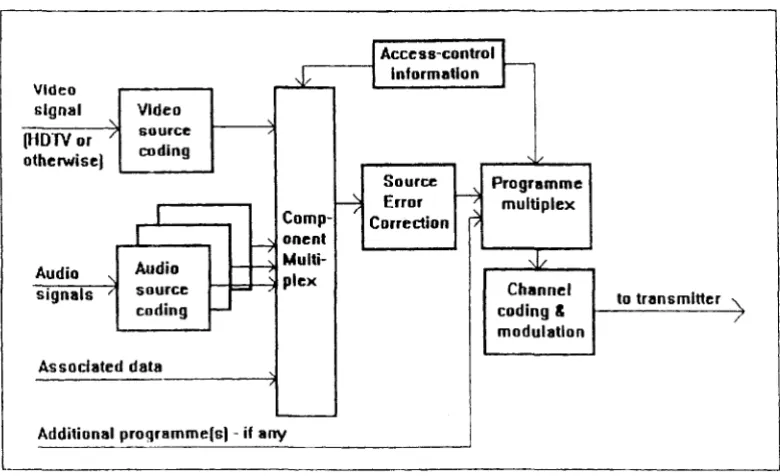
dealing simultaneously with different kinds of service including, but not limited to, TV. Thus the digital environment is essentially modular with different services using different contigurations of standard modules as appropriate. This approach facilitates the interoperability between different service functions which constitutes a major advantage of digital technology as indicated above.Figure I below gives a block diagram of the various elements in a digital TV system and their inter -relationship.
The various elements in the chain are described briefly below:
1.2.1 Source Coding
The volume of information in the "raw" digital image signal is inherently very large and is too much to send through a normal TV channel. Source coding is the process whereby the bit stream containing the picture information is
compressed
(i.e. the number of bits to be transmitted per second is reduced) in such a way that vital information is not lost and the picture can be reconstructed in all essentials without unacceptable degradation at the receiver. Similar techniques can be used to compress the digital data representing one or more sound signals and other forms of data.1.2.2 Multiplexing
The use of multiplexing allows several different components of a television programme (e.g. picture, several sound channels, associated data etc) to be combined into a single bit-stream and similarly several different television programmes to be carried simultaneously in a single broadcast television channel.
1.2.3 Channel Coding and Modulation
With digital transmission it is essential to provide protection against some loss or corruption of the broadcast data by deliberately introducing additional data derived from it into the multiplex signal; this is known as channel coding.
Finally, in order that the multiplexed information can be broadcast, it must be imposed on one or more carrier signals that have the required propagation characteristics. This process is called modulation.
1.2.4 Conditional Access
Figure I below gives a block diagram of the various elements in that part of a digital TV system involved with signal processing for transmission and their inter-relationship.
VIdeo .J,.
I
Access-controlJ--1
Information signal'
VIdeo(HDlV or / source otherwise) coding
Source
~ Programme
H
Error multiplexI
Comp- / -"Correction /
I
-1 onenttAulti-
w
Audio Audio 1-~
signals , source plex Channel to transmitter '\.
coding 1- coding & /
modulation Associated data
Additional programme(s) - if any
Figure 1: Basic structure of a digital television system
1.3 The Service Potential
The approach to digital television currently discussed in Europe is to consider that the market may require different grades of television services to be made available in a flexible manner. (See section 2.1 helow where the work of the European Digital Video Broadcasting Group is outlined).
One (of several potential) categorization systems identifies distinct levels of picture resolution:
High Definition Television (HDTV), for use with stationary antennas and having a picture quality level roughly five times the current broadcast PAL and SECAM.
Extended Definition Television (EDTV), for use with stationary antennas and having a picture quality roughly twice current systems.
Standard Definition Television (SOTV), having a picture quality equivalent to current systems. It can be used with portable receivers, as well as fixed antennas.
Limited Definition Television (LOTV), for use with mobile receivers having picture quality levels roughly one quarter of current television systems.
The flexibility referred to above corresponds to the possibility of reconjiguring the available bit-rate between different service options on a programme-by-programme basis to meet different viewer requirements.
[image:10.609.102.492.102.340.2]To illustrate what an hierarchial system and service multiplex could mean in practice for service provision, Figure 2 shows one set of possible options for a single satellite channel.
:rED'i'Vl·
·.L...!=_J. --;;. .. ~~ .... :~. ;....,~ . .,.' ; '
~
C..ber-... 01110
N.B.:--Iiorc.~
•.a. L O T V -tNI bo
-bl·
Figure 2: Possible satellite DTVB service
(Proposal of the Working Group on Digital Television Broadcasting)
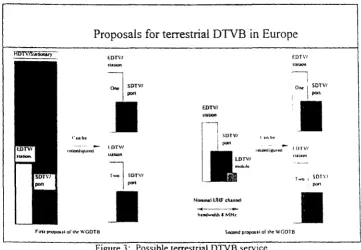
In this example each satellite channel can carry either one HDTV and a second EDTV programme or eight SDTV programmes etc ... or any equivalent combination required. An HDTV receiver could receive any of the programmes at the equivalent quality level. An EDTV receiver could receive the HDTV programme at EDTV quality level or any of the eight SDTV programmes (at SDTV level). Generally, terrestrial broadcasting is subject to greater constraints but Figure 3 illustrates possible service options under investigation for one terrestrial channeL
Proposals for terrestrial DTVB in Europe
EO TV/
...
...,. [image:11.612.126.486.100.307.2] [image:11.612.117.478.429.679.2]IDTVI
...
ED TVI
...
Not~uMIU1-(F dunnci
---
bandwtdth I MHzI ao b(C
EDT\'!
...
i
One I SOTV/
lpon
!lHV/
Two 1 SOT\'/
.
"""
fin1 propou1 of the WGOTB Seccnd proposal of tht: WGDTB
Figure 3: Possible terrestrial DTVB service
In this example each terrestrial channel can carry a HDTV programme which can also be received in EDTV hy an EDTV receiver or in SDTV by a portable receiver. An alternative would be to transmit two EDTV programmes which would be receivable in EDTV quality hy EDTV and HDTV receivers or in SDTV quality by portable receivers.
Further detail on those issues is given in the accompanying volume to this Communication. The main point to be emphasized here however is the possibility of designing digital television systems which are capable of responding in a highly flexible manner to a variety of market requirements. Further work at the research and development level and at the standardization level must be done before such systems can be made available. In the meantime it will be important to ensure that early implementation of digital television in the market will not preclude the subsequent compatible implementation of more sophisticated systems in the future.
1.4 Research and Development
For some years now a number of important R&D projects on digital television have been underway in Europe at national level or through international collaboration.
At national level the Swedish project liD-DIVINE and the German project HDTV-T are concerned with terrestrial HDTV. The UK project SPECTRE and the French project STERNE are investigating conventional quality terrestrial television.
At international level the Community project RACE dTTb deals with terrestrial and cable digital television broadcasting. This project has the potential of integrating all or certain parts of the national projects mentioned above and extending their scope. Also within the RACE II programme are two satellite-oriented projects HD-SAT and FLASH-TV and two cable oriented projects FIRST and BAF.
Under the auspices of the EUREKA framework of international collaboration there is the V ADIS project which provides European inputs to MPEG (the Motion Picture Experts Group of the International Standards Organization - see section 1.5 below) and the EUREKA 256 project which has developed flexible digital codecs.
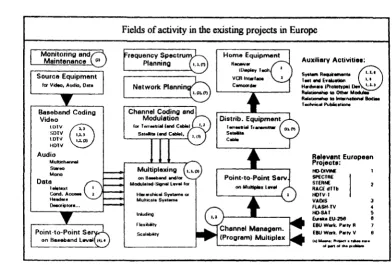
In Figure 4 below the various elements of digital television systems are identified and the scope of the European R&D projects mapped onto them.
Generally it can be concluded that Europe is strong in R&D activity in digital television. Nevertheless there is scope for further development under three general headings:
i) The existing R&D projects could be better coordinated to eliminate overlaps. identify and fill in gaps and ensure the overall coherence of the effort in an efficient manner.
ii) Certain missing elements need to be addressed as a matter of urgency. Those include aspects of satellite digital broadcasting (much of the European work to date has focused on terrestrial broadcasting). Source coding, modulation and overall systems concepts for satellite needs to be investigated as also does the conversion of satellite services into a physical format that can be used on cable networks. This field is especially important as the earliest implementations of digital television in Europe are expected to be by satellite, and the number of homes supplied through cable networks is three times that equipped for direct satellite reception.
Baseband Coding Video
LDTV
HOTV
Audio
so.oa
Mono
Data
Fields of activity in the existing projects in Europe
H••ohicaiSptem•Of
MuhiCat• Sv•ttKM
1"'-'<<WIQ
F"-xibiity
Scalabltity
Relevant European Projects: HO-OIVINE SI'ECTRE STERNE RACE dTTb HOTV·I VAlliS FlASH-TV HO-SAT Ewek•Eu-258 E8U W•~· Pony R
EBU w .. ~. P•tv V
1-.J w-.: ,.,~ ., .... q r .
ol pW1 DIIMPI....,_
Figure 4: Fields of activity in existing projects in Europe. (Analysis of the Working Group on Digital Television Broadcasting)
1.5 Standardization
In broadcasting standardization is necessary in order to ensure the free interchange of signals, programmes and the equipment used to produce and receive them. An ideal world would be one in which common standards were used everywhere, where programmes made in one region could be readily transmitted in any other part of the world, without the need for conversion, and where radio and television signals and receivers are interchangeable.
This is unfortunately not the case today. There are four colour television systems (PAL, SECAM, MAC and NTSC), with many incompatible variants in different parts of the world -even within the Community. Bands in the electromagnetic spectrum are also unevenly allocated with different bands in different parts of the world.
It would appear to be self-evident that certain aspects of broadcasting should be standardized if possible. Common signal formats make it possible to achieve the economics of scale of equipment production, and thus bring unit costs down. Failure to achieve standardization may also lead to user confusion, resistance to invest and thus the retarding of market development.
There are those who argue on the contrary that standardization tends to freeze the development of technology, inhihiting rapid future progress. It is also sometimes in the commercial interest of operators to use proprietary systems which are not available to other operators.
[image:13.612.119.512.74.339.2]It was mentioned in section 1.2 above that digital television systems are combinations of different generic elements. Different bodies at world and regional levels deal with the standardization of these different elements. Although they work independently in practice they generally maintain close liaison as far as possible.
At world level the Radiocommunications Bureau of the International Telecommunications Union (ITU/RB) deals with the standardization of broadcasting. The ITU/RB aims to produce "Recommendations" which are not legally enforceable as such. In relation to digital tdevision the ITUIRB is likely to be influential on the standardization of the modulation and channel coding elements.
Also at world level the International Standards Organization (ISO) and the International Electrotechnical Commission (IEC) are agencies concerned with the standardization of equipment, consumer and industrial products. Under the auspices of both of these organizations a subgroup - the Motion Picture Expert Group (MPEG) - was established to deal with the standardization of source coding and multiplexing of audio-visual systems. The group has already standardized VHS-quality video (MPEG-1) and CD quality audio. The group is now addressing systems with higher video qualities up to HDTV. The group is moving extremely rapidly and it is now fully expected that a generic International digital video Standard, MPEG-2 will be adopted in November 1993. The group is, in addition, preparing a new standard, MPEG-4, dealing with low bitrate coding of audio-visual programmes with a deadline of 1997 for a draft specification of a standard which will be suitable for a whole range of new applications, including interactive mobile multimedia communications.
At the regional level, the European Telecommunications Standard Institute (ETSI), and its joint technical committee with the European Broadcasting Union (EBUIETSI JTC) will set broadcasting standards for Europe. The European Committee for Electrical Standardization (CENELEC} is concerned with the standardization of consumer and industrial equipment and would be the body to standardize conditional access systems. In Europe also the Digital Video Broadcasting Group (DVB) (see Part II) is very active in developing specifications to be contributed to standardization bodies for adoption as standards. Currently the DVB group is proposing to EBU/ETSI that the MPEG-2 system be adopted as a European standard for source coding and multiplexing.
Figure 5 below sets out the bodies involved in developing broadcasting standards at National,
European and World level. The whole system works by means of a formalized series of interactions between these bodies at each level and between levels. The final results are National, European and World standards as outlined above.
National level (Europe)
European level
World level
National Standards Bodies
Consumer Electronics Companies
Telecoms Administrations/ Operators
ISO (non-
I
I
IECelectriceq
I
[electrical)ISO/IEC JTCIWG MPEG
CEPT European
Radio
Office
Broadcasting Companies
ELGDVB Technical Module
Figure 5: The principal bodies involved in broadcasting standardization at National, European and World levels
1.6
Implementation IssuesAt the beginning of this Communication it was argued that the potential advantages of
optimally implemented
digital television systems are very great. The words optimally implemented are now emphasized.History shows clearly that the mere existence of new technology does not ensure its uptake in the market. Furthermore even when such technology does impact the market it can often be seen with hindsight that better ways could have been defined for its introduction.
There are several important challenges to be met before digital television systems can be effectively implemented in the market in Europe and before the potential benefits of this new technology can be fully realized in practice.
This section sets out for discussion some of the underlying issues involved. It is considered that it is in this field of effective implementation that Member States will wish to have the most profound reflections and will need to take the most far-reaching decisions.
1.6.1 The Issue of Spectrum Availability
This issue is mainly of importance for terrestrial broadcasting. Satellite broadcasting (and of course cable distribution) are less concerned. The situation in relation to existing frequency planning in Europe is set out in the accompanying volume. Two aspects are emphasized here. Firstly there is in general very little spare spectrum for new terrestrial broadcasting in Europe and secondly the frequency planning situation varies widely between countries, with, for example, channel occupancy in the VHF/UHF bands very close to saturation in Italy while the position is much less constrained in Scandinavia.
[image:15.628.117.519.90.312.2]involves a fifteen year simulcast period before NTSC is finally withdrawn. It will thus be at least two decades before the US makes the complete transition from analogue to digital TV. It may also be worth pointing out here that the US frequency planning is in general less constrained than is the case in Europe.
When the present frequency assignments for terrestrial television broadcasting in Europe were made, it was regarded essentially as a public service, and therefore they were designed to ensure that virtually the whole population could satisfactorily receive the appropriate national or regional programme services. Because of the technical constraints of the PAL or SECAM system used, this requires not only a network of high-power transmitters located about 100 km
apart, but also many hundreds or thousands of low-power "gap-filler" re-transmitters, such that the transmissions for each programme service require a total of about nine channels. As the bands currently allocated for terrestrial television broadcasting in Europe provide at most a total of 11 VHF
+
48 UHF channels, they cannot accommodate more than about 6 national terrestrial television programme services on this basis. In the larger European countries, at least one set of "regional" programme services takes the place of a potential national network. Elsewhere, notably in the United States, frequency assignments for terrestrial television have been granted according to the "local market" approach: within each major conurbation, assignments for as many high-power transmitting stations as possible are grouped together so that several different "stations", each responsible for its own programming, can compete on an equal basis to serve that market; "gap-filler" re-transmitters are used mainly to ensure that all stations in a market have the same coverage.In section 1.1 it was stated that an increase of between 30 and 40 times in the efficiency of spectrum usage could be achieved using appropriate digital techniques. This very high number results from the assumption that a system such as the COFDM modulation system is employed in Europe. The use of COFDM would allow the construction of "single frequency networks" (SFN) avoiding the need, as at present, to use different frequencies in adjacent regions for the same service, thus using up much more spectrum per service. It should be emphasized that such efficiency gains can only be achieved
if
such SFN can be implemented and will accrue only when the very lengthy transition has been made.It is important to appreciate that such SFN operation (enabling full national coverage of up to five digital programme services to be provided within one of today's channels) corresponds to the existing practice in Europe, but not to that in the United States. Indeed, because SFN operation is incompatible with the long-standing "local station" approach to television broadcasting. This situation could limit the possibility that COFDM would be adopted in the United States.
It was pointed out above that the spectrum issue is largely of importance for terrestrial broadcasting, with the situation for satellite being much easier. The obvious corollary of this is that satellite television services may have a competitive advantage with the new technology and the implications for the future of terrestrial broadcasting will have to be faced.
The above analysis raises the issue of the optimum allocation of terrestrial frequencies in the medium and longer term. Spectrum is an extremely valuable natural resource with much competition for its use and if the new technology allows potentially a dramatic increase in efficiency, it will become progressively more untenable to maintain the status quo as time passes.
The conclusions of this section are:
*
*
the recognition of the constrained and uneven frequency planning situation for terrestrial television in Europe;
*
*
1.6.2
the recognition that the status quo cannot be maintained into the future and thus:
the need to develop practical and implementable
migration
strategies for the transition from the existing to the future frequency planning regimes, and the need for the Member States and the Community to take the necessary decisions in a coordinated way to ensure the achievement in practice of the benefits of the new technology.The Issue of Timescales
It is clear from the above discussion that the full introduction of a new network technology such as digital terrestrial broadcasting has a long planning horizon, particularly when, as has been stressed above, it is to be part of a global information network providing many different services simultaneously. In Europe, private operators are increasingly active in the broadcasting market. The timescales for the return on investment of such operators may be shorter than this. This can lead to tension in the planning process, especially if early market entry were to make more difficult or even impossible the subsequent general transition to the optimal overall system.
Another issue arises in relation to the generalized desire to wait until the "ultimate" technology is available before implementation decisions are taken. This is based on the false assumption that this "ultimate" technology will ever exist. On the contrary, the history of technological progress shows that constant improvements are achieved over time. Every implementation decision therefore involves acceptance of systems compromises which may not be necessary say five years later. This cannot argue in favour of constantly waiting for these improvements, however, as that would simply lead to inaction and the failure to achieve the tangible benefits which could be obtained by using current technology.
This issue also adds an important dimension to the international environment. The history of television is replete with examples of one region of the world developing and seeking to implement a new television system, only to find after three or four years that another region wishes to introduce further improvements, followed in turn by a third region opting for a system that purports to be even more advanced a few years later. Indeed, there is potentially no limit to the number of iterations in the cycle. Technology is advancing constantly and there is no compelling need -viewed from the local, regional perspective - why any region should accept techmcal compromises that would be unnecessary for its own implementation circumstances, and in whose selection it played no pan, even though those compromises may have been crucial for the first region at the time it was planning to implement the system originally. This dimension has always caused difficulties in the past. It has become even more pronounced in recent times, threatening to block the emergence of a common global approach to advanced television that would be simultaneously acceptable in Europe, Japan and the USA.
The analysis in this section argues in favour of a Community policy of:
*
*
defining a reasonable long-term vision of the future requirement of advanced television systems in order to guide commercial and government strategies in this field;
1.6.3 The Issue of Community Decision Ta]cin2
Certain aspects of television broadcasting will always retain a regional or local character. Nevertheless the process of European integration means that the planning of television systems and networks can no longer be done at national level alone. The single European market with its implications for manufacturing and services and the potential for pan-European broadcasting to provide easier access by all Europeans to the cultural diversity within the Community, argue compulsively for a common approach. In addition satellite television knows no borders and terrestrial frequency planning requires significant coordination across the borders of the densely packed countries of the Community.
The Community dimension of future television planning is therefore large. Europe cannot afford the costs that would be inherent in a fragmented approach which would inhibit market development and limit access to Community-wide information provision and cultural offerings.
In practice, however, experience shows that the instruments available to the Community for implementing new television systems are relatively weak. This contrasts sharply to the situation of the USA where the Federal Communication Commission can ensure implementation through powerful regulatory means including the setting of mandatory standards and the control of the allocation (and withdrawal) of spectrum. By contrast the European consensus-based approach is vulnerable to attack by any powerful interest which is unwilling to accept compromises not in its immediate interest.
PART2 DIGITAL VIDEO UROADCASTING ACTIVITIES IN EUROPE, TilE UNITED STATES OF AMERICA AND JAPAN
This part of the Communication deals with the plans in the three regions for the introduction of digital video broadcasting services and ti.e processes preparing for this.
2.1 Europe
Over the past decade Europe has completed development of advanced television systems based on MAC technology: D2MAC for 625 line services with 4:3 and 16:9 aspect ratios, and HDMAC for HDTV services. These systems show excellent performance: D2MAC is in the early stages of commercial exploitation and HDMAC is available for use by broadcasters wishing to provide HDTV services soon. Both systems are designed for use on satellite and cable.
The Council has consistantly affirmed, through Decisions 89/337/EEC, 89/630/EEC, 93/424/EEC and Directive 92/38/EEC, the importance for European industry, broadcasters and viewers of High Definition Television.
The market implementation of commercially viable HDTV in Europe for broadcast television and for non broadcast applications, remains an object of Community policy.
2.1.1 The European Digital Video Broadcasting Group
Towards the end of 1991 a group of broadcasters, industrialists and government officials came together informally to discuss the potential for and requirements for digital terrestrial television broadcasting in Europe. The Commission participated in the meetings of the group from an early stage, encouraging it in its work and encouraging it to expand its activities both in scope and in membership. By the summer of 1993 the European Launching Group for Digital Video Broadcasting had expanded its scope to include satellite and cable and its membership to some thirty to forty organizations. These organizations included: broadcasting complllies, both public and private, and both terrestrial and satellite; manufacturers; satellitr. and cable operators; government administrations and European international organizations.
The Launching Group prepared a Memorandum of Understanding (MOU) setting :mt its aims and methods of working. This MOU (see accompanying volume) is open for signature and has already been signed by the 85 organizations who are listed also in the accompanying volume. The Launching Group has thus made the transition from an informal grouping to an established body, called the European Digital Video Broadcasting Project.
The aim of the group as set out in Article 1 of the MOU is:
"to create in Europe a framework for a harmonious and market driven development of digital television via cable, satellite and terrestrial broadcasting.
This shall be realized through:
promoting and contributing to the definition of technical standards for digital television and their widespread utilization/adoption;
facilitating the introduction of new television services using these standards, which includes studies on ancillary matters such as frequency planning and conditional access;
facilitating the closest possible coordination between pre-competitive R&D and standardization."
The structure of the organization comprises:
A General Assembly of all the members
A Steering Board of up to 34 elected (voting) members A Technical Module
A Satellite/Cable Commercial Module A Terrestrial Commercial Module An Ad hoc Group on conditional access.
2.1.2 The Work of the Digital Video Broadcasting Group
For about the first year of its existence, the Launching Group focussed its attention on the prospects for digital terrestrial television. The Technical Module - then called the Working Group on Digital Television Broadcasting (WGDTB), was charged with producing a comprehensive report on the matter. This report was completed in November 1992 and is included in the accompanying volume to this Communication.
Following the announcement by two major satellite television organizations - News International and Canal+ - of their intention to provide pay-television services by satellite using digital compression technology from the second half of 1994, attention was focussed within the Technical Module on satellite and cable issues.
The Technical Module is working very rapidly and its output is already extensive. It has:
*
*
surveyed the existing European R&D and mapped it on to systems requirements (see Figure 4 above), and identified gaps in the R&D effort;
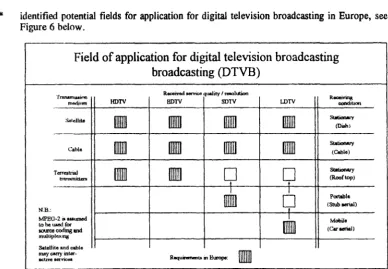
identified potential fields for application for digital television broadcasting in Europe, see Figure 6 below.
Field of application for digital television broadcasting
broadcasting (DTVB)
·rnuum .... inn Reooi.ed --..ico quality I ...,lution Reco~
medi'wn HDTV HDTV SDTV LDTV cond1Uon
S.tclhlll
lllllll
lllllll
lllllll
IIlllll
sc.tionluy (Diah)Ill
Ill
Ill
Ill
Stat.iocwyCable (Coble)
T=estrial
Ill
lllllll
y
Q
SlatioMry...Utton (Rooftop)
nllm
o
(Stub Mrial) PortableN".B.: I
MPI!G-2 0. auumod
II
Mobileto he...:! for
IOI.IfCO codingond (Cartlllrial)
multiplcuung
S.lclllito md cable
may cony
int«-Requirements in Hurope:
Ill
actlvCIIGfVtcol
Figure 6: Field of application for digital television hroadca~ting
[image:20.612.111.499.359.627.2]*
identified potential systems configurations for the flexible delivery of digital television services in Europe, both by satellite (see figure 3 above and terrestrially (see figure 4 above).*
proposed a provisional timetable for Digital Video Broadcasting (DVB) in Europe see Figure 7 below.Provisional timescale for DTVB in Europe
WGDTB 1992 1993 1994
s..mcc dcfipj!jqp !WGDTIU
• Slldlilc, cable - - · •
• Tonalrill, cablo
Source codjng g4
"""'i*lrins IMPEYl
• ED1V, SD1V, lD1V ·IIDTV
ClwmeJ codirur. rn""'Ptioo
~
----·
---·
• Saldlilc, cablo ( ..• ? ... ) - - - -
.?
~• Tcnalrial, cable (WGDTB) 1'
Swr.em cornp!otion IWGDTB ?I • Salcllilc, cablo w/o I IDlV
--·--·?
1995 1996
• Slldlilc, cablo incl. IIDlV
· T...-;.a, cablc
---·
Sf.N14rizeJim CITC llll1liJITSil
• Slldlilc, cablo w/o HDlV
1997
• Slldlilc, cab1o ind. HDlV
• T cnalrial, cablo
---·
--~---==-·---·
~
Equipmept dcojon Ondus!ryl • Slldlilc, cablo w/o HDlV · Saldlilo, cablo incl HDlV
• T CITCIIriol, cablc
s..mcc rgc1y to 1111t
• Saldlilc, cable w/o liDlV • Sa&cllilc, cable incl. HDlV • T CITCIIriol, cable
Figure 7: Provisional timescale for DTVB in Europe (Analysis of the Working Group on Digital Television Broadcasting)
1998
It should be emphasized that the ideas listed and illustrated above do not constitute final choices and decisions. They are included here to illustrate the state of thinking on these issues within the European Digital Video Broadcasting Group. They are intended as an aid to the discussions being initiated through this Communication.
The technical module has also been active in recent times in tollowing developments of relevance in MPEG. It has helped to ensure, together with other involved bodies, such as the EBU/ETSI JCT, the coordination of European inputs on the definition of the MPEG-2 generic video standard. It is providing technical inputs in the form of specifications to ETSI with a view to assisting the adoption of a European standard for source coding and multiplexing based on the MPEG-2 work.
the service requirements, systems configurations and timescales illustrated above may be modified or confirmed in the future.
The Conditional Access Ad Hoc Group is charged with seeking agreement on common European conditional access systems, if this is possible.
The work of the European Digital Video Broadcasting Group is said to be "market led" in the sense that service requirements, priorities and timescales are determined by those economic operators having the stated intention to provide DVB services in Europe.
2.2 The United States of America
Although much attention has been focused on the US process for introducing digital terrestrial television, in fact the first medium to use digital techniques, as is probably also the case in Europe, will be satellite.
2.2.1 Satellite Television
Hughes Aircraft Company has announced its intention to provide a satellite television service in the US from early
1994.
There are intended to be up to150
separate services provided consisting of movies, in a near-video-on-demand mode (i.e. each movie is repeated on other channels at short intervals and so the viewer may choose his time to start viewing), sports, general interest programmes and specialist interest programming.The broadcasting system uses digital compression techniques and uses the MPEG approach. The extent to which it is fully compatible with the evolving MPEG-2 Video standard remains to be seen.
2.2.2 Terrestrial Television
The Federal Communications Commission, under the authority of the Communications Act, regulates broadcasting in the USA in the public interest. It has well established formal rules for setting standards and for issuing licences. Its activities are carried out in public and at stated intervals, comments are received from all interested parties. Since 1987 a process has been underway, governed by these rules, to define a terrestrial broadcasting standard for HDTV.
The FCC appointed an advisory committee - the Advisory Committee on Advanced Television Service (ACATS) to assist it in this process. The ACATS will eventually make a recommendation to the FCC which will then make its decision. The FCC is free to reject all or part of the recommendations of ACATS.
The FCC process relates only to a terrestrial broadcasting system; It does not relate to satellite or cable systems nor is it concerned with equipment performance standards.
The ACATS invited interested organizations to propose advanced television systems as the basis of the future standard. These systems were to be tested in full hardware implementation. Testing laboratories were e . .c;tablished for this purpose.
i) Scannin& Formats
Six formats are listed:
1050/l : l/30' 24 787 .5/l: 1/60, 30, 24
1050/2:1/60
(the tirst number is lines, the second number is either progressive (I: I) or interlaced (2: 1) and the third number is frames per second).
Progressive scanning has been judged by the Americans to be very important in view of the need for interoperability with other media. Square pixels have also been chosen for this reason.
ii) Video Compression
The Grand Alliance will use MPEG-2 "syntax" with additional features. Those features are under discussion.
iii) Transmission
The Grand Alliance still had to choose between four transmission systems (nQt at the moment including COFDM favoured by the Europeans). If necessary a competition between some or all of these systems will be organized.
iv) ~
The Grand Alliance must choose between three different sound systems.
Once the final parameters are chosen, tentatively fixed for the Autumn of 1993, then the system will have to be built and tested. Assuming the tests are successful and that no redesign and retesting is required this process should take nine months. Thus, by the middle of 1994 a specification could exist which ACATS could propose to the FCC as a standard. The FCC itself then takes over and has its own formal open consultation process on the proposed standard. This process would normally take one year and if so the FCC could set a standard for terrestrial advanced television broadcasting in the middle of 1995. Given the complexity of the technical and political processes involved it would not however be surprising if the whole process (assuming it is indeed finally successful) were to slip by about one year to the middle of 1996.
Separately from the work of ACATS, the FCC has made a number of important decisions:
*
*
*
*
The new system must use 6MHz channels (The European channel spacing practice is 7 or 8MHz)
The new service will be simulcast with the existing NTSC services
Following the setting of the standard (1995/96) broadcasters will have three years to apply for a licence to broadcast the new service. If a licence is awarded they get an additional 6MHz of spectrum per programme
*
Following fifteen more years (i.e. 2016/2017) the NTSC system would be withdrawn and the entire US terrestrial television network would be digital.Independently of the detailed technical nature of the system being chosen by the Americans, it is worth retlecting on the process itself. The US process has a clear goal or vision and the means necessary to carry it out. The clear vision sees the universal replacement of the current analogue television system by a new one based on digital technology over a period of about two decades. There is a well defined and credible implementation strategy for migrating from the existing to the future system. The means necessary to carry it out - the FCC - is a statutory body with considerable powers, which is independent of both the industrial and political systems and can and does set timescales and goals, to which the economic actors respond. It
works in the interest of no economic or other sector but in the public interest.
While emphasizing that the FCC process is open and involves much consultation it may nevertheless be described as "top down" process with a long term time horizon in contrast to the "bottom up" approach underway in Europe. Although the FCC needs to take fully into account the views of the market actors, the US process cannot be described as "market led" in the sense in which that is used in Section 2.1.2 above.
2.3
Jrunm.
Japan was the first region of the world to design and implement (in an, at lea~t. pre-commercial manner) an HOTV system. Using their satellite delivered MUSE transmission system, 8 hours a day are currently being broadcast in Japan. The costs of receivers remains however, very high and it is unclear if the system will ever be commercially successful even in Japan not to speak of any other region.
On terrestrial networks sharper 4:3 pictures have been provided using the Clearvision system which employs improved receiver processing and the use of enhanced signal processing in the studio. Very high costs of receivers have limited sales however. In the near future 1993/1994 it is intended to provide a wide screen enhanced NTSC service, EDTV. The Japanese have been cautious to date about digital television developments for a number of reasons:
*
*
*
the belief that the MUSE system provided adequate HDTV service using currently available technology and could have a reasonable operational period before being overtaken by new technology.
the great practical difficulties of implementing terrestrial digital systems in Japan due to the frequency planning difficulties there which are more constrained than in Europe and much more so than in the United States.
the feeling that digital technology had very great potential for the future and that it was premature to rush into setting standards soon while much of the new potential remained to be explored.
It should be emphasized that Japan has great strength in depth in digital technology and it will not be surprising if their investigations identify important new concepts and approaches in this field.
In recent times the Japanese Ministry of Posts and Telecommunications has announced establishment of a new study group to investigate the requirements for and potential of new digital technology for future broadcasting systems. The scope of the study covers satellite, terrestrial and cable television delivery means. The time horizon is the next twenty years. The Group was established on 26 May 1993 and will report its findings to the Ministry in one years time.
PART3 A FRAMEWORK FOR COMMUNITY POLICY
The preceding analysis shows that:
*
*
*
digital technology offers significant potential benefits in relation to television service quality, the flexibility of its provision and the more efficient use of spectrum, compared with current analogue technology and digital television has the potential of accelerating the implementation of global information networks delivering a wide variety of information services in a convenient and flexible manner;
the complete transition from the existing analogue system to a digital system is a long-term process requiring, perhaps, two decades to complete;
this transition will have to he organized and coordinated in order to enable the full potential henetits of the technology to be achieved in practice. Some of the benefits of the new technology will not be fully obtained until the end of the transition period. In the meantime it will be important to avoid the situation where early implementation of digital television in the market makes it difficult or impossible to introduce subsequent more general and more advanced steps in a compatible manner - thus inhibiting future market development.
Taking these understandings into account, the following set of principles governing Community policy in this field is offered for consideration.
3.1 Principles of Communitv Policy
The following five key aspects are identified:
3.1.1 The Need for a Long Term View
It has been argued consistently that the full benefits of the new technology will not be <.chieved in practice unless the lengthy transition from today's analogue system to tomorrow's completely digital system is implemented in an optimal manner. This presupposes not only that there is a long term view of what is ultimately to be achieved, hut also that there is the will and the means to plan and implement a consistent migration path between the existing situation and the future one.
This vision can not be limited to television alone which will be but one of a range of interoperating information services in the future global information network, but should extend to the requirements for achieving the global information network itself in an optimal fashion.
Elements which will be vital in this regard include:
*
*
A system conception and design which allows all potential forms of multimedia services -mobile, portable, standard definition, extended definition and full high definition television- as well as easy interoperability with other information services, to be realized in future in a flexible and fully consistent and mutually compatible manner, in response to market demand.
*
*
A clear view of how best to re-deploy the spectrum so as to take advantage of the new technology. Member States and the Community will have to reflect deeply on the optimum use of terrestrial spectrum in particular, in this connection. It is not to be excluded that a radical rethinking of existing frequency planning may be necessary.
the development of migration strategies for making the transition between the existing situation and the future one. Once the best migration path or paths have been chosen (taking full account of the Community dimension in this regard), this migration path or paths should be implemented in a consistent manner throughout the Community. This is unlikely to be easy or cost free. The price of failure of action or inadequate action here however would be that the full benefits of the new technology would not be realized in practice. This could include the less than fully efficient use of the valuable resource of the electro-magnetic spectrum.
Market forces will be crucial for the introduction of new services; It has been argued above, however, that market forces
alone
may not lead to the optimum implementation of the future global networks. This is so because the timescales relevant to the return on investment of economic actors is much shorter than the timescale required for such optimum implementation.This issue would appear to be fully understood by Japanese planners but also in this field now very much by the US authorities.
The Community is thus faced with a major political choice: whether to see this new technology being implemented in practice through market forces alone; or whether to develop a long term vision of the future global network and encourage market parties to offer services consistent with that vision.
3.1.2 The Need for Continued Research and Development
Although the digital era in broadcasting is just beginning progress has already reached the point at which the introduction of digital television broadcasting becomes commercially attractive. Technology has evolved rapidly in this area in the recent past but it will certainly continue to evolve significantly during the implementation times discussed above. It will continue to be of great importance that R&D receive continuing support at national and Community level in this area in order that the most developed technical options are available to market actors when implementation decisions are to be taken.
Specific aspects of this matter already identified in section 1.4 above include:
*
*
*
The better coordination of the existing national and international R&D projects in Europe with a view to avoiding overlaps, filling gaps and ensuring an overall coherence of the effort.
Addressing already identified gaps including aspects of digital satellite broadcasting (source coding, modulation, overall systems concepts), and the transcoding of satellite services into a physical format that can be used for cable networks.
3.1.3 The
Need
for Appropriate StandardsIf common standards can be achieved tiJr broadcasting, everybody gains - at least in the lung run. Manufacturers gain since common standards allow the achievement of economies of scale. Broadcasters gain due to the prospect of large unfragmented market for their services. Programme makers gain since they avoid conversion costs for their programmes. Perhaps most important of all the consumer gains due to the reduced equipment costs and the wide access to services. The fact that the consumer is not confused by different standards and has the confidence to invest reflects back on the whole of the above chain in a positive manner fonning a virtuous circle.
This is the ideal world - not always achieved in practice, particularly at the international level.
At the European level the case for common systems is clearly unanswerable. At the broader international level the benefits of the greatest degree of commonality between - perhaps inevitably different systems, makes the dedicated pursuit of such consumer elements a worthy objective of international cooperation.
A very positive aspect of standardization activities in this field at world level is the speed and success to date of the MPEG proce.~s. It would appear that the new MPEG-2 Video standard soon to he agreed provides a good basis for European requirement" for source coding and multiplexing. It also has the potential for the creation of significant elements of commonality between European systems and those that will be implemented in other parts of the world. Substantial cost reductions would follow from standard MPEG chips being available in large quantities from a variety of competing sources.
If the MPEG-2 approach is to provide the basis of future European service concepts, then it is essential that early implementation of digital television in the European market is fully compatible with this approach.
In addition to source coding and multiplexing the elements of channel coding and modulation must also be addressed. Here aspects of compatibility between services on the three different delivery systems, terrestrial, satellite and cable, should be taken into account, since it is desirable to ensure that viewers will be able to use the same receiver to obtain all the services supplied by whichever of these three systems are available where they live. The importance given in Europe to the creation of single frequency terrestrial networks and to mobile services has been emphasized. The COFDM modulation system may have much to offer in this connection.
Finally the contentious area of the requirement to develop common European conditional access systems must be addressed and resolved as early as possible.
3.1.4 The Need for Full and Qpen Consultation
3.1.5 The Need
to
Defend the Public InterestThe Community and its Member States have the duty at all times to ensure that the public interest is defended against threats from powerful industrial and commercial sources. The protection of the consumer and the ensuring of fair competition are cornerstones of national and Community policy in general and are also specifically relevant in the field under discussion. At a time of increasing media concentration it is also intended to ensure that all broadcasters have access to digital broadcasting technologies and that no barriers to entry are erected for new market entrants. In order that the market may be kept open, media companies should be prohibited from using restrictive practices in order to impose their own technologies or to limit competition from competing television channels.
3.2 Next Steps in the Development of Community PolitY for Didtal Video Broadcasting There is now much consideration and activity in Europe relating to digital television broadcasting. The potential of the new technology, the constraints on that potential and important elements of the requirements for realizing in practice this potential in the future- are all becoming clearer. It is not the case however that these considerations have reached such a stage of maturity that definitive proposals for long term Community policy can be made at this time. It is not
a fortiori
appropriate to propose now new Community legislation in this field. This was not the intention of this Communication. The intention is rather:*
to report on developments in the technology and its potential*
to report on activities in Europe and elsewhere in the world*
to propose a framework within which Community policy could developHaving set out for discussion the principles which could underline Community policy in this field in the last section, this section addresses the actions and initiative which needs to be undertaken in the short term future - say the next year or two.
3.2.1 Consultation of the Market Actors
The market actors in this field: broadcasters public and private; manufacturers, and operators of cable, satellite and telecommunications systems will have a crucial role to play in determining the future evolution of advanced television systems in Europe. Their commercial intentions and ambitions, their requirements of technology and of each other, their views of an appropriate regime of national and Community regulation in this tield are important inputs to Community policy.
The European Digital Video Broadcasting Group now provides an open forum of consultation in which these market actors can make their views known and can work together to achieve common purposes. The Commission considers that this is a positive development and will continue to encourage its work. The decision of the group to make its deliberations and the outcome of its work freely available to the Commission as an input to Community policy formulation is welcomed.