Advanced
Cemmunicat1ons
Experiments
Results of an investigation of requirements and options in the field of
!""'
L-
COMMISSION OF THE EUROPEAN
COMMUNITIES
- Directorate General Telecommunications, Information Industries and
Innovation-Directorate RACE Programme and Development of Advanced Telematics Services
Ref: XIII/F /GE0197 Revision: 24 November 1989
Operation 1992
Results of an investigation of requirements and options in the field of
/Advanced Communication
Experimen~
-Preface
The demand for IT and Communications-based services/ applications is evolving rapidly as technology and improved cost-performance open up new possibilities.
Therefore, in the context of implementing the Council decisions on the RACE, DRIVE, DELTA and AIM programmes, sector actors have been invited to participate in the
identification of future R&D Requirements and Options. This systematic consultation was
given the name "Operation 1992". It involved representatives of telecommunication
administrations, telecommunications manufacturing industry, service providers, IT
manufacturing industry, users, social actors and national administrations. The scope of
Operation 1992 derived from the scope of the existing programmes and their direct extension.
The areas covered include:
Advanced Communications-technologies (including Mobile Communications and digital HDTV)
Integrated Service Engineering
Advanced Communications Experiments Medical and Bio-informatics
ITT&B-based Learning Technology Advanced Road Transport Telematics Applications of ITT&B in Rural Areas.
The following criteria apply in Operation 1992:
> strategic importance for Europe's future socio-economic performance;
> necessity or significance of "added-value" of transnational R&D cooperation ( precompetitive, prenormative or pre regulatory),· and
> strong commitment of sector actors and support of national administrations.
Operation 1992 reflects the thinking and contributions of over 2000 individuals and organisations which responded to the Call for Ideas. These contributions were developed and complemented by in-depth work of experts. For each area a Requirements Board investigated the need for action, and Technical Panels addressed the corresponding specific R&D requirements. The experts who participated in the writing and discussion of the reports are
acknowledged in the respective volumes. The groups of experts (acting in a personal
capacity) can in their overall composition he considered as representative of the respective
sectors. However, in order to make the results as representative as possible, a series of
workshops were held in September 1989. This document is a revision of the edition of 5 July 1989 which takes into account the contributions at these workshops. Further contributions and comments are invited.
The present document is part of a series covering the various areas. For each area there are at least two documents available: "Rationale for action" and "Specification of priority R&D tasks". In addition there are the reports of the Requirements Boards, which in some cases cover several related areas, as well as other background documents. The status of the present document is that of a draft.
Acknowledgements
The Commission gratefully acknowledges the following individuals, each of whom contributed to Operation 1992 and shared their vision of the future in telecommunications and services for Europe. The overall concerted efforts relied on the joint work of Requirements Boards looking at the strategic context, Technical Panels investigating the technology requirements and Management Committees providing the link to the views of Member States.
The work reflected in this document would not have been possible without the hundreds of well-thought-out contributions that were received in response to the "Call for Ideas" is$ued in the context of "Operation 1992". The Commission takes this opportunity to express its gratitude to all contributors.
Finally, thanks are due to the staff of the Commission for the dedication they have shown in
supporting the whole operation. ·
List of members of the ACE Technical Panels
I
NAMEBaaken, Th. Bane res, J .M. Bisiaux, G. Bock, W. Bradley, C. Clark, P.
Coman, C.
de Querol, R. de Wergifosse, P.Dodel, H.
Dorrhyee, G. Dyer, N.
Elliot, J.
Ensink, P.
Ferrero, J.
FUrst, H.
Gianfranco, B. Griesmar, C. Harre, D. Holloway, B.
Kelly, J.
Morgan, K.
Nanson, B.
Puglisi, G.C. Pohjanpalo, E. Rambourdin, M. Rasmussen, B Renoulin, R.
Ruiz de Querol, R.
Sala, G. Schindler, S.
Seetzen, J.
Simonsen, J.
Taibi, F.P. Timm, P. Waksman, G
COMPANY
VDI/VDE Caixa Barcelona
Region Nord Pas Calais Anitra
International Stock Exchange Logica
International Council of Museums
CENTRISABrutele MBB SLIGOS
Commercial Union Assurance Interactive Media Systems KLM
Agencia EFE Nassauisches Heim Alpi Tour Informatica Telesystemes
Telemarket Midland Montagu Grand Metropolitan
Science Policy Research Unit Ordnance Survey
Peugeot Kone
Banque Nationale de Paris Scandinavian Airlines System CCETT
CENTRISA Datamont TELES VDI/VDE Struer Bredband Sigma DANISCO Acta COUNTRY D E F D
UK
TABLE OF CONTENTS
VOLUME I - WORK. AREA DESCRIPTIONS
INTRODUCTION
OVERVIEW: THE ACE CONTEXT
1.
2.
3.
4.
5.
6.
Introduction MissionSubject Areas Covered: The ACE Overview Model Interconnected Investment Requirements
Project Structures and Participants Milestone Plan
TERMINOLOGY AND CONCEPTS
PART I- IBC GENERIC APPLICATION STRATEGIES (TA.100)
1.1 Advanced Communications Usage Modelling and Operational & Functional
Specifications (T A.101, T A.106, T A.107)
1.1.1 1.1.2 1.1.3 I.1.4 1.1.5 1.1.6 1.1.7 1.1.8 1.1.9 1.1.10 I.l.11
Distributed Case Handling (TA.101, TA.106, TA.107) Interpersonal Communications (TA.101, TA./06, TA./07) Remote Delivery of Expertise (TA.101, TA./06, TA.l07)
Distributed, Collaborative Decision Making (T A.101, T A.106, T A.107) Distributed, Collaborative Design (TA.101, TA./06, TA.l07)
Distributed Learning/Training (T A.101, T A.106, T A.107) Monitoring and Surveillance (T A.101, T A.106, T A.107) Te1emarketplace (T A.101, T A.106, T A.107)
Distribution/Entertainment/Leisure (T A.101, T A.106, T A.107) Multimedia Interpersonal Messaging (TA./01, TA.106, TA.107) Multimedia Information Assembly, Access and Distribution
(TA.101, TA.106, TA.107)
1.2 Consolidation of Technical Results of Experiments (T A .112)
1.3 Impact and Opportunity Assessment (TA.116)
3 5 5 5 6 9 10 II 13 15 16 17 18 19 20 21 22 23 23 24 25 25 26 26
PART II- TECHNIQUES FOR ADVANCED COMMUNICATIONS EXPERIMENTS 29
11.1 Network and Technology Resources for Application Experiments (T A.200 - T A.235) 30
11.1.1 Server Module Kit for Application Experiments (TA.200, TA.211 - TA.219) 31
11.1.1.1 Translation
I
Interpretation Servers (T A .211, T A .212)11.1.1.2 Integrity Mechanisms (TA.213- TA.215) 11.1.1.3 Conference Servers (TA.216)
11.1.1.4 Multimedia Mail Servers (TA.217) 11.1.1.5 Database Systems (TA.218)
11.1.1.6 Distribution Servers (T A.219)
VOLUME I (contd)
11.1.2 Workplace Module Kit for Application Experiments (TA.221 - TA.223) 33
11.1.3 Network Requirements for Application Experiments (TA.231 - TA.235) 34
11.2 Resource Packages Supporting Generic Applications (T A.250 - T A.261, T A.270, 35
TA.275)
11.3 Elicitation Technology and Techniques (T A.281 - T A.283) 38
PART III- APPLICATION EXPERIMENTS (TA.300)
111.1 Application Experiments Addressing Business Functions (TA.301 - TA.312)
111.1.1 111.1.2 111.1.3 111.1.4 111.1.5 111.1.6 111.1.7 111.1.8 111.1.9 111.1.10 111.1.11 III.I.I2
Operations/Production/Production Engineering (TA.301, TA.301A, TA.301B) Marketing (T A.302, T A.302A, T A.302B)
Purchasing (T A.303, T A.303A, T A.303B) Sales (T A.304, T A.304A - T A.304D) Transport/Distribution (T A.305) Finance/ Accounts (T A.306)
Technical Support/Service (TA.307, TA.307 A, TA.307B) MIS/Telecommunications (T A.308)
Administration (TA.309) Business Planning (T A.310) Design (T A .311, T A .311 A)
Human Resources/Organisation (TA.312. TA.312A- TA.312G)
111.2 Application Experiments ~ddressing Business Sectors (T A.321 - T A.330)
111.2.1 111.2.2 III.2.3 Ill.2.4 111.2.5 III.2.6 111.2. 7 111.2.8 III.2.9 Ill.2.10 III.2.11
Banking, Finance and Insurance (TA.321, TA.321A - TA.321E)
Media, Publishing, Advertising, and Culture (T A.322, T A.322A - T A.322G) Retail and Distribution (T A.323, T A.323A)
Healthcare (T A.324, T A.324A, T A.324B)
Public Administration (T A.325, T A.325A - T A.325E)
Manufacturing and General Industry (T A.326, T A.326A - T A.326D) Transport, Travel and Tourism (TA.327, TA.327A- TA.327F) Agriculture (TA.328, TA.328A, TA.328B)
Utilities (T A.329, TA.329A)
Liberal Professions and Professional Institutions (T A.330, T A.330A)
Building and Constructio~ (TA.331, TA.331A, TA.331B)
Page viii
VOLUME II- TASK DESCRIPTIONS
PART I- IBC GENERIC APPLICATION STRATEGIES 75
T A.l 00 IBC Application Strategies 75
Advanced Communications Usage Modelling and Operational and Functional Specifications 77
TA.IOI Usage Reference Model 77
T A.l 06 Generic Application Operational Specifications 79
T A .1 07 Functional Specifications of Resource Packages for Generic Application 80
Consolidation of Technical Results of Experiments 81
TA.II2 Extraction and Consolidation of Network and Technology Aspects 81
Impact and Opportunity Assessment 82
TA.116 Criteria and Guidelines for Success for Advanced Communications 82
PART II- TECHNIQUES FOR ADVANCED COMMUNICATIONS EXPERIMENTS 85
Network and Technology Resources for Application Experiments 85
Server Module Kit for Application Experiments 85
TA.200 TA.211 TA.212 TA.213 TA.214 TA.215 TA.216 TA.217 TA.218 TA.219
Integration and Coordination Translation
Real-time Interpretation Personal Identification Data Integrity
Encryption
Conference Control and Reservation System Multimedia Mail System
Distributed Multimedia Database Server Multiple Access Multiple Delivery System
Workplace Module Kit for Application Experiments
TA.22I Professional Workplace
T A.222 Transportable/Mobile Workplace
T A.223 Residential Leisure Space
Network Requirements for Application Experiments
TA.231 TA.232 TA.233 TA.234 TA.235
Network Management System for Usage and Performance Measurement Infrastructure for Application Experiments
Interconnecting Islands of Advanced Communication Infrastructure LAN/IBC CPN Interconnection
Cable System Interconnection
VOLUME II (contd)
Resource Packages Supporting Generic Applications
TA.250 TA.251 TA.252 TA.253 TA.254 TA.255 TA.256 TA.257 TA.258 TA.259 TA.260 TA.261 TA.270 TA.275
Resource Package Development General Framework
Lab Prototype Resource Package for Distributed Case Handling Lab Prototype Resource Package for Interpersonal Communications Lab Prototype Resource Package for Remote Delivery of Expertise
Lab Prototype Resource Package for Distributed Collaborative Decision Making
Lab Prototype Resource Package for Distributed Learning
I
TrainingLab Prototype Resource Package for Monitoring and Surveillance Lab Prototype Resource Package for Telemarketplace
Lab Prototype Resource Package for Entertainment
I
Leisure DistributionLab Prototype Resource Package for Multimedia Interpersonal Messaging Lab Prototype Resource Package for Multimedia Information Assembly, Access and Distribution
Lab Prototype Resource Package for Distributed Collaborative Design User Experimentation with Prototype Resource Packages
Advanced Communication System Building Techniques
Elicitation Technoloay and Techniques
TA.281 TA.282 TA.283
Techniques for Elicitation of User Reaction Simulation for Application Experimentation Presentation for Application Experiments
PART III- APPLICATION EXPERIMENTS
General Framework
T A.300 Application Experiments General Framework
Application Experiments Addressing Business Functions
Operations/ Production/ Production Engineering
T A.30 1 Operations/Production/Production Engineering General Task
TA.301A Multi-Site Multi-Media Remote Surveillance and Incident Reporting TA.301B Building and Construction Project Management
Marketing
T A.302 Marketing General Task
T A.302A Targeted Advertising Delivery and Billing
T A.302B Marketing and Sales Optioneering and Product Specification
Purchasing
T A.303 Purchasing General Task
T A.303A Remote Inspection for Quality Control and Purchase T A.303B Product Selection by Store Buyer
Page x
VOLUME II (contd)
Sales
T A.304 Sales General Task TA.304A Tete-Auction Support
T A.304B Electronic Catalogue Showroom
TA.304C Pre-sale, Product Knowledge and Campaign Positioning Training T A.304D Electronic Trading Post
Transport/ Distribution
T A.305 Transport/Distribution General Task
Finance/ Accounts
T A.306 Finance/ Accounts General Task
Technical Support/ Service
T A.307 Technical Support/Service General Task T A .307 A After Sales Service Support
T A.307B Transportable/Mobile Communication Unit for Repair and Maintenance
MIS /Telecommunications
T A.308 MIS/Telecommunications General Task
Administration
T A.309 Administration General Task
Business Planning
TA.310
Business Planning General Task
Design
TA.311 Design General Task
TA.311A Collaborative Design
Human Resources/Organisation
TA.312 Human Resources/Organisation General Task T A.312A Open Management Education
T A.312B Distributed Masterclass
TA.312C On-the-Job Training for Manufacturing
TA.312D Multi-Media Maintenance and Training Manual
T A.312E Training and Continuing Education in the Transport Sector T A.312F On the Job Training and Continuing Education in Healthcare TA.312G On-line Training in Agriculture
TA312H Corporate Culture and Procedural Training ·
VOLUME II ( contd)
Application Experiments Addressing Business Sectors
Banking, Finance and Insurance
T A.321 Banking, Finance and Insurance General Task
TA.321A Personal Banking Services
T A.321 B Collaborative Dealing in Banking
TA.321C Direct Marketing and Selling of Personal Insurance Services TA.321D Re-insurance Dealing
TA.321E Stolen Goods Register
Media, Publishing, Advertising and Culture
T A.322 Media, Publishing, Advertising and Culture General Task T A.322A Distributed Publishing, Editing, Printing and Advertising T A.322B Local Publishing, Editing, Printing and Advertising T A.322C Domestic Video/Film/Music Library
T A.322D Professional Distribution of Film for Exhibition and Production T A.322E Museum, Art and Exhibition Catalogue
TA.322F Ownership Register for Antiques and Objets D'Art (AOD) T A.322G Distributed Local Access Television
Retail and Distribution
T A.323 Retail and Distribution General Task T A.323A Home Shopping
Healthcare
T A.324 Healthcare General Task
T A.324A Information and Communication between Health Care Actors TA.324B Support for People with Special Needs
Public Administration
T A.325 Public Administration General Task T A.325A Public Information Service Centres
T A.325B Communication and Information for Public Administration
T A.325C Remote Surveillance for Traffic, Security and the Environment TA.325D Local Work Centres
TA.325E Advanced Communications for Local Development
Manufacturing and General Industry
T A.326 Manufacturing and General Industry General Task T A.326A Manufacturing Consultancy Services
T A.326B Product Library
T A.326C Engineering and Design for Manufacturing T A.326D Remote Control, Diagnosis and Maintenance
Page xii
VOLUME II (c:ontd)
Transport, Travel and Tourism 255
T A.327 Transport, Travel and Tourism General Task 255
T A.327 A Remote Inspection and Tele-Supervision for Repair of Aircraft 257 TA.327B Remote Inspection of Damaged Goods for Authorisation of Replacement or Repair 259 T A.327C Business Traveller Communications and Workcentres 260
TA.327D Telemarketplace for Freight and Transport 261
TA.327E Cultural Event Promotion and Sale 262
T A.327F Airport Teleshopping 264
Agriculture
T A.328 Agriculture General Task
T A.328A Distributed Integrated Multimedia Agricultural Information system T A.328B Remote Expert Support in Agriculture
Utilities
T A.329 Utilities General Task
TA.329A Utilities Distributed Information Network
Liberal Professions and Professional Institutions
T A.330 Liberal Professions and Professional Institutions General Task T A.330A Professional Seminars and Conferences
Building and Construction
·TA.331 Building and Construction General Task
TA.331A Building and Construction Collaborative Design and Planning T A.331 B Building and Construction Components Library
I
Telemarketplace265
265 267 269
271
271 273
275
275 277
279
GE 01970
VOLUME I
-INTRODUCTION
This report on the results of an investigation into the requirements and options for work in the field of Advanced Communications Experiments (ACE) represents the considered views of experts drawn from a wide cross-section of telecommunications user organisations. In formulating this document, the panels of experts have taken into account the many ideas provided as a result of the Call for Ideas issued by the Commission in February 1989.
This reflection took as its starting point the work currently being carried out under Part 111.2 of the RACE Programme (R&D for Advance Communications-Technologies in Europe). This consists of a set of user-based Application Pilots, addressing a spectrum of requirements covering a range of sectors of economic activity. The work of the Expert Panels dealt with two interrelated questions:
• What would be the appropriate subjects for future user-centred Advanced Communications Experiments?
• What format should these take to reflect adequately the interests of participating actors?
The areas identified reflect a perception of the scope and strategic importance of advanced communications to user organisations. The significant potential for application of telecommunications to the solution of user problems, to the creation of competitive advantage
and to the creation of new ways of doing business has been emphasised in this work.
This document has been redrafted following comments and suggestions arising from the Workshops, Panel and Requirements Board meetings held in September and October 1989. Participants in these consultations included not only user organisations, but also representatives of network operators, ITT &B industry and service providers.
OVERVIEW; THE ACE CONTEXT
I. Introduction
ACE is structured in such a way as to increase the understanding of the changes that advanced communications will introduce into business processes and of how businesses will be
transformed as a result of these new technologies. This understanding is essential to the
efficient & rapid uptake of the technology, and to its conversion into competitive advantage. In order to optimise the match between communications products and services and user requirements, ACE deals with both user/application lead processes and opportunities created by technological developments.
1.1 Background
Ideas for Advanced Communications Experiments (ACE) have been developed against the background of the work on telecommunications technologies carried out in the RACE Programme. The need to refine the understanding of user needs is recognised in some elements of the RACE Programme. This need has been addressed both by analytical processes and by the establishment of a set of Application Pilots covering a range of industry sectors. Pilots are user centred and where possible user lead, and aim to investigate and implement trial applications of advanced communications, using technology which is sufficiently stable to allow user participation.
In this process, it has become evident that the danger exis~s of a mismatch between the future
capabilities of advanced communications technology, the fit of products and services to the needs of users, and the ability of user organisations to adopt the technologies in order to exploit the opportunities presented.
It has been recognised during these application pilots that much more work needs to be done
with respect to research into applications and particularly to more comprehensive and systematic analyses of generic needs, and the relationship to business, residential and leisure user requirements.
1.2 The User Role
The approach of offering technologically innovative products and services to users without their detailed involvement has frequently failed to deliver users the tools and benefits they were lead to expect, and has simultaneously failed to deliver return on R&D investment. Indeed, it has
been estimated that more than two-thirds of successful technological innovations originated as
the result of inventive activity on the part of the user. The role of the user must thus be more than consultation to verify acceptance of technological findings - rather it must be an interactive and closely coupled part of developments. This problem is at its greatest where investments are large and lead times are long, as they are in telecommunications.
Early and close involvement of future users significantly enhances the identification of successful innovation. This implies the user being a partner in the design and development process. The user becomes a co-inventor and as such should occupy a leading position in the relevant projects.
2. Mission
providing the opportunity to cross-check necessary assumptions made on the basis of the development of the basic technology and system engineering considerations.
The mission is further described below.
2.1 FacjUtating the match of user aooli,atjons to telecommunications oroducts and services
The problem which ACE seeks to address in a systematic and analytical manner is bow the functionality delivered by advanced communications systems, including the capability to deal with high-quality still and moving images, may be matched with the varied requirements of business and residential user communities. Telecommunications services and products which have in the past appeared attractive from a technological point of view, have frequently failed in the light of practical experience. In ACE, this lack of understanding is addressed through a
sy~tematic and practical approach to the applications and user constraints, in addition to the technological potential.
2.2 Enabling User Oooortunities Generated bv Communications Technology
In addition to the approach of experimenting with user applications using appropriately
advanced technology, it is necessary to consider opportunities which may be created by
technology. Good examples of this are the rate of increase in the size of the market for mobile and personal communications, and the growth in the facsimile market. A bidirectional approach is thus necessary and envisaged. Part III relates to the application orientation. Part II remains closely connected to the concept of applications (ie relating to the users motivation), but addresses this from a viewpoint of opportunities created by technological advance.
2.3 Identifying Commonalities between Aoolications of Advanced Communications
Generic Applications of advanced communications have been identifie.d in the planning exercise. These have tentatively been defined as applications that exhibit common operational requirements either across business sectors, or across business functions, or both. An analogy may be drawn between these Generic Applications and the packages that have formed the base for the development of the market for personal computers, ie the combination of spreadsheet,
database and word processing, coupled with a growing demand for graphics. Such generic
applications relate to the motivation for purchase of communications resources, and are thus
defined to occupy significant areas of the market for advanced communications. The
refinement of this set of ideas, and the associated operational requirements is potentially of major strategic importance in identifying entry strategies for the various players (users, network operators, service providers and manufacturers).
2.4 ldentifyjng Potential Common Solutions
In parallel with the identification of and experimentation with Generic Applications, resource
packages containing both product and service elements will be identified whose functional
requirements match the operational requirements of the applications. The objective here is to identify the functional requirements of these resource packages in order to optimise the number of development variants necessary to fulfil the requirements of the competitive market.
3. Subject Areas Covered: The ACE Overview Model
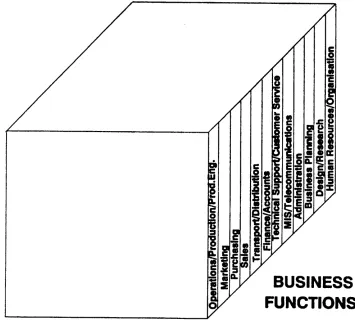
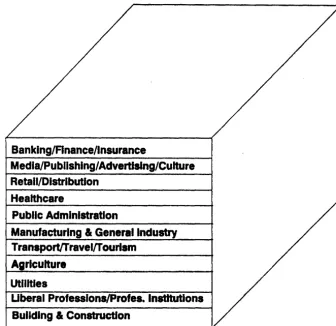
In order to analyse the relationship of advanced communications to business, the three-dimensional model in Fig 1 has been used to relate Generic Applications of advanced
communications to both business functions and business sectors. This enables easier
identification of possible commonalities and economies of scale. The issue which is addressed by ACE in general is "which Generic Applications. in which sectors and in which func~ions?"
BUSINESS
SECTORS
Banklng/Financennaurance
Media/Publishing/Advertising/Culture Retail/Distribution
Healthcare
Public Administration
Manutacturln & General Industry Transport/Travel/Tourism
Agriculture
Utilities
Uberal ProfesslonS/Profea.lnatltutlons
Building & Construction
Fig 1: Advanced Communications Applications Domain
3.1 IBC Generic Apolicatjon Strategies
c
0
I
c
II
c
BUSINESS
FUNCTIONS
Part I of ACE is concerned with identifying and building consensus on the operationa! requirements of the Generic Applications of advanced communications, and with the functional requirements of the associated resource packages. In addition work has been identified on the extension of the Usage Reference Model (URM) developed in RACE, and the extension of (Generic) Application Analysis. The extraction and consolidation of results from resource package prototyping and experimentation in Part II and on field application experiments in Part III (see below) is also covered by work in this area. A key output will be the identification of guidelines and criteria for success in the introduction of advanced communications. These are critically important from the viewpoint of the user, the network operator, equipment supplier and the service provider in order to determine optimum introduction strateaies.
Since this work has its foundation in the technologies of Integrated Broadband Communications, consensus management will be established in direct connection with the existing activities in the RACE Programme.
3.2 Technioues for Advanced Communjcqtions Exoerjments
[image:24.578.51.516.105.430.2]PART I:
a:
GENERIC APPIJCATIONS STRATEGIESFIG
2
:
WORK
STRUCTURE
AND
INFORMATION
FLOWS
FOR
ADVANCED CONSOUDATION IMPACTADVANCED
COMMUNICATIONS
COMMUNICATIONS OF & USAGE MODEWNG EXPERIMENTAL OPPORTUNfTYEXPERIMENTS
&. SPECIFICATION RESULTS ASSESSMENT~---'
Ij
I I
~---~---1
I I PART I: ~ES FOR ADVANCEDco•••..:AnotiS
EXPERIIIEIIT8I I
.
I I I
TECHNOLOGY RESOURCE EUCJTATlON I .NETWORKS PACKAGES TECHNOLOGY I
-
---___
,
FOR APPUCAOON SUPPORTING & EXPERNENTS GENERIC APPL.ICATIONS TECHNIQUES'
I I
I
~
I I I
In addition, work is addressed to providing technological support to field application experiments by identifying elements of a "module kit" including communications servers, network requirements and advanced communications workplace requirements.
3.3 Advanced Communjcatjons APPlications ExPeriments
Part III consists of a series of user-based trials of advanced communications, exploiting where possible the concepts concerning Generic Applications. The subjects of these tasks are the result of the extensive investigation of the requirements and problems in various business sectors and business functions carried out in the Planning Exercise. Technological work in Part II will be exploited as appropriate ~nd when available.
The basic flows of information between the work areas is as shown in Fig 2.
4. Interconnected Investment Requirements
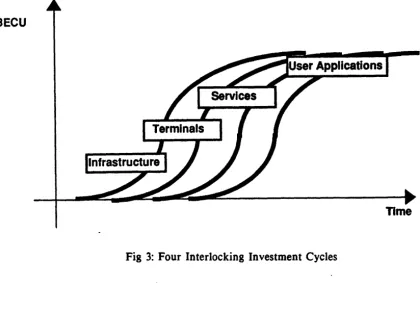
Large-scale investments are necessary in basic infrastructure, system design and equipment, service development and user application adoption. These investments are all inherently interlinked and, considering the development cycles of complex and extensive telecommunications systems, are spread in time over a period of up to 20 years. This leads to problems of fitting the system to user requirements, particularly when design decisions at an early stage of the process may determine the future availability of options and facilities for users, and consequently commercial and economic success or failure.
A fundamental problem relates to the techno-economics of telecommunications service provision, which rests on identifying at an early stage sets of functionality that are common between users. The interactions then impact at all stages of development, including basic infrastructure, equipment, services and applications. For the economics of telecommunications to work, sufficiently large user communities must be found which share common requirements and which need to intercommunicate. In the absence of such 'communities of communication' the provision of products and services is viable for only a very limited range of cases. The interrelationship is presented in Fig 3, together with the associated investment problem.
BECU
nme
[image:26.575.63.483.500.811.2]5. Pro iect Structures and Participants
The work of the Planning Exercise has identified priorities and options for action. It is
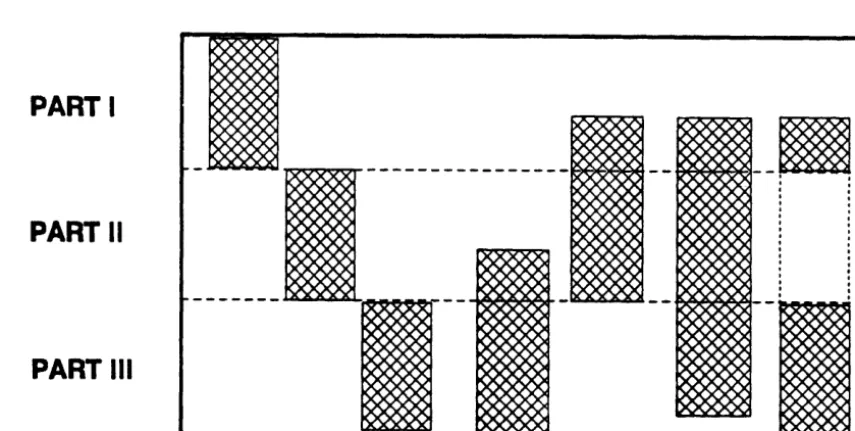
structured into Volume I which identifies the Issues and Scope for action and Volume II, which identifies a series of tasks. The whole is additionally structured into three Parts, where Part I tasks relate to matter that is necessary for establishing consensus on issues of public interest, Part II relates to pre-competitive R&D and Technology, and Part III relates to integration and verification in the form of user based field application experiments to verify application concepts.
It is anticipated that projects may address a number of tasks. Projects that span more than one Part are also anticipated. However, it is likely that any project will have its "centre of mass" in only one Part. It is expected that all projects will contribute the formation of consensus in
Part I. Possible project configurations are shown in Fig 4 below.
PART I
1--~~)Q ~~~or---~~~ toOOOO<l_-
m
.
.
.
.
I 0 I 1
I o
I 0
PART II
0 I I 0 I 0 I 0
I o
I I I o
0 I 0 I 0 I
---
DOOQOO_~mI I I I I I
PART
Ill
Fig 4: Project Configuration Options
5.1 Particioants
In order to fulfil the objectives of the work, a variety of participants will be required including:
• Users
• Service Providers/Package Integrators
• Telecommunications Network Operators
• ITT &B Industry
It is considered that Part III projects will be most likely to meet their objectives if they are user or service provider lead. A variety of skills is likely to be necessary for the execution of Part I tasks, while Part II tasks will benefit from high quality technological leadership.
[image:27.575.46.474.259.474.2]5.2 Timing
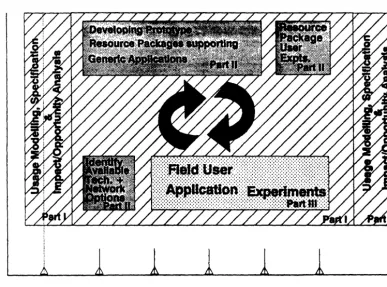
The bidirectional approach referred to in 2.2 above represents the need to operate projects from differing technological time bases. Part III projects will need to use technology that is sufficiently stable to enable the focus of the experiment to be on the applications in question, without interference from technological uncertainty. Part II projects however, will adopt be more technologically ambitious targets. Concertation will be facilitated to enable the Part III and Part II projects to operate in a mutually beneficial manner by maximising cross-fertilisation. The overall scheme is shown in Fig 5.
T
Fig 5: Activity Timing and Interrelationships
6. Milestone Plan
[image:28.596.87.475.207.494.2]TERMINOLOGY AND CONCEPTS
In the course of the development of this "Specification of Priority RD&T Tasks", various
concepts and related terminology have been developed in order to deal with the subject matter. The following text gives an explanatory and indicative usage of these terms. A set of formal definitions will be created as part of the further development of this set of concepts, and as part of any RD&T work undertaken, both in the context of Advanced Communications Experiments and in the context of Integrated Service Engineering.
Applications, Resources (Services and Products), User, Buyer
In the pursuance of their business and personal objectives, individuals and/or organisations have
·needs and wants that may be analysed/refined into tasks and processes. Applications are
determined by these needs, wants and objectives, and to the derived tasks and processes.
Resources (services and products) of various kinds may be used to fulfil the requirements of
these tasks and processes. The individual and/or organisation then becomes the user of these
resources. The same (or different) individual and/or organisation may also be the purchaser or
buyer of the resources.
Applications of Advanced Communications
Some of the resources used by individuals/organisations may be communications products and
services. Applications of advanced communications are those applications where the user chooses
to achieve his/her objectives by the use of communications resources. Applications of advanced communications thus relate to the motivations for purchase of communications resources. As such they cannot be realised or implemented. Only the resources (services and products) can be implemented, and offered to the market. Applications themselves are the motivaton of demand.
·Generic Applications of Advanced Communications, Operational Specifications,
A set of Generic Applications of advanced communications may be identified, which covers a
large proportion of the complete set of all applications of advanced communications. They relate to motivations for the purchase of communications resources, and are thus defined so that they offer significant potential in market terms for those offering resources (communications services and products) to fulfil the needs of the generic applications of advance<!
communications. All applications of advanced communications that belong to a generic
application will exhibit common operational characteristics. ACE will identify the important
generic applications of advanced communications and their operalional specifications.
Resource Packaaes, Functional Requirements
Users need to have resources assembled into resource packages to fulfil the requirements of
applications. ACE will define functional requirements for resource packages to support generic
applications. Resource packages are considered to consist of a combination of facilities
implemented in hardware and/or software, interface definitions and service definitions. The
requirements will be defined initially by analysis, and subsequently by building and testing prototypes conforming to these initial requirements in laboratory experiments involving users. This work will also draw on the analysis and results of application experiments executed in the
field. Commonalities between resource packages will be reflected in common functional
Advanced Communication System
An advanced communication system may provide resources for more than one application.
Advanced communications will form the dominant element in the system, which may at the same time be a data processing system, an information system, and/or, for example, a collaborative dealing or integrated CAD system.
The objective is that users, system integrators, equipment vendors and service providers would be able to build advanced communications systems from commonly available resources (products and/or services), with a minimum of special engineering and special service provision.
Call, Connection
Us.ers of advanced communication systems perform communications processes or tasks. These
tasks will be enabled by calls over IBCN connections.
Products, Services
To a large extent in general usage the terms product and service are interchangeable. For
example, insurance companies which provide services nevertheless describe their various policies and investment vehicles as products. At the same time software products can be described as providing a service to the user.
However within an advanced communications context terminal hardware and software are naturally described as products, even though they may sometimes be supplied by service
providers (as part of the service). Hardware and software vendors will provide advanced
communication products which will be dependent on, and interface with, network services provided by network operators.
PART I- IBC GENERIC APPLICATION STRATEGIES (TA./00)
Issue
Advanced Communications technologies offer significant opportunities both for the realisation of a more dynamic market for telecommunications equipment and services and for the creation
of a more efficient and competitive economy at large. If the potential of this set of
technologies is to be fully realised, the historical focus of the telecommunications sector on the delivery of either services or equipment must be supplemented by a focus on applications of
telecommunications. Applications are the purposes to which telecommunications is put, as seen
by the users.
·However, given the novel nature of the technology, services and applications in question, there is a danger of a mismatch between the capabilities of the IBC system and the requirements of
the market and users as these emerge. It is thus necessary to relate the applications to
underlying motivations of users (ie their needs and wants for telecommunications), to identify operational requirements of these applications of telecommunications, and to define functional requirements. These should be independent of specific implementations.
Experiments in Part III are based on an understanding of how technology will affect business
strategies and business processes and cause change in communication patterns and needs for
information. This will cause not only change within organisations, but also change in the
structure of business across sectors and the positions of business in the environment/market The combination of this understanding and the knowledge of the ways in which telecommunications can be applied to both process transformation and business sector transformation is essential to the efficient and rapid uptake of the technologies, and to the validation of system functionality at an early stage in the development process .
. &ope
The scope for action includes:
• the establishment of IBC application strategies
• the collection and consolidation of data from a variety of sources, but primarily focusing on
the experiments and laboratory prototypes created within ACE, in order to create an advanced communications reference model
• the assessment of opportunities created by and impact of advanced communications,
focusing on information generated by the experiments in Part II and Ill, in order that
conclusions may be drawn concerning introduction options and strategies
• the characterisation of Generic Applications and definition of their operational
requirements
• the definition of functional requirements for resource packages supporting the Generic
I. I Advanced Communications Usage Modelling and Ooerational & Functional Soecifications
(T A.JOJ, T A.l06, T A.l07)
Issue
Advanced communications will be built on the underlying technologies encompassed by
Integrated Broadband Communications (IBC). Despite the lack of prospect for any single
dominating service (such as telephony in the case of the current market for telecommunications) and the general trend towards diversity, a limited set of Generic Applications of advanced
communications is likely to emerge. These should relate to the needs and wants of
usen
(andhence to their decisions to purchase telecommunications). They should be defined in such a way that they cover a significant part of the user requirements and emerging market for advanced communications. In addition, it is considered that these may form a foundation on
which the interlocking investment decisions of the various actors (infrastructure,
system/equipment, services, applications) can be based.
A common understanding of the Generic Applications will accelerate the development of the market by:
• avoiding fragmentation across sectors, geography or business functions
• reducing the separation between user requirements and implementations.
Generic Applications are loosely defined as requirements for applications of advanced communications which are widespread and which provide a market opportunity for product and service providers. Generic Applications will typically be common across sector and/or across business function (where business functions are for example marketing, operations, finance).
In addition, advanced communications experiments in Part III will generate information concerning the characteristics of usage. Operational requirements, which are as far as possible
independent from particular implementations, will be identified. These will complement
functional requirements of resource packages, which will also be defined, expressed from the viewpoint of the implementer.
Scope
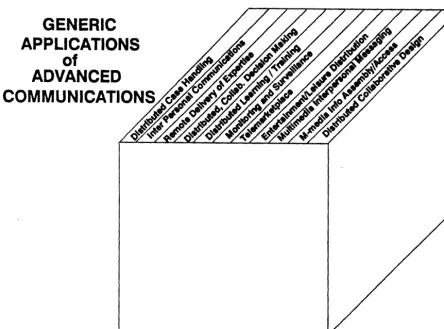
An initial set of Generic Applications has been identified (see Fig 6 below). These are based on
current perceptions of the technology
I
market match and the opportunities for the applicationof advanced communications. They are developed from a perception of the problems
experienced by user organisations which telecommunications can address. The set of the
Generic Applications and their inter-relationship will clearly evolve as more experience is gained, both through developments in the market and through the field experiments described in Part III.
Tl :e identification of Generic Applications and their characterisation in terms of operational re tuirements (user viewpoint) is of primary importance, together with a definition of the functional requirements (system viewpoint) for the resources needed for their support. The objective is to develop a system that is robust to variations and developments in the market.
Tasks have been defined dealing with the definition of operational requirements for Generic Applications and the definition of functional requirements of resource packages. In addition, a model of usage of advanced communications is to be further developed from the base work of the RACE Programme. The starting list of Generic Applications and their descriptions are identified in the following sections. These descriptions will be refined by the Part I tasks in the light of the results of prototype development and experimentation in Part II and field experiments in Part III.
Fig 6: ACE Domain - Generic Applications Viewpoint
Operational specifications for generic applications and common functional requirements for associated resource packages will be defined. The basis of this will be the user requirements established by the field experiments in Part III, by extrapolation from work on user experiments in Part 11.2 and other relevant sources both internal and external to ACE.
1.1.1 Distributed Case Handling (T A./01, T A.106, T A.107)
Issue
This relates to the case handling, management and collaborative processing of a series of (multimedia) documents (or separate documents in a variety of media) inter-related by a common theme, whose origin and ownership may be distributed across one or more organisations and locations.
In an office environment, documents circulate for editing/comment. Every editor performs
certain tasks on the document, eg approving, correcting, editing. Tasks have to be performed
within certain time limits, and frequently according to a particular, pre-defined process. It is
essential to be able to follow the document in order to locate it and to determine which preparation steps have actually been performed.
The communication requirements can be considered as a special form of conference, only partly
[image:34.587.46.491.39.368.2]Scope
Case handling requirements include looking up documents, performing queries, ·and seeking the advice. The documents needed or the people to be consulted are frequently not situated at the same place as those handling the case. Indeed, IBC will allow the locations of the people and operations to be controlled by factors other than the need to be close to the information.
Case handling involves a number of inter-related activities to be performed on a (multimedia) document. Documents must be passed around in a controlled way, distributed, archived, retrieved, named; different versions of documents are created when, at the expansion point of a distribution list, multiple copies are spread and then considered independently. The resulting versions must remain identifiable or even be capable of recombination. Decision making on the case must be supported by appropriate interpersonal communi~tions.
The complexity of this process is increased, and the relevance to IBC becomes evident, when the various stages of the process are distributed over a variety of sites as well as spread out in time. In the IBC environment, the case document material may be in any of a variety of media, eg text, image, graphic, video.
The above is true for an office environment in which documents are passed around editors. Every person applies some processing to the document. Documents may also be jointly edited. Editors then apply their considerations concurrently to the document which introduces a need for synchronisation and personal interaction mechanisms. Editing steps and decisions made concerning the case must be identifiable and changes may have to be propagated to every editor simultaneously.
The operational requirements of this Generic Application and the functional requirements for the related resource packages will be refined by analysis under the tasks in 1.1, by prototype development and experimentation in Part II aqd by exploiting the results of field experiments in Part Ill.
1.1.2 lnteroersonal Communications (T A./01. T A./06. T A.l07)
Issue
Amongst other more specialised applications, IBC will deliver person-to-person multimedia communications. Video-phone and video-conference are both included within this Generic Application.
The Generic Application requirement is to enable people to communicate with each other, in a way that is as closely as possible equivalent to them being in the same room. This implies a means of identification or recognition, and a means of hearing and seeing each other and seeing the same material. However, the motivation for communication is personal contact, rather than for example the discussion of a document. The analogy outlined above inevitably has its limitations - it is also necessary to maintain a set of signals that provide the user with the conscious information that they are dealing with a communications mode that is remote, while the practical operation of the communications system is made as easy as possible.
In practice, the requirement is met by the provision of a multimedia workplace, which may be a desk, office or may be mobile in some implementations, with a user interface that facilitates easy multimedia communications to another workplace. Additionally, there is a variant of this application that relates to the domestic environment, where the process that the IBC is supporting is the need to maintain interpersonal contact for purely social reasons. It will be important to deal with communication between workplaces of different types, for example between an advanced IBC workplace and a PSTN workplace. Without this the takeup of the related technology and services will be slow owing to failure to achieve a critical mass of users.
Typical applications include communications between professionals, between a tele-worker and a supervisor, and between physically disabled people (with IBC they become intellectually mobile whilst being physically housebound).
Scope
All business function and business sector experiments require person-to-person communications support - this Generic Application will require personal identification and/or some form of access control. It also follows that a common style of human-machine interface should be established which would be available to meet the requirements of the other applications. The 'metaphor' or 'cognitive model' which is used to support this Generic Application will be of prime importance.
The concept of the IBC delivering the information to the person must be supported, rather than relating the person to a single workstation. Facilities for multiple users on one workstation and appropriate access controls are vital.
An important subset of this Generic Application is the requirement for personal mobility including the need for mobile and portable workstations and communications on the move.
Another aspect of this Generic Application concerns the media components approach where the lBC services are delivered to disparate attached devices under separate controls but which together are orchestrated into a seamless multimedia interpersonal communication. The personal user would then be able to select the most appropriate form of communication for the current task. A single telephone call might be appropriate for a simple factual enquiry whilst high quality video, stereo sound and a hard copy colour print might be needed for more demanding tasks.
The operational requirements of this Generic Application and the functional requirements for the related resource packages will be refined by analysis under the tasks in 1.1, by prototype development and experimentation in Part II and by exploiting the results of field experiments in Part III.
f.J .3 Remote Deliverv of Expertise (T A.JOJ, T A../06, T A./07)
Issue
Many IBC applications will involve users consulting with human or machine sources of expertise. Several providers of expertise could be involved in a consultation session.
This Generic Application enables the skills/knowledge or expertise of an individual, or group of individuals, to be available, on demand by people without that expertise. The IBC will enable access to the expertise to be interactive and efficiently shared by many geographically remote 'customers'. There is particular relevance in an environment where demographic change renders skilled personnel yet more valuable, and where the increase in competition in traditional markets and the movement to information based economies increases the dependence on various skills.
Scope
Examples include:
• the ability to refer medical problems between specialist consultants without moving the patients
• the ability of individuals to consult a lawyer and
• the sale of stockbroking advice from a team of experts over multimedia systems.
The remote provision of expertise may require all kinds of IBC communications relations, varying between 'one to one' and 'many to many' relations between both people and computers in fixed and variable locations.
The most easily acceptable scenario of remote expertise provision would consist of:
• one or several expertise users
• being located at a single or at different places
• communicating with one or several expertise providers
• being located at one or several other places.
Both user(s) and provider(s) may wish to communicate with other people or computers during the session.
Workplace videoconferencing is one appropriate communications environment for remote expertise provision. By means of conferencing workstations, the expertise user(s) and providers(s) should have the ability to dynamically interconnect to and disconnect from other remote systems/people.
The operational requirements of this Generic Application and the functional requirements for the related resource packages will be refined by analysis under the tasks in 1.1, by prototype development and experimentation in Part II and by exploiting the results of field experiments in Part III.
1.1 .4 Distributed. Collaborative Decision Mflkjng (T ..4.101, T ..4.106, T A./07)
Issue
To support this Generic Application, IBC will provide a platform for multi-party distributed decision support.
For many applications a need to facilitate the usual decision-making pr6cess can be found, especially when many people are working together to achieve a common goal. In this case decision making is typically a multi-hierarchical and multi-party process, involving people who have the expertise to support a decision under tech.nical and/or managerial and/or commercial aspects.
Such a decision-making process is even more complex if the people deciding are not at the same place. Until now these people had to come together or otherwise the decision had to be made in several stages - both proceedings are very time-consuming and often error-prone.
This Generic Application involves a number of IBC users in different locations participating in a decision-making process. It will require audio-visual conference facilities with appropriate conference control procedures, plus multimedia document transmission support and management.
Scope
During a typical decision-making process many discussions take place, (complex and/or
technical) details have to be clarified, experts have to be consulted. Therefore the aspects of
human interactions (taking into account the gestures and facial expressions of the involved people) and the need to present and explain detailed information are very important. In order to support distributed decision making a videoconferencing system is one appropriate facility
which fulfils the above mentioned requirements. In such a videoconferencing system
multimedia-document environments have to be taken into account. While working on
multimedia documents during the decision-making process, revision control facilities will be
used. If a formal agreement is made remote signature procedures will be applied.
The operational requirements of this Generic Application and the functional requirements for
the related resource packages will be refined by analysis under the tasks in I.l, by prototype
development and experimentation in Part II and by exploiting the results of field experiments in
Part III.
1.1.5 Distributed. Collaborative Design (TA./01, TA./06, T A./07)
Issue
Many design processes involve the participation of a number of different people. The IBC will allow remote participation in this process. This Generic Application focuses on multiple (and iterative) remote contributions to a design process. The (fesign is typically that of a physical object, though many other activities dealing with products that are other than physical goods may also have the same characteristics, eg the design of a software package. However, it is considered that this application is distinct from information-based decisions, which may have no single object as their focus.
In a decision-making process information plays a key role; in a design process a focus on the goods or object is more important, but without neglecting the possibilities to discuss design
problems and to decide how to solve them. Therefore the multi-party distributed decision
support mentioned above can be seen as the superset to facilitate remote contributions in a design process.
Scope
The Generic Application is relevant in the media and publishing sector as well as in the
electronics, aerospace and automotive industries. In addition the major research institutes,
already familiar with international collaboration on large projects should be considered, as
should any other sector where a 'product' of some kind is created by the collaboration of a number of individuals.
General needs include inter-personal communications to support the iterative process of decision making in a phased or iterative development process.
Access via IBC to multimedia data bases will be required, maintained by each component maker
or supplier, or possibly by a new class of brokers established as a "telemarket". In some cases
the provision of the data base could be a third-party service. Data must be available as displays
or hard copy, and as files which can be entered into the users' CAD systems.
The service aspects to be investigated would include the following:
• methods of establishing connections, over switched public networks or leased-channel
• access control, security of data, privacy and charging
• integration with differen~ types of current and future workstations and software systems
• impact of A TM, and suitability to traffic patterns (potentially bursty with short response
time requirement).
The operational requirements of this Generic Application and the functional requirements for the related resource packages will be refined by analysis under the tasks in 1.1, by prototype development and experimentation in Part II and by exploiting the results of field experiments in Part III.
1.1.6 Distributed Learning/Training (T A.lOJ, TA.l06, TA.l07)
Issue
The availability of multimedia communications will significantly improve the possibilities of
remote education and training. Conferencing capability will be included to permit general
interaction between the participants in the learning event.
Most application areas include the wish or need for users to gain knowledge and expertise using IBC as a vehicle for information flow. In all areas, technological change has necessitated the re-education of adults throughout their working life. This Generic Application will include elements of teaching (where the teacher defines the syllabus and controls the pace) and learning
(where the pupil is given the means to acquire information and skills). It will also include the
joint authorship and preparation of material.
Examples include instruction in the maintenance of aircraft and similar complex products, marketing of drugs coupled with information about their use, skills- based learning through access to material assembled off -line.
A key feature of this application is that it is usually non-symmetrical in information flow, as
the provider of the material cannot cope with each of many pupils returning similar quantities of data.
Scope
The typical classroom situation is an example of a conference in which only one person is actively contributing, while others are listening. Direct visual contact is needed as it helps to clarify terms by employing gestures and facial expressions. IBC technology might change this pattern, but it is a basic model.
In many environments, particularly in scientific areas, participants need to coordinate their work, present results and discuss open issues. Groups may be small, possibly not more than ten people. Discussions often do not have an appointed leader. Contributions to the discussion are typically short and need support for visualisation in different ways, eg overhead slides, desk-top presentation.
In a seminar, participants are listening most of the time. Usually a lecture is supported by
applying an overhead projector. Some support for discussion is needed.
Roles in these various environments are not statically assigned. Support for integration of
different presentation mechanisms and media are required.