White Rose Research Online URL for this paper: http://eprints.whiterose.ac.uk/99957/
Version: Accepted Version Article:
Arthurs, Y. and Timmers, R. (2016) On the fluidity of consonance and dissonance: The influence of musical context. Psychomusicology: Music, Mind, and Brain, 26 (1). pp. 1-14. ISSN 0275-3987
https://doi.org/10.1037/pmu0000102
[email protected] https://eprints.whiterose.ac.uk/
Reuse
Unless indicated otherwise, fulltext items are protected by copyright with all rights reserved. The copyright exception in section 29 of the Copyright, Designs and Patents Act 1988 allows the making of a single copy solely for the purpose of non-commercial research or private study within the limits of fair dealing. The publisher or other rights-holder may allow further reproduction and re-use of this version - refer to the White Rose Research Online record for this item. Where records identify the publisher as the copyright holder, users can verify any specific terms of use on the publisher’s website.
Takedown
If you consider content in White Rose Research Online to be in breach of UK law, please notify us by
On the Fluidity of Consonance and Dissonance: the Influence of Musical Context
Yuko Arthurs
Renee Timmers
Department of Music, the University of Sheffield
Author Note
Yuko Arthurs, Department of Music, the University of Sheffield, Sheffield, UK;
Renee Timmers, Department of Music, the University of Sheffield, Sheffield, UK.
This research was supported by the University of Sheffield as part of a three-year
doctoral Faculty Scholarship awarded to Yuko Arthurs.
Yuko Arthurs is a PhD student at the University of Sheffield, UK. She gained a BA in
Musicology and an MA in music at Tokyo University of the Arts, Japan, and an MA in the
Psychology of Music at the University of Sheffield, UK. She has presented papers at the
ICMPC12 and the ICME.
Renee Timmers is Senior Lecturer in Psychology of Music at the University of
Sheffield. She gained a PhD in Social Sciences at Radboud University Nijmegen, NL and an
MA in Musicology at the University of Amsterdam, NL.
Correspondence concerning this article should be addressed to Yuko Arthurs,
Department of Music, the University of Sheffield, 34 Leavygreave Road, Sheffield, S3 7RD,
United Kingdom.
Abstract
The consonance/dissonance (C/D) level of a triadic chord is not a fixed or absolute value. Rather, it is fluid, since C/D depends both on a chord’s sonic characteristics and on the
musical context in which it appears. To test the fluidity of C/D - the extent to which C/D
perception is dependent on musical context - four types of chords, major, minor, augmented
and diminished triads, were presented in isolation (“without musical context”) and as part of
a short cadence (IV-V-I, “with musical context”). The C/D level of each chord was judged, as
was the overall C/D and pleasantness/unpleasantness (P/U) level of the cadences. When
isolated, major triads were considered most consonant, followed by minor and diminished
triads, while augmented triads were judged most dissonant. In the context of a musical
cadence, this rank order remained the same, but augmented and diminished chords were
evaluated as less or more dissonant depending on their functional position within the cadence
(for instance, diminished triads were relatively consonant when on the subdominant, while
augmented triads were relatively dissonant when on the tonic). These findings lend support to
the hypotheses that: (a) the degree to which the harmonic function of a chord is familiar, and; (b) the degree to which a chord’s stability (and hence also the listener’s expectation) is
violated contribute to the perception of C/D.
Keywords (5): consonance and dissonance: pleasantness: musical context: chord function:
On the fluidity of consonance and dissonance: the influence of musical context
Consonance and dissonance (C/D) have over centuries been the central talking point
in the discussion about the perception of chords. Consonance refers to the harmonious
sounding of stimulating tones, and consonant sounds are often described as beautiful,
pleasant, united, and smooth. Dissonance, meanwhile, refers to stimulating sound that has a
rough quality, or to sounds that are unpleasant and inharmonious (Parncutt & Hair, 2011;
Tenny, 1988). Listeners are able to judge almost instinctively whether a sound is consonant
or dissonant, and the discernment of consonance and dissonance is an ability that does not
require any particular skills or special knowledge. Nevertheless, for researchers, explaining or
establishing theories of the phenomenon of C/D has proved to be a significantly more
challenging task. The ancient Pythagoreans found that the consonant or dissonant sounds
created by intervals are related to the frequency ratio between the two constituent notes of the
intervals: the simpler the integer ratios between these notes are, the more consonant the
intervals will sound. In the late 19th century, Helmholtz proposed that roughness caused by
beating contributes to dissonance, and that therefore consonance is the absence of roughness
(1877/1954). This theory was later developed by Plomp and Levelt (1965), and Kameoka and
Kuriyagawa (1969), who demonstrated that the occurrence of roughness is related to the
critical band. When the frequencies of two notes are within 25% of the width of the critical
bands for those frequencies, the sound is dissonant, while the sound becomes progressively
less dissonant as the two frequencies move further apart from, or closer towards, the 25% of
the critical bandwidth.
An alternative account of C/D is Stumpf’s theory of fusion (Boring, 1942: Schneider,
1997). “Fusion” refers to the experience of hearing well-blended, simultaneous sounds that
are perceived as one whole, coherent sound. Two tones tend to fuse better when they have
will be, whereas segregated sound that lacks fusion will be more dissonant. According to this
theory, an octave is the most fused of all intervals, followed by the perfect fifth, and then by
major and minor triads, a hypothesis that gained empirical support from a study conducted by
DeWitt and Crowder (1987). Many recent C/D studies consider harmonicity to be an
important factor in C/D perception (Bidelman & Krishnan, 2009; Cousineau, McDermott, &
Peretz, 2012; McDermott, Lehr, & Oxenham, 2010; Tramo, Cariani, Delgutte, & Braida,
2001). These studies demonstrate that more harmonic intervals or chords will also be more
consonant. In the case of intervals, those with simpler frequency ratios are said to be more
harmonic, since the partials of two simple notes coincide to a greater degree and thus produce
more regular patterns (Gill, & Purves, 2009). Tramo et al. (2001) showed that the
autocorrelation histograms of the neural responses of cats to intervals finely mirror the
patterns of the sound waves of those intervals, and a more regular pattern of neuron firing
was observed when the cats were played a perfect fifth as opposed to a minor second. Some
recent studies demonstrated that harmonicity is a greater contributing factor to the perception
of consonance than roughness. McDermott et al. (2010) found a strong correlation between listeners’ pleasantness ratings of intervals and chords on the one hand and harmonicity on the
other, while the correlation between pleasantness ratings and the absence of roughness was
weak. Similarly, a study by Cousineau et al. (2012) showed that, although listeners with
amusia who were able to detect roughness tended to dislike it, they showed no preference for
consonant or harmonic tones over more dissonant and inharmonic ones. This finding
indicates that roughness is not by itself sufficient to account for C/D perception.
Despite the richness of studies on C/D perception, our theoretical understanding of the
C/D of chords remains incomplete. Results from behavioral studies (Bidelman & Krishnan,
2011; Cook & Fujisawa, 2006; Johnson-Laird, Kang, & Leong 2012; Roberts, 1986) are
being most consonant, followed by minor triads and diminished triads, while augmented
triads are the most dissonant of all. One of the greatest difficulties for theory is the apparent
discrepancy between the C/D of augmented and diminished triads. “Acoustic dissonance” for
triads (Hutchinson & Knopff, 1979) is based on the difference between the dissonance factors
for the three dyads that constitute each triad, together with the roughness of each complex
tone. The calculated data is, it seems, mostly consistent with the relative C/D of chords in
music theory. “Root ambiguity”, a theory suggested by Parncutt (1988. 1989), refers to the
idea that a chord with a clearer root is perceived as more consonant. According to this theory,
a major chord will sound more consonant than a minor chord because the major chord possesses a clearer root. Both “acoustic dissonance” and “root ambiguity” predict that the
diminished chord will be the most dissonant type of triad; but this contradicts the evidence
from behavioral data. Recent studies show that behavioral data on the rank order of the four
triads may be explained by a different type of listener response and by other acoustic features
of a chord. Bidelman and Krishnan (2011) found that chords that were judged to be more consonant elicited stronger “neural pitch salience”, which they calculated based on neural
activity in the midbrain in response to the four chords. The ordering of the four chords, from
the one that elicited the strongest neural pitch salience to the weakest, was consistent with the
behavioural data. Likewise, McDermott et al. (2010) found a strong correlation between the listener’s preference for a chord and its harmonicity. However, we cannot definitively
ascertain harmonicity’s role in determining the relative C/D of augmented and diminished
chords, as diminished triads were not tested in the experiments.
The studies mentioned above focus on sensory consonance/dissonance, but when
intervals and chords appear within the flow of music, their C/D is called “musical
consonance/dissonance” or “tonal consonance/dissonance” (Krumhansl, 1990; Terhardt,
chords, but also on the musical context in which the interval or chord is presented. If this is
the case, then factors such as: the principles of tonality; the musical context in which the chord appears; the listener’s musical schema; the listener’s familiarity with the style of music;
and the music’s acoustic properties may all play a part in shaping C/D perception (Cazden,
1980; Gardner & Pickford, 1943; Krumhansl, 1990; Lundin, 1947; Terhardt, 1984). Gardner
and Pickford (1943, 1944) conducted a study to demonstrate the influence of musical context,
in which they employed various chords (details not given) in different contexts and keys as
musical stimuli. They found that context did indeed influence participants’ judgements of the
“dissonance-level” of target chords. Roberts (1986) also showed that chords sound more
consonant when heard in a “traditional” harmonic progression as opposed to a “non
-traditional” one. Unfortunately, these studies say little about precisely which elements of
musical context might be responsible for influencing C/D judgements of chords, and nothing
about how they might do so. The influence of context on the evaluation of dissonance was
also observed in an experiment by Johnson-Laird et al. (2012), in which major triads,
sevenths, minor sevenths, and minor triads were judged to be more consonant when heard in
the context of a common harmonic progression than when in random, non-tonal sequences.
The effect of context on C/D perception may be attributable to harmonic expectations based on the listener’s musical schema. One’s musical schema is acquired as a result of
enculturation, through a process of becoming familiar with a certain musical culture or genre.
It is our musical schema that enables us to predict oncoming events, and to process these
events on the basis of the knowledge we have stored in the schema (Bharucha, 1994).
Empirical studies (Bigand, Madurell, Tillmann, & Pineau, 1999; Bigand & Pineau, 1997;
Tillmann, Janata, Birk & Bharucha, 2008; Tillmann & Lebrun-Guillaud, 2006; Tillmann &
Marmel, 2013) reveal that C/D judgements of expected chords, and in-tune or out-of-tune
ones. C/D of chords on the tonic - the governing and therefore most stable function,
according to the theory of harmonic hierarchy - were judged faster and more accurately than
that of chords on less stable functions such as the dominant and subdominant (Tillmann et al.,
2008). Expected events are also thought to induce more positive affective reactions than
unexpected events (Huron, 2006). Recent studies employing event-related potentials (ERPs)
revealed that the early right anterior negativity (ERAN) is activated by unexpected chords in
chords sequences, and acoustically identical chords generate different amplitudes in the ERP responses depending on the confirmation or violation of a chord’s harmonic functions
(Koelsch, Gunter, Friederici, & Schroeger 2000; Leino, Brattico, Tervaniemi, & Vuust, 2007;
Loui, Grent-‘t-Jong, Torpey, & Woldorff, 2005; Maess, Koelsch, Gunter, & Friederici, 2001).
Also, target tones are recognized more accurately when they appear in familiar or meaningful
contexts than when they appear in an unfamiliar or meaningless contexts (Dewar, Cuddy &
Mewhort, 1977), and mismatch negativity (MMN), elicited by stimuli that deviate from other
stimuli, was larger when this deviation occurred in familiar as opposed to unfamiliar contexts
(Brattico, Näätänen & Tervaniemi, 2002).
The effect that one’s schema has on perception is a part of cross-cultural differences
in music perception. Listeners with different musical cultures have been shown to perceive
some intervals in the chords of Western tonal music differently. A study by Maher (1976),
which asked Canadian and Indian listeners to give twelve intervals “restful” or “restless”
ratings, demonstrated that Indian participants generally rated intervals more “restful” than the
Canadian group, and revealed that they did not judge that minor seconds and major sevenths
were “restless” as Canadian listeners tended to. Attitudes to roughness and dissonant sound
also vary from culture to culture. In Western tonal music, beating that causes roughness is
normally avoided, as there exists an assumption that “rough sounds are inherently bad and
Bonfiglioli, 2000; Sollberger, Reber, & Eckstein, 2003), and dissonant music induces
negative emotions and physiological responses that support this negative association
(Dellacherie, Roy, Hugueville, Peretz, & Samson, 2010). By contrast, however, some musical
cultures appreciate dissonance and beating, and positively encourage their appearance. For
instance, the sitar and the shamisen, a traditional Japanese instrument with three strings, are
both intentionally structured to create a buzzing noise (Malm, 2000); there is a method of
tuning in Balinese gamelan designed to create beating when the orchestra play together; and
there is a variety of Balkan singing called gang, in which a chorus alternately follows and
then accompanies a solo singing section, singing the same melody just a major or minor
second apart (Vassilakis, 2005). The people of the region consider these intervals “pleasant
and desirable”, although those from outside the region are more likely to fail to appreciate the
resulting sound (Vassilakis, 2005). These examples help to convey something of the diversity
and richness of C/D perception.
Another important issue concerning C/D is its relationship with pleasantness.
Consonant sounds are often described as pleasant, and so it has been postulated that
pleasantness should be considered an indication of consonance (Tenney, 1988). Many studies
employing only non-musicians, or both musicians and non-musicians have shown that C/D
and pleasantness/unpleasantness (P/U) are similar – that is to say, that there is a close match
between C/D and P/U judgements (Guthrie & Morrill, 1928; Johnson-Laird et al., 2012;
Plomp & Levelt, 1965; van de Geer, Levelt, & Plomp, 1962). However, differences between
the perception of C/D and P/U have also been highlighted in a study by Guernsey (1928). In
her study, musically trained participants judged octaves and perfect fifths as being the least pleasant
intervals, despite their also being judged the most fused and smooth.The present study explores
correlated by canvassing the judgements of participants with a moderate amount of musical
training and experience.
Regarding the influence of musical experience on C/D judgements, both behavioral
and neuroscientific studies show that musicians are more sensitive to C/D than non-musicians
(Brattico, Pallesen, Varyagina, Bailey, Anourova, Järvenpää, Eerola, Tervaniemi, 2009; Itoh,
Suwazono, & Nakada, 2010; Roberts, 1986; Rogers, 2010; Schön Regnault, Ystad, & Besson,
2005). Further, musicians are more likely to rely on sensing the harmonicity of a chord in
order to judge its C/D than their non-musician counterparts (Kung, Hsieh, Liou, Lin, Shaw, &
Liang, 2014; McDermott, Lehr, & Oxenham, 2010). On the other hand, no difference
between musicians and non-musicians were found in certain other cases. For instance, there was “no reliable effect” of musical experience on the dissonance ratings of chords
(Johnson-Laird et al. 2012), no difference between the C/D and pleasantness judgements of musicians
and non-musicians when chords were presented in a context (Roberts, 1986), and no
difference between musicians’ and non-musicians’ judgements of the semantic connotations
of an interval’s C/D (Costa et al., 2000). These examples emphasize both the rigidity and the
fluidity of C/D perception. This study will focus in particular on the influence of familiar
harmonic functions on the perception of chords, using participants who have had a moderate
amount of musical training and who are familiar with tonal cadences.
Present Study
As Lundin (1947) claimed, the C/D levels of chords are neither fixed nor absolute, but
change according to context. It is true that each chord may have a certain standard level of C/D based on its sensory C/D. However, the effects of musical context and of the listener’s
musical schema mean that there is fluidity to C/D judgements in the case of all chords. The
particular the influence of harmonic function, on the listener’s C/D and P/U perceptions of a
triad. Experiment 1 tested listener’s C/D perceptions of major, minor, augmented, and
diminished triads in isolation. In Experiment 2, all triads were allocated a different position in
the short sequence IV-V-I in both major and minor keys. The results of the two experiments
will be compared in order to assess the “fluidity” of the chords – that is, the extent to which
the level of each chord’s C/D varies according to whether it appears in isolation or in a
musical context.
Although musical context is considered to be the key factor in determining musical
C/D, it has not been clearly specified what “musical context” connotes, nor what or how the
various components of musical context influence C/D judgements. In the case of a short
harmonic progression consisting of several chords, musical context can be defined as the
relationship between the target chord, and the preceding and succeeding chords. For short
harmonic progressions, then, sensory relatedness and the hierarchy between notes and chords
in a local context, and the function of chords in a global context, together comprise the
musical context. In the case of longer, more complicated musical works, melodic anchor and
rhythmic patterns will be part of the musical context as well. This study considers musical
context in two ways: a musical context in which the same chords are given different
harmonic functions; and the presence and absence of musical context - that is, chords in
isolation and chords that appear in some musical context. Experiment 2 examines the fluidity
that results from the same chord being heard in different functions, and later the results of
Experiments 1 and 2 will be compared in order to analyze whether and to what extent context
influences fluidity – that is to say, how the C/D of chords varies according to whether they
are heard in a musical context.
Hypotheses: Fluidity 1. Different Harmonic Function
In Experiment 2, each triad was allocated a different position in the short sequence
IV-V-I in both major and minor keys (major and minor triads appeared only in sequences in
major or minor keys respectively). The appearance of an augmented or diminished chord is
expected in certain progressions, since both chords have certain “expected” harmonic
functions. In such cases, the chord will be more familiar and therefore less
dissonant-sounding than the same chord in an aberrant or unfamiliar chord progression, or if it occupies
an unfamiliar function. There are three possible models for explaining how augmented and
diminished chords may be perceived differently depending on harmonic function: the familiar
harmonic function model; the tonal stability model; and the position of the fifth note of the
target chord model.
1. The Familiar Harmonic Function Model
Previous studies (Koelsch, Gunter, Friederici, & Schroeger, 2000; Leino, Brattico,
Tervaniemi, & Vuust, 2007; Loui, Grent-‘t-Jong, Torpey, & Woldorff, 2005; Maess, Koelsch,
Gunter, & Friederici, 2001) show that the degree of expectation for a chord varies according
to its harmonic functions. In other words, chords are expected in a certain context with a
certain harmonic function, but the acoustically identical chord can seem unexpected when it
performs an uncommon harmonic function. These studies used ERPs, and demonstrated that
the Neapolitan chord elicits a larger amplitude of the ERAN when it appears on the
unexpected tonic function than when on the expected subdominant function (Koelsch et al,
2000; Leino et al, 2007; Loui et al, 2005; Maess et al, 2001). On the basis of this, the familiar
harmonic function model predicts the following: augmented and diminished chords will
sound most consonant when heard on their most familiar and conventional functions. In
in practice the mediant is quite an uncommon chord. Augmented chords are often used as a
substitute for a dominant chord, or as neighbouring or passing chords (for example, within
the progressions I – I+ - IV, and I –I +- I), in order to give the music a chromatic sound and
to embellish the harmony (Gauldin, 1997). The most familiar function for augmented triads is
the dominant, followed by the tonic. Diminished triads can act as leading note chords that
precede the tonic and the end of the cadence, and have a dominant function in this context.
They can also appear as the supertonic in a minor key (Andrews, 1950), and in this context
they have a subdominant function. This familiar harmonic function model predicts that
augmented chords will sound more consonant when they appear on the dominant or tonic,
and that diminished chords will be more consonant when on the dominant or subdominant.
Conversely, they should sound most dissonant when occurring in any other function.
2. The Tonal Stability Model
Turning now to the second model, which is based on the notion of the tonal hierarchy
of chords, and according to which C/D and P/U judgements are susceptible to the influence of
the tonal stability of chords rather than being determined by the familiarity of their function.
The second model supposes that an unexpected chord sounds more dissonant when it appears
on a more stable function than when on a less stable function, because the violation of
stability will be greater with the former. This idea is based on the theory of the psychological
tonal hierarchy and stability of chords (Bharucha & Krumhansl, 1983; Krumhansl, 1990). In
Western tonal music, there are 12 tones in each octave, and chords can be built up on each
tone. However, these 12 tones or chords do not appear an equal number of times in most
pieces of music, but rather some tones and chords - such as tonic, dominant, and subdominant
- occur more frequently than others. These dominating tones and chords are more important,
and are described as stable because they help to establish the sense of key and function as a
Krumhansl employing the probe-tone technique demonstrate the psychological tonal
hierarchy that exists in a listener’s musical schema. Her studies reveal that listeners give the
highest ratings of fitness to tonic tones (Krumhansl & Kessler, 1982) or chords (Krumhansl,
1990), followed by dominant and subdominant tones or chords. Bigand (1997) also provides
empirical evidence of a correlation between the level of a tone in a tonal hierarchy and that tone’s stability. This psychological tonal hierarchy is generally in accordance with music
theory, and with findings concerning the frequency of a chord’s occurrence as investigated by
Budge (1943). Chords rooted in a tonic tone (e.g., C-E-G, C-E-G-B in the key of C major)
account for 41.79% of the musical pieces she examined, followed by 31.68% for chords with
a dominant tone root, and 8.45% for chords with a subdominant tone root (Krumhansl, 1990).
Tonic tones or chords are the most frequently occurring, and are therefore the most stable in
the hierarchy. This dominance of the tonic can be represented by other subjective measures
(Tillmann, 2008). Of all chords, tonic chords elicit the greatest sense of completion (Tillman
& Lebrun-Guillaud, 2006), and the lowest levels of tension (Bigand, Parncutt, & Lerdhal,
1996). Tones and chords with more stability are processed more quickly and accurately
(Bigand, Tillmann, Poulin-Charronnat, & Manderlier, 2005 ;Bigand, Poulin, Tillmann,
Madurell, & D’Adamo, 2003; Tillmann, & Marmel, 2013), and judgements of C/D are
processed most quickly when the target chord is on the tonic, followed by the dominant, and
most slowly when on the subdominant (Bigand & Pineau, 1997; Tillmann, Janata, Birk, &
Bharucha, 2008).
Stability is also attributable to the sensory C/D of chords (Bigand et al., 1996; Dibben,
1999), and roughness especially is an important contributing factor. Chords with more
roughness induce higher musical tension (and less stability) than those with less roughness
(Bigand et al., 1996), and musical tension is often considered the opposite of resolution or
frequency ratios and are therefore judged as being stable and consonant, even in atonal music
(Dibben, 1999). There is a correlation between sensory C/D and stability: the more consonant
a sound is, the more stable it sounds to the listener. Therefore, being consonant is a
prerequisite for tonal stability.
The second model supposes that an unexpected chord, one that does not normally
appear in that context, will violate tonal stability. The violation of tonal stability may be
bigger when the chord occurs on a more stable function than when it occurs on a less stable
function. Thus, an unexpected chord on the tonic is likely to sound particularly dissonant
because of the violation of tonal stability, while a similar chord on the subdominant function
will be less so due to it being less of a violation of stability.
3. The Position of the Fifth Note Model
The third model to consider is the position of the fifth note of the target chord in the
context of the scale. This model predicts that the C/D of augmented and diminished chords
may be influenced by the importance of the fifth tone of the chord, which is replaced by an
augmented or diminished tone. In Experiment 2, the same target chords are allocated to one
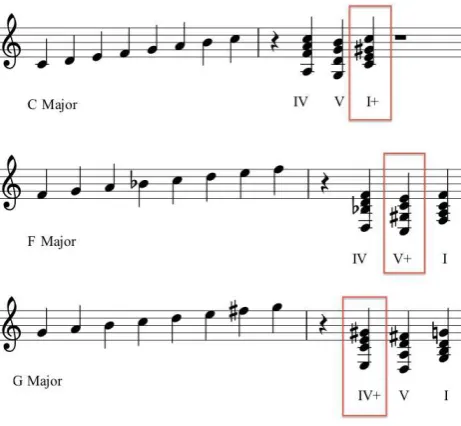
of three unexpected positions in a short harmonic progression, IV-V-I. For example, an
augmented chord, C- E-G# appears on IV when the sequence is in the key of G major, on V
when it is in the key of F major, and on I when it is in the key of C major (See Figure 1). An
acoustically identical chord can appear in different keys, and can as a consequence perform different harmonic functions. In addition, the position of a chord’s constituent tones in the
tonal hierarchy will change depending on the key. These facts indicate that the tonal
hierarchy is dependent on context rather than on the acoustic sonority of a chord (Bigand,
1997; Tillmann, 2008). To illustrate this further, the fifth note of a C major chord, G, is a
major, and so its importance in the hierarchy changes accordingly. In augmented and
diminished chords, however, the fifth note (G sharp and G flat respectively when the root is
C) does not feature either in the C major scale or the C minor scale, and this deviation violates the listener’s expectations. On this basis, the third model hypothesises that a chord
whose fifth note is replaced and violated by an augmented or diminished note will be more
dissonant when the replaced tone has a more important position in the tonal hierarchy,
because the violation of expectation will be greater in such a case. The fifth note of a chord
will be the tonic when that chord is on IV, or the supertonic when on V, or the dominant
when on I - so the prediction is that unexpected augmented and diminished chords will sound
most dissonant when they are on the subdominant (IV) followed by when they are on tonic (I),
and most consonant when on the dominant (V).
Table 1 summarizes the three hypotheses regarding the effect on C/D of the function
of a chord. The first hypothesis predicts that a chord will sound more consonant when it
appears on the most frequent, and therefore most familiar, function. Augmented chords are
thus expected to be more consonant when on the tonic or dominant, and less consonant on the
subdominant. Diminished chords, meanwhile, may sound most consonant when heard on the
dominant, and less consonant when on any other functions. The second model supposes that
augmented and diminished chords will sound most dissonant when they occur on the tonic
because of the greater violation of stability that this would represent. The third model posits
that the C/D of augmented and diminished chords is influenced by the importance of the fifth
note of chords in a key context: a chord will sound more dissonant when the fifth note of the
chord being replaced by either an augmented or diminished tone has a more important
position in a tonal hierarchy. According to this model, both augmented and diminished
chords are most consonant when they appear on the dominant, followed by the tonic, and the
different aspects of the tonal hierarchy. The second model concerns the stability of the
function performed by the chord, while the third model deals with the importance of the fifth
tone of augmented or diminished chords in a key context.
<Insert Table 1>
Hypotheses: Fluidity 2. The Presence and Absence of a Musical Context
The C/D ratings for four types of chord in Experiment 1 (without context) and the
ratings for Experiment 2 (with context) will be compared in order to examine the second
variety of fluidity: the influence of context on the C/D level of a chord. Expectedness may
play an important role in shaping the influence of context on C/D perception. Studies by
Roberts (1986) and Johnson-Laird, Kang, and Leong (2012) found that chords were judged to
be more consonant when appearing in more orthodox, expected contexts. In terms of the
present study, then, we can expect that the same chord will sound more consonant when
appearing in a more expected musical context than when heard in isolation, and it will sound
more dissonant in unexpected musical contexts than in isolation. By contrast, the C/D level of
a chord in isolation can only be influenced by its acoustic features as it is not subject to the
effects of context and expectedness.
The influence of context is expected to vary according to the type of chord in question.
The C/D level of augmented and diminished chords both with and without context is
expected to vary more than the C/D level of major and minor triads. This is because
augmented and diminished triads are less stable (Krumhansl, 1990), and have less clear roots
than major and minor triads (Parncutt, 1988). Also, unlike both major and minor triads (e. g.
C-E-G and C-E -G), the augmented (e.g., C-E-G#) and diminished (e.g., C-E -G ) triads
be tonic chords of the key. These factors help to contribute to the wider range of C/D
judgements that these chords elicit compared to major and minor chords.
Experiment 1. Chords Without Musical Context
Method
Participants
Thirty-six adults (Male: 16, Female: 20. Age range: 21-74 years, with a mean age of
33.72 years), all with a moderate amount of musical experience, were recruited. There were
18 participants who had had at least 5 years’ worth of music lessons in some form or other,
while a further 11 participants were either music students or had already gained degrees in
music. 7 participants had not received any formal music lessons or training, but played an
instrument or listened to music on a daily basis.
Materials
Materials consisted of major, minor, augmented and diminished triads built on 12
scale degrees (C4: 261.63 Hz, C#4, D4, D#4, E4, F4, F#4, G4, G#4, A4, A#4, B4: 493.88
Hz), all of which were played in root and close position, making a total of 48 triads. Each
triad was created by a software program called Cubase using a piano sound, YAMAHA
S90ES Piano. The duration of each chord was 1.10 seconds.
Procedure
Forty-eight single triads in root position and close position, each one either a major,
minor, augmented or diminished triad, were played in a random sequence using all 12 keys.
pressing buttons on a computer keyboard as quickly and accurately as possible. The next
chord would appear after the participant had pressed the “continue”button. Participants’
response times were recorded.
Results and Discussion
Table 2 shows the median, 25th and 75th percentiles of C/D judgements for each
chord. As can be seen, major triads were judged the most consonant type of triad, followed
by minor triads, and then diminished triads, while augmented triads were considered the most
dissonant triad. This result reconfirms those of similar experiments in the past (Bidelman &
Krishnan, 2011; Cook & Fujisawa, 2006; Johnson-Laird et al., 2012; Roberts, 1986), and
contradicts the rank order of calculated dissonance value by Hutchinson and Knopff (1979). Friedman’s non-parametric test was used to compare the frequency of “Consonant” responses
for each chord, averaged across 12 keys per participant as the data was not normally
distributed. The results show that there are statistically significant differences between
listeners' judgements of each chord, 2
= 75.47, df = 3, p < .001. The Wilcoxon sign-ranked
test shows that judgements for major triads were significantly higher – that is to say,
participants judged them to be significantly more consonant - than for minor triads, z = -3.40,
n = 36, p < .001, two-sided, augmented triads, z = -5.17, n = 36, p < .001, two-sided, and
diminished triads, z = -4.74, n = 36, p < .001, two-sided. As for minor triads, judgements
were significantly higher than for either augmented triads, z = -5.04, n = 36, p < .001,
two-sided, or diminished triads, z = -3.96, n = 36, p < .001, two-sided. Wilcoxon sign-ranked test
also shows that judgements for diminished triads were higher than for augmented triads, z =
-4.36, n = 36, p < .001, two-sided.
Reaction time (the length of time between the start of the sound stimulus and the
(Chord Type) after log-transformation. However, no main effect of Chord Type on response
time was found (p = .884).
<Insert Table 2>
Experiment 2. Chords with Musical Context
Experiment 2 examined differences in the perception of the same four triads from
Experiment 1 (major, minor, augmented and diminished triads) when these are given
different harmonic functions. All triads were allocated a variety of different positions in the
short sequence IV-V-I in both major and minor keys (major and minor triads appeared only
in sequences in major or minor keys respectively).
Method
Participants
The participants were the same individuals who took part in the previous experiment.
Materials
We used 72 chord sequences. Each chord sequence was preceded by a diatonic scale
in order to present the key to the participant, and was then followed by the following three
chords: IV-V–I (See Figure 1). One of the chords was the target chord. Triadic chords with
roots of C, F , A, or E - these being the most distant tones in the circle of the fifths - were
chosen as target chords to cover all 24 keys (Table 3). For example, a C major target chord is
capable of fitting into three different keys depending on its function: the key of C major when
on the final tonic chord (I) of the sequence IV-V-I; the key of F major when on the dominant
(V); and the key of G major when on the subdominant (IV). Thus, it is possible to create
sequences contained either one augmented triad (24 sequences), or one diminished triad (24
sequences), or a major or minor control triad (24 sequences). Target chords were put in either
the tonic, the dominant or the subdominant position in each chord sequence (Figure 1). It is
true that, in normal harmony practice, augmented or diminished chords do not appear in the
cadence IV-V-I. Nonetheless, the rationale behind intentionally allocating them to the IV-V-I
sequence was that we would be able to see the effect of function more clearly.
<Insert Table 3>
All sound materials were sourced from Cubase, and a piano sound, YAMAHA S90ES
Piano was used. The duration of each sequence was approximately 7 seconds in total: the
scale was 2.20 seconds, and the first chord appeared after 0.85 seconds of silence. Each chord was 1 second long, and there was 0.50 seconds’ silence between them. The interonset interval
was 1.50 seconds. The aim was to present a sequence that allowed participants enough time
to judge each chord, but that was not so slow that they would have trouble perceiving the
three chords as a cadence. The tempo and loudness of all materials were kept constant
throughout.
Procedure
Seventy-two chord sequences consisting of a scale and three chords were presented.
Two tasks were given to participants: to give C/D ratings for each individual chord within the
chord sequence, and to give C/D and pleasantness ratings for the entire chord sequence. The
first task for participants was to judge whether each of the three chords they heard was either
consonant or dissonant as quickly and accurately as possible, which they did by pressing a
button directly after each chord was played. One of these three chords was either augmented
or diminished (target chords), or a control chord (major or minor). Participants were not
sequence appeared successively and the listener was not able to pause the sequence, meaning
that they had to respond before the next chord. The second task was that, after each sequence
had finished, participants rated the C/D and P/U levels of the whole sequence on a 7-point
scale, with 1 being extremely dissonant/unpleasant and 7 being extremely consonant/pleasant.
Design
Combining the manipulation of Mode (two levels: major and minor), Chord Type
(three levels: augmented triads, diminished triads, and controls), and Functions (three levels:
tonic, dominant, and subdominant) results in a possible 18 conditions for the four target
chords. There are 72 sequences in total. In the analysis, responses were averaged across the
different pitches that were used, resulting in 18 responses per participant.
Results and discussion
C/D judgments of the target chords
Listeners’ judgements of the target chords as being either “Consonant” or “Dissonant”
were recoded as 0 or 1, respectively. The frequency of each response was averaged across the
keys per 18 conditions, and the resulting data was not normally distributed. Hence, a
non-parametric test was performed to examine the influence of three factors - Mode, Chord Type,
and Function - on C/D judgements, and their interactions with each other. The Wilcoxon
signed rank test showed no statistically significant differences between major and minor
modes. As for Chord Type, Friedman’s two-way analysis of variance by ranks revealed
significant differences in C/D judgements depending on Chord Type, 2 = 59.61, df = 2, p
= .001. Post-hoc analysis with the Wilcoxon signed-rank test was conducted with a
triads was found. However, there were significant differences between augmented and
control triads (major and minor triads), z = 5.19, n = 36, p < .001, and between diminished
and control triads, z = 5.17, n = 36, p< .001. These results indicate that the control triads were
more consonant than either augmented or diminished triads. An application of Friedman’s
test also revealed statistically significant differences between tonic, dominant, and
subdominant, 2
= 7.32, df = 2, p = .026, and post-hoc analysis with the Wilcoxon signed-rank
test showed that the subdominant was more consonant than the dominant, z = 2.46, n =36, p
= .0014, though there was no difference between either the tonic and the dominant, or the
tonic and the subdominant. In terms of the interaction between Chord Type and Function, no
significant difference was found in either augmented or control triads (major and minor
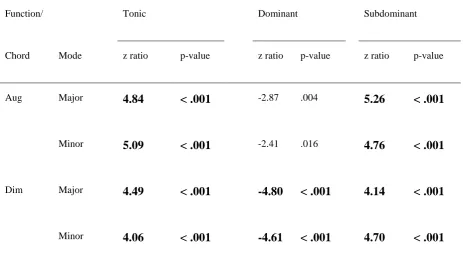
triads). There were statistically significant differences in C/D judgements for diminished
triads depending on Function, 2 = 18.43, df = 2, p < .001, with diminished triads on the
subdominant judged to be more consonant than those on either the tonic, z = 3.18, n =36, p
= .001, or the dominant, z = 3.33, n =36, p = .001. As for the triple interaction between Mode,
Chord Type and Function, the application of Friedman’s test in augmented and control triads
showed no significant difference between Mode and Function. However, there were
significant differences in diminished triads both in major modes, 2 = 12.80, df = 2, p = .002,
and minor modes, 2
= 15.50, df = 2, p < .001. Post-hoc tests revealed that C/D judgements for
diminished triads in major modes on the subdominant were higher than those on either the
tonic, z = 2.56, n = 36, p = .010, or the dominant, z = 2.51, n = 36, p = .012. Equally, in minor
modes, diminished triads on the subdominant were more consonant than those on either the
tonic, z = 2.73, n = 36, p = .006, or the dominant, z = 3.08, n =36, p = .002. The results reveal
the strong tendency among participants to perceive diminished triads as being more
Participants’ reaction times were also analyzed after log-transformation. A three-way
repeated measures ANOVA indicated a significant main effect of Function: F(1.68, 59.02) =
14.720, p < .001, partial 2 = .29. Participants responded quickest to chords on the dominant
(p < .001), followed by those on the tonic, and lastly on the subdominant.
Overall consonant/dissonant ratings
After listening, participants rated C/D and pleasantness levels. A three-way ANOVA
with repeated measures was performed to test the effect of Mode (major vs. minor), Chord
Type (augmented, diminished, and control), and Function (tonic, dominant, subdominant) on
ratings and reaction times. There was a significant main effect of Mode: F(1, 35) = 11.29, p
= .002, partial 2 = .24, as sequences in major keys were rated more highly (in other words,
were considered more consonant) than those in minor keys. Sequences containing only major
and minor triads were rated higher than those containing augmented or diminished triads (p
< .001); Chord Type: F(1.24, 43.39) = 155.21, p < .001, partial 2
= .81. There was a
significant interaction between Mode and Chord Type: F(2, 70) = 12.52, p < .001, partial 2
= .26 (Figure 2). As for the effect of Function, this had a significant main effect: F(2, 70) =
15.50, p < .001, partial 2 = .30. There was significant interaction between Chord Type and
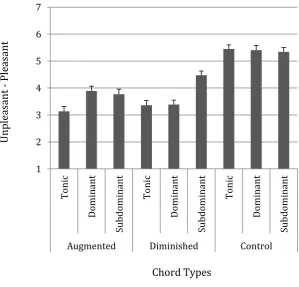
Function: F(3.32, 116.19) = 15.11, p < .001, partial 2 = .30. The mean ratings are shown in
Figure 3. Sequences containing augmented triads on the tonic in a major context were rated
significantly lower (more dissonant) than those on other functions (p < .001), while
sequences containing diminished triads on the subdominant in both major and minor contexts
were significantly more consonant than those on either the tonic or dominant (p < .001),
replicating the results of the evaluations of specific target chords reported above.
As for the log-transformed reaction times for C/D ratings, there was a significant main
control chords as targets (major and minor triads) were rated quickest among the three types
of chord, and significantly quicker than diminished chords (p < .001). An interaction between
Mode and Chord Type was also found: F(2, 70) = 9.04, p < .001, partial 2 = .20: the effect of
Chord Type varied according to Mode. Control chords in a major context (all of which were
major triads) were processed significantly quicker than were augmented and diminished
triads (p < . 001), although there was no difference in reaction times between sequences
containing minor, augmented or diminished triads.
<Insert Figure 2 & 3>
Overall pleasantness ratings
A three-way ANOVA with repeated measures (Mode 2, Chord Type 3, Function 3)
was performed on the P/U ratings. All main effects were found to be significant: Mode: F(1,
35) = 4.51, p = .041, partial 2 = .11, Chord Type: F(1.21, 42.62) = 88.37, p < .001, partial 2
= .71, Function: F(2, 70) = 17.51, p < .001, partial 2 = .33. The general trend was very
similar to that for overall C/D ratings. There were significant interactions between Mode and
Chord Type: F(2, 70) = 11.22, p < .001, partial 2
= .24 (Figure 4), and between Chord Type
and Function: F(4, 140) = 18.072, p < .001, partial 2 = . 34 (Figure 5). The effect of Chord
Type varied according to Function, as sequences featuring augmented triads on the tonic were
significantly different from those with the same triads on the dominant and subdominant: F(1,
35) = 17.13, p < .001, partial 2 = .32. Also, the sequences with diminished triads on the
subdominant were judged more pleasant than those with diminished triads on either the tonic
or the dominant: F(1, 35) = 38.96, p < .001, partial 2 = .51.
As for log-transformed reaction times, only a significant main effect of Chord Type
quickest among the three types of chord, and were significantly quicker than responses for
augmented triads (p < .001).
<Insert Figure 4 & 5>
Correlation between C/D and P/U
The results of the three-way ANOVA with repeated measures, one for each overall
C/D and P/U evaluation, indicate that both have identical main effects (Mode, Chord Type,
and Function) and interactions (Mode and Chord Type, and Chord Type and Function).
Pearson’s product-moment coefficient revealed a very strong positive correlation between the
mean evaluation of C/D and P/U: r(18) = .99, p < .001. Additionally, the data we assessed on the correlation between participants’ C/D and P/U ratings revealed interesting individual
differences. In short, not all participants gave similar ratings to C/D and P/U. The range of
coefficient values run from -.092 to .980, with the median being .831. For most participants,
C/D and P/U ratings were highly correlated (p = .001 to p = .015). However, for a few
participants (four out of 36), C/D and P/U were evidently different qualities, demonstrated by
the fact that their results show no correlation between C/D and P/U (r < .50, p > .05).
Nevertheless, C/D and P/U ratings are generally very similar overall, and it can be supposed
that most participants perceived them similarly. This supposition is also consistent with the
findings of Guthrie and Morrill (1928), who noted that judgments of the consonance and
pleasantness of intervals were very similar.
Chords Without and With Musical Context
A non-parametric test compared the C/D judgments of chords in isolation
(Experiment 1) with those of chords in context (task 1 in Experiment 2, target chords), in
Wilcoxon Signed Rank test was performed to compare eighteen pairs (two Modes, three
Chord Types, and three Functions) with a Bonferroni correction applied, resulting in an alpha
level for statistical significance that was set at = .00278. The results for significant pairs are
shown in Table 4. There was no statistically significant difference between control triads,
with the exception of minor triads on the subdominant, which were more consonant than
when in isolation, z = 3.29, n = 36, p = .001. As for augmented and diminished triads, all
were significantly different, except for augmented triads on the dominant in both major and
minor modes. For most of the pairs, the results were positive: that is, chords were more
consonant when appearing in context than when in isolation. However, the results for
diminished triads indicate that diminished chords on the dominant in both major and minor
modes were judged more dissonant when heard in context.
<Insert Table 4>
General Discussion
Two experiments were conducted to investigate the influence of musical context on the C/D
perceptions of four triads. In Experiment 1, participants were presented with four types of
triad without musical context, and they were asked to judge whether these were consonant or
dissonant. Major triads were judged the most consonant, followed by minor, and then by
diminished. Augmented triads were judged the most dissonant. This result is consistent with
previous studies such as Bidelman & Krishnan (2011), Cook & Fujisawa (2006),
Johnson-Laird et al. (2012), and Roberts (1986).
Experiment 2 investigated the influence of context and function on the C/D and P/U
levels of chords. Participants judged whether each chord of the three-chord sequences they
whole sequences (task 2). Across all tasks, the control chords (major and minor triads) were
rated higher for consonance and pleasantness than either augmented and diminished chords.
Major chords were in addition rated higher for consonance and pleasantness than minor
chords, and were judged most quickly, corroborating the results of similar experiments that
have demonstrated that more expected stimuli are processed more quickly (Bigand et al.,
1999; Bigand & Pineau, 1997; Tillmann et al, 2008; Tillmann & Lebrun-Guillaud, 2006).
Fluidity 1: Different Harmonic Function
The familiarity model predicts that a chord will sound more consonant when it is
heard on a more familiar harmonic function. Since, for example, the dominant or tonic is a
familiar function for augmented chords, and the dominant or subdominant are familiar
functions for diminished chords, the familiarity model will predict that these chords will
sound more consonant than the same chords on a less familiar function. By contrast, the tonal
stability model predicts that augmented or diminished chords will be most dissonant when on
the tonic, followed by the dominant, and most consonant when on the subdominant. The third
model based on the position of the fifth note in a scale predicts that the target chord will
sound most consonant on the subdominant, followed by the tonic, and most dissonant when
on the dominant. This prediction derives from the idea that a chord is more dissonant when
its fifth note, which is violated by an augmented or diminished tone, has more importance in
tonal hierarchy
The results of Experiment 2 show that the C/D levels of acoustically identical chords
vary according to harmonic function, a finding that closely matches the previously mentioned
hypothesis that the same chord will provoke different expectations and brain responses when
it fulfils different harmonic functions (Koelsch et al., 2000; Leino et al., 2007; Loui et al.,
diminished chords in both major and minor contexts. Both judgements for target chords (task
1 in Experiment 2) and ratings of whole chord sequences for C/D and P/U (task 2 in
Experiment 2) show that diminished chords on the subdominant were consistently judged
more consonant and pleasant than the same chord appearing in any other function. These
results for diminished chords could be ascribed to familiarity: diminished triads often appear
as a supertonic chord in a minor key, and a diminished chord on the subdominant is identical
to a diminished seventh chord built on the supertonic (II) of the key without the root (Parncutt,
2006). In this context, diminished triads will often be followed by V and I chords to make a
common harmonic progression, which is the same progression employed in this experiment:
IV-V-I. This influence of familiarity seems to be consistent with the results of previous
(Koelsch et al., 2000; Leino et al., 2007; Loui et al., 2005; Maess et al., 2001), in which the
Neapolitan chord appearing on an unexpected function (the tonic) triggers larger negativities
than the same chord on an expected function (the subdominant).
As for C/D judgements of augmented chords (task 1 in Experiment 2), no significant
differences were found in the C/D judgements between functions. This may be due to the fact
that the dissonant characteristics of the augmented chords were too strong to be influenced by
their function, a postulation that is consistent with Johnson-Laird et al.’s (2012) finding that
non-tonal chords with a strong acoustic character are less likely to be influenced by context.
However, augmented triads on different functions did receive different ratings, with
sequences containing augmented triads on the tonic in a major key (task 2 in Experiment 2)
receiving the lowest C/D and P/U ratings. This may be due to there being a greater violation
of expectation for augmented triads on the tonic, an idea that supports the second model
based on the stability of chords. Diminished chords on the tonic were likewise judged to be
less consonant, though this was also not statistically significant. Perhaps augmented and
sequence was expected to be consonant, in order to provide a proper end to the cadence. This
larger violation of expectation may also be due in part to the fact that the tonic is the most
stable function (Bharucha & Krumhansl, 1983; Krumhansl, 1990), that there is a greater
expectation that a cadence will end on the tonic than in any other way (Tillman &
Lebrun-Guillaud, 2006), and that the sense of key and harmonic context has to be established well
towards the end of a chord sequence (Koelsch et al., 2000). A greater violation of stability
occurred in the case of augmented triads on the tonic because, for a variety of reasons, the
expectation for a stable tonic to complete the cadence is greater than it is with the other two
functions.
By contrast, the results for augmented triads do not lend support to the familiarity
model. This may be owing to the fact that augmented triads on the tonic are familiar only in
very particular circumstances, and that these were not to be found in the experimental stimuli.
The tonic in the stimuli sequences of this experiment was in all cases the last chord of the
sequence. However, augmented chords typically only appear on the tonic at some point
within a sequence in order to lend the phrase a chromatic sound, and this of course represents
a very different usage for the augmented chord.
The result that diminished chords on the subdominant were consistently perceived as
more consonant than the same chords on the other two functions lend partial support to the
third model, which is concerned with the position of the fifth note in the scale. This model
predicts that the target chord will sound most consonant on the subdominant, followed by the
tonic, and most dissonant when on the dominant. Although there is no statistically significant
difference between the overall ratings for C/D and P/U for a diminished chord on the tonic
and the same chord on the dominant, the chord was judged slightly less consonant and less
pleasant on the dominant when the fifth note was the supertonic than it was on the tonic when
model. However, the results for augmented chords, which showed that these were most
dissonant when on the tonic, do not conform to this model’s predictions. It is difficult to
know whether to conclude that there is some difference between the perception of the
consonance of augmented and diminished triads that renders this model only partially valid,
or whether the results for augmented chords in fact indicate that the model is wholly invalid.
In short, Experiment 2 confirmed that C/D is fluid, and that the C/D levels of chords
vary according to harmonic function. The results for diminished triads are consistent with all
three hypotheses, while the results for augmented triads are consistent only with the second
model based on the stability of the function of a chord. The difference between the results
obtained for augmented triads and those obtained for diminished triads may be due to the fact
that the diminished triad and the augmented triad are very different types of chord: each has
its own unique acoustic properties, and each has a particular role to play in musical harmony.
Fluidity 2: Presence and Absence of a Musical Context
The comparison between chords in isolation (Experiment 1) and chords in a musical
context (task 1 in Experiment 2) reveals the influence of context on C/D perception for both
diminished and augmented chords. Augmented triads on the tonic and subdominant were
more consonant when occurring in a context than when in isolation. The influence of context
on the C/D levels of diminished triads varied: diminished chords on the dominant were more
dissonant in a context than in isolation, but when they appeared on the tonic and subdominant
they were more consonant in a context. As for control chords, with the exception of minor
chords on the subdominant, no difference in C/D judgements was evinced between major and
minor triads heard in isolation and in a musical context.
Both augmented and diminished triads were judged more consonant when they
for augmented and diminished chords differ from one another when it comes to the dominant:
there is no significant difference between the C/D levels of augmented chords on the
dominant and the same chords in isolation, whereas diminished chords on the dominant in
both major and minor modes were judged more dissonant in a musical context than in
isolation. This partly confirms the hypothesis that chords sound more dissonant when heard
in an unexpected context than when heard in isolation, since, according to the second hypothesis of Fluidity 1 (the “tonal stability of a chord’s function” model), a diminished
chord is not expected to sound most consonant when heard on the dominant. However, the
second hypothesis of Fluidity 1 also predicts that the tonic will be an unexpected context for
both augmented and diminished triads. As such, the fact that both triads were judged to be
more consonant when on the tonic than when in isolation does not match the second
hypothesis of Fluidity 1, and fails to support the hypothesis that an unexpected context makes
chords more dissonant.
This exception of the dominant also may be due to the violation of the role of the
dominant. Diminished triads often appear on the dominant in major modes as leading note
chords, and are so called because they lead to the tonic to end the cadence. The dominant is,
therefore, a familiar harmonic function for the diminished triad. While the diminished triads
used in Experiment 2 were built on the fifth note of the scale, a leading note chord occurs on
the seventh note of the scale. In order to have worked “properly”, the dominant should have
led smoothly to the final tonic; but in fact the diminished triads on the fifth note of the scale
in the stimuli sequences did not function in this way. These unexpected diminished triads
violated the sense of a proper flow from the dominant to the tonic, and hence also violated listeners’ expectations – at least, this seems like a reasonable explanation for the perceived
dissonance of diminished triads on the dominant. The findings for diminished triads perhaps
notes of the scale, and they also suggest that participants’ C/D judgements are determined
more by their familiarity with authentic harmonic progressions than by the mere harmonic
function of a particular chord.
The differences between chord types suggest that, as predicted, the influence of
context varies according to the chord: in other words, the degree of the fluidity of C/D
judgements depends on the type of chord in question. A study by Johnson-Laird, Kang, and Leong (2012) found similar results that the degree to which context influences the listener’s
judgements of dissonance will vary according to the particular chord being judged. This study
compared tonal chords (such as major triads, minor triads, the seventh and the minor seventh)
and non-tonal chords (for example, chords that do not consist of the third or fifth), and found
that the former were more influenced by context than the latter. However, this result could be
attributable to the characteristics of the non-tonal chords: in other words, the acoustic features
of these non-tonal chords may have been too original or too different from those of orthodox
tonal chords for them to be influenced by context. The qualities and characteristics of chords
may contribute to the degree to which context influences the listener. In the case of this
present study, the more dissonant or ambiguous the chord was in isolation, the more fluid the
C/D judgements of the chord were in musical context. The results of Experiment 1 and the
comparison between Experiments 1 and 2 bear this out: augmented triads were judged to be
very dissonant in isolation, while diminished triads were judged to be neither particularly
consonant nor particularly dissonant - that is to say, diminished triads were ambiguous. In the
case of both augmented and diminished triads, their C/D levels fluctuated greatly according
to context, especially diminished triads due to their ambiguity. By contrast, major triads were
judged to be solidly consonant, whatever their context. Major triads have the clearest root
among these four chords, according to Parncutt (1988), and their unambiguousness and
and context. Support for this assertion comes from Janata (1995), who found that it is more
difficult and takes more time to process chords with ambiguous C/D or tonal context than it
does to process those that are unambiguous, such as clearly consonant or very dissonant
chords.
C/D and P/U
With regard to perceptions of P/U, the results reveal a strong correlation between
these and C/D perceptions; consonant chords are generally judged to be pleasant, while
dissonant chords are typically considered unpleasant. This finding agrees with the notion that C/D and P/U are commonly conflated in people’s minds. However, a few listeners judged
neither that consonant chords were pleasant, nor that dissonant chords were unpleasant. Guthrie and Morrill’s (1928) reported incongruency between the perception of C/D and of
P/U: they found that musicians judged C/D (measured in terms of fusion and smoothness)
and pleasantness differently. The lack of consistency between different studies of C/D and
P/U demonstrates that, despite the common assumption to the contrary, P/U and C/D
judgements do not always closely match one another. This opens up the possibility for
thinking that dissonance can in some instances induce pleasantness in the listener. There are
moments in certain pieces of music where dissonant chords in fact sound pleasant, for
instance in contexts in which the dissonant chord is resolved in an expected fashion. The
pleasantness of certain dissonant chords might be attributable to the fact that, as Meyer (1956)
wrote with reference to Zarlino’s view on the matter, dissonance in a piece of music has an aesthetic power that “adds beauty and elegance to the work and makes the consonance which
follows more acceptable and sweet” (1956, p. 229). Perhaps more ecologically valid and rich
material would be needed to better explore “the pleasantness of dissonance”.
One criticism that might be levelled at this experiment is that the experimental
and resolutions. In Experiment 2, both augmented and diminished triads were made to
function in atypical contexts. Some “typical” contexts in which they would normally appear
in tonal music were overlooked due to an experimental design that prioritized the influence of
function, and it cannot be denied that this increased the likelihood of making these chords
more dissonant and unpleasant. This is especially the case for diminished triads on the
subdominant, which were judged to be more dissonant in musical context than in isolation.
According to expectation theory (Huron, 2006), an unexpected stimulus is liable to induce a
negative reaction. It is by no means necessary that a dissonant chord will be an unexpected
stimulus, and so expectation theory should not lead us to believe that dissonance will
customarily produce a “negative” expectancy reaction: however, unexpected occurrences of
augmented and diminished triads in atypical contexts may indeed have led many listeners to
respond to the experimental stimuli with surprise, confusion or annoyance. In addition to the
problem of augmented and diminished chords appearing in atypical contexts, the
experimental design also failed to take into account the fact that these chords are typically
supposed to be resolved. It seems plausible that C/D judgements will be influenced by the
way in which a chord is resolved in the real listening experience, and so this relation might be
a profitable avenue for future research. Recent research shows that expected closures to chord
sequences (such as dominant-tonic (V-I)) are judged to have a higher sense of completeness
and belongingness within the sequence, less tension, and are more accurately and rapidly
judged for consonance (in tune) and dissonance (out of tune) than unexpected closures
(Bigand et al., 2003; Bigand et al., 1999; Bigand & Pineau, 1997; Steinbeis, Koelsch &
Sloboda, 2006; Tillmann et al., 2008; Tillmann & Lebrun-Guillaud, 2006). In the light of
these findings, one can assume that an augmented or diminished chord that is resolved in an
studies should help to shed more light both on the importance of orthodox contexts for the
perception of augmented and diminished chords, and on the importance of their resolution.
The present study is valuable as it provides empirical data about the influence of
musical context on the perceived C/D of major, minor, augmented and diminished triads. The
results confirm that the C/D and P/U of chords are influenced by musical context and
harmonic function, particularly in the case of diminished triads. The degree to which a chord
is influenced by these factors varies according to the type of chord in question, and stands as
confirmation of the dual and contradictory character of C/D: its rigidity and fluidity.
References
Andrews, H. K. (1950). The Oxford Harmony. Oxford: Oxford University Press.
Bharucha, J. (1994). Tonality and expectation. In Aiello, R (ed.), Musical Perceptions, 213-
239, New York: Oxford University Press.
Bharucha, J., & Krumhansl, C. L. (1983). The representation of harmonic structure in music:
hierarchies of stability as a function of context. Cognition, 13, 63-102.
Bigand, E. (1997). Perceiving musical stability: the effect of tonal structure, rhythm, and
musical expertise. The Journal of Experimental Psychology: Human Perception and
Performance, 23(3), 803-822.
Bigand, E., Parncut, R., & Lerdahl, F. (1996). Perception of musical tension in short chord
sequences: The influence of harmonic function, sensory dissonance, horizontal
motion, and musical training. Perception & Psychophysics, 58(1), 125-141.