<
COMMISSION OF THE EUROPEAN COMMUNITIES
COM(93) 48 final
Brussels, 11 February 1993
REPORT FROM THE COMMISSION
Summary
I Introduction
Council Decisions and objectives Structure of the Programme Nature and structure of the report
II Impact and progress with regard to policy objectives
Raising the participation of young people in initial vocational training Raising standards, improving quality,· and diversifying training provision Enhancing adaptability of initial vocational training to change
Developing a Community dimension in initial vocational training Improving cooperation within Member States and transnationally Encouraging more diversified forms of vocational guidance Improving knowledge of developments in the labour market Promoting equality of opportunity tor young women
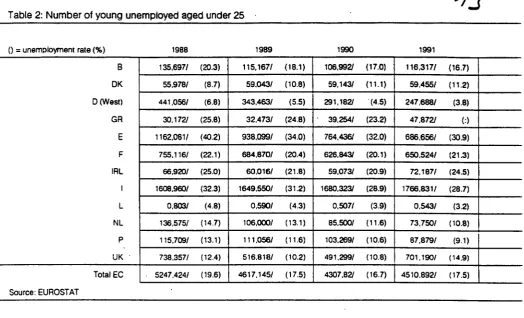
Developing training opportunities tor disadvantaged .young people Promoting creativity, initiative and enterprise of young people
Ill Communitv !:·:~1 Action 1988-1991
European Network of Training Partnerships
Thematic priorities and selection Number of projects
Transnational activities
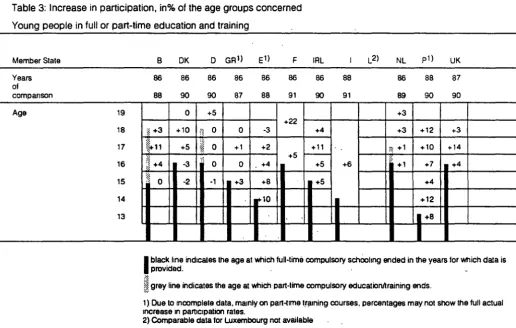
Number and characteristics of participants Results and outcomes
Youth Initiative Projects
The Youth Initiative approach Number of projects and participants Results and outcomes
Cooperation in research on initial vocational training
Organisation and thematic priorities Results and outcomes
Study visits by vocational training specialists Dialogue on the implementation of the Programme
SUMMARY
•
..3
The PETRA Programme is based on the Council Decisions of 1 December 1987 and 22 July 1991. 1t became operational in Autumn 1988 and was extended, with effect
from 1 January 1992. to run on a considerably enlarged basis up to 31 December
1994.
• The main objective of the Programme is to support the policies and activities of
Member States which are aimed at ensuring that all young people in the Community
who so wish receive one year's, or if possible.
two or more years' vocational training,
in addition to their full-time compulsory education. The Programme is also intended to
improve the provision of vocational training for young people with regard to a range
of specific aspects. and to add a Communrty dimension to the design and
implemen-tation of vocational training policies in the Member States.
• Financial support from the Community amounted to 40.0 MECU over the four-year
period 1988-1991; 29 MECU were provided for 1992.
• In the run up to 1992. and within the context of intensified discussion and debate on
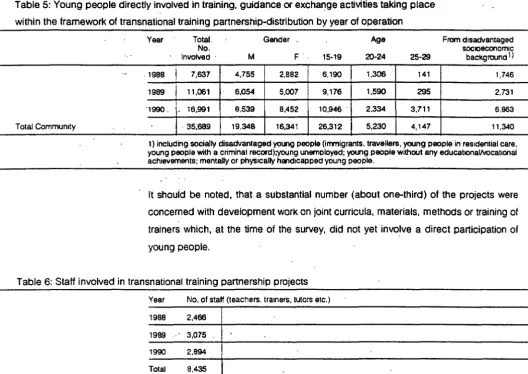
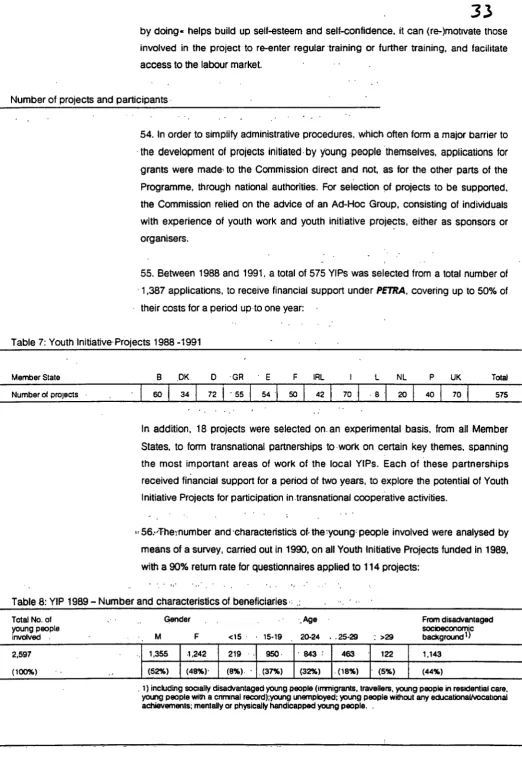
the importance of human resources development for attaining the new goals of the
Community, the Programme has evolved to form a coherent unified framework for
Community action in the field of initial vocational training of young people and their
preparation for working life. It is aimed at all categories of young people in vocational
training, and all forms of youth training leading to a recognised qualification. In this
way, the Programme now fulfils a strategic role in the development of Community
policy on initial vocational education and training, comparable to that of the maror
Community programmes in the field of higher education. In its new enlarged phase, it
provides already a first operational response. as regards initial vocational training, to
each of the broad objectives set out in Article 127 of the Maastricht Treaty on the
Political Union.
• Over the period 1988-1991, approximately 75,000 young people have directly
benefited from the actions of the Programme, and more than 10,000 staff In initial
training. A large number of the young people involved came from a disadvantaged
socio-economic background. In addition, the Community has provided support for
more than 70 research institutes, from all Member States. to cooperate on research
on the effectiveness of initial vocational training provision.
• As regards the primary objective of the Decision of 1 December 1987, visible
access to initial vocational training and in offering at least one year's training to all
young people who so wish. Since the adoption of the Programme. the number of
young people retained in education and training. after completion of their period of
full-time compulsory schooling, has increased by an average annual rate equalling
between O.So/o and 4.3o/o of the size of the total age group, in the respective Member
States. Though disparities between 11/iember States with high retention rates and
those with low retention rates still persist. they have shrunk noticeably.
• Through its support for innovative action. local and regional cooperation, and joint
transnational work and transfer of experience, the Programme has made a
contribution to a wide range of initiatives in the Member States. aimed at improving
the quality of initial vocational training. A number of major reform activities in different
Member States have drawn on its experience and outcomes.
• PETRA has played a pivotal role in piloting practical approaches to introducing a
Community dimens1on into initial vocational training provision. It has broadened the
base of experience, in all Member States, on which further transnational cooperation
and exchange can build. It has created transnational networks of training initiatives,
many of which continue to function after the expiry of financial support from the
Community. The work of these projects has resulted in the production of transferable
training materials and methods. both for the training of young people and of their
teachers and trainers. It has also paved the way for the organisation of training
exchanges for young people, on a much larger scale than hitherto, between all
Member States of the Community.
• As regards the new enlarged phase of the Programme, which took effect from 1
January 1992, speedy progress has been achieved. A new organisational framework
was set up to implement the three main types of Action under which the activities of
the new phase are grouped. Practical work in two of these fields of action started in
I Introduction
Council Decisions and objectives
1. PETRA was launched in 1988 on the basis of the Council Decision of 1 December
'1987 concerning an action programme ·tor the vocational training of young people
and their preparation for adult and working· life. Initially intended to run for a period of
five years, up to 31 December 1992, the Programme was aimed at a comprehensive
set of common objectives which could be summarised under three main points:
0 to support the policies and activities of Member States which are aimed at
ensuring that all young people in the Community who so wish receive one year's, or it
possible, two or more years' vocational training, in addition to their full-time
compulsory education;
0 to support and supplement activities at national level which are intended to
improve the provision of vocational· training, raise its standards and quality, and
enhance the capacity of vocational training systems to adapt to rapid economic,
technological and social change;
0 to add a Community dimension to the design and implementation of vocational
training policies in the Member States:' ·
Part of the underlying rationale was the deep-felt concern of all Member States that.
to prepare for the changes to be faced in the 1990s and beyond. the Community
must ensure that initial vocational training is available to all: no young person should
enter the labour market without at least a basic vocational qualification. Training
leading to such· qualification should reflect the needs and opportunities emerging
from the evolving Community framework for' work
aria
industrial and human resourcesdevelopment.
2. In the run up to 1992, the target year for completion of the Internal Market, and
within the context of discussion and debate on the preparation of the Maastricht
Treaty, the issue of vocational training has attracted increasing attention. in the policy
agenda of th~ Community. This is clearly reflected. iriter alia. in
0 the meetings of the European Council i'n 1988 and 1989, which affirmed the
importance of improved access to vocational training for the completion of the
human resources, and emphasised the rote of the Community action programmes on
.
-the insertion of young people into vocational training and -their integration into working
·life as a decisive element of the social dimension of the Community;
0 the Social Charter (adopted on 9 December 1989 by 11 Member States), which
inc_orporates the right of access ~o vocational training tor all workers, and more . specifically st~tes inter alia in point 23: "Following the end of compulsory education . .. young people must be entitled to receive initial vocational training of a sufficient
duration to enable them to ~dapt to the requirements of their future working life: for young workers,_such training should take place during working hours';
0 the Conclusions of the Council and Ministers of Education meeting within the
Council of 14 December 1989, which called for a stronger and broader response, at
Community level, to the new challenges faced by technical and vocational education
and training in the Member States, and invited the Commtssion to adapt and
reinforce existing Community programmes in this field:
0 th~ views expressed by the social partners. in the framework of the Social Dialogue. In their joint opinion of 26 January 1990 on education and training, they
.
.
emphasised the importance of high quality education and initial vocational training
leading to recognised qualifications as an essential and irreplaceable condition for
the successful integration of young people into working and economic life.
Furthermore, in their jqint opinion of 6 Nove.mber 1.990 on the transition from school to
adult and wort:<ing life, they identified concrete priorities and defined more ch:iarly the
part to be played by the various parties in the preparation and motivation of young
people for working life; . .
0 the Resolution of .the European Parliament ( 16 February 1990) which called for
stronger. Community. programmes in support of the education and training of young
.I ,peqple ~QP thei~ m,obi!ity;;.
0 and also in the recent Commission Memorandum on 'Vocational Training in the
l;uropean Community in the 1990s" of December 1991, which is currently being
discussed with and within the Member States.
3. The Commission respon9ed to this development by submitting to the Council, in
. '
November 1990, a proposal concerning an extension and development of the PE17lA
,Programme and practic.al steps to rationalise Community action in the field of
Structure of the Programme
introduced a number of new objectives, inter alia With a view to
0 stimulate and. support cooperation and the development of transnational training
partnerships between training providers. industry and other promoters of local and
regional development;
D
develop opportunities tor young people in initial vocational training, young workersand young people taking part in advanced programmes to benefit from periods of
training or work experience in other Member States (inCluding the continuation and
development of Community action formerly implemented under the Young Workers'
Exchange Programme);
0 foster Community cooperation in the sphere of vocational information and
guidance.
The 199l Decis1on provided·for the launch of a liew phase of the Programme to take
effect from 1 January 1992, for a three-year period up to 31 December 1994.•
4. The Community Actions implemented under the first phase ( 1988-1991 ), to achieve
the objectives of the Decision and support and supplement the activities of the
. Member States to this effect, can be summarised under five main types of operation:
0 the creation and development of a European Network of Training Partnerships
(ENTP) which links innovative initial training projects from different M~mber States. to · encourage practical cooperation in the Community on the improvement of provision
for young people and to raise awareness of needs and opportunities in a Community
context;
D
support for ·Youth Initiative Projects• (YIPs) -i.e. ·.innovative projects in whichyoung people themselves are mainly responsible for the planning, organisation and
implementation -, which focus on information on the transition from school to
vocational training and working life, and/or encourage the development of
entreprenelir_ial skills. creativity and responsibility amongst young people;
0 the development of transnational cooperation. at Community level, in research on
the effectiveness of current policy and practice in the initial training field and on the
0 exchange of vocational training specialists between the Member States:
0 the organisation of dialogue and review of the implementation of the Programme.
especially between policy-makers and the social partners. and dissemination of
outcomes and results from the Programme.
The Council Decision of 1987 did not contain any reference to the amount estimated
as necessary for the implementation of the Programme. and so the Community's
planned financial support for the four-year period 1988-1991 was suggested on an annual basis with the following appropriations being authorised, 1988: 8.0 MECU:
1989: 9.0 MECU; 1990: 9.5 MECU; 1991: 15.0 MECU, amounting to the total of 41.5
MECU. The actual expenditure incurred on the Programme during the same period
was 39.99 MECU (1988: 6.83 MECU; 1989: 9.55 MECU; 1990: 5.73 MECU: 1991:
14.88.-MECU):
5. The management of the Programme involved from the start close cooperation with
the Member States. At the invitation of the Commission. national authorities appointed
a group of senior officials. in most cases from national Ministries responsible for both
education and employment. to assist the Commission implement the actions of the
Programme. and to ensure integration with the development of national policies and
practice. In addition. the Commission provided support for technical assistance in the
Member States. i.e. for the appointment of Programme Assistants to help especially
with the·selection of training projects for participation in the ENTP, their integration in
the European Network and the development of transnational partnerships, and the
dissemination of their results in the respective Member States.
The Commission also arranged for technical support for the Programme at
Community level. to be provided, on a contract basis, by a PETRA Office assisting the
development of the ENTP. the Youth Initiative Projects and the research activities;
responsibility for the exchange of vocational training specialists was located with
CEDEFOP, acting on behalf of the Commission. An overview of the management
structure for the first phase of the Programme ( 1988 -1991) is contained in Annex I.
6. The Council Decision of 1991 provided tor continuation of the .activities initiated in
the first phase and their rationalisation and adaptation to the new objectives. while at
the same time extending considerably the range of Action to cover new fields. It also
strengthened the management structure, through the establishment of a statutory
AdVisory Committee on PETRA. As from January 1992. the Programme includes three
nisin types of Actions, summarised below. together with complementary measures.
;J
• Action 1 -.support for training and work experience placements in another Member
State. for young people in initial vocational training, young workers and young
unemployed, and young people in advanced programmes. This Action now
incorporates the Young Workers'. Exchange Programme. hitherto run as a separate
activity;
• Action II - Support for transnational cooperation in the joint development of training
modules and joint training of trainers. through the participation of training institutions
and projects, including youth initiative projeGtS set up by young people themselves.
in the PETRA European Network of Training Partnerships;
• Action Ill -Support for national systems for the exchange of vocational guidance
data and experience; and examples of good practice in vocational guidance. through
the establishment of a Community network of national contact points and the training
of guidance counsellors/specialists on Community aspects of guidance;
• complementary measures - including support for the dissemination of the results of
the Programme; transnational qooperation in research on the vocational training of
young people; and technical assistance at Community level and in Member States for
the implementation, coordination and evaluation of the Programme.
The new phase of PETRA provides now a single framework for Community action in
support of the vocational training of young people up to, and including, age 27. In its
implementation. the Commission continues to benefit from assistance provided by the
European Centre for the Development of Vocational Training.•
Nature and structure of the report
7. The present report is submitted in order to take stock of the development of the
Programme up to the end of 1991, and to describe the basis on which the new
enlarged phase can build. It should be seen in the context of the overall reporting
process on the Programme, i.e. in conjunction with
0 the Commission's interim report published in March 1990; and the more
comprehensive Review.of Progress on which it was based, containing a detailed
analysis of the industrial, social and demographic changes which form the context to
the PETRA Programme. as well !3S a description of the national policies and
programmes which underpin the implementation of the Decision of 1 December
0 other technical Programme publications. especially the PETRA Yearbooks for 1990 and 1991, which provide a regular update on the development of the individual
Actions.
8. Further reports by the Commission. as required under the 1991 Decision. will
include
0 an interim report before 31 December 1993. and
0 a final report by 31 December 1995, including an overall evaluation of the
implementation of the Programme.
Furthermore, the results of the Community measures pursuant to the 1991 Decision
shall be subject to objective external assessment. for the first time in the course of
1994, and for the second time during the course of 1995.
9. The present report forms part of this continuing reporting process. It reviews in
Section II the impact of the Programme and the progress achieved with regard to the
policy objectives,and in Section Ill the overall development of the Actions
implemen-ted in the period 1988 -1991. Section IV gives an outlook on the development of the
II Impact and progress with regard to policy objectives
10. The Council Decision of 1 December 1987 sets out. in Article 1, clear objectives
for the PETRA Programme and. in Article 2. a common framework for policy and
action in the field of vocational training for young people, reflecting priorities and
needs of all Member States and the Community as a whole. The definition of concrete
common objectives. together with a joint programme for action at Member State and
Community level, was also an important step forward towards ensuring coherent
policy development and concentrating efforts on areas and problems where they are
most needed. The added value of this approach includes
0 at general policy level, a more transparent and better articulation with overall
Community goals;
0 for the young individuals possibly a new perspective for the development of an
idea of what they want to get out of their lives- (re-) motivating them for vocational
training which provides better access to a wider range of opportunities and choices
in the Community;
0 for the training systems a new focus on innovation, adaptation and convergence:
and
0 for the operators a stimulus towards transnational cooperation, exchange of
experience and familiarisation with training elsewhere in the Community.
In this section of the report, policy developments and progress are reviewed in
regard to the individual objectives set out in the Decision. Where appropriate,
specific reference is made to the Community level Actions which were implemented
to support and complement the activities of the Member States, in particular the
European Network of Training Partnerships (ENTP). the Youth Initiative Projects (YIPs)
and tile cooperative research activities. These actions are considered in more detail
in section Ill.
11. In reviewing Member States' progress in the implementation of the Decision,
account needs to be taken of the demographic and labour market context in which
initial vocational training systems have to operate. Three main aspects should be
considered:
0 In the current period of demographic decline, vocational training institutions are
"'~
operational year of the Programme, .the total number of 15-19 year,.olds was 24.9
million in the Community; about one-third of these young people were estimated to
participate in full-time or part-time initial vocational training. ln 1995, the total number . .
of 15-19 year-aids will have fallen by 17%, and in the year 2000 by 21% (see table 1 ).
To retain only the same number of young people in vocational training as in 1988,
training systems would need to attract 37% of the relevant age group in 1995 and
39% in the year 2000: even larger efforts will be required to increase the number of
participants in initial vocational training;
Table 1: Young people (15 to 19) in the European Community (1988
=
100=
24,9 million)B OK
D
GR
E
F
IRL
I
L
NL
p
UK
EC
Source: EOROSTAT
1980 1988 1995 2000 . 2010 2020
113.3 100 87 86 80 69
105.8 100 89 74 86 79
122.6 ·100 71 74 78 56
98.9 100 97 69
96.5 100 94 76 80 77
99.6 100 86 90 85 80
95.4 100 96 69 72 65
99.8 100 61 67 63 57
117.0 100. 67 91 92 79
103.7 100 76 75 63 76
104.3 100 95 86
-
-106.5 100 80 85 96 67
105.1 100 63 79 80 72
0 though the unemployment rate of young people under 25 in the Community has
fallen from 19.6% (5.2 million) in 1988 to 17.5% (4.5 million) in 1991, it remained twice
as high as the overall rate (9.8% in 1988, and 8.8% in 1991) (see table 2). Young
women still face a higher risk; in 1988 their unemployment rates were 28% higher
than those of young men, and 19% higher in 1991. School-leavers without a
qualification continue to form a group of young people for whom the risk of
- unemployment is several times higher than for those with a qualification. There is no
doubt, in all Member States, that successful basic education and initial vocational
training provide a key for young people's integration into the labour market. Training
systems will therefore have to pay special attention to the development of
opportunities for young people leaving compulsory school with low levels of
Table 2: Number of young unemployed aged under 25 ·
() = unemployment rate(%)
B
DK
D (West)
GR
E
F
IRL
I
L
NL
p
UK
Total EC
Source: EUROSTAT
1988 19S9 1990 1991
135,697/ (20.3) 115,167/ (18.1) 106,9921 (17.0) 116,317/ (16.7)
55,9781 (8.7) 59.0431 (10.8) 59,143/ (11.1) 59.455/ (11.2)
441,0561 (6.8) 343,463/ (5.5) 291,182/ '(4.5) 247,688/ (3.8)
30.172/ (25.8) 32.473/ (24.8) 39,254/ (23.2) 47,8721 (:)
1162,0811 (40.2) 938,099/ (34.0) 764,4361 (32.0) 686.656/ (30.9)
755,116/ (22.1) 684,870/ (20.4) 626.8431 (20.1) 650,524/ (21.3)
66,920/ (25.0) 60,016/ (21.8) 59,0731 (20.9) 72,187( (24.5)
1608,960/ (32.3) 1649,550/ (31.2) 1680,3231 (28.9) 1766,831/ (28.7)
0,803/ (4.8) 0,590/ (4.3) 0,507( (3.9) 0,543/ (3.2)
136,575/ (14.7) 106,000/ (13.1) 85,500/ (11.6) 73,750/ (10.8)
115,709/ (13.1) 111,056/ (11.6) 103,269/ (10.6) 87,879/ (9.1)
738,357/ (12.4) 516.818/ (10.2) 491,299/ (10.8) 701 '190/ (14,9)
5247,424/ (19.6) 4617,145/ (17.5) 4307,82/ (16.7) 4510.892/ (17.5)
0 at the same time, growth in employment and opportunities for vocational careers
occur primarily in higher skilled occupations: within occupational sectors, a trend
towards increased skills requirements is obvious for most jobs. Initial training systems
need to place more emphasis on developing a wide-ranging set of core skills,
[image:13.574.19.544.69.387.2]Raising the partiCipation of young people· in education and initial vocational training· ·
12. Since the adoption· of the Decision, several Member States have taken specific
action aimed at incr·easing the number of young people in initial training, so as to
ensure that the highest ·possible number of new entrants to the labour market have a
· rec'6gnised v?c~tioiial qualification. The mai". types of action can be summarrsed
under three aspects:
0 fixing quantitative targets for participation in education and vocational training. In
France, the policy· aim is to ensure that. by the· end of this century. three out of four
·young people should obtain a qualification at Baccalaureat level: a •Baccalaureat
ptofessionnel• has been introduced which may be obtained by young people on
succe·ssful completion of a two-year course following their initial vocational
.·.qualification. In Spain. within the context of the recent reform, the target for the year
2000 is to retain 80% of all young people in schooL up to the age of 18. with options
·of vocational' or academic courses at 16+. The UK Government has endorsed the
ta.rgets set by'the Confederation of British Industry which require that. by 1997, 80%
·of-all young people attain
a
National Vocational Qualification (NVQ) at Level 2 (basiccraft), or its-academic equivalent; while at least half of the age group should attain
NVQ Level 3 (advanced craft), ·or its academic equivalent. by the year 2000;
: G
establishing an· entitlement, or ·right, to obtain ·a vocational_ qualification or to take·part in vocational train'ing: ln.-1991, ·the Dutch Government announced that
everybody, of any·age, should have the right to obtain a •starting qualification•, i.e. a
vocational qualification. at the level of an initial apprenticeship course; this is now
underpinned by the ~Youth Guarantee .. Scheme introduced in the same year. In Portugal; the government ·and 'the Social Partners recently (July 1991) signed a formal
· agreement to make ever)i effort to ensure that young people will receive at least one
year of initial vocational training, after completion of their compulsory schooling; the
national- authorities· are currently re-designing the training courses (run under the
responsibility of the Employment Minisuy), and will no longer organise initial training
courses of less than one year's duration. In the United Kingdom. all young people
under 18 who have left school,·and not found employment, have a right to accede to
training under the Youth Training Scheme, lasting one or two years; training credits
are now being· made available to 16 or 17 year old school-leavers, i.e. vouchers
representing a· real money value and enabling them to "buy• appropriate training
. offers; :.
0 extending provision of initial vocational training. In a number of Member States,
-1J
(OK, F, NL,
P).
Some have establis~ed new types of provision. e.g. the vocational schools in Portugal, or created the legal basis tor it. e.g. the new Institutes for . Vocational Training in Greece whic~ are now being set up under a new (1992) law and wiU mainly cater for those young people who·, after completion ofpost-'
compulsory secondary education. do not proceed to higher education. In Germany,
the existing network of inter-firm training centres has been further developed, and
extended to the new •Lander•.
13. AU these actions are aimed at making the option ·Of vocational education and
training more attractive to young people, by raising its status or facilitating access to
it. Similar objectives apply to a new initiative in Germany which was launched in
1991, offering new opportunities and special suppor1 to particularly gifted young
~ people in vocational training; and to a new proposed law concerning the possibilities
of progression from vocational training to higher education, which underpins current
efforts directed towards promoting equality of status between vocational and
post-compulsory general ec;iucation. In Italy, a major national reform project, .. progetto
.92·. has tackled head-qn the danger that vocational schools are going to go on
being seen a~. the inferic::>r alternative to technical and grammar schools; in common with reforms in other Member States (especially France, Spain, and Portugal), it aims
at raising the status and attractiveness of vocational training for young people.
14. In Germany, the unification process involved the application of Federal
Legislation on vocational training to the five new •Lander•, as from 1 September
1990, This meant a radical c~ange of the training system on the territory of the former GOA, causing problems in ensuring adequate provision of training places for young
people. especially as the collapse of a large number of enterprises resulted in a
~erious ~hrinkage of company-based training opportunities. Major initiatives were taken. at national level, to counteract the impact on the training situation, with positive
effects; by September 1991, the overwhelming majority of young people who applied
had actually been placed in training, and the remaining small minority had received a
placement offer .
. 15. In many of these actions PETRA projects were actively involved; e.g. in the
development of the ·baccal.aureat professionnel• in France; the creation of
vocational schools and the strengthening of the apprenticeship system in Portugal;
the Youth Tr~.ining Scheme in the UK; the diversification of inter-firm training centres in Germany, and the preservation of training provision in the new •Lander•; or
.. progetto 92• in Italy. One of the main contributions of the PETRA projects consisted
in their.attempt to add, a special focus on Community aspects. to major national
through their experience and out9omes from transnational cooperation.
16. In relation to the primary objective of both the 1987 and the 1991 Council
Decisions. i.e. to ensure that all young people who so wish receive one year's, or if
possible, two or more years' vocational traini11g, some indication of progress can also
be gained from the analysis of participation rates in post- compulsory education and
training. The Commission's 1990 Interim Report on PETRA highlighted considerable disparities between the individual.Member States. as regards the number of young
people retained in full- or part-tim~ education and training aged 16+, using the latest data available for the period. prec.eding the ·e1doption of the 1987 Decision (i.e. the
1985/86 school year. in most cases).
In all Member States. participation of the 16/17-year-olds has gone up since then. by
an annual average increase equalling between 0.5% and 4.3% of the total age group.
according to the individual Member State .(with the exception of Germany, where
retention rates had already been close to 100%). In most Member States the end of
compulsory full-time schooling is now.fixed at. age 15 or 16, the 16-17 year-olds form
the ·heart• of the PETRA target group. But.considerable increases can also be
observed, in a number of cases, in retention rates .at age 18. Table 3 shows the
development related to the individual age groups:
Table 3: Increase in participation, in% of the age groups concerned
Young people in full or part-time education and training
Member State
Years of
companson
Age 19
18 17 16 15 14 13
B DK D GA 1l Ell F IAL I L2) NL pl) UK
86 86 86 86 86 86 86 88 86 88 87
88 90 90 87 88 91 90 91 89 90 90
0 +5 +3
+22
'l +3 +10 -~·~~ 0 0 -3 +4 +3 +12 +3
1(+11
+5 ?:~ ::: 0 +1 +2 + 11 X: +1 +10 +14;~
+4+5 ! "
-~~· ·::
·3 0 0 +4 +5 +6 +1 +7 +4
~~
0 -2 ·1 +3 +8 +5 +4
·<
10 +12
I
+8I
I
black hne ind1cates the age at which full-time compulsory schooling ended in the years for which data isprovided. . . _
~~l
grey line indicates the age at which part-lime compulsory education/training ends.1) Due to rncomplete data. ma~nly on part-tme t.r~1ning courses. percentages may not show the full actual 1ncrease 1n partiCipation rates.
[image:16.578.38.555.439.767.2]1=7
'17: ln- analysing the actual participation rates of 17-year-olds. in comparison with
those observed in 1986. two interesting points can be noted:
0 while in 1986 only-one-third of the Member States retained more than 80% of this
age g·roup in education and ·training, now 7 Member States have reached or passed
this benchmark (B, OK; D, F; IRL, I and NL);
o·
the disparities between Member States have ·shrunk though still remaming considerable; whereas in 1986 the highest participation involved 96% of the agegroup (Germany) and the lowest 39% (Portugal), ttie latter has gone up to 49%;
Belgium and France now show figures very near to those for Germany, and in all
other Member States retention rates have moved closer to those in the leading group.
18. The· available data· on retention rates does not provide, on a transnationally
·comparable basis; information on the split between general education and vocational
training. There is some indication that, in some Member States. participation in
post-compulsory general education has risen faster than in vocational training. The data
also does not reflect fully recent developments which have taken place in the field of
initial vocational training. Over the last few years, considerable efforts have been
made in all Member States- whether with underpinning support from, or informed by,
the actions of the Programme, or in parallel to them - to improve training provision for
young people. In statistical terms. many of the effects will only become visible at a
later stage. Much of the progress achieved so far has had its main impact on the
qualitative rather than the quantitative aspects of training. These developments are
reviewed below.•
Raising standards. improving quality, and diversifying training provision
19. Qualitative improvement of the training prov1sion forms a central part of current
reform or new legislation launched in a number of Member States. including action to
strengthen the functioning o·f the part-time training centres in Belgium: the
re-organisation of initial vocational training. in Denmark and the Netherlands. and of
Youth Training in the United Kingdom: ·,.Progetto 92· in Italy; the new •module
2·
courses in Spain: the new Law on • Technical secondary education and further
vocational training• in Luxembourg; and the development of a new type of vocational
school in Portugal. These initiatives differ in approach and encompass a wide variety
of objectives and specific action. A common element. however. is their attempt to
introduce greater breadth into vocational courses, avoiding premature narrow
polivalent qualifications. Simil~r aims are intended with the introduction of General National Vocational Qualifications (GNVQs) in the United Kingdom which parallel the
·ladder• of NVOs. In some cases these reforms also involve more decentralised
responsibilities for management and finance (OK,
NL,·
P, UK), or more autonomy forindividual training establishmen~s (1), thus introducing a more market-oriented approach to training and encouraging competition for quality.
20. Other measures inc?lude training-in the use of new technologies (all Member
States), the development of foreign language learning in vocational schools (e.g.
France and :Germany), or .the up-dating of training content in specific fields (e.g.
training for the service sector. or commerce. in the new •Lander• of Germany).
21. The principal factor determining standards in initial vocational training is the
quality of the teaching and training staff. Some of the
PETRA
Research Partnerships . were focused on this issue. The widest Jange of activity, in this field. developedhowever within the framework of the ENTP. The great majority of projects used the
opportunity presented to them, .. through the. transnational partnerships, to exchange
staff and carry out joint staff. traini11g acti~ities, with a view to widen their staff's awareness of industrial. standards,. attitudes and practices in other Member States.
The more than 10,QOO trainers, ~tors and teachers who have participated in the first phase of the Prog~amme are now, able, in their day-to-day training practice, to apply this European. experience and thus to underpin the implementation of reform activities
in their respective Member States.
22. Similar effects of transnational cross-fertilisation are also observed from the large
number of ENTP projects which conc'entrated on the joint development of training
materials (often linked with training activities tor staff). Much of their work reflects new
thinking on standards_ and q~ality of initial vocati9nal training, related to current
reform initiatives.
23. These projects now form a pool of innovative experience and advanced expertise
Enhancing adaptability of initial vocational training to change
·24. AU the reform initiatives referred to in paras 19-20 above are clearly also aimed at
adapting initial vocational training to changing needs. Especially decentralisation of
responsibility for the provision of training has helped to make vocational training more
responsive to local and regional requirements. In a number of Member States (OK.
GR, NL, P, UK) these developments are supported by new approaches to involving
industry and the social partners more actively and in a more effective way in the
definition of skills needs, vocational profiles and curricula. Attention is also being
focused on exploring and further developing a modular organisation of training,
enabling a more flexible response to new emerging requirements.
25. In the Programme. ·some of the Research Partnerships worked on new models tor
more effective planning of training provision at regional level. The ENTP projects have
underpinned responsiveness to new needs. through their commitment to practical
cooperation with a variety of partners in their local·or regional context. The ENTP and
YIPs have also developed approaches to enhancing more •transversal• skills which
increase young people's. capacity t6 adapt to changing requirements in the
workplace. New experience was gained, through the work of the ENTP. with the joint
elaboration· and implementation of training units covering specific content topics. A
major contribution of the ENTP. projects was to be seen in the fact that they
highlighted practical ways to face a number of needs and changes with regard to
training in a new, evolving Community context.•
Developing a Community dimension in initial vocational training ·
26. A number of Member States have deliberately explored the opportunities offered
through the Programme to introduce or reinforce a Community dimension in their
initial training provision. In Denmark, amendments were prepared (and voted in
February 1992) to the 1989 Vocational Training Act, adding a European dimension to
it. All young people are now entitled to· attend the firm-based part of their
apprenticeship courSe, either fully or in part.· in any of the EC or EFTA Member States,
with financial support from ·a training fund based on a training levy paid by
employe·rs. The ·main objective is· to internationalise the aims and content of Danish
training courses. Similarly in early 1992, the Dutch Government published a
discussion paper to outline its new policies for the intemationalisation of education
and training. Amongst other activities, this policy involves the promotion of a new
exchange programme for teachers and trainers; financial support for exchanges of
sypport agency for transnation.al exchanges. The expenenc::e,. gained through, the ·
trans.national work pf the ENTP has-directly contributed to these developments. Other
Member .St~tes have t,Jsed .•their~ projects .in the ENTP to provide a •Community
' -
.
'. ' ' ~-wjndow• in r)ational refoi!Jl initiatives.
27.Through its Programm.e, the Com,munity has p_layed a particularly active rote,
. since 1988, as regards the development of transnational vocational training
-P!acements: for young pe~ple .. Compared to general youth exchange or mobility of university stude_nts betwe~n the Member States of the Community, opportunities for
• ' • ·~I • .
. exchang~s in th~. field C?f initial vocational .training were, and still are, very poorly developed:_ spme studi~s conducted .~uring the first phase of the Programme . suggest that only between 0.5% and .1% of young people were benefiting from a
placement period in another Member State which forms part of, or complements their
. initial vocational.trainin_g. Evidence from the> development of the ENTP indicates that
only_ few trainiDg establishments have experience in this field. PETRA has offered
oppqrtunities for exct)_ange and transnational cooperation to young people and
operators ir:l initi~t trail')ing which, in this form. are ~ot, or only to a lesser extent, provided through national initiatives. The Programme has helped to broaden the
- ~ . . . '
. s.m~ll ba~e. of experi.ence, b~ tackling the organisational, linguistic and other problems to be faced .in tl:le,.i11Jplementation of transnational vocational exchanges,
,and by disseminating information on good practice ..
28. The de~elopment of a Community dimension in initial vocational training provision introduces a new quality into the systems. Practical European experience which is
generated by, or me.diated through, the process of initial training has a strong effect
on young people's awareness of the Community, probably stronger than many other
'.· - ..
.
-ways of learning about Europe (e.g. thrpugh tourism, media), because it relates to a
central.aspect pf life fqr each young pers<?n. i.e. the preparation for working life.
Training which takes aqcount of the enlarg~d Cofl)munity framework for work and
care.ir, and reflects the specific needs and opportunities of a new economic space . .
.
withou! frontiers, is an important product sought on the developing European market. ' . ' ~ . .
.
place _tor training.
By publicisi~g and providing financial and technical' support to transnational
exchanges •. the Programme has J?rovoked an upsurge of interest, at all levels in the
training world, in Community aspects of training and in cooperation with partners in
other Member States. Through its operations the Programme has lowered the
threshold .of access to cooperative work in the Community, for many training
institutions which had little or no experience in this field, and has directed their
training establishments, of •Shopping around• for innovative •products• (methods.
materials, courses) and other training support, and offering in turn their own specific
experience arid practice. To some ·extent, this has fostered a form of entrepreneurial
spirit in the establishments involved in the ENTP. which was enhanced through their
search tor partnership at the local/ regional level, and helped them to play a more
pro-active role on the training market.
29.
In
a large number cit training partnerships, this has led to the joint developmentand application of curricula and training materials. In some of the partnerships, where
young people completed ·a jointly-developed new training module in another Member
State, the results were fully credited for (part of) a vocational qualification, by all
Member States participating in the respective partnership.
30. In' all Member States, enterprises were encouraged. to take an active part in the
Programme. and a number of projects in the ENTP were actually initiated by firms.
Through their involvement in transnational training cooperation, and the opportunities
offered
to
their trainees to benefit from a training placement in another Member State.firms were able to develop European experience amongst their staff, including in
SMEs where such opportunities rarely exist. Some professional organisations,
chambers ·etc:, and regional authorities, were using the framework provided by
PETRA to create or develop'their own networks for transnational cooperation and joint
exploitation of training resources, especially in border regions, but also between
more remote parts of the Community.
31. The preparation ·and organisation of transnational training partnerships has drawn
new attention
to
problems related to the unclear status: of young people involved intraining placements abroad; especially as regards the issue of health and safety and,
in the case of apprentices
ot
trainees employed by firms, contractual and social security questions. While, up to now; ad hoc or case by case solutions were found byeth-e'
E'Ntp·i)rojects!
1We~new enlarged';ptiase~:oHhe
Programme calls for generally applicable regulations. A more substantial analysis is therefore being prepared, in1992, to provide a systematic overview of relevant current regulations and practices
Improving cooperation within M~mber States ~nd transnatio.nally
. 32. Cooperation and coordination betw~~n ditf~rent types of training provision. and betwe_en different partn_e~s in_volved, especially v9cational schools, firms and the social ~artners, has be~n. an issue of <?Ontinuing concern in a number of Member States. In Belgium, a new tripartite Flemis~ Educa~o~ Council was set up, in 1991, to bring together all parties concerned with education and training in a joint approach to
_identifying training needs, and t~ teed relevant information to vocational schools. training establishments and employment .
.
.
s~rvices; . similar committees were also set up at regional level. .In Qenmark and the ~etherlands, the recent reforms have . ·resu_lted in much stronger involvement of QOth sides of industry in the management of' .
vocational training provision, .at national and at regional/local level. The Organisation
for Vocational Education and Training, established under the new (1992) Law in
.~re~e.is responsible i.~. for pol_icy development,and implementation, planning and . coordinat[on of training provision, and cooperation with national and international
bodies. and involve~ representatives from d.ifferent Ministries and the social partners jn its management.board.
In the United Kingdom, many of the. detailed responsibilities for the management and
prqvision of training have bee.n decentralised to employer-led, locally based
bodies-.. the.}raining and Enterprjse Cou~cils (TECs). ln~roduced in 1989 and now extended . thro~;~ghout. th~ whole country, the .TECs have become the focal point for cooperation
between education, training and the world of work in their regions.
New formal agreements were also made in Portugal between the national authorities
and the social partners. to cooperate more_ closely in the development of training
provision. In Italy, new partners~ip arrangements are being developed, as part of ·Progetto 1992•, between the Ministries of Educati()n and Employment, but also with
th~ R~gions and. industrial/commercial associations:-Jn Luxembourg the new Law on .dechnical.and.Nocational education.urges.schools to,.establish stronger links with the · · t r;,. ;. ,. ' ;.:,.o;,.• •\__., t•~~
.. ~~t;JH, r;.1 .-.·1· : .... ,~~-• .• I! ·.;r~ .'
world of work, through support for cooperative projects with industry.
33. In the implementation _of the Programme, the Commission has fostered a
multi-partner approach. Most of the developments referred to in paras 25-30 above have
enhanced the added value which can be obtained from transnational cooperation. At
project level, the development of multi-lateral partnerships provided access to a
broad range of different types of expertise and European experience; a number of
projects have developed permanent links which continue af1er expiry of Community
funding. Through projects' links with local or regional consortia in their respective
individuals who benefit directly or indirectly from it.
·34.
By
networking projects throughout the territory of the Community, PETRA has also· created' practiCal facilities to promote· cooperation between the more advanced and
·the less·developed regions, and between •south• and •north•. More than 60% of the
ENTP. projects· in· Greece. Spain, Italy and Portugal were engaged in partnerships
with projects in ·other than these four Member States.•
Encouraging more diversified forms of vocational guidance ·
35 .. In the range of vocational guidance services, their tasks and organisation.
considerable disparities are still to be observed between the individual Member
. .
States. The improvement of guidance provision requires particular attention, in
·Member States and at Community level. in view of the rapid changes in the world of
work, the training systems. and the enlarged Community context in which they
develop. In Germany, considerable progress has been achieved in establishing
trans-border cooperation with guidance services.of neighbouring countries and in
preparing .for more effective exchange of guidance data with other Member States. In
· Italy·, a new national council is now· concerned with the development of educational
and vocational· guidance. In the United Kingdom, new guidelines have been issued
for·developing Careers Service Partnerships, to involve a wide range of local partners
in a more comprehensive and more responsive approach to vocational guidance.
· 36. The Community has tackled. through the Programme. new requirements for
vocational guidance from a number of different perspectives. ENTP projects
developed a variety of materials and methods, both for use in training institutions or
by specialised guidance se!Vices. and·networks for exchange of guidance data. A
large number of YIPs were concerned with providing information services for young
people, outside the institutional frameworks and easily accessible, on a local basis.
Some of the transnational Research Partnerships focused on the effectiveness of
· guidance methods and on new models to meet the guidance needs perceived by
young people. Most of this work had a pilot character; its results are now available to
inform reform initiatives in the Member States and new specific action at Community
Improving knowledge of developments in the labour market
37. In the Programme, one important approach to·helping training institutions. trainers
and ·young people be better aware of local, regional or specific sectoral needs was
that of promoting local cooperation. Some ENTP projects also engaged in the
-development and implementation of more effective information systems to link
training to existing o~ emerging job opportunities, mostly in the local labour markets. At a more general level, the Programme provided a major contribution through
specific research work resulting, inter alia, in a Community- wide overview of Member
States' strategies to identity relevant developments in· the labour market, and of the
approaches used to respond to new.skills requirements.•
Promoting equality of opportunity for young women
38. As regards ·the promotion of equal opport-unities, Community action under the
Programme was particularly aimed at supporting and supplementing measures taken
by Member States to enable young women to participate on an equal basis in all
vocational training programmes. In numerical terms, PETRA has succeeded in
achieving almost equal participation of girls and young women in the ENTP and the
Youth Initiative Projects. though they were not equally represented in all sectors of
training. A substantial number of transnational partnerships were specifically geared
towards training girls in· non-traditional technical or"vocational fields. The results of
these projects were considered by all Member States concerned, as a very positive
contribution to reinforcing and encouraging further initiatives in the mainstream
. :training systems:.
Developing trarning opportunities for disadvantaged young people
39. Whatever definition is used, in the different Member States, to describe the group
. of •disadvantaged•. or young people •at risk•; the number of those who leave the
education and training systems without a vocational qualification is considered to be
unacceptably high, by all Member States. Since 1988, all Member States have
continued, reinforced or set up new initiatives to improve training opportunities for
these young people.
A particular added value of the Programme, in support of such initiatives, is to be
seen in the involvement of young people from a disadvantaged socio- economic
2.S
...
.. .specifically, have few opportunities to participate in tral'1~national training activities. A
.
-large number of ENTP partnerships showed a particularly strong bias towards
developing training for disadvantaged young people; about one-third of the total
.
.number of young participants belonged to thi~ group (see table. 5, page 32). In addition, many of the Youth Initiative Projects have offered a stimulating new learning
environment for young people ,who had failed in.the·mainstream training systems or
where otherwise disadvantaged (representing 44% of all YIP participants in 1989:
see table. 8, page. 36). A .further contribution .was made by some of the PETRA
Research Partnerships which jointly1~orked on th~ evaluation of different types of . national measures aimed at this group.8 ..
Promoting creativity, initiative and enterprise of young people
40. To adapt initial vocational training to meet new skill requirements, priority should
be given to the development of .transversal qualities and competences, rather than
specific job related skills, in. order to promote and bring to bear creativity, initiative
and enterprise amongst young people. This concept is now penetrating new
approaches to youth training in all Memb.er. St~tes. Since its beginning, the Programme has played an essential role in promoting such approaches, by providing
.. a framework for pilot ~ction and facilitating extensively transnational exchange of experience in this field. Central to this work was the development of methods to foster
transversal skills, or •key• competences, .which prepare young people better to cope
with the fast-changing requiremen_ts in the. work place. with new patterns of
employment and, indeed, possibilities for self-employment. Both the ENTP and the
Youth Initiative Projects have concentrated very strongly on these aspects. and
developed a variety of models involving specific forms of project work, new methods
of assessment, or training of teachers and trainers. This work has attracted wide
att~ntion amongst. vocational schools, training .. centf!=!S and firms. One of the ENTP training ,partnerships,<;ioyolvlng~.a:conso.r:tiumiof se:v~ral large national or multi-national companies, is now implementing a jointly developed approach to •enterprise
training•: its first results demonstrate the transferability and adaptability of this
approach across the bou~daries,.of national· systems. A specific Research Partnership was set up, in 1991 .• to analyse the effectiveness of different •enterprise
Ill Community -level Action 1988 ·-1991 · ·
European Network of Training·Partnerships· .;
· 41. The European Network -of Training Partnerships (ENTP) was launched in 1988 to
\
stimulate transnational cooperation between projects ·aimed at improving access to,
. and quality and diversification
ot,
the-·initial vocational training provision. taking into ·account-the different levels of ability-amongsfyoung people. With this in view, theNetwork is also· intended to encourage the development of cooperation and
partnership between different actors and providers of training at the local or regional
level.
Thematic priorities and selection
42. Projects were-proposed by the national authorities {Ministries of Education and/or
Employment) ·on the' basis of· thematic priorities agreed with the group of National
Policy Coordinators. with the final selection being made by the Commission. in
consultation with the individual Member States.
Thematic or target group priorities for the period 1988-1991 included:
0
young people with particular difficulties. early school-leavers, young unemployedand those at risk of other social exclusion, tor' whom special or remedial provision
may be needed;' ·
0
alternance-based training;•• '!
. 0
vocational guidance in all its forms,'designed to·stifnulate the ability and motivation lot:young people·.t0·undergd,vocationaJ traihing;:.J!!;"l,:.... :Oequality of opportunity for girls and young women, using various ways to increase
their participation in vocational and technical education and training;
0
enterprise training, i.e. improving the ·quality·of training and training methods withregard to developing skills and qualities such as creativity, initiative, ability to
communicate and work in a group;
Number of projects
-D the creation and use of new types of training partnerships: .
D the training needs of less developed areas in the Community which may require a
- .
combination of training policy and economic and social development strategy;
..
D
the training of. trainers, to enable them ~o respond to new tasks and roles.A number of projects concentrated on sectoral priorities. such as tourism and the
. - '
hotel and catering fields; others concentrated on work spanning a number of
· thematic fields and aimed at linking training .and guidance provision closely to the
development of entrepreneurial capacity in -the local community, instead of
employment in a particular sector of the economy: again others were concerned with
the identification of new vocational profiles, e.g. in fields ·such as the protection of the
environment or the historical/cultural heritage.
All projects were selected in view of their innovative capacity and their ability to act
as multipliers in the national systems.
43. In order to ensure cost-effective use of the limited financial resources and
maximum impact on the different types of trainiQg provision in the Member States.
· participation· in the Network was organised. on a "rotation • basis. Projects were
normally supported for a period of three years. Each year a group of new projects
was admitted; thus in 1991, the first group of projects completed their three-year
period and ceased to receive funding from the Programme. Given the lack of
previous international experience of most of the projects, special assistance was
provided to all new projects in the Network, e.g. through the preparation of
· descriptive project Directories and the organisation of contact workshops at
Commu~ity level, to facilitate the identification of possible partners in other Member States and the development of a joint practical work programme.
44. Between 1988 and. 1991, a total of 403 training projects were admitted
\C.
theENTP, selected from a much larger number of suitable proposals from all Member
States. Furthermore, special support was granted to 35 development projects in the
supra-priority regions in Greece; Spain. Ireland and Portugal, to help these Member
States to obtain maximum benefit from the Programme. Finally, in 1991, a number of
50 additional projects were launched with an explicit aim to explore new areas and
problems to be faced-in the new, enlarged.phase of PETRA. The total number of
'.
Table 4: Projects forming part of,- or: complementing, the work of the ENTP (1988- 1991).
Member State·
ENTP
"
Development proJects
..
.
'Additional proJects
Total
Transnational activities
8 ·DK D GR .. E F - IRL L NL p UK Total
26 20 54 ' 22 52 45 23 50 - 18 22 25 46 4031)
10 9 7 9 35 1>
3 4 8 2 2 7' 4 5_ -- 2 3 1 9 5o2l
29 24 623) 34 63 52 34. 55 20 25 35 55 4884)
. I
1) Financial Community support for ENTP and Development projects was normally granted at equal level"
. for all projects 1n the respectrve category. ·
2} The level of financial Community support differed b'etween the individual proJects. depending on the1r
size and type o! act1vity. · · · · .... ·· ·
3) In addition, special support was made available lor projects in the new •Lander• of the Federal
· Republic which are not Included 11i the total shown 1n the table. · = •
4} Many proJects worked w1th partners 1n other Member States Who were not f1nanctally supported under
PETRA; other protects were admitted to the ENTP. on proposal of the1r natiOnal authont1es. without · · reQUinng financ1al support from the Commumty. These are not 1ncluded here; the actual numDer of all
proJects 1n th1s part of the Programme IS well over 500.
~5. The transnation~l activities of the projects .involved directly in, or complementing the work of the ENTP explored a broad field of possibilities to develop a practical
Community dimension in their app~oaches to ini~ial vocationa(training, including 0 exchanges of staff; .
D exchanges of young people;
0-the transfer ofiteaching material, content. methods,. etc.;
0 the adaptation of training structures, content and certification;
0 the joint planning and use of training courses. materials and methods for the
training of young people and staff.
Most transnational partnerships initiated under' PETRA had a multi-lateral character;
·so far the majority of projects has worked· with three or more partner projects abroad,
about one-fourth had only one partner in another Member State.
Number and characteristics of participants
46. Statistical -data on the number of· people involved in the ENTP is at present still
incomplete. A survey carried out at the end of.1990, amongst 270 projects admitted
. ·to the Network during the period Autumn ·1988- Spring 1990, gives however some
indication-of the quantitative development of the -Network during this period (return
rate for completed questionnaires: 86%):
[image:28.574.35.557.34.790.2]